Introduction
The adverse effects of cigarette smoking on health are long documented. Although the significant health risk with premature mortality is well known, it is a common life-style addiction in many societies. Cigarette smoke consists of number of teratogens, including polycyclic aromatic hydrocarbons and aromatic amines (Fowles and Dybing, Reference Fowles and Dybing2003), which upon inhaling not only affects overall health, but may also have an adverse effect on fertility (Dechanet et al., Reference Dechanet, Anahory, Daude, Quantin, Reyftmann and Hamamah2011). Furthermore, the cigarette smoking habit has increased in the last decade (Cinar et al., Reference Cinar, Dilbaz, Terzioglu, Karahaili, Yucel, Turk, Taskin and Kose2014). All stages of reproduction have been suggested to be affected by the toxic compounds in cigarette smoke. Some studies have reported adverse effects on hormonal control (Dechanet et al., Reference Dechanet, Anahory, Daude, Quantin, Reyftmann and Hamamah2011; Soldin et al., Reference Soldin, Makamb, Soldin and O’Mara2011), follicle development (Neal et al., Reference Neal, Zhu and Foster2008; Sadeu and Foster, Reference Sadeu and Foster2011a,b; Richardson et al., Reference Richardson, Guo, Fauser and Macklo2014), embryo development (Dechanet et al., Reference Dechanet, Anahory, Daude, Quantin, Reyftmann and Hamamah2011) and implantation (Kazemi et al., Reference Kazemi, Ramezanzadeh, Esfahani, Saboor-Yaraghi, Nejat and Rahimi-Foroshani2013). Moreover, tubal and endometrial functioning, including angiogenesis, has been shown to be affected by cigarette smoke toxicity (Dechanet et al., Reference Dechanet, Anahory, Daude, Quantin, Reyftmann and Hamamah2011). Smokers have delayed conception with earlier menopause. Cigarette smoking has also a great effect on infertile couples who are undergoing in vitro fertilization (IVF). Follicular fluid from women undergoing IVF treatment has been reported to contain teratogens, including nicotine, cotinine, BaP and cadmium, related to the number of cigarettes smoked. Although there are multiple studies proposing the adverse IVF outcome of cigarette smoking, there are opposing data as well. Some studies have stated that cigarette smoking has adverse effects on the different stages of IVF, whereas some do not report any influence. To date, contradictory results of differences in the antral follicle count (Freour et al., Reference Freour, Masson, Dessolle, Allaoua, Dejoie and Mirallie2012), follicle size variations (Freour et al., Reference Freour, Masson, Dessolle, Allaoua, Dejoie and Mirallie2012), oocytes retrieved (El-Nemr et al., Reference El-Nemr, Al-Shawaf, Sabatini, Wilson, Lower and Grudzinskas1998; Freour et al., Reference Freour, Masson, Dessolle, Allaoua, Dejoie and Mirallie2012), fertilization (Sterzik et al., Reference Sterzik, Strehler and De Santo1996; El-Nemr et al., Reference El-Nemr, Al-Shawaf, Sabatini, Wilson, Lower and Grudzinskas1998; Tiboni et al., Reference Tiboni, Bucciarelli, Giampietro, Sulplizio and Ilio2004) and pregnancy (Van Voorhis et al., Reference Van Voorhis, Syrop, Hammitt, Dunn and Snyder1992; Freour et al., Reference Freour, Masson, Dessolle, Allaoua, Dejoie and Mirallie2012) rates have been reported. Although some studies have reported lower numbers of oocytes (Harrison et al., Reference Harrison, Breen and Hennessey1990; Barbieri et al., Reference Barbieri, Sluss and Powers2005; Lambert-Messerlian and Harlow, Reference Lambert-Messerlian and Harlow2006), reduced fertilization (Klonoff-Cohen et al., Reference Klonoff-Cohen, Natarajan, Marrs and Yee2001; Neal et al., Reference Neal, Hughes, Holloway and Foster2005; Hassa et al., Reference Hassa, Gurer and Tanir2007; Gruber et al., Reference Gruber, Just, Birner and Lösch2008) and pregnancy (Harrison et al., Reference Harrison, Breen and Hennessey1990; Klonoff-Cohen et al., Reference Klonoff-Cohen, Natarajan, Marrs and Yee2001; Neal et al., Reference Neal, Hughes, Holloway and Foster2005), and higher rates of miscarriages (Pattinson et al., Reference Pattinson, Taylor and Pattinson1991; Kinney et al., Reference Kinney, Kline, Kelly, Reuss and Levin2007) in IVF cycles, some individuals argue that there is no difference in fertilization (Pattinson et al., Reference Pattinson, Taylor and Pattinson1991; Weigert et al., Reference Weigert, Hofstetter and Kaipl1999; Wright et al., Reference Wright, Trimarchi, Allsworth and Keefe2006; Cinar et al., Reference Cinar, Dilbaz, Terzioglu, Karahaili, Yucel, Turk, Taskin and Kose2014) and pregnancy rates (Sterzik et al., Reference Sterzik, Strehler and De Santo1996; El-Nemr et al., Reference El-Nemr, Al-Shawaf, Sabatini, Wilson, Lower and Grudzinskas1998; Weigert et al., Reference Weigert, Hofstetter and Kaipl1999; Kharrazi et al., Reference Kharrazi, DeLorenze and Kaufman2004; Cinar et al., Reference Cinar, Dilbaz, Terzioglu, Karahaili, Yucel, Turk, Taskin and Kose2014) between smokers and non-smokers. Interestingly, studies have reported that embryo development is not affected by cigarette smoke (Neal et al., Reference Neal, Hughes, Holloway and Foster2005; Wright et al., Reference Wright, Trimarchi, Allsworth and Keefe2006). However, lower implantation rates have been reported in smokers (Neal et al., Reference Neal, Hughes, Holloway and Foster2005). This study aimed to investigate the effects of cigarette smoking on oocyte quality and number of oocytes retrieved from young fertile women who were undergoing controlled ovarian stimulation as oocyte donors.
Materials and methods
Study population
In total, 56 fertile women undergoing ovarian stimulation and a oocyte donation programme in the IVF Clinic at Near East University Hospital between May 2015 and June 2019 were included in this study. The mean age of the donors was 25 ± 5 years. Medical history was obtained from each donor by interview. Gynaecological examination was also performed for each donor prior to stimulation. All donors had to have negative test results for infectious diseases, including HIV, hepatitis B and C, and syphilis. Additionally, the donors had to have negative screening for haemoglobinopathies with normal karyotypes.
Controlled ovarian stimulation and oocyte pick-up
Prior to each stimulation cycle, antral follicle count (AFC) was determined by transvaginal ultrasound between days 1 and 3 of the menstrual cycle. On days 1 to 5 of the menstrual cycle, a short antagonist protocol of controlled ovarian stimulation (COS) was initiated. Personalized recombinant follicle stimulating hormone (FSH) doses were applied for each patient depending on the AFC, body mass index (BMI) and age. On day 5 or 6 of the ovarian stimulation protocol, a vaginal ultrasound check was performed and further checks were performed at 2-day intervals. Once three or more follicles had a 14 mm diameter, gonadotropin releasing hormone (GnRH) antagonist was administered. Recombinant human chorionic gonadotrophin (hCG) was administered once three or more follicles had a 17 mm diameter to trigger ovulation. Oocyte pick-up (OPU) was performed at 35.5 h following recombinant hCG administration.
Oocyte evaluation
Cumulus–oocyte complexes were incubated at 37°C for 2 h prior to denudation enzymatically with 80 IU/ml hyaluronidase enzyme and mechanically. Morphology was assessed using an inverted microscope with Hoffman modulation. Fragmentation of polar bodies, aberrations in the perivitelline space and zona pellucida and cytoplasmic anomalies, including vacuoles and granules, meant that the oocytes were classified as abnormal.
Use of cigarette smoke and statistical analyses
Each donor filled in a questionnaire on demographics, previous donation history and cigarette smoking. The donors were divided into two groups; smokers and non-smokers. AFC and number of oocytes retrieved with the quality of oocytes in young and fertile donors were evaluated in two groups using Student’s t-test and GraphPad prism software. The BMI and the age of the donors were 22 ± 3 and 25 ± 5, respectively.
Results
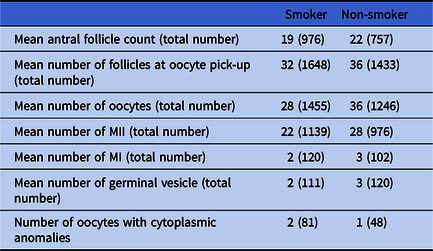
In total, 56 donors underwent COS cycles. None of these donors had any chronic diseases. Of these, 35 were smokers. The mean age of both smokers and non-smokers was 25 years. Forty nine per cent (17/35) of smokers had a university degree and 23% (8/35) had a high school degree. The mean BMI was 22. Mean recombinant FSH dose administered to the smokers was 2713 IU, with a mean cycle length of 10. Total AFC was 976 with a mean AFC of 19 (±9), and included 1648 follicles with mean of 32 at the time of OPU for the smokers.
In the non-smokers group, 52% (11/21) had a university degree and 24% (5/21) had a high school degree. The non-smokers had a mean BMI of 21. In this group, the donors were administrated a mean of 2640 IU recombinant FSH in 10 days. In total, 757 AFC with the mean of 22, and 1433 follicles with 36 mean were collected at the time of OPU (Table 1).
Summary of oocyte details

In total, 1139 mature metaphase II (MII) oocytes with a mean of 22 MII oocytes and 120 metaphase I (MI) with a mean of two MI oocytes were collected from smokers. Whereas 976 MII oocytes in total with a mean of 28 MII oocytes and 102 MI oocytes in total with a mean of three MI were obtained from the non-smokers (P > 0.05). Also, 81 oocytes in total with cytoplasmic anomalies were obtained from the smokers and 48 oocytes in total from the non-smokers (P < 0.05; Table 1).
Discussion
Infertility is the major issue in reproductive medicine. For a healthy live birth, successful oogenesis and spermatogenesis are crucial. Many factors are involved in the maturation of oocytes and therefore it is difficult to find the optimum conditions to maintain the perfect environment during oogenesis. Gamete donation programmes have gained importance in recent years, especially after improvements in cryopreservation techniques. Cigarette smoking is one of the most common life-style factors that may have adverse effects on IVF outcomes. This study investigated the effects of cigarette smoke on the development of oocytes obtained from healthy and young oocyte donors. Only donor oocytes were included in the study to exclude the other potential aetiologies of infertility at the subjects.
To date, many studies have investigated cigarette smoking influence on reproduction. However, the data are controversial. Some studies have shown that cigarette smoke contents, including nicotine, cotinine and cadmium, affect the development of oocytes. Cadmium was detected in oocytes obtained from smokers. Furthermore, cigarette smoke contents, such as benzoapyrene, have also been detected in follicular fluid of women undergoing IVF who were both smokers and non-smokers, with higher levels detected in smoker’s samples. It can be deduced from all these data that cigarette smoking affectsfollicle growth (Budani and Tiboni, Reference Budani and Tiboni2017). Cadmium, nicotine, cotinine and anabasine were shown to suppress cumulus expansion with lower progesterone production (Vrsanska et al., Reference Vrsanska, Nagyova, Miynarcikova, Fickova and Kolena2003). Additionally, steroidogenesis has also been shown to be affected by cigarette smoking (Dechanet et al., Reference Dechanet, Anahory, Daude, Quantin, Reyftmann and Hamamah2011; Soldin et al., Reference Soldin, Makamb, Soldin and O’Mara2011). Cigarette smoke has been shown to lead to the production of smaller size oocytes with lower numbers of granulosa cells (Paixao et al., Reference Paixao, Gaspar-Reis, Gonzalez, Santos, Santana, Santos, Spritzer and Nascimento-Saba2012). Additionally, thicker zona pellucida (Shiloh et al., Reference Shiloh, LahavBaratz, Koifman, Ishai, Bidder and Weiner-Meganzi2004; Jennings et al., Reference Jennings, Merriman, Beckett, Hansbro and Jones2011), higher perivitelline space, small-sized polar bodies, aberrant shapes with rough surfaces have also been reported in mice (Mai et al., Reference Mai, Lei, Yu, Du and Liu2014). Furthermore, both oocyte maturation and ovulation rate have been shown to be altered (Mailhes et al., Reference Mailhes, Young, Caldito and London2000). Exposure to cigarette smoke condensate (CSC) and cadmium led to lower rates of cleavage, higher production of reactive oxygen species, shortened telomeres, higher chromosomal abnormalities and apoptosis (Huang et al., Reference Huang, Okuka, McLean, Keefe and Liu2010). Furthermore, female smoker mice had offspring with differently sized ovaries, and lower numbers of primordial and primary follicles with low MII oocytes (Camlin et al., Reference Camlin, Sobinoff, Sutherland, Beckett, Jarnicki, Vanders, Hansbro, McLaughlin and Holt2016). Lower fecundity, including early menarche and early menopause, was observed in the offspring (Strohsnitter et al., Reference Strohsnitter, Hatch, Hyer, Troisi, Kaufman, Robboy, Palmer, Titus-Ernstoff, Anderson, Hoover and Noller2008). Decrease in ovarian reserve and lower AFC with low AMH levels have been reported previously (Freour et al., Reference Freour, Masson, Dessolle, Allaoua, Dejoie and Mirallie2012). Furthermore, higher ROS levels were observed in follicular fluid that was associated with low oocyte quality (Das et al., Reference Das, Chattopadhyay, Ghosh, Goswami, Chakravarty and Chaudhury2006). Cytoplasmic anomalies, such as thicker zona pellucida, have been reported in oocytes obtained from female smokers and also in mouse models (Shiloh et al., Reference Shiloh, LahavBaratz, Koifman, Ishai, Bidder and Weiner-Meganzi2004; Jennings et al., Reference Jennings, Merriman, Beckett, Hansbro and Jones2011). Similar observations of cytoplasmic anomalies have also been observed in our study. Almost twice as many oocyte anomalies were present in smokers compared with non-smokers (P < 0.05). The results of this study showed that the numbers of MII stage oocytes collected were same in both groups. Hence pre-conception smoking did not seem to affect maturation of the oocytes. Previously published studies have also shown that the amount of cotinine (>10 ng/ml), the basal FSH level, E2 concentration, COS length, mean number of oocytes, fertilization and pregnancy rates did not show any variation between smokers and non-smokers (Fuentes et al., Reference Fuentes, Munoz, Barnhart, Arguello, Diaz and Pommer2010).
In conclusion, to date, many studies have investigated the effects of cigarette smoking on IVF outcome. However, there has been no solid conclusion reached. As this life-style factor can be modified, it is important to evaluate the effect of cigarette smoking on IVF outcome. In our study, cigarette smoking did not seem to affect the numbers of oocytes obtained from young females. However, significantly higher numbers of cytoplasmic anomalies were observed. Therefore, it is crucial to perform more studies with higher numbers of patients to elucidate these findings.
Financial support
This research received no specific grant from any funding agency, commercial or not-for-profit sectors.
Conflicts of interest
None.
Ethical approval
Ethical approval was granted by the ethics committee in Near East University (YDU/2019/71-839).