INTRODUCTION
Species-specific traits of trees control ecosystem dynamics, define the process of forest succession, and differences in traits are at the basis of temporal changes in forest structural characteristics (Guariguata et al. Reference GUARIGUATA, RHEINGANS and MONTAGNINI1995, Parrotta Reference PARROTTA1995, Powers et al. Reference POWERS, HAGGAR and FISHER1997). Monocultures permit the study of the impact of specific traits of individual tree species and their role in the successional development of secondary forests. In contrast, in a natural, more diverse, forest, the variation in successional changes cannot be directly attributed to the myriad of species’ traits. Species-specific traits of a dominant plant species, usually a fast-growing early-successional tree species, have proven to be important in the establishment of seedlings, driving forest succession (Cusack & Montagnini Reference CUSACK and MONTAGNINI2004, Guariguata et al. Reference GUARIGUATA, RHEINGANS and MONTAGNINI1995, Lugo Reference LUGO1997, Parrotta et al. Reference PARROTTA, KNOWLES and WUNDERLE1997).
Ochroma pyramidale is known as a very fast-growing pioneer tree species, with the lightest wood density produced in commercial plantations (0.17 g cm−3), with a fast turnover of some of the largest leaves among neotropical trees, able to create a thick leaf-litter biomass cover, and has a narrow, thin crown, and a short life cycle (15–20 y; Coley Reference COLEY1983, Dalling et al. Reference DALLING, LOVELOCK and HUBBELL1999, Francis Reference FRANCIS1991, Park & Cameron Reference PARK and CAMERON2008, Selaya et al. Reference SELAYA, OOMEN, NETTEN, WERGER and ANTEN2008). Early-successional tree species are typically characterized by bursts of accelerated growth, rapid early height and basal area growth (Aide et al. Reference AIDE, ZIMMERMAN, PASCARELLA, RIVERA and MARCANO-VEGA2001, Cusack & Montagnini Reference CUSACK and MONTAGNINI2004, Denslow & Guzman Reference DENSLOW and GUZMAN2000, Finegan Reference FINEGAN1996, Park & Cameron Reference PARK and CAMERON2008, Saldarriaga et al. Reference SALDARRIAGA, DARREL, THARP and UHL1988). The relative open crown in O. pyramidale forests allows some light to reach the understorey, and is expected to promote establishment and growth of tree seedlings (Poorter Reference POORTER1999, Whitmore Reference WHITMORE, Tomlinson and Zimmermann1978). However, the rapid leaf growth, leaf turnover and large leaf size (13 × 13 to 35 × 35 cm) of O. pyramidale creates a thick litter layer, which could impede seeds reaching the soil layer, thereby creating an obstacle for the colonization of early-successional plant species (Carson & Peterson Reference CARSON and PETERSON1990, Sayer Reference SAYER2006, Vázquez-Yanes & Orozco-Segovia Reference VÁZQUEZ-YANES and OROZCO-SEGOVIA1992). Larger seeds of late-successional tree species are probably favoured by the thick litter layer, as they have enough reserves to survive (Seiwa & Kikuzawa Reference SEIWA and KIKUZAWA1996, Tao et al. Reference TAO, XU and LI1987).
We evaluated the potential of this fast-growing early-successional tree species O. pyramidale to accelerate structural growth by comparing height, density and basal area of canopy trees in O. pyramidale dominated forests with diverse secondary forests and rain forests. Furthermore, we tested whether O. pyramidale is able to facilitate succession by comparing diversity and density of established seedlings (trees and shrubs), and basal area and density of tree seedlings of early- and late-successional species among forest types. Finally, we tested whether the leaf-litter thickness and canopy openness were correlated with the diversity and density of shrubs and tree seedlings of especially early and late-successional tree seedlings.
We hypothesized that: (1) the secondary forests dominated by O. pyramidale have similar canopy structural attributes (basal area, height and density) relative to rain forest; (2) Ochroma pyramidale forests have a lower density of early-successional tree seedlings and a higher density of late-successional tree seedlings compared with diverse forests; (3) the leaf-litter-layer thickness increases the density of late-successional trees, and (4) canopy openness is positively correlated with the density of early-successional tree seedlings.
METHODS
The study was carried out on the margin of Montes Azules Biosphere reserve, Chiapas, Mexico (16°46′08″N, 91°08′12″W) in the Mayan community named Lacanhá Chansayab, with an altitude of 350 m asl. The climate is humid and warm with a mean annual temperature of 25 °C and a mean annual precipitation > 2000 mm (INEGI 1988, Pennington & Sarukhán Reference PENNINGTON and SARUKHÁN2005). The farmers of this community manage the natural resources using a traditional slash-and-burn system (Nations & Nigh Reference Nations and Nigh1980). The predominant vegetation consists of evergreen rain forest with dominant species such as Dialium guianense, Brosimum alicastrum, Swietenia macrophylla, Ficus spp. and Spondias mombin (Miranda & Hernández X Reference MIRANDA and HERNÁNDEZ X1963). Ochroma pyramidale is often preferred by farmers in Lacanhá, and they sow these seeds in high densities starting several months before the initiation of the fallow period to facilitate their rapid establishment and dominance (Douterlungne et al. Reference DOUTERLUNGNE, LEVY-TACHER, GOLICHER and ROMÁN DAÑOBEYTIA2010).
Study sites
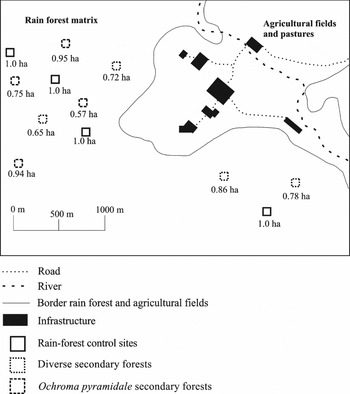
A total of 12 sites were selected (Figure 1), eight covered with secondary forest with an area of 0.5–1.0 ha, that were last cultivated 10–15 y previously, which were divided into four patches of secondary forest dominated by O. pyramidale (referred to as O. pyramidale forests), and four secondary forest patches without O. pyramidale (referred to as diverse forests). Four rain-forest sites were included as control sites.
Location and size (ha) of each site per forest type (Ochroma pyramidale secondary-forests, diverse secondary-forests and rain forests) in the community of Lacanhá, Chansayab, Chiapas, Mexico.

Data collection
Canopy trees were measured in six quadrats of 10 × 10 m per site in which dbh and height of all trees ≥ 5 cm dbh were measured and identified. Tree density, height and basal area were determined per species per site.
Vegetation in the understorey was measured in 2 × 2-m plots per site in which plant species < 5 cm dbh were categorized into trees and shrub seedlings. Tree and shrub seedling height and diameter at base were measured, and density and diversity (Shannon–Wiener H') were calculated per site. Tree individuals were distinguished from shrubs by their monopodial growth form (Pennington & Saruhkán Reference PENNINGTON and SARUKHÁN2005). Tree seedlings were classified as early- or late-successional species based on their tolerance to shade, seed size, growth rates and maximum height based on information gathered from previous studies in the area (Levy-Tacher Reference LEVY-TACHER2000, Levy-Tacher & Aguirre-Rivera Reference LEVY-TACHER and AGUIRRE-RIVERA2005, Román-Dañobeytia et al. Reference ROMÁN-DAÑOBEYTIA, LEVY-TACHER, ARONSON, RODRIGUES and CASTELLANOS-ALBORES2012).
We estimated the percentage of canopy openness at 15 random points for each site using a hemispherical crown densiometer (Forestry Suppliers, Inc, Jackson, MS, USA). The litter-layer thickness was measured by estimating the distance from the top mineral-soil layer until the top of the litter layer in five random positions with the use of a ruler, in each of the sites.
Data analysis
Plant species diversity (Shannon–Wiener H’ index) was calculated per site using EstimateS (Version 7.0.0: http://viceroy.eeb.uconn.edu/estimates). All variables were tested for normality using Kolmogorov–Smirnov normality tests. Non-normal data were normalized using logarithm transformations. Data were analysed for differences among forest types with an ANOVA, followed by Tukey post hoc tests and a Kruskal–Wallis test, followed by Bonferroni-corrected Mann–Whitney U post hoc tests for data that could not be transformed to follow a normal distribution. Analyses were conducted in SPSS 17 (SPSS, Inc). GLMs with backward elimination were used, by discarding the least significant predictor variables one by one until all remaining ones were significant (P < 0.05). Basal area, density and tree height of canopy trees, leaf litter, canopy openness and forest type were used as predictors. The response variables were tree and shrub diversity and density, and density of early- and late-successional tree seedlings in the understorey.
RESULTS
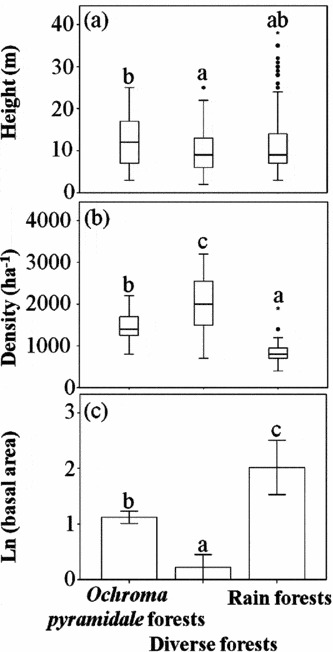
Tree height of canopy trees was lowest in diverse forests (mean ± SD: 9.8 ± 1.7 m), followed by rain forest (12.8 ± 2.9 m) and O. pyramidale forests (12.4 ± 1.8 m; χ 22,1076 = 24.3, P < 0.001; Figure 2a). Tree density of canopy trees was highest in diverse forests (1988 ± 685 ha−1), followed by O. pyramidale forests (1450 ± 339 ha−1) and lowest density in rain forests (875 ± 307 ha−1; χ 22,69 = 36.3, P < 0.001; Figure 2b). Basal area of canopy trees was similar between rain forest (14.2 ± 17.6 m2 ha−1) and O. pyramidale secondary forests (3.2 ± 0.9 m2 ha−1), and lowest in diverse forests (1.4 ± 0.8 m2 ha−1; ln-transformed; F 2,69 = 34.3, P < 0.001; Figure 2c). The basal area of O. pyramidale trees compromised 59% of the total basal area in O. pyramidale sites, while in diverse forests the tree species with the highest densities (Belotia mexicana, Heliocarpus appendiculatus and Astronium graveolens) did not surpass 25% of the total basal area per site.
Box plots and bar comparing tree height (a), tree density (ha−1) (b) and bars with natural logarithm of basal area (m2 ha−1) (c) from canopy trees (> 5 cm) measured in six quadrats of 10 × 10 m among Ochroma pyramidale secondary-forest, diverse secondary-forests and rain forests in the community of Lacanhá, Chiapas, Mexico. Box plots with the same letters are not significantly different; based on a Kruskal–Wallis and a post hoc Mann–Whitney U test with Bonferroni correction. Bars with the same letters are not significantly different; based on an ANOVA test and post hoc Tukey test. Black dots represent outliers, and asterisks extreme cases of outliers.

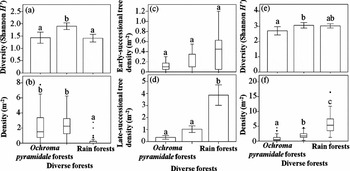
We recorded a total of 241 tree species in the understorey, of which 90 species occurred in O. pyramidale forests, 111 in diverse forests and 120 in rain forest. The tree seedling diversity was lowest in O. pyramidale secondary forest and highest in diverse forests (F 2,45 = 4.28, P = 0.02; Figure 3a). Total tree seedling density was also lowest in O. pyramidale secondary forests (χ22,237 = 148, P < 0.001; Figure 3b).
Box plots and bars that represent the comparison of understorey tree diversity (Shannon H’) (a), tree density (m−2) (b), early- (c) and late-successional tree density (m−2) (d), shrub diversity (Shannon H’) (e) and shrub density (m−2) (f) among Ochroma pyramidale secondary-forests, diverse secondary-forests and rain forests in the community of Lacanhá, Chiapas, Mexico, including individuals <5 cm in dbh from 20 2 × 2-m plots. Bars with equal letters are not significantly different; based on an ANOVA test and post hoc Tukey test. Box plots with equal letters are not significantly different; based on a Kruskal–Wallis and a post hoc Mann–Whitney U test with Bonferroni correction. Black dots represent outliers, and asterisks extreme cases of outliers.

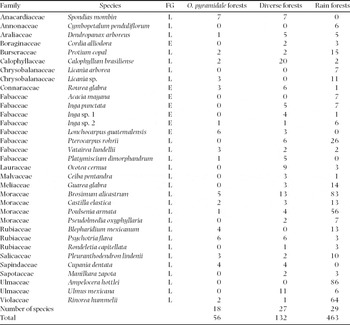
We were not able to classify all measured tree species in early- or late-successional species, and therefore only tree species with a total density of 10 or more individuals were considered in the classification, resulting in 79% (33 species) of the total species richness (Appendix 1). The density of early-successional tree seedlings in the understorey was lowest in O. pyramidale forests (Appendix 1), but not significantly different from the other two forest types (χ 22,45 = 5.17, P = 0.075; Figure 3c). The density of late-successional tree seedlings was highest in the rain forest, and similar between O. pyramidale and diverse forests (F 2,45 = 46.3, P < 0.001; Figure 3d). The basal area of early-successional tree seedlings (χ 22,45 = 2.41, P = 0.300) and late-successional tree seedlings (χ22,45 = 5.20, P = 0.074) was similar in all three forest types. The diversity of shrubs was highest in diverse forests (F 2,45 = 11.1, P < 0.001; Figure 3e) and lowest in rain forest and O. pyramidale forests. The density of shrubs was highest in rain forest, and lowest in O. pyramidale forests (χ22,237 = 119, P < 0.001; Figure 3f).
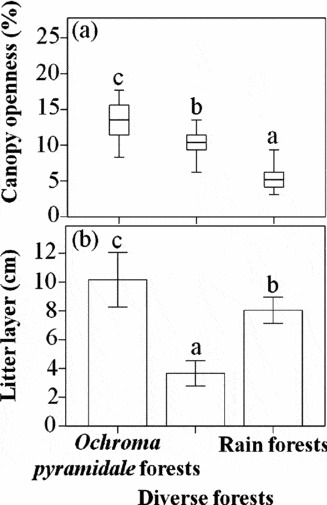
Canopy openness was lowest in rain forests (5.3% ± 1.2%), followed by diverse forests (10.2% ± 1.8%), with highest values in O. pyramidale forests (mean 13.5% ± 2.6%; χ22,178 = 135, P < 0.001; Figure 4a). The litter layer was thickest in O. pyramidale forests (10.2 ± 4.0 cm), followed by rain forests (8.0 ± 2.0 cm), with lowest thickness (3.7 ± 1.9 cm) reported from diverse forests (χ22,178 = 27.9, P < 0.001; Figure 4b).
Box plots and bars that represent the comparison of canopy openness (%) (a), measured at 15 random points for each site using a hemispherical crown densitometer and litter layer thickness (cm) (b), measured by estimating the distance from the top soil layer until the top of the litter layer in five random positions with the use of a ruler and among Ochroma pyramidale secondary-forests, diverse secondary-forests and rain forests, in the community of Lacanhá, Chiapas, Mexico. Bars with equal letters are not significantly different; based on an ANOVA test and post hoc Tukey test. Box plots with equal letters are not significantly different; based on a Kruskal–Wallis and a post hoc Mann–Whitney U test with Bonferroni correction.

The diversity of both tree seedlings and shrubs in the understorey could not be explained by any of the predictor variables. Tree (F 1,11 = 66.9, R2 = 0.87, P < 0.001) density in the understorey decreased with canopy openness and shrub density (F 1,11 = 11.3, R2 = 0.53, P = 0.007) increased with increasing canopy openness. The density of late-successional tree seedlings (F 1,11 = 79.1, R2 = 0.89, P < 0.001) increased with decreasing canopy openness. Early-successional tree seedling density and basal area, as well as late-successional tree seedling basal area in the understorey were not correlated to any of the predictor variables.
DISCUSSION
Our results show that forests with O. pyramidale as the dominant tree present higher basal area and height of canopy trees, compared with diverse forests. Density of canopy trees was lowest in rain forests, but a lower density of canopy trees was observed in O. pyramidale forests than in diverse forests. The vegetation in the understorey had a lower tree density, tree diversity and shrub diversity in O. pyramidale forests than in diverse forests. Canopy openness proved an important variable in explaining the density of shrubs and tree seedlings in the understorey as well as late-successional tree seedling density. Height, density and basal area measurements of canopy trees in O. pyramidale forests were different from the values reported in rain forests but differences were smaller between rain forest and O. pyramidale than between rain forest and diverse forests, implying a structural acceleration of trees in the canopy of O. pyramidale forests. The sowing of O. pyramidale seeds before the fallow period results in high light competition between recruited individuals, stimulating vertical growth. Similar management strategies have been used as an inexpensive and effective method for restoring degraded areas dominated by the invasive fern Pteridium aquilinum (Douterlungne et al. Reference DOUTERLUNGNE, LEVY-TACHER, GOLICHER and ROMÁN DAÑOBEYTIA2010) or to compensate for high predation risks and to improve growth form in monoculture plantations (Chapman & Chapman Reference CHAPMAN and CHAPMAN1999). The weeding of undesired plant species before the end of the cultivation period allows O. pyramidale individuals a head start on other plant species, decreasing total tree density and ensuring a dominance of O. pyramidale in the canopy (Douterlungne et al. Reference DOUTERLUNGNE, LEVY-TACHER, GOLICHER and ROMÁN DAÑOBEYTIA2010). The high density, rapid tree growth and closed canopy cover created by the large leaves, during initial early stages of growth of O. pyramidale, increases opportunities to compete among other plants, even out-shading the invasive fern Pteridium aquilinum (Douterlungne et al. Reference DOUTERLUNGNE, LEVY-TACHER, GOLICHER and ROMÁN DAÑOBEYTIA2010). Vertical growth is increased due to crown competition between O. pyramidale individuals, while stem diameter growth is developed after optimal height is reached, and does not necessarily decline with tree density due to accelerated growth of surviving trees (Laurance et al. Reference LAURANCE, OLIVEIRA, LAURANCE, CONDIT, NASCIMENTO, SANCHEZ-THORIN, LOVEJOY, ANDRADE, D'angelo, RIBEIRO and DICK2004). The dominance of O. pyramidale permits the advanced basal area and height of trees in secondary forest, which could facilitate the restoration process, creating a higher basal area as well as an average height, but due to its fast leaf turnover, also increases the soil organic matter accumulation (Diemont et al. Reference DIEMONT, MARTIN, LEVY-TACHER, NIGH, RAMIREZ LOPEZ and GOLICHER2006, Douterlungne et al. Reference DOUTERLUNGNE, LEVY-TACHER, GOLICHER and ROMÁN DAÑOBEYTIA2010, Levy-Tacher & Golicher Reference LEVY-TACHER and GOLICHER2004), and a structural barrier for seedling establishment.
Forests dominated by O. pyramidale have a lower overall density of seedlings in the understorey layer. The lower tree density in the canopy as well as lower total density of tree seedlings facilitates the removal of the vegetation before the cultivation period after 5 y of fallow period, with little effort to clear the area for another agricultural cycle, especially because O. pyramidale individuals have a relatively soft wood density (0.16 g cm−3; Byrne & Nagle Reference BYRNE and NAGLE1997) compared with other early successional tree species such as Cecropia spp. (0.30 g cm−3) or Lonchocarpus spp. (0.69 g cm−3; Fearnside Reference FEARNSIDE1997). A lower tree density in O. pyramidale forests could increase occupation of biological space and therefore positively affect seedling establishment (Ross & Harper Reference ROSS and HARPER1972), however, we expected that leaf-litter thickness could play an important role in reducing seedling establishment and form a barrier for emerging seedlings (Carson & Peterson Reference CARSON and PETERSON1990, Vázquez-Yanes & Orozco-Segovia Reference VÁZQUEZ-YANES and OROZCO-SEGOVIA1992). In contrast, leaf litter-layer thickness was not correlated with density of early- or late-successional tree seedlings in the understorey, and hence, does not seem to function as a barrier for seedling growth. However, early-successional tree seedlings only contributed 8.5% of the total tree seedling density, implying that seedling establishment for early-successional tree species was relatively low. It was probably due to this low density that we did not find a relation between the density of early-successional tree seedlings and litter layer thickness in these secondary forests of 10–15 y of age, where canopy trees are slowly replaced by mid- to late-successional tree species (Finegan Reference FINEGAN1996). Neither did we find a relation between leaf-litter thickness and late-successional tree seedling density; canopy openness was a better predictor in explaining their density.
While canopy openness was considerably higher in O. pyramidale forests, which could negatively affect late-successional tree seedling density in the understorey (Molofsky & Fischer Reference Molofsky and Fischer1993), also favouring the establishment of early-successional species, the density of both late- and early-successional tree seedlings was similar between the two secondary forest types.
Guariguata et al. (Reference GUARIGUATA, RHEINGANS and MONTAGNINI1995) studied a tree monoculture plantation (Jacaranda copaia) with high canopy openness in comparison to other tree species. They reported a higher understorey shrub density in areas with higher canopy openness, similar to our results, where O. pyramidale forests were associated with a higher shrub density. The higher density of shrubs in the understorey could attract a larger diversity and abundance of bats and birds which are known for their preference of fruits from shrubs (Galindo-González et al. Reference GALINDO-GONZÁLEZ, GUEVARA and SOSA2000). This indicates the importance of the species-specific functional traits of canopy trees, which can influence seed dispersers and hence the establishment of certain plant species (Powers et al. Reference POWERS, HAGGAR and FISHER1997). Tree species that have a thin crown can be important for the initial stages of succession, creating an ideal environment for light-demanding plant species in the understorey, and in turn, provide shade for the establishment of mid- to late-successional tree species (Parrotta Reference PARROTTA1995, Powers et al. Reference POWERS, HAGGAR and FISHER1997). Even though late-successional tree density in the understorey was similar between secondary forest types, the low density of overall plant species in the understorey, as found in this study, is unlikely to cast sufficient shade to favour the establishment of mid- to late-successional tree species. Moreover, the thin crown of O. pyramidale, could negatively affect establishment and growth of these mid- to late-successional tree species over time. We therefore recommend monitoring establishment and growth of late-successional tree species in both secondary forest types, to be able to understand the consequences of species-specific traits of canopy trees on secondary forest succession.
Due to its fast growth O. pyramidale can enhance growth of secondary forest in terms of structural attributes towards late-successional stage forest, and has the capacity to suppress overall seedling establishment. Density of late-successional trees was similar between O. pyramidale and diverse forests, but our sites were partly encompassed by rain forest, which can function as seed sources for late-successional tree species. In a study where seed sources were limited, a fast-growing tree species facilitated native tree species recruitment (Otsamo Reference OTSAMO2000). We therefore hypothesize that O. pyramidale can facilitate late-successional seedling establishment and stimulate structural growth in degraded areas with low seed source availability, but this should be tested further in the future.
ACKNOWLEDGEMENTS
This research was funded by Etnobiología para la Conservación A.C. and by a doctoral scholarship awarded to the first author by CONACyT-Mexico (Reg. 239503). We are grateful to M. Castellano and E. Chankin for allowing us to work on their lands. Furthermore, we would like to thank J. Chankin, A. Chankin, C. Peñaloza Guerrero, R. van Toor, V. Hommersen, M. Wulms and A. Sanchez for their help in the fieldwork. We would also like to thank Dr L. B. Vázquez for useful comments during the writing of the manuscript.
Density (m−2) of tree species and family per early- (E) or late-successional species (L) in the understorey (< 5 cm dbh) of Ochroma pyramidale secondary-forests, diverse secondary-forests and rain forests, in the community of Lacanhá, Chiapas, Mexico. Species nomenclature follows Miranda & Hernández X (Reference MIRANDA and HERNÁNDEZ X1963) and Pennington & Sarukhán (Reference PENNINGTON and SARUKHÁN2005).