Introduction
As Robert Jervis noted, when a good idea comes along, we tend to expand, extend and apply it widely, without considering its problems and limitations.Footnote 1 The security dilemma is one of those good ideas in International Relations (IR) theory.Footnote 2 Not surprisingly, many have expanded, extended, and applied it to ‘address many of the most important questions of International Relations theory and security policy’.Footnote 3 Indeed, the security dilemma, while often regarded as a concept within defensive realism, has proven to be so irresistible that it has been taken up by most, if not all, non-realism paradigms. Many proponents of non-realism paradigms have argued that their prescriptions – be it building international institutions, democratisations, or reshaping states' identities, can help bring peace and cooperation partly because those prescriptions can alleviate the security dilemma.Footnote 4
The eruption of ethnic tension and then conflict within the former Soviet Union after the collapse of the Soviet Union and the violent disintegration of the former Yugoslavia Federation brought ethnic conflict to the front page, even though ethnic conflict has been with us for centuries, if not millenniums.Footnote 5 The collapse of central authority and the emergence of de facto anarchy in those places also provide IR scholars with the justification for applying the security dilemma to ethnic conflict, because the security dilemma requires a (de facto) anarchical environment to operate. This sizable literature on the security dilemma in ethnic conflict is a result of these two developments. Along the way, the security dilemma has become a prominent tool for understanding ethnic conflict, and some pundits have prescribed specific solutions for resolving ethnic conflict based on their understanding of ethnic conflict by applying the security dilemma.Footnote 6
This article critically examines this literature on the security dilemma in ethnic conflict.Footnote 7 I first show that many attempts of applying the security dilemma to understand ethnic conflict have been based on an imprecise and often mistaken understanding of the concept. As a result, the literature on the security dilemma in ethnic conflict, despite shedding some light on the dynamics of ethnic conflict, has also obscured some fundamental facts about ethnic conflict.
I then show that the security dilemma can be applied to ethnic conflict, provided our application is grounded upon a sound understanding of the concept. Understood correctly, the security dilemma theory (model) and the broader spiral model constitute a dynamic, versatile, and powerful theory of state or group interaction that captures some general dynamics leading to the outbreak of war, including ethnic conflict.Footnote 8 As such, the security dilemma theory and the broader spiral model can serve as part of the foundation of a dynamic and integrative theory of ethnic conflict (and cooperation). Such a theory will be able to accommodate many factors and integrate many diverse understandings of ethnic conflict from realism, social psychological approach, social constructivism, the Copenhagen school, and the ‘rational choice approach’.
Getting the security dilemma in ethnic conflict right is of not only academic value but also policy relevance. Theory-wise, because the security dilemma centres on states' uncertainty over each other's intentions (see below) and how to cope with the uncertainty over others' intentions and the fear derived from it is a central question in international politics,Footnote 9 getting the security dilemma in ethnic conflict right connects the discussion with some of the key debates in international politics. Policy-wise, gauging the intentions of the other side (and thus getting the nature of a spiralling conflict right) is crucial for formulating one's policy toward the other side, and gauging the intentions of both sides right is crucial for formulating sound policy for mediation and intervention.Footnote 10
The rest of the article is constructed as follows. Section 1 summarises a more rigorously reformulation of the security dilemma developed elsewhere.Footnote 11 Section 2 and section 3 critically examine the expansionist and the stripping-down misapplications of the concept. Section 4 demonstrates the value of the security dilemma theory for constructing dynamic and integrative theory of ethnic conflict and points to the possibility of such a theory. A brief conclusion follows.
1. The security dilemma reformulated
By critically examining and building upon the original expositions of the security dilemma by Butterfield, Herz, and Jervis,Footnote 12 I have arrived at a more rigorous (re-)formulation of the security dilemma, which I call it the BHJ formulation after its three founding figures. As I elaborate in detail elsewhere, the BHJ formulation, when coupled with an explicit differentiation of the security dilemma (as a phenomenon or a theory/model) from a spiral (again, as phenomenon or a model), is not only more rigorous but also more versatile. The BHJ formulation clarifies much confusion in existing literature while capturing and integrating many factors/dynamics and insights into a coherent theory of war and peace via interaction between states or groups.Footnote 13 This section briefly summarises this reformulation and some of its most critical implications that are most relevant for the discussion follow.
The BHJ formulation has eight major aspects: (1) The ultimate source of the security dilemma is the anarchic nature of international politics.Footnote 14 (2) Under anarchy, states cannot be certain about each other's present and future intentions, partly because intentions can change. As a result, states tend to fear each other (that is, the other side may be a predator).Footnote 15 (3) The security dilemma is unintentional in origin: only between two states that merely want security without intending to threaten the other – that is, both are benign or defensive realist states – can a genuine security dilemma exist.Footnote 16 (4) Due to the uncertainty about each other's intentions (hereafter, uncertainty) and fear, states resort to the accumulation of power or capabilities as a means of defence, and these capabilities inevitably contain some offensive capabilities; (5) the dynamics of the security dilemma is self-reinforcing and often leads to (unintended and bad) spiral-like situations, such as the worsening of relationships, arms race, and war; (6) the dynamics of the security dilemma tends to make some measures for increasing security such as accumulating unnecessary offensive capabilities self-defeating: more power but less security;Footnote 17 (7) the vicious cycle derived from the security dilemma can lead to tragic results, such as unnecessary or avoidable wars and, (8) the severity of the security dilemma can be regulated by both physical factors (for example, geography, asymmetric distribution of power) and social psychological factors (for example, ethnocentrism, nationalism, worst-case mentality).
Among the eight aspects, three aspects are essential: anarchy (which leads to uncertainty, fear, and the need for self-help for survival or security), lack of malign intention on both sides, and some accumulation of power (including offensive capabilities). In contrast, other aspects are either consequences or regulators of the security dilemma, and they are neither sufficient nor necessary for the rise and continuation of the security dilemma. The three essential aspects are what make a situation a genuine security dilemma, and other aspects cannot make a situation a genuine security dilemma, however powerfully they may operate, if the three essential aspects do not apply to the situation.
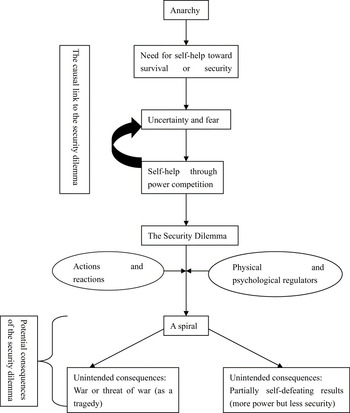
With this more rigorous definition, it becomes evident that the complete causal link from anarchy to the security dilemma and then to war is rather lengthy and by no means straightforward, and it can be captured as follows: Anarchy generates uncertainty; uncertainty leads to fear; fear then leads to power competition; power competition activates the (dormant) security dilemma; and the activated security dilemma leads to war through a spiral (see Figure 1).
The causal link from security dilemma and war.

Several immediate implications of the more rigorous reformulation should be stressed.
First, the upper part of Figure 1 speaks about the fundamental and proximate causes of the security dilemma, whereas the lower part of Figure 1 speaks about the potential outcomes that can be produced by a security dilemma, and these two parts must be understood separately. Although the security dilemma may produce certain types of outcome, not all those types of outcome are produced by a security dilemma. Thus, while the security dilemma can produce unintended and self-defeating results, not all such results are produced by a security dilemma.Footnote 18 Likewise, while the security dilemma can produce (bad) spiral-like situations (for example, a deterioration in relations), not all spirals are caused by a security dilemma.Footnote 19 Finally and most critically, while the security dilemma can potentially lead to war, not all wars are caused by a security dilemma.Footnote 20
Second, we should clearly differentiate the causal factors that give birth to the security dilemma (anarchy, uncertainty and fear, and some accumulation of power) from the physical and psychological regulators of the security dilemma. Although regulators regulate the severity of the security dilemma, they can neither give birth to, nor are they necessary for maintaining, the security dilemma (Kydd, 1997a; see also Glaser, 1992 and Jervis, 1976). Thus, just because some regulators (for example, misperceptions) are exacerbating a (spiral-like) situation, it does not mean that the situation is a security dilemma. By the same token, the absence of certain regulators does not mean that the situation is not a security dilemma either.
Third, we should clearly differentiate the causal factors that give birth to the security dilemma from the potential intermediary outcomes that are induced by the security dilemma but at the same time can come back to reinforce the security dilemma through a feedback mechanism. For instance, although an arms race can reinforce a security dilemma, the arms race is a possible outcome, not a source, of the security dilemma. Likewise, while some state behaviours can generate uncertainty and fear in other states, which can then come back to exacerbate the security dilemma, this uncertainty and fear should not be confused with the original uncertainty and fear dictated by anarchy. Feedbacks are not cause.
Fourth and most critically, all three essential aspects (anarchy, lack of malign intention, and some accumulation of power) are absolutely necessary for a genuine security dilemma to exist. Neglecting any one of the fundamental aspects will inevitably lead to error. One cannot identify a particular situation as a security dilemma just because that situation possesses several unessential aspects of the security dilemma: A situation is a security dilemma only if it has all three essential aspects of the security dilemma. If one is allowed to label a situation that has some of the unessential aspects yet lacks the essential aspects of a security dilemma as a security dilemma, then the security dilemma is ‘in danger of becoming a meaningless and ambiguous term associated with any deterioration in relations’.Footnote 21
A fifth point follows immediately from the fourth point. Because anarchy and some accumulation of power are usually, if not always, present, this leaves lack of malign intention as the most critical ingredient for identifying whether a situation is a genuine security dilemma.Footnote 22 When one or two sides in a situation is malign (that is, intentionally threatening), a situation is not a genuine security dilemma even if it has all other aspects of a security dilemma such as spiral and unintended consequences.
Sixth, the security dilemma is conditional, not universal. Because the security dilemma requires lack of malign intention to operate, between two states, whenever one or both states are intentionally threatening – whether the other side knows it or not – there is no real security dilemma between them.
Seventh, the security dilemma is structural, not perceptual or psychological, in origin – only a competitive self-help anarchy can give birth to the security dilemma.
Eighth, exactly because the security dilemma contains eight critical aspects, the security dilemma as a concept and a theory is both extremely inclusive and restrictive. The security dilemma can accommodate many situations and factors (for example, geography, hatred), but certain situations and factors simply do not belong to the security dilemma either as a concept or a theory of state/group interaction (for example, malign intentions).
Finally, it is useful and indeed necessary to differentiate the security dilemma (model) from the broader spiral (model). A spiral does not require lack of malign intentions on both sides to operate: a spiral is compatible with both benign and malign intentions. As such, a spiral is universal whereas a security dilemma is conditional. There is, however, a reversible and graduated continuum between a security dilemma and a spiral: A security dilemma can be transformed into a spiral when one or both sides become malignant (for example, one or two sides may become so frightened that they may decide that their security now requires them to pursue aggression).Footnote 23 As becomes clear below, many of the situations in existing literature on the security dilemma in ethnic conflict are better captured by the broader spiral model, rather than the more restrictive security dilemma model. Apparently, only when such a point of changing intentions from benign to malign is crossed, would a conflict actually break out.
II. The expansionist drive: three waves
Barry Posen brought the security dilemma into the studies of ethnic conflict. Posen's initial foray was then taken up by Stuart J. Kaufman and capped by Paul Roe. Armed with the BHJ formulation, this section critically examines these major works and shows that all three authors' application of the concept was based on misguided extension and expansions of the concept.
A. Barry Posen
Barry Posen advanced that ‘the collapse of imperial regimes [for example, the Soviet Union] can be profitably viewed as a problem of emerging anarchy’. As such, Posen argued that the security dilemma theory can be fruitfully applied to understand ethnic conflict under this emerging anarchy. He defined the security dilemma as follows: ‘States can trigger these reactions even if they have no expansionist inclinations. This is the security dilemma: what one does to enhance one's own security causes reactions that, in the end, can make one less secure.’ In his discussion, of the eight major aspects of the security dilemma, Posen paid attention to the following six: (1) anarchy (or de facto/emerging anarchy); (2) fear (implicitly due to the uncertainty about others' intentions); (3) lack of expansionist (or malign) intentions; (4) self-defeating result; (5) an action-reaction spiral that can drive two states to preventive and pre-emptive actions, and (6) the regulation of the security dilemma by indistinguishability of offense and defense weapons, by offense-defense balance, geography, and potential allies.Footnote 24 Most importantly, Posen did include the crucial ingredient – lack of malign intention – in his definition.
Yet, Posen contradicted himself almost immediately. He noted that there was a security dilemma between the Croats and the Serbs in Croatia even when ‘there were plenty of signals of malign intent [on both sides]’.Footnote 25 Posen thus implicitly asserted that the security dilemma is compatible with malign intentions. Such a stand, of course, is incompatible with his definition of the security dilemma.
B. Stuart J. Kaufman
After Posen's initial foray, Stuart J. Kaufman brought the security dilemma firmly into the field of ethnic conflict in three consecutive articles.Footnote 26
In his first article, Kaufman did not define the security dilemma, yet his misunderstandings of the security dilemma were already evident. Kaufman repeatedly asserted: ‘elite-led violence […] created a security dilemma’, and ‘this rise in violent chauvinism creates a security dilemma spiral’.Footnote 27 Yet, according to the BHJ formulation, violent chauvinism can only exacerbate a security dilemma. Meanwhile, (sporadic) elite-led violence either turns an already existing security dilemma into a security-threat spiral or is the result of a security dilemma or spiral (see below).
Kaufman's misunderstanding of Jack Snyder's structural security dilemma was also obvious. Kaufman thought that Snyder defined a structural security dilemma as ‘a situation in which the security of each state requires the insecurity of others’.Footnote 28 As a matter of fact, however, Snyder defined the security dilemma – not just the structural security dilemma – as ‘a situation in which the security of each state requires the insecurity of others’.Footnote 29
In his two latter articles, Kaufman did define the security dilemma, giving two seemingly similar but actually quite different definitions of the security dilemma. Citing Jervis, Snyder, and Posen, Kaufmann defined the security dilemma as ‘a situation in which its [that is, a state's] attempts to increase its security threaten the security of its neighbour. When this occurs, the neighbour often takes counteravailing action to protect itself, whereupon the first state perceives a threat, and a spiral of escalating hostility results. The key point is that the conflict need not be the result of aggressive intent; it is the result of the structure of the situation, a structural security dilemma. The ultimate result is sometimes war.’Footnote 30
In contrast, retaining Posen and Snyder while discarding Jervis, Kaufman gave a very different definition in a later article. ‘A security dilemma requires that the fears of extinction be mutual – that actions taken by one side to avert extinction be seen by the other side as threatening extinction for themselves. A security dilemma also requires a de facto situation of anarchy and – if it is to lead to war – the military means to enable both sides to fight […] Each group's fear of extinction may then become justified, because its existence as a community may really be threatened by the goals of the other. If this point is reached, each group is driven to increasingly extreme measures – especially the creation and use of armed forces – to protect itself and coerce other groups. The result is a security dilemma: a situation in which one side to make itself more secure have the effect of making the other side less secure.’Footnote 31 Apparently, by the time of his third article, Kaufman only paid attention the following aspects of the security dilemma: (1) de facto or emerging anarchy; (2) fear; (3) the presence of military capabilities to hurt; (4) the spiral (action-reaction dynamics); (5) unintended consequences, and (6) the outcome (for example, war). Most importantly, while the definition in his second article includes lack of malign intentions on both sides, the definition in his third article discards this essential element. As a result, his application of the security dilemma became more questionable. Overall, Kaufman committed four errors that reinforce each other.
First, he disregarded the unintentional origin of the security dilemma. By repeatedly emphasising that a security dilemma is ‘created’, ‘caused’, or ‘provoked’ by aggressive intentions and behaviours in numerous places, Kaufmann explicitly regarded the security dilemma as an intentional, rather than an unintentional, enterprise.Footnote 32 When discussing elite-led ethnic conflict, Kaufman claimed, ‘The security dilemma is not inherent in the situation, but is created by aggressive elites on one or both sides’, and ‘elite intentionally cause both mass hostility and a security dilemma’.Footnote 33 When discussing mass-led ethnic conflict, he similarly asserted: ‘Long standing ethnic hostility pushes elites to take increasingly extreme positions on ethnic issues. The resulting behavior creates a security dilemma.’Footnote 34 Furthermore, he maintained that ‘anarchy and the possibility of a security threat are not enough to create a security dilemma between communities which may have been at peace for decades’. Instead, an ethnic security dilemma fundamentally requires hostile intention to operate: ‘An ethnic security dilemma requires reciprocal fears of group extinction, and such fears do not arise unless hostile masses define their security in extreme ways, or unless outbidding elites emerge to make the pursuit of such goals into policy.’Footnote 35
Second, by repeatedly asserting that actual violence must precede the security dilemma in his theoretical elaborations and empirical cases, Kaufman implied that the causal link between the security dilemma and actual conflict is that the latter causes the former.Footnote 36 Such a formulation is diametrically opposite to the BHJ formulation, which explicitly maintains that it is the security dilemma that causes large-scale violence (that is, war), not the other way around, although ‘extreme measures’ and sporadic violence can exacerbate a security dilemma or an active spiral.
Third, Kaufman misunderstood the spiral dynamics of a security dilemma. Examining the case of the Dniestr region in Moldova, he claimed, ‘Eventually, the extremists organize militias and armies to launch violent provocations. If the other side responds in kind, a security dilemma spiral takes off, continuously fed by violent propaganda […] What drove nationalist extremists to violence was the resistance, first by the conservative government, and later by Russophones, to those measures (especially the language law) the nationalists considered necessary for their group's survival.’Footnote 37 In reality, the spiral had taken off long before the potential victim reacted: the spiral took off as soon as central authority collapsed and uncertainty and fear set in.
Fourth, Kaufman's discussion heavily relies on Jack Snyder's ‘structural security dilemma’ and ‘perceptual security dilemma’. Yet, Snyder's two concepts were also based on misunderstanding of the security dilemma.Footnote 38
Exploring different explanations for aggressive behaviour and differentiating states into security-seekers and expansion/power-seekers, Snyder identified four possible explanations: the structural security dilemma, the perceptual security dilemma, imperialist's (security) dilemma, and deadlock.Footnote 39 Apparently, his ‘structural security dilemma’ corresponds to a security dilemma with only physical modifiers, and his ‘perceptual security dilemma’ corresponds to a security dilemma with both physical and perceptual/psychological modifiers. Because the two sides in the ‘structural security dilemma’ and the ‘perceptual security dilemma’ are benign states, both labels depict genuine security dilemmas. Nowhere did Snyder suggest that ‘structural security dilemma’ and ‘perceptual security dilemma’ are situations in which one or both sides are malign states (that is, they seek to harm each other intentionally), although his definition of the security dilemma does not rule out the possibility of malign intentions. Nonetheless, Snyder was mistaken to take two types of regulator of the security dilemma – physical/material and perceptual/psychological – as two types of security dilemma. ‘Structural’ and ‘perceptual’ security dilemmas are about two types of regulators rather than two types of security dilemma.Footnote 40
Kaufman went further, and bending Snyder's elaboration to fit into his pre-conceived picture of the security dilemma in ethnic conflict. As a result, Kaufman's ‘perceptual security dilemma’ and ‘structural security dilemma’ has almost nothing to do with Snyder's original formulation, not to mention the BHJ formulation.
Kaufman contended that the inter-ethnic security dilemma at the beginning is close to a perceptual security dilemma.Footnote 41 More importantly, he believed that a perceptual security dilemma is false and thus less dangerous whereas a structural security dilemma is genuine and thus more dangerous, and that the value of the former is that it can be transformed into the latter. ‘The real potency of perceptual security dilemma, in ethnic conflict as in international conflict, is that they can create real, structural, security dilemma […] Thus, the start of the violence was a perceptual security dilemma [and …] the result was a structural security dilemma’.Footnote 42 So how does a perceptual security dilemma get transformed into a structural one? The cause, according to Kaufman, is extreme definition of security, violence, and actual conflicts.Footnote 43
For Kaufman, the causal link from anarchy to ethnic conflict thus runs like this: from hostile elite, to a perceptual security dilemma, to hostilities/extremist policies, to real violence/conflicts, to a structural security dilemma (transformed from a perceptual security dilemma by mass hostility/violence or elite out-bidding), and finally to full-blown war.Footnote 44 He misunderstood the security dilemma (plus Jack Snyder's ill-informed extension of the concept). Indeed, he explicitly rejected the BHJ formulation of the concept: ‘the neorealist concept of a security dilemma cannot be mechanistically applied to ethnic conflict […]’.Footnote 45Not surprisingly, his application of the security dilemma has consistently departed from the BHJ formulation of the concept.
C. Paul Roe
Paul Roe's understanding about the security dilemma can be clearly divided into two phases. He was heading toward the right direction in the first but then went astray in the second.Footnote 46
Roe (1999, 2000). In his first two articles on the security dilemma in ethnic conflict, Roe mentioned the following six aspects of the security dilemma in various places. These six aspects are: (1) unintended consequences (that is, tragedy); (2) unintentionality; (3) uncertainty (about states' intentions); (4) regulators of the security dilemma (that is, the indistinguishability of offense and defense weapons and the offense-defense balance); (5) emerging or de facto anarchy, and 6) action-reaction dynamic (spiral) and the perceived need to pre-empt.Footnote 47 Most importantly, he correctly recognised the question of intentionality is central to the security dilemma.Footnote 48 As a result, Roe was able to correctly recognise that Posen, Kaufman, and Erik Melander before him all employed a ‘wide’ – or more precisely, incorrect – definition of the security dilemma, most evidently by omitting the essential element of unintentionality.Footnote 49
Despite making many valid points, however, Roe's understanding of the security dilemma was imprecise and incomplete. He committed three major errors, in addition to his failure to note Kaufman's skewed understanding of Snyder's perceptual and structural security dilemma (see above) and the minor error of not stating more explicitly that only some fear of others (that is, they may be malignant) may be ‘unfounded’.Footnote 50
First, following Wheeler and Booth,Footnote 51 Roe asserted that the indistinguishability of offense and defense is a ‘core definition [of the security dilemma]’.Footnote 52 Yet, the indistinguishability of offense and defense is not essential for a security dilemma to operate: it merely regulates the security dilemma. Moreover, even if offense and defense are completely distinguishable, a security dilemma can still operate.Footnote 53
Second, Roe asserted that a worst-case assumption is necessary for driving the action-reaction spiral in a security dilemma.Footnote 54 Yet, the security dilemma dynamics does not need the worst-case mentality to operate: all it needs is some fear. The worst-case mentality is an extreme form of fear, and it is perhaps only necessary for eventually turning a security dilemma into an actual conflict.Footnote 55
Finally, Roe repeatedly cites Erik Melander's mistaken formulation that the need to pre-empt is a specific precondition of any security dilemma.Footnote 56 Roe failed to realise that the attraction of pre-emptive war is the result – rather than a precondition – of a security dilemma spiral.Footnote 57
Roe (2001, 2004). In 2001, Roe abruptly changed his mind, claiming that the ‘tight formulation [that is, the BHJ formulation] is not the best approach’ and that he ‘cannot know what is the correct definition of a security dilemma’.Footnote 58 He now committed three more fundamental errors, in addition to the three major errors he committed earlier (see above).
First, Roe now de-emphasised the unintentional origin of the security dilemma, concurring with Glaser that greedy states can go with the security dilemma – a position that Roe explicitly rejected earlier. Roe now claimed that ‘the debate over greedy and non-greedy states might be considered a false one’.Footnote 59
Second, Roe now lifted ‘unintended consequences’ to a central position in the definition of a security dilemma and essentially equated it with unintentionality. Because even malign behaviours can induce unintended consequences,Footnote 60 however, unintended consequences per se do not indicate a lack of malign intentions. Moreover, ‘unintended consequences’ is the result, whereas un-intentionality the essential ingredient, of a security dilemma. As such, ‘unintended consequences’ and un-intentionality cannot be equivalent.
Third, Roe now replaced the problem of intentionality with Boulding's useful but under-specified dichotomy of real compatibility versus illusory compatibility as the central problem for identifying a situation as a security dilemma.Footnote 61 Roe wrote: ‘my categorization of the security dilemma rests not so much with benign/malign intentions but with compatible/incompatible security requirement’.Footnote 62 Unable to finding a solution for the central but difficult problem of determining states' intentions when it comes to determining whether a situation is a security dilemma, Roe chose to simply finesse the problem.Footnote 63
Worse, even on the issue of real versus illusory compatibility, Roe committed two errors. First, Roe ignored the limit of Boulding's dichotomy, noted by Jervis long ago.Footnote 64 Indeed, Boulding himself explicitly acknowledged the dichotomy's limit: ‘Even real incompatibilities are functions of national image rather than of physical facts and are therefore subject to change and control.’Footnote 65 Here, Boulding explicitly pointed out that security requirement has a subjective and an objective side.Footnote 66 Roe failed to grasp that this duality of security requirement makes illusory incompatibility unfit for replacing lack of malign intention as the essential ingredient of a security dilemma. For instance, the security dilemma may not apply in a situation of illusory incompatibility that is caused by one or both sides' intentionally defining their security interests in an expansive way and then pursuing their ill-informed goals even though their objective security interests are compatible. This combination of subjective incompatibility with objective compatibility is a situation of illusory incompatibility. Yet, it may not be a genuine security dilemma because the illusory incompatibility here is due to one or both sides intentionally defining and pursing their security interest in such an expansive way that one or both sides are already malignant.Footnote 67 Hence, the security dilemma applies to only a subset of situations with illusory incompatibility because illusory incompatibility can be caused by malign intentions. Equally important, subjective ‘illusory incompatibility’ (assuming objective compatibility) can also be the outcome of security dilemma dynamics. As such, illusory incompatibility cannot replace lack of malign intentions as the key factor for determining whether a situation is a security dilemma.Footnote 68
Second, Roe based much of his discussion on compatibility on the dichotomy of security-seekers versus power-seekers.Footnote 69 For Roe, the fundamental questions for identifying a situation as a security dilemma were: (1) whether two states' security requirement are compatible, and (2) whether the two states are ‘security-seeking’ yet still resort to countermeasures based on illusory incompatibility.
Roe believed that when two states have compatible security requirements, both must be benign toward each other and the ‘(tight) security dilemma’ applies.Footnote 70 In contrast, when two states have incompatible security requirements, both must be aggressive toward each other and the ‘(tight) security dilemma’ no longer applies. Essentially, Roe equates a state's definition of its security – which is goals/motives or preferences over outcomes – with its intentions or preferences over strategies.Footnote 71 Unfortunately, this practice has been long discredited (Powell, 1994; see also the discussion above). Moreover, Roe was never clear about whether he talked about the objective or the subjective side of security requirement.
Furthermore, the dichotomy of security-seeking versus power-seeking is misleading and inoperable. Every state under anarchy seeks both (absolute and relative) power and security. Moreover, because power and security do interact and power provides part of the foundation for security, ‘there is no possibility of drawing a sharp line between the will-to-live and the will-to-power’.Footnote 72 Consequently, it is difficult to operationalise the dichotomy of power-seeker versus security-seeker for labelling states.Footnote 73
Ominous outcomes
Because Roe committed many errors, his understanding of the security dilemma and application of the concept to ethnic conflicts had worsened into incoherency by 2004. The culmination of his errors is a scheme of differentiating three types of security dilemma: ‘tight security dilemma’, ‘regular security dilemma’, and ‘loose security dilemma’.Footnote 74 His scheme, however, is possible only by discarding the central problem of intentionality and replacing it with either security-seeking motive or illusory incompatibility whenever it suits. In his scheme, the ‘tight security dilemma’ is the only label that is consistent with the BHJ formulation because it depicts a situation between two benign states.Footnote 75
Citing Snyder,Footnote 76 Roe argued that a ‘regular security dilemma’ is ‘a situation in which each state believes that its security required the insecurity of others’.Footnote 77 Roe failed to recognise that his ‘regular security dilemma’ is either a false security dilemma or simply an outcome generated by the spiral of a security dilemma. If one or both sides come to believe that intentionally threatening the other side is the means toward its own security due to the spiral dynamics of a security dilemma, then the situation simply depicts an outcome generated by a security dilemma spiral. Yet, once one or both sides come to believe that intentionally threatening the other side is the means toward its own security, the situation is no longer a security dilemma, but a genuine security threat. Of course, if one or both sides believe that intentionally threatening the other side is the means toward its own security at the very beginning, then the situation is never a security dilemma.
Roe's ‘loose security dilemma’ depicts the situation between two malign states. Hence, for Roe, ‘in loose security dilemma […] it appears not to matter whether actors are security seekers or power seekers’.Footnote 78 Of course not: There are no security seekers there, if security seeker is to denote benign state. Obviously, this situation cannot possibly be a real security dilemma, as Roe correctly admitted before.Footnote 79
Overall, for Roe, the security dilemma is no longer necessarily a tragedy. Only his ‘tight security dilemma’ requires un-intentionality, thus constituting a true tragedy. In contrast, his ‘regular’ and ‘loose’ security dilemma does not require un-intentionality, thus no longer constituting true tragedy.
Roe's scheme of three types of security dilemma is the result of bending the original BHJ formulation beyond recognition. Not surprisingly, he ended up in having great difficulty in fitting the Croatian case into his supposedly more flexible typology. He could sustain his scheme only by dismissing evidences and interpretations that contradict his interpretations. Thus, despite citing Robert Haden and Haakan Wiberg, both of whom interpreted the Croats led by its President Franjo Tudjman as the aggressor versus ethnic Serbs inside Croatia, Roe rejected them without providing any justification.Footnote 80
As Roe noted, Section 1 of the new Draft Constitution of Croatia established the Republic of Croatia as the national state of the Croatian nation and the state of the members of other nations and minorities, and Article 12 of the Constitution also specified the Croatian language and alphabet of Croatia as the Croatia's official language and alphabet. Furthermore, Tudjman refused to renounce what happened at the Jasenovac concentration camp, where tens of thousands of Serbs were slaughtered by Croats in collaboration with Nazi Germany during World War II. Moreover, the Croats backed their words with deeds: ‘Dual-language road signs were town down even in Serb majority areas’. Finally, ‘numbers of Serbs were removed from the bureaucracies and the police and duly replaced with ethnic Croats.’Footnote 81 By any measure, the Croats were threatening the Serbs, not only symbolically but physically.
In light of these overwhelming evidences that the Croats were really aggressive, Roe wrote, ‘The regime in Zagreb (i.e., Tudjman's regime of Croatia) was arguably revisionist (power seeker) [that is, malign actor] in its general stance toward the maintenance of the Yugoslav Federation. Still, in the specific context of relations with the republic's ethnic Serbs, there is some weight of opinion to suggest that Tudjman was security seeking; he simply misjudged the reaction of the Krajina Serbs to Croatization, rather than deliberately attempting to suppress the Serb community.’Footnote 82 Roe even called the Croats' aggressions against the Serbs ‘pragmatic’!Footnote 83
Yet, if Croatiaztion that was intended to denigrate Serbs into second-class citizens can be considered as security-seeking, then the label of security-seeking no longer holds any useful meaning. After admitting that the defence for Tudjman as security seeking – that is, benign – is ‘difficult’, Roe refused to acknowledge that Croats led by Tudjman were really aggressive. As a result, Roe could not help sound apologetic for Tudjman: ‘Although perhaps security seeking, Tudjman's government was often erratic and at times sent contradictory signals to the Karjina Serbs.’Footnote 84
Summary: the array of errors
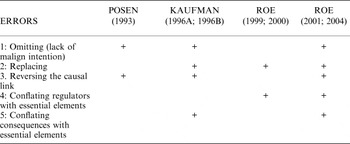
To summarise, Posen, Kaufman, and Roe's attempt to apply the security dilemma to the understanding of ethnic conflicts suffers from an expansionist mentality, and they committed several common mistakes (see Table 1 for a summary). Fundamentally, these authors erroneously believe that (almost) all wars are caused by the security dilemma because the security dilemma generates spiral and war is usually a result of an action-reaction spiral. Yet, the security dilemma applies to only a subset of wars and spirals.
Common errors toward the security dilemma

III. The ‘rational choice’ stripping-down
While the dominant trend in the literature has been to stretch the concept of security dilemma beyond recognition, there has also been a notable trend to strip down the security dilemma, especially to strip away the security dilemma of most of its physical and psychological regulators, by the ‘rational choice’ or ‘rationalist’ approach toward (ethnic/civil) war.Footnote 85 Essentially, the approach reduces the security dilemma to a minimalist calculation of uncertainty about capability and resolve (captured by ‘bargaining range’ in the game model) and a commitment problem (that is, states cannot promise not to cheat after a bargain is struck).Footnote 86
The effort to strip down the security dilemma was launched by James Fearon. After correctly noting that anarchy and security dilemma alone cannot cause wars,Footnote 87 Fearon then turned the problem of security dilemma and war into merely ‘the question of why the inability to make commitments should necessarily make war between rational states.’Footnote 88 Fearon committed three critical errors here.
First, Fearon (and other adherents of the ‘rational choice’ approach after him) failed to recognise is that this so-called commitment problem is simply a new label that conflates the problem of uncertainty about others' intentions with the problem of uncertainty over others' motivations,Footnote 89 although with a much reduced content. According to Fearon, the commitment problem is driven by the inherent incentives for actors to cheat even if a cooperative deal is struck. Yet, for the BHJ formulation, in addition to the possibility that actors will cheat in cooperation (which may or may not be caused by changed intentions), the problem of uncertainty about others' intentions is also driven by the possibility that states may have malign intentions and intentions can change. Then there is also the possibility of not reaching cooperation at all. Finally and perhaps most critically, fear that the other side will not keep its end of the bargain is an innate component of the commitment problem, and yet rational choice has no role for fear because it cannot model emotions.
Second, to make sure that war is now a commitment problem and intentions have no role in explaining war, Fearon simply assumed away the problem: ‘States have no private information and motivations [that is, intentions] never change; thus states understand each other's motivations perfectly.’Footnote 90 When motivations are assumed to be fixed while intentions are assumed away (or somewhat replaced by ‘the commitment problem’), the security dilemma largely disappears because the security dilemma critically depends on the possibility that states' intentions can change for the worse.
Third, while Fearon discussed the effect of objective offensive advantage – which is a material factor – on security dilemma and war, he ignored all of the (social) psychological regulators of the security dilemma (for example, fear, nationalism, ethnocentrism, and identity) as potential drivers of the security dilemma and war.
Overall, the rational choice approach treats the security dilemma as a problem of credible commitment but little else.Footnote 91 The security dilemma theory certainly accommodates the commitment problem (that is, incentives to cheat in cooperation) and private information that the ‘rational choice’ approach identifies, but it is much more. Foremost, the uncertainty over others' intentions as understood by the security dilemma theory includes far more dimensions than the ‘commitment problem’ as ‘rational choice’ approach identifies. Moreover, the security dilemma theory sees the severity of security dilemma as critically dependent on both physical/material and psychological regulators. The security dilemma accommodates physical factors that ‘rational choice’ approach can accommodate (for example, mixture of population, geography), but also psychological factors (for example, fear, memories of conflict history, group mobilisation rhetoric) that the ‘rational choice’ approach simply cannot model, thus denies. Indeed, without these psychological regulators of the security dilemma being part of the picture, it is hard to see how the security dilemma can ever drive states and groups to war.
The fundamental problem here seems to be that adherents of the ‘rational choice’ approach have been confused about whether their models are ‘useful fictions’ that uncover and illustrate some important dynamics of (ethnic) war or whether their models are ‘miracle makers’ that adequately capture the dynamics that links the security dilemma with war.Footnote 92
If the goal is the former, stripping down the security dilemma is justifiable because doing so makes (game) models tractable thus allowing models to uncover some important mechanisms behind the phenomenon. Indeed, such a stripping down of the security dilemma may be necessary: (game) models simply cannot deal with psychological regulator of the security dilemma (for example, fear and hatred), and cannot even deal with all the material regulator of the security dilemma at once. If the goal is to later, however, stripping down the security dilemma cannot be justified because doing so will assume away many important factors that independently or interactively drive states to war. Such an attempt to impose false reality upon reality can only lead to misleading conclusions.
Unfortunately, almost all adherents of ‘rational choice’ approach wanted to present their models as models that can adequately capture the general dynamics, if not the whole story, of ethnic conflicts (or war). As such, while their stripping down of the security dilemma fits with their hidden agenda of imposing the imperialism of ‘rational choice’ approach, the whole research programme has produced misleading understandings about the role of the security dilemma in ethnic war and war in general. Eventually, the ‘rational choice’ approach came to the position that there are no real fundamental differences between ethnic war and other forms of civil war that are based on ideology and class.Footnote 93 Ethnic conflict has disappeared as a separate category of conflict altogether!
IV. Toward a dynamic and integrative theory of ethnic conflict
The preceding discussion does not lead to the conclusion that the security dilemma cannot be fruitfully applied to understand ethnic conflict. Indeed, the exact opposite is true: The security dilemma can be fruitfully applied to understand ethnic conflict, provided the application is done properly – by strictly observing the original BHJ formulation of the concept. Below, I show that sticking to the BHJ formulation actually allows us to achieve a more rigorous understanding of the dynamics of ethnic conflict, thus paving the way toward a dynamic and integrative theory of ethnic conflict. I start by illustrating that the possible scenarios derived from a security dilemma-spiral model capture many real world cases. I then lay out a proto-general theory of ethnic conflict.
The security dilemma in ethnic conflict: four outcomes
Between two ethnic groups that used to live together peacefully but have an unhappy history of living together from time to time, the security dilemma emerges when central authority gradually or suddenly breaks down. Alternatively, the security dilemma can emerge when the central authority is captured or dominated by one group thus becoming a de facto intra-group elite group and the other group has to provide their own security (for example, Rwanda in which the Hutus controlled the state, Sudan in which the northern Muslims controlled the state). Either way, one or both groups begin to fear each other since a more-or-less neutral central authority is no longer in place to protect them. At this time, a security dilemma is born, and it can go four different directions.Footnote 94
The first is that the emerging security dilemma is quickly brought under control because the central authority is quickly restored or that both sides take effective measures to dampen the security dilemma. Ukraine represents the former scenario. In Ukraine, central authority was quickly restored and the emerging security dilemma was quickly brought under control. The former Czechoslovakia represents the latter scenario as the Czechs and the Slovaks agreed to part their way peacefully.Footnote 95 In both cases, conflict has been avoided, although some tension may remain indefinitely between the two groups. This outcome is the best outcome possible.
The second possibility is that the two sides in a security dilemma (especially the elite) are unwilling or unable to take effective measures to dampen the security dilemma yet neither side takes measures to exacerbate the security dilemma because they do not harbour malign intentions toward each other. The most likely outcome of such a scenario is a worsening of the security dilemma ‘on autopilot’. Such a scenario is unlikely to result in war although war is still possible, mostly because neither side harbours malign intentions. The situation in Moldova's Dniestr region before the spring of 1990 was perhaps one such case.Footnote 96
The third possibility is that the security dilemma is exacerbated because some elites in one or both sides – despite harbouring no malign intention against the other group – strive to gain power or to avoid losing power by fanning up ethnic tension and hatred. In other words, elite within the two groups engage in ethnic outbidding for instrumental reasons. ‘The leaders set an aggressive goal, usually domination over another group, not because their constituents demand it, but because the leaders expect that once they have succeeded in provoking violent conflict they can count on a “rally around the flag” effect which will bolster their power and de-legitimize their political opponents.’Footnote 97
Even if the elite within the two groups harbour no malign intention toward the other group, however, the situation still can end up in actual conflict for two reasons. First, the security dilemma dynamics exacerbated by instrumental ethnic outbidding may go beyond the control of those elite who sought merely to gain or retain power by fanning tension and hatred. A fraction of the population (for example, thugs) can hijack the movement and force the elite who may not harbour real hatred to play along, or they will be replaced by elite with genuine hatred or pretending to have more genuine hatred. Second, facing competition or potential outbidding from other elite (whether they harbour real hatred or not), the elite who originally harboured no real hatred will either become extreme or pretend to go extreme. Either way, the elite ends up in being trapped in what he preached, even if he did not believe in ethnic hatred originally. The situation in Moldova between the fall of 1989 and May 1990 might have been such a case. During that period, within the Moldovan leadership, anti-nationalist leaders were first replaced by moderate nationalists, and moderate nationalists were then eventually outflanked by extreme nationalists, as the mass mobilisation and then violence against Russophobes by the Popular Front of Moldovan began to make moderate position increasingly difficult.Footnote 98 A case can also be made that Slobodan Milosevic had fanned up ethnic hatred for mostly instrumental reasons at the beginning, but then got trapped in his own propaganda.Footnote 99 In these cases, one can argue that the dynamics of group politics had eventually transformed an initial security dilemma into a security threat.
The fourth possibility is that is that one or both sides do harbour real malign intentions. In this situation, the security dilemma is only real at the very beginning of the process (for example, the collapse of the central authority). As soon as one or both sides (especially the elite) begin to harbour malignant intention against the other side, the security dilemma ceases to operate and becomes a genuine security threat. Such a situation will almost inevitably end up in massive violence or war, unless the international society intervenes timely. Rwanda under the Hutus and Croatia under Tudjman fit into this situation.
Toward a dynamic and integrative theory of ethnic conflict
The security dilemma theory and the broader spiral model is essentially a dynamic model for understanding how interactions between two groups can drive the two groups toward conflict. The security dilemma theory and the broader spiral model is also extremely inclusive thus integrative: the model not only captures many of the basic features of international politics, but also can integrate many material and psychological factors plus domestic politics (via the action-reaction cycle) into a unified framework.Footnote 100 As such, the security dilemma/spiral model can serve as part of the foundation for constructing a dynamic and integrative theory of ethnic conflict. The following discussion is meant to illustrate the potential for such a theory rather than a wholesale effort to develop such a theory for now.
For instance, the security dilemma theory and the broader spiral model can integrate all those psychological and physical factors in ethnic conflict there were identified by various approaches: they can be simply understood as psychological and physical regulators of the security dilemma or spiral. The four psychological factors (fear, hatred, resentment, rage) identified by Roger Petersen can be easily integrated into the security dilemma/spiral model as psychological regulators of the spiral dynamics.Footnote 101 Foremost, fear (of survival) has been a central component of the security dilemma model and the larger realism literature, and fear of ethnic extinction as emphasised by Horowitz and Kaufman should be no different.Footnote 102 The same applies to hatred, whether it is ‘ancient’ as identified by Kaplan and ‘modern’ (for example, myths of past atrocity) as identified by Kaufman.Footnote 103 Hatred can magnify fear, in which case it can exacerbate an existing security dilemma or spiral. Alternatively, hatred can lead to malign intentions, in which case will nullify any security dilemma and turn it into a spiral of security threat.Footnote 104
Similarly, many material factors identified in the literature can also be easily integrated in the security dilemma/spiral model as physical regulators of the spiral dynamics. For instance, geography, the factor that Toft singularly focused, has always been part of the discussion in security dilemma.Footnote 105 Likewise, the presence of conflict of economic interest or other material interest (for example, territory) can also be easily brought into the security dilemma model because conflict of interest has always been at the core of (realism's) theory of conflict.Footnote 106 Finally, the possibility that the presence of allies (or foreign patrons in ethnic conflict) can exacerbate the security dilemma has long been recognised.Footnote 107
None of the above-mentioned factors alone, however, can offer an adequate explanation of ethnic conflicts. The challenge therefore is to bring all the above-mentioned factors into an integrated framework. The security dilemma theory and the broader spiral model provide a venue for integrating them because the theory/model is dynamic, interactive, and integrative.
For instance, the security dilemma/spiral-based interaction approach is compatible with and can subsume a social constructionist approach toward security, including ‘ontological security’.Footnote 108 For instance, Elite's manipulation of ethnic identity, hatred, and fear can be understood as a process of constructing a hardened ethnic identity and engineering a sense of ‘ontological insecurity’. The interaction approach is also compatible with the Copenhagen school toward security, because ‘societal security’ – the central concept of the Copenhagen school – is too centred upon (collective) identity.Footnote 109 Quite possibly, ‘ontological insecurity’ or ‘societal insecurity’ is essentially the ‘fear of ethnic extinction’ as emphasised by Donald Horowitz and Stuart J. Kaufman. And of course, precisely because security and identity can be constructed and thus reconstructed, it is possible, although much more difficult, to reconstruct ethnic identities to build ethnic peace.Footnote 110
Similarly, the four independent theories (or drivers) of ethnic conflict identified by Daniel Byman – ethnic security dilemma, status concern, hegemonic ambition, and aspiration of elites – can and should be brought into an integrative theory.Footnote 111 Briefly, when a dominant but minority group wants to maintain its hegemony whereas a disadvantaged but majority group wants to obtain equal rights or even to gain hegemony, the two groups are now locked in a classic security dilemma or spiral, depending on the two sides' intentions. During the process, it is almost inevitable that some elites from both groups will want to profit from such a dynamics, whether for their personal gains (for example, leadership, national hero, if not the founding father of a new nation state) or for their groups' gains (for example, a nation state, a ‘pure’ nation state). Such a dynamics is extremely volatile and most likely leads to war. The events followed Tudjman's ascendance to power in Croatia had borne out this general dynamics perfectly but tragically. The same can be said for the Kurds in northern Iraq under the Ba'athist regime. Because the Ba'athist regime was a pan-Arabic nationalistic movement, they wanted to Arabise the country, including the Kurds. When the Kurds rose to defend their identity and culture by arming themselves, the typical spiral was on and it again proved to be deadly.Footnote 112
For understanding inter-state conflicts, it is often useful to assume states as unitary actors as a first-cut. For understanding inter-ethnic group conflict, however, assuming ethnic groups as unitary actors is usually wrongheaded even as a first-cut: the dynamic interaction between elite and mass is a key to understanding ethnic conflict. Thus, another key for understanding the dynamics of ethnic conflict is to understand the interplay between intra-group politics (that is, between elite and mass) and inter-group dynamics. As such, combining the ‘two-level game’ approach with the ‘second image reversed’ approach is a must for understanding the dynamics of ethnic conflict.Footnote 113 One can easily image that inter-group politics will favour the moderate and the nationalistic elite differently in intra-group politics and that intra-group politics limits the feasibility of compromising in inter-group politics.
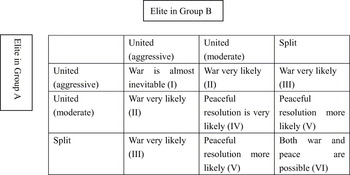
Within each group, there are at least two actors: the elite (including the leadership) and the mass, and more often than not, neither the elite nor the mass will be united. As such, interaction between two ethnic groups can be quite complex. Assuming that elite within a group can adopt two positions toward the other group (moderate and hostile) and that mass is generally united in moderation, we can arrive at a simply scheme regarding the possible combinations of inter-ethnic group politics (see Figure 2).Footnote 114 The scheme has at least six different scenarios.
Elite preferences and outcomes in ethnic conflict.

In a scenario in which the elite within both groups are united in aggressive intention (scenario I), it is hard to stop the war without external intervention. There is no real security dilemma in this scenario.
In a scenario in which the elite in both groups are united in moderation (scenario IV), the probability of peaceful outcome (either separation or co-existence) is high. The security dilemma will remain essentially dormant or be largely contained in such a scenario, the international community only needs to encourage a peaceful solution of the situation. Both the case of Czechoslovakia and the case of Romania seem to fit into this case.Footnote 115
The scenario in which the elite in one group in united in moderation whereas the elite in the other group is split is the second best scenario (scenario V). In such a scenario, probability of peaceful outcome (either separation or coexistence) is also high, although lower than it in scenario IV. The security dilemma can be contained in such a scenario, if the side with a united moderate group can work closely with the moderate in the divided group to contain the spiral and thus marginalise the more nationalistic fraction in the divided group. Again, the international community only needs to encourage a peaceful solution of the situation. Yet, it is imperative that the international community avoids heavy-handed tactics against the divided group in order to prevent nationalistic backlash against the moderates in that group's elite. The key here is to make ‘moderation pay’, as Donald Horowitz aptly put it.Footnote 116
In a scenario in which the elite in one group is united in malign intentions whereas the elite in the other group is split or moderate (scenarios II & III), the chance of war will be high. In such a scenario, however, the target of international intervention is clear-cut. The international community should commit itself early to deter the malign side from driving up the spiral, and failures to do so will greatly increase the chance of actual conflict. The case of Milosevic's Serbia versus Croatia and Bosnia, the case of Tudjman's Croatia versus Serbs within Croatia, and the case of Islamic north versus Christian south in Sudan all fitted into this scenario.
The scenario in which both the elite and the mass in the both groups are divided is perhaps the most common scenario (scenario VI), and it is also the most complex. This scenario can result in either war or peace, sometimes via the scenarios noted above as intermediate outcomes. Any sound theory of ethnic conflict will have to be built upon this scenario.
Finally, while a dynamic and integrative theory of ethnic conflict will perhaps inevitably put more responsibilities on the elite, it is misleading to put all the responsibilities on the elite. One must ask why the mass follows malign leaders or elite at all, when the risk of ethnic conflict seems to be so great and the potential gain so uncertain for the mass. A dynamic and integrative theory of ethnic conflict thus must also explain this puzzle. One possibility is that malign elite on one or both sides can simply mobilise a fraction of the population (for example, thugs) to inflict so much devastation on the other side that the other side is almost sure to respond with hatred and rage, as the Serbs under Milosevic had done in Kosovo and Croatia.Footnote 117 Once this is achieved, the general mass of the side that initiated the violence will become fear of becoming the target of revenge by the other side, even though they did not instigate the violence. As a result, the mass on both sides would ‘rationally’ feel compelled to support mass violence and ethnic war.Footnote 118 A dynamic and integrative theory of ethnic conflict will have to accommodate all the facts and scenarios mentioned above.
Conclusion
I have critically examined the application of the security dilemma as an analytical tool for the understanding of ethnic conflicts. I have shown that many applications have been misguided based on an incomplete and incorrect understanding of the security dilemma and have led us to some dubious, if not counterproductive, prescriptions for coping with ethnic conflict.
To understand ethnic conflicts with the security dilemma or the spiral model, we have to be loyal to the original BHJ formulation of the concept. Because the security dilemma theory and the broader spiral model are extremely versatile, they can serve as a foundation of a dynamic and integrative theory toward ethnic conflict. Combining with a ‘two-level game’ approach that can integrate intra-group politics with inter-group politics, a dynamic and integrative theory of ethnic conflict that will generate important insights for managing and containing ethnic conflict is within our reach. Such a dynamic and integrative theory should be our task ahead.
Needless to say, until we have a sound theory of ethnic conflict at hand, we have to constantly remind ourselves of our limited knowledge and thus be cautious in prescribing simplistic solutions. Indeed, even if we have such a theory of ethnic conflict at hand, we still have to be cautious because each ethnic conflict has its own characteristics, and we shall be damned if we prescribe a panacea for ethnic conflict by ignoring those unique characteristics.