Introduction
The rice brown planthopper (Nilaparvata lugens (Stål)) (Hemiptera: Delphacidae) is one of the most destructive insect pests of the rice plant Oryza sativa L. in Asia. This insect sucks nutrients from the phloem of rice plants and transmits viral diseases. High N. lugens populations can destroy a plant in a short period of time (Sogawa, Reference Sogawa1982). N. lugens harbors an obligate endosymbiont called the yeast-like symbiont (YLS) in their abdominal fat body. YLSs are members of the family Clavicipitaceae in the Pyrenomycetes class of fungi (Chen et al., Reference Chen, Cheng, Kuan and Hou1981; Suh et al., Reference Suh, Noda and Blackwell2001). N. lugens depends on their symbiotic YLS to produce many essential amino acids that are at low concentrations in the phloem sap of plants (Hongoh et al., Reference Hongoh, Sasaki and Ishikawa2000; Noda & Koizumi, Reference Noda and Koizumi2003). RNA interference (RNAi) already proved useful in functional genomic research on insects, and has considerable potential to control insect pests (Belles, Reference Belles2010; Liu et al., Reference Liu, Liang, Zhou, Jiang, Zhu, Yu, Zhang, Gurr and Zhu2015). Silencing genes influencing the development or reproduction of N. lugens, or its symbiont, is one new possible control alternative to reduce damage caused by this pest.
Protein synthesis is essential for the growth and development of all organisms. Elongation factor 1 (EF-1) plays a central role in protein biosynthesis. It consists of four subunits EF-1α (51 kDa), EF-1β (26 kDa), EF-1δ (33 kDa) and EF-1γ (49 kDa) in animal (Kidou et al., Reference Kidou, Tsukamoto, Kobayashi and Ejiri1998; Ejiri, Reference Ejiri2002). The four subunits form two functionally distinct parts, EF-1α and EF-1βγδ. EF-1α is a G-protein that catalyzes the binding of aminoacyl-tRNA to the A site ribosome via codon–anticodon interaction (Negrutskii & El'skaya, Reference Negrutskii and El'skaya1998). The βγ and δ subunits of EF-1 catalyze exchange of the residual GDP on EF-1α for GTP. The main role of EF-1γ is to ensure the proper scaffolding of the different subunits in the EF-1 complex as well as to direct its intracellular localization (Le Sourd et al., Reference Le Sourd, Boulben, Le Bouffant, Cormier, Morales, Belle and Mulner-Lorillon2006). Besides its canonical role in protein synthesis, elongation factor is also involved in several other cellular processes. For example, EF-1 interacts with actin and tublin, activates degradation of some proteins and is probably involved in apoptosis and signal transduction (Chen et al., Reference Chen, Proestou, Bourbeau and Wang2000). EF-1α is found in cytoplasm and nucleus, where it plays a role in transcription. Therefore, it appears to be the so-called moonlighting protein (Billaut-Mulot et al., Reference Billaut-Mulot, Fernando-Gomez, Loyens and Ouaissi1996; Ejiri, Reference Ejiri2002; Lamberti et al., Reference Lamberti, Sanges and Chambery2011).
EF-1α has been extensively investigated in bacteria, plants and animals. In Trypanosoma brucei, EF-1α is found in a complex that contains calmodulin, which means EF-1α may be involved in calcium-dependent signaling pathway (Kaur & Ruben, Reference Kaur and Ruben1994). In insects, the cDNAs for EF-1α, β, γ and δ were cloned from the silk gland of Bombyx mori (Janssen & Möller, Reference Janssen and Möller1988; Taira et al., Reference Taira, Kamiie, Kakuta, Ooura, Matsumoto, Ejiri and Katsumata1992; Kamiie et al., Reference Kamiie, Taira, Ooura, Kakuta, Matsumoto, Ejiri and Katsumata1993, Reference Kamiie, Nomura, Kobayashi, Taira, Kobayashi, Yamashita, Kidou and Ejiri2002, Reference Kamiie, Yamashita, Taira, Kidou and Ejiri2003). However, the study on its tissue distribution and expression patterns and function were very limited. In Locusta migratoria, the production of EF-1α and 1γ was stimulated by juvenile hormone and may contribute to the massive protein synthesis required for egg production (Zhou et al., Reference Zhou, Zhang, Fam, Wyatt and Walker2002). When the EF-1β′ was knocked-down using RNAi in Spodoptera exigua, the survival rate was significantly lower than control groups. Other elongation factors and transcription factors were also influenced (Zhao et al., Reference Zhao, Qin, Wei, Guo, Dang, Wang and Tang2012). These results showed that as a component of the translation machinery, from mRNA to protein, elongation factors also play important roles in insect development and reproduction.
In the present study, we cloned cDNAs of the EF-1α and 1γ gene from N. lugens and its YLS. The structure, tissue distribution and expression patterns of these genes were investigated. Moreover, RNAi was used to study the effect of these genes on the development and reproduction to N. lugens.
Materials and methods
Insects and tissues preparation
N. lugens were reared and maintained on rice variety Taichung Native1 (TN1, a N. lugens-susceptible rice cultivar) in wire mesh cages under greenhouse conditions (28°C, 85% relative humidity and 16 h light/8 h darkness).
Adult females, 2 days after eclosion, were immobilized by placing them in a freezer for 15 min, and their heads, thoraxes, abdomens, midguts, ovaries, salivary glands and fatbodies were dissected with tweezers. Hemolymph was collected as follows: N. lugens was attached dorsally onto a Petri dish using adhesive tape. The legs were removed, and the drops of hemolymph collected using a capillary glass. Tissue samples from 100 adults were pooled randomly into one group. The individuals from the day 1 of the first instar to day 3 of the fifth-instar nymphs and newly emerged brachypterous female and male adults were randomly selected respectively, ten individuals were pooled into one group. All samples were collected in triplicate. The samples were frozen in liquid nitrogen and stored at −80°C.
Primer design, RNA extraction and reverse transcription
Four sequences of EF-1α and 1γ (named NlEF-1α, YsEF-1α, NlEF-1γ and YsEF-1γ) were identified from our transcriptome database from whole bodies of N. lugens. Primers specific for these genes were using NCBI Primer blast and synthesized by Invitrogen Co., Ltd. Shanghai, China.
Total RNA was isolated using an RNeasy Mini kit (Qiagen, Hilden, Germany), the potential genomic DNA contamination was removed by a treatment with DNase I kit (Qiagen, Hilden, Germany) after RNA extraction. RNA concentration and quality was determined using a Nanodrop spectrophotometer (Thermo Scientific, USA). Each RNA sample was incubated at 65°C for 5 min before reverse transcription reaction. First-strand cDNA was synthesized with ReverTra AceqPCR RT Kit (Toyobo, Osaka, Japan) and each reaction contained: 4.0 µl 5 × RT buffer, 1.0 µl enzyme mix, 1.0 µl primer mix, 700 ng RNA and Diethy pyrocarbonate (DEPC)-treated water in a final volume of 20 µl according to the manufacturer's protocol. The thermocycler was programmed 37°C for 45 min, then maintained at 4°C. The 10× diluted first-strand cDNA (3.0 µl) was used as template for PCR.
cDNAs of EF-1α and 1γ cloning
The cDNA sequence of EF-1α and 1γ was amplified by PCR using primer pairs listed in online Supplementary table S1. Amplification was carried out in a total reaction volume of 25 µl, containing 3.0 µl cDNA, 20 pmol of each primer, 0.2 mM deoxy-ribonucleoside triphosphate (dNTPs), 1× PCR buffer and 2.5 units of r-Taq DNA polymerase (Takara, Shiga, Japan). PCRs were performed with the following cycles: initial denaturation at 95°C for 2 min; followed by 35 cycles of 30 s at 95°C, 30 s annealing at 58°C, 90 s extension at 72°C; and a final extension at 72°C for 10 min. The expected band was purified using a DNA gel extraction kit (Tiangen, Beijing, China) and cloned in pCR®2.1 TOPO vector (Invitrogen Co., Ltd. Shanghai, China). Approximately five randomly picked positive colonies for each gene were then amplified and sequenced with the M13 primer pair with ABI Prism 3100 DNA sequencer (Invitrogen Co., Ltd. Shanghai, China). The plasmid pTOP-NlEF-1α, pTOP-YsEF-1α, pTOP-NlEF-1γ and pTOP-YsEF-1γ were extracted from each positive clone using high pure plasmid isolation kit (Roche, Mannh-eim, Germany).
cDNA sequence, protein sequence and gene structure analyses
The cDNA sequences were compared with other EF-1 sequences deposited in GenBank using the BLAST-N and BLAST-X tools at the National Center for Biotechnology Information (NCBI). The copy number was predicted by BLAST analysis of N. lugens (assembly GCA_000757685.1) and N. lugens YLS (assembly GCA_000758425.1) genome database (Xue et al., Reference Xue, Zhou, Zhang, Yu and Cheng2014). DNASTAR software (DNASTAR Inc., Madison, USA) was used to identify the open reading frame (ORF), deduce amino acid sequence, and predict the isoelectric point and molecular weight. Alignments analyses were done by using the Clustal method with MegAlign software. Protein annotation and domain searches were performed using http://smart.embl-heidelberg.de/. A phylogenetic tree was constructed using MEGA 5.05 software (http://megasoftware.net/) based on the amino acid sequences of known EF-1 with neighbor-joining methods. A bootstrap analysis was carried out and the robustness of each cluster was verified using 1000 replicates.
The exon–intron structure was predicted by aligning mRNA with genomic DNA sequence using the spidey program http://www.ncbi.nlm.nih.gov/spidey/spideyweb.cgi/ and GSDS online http://gsds.pku.edu.cn/.
Gene expression analysis by reverse transcription-quantitative polymerase chain reaction (RT–qPCR) analysis
Total RNA was collected from various developmental stages, including the day 1 of the firt instar to day 3 of the fifth-instar nymphs and adults. Tissues used for RNA extraction were head, thorax, abdomen, midgut, ovary, salivary gland, hemolymph and fatbody of adult females (2 days after eclosion). Expression of the EF-1α and 1γ genes in N. lugens was analyzed by RT–qPCR using a qPCR master mix SYBR® Premix (Toyobo, Osaka, Japan) on ABI 7500 System (Applied Biosystems). All RT–qPCR reactions were run in triplicate using 3.0 µl cDNA per reaction. The 18 s rRNA (JN662398) and β-actin (EU179846) gene as the reference gene were used in the mRNA expression (Wang et al., Reference Wang, Li, Chen, Lai and Fu2015). Relative value for the expression level of target gene was calculated by the equation Y = 10(Ct internalCt target)/3 × 100%. Duncan's Multiple Comparison test was used to determine differences among tissues and stages. Values of P < 0.05 were considered significant.
Genes expression down-regulation using RNAi
The plasmid pTOP-NlEF-1α, pTOP-YsEF-1α, pTOP-NlEF-1γ and pTOP-YsEF-1γ was used as the template for amplification of the target NlEF-1α, YsEF-1α, NlEF-1γ and YsEF-1γ genes, respectively. Highly conserved regions were chosen for double-stranded RNA (dsRNA) synthesis for the four genes. Specific primers based on the ORF of target genes were designed for dsRNA synthesis and the T7 polymerase promoter (TAATACGACTCACTATAGGG) was fused with gene-specific primers at the 5′ end. The sequence and location of primers are given in online Supplementary table S1. Amplification was carried out in a total reaction volume of 25 µl, containing 1.0 µl plasmid, 20 pmol of each primer, 0.2 mM dNTP, 1× PCR buffer, and 2.5 units of r-Taq DNA polymerase (Takara, Japan). PCR amplification was performed in 35 cycles of 94°C for 40 s; 58°C for 30 s and 72°C for 40 s; with final extension step of 72°C for 7 min. PCR products were examined on 1% agarose gel for verification and then purified using TIANgen Midi Purification Kit (Tiagen, Beijing, China). The dsRNA (679 bp for NlEF1γ, 691 bp for NlEF1α, 644 bp for YsEF1γ and 697 bp for YsEF1α) was then in vitro generated using MEGAscript RNAi Kit (Ambion, Life Technologies, Burlington, Ontario) and stored at −80°C until use. A dsRNA that targets the green fluorescent protein (GFP) gene (AB608314) expression was also produced as described above and used as control.
About 70 ng of dsRNA (0.1 µl insect−1) was injected into the thorax between the mesocoxa and the hind coxa of N. lugens using Eppendorf microinjection system TransferMan NK2 (injection pressure, 300 hPa; time, 0.5 s; compensation pressure, 30 hPa) (Liu et al., Reference Liu, Ding, Zhang, Yang and Liu2014; Wang et al., Reference Wang, Li, Chen, Lai and Fu2015). In parallel, N. lugens injected with GFP dsRNA (70 ng) were used as the negative control. To study the effect of gene knockdown on survival rates, third-instar nymphs (1-day old), were used for injection. To study the effect on reproduction, fifth-instar nymphs (3-day old) were used for dsRNA injection. After a 12-h recovery period, the survived nymphs (at least 30 individuals) in each treatment were selected and reared on 30- to 35-day-old plants of rice variety TN1 in one cage at 28°C, 85% relative humidity and 16 h light/8 h darkness. Each treatment or control was repeated three times. Four days after injection, RNA was isolated from five individuals to test the efficiency of RNAi knockdown using RT–qPCR. The relative amounts of target genes and NlVg transcripts were normalized to the endogenous reference gene 18S rRNA and actin at first, and then normalized relative to the level of gene transcripts in nymphs treated with the dsGFP injection using the comparative Ct method and expressed as a ratio between the treated and control groups (Livak & Schmittgen, Reference Livak and Schmittgen2011). Duncan's tests were used to determine differences between the treatment and control. Values of P < 0.05 were considered significant.
Enzyme-linked immunosorbent assay (ELISA) analysis
Whole bodies of individual N. lugens females 4 days after eclosion were homogenized in 200 µl phosphate-buffered saline (PBS) buffer containing 0.05% Tween-20 with a glass tissue grinder in an ice bath. Homogenates were centrifuged at 10,000 g for 10 min at 4°C, and the supernatants were used for the vitellogenin (Vg) determination with Insect VTG Elisa Kit (BioTsz, San Francisco, CA, USA). The antibody against Vg used in this kit was made by the conserved Vg domain of insect based on Drosophila melanogaster. The optical density was read at 450 nm on Sunrise ELISA reader (Tecan, Maennedorf, Switzerland).
Observation of insect survival and fecundity
The survival rates of the third instar after injection were observed at 48 h intervals with duration of 11 days. To test for an effect of treatment, ANOVAs were performed using the cumulative percentage of dead nymphs as the dependent variable and treatment dsGFP injection, dsNlEF-1α, dsNlEF-1γ, dsYsEF-1α, dsYsEF-1γ injection as the independent variable. Duncan's tests were used to determine differences among groups when treatment effects were detected.
To study the fecundity and egg-hatching rates, the injected fifth-instar nymphs in each treatment were separated into two groups. The first group was used to record the number of eggs and offspring. Once the fifth instar after injection emerged, each female was matched with one male and each pair was put into one cage. In total, 15 single pairs per gene were successful. The number of newly hatched nymphs was recorded every other day until the parents died. The number of unhatched eggs was also recoded. The second group was used to study RNAi efficiency, ELISA analysis and for ovary dissection. Ten newly emerged 4-day-old females were collected for ELISA analysis. Six females were collected from each treatment at days 4 and 10 after adult emergence and ovaries were dissected then photographed with VHX-2000 microscope. We used the grading criteria developed by Lu et al. (Reference Lu, Qi, Qin, Hu, Wang, Zhang, Cheng and Zhai2011) to determine the ovarian development.
Result
Cloning, structure and phylogenetic analysis of the EF-1α and 1γ
Four cDNA sequences with an entire ORF (named NlEF-1α, NlEF-1γ, YsEF-1α, YsEF-1γ) were assembled and amplified with PCR with length of 1702, 1324, 1538 and 1037 bp, respectively. These cDNA sequences were deposited in GenBank under accession numbers KP001172, KP001173, KT371532 and KT371533. NlEF-1α and NlEF-1γ shared high identity with N. lugens genome database and YsEF-1α and YsEF-1γ shared high identity with N. lugens YLS. The NlEF-1α cDNA fragment shared high identity with the EF-1α of Nasonia vitripennis (up to 86% identity with an E value 0.0 and 81% coverage). The NlEF-1γ cDNA fragment shared high identity with the EF1γ of Papilio machaon (up to 66% identity with an E value 7e-87 and 98% coverage). The YsEF-1α cDNA fragment shared high identity with the EF-1α of Metarhizium acridum (up to 88% identity with an E value 0.0 and 89% coverage). The YsEF-1γ cDNA fragment shared high identity with the EF-1γ of M. acridum (up to 71% identity with an E value 5e-125 and 94% coverage). The analysis of the nucleotide sequences of ORF showed high identity (up to 71.9%) between NlEF-1α and YsEF-1α, while the percent identity between NlEF-1γ and YsEF-1γ is 36.1% (table 1).
Sequence pair distances between NlEF-1α, NlEF-1γ, YsEF-1α and YsEF-1γ at the cDNA level and protein level.

Sequence pair distances were calculated by the ClustalV method of MegAlign software. The percent of identity is given in the upper part, and the divergence is given in the down part. Divergence is calculated by comparing sequence pairs in relation to the phylogeny reconstructed by MegAlign. Percent Identity compares sequences directly, without accounting for phylogenetic relationships.
The cDNA of NlEF-1α contains an entire ORF of 1389 nucleotides encoding a protein of 462 amino acids with a predicted molecular weight of 50.49 kDa and pI of 8.97. The cDNA of YsEF-1α contains an entire ORF of 1383 nucleotides encoding a protein of 460 amino acids with a predicted molecular weight of 49.8 kDa and pI of 9.16. The three domains (domains I, II and III) and motifs implied to be involved in tRNA-, ribosome- or GTP-binding are all present and conserved in NlEF-1α and YsEF-1α proteins. The consensus GTP-binding motifs GxxxxGKS (motif G-1, signature motif of phosphate-binding loop), T (motif G-2), DxxG (motif G-3) and NKMD (motif G-4) are found in domain I of NlEF-1α and YsEF-1α. Two surface loops that undergo conformational changes upon GTP binding, Switch I region(ERERGITIDIAL)and Switch II region (PGHRDFIKNMITGTSQADC), are both present in NlEF-1α and YsEF-1α between amino acids 67–78 and 98–112, respectively (online Supplementary fig. S1). NlEF-1α has a proline–proline insertion behind the motif G-4, YsEF-1α has this deletion at the corresponding position. This result is in agreement with the results reported by Vinkenoog et al. (Reference Vinkenoog, Sperança, van Breemen, Ramesar, Williamson, Ross-MacDonald, Thomas, Janse, del Portillo and Waters1998), showing EF-1α in arthropods contains two amino-acid proline–proline insertions behind the last conserved box involved in GTP binding, which is absent from the yeast (Vinkenoog et al., 1998). The NlEF-1α and YsEF-1α shared 78.7% similarity at amino acid sequence level (table 1).
The cDNA of NlEF-1γ contained an entire ORF of 1239 nucleotides encoding a protein of 412 amino acids with a predicted molecular weight of 47.10 kDa and pI of 6.01. The cDNA of YsEF-1γ contained an entire ORF of 948 nucleotides encoding a protein of 315 amino acids with a predicted molecular weight of 36.4 kDa and pI of 6.27. The two domains (domain I including a N-terminal motif of glutathione S-transferase (GST-N) from 2 to 82 and C-terminal motif(GST-C) from 103 to 195, domain II from 250 to 357) are present in the NlEF-1γ. However, the motif GST-N in domain I is absent in the YsEF-1γ (online Supplementary fig. S2).
The deduced four amino acids of EF-1α and 1γ were aligned with sequences from fungi and other insect species including Lepidopera, Diptera, Coleoptera and Orthoptera. The protein NlEF-1α presents high identity with the EF-1α of Hemiptera H. vitripennis (up to 96% identity with an E value 0.0 and 100% coverage). The identity with humans is 85%. YsEF-1α shows high identity with EF-1α in the Ascomycota M. anisopliae (up to 96% identity with an E value 0.0 and 100% coverage). The protein NlEF-1γ shows high identity with the EF-1γ of Orthoptera L. migratoria (up to 64% identity with an E value 0.0 and 100% coverage) and 55% with humans. The protein YsEF-1γ shows high identity with the EF-1γ of Ascomycota O. sinensis (up to 74% identity with an E value 2e-162 and 100% coverage). A neighbor-joining phyologenetic tree confirmed NlEF-1α and NlEF-1γ clustered into the insect group and YsEF-1α and YsEF-1γ clustered into the fungi group (online Supplementary fig. S3). Overall, the sequence of EF-1α appears more conserved among insects and fungi than EF-1γ.
Structure of EF-1α and 1γ gene from N. lugens and YLS
The ORF of NlEF-1α was 1389 bp and composed of 6 exons ranging in size from 72 to 324 bp. Two copies of NlEF-1α were found in N. lugens genome. One of 7567 bp is in KN152563 and the other of 7377 bp is in KN153172. The two copies have similar number of exons and also exhibited nearly identical exon length. The intron arrangements and phase are also very similar between the two copies (online Supplementary fig. S4). Genes flanking EF1-α in scaffolds KN152563 and KN153172 showed no homology, suggesting there are two copies of EF1-α in the N. lugens genome. The ORF of NlEF-1γ was 1239 bp and found one copy of 23605 bp in KN153172 in N. lugens genome. The NlEF-1γ gene consists of nine exons (12, 150, 64, 143, 164, 283, 139, 128 and 156 bp in length, respectively) separated by eight introns (online Supplementary fig. S4).
The ORF of YsEF-1α was 1383 bp, one copy of 1930 bp was found in KN173736 in YLS genome. The YsEF-1α gene consists of 5 exons (43, 29, 63, 139 and 1109 bp in length, respectively) separated by four introns (122, 111, 264 and 56 bp, respectively). The ORF of YsEF-1γ was 948 bp in KN173744 without intron in YLS genome (online Supplementary fig. S4). These results demonstrate that the exon–intron organization of EF-1α and 1γ is distinct between N. lugens and its yeast-symbionts.
Temporal and spatial expression
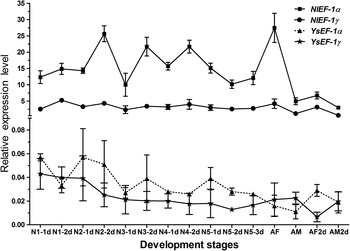
The expression level of NlEF-1α was about tenfold higher than that of NlEF-1γ across all developmental stages assessed (fig 1). NlEF-1α was expressed higher in adult females than males and was highly expressed on day 2 of second, third and fourth instars. However, the YsEF-1α and YsEF-1γ expressed constitutively at similar levels during development stages and the expression was considerably lower than that of NlEF-1α and NlEF-1γ (fig. 1).
Developmental expression of four genes in N. lugens was determined by RT–qPCR. cDNA templates were derived from N1-1d, day 1 of the 1st ; N1-2d, day 2 of the 1st; and so on; AF, newly emerged female adults; AM, newly emerged male adults; AF2d, 2-day-old female adults; AM2d, 2-day-old male adults. These data represent the mean values ± SD of three replicates with ten individuals in each replicate. Relative value for the expression level of target gene was calculated by the equation Y = 10(Ct internal–Ct target)/3 × 100%. ‘*’ means statistically significant difference for the same genes during the different developmental stages in the expression levels by Duncan's Multiple Range test (P < 0.05).

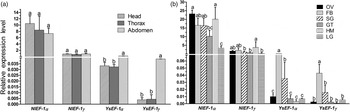
The expression levels of NlEF-1α and NlEF-1γ in different body regions of adults (head, thorax and abdomen) were not significantly different. However, the level of YsEF-1α and YsEF-1γ was significantly higher in the abdomen than in head and thorax (fig. 2a). An expression analysis of specific tissue, including hemolymph, ovaries, fat bodies and salivary glands, gut and leg was also performed. NlEF-1α and NlEF-1γ genes were expressed at high levels all tissues except leg. The YsEF-1a and YsEF-1γ showed very similar expression patterns, with the highest level of expression occurring in fat body (fig. 2b).
(a) Comparison of four genes expression in different parts of N. lugens. (b) Comparison of four genes expression in various tissues. cDNA templates were derived from HM, Hemolymph; OV, ovaries; FB, fat body; SG, Salivary glands; GT, midgut; LG, leg of adults. The data represent the mean values ± SD of three replicate with 100 individuals in each replicate. Relative value for the expression level of target gene was calculated by the equation Y = 10 (Ct internal– Ct target)/3 × 100%. Same letters above each bar in same gene indicate no statistical difference by ANOVA followed by the Duncan's Multiple Comparison test (P < 0.05).

NlEF-1α and NlEF-1γ are required for survival and fecundity of N. lugens
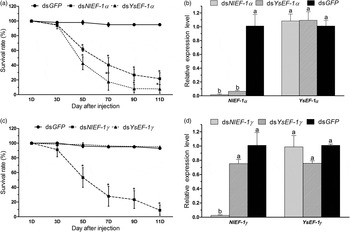
The survival rate of nymphs began to decrease 5 days after injecting EF-1α dsRNA from N. lugens or the YLS. The survival rate was significantly lower in nymphs injected with dsNlEF-1α (61.6%) or dsYsEF-1α (42.6%) than with the dsGFP (98.0%) control. Eleven days post injection, the survival rate of nymphs decreased to 21.7% (dsNlEF-1α) and 7.8% (dsYsEF-1α), yet the dsGFP control remained high (95.0%) (fig. 3a).
Injection of dsNlEF-1α and dsYsEF-1α into planthoppers. (a) Survival rates over 11 days post-injection. (b) The mRNA level of NlEF-1α and YsEF-1α 4 days after injection. (c) Effect of injections of dsNlEF-1γ and dsYsEF-1γ on the survival and (d) the mRNA level of NlEF-1γ and YsEF-1γ of the planthoppers 4 days after injection. dsNlEF-1α,700 ng µl−1 NlEF-1α dsRNA; dsYsEF-1α,700 ng µl−1 YsEF-1α dsRNA; dsNlEF-1γ, 700 ng µl−1 NlEF-1γ dsRNA; dsYsEF-1γ, 700 ng µl−1 YsEF-1γ dsRNA; dsGFP, 700 ng µl−1 GFP dsRNA. For accumulative mortality, the data represent the mean values ± SD of three replicate with 30 individuals in each replicate. ‘*’ means statistically significant difference in the expression levels by Duncan's Multiple Range test (P < 0.05). For the mRNA level, three biological replicates with five individuals in each replicate were conducted and the mean ± SD (n = 3) was calculated to measure the relative transcript levels using the 2−ΔΔCT method. Different letters above each bar indicate statistical difference by ANOVA followed by the Duncan's Multiple Comparison test (P < 0.05).

RT–qPCR analysis of mRNA abundance 4 days after injecting NlEF-1α dsRNA indicated that expression of NlEF-1α decreased by 98% and YsEF-1α by 95% (fig. 3b). This indicated that the RNAi-mediated knockdown of N. lugens was successful. Down regulation of EF-1α the yeast like symbiont may have occurred due to the high similarity (up to 71.9%) in the nucleotide sequences between NlEF-1α and YsEF-1α. Surprisingly, the injection of dsRNA of YsEF-1α from YLS did not cause down regulation of target gene YsEF-1α.
After injecting dsRNA NlEF-1γ, the survival rate of nymphs began to decrease after 5 days (53.3%) however no effect was observed with dsYsEF-1γ (96.1%) or the dsGFP control (96.0%). At the 11th day, the survival rate of nymphs decrease to 8.9% (dsNlEF-1γ), significantly lower than dsYsEF-1γ (95.0%) and control dsGFP (93.0%) (fig. 3c). RT–qPCR analysis of mRNA abundance indicated the expression levels of NlEF-1γ decreased by 98% after the injection of dsRNA of NlEF-1γ at the 4th day. But no reduction in abundance of YsEF-1γ after the injection of dsRNA of YsEF-1γ, compared with the control dsGFP (fig. 3d).
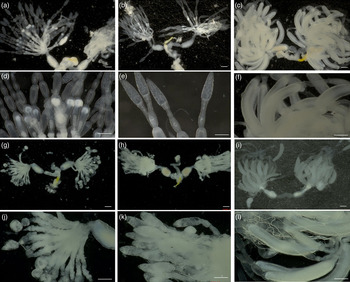
Fifth-instar nymphs were treated with EF-1 dsRNA to assess the effects on reproduction. All individuals successfully molted into adults and no negative effect on survival was observed when the target genes were knocked down at this late developmental stage (data not shown). Groups injected with dsNlEF-1α, dsYsEF-1α and dsNlEF-1γ all failed to produce viable eggs. Ovarian development was then evaluated through assessing ovaries after dissection and through analysis of Vg levels in whole bodies. The dissection revealed that ovarian development halted following RNAi treatment and remained in either the grade I transparent stage or grade II vitellogenesis stage 4 days (fig. 4a, d, b and e) and even 10 days (fig. 4g, j, h and k) after eclosion. However, the ovaries from females injected with dsGFP fully developed to the grade IV egg-laying stage 4 days after eclosion (fig. 4c, f).
RNAi-mediated knockdown of gene NlEF-1α and NlEF-1γ caused ovary aplasia. Ovaries were dissected from females injected with 700 ng µl−1 dsRNA at the 4th and 10th day after eclosion. NlEF-1α: (a, d) the 4th day. (g, j) the 10th day; NlEF-1γ: (b, e) the 4th day. (h, k) the 10th day; GFP: (c, f) the 4th day. (I, L) the 10th day. Scale bars: 100 µm.

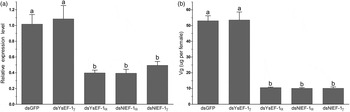
The knockdown of NlEF-1α and NlEF-1γ caused a significant reduction (about 60%) in the expression levels of Vg (fig. 5a). The ELISA results showed the Vg protein was significantly reduced in females injected with dsRNA of NlEF-1α, NlEF-1γ and YsEF-1α compared with females injected with dsRNA of GFP (fig 5b).
Injection of dsRNA on the mRNA level of Vg (a) and on the protein of Vg in whole body extracts of individual females at the 4th day after eclosion (b) dsNlEF-1α, 700 ngμ l−1 NlEF-1α dsRNA; ds NlEF-1γ,700 ng µl−1 NlEF-1γ dsRNA; dsGFP, 700 ng µl−1 GFP dsRNA. For the mRNA level, three biological replicates with five individuals in each replicate were conducted and the mean ± SD (n = 3) was calculated to measure the relative transcript levels using the 2−ΔΔCT method. For Vg ELISA measurements, ten individual females were conducted. Different letters above each bar indicate statistical difference by ANOVA followed by the Duncan's Multiple Comparison test (P < 0.05).

Discussion
Elongation factors are the workhorses of protein synthesis on the ribosome, elongating the nascent polypeptide chain by one amino acid at a time. EF-1α is ubiquitous and the second-most abundant eukaryotic protein after actin, comprising 1–2% of the total proteins in normal growing cells (Condeelis, Reference Condeelis1995). It is encoded by a small multigene family. There are at least two EF-1α genes in humans, more than ten genes in maize (Ejiri, Reference Ejiri2002), four genes in rice (Kidou & Ejiri, Reference Kidou and Ejiri1998) and two copies in bee and fruit fly (Hovemann et al., Reference Hovemann, Richter, Walldorf and Cziepluch1988; Danforth & Ji, Reference Danforth and Ji1998). In both fruit fly and bees, the different copies are divergent enough to be easily recognized and selectively amplified with specific primers. Two different isoforms encoded by a separate locus and have distinct expression pattern. Our result showed that there are at least two identical copies of NlEF-1α in N. lugens and one copy of YsEF-1α in its YLS. The coding regions of NlEF-1α and YsEF-1α are very similar in sequence both at the nucleotide level (71.9% identity) and the protein level (78.7% identity); however, the exon–intron organization of NlEF-1α and YsEF-1α is completely different. NlEF-1a consists of six exons, while YsEF-1a consists of five exons. The two copies of NlEF-1α demonstrate similar exon and intron organization. They share significant sequence identity in the coding regions, but may not in the 5′- or 3′- untranslated regions. Therefore, further study is needed to amplify the untranslated regions and analysis the two copies expression pattern. EF-1γ was a single copy gene in the arthropods and contains amino acid residues necessary for GST activity. We confirmed there was one copy of NlEF-1γ in N. lugens and also one copy of YsEF-1γ in its YLS. These two genes (NlEF-1γ and YsEF-1γ) are very different in the coding regions both at the nucleotide level (36.1% identity) and the protein level (33.9% identity). They are also very different in gene structure. NlEF-1γ consists of nine exons, while YsEF-1γ consists of only one exon. The genomic analysis of YLS demonstrated that YLS showed genome size reduction and limited metabolic abilities when establish a symbiotic relationship in N. lugens (Fan et al., Reference Fan, Noda, Xie, Suetsugu, Zhu and Zhang2015).The analysis of EF-1a and EF-1γ gene structure showed that YLS has smaller average intron size, less intron numbers when compared with that in N. lugens.
The consensus amino acid residues necessary for GST activity (the GST-N motif, GST-C motif) and EF1G are conserved between NlEF-1γ and other arthropods. The GST-N motif in domain I has a putative GSH-binding site (G-site) that was absent in YsEF-1γ. The conserved GST-C motif in domain I does occur in YsEF-1γ and is likely to play a key role in facilitating the protein folding and assembly of proteins in a chaperone-like manner. GST-N in EF-1γ may be a sensor that signals the redox state of the cell to the protein synthesizing machinery, as translation is activated by reduced glutathione and inhibited by oxidized glutathione (Ejiri, Reference Ejiri2002). In order to adapt to intercellular environments, the yeast like symbiont had lost partial genes encoding antioxidant enzymes, DNA repair enzymes, and proteins involved in resistance to environmental toxins. We proposed that GST-N motif is not essential for the YLS life; however, GST-C and EF1G are important for the remaining function and stability of EF-1βγδ in protein synthesis.
EF-1α occurs at a molar ratio that exceeds that of EF-1β and 1γ (Slobin, Reference Slobin1980). The abundance of EF-lα mRNA declines with age and there are indications that fruit flies with additional expression of EF-lα have a longer lifespan than ‘normal’ flies (Webster & Webster, Reference Webster and Webster1983; Shepherd et al., Reference Shepherd, Walldorf, Hug and Gehring1989). In N. lugens, the expression level of NlEF-1α was almost tenfold higher than that of NlEF-1γ. We found that NlEF-1α and NlEF-1γ were expressed in almost all tissue and stages and the expression level was significantly higher in female than in male. The highest levels were found in ovary, hemolymph, fat body and salivary gland. These tissues play a major role in the overall metabolism, digestion or reproduction in N. lugens and therefore need high level of protein synthesis and elongation factors. As a component of the translation machinery, coordinate regulation of the expression of these genes was needed. Temporal expression showed that the levels for NlEF-1α and NlEF-1γ changed in parallel and the level of NlEF-1α was higher than NlEF-1γ. In YLS, the expression level of YsEF-1α was also higher than YsEF-1γ. YLS mainly distributed in fat body of N. lugens, which is the center of material metabolism. The highest expression of YsEF-1α and YsEF-1γ was detected in the fat body as expected.
Proteins provide the structural framework of a cell and perform the enzymatic activities sustaining DNA replication and energy production. Since protein synthesis machinery exerts important effects on cell physiology. Not just for housekeeping in protein synthesis, EF-1 has important regulatory roles in cell growth, apoptosis and signal transduction. In N. lugens, knockdown of the expression of NlEF-1α and NlEF-1γ through injecting dsRNA caused high mortality and stopped ovarian development. Vg levels were also influenced when NlEF-1α and NlEF-1γ were suppressed. Our paper demonstrated the feasibility of using RNAi to knock-down gene expression in N. lugens. However, the expression of YsEF-1α and YsEF-1γ in YLS was not down-regulated through injection dsRNA of these corresponding genes. RNAi arose in an early eukaryotic ancestor and appears to have been conserved throughout most of the fungal kingdom, although some ascomycetes such as Saccharomyces cerevisiae and Candida lusitaniae (Nakayashiki et al., Reference Nakayashiki, Kadotani and Mayama2006), as well as basidiomycete fungi such as the corn smut Ustilago maydis (Laurie et al., Reference Laurie, Linning and Bakkeren2008), do not possess such defense mechanisms. In the obligate parasites Trypanosoma cruzi, Leishmania major and Plasmodium falciparum, RNAi components also are absent (Laurie et al., Reference Laurie, Linning and Bakkeren2008). Previous studies have indicated that relatively compact genomes and the sharply limited transposon complement in these organisms is a biological consequence of RNAi absence (Laurie et al., Reference Laurie, Linning and Bakkeren2008). Here we proposed the reasons for inefficient RNAi-based gene silencing in YLS: (1) The uptake and spread of dsRNA is defective in YLS through injection dsRNA into N. lugens. (2) The RNAi pathway may be dispensable for YLS. Since RNAi is based on sequence recognition, targeting a gene by RNAi can give rise to the silencing of another gene with similar sequence (Elbashir et al., Reference Elbashir, Harborth, Lendeckel, Yalcin, Weber and Tuschl2001). The similarity of the nucleotide sequences between dsRNA of YsEF-1α and NlEF-1α was up to 86%, the expression of NlEF-1α was down-regulated and off-target effect was occurred when the nymphs injected with dsYsEF-1α. Off-target effect occurs when an mRNA sequence shares high degree of sequence similarity with dsRNA, i.e. 100% over 25 nt, ≥94% over 50 nt, ≥89% over 100 nt, ≥84% over 200 nt and ≥81% over 300 nt. The minimum length 30–50 nt of high similarity stretch between the dsRNA and its target is sufficient to observe an efficient RNAi (Rual et al., Reference Rual, Klitgord and Achaz2007). The dsNlEF-1α (691 nt) shares 86% sequence similarity with EF-1α gene in other insects such as Bactericera cockerelli and Plebejus argus. While the dsNlEF-1γ (679 nt) presents 76% identity with EF-1γ gene in Papilio xuthus and the minimum length of 100% similarity stretch is shorter than 25 nt. Theoretically NlEF-1γ gene would be more practical to be applied in RNAi-based N. lugens control.
Supplementary material
The supplementary material for this article can be found at https://doi.org/10.1017/S0007485316000882.
Acknowledgements
This work is supported by the National Natural Science Foundation of China (Grant no. 31201512). Zhejiang Provincial Natural Science Foundation of China (Grant no. LY15C140004). Rice Pest Management Research Group of the Agricultural Science and Technology Innovation Program of Chinese Academy of Agricultural Science. Central Public-interest Scientific Institution Basal Research program (Grant no. 2012RG003-1). The authors are grateful to Dr Simon Baxter (Academic editor, Bulletin of Entomological Research) and Reviewers whose patience and constructive feedback has helped enormously in the improvement of this manuscript.