Introduction
Elephant grass (Pennisetum purpureum Schum.) is a pasture of great importance in tropical and sub-tropical climates, especially on dairy farms, due to its high productivity, palatability and persistence (Cavalcante and Lira, Reference Cavalcante and Lira2010). When established and managed under appropriate conditions, elephant grass can persist for decades (Olivo et al., Reference Olivo, Diehl, Agnolin, Bratz, Aguirre and Sauter2017). Normally, elephant grass is established exclusively in monocultures under high fertilization levels due to its particularly high response to nitrogenous fertilizers. However, dependence on commercial nitrogen (N) fertilizers involves high production costs and environmental issues (Döbereiner, Reference Döbereiner1997). Under this management strategy, the forage yield is concentrated in the summer (Deresz et al., Reference Deresz, Matos, Mozzer, Martins, Aroeira, Verneque and Coser2003) and exhibits great variability in herbage nutritive values (Diehl et al., Reference Diehl, Olivo, Agnolin, de Azevedo Junior, Bratz and dos Santos2014).
In contrast, legume–grass mixtures increase the herbage yield, improve the seasonal distribution of forage, increase animal productivity and reduce the environmental impact due to the lower use of N fertilizer (Carvalho and Pires, Reference Carvalho and Pires2008; Atienza and Rubiales, Reference Atienza and Rubiales2017; Silva et al., Reference Silva, Fialho, Carvalho, Fonseca, Carvalho, Bremm and Da Silva2018) and decreased greenhouse gas emissions (de Andrade et al., Reference de Andrade, Ribeiro-Filho, de Liz, Almeida, Miguel, Raupp, Ramos and Almeida2014). Legume–grass mixture systems are characterized by different plant architectures and distinct patterns of root growth, which improve the use of water, light and nutrient resources (Costa et al., Reference Costa, Barbosa and Sá2010).
Despite these advantages, few studies have investigated these mixed forage production systems and few farms have adopted them. The slower establishment than that of grasses and complications in establishment and pasture management, indicating low legume persistence, are among the main reasons for the reduced use of forage legumes (Abdul-Baki et al., Reference Abdul-Baki, Bryan, Klassen and Codallo2002; Silva et al., Reference Silva, Fialho, Carvalho, Fonseca, Carvalho, Bremm and Da Silva2018).
Among the forage legumes, the pinto peanut (Arachis pintoi Krap. and Greg.) is notable for its adaptation to medium-fertility soils (Crestani et al., Reference Crestani, Ribeiro Filho, Miguel, de Almeida and Santos2013), tolerance of heavy grazing, high herbage yield and nutritive value (Diehl et al., Reference Diehl, Olivo, Agnolin, de Azevedo Junior, Bratz and dos Santos2014; Olivo et al., Reference Olivo, Diehl, Agnolin, Bratz, Aguirre and Sauter2017) and animal performance (Azevedo Junior et al., Reference Azevedo Junior, Olivo, Meinerz, Agnolin, Diehl, Moro, Parra, Quatrin and Horst2012).
The mixture of elephant grass and pinto peanut is feasible if elephant grass is planted in equidistant rows at establishment, with pinto peanut between them (Olivo et al., Reference Olivo, Diehl, Agnolin, Bratz, Aguirre and Sauter2017). This planting plan is viable, but little is known about the response of the mixed forage system to different levels of pinto peanut in the herbage mass and their effects on the companion grasses and the productivity of the forage system. The aim of the current research was to evaluate the effects of different levels of pinto peanut in the herbage mass on the companion grasses (elephant grass and other grasses) under grazing conditions and on the productivity and nutritive value of the forage systems.
Materials and methods
Study site
The study was performed in Santa Maria in the central region of Rio Grande do Sul in an area belonging to the Laboratory of Dairy Livestock of the Department of Animal Science of the Federal University of Santa Maria, RS, Brazil (95 m asl, 29°43′S and 53°42′W). The soil is classified as Hapludalf Paleudult (Soil Survey Staff, 2014). The climate is Cfa (humid sub-tropical) according to the Köppen classification (Alvares et al., Reference Alvares, Stape, Sentelhas, Gonçalves and Sparovek2013). The experimental period lasted 331 days from May 2016 to April 2017. The average monthly precipitation and daily temperature during the experimental period were 148 mm and 19.3 °C, respectively. The 30-year average annual rainfall and monthly temperature were 139.1 mm and 18.1 °C, respectively.
An area of 1.0 ha was sub-divided into nine areas of 0.1 ha, where elephant grass (P. purpureum Schum.) ‘Merckeron pinda’ was established in 2004, in rows spaced 4 m apart. In the same year, pinto peanut (A. pintoi Krap. and Greg.) ‘Amarillo’ was established between rows of elephant grass in part of the area. In the other part, the development of spontaneous-growth species was allowed between rows of elephant grass. Throughout the experimental area, annual ryegrass (Lolium multiflorum Lam.) was sown, in May, between elephant grass rows. Since their initial establishment, the perennial species have been preserved through land management. For this management, characterized as a low-input system, a protocol was followed in which soil analysis was performed every 2 years, the soil was corrected when necessary, and annual phosphate and potassium fertilization were applied. Nitrogen fertilization ranged from 50 to 100 kg/ha/year. The area was grazed without interruption throughout the year by lactating cows under rotational stocking.
In May 2017, the soil surface was scarified between the rows of all experimental areas and annual ryegrass (L. multiflorum Lam.) BRS Ponteio was sown at 30 kg/ha. For fertilization, the recommendations of the Comissão de Química e Fertilidade do Solo (RS/SC, 2004) for warm season grasses were followed. Then, 60 and 100 kg/ha/year of phosphorus (P) in the form of phosphorus pentoxide (P2O5) and potassium (K) as potassium oxide (K2O) fertilizer, respectively, were applied in the area without legumes, whereas in the area with legumes, 80 and 100 kg/ha/year of P2O5 and K2O, respectively, were applied. For nitrogen (N) fertilization, 100 kg N/ha/year as urea was sub-divided into seven applications.
Treatments and experimental design
Three treatments were evaluated: one consisting of elephant grass-based, ryegrass and spontaneous-growth species (Treatment 1 – control) and two others containing the same species + two levels of pinto peanut, low density (Treatment 2) and high density (Treatment 3), between the rows of elephant grass. The choice of the legume mixture treatments was intentional, based on forage availability prior to experimentation. The pinto peanut forage availability between rows of elephant grass, with mean values superior or inferior at 500 g/kg DM, determined the paddocks with high and low legume density, respectively. At the end of the experiment, the average values of pinto peanut were 63 g/kg dry matter (DM) and 206 g/kg DM of herbage yield for the low- and high-density levels, respectively. A completely randomized design was used with three treatments (grazing systems) and three repetitions (paddocks) in completely split-plot grazing cycles (grouped by cool and warm seasons).
Grazing management
The grazing method adopted was rotational stocking based on 1-day grazing and a forage offer of 6 kg DM per 100 kg of body weight (BW). Lactating cows with an average weight of 530 ± 78 and 19 ± 4.3 kg milk/day (d) were used. Paddocks were grazed in a 31-d cycle (~1day grazing followed by 30 days rest). The cows were milked twice per day and fed concentrate at 9 g/kg BW/d after each milking as a supplement. These experimental animals were subjected to similar management with the pasture of the season and the same supplementation when they were not in the experimental areas.
Grazing during the cool season (characterized by the time of development and use of ryegrass) started in August 2017 using ryegrass sward height of 20 cm as the criterion for grazing. In the warm season, grazing was initiated on 7 December and elephant grass sward height was used as the criterion (from 100 to 120 cm).
Pasture measurements
Before and after each grazing, the paddocks were sampled to determine the pre- and post-grazing herbage mass. Four elephant grass sites were selected in each paddock. The herbage of these sites (0.5 m in length by the relative clump width) was then clipped to a stubble height of 50 cm. From elephant grass samples, a sub-sample was taken to evaluate morphological composition (leaf blade, stem + sheath and senescent material). In the area between rows of elephant grass, four sites were selected and 0.25 m2 quadrats were established. The herbage of these sites was clipped close to the ground. The forage mass was weighed fresh and a sub-sample taken to determine botanical composition (pinto peanut, grasses and other plants and dead material). These components of pasture and the morphological components of elephant grass were placed in a forced-air oven and dried at 55 °C to constant weight. The leaf blade samples of elephant grass and other grasses between rows of elephant grass were ground in a Willey-type mill, model TE-680 (Tecnal Laboratory Equipment LTDA, Piracicaba, Brazil) and used to estimate the nutritive value.
The pre-grazing and post-grazing samples were initially mixed and grouped by paddock. Subsequently, these composite grazing samples were grouped according to each treatment and season, i.e. the cool season (from May to September) and the warm season (from October to April). To estimate the nutritive value, crude protein was analysed according to the Kjeldahl method (AOAC, 1995) and the in vitro digestible organic matter was evaluated based on Tilley and Terry (Reference Tilley and Terry1963) with 48 h incubation. Total digestible nutrients were estimated by the percentage times digestible organic matter divided by 100 (Barber et al., Reference Barber, Adamson, Altman, Haresign and Cole1984) and expressed in g/kg DM.
The elephant grass comprised 30 m2 every 100 m2 of the experimental area. Thus, the initial herbage (pre-grazing) and residual (post-grazing) mass of both elephant grass and forage between rows of elephant grass were estimated from the sample taken and multiplied by their presence in the stand. The values were summed to obtain the herbage mass of the paddock (Diehl et al., Reference Diehl, Olivo, Agnolin, de Azevedo Junior, Bratz and dos Santos2014). The forage accumulation for the first grazing cycle was the pre-grazing forage mass in the paddocks. The forage accumulation in the subsequent grazing cycles was calculated by subtracting the pre-grazing forage mass of the following cycle from the post-grazing forage mass of the previous cycle. The forage yield was calculated by summing the forage accumulation in each grazing cycle.
Animal measurements
The stocking density was calculated based on a herbage allowance of 8 kg DM per 100 kg BW and by 450 kg (animal unit – AU). For the stocking rate, the stocking density (AU) was divided by the days of the interval between grazing cycles. Grazing efficiency was calculated as the ratio between the amount of forage removed by the animals (i.e. the difference between pre- and post-grazing plus losses) and the pre-grazing forage mass (Pedreira et al., Reference Pedreira, Rosseto, da Silva, Nussio, Moreno, Lima and Leme2005), expressed in the current study in g/kg DM. Forage intake, as a percentage of BW, was obtained by dividing the stocking density by the removed herbage mass, and expressed in g/kg BW.
Statistical analysis
The data were subjected to analysis of variance, and the averages were compared via Tukey's test at P < 0.05 and correlation using Pearson's correlation coefficient. The variables were analysed individually, by treatment and season, using the statistical software SAS Institute (2016). The statistical model used was:
 $$Y_{ijk} = {\rm} m{\rm} + {\rm} T_i + {\rm} R_j\lpar {T_i} \rpar {\rm} + {\rm} S_k + {\rm} (TS)_{ik} + {\rm e}_{ijk}$$
where Y ijk is the dependent variable, m is the overall mean, T i is the effect of treatment, R j(T i) is the effect of repetition within treatment (error a), S k is the effect of grazing cycles within the season (cool and warm seasons), (TS)ik is the interaction between treatment and season and ε ijk is the residual experimental error (error b).
Results
Pre- and post-grazing herbage mass
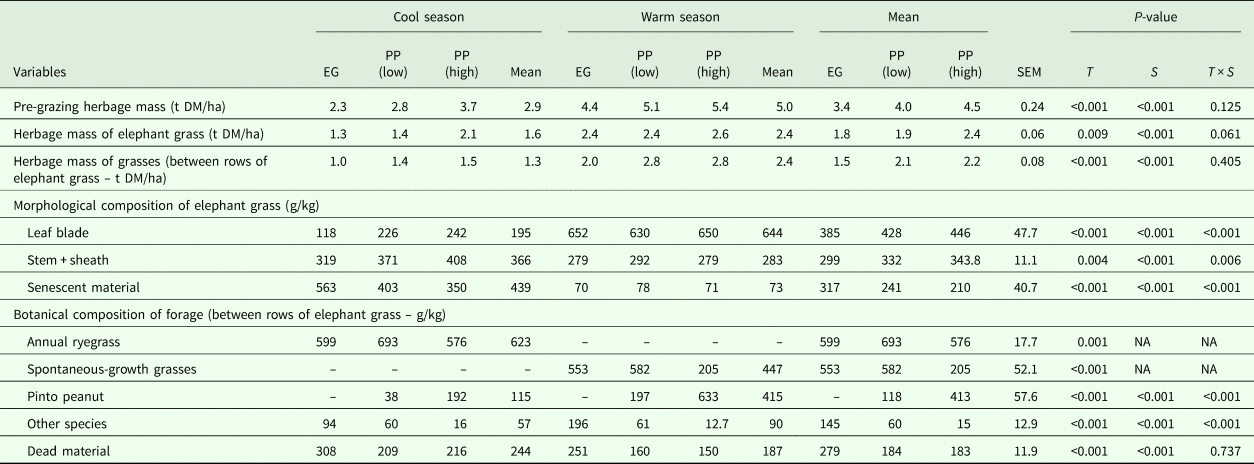
There was a significant difference (P < 0.001) in the cool season with respect to the pre-grazing herbage mass (Table 1), with higher values for pasture with a greater presence of legumes. In the warm season, there were differences among the forage mixture systems, with higher values in the system with legumes. The presence of pinto peanut affected positively the morphological composition of elephant grass, with a greater (P < 0.001) concentration of leaf blades (r = 0.688; P = 0.013) and stem + sheath (r = 0.781; P = 0.002) and a smaller concentration of senescent material (r = −0.759; P = 0.004) in grazing cycles during the cool season. In the warm season, the morphological composition of elephant grass was not affected (P > 0.05) by the presence of pinto peanut.
Herbage mass, morphological composition of elephant grass and botanical composition of three pasture systems, Santa Maria, RS, Brazil, 2016–2017
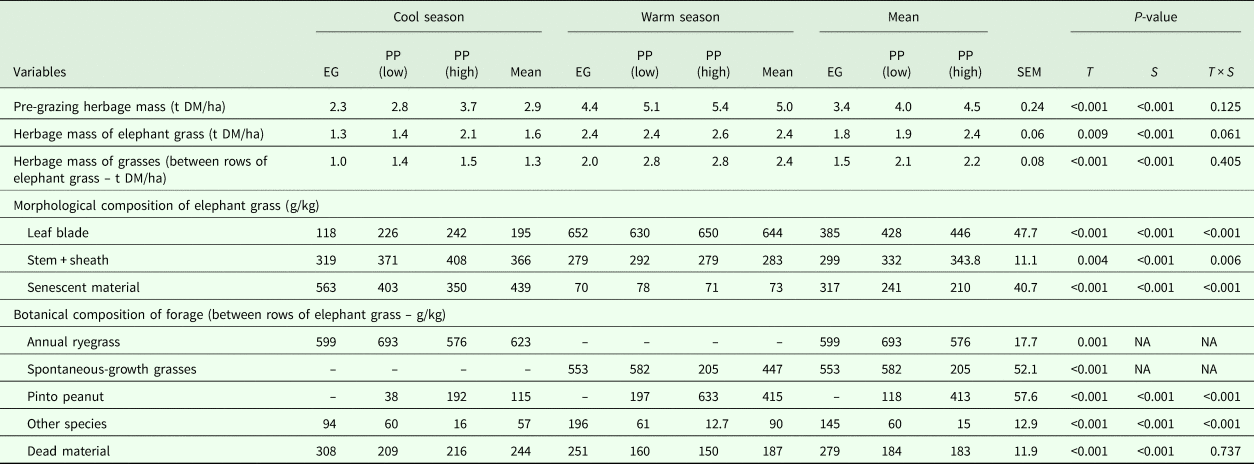
EG, elephant grass-based (control); PP (low), pinto peanut, low-density in the forage mass + EG; PP (high), pinto peanut, high-density in the forage mass + EG; SEM, standard error of the mean; P-value, significance level; T, treatment; S, season; NA, not analysed.
The presence of forage legume at high density in the pasture composition implied a lower participation of other spontaneous-growth grasses (r = 0.909; P = 0.001). In order of their contribution to the total forage mass, the following species were notable: sour grass (Paspalum conjugatum Berg.), vaseygrass (Paspalum urvillei Steud.), Bermuda grass (Cynodon spp.) and Alexander grass (Urochloa plantaginea (Link) Hitch). There was also a proportional effect of the presence of legumes in relation to the presence of other species (r = −0.879; P = 0.002), such as Sida spp., redshank (Polygonum persicaria L.) and flaxleaf fleabane (Conyza bonariensis (L.) Cronquist.). The presence of pinto peanut reduced the proportion of dead material of the forage between rows of elephant grass both in the cool season (r = −0.531; P = 0.075) and in the warm season (r = −0.764; P = 0.003), with a higher proportion of green herbage in the mixed systems.
Regarding the presence of ryegrass in the pasture composition, the lowest (P = 0.001) value was verified in the pure grass system, in contrast to the pinto peanut low-density system, due to the great (P < 0.001) presence of other species; in the high-density pinto peanut mixed system, the lower abundance of ryegrass was due to the abundant presence of this legume.
Herbage accumulation rate and herbage yield
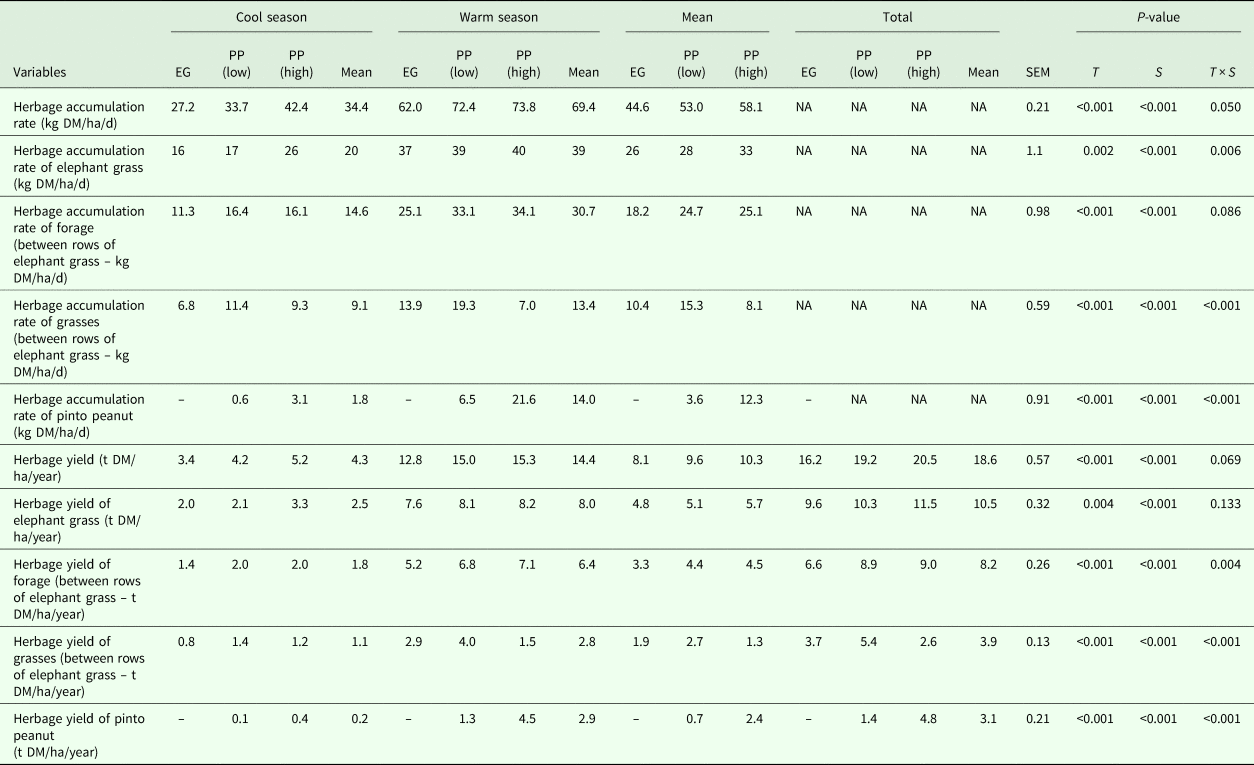
There was a difference (P < 0.001) in the herbage accumulation rate (Table 2), with higher values associated with the presence of pinto peanut in the pasture composition. In the cool season, for elephant grass, there was an effect only on the high-density legume system; for the herbage accumulation between rows, both mixed systems had a greater accumulation rate (P = 0.002) than that found in the forage system without legumes. In the warm season, there was no effect of pinto peanut on the herbage accumulation rate of elephant grass. The presence of pinto peanut between the rows of elephant grass resulted in greater rates of herbage accumulation than in the pure grass system.
Forage productivity of three pasture systems, Santa Maria, RS, Brazil, 2016–2017
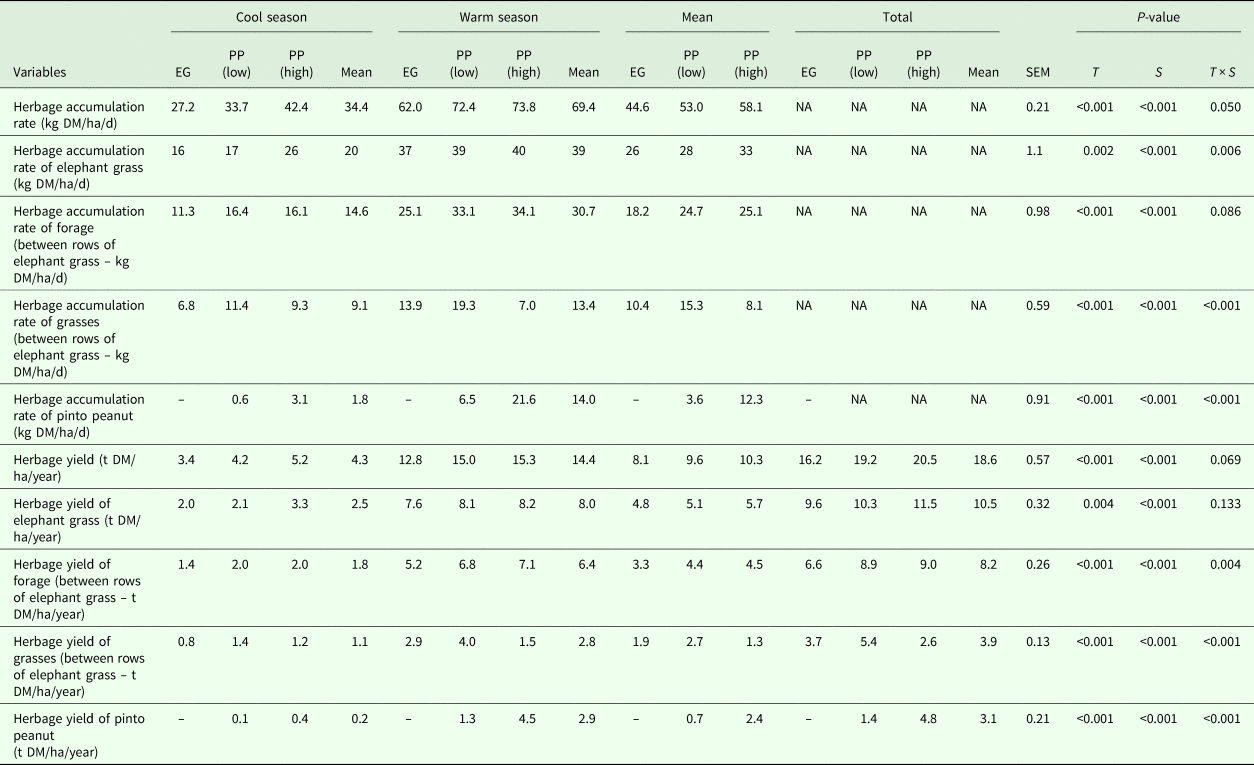
PS, pasture system; EG, elephant grass-based (control); PP (low), pinto peanut, low-density in the forage mass + EG; PP (high), pinto peanut, high-density in the forage mass + EG; SEM, standard error of the mean; P-value, significance level; T, treatment; S, season; NA, not applicable.
In the grass–legume forage systems, the values of herbage accumulation were not different across treatments (Table 2), with a production of approximately 20 t DM/ha/year. In the cool season, the differences were more evident, with greater yields associated with forage legume levels (r = 0.9283; P < 0.001). In the cool season, the forage yield of legume improved the residual effect on subsequent crops and the proportionality of low- and high-density pinto peanut (P < 0.001) compared with the pure grass system.
Nutritive value
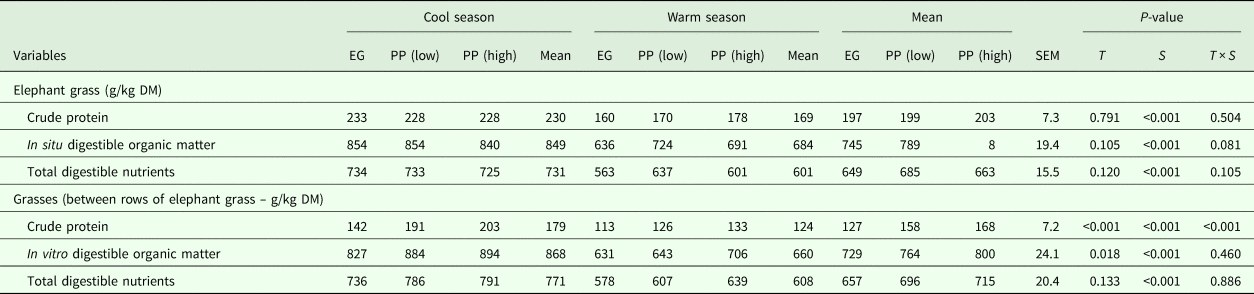
Regarding the nutritional value of elephant grass (Table 3), the crude protein, digestibility and total digestible nutrients had similar values across the systems in the cool season. The values observed for grasses between rows of elephant grass were considered high due to the abundant presence of ryegrass, which typically has better nutritive value than that of warm-season grasses. In the warm season, there was a greater effect (P < 0.001) of the highest level of forage legumes than without the legume system in relation to crude protein. This result confirmed that pinto peanut benefited the companion grass, increasing its protein concentration. The same occurred for grasses between rows of elephant grass, with higher protein values (P < 0.001) both in the cool and warm seasons. The correlation analysis between pinto peanut and herbage protein concentration in elephant grass (r = 0.688, P = 0.008) and other grasses between rows (r = 0.651, P = 0.001) confirmed these results. As with the other variables, there were no differences among forage systems. However, between seasons, the lowest values obtained in the warm season were associated with the pastures of that season, which usually had lower nutritive values than those of the cool season grasses.
Nutritional value of the grasses in the three pasture systems, Santa Maria, RS, Brazil, 2016–2017
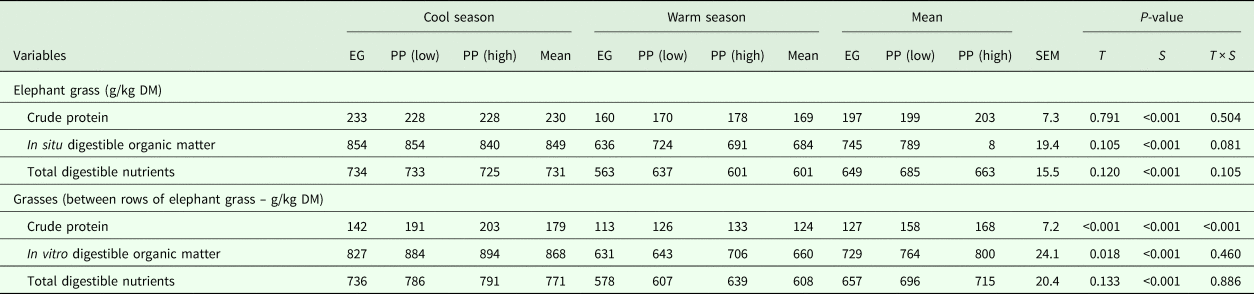
EG, elephant grass-based (control); PP (low), pinto peanut, low-density in the forage mass + EG; PP (high), pinto peanut, high-density in the forage mass + EG; SEM, standard error of the mean; P-value, significance level; T, treatment; S, season. In cool season: elephant grass (leaf blade 195 g/kg DM; stem + sheath 366 g/kg DM; senescent material 439 g/kg DM); grasses between rows of elephant grass (annual ryegrass 622 g/kg DM). In warm season: elephant grass (leaf blade 644 g/kg DM; stem + sheath 283 g/kg DM; senescent material 73 g/kg DM); grasses between rows of elephant grass (sour grass 494 g/kg DM; vaseygrass 220 g/kg DM; Bermuda grass 208 g/kg DM; Alexander grass 73 g/kg DM).
Grazing efficiency
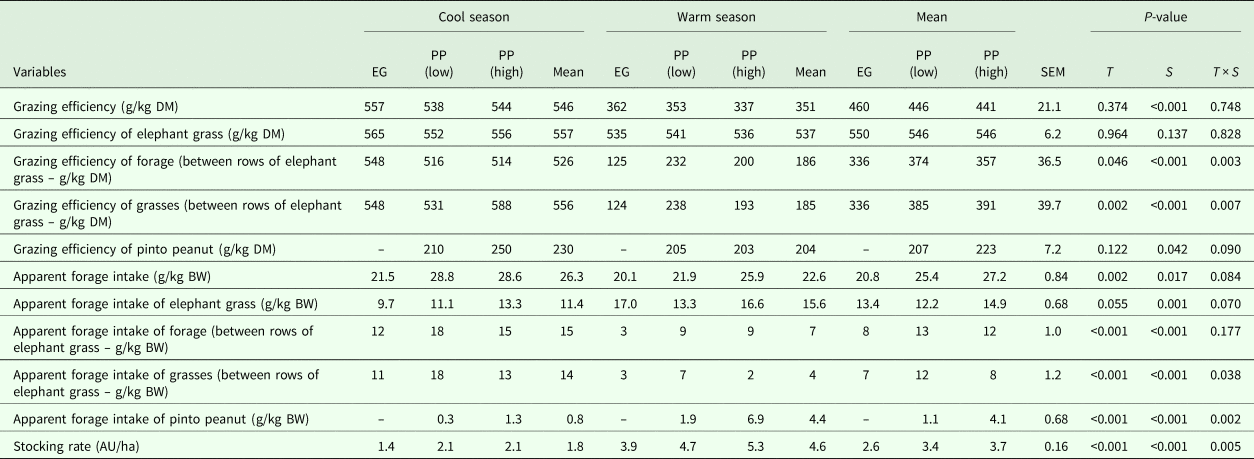
There was no effect on grazing efficiency in the pastures (Table 4). The grazing efficiency in elephant grass was high and was similar between the cool and warm seasons, indicating the preference of cows for this forage grass throughout the year. There was an effect on the grazing efficiency of herbage between rows of elephant grass in the warm season, with a higher value (P = 0.046) associated with the presence of pinto peanut. The correlation analysis indicated that there was an associative effect between the presence of forage legumes and grazing efficiency (r = 0.700; P = 0.005).
Animal responses in the three pasture systems, Santa Maria, RS, Brazil, 2016–2017
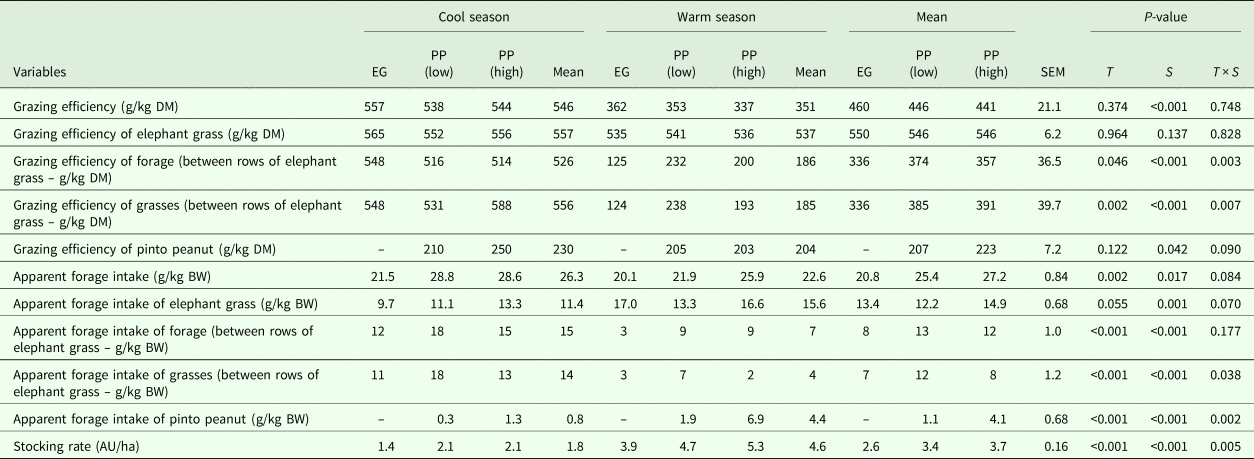
EG, elephant grass-based (control); PP (low), pinto peanut, low-density in the forage mass + EG; PP (high), pinto peanut, high-density in the forage mass + EG; SEM, standard error of the mean; P-value, significance level; T, treatment; S, season.
Forage intake and stocking rate
The high value of forage intake (Table 4) observed in the cool season was related to the abundant presence of ryegrass (Table 1) in the pasture composition with greater (P = 0.001) grass–legume systems. Between rows of elephant grass, forage intake was high in grass–legume systems. The same was found with elephant grass. The presence of pinto peanut at the highest density in the warm season resulted in greater (P = 0.002) herbage intake of the pasture.
The stocking rate (Table 4) values were related (r = 0.776; P < 0.001) to the pre-grazing elephant grass mass, considering that this forage comprised most (491 g/kg DM) of the pasture composition. The stocking rate was greater (P < 0.050) in the warm season because of the high contribution of elephant grass to the forage yield in all grazing systems compared with that during the cool season. Consequently, in the cool season, there was an effect of pinto peanut, resulting in greater (P < 0.001) herbage mass and stocking rate. In the warm season, a higher stocking rate (P < 0.001) was found for the grass–legume system than in the grass system.
Discussion
Pasture responses
The results demonstrated that the presence of pinto peanut between rows in the pasture composition contributed to balancing the herbage mass availability between the cool and warm seasons. This condition is important since it facilitates the management of more uniform nutritional requirements for animals throughout the year.
The effect of pinto peanut occurred both in herbage between the rows of elephant grass and within the rows, which were composed of the clumps of elephant grass. A similar condition was observed for elephant grass mixed with red clover (Diehl et al., Reference Diehl, Olivo, Agnolin, de Azevedo Junior, Bratz and dos Santos2014). However, in the warm season, pinto peanut did not affect the morphological composition of elephant grass. A possible explanation is the competition for water, light and nutrients between the grasses and forage legumes. During the growth of legumes, at least 0.80 of their nitrogen needs must be supplied by biological fixation to ensure survival in the area of mixed forage systems (Miranda et al., Reference Miranda, Vieira and Cadisch2003).
The reduction of the dead material fraction on the pasture and the high proportion of green herbage in the mixed systems is probably due to the higher nitrogen supply to the system (Primavesi, Reference Primavesi2002), implying a higher leaf biomass associated with pinto peanut than with elephant grass in the cool season. However, the presence of pinto peanut and other species in the cool season interferes with the growth and development of ryegrass, reducing its participation in the forage mass.
In the cool season, higher values of the herbage accumulation rate were associated with pinto peanut in the pasture composition. This result was probably due to a synergistic effect, since degradation of sward forage peanuts occurs with low temperatures and frost, including both the above- and below-ground parts (Hakala and Jauhiainen, Reference Hakala and Jauhiainen2007), resulting in the release of nutrients from the companion species (Assmann et al., Reference Assmann, Assmann, Soares, Cassol, Giasson and Giasson2007; Ludwig et al., Reference Ludwig, Lovato, Pizzani, Goulart and Schaefer2010). In the warm season, the higher herbage accumulation rate of forage between rows of elephant grass in the presence of pinto peanut can be explained by the greater proximity of the pinto peanut to the associated species.
The herbage yield values are associated with the herbage accumulation rates, and the results of the current research confirm the effect of forage legumes on the subsequent crop (Peyraud et al., Reference Peyraud, Le Gall and Lüscher2009; Atienza and Rubiales, Reference Atienza and Rubiales2017; Traill et al., Reference Traill, Bell, Dalgliesh, Wilson, Ramony and Guppy2018). Herbage yield ranged from 19.1 to 20.5 t DM/ha/year and was similar to that reported for perennial legume–grass pasture by Pachas et al. (Reference Pachas, Shelton, Lambrides, Dalzell, Murtagh and Hardner2018).
The high value of crude protein in the leaf blade of elephant grass during the cool season was associated with the low growth of this forage, and in this condition, better nutritive values were found in elephant grass forage (Olivo et al., Reference Olivo, Charão, Pereira, Ziech, Meinerz and Tyska2007). In the warm season, the presence of pinto peanut affected the crude protein concentration of elephant grass positively. The same was found for crude protein in grasses between the rows of elephant grass. This result was probably due to the release of nutrients for the companion grasses provided by the degradation of pinto peanut (Hakala and Jauhiainen, Reference Hakala and Jauhiainen2007; Ludwig et al., Reference Ludwig, Lovato, Pizzani, Goulart and Schaefer2010). Similar results were found in a study conducted with elephant grass in the same region, with protein contents of 204 and 177 g/kg DM for the cool and warm seasons, respectively (Diehl et al., Reference Diehl, Olivo, Agnolin, de Azevedo Junior, Bratz and dos Santos2014).
The presence of pinto peanut in the cool season, at both levels, approached the values obtained for crude protein, since the crude protein content is similar to that of ryegrass in this season (Diehl et al., Reference Diehl, Olivo, Agnolin, de Azevedo Junior, Bratz and dos Santos2014). The presence of pinto peanut, even at the highest level in pasture composition, did not influence pasture digestibility or total digestible nutrients. However, in all systems, the nutritive value was greater than in the warm season.
Studies have demonstrated that pinto peanut ‘Amarillo’ has low variability in nutritive value throughout the year, even in a sub-tropical climate, compared with that of grasses. In the same region, levels of 246 and 191 g/kg DM; 340 and 378 g/kg DM; 841 and 773 g/kg DM have been obtained for crude protein, neutral detergent fibre and in vitro digestible organic matter of pinto peanut, respectively, in the cool and warm seasons (Diehl et al., Reference Diehl, Olivo, Agnolin, de Azevedo Junior, Bratz and dos Santos2014). In another study, the values of pinto peanut (averages of the year) were 228, 382 and 741 g/kg DM for the same variables, respectively (Olivo et al., Reference Olivo, Diehl, Agnolin, Bratz, Aguirre and Sauter2017). These results improved the nutritive value of forage grass–legume pastures throughout the year.
Animal responses
The average values indicated that there was no forage intake limitation, a condition that normally occurs when the grazing efficiency exceeds 500 g/kg DM (Delagarde et al., Reference Delagarde, Prache, D'Hour and Petit2001). The grazing efficiency of the pasture was greater in the cool season associated with the high contribution of ryegrass. Additionally, the high nutritional value of elephant grass in the cool season improved this result (Olivo et al., Reference Olivo, Charão, Pereira, Ziech, Meinerz and Tyska2007). The grazing efficiency was low in the warm season, probably as a result of companion grasses, which have lower nutritive value. Grazing efficiency was greater in grass–legume systems between rows of elephant grass. This result may have been due to the forage legume effect improving the nutritive value of the companion grasses. The grazing efficiency of pinto peanut was lower, indicating that the dairy cows grazed the grass preferentially. This intake behaviour contributed positively to the perennialization of legumes in the system.
The greater apparent forage intake in mixed pastures was probably caused by the presence of the pinto peanut. Elephant grass intake was high during the cool season, a condition associated with the lower growth of this forage due to the cold. In this condition, the herbage yield was reduced, with a lower fibre content and better nutrient value (Diehl et al., Reference Diehl, Olivo, Agnolin, de Azevedo Junior, Bratz and dos Santos2014; Olivo et al., Reference Olivo, Diehl, Agnolin, Bratz, Aguirre and Sauter2017). In the cool season, the similarity observed in herbage intake was due to the high presence of ryegrass in the pasture composition for all systems.
In both cool and warm seasons, stocking rates were greater in grass–legume systems. This result was due to the contribution of pinto peanut increasing the herbage yield and the nutritive value of the pasture. A similar value was found with elephant grass mixed with red clover (Azevedo Junior et al., Reference Azevedo Junior, Olivo, Meinerz, Agnolin, Diehl, Moro, Parra, Quatrin and Horst2012).
The stocking rate in the warm season, 4.6 AU/ha, was greater than that obtained with elephant grass ‘Kurumi’ in monoculture or mixed with pinto peanut, cv. Amarillo, and fertilized with 200 kg N/ha (Crestani et al., Reference Crestani, Ribeiro Filho, Miguel, de Almeida and Santos2013).
Conclusions
The presence of pinto peanut interferes with the pasture botanical composition, reducing the presence of other species and dead material. This forage legume affects the morphological composition of elephant grass, resulting in a higher proportion of leaf blades and stem + sheath and a lower proportion of senescent material in the cool season.
At different levels of pinto peanut, there is an increase in the herbage yield and protein concentration of the companion grasses, forage intake and stocking rate. The forage legume does not affect the in vitro digestible herbage mass and total digestible nutrients of the companion grasses.
Increasing the forage legume contribution from 0.063 to 0.206 of herbage yield is proportionally associated with the best results for pasture and animal responses and the best seasonal forage distribution throughout the year.
Author ORCIDs
A. C. Vieira, 0000-0002-7140-1421.
Financial support
The research was supported by the National Council of Scientific and Technological Development (CNPq), Foundation of Support to Technology and Science (FATEC) of Federal University of Santa Maria (UFSM) and resources own Laboratory of Dairy Livestock from the milk production.
Conflict of interest
None.
Ethical standards
The techniques and procedures used in this study were approved by the Animal Experimentation Ethics Committee of the Federal University of Santa Maria (protocol n. 23081016073/2011-27, opinion n. 113/2011).