Introduction
Every year the National Academy of Recording Arts and Sciences presents dozens of awards for excellence in recorded music. Among these ‘Grammy’ awards are those for ‘Record of the Year’ and ‘Song of the Year’. One of these recognises the producer's and the performer's work on the ‘record,’ and the other, the songwriter's work on the ‘song’. It is understandable that the Academy would acknowledge separately these distinct roles in popular music, as the industry has different job titles for the two. But the distinction goes beyond the practical to the philosophical. The ‘record’ and the ‘song’ are separate musical entities. Exactly what these entities are, however, is unclear.
In the eyes of the music business and the law the distinction is unambiguous: the songwriter creates, and usually holds the copyright to, the (abstract) composition, while the producer and performer are responsible for, but are not necessarily copyright holders of, the (concrete) recording. Philosophically, however, it is not so tidy. When listening to or analysing the music in a recording, for example, it is rarely self-evident which musical elements belong to the composition and which belong to the performance. That a song can be recorded dozens of times, in varied and contrasting genres, suggests that producers, arrangers and performers all contribute to the musical result, if not to the original song. In this light, the record can easily be seen as the musical work, and much fruitful analysis can and does come from doing so. At the same time, though, one must acknowledge that lying deep inside every record is the song, composed of those core elements found in each and every recorded version of that song. Discerning those elements is the hard part. John Wallace White argues for the song's separate identity:
If a tune's syntax is essentially that of tonal music, a stylistic comparison between the original version and its remake may reveal very little difference in such parameters as melody and basic harmony. This is not surprising, since changes to a tune's primary structure would negate easy aural connection to the original and seemingly contradict the aims of the record producer. (White Reference White1997, p. 5)
To recognise a certain melodic or harmonic similarity is one thing. To pinpoint a specific core melody or core harmonies of a song is quite another. Such components must be present, though, for if one were unable to distinguish the song from the record, the ‘Song of the Year’ and the ‘Record of the Year’ simply would go to the writer and the producer of the same hit single.
As noted above, many analyses of popular songs employ a single recording as a text for study. This type of approach avoids the difficult questions just raised and provides the analyst with an unambiguous definition of the work. It simply is the recording, and because it is a permanent record, varying in its performance only to the extent that the listeners' audio equipment does, one need not separate the song from its performance. The recording merges the two into one. As a result, the record is frequently attributed only to the named performing artist. Scholars give perfunctory credit to the songwriter(s) but usually will refer to the record – and even the song – as being ‘by’ the lead performer or group. Questions of attribution and authorship aside, if one convincingly can delineate the song and its performance, the stage is then set for successful analysis and discussion of each.
Of course, popular songs rarely are represented by anything resembling an authoritative score, if they are even notated at all. Furthermore, most songs are realised in multiple recordings or performances, often by multiple performers, across various points in time. As it turns out, however, this multiplicity of instances helps to clarify which musical elements fall in the realm of the song and which, of the performance. Nicholas Cook suggests that
just as we traditionally understand performances in terms of the works they are performances of, so we need to understand works in terms of the performances they emerge from. In other words, we need an analytical approach that doesn't presuppose the identity of a song as a meaningful whole, but lets it emerge in answer to the question ‘by virtue of what are these texts received as representations of the same abstract entity, such that what is heard derives meaning from being heard in this context’? (Cook Reference Cook1996, p. 40)
I propose that the popular song is, as Cook suggests, an abstract entity, one whose identity emerges only after careful study of its various realisations. I further propose that a song's core components lie at a level of abstraction beyond a simple lead sheet or notated melody. Even the songwriter's own arrangement is subject to variation by different performers, but there remain a few distinct elements in any song that are faithfully retained in any performance that purports to be a performance of that song. Furthermore, I believe these elements can be identified, and this essay is a step toward finding them.
What follows first is a discussion of some recent literature on the practice of cover versions, after which I make the distinction between cover versions and non-cover versions, pointing out that the difference is one of degree, not of kind. Second, from a close investigation of the melodic pitch elements in six versions of a single song, comes the notion of core components, perhaps parts of the ‘abstract entity’ to which Cook refers. Finally, to close, are some brief reflections on the role of pitch compared to other musical domains, on the possibility of other repertoire being investigated with similar methods, and on general questions of authorship.
Covers and versions
Defining a cover as an ‘intertextual commentary on another musical work or style’, Mark Butler (Reference Butler2003, p. 1) points out four ways in which the duo Pet Shop Boys make such commentary upon U2's ‘Where the Streets Have No Name’. First, Neil Tennant, singer of Pet Shop Boys, gives a ‘remarkably smooth’ nonchalant delivery where Bono, of U2, is so earnest and strident his voice cracks. Second, the cover's synthesiser-heavy production, often considered artificial, is in stark contrast to U2's rock arrangement. Third, U2 builds to a huge climax whose melody becomes a ‘catchy ditty’ in the cover. These three transformations suggest a mocking of U2's over-the-top sincerity, a pompousness criticised elsewhere in print by Neil Tennant himself, but the fourth change confirms it for Butler: the Pet Shop Boys make a version with all the hallmarks of disco. ‘And in this transformation lies the core of their critique of the original song's authenticity, for disco has been widely construed as anathema to the spirit of rock ’n' roll' (Butler Reference Butler2003, p. 7). I review Butler's assessment at length because it is representative of discourse for this type of analysis; it is the language of covers. Owing to the huge variety of performers in recorded history and their penchant for reinterpretation, the popular music field is rich with such analysis. To analyse the cover is to concern oneself with the differences between performances of a song, with particular attention paid to the inherent commentary that the later version makes upon the earlier one. It is true, of course, that core-like elements – melodic fragments, harmonic patterns – are discussed, but only in service of the main discussion, that which involves a comparison of production elements, arrangement and vocal style. The fact that virtually any U2 song could be given the same treatment by the Pet Shop Boys (and then could yield a similar analysis) is actually a virtue of this type of analysis. As powerful as such analysis may be, it clearly is not always focused on the song itself.
Dai Griffiths (Reference Griffiths, Hesmondhalgh and Negus2002), in his article ‘Cover versions and the sound of identity in motion’, looks more at the covering performer than the cover recording itself. Considering mainly textual and textural content (lyrics and arrangements), Griffiths looks at covers to comment not only on the different performers, but also on the shifting identities of the performers. As his title suggests, this identity often changes from cover to cover. It is as if a song offers a role to play, and each time it is performed someone new steps into the spotlight to comment upon those who went before. The commentary need not be explicit. It is implicit in the very identity of the actor filling the part. One of his examples is Bob Dylan's ‘Just Like a Woman’, which conveys a radically different meaning when performed by a woman. Other facets of identity – sexuality, race, class, nation and language – are transformed throughout a song's changing history.
Like Butler, Griffiths does not need to refer to abstract core components of a single song. The issue at hand is how the covers relate to each other. Tracing which versions are actually being covered, though, can be a tricky business. Describing Ray Charles's version of ‘Your Cheatin’ Heart' Griffiths writes, ‘the addition of strings, mixed-gender backing vocals and cocktail piano quite transformed [Hank] Williams’ sparse original, if indeed Charles was covering the Williams original, rather than hit versions in 1953 for Frankie Laine and for Joni James' (Griffiths Reference Griffiths, Hesmondhalgh and Negus2002, p. 57). This ambiguity alone ought to be enough to encourage the analyst at some point, when considering covers, to consider what it is that binds them together, what the performers are saying that they did not, in fact, author themselves.
Many recordings we think are ‘original’ may be found to be simply versions of earlier demos, or even of earlier rehearsals or unrecorded performances. Sometimes a songwriter will write a song, which famously gets recorded by another performer, only to release his or her own new version later. If one asserts that all versions necessarily are covers of other existing versions, matters can get confusing when songwriters cover themselves and huge hit songs are deemed covers of obscure demo tapes. For example, in 1967 Carole King and Gerry Goffin wrote ‘(You Make Me Feel Like) A Natural Woman’ expressly for Aretha Franklin for whom they produced a demo recording, a tape on which Franklin, engineer Tom Dowd and arranger Arif Mardin based their hit production (King Reference King2012, pp. 122–4). Later, in 1970, King recorded it again herself for her 1971 album Tapestry ‘with a simple arrangement along the lines of the original demo [but with] a few chords from Arif's arrangement that weren't on [the] original demo’ (King Reference King2012, p. 126). Kurt Mosser grapples with an apparent paradox: ‘It seems counterintuitive to suggest that King's own [1971] performance is the cover, in that it is, obviously enough, originally her own song. Yet it also seems counterintuitive to suggest that Franklin's earlier and paradigmatic version should be, in any relevant way, a cover’ (Mosser Reference Mosser2008, p. V.a.) Not only are these suggestions counterintuitive, but they are also unnecessary. The paradox disappears if we are not compelled to see all versions as inter-referential and instead are inclined to see them referring to one abstract formation, discarding as irrelevant any question of which came first. In other words, the three (demo, Franklin's, King's) all are versions of something else entirely.
‘There is a difference between cover records and cover songs’ (Cusic Reference Cusic2005, p. 176). With this, Don Cusic gets right to the point. Some performances are commentaries on other recordings, while others are interpretations of songs with little regard for other renderings. Gabriel Solis follows this thread:
A cover is not simply any new version of an older song for which the original was a recording. Rather, a cover is a particular kind of version: a new recording or performance of an older song that exists in the memories of musicians and audiences because of a strong, previous recorded version, and for which authority and authenticity are understood to be shared by the original performer and the covering performer. (Solis Reference Solis2010, p. 315)
Echoing Cusic, Solis goes on to acknowledge the difference between ‘version’ (Cusic's ‘cover song’) and ‘cover’ (Cusic's ‘cover record’). He sets the difference historically in the change from the older jazz tradition of making versions of pop tunes (versions) to the advent of rock in the 1950s and 1960s, which was accompanied by inter-performer commentary (covers).
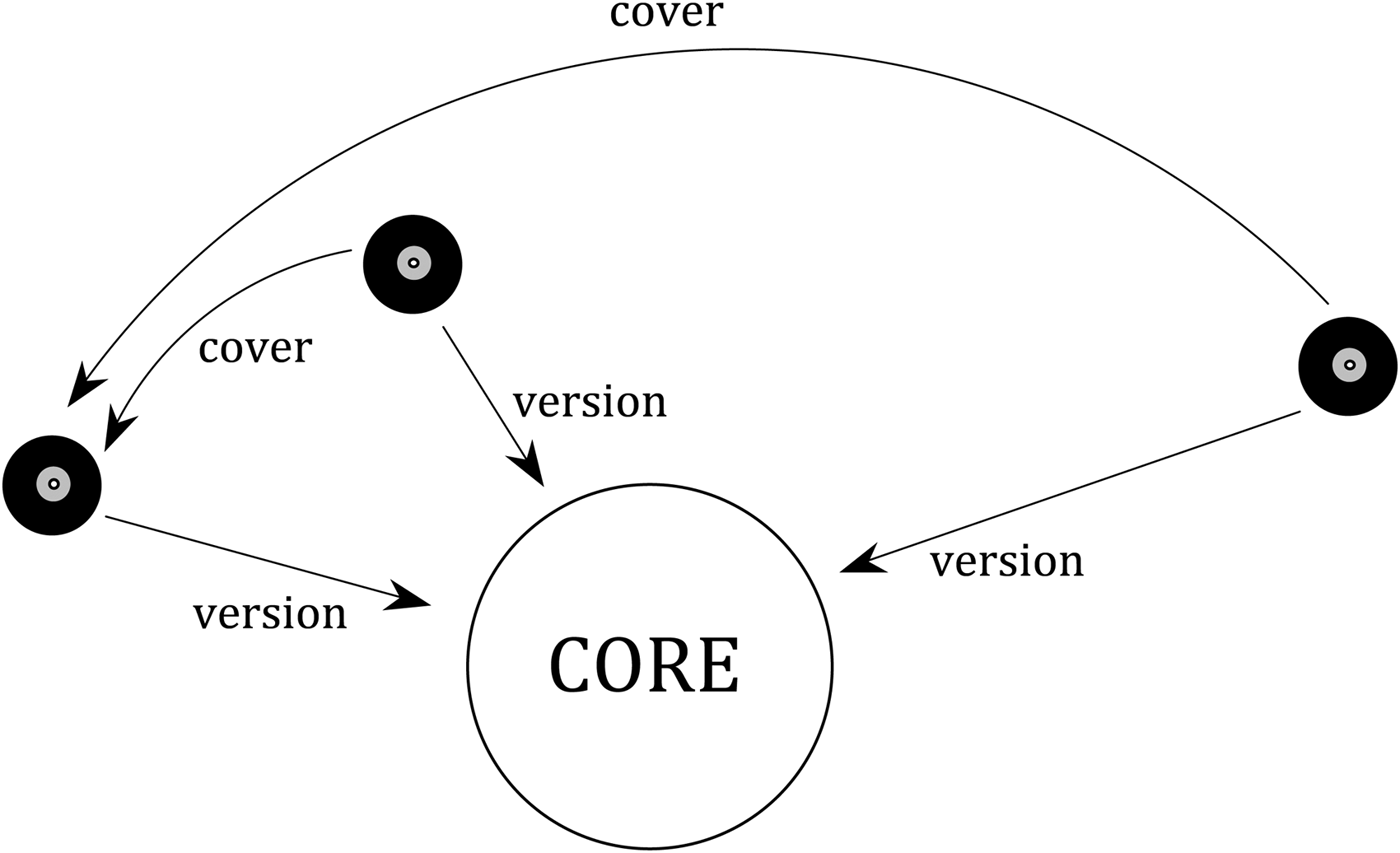
Using the simple terms ‘version’ and ‘cover’, I offer in Figure 1 a simple representation of the relationships between versions, covers, and a song's core components. The song's core is placed in the centre, and the versions of the song are numbered around it. The arrows marked ‘version’ represent these relationships. All versions require this arrow, for without it, there is no essential connection. The arrows between versions represent covers. Some versions are covers of multiple versions, hence multiple ‘cover’ arrows. Some versions ignore others. Naturally, performers often create a version of a song unaware of the versions that already exist. One of the versions can even be a performance by the songwriter. In this role, though, the songwriter is acting as performer, whose interpretation is not privileged in any logical way over the others. Professional songwriters are often the first to admit that theirs are not the best representations of their work.
A scheme of versions, covers, and core.

Of course, version and cover are far from mutually exclusive. Many recordings easily can be both to a certain extent, while some versions are wholly unique, referring specifically to no other version, only to the song's core elements. What is more, one cover might adhere very closely to the version it is covering, while another cover, making only passing reference to another performer's version, deviates substantially. Appreciating this distinction, Griffiths has proposed the useful terms ‘rendition’ and ‘transformation’. The former is a cover that more faithfully reproduces another version, while the latter is one that substantially reworks it (Griffiths Reference Griffiths, Hesmondhalgh and Negus2002, p. 52).
Core components in ‘Didn't We’
Philip Tagg (Reference Tagg and Middleton1982) has outlined a methodology, quite complex at first glance, that allows for the comparison and deduction of meaning in musical elements. He includes a ‘checklist of parameters of musical expression’. These parameters, divided into seven categories, are later used as hypothetical substitutions, whereby the parameters of a subject are systematically altered to discover which parameters carry a given meaning. As an example, Tagg takes the Swedish National Anthem and compares seven versions, each containing one altered parameter: one has a lyrics substitution, another uses different articulations, or a new rhythmic subdivision is introduced in another. Searching for the ‘solemn and positively dignified yet confident character’ (Tagg Reference Tagg and Middleton1982, p. 86) national anthems tend to exhibit, Tagg examined the hypothetical versions to determine which parameters, when altered, erase the dignified character from the melody. These parameters can then be confirmed as bearers of the dignity. My method is similar to Tagg's in that it systematically separates musical parameters, specifically melodic pitch. Unlike Tagg's, however, it begins not with a definitive version but with different, actual, performances that are all accorded the same status.
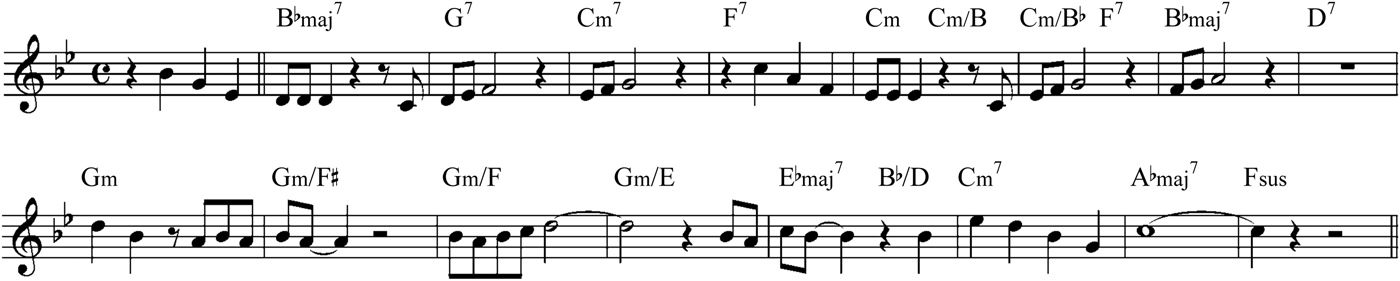
In 1968, Richard Harris recorded songwriter Jimmy Webb's ‘Didn't We’, reaching #63 on Billboard's Hot 100. Barbra Streisand took it to #82 in 1972, giving the song its only other appearance on that chart. These two versions, Stan Getz's jazz version, Gene Ammons's R&B version, Michael Feinstein's more recent version, Dan Coates's easy piano sheet music version and Jimmy Webb's own version all are unique performances, not one of them the ‘true’ text.Footnote 1 Therefore, in one sense, an analysis of the song is impossible. These performances can, however, help us to separate the song's core from its interpretations. Example 1 is a simple lead sheet of the song, an exposition of its melody and harmonic progression. It must be said, however, that this lead sheet is yet another version, my own interpretation of the song. Privileging some pitch and rhythm choices over others, it is an easy-to-read synthesis of the versions I know. In no way is it a definitive version, but for those unfamiliar with the song, it can be a helpful introduction.Footnote 2
Lead sheet for first AB of Jimmy Webb, ‘Didn't We’, arbitrarily set in Bb major.
The first task is not to showcase meaning inherent in the differences but conversely to look at the few related elements and to construct a contour-based notation to represent the song's definitive features. These features become more defined and more apparent with each additional version studied, just as a person's character becomes observable after multiple subjections to different situations or environments. The resulting abstract structure – abstract because it is a musical entity not actually manifest, as is, in any one version – is the song's unchangeable core that no interpreter would do without, while the ancillary contributions of performers, producers, and arrangers – refracting the core through their own prisms – contribute richer meaning, a meaning perhaps more easily analysed as a second task once the core is exposed.
In all six versions studied, ‘Didn't We’ is in the form ABAB', or bar form, which is not to be confused with verse/chorus form. There is no chorus or refrain to which verses lead. The first A section ultimately leads to a half cadence at the end of B, while the second A section leads to an authentic cadence at the end of B', thus making AB' a consequent to the antecedent AB. From each version, only the first AB is extracted for study, as the initial statements usually are the clearest melodic expositions. Performances of subsequent iterations may be of interest in later study.
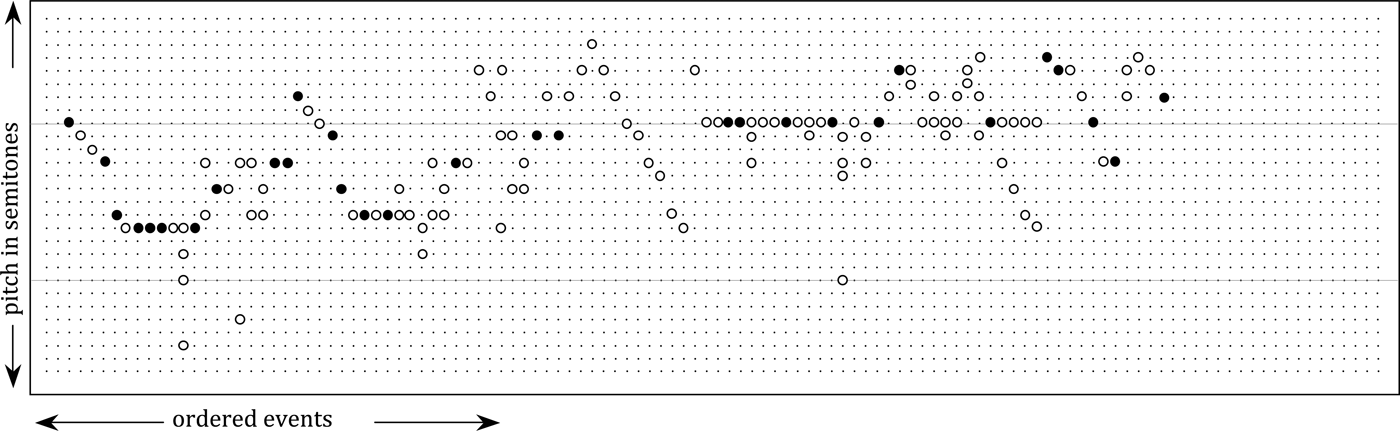
Figure 2 is simply a long grid of dots where the vertical, Y-axis represents pitch not in scale steps, but in semitones.Footnote 3 This song does lend itself to a diatonic reading, but a chromatic backdrop, or grid, is preferred for three reasons:
1. This song could conceivably be harmonised or arranged in such a way as to obscure its diatonic origins and yet still be to all listeners ‘Didn't We’. Think of a modern jazz rendering or a solo performance on a synthesiser that automatically and consistently harmonises a specific tetrachord over the melody.
2. Some versions use notes outside the key. Gene Ammons's, for example, contains typical jazz articulations with some chromaticism. Of course they are based on a diatonic framework or skeleton, but it is not the role of this study to do tonal analysis on each performance. They are to be measured dispassionately against a neutral backdrop, in an effort to define what the performers did, not how or why. Later, when analysing individual performances, however, evaluations about diatonicism can be made.
3. The intent is to examine the pitch domain absent the others such as key or scale. Different versions are in different keys, and avoiding specific pitch names privileges no one key above another. Note that pitches are not named in Figure 2 for this reason. There is one concession to tonality, though. The first scale degree is designated by a horizontal line simply to orient the listener.
The horizontal X-axis represents time, but not uniformly divided. Every pitch event from each version is represented on the grid as a circle. The filled-in circles represent those events that take place in all six versions; the empty ones, all other events. A real-time, left-to-right scan, therefore, would not occur at a uniform speed. For example, Gene Ammons's version is responsible for the large swoop of open circles in the middle, and it takes up a big chunk of the X-axis. This is not a problem. The five other versions simply skip over this part of the graph. It is best to think of these as ordinal events not displayed in real time.
‘Didn't We’ (first AB, melody). Composite of six versions. Filled dots represent pitch events found in all versions.
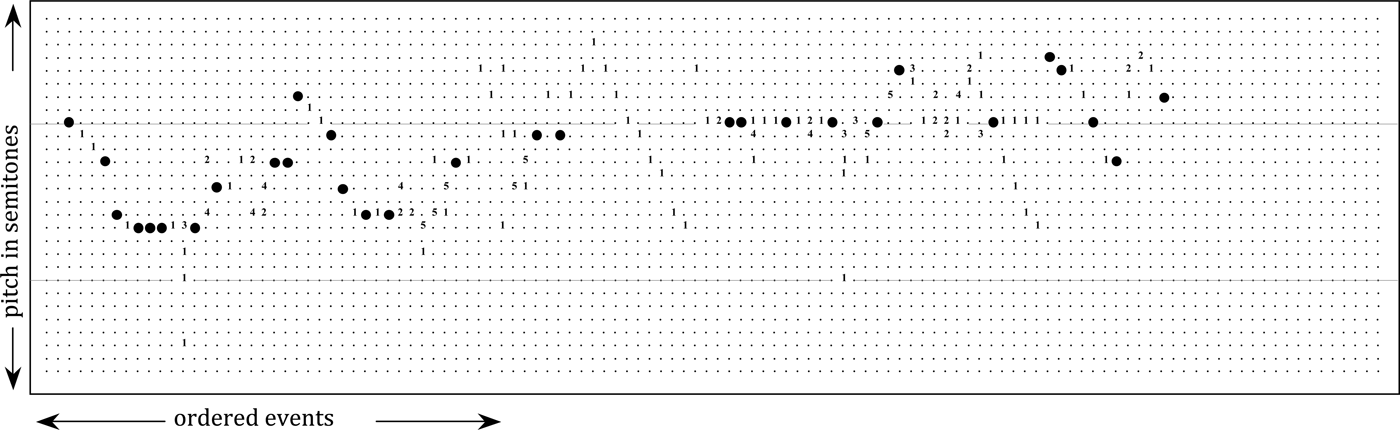
Some of the events represented by open circles, like those in the Ammons swath, are played in only one version. Some are common enough to appear in four or five. Figure 3 replaces each open circle with a numeral, representing the number of versions that play that particular event. Note that the decorative outliers are mostly 1s. The closed circles act as melodic anchors: secured notes that not one of the six versions omits. A five is often near the anchors, robbed of its chance to be an anchor itself by a singer too ornate, or by one performer who stayed silent! In fact, many vertically aligned numbers don't add up to six. That is because each performer leaves a different amount of eventless space between melodic anchors. Some sing straight from anchor to anchor, with zero events in between. Remember time does not progress evenly from dot to dot. Performances can linger on one event and can skip over several, but they all will hit the anchors.
‘Didn't We’ (first AB, melody). Composite of six versions. Numerals indicate number of versions containing that pitch event.
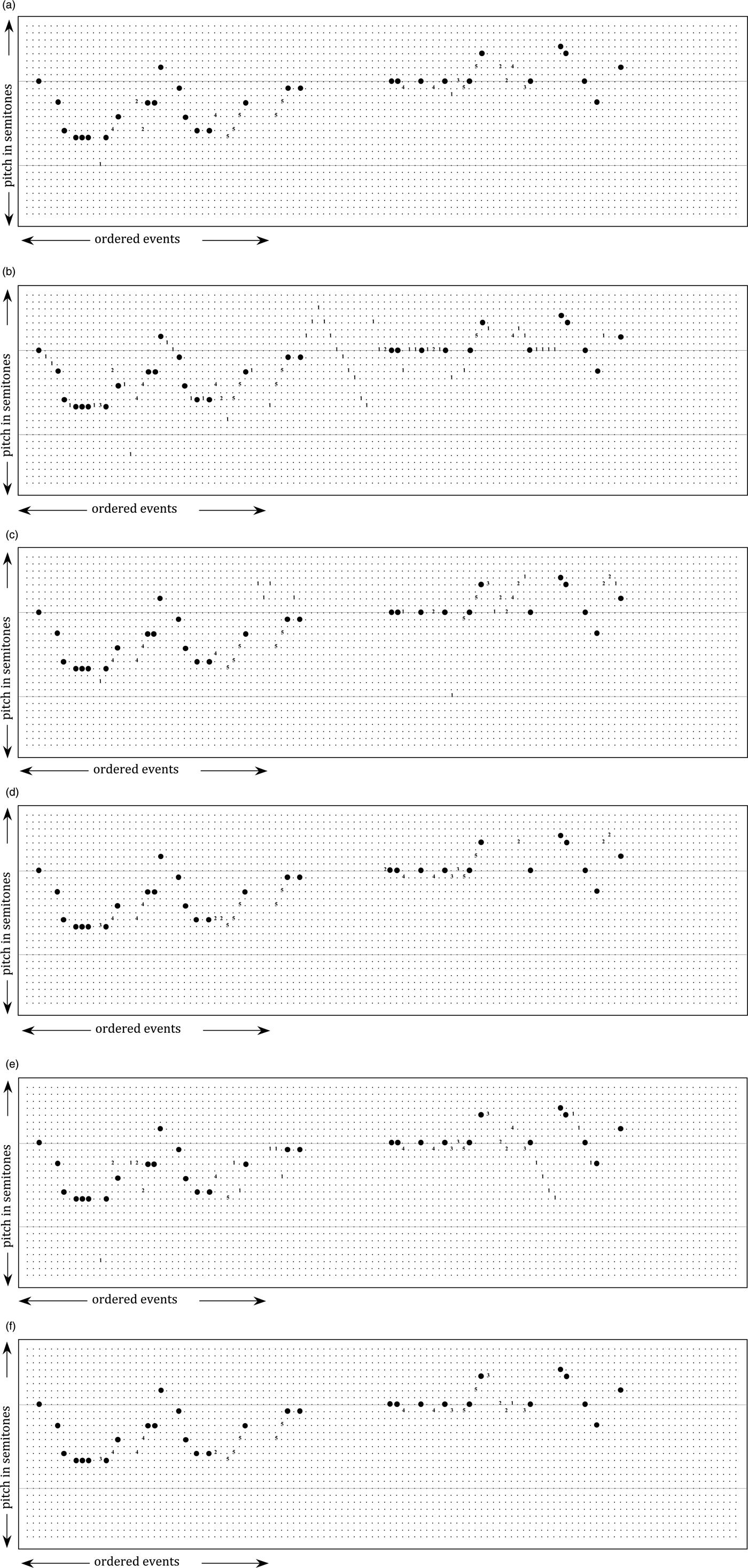
What follows is an individual examination of each of the versions of ‘Didn't We’. Figure 4a is another grid of dots, and everything contained in this grid appears in the previous figure, but only the events sung by Richard Harris in his version appear here. Any event that Harris does not perform is omitted. Anchors, always played, are retained, and the non-anchor events Harris plays appear here in their numeral form. The numeral, just as in Figure 3, represents the total number of versions playing that event. Thus, we are able to give a ranking to each of Harris's events. The lower the number of each event the more unique the event is to Harris. Events in Figure 4a marked ‘1’ are played only by him. An event marked ‘2’ is found in this, Harris's version, and in one other version. There are many fours and fives, common deviations from the anchors, but the first six and the last six events of his version are nothing but anchors. He offers two unique decorations (the 1s), but mostly he sticks with the crowd, showing high numeric values in the graph.
(a) ‘Didn't We’ (Richard Harris's version, 1968). Numerals indicate total number of versions containing that pitch event. (b) ‘Didn't We’ (Gene Ammons's version, 1968). (c) ‘Didn't We’ (Barbra Streisand's version, 1972). (d) ‘Didn't We’ (Dan Coates's sheet-music version). (e) ‘Didn't We’ (Jimmy Webb's version, 1996). (f) ‘Didn't We’ (Michael Feinstein's version, 2003).
Figure 4b shows Gene Ammons's performance in the same way Figure 4b showed Harris's. There are many 1s floating around this graph, which one might expect in a jazz performance. Each of these 1s is part of his own personal stamp. Some 1s stretch out and repeat certain pitches, while others chromatically fill in intervals.
Barbra Streisand's performance is shown in Figure 4c. Her unique events, or 1s, are reserved for high and low extremes here and there. They seem to burst out of the contour at times. Like Harris's, though, her performance shows many safe 4s and 5s here.
In Figure 4d, one finds even less deviation from the anchors. This example, a representation of Dan Coates's easy piano version, contains absolutely no 1s. In other words, Coates included nothing in his melody that no other performer didn't. Everything here appears in at least one other version.
Under this sort of representation, how might the songwriter's own version appear? Would it be mostly embellishment free, showing all 5s and 4s, avoiding any impurities that might mess up his creation? Or would there be many 1s, a result of his putting in all the ‘good’ notes that the various interpreters never seem to get. Figure 4e shows Jimmy Webb's results. Perhaps not surprisingly, it shares some elements of the former versions. There is a clearly stated beginning as in Harris's version (a recording Webb produced) and small swaths of 1s as in the Ammons version. It would be difficult to argue that his is in some way the primary or true version. Cook agrees but in the context of classical music:
A pianist preparing a piece by one of these composers may well listen to the composer's recording just as she or he may well listen to other pianists' recordings. And obviously she or he will hear the composer's recording as possessing a certain kind of authority that the others don't, just because it is the composer's. But few pianists will feel constrained to earnestly reproduce the wayward rhythms of Debussy's playing, any more than conductors are likely to lovingly replicate Elgar's portamenti. (Cook Reference Cook1996, p. 38)
Finally we have the least elaborate version of all. Figure 4f shows Michael Feinstein's more recent interpretation, co-produced by Webb. The simplicity of his vocal delivery is reflected in the sparseness in the grid.
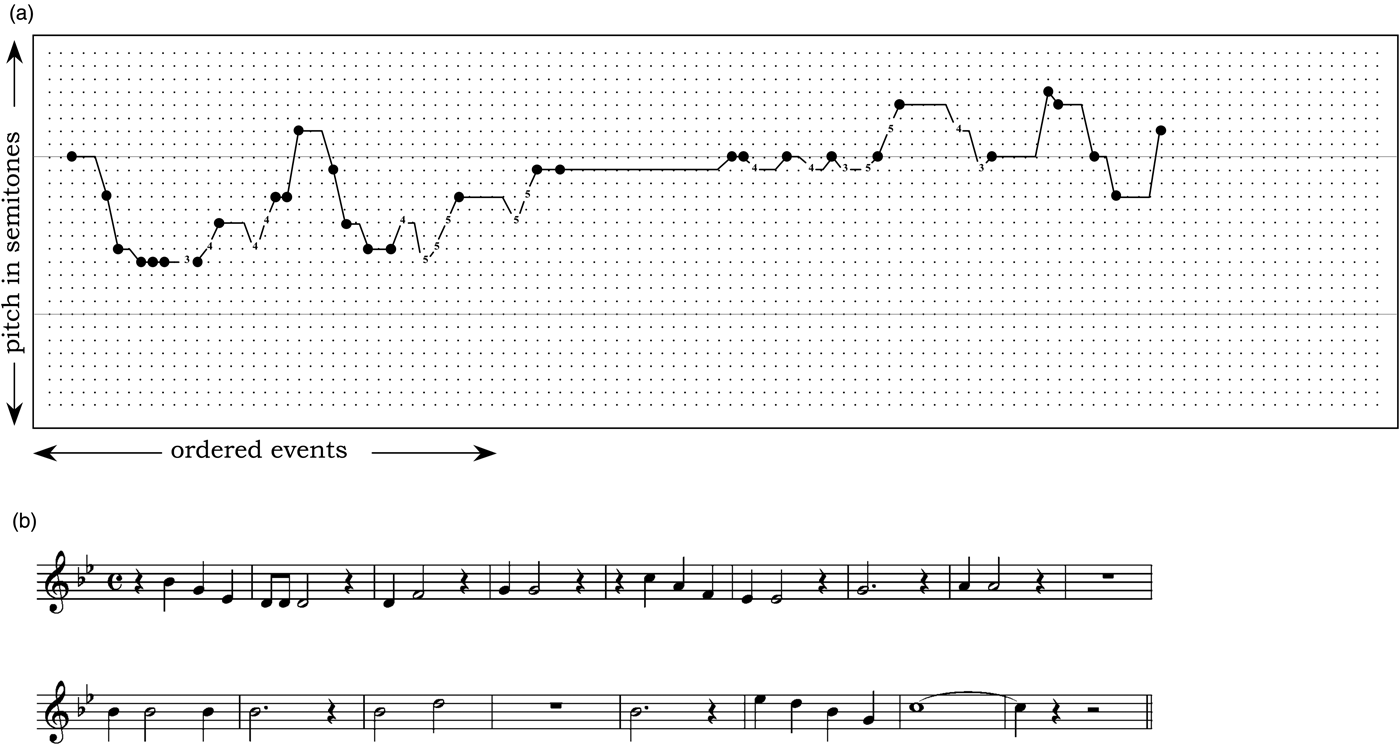
Now it would be useful to compare the contour of each of these versions to some single standard. Not to one real, existing version but to some kind of norm or amalgam of all of them. Returning back to Figure 3, one can imagine a line progressing from left to right, anchor to anchor. The line would approach each column of dots and intersect the position in that column with the highest number, also keeping in mind that if as many or more voices refrain from an event than play a single one, the line remains on the same pitch and moves to the next column. Such a line would represent what most of the versions are doing at any point in the melody. So, for example, in Figure 3 this imaginary line would emerge at the first anchor and progress to the right. The two 1s would be ignored because more versions ignore them than play them. Figure 5a shows what the resulting, ‘normal’ contour would look like if this procedure were followed all the way through. Events that lie on this line but are not statistically the norm, such as 1s or 2s that are mere pitch repetitions, are not shown. Thus this (pitch-) ‘prevalence contour’ shows both the oft-played pitches and, by the numerals, their prevalence. Of course there probably is no version played just like this, just as there is no one single person who reflects all the statistically normal human physiological attributes, but each version can usefully be measured against it. See Figure 5b for a notated rendering of this prevailing contour. In many respects, this melodic core serves as a background of sorts, giving structural underpinning to the melodic embellishment provided by the performer. It may be useful to compare Example 1 and Figure 5b to show how the melodic core is more skeletal than the lead-sheet version.
(a) ‘Didn't We’. Prevailing contour with anchors. (b) ‘Didn't We’. Melodic core.
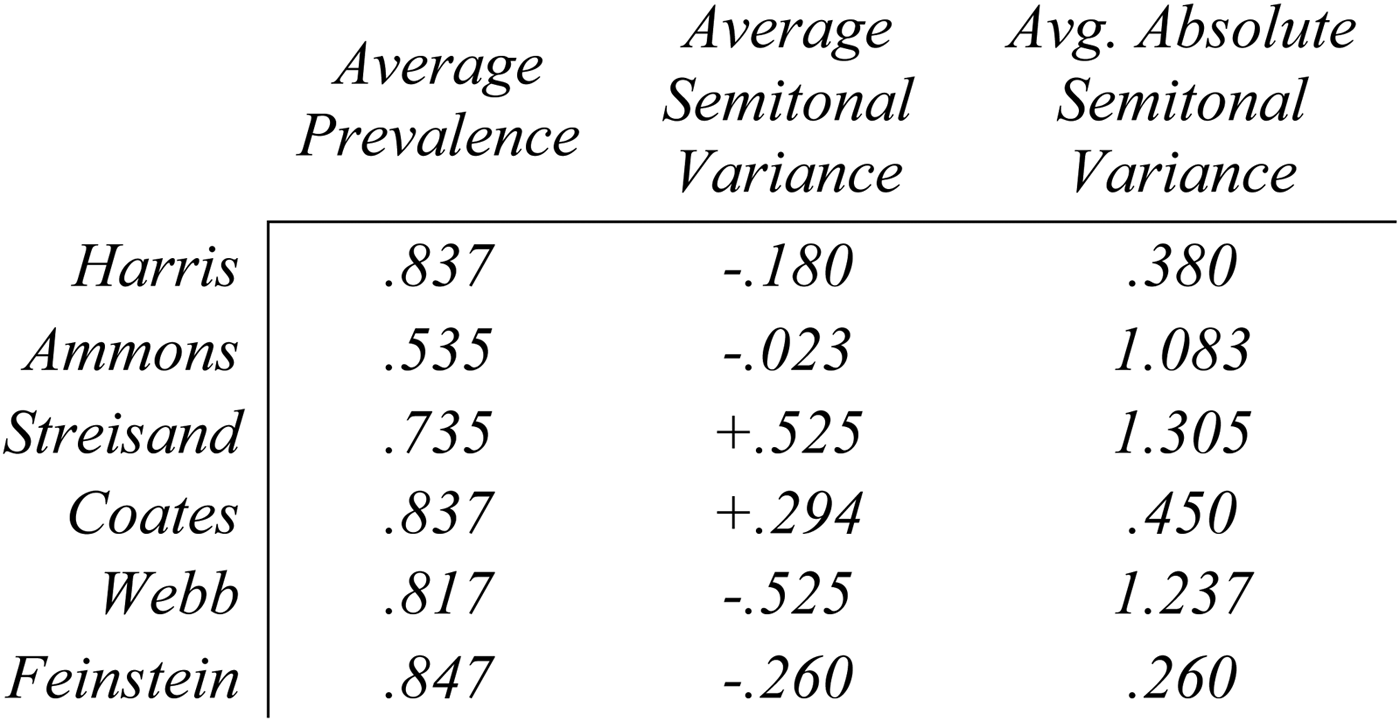
What follows next is a method for crunching all the numbers in these individual Figures 4a through 4f, producing a high score for the performances sticking to the oft-used notes and a low score to those that deviate wildly from the norm. In each version, the closed dots (at a value of 6) and all the numbers are totalled then divided by the total number of events. This gives ‘average pitch prevalence’. Admittedly, the required anchors add significant weight at a value of six, but they must be included. Otherwise the numbers of outlying events won't be compared in proper proportion. For example, a version with only a 1 or 2 scattered about, not diverging much from the anchors, would rank lower than one with rampant 3s, 4s and 5s! Also, high values weighted by the heavy 6s reflect a melody that is anchor-heavy, a quality sure to be reduced as more versions are factored in. The average pitch prevalence for each version is adjusted to a scale of 0–1 and listed in the first column of Figure 6. Note the high ranking of the plaintive Feinstein version. Ammons's idiosyncratic reading predictably receives a low score (or a high one if subtracted from 1 and read as deviance from the norm), but remarkably Harris and Coates receive identical scores, even though they contain different events.
Six variants of ‘Didn't We’.
If each event in a version is ranked with a positive number, negative number, or zero, based on its distance in semitones away from the pitch prevalence contour, those numbers could be averaged, showing the average variance from the contour. Figure 6 shows such results in its second column. If the original values were treated not as positive or negative, but as absolute values, variance above the contour would not cancel out the variance below. The score would get higher and higher as the melody goes on. For example, Gene Ammons ranks closest to zero in average variance, but very high in absolute variance. His decorations are equally above and below the prevalent contour. This absolute semitonal variance is shown in the third column of Figure 6. Although one might think that all later versions will simply elaborate on the earlier ones, never reducing them any further toward the core components, Feinstein's version has a higher average pitch prevalence than even the first recorded version. This suggests that the performer skilfully omitted certain pitch events, creating the most ‘normal’ of the group. This simplicity or non-uniqueness is balanced by the warmth and directness of his performance.
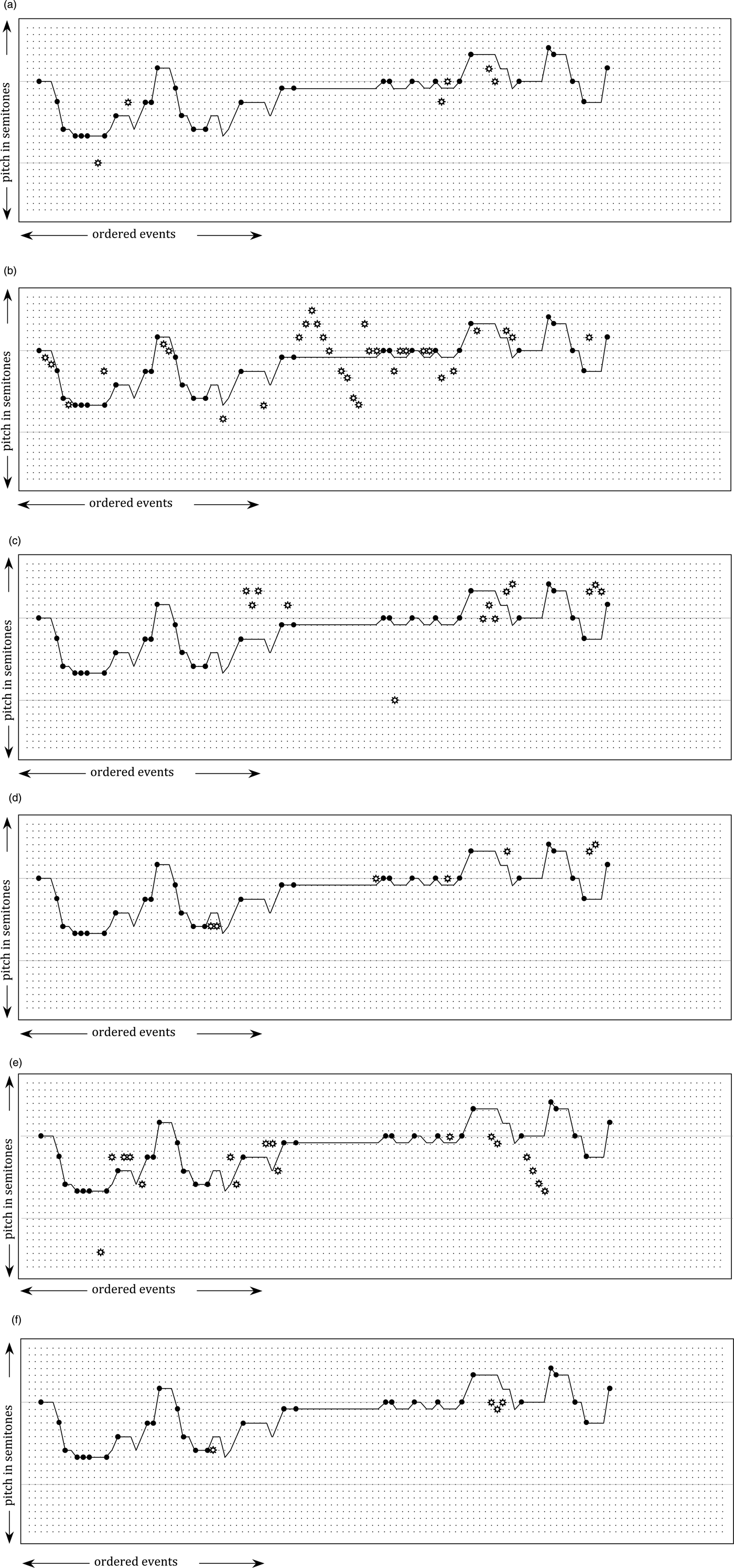
Characteristic deviations from the prevalent contour in each of the versions can be viewed as variants in Figures 7a through 7f. Here, the individual performers' 1s and 2s from Figure 4 are juxtaposed against the prevalence contour. These are the star shapes in the figures. In Figure 7b, one finds Ammons's elaborations twisting about. Barbra Streisand's variants in Figure 7c create an interesting design. The melody is decorated only by three little turns, all in the upper register. Dan Coates's piano arrangement, Figure 7d, appears as expected, but it is interesting that his last two variants were almost certainly inspired by Streisand's popular rendition. Jimmy Webb, in Figure 7e, shows some stylistic flip-flopping above and below the prevalence contour, as well as some small jazz-like runs. One near the end is an exact transposition of the melody's opening four notes. Figure 7f is startling. Only four of Feinstein's pitches do not lie in the prevalent contour. What we're left with in these final figures is, in essence, a separation of the singer from the song. The prevalence contour represents the melodic core, something found in nearly any version of the song. The variants highlight exactly the embellishments and additions for which that particular performer is responsible.
(a) ‘Didn't We’. (Richard Harris's version, 1968). Variation from prevailing contour. (b) ‘Didn't We’. (Gene Ammons's version, 1968). (c) ‘Didn't We’. (Barbra Streisand's version, 1972). (d) ‘Didn't We’. (Dan Coates's sheet-music version). (e) ‘Didn't We’. (Jimmy Webb's version, 1996). (f) ‘Didn't We’. (Michael Feinstein's version, 2003).
Conclusions
Considered in this essay is the notion that all popular songs contain core components, aspects of the song that are manifest in every version, providing the essence of the song brought to a unique life by the individuality of each performer. Thus there is an essential connection between the abstract core and any performance purporting to be a version. Even inadvertent or accidental creations that prove to contain the core components might share this connection. It is my assertion that, in popular music, the core components usually are melodic anchors and the prevalence contours they form. This is not to say that melody by its nature is and always will be the component performers are most unwilling to alter completely, or that a song is defined only by its melody. After all, a song's melody, harmony and lyrics all comprise the copyrighted work. It is also not to say that melody is privileged in some way over timbre, form, dynamics and articulation. Quite the opposite, it is simply to say that given current popular music practices, the prevalence contour with anchors seems to be tied to the essence or identity of the song in the abstract, and the other parameters are so privileged as to define the performance. The core is, in a sense, what is left over after the performer has worked the song over. It is the common denominator. But this may not always be the case, and studies similar to this one may be undertaken with respect to other critical domains such as chord progressions and lyrics.
There are some recorded versions of songs that I might consider spoilers. They are recordings using non-pitched instruments to cover a song. They are spoilers because they do not faithfully reproduce the melodic anchors and only vaguely resemble the contour, yet are versions nonetheless. One such example is Joey Baron's recording of Burt Bacharach's ‘Alfie’. It is performed solely on the drumset. The drums and cymbals lack definite pitch, but their timbre and relative pitch portray the essence of ‘Alfie’. It is one thing, though, to choose varied pitches from an infinite palette, and another to use a restricted palette like the drumset and choose the sounds that most closely represent the pitches of the melody. This raises one question not yet addressed. Is my project simply a survey of what musicians do, tallying up all versions out there and making a composite, or is it an attempt to determine how people recognise songs? I tend to think it is the former, and in the case of Baron's ‘Alfie’ the core component may be a contour with no melodic anchors. A more sophisticated system than mine might allow for a ranking of different components, each song receiving a different ranking order. For example, one song might have melodic anchors that are faithfully reproduced in 99 per cent of the versions, a chord progression, ranked second in essentiality, is used in 96 per cent of the versions, and a meter used in 58 per cent of the versions. In this way, a song would not need certain components to be 100 per cent prevalent in order to contribute to its essence. This wouldn't necessary lessen the purity of the idea of an essence. It would allow the core to have a rotating set of components, some more prevalent than others.
Some might think that the application of the procedure used in this paper is restricted only to popular music. The pop/rock repertoire, so the logic goes, is full of cover versions and representations, all widely varied. One could argue that, in the classical domain, all performers (theoretically) will read from a single score, allowing for a much narrower range of performance variations. What is more, there is a score. The core components in popular music can be seen to represent the missing score to which various versions refer. But these arguments are only partly true. The variation even in the performance of a notated score is quite wide. Furthermore, it is not unreasonable to consider the score itself a performance. Faithful performances of the score may be cover versions, if you will, but of what is the score itself a version? Schenkerian analysis can reveal structural middlegrounds, that might be considered core components of sorts. Considering the realm of live performance, one might consider the many jazz or pop interpretations of the classical repertoire, such as Bob James's ‘Night on Bald Mountain’ or Miles Davis's (and Gil Evans's) ‘Concierto de Aranjuez’. Certainly, their versions are subjective, but the performers (and arrangers) nevertheless make choices based on certain intuitions that can be more prevalent or less prevalent among musicians. An analysis of such choices jazz artists make might define common conceptions about the roles of musical parameters, identifying those that, for whatever reason, create a lasting impression upon the listener. I agree with Cook, who also suggests, ‘until we know how to theorise musical performance we cannot reasonably claim to have an adequate theoretical approach to rock, or to the art tradition either’ (Cook Reference Cook1996, p. 24). Most importantly, there is a huge body of work that resides somewhere between, not neatly within, those two traditions.
Solis has suggested that, in the art of covers, it is not the author of the song that has significance. Authorship resides with the performer:
Importantly, song authorship (as opposed to recording authorship) is insignificant in rock covers – Phil Collins's recording of ‘You Can't Hurry Love’ is a version of a song written by Motown's great songwriting team of Holland, Dozier, and Holland, but it is a cover of the Supremes; Kylie Minogue's recording of ‘The Loco-Motion’ is a version of a song by Gerry Goffin and Carole King, but it is a cover of Little Eva's recording (or is it a cover of Grand Funk Railroad's cover of Little Eva's recording?). (Solis Reference Solis2010, p. 308)
Following this notion, it is easy to conceive of a scenario where cover inspires a cover, which inspires another, and so on in series. Eventually a cover may retain absolutely none of the song's core components and break the essential connection. This could be a case where a new set of core components (a new song altogether) is produced, but what occurs more often is the birth of what might be called a semi-cover, where only a portion of a song is borrowed, and the new creation makes no claim even to be a version of the original. Many songs incorporating digital samples might fall into this category. So might songs that borrow a simple guitar riff. While most versions of songs can be ascribed dual authorship (half credit to the songwriter, half to the performer – as in Song of the Year and Record of the Year), the semi-covers raise thornier questions about authority. For many, the wide-open possibilities for performers' interpretation in popular music mean that there can be no single, unchanging author or authoritative composer of a song. From a certain perspective, the author is indeed dead. But must the author be a single individual? The abstract core components of a song as seen in this essay were not consciously proposed or created by a single individual. They arose out of a consensus of many. When Dave Headlam implied such an abstract authorship as regards the blues-derived music of Led Zeppelin, Cook responded that ‘[f]or [Roland] Barthes the death of the author represented a decentring of authority. But for Headlam it represents quite the opposite. By dint of replacing the flesh-and-blood author (or rather authors) with a theoretical construct, he achieves the extension to a new domain of a concept of authority that is unambiguously rooted in nineteenth-century value systems’ (Cook Reference Cook1996, p. 31). The essences of popular songs, especially those in the cover-heavy rock genre, seem to be created by no human, yet are undeniably present. Songwriters attest to this when they routinely speak of inspiration as the simple grabbing of an idea that is already ‘out there’ somewhere waiting to be written down.
It may be the case that versions of a song are merely representations, modest and transient. Recognising that the life of a song is sustained by its many versions and performances, Jeffrey Magee offers ‘a methodology that might be called the song profile, a selective but in-depth exploration of a song's composition and performance history that makes apparent how variable meanings are socially constructed through time’ (Magee Reference Magee2000, p. 537). Perhaps the essence of a song is, in fact, indefinable by its very nature, just as a single point in space is unapproachable, ever shrinking upon approach. Just as a single moment in time is never actually perceived, gone before it can be recognised, perhaps a song will never be defined, thereby enabling it to live forever.