Introduction
The ancient Kirghiz (Chinese Xiajiasi 黠戛斯) tribes of the Yenisei River Basin lived in the interior of Eurasia and their mysterious history and culture are little known to the outside world.Footnote 1 Nonetheless, rare ancient Chinese booksFootnote 2 and artefacts with Chinese characters that were unearthed in the local Yenisei regionFootnote 3 show a vivid picture of the foreign exchange history of the Yenisei people. What about the local language materials in the Yenisei region? The purpose of this article is to better understand the Yenisei people’s foreign exchange by using the Yenisei inscriptions that were unearthed from the Yenisei region and written in the local Turk-Runic language as the research material.
Over 150 Yenisei inscriptions, including steles, cliffs, and utensils engraved in Turk-Runic language, were found in the upper reaches of Yenisei River. They are historical and cultural relics of the Kyrgyz Khaghanate (about the eighth to eleventh centuries?). Compared with the significant Orkhon inscriptions, which are known for their large inscriptions of the Turkic Khaghanate and the Old Uyghur Khaghanate, Yenisei inscriptions are irregularly engraved, short, and have different expression paradigms. Also, some Turk-Runic letters differed from the conventional Turk-Runic language form, and polyphony also existed. These factors make the Yenisei inscriptions much more difficult to decipher than the Orkhon inscriptions. Specifically, this study uses the local Turk-Runic language inscription that was found in the local Yenisei area as the data.
Interpretations of the E77 Yenisei inscription
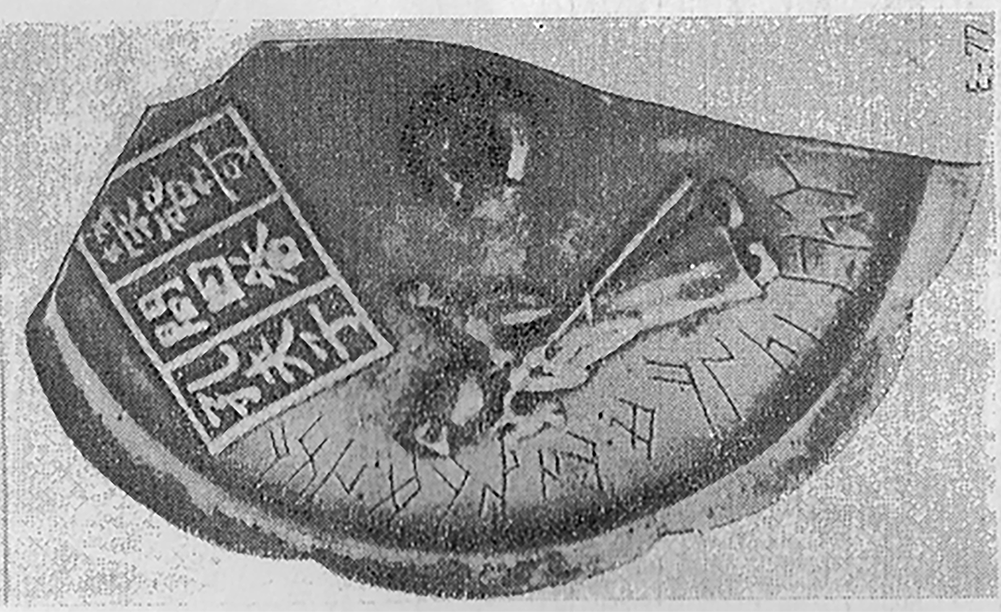
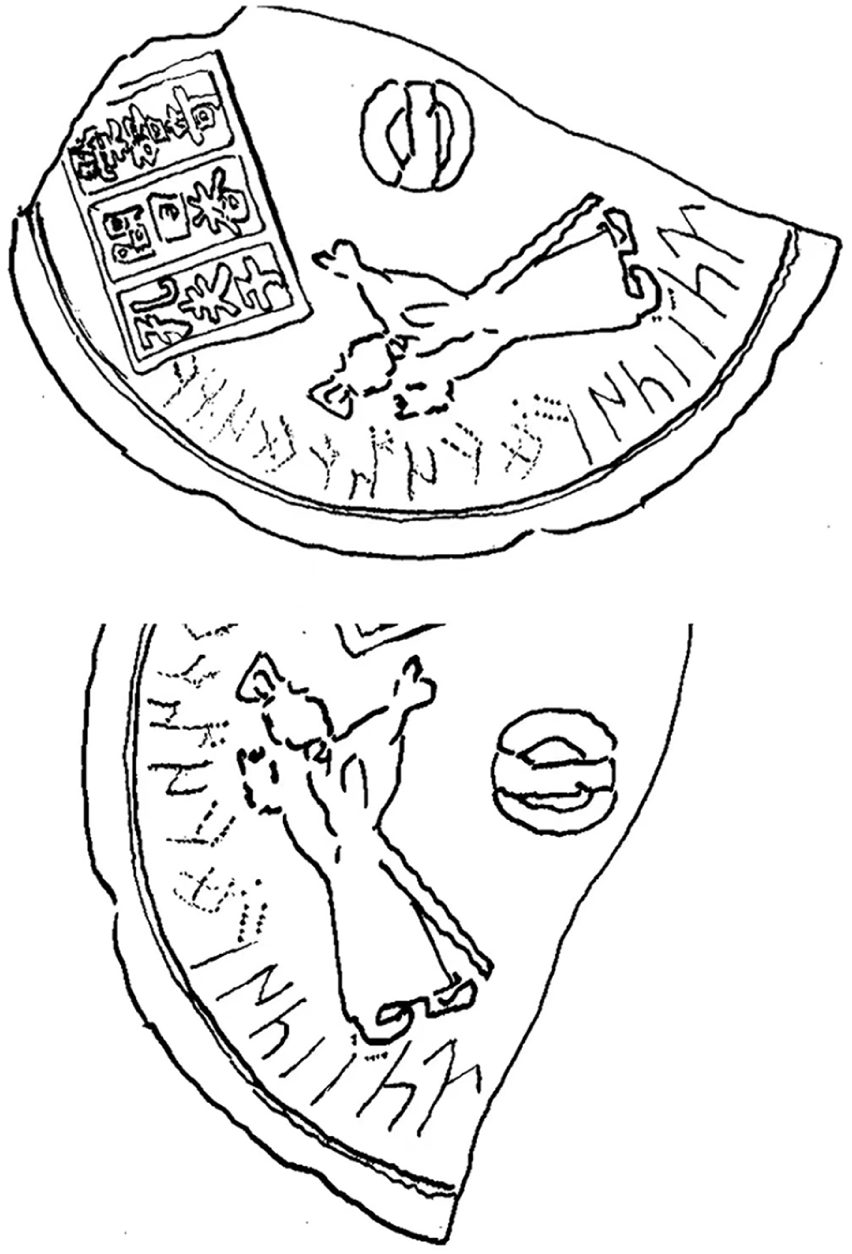
The interpretations of the E77 Yenisei inscription are based on the engravings on the left half of a fragment of a Tang-Dynasty bronze mirror called the Sanlejing 三樂鏡 (Lobed Mirror of Three Delights). The mirror, about 12.7 centimetres in diameter, was found in the Minusinsk Basin and is held by the Minusinsk Museum (holding number MKMA 5194).Footnote 4 The mirror is inscribed in relief at the upper end with three lines of nine Chinese characters: Rongqiqi 榮啟奇, wenyueda 問曰答, and Kongfuzi 孔夫子 (Rong Qiqi is questioned by and responds to Confucius). At the lower left of the Chinese inscription is a standing figure of Confucius, holding a staff. The Turk-Runic is inscribed along the circumference of the mirror from right to left—from the foot of the figure of Confucius to the Chinese character Kong 孔, including two pause signs ‘:’, containing 18 words and signs. However, the inscription on E77 is shallowly carved and partially smoothed. On the reverse of the mirror is the inscription ‘J. R. RYDBERGS. GALVANSTALT STOCKHOLM’, which is probably a label from a previous owner/collector.
The rest of this research article is a detailed discussion of the Turk-Runic text that is engraved on the bronze mirror, starting with a review of earlier studies of that text. As there is no unified worldwide standard in scholarship regarding the transliteration and transcription patterns of Turk-Runic, the authors of this article abide by the table of transliteration and transcription symbols provided by Bai Yudong 白玉冬 and transliterate them from left to right.Footnote 5 Bai’s transliteration and transcription principle is commonly accepted practice and has been followed by other scholars when conducting their research.Footnote 6
A picture of E77 was first published in 1889 in the archaeological survey report of the Archaeological Society of Finland on Yenisei inscriptions.Footnote 7 The Russian scholar W. RadloffFootnote 8 was the first researcher to provide his milestone interpretations in 1894. He transliterated it as r ŋ Q s t ü s k: k ü z k m: ü z k (in Old Turkic), transcribed it as är angqas-töšäk küzküm üzüki (in Old Turkic), and translated it into German as ‘Der Mann Angkas-Töschäk, ein Stück meines Spiegels’, which in English means ‘The man Angkas-Töschäk, a mirror of mine’. Forty-three years later, the Turkish scholar H. N. OrkunFootnote 9 cited W. Radloff’s interpretation in his study with no changes. Later, in 1983, in his collected works on the study of Yenisei inscriptions, the Soviet scholar D. D. VasilyevFootnote 10 transliterated the E77 as r t ŋ(s)t ü k m s k ü n k m: ü z k (in Old Turkic) and provided a picture and copying of it. His transliteration differs greatly from that of W. Radloff.
In 2013, the Turkish scholar E. Aydin et al.Footnote 11 provided a copy of the text (which was transliterated as r t ŋ t ü k m s k ü z ŋ m: ü z k in Old Turkic by the authors of this articleFootnote 12). The text was transcribed as er <atim> teŋ tükemiš közŋüm üzk (in Old Turkic) and translated as ‘Erkeklik adim Teng Tükemiš(tir). Aynam<…>’ (in Turkish), meaning ‘My adult name (is) Teng Tükemiš. My mirror ……’. The copy from E. Aydin et al. differs from the transliterations by W. Radloff and by D. D. Vasilyev. In 2005, the Kazakhstan Cultural Heritage, which is part of the Kazakhstan government programme, created the website TURK BITIG of Kazakhstan, which also has the recording, transliterated by the authors of this article as .r.t.:t ü k ü m:k ü n k m:ü z ü k... (in Old Turkic) and transcribed as …er. ti. ŋ .. s .. tüküm künküm: özük (in Old Turkic). The website also suggests that the writing in the mirror seems to be a personal name. However, its copying (the transliteration is r t l s t ü k m k ü n k m ü z, by the authors of this article) does not match the recording.Footnote 13 The Minusinsk Museum, which was mentioned above and has a good collection of stone sculptures of Yenisei peoples, also provides a recording of E77 (the transliteration is r t ŋ t ü k m: k ü n/z k m: ü z/n k in Old Turkic by the authors of this article). For over a century, scholars who worked on the E77 have formed different opinions on the interpretation of it and there has been no consensus so far, leaving room for further study.
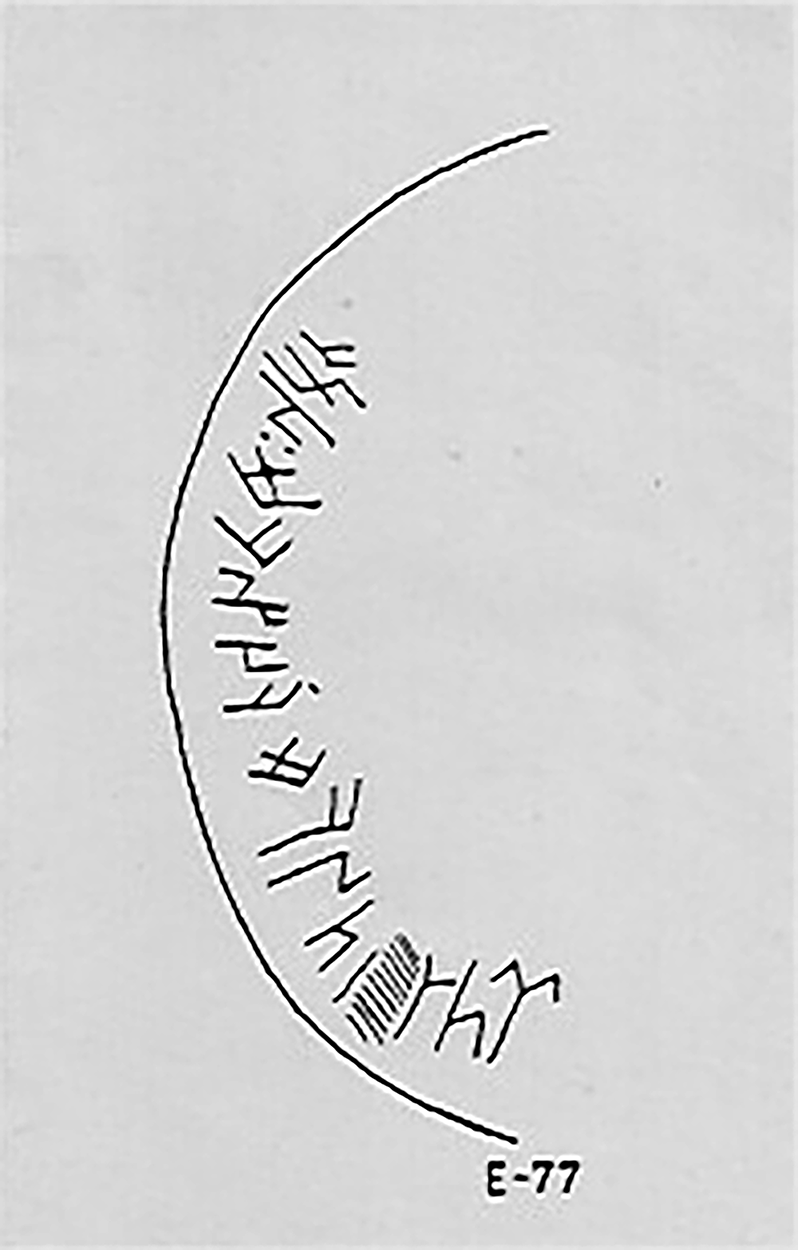
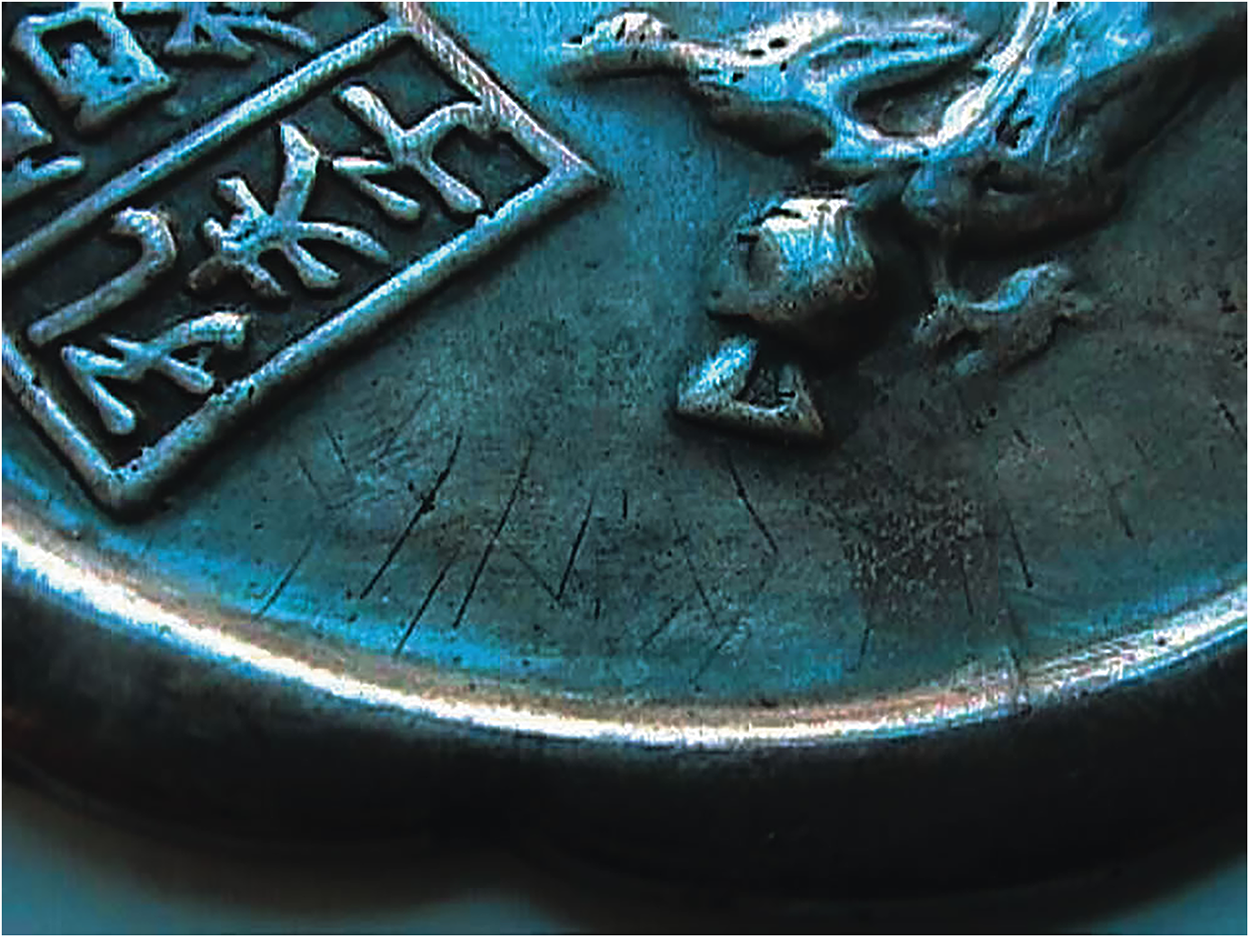
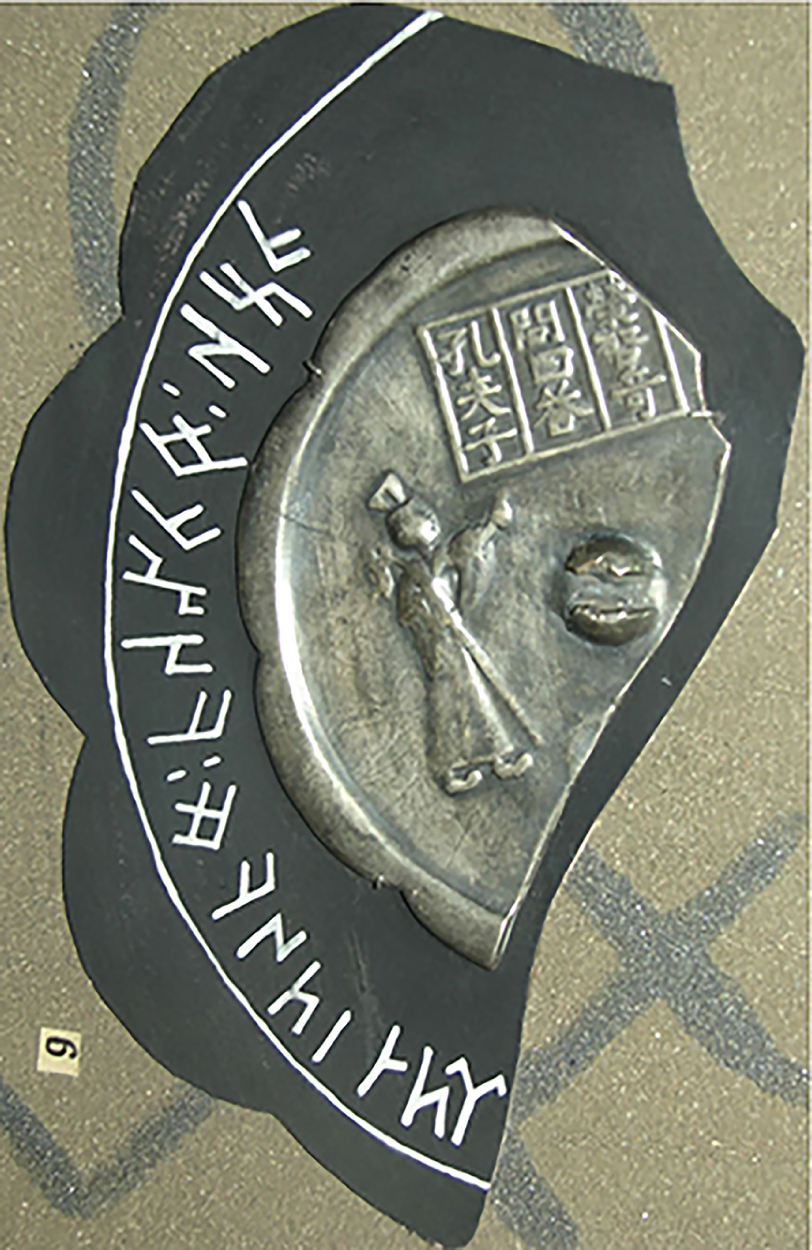
To be specific, the interpretations by the authors of this article are based on the picture and the copying that were published by D. D. Vasilyev (see Figures 1 and 2) and the picture and copying on the websites of Kazakhstan (see Figures 3, 4, and 5). The authors also refer to the pictures of the E77 that are displayed in the Minusinsk Museum, taken by Professor Li Xiao 李肖 of Renmin University of China in 2018.
Transliteration (in Old Turkic): r t ŋ s t ü k m: k ü n S m: ü z k
Transcription (in Old Turkic): är tängäštüküm: künsim: üžük
Word-to-word translation: Man equal to each other (adjective verb affixes in thepast tense of verbs + first-person affixes) Confucius (first-person affixes) character
Semantic translation: The men’s talisman that belongs to me! My Confucius! The character.
E77. Source: D. D. Vasilyev Д. Д. Васильев, Korpus tyurkskih runichskih pamyatnikov basseina Eniseya Корпус тюркских рунических памятников бассейна Енисея [Compilation of Turkic Rune Inscriptions in the Yenisei River Basin], p. 115.

E77. Source: D. D. Vasilyev Д. Д. Васильев, Korpus tyurkskih runichskih pamyatnikov basseina Eniseya Корпус тюркских рунических памятников бассейна Енисея [Compilation of Turkic Rune Inscriptions in the Yenisei River Basin], p. 73.

E77. Source: The website TURK BITIG of Kazakhstan, https://bitig.kz.

E77. Source: The website TURK BITIG of Kazakhstan, https://bitig.kz.

E77. Source: The website TURK BITIG of Kazakhstan, https://bitig.kz.

In this part of the article, the authors provide a detailed critique of the above-mentioned scholars’ copying, transliteration, and translation of the 16 Turk-Runic letters. The first is W. Radloff’s transliteration of ŋ Q s t ü s k as t ŋ s t ü k m>tängäštüküm (The objects of blessing): it is at great odds with the picture, so it will not be discussed here. Second, D. D. Vasilyev and E. Aydin believe that the final letter ‘m’ should be followed by ‘s’, so E. Aydin’s transcription is teŋ tükemiš and he regards it as a personal name. However, judging from the pictures in this article, the ‘s’ is followed by the pause sign ‘:’ and therefore the authors of this article do not agree with E. Aydin. The second letter is also more likely to be a variant writing of ‘ŋ’, as seen in Yenisei inscriptions, than the ‘l’ recovered from the TURK BITIG website copying (see Figure 5). The verb tängäš- comes from the adjective täng, meaning ‘equal’, and is a reciprocal or common form of the verb tängä- ‘to remain equal’ in the sense of being equal or to be equal together.Footnote 14 Moreover, -tük- is a past-tense affix of the verb, acting as a termination form or adjective verb.
The construction of the word tängäštüküm also appears in the second stele of the Toñukuk inscription, which was found in Nalaikh, Ulaanbaatar, Mongolia. The third line on the north of the second stele of the Toñukuk inscription (erected circa 716?) in the Second Turkic Khaghanate said that i l r s Q G N: b i l g a T W ñ uQ uQ: Q z G nt uQ ü č n: Q p G N Q G N: t ü r ük s i r B W D N: Y W R i D uQ i B W >eltäriš qaγan bilgä toñuquq qazγantuq üčün qapγan qaγan türk sir bodun yorïduqï bu ‘Since the efforts of Eltäriš Qaγan and Bilgä Toñuquq, the once life of Qapγan Qaγan, the wonderful and kind people of Turkic, is what it was’.Footnote 15 In this Toñukuk inscription, yorïduqï is the past tense of the adjective verb yorï- ‘to walk, march, live’, followed by the third-person inflectional ending ‘-ï’, which functions as a noun. Here, tängäštüküm is constructed in the same way as yorïduqï above. Tängäštüküm means ‘what I used to keep equal to each other’. With the preceding word r>är ‘man, warrior’, the authors of this article regard the meaning of är tängäštüküm to be ‘the thing that my man used to keep equal with each other’, which can be extended as ‘the objects of blessing (mascot) that blesses equality and justice’. Incidentally, in ancient China, mirrors were used for grooming purposes and to ward off evil spirits and illnesses, to subdue ghosts and demons, to divine good fortune, and even to act as sacred tools for Taoist priests, shamans, etc. The authors’ view of tängäštüküm as the objects of blessing is also supported by this reference.
Discussion of the words k ü n S m>künsim (my Confucius)
Another discussion in this article is on the words k ü n S m>künsim (my Confucius). First, G. Clauson thinks that W. Radloff’s interpretation of k ü z k m>küzküm ‘my mirror’, also quoted by H. N. Orkun, is a misreading of közgüm ‘my mirror’.Footnote 16 Given the confusion between the writing of ‘n’ and ‘z’ ( and
 ) in the Turk-Runic inscriptions, and the phenomenon of Old Turkic’s sonant change to unvoiced sound in Yenisei inscriptions,Footnote 17 W. Radloff’s interpretation mentioned above should not be simply regarded as a misreading, as G. Clauson thinks. However, the writings of the third letter
 and the penultimate letter
 are different, and W. Radloff’s reading of both as ‘z’ is clearly not precise. Although it is possible that the term is transcribed as k ü z k m>küzküm ‘my mirror’, the penultimate
 of the inscription would fit the text only if it were read as ‘z’, as the following commentary ü z k>üzük ‘word’ suggests. Therefore, the third letter
 , which differs from
 , is more securely read as ‘n’, as in the recordings and copyings published by D. D. Vasilyev and the TURK BITIG website. Second, E. Aydin et al.’s interpretation of k ü z ŋ m > közŋüm ‘my mirror’ reads the fourth letter as ‘ŋ’. Judging from the picture, the ‘ŋ’ claimed by E. Aydin is not valid. In other words, the readings k ü n k m by D. D. Vasilyev and the TURK BITIG website, as well as the recordings k ü n/z k m by the Minusinsk Museum, fit the picture better than the recordings by W. Radloff or E. Aydin et al. Third, the major difference between the above-mentioned interpretations and those of the authors lies in the fourth letter, which, according to D. D. Vasilyev’s picture, can be read as ‘k’. In comparison, according to the picture on the TURK BITIG website (see Figure 3), the upper end of the letter is neither straight nor angular, as in
 >k. The upper end is off to the right somewhat and the diagonal line at its uppermost end is not a straight line, but an arc. The copying on the TURK BITIG website (see Figure 5) is also largely consistent with this. Based on observation, the authors of this article have read this fourth letter as ‘S’ and this part is transcribed as künsim.
The following discussion of the words k ü n S m>künsim (my Confucius) is based on the linguistic variations of the words. The authors of the article are aware that loanwords happened in Old Turkic. For example, the Chinese characters Gongzhu 公主 ‘Princess’ (middle Chinese kuŋ-tɕi̭uFootnote 18/kuŋ-tʂyFootnote 19) were adopted by the Old Turkic as qunčuy Footnote 20 and the Chinese back-nasal ‘-ŋ-’ could be transformed into the front-nasal ‘-n-’ in Old Turkic. Another loanword is sin la ingü si, which means Xinluo Wangzi 新羅王子in Chinese characters ‘Prince of Silla’ and is transliterated as sin la ingü si in the book of Old Uyghur of Wutaishan Zan 五臺山讚 (numbered as U5335).Footnote 21 Although there is a discrepancy between ingü and the Chinese character Wang 王in the sound, si corresponds to the Chinese character zi 子. So, by analogy, it is possible to infer that the künsi in the above künsim corresponds to the Chinese characters Kongzi 孔子 ‘Confucius’ (middle Chinese k‘uŋ-tsiFootnote 22/khəwŋ́-tsź̩Footnote 23). Besides, in the Tibetan manuscripts held by P. Pelliot P.t. 987 and P.t. 988 from Dunhuang, the Chinese characters Kongzi 孔子 ‘Confucius’ are respectively transliterated as Kong tshe and Kong tse.Footnote 24 Zeng Deming 曾德明and Lin Chunyu 林純瑜 also support our inference. They suggest that, from ancient to modern times, the Tibetan equivalent of the Chinese character Kongzi 孔子 was usually recorded as Kong tse (Kongze). Thus, this sound of Kongzi 孔子 ‘Confucius’ (middle Chinese k‘uŋ-tsi/khəwŋ́-tsź̩) fits well with the künsi that is discussed here.
Related to Kongzi 孔子 ‘Confucius’ as in ‘är tängäštüküm: künsim: üžük’, the authors of this article also have a different interpretation of the ü z k>üžük (character): we agree to the transliterations offered by W. Radloff, D. D. Vasilyev, E. Aydin, and the Minusinsk Museum, but none gives a transcription or etymology. The word can be transcribed as üzük ∼ üzök, although its meanings as ‘end, interrupt’, ‘torn’, ‘decided’, ‘refusal’, etc.Footnote 25 are incompatible with the context here. The recording on the TURK BITIG website is ü z ü k, suggesting that özük is a female pseudonym as recorded in the Dīwān luγāt at-Turk (Compendium of the Turkic Dialects) by Maḥmūd al-Kāşġarī.Footnote 26 Unfortunately, this interpretation still contradicts the context. The Dīwān luγāt at-Turk defines the word üžük with two meanings: first as ‘spelling’ and then as ‘letter of the alphabet’.Footnote 27 The word üžük/užik is also included in the Uyghur dictionary that was compiled by J. Wilkens, which defines it as ‘script, character’, derived from the Sogdian ’wj’k.Footnote 28 Unfortunately, again, no Turk-Runic inscriptions have included the word už-ak (character), but the word už-ak occurs several times in the remains of Buddhist scriptures that were unearthed in Turpan as interpreted by W. Bang and A. von Gabain.Footnote 29 For example, in line 5, ‘w už-ak urmïš krgäk’ appears, meaning ‘(Dort) muß man den Buchstaben w anbringen’ ((There) you have to put the letter w).Footnote 30 W. Bang and A. von Gabain pinpoint that už-ak is a foreign word that means ‘silbe, syllable’.Footnote 31 Besides, the word wjk’k (pronounced užkak) occurs in the Manichaean cornucopia of confessional words as interpreted by W. B. Henning and its meaning is ‘Buchstabe, Silbe/letter, syllable’.Footnote 32 W. B. Henning notes that the Turkic word užak comes from the Sogdian wjk’k.Footnote 33 The text ‘oom uṣik-lig čakr’ appears in S. Tezcan’s reading of the Insadi Sūtra in Uyghur and the meaning is ‘mit om-Silben ausgestatteten Rades’ (wheel equipped with om syllables).Footnote 34 S. Tezcan also suggests that the early form of uṣik was uzak, from the Sogdian word wjk’k (pronounced užkak), and the meaning is ‘letter, character’.Footnote 35 The ‘ž’ sound did not originally exist in Old Turkic, but only appears in the spelling of loan words. Because the Yenisei inscriptions reflect an exchange between the Sogdians and the Yenisei River Basin,Footnote 36 we regard the word ü z k as üžük, meaning ‘character’ or ‘syllable’, and it is more appropriately regarded as a word from Sogdian ’wj’k. As üžük is immediately preceded by künsim (my Confucius!), the meaning of üžük here should be ‘character’, which is more likely than ‘syllable’. Therefore, there is no doubt that this üžük (character) refers to Kongzi 孔子 (Confucius) in the Chinese inscriptions.
The image of Confucius, as well as his cultural influences on people and society, however, varies in different regions. According to Zeng Deming 曾德明 and Lin Chunyu 林純瑜,Footnote 37 there are many occurrences of transliteration of Chinese characters Kongzi 孔子Kong tse or Kong tshe in Old Tibetan historical sources. This indicates that Tibetans had heard of the Chinese sage Confucius since around the time of the Tubo 吐蕃 kingdom (633–842). Still, the image of Kong tse or Kong tshe in Tibetan historical sources varied from the Confucius image that is familiar in Chinese culture. The Tibetan Bon religion, which is a major Tibetan indigenous belief system, regards many documents that record the ritual of removal as being works by Kong tse ‘phrul rgyal,Footnote 38 who was a master or king with the power to predict the future. The Tibetan Kong tse ‘phrul rgyal also had the power of divination. The image of Confucius in the guise of Tibetan Kong tse ‘phrul rgyal also changed with the influence of Buddhism. According to the later Buddhist documents Baiḍūrya dkar po (White Beryl) and Baiḍūrya g.ya’ sel (The Interpretation on White Beryl), the Tibetan Kong tse was inspired by Manjusri Bodhisattva and contributed to knowledge about the ‘道 Dao’ (gTo) rituals. Additionally, affected by the compassion of Avalokitesvara Bodhisattva, Kong tse decided to introduce the ‘道 Dao’ (gTo) rituals to Tibet.Footnote 39 Thus, according to the authors’ interpretation of the E77 inscription, the Confucius, regarded by the author of the inscription as ‘the objects of blessing of man’, was therefore the variant icon of Confucius in Chinese culture. The Confucius on the E77 inscription functioned similarly to the Tibetan Kong tse in Old Tibetan historical sources.
According to the authors’ interpretations of the E77 Turk-Runic inscription that is engraved on the Sanlejing 三樂鏡 (Lobed Mirror of Three Delights) and the words k ü n S m>künsim (my Confucius), they translated the E77 inscription as ‘The men’s talisman that belongs to me! My Confucius! The character’. The object of blessing, based on the semantics of the text, was associated with the image of Confucius among the northern people who lived in the ancient Chinese territories during the Tang Dynasty. The similarity between the image of künsim in the historical records of the Tibetan Bon religion and that in the Yenisei inscriptions is not accidental. The image of künsim, a master with divination ability, is considered to have derived from Confucius as the combination of a sage by Han Chinese and a divine king by the indigenous beliefs of the local Yenisei area.
The most typical feature of the Yenisei inscriptions, including E77 and the image of Confucius, is the lack of a record of the date of construction. As far as the study of E77 is concerned, it is necessary to discuss the dating of the inscription here.
Dating of the E77 Yenisei inscription
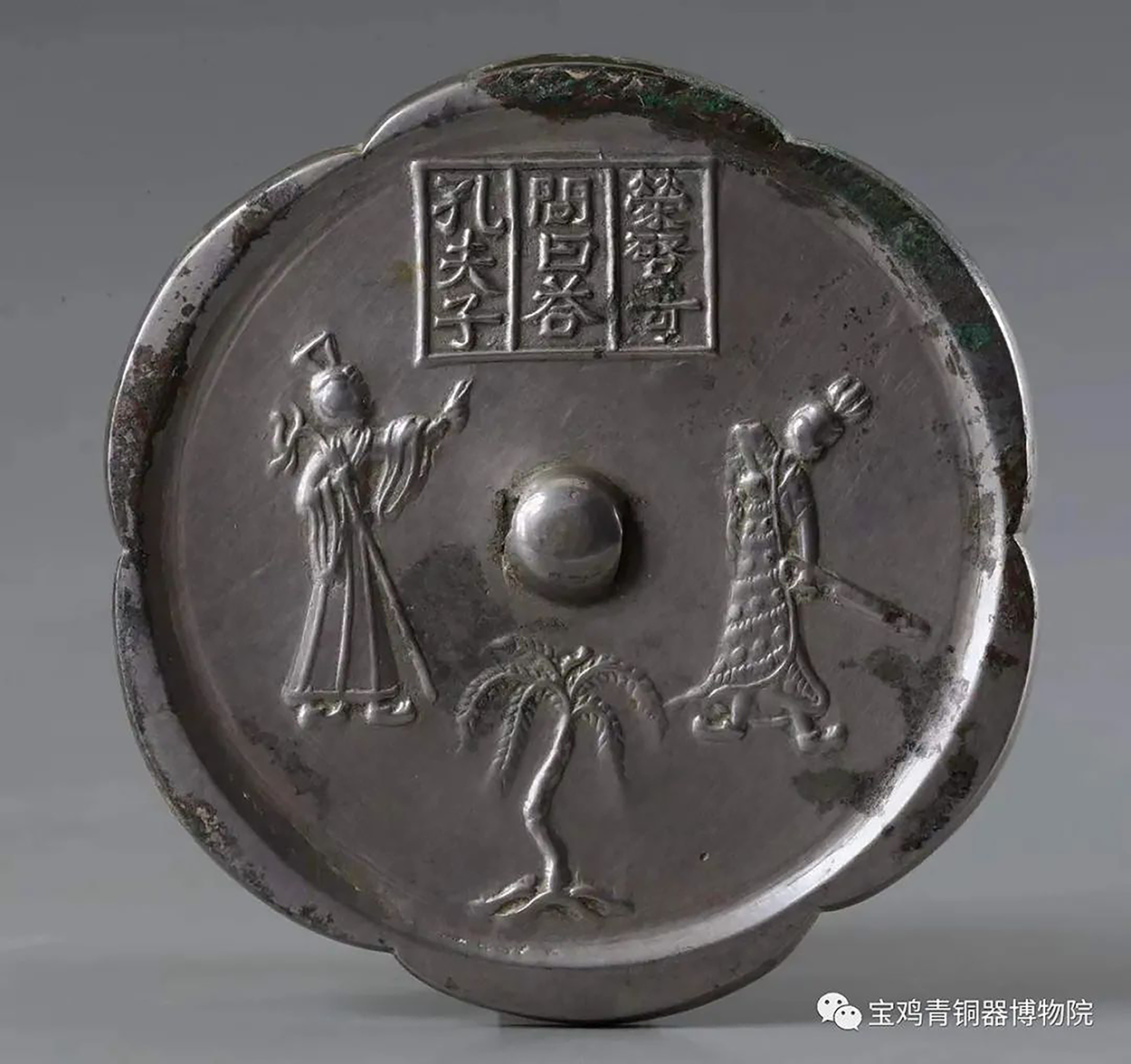
Research on the interpretations of the Confucius image on the E77 Yenisei inscription without tracing its exact date is not complete. In this part of the article, the authors would like to pinpoint the date of the Sanlejing 三樂鏡 (Lobed Mirror of Three Delights). It is well known that the Sanlejing belongs to the Tang-Dynasty period (618–907), although others believe that it was cast in the eighth century. The mirror has the features of an octagonal arc-shaped sunflower form, with a rounded knob (see Figure 6). The figure to the left of the knob is Confucius, who wears a crown and a long robe with wide sleeves, holding a staff in his right hand and raising his left hand in front of him. The figure to the right of the knob, wearing a crown and deer fur, is Rong Qiqi 榮啟奇, who plays a guqin (an ancient Chinese instrument) while singing and dancing. The nine Chinese characters of this inscription, which were written downwards and from left to right, are Rongqiqi wenyue da Kongfuzi 榮啟奇問曰答孔夫子 ‘Rong Qiqi is questioned by and responds to Confucius’. The classic version of the story of Rong Qiqi and Confucius appears in Tianrui 天瑞 (Heaven’s gifts)—a chapter of the third-century Daoist classic known as the Liezi 列子.Footnote 40 Regarding the inscription of the E77, the Soviet scholars L. A. Evtjuhova (Л. А. Евтюхова) and E. R. Rygdylon (Э. Р. Рыгдылон), respectively, give a copying of the image of the bronze mirrorFootnote 41 and its design follows that of the Lobed Mirror of Three Delights that was excavated in China. Another Soviet scholar, E. I. Lubo-Lesnichenko (Е. И. Лубо-Лесниченко), in his study of exotic mirrors that were excavated in the Minusinsk Basin, presents an analysis of another Lobed Mirror of Three Delights that was excavated in Abakan.Footnote 42 Based on the research of E. I. Lubo-Lesnichenko, P. Pelliot infers that the third character of Rongqiqi 榮啟奇 is not the ‘Qi 期’ as written in the Liezi 列子, which may be related to an ancient Chinese taboo tradition. To avoid repeating the name of an emperor whose name was ‘qi 期’, the second ‘qi’ in Rongqiqi was replaced by the homophone character 奇. Use of the taboo word qi 奇 instead of qi 期 indicated that the E77 existed between 712 and 756, which was the period during which Emperor Xuanzong 玄宗 of the Tang Dynasty was in power. Based on the lifespan of Emperor Xuanzong, the authors of this article believe that, although it is impossible to determine how the Lobed Mirror of Three Delights came to the Yenisei area, the dating of the E77 inscription would not be beyond the eighth century.
The Sanlejing 三樂鏡 (Lobed Mirror of Three Delights) found in China, collected by Baoji Bronze Ware Museum, Shaanxi Province, P. R. China. Source: http://www.bjqtm.com/xcjy/dwxc/2022-02-26/735.html (accessed 18 May 2023).

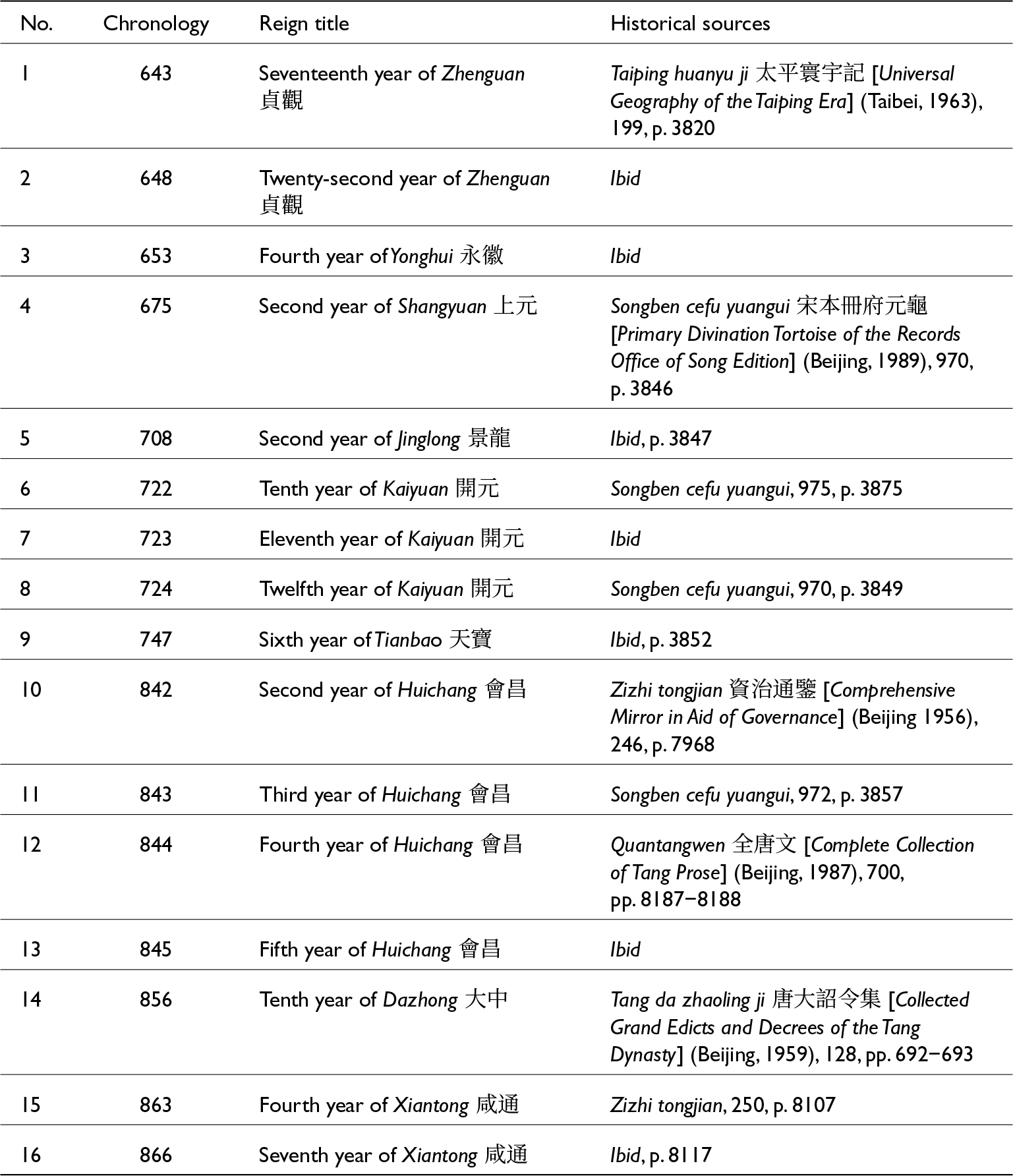
As for the specific dating of the E77, we need to refer to the context of the dealings of the historical Yenisei region with the Tang Dynasty. The history of the Kirghiz was recorded in classical Chinese books and M. R. Drompp’s related research can also give us references and information.Footnote 43 Regarding the relationship between the Kirghiz and the Tang Dynasty, Bai Yudong 白玉冬 has given a summary.Footnote 44 Bai provided the chronology of the Kirghiz tribute to the Tang Dynasty and it is discussed below.
Table 1 shows that the closest relationship between the Kirghiz Khaghanate and the Tang Dynasty was between 842 and 866. This period was when Kirghiz defeated the Uighur Khaghanate and then unified the then Mongolia, and it was also the period during which Kirghiz paid frequent tributes to the Tang Dynasty and asked for a Tang authorised title.Footnote 45 Through these frequent ambassadors, the Tang Dynasty learned that, after 747, the real intention of the long-absent Xiajiasi 黠戛斯 was to gain authorised titles from the Tang Dynasty.Footnote 46 The Tang Dynasty also learned that the Xiajiasi, with these titles, would increase its influence on the northern grasslands. Coincidentally, one of the authorised titles that were sought by Xiajiasi 黠戛斯 was Dengli Kehan 登利可汗 (Tängri qaγan) but it was the same title as Tian Kehan 天可汗 (Tängri qaγan) given by the nomads to the second emperor of the Tang Dynasty, Taizong 太宗 (599–649), in Old Turkic phonology. The Tang Dynasty rejected this request from Xiajiasi 黠戛斯 because the title of 登利可汗 (Tängri qaγan) was also a title that the Tang Dynasty had given to the Uighur Khan, whose country had been destroyed, so confusion had to be avoided. The Tang Dynasty not only refused the request from the Xiajiasi ruler for the ancient Turkic title of Tängri qaγan, but also proposed to grant the title ‘General of the Left Cantonment Guards and Jiankun governor-general (左衛將軍堅昆都督)’ to the Kirghiz ruler following what the second Emperor Tang Taizong did in the twenty-second year of Zhenguan 貞觀, 648: ‘Thus, we will make you the Chien-k’un nation, and will include this [term] in the [imperial] appointment, adding this fine title to show our admiration and affection [for you] (以堅昆为國, 施於册命, 更加美号, 以表懿亲。).’Footnote 47 Unexpectedly, due to the death of the sixteenth Tang Emperor Wuzong 武宗in 846, this friendly proposal could not be realised. Incidentally, most of the Uighurs who had lost their country moved to Xinjiang 新疆 in the eastern section of the Tianshan Mountains.
Records of the Kirghiz sending envoys to the Tang Dynasty in classical Chinese books

Despite the unexpected death of Tang Emperor Wuzong 武宗 in 846, Xiajiasi continued to send envoys to the Tang Dynasty. According to the historical material in Item 14 of Table 1, in 856, the Kirghiz envoy Li Jian 李兼 arrived in Chang’an 长安, the capital of the Tang Dynasty. Although Li Jian’s purpose was not clearly stated in the relevant historical materials, it was simply to strengthen the friendly relations between the Kirghiz and the Tang Dynasty. Item 15 in Table 1 also reveals that the tribute in the fourth year of Xiantong 咸通 (863) is:
Xiajiasi 黠戛斯 sent an envoy, Alp Inančï (Heyinanzhi 合伊难支), to request the scriptures, and an envoy be sent to and from the Tang Dynasty every year and the (Tang) official calendar. Xiajiasi also wanted to attack the Uyghur, so that the areas within Anxi安西 would be subordinated to the Tang Dynasty, but was not allowed (黠戛斯遣其臣合伊難支表求經籍及每年遣使走馬請曆, 又欲討回鶻, 使安西以來悉歸唐, 不許。).Footnote 48
In the above text, ‘request for the (Tang) official calendar 請曆’ shows that they were keen to strengthen their tributary relationship with the Tang Dynasty at that time. The part of the text ‘wanted to attack Uyghur’ also shows that the Kirghiz still had the awareness of continuing to strengthen their influences on northern China. Then, regarding the last sixteenth tribute in the seventh year of Xiantong 咸通 (866), the historical records say:
Xiajiasi 黠戛斯 sent its general Ičränki (Yizhilianji 乙支連幾)to pay tribute, and reported that they will send horseman to welcome to the imperial title-conferring envoy, and made a request for the official calendar of the year of the Hai 亥(pig) year (黠戛斯遣將軍乙支連幾入貢, 奏遣鞍馬迎冊立使及請亥年曆日。).Footnote 49
Unfortunately, there is no way of knowing whether the Tang Dynasty conferred to the ruler of the Xiajiasi 黠戛斯 or not, based only on the Chinese document. Still, materials that were found in the local Yenisei area proper could fill this gap. In around 1990, five marble fragments inscribed with Chinese characters were found in the village of Raykovo (Райково), south of Abakan, the capital of the Republic of Khakassia. The five unearthed fragments had the texts of Gong 貢 (contribute), Fengjiang 封疆 (border region), and Datang Xiantong Qinian 大唐咸通七年 (the seventh year of Xiantong 咸通 of the Great Tang Dynasty (866)). They are now displayed in the Khakas Museum of Ethnography.Footnote 50 In the 1990s, Japanese scholar Masumoto Tetsu 枡本哲 researched these artefacts and found that they belonged to a jade book, reflecting the enthroning system of the Tang Dynasty, but he also believed that the individual who received the jade book from the Tang Dynasty was a Chinese person who was working in the Xiajiasi 黠戛斯 Khaghanate.Footnote 51 However, the prevailing scholarly opinion is that the person who was given the jade book by the Tang Dynasty should be identified as the Xiajiasi 黠戛斯 Khan of the time.Footnote 52 Xiajiasi 黠戛斯 maintained direct contact with the Tang Dynasty between 842 and 866, as shown in Table 1, and was eventually enthroned by the Tang Dynasty. The five fragments show clearly that there were exchanges between the Tang Dynasty and the Kirghiz.
The frequent contact between the Xiajiasi and the Tang Dynasty was also revealed in other Yenisei inscriptions that were written in the local language (i.e. the Old Turkic) of the Kirghiz. For example, E11, a tombstone, which was one of the Yenisei inscriptions discovered in the Mungash Chirik area north of the confluence of the Begre River and the Daye River in present-day Tuva Republic, preserves the record of exchanges between the Tang Dynasty and the Kirghiz. E11 is housed in the Minusinsko Museum (collection number 40) and its ninth line exposes a highlight in the life of the tomb’s owner:Footnote 53
Transcription (in Old Turkic): biš yegirmi: yašïmda: tabγač qanγa: bardïm-a är ärdimim üčün alïpan: altun: kümüšig: ägri täbä eldä: küči: qazγandïm-aFootnote 54
Translation: When I was 15 years old, I went to the place where the Khan of China (i.e. the Emperor of China) was! Since I use my talents as a male, I acquired gold and silver, a dromedary, from (its) country (i.e. China)! And I got their power!
D. D. Vasilyev claims that this inscription provides an example of a Kirghiz nobleman who went to China to learn Chinese and marry a Chinese wife.Footnote 55 However, according to the authors’ interpretation, this inscription contains none of these elements. However, it is plausible that this inscription indicates that the tomb owner travelled to China in the late Tang period.Footnote 56 Li Jinxiu 李錦绣 also confirmed that there was a trade of silk and horses between the Kirghiz and the Tang Dynasty, and the Kirghiz sent envoys to Tang during the Huichang 會昌 period (841–846), replacing the Uighur as the main trade partner in silk and horses with the Tang.Footnote 57
Because of the above findings, it is reasonable to infer that E77, the Sanlejing 三樂鏡 (Lobed Mirror of Three Delights) that was discovered in the Yenisei region, should be dated back to between 842 and 866, when the Kirghiz was in direct contact with the Tang Dynasty. As for the inscription on it, it is reasonable to assume that it was inscribed during this period or shortly thereafter. It is reasonable to regard the image of Confucius that is recorded in the E77 inscription as having been known to the people of the Yenisei Valley between 842 and 866, or shortly thereafter.
Conclusion
The name of Confucius in Yenisei inscriptions is explained above, and it is clear that it was known to the native Kirghizs of Yenisei at Xiajiasi 黠戛斯 Khaghanate from between 842 and 866, or shortly thereafter. Xiajiasi ambassadors’ frequent visit to the Tang Dynasty confirmed that the image of Confucius on the E77 inscription was not foreign to the local Yenisei people. Also, the ancient trades between Xiajiasi and the Tang Dynasty across rough wilderness in deserts may have required the holy divine power of künsim ‘我的孔子啊!’ as a blessing for protection, so it is no coincidence that Confucius in the Yenisei E77 inscription should be interpreted based on both the Tibetan Bon religion and Chinese tradition.
Acknowledgements
This article is part of the result of grant-in-aid project 23VRC041, supported by ‘Sui Tang zhi Beisong gu Tujue yu zuqun yu Huaxia zhongyang wangchao zhi jian de jiaowang shi yanjiu’ 隋唐至北宋古突厥語族群與華夏中央王朝之間的交往史研究 [A study on the history of exchanges between the ancient Turkic-speaking ethnic groups and the central dynasty of China from the Sui and Tang Dynasties to the Northern Song Dynasty], and the Fundamental Research Funds for the Central Universities (‘Sui Tang zhi Beisong gu Tujue yu zuqun yu Huaxia zhongyang wangchao zhi jian de jiaoliu jiaowang jiaorong shi yanjiu’ 隋唐至北宋古突厥語族群與華夏中央王朝之間的交往交流交融史研究 [A study on the history of exchanges, interactions and integration between the ancient Turkic-speaking ethnic groups and the central dynasty of China from the Sui and Tang Dynasties to the Northern Song Dynasty, 2023jbkyzx011]).
Conflicts of interest
None.