Woolly distaff thistle (also called distaff or saffron thistle) is an erect spiny winter annual native to the Mediterranean region of Europe, as well as Egypt and temperate western Asia (Grace et al. Reference Grace, Sheppard, Walley and Sindel2002; Spooner Reference Spooner2000). It is considered one of the worst pasture weeds in North America and Australia (Parsons and Cuthbertson Reference Parsons and Cuthbertson2001) but has also spread to many other temperate regions of the world, including Argentina, Chile, and New Zealand (Burrill Reference Burrill1994; Parsons and Cuthbertson Reference Parsons and Cuthbertson2001). In Australia, it is widespread in both the wheat-producing regions and the semi-arid grazing lands of New South Wales, Victoria, South Australia, and Western Australia. In Western Australia alone, it infests nearly 400,000 ha (988,000 acres) of prime grazing land (Parsons and Cuthbertson Reference Parsons and Cuthbertson2001). Although it is found in a number of states in the United States and in British Columbia (Canada), it is most problematic in California and Oregon (Burrill Reference Burrill1994; DiTomaso and Healy Reference DiTomaso and Healy2007), where it is listed as a noxious weed (DiTomaso et al. Reference DiTomaso, Kyser, Oneto, Wilson, Orloff, Anderson, Wright, Roncoroni, Miller, Prather, Ransom, Beck, Duncan, Wilson and Mann2013).
Management Implications
Woolly distaff thistle is a spiny winter annual native to the Mediterranean region of Europe. It is considered one of the worst pasture and rangeland weeds in North America, Australia, and other temperate regions of the world. Few herbicides or other control techniques have been tested for the management of woolly distaff thistle. We evaluated several conventional chemical control options at various times and rates, as well as integrated organic approaches for the management of this noxious weed in northern California. Among the organic control methods, we evaluated timely mowing, the organic herbicide Suppress® (mixture of capric and caprylic acids), and a combination of these two approaches. Our results show that for conventional herbicide systems, aminopyralid, aminocyclopyrachlor, or clopyralid are all very effective. However, choosing the optimal herbicide depends on economics, site characteristics, and the plant community. For organic systems, control options require a more integrated approach using a combination of timely mowing and an organic herbicide. This study provided several effective management approaches for woolly distaff thistle in both organic and nonorganic systems.
Woolly distaff thistle was first reported in California south of San Francisco in 1891 and has since invaded seasonally dry hillside rangelands around the central coast, particularly north of San Francisco. Because this weed is regionally problematic, the California Invasive Plant Council lists the species as moderately invasive with alert status (http://www.cal-ipc.org/paf). In Oregon, it was first detected in 1987 in the southwestern region of the state (Oregon Department of Agriculture 2010). In the United States, woolly distaff thistle is primarily a problem in heavily grazed, seasonally dry hillsides and pastures, where it can form nearly impenetrable monotypic stands that restrict the movement of livestock and wildlife (D’Amico Reference D’Amico2013; Grace et al. Reference Grace, Sheppard, Walley and Sindel2002). While woolly distaff thistle can readily compete with other annual grasses, it is a poor competitor in perennial pastures or in rangelands dominated by perennial grasses (Oregon Department of Agriculture 2010; Parsons and Cuthbertson Reference Parsons and Cuthbertson2001).
The negative impacts of woolly distaff thistle are many. In cereal crops, it can clog harvesting equipment and reduce yields by up to 70% (Fromm Reference Fromm1990; Shorten Reference Shorten2007). Contamination with thistle seed can increase cleaning costs and even prevent the sale of cereal seed (Quinlivan and Peirce Reference Quinlivan and Peirce1968). Furthermore, woolly distaff thistle in the vicinity of agricultural fields can serve as a host for fungal diseases that affect safflower (Carthamus tinctorius L.) or cotton (Gossypium hirsutum L.) (Shorten Reference Shorten2007).
In addition to restricting animal movement in rangelands and pastures, the spines on woolly distaff thistle can contaminate and downgrade the quality of wool (Grace et al. Reference Grace, Sheppard, Walley and Sindel2002). Its spines also prevent grazing by most livestock, thus reducing the forage carrying capacity of pastures and rangelands. When animals do graze in infested areas, woolly distaff thistle can injure the eyes and mouths of livestock (DiTomaso et al. Reference DiTomaso, Kyser, Oneto, Wilson, Orloff, Anderson, Wright, Roncoroni, Miller, Prather, Ransom, Beck, Duncan, Wilson and Mann2013), which further predisposes them to diseases such as scabby mouth and pink eye (Shorten Reference Shorten2007). Furthermore, the selective avoidance in grazing woolly distaff thistle can result in its ability to outcompete more desirable forage species (D’Amico Reference D’Amico2013; Quinlivan and Peirce Reference Quinlivan and Peirce1968). In Oregon, it was estimated that the economic impact to susceptible rangelands would cost approximately $168 million per year if woolly distaff thistle were able to realize its full invasion potential (Research Group, LLC 2014).
Because woolly distaff thistle is a winter annual, its seeds germinate in early autumn through early winter and overwinter as rosettes (Parsons and Cuthbertson Reference Parsons and Cuthbertson2001; Spooner Reference Spooner2000). Most seeds germinate within the first 2 yr of dispersal (Quinlivan and Peirce Reference Quinlivan and Peirce1968), with seeds retained in the heads through the summer months having higher dormancy compared with the seeds that disperse earlier in the season (Parsons and Cuthbertson Reference Parsons and Cuthbertson2001). Despite the majority of seed germinating in the first couple of years, some seed can remain dormant in the soil for up to 8 yr (Grace et al. Reference Grace, Sheppard, Walley and Sindel2002; Quinlivan and Peirce Reference Quinlivan and Peirce1968).
Seedlings of woolly distaff thistle develop a long taproot that can draw water from deep in the soil profile (Burrill Reference Burrill1994). This characteristic, as with many other thistles species, allows it to compete with shorter-rooted annual grasses. Plants bolt in mid- to late spring and produce bright yellow spiny flower heads from early to late summer (D’Amico Reference D’Amico2013; DiTomaso et al. Reference DiTomaso, Kyser, Oneto, Wilson, Orloff, Anderson, Wright, Roncoroni, Miller, Prather, Ransom, Beck, Duncan, Wilson and Mann2013). Though the fruiting structures have an attached pappus, the seeds are too heavy to be carried any distance by the wind, and the majority disperse close to the parent plant (Parsons and Cuthbertson Reference Parsons and Cuthbertson2001; Spooner Reference Spooner2000). However, some seed can move long distances by clinging to wool, fur, or hair, or through the movement of livestock, contaminated forage, or pasture seed (Grace et al. Reference Grace, Sheppard, Walley and Sindel2002).
While a number of studies have focused on the management of other thistles, particularly yellow starthistle (Centaurea solstitialis L.) (for review, see DiTomaso et al. Reference DiTomaso, Kyser and Pitcairn2006) and Canada thistle [Cirsium arvense (L.) Scop.] (Burns et al. Reference Burns, Prischmann-Voldseth and Gramig2013; Enloe et al. Reference Enloe, Lym, Wilson, Westra, Nissen, Beck, Moechnig, Peterson, Masters and Halstvedt2007; Norland et al. Reference Norland, Fasching, Dixon, Askerooth, Kelsey and Wang2013), many other thistle species have received far less attention, including woolly distaff thistle. Few studies and no peer-reviewed publications have documented effective control options or integrated management approaches for this species. However, Dellow (Reference Dellow1996) noted that once plants begin to bolt they become much more difficult to control.
While the use of hand hoeing can be effective for the control of small populations in the rosette or bolting stage (DiTomaso et al. Reference DiTomaso, Kyser, Oneto, Wilson, Orloff, Anderson, Wright, Roncoroni, Miller, Prather, Ransom, Beck, Duncan, Wilson and Mann2013), hand removal or cultivation is more difficult and often impractical on a larger scale. In addition, cultivation can disturb the soil and promote germination of woolly distaff thistle seed (Shorten Reference Shorten2007). When possible, mowing can be an effective method for woolly distaff thistle control if done in late spring after bolting but before flowering or in dry soils where regrowth is reduced (D’Amico Reference D’Amico2013; DiTomaso et al. Reference DiTomaso, Kyser, Oneto, Wilson, Orloff, Anderson, Wright, Roncoroni, Miller, Prather, Ransom, Beck, Duncan, Wilson and Mann2013; Oregon Department of Agriculture 2010). Even under these conditions, mowing often needs to be repeated two or more times throughout the season to prevent escaped plants from producing seeds (DiTomaso et al. Reference DiTomaso, Kyser, Oneto, Wilson, Orloff, Anderson, Wright, Roncoroni, Miller, Prather, Ransom, Beck, Duncan, Wilson and Mann2013).
Other cultural control techniques for woolly distaff thistle are not considered feasible. For example, heavy grazing often increases populations, because livestock selectively graze more palatable and less spiny species, thereby reducing competition with other plants for light and nutrients (DiTomaso et al. Reference DiTomaso, Kyser, Oneto, Wilson, Orloff, Anderson, Wright, Roncoroni, Miller, Prather, Ransom, Beck, Duncan, Wilson and Mann2013). In Australia, short-duration grazing with very heavy sheep-stocking rates were somewhat effective in woolly distaff thistle control, but 8 to 10 times the normal stocking rates were necessary, and sufficient livestock numbers were generally unavailable (Dellow Reference Dellow1996). Though prescribed burning was noted by one rancher to prevent thistle seed production and reduce populations the following year (D Lewis, personal communication), permits for burning in typical infested areas are difficult to obtain and burning eliminates late-season grass forage. Biological control has not been initiated for woolly distaff thistle due to its genetic similarity with commercial safflower (Oregon Department of Agriculture 2010).
Few herbicides have been tested for the management of woolly distaff thistle. In Australia, chlorsulfuron is recommended for control in wheat-cropping systems (Parsons and Cuthbertson Reference Parsons and Cuthbertson2001), but this option would damage too many desirable species in rangelands and pastures. In the rangelands of Australia, the herbicides paraquat and glyphosate are also recommended for control of woolly distaff thistle (Fromm Reference Fromm1990). However, glyphosate is not selective and would eliminate more desirable species on many pastures and grasslands, and paraquat is rarely used due to its high mammalian toxicity. Auxinic herbicides, including 2,4-D and clopyralid, have been occasionally recommended (Research Group 2014; Parsons and Cuthbertson Reference Parsons and Cuthbertson2001), though little information is available to demonstrate their effectiveness, and 2,4-D is a restricted-use herbicide in California.
The ranching and dairy industries play a key role in the economy of the North Coast counties of California. This region is internationally recognized for producing high-quality and award-winning cheeses, many organically produced. This area also produces high-quality grass-fed beef on organic pastures and rangelands. Within this region, more than 75% of the dairies in Marin County are in organic production, as are more than 50% of the dairies in Sonoma County. The spread of woolly distaff thistle has severely impeded the capacity to produce adequate forage for economic sustainability of pastures and rangelands. This not only threatens the capability of conventional ranchers to be economically viable, but also compromises the ability of landowners to maintain their organic certification due to the need for frequent herbicide applications to control thistles. Thus, land managers will need to use more integrated approaches, including mowing and other organic strategies, to provide long-term thistle management.
Because of the lack of direct information on the management of woolly distaff thistle, land managers have relied on information previously published on yellow starthistle (e.g., DiTomaso et al. Reference DiTomaso, Kyser, Oneto, Wilson, Orloff, Anderson, Wright, Roncoroni, Miller, Prather, Ransom, Beck, Duncan, Wilson and Mann2013). Although yellow starthistle is a related species with some phenological similarities to woolly distaff thistle, recommended control options and timing may not provide the same level of management, and organic control options may not be effective. Thus, the objectives of this study were to develop recommended control options and integrated approaches for both conventional ranchers and pasture managers and organically certified land managers. The data from this study should also lead to solution-based policies that provide sound management and widespread acceptance.
Materials and Methods
Site Description
Trials in the first experiment (conventional herbicide treatments) were established in two locations, on adjacent slopes in Marin County, off Chileno Valley Road 15 km west of Petaluma. In the second experiment, a conventional herbicide treatment was compared against organic control methods in two trials also conducted in Marin County, one within 1 km (0.62 miles) of the first experiment off Chileno Valley Road and a second 3 km south of Point Reyes Station.
The conventional herbicide trials near Chileno Valley Road were located at 38.22°N, 122.82°W, 70 m elevation. The soil here is in the Los Osos–Bonnydoon complex (loam in the top 33 to 45 cm of soil, with approximately 3.0% organic matter). The nearby organic chemical trial was at 95 m elevation on soil in the Felton variant–Soulajule complex (loam in the top 80 cm, organic matter ~2.0%). The organic chemical site near Point Reyes Station (38.06°N, 122.80°W, 25 m elevation) was on soil in the Saurin–Bonnydoon complex (gravelly to clay loam in the top 30 cm, organic matter ~1.8%).
Treatment Characteristics
The first experiment evaluated several herbicides and rates, while the second experiment compared an effective conventional herbicide against organic control options. For the first experiment, the study locations, treatment dates, treatments and rates, evaluation measurements and dates, and stage of development of woolly distaff thistle are listed in Tables 1 and 2. Herbicide treatments included aminopyralid (Milestone®, Dow AgroSciences LLC, Indianapolis, IN 46268), aminopyralid+triclopyr (Capstone®, Dow AgroSciences LLC), aminocyclopyrachlor (Method®, Dow AgroSciences LLC), aminocyclopyrachlor+chlorsulfuron (Perspective®, Bayer AG, 51368 Leverkusen, Germany), and clopyralid (Transline®, Dow AgroSciences LLC). Each herbicide or herbicide combination was tested at two rates with an untreated control, and treatments were applied at two timings, winter and spring. All conventional treatments were made with a CO2 backpack sprayer at 207 kPa (30 psi) and 187 L ha−1 (20galacre−1), using six 11002AIXR nozzles on a 3-m (10-ft) boom. Each treatment included 0.25% (v/v) Competitor® surfactant. Plots were 9 by 3 m. At all locations, studies were established in a completely randomized block design with each treatment replicated four times.
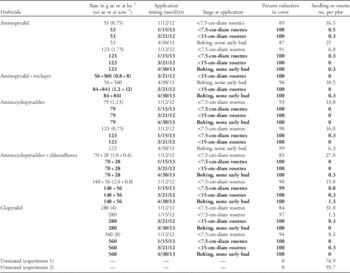
Herbicide treatment, evaluation dates and parameters, and application information for control of woolly distaff thistle at two treatment sites in Marin County.

Woolly distaff thistle control and recovery of rosettes or seedling germination with several herbicides, rates, and timings.Footnote a

a Rows in bold represent control ≥99%, with residual effects on seedling and rosette development at the end of the season (<1.5 seedlings or rosettes per plot).
For the second experiment, the study locations, treatment dates and rates, and stage of development of woolly distaff thistle are listed in Table 3. Aminopyralid treatment characteristics were similar to those described in the first experiment. For the organic herbicide (Suppress®), all treatment characteristics were similar except six 8004 nozzles were used and the spray volume was 468 Lha−1 (50galacre−1) or 935 Lha−1 (100galacre−1). Suppress® contains two active ingredients, 47% caprylic acid and 32% capric acid. Mowing treatments were conducted using a tractor-mounted deck rotary mower set at 10 cm mowing height. Unlike the first experiment, the study was set up at each location in a partially randomized block design to account for the mowing treatments. Each treatment was replicated four times. Evaluations in summer included percent cover of woolly distaff thistle in each plot. In the first experiment, the number of seedlings or rosettes per plot were counted, and in the second experiment, the relative number of surviving plants producing flower heads was determined as 0%, 25%, 50%, 75%, or 100%.
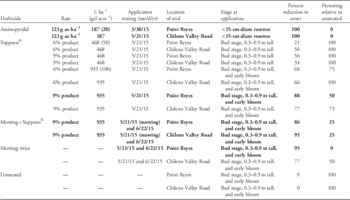
Woolly distaff thistle control and effect on flowering with aminopyralid, the organic herbicide Suppress® (caprylic and capric acid), mowing, and a combination of Suppress® and mowing.Footnote a

a Aminopyralid treatment included 0.25% Competitor® surfactant. Evaluations conducted on July 23, 2015. Rows in bold represent control >85% and with at least 50% reduction in flowering of surviving plants.
Data Analysis
Data were regressed on indexed cover values (% cover relative to untreated plots). Within each trial, we compared control values for all treated plots with the values for untreated plots using Dunnett’s test for comparing multiple means to a single control (JMP v. 12.0.1, SAS Institute, Cary, NC 27513). It was felt that this analysis, rather than a more typical means separation, would provide the strongest evidence for a significant response in treated plots. All analyses were performed using JMP 8.0 (SAS Institute).
Results and Discussion
Conventional Herbicide Treatments
All tested herbicides provided effective control of woolly distaff thistle (Table 2). However, the timing of application not only influenced the control of the invasive plant but also the number of newly germinated seedlings at the end of the growing season. In almost every case, the spring applications in March (2012) or April (2013) had greater than 99% control of woolly distaff thistle and fewer than 1.5 seedlings per plot (27 m2) at the end of the growing season. The exceptions were the low rate of aminopyralid (53 g ae ha−1) and aminopyralid + triclopyr (56+560 gaeha−1) in experiment 2 (April 30 application date) and the high rate of aminocyclopyrachlor (123 g ae ha−1) in experiment 2. For aminopyralid and aminopyralid + triclopyr at the low rate, neither the percent control nor the suppression of subsequent germination was above the threshold of effectiveness. For the high rate of aminopyralid, control was excellent (99%) in the April treatment timing, but control of seedlings or rosettes at the end of the season was not complete (6.3 per plot), although it was reduced by 89% compared with untreated plots.
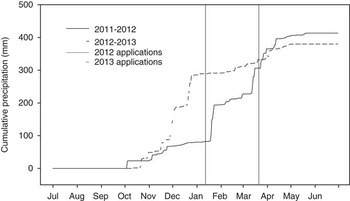
Winter treatments at the lowest rate tested for all herbicides were considerably better in the second experiment (January 15, 2013) compared with the first experiment (January 12, 2012) (Table 2). This included greater control and lower numbers of seedlings or rosettes at the end of the season. We speculate that the improved control in 2013 was due to the dramatic difference between precipitation on the site at the time of herbicide application (Figure 1). At the January herbicide application timing in experiment 1 (2012), cumulative precipitation on the site was only 81 mm (3.2 inches), whereas 288 mm of precipitation had accumulated at the time of the January application in experiment 2 (2013). Thus, plants were probably more drought stressed in 2012 and less likely to respond to the herbicide treatments. In addition, only 94 mm of additional precipitation had accumulated by May in 2013, compared with 331 mm of additional precipitation in 2012. This high amount of late-season rainfall in 2012 could have accounted for increased germination and survival of seedlings after much of the herbicide metabolized in the soil.
Rainfall accumulation over time for Chileno Valley Road treatment site from 2011 to 2013. Vertical lines represent application dates for both experimental years.

Organic Herbicide Treatments
In the second experiment we compared the high rate of aminopyralid in a March and a May application timing with two rates of Suppress® (6% and 9%) applied in two spray volumes (468 or 935 L ha−1 [50 or 100 gal acre−1]), repeated mowing (twice), and a combination of mowing and 9% Suppress® at 935 L ha−1 (Table 3). The Suppress® organic herbicide label recommends rates from 3% to 9%, with 3% used in the control of annual weeds. However, the label suggests rates from 6% and 9% for treatments to plants at older stages of development, which corresponded to the stage of woolly distaff thistle at our application timings. The timing of the organic applications was later in the season than would be normal for postemergence herbicide treatments. However, because Suppress® is a contact nonselective herbicide on annual species, applications were made after the annual forage grasses had dispersed seeds and senesced. This treatment timing would be expected to reduce the seedbank of woolly distaff thistle without negatively impacting seed production of annual grasses or early-season annual broadleaf species.
Results for aminopyralid at the two locations were nearly identical to those of experiment 1 (Table 2), with both sites resulting in 100% control of woolly distaff thistle. Suppress® alone at 6% or 9% (468 Lha−1) or at 6% (935 Lha−1) did not provide effective control of woolly distaff thistle at either location, nor did it prevent treated plants from flowering. The application of 9% (935 Lha−1) Suppress® did not provide effective control at the Chileno Valley Road site but did have a reasonable level of control (88%) and some suppression of flowering (50%) at the Point Reyes site.
Mowing twice was also more effective at the Point Reyes location compared with the Chileno Valley Road site (Table 3). However, organic ranchers in the region have anecdotally indicated that mowing woolly distaff thistle prior to flowering is difficult to perform on steep hillsides and has only provided short-term suppression.
The most consistent treatment, though not as effective as aminopyralid, aminocyclopyrachlor, or clopyralid, was a combination of mowing followed by 9% Suppress® (Table 3). It appeared that the mowing removed excess growth, enhancing exposure of the regrowing woolly distaff thistle to the Suppress® treatment. Though neither site had better than 95% control of woolly distaff thistle, both sites had acceptable levels of control and dramatically reduced the percentage of flowering in surviving plants. While this integrated approach is more labor intensive and less economical compared with conventional herbicides, it does provide ranchers with an organic option for reducing woolly distaff thistle infestations without significantly damaging grass cover early in the season. In situations where repeated control efforts using these organic practices are feasible, it may be possible to eventually deplete the soil seedbank to a level where more economical and less intensive manual options can be employed.
Conclusions
Results of these experiments provide control options for both conventional and organic ranching practices where woolly distaff thistle is a problem. The use of aminopyralid, aminocyclopyrachlor, or clopyralid can all be very effective. Choosing the optimal herbicide will depend on economics, site characteristics, and the plant community. For example, clopyralid has a narrower spectrum of sensitive species compared with aminopyralid and aminocyclopyrachlor and does not injure oak seedlings or saplings. Thus, it may be a better option when young oak trees are present (DiTomaso et al. Reference DiTomaso, Kyser, Oneto, Wilson, Orloff, Anderson, Wright, Roncoroni, Miller, Prather, Ransom, Beck, Duncan, Wilson and Mann2013). In contrast, aminocyclopyrachlor can damage tree species to a higher degree compared with the other products, and it may not be appropriate in a mixed grassland/woodland community (Patton et al. Reference Patton, Ruhl, Creswell, Wan, Scott, Becovitz and Weisenberger2013).
For organic systems, control options for woolly distaff thistle will require a more integrated approach using a combination of control methods. Regardless of the control strategy employed, effective long-term management of this species will depend upon reducing the soil seedbank.
Acknowledgments
We thank the landowners at the Bloom and Gianazzi ranches for allowing us site access and for assisting with the mowing. We also thank the Point Reyes National Seashore for allowing us to use a site at the park. We would also like to thank the Russell L. Rustici Rangeland and Cattle Research Endowment for its financial support.