INTRODUCTION
The species Chelonia mydas Linnaeus Reference Linnaeus1758 (Cheloniidae) is known as the green turtle. Currently, the species is on the Red List of the International Union for Conservation of Nature (IUCN) as an endangered species. The main threats to C. mydas are related primarily to anthropogenic impacts, such as intentional collection of eggs, capture of adult specimens on nesting beaches, habitat degradation (wastewater, solid waste dump of anthropogenic origin, construction of marinas and ports, boat traffic and harvesting of food resources of the species) and incidental capture in fishing activities (Seminoff, Reference Seminoff2004; Reis et al., Reference Reis, Pereira, Rodrigues, Secco, Lima, Rennó and Siciliano2010).
The green turtle has a wide distribution in coastal areas or in the surroundings of oceanic islands of tropical and subtropical regions. It is usually solitary, but can form groups in feeding areas (Márquez, Reference Márquez1990). Young turtles have pelagic oceanic habit and as they develop, they associate with neritic areas due to changes in dietary habits (Bjorndal, Reference Bjorndal, Lutz and Musick1997). In adulthood, the green turtle can measure up to 120 cm in curvilinear carapace length and weigh 230 kg (Bugoni et al., Reference Bugoni, Krause and Petry2001).
Variations in the diet of the species over the areas of occurrence are related to the local availability of food and maturity stage (Bjorndal, Reference Bjorndal1980, Reference Bjorndal, Lutz and Musick1997). During the first years of life, the species is omnivorous, with a carnivorous tendency. After this eating phase, it is predominantly herbivorous and feeding sites are associated with coastal areas. Despite food preference for macroalgae and marine phanerogams in their diet the species can include: sponges, cnidarians, molluscs, crustaceans and fish (Mortimer, Reference Mortimer and Bjorndal1982; Bjorndal, Reference Bjorndal, Lutz and Musick1997).
This study contributes with new information about the diet of green turtles in south-eastern Brazil and describes for the first time the food items recovered in the stomach contents of juvenile specimens collected in Rio de Janeiro State.
MATERIALS AND METHODS
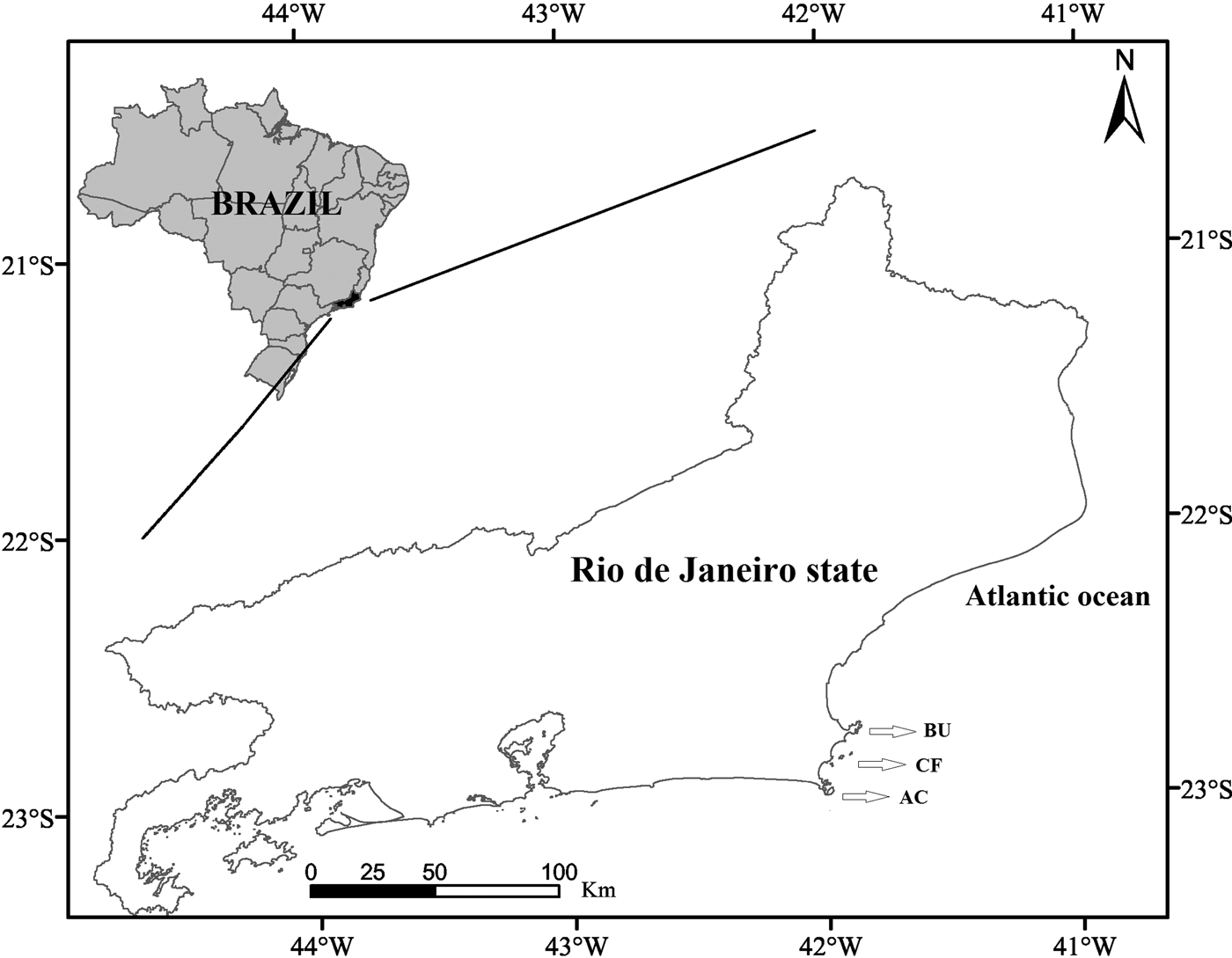
This study was carried out on the central coast of Rio de Janeiro State, south-eastern Brazil, between 22°50′S and 23°00′S. The sampling area includes 40 km of the coastal region from the cities of Búzios (BU), Cabo Frio (CF) and Arraial do Cabo (AC) (Figure 1). In this area, the green turtle is commonly found throughout the year and predominates in the total of turtle carcasses collected from stranding and catches in fisheries (Reis et al., Reference Reis, Silveira and Siciliano2009).
Map of Brazil indicating Rio de Janeiro State and the sampling area between 22°50′S and 23°00′S: Búzios (BU), Cabo Frio (CF) and Arraial do Cabo (AC).

From April to September (austral autumn and winter), the region is predominantly influenced by oligotrophic waters of the Brazil Current, with temperature and salinity above 18°C and 36 psu, respectively. However, between October and March, in the austral spring and summer, the upwelling of the South Atlantic Central Water (SACW) changes the conditions of temperature and salinity, and increases productivity in the region (Valentin, Reference Valentin1984; Valentin & Monteiro-Ribas, Reference Valentin and Monteiro-Ribas1993).
We analysed 49 juvenile green turtles collected between 2009 and 2010 while stranded on beaches. The sizes of carapaces were measured through minimum curved carapace length (cm), from the anterior point at midline (nuchal scute) to the posterior notch at midline between the supracaudals (Bolten, Reference Bolten, Eckert, Bjorndal, Abreu-Grobois and Donnelly1999). The stomach of each specimen was removed from the abdominal cavity, but the total volume of its content was not measured. The stomach content was washed in running water with a sieve (mesh size 500 µm) and the food items were separated according to the taxonomic group.
Macroalgae found in the stomach contents were in an advanced stage of digestion. For the analysis of this food item, 50 ml of their total volume were sampled in each stomach and preserved in formalin with 10% seawater. Other food items (fish and molluscs) were preserved in alcohol solution 70%.
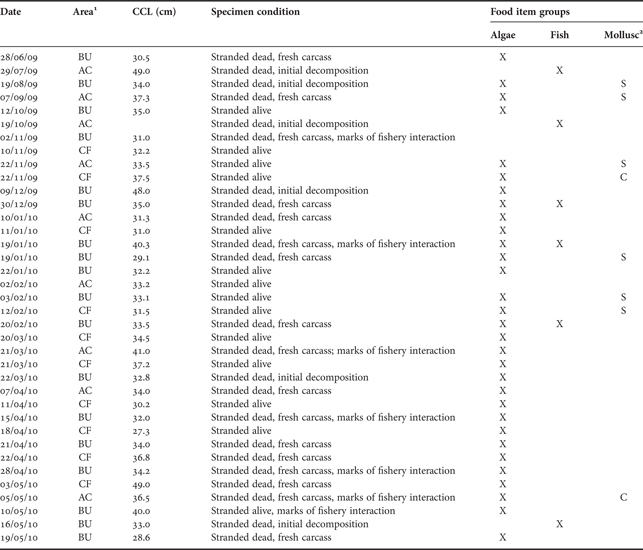
The stranding condition of each specimen with food items in its stomach content is shown in Table 1. Fourteen specimens were found alive, but died immediately after registration: 17 specimens stranded already dead, but the carcasses were fresh, and 6 specimens stranded in the initial stage of decomposition. In the flippers of seven specimens were observed marks of fishery interaction, as cuts by nylon and net mesh marks, probably indicating incidental capture in fisheries (Table 1).
Juvenile green turtles, Chelonia mydas, collected in Rio de Janeiro State and the food items groups recovered in the stomach contents. CCL, minimum curved carapace length (cm).

1, areas where the juvenile green turtles were collected: BU, Búzios; AC, Arraial do Cabo; CF, Cabo Frio; 2, molluscs: S, shells of bivalve and gastropod; C, cephalopod.
The representation of the food items consumed was calculated by the frequency of occurrence, dividing the number of stomach contents holding a given food item by the total number of stomach contents with food items. When the frequency of occurrence exceeded 30%, the food item was considered representative in the stomach contents. The visual predominance (more than 30% from the total volume) of macroalgae species in each sample (50 ml) was also used to make inferences about green turtle feeding preferences.
RESULTS
Regarding the 49 stomach contents of juvenile green turtles, 12 were empty or contained only solid waste of anthropogenic origin (e.g. plastic debris, nylon and polystyrene). Thirty-seven stomachs contained items related to food consumed by the species as follows: 31 contained macroalgae (83.7%), 6 contained teleosts partially digested or disjointed parts (16.2%), 6 contained mollusc shell fragments (16.2%), and 2 contained jaws of cephalopods (5.4%). The curved carapace length of specimens with food items in the stomach ranged between 27.3 and 49.0 cm (mean: 35.0 ± 5.2 cm) (Table 1).
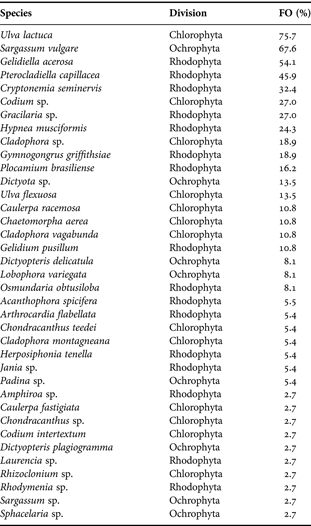
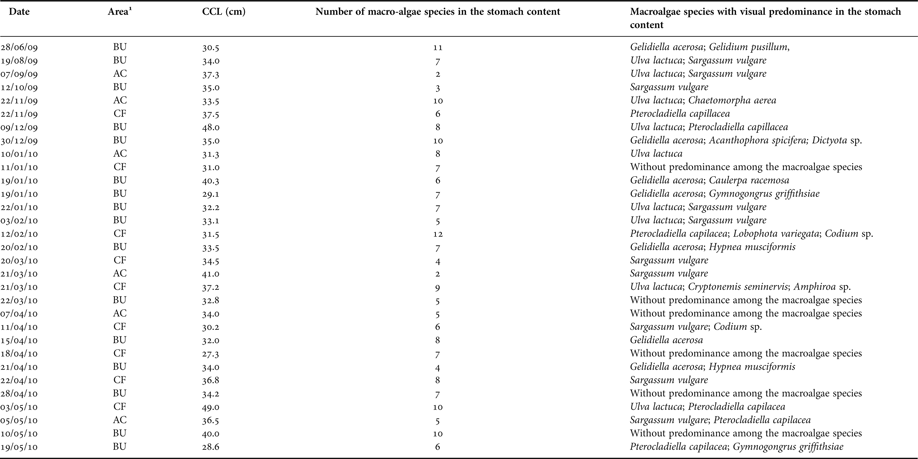
Thirty-seven species of macroalgae were identified in the stomach contents samples. Regarding this total, five species showed frequency of occurrence of more than 30%: Ulva lactuca, Sargassum vulgare, Gelidiella acerosa, Pterocladiella capillacea and Cryptonemia seminervis (Table 2). The visual analysis of macroalgae in each stomach content sample indicated that S. vulgare, U. lactuca, G. acerosa and P. capillacea were the predominant species. In seven stomach contents, the co-predominance of two of these species was observed (Table 3).
Macroalgae identified in stomach contents of juvenile green turtles, Chelonia mydas, in Rio de Janeiro State and the frequency of occurrence (FO%).

Visual predominance of macroalgae in the stomach contents of juvenile green turtles, Chelonia mydas, collected in Rio de Janeiro State. CCL, minimum curved carapace length (cm).

1, areas where the juvenile green turtles were collected: BU, Búzios; AC, Arraial do Cabo; CF, Cabo Frio.
Teleosts were recorded in the stomach contents from a specimen of Trichiurus lepturus with 30 cm of total length (initial stage of digestion), a specimen of Paralonchurus brasiliensis with 19 cm of standard length (estimated by otoliths sagittae) and the presence of crystallins, vertebrae, bones, fragments of otoliths and skull bones. Fragments of seashells (bivalves and gastropods) were observed; however, taxonomic identification was not possible. In two stomach contents the occurrence of cephalopods was observed by the presence of jaws, but the prey taxonomic identification was possible only in one stomach content. Two specimens of the cephalopod Histioteuthis corona corona with mantle lengths estimated as 8.5 and 9.1 cm were observed in this stomach content.
DISCUSSION
The predominance of macroalgae in the stomach contents of green turtles confirms herbivory as the dietary pattern of the species. This dietary pattern, already described in the literature, is established from the first years of life (Bjorndal, Reference Bjorndal, Lutz and Musick1997). Juvenile green turtles can perform short and long-distance movements along marine waters (Godley et al., Reference Godley, Lima, Åkesson, Broderick, Glen, Godfrey, Luschi and Hays2003; Gallo et al., Reference Gallo, Macedo, Giffoni, Becker and Barata2006; Seminoff & Jones, Reference Seminoff and Jones2006), but the specimens can occupy stable home ranges for several months, especially when food resources are available (Seminoff et al., Reference Seminoff, Resendiz, Hidalgo and Nichols2002; Makowski et al., Reference Makowski, Seminoff and Salmon2006; Hart & Fujisaki, Reference Hart and Fujisaki2010). Over 80% of the green turtles with food items in the stomach content (N = 31) were collected still alive or had a recent death (Table 1). So, we can suggest that these specimens were feeding in the study area before dying and that their stomach contents represent the local food availability.
The frequency of occurrence analysis indicated that only 13.5% (N = 5) of the total macroalgae species recorded in the stomach contents might be considered as preferred items. However, caution is needed in the interpretation of the results when only one variable, such as frequency of occurrence, is applied to feeding preference description (Wetherbee & Cortés, Reference Wetherbee, Cortés, Carrier, Musick and Heithaus2004). It can bias the results, since the expression of stomach contents with presence or absence of a given food item does not consider the amount of food intake. In order to minimize this bias as far as possible, the visual predominance of macroalgae species in the stomach contents of juvenile green turtles was applied. Combining both results, we can suggest that in the study area the macroalgae preferentially consumed by the green turtle are Sargassum vulgare, Ulva lactuca, Gelidiella acerosa and Pterocladiella capillacea.
Due to the phenomenon of upwelling, the central coast of Rio de Janeiro State has biogeographical importance for macroalgae, with occurrence of tropical, subtropical and temperate species. This region is the geographical distribution limit for various taxa (Yoneshigue-Valentin & Valentin, Reference Yoneshigue-Valentin, Valentin and Seeliger1992), which increases the availability of species to be used as food by marine herbivores. Brasileiro et al. (Reference Brasileiro, Yoneshigue-Valentin, Bahia, Reis and Amado Filho2009) revised and updated the available information about the macroalgae occurrence in the study area until 2008; 339 infrageneric taxa, which corresponds to 53% of the total recorded along the Brazilian coast, are confirmed for this region. All the macroalgae species identified in the stomach contents of juvenile green turtles have been described for the study area. The three sampling sites considered in the present study (Búzios, Cabo Frio and Arraial do Cabo) have the highest macroalgae species diversity of this region (Brasileiro et al., Reference Brasileiro, Yoneshigue-Valentin, Bahia, Reis and Amado Filho2009).
The food preference of green turtle across its distribution varies due to the local availability of macroalgae and/or phanerogams. The opportunistic behaviour, using food resources of greater availability, is the major feeding strategy reported to the species (e.g. Sazima & Sazima, Reference Sazima and Sazima1983: São Paulo, Brazil (24°S); Garnett et al., Reference Garnett, Price and Scott1985: Torres Strait, Australia (09°S–10°S); López-Mendilaharsu et al., Reference López-Mendilaharsu, Gardner, Riosmena-Rodriguez and Seminoff2008; Baja California, Mexico (24°N–25°N); Carrión-Cortez et al., Reference Carrión-Cortez, Zarate and Seminoff2010: Galapagos Islands, Ecuador (0°S); Guebert-Bartholo et al., Reference Guebert-Bartholo, Barletta, Costa and Monteiro Filho2011; Paraná, Brazil (25°S). However, Russell & Balazs (Reference Russell and Balazs2009) analysing the feeding habits of this species in Kāne'ohe Bay, Hawaii (21°N), found that the abundance of a particular resource does not necessarily mean that it is used at a higher rate by the turtles. Fuentes et al. (Reference Fuentes, Lawler and Gyuris2006), in a study carried out in Green Island, Australia (16°S), concluded that the diet of the species can vary due to factors that are independent of the availability of food, such as tidal influence in the areas of feeding, presence of predators and intraspecific competition.
On the coast of Rio de Janeiro State, in spite of the diversity of macroalgae species available to the green turtle, there is a preference for some species as food resources. If the macroalgae preferentially consumed are the more abundant, an opportunistic feeding habit could be suggested for this species in the study area. Surveys on macroalgae abundance are necessary to confirm this assumption.
ACKNOWLEDGEMENTS
We thank the team of Grupo de Estudos de Mamíferos Marinhos da Região dos Lagos (GEMM-Lagos), who provided us with the green turtle stomach contents for this study, CENPES/PETROBRAS who coordinated the Projeto Habitats—Heterogeneidade Ambiental da Bacia de Campos, involved in this study, Dr Lísia Mônica de Souza Gestinari, who identified the macroalgae species and Dr Roberta Aguiar dos Santos, who identified the cephalopods species. D.R. Awabdi received an undergraduate fellowship from Coordenação de Aperfeiçoamento de Pessoal de Nível Superior—CAPES. This study was supported by Conselho Nacional de Desenvolvimento Científico e Tecnológico—CNPq (Grant 300241/09-7) and Fundação de Amparo a Pesquisa do Estado do Rio de Janeiro—FAPERJ (Grant E-26/102.915/2011). A.P.M. Di Beneditto is a member of CNPq INCT Material Transference from the Continent to the Ocean (Grant 573.601/08–9).