The latter part of the nineteenth century has been distinguished by two movements: one, popular education; the other, the woman movement.
—Ellen Henrotin, president of the General Federation of Women's Clubs (1897)Footnote 1A remarkable transformation of civil society and government occurred in the last half of the nineteenth century as public education systems expanded. The spread of common and secondary schools altered familial relations as more children attended school and it accelerated the entrance of women into fields of social life beyond the domestic sphere. As the numbers of schools proliferated and the enrollments of girls increased, the widespread need for teachers and public educational officers met an emerging class of educated women. This conjunction led to new levers of civic and political influence for women and to shifts in patterns of authority between men and women.Footnote 2
Consider three peculiar facts about the history of women and politics in the United States. First, before the Nineteenth Amendment to the U.S. Constitution, and prior to achieving full suffrage rights in some states, women won the right to vote in public schooling matters, including in elections for local, county, and state educational officers (see Table 1, page 26). Second, towards the end of the nineteenth century, as more and more women became educators, they came to hold key county and state supervisory positions. In fact, the first elective offices women held were educational superintendencies created by state constitutions and state legislatures. Third, women's rising political authority in public education was greater in rural than in urban areas, greater in the Western states than in the Central, and greater in the Central than in the Eastern states.
Woman Suffrage Laws in the States, Prior to the 19th Amendment to the U.S. Constitution, 1920.i

Note: States are listed in order of when women could vote in school elections.
Sources: All dates prior to 1902 and notes for the School Suffrage, Municipal and Taxation columns, as well as some dates and all notes for the “Full” column were compiled by the author from Susan B. Anthony and Ida Husted Harper, eds. History of Woman Suffrage, Vol. 4: 1883–1900 (Rochester, NY: Privately published, 1902). Dates after 1902 were compiled by the author from Martha Stapler The Woman Suffrage Year Book (New York: National Woman Suffrage Pub. Co., 1917). The “U.S. President” and “Party Primary” columns and most of the “Full” column reproduces Table 1 from: Holly J. McCammon et al., “How Movements Win: Gendered Opportunity Structures and U.S. Women's Suffrage Movements, 1866 to 1919,” American Sociological Review 66, no. 1 (2001).
i The states are ordered according to when women could vote in elections related to school matters. School suffrage was the most common type of woman suffrage prior to full suffrage. Dates in brackets under the school suffrage column signify that school suffrage was secured through full suffrage laws. A date followed by (t) means the law was a territorial law, passed prior to statehood. All dates signify a statewide right enjoyed by women, unless the date is marked by an asterisk, in which case only some women—usually rural denizens—had the school suffrage. The passage of a school suffrage law did not necessarily empower women to vote for county- or state-level offices. More detail on the particulars of the laws can be found in the endnotes. All together, thirty-nine states had enacted some type of woman suffrage laws prior to 1920. Nine states had enacted no woman suffrage laws. These were: Alabama, Florida, Georgia, Maryland, North Carolina, Pennsylvania, South Carolina, Virginia, and West Virginia. See Stapler, The Woman Suffrage Yearbook.
ii Kentucky progressively allowed more women across the state to vote in school-related elections. The 1838 law allowed only widowed women with children in sparsely populated rural county districts to vote; the 1888 law allowed widows in fifth- and sixth-class cities to vote; and the 1894 law allowed all women in second-class cities to vote. Until 1912, when a full school suffrage bill passed, no women in first-, third- or fourth-class cities had the school suffrage. See Anthony and Harper, History, 674–75; and Stapler, The Woman Suffrage Yearbook.
iii The Kansas Constitution of 1859 held that all women over the age of 21 should vote in school district elections, the same as men. An 1861 suffrage law allowed only women in rural areas to vote for school district elections; this right was extended to women in cities as well in 1887 as part of more general municipal suffrage laws. See Anthony and Harper, History, 659–65.
iv In Nebraska, all women enjoyed school suffrage from 1869 to 1875, when it was limited only to widows and spinsters. In 1881, school suffrage for all women was restored, but women could not vote for county or state offices. See Anthony and Harper, History, 808.
v In territorial Utah, women had full suffrage from 1870 to 1887, when Congress passed the Edmunds-Tucker Act, which in addition to banning polygamy, disenfranchised all women, among other things. Women in Utah regained full suffrage in 1896, when Utah became a state. See Anthony and Harper, History, 951–52.
vi In Michigan, this school suffrage law was limited to local offices only. Women could not vote for county or state offices. See Anthony and Harper, History, 769.
vii Between 1875 and 1885, women could only vote in local school elections; after 1885 they could vote in county-wide elections as well. See Anthony and Harper, History, 778–79.
viii No woman school suffrage in the New Hampshire cities of Manchester, Franklin, or Nashua. See Anthony and Harper, History, 818–19.
ix School suffrage limited to women living in rural areas, villages, and counties. See Anthony and Harper, History, 866–69.
x School suffrage limited to widows not residing in formalized “school districts,” meaning only women in rural or county areas could vote. See Anthony and Harper, History, 787–788.
xi The territorial government of Washington granted women full suffrage in 1883, but this was overturned. See Anthony and Harper, History, 968). See footnote 12. In 1890, women won back suffrage in school elections, though they were not allowed to vote in county or statewide offices. See Anthony and Harper, History, 978.
xii In territorial Washington, women had full suffrage from 1883 to 1887, when the Territorial Supreme Court overturned the law for a year, until it was reenacted by the legislature in 1888. The Court overturned the law again only four months later. See Anthony and Harper, History, 968–70. Women did not regain full suffrage until 1910, well after Washington became a state in 1889. See Stapler, The Woman Suffrage Yearbook.
xiii Male Wisconsin voters granted women suffrage in school elections in 1885, but the State Supreme Court ruled a year later that women could only vote on separate school ballots. See Anthony and Harper, History, 988–92. Because the court ruled that this could be done only with state approval, women effectively could not vote until 1900 when the state passed a law allowing this practice. See Joseph Ranney, “The History of Wisconsin's Women's Rights Law, Part 1: Wisconsin Women and the Law, 1846–1902,” in Wisconsin Lawyer (Madison: State Bar of Wisconsin, 1996).
xiv Women were allowed to vote for local and county school board members from 1887 until 1894, when the State Supreme Court disallowed the practice. See Anthony and Harper, History, 830–32.
xv New Jersey is the first state and only colony to have granted women suffrage in its original state constitution. The 1776 constitution specified that “all inhabitants of worth $250” would have the vote, and some women voted. The right of propertied women to vote was made explicit in 1790 when elections law was revised to read “he or she” in referring to voters. This right was overturned in 1807 by the legislature, which limited the vote to “white male citizens.” See Anthony and Harper, History, 830.
xvi Several state supreme court decisions refined, obscurely, the force of the law to apply only to those school offices created by legislatures; this meant that women could vote for most school trustees throughout the state. See Anthony and Harper, History, 600–609.
xvii Limited to women paying property taxes. See Anthony and Harper, History, 556.
These facts suggest important linkages between women, an emerging profession of educators, electoral politics, and political administration during the formation of public education in the American states.Footnote 3 Over the last half of the nineteenth century and the early decades of the twentieth, as public education became increasingly important to state governments, how did patterns of professional and political authority between men and women shift in the field of public education? In addition, what ideologies, political institutions, and economic factors structured women's increasing authoritative role in this important field of public policy?
To answer these questions, I turn to historical and comparative analysis of the American states, drawing on reports from state governments and the U.S. Bureau of Education, studies by the National Education Association, and census data. In Section One, I situate this study in scholarship on the gendered bases of social policy and suggest why political scientists have generally overlooked the historical intersection of women and the expansion of American public education. Section Two traces the economic, ideological, and institutional origins of women's entrance into teaching, and Section Three considers the shifting power of women within the education profession. In Section Four, I present a complete table of woman's suffrage rights, and I highlight how women's right to vote in school elections was central to the emerging political power of women. Section Five examines the rural orientation of state governments over the turn of the twentieth century and documents women's role as education superintendents at intermediate levels of government and as rural supervisors of schools. Finally, in Section Six, I consider political, professional, and economic factors that structured patterns of women's office holding across the states.
Ultimately, I show how public education was the original policy field through which American women became empowered as voters and political officials. Crucially, regimes of democratic institutions such as voting rights and electoral offices, more so than the development of state capacity or economic development, were fundamental to women's increasing authority in the policy domain that commanded the largest share of state and local resources at the time.
I. Gender and the State, Public Education and American Political Development
During the woman suffrage movements of the nineteenth century, the question of women's role in politics stirred great controversy. Suffragists and anti-suffragists alike agreed that women possessed greater moral virtue than did men and that this virtue was good for the nation. However, they disagreed about how far women's role should extend beyond the domestic sphere into a political arena where they believed corruption was widespread. Whereas anti-suffragists worried about politics polluting the moral purity of women, suffragists believed that the health of the republic depended on women's entrance into politics.Footnote 4 These debates peaked during the Progressive Era when “the very functions of government were changing” and “federal, state and municipal governments increased their roles in social welfare and economic life.” Regardless of how such changes in government altered the political status of women, the reform efforts “brought a tradition of women's involvement in government to public attention.”Footnote 5 Women's role in matters of public education was central to that tradition.
Still, political scientists have not focused on the historical role of women as voters and as office holders in the field of public education. For good reasons, histories of women shaping social policy have focused instead on the non-electoral and volunteer activities of women. In the past three decades, scholars firmly established that middle class white women's political participation, prior to the Nineteenth Amendment, extended far beyond the domestic sphere.Footnote 6 In the earliest days of the American polity, norms of womanhood and civic ideals were combined in the role of republican motherhood.Footnote 7 During the nineteenth century, women carved out a “separate sphere” of civic womanhood distinct from the male sphere of partisan corruption, and they developed a “domestic politics” rooted in feminine roles as mothers, caregivers, and home economists.Footnote 8 With the settlement of the West, women pioneers were often the civic equals of men on the frontier.Footnote 9 Throughout the United States, but especially in the North Atlantic and North Central states, the role of woman as an economic manager of the home had expanded its reach quite far into city life as “municipal housekeepers.” Through the General Federation of Women's Clubs and the Mothers Congresses, among other organizations, women addressed social problems related to mothers and children, sanitation, health, charities, and education.Footnote 10
These histories of women's civic and political roles and the gendered bases of social policy were the grounds of a new scholarship on the “maternalist welfare state,” which brought women back in as important political actors linked specifically to the activity of the state.Footnote 11 Koven and Michel, for example, found that in the U.S., Great Britain, France, and Germany, “the growth of welfare bureaucracies between 1880 and 1920 led to the expansion of caretaking professions dominated by women” such as social work and nursing. These female professions subsequently pressured the state. However, they also found that strong states (more rationalized, more bureaucratized) such as France and Germany allowed women less political space in government to press their reform agendas than weak states (less rationalized, less bureaucratized) such as the United States and Britain.Footnote 12 Theda Skocpol's study of the first social benefits in the United States—pensions for soldiers and widows—supported this finding. Women came to influence social policy formation in part because of fortunate timing: as male-dominated patronage party systems weakened, “huge maternalist associations, organized as local clubs tied into state and national federations, sought to extend into civic life and public policymaking the caring values of the separate ‘domestic sphere’ culturally ascribed to the female gender during that time.”Footnote 13 Politically engaged clubwomen moved the state to craft widows' pensions and to consider the care of children, policies that benefitted women in their roles as mothers. Through such reforms, women came to hold official positions in state and the national government such as in the federal Children's Bureau. More generally, women effectively lobbied city, state, and federal governments through women's organizations.Footnote 14
Thus, over the turn of the twentieth century, important linkages emerged between women's organizations in the United States or women's professions in Europe and the capacity of women generally in male-dominated states to improve the lives of women, children, the sick, and the poor. Although the focus in this scholarship has been on social benefits, similar intersections between women's gender roles, their professional and civic activity, and the formation of state institutions also apply to the field of public education. A few studies of women and social policy that have employed educational factors such as spending on students have expected spending to be positively related to the passage of laws backed by women's clubs.Footnote 15 In addition, studies on women's organizations often note how public education was a primary concern of women's clubs. However, there has not been to date a direct study of women's civic-professional and political roles in state public education systems.
As these systems expanded, citizens increasingly saw and legitimated a political-administrative role for women in those matters. In comparison to other public policy areas such as health and welfare in which women influenced government outside electoral channels, in the field of public education, women were also uniquely voters, and they quite commonly became appointed and elected officials in the county and state administration of public education. This latter electoral aspect especially distinguishes women's historical influence in public education from their influence in other policy areas.Footnote 16 Furthermore, because this influence was mediated directly by labor markets and the emergence of a profession of educators, it was distinct as well from the group influence women exerted through voluntary organizations such as women's clubs.
The relative lack of attention to public education in gendered analyses of the American state is not surprising given the fact that public education is generally left out of accounts of American political development.Footnote 17 From an international comparative standpoint, there are good reasons for this neglect. Unlike nineteenth-century European states such as France, the United States never developed a national bureaucracy with centralized control over public education. Instead, public education has expanded more democratically and with a more pluralist politics.Footnote 18 In contrast to Europe, where “popular resistance and central state leadership, in tandem with initiatives by industrialists and landowners, were the key features of school reform,” in the United States “patterns of popular resistance were largely absent; school expansion was mainly a local affair; and the political coalitions supporting the schools transcended class divisions.”Footnote 19 The decentralized nature of the federal polity, and the activity of partisan state legislatures responsive to the educational interests of middle-class and working-class constituents, meant that citizens were less likely to view schooling as a top-down imposition from central government officials. Instead, citizens embraced schools as local communal institutions, even though city governments and state legislatures played a constitutive role in their creation.
However, the locus of administration and the degree to which the state is powerful is not always identical, as de Tocqueville observed, and the permissiveness of state authority in the local administration of schooling has not equaled an irrelevant state.Footnote 20 Top-down visions were far from uncommon, and the American tradition of locally controlled schools has not entailed an absence of “state” involvement in those schools.Footnote 21 Following de Tocqueville, we should distinguish the fact that schools are administered primarily at the local level from the fact that central state actors have significantly driven public school expansion, albeit at the level of the federated states rather than the national government. As in most nation–states during the period, central-state actors and professional elites in the American states sought to rationalize public education systems and to increase the administrative control state government would have over education institutions in the periphery of their territories. The primary aim of the state superintendents of public instruction, for example, most of whom were selected by popular election with a constitutional mandate to monitor the state's common and secondary school systems, was to make the administration, funding, and curricular offerings more uniform across their states.Footnote 22
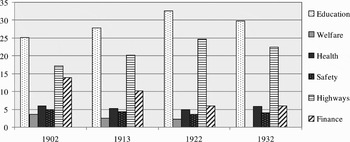
Whatever the efficacy of these officers, who are discussed in more detail below, the fact is that states considerably expanded their administrative and fiscal role in public education such that, by the turn of the twentieth century, education had become the major expense borne by state governments. From 1902 to 1932, for example, spending in education outweighed health and welfare expenditures (Figure 2).Footnote 23 Along with building roads, public education was the first policy domain in which state governments first begin to reach into the peripheral parts of their territories and to develop formal, taxing, and distributive powers that characterize state capacity.Footnote 24 Given this, conceiving of the public schools as appended in a secondary or tertiary way to the primary functions of American government may fail to show the important transformative function that public education systems have played in American political development.
Furthermore, the relatively decentralized nature of American public education has not meant a slower rate among nation–states in educating citizens. Rather, public education was the “realm of social policy in which America was a leader among modernizing nations,” and primary schooling spread throughout the United States earlier than in western European states.Footnote 25 For example, between 1870 and 1910, 91 percent of American children aged 5 to 14 years old were enrolled in school for part of the year. By comparison, 62 percent of British, 66 percent of Norwegian, 74 percent of German, and 82 percent of French children of the same age cohort were so enrolled.Footnote 26 State actors actively pushed increasing school enrollments, even though the cost of maintaining schools was expensive. It is perhaps not surprising that with so many children in school (for an average of 6 months a year by 1900), the expanding education systems turned to women who were themselves the products of the common schooling system to fill the ranks of the teaching corps.
Again, a national comparative perspective is instructive because the role of American women in the field of public education is unparalleled. In contrast with other nineteenth-century nation states where majorities of teachers were men well into the twentieth century, outside of the South in the United States, teaching became primarily a woman's occupation by 1900. By 1929, American women were 86 percent of primary school teachers and 63 percent of secondary school teachers. Comparable figures were lower in other countries, especially in secondary education: in Germany, only 25 percent of primary teachers and 29 percent of secondary teachers were women; in Japan, only 33 percent and 24 percent respectively. Out of 24 countries, the United States had the highest percentage of female secondary teachers, well over the mean of 33 percent.Footnote 27 Thus, one of the social policy fields in which the United States was a leader was also formidably the province of women.
Given this fact, women's relationship to the expansion of public education systems should be of special interest to scholars of gender and politics and American political development. The emergence of state-backed public education systems apparently created limited yet significant transformative political opportunities for women, as voters and political office holders, elected and appointed. Their activity in the field of public education, even when it was gendered as women's work, though not when it was devalued as merely women's work, was the original path on which many American women came to hold political power in the United States. State public education systems ultimately afforded women political opportunities as voters, as appointed supervisors of rural schools, and as elected county and state superintendents. When the field of public education is entered into the gendered history of the state, women emerge as more deeply implicated in state formative developments than previously thought.Footnote 28
As in any shift in patterns of authority, however, women's increased political status in this one policy field did not suddenly transform gender hierarchies. Changes in women's social and political status were qualified and constrained. Theoretically, power relations and social hierarchies will endure: without the attribute of endurance, such hierarchies are not meaningfully powerful. Gendered hierarchies are especially persistent, in part because the dominant power of men and the subordinate power of women are rearticulated in many social fields: in the home, in civil society and professional life, and in politics. Thus, even as norms about women's appropriate social roles changed, the force of constraining gender ideologies persisted to some extent. A case in point is the identity of the “municipal housekeeper”—a term that acknowledges woman's important presence in the political life of the city even as it asserts a fundamentally domestic role for her. Furthermore, even when such marginal shifts took place, the previous patterns of dominance and subordination sometimes chased after those changes with a reversion to the status quo. Arguably, this is what happened toward the end of the Progressive Era, when the new power of women voters diminished as appointments replaced elections in the selection of administrators.Footnote 29 Nevertheless, such marginal transformations are crucial in understanding the historical role women played in politics and in understanding political development more generally.
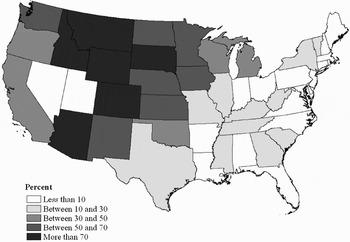
Ideological, economic, professional, and political factors all structured the political opportunities facing women in the field of education, which were not at all uniform across the nation. As the map of women's hold on the intermediate or county superintendency shows in Figure 1, their administrative role in public education was far greater in states west of the Mississippi River. Although this Western exceptionalism may be linked to the distinctive political culture of the West, a culture in which women on the frontier enjoyed relatively equal status with men that was lacking in the older Eastern states, women's authority as public educators was not equally strong in all Western states, nor was it equally weak in all Eastern states. In Section Six below, variation in suffrage laws across the states, the role of the state in public education, the civic activity of women and teachers, and the gendered contours of the labor market are examined through statistical analysis. Before moving on to that analysis, I first discuss the ideological and economic foundations of women's entrance into education, and I offer an account of the autonomy that women as educators possessed. In fact, the evolving depth of women's professional authority may have been linked to their success in holding political offices in rural areas, and rural areas were the focus of state officers of education in the first decades of the twentieth century.
Percentage of Intermediate Superintendent Offices Held by Women in 1930.

II. Constructing the Role of the Woman Educator
Many histories of women educators linger on the limited extent to which work in teaching freed women from their social and economic subordination to men. Overall, a dour assessment prevails: although teaching enabled some women to make their own living, teacher pay was relatively low; teachers did not have the same social status as doctors or lawyers, and women classroom teachers were often subordinate to male administrators.Footnote 30 It is true that women educators, especially elementary school teachers, enjoyed less occupational autonomy than the men in their field or the men of other professions.Footnote 31 Nevertheless, the nineteenth century economic, ideological, and political foundations of women's entrance into teaching created forms of empowerment for many women, even as new forms of subordination also emerged.
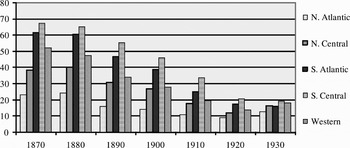
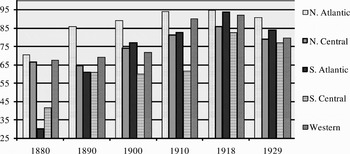
In the last half of the nineteenth century, in all regions of the United States, women rapidly became the majority of American public school teachers, though regional variation remained by 1900: for example, 86 percent of teachers were women in the North Atlantic states, but only 54 percent were women in the South Central states.Footnote 32Figure 3 documents, among other things, the remarkable decline of male teachers in the South from 1870 to 1930. The figure also indicates a slight drop in the percentage of women teachers in 1930, which may have been due to the Great Depression; I discuss this development below.Footnote 33
State and Local Government Spending by Function.

Percentage of Teachers who are Male, by Region.

The widespread increase in the number of female teachers and the correspondent decline in the number of male teachers were due in part to the general structure of occupations facing women and men at the time. Women became educators because professions such as law, medicine, and theology were closed to them and because blue-collar employment was inconsistent with notions of femininity prevalent among the “respectable” middle and upper classes. Furthermore, there were relatively few white-collar clerical jobs open to either men or women until the 1920s.Footnote 34 From 1860 to 1920, a rise in clerical workers met a decline in domestic workers whereas the percentages of women who were operatives and professionals stayed relatively constant.Footnote 35 Professionals averaged about ten percent of the female workforce from 1860 to 1920.
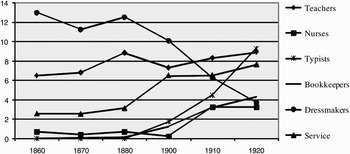
Comparisons among more specific occupations further reveal women's historical role as teachers in the female workforce. First, teachers were about 6 percent of employed white women in the nation in 1860 and about 8 percent in 1920. Between 1880 and 1900, there was a slight drop in teachers and a concurrent rise in non-domestic service workers; but, after 1900, these occupations increased in parallel (Figure 4). Around 1900, the female occupational structure shifted dramatically as the number of typists and bookkeepers (and nurses to a lesser extent) began to increase. In 1910, the number of women in teaching outnumbered the number of women in most other non-domestic, non-labor occupations. Nevertheless, by 1920, clerical workers such as typists outnumbered teachers, a relation that continued for the rest of the century.Footnote 36
Percentage of White Female Workforce in Selected Common Nondomestic Occupations.

Unlike women's opportunities in clerical lines of work, which were driven to a large extent by technological innovation, the origin and continuation of women's opportunities to teach were driven by rational (that is, organizational) and irrational (that is, gendered) state interests.Footnote 37 The formalization of schooling increased as state education systems expanded. This formalization was “characterized by age grading, more professionalized staff … more stringent certification requirements, and greater standardization of the curriculum.”Footnote 38 These characteristics led to an increasing number of women educators for several reasons.
First, credentialing and a longer school term made teaching a less casual occupation, which paradoxically meant less competition with men for jobs. The need for credentials made teaching less attractive to men who would teach as a stepping-stone to other occupations, or in addition to other jobs. Second, with more positions available, and with the increased wages that accompanied credentialing, women “flocked to teaching.”Footnote 39 Finally, prevailing ideologies about the appropriate role that women would play outside the home helped legitimate women's choices to become teachers.
Ideas about the nature of woman as fundamentally caring and virtuous generally legitimated the increasingly public role of women in the nineteenth century. Such ideas had force in the field of public education as well.Footnote 40 The most important of these were the “cult of true womanhood” and the idea of a “woman's separate sphere.”Footnote 41 Women such as Catherine Beecher had expanded the definition of home—the prescribed proper sphere for women—to include the classroom and school district as well. In the 1820s and 1830s, Beecher founded several female seminaries—training institutions that explicitly promoted teaching as a profession that belonged to women.Footnote 42 In Beecher's view, developing the role of the woman educator was not only good for the nation, it was also good for women because the profession offered them “influence, respectability and independence.”Footnote 43 Such ideas helped to sanction this new public role.
These ideologies also influenced professional elites linked to state departments of education. Male state superintendents leaned deliberately on the domestic-educator ideology and took on the mission of the female seminaries as they actively campaigned to recruit women as teachers.Footnote 44 For example, starting in 1848, the year of statehood, the State Superintendent of Public Instruction in Wisconsin published reports on “The Condition and Improvement of the Common Schools and Educational Interests of the State.” The first nine years of reports lacked reference to women's supposed natural suitability to be educators. By 1858, however, Superintendent Lyman Draper deliberately campaigned to marshal public support for a female teaching corps. The state's all-male legislature was the primary consumer of this report. The report thus appears as a purposive attempt to transform male conceptions about what women may appropriately do.
Draper leans little on an argument that is prominent later on—that it is good economic sense to hire women. At this point, his aim was to portray women as naturally capable teachers. For example, he argued: “Females, in consequence of their higher moral instinct, their more refined tastes, together with their more patient and sympathizing natures, are fitted in a more eminent degree than the male sex for imparting instruction to the young.” As he deliberately justified a gendered division of teaching labor with passages like these, he summoned East Coast educational expertise to support his claims. For example, he commended a school committee in Framingham, Massachusetts for its insight into the graded capacity of women's intellects and ability to command a classroom. That committee argued, “In our high schools and colleges, it is obviously better to employ permanent male teachers. But, in all elementary instruction, the very structure of her mind fits woman for the task. Nature has her marked out for this great work. Outside of the family, she nowhere seems so truly to occupy her appropriate sphere. No occupation harmonizes better with her character.”Footnote 45
Nevertheless, gender alone did not qualify women to be hired as teachers. Like Beecher, state superintendents recognized that even though women's “natures” were a good fit for instructing the young, women would still need formal pedagogical training. Accordingly, the superintendents became influential supporters of Normal schools, or teacher training schools. Wisconsin's Draper, for example, thought Normals would “have a tendency to draw out” an important “class of talent, and prepare a noble army of female teachers.”Footnote 46 Still, whereas female seminaries were founded by women for women in order to empower them and give them a profession exclusively theirs through which they could improve the character of the nation, male statesmen, most of them Whigs, were the key founders of the state Normal schools. Their primary concern was to rationalize, systematize, and bring order to what they perceived as a lack of training for female teachers. This gendered difference between the seminaries and the Normal schools is quite stark. In contrast to the education of female seminary students, state governments funded the education of Normal students, either in whole or in part. Consequently, Normal students were more directly subjected to the educational aims of the state. Footnote 47
Because of the wide range in the curricula offered to Normal students, the value of the Normal certificate in the overall scheme of qualifications for teachers varied across the states and their locales. However, being a Normal graduate was an important distinction for career educators; those who graduated were an elite group. At the end of the nineteenth century, the U.S. commissioner of education reported that there were only 8,188 Normal graduates available to fill the 50,000 new jobs that were opening up the following year.Footnote 48 The percentages of Normal school students who were women were high from the beginning in the North and the West, where they were between 65 and 75 percent of enrollments respectively in 1880. By contrast, women were less than 30 percent of enrollments in the South Atlantic states in that year. Yet by 1929, across all regions, the Normals had become institutions attended almost entirely by women (Figure 5).
Percentage of Enrollments in Normal Schools, Female, by Region.

Many Normal graduates went to teach in the cities, yet many also went to rural areas, thus meeting a primary objective of the state's aim to increase the number of qualified teachers in rural areas. Furthermore, many graduates taught at the elementary level. However, as more high schools were established, they increasingly taught at the secondary level as well. Finally, although most Normal graduates were not likely to become administrators, many women administrators had attended the schools.
As early as the mid 1870s, many state superintendents had already shifted their priority away from constructing what was the appropriate role for the female educator, and they turned their attention to the cause of compulsory schooling laws.Footnote 49 Naturalizing logics about where in the educational system women should “appropriately” serve gave way to the practical need of the system to draw upon the large corps of women who had invested the most time in the field. For example, as early as 1873, the U.S. commissioner of education reasoned that “the difficulty experienced in finding fully educated men for the various departments of school work has for some years past led to an engagement of women in this work … on the ground that cultivated women are more frequently available for the performance of such duty than equally cultivated men.”Footnote 50
On the one hand, the domestic-educator ideology originally fitted women into the primary needs of education systems, and the new role of the woman educator emerged in such a way that the hierarchy of needs in the education systems was met without immediately disturbing power relations between men and women. On the other hand, women's entrance into teaching led them to accumulate qualifications such as the Normal school certificate and time on the job as teachers managing classrooms. They became “cultivated” in this way, and the need for cultivated persons often led to hiring women as secondary school teachers and administrators. Ultimately, as female teachers became administrators as well, the force of the domestic-educator ideology diminished, though it did not simply disappear. For example, a survey of 325 Oklahoman female educators born around 1900 found that many of them continued to look “upon teaching as an extension of a woman's domestic role in which the classroom and school building were her family.” However, even as the power of the ideology persisted to some extent, nearly all of them “struggled … for fair treatment on the job, and most promoted female leadership in the schools.” Moreover, 25 percent of them became administrators or superintendents in their communities.Footnote 51
III. Women's Changing Status in the Profession
The history of the National Education Association (NEA) sheds further light on the contradictions of empowerment and subordination facing women educators.Footnote 52 Forty-three men founded the NEA in Philadelphia in 1857. Because of distance, most were from Pennsylvania, Delaware, and New York, but the founders also came from Ohio and Massachusetts, Georgia, South Carolina, Indiana, Illinois, Missouri, and Iowa. By the end of the 1860s, with many members from Ohio, they had gained considerable influence with congressmen such as James Garfield, the later United States president, who championed the formation of a presidential cabinet-level secretary of education.Footnote 53
Although women were originally barred from membership in the NEA, they were admitted as early as 1866, a fact reflecting the rising numbers of female teachers. Significantly, the NEA was one of the first civil society organizations to be sex-integrated and one of the first (perhaps the first) professional organizations to be sex-integrated.Footnote 54 By the turn of the century, women's numerical power in the association had increased substantially. However, a sharp gendered hierarchy had emerged between classroom teachers, most of whom were female, and the principals and superintendents, most of whom were men.
Men in the profession had mixed reactions to women's increasing presence in the association. Some male administrators suspected, perhaps correctly, that the status of the profession would fall if the influence of women increased.Footnote 55 Others were careful to maintain women's interest in the association, as they reasoned that the majority of classroom teachers would likely remain female, and they believed in the idea of a unified profession. However, this attention to women “was never complete or principled” and it “never developed to the point that women teachers were understood to have an existence in schools or in the NEA that was independent of their usually male administrative superiors.”Footnote 56
In the early 1900s, women expressed dissatisfaction about “the lack of opportunity for [female] classroom teachers to participate adequately in NEA affairs” even though “they provided most of the Association's revenue.”Footnote 57 Radical female teachers' organizations such as those founded by Margaret Haley in Chicago and Grace Strachan in New York became increasingly active at NEA conventions.Footnote 58 After 1906, the female majority of the NEA argued that association money should be in the hands of all its members rather than in the hands of a small committee of male “Old Guards.”
At the 1910 annual conference, Katherine Blake, a principal and district superintendent from New York City, submitted a minority report to the male-controlled nominating committee in order to put Ella Flagg Young, a career educator from Chicago, on the ticket for NEA president.Footnote 59 Blake's nomination was successful and the members voted in Flagg Young two to one over the male candidate. She served as the first female president of the association during 1911. Flagg Young had already undermined sex hierarchies in 1909 when she became the first women educator appointed as the superintendent of a large city school system (Chicago).Footnote 60 At the time, Helen Bennett drew attention to the substantial public resources for which Flagg Young would be responsible as city superintendent: “The total value of the school property … was forty-two million three hundred sixty thousand seven hundred and thirty-eight dollars. The annual expenditures totaled over twelve million. There were six thousand two hundred and ninety-six teachers, five hundred and thirty-four of whom were men. The schools numbered two hundred and sixty-seven and the pupils two hundred and ninety thousand.” When Flagg Young became president of the NEA a year later, Bennett remarked, “The educational world had now given [her] all it had to offer. She was at the same time head of the school system in the second largest city in the country and of the largest association of teachers and educators.”Footnote 61
Flagg Young's two achievements in the profession and in city government reveal how authority outside of politics and authority within politics may reinforce one another during the careers of individuals. Her long career as a teacher, principal, county superintendent, and leader in state teachers' associations led her to have such authority that she could secure the office of a city superintendent, which was almost exclusively the province of men. In turn, the city superintendency put her in direct command of more than five hundred male educators, all of them public employees, which positioned her to appear more authoritative to men in the NEA. Feedback effects such as these likely operated in the careers of other prominent women educators. That is, the educational authority women accumulated early on as excellent teachers or principals positioned them to hold political offices at lower levels of government, usually in county administration. Such office holding may have increased their authority within state teachers' associations. In turn, this increasing professional status at the state level may have made their selection to an office in a large city or in state government more likely. That status would feed back again into the profession, where exceptional women such as Flagg Young, Mary C.C. Bradford, and Josephine Corliss Preston (state superintendents in Colorado and Washington and NEA presidents), among others, could become NEA president.Footnote 62
In her first days of her presidency, Flagg Young had no trouble taking command of the business meetings of the association. The meeting minutes show her easily overcoming the grumblings of some of the male trustees as she challenged budgetary items that did not benefit classroom teachers.Footnote 63 She helped pave the way for women to have greater influence in the NEA. Following her presidency, the NEA underwent important institutional changes. In 1913, women in the NEA created a “Department of Classroom Teachers.” Among other things, the department would address teachers' struggles with male administrators and superintendents. Flagg Young's presidency and the creation of the department “marked the beginning of the decline of the influence of higher-education leaders in the NEA,” and the Department of Higher Education, almost exclusively controlled by men, withdrew from the NEA in 1924.Footnote 64 Men immediately restored some of their control: for example, the next six presidents were men. After WWI, however, women resumed their control for most of the 1920s.
Outside the NEA as well, men in the field of public education challenged women's increasing authoritative role reflected by developments such as these. In thousands of school boardrooms across the country, men reasserted their occupational prerogative and sought to claim teaching jobs as off-limits to married women. Local school districts passed policies that barred hiring married women (the hire bar) or retaining women teachers who married (the retain bar).Footnote 65 These bars were solely local policies; state legislatures never instituted them. The first of them probably emerged at the turn of the twentieth century; however, they did not become widespread until the 1920s, and they reached their peak during the American entrance into World War II.
The Research Bureau of the NEA became particularly concerned with the unequal treatment of women within the profession and conducted several studies on teaching personnel practices involving married women. In 1928 and 1931, the NEA surveyed all American municipalities with populations of at least 2,500 people.Footnote 66 The 1928 study revealed that 61 percent of the respondent municipalities had passed hire bars; 52 percent passed retain bars. By 1931, these numbers had increased to 76 percent and 63 percent respectively.Footnote 67 One rationale for the bars rested on a public bounty argument that married women should not take jobs that single women would need to support themselves or that married men would need to support their families. Most likely, the onset of the Great Depression accelerated the passage of these bans, though the public rationales for them preceded the onset of the economic downturn.Footnote 68 Whatever the rationales, there is no doubt that such policies forced many women to make an unfair choice between career and family that men did not have to consider.
To some extent, professional legal opinion at higher levels of the state judiciary was on the side of women educators. Whenever women challenged the marriage bars in state supreme courts, the courts struck them down. In one case in Oregon in 1916, the counsel for the local school district that had passed hire and retain bars argued that with marriage comes “additional duties and obligations” that will “largely occupy and dominate” the woman's mind and “divert her attention.” The board's counsel also argued that the policy was fair because single women expected “that one in their ranks who marries will step aside and make room for” them.Footnote 69 The Oregon State Supreme Court, however, did not agree with these arguments, ruling, “If a teacher is just as competent and efficient after marriage, a dismissal because of marriage would be capricious” and there were no grounds for it.Footnote 70 A study of such court cases concluded, somewhat obtusely, that at least for women who were willing to challenge local school board policies in the courts, “opportunity for a career in a public school teaching coincident with a career in homemaking is relatively well assured.”Footnote 71
The increasing passage of such bars in the 1920s may have been related to the emergence of fixed (or single) salary schedules for teachers that began at that time.Footnote 72 Salary schedules pay all teachers on the same scale according to number of years on the job, regardless of sex or status as an elementary or secondary school teacher. Lobbying state legislatures and school district boards to institute the schedules was a primary objective of women teachers' organizations in California, Illinois, and New York. In 1910 Grace Strachan, who led the Interborough Association of Women Teachers in New York City, wrote a book entitled, Equal Pay for Equal Work: The Story of the Struggle for Justice Being Made by the Women Teachers of New York. Footnote 73 A year later, the New York legislature passed a law requiring equal pay for equal work in teaching. In 1921, Denver, Colorado and Des Moines, Iowa became the first cities to create the salary schedules. By 1925, eighty percent of women had won pay equality in the largest American cities.Footnote 74 Such salaries not only made the overall cost of salaries higher and burdened locales, they also may have had lowered the salaries of secondary teachers, many of whom were men.
In the 1920s, the NEA with its female presidents firmly supported these salary schedules, and most men in the profession were firmly opposed to the marriage bars, which they viewed as the outgrowth of popular prejudice. In addition to tackling issues such as these that blatantly harmed the careers of women educators, the female presidents of the NEA and its field secretaries continued the strategy of male presidents to cast the NEA as a professional organization rather than as a labor union like its main rival the American Federation of Teachers (AFT). They also distanced themselves to some extent from more radical teacher organizations such as Strachan's Interborough Association in New York. By distinguishing the association in this way, leaders of the NEA sought to make it attractive to both its middle class administrators, most of whom were male, and its teachers, most of whom were female.Footnote 75
While the economic rationale of the union-like AFT and its affiliates appealed to the economic interests of women, the NEA's primary concern with professionalization appealed to women's social status concerns and to women and men educators' shared belief in the social mission of their occupation. Elite men and women in the NEA, like elites from similar associations such as the American Medical Association, “saw themselves as guardians of important social values” who promoted “community welfare” in a way that contrasted with the more specific economic concerns of associations of “farmers, businessman and organized workers.”Footnote 76 However, the civic activity of all professional associations was not equally enthusiastic. Brint and Levy found in a study of presidential addresses from ten professional associations that the NEA was the most civically concerned among them.Footnote 77 The increasing influence of women in the NEA may have been partially responsible for its strong civic orientation relative to the other professions.
Perhaps external civic engagement and internal civic engagement were linked. The desire for democratic participation certainly motivated the female members of the NEA as they sought to elect a person who represented their concerns. When Katherine Blake nominated Flagg Young to become president of the NEA, she stood before a committee of men with the authoritative presence of the columns fronting Columbia University's Butler Library, named for a member of the association's Board of Trustees. Blake said:
The question of the presidency has been talked over in every hamlet in this country. For the first time in the history of this organization, a woman has been mentioned for the high office that has been filled for so many years by so many distinguished men, and for the first time we have a woman who stands, frail and little as she is, towering above those that are about her. … We have a woman to speak for us in Mrs. Young … and I beg your suffrages for her.Footnote 78
In addition to speaking for the women who attended the meeting in Boston, Blake also claimed to speak for the women educators across the country, caught up in the excitement of a “democratic election” in a non-political field. The groundbreaking symbolism of the first woman president of a national association of educators certainly mattered to both the women and men in the profession. The national distinction Flagg Young achieved, however, may not have been possible without political paths open to women as superintendents of education in the state of Illinois and elsewhere. Already, several decades before the election of Flagg Young, women had broken political ground as voters and as elected officials within county and state politics.
IV. Women and School Suffrage
In 1892, when male and female North Dakotans elected Laura Eisenhuth to be state superintendent of public instruction, she became the first woman in the United States elected to a statewide office. By 1913, voters in five states had elected women as state superintendent, and the governor of Utah had appointed one woman as well. A few lines in the immense fourth volume of the History of Woman Suffrage are all that scholars have written about Eisenhuth. The volume simply points out that she was a Democrat who served one term before losing in the next election to Emma Bates, a Republican.Footnote 79 Her biography is more interesting than this account suggests. Prior to becoming state superintendent, Eisenhuth already had a long career in public education, having worked in the Iowa public schools for eleven years before moving to North Dakota where she served as a county superintendent for four years. Despite being a gendered outsider to the state government of North Dakota, her final words as state superintendent exhibit a fascinating self-confidence about her own authority:
Being the first woman to hold a position of this kind I have realized that even my warmest friends have looked upon my work as an experiment, and that the novelty of my position might have made my relationship with the other officers strange and constrained; that such has not been the case in any instance is a matter of deep gratitude to me. I have endeavored to discharge the duties of this office with an eye single to the benefit of education and in such a manner that it would reflect credit upon womankind; that I have been successful in even a greater degree than I had hoped for, I have been warmly assured.Footnote 80
If her relationship with other officers might have been “strange and constrained,” it was because she was a vocal critic of male political partisanship. She argued that her office was “too great a responsibility to rest in the hands of one person who holds his position too often by political intrigue, and who can prostitute this power for political capital.”Footnote 81 In addition, she advocated aligning the election of state superintendent with other school elections, which would effectively shelter the job from party politics, a political field dominated by men, and place it more squarely in the field of education politics where women had the suffrage.
Founders of the domestic-educator ideology such as Beecher did not sanction the idea of women becoming voters or elected officials. Nevertheless, as in North Dakota, women in most states secured “school suffrage”—the right to vote for school board positions; for local, county and state educational officers; and on taxing issues. This was not true in the South, where women won few gains in suffrage rights and where they were unlikely to hold office. In the North Atlantic states, women possessed school suffrage, but that right did not lead to widespread office holding. In the West, a straightforward pattern of increasing authority—from securing school suffrage rights to securing full suffrage rights to office holding—was the norm. A surprising pattern emerged in some of the Central states, such as Wisconsin and Missouri. In these states, women commonly held county superintendencies before they had secured even limited suffrage rights.
Historians have written little about nineteenth century campaigns for school suffrage, and this remains an untapped ground for research. The best account follows the career of Clarina Howard Nichols who pushed for school suffrage in Vermont and Kansas. Nichols's views on womanhood occupied a middle position between the separate sphere ideologies of Beecher and the prominent antebellum suffrage activists such as Susan B. Anthony who distanced herself from the domestic ideology as she pushed for equal political rights for men and women. Through her association with Anthony, Nichols came to believe that “the vote would provide women with equal political influence and the best means of self-protection.”Footnote 82
Although Nichols failed to move the Vermont legislature to pass a school suffrage law in 1852, she had more success in Kansas, where she relocated as a widow with two sons in 1858. By the time of her campaign in Kansas, Nichols had “developed a nonpartisan, motherly persona that allowed her to address partisan issues and challenge the patriarchal construction of the law without losing moral authority.” She successfully persuaded male delegates to insert a school suffrage plank into the statehood constitution. This became the first statewide school suffrage law in the United States. As “she sat knitting day after day” at the convention, a few key Republicans sought “to connect their party's goals with female moral virtue” by supporting her arguments. Solon O. Thatcher, for example, argued that “female influence” should prevail in schooling matters “as it radiates from the fireside,” and another Republican noted that “our sisters and wives take more interest in the cause of education than ourselves.” Although the school suffrage law was an important precedent on the pathway to full suffrage, it may have reinforced differences between men and women more than their equality.Footnote 83 Still, in part because of this law, Kansas women were elected to key positions in the state's public education system. For example, by 1910 women held forty percent of all county superintendent positions; by 1920, they held sixty-seven percent.
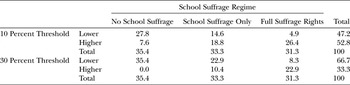
Table 1 frames school suffrage as foundational to the development of women's expanding voting rights prior to the Nineteenth Amendment to the U.S. Constitution. Before the amendment, women in thirty-one states possessed school suffrage. In twenty-five states (or territories), women had this right independent of full suffrage rights.Footnote 84 Of the fifteen states that granted full suffrage to women prior to the Nineteenth Amendment, ten were already school suffrage states: Colorado, Kansas, Michigan, Oregon, New York, Washington, Arizona, Montana, South Dakota, and Oklahoma. Of the remaining five, three were early suffrage rights movers in the Mountain West: Wyoming, Utah, and Idaho.Footnote 85 The other two states, California and Nevada, have rarer histories: women secured full suffrage relatively late there—not until 1911 and 1914 respectively—without having had already secured school suffrage.
Although marital status was generally an obstacle to women's participation in many aspects of social life, women could typically vote in school elections regardless of whether they were married, widowed, or single.Footnote 86 Only two of the twenty-five school suffrage states (Kentucky and Nebraska) originally limited suffrage to widows. Even in these states, legislatures extended voting rights later on to married women in rural areas. In the remaining twenty-three states, all white women living in rural areas could vote, and nearly all women living in urban areas could vote as well. Furthermore, marital status was no limitation on the right of women to hold local, county, or state educational offices.Footnote 87
When compared to a full suffrage regime, school suffrage might be dismissed as politically insignificant or as merely a token of appreciation for women's role as teachers. In the North Atlantic and North Central states where women commonly had the right to vote in school matters, but where they seldom held educational offices, this may have been the case. For example, Connecticut women secured school suffrage in 1893. However, Elizabeth Bacon, writing in volume four of the History of Woman Suffrage, was skeptical though not fully dismissive of the power school suffrage gave women. On the one hand, she asserted that “women soon learned that their votes amounted to but little” because male political parties controlled nominations for school board jobs. On the other hand, she pointed out that the unsuccessful attempt by male legislators in the late 1890s to repeal the school suffrage law indicated that women “did have some effect at the polls.”Footnote 88 For example, the members of a women's club in Willimantic succeeded in mobilizing 975 women to go to the polls to unseat a school board member. Other reactionary responses on the part of men suggest that school suffrage had some effects. In 1897, the Connecticut legislature altered voter registration procedures for school elections. Bacon believed this was done to “make the process of becoming a voter more disagreeable” with the effects of discouraging women. Nevertheless, by the end of the century, voters did elect some women as school trustees, and the state superintendent of public instruction had appointed women to be school visitors.
Elsewhere, when proponents of full woman suffrage offered justifications for it, they sometimes referred to the fact of women's school suffrage rights and to the fact that voters elected women to educational offices. For example, at the end of the nineteenth century, Colorado's male governor reasoned:
Since 1876, school affairs have practically been in the hands of women. They have voted at school elections, held the office of superintendent in a majority of counties and taught most of the schools. In these twenty-eight years neither politics nor scandals have impaired our public school system and in efficiency we challenge comparison with any State in the Union. What the women have done for our schools they can do for our civic government. They have introduced conscience into educational affairs and they will do the same in city and State. That is the fear of those who make politics a profession.Footnote 89
Nationally prominent woman suffragists including Susan B. Anthony, Carrie Chapman Catt, Betsey Mix Cowles, and Estelle Reed emphasized how women had proved themselves in school administration. They used women's records of educational service to justify claims for full political citizenship. Many of these women were educators themselves, having served as teachers and as county or state superintendents.Footnote 90 In some states such as Washington and Michigan, where women eventually won full suffrage, prior school suffrage rights may have been an important factor in securing full suffrage rights later on. Whatever the links between school suffrage and full suffrage, it is remarkable fact of American history that the first women voters and elected officials in the United States became voters and elected officials in the field of public education.Footnote 91
V. The State's Orientation to Rural Areas and the Intermediate/County Superintendency
As some women like Ella Flagg Young and Laura Eisenhuth became the chief educational officers of large cities or the heads of states, it was far more common, because of the number of positions available, for women to hold offices at the county level, especially in the rural parts of states. The administrative centralization of public education in urban and rural areas occurred through different processes; these separate geographic developments had consequences for women's role as education administrators. During the Progressive Era, a coalition of city officials and professional elites whom David Tyack has called the “administrative progressives” transformed city education from a ward-based system into a system that was more rationally organization and controlled by a bureaucracy.Footnote 92 A wave of rhetoric about removing partisan corruption from politics carried these school reforms. The aims of reform were to instill professional best practices in all schools, to equalize wealth across wards, and to homogenize and standardize curricula in the face of the waves of immigration from Europe. State legislators and bureaucrats played relatively little role in changing the urban systems.Footnote 93 Although legislatures did pass educational laws affecting only “cities of the first class,” because of the critical mass of professionals and other social elites in the cities, urban education had a developmental path of its own.Footnote 94
In 1895, a “Committee of Twelve” in the NEA investigated public education in the rural parts of states. Although “the state superintendent stands at the head of the public-school system of the State,” they noted, “his work is more closely related to rural than to city schools.” The committee believed that the state superintendent's administration should be “properly articulated” throughout the lower county, township, and district divisions. They recommended that legislatures grant the chief state school officers the power to withhold appropriations to all subdivisions that did not comply with statutory and administrative educational laws.Footnote 95 In contrast to superintendent offices in cities, “the county superintendency evolved not from a grassroots school organization, but rather was created to assist state superintendents in overseeing distribution of state funds and in assuring local school compliance with state laws.”Footnote 96 Because the city systems were older with many urban district laws already governing them, the power of city offices was relatively independent of state departments of public instruction, even though professional networks connected city and state department officers.
With respect to rural education, the NEA Committee of Twelve forcefully recommended that the administrative and funding bases of schools should map onto county or township lines, rather than be divided across local districts. The larger units “would conduce to effectiveness and simplicity of organization; to economy in the use and distribution of funds; to the equalization of the burdens of taxation, and to a system of supervision which would produce better results from the instruction given in the rural schools.”Footnote 97 At stake in these reforms was the so-called “Rural School Problem”—that of unequal quality of educational opportunity across the rural and urban areas of the state.Footnote 98 The two most important offices dealing with this problem were the county superintendent (or township superintendent in the New England states) and the rural supervisors (or school visitors). The superintendent positions emerged soon after the Civil War and were widespread throughout the country, numbering more than 3,000. Outside of the Atlantic states, they were elective. By contrast, the rural supervisor positions were appointive and housed in the state departments of education. They emerged around the turn of the twentieth century, and they numbered fewer than 100.Footnote 99
The responsibilities of county superintendents were many, and over time, “state education agencies granted them increased authority.”Footnote 100 In addition to managing funds and monitoring local schools for compliance with state laws, county superintendents compiled school statistics and examined teachers, they secured funds to build schools, they sought to improve school architecture and the beauty of school grounds, and they regulated the sanitation and hygiene of the school plants. In addition to the skills needed to perform these administrative functions, the county superintendent needed political talent as well that would “awaken the sympathy” and “arouse the interest” of parents and school boards and forge positive relationships with them. The NEA committee suggested that he or she should “be a leader, endowed by nature with a strong native sense, and at the same time able to impart enthusiasm and energy to all with whom he comes in contact.” Leadership was especially necessary for promoting the major rural reform of the day—the consolidation of small school districts, which often entailed the controversy of adjusting school district lines. Finally, the task of the county superintendent was pedagogical as well. They should “observe carefully the environments of the school, which exert a powerful, though unconscious, influence upon the character of the pupils,” and they should be careful to guard “the bearings of the aesthetical upon the ethical side of the child's nature.” Curricular decisions involved among other things considering “the relations of music and art as determining the development of the child along the right lines” and introducing studies to increase the “attractiveness and civilized aspects of farm life.”Footnote 101 These were high hopes for an office that was generally understaffed and underpaid.
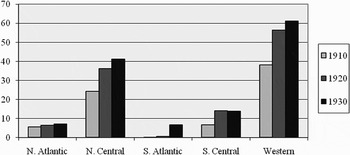
In 1873, John Eaton, the second U.S. commissioner of education, “observed that the practice in western states of electing women county superintendents represented a novel experiment that should be watched closely.”Footnote 102 Soon after 1888, when California passed a non-suffrage law that made women eligible for holding school offices, male voters in 11 counties elected women as superintendents. In Colorado, women secured full suffrage in 1893, and one year later the number of women holding the 56 county superintendencies increased from 0 to 26. In the same year, male and female voters in Colorado elected Angenette J. Peavey to become the second female state superintendent of public instruction in the United States and the second woman to hold a statewide office. In the reports she published for the governor and legislature, she called attention to women's new role in the government of education: “It is necessary to secure for this important office the most unselfish and public-spirited men and women in the community … . The future prosperity of the nation depends upon the education of those who are to be citizens, and a true patriot will vote regardless of party, sex, color or creed, for the person best qualified to select the teachers and manage the schools.”Footnote 103 In 1910, women held county (or township) superintendent positions in all parts of the country except the South Atlantic states, and the percentage of such offices they held increased considerably in all regions until 1930 (Figure 6). As an increasing number of women came to hold superintendent positions, claims of professional expertise such as Peavey's here and Eisenhuth's above gradually trumped arguments about women's moral purity, which had previously justified women's entrance into public education.Footnote 104
Percentage of Intermediate Superintendent Offices Held by Women, by Region.

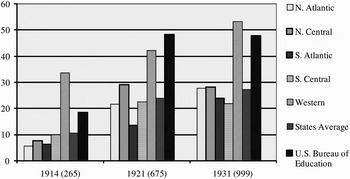
By the second decade of the twentieth century, women also commonly held positions as rural supervisors of schools, normally appointed by the state superintendent.Footnote 105 By 1917, more than half the states had these positions.Footnote 106 In addition to providing information to the counties, rural supervisors also worked with superintendents to secure the interest of different parties across the state. These included the “State college of agriculture, the State normal school leaders, the academic departments of education in the State University, the rural high schools and the state department of good roads, the State grange, the federation of women's clubs … and school-improvement associations.”Footnote 107 Finally, as an agent of the state superintendent, the supervisor represented the state at meetings and acted as an advisor to the state board of education, giving expert advice on curriculum suitable for “country life.” Throughout the country, women nearly always held these positions in the state departments of education. In addition to the rural supervisors, women also held positions as supervisors of elementary schools and supervisors of home economics programs. Because of the state's concern with rural areas, women's presence in the state departments, and at the U.S. Bureau as well, increased considerably from the 1910s to the 1930s (Figure 7).
Percentage of Positions in Departments of Education Held by Women.

One of the most pressing problems facing rural schools was their small size, and educational reformers advocated consolidating schools through the reorganization of districts. The undeveloped terrain in the areas where many women superintendents worked made their jobs especially difficult. For example, in 1916, Jennie Burkes was county superintendent in Tennessee, the pivotal state to ratify the Nineteenth Amendment to the U.S. Constitution. Her mountain county was typical “as far as ruggedness, bad roads, and low property assessment” were concerned. When she started her job, “every problem known to education—short term, poor pay, bad buildings, (and) no equipment” confronted the county. With some comedy, Burkes described how the men in the county received her that first year:
With the courage which only the inexperienced know, we [Burkes, her staff, and a supervisor from the State Department] took our school out of politics … and established a new order of administration. The last straw fell when the [State] board employed a rural supervisor of schools. The people considered this action a piece of unheard-of extravagance and questioned its legality. The court, at its next session, took up the matter and voted against the employment of a supervisor by a majority of 17 to 5. When this honorable body were told that they had absolutely nothing to do with the hiring of a supervisor, they settled back with this question: “What will she do next?”
The greatest obstacle to consolidation efforts was poor roads, which residents of the county wanted improved not only for educational reasons. With the help of the rural supervisor from the state department, Burkes persuaded the county board to promote school consolidation, arguing that good roads might follow from district reorganization. The strategy worked. According to Burkes, the next session of the county court “issued pike-road bonds to the amount of $377,000 so that good roads may go hand in hand with good schools in Claiborne County.”Footnote 108 With the aid of rural supervisors, county superintendents such as Burkes achieved remarkable improvements to the quality of education in rural areas, despite being confronted by serious infrastructural problems in their counties and despite lacking sufficient resources to redress them fully.
Compared to the city superintendents, the county offices typically had more territory to cover, more teachers to supervise, and more buildings to inspect. Nevertheless, the professional role of county superintendents and rural supervisors never commanded the same status, esteem, or salaries as the urban superintendents and their head assistants.Footnote 109 Studies by Katherine Cook, the chief researcher on rural education at the U.S. Bureau, who had been state superintendent in Colorado from 1909 to 1911, found that the county superintendents were generally overworked and underpaid: in 1917, 3,087 county superintendents received an average of $1,470, whereas 2,134 city superintendents received an average salary of $2,238. Unfortunately, these studies did not specify salaries by gender. However, they did show that within each state, the size of the gap between county and city pay varied, with the smallest gaps located in the South and the largest gaps located in the West.Footnote 110 Gender relations may have structured this regional variation: the highest paid county offices were in the South where women were least likely to hold them and the lowest paid were in the West where women where most likely to hold them.
As state actors reorganized education in rural areas by pushing among other things the consolidation of school districts, the professionals who corresponded to the rational divisions of the state's administration would become empowered.Footnote 111 At the county level and in rural areas, the political authority of many women increased. Paradoxically, the lower status and prestige of the rural offices may have actually helped women to secure them in an era when men dominated politics. Given prevailing gender hierarchies, women found it easier to convert their educational authority into office holding in rural areas rather than urban areas.Footnote 112 Despite the low pay, women sought these positions as an outlet for their administrative talents. By the early 1920s, Edith Lathrop of the National Council of Administrative Women in Education “urged college educated women to pursue teaching and school leadership because county superintendencies, especially those in the West, offered women opportunities.”Footnote 113 The number of female county superintendents reached its historical peak in 1930 when women held 27 percent of all positions nationwide.Footnote 114
VI. Variation across States in Women's Hold on the Intermediate/County Superintendency
Still, regional variation in women's hold on the intermediate superintendency was quite stark. Although the percentage of women office holders increased nearly 100 percent from 1910 to 1930 outside of the Western and the North Central states, women never held more than twenty percent of the offices outside those regions (see Figure 6).Footnote 115 Over time, women in the Western states led in office holding with Central states lagging behind and the Eastern states lagging further still. The North/South division mattered as well, with women in the North Central and North Atlantic states having greater authority than women had in the South Central and South Atlantic states, respectively. Nevertheless, westward movement mattered most. Finally, we also see variation across states within the same region (Figure 1).
In order to explain this Westward exceptionalism and the variation across states and across time, I collected and pooled data for 1910, 1920, and 1930 on political, civic, professional, and economic factors that may have structured women's increasing political authority. Tables 2A and 2B are cross-tabulations that provide initial confirmation of several key political factors—voting rights and office selection procedures—that contributed to the increasing political role of women educational administrators at the intermediate governmental level. Regression analyses, the results of which are presented in Table 3, provided further leverage for explaining variation in women's political empowerment. Using a random effects specification to account for clustering by state, which made it possible to separate out across state and within state variance over time, I estimated several GLS regression models on the percentage of superintendent offices held by women in 1910, 1920, and 1930.Footnote 116
Women's Office Holding By Voting Rights, 1910–1930

Note: Cells are percentages of total observations.
N = 132 (47 states at 1910, 1920, 1930).
Women's Office Holding by Selection, 1910–1930

Note: Cells are percentages of total observations.
N = 132 (47 states at 1910, 1920, 1930).
GLS Random Effects Regression Percentage of Intermediate Superintendent Offices Held by Women, 1910–1930

Notes: Standard errors in parentheses. Bold coefficient estimate indicates statistical significance at p < 0.05. Delaware is not included in the analysis because it has zero intermediate offices in all three decade years.
First, by drawing upon Table 1 above, I created two scales that categorized the states according to the voting rights possessed by women. A three-point scale focuses on women's right to vote in school elections, whereas a more complex seven-point scale takes into account the full spectrum of voting rights women possessed, school-related or otherwise, including for example, the right to vote in primaries. Both scales capture schedules of voting rights that women could exercise at a snapshot in time—in 1919 prior to the Nineteenth Amendment.Footnote 117 For the three-point scale, named school suffrage regimes, I coded states in which women lacked school suffrage rights as 1; states where women possessed school suffrage but not full suffrage rights, I coded as 2; and states where they had secured the right to vote in schooling matters through the possession of full suffrage rights, I coded as 3. For the seven-point scale, named woman suffrage rights regimes, I indexed states with no suffrage rights as 1. States in which women secured full suffrage before the turn of the twentieth century, I indexed at 7. Then, depending on the balance of other voting rights (municipal, school, presidential, or primary), I indexed states on a scale between 2 and 6. The seven-point index also captures whether school suffrage rights were secured prior to full suffrage rights. The full coding scheme is presented in the Appendix.
Before moving on, it is important to note that each state has the same score on the school suffrage and woman suffrage rights regime scales for each point in time (1910, 1920, and 1930). Applied this way, the scales are meant to capture social and political forces in the states that are more complex and more enduring than the particular voting laws that appear on the books at a specific point in time. Thus, while the indices certainly measure the regimes of suffrage rights at 1919, they may also capture other forces that led to the passage of such laws in the first place.
For example, the individualistic pioneer culture in some of the Western states may have contributed both to the early passage of suffrage laws there, but also to the successful and widespread political participation of women as office holders at 1920 and 1930.Footnote 118 Similarly, the moralistic culture of the North Central states may have contributed to the passage of school suffrage laws and to women's relatively high levels of office holding in those states when compared to women's lack of suffrage rights and relative lack of office holding in the more traditional, patriarchal South. On the other hand, the individualistic culture of the North Atlantic states, which may have contributed to the widespread passage of school suffrage laws there, did not lend itself to widespread office holding by women.Footnote 119 I discuss the probable reasons for this development below.
Generally, I expected women's office holding to be highest in states with full suffrage rights, higher in states with only school suffrage rights, and lowest in states with no school suffrage rights. Furthermore, because the right of women to vote in school elections will matter most when selection for those offices is by election, I expected that elective rather than appointive offices would lead to higher rates of office holding for women. A dichotomous indicator variable for this selection procedure, office is elective, is thus included in the analysis as well. As an initial confirmation of the significance of school suffrage rights, consider Table 2A, which cross tabulates the school suffrage regimes in the states against two significant thresholds of women's office holding—more or less than 10 percent of all offices and more or less than 30 percent of all offices. The tabulation meets the expectations: over 1910, 1920, and 1930, women's hold on the intermediate superintendency was significantly higher when women possessed either school suffrage or full suffrage rights. Similarly, Table 2B, which cross tabulates the office selection procedure against the same two thresholds of office holding, confirms that women's grasp on the intermediate superintendency was significantly stronger in states where the offices were elective rather than appointive. As in the cross tabulations, in the regression analyses I expected that the more complex measure of woman suffrage rights regimes, along with the cultural forces antecedent to the passage of particular suffrage laws, would continue to structure women's opportunity to hold administrative offices in education even after the Nineteenth Amendment was ratified.
Although elections for intermediate superintendents were non-partisan in some states, partisan affiliations were more common.Footnote 120 Given the changing context of women's suffrage rights, then, it is possible that greater competition between political parties in a state would lead the parties to reach out to new women voters, which they might do by putting women forward as candidates for political offices, including the office of county superintendent.Footnote 121 For each year in the analysis, I measured partisan competition in the states by calculating the average difference between the percentage of Democrats and Republicans in each chamber of the state legislature (partisan competition, legislatures). I expected that women would enjoy higher levels of office holding in states whose legislative parties are closer in size.
In addition to these political contextual variables, I also included a general measure of state development—the number of years since statehood; a measure of urbanization in the states—the percent of the population living in cities of more than 25,000 people; and the rate of illiteracy—the percentage of the population ten years and older that is illiterate. Generally, we might expect that older states will have larger state governments with greater involvement in more policy fields and that this might lead to enhanced political opportunities for social groups such as women. We might also expect that more urbanized states with more literate populations would be more likely to support the changing social roles of women. Along with these general factors of state and economic development, I included three particular measures of the states' increasing role in public education as well.
The first of these—state government spending, percent to education—measures the percentages of total state government spending apportioned to locales for public education. I expected that greater state expenditures on public education were likely to be concentrated in rural areas during this period and that this might have positive effects on women's increased office holding. Second, I used the average spending per student to measure the general level of wealth in the state and the financial commitment of citizens to public education. The most significant fraction of that cost is the salaries due to personnel. Because spending in urban areas was higher than spending in rural areas; because women administrators were concentrated in rural areas; and also because the salaries of female educators, whether teachers or administrators, were lower than salaries for men, I expected that lower expenditures per student would be related to higher levels of office holding for women. A third important indicator of the state's role is the power of the state superintendent of public instruction. I constructed a measure of this power based on two factors: the ratio of the salary of the state superintendents to the governors of their states and the number of staff in the state departments of public education per hundred thousand schoolchildren. Offices with higher salaries and greater capacity in staffing date back to a time when men were in greater control of the education profession. The higher salaries may also reflect the fact that men rather than women have historically controlled the office. The power of the state superintendent's office may also reflect a higher overall political prestige accorded to political offices in the field of public education at lower levels of government. Thus, I expected that the more powerful the state superintendent, the more likely it would be that men would want to occupy positions articulated at lower levels throughout the state education systems, and women's rates of office holding would be lower.
Given the maternalist welfare state studies mentioned above, we might expect that the strength and activity of women's civic organizations facilitated the ascent of women educators to superintendent positions. Of special interest would be the role of the state affiliates of the General Federation of Women's Clubs (GFWC) and the Mothers Congress and Parent Teacher Associations (MCPTA). Membership data for the latter organization are sparse; however, data on membership in the state affiliates of the GFWC are available through the Civic Engagement Project at Harvard University directed by Theda Skocpol. In the statistical analysis presented here, Membership in GFWC employs these data as one indicator of women's civic activity in the states. In addition, I constructed a variable called founding of women's civic organizations that measures women's civic organizational presence for each decade year, based on the combined ages of the state affiliates of the GFWC and the MCPTA, normalized against the averaged ages for all states in each decade year. States with older affiliates have higher values on the measure than states with younger affiliates. I expected that women's office holding would be higher in states with higher rates of membership in the GFWC and it would be higher in states with affiliates that have been around for longer periods.Footnote 122
The civic activity of women teachers and the balance of power between men and women in the teaching profession may also have affected women's rise to the superintendency. Unfortunately, there are no easily accessible data on men and women's rates of participation in state teachers' associations for the decades analyzed here. However, we do have data on state memberships in the NEA, although they are not segregated by sex. Women's rate of participation in the NEA increased over time, and membership in the NEA shot up after 1920, when President Charl O. Williams (a former woman county superintendent in Tennessee) began a coordinated campaign to increase the number of members.Footnote 123 Given that most recruits were teachers rather than administrators and that most teachers were women rather than men, I assumed that higher rates of teacher participation in the NEA would reflect higher rates of women's involvement in the profession. I expected that higher rates of NEA participation would be positively related to higher rates of women's office holding, especially after 1920. The most direct available measure of the balance of men and women in the profession is the percentage of teachers who are male. This percentage is included in the analysis as well. I expected that higher percentages of male teachers in the state would depress women's office holding.
Finally, the number of women who entered teaching may have been structured by the division of labor between men and women and by their relative educational qualifications. Depending on the state in which they lived, women and men were more or less likely to be professionals, white-collar or blue-collar workers, laborers, or farmers. As a measure of the gender balance in the professional class, I calculated the difference between the percentages of the male and female labor forces composed of professionals. I expected that in states where women were more likely than men to be professionals, they were also more likely to hold the intermediate superintendency. Outside of the professions and within the universe of women's work alone, clerical work was the most attractive occupation that educated women sought.Footnote 124 Thus, I expected that states in which clerical workers are a larger share of female workforce would have lower rates of women office holding. Finally, because higher education is at the base of women's participation in the professions, and because college educated women were more likely to pursue civic and political activity, I expected that states in which women were a larger share of the total number of college students would have higher levels of women office holding.Footnote 125
In Model 1 of Table 3, political partisanship in state legislatures was included but not found to be statistically significant, perhaps because of incomplete data on several key states for the analysis, Kentucky among them. Because of its insignificance in Model 1, and in order to increase the number of observations in the analysis, Models 2 and 3 dropped partisanship.Footnote 126 In Model 2, as expected, the woman suffrage rights regime, the selection procedure for the intermediate superintendent positions, the years since statehood and rates of illiteracy, the power of the state superintendent of public instruction, teacher membership in the National Education Association, and the percentage of teachers who were male were all statistically significant predictors of the percentage of superintendent offices held by women. However, the number of intermediate offices in the state, the degree of urbanization, state government spending on education, educational spending per student, the membership and founding history of women's civic associations, the percentage of the female workforce in clerical lines of work, and the percentage of college students who were women were not found to be statistically significant predictors of women's office holding.
Table 3 also shows that women's chances of success improved significantly over time. A reasonable interpretation of this finding is that suffrage rights mattered: prior to the Nineteenth Amendment, women held considerably fewer educational offices than they held after the Nineteenth Amendment. In Model 3, the decade year is interacted with the office selection procedure and the percentage of teachers who are male. Given the changing landscape of suffrage rights between 1910 and 1930 and changes in the national economy leading up through the Great Depression, I expected both factors would become increasingly important over time, with the first enhancing the opportunities for women educators and the second diminishing them. Model 3 supports these expectations. Women living in states with elective offices were increasingly likely to hold them over time, and women living in states with higher percentages of male teachers were decreasingly likely to hold elective offices.
Several findings stand out from the three models. First, woman suffrage rights regime is consistently and significantly related to office holding. This is somewhat surprising given the view among some scholars that women's suffrage and the social forces or cultural factors that structured the passage of suffrage laws had relatively little immediate and positive impact on the political success of women.Footnote 127 The office selection procedure is also significant in the first two models. Furthermore, the interaction of selection method with each decade year is highly significant, both statistically and substantively. This finding is particularly interesting: with all other factors held constant, including the suffrage rights variable, elective selection highly increased the chances of women's office holding; appointive offices diminished their chances.
Only two states, Arkansas and Kentucky, changed the selection procedure of county offices from election to appointment between 1910 and 1930. After the change, the percentage of women holding office dropped slightly in Arkansas, from 8 to 7 percent. However, in Kentucky, the drop was steeper, from 23 percent to 16 percent. Given the strong significance that elections played in women's hold on these offices, it is plausible that the diminution of women's office holding from its historical peak in 1930 may have been due to appointive selection methods becoming more widespread.Footnote 128 Along these lines, a notable constitutional change in Colorado in 1950 suggests a negative relationship between appointments and women's political power. Women in Colorado held the elective position of state superintendent for nearly sixty consecutive years, beginning with Angenette Peavey in 1893 and ending with Nettie Freed's retirement in 1950. In 1950, the position was “reformed” to become a commissioner of education, appointed by the State Board of Education. Men have held the office ever since then.
In all models, the power of the state superintendent was statistically and substantively significant: the more powerful the state superintendent, the lower the percentage of office holding by women. As I discussed above, state superintendents during the middle of the nineteenth century campaigned to bring women into the ranks of teachers, often in a patriarchal mode that leaned heavily on maternalist rhetoric. The most powerful of these superintendents were located in the Atlantic states and the North Central states. In addition to having the oldest state offices of education, the North Atlantic states also had the oldest teaching professions dating back to a time when men unquestionably monopolized them. In those states, school boards and male supervisors may have hired women in a more exploitative fashion.Footnote 129 One thing lacking in the West where women's political opportunity was greatest, and one thing present in the East where their opportunity was most constrained, was greater influence and power of the state superintendent. Again, these facts had paradoxical implications for women's political power. On the one hand, women became the chief state school officers in some state governments, the most powerful officer within the territory of the state. On the other hand, when the power of these positions across states is compared, women tended to hold the least powerful among them.
The power of the state superintendent may also have been related to the number of men within the profession in a state: the more men in the profession, the more powerful the chief of the departmental division that corresponded to the work of that profession. Thus, another factor that structured women's hold on the county superintendency was the balance of men and women in the professional class. In all three models, the stronger the presence of women professionals in the state relative to men, the more likely it was for women to have a tighter grasp on office holding. In the West, women were more likely than men to be professionals; by contrast, in the Atlantic states, men truly dominated the professions. This finding fits the basic contours of how women's pursuit of educational qualifications, in competition with men, varied across the states. As women in the Atlantic states were becoming the vast majority of classroom teachers, men came to monopolize new types of professional authority through “exclusive access to the sanctioned expertise of higher education” such as the PhD in pedagogy granted by university departments of education. Universities in the North Central and Atlantic states were the first to grant these degrees.Footnote 130 Thus, the marginal gains in authority women enjoyed in the first two decades of the twentieth century by entering Normal schools may have become frozen by the 1930s because of an advancing threshold of educational qualifications. Competition with men for teaching jobs, which is likely to have been linked to the race for higher degrees, further supports this narrative. In all of the models analyzed, the percentage of teachers who were male plainly constrained women's opportunities to become administrators. Furthermore, as Model 3 in Table 3 reveals, in each decade examined, it became more and more difficult as time passed for women to secure positions as superintendents, given higher percentages of male teachers.
Finally, the statistical analyses suggest that women's administrative activity in the field of education was a significant avenue through which they became politically engaged, independent and perhaps in addition to their participation through civic channels such as the Mothers' Congresses and other women's clubs. Neither the founding dates of women's organization nor the membership in the state affiliates of the GFWC were statistically significant predictors of office holding. The positive relationship between the latter variable and office holding may suggest that some additive affect is occurring here, though in the analysis that relationship was again not statistically significant. The negative relationship between the founding dates variable and office holding may be because many of the first Mothers Congresses were located in the eastern states where women were less likely to hold offices. The direction of this relation may thus be due more to the age of the states rather than to the historical presence of the women's organizations there.
In addition to these findings from the regression models, direct comparisons of pairs of states within the same regions also usefully illustrates cross-state variation. Table 4 compares Oregon to Washington in the Northwest and Alabama to Texas in the central South. As the final column of the table shows, women held a higher percentage of county offices in Washington than in Oregon in 1910; similarly, more women held offices in Texas than in Alabama in 1930. The difference in the Northwest may have turned on the historical coincidence of a younger public education system and a younger education profession more recently organized in Washington state. Comparing Texas to Alabama, women's relative success in Texas may have turned on the historical coincidence there of a less powerful state superintendent and a much higher number of offices available at the county level. The office-selection method very likely mattered as well: in Alabama, the office was appointed whereas in Texas, the office was elected. One further point: the larger pools of female county administrators in Washington and Texas may have increased the likelihood that women in those states could convert careers as public educators at lower levels of government into holding offices at the top of the state administrative systems. The much larger corps of county-level administrators in Washington, for example, may help to explain the exceptional political status of Josephine Preston Corliss, mentioned above, who in 1912 was the first woman Washington voters elected to the state superintendency. By contrast, Oregon did not have its first female state superintendent of public instruction until 1990.
Selected Within-Region Comparisons of Field of Public Education Facing Womeni

* Indicates a more favorable opportunity structure facing women (see notes) Sources: For the fifth and seventh columns, Blount, Jackie M. Destined to Rule the Schools: Women and the Superintendency, 1873–1995 (Albany: State University of New York Press, 1998). For the second column, see Appendix for the Power of State Superintendent. For the third column, Charles S Foos, “State Educational Associations,” U.S. Department of the Interior, Report of the U.S. Commissioner of Education, Vol.1 (Washington, DC: Government Printing Office, 1909). For the fourth column, “Biennial Survey of Education, 1928–1930,” U.S. Department of the Interior, U.S. Office of Education, Bulletin No. 20, Vol. II (Washington, DC: Government Printing Office, 1931).
i This table suggests that the percentage of women holding county offices (the last column) may depend upon a conjunction of the power of the state superintendent (the second column), attributes of the education profession (the second and third columns), the numbers of county offices open to women, and whether those offices were elective or appointive (the fourth column). On each variable, the pair of states is compared, and if that variable favors women's political opportunity, the cell is marked with an asterisk. If the variable indicates that the opportunity structure on that dimension is relatively equal for the pair of states, neither state is marked with an asterisk. The penultimate column is a sum of the number asterisks across the row. For each pair of states, this score is positively related to the percentage of women holding office shown in the final column.
ii For each pair of states, I expect younger and less powerful offices (these usually go together) of the state superintendent to favor women's political opportunity. Accordingly, Washington with its less powerful office than Oregon's, and Texas with its less powerful office than Alabama's, is each marked by an asterisk.
iii For each pair of states, I expect that a younger education profession will favor women's political opportunity. Accordingly, Washington with its younger profession than Oregon's is marked with an asterisk, and neither Alabama nor Texas is marked, since their education associations are roughly about the same age.
iv As discussed above, I would expect thresholds of male presence in the education profession to structure women's political opportunity: too few men or too many men in the profession would indicate diminished women's political opportunity. Because the percentages of male teachers are relatively equal for these two pairs of states, none of the states on this measure are marked by an asterisk.
v I would expect a greater number of county level offices to increase women's political opportunity. Elective offices would also increase women's opportunity. Accordingly, Texas with its greater number of offices than Alabama, which are elected rather than appointed, is marked with two asterisks. Because Oregon and Washington have a roughly equal number of offices, and elections are the rule in both states, neither state is so marked.
Thus, across states, the prevailing power of the state superintendent and the extent to which men in general valued teaching had consequences for women's political authority in the administration of public education. Thresholds of male influence in the profession and the state bureaucracy may have structured women's political opportunity. As Tables 3 and 4 suggest, in states with relatively high percentages of male teachers and states with more powerful state superintendents, the numbers of women in the profession may have been insufficient to overcome prevailing gender hierarchies. On the other hand, patterns of male domination may also have endured in states with lower percentages of male teachers and relatively strong superintendent offices, as in the North Atlantic states. There, the relative lack of men in the basic corps of teachers may indicate a societal devaluation of teaching as merely women's work. Women apparently had the most success in holding educational offices in states where men entered teaching at relatively higher rates—as in the West and South Central states, where the percentages of male teachers was higher than in the Northeast but lower than in the South Atlantic states—and where the state superintendency was less powerful.
On this score, it may be that differences in women's administrative power across states reproduced what Koven and Michel found when they compared the development of maternalist social policies in Western Europe to similar policies in the United States.Footnote 131 As mentioned above, states with a longer history of rational bureaucratic organization when compared to those with younger, less developed bureaucracies were less likely to afford women opportunities in administrative positions. Comparing precociously rationalized Massachusetts to lately rationalized Colorado, for example, reveals a very similar pattern. Where many Atlantic states (Northern and Southern) are like France and Germany in this respect, some Central and all Western states are more like Britain and the national polity of the U.S. Thus, precocious state formation and the gendered paths of professional development may have circumscribed the political opportunities of women to become administrators in county and state offices of education.
Conclusion
Even though gendered hierarchies certainly endured in the educational profession and the administration of public education, the patterns of authority between men and women in the profession and the political field of public education shifted as many women become empowered as voters, superintendents, and supervisors of schools, especially in rural areas and in the West. As the study of the intermediate superintendency reveals, suffrage rights and electoral politics clearly helped position women in key political offices dealing with public education. The comparison of states reveals that basic democratic institutions such as voting rights and elections may have contributed more than state development to the empowerment of women.
As women educators were increasing their hold on superintendent positions in the counties, “progressive education reformers” in the cities were delinking educational offices from the “corrupt ballot box” in order to raise them to a higher plane of efficiency and good government that was “above politics.”Footnote 132 Historical figures like Laura Eisenhuth—the first woman elected to a statewide office—approved this reform vision. Ironically, appointment systems divorced from male party politics and supported by women would ultimately benefit men who enjoyed a head start in securing the graduate university degrees certifying policy expertise. However, because county government was relatively insulated from these appointment reforms until after the period studied here, women's increasing hold on county offices was protected to a considerable extent, at least until the 1930s.
The emergence of state public education systems such as Colorado's or Montana's that in 1920 were almost totally controlled by women demonstrates a complex historical fit between the expansion of a system of public education and women's increasing participation in the workforce as teachers. Although gendered ideologies of womanhood are found at the origins of women's entrance into teaching, the authority and expertise they accumulated as educators may have qualified women, perhaps in a gender-neutral way, for their eventual political authority as office holders.
To better understand such dynamics, it would be fruitful to compare women's authority in different professions and their political participation in the social policy fields linked to specific lines of work. For example, in comparison to the field of social work that was developed by women, which lacked a corresponding field of electoral politics; and in comparison to the stark power differential between male doctors and female nurses in the medical profession, which also lacked a corresponding electoral field; the gendered ownership of the education profession was less well-defined and more contested earlier on, and the attendant electoral field became a lever for shifting the power relations between men and women. Future research might investigate how these gender balances structured the state's role in different fields of social policy and how women's political participation as lobbyists, civic volunteers, voters, and elected and appointed office holders shifted consequently.
Finally, this study has focused on politics within the states. Another fruitful avenue of inquiry would be to examine how women's power as voters and officials in the field of public education influenced intergovernmental relations between the federal and state governments. We know that in the last two-thirds of the twentieth century, whereas the federal government tended to provide goods for men through programs like Social Security, state governments tended to provide goods for women through programs like income assistance.Footnote 133 The business of public schooling is done mostly by women, it directly benefits women in the form of teacher salaries, and it is administered mostly at the state and local levels rather than at the national level. An explicit focus on gender may reveal social and political processes through which educational policy has persisted as a state rather than as a national concern. In turn, greater focus on public education in American political development may shed light on the political processes through which gender relations are institutionalized in the federal system of the United States.
Appendix of Variable Definitions and Sources