INTRODUCTION
Studies of craft production in past economies can highlight the impact of those activities on sociopolitical organization. By examining lithic production among the Late to Terminal Classic period (a.d. 600–890) lowland Maya, this article examines the role of small-scale craft production as a mechanism for reducing economic risk. The data presented in this article illustrate that for small-scale craft producers, part-time lithic extraction and production helped create long-term stability. Studies of economic activity are used to examine the role economies and economic diversification play in creating stability for small-scale householders. This research demonstrates the importance of crafting activities for householders and the impacts they can have on sociopolitical dynamics. While the focus here is on lithic production, other types of crafting may have operated in similar ways. Lithics are particularly helpful, however, for analyzing economic activities, as lithics preserve well archaeologically and are reductive, making it easier to identify production areas. Part-time craft production activities provided a mechanism of risk reduction for small-scale craft producers which helped them maintain their economic activities during periods of stress or conflict. This argument is evaluated through the analysis of lithic production at a chert extraction and production area, Callar Creek Quarry, Belize.
Although traditional archaeological studies of economies focused on top-down and bottom-up frameworks, based on substantivist and formalist economic studies (Polanyi Reference Polanyi, Polanyi, Arensberg and Pearson1957, Reference Polanyi2001[Reference Polanyi1944]; see discussions from Halperin [Reference Halperin1994] and Isaac [Reference Isaac and Carrier2005] and Wilk and Cliggett [Reference Wilk and Cligget2007] for an overview), more recent approaches for examining past economies which build on these theories (Demps and Winterhalder Reference Demps and Winterhalder2019; Kovacevich and Callaghan Reference Kovacevich and Callaghan2014; Masson and Freidel Reference Masson and Freidel2012; Morehart and De Lucia Reference Morehart, De Lucia, Morehart and Lucia2015; Smith Reference Smith2017) are utilized here to create analytical frameworks through which to consider the dynamic nature of past economic systems and emphasize their changing nature (Golitko and Feinman Reference Golitko and Feinman2015; Hirth Reference Hirth, Garraty and Stark2010). This research draws from Masson and Friedel's (Reference Masson and Freidel2012) model of articulated economies where goods are distributed through a variety of systems depending on their value. The model emphasizes market exchange while acknowledging the presence of other types of exchange, such as redistribution and gift-giving. Thus, Masson and Friedel (Reference Masson and Freidel2012) point out that the economy is a set of varying activities in which different resources circulate through various mechanisms such as barter, market exchange, reciprocity, and redistribution. Masson and Freidel's (Reference Masson and Freidel2012) emphasis on changing values across exchange systems draws on anthropological concepts of value and their change through time (Appadurai Reference Appadurai and Appadurai1986; Graeber Reference Graeber2001; Helms Reference Helms1993; see also Matthews and Guderjan [Reference Mathews, Guderjan, Mathews and Guderjan2017] for further archaeological discussion).
This approach, and other recent frameworks for the study of past economies, acknowledges the embedded nature of economies within other institutions and their overlap with social processes, such as political and ideological institutions. It should be noted, however, that the embeddedness of economies does not discount the operation of individuals in self-interested ways; the use of self-interest in economic activities occurs despite other social and political pressures. Additional factors, such as cultural expectations, influenced economic activity (Hirth Reference Hirth, Garraty and Stark2010; Hirth and Cyphers Reference Hirth and Cyphers2020). Furthermore, although embedded economies have traditionally been a marker of substantivist economic theory, that is not the approach taken here, as this analysis integrates ideas from multiple perspectives.
By examining the ways in which goods were produced and circulated, the role of small-scale producers in broader economic activities and the advantages that the involvement in these activities provided to these producers can be better understood. Some individuals may have increased social or political benefits from certain economic activities than others (Bourdieu Reference Bourdieu and Richardson1986). Furthermore, economic activities can be simultaneously, but not exclusively, sources of legitimation of authority for leaders, sources of ritual and ideology, mechanisms of integration or fragmentation, and tasks performed by all households. The goals of economic activities vary, including participating in them for economic gain or as a result of a requirement such as taxation or tribute. This article focuses on the role of economies as mechanisms for risk reduction, for small-scale craft producers who may be susceptible to economic uncertainty.
Risk Reduction
Economies are important sources of risk, but aspects of economies can also provide opportunities for risk reduction. Risk is “unpredictable physical peril or uncertain economic returns” (Bousman Reference Bousman2005:194). This article focuses on the later part of the definition. Risk reduction then, is the minimization of economic uncertainty through the mediation of activities that may cause more stress or resource shortages to individuals or households. Risk reduction can refer to specific activities that are performed or relationships that are created to serve as “fallback” options for individuals or groups.
Risk reduction is often studied in terms of mechanisms to acquire raw materials in resource-poor areas, particularly in mobile hunter-gatherer societies (Bousman Reference Bousman2005; Faulkner Reference Faulkner, Marwick and Mackay2011; Gould Reference Gould1980; Hiscock Reference Hiscock1994; Weissner Reference Wiessner, Leacock and Lee1980). Ethnographic studies of risk reduction illustrated that social networks are a main avenue with which to mediate risk (Cashdan Reference Cashdan1985; Gould Reference Gould1980; Weissner Reference Wiessner, Leacock and Lee1980). For instance, in the Kalahari, reciprocal exchange networks of prestige goods, Hxaro networks, provide individuals with connections to groups living in other areas so that in times of resource stress they may travel to these areas to obtain necessary resources (Weissner Reference Wiessner, Leacock and Lee1980). Hxaro networks create social ties through repeated gift-giving (Weissner Reference Wiessner, Leacock and Lee1980).
In sedentary societies, like in mobile contexts, economies and their associated social relationships are a means of mediating resource scarcity (Hirth Reference Hirth2009a, Reference Hirth2009b; Marston Reference Marston2011; Masson and Friedel Reference Masson and Freidel2012). As economies inherently require social interactions (Fleisher Reference Fleisher, Garraty and Stark2010; Garraty Reference Garraty, Garraty and Stark2010; Granovetter Reference Granovetter1985; Hirth Reference Hirth, Garraty and Stark2010; Hirth and Cyphers Reference Hirth and Cyphers2020; Polanyi Reference Polanyi, Polanyi, Arensberg and Pearson1957, Reference Polanyi2001[Reference Polanyi1944]; Sahlins Reference Sahlins1972), they are excellent situations through which to develop relationships which may provide fallbacks in times of stress. These relationships are a type of social capital which require effort to create and maintain (Bourdieu Reference Bourdieu and Richardson1986). The interaction between individuals and the trust required to operate economic transactions is particularly important for reciprocal and redistributive exchanges. Increasing social distance is possible in market exchange (due to the rules of market exchange), but in contexts without currency or set units of exchange, these activities still require trust (Abbott Reference Abbott, Garraty and Stark2010; Fleisher Reference Fleisher, Garraty and Stark2010; Garraty Reference Garraty, Garraty and Stark2010; Golden et al. Reference Golden, Scherer, Schroder, Vella, Recinos, Masson, Freidel and Demarest2020; Granovetter Reference Granovetter1985; Halperin Reference Halperin1994; Hirth Reference Hirth, Garraty and Stark2010; Smith Reference Smith1974; but see Baron Reference Baron2018a, Reference Baron2018b; Freidel et al. Reference Freidel, Masson and Rich2017; see Tokovinine [Reference Tokovinine, Masson, Freidel and Demarest2020] for discussions of units of exchange among the Classic-period Maya). Governance of market systems, market exchange mechanisms, and marketplaces (Blanton and Fargher Reference Blanton, Fargher, Garraty and Stark2010; Cap Reference Cap2015a; Garraty Reference Garraty, Garraty and Stark2010; Isaac Reference Isaac, Hirth and Pillsbury2013; King Reference King, Masson, Freidel and Demarest2020; Mann Reference Mann1986; Sahlins Reference Sahlins1972) do not negate the social relationships that can be maintained through these activities, and provides opportunities for leaders to tax exchanges or to benefit through the prestige produced by providing the marketplace location (Hirth Reference Hirth, Garraty and Stark2010; Masson and Freidel 2013; Polayni Reference Polanyi, Polanyi, Arensberg and Pearson1957; see Cap [Reference Cap2015a] for an overview). It is essential to consider that market exchange, defined as exchange which presupposes a shared valued system but not a price fixed system (Garraty Reference Garraty, Garraty and Stark2010), can occur within a marketplace or in other contexts. Markets, on the other hand, are “institutions predicated on the principles of market exchange of alienable commodities” (Garraty Reference Garraty, Garraty and Stark2010:5). This definition allows for the consideration of interpersonal relations in markets and market exchange.
The social aspects of economic activities, particularly trust, allow the development of social relationships through economic exchange, which in turn leads to risk reduction. By creating a relationship with individuals with whom reciprocal, redistributive, or market activities are performed, one may reduce risk by relying on those individuals in times of economic stress or other types of upheavals. In addition to generalized manners of reducing risk, it can occur through the operation of political entities, such as the organization of resource storage by leaders/governments to mediate against famine. Thus, risk reduction takes many forms, but it relies on the social connections present within economic activities. Economic activities mediate resource scarcity by integrating communities and providing avenues for exchange.
Economic diversification, such as part-time craft production, is a resourceful way of reducing economic risk which draws on social relationships through economic activity (Blanton and Fargher Reference Blanton, Fargher, Garraty and Stark2010; Hirth Reference Hirth2009a, Reference Hirth2009b, Reference Hirth, Manzanilla and Hirth2011a) and can help restructure social relationships (Everhart and Ruby Reference Everhart and Ruby2020). Craft production has been the subject of much discussion in anthropological literature, particularly focused on the degree of independence of the producers (Clark Reference Clark and Hirth2003, Reference Clark2007; Clark and Bryant Reference Clark, Bryant, Hester and Shafer1991; Costin Reference Costin1991, Reference Costin, Feinman and Price2001, Reference Costin, Feinman and Nichols2004, Reference Costin, Morehart and Lucia2015; Costin and Hagstrum Reference Costin and Hagstrum1995; Flad and Hruby Reference Flad and Hruby2007; Hirth Reference Hirth2009b, Reference Hirth, Manzanilla and Hirth2011b; Janusek Reference Janusek1999; Moffett et al. Reference Moffett, Hall and Chirikure2020; Pastrana and Hirth Reference Pastrana, Hirth and Hirth2003; Torrence Reference Torrence1986) and the amount of time spent on craft production activities (Brumfiel and Earle Reference Brumfiel, Earle, Brumfiel and Earle1987; Clark Reference Clark1995, Reference Clark2007; Costin Reference Costin1991, Reference Costin, Feinman and Price2001; Hirth Reference Hirth2009b; Shimada Reference Shimada2007). Examinations of the association of craft production with households and other structures, as well as the scale of crafting provide the opportunity to further examine the role of these activities in economic organization and how the economic role of these materials was managed (Chirikure Reference Chirikure2020; Moffett et al. Reference Moffett, Hall and Chirikure2020). This article focuses on part-time, seasonal, or intermittent crafting that was neither the only or the full-time occupation of the producers (Costin Reference Costin1991, Reference Costin, Feinman and Price2001) nor the main source of household income (Hirth Reference Hirth2009b). The part-time nature of these activities informs us about production management and organization (Costin Reference Costin1991; Hirth Reference Hirth2009b), providing a productive avenue through which to examine the centrality of crafting for economic and risk reduction activities.
Intermittent crafting serves as a common method of risk reduction as it is a manner of integrating craft production into the household economy without disrupting other household economic activities (Hirth Reference Hirth2009a, Reference Hirth2009b, Reference Hirth, Manzanilla and Hirth2011b; Healan Reference Healan2009). It provides fewer disruptions as a seasonal or periodic activity which can be scheduled around agricultural activities or is performed by individuals in a household who are not involved in other aspects of domestic economies (Hirth Reference Hirth2009a, Reference Hirth2009b, Reference Hirth, Manzanilla and Hirth2011b). As craft production is generally a skilled occupation, it is not something that would be picked up in times of resource stress, but rather an activity which occurred over long periods of time as a mechanism of economic diversification (Hirth Reference Hirth2009a, Reference Hirth2009b).
Some part-time craft producers occupy marginal agricultural land, which limits their acquisition of agricultural goods through farming. Instead, they rely on craft production to mediate resource stress by exchanging craft goods to obtain agricultural products (Brumfiel and Nichols Reference Brumfiel and Nichols2009; Hirth Reference Hirth2009a, Reference Hirth2009b). Furthermore, having multiple sources of income minimizes risk by diversifying economic activity, thus increasing the utility of these activities for households (Hirth Reference Hirth2009a). In particular, lithic extraction and production are not susceptible to environmental challenges, as opposed to agricultural activities, so lithic production provides insurance against the vagaries of agricultural production. Many exchanges by part-time craft producers rely on social relationships, combining these two aspects of risk reduction.
The focus in this article on the role of crafting in risk reduction for the domestic economy complements studies of the role of crafting on political power and prestige, which have concentrated on the utility of crafting for elite individuals (Carballo Reference Carballo2007; Costin Reference Costin and Costin2016; Foias Reference Foias, Masson and Freidel2002; Graeber Reference Graeber2001; Helms Reference Helms1993; Inomata and Triadan Reference Inomata and Triadan2000; McAnany Reference McAnany2010, Reference McAnany, Hirth and Pillsbury2013; Schortman and Urban Reference Schortman and Urban2004). The approach utilized here draws on these previous studies and provides an avenue to look at the multiple ways in which economic activity influenced people's lifeways.
Mesoamerica and Economic Risk
In Mesoamerica, craft production and economic diversification have been viewed as a way of providing connections between households. At the well-preserved site of Joya de Cerén in the southern Maya lowlands, each household specialized in some form of craft or agricultural product which created economic interdependencies between the households (Sheets Reference Sheets2000, Reference Sheets2006, Reference Sheets and Smith2017, Reference Sheets, Masson, Freidel and Demarest2020; Sheets et al. Reference Sheets, Lentz, Piperno, Jones, Dixon, Maloof and Hood2012, Reference Sheets, Dixon, Lentz, Egan, Halmbacher, Slotten, Herrera and Lamb2015). These connections enabled the residents to fall back on their social relationships during times of particular resource shortages, much as the social connections were used in similar ways in the mobile societies discussed above (see also King [2012] for a different example).
Similarly, in other areas of Mesoamerica, part-time household craft production was an additional economic activity to agricultural production, and was meant to reduce the risk due to access to agricultural lands or the vagaries of agricultural production (Brumfiel and Nichols Reference Brumfiel and Nichols2009; Feinman and Nicholas Reference Feinman, Nicholas and Shimada2007, Reference Feinman, Nicholas, Manzanilla and Hirth2011; Hirth Reference Hirth2009a, Reference Hirth2009b, Reference Hirth, Manzanilla and Hirth2011b; Hirth and Cyphers Reference Hirth and Cyphers2020; Lewis Reference Lewis, Scarborough, Valdez and Dunning2003; McKillop Reference McKillop2019). Furthermore, part-time craft production and the production of surplus have been used as ways of meeting demand arising from community-based social ties (De Lucia and Morehart Reference De Lucia, Morehart, Morehart and Lucia2015:76; Kovacevich Reference Kovacevich, Marken and Fitzsimmons2015). Such circumstances arose as a result of relationships between craft producers and those living near raw material sources (Manzanilla Reference Manzilla, Manzanilla and Chapoelaine2009:37), and created cooperative areas of resource specialization (Kunen and Hughbanks Reference Kunen, Hughbanks, Scarborough, Valdez and Dunning2003). Thus, studies throughout Mesoamerica illustrate that craft production activities create and maintain social and economic ties between groups of individuals, usually within communities. The creation and maintenance of social ties can help provide networks of risk reduction through economic diversification and social interactions which may help craft producers mediate risk.
The focus on small-scale household producers is an informative approach in Mesoamerica where most craft production was seasonal or intermittent (Feinman Reference Feinman2018; Feinman and Nichols Reference Feinman, Nicholas, Rosenswig and Cunningham2017; Hirth Reference Hirth2009a, Reference Hirth2009b, Reference Hirth, Manzanilla and Hirth2011a, Reference Hirth, Manzanilla and Hirth2011b; Healan Reference Healan2009). There are a few well-known exceptions, including the sites of Colha and Teotihuacan. Colha represents site-level craft production, with multiple production areas throughout the site (Hester and Shafer Reference Hester and Shafer1984, Reference Hester and Shafer1992; King Reference King2000, Reference King2012; Roemer Reference Roemer, Hester and Shafer1991). At Teotihuacan, production workshops varied in size and scale and some may have represented full-time craft production (see Carballo Reference Carballo2005, Reference Carballo2007, Reference Carballo, Hirth and Pillsbury2013; but see Clark [Reference Clark and Isaac1986]). Full-time craft producers may have produced goods for elites as part of tax/tribute activities at workshops such as those near the Pyramid of the Moon (Carballo Reference Carballo2005, Reference Carballo2007; Andrews Reference Andrews1999). The prominence of part-time production increases the importance of considering its role as a mechanism of economic diversification and impact on the daily lives of the producers.
Lithic Production in the Maya Lowlands
Studies of lithic production in the Maya lowlands focus on chert and limestone, as they are locally available. Nonlocal obsidian is present throughout the area, although there is little evidence of intensive production within the lowland region (but see Ford and Olsen [Reference Ford, Olson, McAnany and Isaac1989] for a discussion of Laton). Chert is common throughout much of the Maya lowlands, and thus is the most commonly utilized stone tool raw material (Andrieu Reference Andrieu, Sternke, Eigeland and Costa2009). As such, its production and use are instrumental for understanding economic organization since it was utilized by all segments of the population. Studies of chert use in the Maya lowlands focus more on production than extraction of lithic materials, although there are known quarry contexts (Ausel Reference Ausel2012; Aoyama Reference Aoyama, Hruby, Braswell and Mazariegos2011; Barrett Reference Barrett2004, Reference Barrett and Lohse2006, Reference Barrett, Hruby, Braswell and Mazariegos2011; Black and Suhler Reference Black, Suhler and Adams1986; Foias et al. Reference Foias, Halperin, Moriarty, Castellanos, Foias and Emery2012; Ford Reference Ford1984; King and Shaw Reference King, Shaw and Valdez2006; Meadows Reference Meadows and Houk2000; Paris Reference Paris2012). Examinations of these contexts illustrate that management of raw material resource access and extraction vary between sites, with evidence supporting management by elite leaders in some cases (Barrett Reference Barrett2004), but not in all instances.
In terms of production activities, as mentioned above, Colha is the best-known lithic production area in the Maya lowlands (Hester and Shafer Reference Hester and Shafer1984, Reference Hester and Shafer1992; King Reference King2000, Reference King2012; Roemer Reference Roemer, Hester and Shafer1991). Colha illustrates site-level production activities, where most occupants produced lithic materials (King Reference King2000). The site-level production at Colha is unique to the site and is not the norm for the organization of lithic production in the Maya lowlands.
Most lithic production in the Maya lowlands is organized on a household level. Many households produced at least some of their own lithic material (for Upper Belize River Valley (UBRV) examples see Connell [2000], Kurnick [2013], Peuramaki-Brown [2012], Robin [1999], VandenBosch [1999], and Yaeger [2000]). Bifaces and other specialized tools, however, were produced in household workshops (Hearth Reference Hearth and Robin2012; VandenBosch Reference VandenBosch1999). These bifaces were then distributed to other households within the settlement (see Sheets [2000] for a description of the ways in which such exchange mechanisms functioned).
Studies of lithic production throughout the Maya lowlands point to variation in the organization and structure of lithic extraction and production activities and management. For instance, lithics of ritual importance, such as eccentrics, were produced by specialists associated with the royal rulers (Hruby Reference Hruby2006). On the other hand, small household workshops produced utilitarian objects with little evidence of the involvement of royal elites (VandenBosch Reference VandenBosch1999; VandenBosch et al. Reference VandenBosch, LeCount, Yaeger, LeCount and Yaeger2010). Likewise, production occurred within site cores (Whittaker et al. Reference Whittaker, Kamp, Ford, Guerra, Brands, Guerra, McLean, Woods, Badillo, Thornton and Eiley2009), sometimes associated with marketplaces (Cap Reference Cap2015a, Reference Cap2019, Reference Cap, Masson, Freidel and Demarest2020). Given the diversity of lithic production areas, the significance of these activities for producers merits further study.
Here two lithic producing households, which were part-time, probably intermittent, lithic producers living adjacent to a raw material source, are examined to study the use of craft production as a manner of reducing risk through economic diversification. This case study examines the impacts of economic diversification on the integration of small-scale householders into regional political systems and the effects of these regional political systems on individuals. Specifically, this article examines these issues through the lens of the Late to Terminal Classic-period (a.d. 600–890) lowland Maya from the viewpoint of Callar Creek Quarry, a chert production area surrounded by two household groups. Callar Creek Quarry residents show evidence of involvement in regional economic activities and integration within local political communities. The economic activities at the site continue during a time of political upheaval and change in the region. I argue that the part-time craft production activities at the quarry provide a mechanism of risk reduction for the quarry residents, which helps them maintain their economic activities during politically turbulent times.
REGIONAL BACKGROUND: UBRV
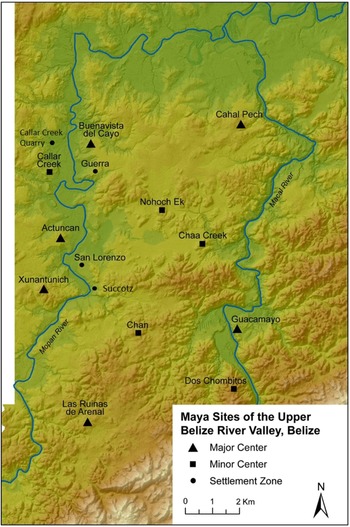
The lowland Maya of western Belize provide an apt area for a case study of the role of economic activity in providing avenues for risk reduction as extensive previous research has been performed on the regional political and economic organization. There is a detailed political history and a broad understanding of the variety of economic activities which took place in the Upper Belize River Valley (UBRV; Figure 1; see Chase and Garber [Reference Chase, Garber and Garber2004], Houk [Reference Houk2015], and Willey [Reference Willey and Garber2004] for overviews of research).
Map showing locations discussed in the text. Map by Bernadette Cap used with permission of Mopan Valley Archaeological Project/Mopan Valley Preclassic Project (MVAP/MVPP).

The Late to Terminal Classic period (a.d. 600–890) in the UBRV was a period of regional political change. Power shifted between the major centers of Buenavista del Cayo (hereafter Buenavista) and Xunantunich, due to the influence of the site of Naranjo and their involvement in broader lowland Maya political activities (Brown and Yaeger Reference Brown, Yaeger, Houk, Arroyo and Powis2020; LeCount and Yaeger Reference LeCount and Yaeger2010; Martin and Grube Reference Martin and Grube2008; Yaeger and Brown Reference Yaeger and Brown2019; Yaeger et al. Reference Yaeger, Kathryn Brown, Helmke, Zender, Cap, Rodriquez and Batty2015). Thus, the occupation and use of Callar Creek Quarry during the Late to Terminal Classic period allows the opportunity to address the impact of political shifts between major centers in the region on the economic activity of small-scale, rural, craft producers. Specifically, use of Callar Creek Quarry continued unchanged during the Late Classic II period, when power shifted from Buenavista to Xunantunich, providing an opportunity to address the role of economic activity in that stability.
UBRV Economic Activities
Research in the UBRV indicates diverse economic activities occurred including market exchange, reciprocity, gift-giving, and taxation/tribute, as well as household and specialized production activities. Evidence for marketplace exchange in the UBRV is strong and marketplaces were identified at Xunantunich (Cap Reference Cap2019; Keller Reference Keller2006) and Buenavista (Cap Reference Cap2015a, Reference Cap and King2015b, Reference Cap, Masson, Freidel and Demarest2020) through architectural evidence, microartifact analysis, and soil chemistry. These marketplaces were centers for the exchange of chert and limestone bifaces, obsidian blades, shell, and cloth (Cap Reference Cap2015a, Reference Cap and King2015b, Reference Cap2019; Cap et al. Reference Cap, Peuramaki-Brown and Yaeger2015; Heindel Reference Heindel2010; Heindel et al. Reference Heindel, Cap and Yaeger2012; Keller Reference Keller2006). The marketplaces indicate that producers and consumers in the UBRV had a close relationship (Yaeger Reference Yaeger, Bevan and Wengrow2010a). That is, producers and consumers probably interacted frequently, whether through a marketplace setting or other exchange venues. Further investigation of the number and location of additional marketplaces in the UBRV would help elucidate their role in economic activity and the involvement of elite individuals in marketplace activity (LeCount Reference LeCount, Fargher and Heredia Espinoza2016). Furthermore, market exchange and market systems can operate outside marketplaces (Garraty Reference Garraty, Garraty and Stark2010). While there is clear evidence for marketplace exchange, market exchange outside of such places also may have occurred.
In addition to marketplace exchange, previous research indicates the concurrent operation of exchange mechanisms such as gift-giving and taxation or tribute. Items which were probably exchanged through gifting include certain types of polychrome ceramics (Ball and Tascheck Reference Ball, Taschek and Garber2004; Reents-Bundet Reference Reents-Budet, Bishop, Tashchek and Ball2000; Reents-Bundet et al. Reference Reents-Budet, Bishop, Macleod and Reents-Budet1994, Reference Reents-Budet, Bishop, Tashchek and Ball2000; Tascheck and Ball Reference Taschek, Ball and Kerr1992). Polychromes, often produced by elites, were distributed between elites during feasting and other ceremonies as a way of creating and maintaining elite social networks (Neff Reference Neff, LeCount and Yaeger2010; Reents-Bundet Reference Reents-Budet1998, Reference Reents-Budet and Kerr2000).
Craft production in the UBRV included production in household workshops and generalized household production activities. Goods produced include chert preforms, bifaces and drills, manos and metates, cloth, shell, limestone blocks, and agricultural items (Chapman et al. Reference Chapman, Sword and Brown2015; Devio Reference Devio2016; Hearth Reference Hearth and Robin2012; Horowitz Reference Horowitz2017, Reference Horowitz2018a, Reference Horowitz, Horowitz and McCall2019; Kestle Reference Kestle and Robin2012; Robin Reference Robin2013; Robin et al. Reference Robin, Meierhoff, Kestle, Blackmore, Kosakowsky, Novotny and Robin2012; VandenBosch Reference VandenBosch1999; VandenBosch et al. Reference VandenBosch, LeCount, Yaeger, LeCount and Yaeger2010; Yaeger Reference Yaeger2000). Studies at Chan illustrate that households produced one or more items in larger quantities than necessary for their own consumption to exchange within, and possibly outside, the community (Robin Reference Robin2013).
The best-studied cases of household production in the UBRV are of formal lithic tools such as bifaces. Households at Chan (Hearth Reference Hearth and Robin2012), Chaa Creek (Connell Reference Connell2000), and Succotz (VandenBosch Reference VandenBosch1999; VandenBosch et al. Reference VandenBosch, LeCount, Yaeger, LeCount and Yaeger2010) produced chert bifaces in amounts that indicate exchange within the community (Horowitz et al. Reference Horowitz, Cap, Yaeger, Peuramaki-Brown and Eli2019). In each case, only one household in each community produced bifaces. Informal lithic production occurred at most households within the UBRV, although at San Lorenzo, one household did perform more chert reduction activities than others, probably due to that household's proximity to the San Lorenzo chert source (Yaeger Reference Yaeger2000).
Investigations throughout the UBRV point to part-time craft production where producers participated in multiple types of economic activities (Yaeger Reference Yaeger, Bevan and Wengrow2010a). Evidence for part-time production comes from the low densities of craft production remains in households, which suggests the ability to produce diverse types of goods. For example, at Chan, limestone quarries for limestone blocks and lime plaster production were found adjacent to households (Kestle Reference Kestle and Robin2012). These households quarried limestone, as well as participating in agricultural activities, and in some cases, other types of crafting such as lithic (Hearth Reference Hearth and Robin2012) or shell production (Keller Reference Keller and Robin2012). Furthermore, the presence of some chert debitage in most households in the UBRV suggests households produced some of their own tools that then would have been used for subsistence activities including farming and food preparation (Kurnick Reference Kurnick2013; Peuramaki-Brown Reference Peuramaki-Brown2012; Robin Reference Robin1999; VandenBosch Reference VandenBosch1999; Yaeger Reference Yaeger, Bevan and Wengrow2010a, Reference Yaeger, LeCount and Yaeger2010b). More instances of craft production in the UBRV probably occurred but would have utilized perishable materials that are not archaeologically preserved, such as basketry or cloth production (see Cap [Reference Cap2019] for a discussion of spindle whorls). Thus, craft production activities were probably more common in the region than the available archaeological evidence suggests.
Archaeological evidence points to diverse economic activities in the UBRV. The variety of exchange mechanisms and production activities in the region points to multiple exchange mechanisms operating concurrently. The prevalence of small-scale craft producers indicates that this type of production was economically beneficial to the craft producers. Through examinations of Callar Creek Quarry, we gain a useful vantage point into the role of economies as arenas for risk reduction, particularly of small-scale, part-time craft production.
CALLAR CREEK QUARRY
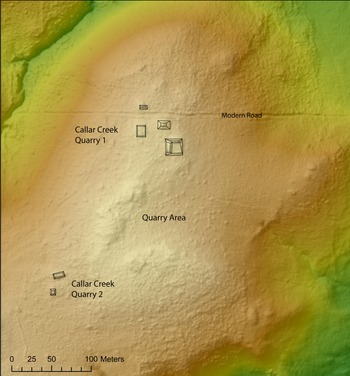
Callar Creek Quarry (CCQ) is a chert quarry west of Buenavista on the east bank of the Mopan River. Excavations at the quarry and adjacent habitation areas were conducted under the auspices of the Mopan Valley Archaeological Project, directed by Jason Yaeger. The quarry, which spans approximately 80 × 100 m, is located between two household groups, a patio group to the northeast (CCQ-1) and an L-shaped group to the southwest (CCQ-2; Figure 2). The construction and occupation of the household groups are contemporaneous with the most intensive period of use and extraction of the quarry area, the Late to Terminal Classic period (a.d. 600–890), although evidence for use of the quarry spans the Archaic to Historic periods.
Map of Callar Creek Quarry and surrounding households. Base image by B. Cap courtesy of MVAP/MVPP, map by the author.

While evidence indicates use of the quarry during a longer time span, the discussion here focuses only on the Late to Terminal Classic period as that was the period of most intensive use of the quarry and the period to which a sample of quarry debitage could be firmly dated, with no evidence of intermixing. Dating of the use of the quarry was determined through the presence of diagnostic ceramics found within the quarry debitage (Horowitz Reference Horowitz2017; dating based on phases in LeCount et al. [Reference LeCount, Yaeger, Leventhal and Ashmore2002]).
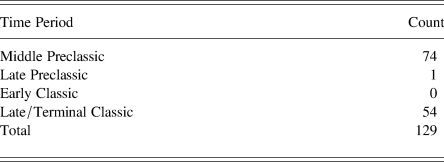
While the overall quantity of temporally diagnostic ceramics (Table 1) was small (only 5.3 percent of the total sherds recovered from the quarry), they permitted the identification of 16 Late to Terminal Classic-period quarry contexts which were not intermixed with debitage from other time periods. It should be noted that Late to Terminal Classic diagnostic ceramics are well-defined and easily recognized, which facilitated the identification of these contexts. Examples identified in the quarry include Belize Valley Ash Tempered Wares, Mount Maloney Black, and Uaxactun Unslipped Wares (Gifford Reference Gifford1976; LeCount Reference LeCount1996, Reference LeCount, LeCount and Yaeger2010; LeCount et al. Reference LeCount, Yaeger, Leventhal and Ashmore2002). This is particularly notable in comparison with Early Classic contexts, which have fewer diagnostic ceramic forms. In fact, more Middle to Late Preclassic-period contexts were identified than Early Classic contexts, in part due to the easy identification of some Preclassic-period ceramics, such as Mars Orange Wares.
Ceramic sherds associated with quarry contexts.

Furthermore, despite Late to Terminal Classic diagnostics that distinguish between the Late Classic I and II (a.d. 600–780) and Terminal Classic (a.d. 780–890) periods (Le Count et al. Reference LeCount, Yaeger, Leventhal and Ashmore2002), such diagnostics were not present in large enough quantities to distinguish specific contexts associated with these time periods. Thus, the Late to Terminal Classic periods (a.d. 600–890) are discussed together. While not the focus of this article there is little difference in the reduction sequence between deposits of different time periods (see Horowitz [Reference Horowitz2017] for more information).
The associated household groups were constructed contemporaneously with use of the quarry. Construction of CCQ 1, the patio group, began in the Early Classic period (a.d. 200–600) with a second construction phase in the Late Classic II period (a.d. 670–780). Ceramic evidence illustrates abundant Middle Preclassic occupation, although there is no evidence of construction (Horowitz Reference Horowitz2017). Radiocarbon samples from Structure 4 of CCQ 1 support the presence of a Late to Terminal Classic period construction stage, dating to cal a.d. 770–900 or 925–945 (1180 ± 30 BP), and an Early Classic terminus post quem for the earlier construction phase, dating to cal CE 405–550 (1580 ± 30 BP; radiocarbon dates were run and calibrated by Beta Analytic). These samples support the data obtained from the ceramic materials from construction fill; that the structures at CCQ-1, particularly Structure 4, were constructed in two construction episodes, the first in the Early Classic, or slightly earlier, and the second in the Late to Terminal Classic.
CCQ 2, the L-shaped group, was constructed in a single construction phase in the Late Classic II to Terminal Classic period (a.d. 670–890). Dating of the structures was based on diagnostic sherds identified in construction fill as well as radiocarbon dates from the same context (Horowitz Reference Horowitz2017). Diagnostic ceramics in the fill provide a terminus ante quem of the Late Classic II to Terminal Classic (a.d. 780–890), based on the presence of diagnostic ceramics such as Cayo Unslipped: Cayo Variety Jar with a piecrust rim (LeCount et al. Reference LeCount, Yaeger, Leventhal and Ashmore2002). Thus, while the quarry was utilized for a long time, the occupation at the quarry with associated architecture seems to have begun in the Early Classic, with expansion of the construction, including construction of a new residential group, during the Late to Terminal Classic period. Earlier architecture may be present but was not identified in the excavations conducted.
The exact timing of the end of occupation and use of the quarry is unclear. While evidence from the residential structures suggests that occupation in those groups stopped after the Terminal Classic period, the presence of a few pieces of knapped glass in the quarry (Horowitz Reference Horowitz2017) suggest continued visitation through the Historic period. That is, even after people were no longer living at the quarry, they were probably visiting the area. Due to the uncertainties in establishing the exact timing of the abandonment of the CCQ households, this article contains no further discussion of the causes of their abandonment or its relationship to the economic activities discussed here.
Quarry Deposits and Reduction Activity
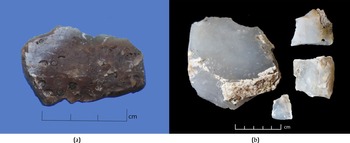
The chert deposits at CCQ consist of materials from two chert formation episodes, in situ bedded chert in buried deposits and large nodules on the surface which eroded out of the parent bedrock. The chert quality varies greatly from high-quality cherts with small grain size and minimal inclusions to lower quality cherts with larger grains and inclusions, including fossils (Figures 3 and 4). The bedded chert has higher quantities of fossil inclusions and is generally poorer quality. The chert cobbles frequently contain lithic materials of varying quality; thus, high- and low-quality cherts co-occur in single nodules (Horowitz Reference Horowitz2017). The raw material is all chert, following the conventions in Luedtke (Reference Luedtke1992) for referring to chert and related raw materials.
Chert quality at Callar Creek Quarry. (a) Bedded chert with fossil inclusions. (b) Cobble chert showing varying quality. Photographs by the author.

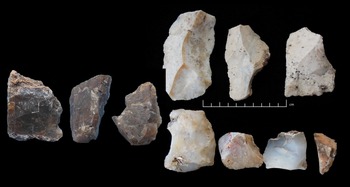
Debitage from Callar Creek Quarry. Photograph by the author.

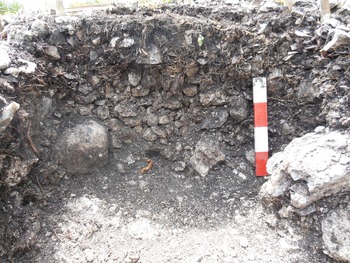
Lithic extraction occurred throughout the quarry. Evidence for extraction includes the presence of a quarry cut, use of visible cobbles, and the removal of buried deposits (Horowitz Reference Horowitz2017, Reference Horowitz2018a, Reference Horowitz2018b). Debitage from lithic production was identified throughout the quarry in surface and buried deposits. A debitage mound was associated with the quarry cut, suggesting reduction of lithic materials associated with extraction activities (Figure 5).
Buried deposits of lithic materials at Callar Creek Quarry. Photograph by the author.

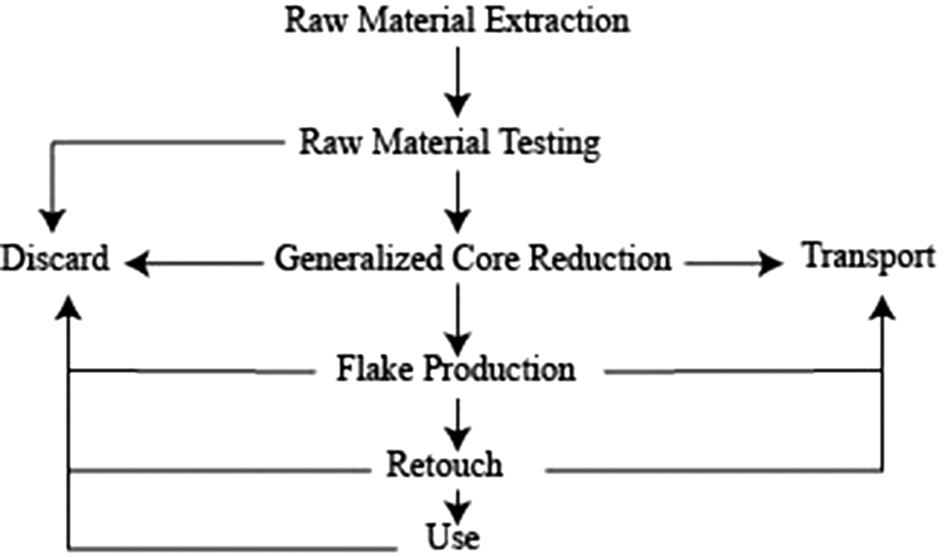
Lithic production at CCQ consisted of generalized core reduction to create core blanks and flake tools (Figures 4 and 6). Although these materials may have been further reduced elsewhere, no evidence of formal tool production was identified at the quarry (Horowitz Reference Horowitz2017, Reference Horowitz2018a, Reference Horowitz2018b, Reference Horowitz, Horowitz and McCall2019).
Reduction sequence of materials from Callar Creek Quarry. Image by the author.

Attribute analyses of lithics (n = 35,652) support the presence of generalized production and early stage reduction. The assemblage consists of debitage (99.2 percent, n = 31,165) with a small number of cores and tools. The tools present, predominately bifaces (n = 9) and unifaces (n = 36), were probably used for quarrying activities rather than resulting from production activities.
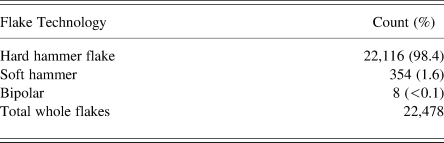
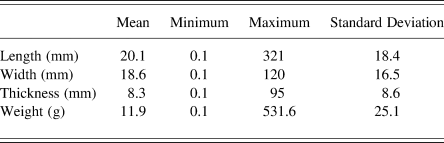
Production of generalized cores and flake tools is illustrated by the ubiquity of hard hammer percussion, with little evidence of bifacial thinning or other types of reduction (Table 2). Hard hammer and soft hammer flakes were identified based on their distinguishing characteristics following Whittaker (Reference Whittaker1994) and Andrefsky (Reference Andrefsky2005), such as form, thickness, and platform characteristics. Furthermore, the presence of low numbers of dorsal flake scars (average = 1.67) and average numbers of platform facets (average = 1.04) indicate generalized production and early stage reduction. The average size of materials (Table 3) indicates early stage reduction, with predominately larger materials often associated with initial reduction. The large size of materials may be related to raw material availability as well.
Flake production technique of whole flakes.

Descriptive statistics of quarry debitage.

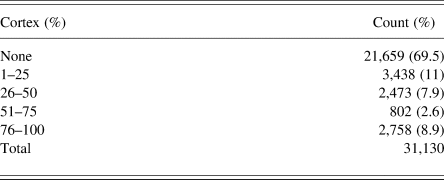
While supporting the presence of generalized production, the amount of cortex presents a more complex picture. While lithics representative of early stage reduction, cobble testing, and quarrying generally have large amounts of cortex, this is not the case at CCQ as over half of the materials lacked cortex (Table 4). The unexpected trend in cortex can, however, be explained due to the relationship between cobble size and cortex. The size and shape of raw material changes the possible amounts of cortex; the ratio of the surface area to volume varies according to both of these factors, and hence the maximum possible amount of cortex present also varies (Dibble et al. Reference Dibble, Schurmasn, Iovita and McLaughlin2005; Douglass et al. Reference Douglass, Holdaway, Fanning and Shiner2008; Lin et al. Reference Lin, Douglass, Holdaway and Floyd2010). Large cobbles, like those found at CCQ, have lower average cortex/volume ratios than small nodules (Dibble et al. Reference Dibble, Schurmasn, Iovita and McLaughlin2005). The lack of cortex at CCQ should not be taken as an indicator of a lack of early stage reduction but can be explained by the large size and form of the raw materials.
Cortex percentage of quarry debitage.

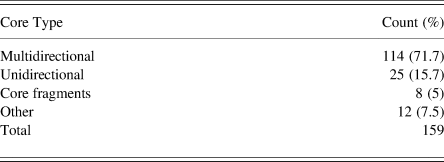
The number and makeup of cores indicate generalized and early stage reduction (Table 5). Multidirectional cores (Table 5), are indicative of generalized reduction. The unidirectional cores are predominately tested cobbles, with only a few flakes removed to test raw material quality. Tested cobbles were common due to the variable nature of the raw material which led to frequent core discard. The cores support the early stage and generalized nature of reduction, but their numbers likewise indicate the transport of materials away from the quarry (Horowitz Reference Horowitz2017, Reference Horowitz, Horowitz and McCall2019). With such a low number of total cores, compared to the amount of debitage produced, it is clear these materials were transported away from the quarry, presumably for exchange. Core transport is reflected in the quarry reduction sequence (Figure 6) as an essential part of the reduction activities.
Core forms.

The density of the lithic materials at Callar Creek Quarry indicates that, for CCQ residents, lithic production was a part-time activity and not the only one in which they participated. The density of debitage (3,181.4 lithics/m3 in the quarry debitage mound) is in no way comparable to areas considered full-time workshops, such as Colha (5 million flakes/m3; Roemer Reference Roemer, Hester and Shafer1991) or the Succotz Lithic Workshop (2 million flakes/m3; VandenBosch et al. Reference VandenBosch, LeCount, Yaeger, LeCount and Yaeger2010), an example of part-time production. The density of lithic debitage indicates the part-time, periodic nature of production activities. Other activities performed by CCQ residents included farming and other household tasks, such as weaving and food preparation, as exemplified by finds of spindle whorls, chert tools, and mano and metate fragments within the residential complexes (Horowitz Reference Horowitz2017). Thus, while the residents of the households were lithic producers, they were not full-time lithic producers and participated in other economic activities. As mentioned above, most lithic production in the Maya area was a part-time activity (Barrett Reference Barrett, Hruby, Braswell and Mazariegos2011; Hearth Reference Hearth and Robin2012; Hirth Reference Hirth, Manzanilla and Hirth2011a, Reference Hirth, Manzanilla and Hirth2011b; VandenBosch Reference VandenBosch1999; VandenBosch et al. Reference VandenBosch, LeCount, Yaeger, LeCount and Yaeger2010). For the residents, lithic production served to diversify their economic activities and meant they depended less on any single activity for their economic stability and continuance.
Chert Distribution and Regional Connections
The reduction sequence of the CCQ materials indicates that segmented lithic production occurred in the region. CCQ residents tested raw materials and created chert preforms (Figure 6), which were further reduced by lithic producers elsewhere in the valley. In addition to early stage production within the quarry, lithic production has been identified at workshops throughout the valley, such as the Succotz Lithic Workshop, a biface production area (VandenBosch Reference VandenBosch1999; VandenBosch et al. Reference VandenBosch, LeCount, Yaeger, LeCount and Yaeger2010), in households throughout the region (Connell Reference Connell2000; Peuramaki-Brown Reference Peuramaki-Brown2012; Robin Reference Robin1999; Yaeger Reference Yaeger2000), and at the Buenavista and Xunantunich marketplaces (Cap Reference Cap2015a, Reference Cap2019). These production areas indicate widespread chert production in different areas in the UBRV. For instance, in the Buenavista and Xunantunich marketplaces, Cap (Reference Cap2015a, Reference Cap2019) identified only final stage finishing of bifaces, while the Succotz Lithic Workshop contains all stages of the biface production process, as materials were quarried from a nearby chert source (VandenBosch Reference VandenBosch1999).
Thus, CCQ products, such as tested cobbles and prepared cores, were exchanged away from the quarry. Due to difficulties in geochemically sourcing this type of chert and the intrasource variability in color and quality which makes visual identification of regional sources difficult, the exact nature of the distribution of these materials is difficult to determine. However, some speculation on their distribution mechanism can be performed.
Multiple types of exchanges could have been used to distribute the lithic raw material which may have involved exchange with nearby settlements, either through peoples’ visits to the quarry or their transport of raw material to other locations. These locations may have included specialized production areas, like biface production areas, or regional marketplaces, like the one at Buenavista. Raw material exchange in the marketplace would not leave a distinctive signature if reduction did not occur at the market, thus making its distribution hard to trace. As the lithic material from the Buenavista marketplace indicates only final stage biface production (Cap Reference Cap2015a), if CCQ materials were distributed through a marketplace, reduction activities did not occur there. Thus, materials from CCQ could have been exchanged through market exchange or through reciprocal exchanges with neighboring households. Hopefully future technological advances in lithic sourcing will allow further clarification of exchange mechanisms. Even without the specific exchange mechanisms involved in chert distribution, however, analysis of nonlithic materials from CCQ can shed light on the integration of the quarry residents with regional economic and political communities.
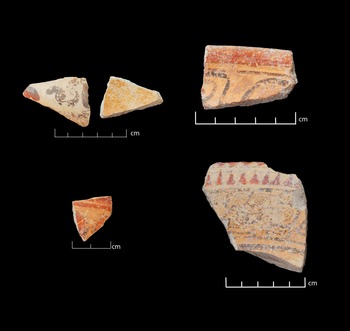
Artifactual evidence from CCQ indicates it was affiliated with the political community at the nearby site of Buenavista, the regional power from the Early Classic through the early Late Classic period (Brown and Yaeger Reference Brown, Yaeger, Houk, Arroyo and Powis2020; LeCount and Yaeger Reference LeCount and Yaeger2010; Martin and Grube Reference Martin and Grube2008; Yaeger and Brown Reference Yaeger and Brown2019; Yaeger et al. Reference Yaeger, Kathryn Brown, Helmke, Zender, Cap, Rodriquez and Batty2015). Material evidence from CCQ suggesting affiliation with Buenavista includes polychrome ceramics in the Buenavista style (cream polychromes), a sherd featuring a possible fragment of the Buenavista device, and several other polychrome fragments, including one with glyphs and several with pseudoglyphs (Figure 7; Ball and Tascheck Reference Ball, Taschek and Garber2004). Polychrome ceramics in the Buenavista style are believed to have been produced at Buenavista (Ball and Tascheck Reference Ball, Taschek and Garber2004) and indicate interactions between the site's rulers and the surrounding region. The presence of different types of ceramics has been used in the UBRV to discuss political affiliations with various sites during the Late Classic period (Connell Reference Connell2000).
Ceramics from Callar Creek Quarry illustrating connections with the political community of Buenavista. Photograph by the author.

CCQ's affiliation with Buenavista may have been a result of interactions with the proximate minor center of Callar Creek, which illustrates political connections to Buenavista through ceramic and architectural affiliations (Kurnick Reference Kurnick2013, Reference Kurnick2016). The minor center of Callar Creek and CCQ were both named for the modern-day aldea of Calla Creek in which Callar Creek is located; the quarry is located within the bounds of the modern-day aldea of Santa Rosa, but was also named for the modern settlement of Calla Creek (Kurnick and Salgado-Flores Reference Kurnik, Salgado-Flores and Yaeger2009). Both the minor center and the quarry exhibit connections with the Buenavista political community and are located on the west bank of the Mopan River, about one kilometer apart. Any relationship between the two cannot be confirmed based on current evidence from excavations of the two areas, other than that they were both part of the Buenavista political community, but given the close proximity of the areas, it is possible that CCQ residents connected with the Buenavista community through interactions with the rural elites at Callar Creek.
The most visible evidence of continuity in the face of regional change at CCQ is the construction of a second household group during a time when the UBRV was in political turmoil. The regional power switched from Buenavista to Xunantunich in the Late Classic II (a.d. 670–780; Figure 1; Brown and Yaeger Reference Brown, Yaeger, Houk, Arroyo and Powis2020; LeCount and Yaeger Reference LeCount and Yaeger2010; Martin and Grube Reference Martin and Grube2008; Yaeger and Brown Reference Yaeger and Brown2019; Yaeger et al. Reference Yaeger, Kathryn Brown, Helmke, Zender, Cap, Rodriquez and Batty2015), yet it was the time when CCQ residents expanded (CCQ 2). Despite this regional political instability, occupation and economic activity at CCQ continued unchanged. These circumstances suggest that they were insulated from regional political shifts in a way that allowed them to continue their economic activity, despite political changes that would have shifted elite-managed economic networks (including possibly market exchange). Of note is that occupation at CCQ occurred before and after the powerful elites ruled from Buenavista.
The connection of CCQ with the Buenavista political community may have influenced the ways in which lithic materials from the quarry were exchanged. While we cannot draw an exact correlation between economic exchange networks and political communities (LeCount Reference LeCount, Fargher and Heredia Espinoza2016), the economic activities that the quarry residents were involved in would have brought them into contact with different individuals within the region, which may have increased the utility of having a political affiliation with a regional political power. In the following section, I discuss the role of small-scale craft production as an economically beneficial activity and how that may have contributed to the stability of the CCQ residents and their economic condition.
DISCUSSION
CCQ illustrates continuity in occupation and use of the quarry for a relatively long time, including during a time of political turmoil in the surrounding region. As discussed above, there is evidence of CCQ's connection with the political community at Buenavista. Despite this connection, and its position between Buenavista and Xunantunich (Figure 1), occupation and use of the quarry remains stable throughout the Late to Terminal Classic period when political conflict occurred between these major centers.
CCQ was used and occupied continuously during the transition of political power between Buenavista and Xunantunich in the Late Classic II period (a.d. 670–780). The construction of a household group and the continued occupation at the site suggests that the residents of CCQ were not greatly impacted by the political conflict between the major centers in the region, despite their affiliation with the political community of Buenavista. This situation contrasts with the evidence from the site of Callar Creek which was affiliated with the site of Buenavista. The site itself was abandoned and faded from power around the same time that Buenavista lost power to Xunantunich (Kurnick Reference Kurnick2013, Reference Kurnick2016).
The continuity at CCQ despite regional political instability may be associated with the economic diversification by quarry residents made possible by their position literally on top of a chert raw material resource. By managing access to this asset, residents were not only chert producers but had access to the raw material itself. Ethnographically, lithic producers had fewer economic resources than other residents and such literature suggests that lithic tool producers were generally the last settlers in a region and thus had less access to high-quality agricultural lands, forcing a reliance on lithic production (Arnold Reference Arnold1985; Deal Reference Deal1998). This pattern holds true for other craft producers (Shott Reference Shott2018). CCQ's continuity, however, points to the economic advantage of raw material resource management and production activities. Access to the chert source was a foundational component of the economic activities at CCQ and thus a factor in the risk reduction benefits of economic diversification. Like other part-time periodic lithic producers in Mesoamerica (Hirth Reference Hirth2009a, Reference Hirth2009b; Healan Reference Healan2009), CCQ residents’ involvement in lithic production provided an opportunity for economic diversification that reduced economic risk.
While the continuity and success of CCQ residents point to economic diversification as a mechanism for reducing risk associated with regional political instability, they are by no means the only peoples in the region to do so. Throughout the UBRV, occupants of small settlements showed their affiliations to local political powers while simultaneously maintaining subsistence economies that insulated residents from shifting political alliances (Leventhal and Ashmore Reference Leventhal, Ashmore and Garber2004; Yaeger Reference Yaeger, LeCount and Yaeger2010b), which were illustrated through ceramic affiliations and structure orientation (Connell Reference Connell2000, Reference Connell, LeCount and Yaeger2010; Kurnick Reference Kurnick2013, Reference Kurnick2016; Yaeger Reference Yaeger2000, Reference Yaeger, LeCount and Yaeger2010b). Economic exchange networks, however, were stable despite the changing political landscape (Meierhoff et al. Reference Meierhoff, Golitko, Morris and Robin2012; Robin Reference Robin and Robin2012a, Reference Robin and Robin2012b, Reference Robin2013; Robin et al Reference Robin, Kosakowsky, Keller and Meierhoff2014, Reference Robin, Wyatt, Meierhoff, Kestle, Marken and Fitzsimmons2015; Yaeger and Brown Reference Yaeger and Brown2019). Thus, CCQ is an example of how small sites maintained economic independence and regional political connections. The economic diversification from small-scale craft production enabled the maintenance of their activities, due to the social connections they created, which operate outside the bounds of formal economic networks.
CONCLUSIONS
While the lives of CCQ residents were in many ways shaped by their relationship with the lithic raw material to which they had access, their lives were in no way monolithic. They participated in day-to-day activities like other rural Maya farmers, interacted with other occupants of the hinterland, and maintained connections to and identified with larger regional polities. Their lithic production activities aided in this integration and residents’ economic security by providing additional sources of economic activity.
The lithic economy served to connect CCQ residents, and presumably other regional producers, to the regional political community and served as a source of wealth and social status for those individuals. Thus, for CCQ residents, economies were a source of political integration and independence. Residents had political affiliations to Buenavista, which they showed through ceramic styles, and used their economic activities to maintain their household during times of instability. By serving as mechanisms of integration and independence, economies can be seen as both embedded in and separated from political and social processes for the Late to Terminal Classic-period Maya. That is, the CCQ residents’ economic activities both provided them with opportunities to work within economic frameworks associated with regional political structures and to work outside of these frameworks.
The evidence from CCQ illustrates the importance of small-scale economic activity for rural householders in the Late to Terminal Classic period for the lowland Maya. These small-scale economic activities provided lithic producers with economic wealth that was in turn a mechanism for regional sociopolitical integration and served as a mechanism for reducing risk through the continuity of lithic extraction activities during periods of regional shifts. The diversification of economic activities through part-time lithic production permitted broader stability in the settlement, probably in part because of the multiple economic activities in which the quarry residents were involved. At least some of the distribution networks through which chert was exchanged were unaffected by broader political disruptions, highlighting the consequences of multiple distribution networks and the significance of studying articulated economies (Masson and Freidel Reference Masson and Freidel2012). This evidence from CCQ supports the proposals put forth by other scholars (Hirth Reference Hirth2009a, Reference Hirth2009b, Reference Hirth, Manzanilla and Hirth2011a, Reference Hirth, Manzanilla and Hirth2011b; Hirth and Cyphers Reference Hirth and Cyphers2020; Marston Reference Marston2011; Masson and Freidel Reference Masson and Freidel2012) that diverse economies and the social connections created by these economic activities are a means of mediating resource scarcity. The evidence of production and continuity of occupation at CCQ indicates that part-time craft production can have lasting impacts on the lives of hinterland residents and helps explain the continuity in occupation as economic activities served to provide a safety net for the quarry residents.
Given this evidence, we can return to the discussion of the social aspects of economic activities and the value of those activities for creating risk reduction networks (Bourdieu Reference Bourdieu and Richardson1986; Blanton and Fargher Reference Blanton, Fargher, Garraty and Stark2010; Hirth Reference Hirth2009a, Reference Hirth2009b, Reference Hirth, Garraty and Stark2010). The economic diversification of CCQ residents contributed to their success and allowed them to both affiliate with and maintain some independence from regional political powers. The continuity of CCQ during times when shifting political dynamics in the region suggest their involvement in economic networks was not managed by political elites. In these exchanges, social connections would be more advantageous to continue operating outside of regional political structures.
Evidence from CCQ suggests that small-scale craft economies had some independence from regional political leaders. Were this not the case, the political instability in the region would have led to the dismantling of these economic networks. Those networks that remained strong are the small ones operating between individuals of different households and small-scale producers. Thus, for the Classic-period Maya, small-scale economic activity was vital for small-scale producers/householders and served as a manner of risk reduction by diversifying their economic activities and creating opportunities for developing and maintaining social relationships which served to reduce economic risk. These networks operated partially independently from overarching political structures.
RESUMEN
El papel de la producción artesanal en las economías antiguas puede proveer información para contextualizar el papel de las economías en sistemas sociales y políticos. Este artículo se enfoca en la producción lítica del mundo Maya en el periodo clásico tardío y terminal (670–890 d.C.). El objetivo es examinar la importancia de las actividades económicas en la integración de productores artesanales en comunidades políticas regionales y explorar su importancia en tiempos de conflicto político. Utilizando un estudio de la extracción y producción de materiales líticos en una cantera de pedernal en Callar Creek Quarry, Belice, este articulo examina la importancia de la producción artesanal en la reducción de riesgo económico. Este estudio ilustra que la producción lítica era una manera de diversificación de actividades económicas que redujo el riesgo económico y problemas con actividades políticas en la región. Los productores líticos de Callar Creek Quarry eran productores de medio tiempo que participaron en otras actividades económicas. La participación en la producción lítica era una manera de diversificación económica que proveyó estabilidad económica y una oportunidad de minimizar su involucramiento en la inestabilidad política en la región. La utilización de diversificación económica como una manera de reducción de riesgo económico provee evidencia para la continuidad de los residentes rurales durante tiempos de inestabilidad política. En Mesoamérica, la diversificación económica de productores artesanales era una manera de reducir el riesgo económico. Por esta razón muchos productores artesanales participaron en actividades de producción. Callar Creek Quarry muestra que la producción artesanal de medio tiempo era una actividad importante de productores de pequeña escala y provee oportunidades para la integración regional y protección de inestabilidad política.
ACKNOWLEDGMENTS
Research at Callar Creek Quarry, Belize was conducted under the auspices of the Mopan Valley Archaeological Project directed by Jason Yaeger, with the permission of the Belize Institute of Archaeology. Funding was provided by a National Science Foundation Doctoral Dissertation Improvement Grant (BCS Grant #1416212), a National Geographic Young Explorer Grant (Grant #9089-12), and the School of Liberal Arts at Tulane University. Thanks to Marcello Canuto, Dan Healan, Tatsuya Murakami, Jason Yaeger, Kat Brown, and Bernadette Cap for their comments on earlier materials that improved the quality of this article and to Erlend Johnson and Sarah Kurnick for comments on an earlier draft of this manuscript. Jocelyn Ponce edited the Spanish abstract. Detailed comments from three anonymous reviewers improved the quality of the manuscript.