INTRODUCTION
Sea anemones are well represented in marine benthic communities and are adapted to variable environmental conditions (Manuel, Reference Manuel1988). They are very common in shallow waters of the Antarctic, inhabit hard as well as soft substrata and often enter into symbiotic or commensal relationships with animals of other groups.
Life in diverse habitats requires differing strategies of obtaining food. As with other anthozoans, sea anemones have the following modes of nourishment: (1) capturing solid food, (2) absorbing dissolved organic matter (DOM) and (3) using assimilates of their symbiotic algae (Schlichter, Reference Schlichter1978). All those kinds of nourishment can be applied together or separately.
There are different ways of prey collecting. When prey is suspended in the water column (usually zooplankton) it has to be intercepted by one or more tentacles and transferred to the mouth. Sessile prey, which can be dislodged by wave action or by foraging predators, is pushed into the tentacle crown. As concerns motile prey it simply blunders into the anemone's tentacles (Sebens, Reference Sebens1981). Each of these modes of prey capture requires corresponding morphological adaptations. For example, according to the observations realized by means of the Russian manned underwater vehicle ‘Sever-2’ during the 33rd cruise of research-vessel ‘Odyssey’, 1984 (Sirenko, Reference Sirenko, Sirenko and Vassilenko1993), a deep-water sea anemone Actinostola callosa extracted organic particles with numerous tentacles disposed on the surface of a wide oral disc. The disc in this anemone can assume the form of a tube that allows selecting of food particles from water passing through it (Figure 1. 1–3). However, this species of anemone is able to capture big prey. According to German researchers, this anemone, an inhabitant of Norwegian fjords, was also discovered feeding on the coronate medusa Periphylla periphylla. Sea anemones were observed by means of a remotely operated vehicle (ROV); it turned out that A. callosa can completely swallow a medusa in half an hour. In laboratory experiments it took more than 40 min to engulf the medusa, the diameter of which exceeded the size anemone. The Periphylla population does not show any significant seasonality and its biomass is much larger than the biomass of the anemone, which might explain the high population density of A. callosa (Jarms & Tiemann, Reference Jarms and Tiemann2004).
Difference in form of the oral disc and tentacle distribution in deep-water sea anemone Actinostola callosa and Antarctic coastal inhabitant Urticinopsis antarctica. 1–3. A. callosa with tube-like rolled up oral disc (Photo by B. I. Sirenko). 4. U. antarctica with long and numerous tentacles with tests of three sea-urchins eaten by it. (Photo by O. V. Savinkin.)

In other cases anemones have long and numerous tentacles able to search for food by ‘sweeping’ the substrate, as it is typical for Anemonia viridis (Forsskål, 1775) (Chintiroglou & Koukouras, Reference Chintiroglou and Koukouras1992).
The food of many sea anemones consists of almost any benthic organisms which can be caught and swallowed: crustaceans, worms, molluscs, fish, etc. The anemones are often able to eat objects of large size relative to their own bulk. Nevertheless in some cases laboratory experiments have demonstrated that A. equina indiscriminately ingests small prey, but size of prey is still restricted, because larger objects cannot be gulped (Davenport et al., Reference Davenport, Moloney and Kelly2011). Many anemones are omnivorous animals. However, it does not mean that a species may not have a regular diet in which one or two items predominate (Stephenson, Reference Stephenson1928). Moreover factors of environment (depths, different types of substrata, wave action) and time (seasons, daytime and night time) influence the accessibility of prey in communities and indirectly to the diet of sea anemones (see Chintiroglou & Koukouras, Reference Chintiroglou and Koukouras1992; Kruger & Griffiths, Reference Kruger and Griffiths1996; Davenport et al., Reference Davenport, Moloney and Kelly2011; Quesada et al., Reference Quesada, Acuña and Cortés2014).
The goal of this study was to examine the composition of the diet of Urticinopsis antarctica.
MATERIALS AND METHODS
Urticinopsis antarctica is one of the most common and plentiful sea anemones of the Antarctic coast, therefore it is well represented in the collection of Zoological Institute (the list of samples is presented below). Our study and data published before show that the species is widespread in Antarctic and Subantarctic waters (Figure 2). It is recorded from McMurdo Bay, South Shetland Islands, Prudz Bay, Cosmonauts Sea, Haswell Archipelago (Davis Sea) and the Weddell Sea. The predatory feeding habits of Urticinopsis antarctica could be confirmed by observations of research-divers and analysis of the coelenteron contents.
Distribution of Urticinopsis antarctica. Black circles – our data, samples from collection of the Zoological Institute; empty circles – localities from literature data.

Diet is usually studied by analysis of gastrovascular cavity content. It often encounters some difficulties owing to different extent of digestion, egestion and poor preservation of prey items. The possibility of accidental ingesting of shells and some non-food animals during sea anemone collecting also should be taken into account (Lampitt & Paterson, Reference Lampitt and Paterson1987). In spite of these difficulties this method is widely used, and was employed in our study too.
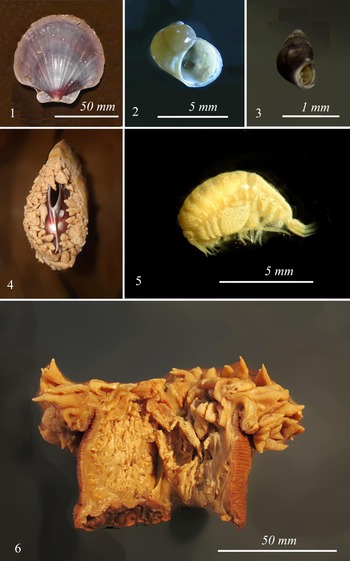
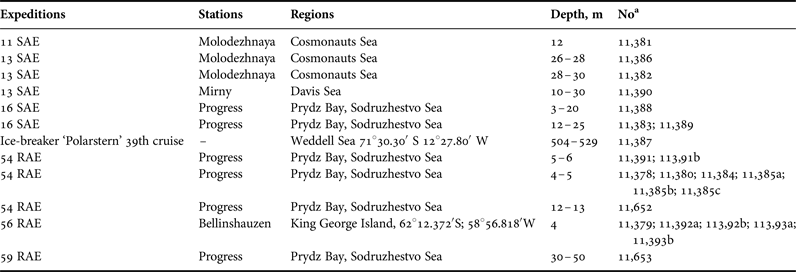
Twenty-three specimens of sea anemone Urticinopsis antarctica were dissected in the course of the study of its morphology and variability of taxonomically important characters (Figure 3. 6). These have been deposited in the collection of the Zoological Institute of RAS. These samples were collected by Soviet, Russian and International Antarctic expeditions (see Table 1).
Dissected specimen of the Urticinopsis antarctica and the most intact food items from the gastric cavity of sea anemones. 1. Addamussium colbecki (Smith, 1902) (Bivalvia). 2. Laevilacunaria pumilia Smith, 1879 (Gastropoda). 3. Eatoniella caliginosa Smith, 1875 (Gastropoda). 4. The anemone with its prey in pharynx – A. colbecki (Smith, 1902). 5. Symbiotic amphipod Conicostoma sp. 6. Dissected sea anemone.

Samples of Urticinopsis antarctica collected by Soviet, Russian and International Antarctic expeditions.

a Numbers of specimens are noted following Incoming catalogue of Department of Porifera and Coelenterata, Zoological Institute, Russian Academy of Sciences.
All the specimens of U. antarctica were fixed in formaldehyde solution and preserved in 70% ethanol. Anemones were dissected by transverse cutting on the level of the pharynx and immediately above the base. Then they were also cut longitudinally along the endocoel of one of the directive pairs of mesenteries. This method of anatomical study gives a high possibility of more careful examination of the gastrovascular cavity. The specimens were dissected by use of scalpel or a blade in conformity with the size of the animals. The food items were counted and then identified to the lowest possible taxonomic level by specialists of ZIN RAS.
To study the quantitative diet composition we used the method detailed in Chintiroglou & Koukouras (Reference Chintiroglou and Koukouras1992). The following parameters were calculated:
 $${\rm Vacuity}\,{\rm coefficient}\,V = Ev \times 100/N$$
where Ev, the number of empty coelenterons, N, the total number of coelenterons examined.
RESULTS
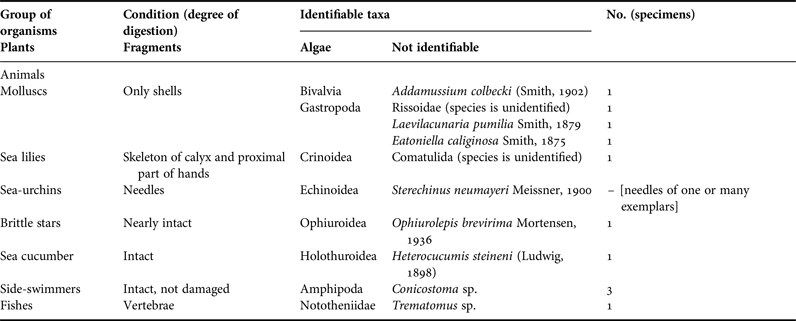
Among 23 individuals of Urticinopsis antarctica only six contained eaten animals, giving a vacuity coefficient of ~74%. All identifiable animals found in the coelenterons are listed in Table 2. Four anemones had in their gastric cavity the remains of invertebrate animals and one enclosed the remains of a fish, rather damaged by digestion. These organisms were considered to be food items for the studied anemone species (Figure 3. 1–4). So we can regard as prey of Urticinopsis antarctica four mollusc species – Laevilacunaria pumilia Smith, 1879 and Eatoniella caliginosa Smith, 1875 (Gastropoda; 56 RAE, King George's Island, 4 m), Addamussium colbecki (Smith, 1902) (Bivalvia; 54 RAE, Prudz Bay, 5–6 m) and one not strictly identified representative of the family Rissoidae (Gastropoda; 13 SAE, Cosmonauts Sea, 28–30 m); a single specimen of crinoids (Crinoidea; ‘Polarstern’ 39 th cruise, Weddell Sea, 504–529 m); sea-urchin Sterechinus neumayeri Meissner, 1900 (Echinoidea, 56 RAE, King George Island, 4 m), needles of which were found in gastric cavity; a small ophiuroid Ophiurolepis brevirima Mortensen, 1936 (Ophiuroidea; ‘Polarstern’ 39th cruise, Weddell Sea, 504–529 m). In addition to this some fish bones (probably belonging to Trematomus sp., Nototheniidae; 54 RAE, Prudz Bay, 4–5 m) were also found. The fragments of unidentifiable algae were also discovered in one of the specimens.
Content of gastrovascular cavity of Antarctic sea anemone Urticinopsis antarctica.

All molluscs found in sea anemone guts were represented only by empty shells, which were nearly unharmed; only the edge of bivalve valves were slightly damaged (Figure 3. 1–4). Remains of the fish were represented by vertebrae. Findings of echinoderms were different. The test of sea-urchin was probably ejected since only needles were discovered in the actinopharynx. In contrast, crinoid skeleton (calyx and proximal parts of hands) and nearly intact ophiuroid were found in the gastric cavity (see Table 2).
In contrast to all listed animals, three specimens of scuds Conicostoma sp. (Amphipoda; ‘Polarstern’ 39th cruise, Weddell Sea, 504–529 m) were in very good condition (Figure 3. 5). They were not destroyed by digestion and therefore may represent commensal organisms, which live in close association with Urticinopsis antarctica (see discussion).
DISCUSSION
The analysis of Urticinopsis antarctica coelenteron content distinctly showed the ability to catch and eat different low mobile invertebrate animals and also some fish, Trematomus sp., which live on the seafloor and are primarily benthic feeders (Brueggeman, Reference Brueggeman1998). As with other motile animals, fish occasionally blunder into an anemone's tentacles and are captured. Sessile organisms are probably dislodged by wave action or by foraging predators (see Introduction). Big body size (up to 120 mm height in preserved condition) and presence of numerous long tentacles also indicate the ability to capture quite large benthic animals.
We don't see that the actinian species has a distinct food preference. So we consider this anemone to be a generalist, according to the classification of Kruger & Griffiths (Reference Kruger and Griffiths1996). However, a small number of studied specimens and poor gastric cavity content are not enough for reliable judgement. However, our observations and data from literature show that Urticinopsis antarctica slightly prefers to feed on Echinodermata. They are sea stars Perknaster fuscus antarcticus (Koehler 1906), Odontaster validus Koehler 1906, Diplasterias brucei (Koehler 1908) and sea-urchin Sterechinus neumayeri Meissner, 1900, which compose about 77% of its diet (Dayton et al., Reference Dayton, Robilliard, Paine and Holgate1970). Another representative of this invertebrate group which also could be part of the diet of U. antarctica is the holothurian Heterocucumis steineni (Ludwig, 1898); unfortunately this animal was identified only in a photo (Figure 4).
Holothurian Heterocucumis steineni half-swallowed by Urticinopsis antarctica. (Photo by O. V. Savinkin.)

Moreover, the predatory feeding habits of Urticinopsis antarctica were confirmed by observations of research-divers B.I. Sirenko and A.F. Pushkin, the participants of Soviet Antarctic expeditions (ZIN RAS). According to the divers’ personal observation of Sirenko, a number of sea-urchin naked tests or ‘shells’ frequently surround large specimens of Urticinopsis antarctic at the bottom of Prydz Bay (Sodruzhestvo Sea, see Figure 1. 4). Even more exhaustive experiments were carried out by Pushkin in the natural habitat (Haswell Archipelago, Davis Sea). During his dives he regularly put a quite large sea-urchin (probably Sterechinus neumayeri) at the oral disc of Urticinopsis. It turned out that the anemone can digest a sea-urchin and throw out its ‘shell’ in a few days.
Study of the stinging capsules set of U. antarctica showed that the capsules typical for scyphozoan medusas (Scyphozoa) sometimes occur in endodermal epithelium of the pharynx (our observations). These capsules have proper orientation there and seem to function as cleptocnidae, known in other invertebrates (for example, nudibranch molluscs), which are able to eat cnidarian polyps and medusas and to use their stinging capsules. The latest observation concords with those of American researchers, who believed that medusas constitute 21% of Urticinopsis antarctica diet (Dayton et al., Reference Dayton, Robilliard, Paine and Holgate1970).
In contrast to molluscs, echinoderms and fish, three specimens of side-swimmers Conicostoma sp. were not destroyed by digestion. It is known that representatives of this and related genera are associated with sea anemones and sponges (Barnard & Karaman, Reference Barnard and Karaman1991). Thus the observed specimens may represent not prey items, but commensals of Urticinopsis antarctica.
Hence, all available data show that the large and common in the Antarctic anemone Urticinopsis antarctica is probably able to feed on any big benthic and even some nektonic animals. Moreover, according to American researchers, cannibalism is also possible in this species (Dayton et al., Reference Dayton, Robilliard, Paine and Holgate1970, Figure 4).
ACKNOWLEDGEMENTS
Taxonomic identification of the food species was carried out by the following specialists, to whom we are greatly obliged: Dr E. N. Egorova, Zoological Institute of Russian Academy of Sciences, Saint-Petersburg, Russia (Gastropoda); Dr S. A. Malyavin, Zoological Institute of Russian Academy of Sciences, Saint-Petersburg, Russia (Amphipoda); Dr A. V. Smirnov, Zoological Institute of Russian Academy of Sciences, Saint-Petersburg, Russia (Crinoidea, Echinoidea, Holothuroidea); Dr I. S. Smirnov, Zoological Institute of Russian Academy of Sciences, Saint-Petersburg, Russia (Ophiuroidea); Dr O. S. Voskoboinikova, Zoological Institute of Russian Academy of Sciences, Saint-Petersburg, Russia (Nototheniidae). We are grateful to Dr A. F. Pushkin, Mr O. V. Savinkin and Dr B. I. Sirenko for kindly reported field observations and (the two latter) for the presented pictures of alive Urticinopsis antarctica and Actinostola callosa respectively.