


I. INTRODUCTION
Research on the polarization properties of the electromagnetic field scattered by a distributed radar object with the aim to classify and recognize them is closely connected with the definition of the polarization properties of the scattered field on the basis of the emergence principle and with the use of possible relations between polarization properties of the constituent parts of the complex radar object. We will use the term “random complex radar object” (RCRO) if the object is composed of a number of elementary scattering centers located close to each other (i.e. within a radar resolution cell) at random positions. Usually, RCROs are man-made objects and their size is considerably less than a radar resolution cell. When a radar object has many elementary scattering centers randomly distributed over an area with a size not less than a radar resolution cell, then we will name these objects “distributed random objects” (DRO). Usually DROs are scattering extended surfaces and volumes (sea, earth, clouds, precipitations, and forest).
Many methods for classification of objects based on observation by radar exist. The ones that evaluate the profile power in the echo of the objects suffer from a dependence on the polarization used for the sounding signal. The paper explores methods to use sounding signals and appropriate processing of the received echoes resulting in profiles that are independent of the polarization, hence the objective to find parameters that are invariant to polarization.
The research leads to the concept of “generalized interference laws”. The paper first presents the results of the theoretical and experimental investigation of parameters that are invariant to polarization at the scattering of electromagnetic fields by two-point and multipoint radar objects. Such a two-point radar target is the simplest model of a distributed object. The paper then demonstrates that the interference process of the field scattered off multi-point RCROs leads to polarization-energetic speckle. The polarization-energetic response function of an RCRO can be considered to be a collection of space harmonics. Every space harmonic of this collection is initiated by one pair out of many pairs, which can be formed by the points constituting the scattering RCRO. Every space harmonic will have an amplitude, which will be determined by the value of the proximity (or distance) of the polarization states of the points involved in the respective pair. The positions of the elementary scatterers composing the RCRO are stochastic, but they are constant for a fixed aspect angle, since the RCRO is assumed to be a rigid structure. We have a number of interfering pairs of elementary scatterers and they exhibit stochastic space diversity. The polarization proximity of each pair of elementary scatterers also is a stochastic parameter, and thus, even when the spatial separation between points in a pair is the same, we will have a classical stochastic process at each change of the aspect angle. The definitions of the so-called emergence principle and polarization proximity (distance) will be shown in the sequel of this paper. Our approach to the problem is based on our preliminary publications [Reference Tatarinov, Tatarinov and van Genderen1–Reference Tatarinov and Tatarinov4] and it is formulated like this for the first time in its integrated form with theory and related experiments.
The structure of the paper is that first a model is developed showing the polarization parameters of a simple object consisting of two points. The basic concepts of the so-called emergence principle and the polarization proximity will be established as they result from interference between elementary scatterers. The theory is illustrated by the experimental results achieved using a polarimetric radar and a number of known two-point objects (Section II). Then the two-point object is generalized to an M-point object. The angular distribution of the Stokes parameters is developed, showing that some parameters can be found that are independent of the polarization used by the radar and only by the object itself. Also here, the theory is illustrated by experimental results achieved using a polarimetric radar observing a complex radar object (Section III). The discussion in this paper ends with some conclusions.
II. SIMPLEST MODEL OF A COMPLEX RADAR OBJECT: MAIN DEFINITIONS
First of all, we will consider the results of the theoretical and experimental investigations of polarization- power parameters at the scattering by two-point radar objects. Such a two-point object is the simplest model of a distributed object. Here we will also introduce the definitions of both the emergence principle and its link with the analysis of parameters that are invariant to polarization and the proximity and distance of polarization states.
A) Definition of a complex radar object: generalized interference laws, emergence principle, and polarization proximity (distance)
We will define a complex radar object using the Stratton–Chu integral [Reference Tatarinov and Tatarinov4], which allows us to represent a field scattered by this object as the sum of waves scattered by elementary scatterers (“bright” or “brilliant” points), constituting the complex object. An example of a man-made RCRO is shown in Fig. 1(a). Figure 1(b) shows the result of the scattering process from this object that was obtained using a scaled simulation method [Reference Kozlov, Tatarinov, Tatarinov and Krivin3]. In this picture, one can see the collection of bright points both of the object and sea surface.
(a) Image of a navy ship. (b) Collections of bright points of the ship.

For the case when every elementary scatterer is characterized by its SM ‖Ṡ min‖; (i, n = 1, 2) the complex vector of the scattered field can be defined in the form

where X m is the distance between the center of gravity of the object and the mth bright point, R 0 is the distance between the radar and the center of gravity of the object, θ is the aspect angle of the object, and  is the complex vector of the initial wave. It is useful to point out here that the expression (1) represents the polarization properties of all individual scatterers, which together form the large complex radar object. Unfortunately, the properties of a large system in principle cannot be derived by simply adding the properties of the elementary parts of the system. The properties of the integral system appear after considering the relations between its elements. These relations lead to the “emergence” of new properties which do not exist for every element separately. The concept of “emergence” is one of the main definitions of the systems analysis [Reference Peregudov and Tarasenko5]. So, we will try to find the polarization properties of the electromagnetic field scattered off a complex radar object on the basis of the emergence principle, using the possible relations between the polarization properties of all elementary scatterers constituting a complex radar object. We will take into account that these elementary scatterers cannot be resolved by radar.
B) The generalized interference laws for a two-point object, emergence principle, and polarization proximity (distance). Angular distribution of the space frequencies and Stokes parameters at the scattering by a complex object
Interference between electromagnetic waves leads to the redistribution of the power mean density in space. This redistribution is due to the superposition of the electromagnetic waves. According to the laws of interference [Reference Tatarinov, Tatarinov and Ligthart6, Reference Tatarinov and Tatarinov7], interference does not exist if the waves are polarized orthogonally. This fact can be illustrated by the mean value of the unit matrix |‖δjl‖ using the notation of bra and ket Dirac vectors from quantum mechanics. So, for the waves having coinciding and orthogonal polarizations, respectively, we can write


However, besides the power, which can be found using the expressions (2), we can find other bilinear combinations of electromagnetic waves vectors projections – the so-called Stokes parameters [Reference Tatarinov, Tatarinov and Ligthart6]. These parameters have the dimension of power and can be found as mean values of Pauli matrices


In the far field, the wave transmitted by a radar system can be regarded as a completely polarized plane wave. The signal received by the radar, however, is seldom completely polarized. This is because the received signal consists of the superposition of a number of waves with different polarizations as the result of the reflection off multiple scatterers. As opposed to the zero Stokes parameter, the third Stokes parameter may reveal the existence (or not) of interference when the polarizations of the interfering waves are different.
Let us consider now the dependence of the polarization parameters of the scattered field both on the spatial distribution of the scatterers and on their possible interactions. We will consider the simplest complex (distributed) radar object, consisting of two closely spaced scatterers A and B (reflecting elliptical polarizers), which cannot be resolved by the radar. These scatterers are separated in space by a distance l and are characterized by the scattering matrices (SMs) in the Cartesian polarization basis

We will consider coherent scattering. The geometry is shown in Fig. 2. As can be noted from (4) we are using the diagonal form of the SM. The point is that we will use later only the so-called invariant parameters of the SM, which are dependent only on the eigenvalues a k=1,2;b k=1,2 of the SM and are independent of the off-diagonal elements of these matrices.
Scattering geometry for the two-point radar object.

In Fig. 2 the distances R 1, R 2 between the scatterers and an arbitrary point Q in far field can be written under the condition 0.5l ≪ R 0 as R 2,1 ≈ R 0 ± 0.5l sinθ ≈ R 0 ± 0.5lθ. Using these expressions, we can find the Jones vector of the scattered field for the case of the radiated signal having a linear polarization at an inclination angle 45°. It should be mentioned here that we are using the Cartesian (linear) polarization basis both for the scattered matrices and for the Jones vector of the scattered field.

where ξ = klθ. The angular dependence of the polarization-energetic response functions in the form of the Stokes parameters S 0, S 3 is

The expanded form of the energetic response function S 0(θ) can be found as

where η1 = arctg{[Im(ȧ 1ḃ 1* + ȧ 2ḃ 2*)/Re(ȧ 1ḃ 1* + ȧ 2ḃ 2*)]} and S 0a = a 12 + a 22, S 0b = b 12 + b 22. The values S 0a and S 0b are the Stokes zero-parameters of the elementary scatterers “a” and “b”.
As can be seen from (6), the S 0(θ) parameter includes the sum of the Stokes parameters S 0a and S 0b, and a term that represents a function that is harmonic in space with the angular dependence cos(2klθ + η1). This latter term has an initial phase η1 and amplitude  that is connected with the eigenvalues of the elements of the SM.
For the definition of a generalized approach to an analysis of the polarization-energetic parameters of the electromagnetic field due to interference, we will consider now the angular dependence of the Stokes parameter S 3(θ) of this field. It can be found as
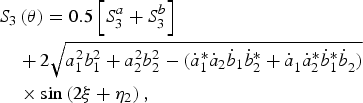
where 
 , and
 are the third Stokes parameters of elementary scatterers “a” and “b”.
Thus, the angular distribution of the Stokes parameter S 3 of the electromagnetic field due to interference is also the sum of interference elements the third Stokes parameters and a space harmonic periodic function sin (2klθ + η2), which has an initial phase η2 and amplitude 
Expressions (6) and (7) are generalized Fresnel–Arago interference laws for waves having arbitrary polarizations.
It is useful to briefly highlight a physical understanding of these laws. The angular harmonic functions cos(···) and sin(···) in the expressions (6) and (7) represent the influence of the spatial separation l on the distribution of the polarization-energetic parameters of scattered field in the far zone. The derivative of the full phase ψ(θ) = 2klθ + ηi (i = 1,2) of the angular harmonic function along the angular variable is the space frequency

Thus, the space frequency in the complex radar object theory equals twice the distance between the elementary scatterers constituting the radar object, normalized to the wavelength.
Next we will analyze the amplitudes of angular harmonic functions cos[2klθ + η1], sin[2klθ + η2] to assess the impact of the polarization properties of the elementary scatterers on the polarization-energetic parameters of the field scattered by the complex radar object. Let us write the polarization ratios Ṗ A = ȧ 2/ȧ 1 and Ṗ B = ḃ 2/ḃ 1, which are characterizing the point radar objects A and B in the complex plane of radar objects [Reference Tatarinov, Tatarinov and Ligthart6]. Using stereographic projection, we can find the spherical distance between the points S A, S B, laying on the surface of the Riemann sphere having unit diameter, which are connected with points Ṗ A, Ṗ B of radar object's complex plane. The coordinates of the points S A, S B on the surface of the sphere are 

 and the spherical distance between these points can be found as

where  is the Euclidian metric in the complex plane of radar objects. After substitution of the polarization ratios
 and
 into (9), we can write

The value

is the so-called polarization distance between two waves (or radar objects), having different polarizations [Reference Tatarinov, Tatarinov and Ligthart6]. When the waves have coinciding polarizations (Ṗ A = Ṗ B) the polarization distance value is D = 0 and when the waves have orthogonal polarizations (Ṗ B =− 1/Ṗ A*) the polarization distance value is D = 1. Thus, it follows from (9) and (10) that

We can use also so-called polarization proximity value N that can be defined as N = 1 − D. Then

The waves with coinciding polarizations (Ṗ A = Ṗ B) have a polarization proximity value N = 1 and the waves with orthogonal polarizations (Ṗ B = −1/Ṗ A*) have a polarization proximity value N = 0. Then we can write

If we compare the amplitudes of the space harmonic oscillations with the expressions (11) and (12), we can see that the expressions (4) and (5) can be rewritten as


We can consider these expressions as generalized interference laws [Reference Tatarinov and Tatarinov7]. It follows from the expression (13) that the orthogonally polarized waves cannot give an interference picture in case the polarization proximity value N = 0. However, the expression (13b) demonstrates that in this case the third Stokes parameter will have the maximal value of this interference picture visibility.
It follows from expressions (13a), (13b) that every Stokes parameter has some constant component, which is defined by the respective Stokes parameters of both objects (“a” and “b”), and space harmonics functions cos[2klθ = η1] and sin[2klθ = η2], having amplitudes  and
 , respectively, and space initial phase ηk. So, the polarization-energetic properties of complex radar objects cannot be found using only the properties of its individual elements. The properties of the integral system appear by taking the relations between the individual elements into account. These relations in our case are the polarization distance and the polarization proximity. The use of these values leads to the “emergence” of new properties, which did not exist for every element separately [Reference Tatarinov and Tatarinov4, Reference Peregudov and Tarasenko5].
We define the instantaneous visibility of the generalized interference law as

This equation is similar to the well-known expression for the Fresnel–Arago interference law:

where I 1, I 2 are integrated powers (energies) of the waves, and γ12,γ12 are the degree of coherences. If I 1 = I 2 then the visibility of the interference law is defined by the degree of coherence of second order.
So, we can state that from a physical point of view the parameter N can be considered as a polarization coherence parameter, which defines the proximity of the polarization states of elementary scatterers, and in the same way a degree of coherence of stochastic waves is summarized. In this case, we have an “instantaneous” value of the polarization coherence, while at the same time the coherence degree γ12 is the correlation value.
We can interpret as the simplest meaning of the polarization proximity that it is the scalar product of four-dimensional Stokes vectors, according to the radar object's elements. When this product is zero – the proximity will be zero, and the distance will be one. If this product is one – the proximity will be one, and the distance will be zero.
C) Experimental investigation of the polarization-energetic properties of electromagnetic waves scattered by a two-point radar object
A measurement campaign to investigate jointly the generalized Fresnel–Arago interference laws and the polarization-energetic properties of the electromagnetic field scattered by reflecting interferometers (man-made radar objects consisting of two elements) was realized by the International Research Centre for Telecommunications and Radar of TU Delft [Reference Tatarinov, Tatarinov, van Genderen, Tran, Usov and Zijderveld8]. In this paper, a small part of the results is presented and interpreted from the point of view of the generalized Fresnel–Arago interference laws and the emergence principle with respect to the power and polarization harmonics S 0(θ), S 3(θ) corresponding to the space frequency caused by the distributed radar object used in the campaign.
The radar used for the experiment was capable of transmitting a polarized electromagnetic wave at any polarization, switchable from radar sweep to sweep. On receive it was fit with two parallel receivers, operating in orthogonal polarizations. The radar operated with two separate antennas, one for transmit and one for receive. The settings of the polarization on transmit and on receive were independent. In the actual experiment reported in this paper, the settings were for a linear (H,V) orthogonal basis. However, this is not a fundamental choice, since after calibration the data can be converted from one polarization basis into any other one. The resolution of the radar was set at 6 m, while the carrier frequency was approximately 10 GHz.
Concerning the basic properties of radar required to assess the elements of the Stokes vector, it should be mentioned that both coherent methods and non-coherent methods (measuring powers only) exist. The theory underlying this measurement technique is beyond the scope of this paper [Reference Boerner9].
A collection of two-element man-made distributed radar objects with known polarization properties of their elements was used in the campaign. The difference between the properties of the various elements constituting the distributed radar objects leads to different values of the polarization proximity or polarization distance of these elements. The following combinations of two-element man-made distributed radar objects were used:
(N1) Two empty trihedral corner reflectors (N = 1; D = 0).
(N2) Two trihedrals, where the first one was empty, and the second was fitted with a linear polarizer consisting of a special polarizing grid (N = 0.5; D = 0.5).
(N3) Two trihedrals, where the first one was empty, and the second was fitted with an elliptic polarizer consisting of a special polarizing grid. The transmission coefficients along the OX and OY axes are b Y = 0.5b X and the mutual phase shift between the polarizer's eigen axes is φXY = π/2 (P A = 1; Ṗ B = j0.5; N = 0.5; D = 0.5); This object is shown in Fig. 3.
(N4) Two trihedrals, where the first one was fitted with a linear polarizer, and the second was fitted with an elliptic polarizer (P A = 0; Ṗ B = j0.5; N = 0.8; D = 0.2).
Two-point radar object N3.

The phase centers of the trihedrals were separated by 100 cm, while the wavelength of the radar was 3 cm. For these parameters the space frequency and space period are f SP = 2l/λ (rad)−1, T SP = 0.015rad (or 0.855°). The mechanical construction, on which the trihedrals were mounted, rotated with an angular step of 0.25°.
When the object includes the trihedral with the elliptic polarizer and the empty trihedral (combination N3), we can find the theoretical estimation of the polarization proximity and distance as N = D = 0.5. In Figs 4(a) and 4(b), the experimental angular harmonics functions (generalized interference pictures) S 0(θ), S 3(θ) are shown. It follows from these figures that the visibility for interference picture S 0(θ) is W 0 ≈ 0.3 corresponding to a polarization proximity N 0 = 0.54 (note that the theoretical estimation is N = 0.5). The visibility forS 3(θ) is W 3 = 1, corresponding to a polarization distance D = 0.5.
(a) Generalized interference law for the Stokes parameter S 0(θ) (object N3). (b) Generalized interference law for the Stokes parameter S 3(θ) (object N3).

For the system including the trihedral arranged by the linear polarizer and empty trihedral (object N2), we can find from theory the estimated visibility values W 0 = 0.66; W 3 = 1. These correspond to polarization proximity values  . These values should be compared with the ones obtained from the experiments, N 0 ≈ 0.85; N 3 = 1.
So, one may conclude that there is a close correspondence between the theory and the experimental results providing supporting evidence to the validity of the approach.
III. MULTIPOINT MODEL AND CORRELATION THEORY
As a next step, this section addresses the statistical analysis of the energetic speckle of polarization parameters of the electromagnetic field at the scattering by a multipoint RCRO.
A) The angular distribution of the power of the electromagnetic field at the scattering by a distributed object
The field, scattered by a multipoint radar object having a SM ‖Ṡ min‖; (i,n = 1,2) was already shown by equation (1). Let us now consider the formation of the distribution of the polarization-energetic parameters of the electromagnetic field resulting from the interference process at the scattering by the RCRO. To this end, we will analyze the scattering process by a multipoint RCRO that is composed of M scattering centers. Our approach will be to first derive an expression for the distribution of the power for the case of M = 4 scattering centers and then to generalize the case of arbitrary M centers.
Without loss of generality we will assume that the point scatterers constituting the RCRO, are located on a line (see Fig. 5).
Scattering geometry for the multipoint radar object.

For the example of Fig. 5, where M = 4, we will find that the electrical vector of the field, scattered by the four-points complex object, observed in a point Q located in the far field for the case of coinciding linear polarization both for transmission and reception is

Then we can find the instantaneous distribution of the power of the scattered field in space as a function of the positional angle θ as

So, the instantaneous distribution of the power of the scattered field in space as a function of the positional angle θ is formed by the sum of the radar cross-section of the elementary scatterers (four terms) plus six cosine oscillations. It can be seen that all of these cosine terms are caused by the interference effect between the fields scattered by all pairs of elementary scatterers constituting the RCRO. The number of these pairs can be found by the binomial coefficient

where M is the total number of points, and N is the number of points in each combination. In our case, where M = 4, N = 2, we have C 42 = 6. So, the angular response function of the complex radar object considered will include six space harmonic functions as a result of the interference, summarized in the expression (15). There the values

represent the spatial distance between the scattering elements for every interfering pair. The space harmonic function  corresponds to the definition given in Section IIB. According to this definition, the harmonic oscillation in space with a shape cos(2kdθ) is defined by the full phase ψ(θ) = 2kdθ = (2π/λ)2dθ, the derivative of which is (1/2π)(dψ/dθ) = 2d/λ = f SP. It represents the space frequency with dimension [rad−1]. The period T SP = 1/f SP = λ/2d having the dimension [rad] corresponds to this frequency.
So, the full power distribution of the field scattered by a complex radar object is the sum of the interference patterns formed by a collection of elementary two-points interfering scatterers.
Thus, by inference from (17) we can write the random angular representation of the scattered power, depending on the positional angle as

where C = C M2 is the number of pairs consisting of the elementary scatterers i and l, and M is the total number of elementary scatterers constituting the RCRO.
B) The angular distribution of the Stokes parameters of the electromagnetic field scattered by a random complex object
It was demonstrated in (13) that the angular distribution of the Stokes parameter S 0, S 3 of the electromagnetic field scattered by a two-point distributed object has the form

It follows from (19) that the space harmonics functions are having amplitudes  and
 . Here the values N ab, D ab are, respectively, the proximity and distance of the polarization states of the elementary scatterers of the distributed object [Reference Peregudov and Tarasenko5].
Taking this into account, we can write the angular distribution of the Stokes parameters of the field, scattered by RCRO as the sum of the generalized interference patterns, which are formed by a collection of elementary two-point interfering scatterers


where C = C M2 is the number of pairs consisting of the elementary scatterers i and l. The amplitudes of the space harmonics and the initial space phases of these harmonics will be stochastic values. Thus, further analysis must be based on statistics.
C) A theoretical definition of the autocorrelation function of the angular distribution of the Stoke parameters of the scattered field. Space spectra
Now we will develop a theoretical form of the autocorrelation function of the angular distribution of the Stokes parameter S 3(θ) of the scattered field.
Since we would like to find the autocorrelation function (not the covariance function!), we must eliminate a random constant term ∑m=1MS 3m from the stochastic function S 3(θ) to ensure a zero mean value. Taking into account that the value ∑m=1MS 3m can be a non-stationary stochastic function, the average must be found using a sliding window. After elimination of the non-stationary mean value and subsequent normalization, we can write the stochastic function S 3 (θ) as

Let us suppose that the function (19) is stationary stochastic function. If this function is not stationary, we can exclude a non-stationary part, using the average by a sliding window. Then its autocorrelation function can be found as

Here the space harmonics amplitudes  and space initial phase η are random values, which can be characterized by a two-dimensional probability distribution density
 and Δθ = θ1 − θ2. We will suppose that random amplitudes and phases are independent variables. Using the orthogonality condition we can rewrite the expression (22) into

Considering that the initial stochastic realization S 3(θ) is a function of the random variables  , we will use for the definition of the autocorrelation function of this realization the expression for the mean value of two random variables

Using this expression we can write the autocorrelation function (22) as:
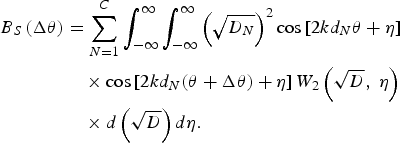
For the calculation of the double integral in the expression (24) we will use the condition  and the assumption W(η) = 1/2π,so a uniformly distributed phase over (−π,π). Such an assumption is common for all statistical radio technical and statistical radio physical problems.
As a result, we can write the theoretical form of the autocorrelation function of the angular distribution of the Stokes parameter of the scattered field as

Taking into account that every term of the sum in (26) is the autocorrelation function for an isolated space harmonic oscillation  having random amplitude
 and random initial space phase ηN, i.e.

it can be seen that the autocorrelation function of the stochastic realization of the Stokes parameters is the sum of the individual autocorrelation functions of all space harmonics, which are contributing to this stochastic realization.
Let us now develop an expression for the averaged space spectra of the complex radar object using expression (27) for the autocorrelation function of the polarization-angular response.
The power spectrum in the case of isolated space harmonics can be found as the Fourier transform of the above autocorrelation function (27):
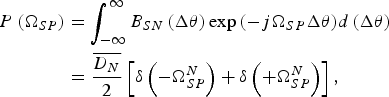
where ΩSP = 2πf SP = 2π(2d/λ) is the space frequency. The spectral lines are located at the distances ±ΩSPN from the origin of the co-ordinate system and their positions are defined by the space frequency f SPN = 2d N/λ of a two-point radar object. This space frequency depends on the spatial separation of two reflectors distributed in the space. The intensity of the power spectral lines is determined by the polarization distance between the polarization states of two scatterers forming the radar object.
The full space spectra of the stochastic polarization-angular response, i.e. the Fourier transform of the autocorrelation function (26), is

So, the power spectra of the polarization angular response function have a discrete form. It is caused by the discrete structure of the RCRO. Besides, man-made distributed radar objects have a finite extension. In this context, we have to emphasize that the power spectra of radar objects have a limited character.
As it was demonstrated in [Reference Tatarinov, Tatarinov and Ligthart10], the so-called equivalence principle “on the average” exists for the RCRO “on the average”. This principle associates some two-element radar objects to a real RCRO. In this case, the distance between elements of the model is connected with the mean-square sizes of an RCRO and the polarization-angular response function of this object is a harmonic function of the object's positional angle. It also follows both from theoretical and from experimental investigations that the polarization-angular response function of an RCRO in the form of the angular dependence of the third Stokes parameter corresponds to a narrow-band random process. For example, the experimental realization, having the form of narrow-band angular dependence S 3(θ) = A(θ)cos[2πf SR0θ + φ(θ)] is shown in Fig. 6. The angular interval for this dependence is ±20°. A rotated Caterpillar heavy construction vehicle with the sizes 5.5 × 2.5 × 1.5 m was used as a complex radar object here.
Experimental realization of S 3(θ), having the form of a narrow-band stochastic process of angular variable.

D) Experimental investigation of the measured autocorrelation functions (ACF) and space spectra
The ACF and space spectra of the stochastic polarization-angular response of a rotated complex radar object, the Caterpillar vehicle mentioned before, are shown in Figs 7 and 8. Figure 7 shows the autocorrelation function in the angular interval +20° w.r.t. the object's side view (dashed line) and the autocorrelation function over the same interval w.r.t. the rear view of the object (solid line). The measurements in these directions allow us to consider the difference in the radar object's space spectral bands when it is observed in areas from the side (dashed line) and from the rear (solid line). It can be seen from Fig. 7 that the RCRO's mean power spectra have a two-mode form. It shows that the so-called equivalence principle can be used “on the average” in order to describe a model of an RCRO [Reference Tatarinov, Tatarinov and Ligthart10] as two distributed scatterers.
ACF of the RCRO stochastic polarization-angular response.

Mean power space spectra of RCRO.

IV. CONCLUSIONS
In this paper, we have elaborated a theory on parameters that describe properties of an object that are invariant to the polarization. For a two-point object it was possible to perform an experiment with a known object and compare the experimentally achieved results with the theoretically expected values. It was shown that good correspondence was achieved between theory and experiment.
We have developed a theory as well for multipoint complex radar objects and we have shown the results of experiments with such an object.
The results of this paper confirm that the formation of the polarization-power parameters of the electromagnetic field at the scattering by RCRO can be regarded as an interference process. This fact allows us to find both the polarization-angular stochastic response autocorrelation function and the RCRO space power spectra. These quantities give us the possibility of recognition and classification of distributed radar objects using the object geometry and the polarization parameter distribution along an object.
 Piet van Genderen graduated from the University of Twente in Enschede, The Netherlands in 1971. He worked with the National Aerospace Laboratory in Amsterdam until 1979. He then moved to Hollandse Signaalapparaten, now Thales Nederland, where he held several positions in R&D. In 1994, he was also appointed full professor at the Delft University of Technology. He holds several patents and (co-)authored about 200 publications. He was thrice awarded with the prize for the paper that best advances the state of the art in radar at the European Radar Conference. He holds an honorary doctorate of the MTA of Bucharest, Romania. His main research interests are in the design of waveforms and associated algorithms for extracting object features
 Victor N. Tatarinov received his Ph.D. in radiophysics at the Tomsk State University in 1970. Later he received the superior Russian scientific degree – Dr. of Technical Science in radar area from St-Petersburg Aviation-Space University in 1983. He became a university professor in 1985. He has authored more than 200 research articles and 9 monographs in the area of electrodynamics, radar, polarization, and coherence theory. He is Fellow of the Electromagnetic Academy (FEMA) at Massachusetts Technology Institute.
 Sergey V. Tatarinov received his Ph.D. in the area of radar from Tomsk State University of Control Systems and Radioelectronics in 2002. He became a university associate professor in 2003. He has authored more than 80 research articles and 5 monographs in the area of signals theory, radar, and polarization statistical theory.



