1. INTRODUCTION
The relativistic intense short pulse propagation is of particular interest for the fast ignition in inertial confinement fusion. In order to propagate a short relativistic intense pulse laser through plasma, drilling by a pre-pulse is required to establish a channel in plasma. Such a partially electron depleted channel can be made by a Gaussian laser beam propagating through a low density plasma. Depending on the quality of the laser beam and pre-pulses, cumulative effects of self-focusing (Borisov et al., Reference Borisov, Shiryaev, McPherson, Boyer and Rhodes1995) can result in significant increase of laser intensity. Such intense laser fields are important as they can directly accelerate electrons or by the forward Raman scattering instability (Modena et al., Reference Modena, Najmudin, Dangor, Clayton, Marsh, Joshi, Malka, Darrow, Danson, Neely and Walsh2002). The efficiency of this process strongly depends on the laser intensity (Decker et al., Reference Decker, Mori and Katsouleas1994; Mori et al., Reference Mori, Decker, Hinkel and Katsouleas1994; Tzeng et al., Reference Tzeng, Mori and Decker1996) and on the density profile of a channel (Mori et al., Reference Mori, Decker, Hinkel and Katsouleas1994; Chiou et al., Reference Chiou, Katsouleas and Mori1996; Liu & Tripathi, Reference Liu and Tripathi1996).
The lasers employed in the experiments have small spot size and introduces two major effects; (1) diffraction and (2) nonlinear refraction. Both these effects have important implications to parametric and harmonic processes. Durfee and Milchberg (Reference Durfee and Milchberg1993) have conducted pioneering experiments on guiding a laser. A laser pre-pulse (1.06 µm, ≤ 4 × 10¹⁴ W/cm2, ~ 100 ps) is focused into a gas chamber of argon, nitrogen, or xenon at 30–100 Torr to create a plasma channel. After a delay of 0–15 ns a main laser pulse was guided upto 24 Rayleigh lengths without suffering diffraction divergence. Nikitin et al. (Reference Nikitin, Antonsen, Clark, Yuelin and Milchberg1997) have reported the guiding of sub-100 fs pulses at intensities upto 5 × 10¹⁵ W/cm2 over a distance of 1 cm in a preformed plasma channel. A pre-pulse (1.064 µm, 100 ps, upto 500 mJ) from the Nd:YAG regenerative-power-amplifier system produced a 1cm long plasma channel at the focus of a 35° base angle axicon, with intensities at the focus of 5 × 10¹³ W/cm2. After 4 ns a pulse (0.78 µm, 90 fs, upto 10 mJ) from the Ti:sapphire system was focused into the plasma channel at an adjustable delay with f/18 optics. In a mixture of 300 Torr He and 50 Torr N2 O, and for maximum injected pulse energy of 6 mJ, the coupling efficiency into lowest-order mode was measured to be 30%, and the size near-Gaussian mode was measured at the channel exit to be 25 µm FWHM, resulting in a guided intensity of 5 × 10¹⁵ W/cm2. Kumar et al. (Reference Kumar, Dahiya and Sharma2011) have shown that a relativistic laser pulse can effectively propagate through a preformed plasma channel without being defocused. Radial density profile of the channel as well as saturating nature of relativistic mass nonlinearity plays an important role.The periodic extent of beam focusing and hence the resulting peak intensity of the pulse depends on the depth of cavitation. Gill et al. (Reference Gill, Mahajan and Kaur2010) observed the self-focusing, self-phase modulation as well as self-trapping of a laser beam in a non uniform plasma channel with relativistic and ponderomotive effects. Verma and Sharma (Reference Verma and Sharma2009) studied the prolongation of a gaseous plasma channel formed by a two-pulse technique for laser intensities below the tunnel ionization threshold. The first laser pulse ionizes the gas completely on the axis and partially off the axis, causing self-defocusing of the pulse. After a few ns, a time delay of less than the recombination time, the second pulse focuses itself, enhancing the heating rate and lengthening the lifetime of the plasma channel. Sodha et al. (Reference Sodha, Kaushik and Sharma1977) observed the effect of self-focusing on the absolute growth rate of parametric back-scattering (e.g., stimulated Raman and Brillouin scatterings) and absorptive instabilities (e.g., two-plasmon decay and ion-plasmon decay instabilities) in a homogeneous and collisionless plasma. The modification in plasma frequency and intensity of laser beam cause the growth rate of instabilities to show an oscillatory behavior with the distance of propagation. Saini and Gill (Reference Gill and Saini2007) investigated the growing interaction of the rippled laser beam with upper hybrid mode leading to enhanced Raman scattering for a collisional magnetized plasma. The presence of ripple leads to additional coupling between the rippled laser beam and the electrostatic upper hybrid mode modifing the background density. Computational results showed the focusing of the upper hybrid wave for a chosen set of plasma parameters. With coupling being strong, the excited upper hybrid wave further interacts with a rippled laser beam and gives rise to an enhanced Raman scattering.
Plasma channel, produced by radial expulsion of plasma electrons due to the large ponderomotive force of a laser, introduces significant nonlocal effects on the stimulated Raman scattering. Liu and Tripathi (Reference Liu and Tripathi1996) studied the stimulated Raman forward scattering (SRFS) of a nonrelativistic laser pump in a preformed cold plasma channel. At lower values of laser power, the plasma wave is radially confined near the axis of the channel, while electromagnetic pump and the sidebands are well extended, and hence, the growth rate is small. However, at high powers, plasma wave radial extent can be comparable to that of the sidebands and the growth rate could be significant. Sajal et al. (Reference Sajal, Panwar and Tripathi2006) examined the SRFS of a relativistic laser pump in a self-created plasma channel including the nonlocal effects. Ponderomotive force due to the front of laser pulse pushes the electrons radially outward, on the time scale of a plasma period ωp−1, creating a radial space charge and modify the electron density, where electron plasma frequency is ωp. The growth rate of Raman forward scattering increases with a normalized pump amplitude at a lower value of pump amplitude, while at higher values of pump amplitude growth rate decreases with increasing the normalized pump amplitude. On increasing the laser spot size growth rate is maximum at a higher value of pump amplitude. Chiou et al. (Reference Chiou, Katsouleas and Mori1996) observed the stability of very intense laser pulses guided by a hollow channel in an underdense plasma. Raman forward scatter would completely destroy the beam in homogeneous plasmas or parabolic channel plasmas. However, in hollow channel plasmas, these instabilities can be completely suppressed. Modena et al. (Reference Modena, Najmudin, Dangor, Clayton, Marsh, Joshi, Malka, Darrow and Danson1996) observed Raman forward scattering (RFS) in the interaction of a high intensity > 1018 W/cm 2 short pulse < 1 ps laser with an underdense plasma n e = 1019 cm −3. High-amplitude plasma wave produced by RFS trapped the electrons and accelerated up to 44 MeV. Shvets and Li (Reference Shvets and Li2001) studied the Raman forward scattering in a shallow plasma channel, arising due to the radial shear of the plasma frequency and the existence of weakly damped hybrid (electrostatic/electromagnetic) modes of a radially inhomogeneous plasma. The interplay ofthese two effects produces double-peaked spectra for the direct forward scattering in a channel. Recently, Verma and Sharma (Reference Verma and Sharma2011) drived the nonlinear eigen modes of a self created magnetized plasma channel and its stimulated Raman scattering. The growth rate of a stimulated Raman backscattering in the reactive quasi-mode regime increases with the magnetic field as well as with the plasma density.
For a short pulse laser, SRFS phenomena is of great importance as the sidebands move in the forward direction along with the pulse for a considerable time and the interaction length is sufficient to scatter significant energy of the pulse. Here, a formalism to examine the SRFS of an intense pulse is developed by creating a prolonged plasma channel with a sequence of two pulses. In this case, density cavitation and relativistic peak intensity of the pulse on SRFS can be investigated. We study the guiding of the main laser pulse through the plasma channel created by two lasers in Section 2. In Section 3, we analyze the SRFS of a laser pulse in a preformed channel with nonlocal effects. The results are discussed in Section 4.
2. GUIDING OF LASER IN A PRE-FORMED PLASMA CHANNEL
Consider two pulses impinged on a gas jet target of atomic density n 0 with a time difference. The first laser field is given by
 $${\vec E}_1 = \hat{x} A_1 \lpar r\comma \; z\comma \; t\rpar e^{ -i\lpar {\rm \omega}_{1} t - k_{1} z\rpar }\comma$$
 $$A_1 \vert _{z=0}^2=E_{11}^2 e^{ - r^2 /r_1^2 } g_1 \lpar t\rpar \comma$$
where g 1 (t) and r 1 are the temporal shape and beam width for the full width at half maximum (FWHM) of the first pulse. Pulse intensity I L≥ 3 × 10¹⁴ W/cm2 quickly tunnel ionizes the air and creats a long cylindrical plasma channel with plasma density maximum near the laser axis and falls off rapidly in the wings. In order to slow down the process of electron-ion recombination and to prolong the plasma, one can launch the second pulse as
 $${\vec E}_2=\hat{x}A_2 \lpar r\comma \; z\comma \; t\rpar e^{ - i\lpar {\rm \omega} _2 t - k_2 z\rpar }\comma $$
 $$A_2 \vert _{z=0}^2=E_{22}^2 e^{ - r^2 /r_2^2 } g_2 \lpar t - z/c\rpar \comma$$
where g 2 (t − z/c) and r 2 are the temporal shape and beam width for the FWHM of the second pulse. In this stage, the density nonuniformity of plasma channel is drived by Kumar et al. (Reference Kumar, Dahiya and Sharma2011)
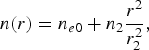 $$n\lpar r\rpar =n_{e0}+n_2 \displaystyle{{r^2 } \over {r_2^2 }}\comma$$
where n 2 is related to the spot size r 2 of the second laser pulse and n e0 is plasma density on the channel axis. We launch the main laser pulse through the plasma channel
 $${\vec E}_0=\hat{x}A_0 \lpar r\comma \; z\comma \; t\rpar e^{ - i\lpar {\rm \omega} _0 t - k_0 z\rpar }\comma$$
where A 0 (r,z,t) is a slowly varying complex amplitude of the laser. At z = 0
 $$A_0 \vert _{z=0}^2=E_{00}^2 e^{ - r^2 /r_0^2 } g_0 \lpar t\rpar \comma$$
where g 0 (t) is the temporal shape of the main pulse and r 0 is the initial beam radius, and E 00 is the amplitude of the beam at the axis. And at z > 0 the main pulse amplitude is modified by the beam width parameter f
 $$\vert A_0 \vert ^2 = \displaystyle{{E_{00}^2 } \over {\,f^2 }}e^{ - r^2 /r_0^2 f^2 } g_0 \lpar t - z/c\rpar .$$
The main laser pulse imparts oscillatory velocity to electrons
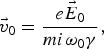 $${\vec v}_0=\displaystyle{{e{\vec E}_0 } \over {mi{\rm \omega} _0 {\rm \gamma} }}\comma \;$$
where relativistic gamma factor γ = (1 + (E 002e −r 2/r 02f 2)/2f 2)1/2 is described in terms of noramalized laser amplitude a 002 = |eA 00/mω0c|2. The dielectric constant (ɛeff(r,z) = ɛeff0 + ɛ2r 2) of the plasma is expressed as
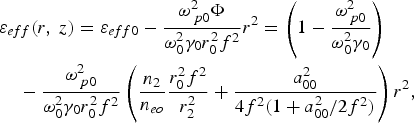 $$\eqalign{&{\rm \varepsilon} _{eff} \lpar r\comma \; z\rpar ={\rm \varepsilon} _{eff0} - \displaystyle{{{\rm \omega} _{\,p0}^2 \Phi } \over {{\rm \omega} _0^2 {\rm \gamma} _0 r_0^2 f^2 }}r^2=\left({1 - \displaystyle{{{\rm \omega} _{\,p0}^2 } \over {{\rm \omega} _0^2 {\rm \gamma} _0 }}} \right)\cr & \quad - \displaystyle{{{\rm \omega} _{\,p0}^2 } \over {{\rm \omega} _0^2 {\rm \gamma} _0 r_0^2 f^2 }}\left({\displaystyle{{n_2 } \over {n_{eo} }}\displaystyle{{r_0^2 f^2 } \over {r_2^2 }}+\displaystyle{{a_{00}^2 } \over {4f^2 \lpar 1+a_{00}^2 /2f^2 \rpar }}} \right)r^2\comma}$$
where ωp02 (=n e0e 2 /m e ɛ0) is the plasma frequency and γ0 = (1 + a 002/2)1/2 is the value of γ on the axis, and e and m are the charge and mass of the electron.
The wave equation governing the electric field of a pump laser beam in a plasma can be written as
 $$\nabla ^2 {\vec E}_0 - \nabla \lpar \nabla \cdot {\vec E}_0 \rpar +\displaystyle{{{\rm \omega} _0^2 } \over {c^2 }}{\rm \varepsilon} _{eff} {\vec E}_0=0.$$
In terms of slowly varying laser amplitude one can neglect (∂2A 0/∂ z 2) by using the Wentzel-Kramers-Brillouin approximation,
 $$2ik_0 \displaystyle{{\partial A_0 } \over {\partial z}}+\nabla_\bot^2A_0 - k_0^2 A_0+\displaystyle{{{\rm \omega} _0^2 } \over {c^2 }}\left({{\rm \varepsilon} _{eff0}+{\rm \varepsilon} _2 r^2 } \right)A_0 = 0.$$
And in the limit ω0 ≫ ωp0 leads to the propagation vector,  $k_0 = \lpar {\rm \omega} _0 /c\rpar \sqrt {{\rm \varepsilon} _{eff0} } $. Following Akhmanov et al. (Reference Akhmanov, Sukhorukov and Khokhlov1966) and Sodha et al. (Reference Sodha, Ghatak and Tripathi1974) we introduce an eikonal approximation,
 ${\vec A}_0 = {\vec A}_0 \lpar r\rpar e^{iS\lpar r\comma z\rpar } $ and separate out the real and imaginary parts of the resulting equation. The coupled set of equations for A 002 and S are solved in the paraxial approximation by expanding S as S = ϕ(z) + βr 2/2 where β = (1/f)(df/dz), ϕ(z) is the axial phase. Laser beam width parameter f governs the equation in terms of dimensionless distance ξ = z/R d,
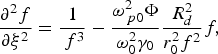 $$\displaystyle{{\partial ^2 f} \over {\partial {\rm \xi} ^2 }}=\displaystyle{1 \over {\,f^3 }} - \displaystyle{{{\rm \omega} _{\,p0}^2 \Phi } \over {{\rm \omega} _0^2 {\rm \gamma} _0 }}\displaystyle{{R_d^2 } \over {r_0^2 f^2 }}f\comma$$
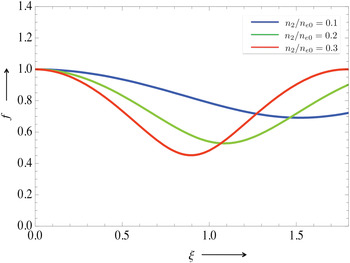
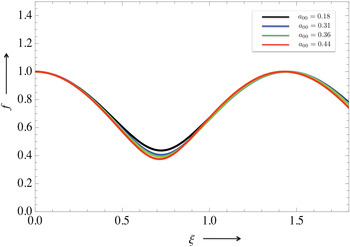
where R d = k 0r 02 is the Rayleigh length. First and second term in the right-hand side of Eq. (13) contribute to the the diffraction divergence and nonlinear self-focusing, respectively. When both terms are equal, beam width parameter becomes constant for all values of z. Nonlinear self-focusing term also contains channel density profile and the relativistic nonlinear term. So the self-focusing of main pulse can be controlled by the plasma channel nonuniformity and its intensity. The boundary conditions at ξ = 0 for an initially plane wavefront are f = 1, ∂f/∂ξ = 0, and S 0 = 0. In Figure 1, we plotted the variation of f with ξ for main laser pulse frequency ω0 = 2.8195 × 10¹⁴ S−1, spot size r 0 = 15 µm and normalized pump amplitude a 00 = e|E 00|/mω0c = 0.44. The other parameters are n e0 = 2 × 1024 m−3, ωp0/ω0 = 0.28 and the spot size of second laser beam, r 2(> r 0) = 18 µm. The main laser pulse shows the periodic focusing inside a plasma channel and increases with increasing density nonuniformity of a plasma channel with n 2/n e0= 0.1, 0.2, and 0.3. For the main laser pulse with different intensities, a 00 = 0.18,0.31,0.36, and 0.44 through the plasma channel with nonuniformity n 2 /n e0 = 0.3, the variation of f with respect to ξ is plotted in Figure 2. Self-focusing behavior for different intensities shows a similarity dueto the ineffectiveness of intensity dependent nonlinearity.
(Color online) Variation of beam width parameter f with respect to the normalized propagation distance ξ = z/R d for the parameters ω0 = 2.8195 × 10¹⁴ S−1, r 0 = 15 µm, a 00 = e|E 00|/mω0c = 0.44, n e0 = 2 × 1024 m−3 and r 2 = 18 µm.

(Color online) Variation of beam width parameter f with respect to the normalized propagation distance ξ = z/R d for the different values of main laser intensities a 00 = 0.18, 0.31, 0.36 and, 0.44 in a plasma channel with nonuniformity n 2/n e0 = 0.3. The other parameters are ω0 = 2.8195 × 10¹⁴ S−1, r 0 = 15 µm, n e0 = 2 × 1024 m−3 and r 2 = 18 µm.

3. STIMULATED RAMAN FORWARD SCATTERING IN THE PRE-FORMED PLASMA CHANNEL
The main laser parametrically excites a plasma wave ϕ = ϕ (x)e −i(ωt−kz) and two side-band electromagnetic waves  ${\vec E}_{\,js} = \hat xA_{\,js} \lpar r\rpar e^{ - i\lpar {\rm \omega} _{\,js} t - k_{\,js} z\rpar }$ with the phase matching conditions
 $${\rm \omega} _{\,js}={\rm \omega} \mp {\rm \omega} _0\comma \; {\vec k}_{\,js}=\vec k \mp {\vec k}_0\comma$$
where j = 1, 2. Sidebands impart oscillatory velocities to electrons
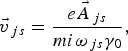 $${\vec v}_{\,js}=\displaystyle{{e{\vec A}_{\,js} } \over {mi{\rm \omega} _{\,js} {\rm \gamma} _0 }}\comma$$
where 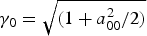 ${\rm \gamma} _0 = \sqrt {\lpar 1+a_{00}^2 /2\rpar }$. The sidebands couple with the pump to exert a ponderomotive force on electrons at (ω, k),
 $${\vec F}_p = e\vec \nabla {\rm \phi} _p=- \displaystyle{m \over 2}\lpar {\vec v}_0 \cdot \nabla {\vec v}_{1s}+{\vec v}_{2s} \cdot \nabla {\vec v}_0^ {\;\ast} \rpar \comma$$
where  ${\rm \phi} _p = \lpar i/2{\rm \gamma} _0 \rpar \left({{{{{\vec v}_0 } \over {{\rm \omega} _{1s} }}} \cdot{\vec E}_{1s}+{{{{\vec v}_0 \ast } \over {{\rm \omega} _{2s} }}} \cdot {\vec E}_{2s} } \right)$. The electron response to plasma wave potential and the nonlinear ponderomotive potential can be obtained from the equations of motion and continuity
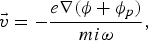 $$\vec v = - \displaystyle{{e\nabla \lpar {\rm \phi}+{\rm \phi} _p \rpar } \over {mi{\rm \omega} }}\comma$$
 $$n_e = \displaystyle{e \over {m{\rm \omega} ^2 }}\nabla \left({n\lpar r\rpar \nabla \lpar {\rm \phi}+{\rm \phi} _p \rpar } \right).$$
Using Poisson's equation ∇2ϕ = 4πn ee, we obtain
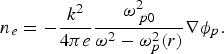
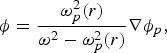 $${\rm \phi} = \displaystyle{{{\rm \omega} _p^2 \lpar r\rpar } \over {{\rm \omega} ^2 - {\rm \omega} _p^2 \lpar r\rpar }}\nabla {\rm \phi} _p\comma \;$$
in the limit of r 02k 2 > 1. The electron density perturbation can be explicitly written as
 $$n_e = - \displaystyle{{k^2 } \over {4{\rm \pi} e}}\displaystyle{{{\rm \omega} _{\,p0}^2 } \over {{\rm \omega} ^2 - {\rm \omega} _p^2 \lpar r\rpar }}\nabla {\rm \phi} _p .$$
The electron density perturbation beats with the electron oscillatory velocity  ${\vec v}_0 $ to produce non-liear currents at sideband frequencies,
 $${\vec J}_{1s}^{NL} = - \displaystyle{1 \over 2}n_e e{\vec v}_0^ {\;\ast} \quad\comma \; \quad {\vec J}_{2s}^{NL}=- \displaystyle{1 \over 2}n_e e{\vec v}_0 .$$
We obtain the wave equation for the lower sideband by using Maxwell's third and forth equations
 $$\nabla ^2 {\vec E}_{1s} - \nabla \lpar \nabla \cdot {\vec E}_{1s} \rpar +\displaystyle{{{\rm \omega} _{1s}^2 } \over {c^2 }}{\rm \varepsilon} _{eff}^{1s} {\vec E}_{1s}=- \displaystyle{{4{\rm \pi} i{\rm \omega} _1 } \over {c^2 }}{\vec J}_{1s}^{NL}.$$
For an electromagnetic wave  $\nabla \cdot {\vec E}_{1s} = 0$ and in terms of slowly varying laser amplitude, one can neglect (∂2A 1s/∂ z 2, ∂ A 1s/∂ z) by using the Wentzel-Kramers-Brillouin approximation,
 $$\nabla _ \bot ^2 A_{1s} - k_{1s}^2 A_{1s}+\displaystyle{{{\rm \omega} _{1s}^2 } \over {c^2 }}{\rm \varepsilon} _{eff}^{1s} A_{1s}=- \displaystyle{{4{\rm \pi} i{\rm \omega} _{1s} } \over {c^2 }}{\vec J}_{1s}^{NL}.$$
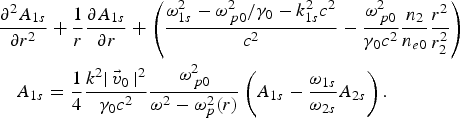
Using Eq. (21) we obtain
 $$\eqalign{& \displaystyle{{\partial ^2 A_{1s} } \over {\partial r^2 }}+\displaystyle{1 \over r}\displaystyle{{\partial A_{1s} } \over {\partial r}}+ \left({\displaystyle{{{\rm \omega} _{1s}^2 - {\rm \omega} _{\,p0}^2 /{\rm \gamma} _0 - k_{1s}^2 c^2 } \over {c^2 }} - \displaystyle{{{\rm \omega} _{\,p0}^2 } \over {{\rm \gamma} _0 c^2 }}\displaystyle{{n_2 } \over {n_{e0} }}\displaystyle{{r^2 } \over {r_2^2 }}} \right)\cr & \quad A_{1s} =\displaystyle{1 \over 4}\displaystyle{{k^2 \vert {\vec v}_0 \vert ^2 } \over {{\rm \gamma} _0 c^2 }}\displaystyle{{{\rm \omega} _{\,p0}^2 } \over {{\rm \omega} ^2 - {\rm \omega} _p^2 \lpar r\rpar }}\left({A_{1s} - \displaystyle{{{\rm \omega} _{1s} } \over {{\rm \omega} _{2s} }}A_{2s} } \right).}$$
Using  ${\rm \zeta} _0^2=\lpar r_2^2 /r_0^2 f^2 \rpar \lpar {\rm \omega} ^2 - {\rm \omega} _{\,p0}^2 \rpar /{\rm \omega} _{\,p0}^2 $, ζ = (r/r 0f),
 $q_{1s}^2=$
 $\left({{\rm \omega} _{1s}^2 - {\rm \omega} _{\,p0}^2 /{\rm \gamma} _0 - k_{1s}^2 c^2 } \right)\lpar r_0^2 f^2 /c^2 \rpar $, and
 $\vert v_0 \vert ^2 /{\rm \gamma} _0 c^2=e^2$
 $\vert E_{00} \vert ^2 /m^2 {\rm \gamma} _0^3 f^2 {\rm \omega} _0^2 c^2=\vert V_{00} \vert ^2 e^{ - r^2 /r_0^2 f^2 } $, and
 ${\rm \beta} ^2=\lpar {\rm \omega} _{\,p0}^2 /{\rm \gamma} _0 c^2 \rpar$
 $\lpar n_2 /n_{e0} \rpar \lpar r_0^4 f^4 \rpar /r_2^2 $.
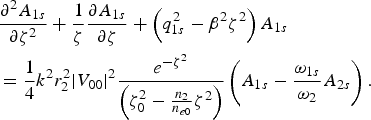 $$\eqalign{& \displaystyle{{\partial ^2 A_{1s} } \over {\partial {\rm \zeta} ^2 }}+\displaystyle{1 \over {\rm \zeta} }\displaystyle{{\partial A_{1s} } \over {\partial {\rm \zeta} }}+\left({q_{1s}^2 - {\rm \beta} ^2 {\rm \zeta} ^2 } \right)A_{1s} \cr & = \displaystyle{1 \over 4}k^2 r_2^2 \vert V_{00} \vert ^2 \displaystyle{{e^{ - {\rm \zeta} ^2 } } \over {\left({{\rm \zeta} _0^2 - {\textstyle{{n_2 } \over {n_{e0} }}}{\rm \zeta} ^2 } \right)}}\left({A_{1s} - \displaystyle{{{\rm \omega} _{1s} } \over {{\rm \omega} _2 }}A_{2s} } \right).}$$
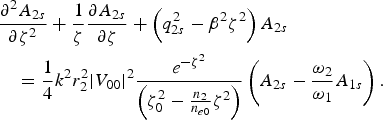
Similarly for the upper sideband wave,
 $$\eqalign{& \displaystyle{{\partial ^2 A_{2s} } \over {\partial {\rm \zeta} ^2 }}+\displaystyle{1 \over {\rm \zeta} }\displaystyle{{\partial A_{2s} } \over {\partial {\rm \zeta} }}+\left({q_{2s}^2 - {\rm \beta} ^2 {\rm \zeta} ^2 } \right)A_{2s}\cr & \quad =\displaystyle{1 \over 4}k^2 r_2^2 \vert V_{00} \vert ^2 \displaystyle{{e^{ - {\rm \zeta} ^2 } } \over {\left({{\rm \zeta} _0^2 - {\textstyle{{n_2 } \over {n_{e0} }}}{\rm \zeta} ^2 } \right)}}\left({A_{2s} - \displaystyle{{{\rm \omega} _2 } \over {{\rm \omega} _1 }}A_{1s} } \right).}$$
where q 2s2 = (ω2s2 − ωp02/γ0 − k 2s2c 2)(r 02f 2)/c 2. In the absence of nonlinear coupling, the eigen-functions of Eq. (25) and Eq. (26) become
 $$A_{1s\comma 2s} = a_{1s\comma 2s} e^{ - {\rm \beta} {\rm \zeta} ^2 /2}\comma \;$$
for the fundamental mode and the corresponding eigen values q 1s,2s2 = 2β become
 $${\rm \omega} _{1s\comma 2s}^2 = \displaystyle{{{\rm \omega} _{\,p0}^2 } \over {{\rm \gamma} _0 }}+k_{1s\comma 2s}^2 c^2+2\displaystyle{{{\rm \omega} _{\,p0} c} \over {\sqrt {{\rm \gamma} _0 } r_2 }}\sqrt {n_2 /n_{e0} }.$$
In the presence of nonlinear coupling, the eigen functions for A 1s,2s remain unmodified, and only the eigenvalue are modified. Now substituting A 1s,2s in Eq. (25) and Eq. (26), multiplying the resulting equation by e −βζ2/2 and integrating over ζ from ∞ to ∞, we obtain
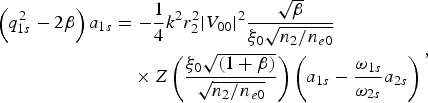 $$\eqalign{\left({q_{1s}^2 - 2{\rm \beta} } \right)a_{1s} & = - \displaystyle{1 \over 4}k^2 r_2^2 \vert V_{00} \vert ^2 \displaystyle{{\sqrt {\rm \beta} } \over {{\rm \xi} _0 \sqrt {n_2 /n_{e0} } }} \cr & \quad \times Z\left({\displaystyle{{{\rm \xi} _0 \sqrt {\lpar 1+{\rm \beta} \rpar } } \over {\sqrt {n_2 /n_{e0} } }}} \right)\left({a_{1s} - \displaystyle{{{\rm \omega} _{1s} } \over {{\rm \omega} _{2s} }}a_{2s} } \right)}\comma \;$$
and
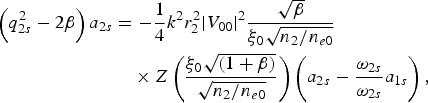 $$\eqalign{\left({q_{2s}^2 - 2{\rm \beta} } \right)a_{2s} & =- \displaystyle{1 \over 4}k^2 r_2^2 \vert V_{00} \vert ^2 \displaystyle{{\sqrt {\rm \beta} } \over {{\rm \xi} _0 \sqrt {n_2 /n_{e0} } }} \cr & \quad \times Z\left({\displaystyle{{{\rm \xi} _0 \sqrt {\lpar 1+{\rm \beta} \rpar } } \over {\sqrt {n_2 /n_{e0} } }}} \right)\left({a_{2s} - \displaystyle{{{\rm \omega} _{2s} } \over {{\rm \omega} _{2s} }}a_{1s} } \right)\comma \; }$$
where Z(x) is the plasma dispersion function. Eq. (29) and Eq. (30) give the nonlinear dispersion relation,
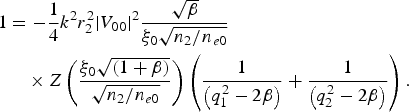 $$\eqalign{1& = - \displaystyle{1 \over 4}k^2 r_2^2 \vert V_{00} \vert ^2 \displaystyle{{\sqrt {\rm \beta} } \over {{\rm \xi} _0 \sqrt {n_2 /n_{e0} } }} \cr & \quad \times Z\left({\displaystyle{{{\rm \xi} _0 \sqrt {\lpar 1+{\rm \beta} \rpar } } \over {\sqrt {n_2 /n_{e0} } }}} \right)\left({\displaystyle{1 \over {\left({q_1^2 - 2{\rm \beta} } \right)}}+\displaystyle{1 \over {\left({q_2^2 - 2{\rm \beta} } \right)}}} \right).}$$
For ω ≈ ωp0 ≪ ω0, ωjs, the phase matching condition k = (k 0 + k 1s) gives the plasma wave number for the resonant coupling to the lower sideband wave
 $$k = \displaystyle{{\rm \omega} \over c}\left({1+\displaystyle{{{\rm \omega} _{\,p0}^2 } \over {{\rm \omega} _0^2 }}\left({1+\displaystyle{{{\rm \omega} _{\,p0}^2 } \over {{\rm \omega} _0^2 }}} \right)\left({\displaystyle{1 \over {2{\rm \gamma} _0 }}+\displaystyle{{\sqrt {\lpar n_2 /n_{e0} } \rpar c} \over {\sqrt {{\rm \gamma} _0 } r_2 {\rm \omega} _{\,p0} }}} \right)} \right).$$
Using ω = ωp0 + iΓ, the nonlinear dispersion relation Eq. (31) becomes
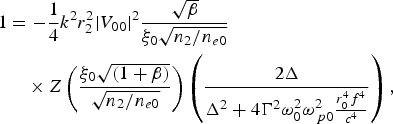 $$\eqalign{1 & = - \displaystyle{1 \over 4}k^2 r_2^2 \vert V_{00} \vert ^2 \displaystyle{{\sqrt {\rm \beta} } \over {{\rm \xi} _0 \sqrt {n_2 /n_{e0} } }} \cr & \quad \times Z\left({\displaystyle{{{\rm \xi} _0 \sqrt {\lpar 1+{\rm \beta} \rpar } } \over {\sqrt {n_2 /n_{e0} } }}} \right)\left({\displaystyle{{2\Delta } \over {\Delta ^2+4\Gamma ^2 {\rm \omega} _0^2 {\rm \omega} _{\,p0}^2 {\textstyle{{r_0^4 f^4 } \over {c^4 }}}}}} \right)\comma \; }$$
where Δ = ((ωp02 − k 2c 2)(r 02f 2/c 2) − 2β).
In the limit ξ0 < 1,  $Z\lpar {\rm \xi} _0 \sqrt {\lpar 1 + {\rm \beta} \rpar } /\sqrt {n_2 /n_{e0} } \rpar \approx \lpar {\rm \xi} _0 \sqrt {\lpar 1+{\rm \beta} \rpar } /$
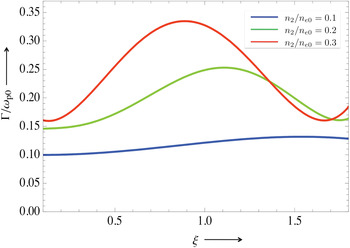
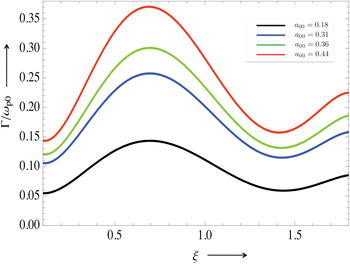
 $\sqrt {n_2 /n_{e0} }+i\sqrt {\rm \pi} \rpar $, we numerically plotted the normalized growth rate Γ/ωp0 with respect to the normalized distance of propagation (ξ = z/R d) in different plasma channels in Figure 3. The presence of plasma channel nonuniformity guide the main laser pulse and increase the focusing in Figure 1, which further increases the growth of SRFS with distance of propagation in Figure 3. In Figure 2, the presense of a nonuniform plasma channel n 2/n e0 = 0.3 focusing is independent of the laser intensity. However, the growth rate increases with the intensity of the main laserpulse in Figure 4.
(Color online) Variation of the normalized growth rate Γ/ωp0 with respect to the normalized distance of propagation ξ = z/R d for the parameters same as in Figure 1.

(Color online) Variation of the normalized growth rate Γ/ωp0 with respect to the normalized distance of propagation ξ = z/R d for the parameters same as in Figure 2.

4. CONCLUSIONS
We have carried out an analysis to understand how SRFS of ultra intense pulse will be affected by a localization effect of residual plasma inside the plasma channel. Two pre-laser pulses produce an axially nonuniform plasma channel. After few ns, main pulse of intensity a 00 = 0.44 shows a periodic focusing in nonuniform plasma channels. Self-focusing increases with the increase in nonuniformity of a plasma channel for n 2/n e0 = 0.1,0.2, and 0.3 as shown in Figure 1. However, self-focusing is independent of main laser intensity in a deep plasma channel with nouniformity n 2/n e0 = 0.3, which is shown in Figure 2. Main pulse undergoes SRFS, producing a plasma wave and two electromagnetic sideband waves. Normalized growth rate of relativistic SRFS of main pulse is modified by density nonuniformity of plasma channel as well as by laser intensity. In Figure 3, in the presence of a plasma channel, the growth rate of SRFS increases with nonuniformity n 2/n e0 = 0.1, 0.2, and 0.3. In the presence of deep cavitation n 2/n e0 = 0.3, normalized growth rate of relativistic SRFS also increases with the intensity of main laser pulse as in Figure 4. Even at higher laser intensities plasma wave breaking can be possible. These energy loss phenomena can play important roles in reducing the growth rate of forward Raman scattering (Modena et al., Reference Modena, Najmudin, Dangor, Clayton, Marsh, Joshi, Malka, Darrow and Danson1996); Rousselaux et al., Reference Rousseaux, Rabec le Gloahec, Baton, Amiranoff, Fuchs, Gremillet, Adam, Hron and Mora2002) at higher pump intensities. Our theory is limited to a 00 < 0.5 i.e., for weakly relativistic cases. Enhanced growth rate of Raman scattering in forward direction can be applied to drive self-modulation of a laser wake field accelerator. This analysiswill also be useful in the study of inertial confinement fusion and laser plasma accelerator. This work is also related to understand the ability of a short pulse to be transmitted in a plasma.
ACKNOWLEDGMENTS
The work is supported by R&D Program through the National Fusion Research Institute of Korea (NFRI) and the grants NRF-2011-0026107, 2011-0018742, 2012-0000590 from the National Research Foundation of Korea.