1. Introduction
The real effect of seigniorage and the welfare cost of inflation tax in advanced economies has been an important subject of discussion among economists and policy makers. Due to their simplicity, cash-in-advance (hereafter CIA) constraints, initiated by Clower (Reference Clower1967) and endorsed by Lucas (Reference Lucas1980), have been a standard setup incorporated into models in order to address these issues. See, among others, Stockman (Reference Stockman1981), Lucas and Stokey (Reference Lucas and Stokey1983, Reference Lucas and Stokey1987), Cooley and Hansen (Reference Cooley and Hansen1989), and Wang and Yip (Reference Wang and Yip1992). Using general equilibrium models without sustainable growth, these authors predict a negative relationship between output and inflation in the long run. Their result remains valid in models with sustainable growth. See Gomme (Reference Gomme1993) and Jones and Manuelli (Reference Jones and Manuelli1995).
A negative relationship between output and inflation emerges in the existing theoretical literature, because inflation acts as a tax on consumption when consumption is subject to a CIA constraint. This makes consumption more expensive than leisure. As a result, the household substitutes leisure for consumption, reducing the labor supply, and thus output falls. In this case, the optimal monetary policy is to maintain a zero or a near-zero nominal interest rate, dubbed the Friedman rule. This policy gives rise to a deflationary environment, wherein the central bank sets the rate of deflation equal to the real interest rate.
However, empirical evidence fails to consistently support a negative real effect of money growth. Although some previous studies find a negative real effect of inflation, later studies document a neutral or a positive relationship between inflation and real economic activities.Footnote 1 In particular, there is a well-established literature that argues that the effects of money growth strongly depend on the level of economic development. For example, Bullard and Keating (Reference Bullard and Keating1995) found that the long-run effects of inflation on real output are positive in low inflation countries in a large sample of postwar economies, and Ghosh and Phillips (Reference Ghosh and Phillips1998) uncovered a negative relationship between inflation and growth for all countries but those with the lowest inflation rates. Moreover, Ahmed and Rogers (Reference Ahmed and Rogers2000) discovered that the long-run effects of inflation on output are positive by using over 100 years of US data, and Khan and Senhadji (Reference Khan and Senhadji2001) estimated the threshold level of inflation at 1–3% for industrial countries and 11–12% for developing countries, above which the relationship between inflation and growth is negative.Footnote 2
One common assumption made in these existing theoretical models with or without sustainable growth is that the labor market is frictionless. As a result, their models cannot envisage how inflation taxes affect the tradeoff between employment and unemployment, which is an important topic, especially in the aftermath of the recent subprime crisis that gives rise to large unemployment. To our knowledge, Heer (Reference Heer2003), Cooley and Quadrini (Reference Cooley and Quadrini2004), and Wang and Xie (Reference Wang and Xie2013) have incorporated labor search in models of CIA constraints and envisaged the optimal long-run inflation rate.
Heer (Reference Heer2003) analyzed the effect of seigniorage on employment and welfare. He extended the “large” household, search models of Merz (Reference Merz1995), Andolfatto (Reference Andolfatto1996), and Shi and Wen (Reference Shi and Wen1999) to a monetary economy with CIA constraints on consumption. Using a calibration and quantitative analysis, he found a positive relationship between seigniorage taxes and employment and a zero optimal inflation rate in the long run. His results indicate that lowering the inflation rate from a positive baseline to a zero level leads to a welfare gain at the cost of higher unemployment, thus lending support to the Friedman rule in a model with a frictional labor market.
By contrast, Wang and Xie (Reference Wang and Xie2013) do not lend support to the Friedman rule. Their model is an otherwise Heer (Reference Heer2003) model except with a separate CIA constraint on firms’ wage payment. Due to the CIA constraint on firms’ wage payment, higher money growth reduces real money balances held by firms, so firms’ wage payment is constrained. This encourages firms to shift from production to nonproduction activities, devoting more manpower to vacancy creation. Thus, the job finding rate facing each searching worker is higher, which in turn raises job matches and the employment level in the steady state. When some moderate amount of money is injected into firms and agents’ responses to labor-market frictions are sufficiently strong, the matching externality effect dominates the labor demand effect via a labor-leisure tradeoff due to the conventional CIA constraint on households’ consumption. Then, equilibrium employment rises. This creates a channel for higher money growth to induce higher welfare, departing from the Friedman rule.
Cooley and Quadrini (Reference Cooley and Quadrini2004) also studied the Friedman rule but in a totally different model with a liquidity effect. In their model, a part of money is held by households in order to consume and do investment. Other part of money is deposited in banks, with money growth also injecting into banks, which is then loaned to firms in order to produce final goods, so there is the liquidity effect. They showed that, with the policy without commitment, the Friedman rule is optimal. However, with commitment, when worker’s bargaining power is sufficiently smaller than worker’s contribution in the matching so the Hosios conditions do not hold, because the high profitability of a match for the firm induces an excessive creation of vacancies, the Friedman rule is not optimal.
Although Heer (Reference Heer2003), Cooley and Quadrini (Reference Cooley and Quadrini2004), and Wang and Xie (Reference Wang and Xie2013) have incorporated frictional labor markets into models with CIA constraints, they do not consider the environment with sustainable growth. The purpose of our paper is to revisit the Friedman rule in a model with sustainable growth. We argue that, even without imposing a liquidity effect or a CIA constraint on firms’ wage payment, an endogenous growth model offers a different channel so that moderately higher money growth can increase the welfare. Intuitively, in a perpetually growing economy, the technology is of constant returns with respect to the growing factor, which is physical capital in our one-sector model. When the labor market is frictional, an increase in the money growth rate gives rise to an expansion in employment. Labor and capital are complementary in production. With an increase in employment, when the technology is neoclassical, as in Heer (Reference Heer2003) and Wang and Xie (Reference Wang and Xie2013), a decreasing marginal product of capital leads to a lower marginal product of labor. However, in an endogenous growth framework, the technology exhibits a socially constant return on capital, and the marginal product of labor is constant. As a result, when a modest increase in the money supply raises employment, output is enlarged and welfare is increased.
Specifically, our model is otherwise identical to Heer (Reference Heer2003) except for allowing for endogenous growth. Thus, our model considers CIA constraints only on households’ consumption and not on firms’ wage payment. In terms of endogenous growth, for simplicity, we follow the setup initiated by Romer (Reference Romer1986), wherein the production is subject to externalities arising from average capital in the economy. The production technology exhibits constant returns with respect to perpetual growth factors in order to be consistent with endogenous growth.
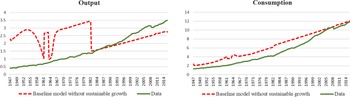
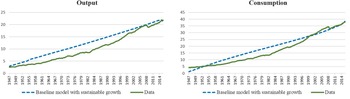
The reason our model departs from the Friedman rule is as follows. An increase in the money growth rate raises the inflation rate in the long run. The presence of CIA constraints induces households to substitute leisure for consumption and to replace real money balances by capital, therefore decreasing the ratio of consumption to capital. Moreover, as agents increase leisure, they reduce search efforts and hence the size of unemployment decreases. While fewer agents searching for jobs cuts back firms’ job openings, a lower ratio of consumption to capital reduces the reservation wage and thus the bargaining wage to capital ratio, so firms’ job openings accumulate. As the latter effect dominates, posted job openings increase. A decreased amount of unemployment, given the job finding possibility, reduces the employment size, but more job openings increase the employment size. As the latter effect dominates, the employment size increases in the long run. In an endogenous growth framework, as the technology is of constant returns with respect to aggregate capital, a larger employment yields a larger marginal product of capital and thus output. Hence, some moderate money growth induces higher welfare, thereby creating a channel for higher money growth to induce higher welfare that departs from the Friedman rule.Footnote 3 Moreover, the optimal long-run inflation rate departs from the Friedman rule, even when the Hosios condition holds. Finally, we find that our model with sustainable growth fits the data better than that without sustainable growth.
Andolfatto et al. (Reference Andolfatto, Hendry and Moran2004) also analyzed monetary policy in models with labor search and CIA constraints. These authors studied a model with the liquidity effect, like Cooley and Quadrini (Reference Cooley and Quadrini2004). In their model, an active firm borrows money to pay wage in advance, and an unfilled job borrows money to maintain a job vacancy, while households’ consumption is constrained by money holding. They studied the monetary policy transmission mechanism, in particular the persistence of key variables following monetary policy changes. Our model is different, as we do not consider the liquidity effect but consider endogenous growth. Moreover, our focus is on the optimal long-run inflation rate, which is different from the focus on business properties in Andolfatto et al. (Reference Andolfatto, Hendry and Moran2004).
A recent study by Chu et al. (Reference Chu, Cozzi, Fan and Furukawa2021) has incorporated labor search into an endogenous growth model with CIA constraints. While our CIA constraints affect consumption only, their CIA constraints affect not only consumption but also investment in R&D. As a result, while our analysis explores the effect of money growth on economic growth via the effect on capital accumulation, their model studies the effect of money growth on economic growth via the effect on investment in R&D. In particular, their focus is only on the effect of money growth on unemployment and economic growth, whereas we study not only the effect of money growth on employment and economic growth but also the optimal money growth rate that maximizes the welfare of the representative agent.
Finally, our paper adds value to Bhattacharya et al. (Reference Bhattacharya, Haslag and Martin2009) and Ghossoub and Reed (Reference Ghossoub and Reed2019), which also found an optimal rate of money growth higher than the Friedman rule in an endogenous growth model.Footnote 4 In these two papers, agents stochastically relocated to different islands can consume only if they carry money with them. The stochastic relocations act like “liquidity preference shocks” in Diamond and Dybvig (Reference Diamond and Dybvig1983), and as a result, the Tobin effect emerges. Our model is different from their models. First, while they study heterogenous agents of overlapping generations, we study a model with homogenous agents who are not relocated to different islands. Second, while their consumption is affected by liquidity preference shocks, our consumption is affected by the cash-in-advance constraint. Moreover, they adopt a frictionless labor market, but we consider a frictional labor market. Thus, in our model, when an increase in the money growth rate causes a substitute of leisure for consumption, both labor search and the size of unemployment are affected, which in turn changes firms’ job creation, and worker’s reservation wage and thus the bargaining wage. As a result, the channel that the money growth rate impacts economic growth is totally different.
The remainder of this paper is organized as follows. Section 2 presents the model and optimization conditions. Section 3 analyzes equilibrium conditions and the long-run equilibrium. Section 4 describes the calibration procedure, provides quantitative results, carries out sensitivity analysis, and compares the predictions of the models with and without sustainable growth with the data. Finally, Section 5 offers concluding remarks.
2. The model
Time is discrete. The economy is composed by firms, households, and a (passive) government. All agents have perfect foresight. The goods market and capital market both are perfect, but the labor market exhibits search and entry frictions. While an unemployed household may search for jobs at the foregone cost of leisure time, a firm can create vacancies at the cost of output.
2.1. Representative household’s problem
The economy is populated by a continuum of identical infinitely lived “large” households of a unit mass. The large household framework allows for modeling capital accumulation under a dynamic general equilibrium setting in a tractable manner while taking into consideration market frictions highlighted in labor search and matching models. The setup of large households is convenient in that all family members pool resources regardless of their labor market status. This useful method of modeling perfect consumption insurance in general equilibrium search models has been common since Merz (Reference Merz1995) and Andolfatto (Reference Andolfatto1996).
A large household consists of a continuum of family members (of measure one). Family members may be (i) workers, who engage in productive activities with the wage rate at
 $w_{t}$
, (ii) job seekers, who undertake job search activities, or (iii) leisure takers, who are involved in nonmarket activities. Employment is a predetermined state in each period. Let
 $ n_{t}\in\! \left ( 0,1\right )$
and
 $s_{t}\in\! \left ( 0,1\right )$
denote the fraction of household members working and searching for jobs, respectively, with the remaining fraction
 $1-n_{t}-s_{t}$
 $\in\! \left ( 0,1\right )$
being in leisure.Footnote
5
If an individual member is employed, then he will supply his time endowment inelastically to the market. When an unemployed agent searches for jobs, he will be matched with a job vacancy with a certain probability. It is thus possible that an unemployed member remains unemployed for some time. As a result, individuals face an uncertainty in income, consumption and leisure. Following Lucas (Reference Lucas1990), Merz (Reference Merz1995) and Andolfatto (Reference Andolfatto1996), we assume that all members in a large household pool their resources in order to maximize the household’s utility.
The representative household is assumed to derive utility from consumption and disutility from both working and job search. Its lifetime utility is described by
 \begin{equation} \sum _{t=0}^{\infty }\beta ^{t}u(c_{t},n_{t}+s_{t})=\sum _{t=0}^{\infty }\beta ^{t}\left [ \log c_{t}-\epsilon \frac{\left ( n_{t}+s_{t}\right ) ^{1+\sigma }}{ 1+\sigma }\right ], \end{equation}
where
 $c_{t}\gt 0$
is the consumption,
 $\sigma \gt 0$
denotes the inverse of the labor supply elasticity,
 $\epsilon$
is a preference parameter attached to leisure, and
 $\beta \in\! \left ( 0,1\right )$
is the subjective discount factor. Heer (Reference Heer2003) also used this additively separable logarithmic preference, which has been shown to be consistent with the balanced growth path (BGP) (King et al., Reference King, Plosser and Rebelo1998).
Let
 $a_{t}$
and
 $M_{t}$
be the amount of non-monetary real asset and nominal money, respectively, owned by the representative household in period
 $t$
.Footnote
6
Since households are the owners of the firms, they receive the profits
 $\! \left ( \psi _{t}\right )$
remitted from firms in each period. The household’s budget constraint in period
 $t$
is then given by
 \begin{equation} (1+\tau _{c})c_{t}+a_{t+1}-a_{t}+(1+\pi _{t+1})m_{t+1}-m_{t}=(1-\tau _{w})w_{t}n_{t}+(1-\tau _{a})r_{t}a_{t}+\psi _{t}+\phi _{t}, \end{equation}
where
 $\tau _{c}$
,
 $\tau _{w}$
, and
 $\tau _{a}$
are the tax rate for consumption, labor income, and capital income, respectively,
 $r_{t}$
denotes the rental rate of assets, and
 $\phi _{t}$
is a lump sum transfer from the government, which includes tax revenues collected and the money injection. As a result, there is a wealth effect from redistribution of seigniorage revenues, like that in Wang and Xie (Reference Wang and Xie2013), Bhattacharya et al. (Reference Bhattacharya, Haslag and Martin2009), and Ghossoub and Reed (Reference Ghossoub and Reed2019). Variable
 $m_{t}=M_{t}/P_{t}$
is real money holdings in period
 $t$
, where
 $P_{t}$
is the aggregate price level in period
 $t$
. The inflation rate is
 $\pi _{t+1}=P_{t+1}/P_{t}-1$
in period
 $t$
.
As in Heer (Reference Heer2003), the representative household faces the CIA constraint on consumption as follows:
 \begin{equation} h(1+\tau _{c})c_{t}\leq m_{t}, \end{equation}
where
 $h\in (0,1]$
is the fraction of the household’s consumption expenditure that must be paid by real money balances. Thus, an
 $h$
fraction of consumption is cash goods, and the remaining fraction
 $(1-h)$
is credit goods. Taxes due for the purchase of cash goods are paid in cash, and thus
 $ h\tau _{c}c_{t}$
is a part of the CIA constraint.
As to the evolution of employment over time, some of the agents who are searching for jobs become employed in the next period, but some currently employed individuals may lose their jobs in the next period. Denote
 $\eta _{t}$
as the success rate of job search in period
 $t$
, which will be endogenously determined. Let
 $\theta \gt 0$
be the exogenous job separation rate. The number of employed individuals in the next period is given by
 \begin{equation} n_{t+1}=\eta _{t}s_{t}+\left ( 1-\theta \right ) n_{t}. \end{equation}
The problem of the representative household is to maximize the lifetime utility in (1), subject to (2), (3) and (4), the no-Ponzi-game condition, initial values
 $a_{0}$
,
 $m_{0}$
,
 $n_{0}$
, and the feasibility conditions
 $c_{t}\geq 0,$
 $n_{t}\in\! \left ( 0,1\right ),\ s_{t}\in (0,1)$
. Let
 $\lambda _{t},$
 $\zeta _{t}$
and
 $\varphi _{t}$
be the Lagrange multipliers for (2), (3) and (4), respectively. The first-order conditions with respect to
 $c_{t},$
 $s_{t}$
,
 $ n_{t+1}$
,
 $a_{t+1}$
and
 $m_{t+1}$
are, respectively,
 \begin{equation} \frac{1}{c_{t}}=(1+\tau _{c})(\lambda _{t}+h\zeta _{t}), \end{equation}
 \begin{equation} \epsilon \!\left ( n_{t}+s_{t}\right ) ^{\sigma }=\varphi _{t}\eta _{t}, \end{equation}
 \begin{equation} \beta \epsilon\! \left ( n_{t+1}+s_{t+1}\right ) ^{\sigma }=\beta (1-\tau _{w})w_{t+1}\lambda _{t+1}+\beta\! \left ( 1-\theta \right ) \varphi _{t+1}-\varphi _{t}, \end{equation}
 \begin{equation} \lambda _{t}=\beta \lbrack 1+(1-\tau _{a})r_{t+1}]\lambda _{t+1}, \end{equation}
 \begin{equation} (1+\pi _{t+1})\lambda _{t}=\beta\! \left ( \lambda _{t+1}+\zeta _{t+1}\right ). \end{equation}
In these conditions, (5) equates the marginal utility of consumption to the marginal cost of consumption, and (6) equates the marginal disutility of job search to the expected marginal gain of a successful job match. Equation (7) is the optimal condition for employment tomorrow, which equates the discounted marginal disutility of employment tomorrow to the discounted marginal benefit of employment tomorrow, the latter being the after-tax wage income plus the adjusted shadow value of remaining in employment later. Finally, (8) and (9) equate the marginal cost to the marginal benefit of holding non-monetary assets and money, respectively.
Combining (5), (8) and (9) gives the following consumption Euler equation:
 \begin{equation} \frac{1}{c_{t}}\frac{1}{1+h[\pi _{t}+(1+\pi _{t})(1-\tau _{a})r_{t}]}=\frac{ \beta }{c_{t+1}}\frac{1+(1-\tau _{a})r_{t+1}}{1+h[\pi _{t+1}+(1+\pi _{t+1})(1-\tau _{a})r_{t+1}]}. \end{equation}
Note that in the case when
 $h=0$
, there is no CIA constraint. Then, (10) reduces to the standard Euler equation
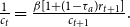 $\frac{1}{c_{t}}=\frac{\beta \lbrack 1+(1-\tau _{a})r_{t+1}]}{c_{t+1}}.$
2.2. The firms
There is a continuum of identical infinitely lived firms. In each period, the firm uses capital
 $k_{t}$
and labor
 $n_{t}$
to produce output
 $ y_{t}$
according to the following technology:
 \begin{equation*} y_{t}=f\!\left ( k_{t},n_{t},\bar {k}_{t}\right ) =A_{t}k_{t}^{\varepsilon }n_{t}^{1-\varepsilon }, \end{equation*}
where
 $\varepsilon \in (0,1)$
measures the income share of capital and
 $ A_{t}$
is the technology level in period
 $t$
. In order for the model to exhibit perpetual economic growth, we follow Bean and Pissarides (Reference Bean and Pissarides1993) and Eriksson (Reference Eriksson1997) and assume that the technology level is
 $A_{t}=A\bar{k} _{t}^{b}\gt 0$
, where
 $A\gt 0$
is a productivity coefficient and
 $\bar{k}_{t}$
is economy-wide average capital in period
 $t$
, which is taken as given by the firm. In equilibrium,
 $\bar{k}_{t}$
is endogenous and equals
 $k_{t}$
. The model can sustain economic growth, when
 $b=1-\varepsilon$
, as in Romer (Reference Romer1986). Alternatively, the model reduces to a neoclassical growth model, when
 $b=0$
, as in Heer (Reference Heer2003).
There is also an evolution of employment from the firm’s perspective. Employment is increased by the inflow of workers due to recruitment and is decreased by the outflow of workers due to job separation.
 \begin{equation} n_{t+1}=q_{t}v_{t}+\left ( 1-\theta \right )\! n_{t}, \end{equation}
where
 $v_{t}$
is endogenously created vacancies, and
 $q_{t}$
is the rate at which a job vacancy matches with job seekers in period
 $t$
.
In order to hire workers, a firm has to post job vacancies in the labor market. There are costs of creating and maintaining vacancies. We assume that posting and maintaining one job vacancy costs
 $e_{t}=ew_{t}\gt 0$
units of output in period
 $t$
, where
 $e\in\! \left ( 0,1\right )$
is a constant parameter.Footnote
7
Hence, the representative firm’s profit flow in period
 $t$
,
 $\psi _{t}$
, is equal to the output produced net of the costs of employment, capital, and vacancy creation and maintenance.
 \begin{equation} \psi _{t}=y_{t}-w_{t}n_{t}-(r_{t}+\delta )k_{t}-e_{t}v_{t}, \end{equation}
where
 $\delta$
is the capital depreciation rate.
When computing the firm’s value at time
 $0,$
the profit in any period
 $t\geq 0$
is discounted by the market interest rates
 $z_{t}\equiv \prod \limits _{i=1}^{t}\frac{1}{1+r_{i}},$
with
 $z_{0}=1$
. As employment is a state variable, the firm’s problem is an optimal control problem. The representative firm maximizes the following discounted sum of profits
 \begin{equation*} \underset {\left \{ k_{t},v_{t},n_{t+1}\right \} _{t=0}^{\infty }}{\max } \sum _{t=0}^{\infty }z_{t}\psi _{t}, \end{equation*}
subject to the production technology and the evolution of employment in (11), where the profit flow
 $\psi _{t}$
is in (12). Let
 $\xi _{t}$
be the Lagrange multiplier for the evolution of employment. The first-order conditions with respect to
 $k_{t},$
 $v_{t}$
and
 $n_{t+1}$
are
 \begin{equation} A\varepsilon k_{t}^{\varepsilon +b-1}n_{t}^{1-\varepsilon }=r_{t}+\delta, \end{equation}
 \begin{equation} e_{t}=\xi _{t}q_{t}, \end{equation}
 \begin{equation} A(1-\varepsilon )k_{t+1}^{\varepsilon +b}n_{t+1}^{-\varepsilon }=w_{t+1}-[\left ( 1-\theta \right )\! \xi _{t+1}-\frac{z_{t}}{z_{t+1}}\xi _{t}]. \end{equation}
Equation (13) states that, in optimum, the firm rents capital to the amount where the marginal product of capital equals the marginal cost, the latter being the sum of the rental rate and the depreciation rate. Equation (14) equates the marginal cost of a job vacancy in period
 $t$
to the expected marginal benefit of new hiring in period
 $t$
. Equation (15) states that in period
 $t+1$
, the firm employs workers to the level where the marginal product of labor equals the marginal cost, the latter being the wage rate in period
 $t+1$
net of the shadow value of remaining in employment in period
 $t+1$
.
2.3. Job matching
The labor market exhibits search and match frictions with the aggregate flow of matches depending on the masses of job vacancies and seekers. Following Diamond (Reference Diamond1982), we assume pair-wise random matching. The number of successful job matches is determined by the following matching function.
 \begin{equation*} M\left ( v_{t},s_{t}\right ) =Bv_{t}^{\alpha }s_{t}^{1-\alpha }, \quad B\gt 0\text { and }\alpha \in\! \left ( 0,1\right ), \end{equation*}
where
 $B\gt 0$
measures the degree of matching efficiency and
 $\alpha \in\! \left ( 0,1\right )$
denotes the elasticity that a job vacancy contributes to a match. The matching function facilitates the endogenous determination of job finding rates and recruitment rates.
Define the tightness of the labor market as
 $x_{t}\equiv \frac{v_{t}}{s_{t}} .$
The job finding rate is
 \begin{equation} \eta _{t}=\frac{M\left ( v_{t},s_{t}\right ) }{s_{t}}=B\!\left ( \frac{v_{t}}{ s_{t}}\right ) ^{\alpha }=Bx_{t}^{\alpha }. \end{equation}
By contrast, the recruitment rate is given by
 \begin{equation} q_{t}=\frac{M\left ( v_{t},s_{t}\right ) }{v_{t}}=B\left ( \frac{v_{t}}{s_{t}} \right ) ^{-(1-\alpha )}=Bx_{t}^{-(1-\alpha )}. \end{equation}
2.4. Wage determination
In a frictionless Walras world, the wage rate is taken as given, as there is implicitly an auctioneer in the labor market, who sets an equilibrium wage rate so as to equate the labor supply to labor demand. In a frictional labor market, however, there is no auctioneer, and a job seeker would encounter at most one unfilled job at one time, and similarly, an unfilled job would be filled by at most one job seeker at one time. This creates a bilateral monopoly.
Following conventional wisdom, the wage rate
 $w_{t}$
is determined by a matched worker-job pair through a cooperative Nash bargaining game. Hiring an additional worker at the wage rate
 $w_{t}$
would create a surplus of
 $ (\,f_{nt}-w_{t})$
for a firm, where
 $f_{nt}$
is the marginal product of labor in period
 $t.$
Moreover, accepting an offer at the wage rate
 $w_{t}$
would generate a gain of
 $(w_{t}+\xi \Omega _{t})$
for a worker, where
 $\xi \in \lbrack 0,1]$
is a fraction,
 $\Omega _{t}\equiv \frac{(1+\tau _{c})u_{nt}}{(1-\tau _{w})u_{ct}}$
is interpreted as a worker’s outside option (or a worker’s reservation wage), in which
 $u_{ct}$
and
 $u_{nt}$
represent the marginal utility of consumption and working, respectively. The expression
 $\frac{(1+\tau _{c})u_{nt}}{(1-\tau _{w})u_{ct}}$
is the after-tax marginal rate of substitution (hereafter MRS) between consumption and leisure. In the bargaining wage, the worker takes into account the fraction of the outside option. In the case when
 $\xi =0$
, the worker has zero reservation wage, and thus, the outside option is not taken into account in the wage bargaining.
We assume that all workers have the same bargaining strength
 $\varrho \in (0,1).$
The outcome of the bargaining game is a wage rate
 $w_{t}$
that solves the following maximization problem.
 \begin{equation*} \max _{w_{t}}\!\left \{ (1-\varrho )\log\! \left ( \,f_{nt}-w_{t}\right ) +\varrho \log\! \left ( w_{t}+\xi \Omega _{t}\right ) \right \}. \end{equation*}
The optimization condition is
 $\varrho (f_{nt}-w_{t})=(1-\varrho )(w_{t}+\xi \Omega _{t}),$
which gives the following bargaining wage.
 \begin{equation} w_{t}=(1-\varrho )\xi \Omega _{t}+\varrho A(1-\varepsilon )k_{t}^{\varepsilon +b}n_{t}^{-\varepsilon }. \end{equation}
Thus, the bargaining is a weighted average of the reservation wage and the marginal product of labor with the weight on the latter being the worker’s bargaining power
 $\varrho$
. Notice that the reservation wage is proportional to the MRS between leisure and consumption. Thus, with other things being equal, higher consumption
 $c_{t}$
, employment
 $n_{t}$
, and job search
 $s_{t}$
all increase the MRS, the reservation wage, and thus the bargaining wage.
2.5. The government
Finally, the model is closed by setting the policy of the passive government. The nominal money
 $M_{t}$
is assumed to grow at a constant rate
 $ \mu \gt 0$
as follows.
 \begin{equation} M_{t+1}=(1+\mu )M_{t}. \end{equation}
The government budget is balanced in each period.
 \begin{equation*} \phi _{t}=\tau _{c}c_{t}+\tau _{w}w_{t}n_{t}+\tau _{a}r_{t}a_{t}+\mu m_{t}. \end{equation*}
3. Equilibrium
This section analyzes the equilibrium. We start by defining the equilibrium.
Definition 1.
Given tax rates
 $\{\tau _{c},\tau _{w},\tau _{a}\}$
and money growth rates
 $\{\mu \}$
, a search equilibrium consists of sequences of household’s allocations
 $\{c_{t},n_{t+1},s_{t},a_{t+1},m_{t+1},\psi _{t},\phi _{t}\}_{t=0}^{\infty }$
, firm’s allocations
 $\{k_{t},n_{t+1},v_{t} \}_{t=0}^{\infty }$
, prices
 $\{w_{t},r_{t},\pi _{t}\}_{t=0}^{\infty }$
, and matching probabilities
 $\{\eta _{t},q_{t}\}_{t=0}^{\infty }$
such that
-
1. Given
 $\{\tau _{c},\tau _{w},\tau _{a},w_{t},r_{t},\psi _{t},\pi _{t}, \phi _{t},\eta _{t}\}_{t=0}^{\infty }$
, the allocations
$ \{c_{t},n_{t+1},s_{t},a_{t+1},m_{t+1}\}_{t=0}^{\infty }$
solve the household’s problem.
-
2. Given
$\{w_{t},r_{t},q_{t}\}_{t=0}^{\infty }$
, the allocations
$ \{k_{t},n_{t+1},v_{t}\}_{t=0}^{\infty }$
solve the firm’s problem, with profits
$\psi _{t}$
being determined by (
12
).
-
3. The rate of return
$r_{t}$
and the wage rate
$w_{t}$
are determined by (
13
) and (
18
), respectively.
-
4. The matching probabilities
$\eta _{t}$
and
$q_{t}$
are determined by (
16
) and (
17
), respectively.
-
5. The asset market and the goods market clear in every period, that is,
$ a_{t}=k_{t}$
and
$c_{t}+k_{t+1}-(1-\delta )k_{t}=y_{t}-e_{t}v_{t}$
for all
$t$
. -
6. The government budget is balanced in each period.








We are ready to analyze the equilibrium. Our focus is on the long-run effect of monetary policies on the welfare. This section derives equilibrium conditions in our model with sustainable growth, which is the case of
 $ b=1-\varepsilon$
, with the model in Heer (Reference Heer2003) without sustainable growth under the case of
 $b=0$
relegated to the Appendix.
3.1. Equilibrium in the model with sustainable growth
In this case,
 $b=1-\varepsilon$
and growing variables increase without a bound. To ensure a stationary system, we will transform the equilibrium system by deflating growing variables by capital stock
 $k_{t}$
.
The equilibrium system is characterized by a system of seven difference equations. The system governs the dynamic properties of
 $\{\chi _{t},x_{t},n_{t+1},s_{t},\pi _{t+1},g_{t+1},\vartheta _{t}\}$
, where
 $\chi _{t}$
 $\equiv$
 $\frac{c_{t}}{k_{t}}$
and
 $\vartheta _{t}\equiv \frac{m_{t}}{ k_{t}}$
are, respectively, the ratio of consumption to capital and the ratio of real money balances to capital, and
 $g_{t+1}\equiv$
 $\frac{k_{t+1}}{k_{t} }-1$
is the growth rate of capital from period
 $t$
to period
 $t+1$
.
First, if we let
 $\omega _{t}\equiv \frac{w_{t}}{k_{t}}$
denote the ratio of wage to capital, then (18) gives
 \begin{equation} \omega _{t}=(1-\varrho )\xi \widetilde{\Omega }_{t}\frac{1+\tau _{c}}{1-\tau _{w}}\frac{\epsilon\! \left ( n_{t}+s_{t}\right ) ^{\sigma }}{1/\chi _{t}} +\varrho A(1-\varepsilon )n_{t}^{-\varepsilon }, \end{equation}
where
 $\widetilde{\Omega }_{t}\equiv \frac{\Omega _{t}}{k_{t}}=\frac{1+\tau _{c}}{1-\tau _{w}}\frac{\epsilon\! \left ( n_{t}+s_{t}\right ) ^{\sigma }}{ 1/\chi _{t}}.$
Next, the resource constraint, divided by
 $k_{t}$
, is
 \begin{equation} \chi _{t}+g_{t+1}+\delta =An_{t}^{1-\varepsilon }-e\omega _{t}s_{t}x_{t}. \end{equation}
Moreover, substituting (16) into (4), the law of motion of employment in equilibrium is
 \begin{equation} n_{t+1}=Bx_{t}^{\alpha }s_{t}+\left ( 1-\theta \right ) n_{t}. \end{equation}
Using (13), we can rewrite the Euler equation in (10). If we multiply both sides of the equation by
 $c_{t+1}$
, with some manipulation, the Euler equation is rewritten as
 \begin{equation} \frac{\chi_{t+1}}{\chi_{t}}\frac{1+g_{t+1}}{\Psi (\pi_{t},n_{t})}=\frac{ \beta \lbrack 1+(1-\tau _{a})(A\varepsilon n_{t+1}^{1-\varepsilon }-\delta )] }{\Psi (\pi _{t+1},n_{t+1})}, \end{equation}
where
 $\Psi (\pi _{t},n_{t})\equiv 1+h[\pi _{t}+(1+\pi _{t})(1-\tau _{a})(A\varepsilon n_{t}^{1-\varepsilon }-\delta )].$
Furthermore, using (19), the inflation rate in period
 $t+1$
is given by
 \begin{equation} \pi _{t+1}=(1+\mu )\frac{\vartheta _{t}}{\vartheta _{t+1}}\frac{1}{1+g_{t+1}} -1. \end{equation}
In addition, combining (14) and (15) and substituting (6) into (7) yield firms’ demand for labor and households’ supply of labor, respectively, are as follows.
 \begin{equation} A(1-\varepsilon )n_{t+1}^{-\varepsilon }=\left [ 1-\frac{e(1-\theta )}{ Bx_{t+1}^{\alpha -1}}\right ] \omega _{t+1}+(1+A\varepsilon n_{t+1}^{1-\varepsilon }-\delta )\frac{e\omega _{t}}{Bx_{t}^{\alpha -1}(1+g_{t+1})}, \end{equation}
 \begin{equation} \frac{\epsilon\! \left ( n_{t}+s_{t}\right ) ^{\sigma }}{Bx_{t}^{\alpha }}=\beta \left [ \frac{(1-\tau _{w})\omega _{t+1}}{(1+\tau _{c})\chi _{t+1}}\frac{1}{ \Psi (\pi _{t+1},n_{t+1})}-\epsilon (n_{t+1}+s_{t+1})^{\sigma }[1-\frac{ (1-\theta )}{Bx_{t+1}^{\alpha }}]\right ]. \end{equation}
Finally, the binding CIA constraint, divided by
 $k_{t}$
, is
 \begin{equation} h(1+\tau _{c})\chi _{t}=\vartheta _{t}. \end{equation}
Thus, the equilibrium system consists of the seven difference equations (21) - (27), which determine the seven variables
 $\chi _{t},x_{t},n_{t+1},s_{t},\pi _{t+1},\vartheta _{t}$
and
 $g_{t+1}$
.
In the model without sustainable growth, Shi and Wen (Reference Shi and Wen1997) have shown that, given constant search intensity
 $s$
, the steady state is locally stable and thus the equilibrium path toward the steady state is a saddle, if the intertemporal elasticity of substitution is sufficiently large. Heer (Reference Heer2003) is otherwise identical to Shi and Wen (Reference Shi and Wen1997) except for endogenous search intensity
 $s$
. Setting the intertemporal elasticity of substitution at
 $ \frac{1}{2}$
, Heer (Reference Heer2003) numerically showed that the steady state is a saddle. Our model is otherwise identical to Heer (Reference Heer2003) except for
 $ b=1-\epsilon \gt 0$
, and thus the model exhibits sustainable growth. We have followed Heer (Reference Heer2003) and numerically shown that the BGP is a saddle.
The equilibrium is on a BGP, when
 $\chi _{t}$
,
 $x_{t}$
,
 $n_{t}$
,
 $s_{t}$
,
 $ \pi _{t}$
,
 $\vartheta _{t}$
,
 $w_{t},$
and
 $g_{t}$
are constant over time, denoted by
 $\chi$
,
 $x$
,
 $n,$
 $s,$
 $\pi,$
 $\vartheta,$
 $w,$
and
 $g$
, respectively. Note that in the BGP,
 $c_{t}$
,
 $y_{t}$
and
 $k_{t}$
all grow at the common growth rate
 $g$
. To simplify the algebra, without loss of generality, below we let
 $\tau _{c}=\tau _{w}=\tau _{a}=0.$
The conditions that determine the BGP are as follows.
First, in the BGP, the resource constraint in (21) becomes
 \begin{equation} \chi +g+\delta =An^{1-\varepsilon }-e\omega sx, \end{equation}
and the ratio of wage to capital in (20) in the BGP is
 \begin{equation} \omega =\omega (n,s,\chi )\equiv \xi (1-\varrho )\widetilde{\Omega }+\varrho A(1-\varepsilon )n^{-\varepsilon }, \end{equation}
where
 $\widetilde{\Omega }=\epsilon \!\chi\! \left ( n+s\right ) ^{\sigma }.$
Next, along the BGP, the law of motion of employment in (22) and the consumption Euler equation in (23) become, respectively,
 \begin{equation} Bx^{\alpha }s=\theta n, \end{equation}
 \begin{equation} 1+g=\beta (1+A\varepsilon n^{1-\varepsilon }-\delta ). \end{equation}
Moreover, in the BGP, the inflation in (24) becomes
 \begin{equation} \pi =\frac{1+\mu }{1+g}-1. \end{equation}
Further, in the BGP, the labor demand in (25) is
 \begin{equation*} A(1-\varepsilon )n^{-\varepsilon }=\omega -\omega \frac {e(1-\theta )}{ Bx^{\alpha -1}}+(1+A\varepsilon n^{1-\varepsilon }-\delta )\frac {e\omega }{ Bx^{\alpha -1}(1+g)}. \end{equation*}
Substituting
 $\omega$
in (29) and
 $1+g$
in (31) into the labor demand equation above yields
 \begin{equation} (1-\varrho )=\left(\frac{1}{\beta }-1+\theta \right)\frac{\varrho ex^{1-\alpha }}{B} +\xi \left [ \frac{(1-\varrho )\epsilon \chi\! \left ( n+s\right ) ^{\sigma }}{ A(1-\varepsilon )n^{-\varepsilon }}\left ( 1-\left(1-\frac{1}{\beta }-\theta \right) \frac{ex^{1-\alpha }}{B}\right ) \right ]. \end{equation}
Furthermore, the labor supply in (26) is
 \begin{equation*} \frac {\epsilon\! \left ( n+s\right ) ^{\sigma }}{\beta Bx^{\alpha }}=\left [ \frac {\omega }{\chi }\frac {1}{\Psi (\pi,n)}+\left(\frac {1-\theta }{Bx^{\alpha }} -1\right)\epsilon\! \left ( n+s\right ) ^{\sigma }\right ]. \end{equation*}
Substituting
 $\omega$
in (29) into the labor supply equation above gives
 \begin{equation} \frac{1}{\beta Bx^{\alpha }}=\left [ \frac{\varrho A(1-\varepsilon )}{\chi } \frac{n^{-\varepsilon }}{\Psi (\pi,n)\epsilon\! \left ( n+s\right ) ^{\sigma }} +\left(\frac{1-\theta }{Bx^{\alpha }}-1\right)\right ] +\xi \left [ \frac{1-\varrho }{ \Psi (\pi,n)}\right ], \end{equation}
where
 $\Psi (\pi,n)\equiv 1+h[\pi +(1+\pi )(A\varepsilon n^{1-\varepsilon }-\delta )].$
Finally, in the BGP, the CIA constraint in (27) is
 \begin{equation} h\chi =\vartheta. \end{equation}
The BGP system includes eight equations (28)-(35) that determine eight variables
 $\{\omega,x,n,s,\pi,\vartheta,\chi,g\}$
. Once
 $ \{\omega,x,n,s,\pi,\vartheta,\chi,g\}$
are determined, as
 $c$
,
 $y$
, and
 $ k$
all grow at the common growth rate
 $g$
along the BGP, the values of
 $c$
,
 $y$
and
 $k$
over time along the BGP are in turn determined. Hence, all variables along the BGP are solved.
3.2. Existence and uniqueness of the BGP
To analyze the existence and the uniqueness of BGP, in the Appendix we use other conditions to simplify the system into two equations in only two variables: employment
 $n$
and the tightness of the labor market
 $x.$
They are the firms’ labor demand equation (33) and the households’ labor supply equation (34) as follows.
 \begin{equation} (1-\varrho )=\left(\frac{1}{\beta }+\theta -1\right)\frac{\varrho ex^{1-\alpha }}{B} +\xi\! \left [ \frac{(1-\varrho )\epsilon }{A(1-\varepsilon )}\frac{P(n,x)X(n,x) }{1+\xi Z(n,x)}\right ], \end{equation}
 \begin{equation} 1+\frac{1-\beta (1-\theta )}{\beta B}\frac{1}{x^{\alpha }}=\frac{\varrho A(1-\varepsilon )}{\Lambda (\mu )\epsilon }\frac{n^{-(\varepsilon +\sigma )} }{(1+\frac{\theta }{B}x^{-\alpha })^{\sigma }}\frac{1}{X(n,x)}+\xi \!\left [ \frac{1-\varrho }{\Lambda (\mu )}N(n,x)\right ], \end{equation}
where
 $\Lambda (\mu )\equiv \frac{h(1+\mu )+\beta (1-h)}{\beta };$
 $P(n,x)\equiv (1+\frac{\theta }{B}x^{-\alpha })^{\sigma }n^{(\varepsilon +\sigma )}[1+(\frac{1}{\beta }+\theta -1)\frac{e}{B}x^{1-\alpha }];$
 $X(n,x)\equiv n^{1-\varepsilon }[A(1-\beta \varepsilon )-e\varrho A(1-\varepsilon )\frac{\theta }{B}x^{1-\alpha }+(1-\beta )(1-\delta )n^{-(1-\varepsilon )}];$
 $Z(n,x)\equiv e(1-\varrho )\epsilon \frac{\theta }{B}\!\left ( 1+\frac{\theta }{ B}x^{-\alpha }\right ) ^{\sigma }n^{1+\sigma }x^{1-\alpha };$
 $N(n,x)\equiv 1+\frac{\varrho A(1-\varepsilon )e\theta }{B}\frac{x^{1-\alpha }}{A(1-\beta \varepsilon )-e\varrho A(1-\varepsilon )(\theta/B)x^{1-\alpha }+(1-\delta )(1-\beta )n^{-(1-\varepsilon )}};$
 $ P_{n}(n,x)\gt 0,P_{x}(n,x)\lt 0;\ X_{n}(n,x)\gt 0,X_{x}(n,x)\lt 0;\ Z_{n}(n,x)\gt 0,Z_{x}(n,x)\gt 0;$
 $N_{n}(n,x)\gt 0,N_{x}(n,x)\gt 0$
.
Note that the left-hand side of (36) is the marginal cost of the labor demand and the right-hand side is the marginal benefit. In (37), the left-hand side is the marginal cost of the labor supply and the right-hand side is the marginal benefit. These two equations depend on the signs of the derivative of
 $P(n,x),X(n,x),Z(n,x)$
and
 $N(n,x)$
with respect to
 $n$
and
 $x$
.
To simplify the notation, we have used subscripts
 $n$
and
 $x$
to denote the derivative of
 $P(n,x),X(n,x),Z(n,x)$
and
 $N(n,x)$
with respect to
 $n$
and
 $ x,$
respectively. To understand how these derivatives in the above are signed, we consider
Condition 1.
 $\frac{\sigma \alpha }{1-\alpha }\gt 1.$
Condition 1 requires that the reciprocal of the labor supply elasticity
 $ \sigma$
be larger than the ratio of the contribution of a job seeker and the contribution of a job vacancy to a job match,
 $\frac{1-\alpha }{\alpha }$
. It is clear that Condition 1 is easily met.Footnote
8
Moreover, if we let the largest and the smallest possible value of
 $x$
be denoted by
 $x_{\max }$
and
 $x_{\min }$
, respectively, we consider
Condition 2.
 $(i)$
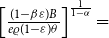
 $x_{\max }\lt \min \!\left\{\left[\frac{(1-\beta \varepsilon )B}{ e\varrho (1-\varepsilon )\theta }\right]^{\frac{1}{1-\alpha }},\frac{\sigma \alpha }{1-\alpha }\frac{\theta }{e(1/\beta +\theta -1)}\right\};$
 $(ii)$
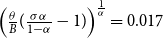
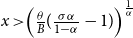
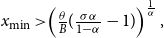 $x_{\min }\gt\! \left ( \frac{ \theta }{B}(\frac{\sigma \alpha }{1-\alpha }-1)\right ) ^{\frac{1}{\alpha }},$
In Condition 2, as the upper bound is set at a very large value and the lower bound is set at a very small value, the condition is easily met.Footnote
9
We are ready to understand the signs of the derivative of
 $P(n,x),X(n,x),Z(n,x)$
and
 $N(n,x)$
with respect to
 $n$
and
 $x$
.
First, we examine the sign of
 $P_{x}(n,x)$
and
 $P_{n}(n,x).$
Combining Condition 1 with part
 $(i)$
of Condition 2, it is clear that the effect of
 $ x$
on
 $P(n,x)$
is negative; that is,
 $P_{x}(n,x)\lt 0.$
Footnote
10
Moreover, it is straightforward to verify that
 $ P_{n}(n,x)\gt 0.$
Next, investigating the sign of
 $X_{x}(n,x)$
and
 $X_{n}(n,x),$
part
 $(i)$
of Condition 2 implies
 $(1-\beta \varepsilon )\gt e\varrho (1-\varepsilon )\frac{ \theta }{B}x^{1-\alpha },$
so
 $X_{n}(n,x)\gt 0.$
In addition, it is straightforward to see that the effect of
 $x$
on
 $X(n,x)$
is negative, and thus,
 $X_{x}(n,x)\lt 0.$
Third, envisaging the signs of
 $Z_{x}(n,x)$
and
 $Z_{n}(n,x),$
part
 $(ii)$
of Condition 2 implies
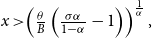 $x\gt\! \left ( \frac{\theta }{B}\left(\frac{\sigma \alpha }{ 1-\alpha }-1\right)\right ) ^{\frac{1}{\alpha }},$
and thus,
 $Z_{x}(n,x)\gt 0.$
Footnote
11
Moreover, it is straightforward to show that
 $Z_{n}(n,x)\gt 0.$
Finally, it is clear to verify that
 $N_{n}(n,x)\gt 0.$
In addition, it is obvious that the positive effect of
 $x$
in the numerator of
 $N(n,x)$
dominates the negative effect of
 $x$
in the denominator, and thus,
 $ N_{x}(n,x)\gt 0.$
Now, we analyze the slope of equations (36) and (37) in the
 $(n,x)$
plane. First, we envisage the special case when the workers have no reservation wage, and thus,
 $\xi =0.$
The labor demand and the labor supply equations (36) and (37) in the case of
 $\xi =0$
are, respectively, as follows.
 \begin{equation} 1-\varrho =\left[\frac{1}{\beta }+\theta -1\right]\frac{e\varrho x^{1-\alpha }}{B} \equiv MB^{D}(\underset{(0)}{n},\underset{(+)}{x}), \end{equation}
 \begin{equation} 1+\frac{1-\beta (1-\theta )}{\beta B}\frac{1}{x^{\alpha }}=\frac{\varrho A(1-\varepsilon )}{\Lambda (\mu )\epsilon }\frac{n^{-(\varepsilon +\sigma )} }{(1+\frac{\theta }{B}x^{-\alpha })^{\sigma }}\frac{1}{X(n,x)}\equiv MB^{S}( \underset{(-)}{n},\underset{(+)}{x}). \end{equation}
It is obvious from (38) that the marginal cost of the labor demand in the left-hand side is constant, while the marginal benefit of the labor demand in the right-hand side
 $MB^{D}$
is increasing in
 $x$
but is independent of
 $n$
. Thus, the labor demand is a horizontal locus in the
 $ (n,x)$
plan. See Locus
 $L^{D}$
in Figure 1.
Existence and uniqueness of BGP without outside options.

Moreover, it is clear from (39) that the marginal cost of the labor supply in the left-hand side is decreasing in
 $x$
. As for the marginal benefit of the labor supply in the right-hand side, notice that the term
 $ \frac{1{\large \ }}{X(n,x)}$
is increasing in
 $x$
and decreasing in employment
 $n.$
Further, the term
 $\frac{n^{-(\varepsilon +\sigma )}}{ (1+(\theta/B)x^{-\alpha })^{\sigma }}$
is also increasing in
 $x$
and decreasing in
 $n.$
Hence, the marginal benefit of the labor supply
 $MB^{S}$
is increasing in
 $x$
and decreasing in
 $n.$
As a result, the labor supply locus is positively sloping in the
 $(n,x)$
plane. See Locus
 $ L^{S}$
in Figure 1.
With a horizontal labor demand locus and a positively sloping labor supply locus, it is clear that there exists a unique value of
 $x_{0}^{\ast }$
and a unique value of
 $n_{0}^{\ast }$
in the BGP.
Next, we investigate the general case when there is the reservation wage, and thus,
 $\xi \in (0,1],$
and focus on the case
 $\xi =1.$
In this case, it serves to rewrite the system of two equations in (36) and (37) as follows.
 \begin{equation} (1-\varrho )=MB^{D}(\underset{(0)}{n},\underset{(+)}{x})+\xi MB^{D\xi }( \underset{(+)}{n},\underset{(-)}{x})\equiv MB^{LD}(\underset{(+)}{n}, \underset{(+)}{x}), \end{equation}
 \begin{equation} 1+\frac{1-\beta (1-\theta )}{\beta B}\frac{1}{x^{\alpha }}=MB^{S}(\underset{ (-)}{n},\underset{(+)}{x})+\xi MB^{S\xi }(\underset{(+)}{n},\underset{(+)}{x} )\equiv MB^{LS}(\underset{(-)}{n},\underset{(+)}{x}), \end{equation}
where
 $MB^{D\xi }(n,x)\equiv \frac{(1-\varrho )\epsilon }{A(1-\varepsilon )} \frac{P(n,x)X(n,x)}{1+\xi Z(n,x)}$
and
 $MB^{S\xi }(n,x)\equiv \frac{ 1-\varrho }{\Lambda (\mu )}N(n,x).$
We start by the slope of the labor demand curve in (40). First, note that in the marginal benefit of the labor demand
 $MB^{LD},$
the term
 $ MB^{D}$
is not affected by
 $n$
. Yet, in the term
 $MB^{D\xi },$
the numerator
 $P(n,x)X(n,x)$
and the denominator
 $1+\xi Z(n,x)$
both are positively affected by
 $n$
, and the net effect of
 $n$
on
 $MB^{D\xi }(n,x)$
is dictated by the term
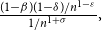 $\frac{(1-\beta )(1-\delta )/n^{1-\varepsilon }}{ 1/n^{1+\sigma }},$
whose power is
 $\sigma +\varepsilon,$
and is increasing in
 $n.$
Footnote
12
As the effect of
 $n$
on the marginal benefit of the labor demand
 $MB^{LD}$
is dictated by the positive effect of
 $n$
on
 $MB^{D\xi },$
it follows that
 $MB^{LD}$
is unambiguously increasing in
 $n$
.
Next, to see the effect of
 $x$
on
 $MB^{LD}$
, note that
 $MB^{D}$
is increasing in
 $x,$
but
 $MB^{D\xi }$
is decreasing in
 $x$
, since
 $ P_{x}(n,x)\lt 0,$
 $X_{x}(n,x)\lt 0,$
and
 $Z_{x}(n,x)\gt 0.$
We do not know whether the positive effect of
 $x$
on
 $MB^{LD}$
is dominated by, or dominates, the negative effect of
 $x$
on
 $MB^{D\xi }.$
Nevertheless, we are sure that when
 $ n=0,$
(40) gives
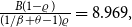
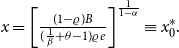 $x=\left[\frac{(1-\varrho )B}{(\frac{1}{\beta }+\theta -1)\varrho e}\right]^{\frac{1}{1-\alpha }}\equiv x_{0}^{\ast }.$
We may also investigate what the value
 $n$
is when
 $x=0$
in the locus (40), but it is impossible to do so, as
 $MB^{LD}$
then goes to infinity. As an alternative, we study what the value
 $n$
is in the locus (40) when
 $ x=1$
. Denote
 $\Delta \equiv \frac{A(1-\varepsilon )}{\xi (1-\varrho )\epsilon }\left[\frac{(1-\varrho )-(\frac{1}{\beta }+\theta -1)\frac{\varrho e}{B }}{1+(\frac{1}{\beta }+\theta -1)\frac{e}{B}}\right].$
Consider
Condition 3.
 $e\lt B\cdot \min \left\{\frac{(1-\varrho )}{(1/\beta +\theta -1)\varrho },\frac{A(1-\beta \varepsilon )}{\theta \lbrack A(1-\varepsilon )\varrho +\xi \Delta (1-\varrho )\epsilon ]},\frac{(1-\beta )(1-\delta )+A(1-\beta \varepsilon )-\frac{\Delta }{(1+\theta/B)^{\sigma }}}{\theta \lbrack A\varrho (1-\varepsilon )+\xi \Delta (1-\varrho )\epsilon ]}\right\}.$
Condition 3 requires that the unit vacancy cost
 $e$
be sufficiently small. These conditions are easily met, if the matching coefficient
 $B$
is sufficiently large.Footnote
13
First, under the first element of Condition 3, we know
 $x_{0}^{\ast }\gt 1$
and
 $\Delta \gt 0.$
Next, under the second element of Condition 3, we get
 $A\left [ (1-\beta \varepsilon )-e\varrho (1-\varepsilon )\frac{\theta }{B}\right ] \gt \xi \Delta e(1-\varrho )\epsilon \frac{\theta }{B}.$
Finally, under the third element of Condition 3, we obtain
 $(1-\beta )(1-\delta )+A\left ( (1-\beta \varepsilon )-e\varrho (1-\varepsilon )\frac{\theta }{B}\right ) -\left ( \xi \Delta e(1-\varrho )\epsilon \frac{\theta }{B}\right ) \gt \frac{ \Delta }{(1+\frac{\theta }{B})^{\sigma }}.$
Then, if we set
 $x=1,$
(40) gives
 $\frac{n^{1+\sigma }(1+\frac{ \theta }{B})^{\sigma }[A(1-\beta \varepsilon )-e\varrho A(1-\varepsilon ) \frac{\theta }{B}+(1-\beta )(1-\delta )n^{-(1-\varepsilon )}]}{1+\xi e(1-\varrho )\epsilon \frac{\theta }{B}\left ( 1+\frac{\theta }{B}\right ) ^{\sigma }n^{1+\sigma }}=\Delta \gt 0,$
according to the first element of Condition 3. This equation is a function of
 $n$
and thus can determine the value of
 $n.$
We can rewrite the equation as follows.
 \begin{equation} (1-\beta )(1-\delta )+\left ( A\!\left[(1-\beta \varepsilon )-e\varrho (1-\varepsilon )\frac{\theta }{B}\right]-\Delta \xi e(1-\varrho )\epsilon \frac{ \theta }{B}\right ) n^{(1-\varepsilon )}=\frac{\Delta }{(1+\frac{\theta }{B} )^{\sigma }n^{\sigma +\varepsilon }}. \end{equation}
The left-hand side of (42), denoted by
 $LH(n)$
, is increasing in
 $n,$
whose value is equal to
 $LH(0)\ =\ (1-\beta )(1-\delta )\gt 0$
when
 $n=0,$
and equal to
 $LH(1)\ =\ LH(0)+\left ( A[(1-\beta \varepsilon )-e\varrho (1-\varepsilon )\frac{\theta }{B}]-\xi \Delta e(1-\varrho )\epsilon \frac{ \theta }{B}\right ) \gt 0,$
when
 $n=1.$
Note that
 $LH(1)\gt LH(0),$
according to the second element of Condition 3. See locus
 $LH(n)$
in Figure 2. Moreover, the right-hand side of (42), denoted by
 $RH(n)$
, is decreasing in
 $n,$
whose the value is equal to
 $RH(0)=\infty$
when
 $n=0,$
and equal to
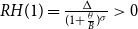 $RH(1)= \frac{\Delta }{(1+\frac{\theta }{B})^{\sigma }}\gt 0$
when
 $n=1.$
It is clear that
 $LH(0)\lt RH(0).$
Moreover, the third element of Condition 3 ensures that
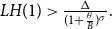 $ LH(1)\gt \frac{\Delta }{(1+\frac{\theta }{B})^{\sigma }}.$
See locus
 $RH(n)$
in Figure 2. As a result, there exists a unique value of an interior
 $n_{1}\gt 0.$
Determination of labor demand
 $n$
, given tightness of the labor market
 $x=1$
.

We thus discover that (40) gives
 $x=$
 $x_{0}^{\ast }\gt 1$
when
 $n=0$
and gives
 $x=1\lt x_{0}^{\ast }$
when
 $n_{1}\gt n=0.$
The results indicate that, in the plane
 $(n,x),$
(40) is a negatively sloping locus in the plane
 $(n,x),$
decreasing from the value of
 $x_{0}^{\ast }\gt 1$
to the value
 $ x=1$
as the value of
 $n$
increases from
 $n=0$
to
 $n_{1}\gt 0.$
See Locus
 $L^{D}$
in Figure 3.
Existence and uniqueness of BGP with outside options and effects of seigniorage taxes.

Now, we envisage the slope of the labor supply curve in (41). Note that, due to
 $N_{x}(n,x)\gt 0,$
the term
 $MB^{S\xi }(n,x)$
is increasing in
 $x,$
which re-enforces the positive effect of
 $x$
on
 $MB^{S}(n,x),$
thereby making the marginal benefit of the labor supply
 $MB^{LS}$
to increase in
 $x$
. Moreover, due to
 $N_{n}(n,x)\gt 0,$
the positive effect of
 $n$
on
 $MB^{S\xi }(n,x)$
offsets the negative effect of
 $n$
on
 $MB^{S}(n,x),$
but it is easy to show that the negative effect of
 $n$
on
 $MB^{S}(n,x)$
dominates.Footnote
14
Therefore, the marginal benefit of the labor supply
 $MB^{LS}$
is decreasing in
 $n.$
As a result, the labor supply locus is positively sloping in the
 $(n,x)$
plan. See Locus
 $L^{S}$
in Figure 3.
With a negatively sloping labor demand locus and a positively sloping labor supply locus, it is clear that there exists a unique value of
 $x^{\ast }$
and a unique value of
 $n^{\ast }$
in the BGP. Thus, we have established:
Proposition 1. Under Conditions 1, 2 and 3, there exists a unique BGP.
With the existence and the uniqueness for the values of
 $x^{\ast }$
and
 $ n^{\ast }$
, when we substitute the values of
 $x^{\ast }$
and
 $n^{\ast }$
to other equilibrium conditions, we can determine the values of
 $w,$
 $s^{\ast },\pi ^{\ast },\vartheta ^{\ast },\chi ^{\ast }$
, and
 $g^{\ast }$
in the BGP. As
 $c$
,
 $y$
, and
 $k$
all grow at the common growth rate
 $g$
along the BGP, the values of
 $c$
,
 $y$
, and
 $k$
over time are in turn determined. Hence, all variables are solved in the case with the reservation wage.
3.3. Comparative-static effects of the seigniorage tax in the BGP
To analyze the optimal seigniorage tax, we note that the discounted sum of the lifetime utility of the representative household is a function of
 $c$
,
 $n$
, and
 $s$
, according to (1). Thus, it is useful to study the comparative-static analysis of the effect of an increase in the money growth rate
 $\mu$
on
 $n$
and
 $s$
by using Figure 3. Notice that an increase in the money growth rate does not affect Locus
 $L^{D}$
, but Locus
 $L^{S}$
is influenced by an increase in
 $\mu$
, as seen by (37). Clearly, a higher
 $\mu$
decreases the marginal benefit of the labor supply. As a result, the labor supply
 $n$
needs to increase in order to lower the marginal benefit of the labor supply, so Locus
 $L^{S}$
shifts rightwards. The new BGP is at
 $E^{\mu }$
in Figure 3, and thus, the employment increases to
 $n^{\mu }$
, while the vacancy to search ratio decreases to
 $x^{\mu }.$
As the result of an increase in employment, via (31) the economic growth rate
 $g^{\mu }$
is unambiguously increased in the new BGP. Yet, as seen from (28)–(32) and (35), the effects on other variables
 $\chi ^{\mu },$
 $s^{\mu },$
 $\pi ^{\mu },$
 $\vartheta ^{\mu }$
and
 $w^{\mu }$
are ambiguous. Thus, we need to resort to numerical solution.
Indeed, as observed by Heer (Reference Heer2003), it impossible to analyze his model, which is the case of
 $b=0$
in our model. As a result, Heer (Reference Heer2003) noted that the effects of a change in the growth rate of money supply cannot be studied analytically but only numerically in his model. Different from Heer (Reference Heer2003), we can study the existence and the uniqueness of the BGP and carry out the comparative-static analysis of the effect of the seigniorage tax in the BGP in terms of a change in the growth rate of money supply. However, to compare the effect of the optimal seigniorage tax in the BGP in our endogenous growth model and the exogenous growth model in Heer (Reference Heer2003), we still need to rely on numerical solution. In the next section, we follow Heer (Reference Heer2003) and calibrate our model in order to investigate the optimal money growth rate.
4. Quantitative analysis
This section calibrates our model in order to match characteristics of the US economy. These characteristics include the labor force participation rate, unemployment rate, inflation rate, and real GDP growth rate.
4.1. Calibration
In the model economy,
 $16$
parameters require values: preference
 $ (\beta$
,
 $\epsilon$
, and
 $\sigma )$
, production
 $(A,$
 $\varepsilon$
,
 $ \delta$
, and
 $e)$
, labor market
 $(B,\alpha,$
 $\theta$
, and
 $\varrho )$
, monetary parameters
 $(\mu$
and
 $h),$
and government
 $(\tau _{a}$
,
 $\tau _{w}$
, and
 $\tau _{c})$
. The time frequency is quarters.
First, we follow Cooley (Reference Cooley1995) and set the quarterly discount factor at
 $ \beta =0.99$
, which corresponds to an annual discount rate of 4%. Next, we set
 $\sigma =2.25$
. This parameter value indicates the labor supply elasticity of
 $0.4$
, which is consistent with the estimates reported in MaCurdy (Reference MaCurdy1981) and Killingsworth (Reference Killingsworth1983). Following Kydland and Prescott (Reference Kydland and Prescott1982), we set the capital share in income at
 $\varepsilon =0.36$
. The capital depreciation rate is set to be
 $\delta =0.025$
, which indicates an annual depreciation rate of
 $10$
%. According to the Job Openings and Labor Turnover Survey (JOLTS), the average quarterly separation rate was
 $10.45$
% during 2001-2015. We abide by the JOLTS and set
 $\theta =0.1045$
.
Moreover, Hall and Milgrom (Reference Hall and Milgrom2008) have estimated and found the daily cost of opening a job vacancy at about
 $43$
% of daily wage, which we follow and set
 $e=0.43$
. As to the wage bargaining, we follow Albrecht and Vroman (Reference Albrecht and Vroman2002) and simply set an equal share for workers and firms, and thus,
 $\varrho =0.5$
. This value is within the range of
 $0.3$
and
 $0.6$
that is commonly used.Footnote
15
To ensure that the Hosios condition is met, we set
 $\alpha =0.5$
. We follow Wang and Xie (Reference Wang and Xie2013) and set the tax rates at
 $\tau _{a}=\tau _{w}=0.2$
and
 $ \tau _{c}=0.05$
, which are commonly chosen in the dynamic tax incidence literature calibrating the US economy. Following Heer (Reference Heer2003), we set
 $ h=0.84$
, so
 $84$
% of the consumption expenditure goes to cash goods.
Finally, the remaining four parameters
 $(\mu$
,
 $A$
,
 $B$
,
 $\epsilon )$
are calibrated simultaneously in order for the steady state of the model economy to match four key statistics in the US. The first target is a
 $0.5$
% average quarterly real economic growth rate in 1947–2015. The second target is a
 $0.881$
% average quarterly inflation rate during 1947–2015. The third and fourth targets are the labor force participation rate and the unemployment rate, which on average were
 $62.9$
% and
 $ 5.8$
%, respectively from 1948 to 2015. The calibration gives
 $\mu =0.0139$
,
 $A=0.1706$
,
 $B=1.027$
, and
 $\epsilon =2.7862$
.
The baseline parameter values are summarized in Table 1. When
 $b=0$
, the model reduces to Heer (Reference Heer2003) and does not exhibit sustainable growth. By contrast, when
 $b=1-\epsilon$
, the model exhibits sustainable growth. Given the baseline parameter values, we have numerically shown that there exists a unique BGP. Moreover, the equilibrium path toward the BGP exhibits saddle-path stability.
Calibration of parameter values for the US economy (quarter)

Our calibration indicates that in the long run, the size of employed agents is
 $n=59.25$
%, and the size of unemployed agents is
 $s=3.65$
%, while the remaining fraction of agents out of the labor force is
 $(1-n-s)=37.1$
%. These values imply that the unemployment rate is
 $5.80$
%.Footnote
16
In addition, the job finding rate per quarter is
 $\eta =1.697$
. A larger-than-one job finding rate means that, on average, a job seeker has more than one job match per quarter.
Moreover, in the model with sustainable growth, the firm’s recruitment rate per quarter is
 $q=0.622$
. In order to match the inflation rate in the model with sustainable growth, the money growth rate per quarter is calibrated at
 $ \mu =1.39$
%. Our calibration indicates that the quarterly consumption-capital ratio is
 $\chi =8.68$
%, and the quarterly economic growth rate is
 $g=0.5$
% in the model with sustainable growth.
Alternatively, in the model without sustainable growth, the firm’s recruitment rate per quarter is
 $q=0.646$
. In order to match the inflation rate in the model without sustainable growth, the money growth rate per quarter is calibrated at
 $\mu =0.881$
%. Our calibration indicates that equilibrium consumption is
 $c=1.5186$
and capital stock is
 $k=20.194$
in the steady state in the model without sustainable growth.
4.2. Numerical results
Now, we offer the numerical effects of a change in the money growth rate. We focus on the effects on the consumption-capital ratio, the inflation rate, employment, unemployment, the economic growth rate, and the welfare in the long run.
4.2.1. Model without sustainable growth
We begin with the model without sustainable growth, which is the model studied by Heer (Reference Heer2003). The baseline of the money growth rate is
 $\mu =0.881$
% in the model without sustainable growth. We explore the effects on key endogenous variables in the steady state when the money growth rate is changed in the range of
 $\mu \in \lbrack \!-0.5$
%
 $,2.5$
%
 $]$
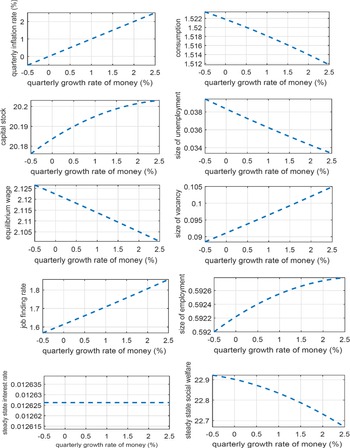
that covers the baseline rate. The results are illustrated in Figure 4.
Effects of changes in money growth rates in the model without sustainable growth.

Figure 4 highlights the following. Firstly, when the money growth rate
 $ \mu$
decreases, the rate of inflation goes down. In the presence of the CIA constraint, households substitute consumption for leisure. As consumption
 $c$
increases, savings decrease, which reduces capital stock
 $k$
. As agents decrease leisure, they increase their search effort. More agents searching for jobs enlarges the size of unemployment
 $s$
. More job seekers would increase the rate
 $q$
at which firms fill a vacancy, which encourages firms to create more vacancies
 $v$
. However, as consumption increases and leisure decreases, the MRS between leisure and consumption increases, which increases the reservation wage and hence the bargaining wage
 $w$
. A higher wage would discourage firms’ recruitment activities. For the baseline calibration, the latter effect dominates, and thus, the vacancy decreases.
Next, there are also two offsetting effects on the size of employment
 $n$
. On the one hand, since
 $n=\eta s/\theta$
, if the job finding probability
 $ \eta$
is unchanged, an increase in the size of unemployment
 $s$
would enlarge the size of employment
 $n$
. On the other hand, as firms decrease their posted vacancies
 $v$
, the job finding probability
 $\eta$
will decrease, which will in turn shrink the size of employment
 $n$
. For the baseline calibration, the former effect dominates, and thus, the employment decreases in the steady state.
Our quantitative exercises indicate that a decrease in the money growth rate from the baseline
 $0.881$
% to
 $0$
% increases consumption by
 $0.32$
percentage points (from
 $1.5186$
to
 $1.5218$
) and unemployment by
 $0.19$
percentage points (from
 $0.0365$
to
 $0.0384$
), while employment falls by
 $ 0.03$
percentage points (from
 $0.5925$
to
 $0.5922$
), and capital also decreases by
 $1.1$
percentage points (from
 $20.194$
to
 $20.183$
). As a consequence, the wage rate increases by
 $0.75$
percentage points (from
 $ 2.1149$
to
 $2.1224$
) and posted vacancies decrease by about
 $0.48$
percentage points (from
 $0.0959$
to
 $0.0911$
). We find that the household’s welfare increases as the money growth rate decreases from the baseline rate to
 $0$
%, as the increase in utility from considerably higher consumption compensates for the decrease in utility from a higher labor force and thus, lower leisure.
4.2.2. Model with sustainable growth
Next, we examine the model with sustainable growth. The baseline of the money growth rate is
 $\mu =1.39$
% in the model with sustainable growth. We analyze the effects on key endogenous variables in the BGP when the money growth rate is changed in the range of
 $\mu \in \lbrack 0$
%
 $,4.5$
%
 $],$
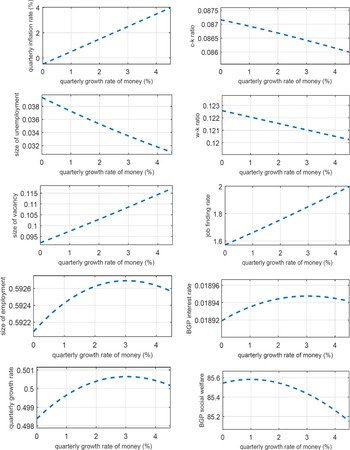
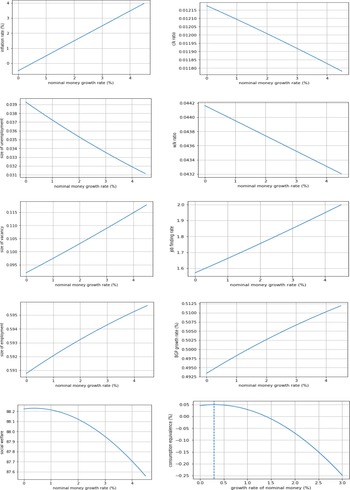
which covers the baseline rate. The results are illustrated in Figure 5.
Effects of changes in money growth rates in the model with sustainable growth.

Figure 5 highlights the following. Like the model without sustainable growth, an increase in the money growth rate
 $\mu$
raises the inflation rate. The presence of a CIA constraint on consumption induces households to substitute leisure for consumption and to replace real money balances
 $m$
by capital
 $k$
. As a result, the ratio of consumption to capital
 $\chi$
decreases. Moreover, as agents increase leisure, they reduce the search effort. Hence, the size of unemployment
 $s$
decreases.
Two offsetting effects on firm’s hiring activities
 $v$
are at work. On the one hand, since there are fewer agents searching for jobs, the firms’ recruitment rate
 $q$
is reduced, which deters firms from hiring activities
 $ v$
. Conversely, as the consumption to capital ratio falls, the MRS between leisure and consumption decreases. Thus, the reservation wage decreases (c.f. (20)), which leads to a lower wage to capital ratio
 $\omega$
. A fall in the wage-capital ratio increases firms’ recruiting activities
 $v$
. The net effect depends on whether the former effect or the latter effect dominates. For the baseline calibration, the latter effect dominates, and thus, the posted vacancy increases in the BGP.
Moreover, two counteracting effects influence the size of employment
 $n$
. At the outset, as
 $n=\eta s/\theta$
, with a given job finding probability
 $ \eta$
, a decrease in the unemployment size
 $s$
will reduce the employment size
 $n$
. In contrast, as recruiting activities
 $v$
increase, the job finding probability
 $\eta$
is enhanced, which in turn raises the employment size. For the baseline calibration, the latter effect dominates the former effect. Thus, the size of employment increases in the BGP. As both employment and capital increase, the real interest rate (i.e. the marginal product of capital) is pushed up and the economic growth rate
 $g$
increases.
In our quantitative exercise, if the quarterly money growth rate is decreased from the baseline
 $1.39$
% to
 $0$
%, unemployment would increase by
 $0.29$
percentage points (from
 $0.0365$
to
 $0.0394$
) and employment would decrease by
 $0.04$
percentage points (from
 $0.5925$
to
 $0.5921$
), while the consumption to capital ratio would increase by
 $0.4$
percentage points (from
 $0.868$
to
 $0.872$
). As a result, the wage to capital ratio would increase by
 $0.07$
percentage points (from
 $0.1219$
to
 $0.1226$
) and vacancies posted by firms would decrease by
 $0.75$
percentage points (from
 $ 0.0996$
to
 $0.0921$
). In the BGP, we find that as the money growth rate is decreased to
 $0$
%, the household’s welfare decreases, since the increase in utility from a higher consumption to capital ratio does not compensate for the decrease in utility from a higher labor force and thus lower leisure. By contrast, when the quarterly money growth rate is increased modestly from
 $ 0$
%, the increase in utility from more leisure serves as compensation for a lower consumption to capital ratio. We find that the welfare is increasing in the money growth rate, until the money growth rate reaches around
 $1.02$
%. Thus, the optimal money growth rate is positive. Using (c.f. (32)), the optimal money growth rate at
 $1.02$
% implies an optimal inflation rate of
 $0.5$
% per quarter, or equivalently, an inflation rate of
 $2$
% per year.
4.3. Dynamic welfare effects of inflation
We have analyzed the long-run effects of changes in the rate of money growth in models with and without sustainable growth. Changes in the rate of money growth also have transitional dynamic effects. In this subsection, we calculate the welfare effect of moderate rates of inflation, taking the transition dynamics into account.
Recall that, to generate the same quarterly inflation rate of
 $0.881$
% in the US data, the quarterly baseline rate of money growth is calibrated at
 $ \mu =0.881$
% for the model without sustainable growth, whereas it is calibrated at
 $\mu =1.39$
% in the model with sustainable growth. Now, we carry out the exercise of unexpected permanent changes in the rate of money growth from the baseline level to different levels. As the money growth rate changes, the equilibrium path will shift and gradually moves toward a new long-run equilibrium. Specifically, when there is a permanent change in the money growth rate from the benchmark rate to a new rate, the allocation will move from the baseline path {
 $c_{t}$
,
 $s_{t}$
,
 $n_{t}$
}
 $_{t=0}^{t=\infty }$
toward a new equilibrium path {
 $c_{t}^{\ast }$
,
 $s_{t}^{\ast }$
,
 $ n_{t}^{\ast }$
}
 $_{t=0}^{t=\infty }$
. The resulting welfare change in terms of the consumption equivalence
 $\kappa$
is calculated as follows.
 \begin{equation} \sum _{t=0}^{\infty }\beta ^{t}u((1+\kappa )c_{t},n_{t}+s_{t})=\sum _{t=0}^{ \infty }\beta ^{t}u(c_{t}^{\ast },n_{t}^{\ast }+s_{t}^{\ast }). \end{equation}
Thus, if
 $\kappa \gt 0$
, the representative household has a welfare gain in that the money growth rate increases consumption at the growth rate of
 $ \kappa$
. By contrast, if
 $\kappa \lt 0$
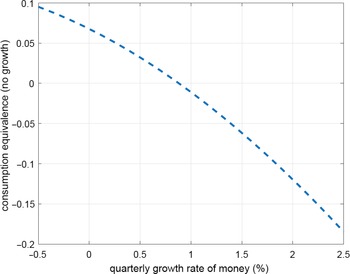
, there is a welfare loss because of a decrease in the growth rate of consumption. The dynamic welfare effects are illustrated in Figures 6 and7.
Welfare gains of changes in money growth rates in the model without sustainable growth.

Figure 6 is the welfare change in consumption equivalence in the model without sustainable growth. As seen from the figure, when the quarterly money growth rate decreases from
 $2.5$
%, the welfare gain measured in consumption equivalence monotonically increases. This pattern is also illustrated in Table 2 in terms of selective money growth rates that are smaller and larger than the baseline rate of
 $0.881$
%. The welfare is maximized when the money growth rate is
 $\mu =-0.5$
%. Our computation indicates that a reduction in the growth rate of the money supply from the baseline rate of
 $0.881$
% to the optimal rate of
 $-0.5$
% gives rise to a welfare gain that is equivalent to a consumption growth rate of
 $0.095$
% per quarter. Even for a reduction in the rate of money supply to zero, there is a welfare gain equivalent to a consumption growth rate of
 $0.064$
% per quarter. Thus, as in Heer (Reference Heer2003), the optimal monetary policy in the model without sustainable growth consists of a deflation consistent with a zero or near-zero nominal interest rate as advocated by Friedman (Reference Friedman and Friedman1969).
Welfare effect of inflation in the model without sustainable growth (%)

Note: Welfare is measured in terms of the consumption equivalence
 $\kappa$
(per quarter).
Welfare effect of inflation in the model with sustainable growth (%)

Note: Welfare is measured in terms of the consumption equivalence
 $\kappa$
(per quarter).
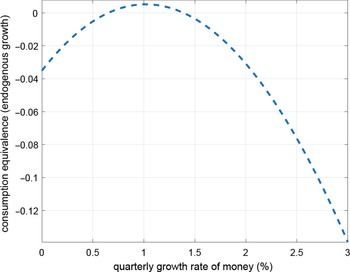
Welfare gains of changes in money growth rates in the model with sustainable growth.

Figure 7 is the welfare change in consumption equivalence in the model with sustainable growth. By contrast, it is obvious to see that the figure displays a pattern that is very different from Figure 6. The figure is not monotonic in the money growth rate, and a monotonic reduction in the money supply from the baseline rate of
 $1.39$
% does not necessarily increase the welfare. As seen from the figure, it exhibits an inverted U shape. When the growth rate of the money supply decreases from the baseline rate of
 $1.39$
%, the welfare first increases and then decreases. Such a non-monotonic pattern is also illuminated in Table 3 in terms of selective money growth rates that are smaller and larger than the baseline rate. Our quantitative exercises suggest that the welfare is maximized when the money growth rate is decreased to
 $\mu =1.02$
%. Such a decrease in the money supply growth rate from the baseline to the optimal one raises the welfare to the level equivalent to a consumption growth rate at
 $0.005$
% per quarter. Thus, even along the transitional dynamic path, the Friedman rule does not hold in our economy with sustainable growth.
4.4. Sensitivity analysis
This subsection carries out sensitivity analysis.
4.4.1. Changes of key parameter values
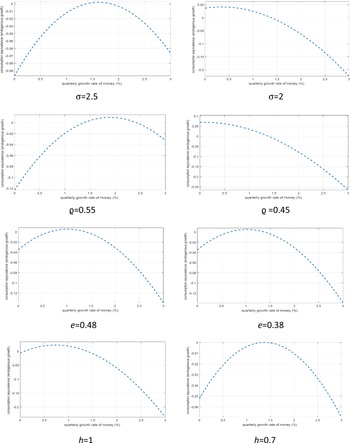
This sub-subsection confirms that our results of dynamic welfare analysis in the previous subsection are robust with regard to the choice of the parameter values. We will change four key parameter values: the inverse of the labor supply elasticity
 $\sigma$
, workers’ bargaining power
 $\varrho$
, vacancy cost parameter
 $e$
, and the CIA constraint parameter
 $h$
.
In our analysis, we perform an analysis of increasing and decreasing each of these four parameter values from the baseline. For each new set of parameter values, we have found a new BGP which is unique. Moreover, the equilibrium path toward the new BGP exhibits saddle-path stability. Using each set of parameter values as a new baseline, we then analyze numerical effects of unexpected permanent changes in the rate of money growth to different levels in each set of parameter values. The results are reported in Figure 8 and.
Welfare gains of changes in money growth rates in the model with sustainable growth when parameter values are changed from the baseline.

From Figure 8, it is clear that all charts are not monotonic in the money growth rate. Indeed, they all exhibit an inverted U shape. As a consequence, for all cases of these changes in parameter values, the optimal money growth rate is positive, departing from the Friedman rule.
Robustness: Welfare effect of inflation in the model with sustainable growth (%)

Note: 1.
 ${\mu}^{\ast}$
is the optimal money growth rate, and
 $\kappa $
is the resulting welfare gain in consumption equivalence (per quarter). 2. Baseline parameter values are in Table 1.
Moreover, according to Table 4, when the labor supply elasticity
 $\frac{1}{ \sigma }$
increases from the baseline to
 $\frac{1}{2}$
or decreases to
 $ \frac{1}{2.5}$
, the optimal money growth rate
 $\mu ^{\ast }$
decreases to
 $ 0.38$
% per quarter or increases to
 $1.62$
% per quarter. When workers’ bargaining power
 $\varrho$
increases from the baseline to
 $0.55$
or decreases to
 $0.45$
, the optimal money growth rate
 $\mu ^{\ast }$
increases to
 $1.892$
% per quarter or decreases to
 $0.06$
% per quarter. In addition, when the fraction of household consumption paid by cash
 $h$
increases from the baseline to
 $1$
or decreases to
 $0.7$
, the optimal money growth rate
 $ \mu ^{\ast }$
decreases to
 $0.72$
% per quarter or increases to
 $1.386$
% per quarter. Finally, a change in the vacancy cost parameter
 $e$
does not change the optimal money growth rate. Table 4 also reports the corresponding welfare gains in consumption equivalence
 $\kappa$
when one of these parameter values changes from the baseline and the optimal money growth rate also changes from the baseline to the corresponding rate.
4.4.2. Exogenous growth model with externalities
Is it possible that a sufficiently large capital externality in an exogenous growth model is enough for our results, and an endogenous growth context is not necessary. Recall that our production function is
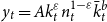 $ y_{t}=Ak_{t}^{\varepsilon }n_{t}^{1-\varepsilon }\bar{k}_{t}^{b}$
. To investigate whether or not such a possibility may emerge, we would need to restrict our model to one with
 $b\lt 1-\varepsilon$
, so the model reduces to an exogenous growth model with an externality.
As our baseline calibration sets
 $\varepsilon =0.36$
and thus,
 $ 1-\varepsilon =0.64$
, we shall restrict the value of
 $b$
to be less than
 $ 0.64.$
Under this restriction, we recalibrate our model. It turns out that the model can be recalibrated only when
 $b\leq 0.21$
.Footnote
17
Thus, we limit the value
 $b$
to be less than or equal to
 $0.21$
. Under the new set of parameter values, for a value of
 $b\leq 0.21$
we have found a new steady state which is unique. Moreover, the equilibrium path toward the new steady state exhibits saddle-path stability. Using the new baseline, we analyze numerical effects of unexpected permanent changes in the money growth rate to different levels. The quantitative results are not different from those in Figure 1, and thus, the optimal money growth rate is zero.Footnote
18
Hence, the results are like those in Subsection 4.2.1 and thus the same as Heer (Reference Heer2003).
4.4.3. Endogenous growth model without externalities
Finally, can an endogenous growth model without capital externalities yield positive optimal money growth? To understand whether or not this is possible, we modify our production function to
 $y_{t}=Ak_{t}n_{t}^{1- \varepsilon }$
, so there is no capital externality. To calibrate the model, we maintain our baseline parameter values as those in Table 1, except for
 $ b=0.$
Note that, even with
 $b=0$
, to match the quarterly inflation rate, the calibrated money growth rate is still
 $\mu =0.0139$
and thus, the same as that in Table 1.
For the new set of parameter values, we have found the existence of a new BGP which is unique. Moreover, the equilibrium path toward the new BGP exhibits saddle-path stability. Using the new baseline, we analyze numerical effects of unexpected permanent changes in the rate of money growth to different levels. The quantitative results are illustrated in.
As is clear from Figure 9, the results are the same as those in Figure 5. In particular, the welfare is not monotonic but exhibits an inverted U shape in the money growth rate. See the plots in the bottom panel of Figure 9. Therefore, an endogenous growth model without capital externalities also yields a positive optimal money growth rate at
 $0.3$
% per quarter.
Effects of changes in money growth rates in an Ak model without externalities.

4.5. Is the model with sustainable growth closer to the reality?
Readers may be curious as to whether our model with sustainable growth is closer to the reality than Heer (Reference Heer2003)’s model without sustainable growth. To answer the question, this subsection compares these two models’ predictions with the observations in the US data. We compare the transition dynamics generated by our baseline endogenous growth model and the transition dynamics generated by Heer (Reference Heer2003)’s baseline exogenous growth model with the observations in the US data.
To compute the transition dynamics of these two models, first, we solve for the initial steady state and the final steady state, given the values of the quarterly money series
 $\{M_{t}\}_{t=1}^{T}$
.Footnote
19
Output corresponds to gross domestic product, and consumption is the personal consumption expenditures. The data are quarterly and have been seasonally adjusted and deflated by the GDP deflators. The data are obtained from the Federal Reserve Economic Data published by the Federal Reserve Bank of St. Louis.
We compare the model’s predictions with the observations in the US data over 1947Q1-2015Q4. Without loss of generality, we normalize
 $M_{1}=1$
and assume
 $t=1$
for 1947Q1,
 $t$
=
 $T$
for 2015Q4, and
 $t$
= 2,
 $\ldots$
,
 $T$
-1 for quarters in transitional periods. Since
 $T=276$
is sufficiently large, the transition dynamics between 1947Q1 and 2015Q4 in these models are not affected by small variations in
 $T$
. On the basis of the solutions for the initial and the final steady states in the model, we compute the transition dynamics using a non-linear solution method in accordance with Chen et al. (Reference Chen, İmrohoroğlu and İmrohoroğlu2006), He and Liu (Reference He and Liu2008), and Chen and Liao (Reference Chen and Liao2015), among others.
Figure 10 draws a distinction between the transition dynamics in Heer (Reference Heer2003)’s model without sustainable growth (red dashed line) and the actual US data (green solid line). Figure 11 contrasts the transition dynamics in our model with sustainable growth (blue dashed line) with the actual US data (green solid line).
Transition dynamics in the model without sustainable growth.

Transition dynamics in the model with sustainable growth.

Apparently, our endogenous growth model well matches the growth trend of output in the US data over 1947-2015. Yet, the transition dynamics in Figure 10 cannot catch the growth trend of output in the US data over 1947-2015. Therefore, the model with sustainable growth is closer to the data than the model without sustainable growth.
5. Concluding remarks
In this paper, we revisit the Friedman rule in a labor search model and analyze the effect of seigniorage on employment and welfare. Our model extends the labor search models with CIA constraints of Heer (Reference Heer2003), Cooley and Quadrini (Reference Cooley and Quadrini2004), and Wang and Xie (Reference Wang and Xie2013) to one that allows for endogenous growth. We show that, even without imposing a liquidity effect or a CIA constraint on the wage payment, an endogenous growth model offers a different channel through which an increase in the money growth rate from zero leads to higher employment, higher economic growth, and higher welfare, thus departing from the Friedman rule.
In our model, an increase in the money growth rate from 0% raises the inflation rate in the long run. The presence of a CIA constraint on consumption induces households to substitute leisure for consumption and to replace real money balances with capital, thus decreasing the ratio of consumption to capital. As the effect via a fall in bargaining wage dominates the effect through a drop of the job search due to higher leisure, the posted vacancy increases. Moreover, because the effect via firms’ higher recruitment activities dominates the effect through a decrease in unemployment, the employment size increases in the long run. In our endogenous growth framework with the technology exhibiting constant returns with respect to aggregate capital, the marginal product of labor is constant. As a result, when a modest increase in the money supply raises employment, output is enlarged and welfare is increased. Therefore, our model creates a channel for the inflation tax to depart from the Friedman rule.
Finally, in addition to compare two models with and without endogenous growth, we also provide the analysis as to which model better fits the data. We have compared these two models’ predictions with the observations in the US data over 1947Q1–2015Q4. We find that the model with sustainable growth fits the US data better than that without sustainable growth.
Acknowledgments
We are grateful for valuable comments and suggestions made by an associate editor and two anonymous referees, Angus Chu, Taiji Furusawa, Jang-Ting Guo, Christian Haefke, Kazuo Mino, Ping Wang, Yong Wang, TszNga Wong, and participants at the Kobe University Conference and the China Meeting of the Econometric Society. Been-Lon Chen thanks the research support by the Ministry of Sciences and Technology of Taiwan. Xiangbo Liu thanks the research support by the Fundamental Research Funds for the Central Universities, and the Research Funds of Renmin University of China [No. 21XNLG03] and National Social Science Fund of China [No. 18CJL012].
APPENDIX A
A.1. Equilibrium in the model without sustainable growth
The model without sustainable growth is the case of
 $b=0$
. This case reduces to Heer’s model. In this case, the equilibrium is characterized by a system of seven difference equations that governs the dynamic properties of the seven variables
 $\{c_{t},k_{t+1},x_{t},n_{t+1},s_{t},\pi _{t+1},m_{t}\}$
. It is easy to derive these seven equations in equilibrium.
In the model without sustainable growth, Shi and Wen (Reference Shi and Wen1997) have shown that, given constant search intensity
 $s$
, the steady state is locally stable, and thus, the equilibrium path toward the steady state is a saddle, if the intertemporal elasticity of substitution is sufficiently large. Heer (Reference Heer2003) is otherwise identical to Shi and Wen (Reference Shi and Wen1997) except for endogenous search intensity
 $s$
. Setting the intertemporal elasticity of substitution at
 $ \frac{1}{2}$
, Heer (Reference Heer2003) numerically showed that the steady state is a saddle. Except for setting the intertemporal elasticity of substitution at
 $ 1$
, our model with
 $b=0$
is the same as Heer (Reference Heer2003), and thus, the steady state is a saddle.
Let
 $c,$
 $k$
,
 $x$
,
 $n,$
 $s,$
 $\pi,$
and
 $m$
be the steady-state values of
 $ c_{t}$
,
 $k_{t}$
,
 $x_{t}$
,
 $n_{t},$
 $s_{t}$
,
 $\pi _{t}$
and
 $m_{t}$
, respectively. The steady-state equilibrium can be obtained when
 $c_{t}=c$
,
 $ k_{t}=k$
,
 $x_{t}=x$
,
 $n_{t}=n,$
 $s_{t}=s,$
 $\pi _{t}=\pi$
, and
 $m_{t}=m$
for all
 $t$
. The seven difference equations in the steady state are derived as follows.
First, combining the definition of the tightness of the labor market and the assumption of the vacancy cost, the steady-state resource constraint becomes
 \begin{equation} c+\delta k=Ak^{\varepsilon }n^{1-\varepsilon }-ewsx, \end{equation}
where
 $w$
is the steady-state wage rate and, from (18), is given by
 \begin{equation*} w=(1-\varrho )\frac {1+\tau _{c}}{1-\tau _{w}}\frac {\epsilon\! \left ( n+s\right ) ^{\sigma }}{1/c}+\varrho A(1-\varepsilon )k^{\varepsilon }n^{-\varepsilon }. \end{equation*}
Next, the consumption Euler equation in the steady state is
 \begin{equation} \frac{1}{\beta }=1+(1-\tau _{a})(A\varepsilon k^{\varepsilon -1}n^{1-\varepsilon }-\delta ). \end{equation}
In addition, substituting (14) into (15), and combining (6) and (7), firms’ labor demand and households’ labor supply in the steady state are, respectively,
 \begin{equation} \frac{1}{1+A\varepsilon k^{\varepsilon -1}n^{1-\varepsilon }-\delta }\left \{ A(1-\varepsilon )k^{\varepsilon }n^{-\varepsilon }+\left [ \frac{e(1-\theta ) }{Bx^{\alpha -1}}-1\right ] w\right \} =\frac{ew}{Bx^{\alpha -1}}, \end{equation}
 \begin{align} &\lbrack 1-\beta (1-\theta )]\frac{\epsilon\! \left ( n+s\right ) ^{\sigma }}{ Bx^{\alpha }}\nonumber\\[3pt]&\quad =\beta \left\{\frac{1-\tau _{w}}{1+\tau _{c}}\frac{w}{c}\frac{1}{ 1+h[\mu +(1+\mu )(1-\tau _{a})(A\varepsilon k^{\varepsilon -1}n^{1-\varepsilon }-\delta )]}-\epsilon\! \left ( n+s\right ) ^{\sigma }\right\}. \end{align}
Moreover, with (3), (4) and (16), the law of motion of employment and the binding CIA constraint in the steady state are, respectively,
 \begin{equation} Bx^{\alpha }s=\theta n, \end{equation}
 \begin{equation} h(1+\tau _{c})c=m. \end{equation}
Finally, by dividing both sides of equation (19) by
 $P_{t}$
, the steady-state inflation rate is
 \begin{equation} 1+\pi =1+\mu. \end{equation}
The steady-state system in (44)–(50) determines the seven variables
 $\{c,k,x,n,s,\pi,m\}$
.
A.2. Existence and uniqueness of the BGP
First, we use the relationship
 $\pi =\frac{1+\mu }{1+g}-1=\frac{1+\mu }{\beta\! \left ( 1+A\varepsilon n^{1-\varepsilon }-\delta \right ) }-1$
in (32) to rewrite
 $[\pi +(1+\pi )$
 $(A\varepsilon n^{1-\varepsilon }-\delta )]=\frac{1+\mu }{\beta }-1$
and
 $\Psi (\pi,n)=1+h[\pi +(1+\pi )(A\varepsilon n^{1-\varepsilon }-\delta )]=\frac{h(1+\mu )+\beta (1-h)}{ \beta }\equiv \Lambda (\mu ).$
As a result, (34) is rewritten as
 \begin{equation} \frac{1}{\beta Bx^{\alpha }}=\left [ \frac{\varrho A(1-\varepsilon )}{\chi } \frac{n^{-\varepsilon }}{\Lambda (\mu )\epsilon\! \left ( n+s\right ) ^{\sigma }} +\left(\frac{1-\theta }{Bx^{\alpha }}-1\right)\right ] +\xi \left [ \frac{1-\varrho }{ \Lambda (\mu )}\right ]. \end{equation}
Next, if we substitute
 $s=\frac{\theta n}{Bx^{\alpha }}$
in (30), we can simplify (33) and (51) as follows.
 \begin{equation} (1-\varrho )=\left(\frac{1}{\beta }-1+\theta \right)\frac{\varrho ex^{1-\alpha }}{B} +\xi \left [ \frac{(1-\varrho )\epsilon P(n,x)\chi }{A(1-\varepsilon )}\right ], \end{equation}
 \begin{equation} 1+\frac{1-\beta (1-\theta )}{\beta B}\frac{1}{x^{\alpha }}=\frac{\varrho A(1-\varepsilon )}{\Lambda (\mu )\epsilon }\frac{n^{-(\varepsilon +\sigma )} }{(1+\frac{\theta }{B}x^{-\alpha })^{\sigma }}\frac{1}{\chi }+\xi \left [ \frac{1-\varrho }{\Lambda (\mu )}\right ], \end{equation}
where
 $P(n,x)\equiv (1+\frac{\theta }{B}x^{-\alpha })^{\sigma }n^{(\varepsilon +\sigma )}\left[1-(\frac{1}{\beta }-1+\theta )\frac{ex^{1-\alpha }}{B}\right].$
Finally, if we substitute
 $g=\beta (1+A\varepsilon n^{1-\varepsilon }-\delta )-1,$
 $\omega =\xi (1-\varrho )\widetilde{\Omega }+\varrho A(1-\varepsilon )n^{-\varepsilon },$
and
 $s=\frac{\theta n}{Bx^{\alpha }}$
into
 $\chi =An^{1-\varepsilon }-e\omega sx-g-\delta,$
we get
 $\frac{1}{\chi }=\frac{1 }{X(n,x)}+\xi \frac{Z(n,x)}{X(n,x)},$
where
 $X(n,x)\equiv n^{1-\varepsilon }[A(1-\beta \varepsilon )-e\varrho A(1-\varepsilon )\frac{\theta }{B} x^{1-\alpha }+(1-\beta )(1-\delta )n^{-(1-\varepsilon )}\gt 0$
and
 $ Z(n,x)\equiv e(1-\varrho )\epsilon \frac{\theta }{B}\!\left ( 1+\frac{\theta }{B }x^{-\alpha }\right ) ^{\sigma }n^{1+\sigma }x^{1-\alpha }.$
Then, we can replace the expression
 $\frac{1}{\chi }$
in (52) and (53) to express the labor demand curve and the labor supply curve, respectively, as follows.
 \begin{equation} (1-\varrho )=\left(\frac{1}{\beta }-1+\theta \right)\frac{\varrho ex^{1-\alpha }}{B} +\xi \left [ \frac{(1-\varrho )\epsilon }{A(1-\varepsilon )}\frac{P(n,x)X(n,x) }{1+\xi Z(n,x)}\right ], \end{equation}
 \begin{equation} 1+\frac{1-\beta (1-\theta )}{\beta B}\frac{1}{x^{\alpha }}=\frac{\varrho A(1-\varepsilon )}{\Lambda (\mu )\epsilon }\frac{n^{-(\varepsilon +\sigma )} }{(1+\frac{\theta }{B}x^{-\alpha })^{\sigma }}\frac{1}{X(n,x)}+\xi \left [ \frac{1-\varrho }{\Lambda (\mu )}N(n,x)\right ], \end{equation}
where
 $N(n,x)\equiv 1+\frac{\varrho A(1-\varepsilon )e\theta }{B}\frac{ n^{1-\varepsilon }x^{1-\alpha }}{X(n,x)}=1+\frac{\varrho A(1-\varepsilon )e\theta }{B}\frac{x^{1-\alpha }}{A(1-\beta \varepsilon )-e\varrho A(1-\varepsilon )(\theta/B)x^{1-\alpha }+(1-\delta )(1-\beta )n^{-(1-\varepsilon )}}.$