Introduction
The introduction of the multileaf collimator (MLC) has incorporated new features to radiotherapy, enabling the generation of irregular field shapes and to modify them easily, the intensity modulation of fixed beams and the generation of volumetric modulation as from arcs. This allows improvements in conformity and homogeneity of the dose distribution. Reference Brezovich, Wu and Popple1–Reference Santos, Ventura, Capela and Lopes5
A study with intensity-modulated radiotherapy demonstrated that the use of finer MLC leaf would be clinically beneficial in cases involving very small or irregular target volumes. Reference Santos, Ventura, Capela and Lopes5 The impact of the narrower leaf on radiotherapy treatment planning has been studied by many authors. Reference Kuntz, Matthis, Wegner and Lutz6–Reference Ruggieri, Naccarato and Mazzola13 The impact of the MLC leaf width on stereotactic radiosurgery (SRS) and 3D conformal radiotherapy treatment plans was analysed for finer (1·7-mm and 3-mm) and wider (10-mm) MLC. The finer MLC allowed to comply with the Radiation Therapy Oncology Group (RTOG) treatment planning guidelines for SRS. Reference Bortfeld, Schlegel, Höver and Schulz-Ertner14 More recently, Wu et al. performed a dosimetric comparison between 2·5-mm and 5-mm MLC for SRS. Reference Wu, Wang and Kirkpatrick15 They demonstrated small dosimetric benefits of the finer MLC. Reference Wu, Wang and Kirkpatrick15 The state of art of MLC on SRS suggests that the finer MLC seems to be a promising approach on multiple metastases treatments. Reference Wu, Wang and Kirkpatrick15–Reference Abisheva, Floyd and Salama24
The use of a single isocenter in multiple metastases SRS (SIMM-SRS) treatment is widely used, and it has shown many advantages in comparison to multiple isocenter technique such as the reduction of treatment time, monitor units (MU) and setup uncertainties. Reference Kuntz, Matthis, Wegner and Lutz6,Reference Tsui, Wu and Cheung25
SRS requires high-dose delivery, high-dose gradient and sub-millimetre precision. It is necessary to quantify the sources of uncertainty involved in the SRS treatment given its special characteristics. The mechanical uncertainties, for all the axes of the linear accelerators with gantry, can be quantified by means of the WL test according to the AAPM TG-142. Reference Klein, Hanley and Bayouth26 The mechanical precision for SRS is required to be less than 1 mm. Reference Lutz, Winston and Maleki27 In the specific case of SIMM-SRS, the WL test might be not sufficient to ensure precision in all targets. Reference Kim, Tseng and Morrow28 In addition, inasmuch as there is no consensus on specific quality controls to determine the geometric precision in SIMM-SRS, it is of utmost importance to analyse the impact of the patient’s setup, above all in single fraction treatments.
The study of the patient’s setup uncertainties entails the dose degradation applying rotations and translations to the targets and the subsequent variation of the quality parameters: Paddick conformity index and the gradient index. There are few studies evaluating the geometric and dosimetric impact of MLC in SIMM-SRS treatments. Reference Jin, Yin, Ryu, Ajlouni and Kim4,Reference Abisheva, Floyd and Salama24 Until today, there are not enough studies related to the dosimetric impact of MLC and the associated setup uncertainties. Reference Tsui, Wu and Cheung25,Reference Calmels, Blak Nyrup Biancardo and Sibolt29,Reference Zhou, Li, Du, Yu, Wang, Wu and Yue30 This evaluation is treatment technique-dependent. For volumetric arc radiotherapy (VMAT) Reference Calmels, Blak Nyrup Biancardo and Sibolt29 , there are not the same considerations as for dynamic conformal arc (DCA) approach. VMAT optimises the dynamic MLC, gantry speed and dose rate. For DCA, the MLC shapes around the planning target volumes (PTVs) and as gantry rotates the aperture changes according to the beam eye view of the PTV. Every 1 to 10 degrees static open projection of PTV changes. The comparison between VMAT and DCA was evaluated in the work of Molinier et al. for multiple metastases SRS. Reference Molinier, Kerr, Simeon, Ailleres, Charissoux, Azria and Fenoglietto31 The VMAT plans were more appropriate than the DCA due to the conformity and homogeneity of the dose distribution and the reduction of treatment time. However, for DCA the dose to the healthy brain is lower than for VMAT. Reference Molinier, Kerr, Simeon, Ailleres, Charissoux, Azria and Fenoglietto31
In this work, the dosimetric impact of high-definition MLC (HDMLC) and 5-mm MLC (MLC-5) leaves was studied for SIMM-SRS by DCA technique using Elements™ Multiple Mets (Brainlab AG, Munchen, Germany) treatment planning system (TPS) taking into account the dose conformity, MU and the avoidance of healthy structures. Additionally, dosimetric differences due to rotation-induced displacements were studied for both MLC following the previous study of our work group. Reference Rojas-López, Díaz Moreno and Venencia32
Method and Materials
Plan selection
Ten multiple brain metastases plan (55 metastases in total) were selected retrospectively. The average number of metastases was 5 ± 2 [min 3, max 10] per plan with an average gross tumour volume (GTV) volume of 1·1 ± 1·3 cc [min 0·02 cc, max 5·1 cc]. The prescribed dose to PTV volume was 21 Gy to D95%.
Patients were immobilised with SRS thermoplastic mask. A high-resolution (1 mm slice thickness) CT scan was acquired on a CT simulator (Somatom Spirit, Siemens Healthineers, Germany). T1, T2 and T1-weighted post-contrast magnetic resonance (MR) images (1 mm slice thickness, 1 mm spacing) were fused with CT images. The images were transferred to the TPS (Brainlab Elements, Brainlab AG, Munchen, Germany) for co-registration. All fusions were inspected and approved by the radiation oncologist. Organs at risk (OARs) were contoured by a physicist or dosimetrist (approved by a radiation oncologist) including the brain, chiasm, optic nerves, optic tract, eyes, lens, cochlea, brainstem and healthy brain. The healthy brain was defined as the volume of the brain minus the volumes of the GTVs and the brainstem. The GTV was delineated by the radiation oncologist and was equal to the clinical target volume (CTV).
The PTV was created following an institutional geometric margin criterion based on Kuntz et al. and others. Reference Kuntz, Matthis, Wegner and Lutz6,Reference Rojas-López, Díaz Moreno and Venencia32–Reference Jhaveri, Chowdhary and Zhang35 If the GTV is located less than 50 mm from the isocenter, a margin of 0·5 mm was assigned. If the GTV is located more than 50 mm from the isocenter or its volume was less than 0·1 cc, a margin of 1 mm was assigned. Reference Rojas-López, Díaz Moreno and Venencia32
Treatment planning
Elements™ Multiple Mets SRS v2·0 (Brainlab AG, Munchen, Germany) is a commercial TPS that automatically optimises a dedicated set of dynamic arcs to treat single isocenter brain lesions. Reference Vergalasova, Liu and Alonso-Basanta36,Reference Gevaert, Steenbeke and Pellegri37 The beams of the Elements™ plans were selected from a predefined template with 5 table angles. Both templates were defined following the institutional protocol. Treatment machine and the collimation system were selected as part of the planning process. The isocenter was selected automatically by the TPS, considering the average of the centre of mass of all GTVs.
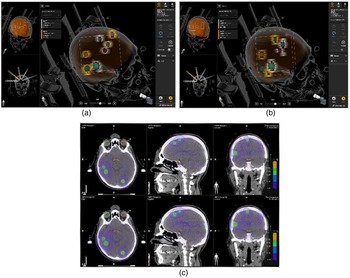
SIMM-SRS plans were optimised for TrueBeam STx® using 6 MV beam with a flattening filter. HDMLC and MLC-5 were employed for planning. Both collimation systems are 120-leaf MLC with 60 central 2·5 mm leaves for HDMLC 38–Reference Sharma, Dongre, Mhatre and Heigrujam40 and 5-mm leaves for MLC-5. The plans were optimised using the HDMLC and MLC-5, as shown in Figure 1. Dose calculation was performed with a 1 mm grid using the Brainlab pencil beam algorithm. Reference Mohan, Chui and Lidofsky41–Reference Mohan and Chui43 The plans were created using a dose template for a single fraction of 21 Gy with a desired PTV coverage of 95% and a tolerated coverage of 90%. The templates were set to aim a homogeneous dose distribution within the PTV. The quality index obtained from Elements™ report Paddick conformity index (PCI), gradient index (GI) and maximum dose (defined as the calculated maximum dose in the voxels) for the GTVs are shown in Table 1.
Comparison for a single isocenter multiple metastases radiosurgery (SIMM-SRS) plan for nine metastases between different multileaf collimator (MLC) leaf widths in Brainlab Elements: a) using HDMLC and b) using MLC-5. c) The dose distribution for both plans is compared between HDMLC (superior) and MLC-5 (inferior).

GTV lesions and mean value and [min, max] of dosimetric parameters reported by the TPS for high-definition multileaf collimator (HDMLC) and MLC-5 plans

The MLC transmission factor and dosimetric leaf gap for the HDMLC were 1·23% and 0·86 mm, Reference Rojas-López and Venencia44 respectively, and for the MLC-5 were 1·4% and 0·9 mm, respectively. These parameters were used in the machine profile configuration of Elements™ for TrueBeam STx®.
Dosimetric parameters such as Paddick conformity index (PCI), Reference Paddick45 gradient index (GI) Reference Paddick and Lippitz46 MU, volume receiving half of prescription isodose, maximum dose to brainstem, chiasm, cochlea, optic tract and optic nerves and the volume of 12 Gy, 10 Gy and 5 Gy to the healthy brain (V12, V10 and V5, respectively) were analysed. The PCI and GI were calculated based on the formal definition of those indices. Reference Paddick and Lippitz46–Reference Wagner, Bova, Friedman, Buatti, Bouchet and Meeks48 The PCI was calculated as shown in Equation 1:
 $$PCI = {{TV_{PI{V_{100}}}^2} \over {TV \times PI{V_{100}}}},$$
where TV is the volume of the PTV,
 $PI{V_{100}}$
is the volume of the prescription isodose, and
 $T{V_{PI{V_{100}}}}$
is the volume of the PTV covered by the prescription isodose.
 $PI{V_{50}}$
is the volume of the 50% prescription isodose. The GI was calculated as shown in Equation 2:
 $$GI = {{PI{V_{50}}} \over {PI{V_{100}}}}.$$
Rotation-induced displacements
The impact of rotation-induced displacements was analysed for HDMLC and MLC-5 plans. At present, the commercial TPS could perform exclusively displacements (translations) on the planning structures to determine their dosimetric effect on targets and OARs. Rotations were not included in TPS. In a previous work Reference Rojas-López, Díaz Moreno and Venencia32 , we worked out on the DICOM files handling to perform rotations of the targets with respect to a single point (isocenter). Additionally, it is known that the group of rotation transformations is non-commutative. The final location where the target was displaced depended on the rotational order and direction. Thus, the optimal combination of rotations is necessary to determine the maximum displacement produced. The complete study of rotational combinations implies to analyse mathematically all possible combinations by the product of the rotation matrices represented in Equation 3. To simplify the computations, the use of optimisation algorithms is useful in these cases considering the coded-uncoded information in bidimensional binary arrays. Bio-inspired optimisation algorithms such as genetic algorithm are easy to implement, they are robust and the optimal solution converged in few cycles.
 $$\matrix{ {{R_{roll}}(\theta ) = \left( {\matrix{ 1 \,\, 0 \,\, 0 \cr 0 \,\, {\cos \theta } \,\, { - \sin \theta } \cr 0 \,\, {\sin \theta } \,\, {\cos \theta } \cr } } \right)}\cr \cr {{R_{pitch}}(\theta ) = \left( {\matrix{ {\cos \theta } \,\, 0 \,\, {\sin \theta } \cr 0 \,\, 1 \,\, 0 \cr { - \sin \theta } \,\, 0 \,\, {\cos \theta } \cr } } \right)} \cr {{R_{yaw}}(\theta ) = \left( {\matrix{ {\cos \theta } \,\, { - \sin \theta } \,\, 0 \cr {\sin \theta } \,\, {\cos \theta } \,\, 0 \cr 0 \,\, 0 \,\, 1 \cr } } \right)} \cr } $$
The order and direction of rotations of 0·5º and 1º of each target were optimised and performed in three directions (roll, pitch and yaw) by the use of a genetic algorithm (GA) using in-house software. The software technical description is shown in literature. Reference Rojas-López, Díaz Moreno and Venencia32 It works under the assumption that if displacements are relatively small with respect to the relevant anatomical dimensions and the radiological path of the treatment beams towards the targets, this approach is valid for an arc treatment. Reference Roper, Chanyavanich, Betzel, Switchenko and Dhabaan12 It allows to handle each structure from the DICOM structure file, applying rotations in any direction with respect to isocenter plan, while the CT and dose DICOM files remained fixed to display dosimetric calculations.
The rotational combinations were performed following the maximum displacement evaluated by a GA. The algorithm worked following the Darwinian principle of natural evolution and the DNA recombination process to reproduce naturally evolution processes and survival of the fittest to find the near-optimal solution. Reference Sale and Sherer49 In last years, the GA was implemented successfully in population pharmacokinetic models, Reference Sale and Sherer49 in multi-population for flexible job scheduling problem, Reference Shi, Long, Li and Deng50 ensemble method for cancerous gene identification, Reference Ghosh, Adhikary, Ghosh, Sardar, Begum and Sarkar51 medical disease estimation, Reference Mantzaris, Anastassopoulos and Adamopoulos52 protein design structure Reference Geng, Guan, Dong and Zhou53 and so on. The typical representation of GA is as follows: First, a random initial population of solutions represented as binary vectors (chromosomes) is generated. The first allele is defined for j ≤ 3. Elements were transformed from the binary to the decimal system. There were 8 combinations in total for the first allele, and each one was assigned a particular combination of the order in which the couch rotations were performed. The second allele is defined for j ≥ 4. Elements correspond to the rotational direction. If the gene is 1, the direction is clockwise (CW). Otherwise, if is 0, it is counterclockwise (CCW). Reference Rojas-López, Díaz Moreno and Venencia32 Second, the chromosomes were evaluated by the module of the difference vector between the centre of mass of the original structure and the displaced structure. Third, the best chromosomes were recombined in pairs by a cross-over point and two daughters were generated. Fourth, the parents and daughters were subject to random bit mutations. Finally, the new chromosomes were evaluated. The process was iterative.
Dosimetric differences in PCI and GI were evaluated for the plans with non-rotated and rotated structures for each MLC leaf configuration.
Ethical Considerations
The treatment plans were selected and anonymised. There was no relationship between the plan and the personal data of the patients. The Institutional Quality Committee (Comité de Calidad Institucional) from our institution approved and authorised the use of this information, the results and the ethical conduct of this study.
Results
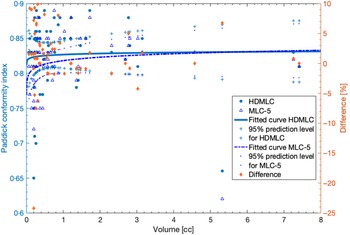
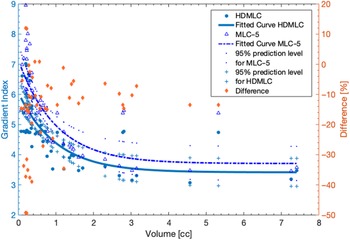
The dosimetric differences in terms of the MLC by the SRS-SIMM plans are shown in Figures 2 and 3. PCI and GI for HDMLC are higher than MLC-5 plans as shown in Table 2. In all cases, dosimetric differences are statistically significant (p < 0·05). The p-values are shown in Table 1. The mean MU for HDMLC plans was 7528 ± 2180 MU [min 5418 MU, max 12,258 MU] and for MLC-5 plans was 7575 ± 2218 MU [min 4993 MU, max 11,673 MU]. The dosimetric differences between both plans tended to decrease as the lesion volume increased as represented by Pearson’s coefficient for PCI (r = −0·1 for HDMLC and r = −0·05 for MLC-5) and for GI (r = −0·6 for HDMLC and r = −0·6 for MLC-5). In Figures 2 and 3 are shown the smaller lesion volume, the higher dosimetric differences between both plans. In addition to the lesion volume, the irregular shape of the metastases has an important role on the dosimetric impact considering different MLC, as shown in Figures 2 and 3 for the 5·3 cc lesion.
Left y-axis: Distribution of Paddick conformity index (PCI) as function of target volume for both plans using high-definition multileaf collimator HDMLC (blue circles) and MLC-5 (blue triangles). Solid and dashed lines represent the fitted curves for PCI as function of volume. The prediction functional levels of 95% are shown in dots for both plans. Right y-axis: Difference between two MLCs taken as reference HDMLC.

Left y-axis: Distribution of gradient index (GI) as function of target volume for both plans using high-definition multileaf collimator HDMLC (blue circles) and MLC-5 (blue triangles). Solid and dashed lines represent the fitted curves for PCI as function of volume. The prediction functional levels of 95% are shown in dots for both plans. Right y-axis: Difference between two MLCs taken as reference HDMLC.

Mean value, standard deviation and [min, max] of dosimetric parameters D 99 , Paddick conformity index (PCI), gradient index (GI), volume receiving half of prescription isodose (PIV 50 ) and D max for organs at risk for plans using high-definition multileaf collimator (HDMLC) and MLC-5. The p-values from one-tailed t-test are shown

In Figures 2 and 3 are shown the data curve fitted only for visual guide, and the prediction levels were based on the existing fit to the data, and they were simultaneous for all predictor values. The simultaneous level measured the confidence that a new observation lies within 95% regardless of the predictor value. The fit is a single-term exponential to generated data and the bounds reflect a 95% confidence level. The intervals associated with a new observation are wider than the fitted function intervals because of the additional uncertainty in predicting a new response value (the curve plus random errors).
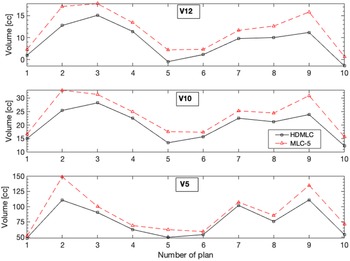
The use of HDMLC in an SRS-SIMM shows a remarkable reduction of the volume of 12 Gy, 10 Gy and 5 Gy to the healthy brain (V12, V10 and V5, respectively) with respect to MLC-5, as shown in Figure 4. It is shown that complying with the dose-volume constraints for both plans, there is an improvement on the reduction of organs at risk (optic nerves, optic tract, chiasm, cochlea and lens) maximum dose in all cases.
Dosimetric differences in healthy brain considering the volume that received 12 Gy, 10 Gy and 5 Gy (V12, V10 and V5, respectively) between the plans using high-definition multileaf collimator (HDMLC) and MLC-5.

The degradation of the plans was evaluated by the dosimetric differences. The differences considered as
 $\left( {{X_{original}} - {X_{rotated}}} \right)/{X_{original}} \times 100$
, where
 $X$
is the dosimetric parameter (PCI or GI), were determined for both MLC leaf width plans. The differences between MLCs were no statistically significant p = 0·364 for PCI and p = 0·762 for GI by a two-tailed t-test.
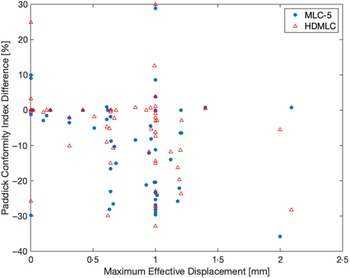
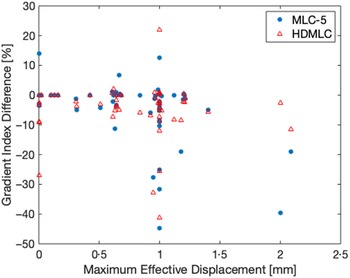
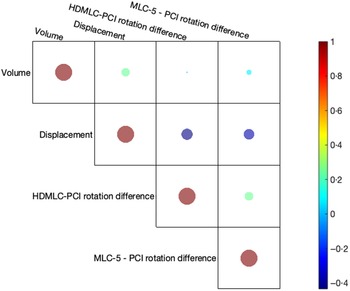
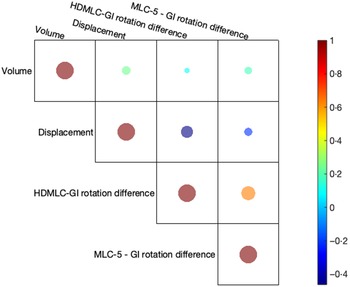
To consider the GTV-to-PTV geometrical margin criterion used in this work, the dosimetric differences as a function of lesion volume and the maximum effective displacements produced by rotations in three directions for 0·5º and 1º in each target are shown in Figures 5 and 6. The correlation between dosimetric differences, lesion volume and displacements were analysed. The Pearson correlation coefficient for all parameters is shown in Figures 7 and 8 for PCI and GI, respectively. There is no correlation between volume and dosimetric differences produced by rotations (
 $\rho \lt 0.08$
for PCI and
 $\rho \lt 0.09$
for GI); however, medium negative correlation (
 $\rho = - 0.43$
for PCI and
 $\rho = - 0.48$
for GI) was determined between displacements and dosimetric differences. In the case for rotation-induced displacement effect and MLC, the dosimetric differences were studied. Small positive correlation was determined for PCI (
 $\rho = 0.25$
) and high positive correlation for GI (
 $\rho = 0.62$
). Nevertheless, in all cases the higher dose difference, the higher maximum effective displacement up to 2 mm.
Comparison of the dosimetric difference produced between rotated and original plans for Paddick conformity index (PCI) between the target located in the original position (original) and the displaced (rotated) for HDMLC (red triangles) and MLC-5 (blue circles) plans as a function of maximum effective displacement produced by 0·5º and 1·0º rotations in three directions (roll, pitch, yaw).

Comparison of the dosimetric difference produced between rotated and original plans for gradient index (GI) between the target located in the original position (original) and the displaced (rotated) for HDMLC (red triangles) and MLC-5 (blue circles) plans as a function of maximum effective displacement produced by 0·5º and 1·0º rotations in three directions (roll, pitch, yaw).

Pearson’s correlation coefficients for volume, maximum effective displacement and Paddick conformity index (PCI) dosimetric rotational differences for high-definition multileaf collimator (HDMLC) and MLC-5. The higher the diameter of the circle, the stronger the correlation.

Pearson’s correlation coefficients for volume, maximum effective displacement and gradient index (GI) dosimetric rotational differences for high-definition multileaf collimator (HDMLC) and MLC-5. The higher the diameter of the circle, the stronger the correlation.

Discussion
There was a statistically significant decrease in the PCI and GI for the HDMLC compared with MLC-5 (p = 0·09 and 6 ×
 ${10^{ - 8}}$
, respectively). These results are in concordance with other authors where they compared the Varian MLC and the micro-MLC for single targets.
Reference Monk, Perks, Doughty and Plowman17
The PCI difference between the MLCs ranged between 9·9% and 24·2% and the HDMLC exhibited better dose conformation as Tanyi et al. reported
Reference Tanyi, Kato, Chen, Chen and Fuss22
indicating a worse conformity of the prescription isodose to the PTV using a wider MLC. Equivalent PTV coverage was achieved using the MLC-5 by adjusting the MLC shape around the target in every case. The GI differences between the two MLCs were higher, ranging from 0·8% to 49·2%. The higher differences were associated with smaller volume lesion (<0·3 cc) indicating a better dose falloff to the PTV using a HDMLC.
The indices in all cases were within some authors Reference Wu, Wang and Kirkpatrick15,Reference Geng, Guan, Dong and Zhou53,Reference Huang, Chin and Robbins54 and our institutional clinical criterion in the range from 0·65 to 0·9 to PCI and from 3·0 to 8·0 to GI. The MU between both plans has no difference in all ranges differing from what previous authors have reported. Reference Monk, Perks, Doughty and Plowman17
Small targets and complex geometrical distribution between OARs and targets are improved from the use of a finer MLC. Reference Wu, Wang and Kirkpatrick15 The HDMLC enhances PTV conformity and surrounding tissue sparing when compared to that of SMLC. Reference Monk, Perks, Doughty and Plowman17 This advantage decreases when the target volume increases.
As other authors mentioned, the finer MLC yields dosimetric advantages in terms of target conformity and dose to the surrounding normal tissues. Reference Chern, Leavitt, Jensen and Shrieve18,Reference Clark, Popple, Young and Fiveash55,56 The current study shows dosimetric benefits of the HDMLC over the MLC-5 for SRS multiple targets in single isocenter treatments. For normal tissue, mean dose was reduced more effectively by a decrease in MLC width. Reference Jin, Yin, Ryu, Ajlouni and Kim19,Reference Burmeister, McDermott and Bossenberger21
The most important characteristic in SRS is the precise dose delivery to the target conformally with rapid dose falloff into the surrounding normal tissues. The small positive correlation (
 $\rho = 0.25$
) for PCI rotation-induced dosimetric differences between two types of MLC indicates that it does not depend on the MLC on how closely the radiation prescription dose conforms to the size and shape of the target. In the other hand, there is a high positive correlation (
 $\rho = 0.62$
) for GI that can indicate that the dose falloff outside of the target is dependent on the MLC. The positive correlation shows that there is a directly proportional relation between the dosimetric rotational difference and the displacement produced by rotations. The dosimetric rotational differences for GI are not statistically significant, and the mean values are similar considering their standard deviations (−4% ± 8% for HDMLC and −4% ± 10% for MLC-5).
The use of the institutional PTV margin criterion is necessary for reducing the dosimetric degradation produced by rotations and satisfies the MLC effect on dose coverage, but is not sufficient as reported by past work of our group. Reference Rojas-López, Díaz Moreno and Venencia32 Rotational corrections via image guidance are necessary for SRS with a thermoplastic mask for immobilisation. The study of Calmels et al. Reference Calmels, Blak Nyrup Biancardo and Sibolt29 suggests that patient positioning errors at each couch rotation should be corrected by image guidance systems such as Exactrac® (Brainlab AG, Munchen, Germany). The use of these systems for position correction treatment table avoids compromising dose coverage for metastases located beyond 3 cm from the plan isocenter. Reference Calmels, Blak Nyrup Biancardo and Sibolt29 There is a clear trade-off between dosimetric quality of small and large targets that should be considered carefully when placing the isocenter. Reference Stanhope, Chang and Wang9,Reference Chae, Woong and Hyun57,Reference Shaw, Kline and Gillin58 Regarding the target coverage, there were dosimetric benefits of a finer MLC. However, the downsizing effect of the MLC decreased with the use of a more precise radiotherapy technique and a more sophisticated grade of the same technique. Reference Abisheva, Floyd and Salama24,Reference Shaw, Kline and Gillin58,Reference Ohtakara, Hayashi, Tanaka and Hoshi59
The effects of rotational displacements produced for each target in SRS-SIMM are not dependent on the MLC for how closely the dose prescribed conforms to the target but the dose falloff outside of the target is dependent on the MLC. Finer collimator leaves are associated with smaller GI differences with respect to rotational displacements. As described Calmels et al., Reference Calmels, Blak Nyrup Biancardo and Sibolt29 PCI close to one is a predictor of local control and sparing of the OAR, while an increase of GI to above three can lead to a higher V12 Gy to the healthy brain, which is related to the risk of radionecrosis; therefore, the use of finer collimator leaves considering the rotation-induced displacements in the patient’s setup could be associated with a lower risk of necrosis.
The use of GA in SRS offers a novel tool to obtain information concerning the maximum displacement performed by the order and the direction of patient’s setup rotations. This fact is valuable, and it can provide well-informed decisions (not only based on geometric concepts) for medical staff to define the appropriate PTV margins. The development of adaptive PTV margins for each metastasis that consider the combined effect of translations, rotations, the dose that healthy brain receive and the specific MLC is proposed as future work.
Conclusion
The finer HDMLC offers dosimetric advantages compared with the MLC-5 in terms of target conformity and dose to the surrounding organs at risk with respect to optimised dynamic arcs from Elements™ Multiple Brain Mts.
The effect of displacements produced by rotations due to setup uncertainties has differentiate effect in both MLC plans for the dose falloff outside of the target. This can be associated with a correct PTV to GTV margins in SIMM-SRS.
Acknowledgements
C. D. Venencia conceived the main idea to the work, planned the treatments, verified the experimental methods and revised the final version to the manuscript.
J. A. Rojas-López performed the computations, developed and verified the in-house software methods, proposed the genetic algorithm optimisation, wrote the manuscript and designed the figures.
R. M. Díaz Moreno processed the DICOM files, developed the in-house software with support from J. A. Rojas-López. R. M. Díaz Moreno revised the final version to the manuscript.
S. Zunino verified and approved the planned treatments, supervised the project and revised the final version to the manuscript.
Financial Support
This research received no specific grant from any funding agency, commercial or not-for-profit sectors.
Conflicts of Interest
Authors declare no conflicts of interest.
Author Agreement
All authors have seen and approved the final version of the manuscript being submitted.