1. The Function of Hesitation Markers.
At present, there is no uncontested theory about the function of hesitation markers (Künzel 1997:51–52), although some theories center around their pragmatic or social function in discourse (Maclay and Osgood 1959). For example, Maclay and Osgood (1959:42) attributed hesitation markers partly to the speaker's desire to keep his or her turn of speech. If the speaker's silent pause is too long, the chance that the listener will interrupt increases. Accordingly, hesitation markers are used to communicate that the turn of speech has not yet been completed (Maclay and Osgood 1959:24). At the same time, the fact that hesitation markers are very common in monologues—such as university lectures, where there is usually no possibility of interruption—seems to contradict this hypothesis (Schachter et al. 1991). However, according to Künzel (1997:58), in “telephone speech” the relative number of hesitation markers increase at the expense of silent pauses. He suggested that this may be due to the fact that when communicating via telephone, the speaker must orally signal to an invisible listener that he or she is not yet finished speaking, whereas in a face-to-face conversation this intention can be communicated visually (p. 59). Alternatively, Clark and Fox Tree (2002:90) point out that in some situations, hesitation markers may actually be used to indicate the speaker's willingness to give up his or her turn of speech. For example, if the speaker suspects that the listener may know a specific word that the speaker has momentarily forgotten, Clark and Fox Tree claim that a hesitation marker may be inserted to invite the listener to complete the utterance. Because these functions contradict one another, they argue that the mentioned pragmatic functions of hesitation markers “cannot both be basic meanings,” but rather implicatures in addition to their actual meaning (pp. 90–91).
Other researchers have attributed the function of hesitation markers to cognitive processes on the part of the speaker. This explanation can be broadly termed the SYMPTOM HYPOTHESIS, which contrasts with the SIGNAL HYPOTHESIS. In particular, the symptomatic explanation of hesitation markers has received general acceptance. Even the terms “hesitation marker,” and for that matter its synonym “filled pause,” imply that these utterances are symptomatic of some sort of cognitive process on the part of the speaker. For example, Goldman-Eisler (1968:26) proposed a general theory of hesitation markers, according to which they may be regarded as an indication of “some central planning process.” Maclay and Osgood (1959) theorized that the function of hesitation markers is to create time for verbal planning in speech, like the unfilled pause. Crystal (1992:170) states that hesitation markers may indicate “the speaker is thinking about what to say next,” and may express “doubt or uncertainty.” Rochester (1973) hypothesized that hesitation markers are indications of time for the speech production apparatus to search for the next word, phrase, or idea. Christenfeld (1994) and Schachter et al. (1991) found that hesitation markers occur when a speaker is faced with an option or a challenging choice. In conjunction with this, Reynolds and Paivio (1968) found that pauses, both silent and hesitation markers, were more frequent in the case of abstract rather than concrete nouns. Siegman and Pope's (1966) findings showed that subjects used more hesitation markers when they described ambiguous occurrences. Shriberg (1994) found that vocalic and vocalic-nasal hesitation markers showed systematic differences in sentence positioning in American English, with vocalic-nasals being more typical for initial position. In her view, vocalic-nasal hesitation markers were “used relatively more often during planning of larger units, and uh may be relatively more likely to reflect local lexical decision-making” (p. 154). Many researchers agree that hesitation markers indicate “time out” while the speaker searches for the next word or phrase (Schachter et al. 1991).
This symptomatic interpretation of hesitation markers, which reflects cognitive processes on the part of the speaker, has more recently come into question, and the perceptual function for the listener has received more attention (the signal hypothesis). Swerts et al. (1996:1033) observed that “most investigations of speech errors are speaker oriented,” and argued that hesitation markers can be “highly relevant perceptually.” They suggested from their results, which showed that in Dutch major discourse boundaries are more likely to co-occur with hesitation markers than weaker ones, that listeners “may profit from FPs [filled pauses] that point towards major changes in topics” (p. 1034). In their study, they defined major discourse boundaries as breaks in “larger-scale discourse units (‘paragraphs,’ ‘topical units’)” (p. 1035). Their study additionally showed that vocalic-nasal hesitation markers are used more frequently at major discourse boundaries in Dutch and that these are more likely to be surrounded by silent pauses on both sides (p. 1035). Furthermore, they found that filled pauses after stronger breaks are longer in duration and higher in frequency than those after weaker boundaries, “but this effect is due to the filled pauses in phrase-initial position” (p. 1035). Summing up, Swerts et al. claimed that “filled pauses [in Dutch] at the onset of major discourse units are prosodically different from those in other positions,” and suggested that these differences in hesitation markers among Dutch “may reflect different planning processes, but they could also be different rhetorical devices that are explicitly controlled by the speaker to signal something to a communication partner” (p. 1035).
Related to this, Fox Tree (2001) found that in American English hesitation markers helped listeners recognize an upcoming target word faster, thereby implying that they presignal upcoming linguistic material for the listener. She also found that in American English, overhearers of a conversation interpret speakers differently, depending on whether they respond to their interlocutor immediately; pause and respond; say um and respond; or say um, pause, and then respond (Fox Tree 2002:37). Accordingly, Clark and Fox Tree (2002:75) criticized the term “filled pause,” because “the unstated assumption is that they are pauses (not words) that are filled with sound (not silence).” They found this term misleading and suggested the neutral term “filler.”
Like Shriberg (1994) and Swerts et al. (1996), Clark and Fox Tree (2002:80) associated vocalic hesitation markers with minor delays in speech and vocalic-nasal hesitation markers with major delays, claiming “uh and um contrast in basic meanings.” However, Clark and Fox Tree emphasized the fact that the delays associated with hesitation markers do not have to reflect syntactic planning, as they are also used in front of single word answers. Contrary to most other researchers, Clark and Fox Tree (2002:80) viewed hesitation markers as being “under the speaker's control.” Whereas other studies assume speaker passivity in the use of hesitation markers, which are seen as symptomatic of the speaker's cognitive processes, Clark and Fox Tree argue for the signaling effect of hesitation markers—speakers “use uh and um to announce that they are initiating what they expect to be a minor (uh) or major (um) delay in speaking” (p. 73).
More recently, the signal hypothesis has been criticized in O’Connell and Kowal 2005:555, whose results indicate that “uh and um cannot serve as signals for upcoming delay, let alone signal it differentially.” Due to their location, the prediction that both vocalic and vocalic-nasal hesitation markers signal a delay would be wrong 76% of the time (O’Connell and Kowal 2005:567). Rather, in their view, the meaning of both hesitation markers is dependent upon the preceding and following verbal context.
The fact that hesitation markers may be associated with specific functions in discourse—whether to convey a message to a listener or to reflect inner cognitive processes on the part of the speaker—is of relevance for the present crosslinguistic study.
2. Language Specificity of Hesitation Markers.
Most researchers agree that the realization of hesitation markers is language specific (Maclay and Osgood 1959; Levelt 1983; Baldwin and French 1990; Künzel 1997; Clark and Fox Tree 2002). However, it is not clear what causes this language specificity. Unfortunately, there are no empirical crosslinguistic studies of hesitation markers and observed differences in languages tend to be impressionistic.
In their general description, Baldwin and French (1990:53) observed that realizations occurring within Received Pronunciation range from “front, central, and back monophthongs with varying degrees of openness […] to opening, closing, and centering diphthongs.” According to their observations, these variants can occur with or without a bilabial nasal. Lickley (1994) found for six British English speakers that vocalicnasals were more common than vocalic hesitation markers in informal conversation. Shriberg (1994:155) suggests that this “may indicate a dialectal difference between British and American English in usage of the two filled-pause forms,” as she found more vocalic hesitation markers than vocalic-nasals in American English.1
Hence, similarities found between American English and Dutch regarding the listener's increased ability to recognize words in upcoming speech upon hearing a vocalic hesitation marker (Fox Tree 2001) may not necessarily apply to British English speakers.
As indicated by Künzel's (1987:37) observations, German hesitation markers differ in their vocalic quality, which can range from an un-rounded, open back vowel to a central schwa. The vocalic element may be preceded by a glottal stop and followed by the bilabial nasal [m], and in many cases the vocalic element is nasalized. According to Künzel (1987:37, 1997:51), these possibilities are speaker-specific, and can be used for speaker identification in the case of German since individuals tend to be consistent in using “their” personal variant.
Swerts et al. (1996:1033) found that hesitation markers composed solely of a vocalic element were more common in Dutch than those consisting of a vocalic and nasal element. Van Donzel et al. (1996:1029) reported that the use of vocalic hesitation markers directly after words with no period of silence between the word and hesitation marker (that is, clitics; Clark and Fox Tree 2002:73) is a common pausing device in Dutch. As already stated, Swerts et al. (1996:1035) found that in Dutch, vocalic-nasal hesitation markers were used more frequently at major discourse boundaries and that these hesitation markers were more likely to have silent pauses on both sides.
In summary, previous language-specific studies of hesitation markers in British English, German, and Dutch have generally concluded that (a) in British English, vocalic-nasal hesitation markers are most commonly used; (b) in German, there is a degree of speaker-specificity regarding vocalic and vocalic-nasal hesitation markers—some speakers use more vocalic hesitation markers, others more vocalic-nasals; and (c) in Dutch, vocalic hesitation markers are most commonly used.
By comparing hesitation markers in English, German, and Dutch, the present study, as outlined below, not only sheds light on potential language-specific characteristics of hesitation markers, it also raises questions regarding the symptom and signal hypotheses.
3. Methods.
The hesitation markers of 16 English, 21 German, and 23 Dutch native speakers were compared to determine potential differences in their realization and usage. The first recordings were made at the University of Bristol in a quiet room. The second group of recordings was conducted at the University of Trier in a sound proof room. Finally, the last recordings were made in quiet rooms at the Free University of Amsterdam and at the University of Utrecht.
3.1. Participants.
Subjects were similar in terms of their education and social class. They were either undergraduate or postgraduate students within the Faculty of Language at their respective universities. Students were all native speakers with knowledge of the other languages in question, yet their proficiency in these languages varied. The English native speakers were familiar with the German language; the Dutch native speakers varied in their proficiency in both English and German; and the German native speakers varied in their proficiency in the English language. In addition, many of the subjects were also familiar with additional languages, such as French and Spanish. Some subjects had spent time abroad, but none had lived abroad. All subjects had acquired their second or third languages in adolescence in a school environment.
The age of the subjects ranged from 18 to 30 years. The English students were generally younger than their German and Dutch counterparts, varying in age between 18 and 21 years, with an average age of 20. The Germans ranged in age from 19 to 26, with an average age of 22. The Dutch students were between the ages of 18 and 30, with an average age of 23.2
Although the German and Dutch speakers tended to be slightly older than their British counterparts, this fact should not jeopardize the quality of the study. In a study by Bortfeld et al. (2001:138)—which investigated, among other factors, the effects of age on disfluency rates in American English conversation—age effects were only found in older speakers (ranging in age from 63 to 72 years). Older speakers overall produced higher disfluency rates than middle-aged (mean age, 47;11) or younger speakers (mean age, 28;10). However, no difference was found between the latter two groups (Bortfeld et al. 2001:138).
There was a general dominance of female over male subjects for each language. Of the English speakers, 4 males were recorded and 12 females. Regarding the German subjects, 9 males and 12 females were recorded. Lastly, eight Dutch males and 15 Dutch females were interviewed. Because it has been found that gender can affect disfluency rates (Bortfeld et al. 2001:139), with males generally using more hesitation markers than females in American English, this factor was further investigated, as discussed below.
Subjects were considered to be representative speakers of the standard variant of their native language.3
The respective standard variants were: Received Pronunciation, Standard-deutsch, and Algemeen Beschaafd Nederlands. Each speaker was asked to assess the extent to which a regional dialect influenced his or her native language pronunciation on a scale of one to four. Category 4 consists of those who always spoke using their standard variant with no influence of a regional dialect; category 3 subjects spoke a standard variant that could be slightly influenced by a regional dialect; category 2 subjects rarely spoke using the standard variant because their regional dialect was noticeably dominant; and category 1 subjects were completely unable to speak the standard variant, because their regional dialect was so dominant. Eighty-five percent of the subjects characterized themselves as belonging to either category 3 or 4. The self-assessment was in all cases similar to the interviewer's assessment, which was completed with the same categorizational process. Participants who characterized themselves as belonging to either category 1 or 2 remained in the study, and it was observed whether or not their results differed from those who had placed themselves in category 3 or 4. Since no such difference was observed, all participants were included in the study, as the regional dialect in question did not contradict the general trend of each language. It is possible, however, that other regional dialects would have contradicted the trend, or that the subjects of categories 1 and 2 were in fact more representative of their standard variants than the assessment procedure suggested.
3.2. Procedure.
During the recordings, questions were posed with the intention of initiating spontaneous speech and, therefore, also hesitation markers. It was not, however, intended for the interviewees to feel pressured during the conversations, and many of the questions were posed to help the participants feel at ease in an experimental setting in which they did not know the interviewer. Generally, a list of questions, which was drawn up prior to the interview, was followed, and the students were asked to describe their personal experiences and opinions on general topics such as current affairs, education, and hobbies.4
A selection of questions posed during the interviews is found in the Appendix.
The interviewer's native language was Canadian English (native-like fluency in German and high fluency in Dutch). Although, to the best of my knowledge, no study has shown that second language learners vary their use of hesitation markers in their native language when speaking with proficient non-native speakers, one could argue that subjects produced hesitation markers differently when speaking to someone with a different native language from their own, even if the non-native speaker did fulfill more of a prompting function. Similarly, one could also argue that British English speakers might change their hesitation markers when speaking to a native Canadian English speaker. In fact, hesitation markers are generally assumed to be quite consistent in an individual's speech, and thus may be used in forensic phonetics to identify speakers partly due to the fact that they are likely to be transferred from the native language into the foreign language and not the other way around (Künzel 1997:51; Baldwin and French 1990).
All recordings were conducted using a Sony DAT recorder (TCDD100). The condenser microphone (Sony ECM-MS907) was placed at a distance of approximately 30 cm from the subject.
The average interview duration was five minutes and 21 seconds. Actual speaking time was not strictly monitored in order to keep speech production natural and to avoid artefacts such as accelerating or slowing down speech in view of a time limit.
The recorded interviews were digitally transferred from the digital audiocassettes to the hard disk of a Windows-based PC system, with no alteration of sampling rate and resolution. They were then edited using the software package Cool Edit Pro and analyzed using Multi-Speech, a Windows-based speech analysis program produced by KAY Elemetrics.
Hesitation markers were located in the total recordings. The process of locating hesitation markers was based primarily on linguistic intuition, as well as on the functional characteristics of hesitation markers (Maclay and Osgood 1959; Rochester 1973; Christenfeld 1994; Schachter et al. 1991; Clark and Fox Tree 2002), and on speaker-specific hesitation marker characteristics (Künzel 1997:51). This process created a corpus of 1,928 hesitation markers, each speaker having his or her individual corpus with a different amount of hesitation markers depending on how often he or she hesitated. These hesitation markers were then analyzed in each language according to four different parameters: (a) number of hesitation markers per minute (hmr); (b) proportion of vocalic, vocalic-nasal, and nasal hesitation markers; (c) positioning of hesitation markers within spontaneous speech; and (d) positioning of vocalic, vocalic-nasal, and nasal hesitation markers within spontaneous speech. The results from all three languages were then compared.
3.3. Determining Number of Hesitation Markers per Minute (hmr).
The frequency of hesitation markers was defined as the number of hesitation markers in the subject's speech divided by his or her speaking time. Speaking time was attained by subtracting the time the interviewer spoke and sections of silence greater than 2s from the total duration of the interview. The speaking time was measured in minutes, and consequently the frequency of hesitation markers was expressed as the number of hesitation markers per minute (hmr). Subjects’ individual hmr's were then averaged and the mean hmr for English, German, and Dutch was obtained. The standard deviation and the maximum and minimum hmr within each language were also derived, and the statistical significance was then tested.6
Level of significance was set at 5%.
Also, as mentioned, because Bortfeld et al. (2001:139–140) observed in their corpus of American English speakers that males tended to use more hesitation markers than females, it was tested whether hmr was influenced by gender in the individual languages.
3.4. Determining Vocalic, Vocalic-Nasal, and Nasal Proportions.
Three types of hesitation marker were distinguished: those composed solely of a vocalic element (v), those composed of a vocalic element followed by the bilabial nasal element (vn), and those composed only of a bilabial nasal element (n). Thus, the present research differs from previous studies, which focus on vocalic and vocalic-nasal hesitation markers (Fox Tree and Clark 2002; O’Connell and Kowan 2005; Swerts et al 1996; Bortfeld et al. 2002; Shriberg 1996). The percentage of each type of hesitation marker relative to each subject's individual total number of hesitation markers was calculated and the proportion of vocalic, vocalic-nasal, and nasal hesitation markers was attained for each subject. The individual values of each type of hesitation marker were then averaged overall with the other speakers for each language. These language-specific results were then statistically compared with those of the other languages.
Finally, based on these initial findings, it was investigated whether there was a correlation between hmr and the percentage of vocalic hesitation markers in each language.
3.5. Determining Positioning of Hesitation Markers.
Four positions were differentiated: (a) hesitation markers surrounded by silence (ss positioning); (b) hesitation markers surrounded by words (ww positioning); (c) hesitation markers preceded by silence and followed by a word (sw positioning); and (d) hesitation markers preceded by a word and followed by silence (ws positioning). Silence was defined as any period of silence exceeding one second.7
The Dutch subjects’ hesitation markers often directly follow words, with no silent pause between word and hesitation marker, as also reported by van Donzel et al. (1996). This occurred less often in English and German. A one second cutoff did not take such clitics (Clark and Fox Tree 2002:73) into consideration. It was not thought that the one second cut-off detracted from the experimental design as it allowed for a crosslinguistic comparison of minor and major delays. However, it may be beneficial in future research to work with a continuous time scale, rather than a categorical one.
Smacking, perhaps alveolar and bilabial clicks, were also considered to be silence. Many speakers of English, German, and Dutch consistently used such smacking noises in proximity to their hesitation markers, an observation that deserves further attention.
The percentage of occurrence in each position was calculated relative to the total number of hesitation markers used by that specific subject. These individual percentages were then averaged in English, German, and Dutch, and crosslinguistic differences were tested to determine statistical significance. As a result, it became apparent which position was most common in English, German, and Dutch.
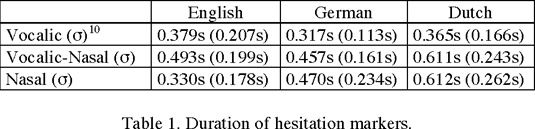
Hesitation markers surrounded by silence were seen to be major delays in speech, whereas those surrounded by words, in proximity of less than 1s, were seen to be minor delays in speech. Accordingly, based on differences in duration, it is claimed that ss positioning represented a major break in discourse, whereas ww positioning represented a minor break. It is possible to argue that in extreme cases, hesitation markers of greater duration may have compensated for periods of silence of shorter than 1s. For this reason, the duration of hesitation markers was also measured. The average duration of hesitation markers is shown in table 1.9
An ANOVA test revealed a significant difference with regard to duration between vocalic hesitation markers in English, German, and Dutch (F(2,579)=4.18, p=0.016, ω2=1%). A post-hoc Tukey HSD revealed a significant difference between the duration of German and Dutch vocalic hesitation markers, German vocalics being shorter than Dutch. Significant differences with regard to duration between English and Dutch and English and German vocalic hesitation markers were not reported. Another ANOVA test revealed a highly significant difference pertaining to duration of vocalic-nasal hesitation markers (F(2,763)= 32.90, p<0.001, ω2=7%). A post-hoc Tukey HSD revealed highly significant differences between the duration of English and Dutch vocalic-nasals and between German and Dutch vocalic-nasals, indicating that Dutch vocalic-nasal hesitation markers were longer than those of English and German. No significant difference was observed with regard to German and English vocalicnasals. Lastly, probably due to lack of nasals, no significant difference was revealed for these hesitation markers either.

The data in table 1 indicate that hesitation markers rarely exceeded 1s in duration; hence the total delay of major discourse breaks (ss) was almost always longer than the total delay of minor discourse breaks (ww).
In some cases, hesitation markers did exceed 1s in duration. For example, one Dutch female speaker demonstrated an average vocalic-nasal hesitation marker duration of 1.019s, and her maximum vocalic-nasal hesitation marker duration was 2.048s. When analyzed more closely, it was found that her hesitation markers in excess of 1s were in all cases surrounded by silence exceeding 1s. Other speakers’ hesitation markers of longer duration displayed the same characteristics.
Categorizing minor and major delays according to the presence or absence of silence surrounding the hesitation marker was based primarily on studies by Swerts et al. (1996) on Dutch and Clark and Fox Tree (2002) on American English. In the former study, it was found that vocalic-nasal hesitation markers were used more frequently at major discourse boundaries, and that these hesitation markers were “more likely to be surrounded by silent pauses on either side” (1996:1035). In the latter study, it was found that “um was followed by delays far more often than uh” (2002:82); “there were also longer pauses on average after um than after uh” (p. 82); “there were more pauses before um than before uh” (p. 84); and “there were longer pauses on average before um than before uh” (p. 84). Swerts et al. (1996) found that hesitation markers surrounded by silence most often occurred in major discourse breaks, while those lacking silence in their proximity most often occurred in minor discourse breaks.
3.6. Determining Relative Positioning.
The relative occurrence of vocalic, vocalic-nasal, and nasal hesitation markers within each position was calculated. Four different positioning possibilities were distinguished, in which three different types of hesitation markers may have occurred:
- 1a. vocalic surrounded by silence (svs)
- 1b. vocalic-nasal surrounded by silence (svns)
- 1c. nasal surrounded by silence (sns)
- 2a. vocalic surrounded by words (wvw)
- 2b. vocalic-nasal surrounded by words (wvnw)
- 2c. nasal surrounded by words (wnw)
- 3a. vocalic preceded by silence, followed by a word (svw)
- 3b. vocalic-nasal preceded by silence, followed by a word (svnw)
- 3c. nasal preceded by silence, followed by a word (snw)
- 4a. vocalic preceded by a word, followed by silence (wvs)
- 4b. vocalic-nasal preceded by a word, followed by silence (wvns)
- 4c. nasal preceded by a word, followed by silence (wns)
Each individual proportion was then averaged with the other individual proportions within English, German, and Dutch, and these results were statistically compared across languages.
4. Results.
4.1. Hmr in English, German, and Dutch.
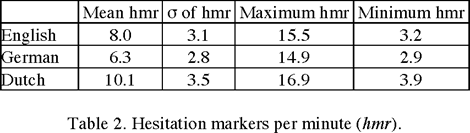
Table 2 shows that Dutch speakers used the most hesitation markers per minute with an hmr of 10.1. English speakers used an average of 8.0 hesitation markers per minute, followed by their German counterparts with an average hmr of 6.3. An ANOVA test revealed a highly significant overall difference between English, German, and Dutch hmr's (F(2,57)=7.93, p=0.001, ω2=19%). A post-hoc Tukey HSD indicated highly significant differences between German and Dutch hmr's, marginally significant differences between English and Dutch, and no significant difference between English and German.11
Although differences in data collection are evident across studies, previous research suggests that English, Dutch, and German have similar articulation rates. Goldman-Eisler (1968) found that English speakers have an articulation rate of between 4.4 and 5.9 syllables per second. In a study by Tauroza and Allison (1990), the average articulation rates in British English vary between 3.16 and 5.33 syllables per second. In Northern Standard Dutch, Blaauw (1995) found that the average articulation rate was 5.2 syllables per second. Verhoeven et al. (2004) found that their Dutch speakers from the Netherlands had an articulation rate of between 4.89 and 5.42 syllables per second. Studies investigating Standard German have suggested similar articulation rates. Dellwo et al. (2003) found that Standard German speakers articulated with an average of 5.6 syllables per second, while their British English speakers in the same study had a mean value of 5.9 syllables per second. Tillmann and Pfitzinger (2003) suggest that, in German, a speech rate of 6.67 syllables per second is fast, and Künzel et al. (1992:49) calculated a mean articulation rate of between 4.4 and 6.0 syllables per second for German. Although previous research suggests that articulation rates in English, German, and Dutch are similar, Laver (1994: 534–546) draws attention to the complications involved with crosslinguistic comparisons of both articulation and speaking rate as a result of structural differences in languages. Due to the facts that (a) previous research suggests similar articulation rates across English, German, and Dutch, and (b) there are numerous problems associated with measuring speed of speech, such measurement was not attempted in the present study (see Pfitzinger 1998, 2001 for a detailed explanation as to why, at least in German, local speech rate is determined by both the phone and the syllable). It is claimed that the results from the previous studies are sufficient within the objectives of this investigation.

Because the ratio of males to females differed within the three language groups and some research indicating that in American English males tend to use more hesitation markers than females (Bortfeld et al. 2001:139–140), a univariate ANOVA was calculated for hmr with the independent variables of gender and language. Although the language differences were confirmed in the post-hoc test, gender was not a significant effect, and the interaction of gender with language was also not significant.
4.2. Proportion of Vocalic, Vocalic-Nasal, and Nasal Markers.
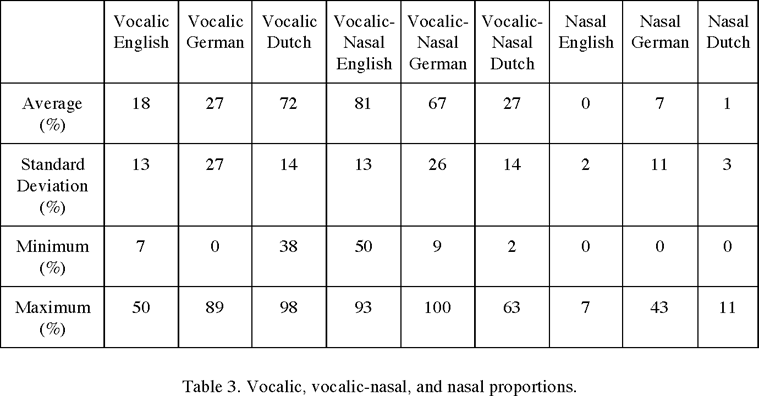
The English and German speakers generally showed a dominance of vocalic-nasal hesitation markers, while the Dutch speakers showed a dominance of vocalic hesitation markers. The German speakers used nasal hesitation markers more frequently than English or Dutch speakers (table 3).
An ANOVA test revealed highly significant differences between the proportions of vocalic-nasals in English, German, and Dutch (F(2,57)= 44.46, p<0.001, ω2=59%). A post-hoc Tukey HSD test revealed a marginally significant difference between the proportions of German and English vocalic-nasals and highly significant differences in Dutch versus English and in Dutch versus German, substantiating the observation that Dutch subjects used far fewer vocalic-nasals than did German and English subjects. Another ANOVA test indicated significant differences between the proportions of vocalic hesitation markers in English, German, and Dutch (F(2,57)=46.24, p<0.001, ω2=61%). Here, a post-hoc Tukey HSD test revealed highly significant differences between Dutch and English, as well as between Dutch and German. However, there was no significant difference between English and German, substantiating the observation that vocalics were used more often in Dutch than in either German or English.

In addition, an ANOVA test revealed significant differences between the proportions of nasals in English, German, and Dutch (F(2,57)=4.43, p=0.016, ω2=10%). A post-hoc Tukey HSD test indicated significant differences between German and Dutch, and between German and English, but not between English and Dutch, supporting the claim that more nasals were used in German than in either English or Dutch. Of the 20 German subjects, 10 used nasals, and their averaged proportion of nasals was 14%. In contrast, only 6 of 27 Dutch speakers used nasals, and their averaged proportion was 6%. Only one English speaker used nasals, which accounted for 7% of his total hesitation marker usage. Accordingly, Germans who did use nasals did so more often than their English and Dutch counterparts.
The tendency for German speakers to use more vocalic-nasal hesitation markers than vocalics was not as consistent as it was for the English speakers, who showed no preference for vocalics. For example, 6% of the hesitation markers used by one German female subject were vocalic and 94% were vocalic-nasal, while three German males showed a clear dominance of vocalic hesitation markers. Their respective vocalic rates were 71%, 89%, and 82%. A highly significant difference was revealed between the proportion of vocalics used by the latter three male subjects and the proportion of vocalics used by the other German speakers (t(2)=6.89, p<0.001, ω2=69%). A highly significant difference was also revealed between the proportion of vocalic-nasals used by these three subjects and the proportion of vocalic-nasals used by the other German speakers (t(2)=-5.76, p<0.001, ω2=61%). Thus, German native speakers showed more polarity in their use of vocalic and vocalic-nasal hesitation markers than English native speakers. No significant difference was revealed between Dutch native speakers and the three German male speakers with regard to the proportion of both vocalic and vocalic-nasal hesitation markers.
There was a higher level of consistency within Dutch native speakers, as opposed to the polarity discussed above within German speakers. However, one Dutch female subject did show a preference for vocalic-nasal hesitation markers with a vocalic-nasal proportion of 63%.
It is of interest to note that the German male subject who displayed the highest proportion of vocalic hesitation markers in German speech also had the highest hmr among the German native speakers. Similarly, as previously noted, Dutch speakers on average had a higher hmr than the English and German speakers, and also tended to use more vocalic hesitation markers. Pearson correlations were run in all three language groups to determine whether the percentage of vocalic hesitation markers correlated with hmr. In English and Dutch, the results were not significant, whereas in German a significant positive correlation was revealed (r=0.46, p<0.05), indicating that Germans who used more hesitation markers in their speech did so by using more vocalics rather than vocalic-nasals.
4.3. Positioning of Hesitation Markers.
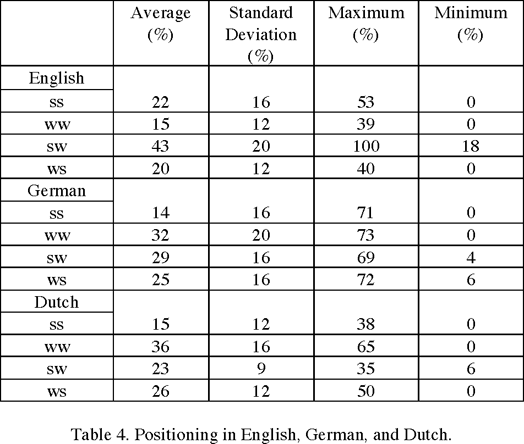
The descriptive analysis revealed that English hesitation markers occurred least frequently in ww positioning, whereas German and Dutch hesitation markers occurred most frequently in this positioning (table 4). An ANOVA test revealed a highly significant difference between ww positioning in English, German, and Dutch (F(2,57)=8.47, p=0.001, ω2=20%). A post-hoc Tukey HSD test indicated that this difference was mainly driven by significant differences between English and German ww positioning, as well as between English and Dutch ww positioning. By contrast, no significant difference was detected between German and Dutch ww positioning.
Another ANOVA test revealed a highly significant difference between sw positioning in English, German, and Dutch (F(2,57)=8.70, p=0.001, ω2=20%). A post-hoc Tukey HSD indicated that this difference was mainly driven by significant differences between English and German sw positioning, as well as between English and Dutch sw positioning. By contrast, no significant difference was detected between German and Dutch sw positioning. These results confirmed the descriptive analysis in which it was found that English subjects' hesitation markers were more frequent in sw positioning than German and Dutch hesitation markers.
No significant differences were revealed in either ss or ws positioning between English, German, and Dutch subjects.
Lastly, it should be noted that the Dutch female speaker who preferred vocalic-nasal hesitation markers over vocalics displayed a slightly higher percentage of ss positioning (25%) and a slightly lower percentage of ww positioning (17%) than the Dutch average. Similarly, of the three German males who displayed an overall preference for vocalic hesitation markers, their percentage of ss positioning was lower than the German average at 7%, 6%, and 9%, although their percentage of ww positioning varied at 29%, 17%, and 59%, respectively.

4.4. Positioning of Vocalic, Vocalic-Nasal, and Nasal Markers.
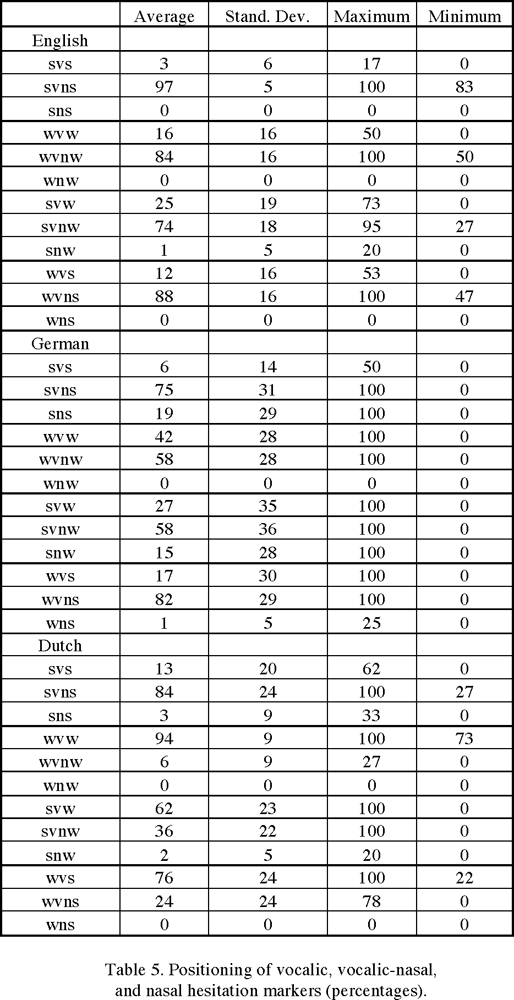
English native speakers showed an obvious dominance of vocalic-nasal hesitation markers in all positions (table 5). This was most salient in ss positioning, in which svns dominated by 97%, and no English speaker preferred any other type of hesitation marker here. In contrast, although vocalic-nasals still dominated, vocalic hesitation markers were most likely to occur in ww and sw positioning. Generally, there was little idiosyncrasy regarding the positioning of vocalic, vocalic-nasal, and nasal hesitation markers hesitation markers within the English group.
In contrast, German subjects showed more idiosyncrasy and high standard deviations in the positioning of vocalic, vocalic-nasal, and nasal hesitation markers. Vocalic-nasal hesitation markers were used most frequently in ss (svns=75%) and ws positioning (wvns=82%) in German.

In ss positioning, the variation of vocalic-nasals and nasals was great (0–100%), rather than a variation between vocalics and vocalic-nasals, as observed in ww positioning. No German subject preferred vocalic hesitation markers in ss positioning. The three German male subjects, whose vocalic to vocalic-nasal ratio was similar to the average Dutch vocalic to vocalic-nasal ratio, generally displayed a preference for vocalic-nasals in ss positioning. At the same time, one of these male speakers exhibited an equal distribution of vocalic, vocalic-nasal, and nasal hesitation markers in ss positioning. Nasal hesitation markers occurred most frequently in ss positioning in German, in comparison to the three other positions. Two speakers who displayed an overall preference for vocalic-nasal hesitation markers did not do so in ss positioning, preferring here nasal hesitation markers. Interestingly, both of these speakers exhibited a dominance of vocalic-nasal hesitation markers in ww positioning.
In ww positioning, vocalic hesitation markers were most likely to occur in German (wvw=42%; wvn=58%), although the variation between speakers for vocalic and vocalic-nasals in this position was great (0– 100%). The three German males who exhibited an overall dominance of vocalic hesitation markers also did so in ww positioning.12
Their relative percentages of vocalic hesitation markers in ww positioning were 75%, 100%, and 90%.
As stated above, two speakers showed an overall preference for nasal hesitation markers in ss positioning, with the relative percentages of these markers being 67% and 100%. Both of these subjects preferred vocalic-nasals in ww positioning, and their relative percentages of vocalic-nasals for this position were 100% and 88%. The other speaker who only used vocalic-nasal hesitation markers in ww positioning did not exhibit any hesitation markers in ss positioning.
The overall dominance of vocalic-nasals in ss positioning in English and German was similarly displayed in Dutch. In Dutch, vocalic-nasal hesitation markers dominated ss positioning by 84%. By contrast, the proportion of vocalic hesitation markers in this position was only 13%. This was the exception because in other positions, vocalic hesitation markers dominated in Dutch. It should be noted, however, that, as in German, the range of vocalic-nasals in ss positioning for Dutch was somewhat idiosyncratic (27–100%), indicating that some Dutch speakers displayed high levels of vocalic hesitation markers in ss positioning.14
Those Dutch speakers who used vocalics in ss positioning did so with relative percentages of 62%, 17%, 36%, 17%, 45%, 50%, 14%, and 25%.
In ww positioning, vocalics dominated by 94% in Dutch, and the standard deviation here was low. Only one Dutch female speaker showed an overall dominance of vocalic-nasals; yet in ww positioning, she displayed a dominance of vocalics, and in ss positioning an expected dominance of vocalic-nasal hesitation markers.
5. Discussion.
5.1. Hmr in English, German, and Dutch.
The results regarding hmr in English, German, and Dutch indicate that hesitation markers display language-specific characteristics (table 2). Dutch speakers used significantly more hesitation markers than speakers of the other languages. It was also found that gender did not have a significant effect on hmr for any of the languages.
5.2. Proportion of Vocalic, Vocalic-Nasal, and Nasal Markers.
The results regarding proportion of vocalic, vocalic-nasal, and nasal hesitation markers in English, German, and Dutch indicate that hesitation markers display language specific characteristics (table 3). The fact that vocalics dominated in Dutch is consistent with the results of Swerts et al.'s (1996) study of Dutch, which found that vocalic-nasal hesitation markers occurred less frequently than vocalic hesitation markers. The results additionally support Lickley's 1994 study, which found for six British English speakers that vocalic-nasals were more common in informal conversation. Moreover, language-specificity was indicated by the observation that nasal hesitation markers were used significantly more often in German than in either English or Dutch. Ten German subjects used nasals, and of these the averaged proportion of nasals was 14%. By contrast, only six Dutch native speakers used nasals, and only one English native speaker used nasals, all minimally.
In addition to language-specific tendencies, differences between speakers within each language were also observed. Most Germans showed an obvious dominance of vocalic-nasals over vocalics. However, for three male German subjects, this ratio was reversed—they displayed a dominance of vocalics, as did the Dutch. Interestingly, their percentage of ss positioning was half that of the German average. Similarly, it was noticeable that the one Dutch female who showed a preference for vocalic-nasal hesitation markers also used an above average percentage of ss positioning. Such results suggest that although these speakers went against their language trend in preference for either vocalics in Dutch and vocalic-nasals in German, this may have been due to a greater relative usage of ss positioning for the Dutch speaker and a lesser relative use of ss positioning for the German speakers.
When the languages were observed separately, only German showed a positive correlation between high hmr and preference for vocalic hesitation markers. It is possible that a correlation could exist in English and Dutch as well, but that the number of subjects in the present study was not large enough to reveal such a correlation, given that both the English and Dutch speakers were more consistent in their preference for specific hesitation markers.
5.3. Positioning of Hesitation Markers.
Highly significant differences were also displayed with regard to the positioning of hesitation markers in sw and ww positioning. English hesitation markers occurred least frequently in ww positioning, whereas German and Dutch hesitation markers occurred most frequently in ww positioning. If it is assumed that hesitation markers in ww positioning are representative of minor discourse breaks—as suggested by both Swerts et al. (1996) and Clark and Fox Tree (2002) (also Fox Tree 2001)—it is conspicuous that the English speakers in this study structured their speech with fewer minor discourse breaks than the German and Dutch speakers.
5.4. Positioning of Vocalic, Vocalic-Nasal, and Nasal Markers.
The results regarding the positioning of vocalic, vocalic-nasal, and nasal hesitation markers in English, German, and Dutch indicate that hesitation markers display language-specific characteristics (table 5). English native speakers showed an obvious dominance of vocalic-nasal hesitation markers in all positions. This was most salient in ss positioning, in which svns dominated by 97%. In contrast, although vocalic-nasals still dominated, vocalic hesitation markers were most likely to occur in sw and ww positioning. In Dutch, vocalic-nasal hesitation markers dominated similarly in ss positioning by 84%, and the proportion of vocalic hesitation markers in this positioning was only 13%. This was an exception because in other positions vocalic hesitation markers dominated in Dutch. In ww positioning, vocalics dominated by 94% in Dutch and the standard deviation here was low. Only one Dutch speaker showed an overall dominance of vocalic-nasals, yet in ww positioning she displayed a dominance of vocalics. In German, nasal hesitation markers occurred not only most frequently in ss positioning, they also occurred in higher percentages than in either English or Dutch.
In addition to language-specific differences in the positioning of vocalic, vocalic-nasal, and nasal hesitation markers in English, German, and Dutch, differences across speakers in each language were also observed. For example, a number of Dutch speakers showed high percentages of vocalic hesitation markers in ss positioning—one speaker even a dominance—although the language trend was to use vocalic-nasal hesitation markers in this position.
Moreover, the idiosyncrasy between German speakers for vocalic and vocalic-nasals in ww positioning was great. Although the three German males who exhibited an overall dominance of vocalic hesitation markers also did so expectantly in these minor breaks, idiosyncrasy of preference for vocalic or vocalic-nasal hesitation markers in ww positioning was observed in the rest of the German group—hence, the population exhibited an overall preference for vocalic-nasals. Within this group, nine speakers preferred vocalic-nasals, and two of these speakers only used vocalic-nasals in ww positioning. By contrast, two other German speakers, in addition to the three German males already mentioned, displayed a dominance of vocalic hesitation markers in ww positioning. Other speakers displayed no preference between vocalic and vocalic-nasal hesitation markers in ww positioning. Six speakers within the German group, who showed an overall dominance of vocalic-nasal hesitation markers, did so in both ww and ss positioning.
Such idiosyncrasies within the German and Dutch groups challenge the idea that hesitation markers solely function to signal delay—or, more specifically, vocalic-nasals a major delay and vocalics a minor delay—to a listener (Fox Tree 2002). Moreover, the fact that the English native speakers in the present study showed an overall preference for vocalicnasals in all positions does not support the idea that such hesitation markers signal a major delay in British English, as is suggested for American English by Clark and Fox Tree (2002).
Future research on other properties of hesitation markers, such as fundamental frequency, or perhaps on the properties investigated in the present study, but applying a more precise technique, may well reveal syntactic, lexical, or pragmatic patterns within these languages not discovered here.
6. Conclusion.
The crosslinguistic comparison of hesitation markers revealed statistically significant differences between English, German, and Dutch. These results indicate language-specific trends regarding hesitation markers in the observed languages. However, the fact that some individual subjects within each language group did not conform to these trends raises questions about the function of hesitation markers.
If hesitation markers have a signaling effect, as proposed by Clark and Fox Tree (2002), the results of the present study may have interesting consequences. Due to the fact that English speakers display a dominance of vocalic-nasal hesitation markers and Dutch speakers a dominance of vocalic hesitation markers, the use of vocalic-nasal hesitation markers to signal a major delay in English—if this is the case at all—must have had a less significant effect on the listener than in Dutch. Similarly, the use of vocalic-nasal hesitation markers to signal a major break in discourse on the part of the three German male speakers who showed an overall dominance of vocalic hesitation markers would have a greater signaling effect to indicate a major discourse break than if used by the other German native speakers who showed an overall preference for vocalic-nasal hesitation markers. The British English speakers and the majority of the German speakers in the present study who displayed a dominance of vocalic-nasal hesitation markers may have used other phonetic cues to signal major and minor discourse breaks to the listener, which were not analyzed in this study. However, it is conspicuous that if vocalic and vocalic-nasal hesitation markers are in fact words, the former signaling a minor and the latter a major discourse break (Clark and Fox Tree 2002), they do not behave similarly in both American and British English.
It is possible that hesitation markers have a signaling function for the listener, but are also a symptom of cognitive processes on the part of the speaker. This interpretation would explain results from various studies, which on the surface appear to be conflicting. For example, four observations have been seen as evidence that hesitation markers are symptoms of the speaker's cognitive processes: (a) hesitation markers are used in monologues (Schachter et al. 1991), (b) they are used more frequently in the case of abstract rather than concrete nouns (Reynolds and Paivio 1968), (c) more hesitation markers are used when subjects describe ambiguous occurrences (Siegman and Pope 1966), and (d) hesitation markers are more often followed immediately by a word than by silence (O’Connell and Kowal 2005). If hesitation markers have both a symptomatic and a signaling effect, this may explain why they can be used pragmatically to both keep and cede the floor (Maclay and Osgood 1959:42; Clark and Fox Tree 2002:90)—perhaps dependent upon the content of the surrounding conversation (O’Connell and Kowal 2005: 572). If the listener interprets hesitation markers to symbolize cognitive processes on the part of the speaker, the former may react differently, depending on the context and the interpreted difficulty of the cognitive process.
The present findings do not solve the “symptom versus signal” debate. On the one hand, the overall language-specificity of hesitation markers, as well as the fact that they are uttered at all, supports the signal hypothesis. Speakers seem to be communicating information to their interlocutor within the norms of their language (Clark and Fox Tree 2002). On the other hand, idiosyncratic differences within the German group in particular, and also within the Dutch, do not support the signal hypothesis. If hesitation markers function solely as words, why would speakers within German and Dutch divide themselves into different subgroups regarding their preferences for these words in similar situations? Moreover, how does one explain a lack of difference between hesitation markers in minor and major positioning in the case of the British English subjects? This type of crosslinguistic research opens a number of avenues for investigating both the symptom and signal hypotheses of hesitation markers. Future research on further properties of hesitation markers may well deliver answers to these questions.
APPENDIX Selection of Questions Posed
English speakers.
- 1. How would you describe the British culture to foreigners?
- 2. How would you advertise the area in and around Bristol in a travel guide?
- 3. Is it advantageous or disadvantageous to accept the Euro in Britain? Why and how would it impact British culture if at all?
- 4. Describe the last holiday you went on. Where was it, and what did you like or dislike most about it?
- 5. How do you think the Iraq war will end, and how will it come to this?
German speakers.
- 1. Kannst du die Gegend/Stadt, wo du herkommst, mit Trier vergleichen?
- 2. Kannst du beschreiben, was du in Trier am Wochenende machst?
- 3. Kannst du die englische Kultur mit der amerikanischen Kultur vergleichen? Wie nehmen Deutsche diese verschiedenen Kulturen im Vergleich mit der eigenen wahr?
- 4. Die SPD-Regierung überlegt, Elitehochschulen in Deutschland zu etablieren. Findest du diesen Vorschlag gut oder schlecht? Warum?
- 5. Was für einen Ausgang wird der Irakkrieg haben und wie wird es dazu kommen deiner Meinung nach?
Dutch speakers.
- 1. Woon je in Amsterdam/Utrecht, of studeer je alleen hier? Wil je een beetje over Amsterdam/Utrecht vertellen? Bevalt het je of niet en waarom?
- 2. Kun je de relatie tussen Nederland en België uitleggen? Wat zijn de verschillen tussen België en Nederland?
- 3. Wat is voor jou belangrijk om een goede studietijd te hebben?
- 4. Kun je beschrijven hoe je een volmaakt weekend zou hebben? Wat voor leuke dingen ga je doen of niet doen?
- 5. Nederlanders zijn er vaak trots op, dat hun land heel tolerant is. Bijvoorbeeld zijn prostitutie en softdrugs toegestaan. Vind je het goed of slecht dat in Nederland meer toegestaan wordt dan in andere landen ter wereld?