Early voting behavior research concluded that campaigns had modest effects on voters, serving mainly to reinforce existing preferences. By the 1990s, political scientists had begun to question this ‘minimal effects’ thesis.Footnote 1 Importantly, whereas earlier work assumed that campaign influence would operate largely by changing the content of attitudes and beliefs, contemporary research emphasized an indirect channel of effect: change in the impact or weight associated with attitudes and beliefs relevant to particular political judgements. By drawing voters’ attention toward – or priming – a subset of the relevant considerations, the campaign was thought to alter the foundations of the vote decision.Footnote 2
Recently, however, LenzFootnote 3 has argued that evidence of priming during elections is weaker than commonly believed. His most surprising conclusions concern issue priming during campaigns: campaign-induced increases in the impact of policy attitudes on vote choice. Numerous studies purport to show such effects.Footnote 4 Lenz contends, however, that the critical test in these studies is fatally flawed. What has been taken as evidence of issue priming, he argues, could equally reflect voters (1) acquiring knowledge of the policy positions of candidates or parties (learning) or (2) adjusting their issue attitudes to better reflect their otherwise-determined vote choices (opinion change). Further, in analyses of plausible episodes of issue priming that take learning and/or opinion-change processes into account, Lenz finds evidence consistent with issue priming in just one out of ten cases.Footnote 5 At the same time, he draws an important distinction between priming of issues and of considerations relating to government performance (for example, economic management), finding that performance judgements are routinely primed in elections he examines. He concludes that ‘performance issues are cognitively easier for citizens than policy issues’, inasmuch as ‘judging a person’s performance is a part of everyday life’.Footnote 6 The upshot is a view of campaign influence that lies between minimal-effects and contemporary accounts: campaigns can prime cognitively simple performance criteria, but not substantive policy conflicts.
The present article, by contrast, reports evidence of issue priming in several elections, including some of those analyzed in Lenz’s research. The main departure from Lenz is to include in issue-priming tests a group of survey respondents that is largely excluded from his studies: respondents who, in one or more waves of the panel surveys analyzed, do not report a major-party vote (or vote intention) when interviewed. Excluding these respondents from the analysis, the article argues, is likely to lead to an underestimate of issue-priming effects. As explained below, there are strong reasons to expect that the respondents excluded from Lenz’s studies are relatively susceptible to priming effects. There are also reasons to expect priming effects among these respondents to be relatively easier to detect. Accordingly, this article includes the previously excluded respondents in its tests of issue priming. Based on analyses of six national elections in four countries (Canada, Netherlands, United Kingdom and United States), we find that – once the formerly excluded group of respondents is included – priming in campaigns is not limited to performance criteria: campaigns can, and sometimes do, engage citizens in issue-based reasoning about vote choice.
These findings have three important implications. First, along with other recent research on the priming hypothesis, the results reinforce a robust conception of the potential impact of election campaigns on voters.Footnote 7 Secondly, and more generally, the results underline the potential for media influence on political attitudes.Footnote 8 Finally, as noted, the article provides evidence that issues can matter: under the right conditions – that is, when issues are prominent in campaign communications – voters choose parties and candidates, in part, on the basis of their policy commitments.
ALTERNATIVE TESTS OF ISSUE PRIMING
Observational tests of the priming hypothesis typically rely on data from survey interviews conducted before and after a priming event: an occurrence in the social or physical world that produces a change in political communications that is sufficient (in principle) to draw voters’ attention toward some set of politically relevant considerations. For example, a debate between presidential candidates that is dominated by the candidates’ conflicting positions on income tax policy can be expected to generate communications – principally news coverage – that are also (relatively) dominated by discussion of the candidates’ income tax positions. Priming theory implies that such a shift in communications should strengthen the links that voters form between their income tax policy attitudes and their electoral choices.
To detect such changes in ‘issue weights’, most scholars have applied a version of what Lenz terms ‘the conventional test of priming’. The test compares the partial correlation between contemporaneous measures of an issue attitude and vote choice, before and after a priming event. The test can be expressed in the following equation:Footnote 9
 $$Vote_{{i,t}} \,{\equals}\,\beta _{0} {\plus}\beta _{1} Issue_{{i,t}} {\plus}\beta _{2} Post_{{i,t}} {\plus}\beta _{3} Issue_{{i,t}} Post_{{i,t}} {\plus}{\epsilon}_{{i,t}} .$$
In this equation, t and i subscript the time of interview and respondent, Vote is vote intention (or reported vote), Issue is an issue attitude, Post is a dichotomy that records whether the interview occurs before (0) or after (1) the priming event, β
0 through β
3 are coefficients to be estimated, and ε is an idiosyncratic error term. If we assume that β
1 is positive (negative), then the conventional test of priming requires
 $\hat{\beta }_{3} $
to be greater (less) than 0 and statistically significant.
Lenz argues that conclusions based on Equation 1 are vulnerable to two criticisms. First, he argues that evidence based on this conventional test of priming can be interpreted as evidence of learning, that is, of voters acquiring knowledge of the policy positions of candidates (or parties) in relation to the seemingly ‘primed’ issues. In other words, a correctly signed and statistically significant estimate of β 3 may signal that voters are better able to connect their issue attitude to the vote as a result of having improved their understanding of where the partiesFootnote 10 stand on that issue. The issue, thus, need not have become more important or accessible to the voter; rather, the voter may simply have learned to better relate her issue attitude to her vote choice.
Secondly, Lenz argues that, even among those who already know where the parties stand on the issues, what looks like the priming of an attitude may instead reflect opinion change. Rather than voters shifting their votes to better reflect their issue attitudes, they may instead shift their issue attitudes to better reflect their otherwise-determined vote choices. A correctly signed and statistically significant estimate of β 3 may thus result from voters adopting the position of their favored party on the issues emphasized in the campaign.
Lenz addresses these shortcomings of the conventional test through the use of panel data bracketing the occurrence of priming events. First, to eliminate confounding with learning, he confines the sample for analysis to those with correct knowledge of parties’ positions on the primed issue throughout the interval during which the priming event occurs. The typical indicator of party-position knowledge requires individuals to place parties on the correct side of an issue before and after the priming event. Among those who pass this test, Lenz reasons, any increase in an issue’s weight cannot reflect a learning process: these voters know the parties’ issue commitments before the priming event, and they still know the parties’ commitments afterwards. Thus if the partial correlation between the attitude and vote choice increases after the priming event, it must reflect a process other than learning, such as priming.
Lenz’s second basic method aims to eliminate opinion change from issue-priming estimates. The approach uses lagged values of attitudes to address the possibility of reverse causation. Lenz prefers what he terms the ‘three-wave test of priming’, which requires measures at three points in time: two prior to the priming event and one following it. The test compares the effect of lagged values of issue attitudes on vote choice, controlling for lagged vote choice, before and after priming events. The implied regression equation is:
 $$Vote_{{i,t}} \,{\equals}\,\beta _{0} \,{\plus}\,\beta _{1} Issue_{{i,t{\minus}1}} {\plus}\beta _{2} Post_{{i,t}} {\plus}\beta _{3} Issue_{{i,t{\minus}1}} Post_{{i,t}} {\plus}\beta _{4} Vote_{{i,t{\minus}1}} {\plus}\beta _{5} Vote_{{i,t{\minus}1}} Post_{{i,t}} {\plus}{\epsilon}_{{i,t}} ,$$
where all terms and subscripts are defined as above.Footnote 11 With the addition of controls and corrections for the clustering of the observations by respondent, an estimate of β 3 provides a test of issue priming that is not biased by opinion change.
The data requirements of the three-wave test outstrip what is typically available to researchers.Footnote 12 Lenz thus proposes a second-best alternative, the ‘two-wave test of priming’. Here, lagged values of issue attitudes are utilized only to estimate the post-event effect of issues on vote choice; the pre-event estimate uses contemporaneous measures of the issue attitude and vote choice. The equation to be estimated is:
 $$Vote_{{i,t}} \,{\equals}\,\beta _{0} {\plus}\beta _{1} Issue_{{i,1}} {\plus}\beta _{2} Post_{{i,t}} {\plus}\beta _{3} Issue_{{i,1}} Post_{{i,t}} {\plus}{\epsilon}_{{i,t}} ,$$
where all terms and subscripts are defined as above.Footnote
13
With controls and corrections for clustering – and restricting the sample to those with party-position knowledge – a correctly signed, statistically significant estimate of β
3 provides an estimate of issue priming that, while imperfect, is clearly superior to the conventional test. First, the estimate of the post-event issue-attitude effect is unbiased, in the sense that confounding by opinion change is eliminated. Secondly, while the estimate of the pre-event issue-attitude effect is not unbiased in this sense, the bias in the estimate is conservative: any adjustment of issue attitudes to coincide with vote choice at t=1 would increase the pre-event estimate of the issue weight,
 $\hat{\beta }_{1} $
, and decrease the estimated priming effect,
 $\hat{\beta }_{3} $
.Footnote
14
PRIMING EFFECTS AND RESPONDENT TYPES
In confronting learning and opinion change as confounders in the analysis of issue-priming effects, Lenz makes an important contribution. To be sure, his approach neglects certain variables and analytical complications highlighted in other research. The use of a pre-/post-priming-event dichotomy to identify priming effects misses important variance in respondents’ exposure to priming messages.Footnote 15 Measures of party-position knowledge that simply capture whether a party is placed on the correct side of an issue ignore learning that manifests as increasing certainty about parties’ policy positions.Footnote 16 Most fundamentally, observational tests of priming have a weaker claim to internal validity than their experimental counterparts.Footnote 17 Still, relative to earlier studies of issue priming, Lenz’s approach is a significant advance.Footnote 18
Nonetheless, there are reasons to revisit Lenz’s application of this approach. Specifically, in six of the ten issue-priming episodes he analyzes, only those who report voting – or intending to vote – for major parties are included in the estimation sample.Footnote 19 For example, in his analysis of the 2000 US presidential election, Lenz considers only the behavior of those declaring for either Republican George W. Bush or Democrat Albert Gore. This means that anyone supporting a minor party, intending or deciding not to vote, or answering that she does not know for whom she might vote (or who is non-responsive to vote choice questions) is not included in the analysis.
Of course, in plurality elections like the US presidential election, most voters end up supporting one of the major parties – and, presumably,Footnote 20 this is why Lenz chose to confine his analyses to major-party supporters.Footnote 21 However, to be included in his panel-based estimates of issue priming, such individuals would also need to have indicated their support for a major party in one (for the two-wave test) or two (for the three-wave test) interviews prior to election day. This does not mean that these respondents’ vote choices cannot change across survey waves. It is simply that the change must be between major parties; conversions to or from minor-party support, abstention or non-response are not observed. To simplify the exposition, we now refer to the classes of respondents Lenz includes and excludes (in his analyses of the elections concerned) as ‘type-A’ and ‘type-B’ respondents, respectively.
Importantly, survey respondents regularly express support for minor parties, an intention to abstain or that they ‘don’t know’ for whom they will vote. Across the samples analyzed here (details below), the mean share of such type-B respondents is 41.3 per cent. The sizable proportion of this respondent type reflects, in part, the fact that these panel surveys include interviews that were conducted, in some cases, months before election day (when many respondents are uncertain how they will vote).
While including type-B respondents adds cases to the analysis, small sample sizes are not likely to explain Lenz’s null findings. Indeed, the issue-priming estimates in Lenz’s study are not only insignificant, but generally near 0.Footnote 22 Instead, this article argues, including type-B respondents in tests of priming is important for two reasons. Put briefly, (1) relative to type-A respondents, type-B respondents can be expected to be more susceptible to priming effects, and (2) given fairly generic assumptions regarding the psychology of the vote, the size of the minimum detectable priming effect among type-B respondents is smaller than it is among type-A respondents. The remainder of this section is focused on elaborating these two claims.
Susceptibility to Priming Effects
The set of type-B respondents can be divided according to whether they report one of three types of voting behavior: abstention (or intended abstention), non-response (that is, reporting that they ‘don’t know’ who they will (or did) vote for, or refusing to disclose this information in a survey interview) or minor-party support. (Henceforth, we describe these groups as abstainers, non-responsives and minor-party supporters).Footnote 23 Importantly, there are theoretical and empirical reasons to suspect that the likelihood of exhibiting each of these behaviors is correlated with plausible determinants of susceptibility to campaign influence.
Abstainers can be expected to be relatively less interested in politics,Footnote 24 and therefore more ambivalent about political objects, such as vote choice.Footnote 25 This should, other things being equal, make them more open to campaign influence.Footnote 26 Relative to the politically interested, furthermore, the less interested – because they are less politically knowledgeable – are also less likely to have ‘crystallized formulas for making [political] judgments’, which may render them more susceptible to priming events.Footnote 27
Of course, while the less interested may be more likely to respond to political information when it is received, they may be less likely to be exposed to (and comprehend) such information in the first place. In the context of an election campaign, however, the positive correlation between interest and reception (that is, the outcome of exposure and comprehension) is likely to weaken.Footnote 28 Campaigns are generally assumed to stimulate voter attention and political learning.Footnote 29 The increased volume and intensity of political communications during elections, further, should attenuate the link between one’s preference for political information and actual exposure to it. Accordingly, campaigns have been shown to increase knowledge of parties’ policy positions, particularly when a single issue dominates campaign communications.Footnote 30 There is also evidence that campaign influence is manifested most strongly among the less interested.Footnote 31 It is reasonable to suppose, in short, that the persuasion-inhibiting qualities of low political interest are dampened during campaigns. Abstainers can thus be expected to be relatively susceptible to campaign influence, particularly in the face of the dramatic upheavals in information examined in observational studies of issue priming.Footnote 32
Similar arguments about campaign susceptibility apply to non-responsives, especially those who, when asked by a survey interviewer, ‘don’t know’ for whom they will vote. Both political interest and attitudinal ambivalence are directly correlated with the propensity for this form of item non-response.Footnote 33 According to the theoretical logic developed above, then, non-responsives may be more affected by campaign communications than other respondents. There are also solid empirical grounds for this supposition, inasmuch as a large share of those who are non-responsive to vote queries prior to election day are, ipso facto, ‘late deciders’. A large cross-national literature indicates that late deciding correlates with qualities that magnify campaign influence, such as low levels of partisan commitment and high levels of ambivalence with respect to vote choice; there is also direct evidence of a positive interaction between campaign influence and the lateness of voting decisions.Footnote 34 Much like abstainers, therefore, non-responsives can be expected to be above average in their susceptibility to campaign influence.
Finally, while less is known about minor-party supporters, various evidence and arguments are consistent with the view that they may also be relatively more influenced by the campaign than others. In a rare study of minor-party voting behavior, Hillygus, analyzing support for Ralph Nader in the 2000 US presidential election, found minor-party support to be exceptionally volatile during the campaign. Just 28.3 per cent of Nader supporters during the campaign cast a ballot in his favor on election day; the comparable figures for Bush and Gore supporters were 70.0 and 67.6 per cent, respectively.Footnote 35 This pattern of vote instability is consistent with the assumption that minor-party supporters are relatively susceptible to campaign influence. Also consistent with this assumption is the fact that Nader defectors were commonly motivated by policy and ideological concerns – considerations we would expect to have been primed by the campaign.Footnote 36 On more theoretical grounds, it seems inevitable that minor-party supporters, at least in plurality elections, will be among the most ambivalent voters, inasmuch as they are repeatedly reminded that a vote for their favored party may be a ‘wasted vote’.Footnote 37 For all these reasons, it is likely that many minor-party supporters are, similar to other type-B respondents, relatively susceptible to campaign influence.Footnote 38
Detectability of Priming Effects
Even if we assume that respondents are equally susceptible to campaign influence – that priming events exert equivalent effects on type-A and type-B respondents – including type-B respondents in issue-priming tests may nonetheless make it easier to detect changes in voting behavior in response to priming events. Applied to discrete measures of vote choice, the two- and three-wave tests of priming depend on changes in voting behavior following the onset of a priming event.Footnote 39 It follows, given certain assumptions regarding the psychology of the vote decision, that the ability to observe voters transitioning to or from abstention, non-response or minor-party support allows us to observe priming effects that exert a smaller influence on voters. This conclusion is implied by the simple voting model presented in this section.
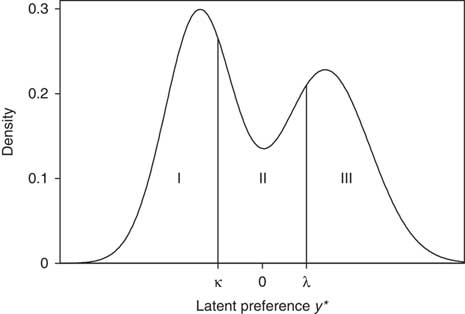
Figure 1 helps explicate the model’s features. The horizontal axis defines a latent preference, y*, with respect to a set of ordered categories of vote intention, y. Assume that a threshold function maps values of y* into y,
 $$y_{i} \,{\equals}\,\left\{ {\matrix{ {1\,if\,y_{i}^{{\asterisk}} \leq \kappa } \cr {2\,if\,\kappa \,\lt\,y_{i}^{{\asterisk}} \leq \lambda } \cr {3\,if\,\lambda \,\lt\,y_{i}^{{\asterisk}} ,} \cr } } \right.$$
where λ>κ. The values of y correspond to support for one of two major parties (if
 $y_{i} \in[1,3]$
) or abstention, non-response or minor-party support (if y
i
=2).
Hypothetical distribution of vote preferences

The model thus describes how voters translate an unobserved continuum of vote preference into a finite set of observed, ordered categories of voting behavior. The unobserved continuum, y*, can be conceptualized as a single dimension of party or candidate evaluation that combines the diverse considerations (for example, partisan identities, government performance evaluations and issue attitudes) that inform the voter’s choice on election day. (Figure 1 also contains an illustrative distributionFootnote 40 of vote preferences, which is useful in the exposition below.)
A priming effect, other things being equal, produces a change in y* in response to a priming event. The priming effect for a given unit, θ i , can be expressed as follows:
 $$\theta _{i} \,{\equals}\,y_{{i,Post}}^{{\asterisk}} {\minus}y_{{i,Pre}}^{{\asterisk}} ,$$
where Pre and Post index preferences before and after the priming event, holding constant all other influences on
 $y_{i}^{{\asterisk}} $
. Critically, if θ
i
is too small, then it may not suffice to push the voter into an adjacent category of voting behavior. Likewise, if
 $y_{i}^{{\asterisk}} $
is to the left of κ or to the right of λ, then values of θ
i
that shift
 $y_{i}^{{\asterisk}} $
away from the threshold for the adjacent category will only reinforce i’s existing vote choice. Put differently, in both situations the priming event may alter the voter’s latent vote preference, although not in a manner that will alter her observable voting behavior.
Now consider the distribution of voter preferences in Figure 1. The voting model implies that: those with preferences to the left of (or equal to) κ in the area under the curve marked I vote for major party 1; those with preferences strictly to the right of λ, in area III, vote for major party 3; and all others, with preferences falling between κ and λ and contained in area II, either abstain, are non-responsive or support a minor party (that is, y
i
=2). Suppose that a priming event occurs that produces an equivalent positive (rightward) shift in y* for all voters, that is, θ
i
>0 for all i.Footnote
41
Whatever the magnitude of θ, no change will be observed for voters in area III: the priming effect simply reinforces these voters’ existing vote choices. For voters in areas I and II, however, whether we observe a change in vote choice (that is, in y) depends on the size of θ and the voter’s distance from the nearest threshold to the right of her latent preference. For those in area I, change in y
i
is observed if
 $\theta \,\gt\,\kappa {\minus}y_{i}^{{\asterisk}} $
; for those in area II, change is observed if
 $\theta \,\gt\,\lambda {\minus}y_{i}^{{\asterisk}} $
.
The above assumes we observe the full distribution of y: major-party voting (
 $y\in[1,3]$
) and abstention, non-response or minor-party support (y=2). Yet what if we do not observe the latter voters – that is, what happens if we do not observe the behavior of type-B respondents? Now, the conditions under which a positive priming effect (θ>0) produces observable change in vote choice are more restrictive:
∙ First, for those in area I, change in y i is observed only if
 $\theta \,\gt\,\lambda {\minus}y_{i}^{{\asterisk}} $
. By definition, of course,
$\lambda {\minus}y_{i}^{{\asterisk}} \,\gt\,\kappa {\minus}y_{i}^{{\asterisk}} $
(where the expression to the right of the inequality states the quantity that θ must exceed to observe a change among voters in area I when we observe y’s full range). For those in area III, a symmetrical conclusion applies when θ<0 (see the Appendix). The implication is that, when we observe only type-A respondents, it takes a larger priming effect (a larger shift in y*) to generate a detectable change in voting behavior among those with an initial preference for a major party.
∙ Secondly, given that the behavior of those in area II is not observed, change in y i is observed only if θ>λ−κ. Conversely, as noted above, when those in area II are observed, change in y i is observed if
$\theta \,\gt\,\lambda {\minus}y_{i}^{{\asterisk}} $
. Given that
$y_{i}^{{\asterisk}} \,\gt\,\kappa $
for all those in area II, it follows that
$\lambda {\minus}\kappa \,\gt\,\lambda {\minus}y_{i}^{{\asterisk}} $
(for area II voters). A symmetrical conclusion applies when θ<0 (see the Appendix). The implication is that it takes a larger priming effect to generate a detectable change in voting behavior when we observe only type-A respondents.


The voting model thus implies that the minimum detectable priming effect is smaller when type-B respondents are observed than when they are excluded, and this conclusion applies even if all respondents initially express a major-party preference.
Note that the voting model yields the intuitive implication that it is easier for a major-party voter to deactivate than to convert: a smaller shift in latent preferences is required for the voter to drift away from an initial vote preference – into indecision or apathy – than for the voter to adopt a preference for another major party. Similarly, the logic implies that it is easier to activate abstainers – to motivate an abstainer to support a major party – than it is to convert voters from one major party to the other.
The implications of the voting model ought to apply in many contexts. Specifically, if it is plausible to represent the vote choice as (1) a set of ordered alternatives along a continuum of preference, where (2) each of two major parties (or sets of parties) occupies an extreme placement on the continuum and (3) all other voting-behavioral alternatives (including abstention and support for other parties) fall between these extremes, then excluding type-B respondents from tests of priming increases the magnitude of the minimum detectable priming effect.Footnote 42
METHOD AND CASE SELECTION
This article has advocated including type-B respondents – who report something other than support for one of the major parties across the waves of a panel survey – in samples used to estimate issue-priming effects. Accordingly, it now revisits the question of issue priming by analyzing plausible priming episodes using samples that include – along with consistent major-party supporters – actual and intended abstainers, non-responsives and minor-party supporters. To isolate the effect of including type-B respondents, we adhere as closely as possible to Lenz’s modeling approach.
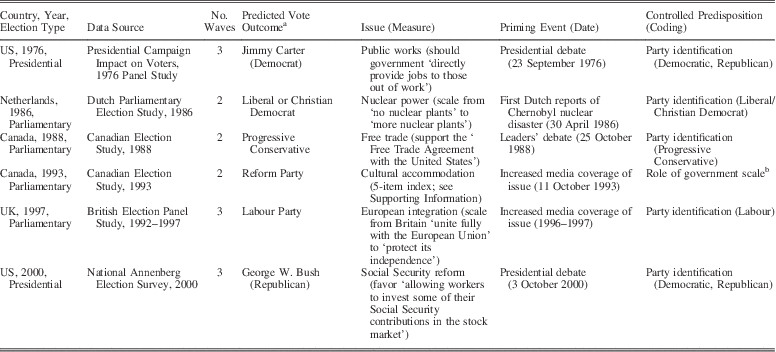
Table 1 provides summary information regarding the set of issue-priming episodes. The set includes five of the six casesFootnote 43 Lenz analyzes using discrete measures of vote preference as dependent variables. The final case (Canada 1993) is treated in great depth by Jenkins and provides unusually good data for analyzing issue priming.Footnote 44 For each case, Table 1 indicates the data source, the number of interview waves utilized in the analysis, the modeled vote outcome, the seemingly primed issue attitude, the priming event and the political predisposition controlled in the models (see below). As these six issue-priming episodes are discussed at length elsewhere,Footnote 45 the remainder of this discussion is confined to a description of the modeling approach and coding rules. The Appendix provides a more detailed account of each case, focusing on analytically important features (especially the seemingly primed issue and priming event in the case), along with measurement information.
Issue-Priming Episodes

a This is the response that is coded 1 on the binary vote-choice variable in the regressions in Tables 2 and 3. All other valid responses are coded 0.
b This follows Jenkins (Reference Jenkins2002). See the Appendix for a discussion of the control for this case.
Central to the analysis of each case are issue-priming estimates based on either the two- or three-wave test of priming (Equations 2 and 3, respectively), depending on whether the case supplies a two- or three-wave panel survey (see ‘No. Waves’ in Table 1). Each model also includes, following Lenz, a control for a long-term political predisposition (generally party identification) and that predisposition’s interaction with the survey wave indicator. In three-wave tests the controlled predisposition is lagged one period; in two-wave tests the measure is from the first wave. Estimation samples are restricted to those possessing party-position knowledge. In this way, the analyses exclude both opinion change and learning as explanations of changes in issue weights.
For each election, the appropriate test is executed, first with only type-A respondents and secondly with both respondent types.Footnote 46 Following Lenz, all models are estimated by ordinary least squares (OLS), with standard errors corrected for the clustering of observations within individuals. Estimates of alternative specifications are presented in Appendix Tables A13–A18 and discussed below.
Table 1 includes general information regarding the measurement of the issue attitudes. The party-position knowledge measures, per Lenz, generally require respondents to place parties (candidates) on the correct side (relative to the major electoral alternative[s]) of a given issue both before and after the priming event.Footnote 47
The following coding rules have been commonly applied across the cases. Attitudinal variables include those who were non-responsive (for example, answered ‘don’t know’) on the relevant items; these individuals are assigned to the midpoint on issue-attitude measures and to the reference category on party-identification measures.Footnote 48 All variables are coded to the unit interval [0,1]. Issue attitudes are coded such that (given the coding of the dependent variable) they (Issue i,t-1 or Issue i,1) and their interactions with the interview-wave indicator (Issue i,t-1 Post i,t or Issue i,1 Post i,t ) are expected to positively predict the outcome in each regression. That outcome, Vote i,t , is a binary variable (following Lenz), where 1 corresponds to an intention to vote or a reported vote for the outcome noted in Table 1.Footnote 49
RESULTS
Issue Priming and Respondent Types
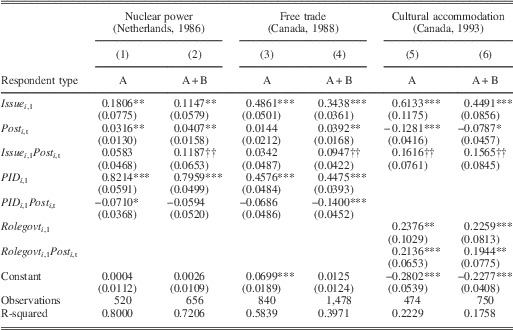
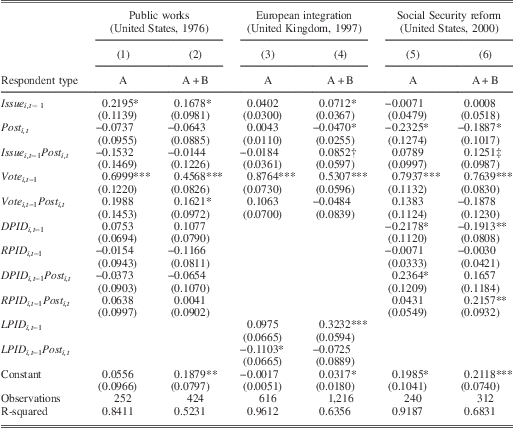
Tables 2 and 3, respectively, present estimates of two- and three-wave tests of priming among those with knowledge of the major parties’ positions. Overall, the results indicate that the inclusion of type-B respondents considerably improves the evidence of issue priming in these tests.Footnote 50
Two-wave Tests of Priming

Note: OLS regression estimates and standard errors corrected for clustering within individuals. Sample restricted to those with knowledge of party positions on primed issues. Two-tailed significance tests are reported for those parameters about which no directional hypothesis is proposed. For one-tailed tests: †††p<0.01, ††p<0.05, †p<0.10. For two-tailed tests: ***p<0.01, **p<0.05, *p<0.1.
Three-wave Tests of Priming

Note: OLS regression estimates and standard errors corrected for clustering within individuals. Sample restricted to those with knowledge of party positions on primed issues. Two-tailed significance tests are reported for those parameters about which no directional hypothesis is proposed. For one-tailed tests: †††p<0.01, ††p<0.05, †p<0.10, ‡p=0.104. For two-tailed tests: ***p<0.01, **p<0.05, *p<0.1.
Consider, first, estimates of the models when the estimation samples include only type-A respondents. In five of the six cases there is no significant difference in the impact of issue attitudes following the onset of the priming event. For the Dutch case, the two American cases, the British case and the 1988 Canadian case, the coefficient estimate on the interaction between the issue attitude and the survey wave (in the two-wave tests, Issue i,1 Post i,t ; in the three-wave tests, Issue i,t-1 Post i,t ) is not significantly different from 0. The one case in which issue priming among type-A respondents is observed is Canada 1993. The model estimate (see Table 2, Model 5) reveals an interaction between the issue attitude and the survey wave that is positive, moderately large and statistically significant (p=0.017).
The latter result, while somewhat unexpected in light of Lenz’s findings, may reflect the exceptional level of voter volatility in the 1993 Canadian election.Footnote 51 In any event, for the five cases included in Lenz’s studies, we reproduce the pattern of null results among type-A respondents. Further, a test of issue priming that combines information from these five studies produces similarly negative results. If we treat each election as an independent test of the priming hypothesis and apply Fisher’s combined test,Footnote 52 we obtain a p-value of 0.324. In short, when the analysis is confined to type-A respondents, there is very limited evidence of issue priming.
The addition of type-B respondents to the estimation samples changes the results considerably. If we apply Fisher’s combined test to the results, then we find strong evidence of issue priming: p<0.001. Further, whereas issue priming is detected in just one case when the estimation sample includes only type-A respondents, it is apparent in five of the six cases when both type-A and type-B respondents are present in the estimation sample. The attitude-wave interactions are sizable, positive and statistically significant for the Dutch case, the two Canadian cases and the British case, and the p-value associated with the large, positive coefficient for the 2000 American case is 0.104.Footnote 53 Only for the 1976 American case does the addition of type-B respondents to the sample not generate evidence of issue priming.
The overall differences between the priming effects when type-B respondents are included and when these respondents are excluded are also significant. Appendix Table A4 reports within- and across-election tests of two hypotheses: (1) that the coefficient on the interaction between issue attitude and survey wave (
 $\hat{\beta }_{3} $
in Equation 2 or 3) is larger when type-B respondents are excluded and (2) that the ratio of the attitude-wave coefficient to the coefficient on the attitude itself (
 ${{\hat{\beta }_{3} } \mathord{\left/ {\vphantom {{\hat{\beta }_{3} } {\hat{\beta }_{1} }}} \right. \kern-\nulldelimiterspace} {\hat{\beta }_{1} }}$
in Equation 2 or 3) is larger when type-B respondents are excluded.Footnote
54
In effect, these are one-sided tests of the proposition that priming effects are larger – in absolute and relative terms, respectively – when type-B respondents are included in the estimates. To summarize these results, while not all within-election differences are significant – which is unsurprising, given that the tests compare partially overlapping samples – the across-election differences are. This finding holds whether priming-effect size is construed in absolute (p=0.037) or relative terms (p=0.040).
The magnitudes of the estimated priming effects are non-trivial with respect to election day vote shares. Following Bartels, we define the priming effect with respect to a given party as the difference between (a) the average probability of a vote for the party assuming the ‘primed’ issue weight (
 $\hat{\beta }_{1} {\plus}\hat{\beta }_{3} $
in Equation 2 or 3) and (b) the average probability of a vote for the party assuming the ‘unprimed’ weight (
 $\hat{\beta }_{1} $
in Equation 2 or 3).Footnote
55
Combining results from all six elections, the weighted estimate of the priming effect – that is, the (weighted) average shift between the two modeled categories of vote choice – is a sizable 4.7 percentage points (95 per cent CI [2.2, 7.2]).Footnote
56
Overall, these results provide impressive support for the article’s arguments concerning the importance of including type-B respondents in priming tests. Results with type-B respondents in the estimation samples are a mirror image of results when these respondents are excluded. In striking contrast to Lenz’s research, in the present analyses the priming hypothesis fares very well indeed.
Priming Effects by Respondent Type
A direct check of the article’s argument that excluding type-B respondents produces downward bias in priming effects estimates is to condition the effect of the variables and interactions in Equations 2 and 3 on an indicator of respondent type, distinguishing between type-A and type-B respondents.Footnote 57 However, this approach considerably increases the number of coefficients to be estimated, adds many correlated terms to the models and, as a result, greatly reduces estimation precision. We have limited power, therefore, to detect differences in priming effects by respondent type. With this caveat, estimates of such models are presented in Appendix Table A6. The results sensibly suggest that priming effects are larger among type-B respondents in these elections, although the differences are not precisely estimated. Applying Fisher’s combined test to the six estimates of the three-way interaction between issue attitude, survey wave and respondent type, we obtain a p-value of 0.111 (among the five elections included in Lenz’s study, p=0.085). The respondent-type difference in effects is significant at the election level only for Canada 1988 (p=0.072). Even so, overall the results suggest that including type-B respondents in issue-priming tests is important because priming effects among type-B respondents differ from those among type-A respondents.
Alternative Specifications
With the aim of adhering closely to Lenz’s modeling approach, we have so far reported OLS estimates of linear probability models (LPMs) of vote choice. Appendix Tables A13–A18 present five alternative specifications: (1) a binary logit model of vote choice, with the response coded as in the LPMs; (2) a multinomial probit modelFootnote 58 of a vote-choice trichotomy, with the major parties (or coalitions) coded as 1 and 3 and other responses (abstention, non-response and minor-party support) coded as 2; (3) an ordered logit model of the same vote-choice trichotomy; (4) a second ordered logit model of the vote trichotomy, save for minor-party supporters being grouped with a major partyFootnote 59 and (5) a linear model of a continuous proxy for vote choice, estimated by OLS, in which the proxy is a party (or candidate) thermometer or favorability rating (for measurement details, see the Appendix).
Importantly, our overall conclusions regarding issue priming are robust to alternative specifications. Applying Fisher’s combined test to the interaction between issue attitude and survey wave yields statistically significant evidence of issue priming under all specifications, except the logit specification.Footnote 60 At the election level, robustness varies. Results for Canada 1993 and UK 1997 are robust to three alternative specifications, while those for Canada 1988 and US 2000 are robust to two. The Netherlands 1986 result, however, fails to hold up under any alternative specification.Footnote 61 Finally, it is noteworthy that the multinomial-probit and continuous-proxy specifications for the US 1976 case suggest issue-priming effects, in contrast to the LPM for the election (above).Footnote 62 Thus, with type-B respondents included, we find evidence of issue priming in all of the elections included in this study in at least one of the specifications examined in the article and Appendix.
CONCLUSION
The priming hypothesis has been central to the contemporary revival of interest in the effects of election campaigns on voters, which makes Lenz’s conclusion that campaigns rarely prime issue attitudes so arresting. Building on his approach, the contribution of this study is to include in issue-priming tests respondents who, at some point in the panels analyzed, intended or decided to abstain or support a minor party, or were non-responsive on vote queries. Across the elections examined in this article, once these respondents – who we term type-B respondents – are added to the estimation samples, issue-priming effects are commonly detected.
The article argues that including these respondents in issue-priming tests is important because type-B respondents may be relatively susceptible to priming effects, and because priming effects may be relatively easier to detect among type-B respondents. It is, strictly speaking, impossible to directly assess the relative contributions of the two mechanisms: as respondent types are defined by patterns of voting behavior, we cannot observe differences in voting behavior independently of respondent type. At a minimum, however, the analysis suggests that including type-B respondents matters not only because it increases the number of cases for analysis, but because it adds cases that are more likely to exhibit priming effects.
Importantly, the critique pursued in this article does not impugn the four issue-priming tests appearing in LenzFootnote 63 that use continuous measures of candidate evaluation as dependent variables. Those tests are unlikely to exclude many respondents. Among the surveys included in the present study, an average of 89.5 per cent of type-B respondents provided a valid response to a continuous proxy for vote choice.Footnote 64 Further, excluding non-responsives from analyses with continuous measures is unlikely to greatly affect the size of the minimum detectable priming effect: the measures should be able to detect small shifts in preference throughout their ranges.Footnote 65 Notably, among the four issue-priming tests in LenzFootnote 66 involving continuous dependents, just one priming effect is detected. Nevertheless, in view of the issue-priming effects reported in the current article, we can at least rule out what we might term the ‘strong version’ of the revisionist view of priming effects – that campaigns rarely prime issue attitudes.
The article also does not undermine the claim that issue-priming estimates based on the conventional test are inflated because of voters’ tendency to adopt the policy positions of their favored party or candidate.Footnote 67 Evidence of issue priming in this article is consistent with such opinion changes to the extent that the two dynamics (priming and opinion change) apply to different groups of voters or operate simultaneously. What is not consistent with the results in the article is the strongest version of the inflation claim: that opinion change ‘creates the appearance that issues matter (through priming) when they do not actually matter’.Footnote 68 The present study suggests, more modestly, that opinion change creates the appearance that issues matter (through priming) more than they actually do.Footnote 69
The findings in this article have broad significance. As suggested in the introduction, they reinforce the view that election campaigns can have important effects on voters. The results suggest that the scope of the campaign’s effect is not limited to a small group of ‘fundamental’ decision criteria, such as the state of the economy and partisanship.Footnote 70 Although such criteria are routinely central to campaign strategies, this article suggests that candidates and parties may also seek to increase the salience of policy issues on which they are relatively advantaged. At the same time, while the article indicates that issues can be primed during campaigns, it does not support strong claims about the distribution of issue-priming effects. The elections examined are most-likely cases for issue priming – selected precisely because unusual features of the elections (for example, the occurrence of a nuclear disaster) make it plausible to claim that a shift in informational context occurred prior to voting day. It remains for future research, with representative samples of elections, to establish the general importance of issue priming in electoral politics.