INTRODUCTION
The Bronze and Earliest Iron Age (ca. 1800–500–1 BC) in the Eastern Baltic generally, and in Latvia particularly, saw the completion of the transition from gathering to a production economy. This process was accompanied by important changes in social relations, as evidenced by (1) a hierarchy of residences, where fortified settlements (hill-forts) were established alongside open settlements, (2) the appearance of prestige bronze objects—weapons, jewelry, and toiletry items, and (3) changes in burial practices, when, alongside flat cemeteries, a new type of burial tradition appeared, which involved the erecting of barrows with various stone structures and occasionally with cremation of the dead.
The chronology of barrow cemeteries has generally been determined based on analogies with similar sites in the southeastern Baltic, and in particular cases also utilizing similarities with the Bronze Age barrows of Northern Europe. Artifact typology, especially that of bronze objects, has also provided a strong basis for archaeological dating of Bronze Age sites. Unfortunately, bronze objects are rare in Bronze Age grave contexts in Latvia. Moreover, the dates of these artifacts are likewise based on analogies with Northern Europe and the southeastern Baltic, rather than on an absolute chronology. Establishing the chronology of flat cemeteries has been an even more problematic issue because of the lack of analogies in the surrounding regions and the general absence of grave goods. In cases when grave goods are present, e.g., at Ķivutkalns cemetery, they have proven to be of little use for establishing precise chronological models with a resolution higher than one or two centuries. Therefore, the 14C dating method has now been applied in order to provide a firmer foundation for the chronology of burial sites and changes in mortuary practices. The aim of this paper is to clarify the dynamics of changes in burial practices both in time and space, based on 14C dates obtained during the last five years, which were previously lacking.
MATERIAL AND METHODS
Burial Sites
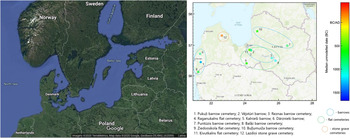
During the Bronze Age, two distinct types of burial ground were generally in use: barrows and flat cemeteries. The burials in both are usually a mix of inhumations and cremations; in some cases, they appear to form a chronological sequence, but in others occur in parallel. The internal structure of barrows is complicated: it usually includes various elements, such as cremation burials, stone cists, stone circles and other stone structures. A common feature is a burnt basal layer of the barrow; finds of horse teeth are prevalent. The third type of burial ground—the stone grave cemetery—appears to be a later phenomenon, introduced during the Earliest Iron Age. The locations of all the cemeteries mentioned in this paper are shown in Figure 1. A short description of each site follows.
Geographical distribution of burial 14C dates. Map generated by OxCal v. 4.3 software (Bronk Ramsey Reference Bronk Ramsey2009).

The Pukuļi barrow cemetery (lat.: 56.40656 lon.: 21.43069) in southwestern Latvia consisted of 14 barrows. One of them had been completely destroyed before any archaeological research started at the site. Two barrows were excavated in 1962–1963, and the rest in 1979–81. The barrows were densely located in a 50 × 100-m area approximately 500 m from the Vārtāja river. Barrow size was variable, but the largest barrow was 1.3 m high and 15 m in diameter.
The first attempt to establish an absolute date for the cemetery took place in 1981, when charcoal from the base of barrow 5 was dated at the laboratory of the Leningrad branch of the Institute of Archaeology. The 14C date was 4000 ± 50 BP, i.e. 2667–2397 calBC (90.5%). In 2016 several more samples from the Pukuļi barrows were dated at Poznan Radiocarbon Laboratory, including charcoal from the base of barrow 9. The 14C date was 7020 ± 50 BP, i.e. 6005–5785 calBC (95.4%). In context with other dates from cremations and inhumations, both of these dates indicate that the burnt basal layers are from much older archaeological contexts than the barrows and should not be related to the burial traditions manifested in the barrows (Vasks Reference Vasks2000).
The Reznes barrow cemetery (lat.: 56.84212 lon.: 24.35427) was located in central Latvia, near the Daugava river. Eight barrows have been recorded, measuring 20–24 m in diameter and 1.6–3 m in height. Archaeological excavations were carried out in 1933, 1935, 1958, and 1969. The stratigraphy indicates that the inhumations are the oldest; in the middle layers there were cremations, while the upper layers had burials in stone cists. Some burials contained occasional grave goods, such as fragments of bronze tweezers and razors, various ornaments, flint arrows, stone axes and pottery—45 artifacts altogether. Almost all barrows had horse teeth among the finds (Šturms Reference Šturms1936). A recent paper by Vasks et al. (in press) offers more detailed analysis of the site, incorporating 14C dates, physical anthropology, and dietary stable isotope analysis.
Vējstūri barrow (lat.: 56.85844 lon.: 24.31040), located by the Daugava river, was excavated in 1967–1968. It was part of an archaeological complex that included the Bronze Age barrow, an Early Iron Age settlement, and a Late Iron Age and medieval cemetery. The Bronze Age barrow had partially been destroyed with the construction of modern farm buildings and other structures; however, three cremations and three inhumations were unearthed (Zariņa Reference Zariņa1987).
Raganukalns flat cemetery (lat.: 56.50293 lon.: 25.75018) was located on an island formed by the rivers Saka and Daugava. It was excavated in 1927–1929 and in 1961. The burials included both inhumations and cremations. Several inhumations had various stone structures: stone cists, or a single stone placed in the grave. No grave goods were found; therefore, establishing a chronology was problematic. In some cases, cremations were located above inhumations, suggesting that the tradition of cremating the dead was introduced later (Graudonis Reference Graudonis1967).
Kalnieši barrow cemetery (lat.: 56.57157 lon.: 25.75018) was located approximately 400 m from the Daugava river. It consisted of three barrows, two of which were archaeologically dated as Bronze Age, while the third was dated to the Middle Iron Age. Barrow 1 was partially excavated in 1948 and in 1959. The lower layers contained inhumations with or without stone cists, while the cremations were buried at a later date, within additional earthen features (Graudonis Reference Graudonis1967).
Dārznieki barrow (lat.: 56.72398 lon.: 21.42016) is a single barrow located in southwestern Latvia. The barrow, with a diameter of 18–20 m and a height of 1.5 m, was excavated in 1936. In addition to inhumations, the barrow contained several cremated remains in clay urns (Graudonis Reference Graudonis1967; Ciglis, Vasks Reference Ciglis and Vasks2017).
Puntūzis barrow cemetery (lat.: 56.99658 lon.:26.39095), located in eastern Latvia, consists of 25 barrows. The barrows vary in their dimensions: they are 0.4–1 m high and 5.5–12 m in diameter. They have been seriously damaged by ploughing and by graverobbers. Seventeen barrows were excavated in 1930, revealing graves without preserved bones, in addition to which there was a single cremation in barrow 10 (Graudonis Reference Graudonis1967; Ciglis and Vasks Reference Ciglis and Vasks2017).
Bašķi barrow cemetery (lat.: 56.10426 lon.: 21.21871), located in southwestern Latvia, consists of three barrows. Two were excavated in 1938. They have been partially damaged by ploughing. Based on the excavation, barrow 1 was archaeologically dated to the 2nd–1st century BC, and the rest were dated to the same period, based solely on the location context (Graudonis Reference Graudonis1967; Ciglis and Vasks Reference Ciglis and Vasks2017).
Ziedoņskola flat cemetery (lat.: 56.41082 lon.: 24.11118) is located in central Latvia by the River Lielupe. Excavation in 1933 revealed inhumations in cist-like stone structures and cremations both with and without stone structures. Further excavations took place in 1998 and 2000 (Graudonis Reference Graudonis1967; Ciglis and Vasks Reference Ciglis and Vasks2017).
Buļļumuiža barrow cemetery (lat.: 57.45377 lon.: 24.73317) is located in northeastern Latvia. In the 1930s approximately 30 barrows were registered, but due to intensive farming and land amelioration during the 1960s–1980s part of the cemetery was destroyed. However, this barrow cemetery is remarkable for the high concentration of barrows in a relatively small area (approx. 20 ha). Several barrows were excavated in 1929, 1930, and 1965. The barrows varied in size and structure (Graudonis Reference Graudonis1967; Ciglis and Vasks Reference Ciglis and Vasks2017).
Ķivutkalns flat cemetery (lat.: 56.85144 lon.: 24.27309) was located in central Latvia on Dole Island in the Daugava river. The cemetery, with 231 inhumations and 20 cremations, was covered with a 1.6–3-m thick cultural layer relating to a later Bronze Age hillfort that was established within decades after the final stage of the cemetery. The site was completely excavated in 1966–1967. The detailed record of the excavation shows that the stratigraphy of the site was sequential, i.e. no burials could have been established during or after the time of formation of the hillfort layers (Denisova et al. Reference Denisova, Graudonis and Gravere1985). A hillfort established directly on top of a cemetery with no significant time distance is indeed a unique situation not only in the Eastern Baltic, but in a wider regional context as well. Issues with the chronological sequences and stratigraphy of the Ķivutkalns site have been discussed in detail by Oinonen et al. (Reference Oinonen, Vasks, Zariņa and Lavento2013) and Vasks and Zariņa (Reference Vasks and Zariņa2014).
Lazdiņi stone grave cemetery (lat.: 57.82316 lon.: 22.63018) is located in northwestern Latvia. The site was partially damaged by farming and removal of stones for building purposes but could be identified as an irregular 42-m-long and 10–20-m-wide structure. In 1933–1934 an area of 650 m2 was excavated. Inhumations were generally located in the southern and southeastern part, while cremations were mainly found in the western part, suggesting a chronological sequence for the site (Šnore Reference Šnore1970).
Sampling
Given the variation in the character of the sites, the conditions and the preservation of the material, the sampling strategy had to be flexible. For example, inhumations in barrows were usually very poorly preserved, and only occasional bone fragments could be collected. So-called “ghost burials”, i.e. obvious grave structures without any preserved bones, were common. In general, Latvian soils are rather pH neutral and therefore usually provide very good conditions for bone preservation. In the case of barrows, it stands to reason that the presence of cremations and burnt layers within the enclosed barrow soils caused a concentration of ash higher than average, thus making the soil notably alkaline and therefore destroying bone more rapidly than in pH-neutral soils. Moreover, even the bone fragments and teeth that were salvaged from excavations are in a very fragile state. For example, during this study four bone samples, even including a horse tooth, failed to produce any organic matter and therefore could not be dated. In turn, calcined bones are much better preserved and in good condition. As a result, no consistent sampling strategy could be followed for the burials from the barrows; instead, the samples reflect the sum of the available material and its condition of preservation.
Reznes barrow cemetery, despite being one of the best-known and most referenced Bronze Age sites in East Baltic archaeology, has so far given only one 14C date, from barrow 6 (Ciglis and Vasks Reference Ciglis and Vasks2017). Barrow 2, as the largest and least disturbed by later activities, was chosen for more detailed sampling in order to better understand the chronology and structure of the barrow. Samples were taken from eight burials at various depths and locations. Cremation 1 was double-sampled (cremated human bone and unburnt horse tooth) as a test for radiocarbon “old wood” effect. Additionally, one sample from barrow 1 was dated in order to compare dates between barrows 1, 2, and 6 (Table 1:9–19).
List of 14C dated burial samples. Calibration of 14C dates done by OxCal v. 4.3 software (Bronk Ramsey Reference Bronk Ramsey2009).

* Archaeological context information given as it appears in primary documentation and/or publications.
** Laboratory code “Poz” = Poznan Radiocarbon Laboratory, Poland; laboratory code “Hela” = LUOMUS, University of Helsinki, Finland.
To widen the geographical perspective, a sample was chosen from the previously undated Vējstūri barrow (Table 1:20) and another from Lazdiņi stone grave cemetery, which had previously been dated once (Table 1:47–48).
In contrast to barrows, flat cemeteries, and Ķivutkalns in particular, have very good bone preservation. Ķivutkalns is probably the most-researched Latvian Bronze Age site, with the largest number of 14C dates. However, given the site’s extensive material, the previously published dates are not exhaustive, especially given the recent controversy regarding 14C dates and stratigraphy (Oinonen et al. Reference Oinonen, Vasks, Zariņa and Lavento2013; Vasks and Zariņa Reference Vasks and Zariņa2014). Additionally, the Ķivutkalns material is suitable for paired dating, given the good preservation and the terrestrial herbivore bones associated with some of the burials. Therefore, two paired samples (human bone and horse tooth) from burials 46 and 151 were dated in order to explore a possible issue with freshwater reservoir effect (Table 1:38–41).
Altogether, 17 bone samples from four sites were dated: both calcined and unburnt human bones, and several horse teeth from burial contexts. All samples were dated at the Poznan Radiocarbon Laboratory. When possible, carbon and nitrogen stable isotopes (δ13C and δ15N) of the bone collagen were analysed as well. The sample treatment protocol in use and AMS technical specifications are reported on the Poznan Radiocarbon Laboratory homepage (www.radiocarbon.pl).
Additionally, we report in this paper 31 dates for Bronze Age burials from previous studies that have so far been published only in Latvian (Vasks and Zariņa Reference Vasks and Zariņa2014; Ciglis and Vasks Reference Ciglis and Vasks2017). Therefore, the following discussion on Bronze and Earliest Iron Age burial practices in Latvia is based on 48 14C dates from 12 different sites.
RESULTS AND DISCUSSION
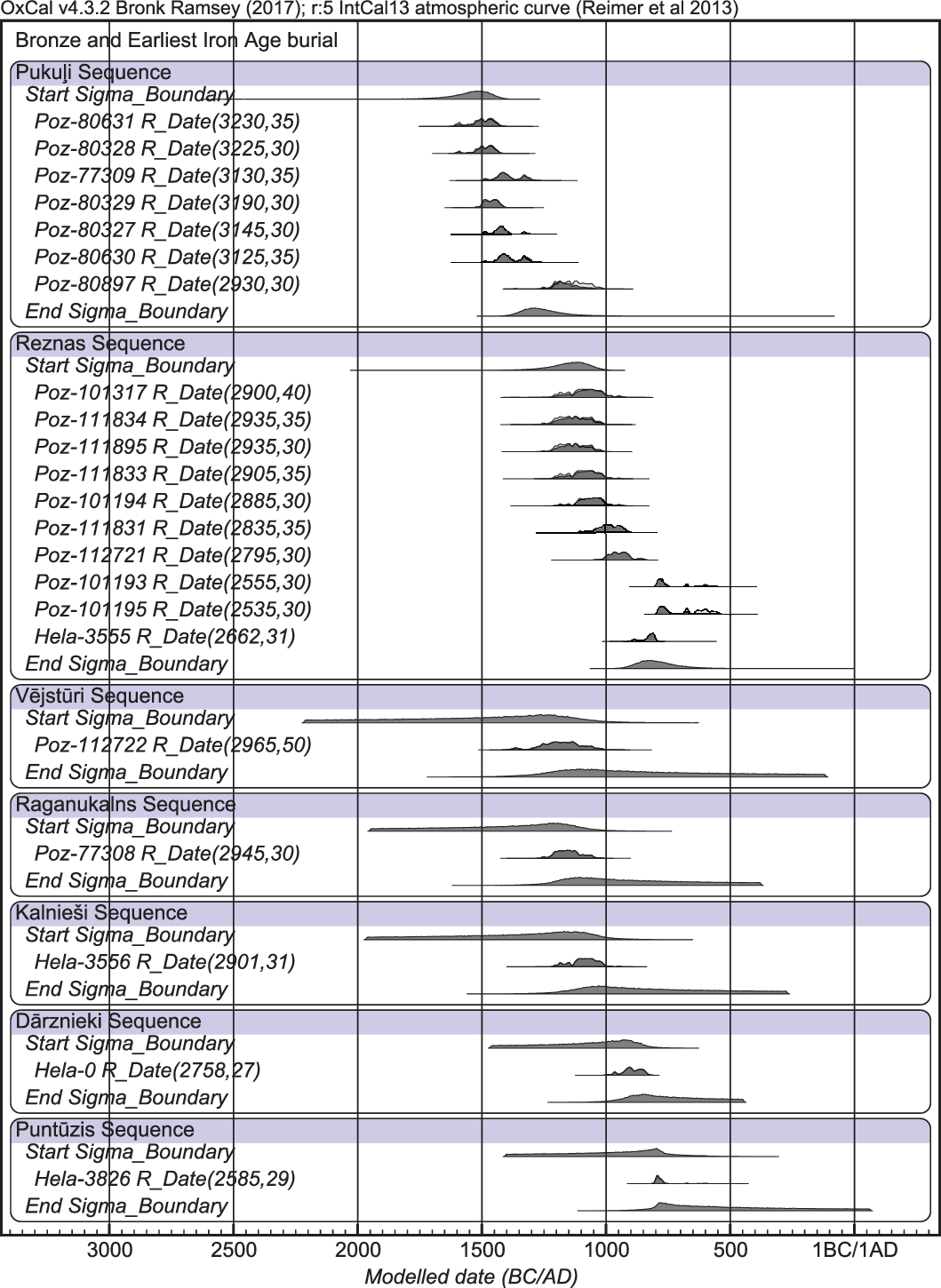
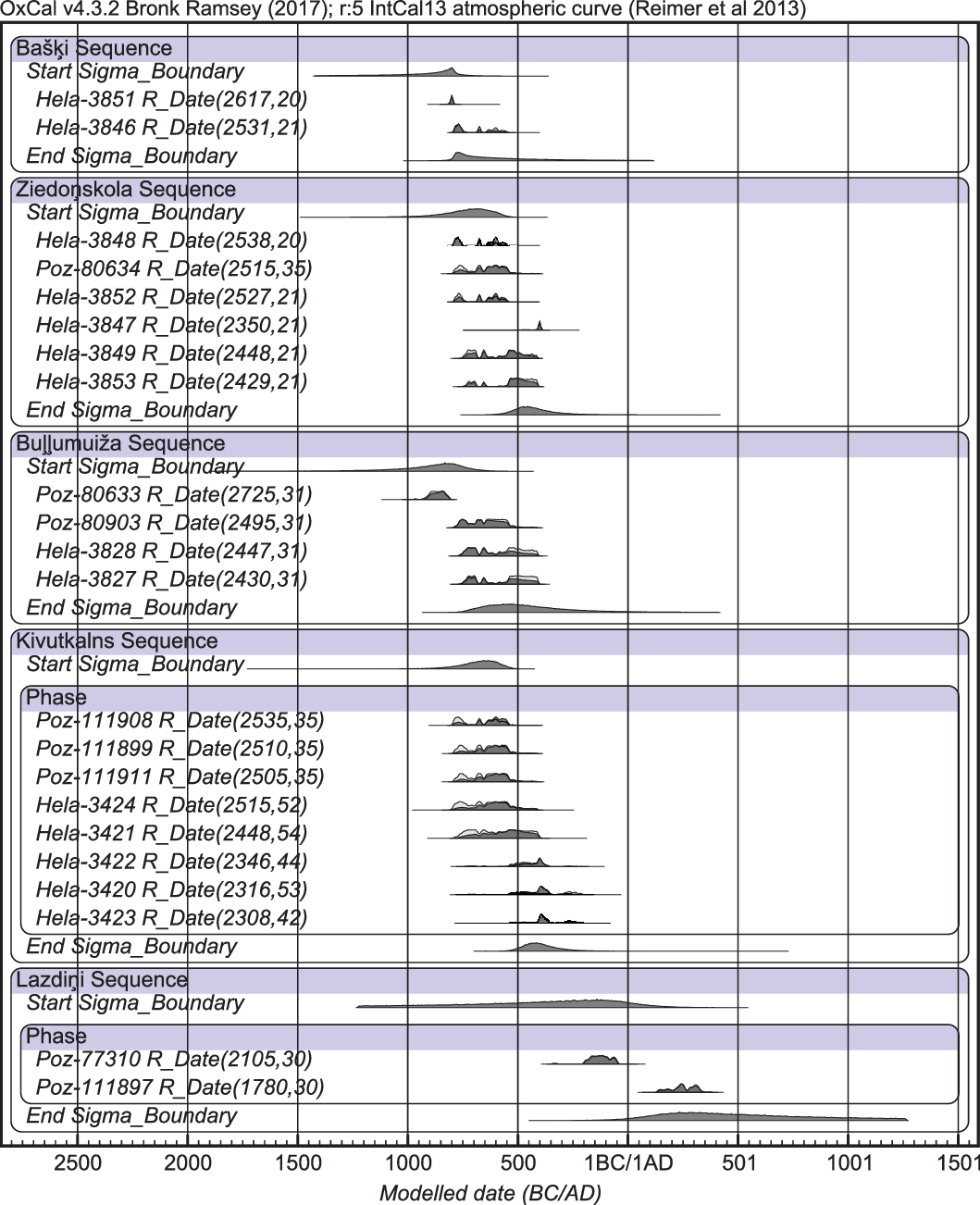
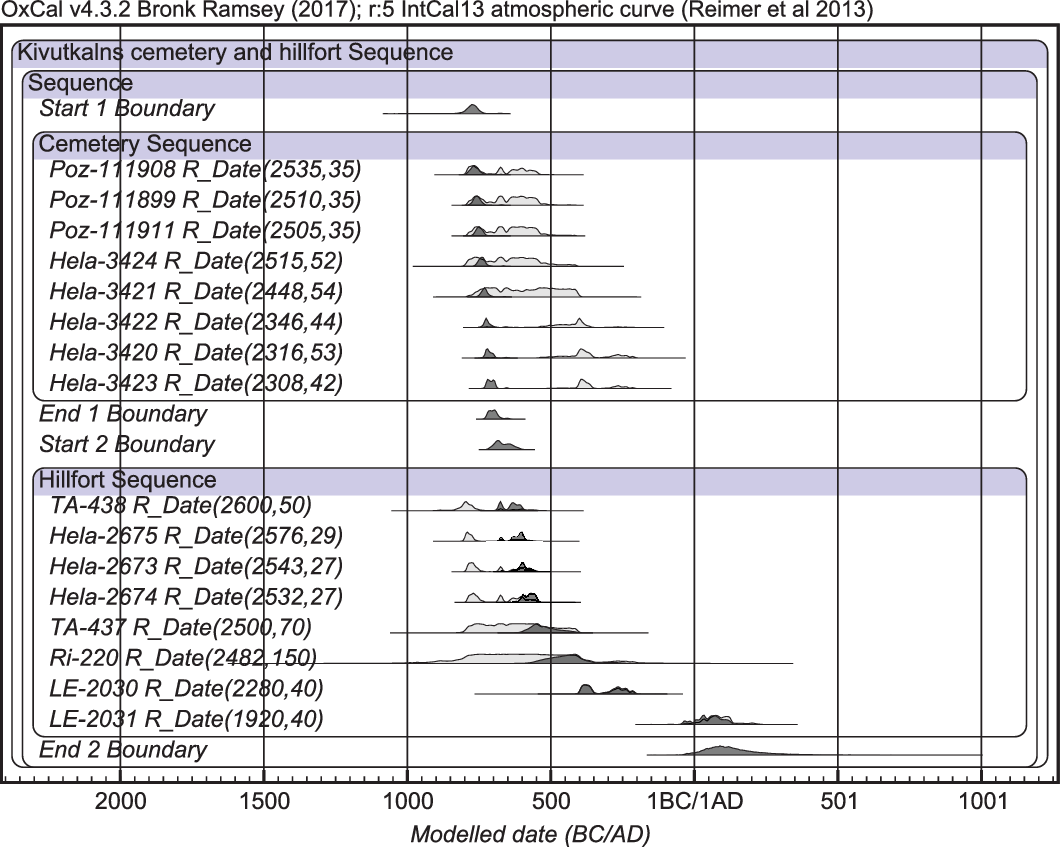
The results are presented in Appendix Table 1. 14C dates were calibrated with OxCal v. 4.3 software (Bronk Ramsey Reference Bronk Ramsey2009) using the IntCal13 calibration curve (Reimer et al Reference Reimer, Bard, Bayliss, Beck, Blackwell, Bronk Ramsey, Buck, Cheng, Edwards, Friedrich, Grootes, Guilderson, Haflidason and Hajdas2013). The calibrations are illustrated in Figure 2 as a multiple plot (normal distribution phase model), and in the supplementary material as single plots.
Multiple plot (normal distribution sequences) of burial 14C dates and Ķivutkalns cemetery and hillfort sequence (contiguous). Hillfort 14C dates from Oinonen et al. (Reference Oinonen, Vasks, Zariņa and Lavento2013).

(Continued).

(Continued).

Human Bone Collagen and Aquatic Reservoir Effects
When dealing with 14C dates of human bone collagen, one of the greatest challenges relates to reservoir effects, which cause the dates to appear significantly older. The global average Marine Reservoir Effect (MRE) is estimated to be ~400 years; however, local variation is very common. In the Baltic region, the average MRE of the Baltic Sea is sometimes used (Pesonen et al. Reference Pesonen, Oinonen, Carpelan and Onkamo2012; Oinonen et al. Reference Oinonen, Vasks, Zariņa and Lavento2013). However, studies with higher resolution demonstrate that the Baltic Sea MRE has a high local variability, and there are regions where average estimates would generate false data (Lougheed et al. Reference Lougheed, Filipsson and Snowball2013; Piličiauskas and Heron Reference Piličiauskas and Heron2015). Unfortunately, the Gulf of Riga of the Baltic Sea is under-researched regarding this question.
Previous publications on the human bone 14C dates from Ķivutkalns also include some stable isotope data as well. The moderate δ13C and δ15N values (~ –21 to –18‰ and 9–11‰, respectively) led researchers to conclude that the diet was generally terrestrial. The δ15N values were explained in terms of a large proportion of meat and dairy products, and the occasionally elevated δ13C as due to an addition of millet in the diet (Oinonen et al. Reference Oinonen, Vasks, Zariņa and Lavento2013; Vasks and Zariņa Reference Vasks and Zariņa2014). We now report stable isotope data of three more humans from Ķivutkalns and six from Reznes, and isotope data for two more horse teeth from Reznes (Table 1). Our Ķivutkalns human stable isotope analysis results correspond very well with the previous studies, and actually, so do the results for the Reznes humans. We therefore agree with the previous interpretation, which excluded the marine factor from the Bronze Age diet. However, we are more cautious when it comes to disregarding freshwater resources. So far, we do not have a comprehensive isotopic dataset of Bronze Age fish from the Daugava. However, a study of the Late Iron Age local and migratory fish of the lower Daugava shows unusually low δ15N values (~7–11‰) and a high variability in δ13C values (~ –25 to –17‰) (Gunnarssone et al. Reference Gunnarssone, Oras, Talbot, Ilves and Legzdiņa2020). Therefore, we are not confident in disregarding the presence of fish in the Bronze Age diet and explaining the variability in human δ13C values solely by millet.
Two paired dates from Ķivutkalns cemetery provide a preliminary basis for approaching the issue of a possible Freshwater Reservoir Effect (FRE) in the isotopic ecology of the Daugava river basin. The dates show minimal disparity, with only a 5 ± 5 14C year offset in the case of burial 46 and a 20 14C year offset for burial 151. Given the typical error margins and standard calibration deviations, these offsets can be considered insignificant. Although more paired dates are necessary, for the purpose of the following discussion we regard the human bone collagen dates as not significantly affected by MRE or FRE and therefore as reasonably accurate and comparable with calcined bone, charcoal and terrestrial animal bone collagen dates. However, it should be noted that charcoal and calcined bone can themselves produce an older date due to the old wood effect. In the case of calcined bone, controlled experiments have shown that the calcined apatite, depending on calcination stage, derives 67 ± 3% to 91 ± 8% of its carbon from the oxidized fire fuel (wood) during combustion. Therefore, “old carbon” would be infused into bone carbonate, if old wood was used in cremation (Zazzo et al. Reference Zazzo, Saliège, Lebon and Lepetz2012). On the other hand, studies have shown that other sources of carbon, such as the bone collagen, might be contributing as well (Soneck et al. Reference Soneck, Brock and Schulting2015). Such cases are occasionally detected if the date differs significantly from the expected range. In this study, none of the calcined bone samples produced suspicious dates. One cremation has a paired date with an unburned horse tooth (Reznes barrow 2, cremation 1), and the offset is 15 ± 5 years. Although this indicates a possible presence of the old wood effect, the dates are still contemporary. For the purpose of the following discussion, we consider this offset to be not alarming.
Revised Site-Level Chronologies
Reznes barrow cemetery now has 10 new 14C dates (barrows 1 and 2), and one previous date (barrow 6). Based on these dates, we can conclude that the site was established during the last quarter of the 2nd millennium BC and was in use until the 8th–6th century BC.
Reznes barrow 2 provided intriguing results. Samples from cremation 1 are the oldest: the calcined bone is dated to 1231–1018 calBC (94.7%) and the horse tooth to 1211–1020 calBC (95.4%). However, the cremation was located in the periphery in what was thought to be an additional earthen feature. On the other hand, the youngest date—798–546 calBC (95.4%)—comes from the so-called central burial (an inhumation). Although the burial was in the lower layers (2.8 m below the modern surface), these dates are actually not in stark contrast with the stratigraphy, as there were no other burials on top of the central one. Five more dates from different burials correspond to the oldest date, and only one burial is closer to the central inhumation, with a date of 804–745 calBC (60.6%). The spatial organization of the barrow—with one burial in the center and others arranged concentrically in several layers—had led archaeologists to speculate that the central inhumation would be the oldest one (Šturms Reference Šturms1936), probably the burial of the founder of the family or kin group, “the patriarch” (LA 1974: 90–91). But the new 14C dates now paint a very different picture, one of a community (re)establishing its ancestral claim by burying one of their dead in a barrow that had been established and actively used several hundred years earlier.
However, a less speculative approach would be to regard this as another case of secondary burial, simply less distant in time than the much younger examples. The occurrence of secondary burials in the visible, above-ground Bronze Age barrows is a rather common phenomenon. Frequently, archaeologists have been able to identify secondary burials already during the time of excavation. Examples of Iron Age, medieval and early modern secondary burials in Bronze Age barrows have been reported previously (Ciglis and Vasks Reference Ciglis and Vasks2017). More cases of secondary Iron Age burials at Reznes barrow cemetery have recently been detected by 14C dating (Vasks et al. in press).
The Ķivutkalns site, with a flat cemetery and a hillfort directly over it, has been a complicated and widely debated topic for the last seven years (Oinonen et al. Reference Oinonen, Vasks, Zariņa and Lavento2013; Vasks and Zariņa Reference Vasks and Zariņa2014). According to some early 14C dates and archaeological dating, it was previously suggested that the hillfort was in use during the 1st millennium BC, meaning that the cemetery should be older than that. In recent years a number of new 14C dates of burials sparked a controversy, as the cemetery and hillfort dates completely overlap, although this is in strong contradiction with the site’s stratigraphy. It has been suggested that two main reasons could have caused the 14C date overlap: old wood effect with regard to the oldest charcoal samples from the hillfort, and the fact that all the dates fall within the range ~800–400 BC, i.e. the dates correspond to the Hallstatt Plateau (Oinonen et al. Reference Oinonen, Vasks, Zariņa and Lavento2013). However, the stratigraphy clearly demonstrated the cemetery to be older than the hillfort, and therefore excluded possibility of a period of overlap. This provides us with additional information that can decrease the uncertainty with regard to the 14C dates and permits the conclusion that the burials should be from ~800 to 680 BC, while the start of hillfort should be ~650 BC (Vasks and Zariņa Reference Vasks and Zariņa2014). If the two oldest hillfort dates are disregarded on the basis of possible old wood effect, and a contiguous parameter is applied, statistical analysis by OxCal demonstrates that this is possible. Even so, convergence analysis shows poor agreement with such model (Figure 2: Ķivutkalns sequence).
Vējstūri barrow previously had no 14C dates. The new date, 1304–1018 calBC (92.3%), updates our knowledge not only for this particular site but is also the earliest barrow date in the Daugava basin micro-region so far. The new 14C date of the Earliest Iron Age Lazdiņi stone grave cemetery provides an update and together with the previous date expands the site’s timeline from 201–46 calBC (95.4%) up to 137–334 calAD (95.4%).
Chronology of the Bronze Age Burial Traditions in Latvia
The geographical distribution of the 14C-dated Bronze Age and Earliest Iron Age burial sites in Latvia allows the distinction of six micro-regions: southwestern Latvia (Pukuļi, Bašķi and Dārznieki), northwestern Latvia (Lazdiņi), central Latvia—Lielupe basin (Ziedoņskola), central Latvia—Daugava basin (Reznes, Vējstūri, Raganukalns, Kalnieši and Ķivutkalns), northeastern Latvia (Buļļumuiža) and eastern Latvia (Puntūzis). The prevalence of Daugava basin sites is obvious. This could be explained (as has been widely accepted in Latvian archaeology) in terms of the role of the Daugava as a major waterway, so that settling along its banks would had been beneficial for the Bronze Age communities in terms of trade, especially trade in bronze. Ķivutkalns hillfort, for example, was a prominent bronze-working center (Vasks Reference Vasks2007). However, the geographical distribution could be a biased parameter due to the fact that Daugava basin is still the best-researched region in Latvia. An exceptionally large number of archaeological sites were excavated during the construction of hydroelectric stations: Pļaviņas HES in 1961–66 and Rīga HES in 1966–1974.
Keeping in mind the above-mentioned considerations, we can still approach a geographical chronology model in the light of the new 14C dates. Firstly, it is obvious that the new tradition of burial barrows did not completely replace the Stone Age flat cemetery burial tradition. The 14C dates from the flat cemeteries in central Latvia—Raganukalns and Ķivutkalns in the Daugava basin and Ziedoņskola in the Lielupe basin—cover the time interval ~1200–500 BC of the Bronze Age. The influence of new traditions, however, can be seen in the flat cemeteries, in the form of cremations.
Secondly, an intriguing question is that of how and by what routes the custom of building burial barrows spread. As mentioned above, in Latvian archaeology the Daugava river has traditionally been considered the main route for innovations to spread. Therefore, a slightly surprising result is that the oldest barrow dates are those from Pukuļi in southwestern Latvia. Moreover, before the 14C dates were available, there was a consensus that barrows appeared in Latvia no earlier than ~1300 BC (Vasks Reference Vasks2000). The Pukuļi barrows, with the oldest burial dated to 1565–1430 calBC (84.2%), thus revise the chronology and demonstrate an archaeological parallel with Scandinavian Bronze Age barrows (Thrane Reference Thrane2013). It should be mentioned that a similar date is attributed to a cremation in a clay urn in eastern Lithuania, the Kretuonas 1B settlement (Girininkas Reference Girininkas2013: 149). The transition from inhumations to cremations in Northern Europe is generally placed in the period 1300–1100 BC (Fokkens and Harding Reference Fokkens and Harding2013: 104). Cremations appeared even earlier—1800–1300 BC—in Central Europe: in Hungary (Kovács Reference Kovács1977: 53–54), Slovakia (Harding Reference Harding2000: 111–112) and Poland (Hensel Reference Hensel1978: 175–176). Evidently, not long after the earliest Central European dates, this new burial tradition reached southwestern Latvia as well, and a few centuries later, following the water routes, it spread further north. Regarding the Daugava basin, the earliest dates for barrows—Vējstūri, 1304–1018 calBC (92.3%), and Reznes, 1231–1018 calBC (94.7%)—overlap with the very latest Pukuļi date, 1220–1025 calBC (95.4%). This is an important discovery, as it has been noted before how the lack of 14C dates prevented the establishment of a reliable chronological model of the Daugava basin barrows (Ciglis and Vasks Reference Ciglis and Vasks2017). The 12th–10th c. BC or even earlier is the time when similar barrows, containing stone cists, appeared at the Baltic Sea coast of Estonia, indicating possible cultural contacts with the lower Daugava micro-region (Lang Reference Lang2007: 161–164). Šlažių barrow cemetery at the Lithuanian coast, on the other hand, has been attributed to the West-Baltic barrow cultural area and is dated to 1300–1100 BC (Grigalavičienė Reference Grigalavičienė1995: 64-65).
The 14C dates show that the barrow burial tradition continued in southwestern Latvia until at least the 8th century BC: Dārznieki is dated to 976–830 calBC (95.4%) and Bašķi is dated to 818–787 calBC (95.4%). Establishing a definite upper chronological boundary becomes a complicated task due to the Bašķi date of 794–551 calBC (95.4%), as the probability distribution falls within the Hallstatt Plateau.
Judging by the 14C dates available so far, it seems that the barrow burial tradition reaches eastern Latvia later than other micro-regions: at Buļļumuiža (four 14C dates) in the northeast it appears at least at 932–808 calBC (94.6%) and at Puntūzis (one 14C date) in the east it is present at least at 816–752 calBC (91.5%). More 14C dates and future research will show if this is indeed the case.
CONCLUSIONS
This study demonstrates how beneficial and important it is to reconsider previous archaeological assumptions by applying an absolute dating method. Several significant discoveries have been made at the site-level as well as the micro-regional and regional level. Reznes barrow 2, as the site studied in most detail in this paper, corrects previous assumptions regarding the chronological structure of a Bronze Age barrow. The most significant discovery is that the central burial, which was previously interpreted as that of the founder of the family/kin group, is actually one of the latest burials. Similarly, assumptions about peripheral cremations as later additions proved to be false. In case of the Vējstūri barrow, a single 14C date proved to be useful not only for dating the site itself, but also for updating the chronology of the spread of the barrow tradition to the Daugava basin micro-region. On a regional level, the previous assumption that barrows first appeared in central Latvia along the Daugava river no earlier than ~1300 BC has been disproven. 14C dates for the Pukuļi barrows in coastal western Latvia indicate that this tradition arrived no later than 1565–1430 calBC (84.2%), thus demonstrating a chronological parallel with Scandinavian Bronze Age barrows. Similarly, the new dates now help to place the Latvian Bronze Age in a more precise Eastern Baltic context. So far, the 14C dates suggest that the burial barrow tradition initially spread along water routes, and only later reached more inland areas. However, more 14C dates and future studies are needed to confirm this interpretation. The same can be said of radiocarbon reservoir effects. Although the few paired dates show no significant offsets, and stable isotope data have so far demonstrated the insignificant role of marine resources, additional paired 14C dates and more stable isotope data are needed to test this hypothesis.
ACKNOWLEDGMENTS
This study was funded by Latvian Council of Science, project No. Lzp-2018/2-0127 (Social Transformations in the Bronze Age Societies of the Lower Daugava River). The authors are most grateful to the staff of the National History Museum of Latvia for their assistance in the sampling process. Special gratitude goes to archaeologist and head of the Archaeology Department, National History Museum of Latvia, Jānis Ciglis for his insight and invaluable counsel.
Supplementary material
To view supplementary material for this article, please visit https://doi.org/10.1017/RDC.2020.136