1. Introduction
Engaging stories appeal not only to our intellect but also to our emotions, imagination, and social conscience (Green, Reference Green2004). Accordingly, the skilled writer may construct a text in such a way as to position readers to respond to story characters and events in a particular manner (Green, Reference Green2006). Recently, studies in the areas of media, cognitive, and neuropsychology have generated some interesting findings that support this claim. A large body of research indicates that readers construct a dynamic mental model of the situation described in the text that extends beyond mere comprehension of the written discourse. More specifically, it is believed that readers integrate the explicit information about story events, characters, objects, and settings provided in the text with inferences drawn from the text and with their prior knowledge of the world to construct a situation model of the text (for a review, see Zwaan & Radvansky, Reference Zwaan and Radvansky1998).
According to this view of narrative comprehension, readers incorporate information about a number of dimensions of the story situation in their mental representation of incoming narrative events, including the time and setting of the occurrence, character involvement, and the relationship of the event to previously described events and the protagonist’s goals (Zwaan, Langston, & Graesser, Reference Zwaan, Langston and Graesser1995; Zwaan, Magliano, & Graesser, Reference Zwaan, Langston and Graesser1995). As readers proceed from one sentence of the text to the next, they monitor these dimensions and integrate incoming information into their existing working memory representation of the story situation. The presentation of new (e.g., a change in the spatial or temporal setting of the story) or incongruent information (e.g., the description of a protagonist’s interaction with an item that is inconsistent with his/her location inside or outside of a building; de Vega, Reference de Vega1995) requires readers to update their situation model, evidenced by a momentary increase in processing time. Thus, readers are motivated to create a coherent and meaningful representation of story events as a necessary component of narrative comprehension (Zwaan & Radvansky, Reference Zwaan and Radvansky1998).
Other studies also demonstrate that in constructing and updating this ‘situation model’, readers process the information contained in or inferred from narrative texts in a manner that is informed by and mimics their interaction with their real-world environment (Zwaan, Reference Zwaan1999a). For instance, readers search for the cause of incoming story events amongst previously acquired information (Trabasso & van den Broek, Reference Trabasso and van den Broek1985), and foreground information relating to protagonist goals within working memory until the goal is satisfied or otherwise becomes obsolete (Lutz & Radvansky, Reference Lutz and Radvansky1997). In addition, readers comprehend information about story events occurring in the present time interval (the ‘here and now’ of the story world) faster than information about events that are narrated in retrospect or outside of their chronological order of occurrence (for a review, see Zwaan & Radvansky, Reference Zwaan and Radvansky1998). As such, readers monitor events within a narrative in much the same way as they track and process events in ‘real-life’. Situation models can therefore be described as the mechanism by which readers may vicariously experience story events (Zwaan, Reference Zwaan1999a).
This notion of reading as the immersive experience of the story world represents a significant departure from traditional theories of language comprehension (Zwaan, Reference Zwaan1999b). Evidence in support of the role of embodied cognition in language processing, however, suggests that readers may mentally simulate the events depicted in a narrative, including character action and emotion, during online comprehension (Glenberg & Kaschak, Reference Glenberg and Kaschak2003). According to this view, the comprehension of language involves the activation of the neurological mechanisms involved in the real-life perception of environmental features, and in the execution of the tasks, described in the narrative (for a review, see Glenberg, Reference Glenberg2011).
For many individuals, it is this experience of simulating or ‘being lost in’ story events that makes reading a good book a truly pleasurable experience (Green, Brock, & Kaufman, Reference Green, Brock and Kaufman2004). Individuals who experience a high level of mental absorption in a narrative may be able to more vividly imagine story events, are less attentive to their surroundings while reading, experience greater emotion while reading, and report a greater sense of connection to story characters (Green & Donahue, Reference Green, Donahue, Klein, William and Suhr2009). Thus, mental transportation represents a high degree of cognitive and affective engagement with the text, and is indicative of the construction of a rich situation model.
Research indicates that readers utilize their knowledge of human emotions to infer characters’ emotional responses to story events (Gernsbacher, Hallada, & Robertson, Reference Gernsbacher, Hallada and Robertson1998). They represent the protagonist in a state of happiness when a story event represents a desired outcome, or in a state of disappointment when the protagonist fails to obtain a valued goal (de Vega, Leon, & Diaz, Reference de Vega, Leon and Diaz1996). Moreover, they appear to do so automatically in the process of comprehending the passage, and regardless of whether the represented emotions are made explicit in the text or are implicit in story events (Gernsbacher et al., Reference Gernsbacher, Hallada and Robertson1998). As noted by Sanford and Emmott (Reference Sanford and Emmott2012), however, this emotional knowledge can be either purely cognitive or it can be experiential (i.e., readers may know that a character feels a particular emotion without any simulatory experience; alternatively, an immersed reader may feel the character’s emotion).
Related research indicates that readers routinely monitor and detect changes in the protagonist’s emotional state during online comprehension. Komeda and Kusumi (Reference Komeda and Kusumi2006) found that readers took longer to read target sentences which described a marked shift in the protagonist’s emotions (e.g., from worry at the start of the story to relief at the end) than target sentences that did not describe an emotional shift. Likewise, de Vega et al. (Reference de Vega, Leon and Diaz1996) placed two different target sentences (i.e., sentences which did, or did not, contain a protagonist emotional shift) at two different locations in each story. While they also observed elevated reading times for the emotional shift sentences in the first location, the same effect was not observed for target sentences in the shifting context in the second location. This indicates that readers had indeed updated their situation models to incorporate the change in the protagonist’s emotions encountered in location one.
Assuming the perspective of the protagonist while reading a narrative text presumably offers readers a particular processing advantage; that is, it provides them with a consistent perspective from which to comprehend story events. Readers require a consistent vantage point so as to form a coherent representation of the story situation, and they actively strive to maintain a coherent perspective. For instance, they find it more difficult to comprehend information that is inconsistent with the predominant perspective (i.e., typically that of the story protagonist) established in the text, and tend to reinterpret inconsistent information so as to make it consistent during reproduction tasks (Black, Turner, & Bower, Reference Black, Turner and Bower1979). Readers also exhibit greater recall of story information when instructed to imagine story events from a stable viewpoint, compared with a no-instruction group (Abelson, Reference Abelson1975). Narrative perspective is therefore an important determinant of the coherence of readers’ situation models. Moreover, adopting the perspective of either an actor or observer in the story world may serve to direct readers’ attention to different aspects of the story situation. Research indicates that readers embody protagonist experiences (e.g., protagonist movements, bodily sensations, and emotions) to a greater extent when they enact events from an actor’s perspective (Brunyé, Ditman, Mahoney, & Taylor, Reference Brunyé, Ditman, Mahoney and Taylor2011), while information about the far-visual details of the story setting are more salient when readers adopt an onlooker’s perspective (Abelson, Reference Abelson1975). The use of narrative point-of-view to influence perspective may therefore influence readers’ ability to construct an elaborate and coherent situational representation of the story world (Ditman, Brunyé, Mahoney, & Taylor, Reference Ditman, Brunyé, Mahoney and Taylor2010).
Narrative point-of-view can be distinguished from narrative perspective, and refers to the relationship of the narrator to the story action that he or she voices in the text (Munro, Reference Munro2000). ‘First-person narrative point-of-view’ is used when the narrative is voiced by one of the characters – typically the primary protagonist – in the story, who refers to themself as ‘I’ (or ‘us’, in concert with another/others). In contrast, in third-person narrative point-of-view, the narrator is typically not a character in the story, and voices the story ‘from above’, either as an omniscient narrator or as a storyteller whose vantage point is limited to the perspective of one of the story characters, and is referred to as ‘he’ or ‘she’ (or ‘they’, as a member of a group). Implicit within this use of the personal pronouns is a distinction in how readers are ‘positioned’ relative to the protagonist as they read about unfolding narrative events (Brunyé Ditman, Mahoney, Augustyn, & Taylor, Reference Brunyé, Ditman, Mahoney, Augustyn and Taylor2009). While first-person narration directly invites the reader to comprehend story events as they are described through the ‘eyes’ of the protagonist, third-person narration implies a distinction between the protagonist and the person of the reader, and appears to place the reader as an observer rather than an actor within the story situation. In this sense, first-person narration appears to be more consistent with the perspective readers typically adopt during story comprehension (i.e., that of the story protagonist).
Nevertheless, while readers typically represent the narrative world from the perspective of the focal character, they may simulate described events from an alternative perspective when prompted to do so. More specifically, they adopt an actor’s perspective when instructed to imagine themselves as the protagonist in the story, but simulate story events from an external third-person perspective when instructed to imagine the story as though they are watching the narrative unfold ‘from above’ (Abelson, Reference Abelson1975). Research has also indicated that addressing readers as the subject of a narrative, by using the second-person personal pronoun ‘you’, promoted the simulation of events from the protagonist’s perspective (Brunyé, et al., Reference Brunyé, Ditman, Mahoney, Augustyn and Taylor2009). In this study, it was found that using third-person pronouns produced an external perspective in readers, while first-person pronouns prompted an internal perspective following single sentences but an external perspective following three-sentence texts. Although Brunyé et al. attributed this differential effect of pronoun influence on perspective to the length of their texts, Sanford and Emmott (Reference Sanford and Emmott2012) proposed that narrative characteristics might interact with pronoun use to alter whether an internal or external perspective is adopted. Specifically, they proposed that these characteristics might serve as cues for establishing an internal perspective by emphasizing embodiment. For example, narratives might include spatio-temporal information, in which the description of the orientation of objects or other characters is presented in relation to the protagonist (e.g., “he walked towards me”). Similarly, sensory and perceptual information describing explicitly what the character sees, hears, smells, and so on, can contribute to the generation of an internal, simulatory experience. Another important feature in narratives is the manner in which speech and thought are presented. For example, direct speech tends to be connected to the deictic centre of the character whereas indirect speech tends to be removed from the character and instead provides an indicator of the narrator’s (i.e., external) perspective. Moreover, direct speech is also more likely to produce embodiment via simulation of speech production than indirect speech, an account which is supported by neuroimaging data (Yao, Belin, & Scheepers, Reference Yao, Belin and Scheepers2011). Relating this back to Brunyé et al.’s (Reference Brunyé, Ditman, Mahoney, Augustyn and Taylor2009) results, Sanford and Emmott (Reference Sanford and Emmott2012) posited that they found stronger external perspective generation for their longer texts than shorter texts, regardless of the type of pronoun used, due to the absence of any internal perspective cues. However, in naturalistic narratives (as opposed to the more simplistic stimuli that tend to be used for experimental purposes, such as in Brunyé et al., Reference Brunyé, Ditman, Mahoney, Augustyn and Taylor2009) it is unlikely that there would be an absence of these internal perspective cues. The crucial points for now, however, are that all of these suggestions point clearly to the importance of adopting an internal perspective on the generation of embodied experience during narrative reading; and, assuming other text characteristics are consistent, the use of pronouns to direct narrative point-of-view serve as important cues for adopting either an internal or external perspective.
In addition to the effect of these text-based characteristics, it is also possible that the perspective adopted is affected by characteristics of the reader. For example, the effect of narrative point-of-view may depend on readers’ familiarity with story events. Readers who are familiar with the events and emotions experienced by the protagonist in a story may be more likely to adopt the first-person perspective offered by the protagonist, while readers whose experience is dissimilar to the protagonist’s may prefer to comprehend narrative events as a third-person story observer to avoid a conflict between their experience of events in the ‘real world’ and their experience of the narrative world. In spite of this, narrative point-of-view has received limited attention in the research literature, and no studies to date have sought to compare the effects of first- and third-person narrative point-of-view on readers’ comprehension of protagonist emotions.
Moreover, while the influence of narrative point-of-view on situation model construction may be mediated by reader experience, readers who are more familiar with the events or emotions experienced by the protagonist in a story may be able to create a more embodied representation of the story world from the outset. For example, Green (Reference Green2004) found that readers who were themselves members of a fraternity or sorority, or who had a close friend or family member who was homosexual, reported greater transportation while reading a story about a homosexual man who attended a college reunion at his fraternity, and perceived the story world to be more realistic. Other studies also indicate that readers’ ability to empathize with the story protagonist influences online comprehension of narrative texts. Komeda, Kawasaki, Tsunemi, and Kusumi (Reference Komeda, Kawasaki, Tsunemi and Kusumi2009) found that similarity of personality between the protagonist and reader on the dimension of extraversion increased the accuracy of readers’ estimations of protagonist emotions. Readers who are highly engaged with the affective dimension of a text are also more likely to detect changes in the protagonist’s emotional state while reading (Komeda & Kusumi, Reference Komeda and Kusumi2006). As such, a reader’s own life experiences may influence their ability to form an effective mental representation of the described situation. Readers may better identify with the focal character in a story and may more readily comprehend story events from the protagonist’s perspective when the character’s experience confirms their own. Experiential familiarity with predominant story themes, events, and interactions may also result in greater activation of the neurological mechanisms involved in the simulation of experience when we imagine narrative events (Zwaan, Reference Zwaan1999a). There are, however, some circumstances in which familiarity with a story situation does not necessarily lead to greater engagement (e.g., in genres such as science fiction). It is thus not our claim that familiarity will produce higher levels of engagement and empathy in all narrative types; rather, we propose that it is the combined effects of familiarity as well as other narrative features that generate engagement. Nevertheless, despite expecting that it is an important factor, few studies have explored the influence of autobiographical experience – that is, readers’ familiarity with the particular themes and events described in a text – on the ability to construct higher-level representations of extended discourse (i.e., rich, coherent situation models).
1.1. the present study
This study sought to investigate the effect of first- and third-person narrative point-of-view and familiarity of experience on situation model construction. Participants read fictional stories narrated in the first and third person, and in which the story protagonist’s emotions either did or did not change within the story. Each passage depicted story events that were either ‘familiar’ or ‘unfamiliar’ to readers, based on participants’ self-reported personal experiences.
Using the ‘emotional shift’ method adopted by Komeda and Kusumi (Reference Komeda and Kusumi2006), it was expected that readers would construct more dynamic situation models and would be more likely to monitor protagonist emotions when reading stories about familiar events. Consistent with this research, it was expected that the presence of a protagonist emotional shift in the final sentence of the text would present a momentary challenge to situation model coherence and would require readers to update their situation model to incorporate the change, evidenced by an increase in reading time for the target sentence and decreased story immersion. It was therefore anticipated that readers would be more attentive to changing character emotions when they had constructed a more elaborate situation model of the text.
Thus, it was hypothesized that when participants read ‘familiar’ stories, the presence of a protagonist emotional shift in the final (target) sentence of each passage would result in (i) increased reading time of the target sentence and (ii) decreased participant ratings of subjective story engagement compared to the non-emotional shift condition. Moreover, it was predicted that these effects would be significantly greater than when participants read stories in the ‘unfamiliar’ condition. Additionally, it was predicted that narrative point-of-view would have an effect on readers’ attentiveness to changing protagonist emotions and sense of immersion in the story. Specifically, it was hypothesized that the increased reading time and decreased ratings of subjective story engagement created by the protagonist’s emotional shift (relative to the non-emotional shift condition, as above) would be greater for first-person stories than third-person stories.
2. Method
2.1. participants
Thirty-three undergraduate university students (14 males, 19 females) participated in the study. Participants ranged from seventeen to fifty-six years of age (M = 23.97, SD = 9.33). Participants provided written consent prior to their participation in the study.
2.2. design
A 2 × 2 × 2 within-subjects design was used to manipulate the independent variables of narrative point-of-view (first-person vs. third-person narrative point-of-view), familiarity of experience (familiar vs. unfamiliar), and emotional shift (shift vs. no-shift). In each instance, the dependent variables were reading time (in milliseconds) for the last sentence of each passage and self-report ratings of overall story engagement for each passage.
2.3. stimulus materials
A total of 480 narrative passages were used in the present study. These passages were created by constructing four versions of 120 unique stories in order to produce four text-based experimental conditions (i.e., first-person, emotional shift; first-person, no emotional shift; third-person, emotional shift; third-person, no emotional shift). This produced a pool of narratives, from which forty most-familiar and forty most-unfamiliar scenarios could be obtained (with the middle forty discarded to ensure sufficient difference in familiarity) (see Section 2.6). One version of each passage (for the ‘emotional shift’ condition) featured a change in the emotions experienced by the protagonist in the last sentence of the text, while an alternative version of each passage did not feature an emotional change (for the ‘no-shift’ condition) (see ‘Appendix’). In the emotional shift condition, the protagonist’s changing emotions typically arose from the structure of the story; that is, from the introduction of a striking and unanticipated event which contained an implicit or explicit change in character emotions (e.g., from anxiety to relief after receiving an excellent examination score). The sentences preceding the target sentence were identical in both the shift and no-shift versions of each passage. All passages were written in past tense form.
The shift and no-shift passages were then transposed into first-person and third-person point-of-view to produce both of the narrative point-of-view (POV) conditions. In the third-person POV condition, ‘limited third-person narrative point-of-view’ – whereby the narrator perceives only that which is presently known to the focal character – was used to ensure the first- and third-person passages would be identical in all other respects. In some instances, word order was changed between conditions (e.g., from “Alison and Jamie went to the movies” to “Jamie and I went to the movies”) to maintain adherence to grammatical conventions. However, the concluding sentence of each passage was identical in length (13 words) for each version of the stories. The total word count (110 words) and sentence count (7 sentences or lines on the screen) was also identical for each passage, and for each version of the unique passages. Additionally, each unique passage featured a different character, and repetition of character names or overt similarity in story content was avoided to prevent prior-exposure effects.
The narratives were carefully constructed to include consistent cues to internal perspective taking (Sanford & Emmott, Reference Sanford and Emmott2012). For example, using the first stimulus example presented in the ‘Appendix’, narratives included physical and sensory cues (e.g., “Ethan sat down at his desk”; “stared at his laptop screen”), thought and emotion cues (e.g., “became lost in thought”; “had been feeling increasingly frustrated”), reference to other characters’ movement or behaviour in relation to the protagonist (e.g., “[their] behaviour towards him”), as well as the use of direct, rather than indirect, speech in order to increase vividness and involvement (“‘I wonder if …’ thought Ethan”). Importantly, since all narratives had both a first- and third-person version, with presentation balanced across participants, the presence of these perspective indicators was equal across the two conditions.
To ensure comparability in the level of descriptive and emotive detail provided in each story, a pre-testing group of peer evaluators (n = 10), who met the general eligibility requirements for the study, evaluated the stimuli on a number of dimensions. Peer evaluators read each of the unique passages and were asked to rate the emotional quality (the extent to which the events described in the story are emotionally evocative) and the descriptive quality (the level of descriptive detail used in the story) of the target narrative using a 5-point scale, with a higher rating indicating a greater degree of emotionality/descriptiveness. Evaluators were also asked to rate the extent to which each passage gave them ‘insight into the thoughts and feelings’ of the story protagonist. A small number of passages were revised following these results.
2.4. self-report measures and scoring
A 120-item Familiarity of Experience Screening Questionnaire was constructed for the present study and used to determine participants’ level of familiarity, based on their prior personal experience, with the situational content of each of the unique passages. Accordingly, each item on the questionnaire represented the content of a particular passage in the pool of unique narratives (e.g., the item “You got a tattoo” corresponded with a passage describing a character’s visit to a tattoo parlour). Participants were asked to indicate the extent to which, based on their own prior first-hand experience, they were familiar with the primary story event described in each item on a 5-point scale, with the anchors being 1 (‘not at all familiar to me’) and 5 (‘very familiar to me’).
A revised version of Komeda and Kusumi’s (Reference Komeda and Kusumi2006) Ego Involvement and Evaluation Scale was used to measure participants’ subjective engagement with each of the presented passages. This measure comprises five items designed to assess readers’ affective engagement with, and evaluation of, each story, including their empathy with the protagonist (“How well were you able to enter into the protagonist’s emotion?”) and interest in the theme of the story (“How interested were you in the theme of the story?”). The scale is based on a 7-point scale with the anchors being 1 (not at all) and 7 (extremely). Scores for the measure were obtained by summing participant ratings for each individual item, and ranged from 7 to 35. Cronbach’s alpha, calculated for this study using participants’ mean scores for each questionnaire item, was also satisfactory (α = .87).
2.5. apparatus
The experiment was conducted using custom-designed computer software which allowed for the timed presentation of stimuli and timed recording of participants’ responses, including sentence reading time. The program was run on a 3NX desktop computer with an Intel Pentium D processor using a Windows 2010 XP operating system, with a 75-hertz refresh rate and 1GB RAM. Stimuli and response items were displayed on a Dell 1680 × 1050 inch, 32-bit colour monitor. Participants’ responses were recorded using a 9-key high-speed DirectIN response box. Ear defenders were used to eliminate extraneous noise.
2.6. procedure
Prior to attending their first session, participants completed the Familiarity of Experience Screening Questionnaire online. Participants who endorsed the required number of items as moderately familiar / very familiar and moderately unfamiliar / not at all familiar to enable presentation of the required number of stimuli in the familiar and unfamiliar conditions were invited to participate in the experiment. During testing, participants read a total of eighty passages (selected from the pool of 120 unique passages) over two sessions, spaced at least 5 days apart. Participants’ responses to the Screening Questionnaire were used to identify the passages depicting the story events that were most familiar and most unfamiliar to the participant. Each individual participant was thereby presented with forty passages that depicted the story events and themes they had rated as being most familiar (for the ‘familiar’ condition), and forty passages depicting story events and themes rated as least familiar (for the ‘unfamiliar’ condition). In addition, forty of the presented passages contained a shift in the protagonist’s emotional state in the last sentence of the text (emotional shift condition), while forty passages did not contain such a shift (no-shift condition). Lastly, half of the presented passages were first-person stories, and half of the passages were third-person. As such, this study utilized an eight-cell design, with ten passages (‘trials’) presented for each cell to ensure adequate reliability of the reading time dependent variable (DV).
Participants completed the first-person and third-person POV conditions in separate sessions; the order in which the POV conditions were completed was balanced across participants to eliminate potential order effects. The order of stimulus presentation within each session was randomized using a custom-designed computer program.
Passages were displayed one sentence at a time in the centre of the screen using black letters and in 18-point Times New Roman font, against a white background. Each sentence remained on screen until the participant pressed any key on the response box to proceed to the next sentence. Participants were instructed to read each passage at their normal reading pace, while being sure to fully comprehend each passage, and to proceed to the next sentence as soon as they had finished reading the previous sentence. The computer recorded the reading time for each sentence of the passage (i.e., from the onset of the target sentence to the time the participant pressed a response key to indicate they had completed reading).
After reading each passage, participants were asked to respond to a probe question about the content of the narrative, to ensure story comprehension. The probe took the form of a statement (e.g., “the protagonist sat a mathematics test”) and required a dichotomous ‘true/false’ response using the response box. All questions were answered correctly, indicating that readers complied with the task. Participants then rated their level of engagement with the story using the Ego Involvement and Story Evaluation Scale. Participants responded to each item following the rating scale displayed onscreen by pressing the corresponding key on the response box. The stimuli and response measures were presented in blocks of ten trials, followed by a brief rest period.
3. Results
Reading time for target sentences and participant ratings of subjective reading engagement were recorded for each passage and analyzed for each condition. Reading time data was screened for outliers using a criterion of ± 3.0 standard deviations from the overall sample mean for each particular trial, and individual mean reading times for each condition were compared with the overall sample mean. Outlying scores for each trial were replaced using the Winsorization method (Barnett & Lewis, Reference Barnet and Lewis1994), and were adjusted to a response equivalent to 3.0 standard deviations above or below the sample mean for the corresponding trial. Less than 1% of individual trial scores were adjusted in this manner. All statistical analyses were performed at an alpha level of .05, except for multiple family-wise post-hoc analyses (paired samples t-tests). In the latter instance, analyses utilized adjusted alpha levels using the modified Holm–Bonferroni method (Holm, Reference Holm1979).
3.1. manipulation check
To examine the effectiveness of the narratives used in this study to capture differences in familiarity of experience, a 2 (narrative point-of-view: first-person, third-person) × 2 (familiarity of experience: familiar, unfamiliar) × 2 (protagonist shift: shift, no shift) repeated measures analysis of variance (ANOVA) was performed using participants’ responses to item 3 (“How similar are your own past experiences to those presented in the story?”) on the Ego Involvement and Story Evaluation Scale. The analysis revealed a significant main effect of familiarity of experience (F(1,32) = 232.07, MSe = .52 p < .001, ηp2 = .88), with participants rating their own past experiences as more similar to the protagonist’s after reading passages in the familiar condition (M = 4.58, SE = 0.13) than in the unfamiliar condition (M = 3.29, SE = 0.13). No other significant main effects or interactions were identified (highest F = 2.66, for the main effect of narrative point-of-view).
In addition, a 2 × 2 × 2 repeated measures ANOVA was performed to assess participant ratings for item 2 (“How similar are your own thoughts and behaviour to those of the protagonist?”) on the scale. Ratings of similarity of thought and behaviour were significantly higher for passages in the familiar condition (M = 4.88, SE = 0.14) than in the unfamiliar condition (M = 4.29, SE = 0.15) (F(1,32) = 93.04, MSe = 0.25, p < .001, ηp2 = .74). Once again, no main or interaction effects were observed (highest F = 1.14, for the three-way interaction). These analyses indicate that differences in experiential familiarity with story events were adequately captured by the presented stimuli. Moreover, the extent to which participants rated their own experiences as similar to the story protagonist’s was not affected by narrative point-of-view or the presence of a protagonist emotional shift. These findings therefore support the effectiveness of the familiarity of experience manipulation used in this experiment.
3.2. reading time analyses
A 2 (narrative point-of-view) × 2 (familiarity of experience) × 2 (protagonist shift) repeated measures ANOVA was performed using mean target sentence reading times. The mean reading times (RT) for each condition are presented in Table 1.
Mean target sentence reading time (ms) in each of the narrative point-of-view, familiarity of experience, and protagonist shift conditions. Standard deviations are presented in parentheses

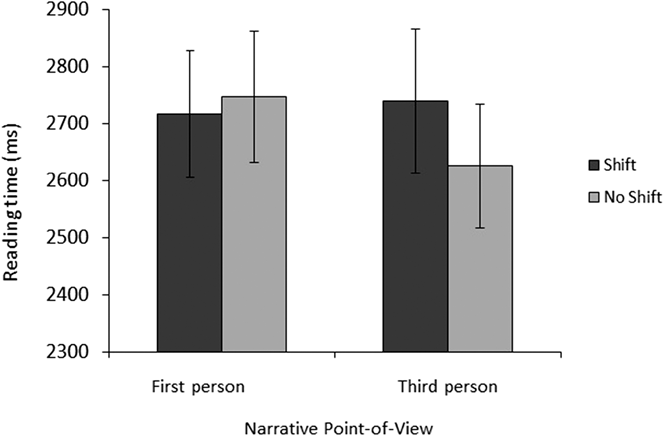
While the repeated measures ANOVA did not establish any significant main effects on target sentence RT (highest F = 1.07 for the main effect of protagonist shift), the interaction between narrative point-of-view and protagonist shift reached significance (F(1,32) = 5.19, MSe = 65762.9, p = .029, ηp2 = .140). Post-hoc repeated measures t-tests used to investigate this interaction found that participants took significantly longer, on average, to read third-person sentences featuring a protagonist emotional shift than third-person sentences that did not contain an emotional shift (t(32) = 2.27, p = .03). There was, however, no significant difference in target sentence reading times for shift sentences in the first-person condition (t(32) = 0.56, p = .58). This indicates that a significant shift effect was observed for the third-person condition but not for the first-person condition (see Figure 1).
Mean target sentence reading time (in ms) for the narrative point-of-view and protagonist shift conditions. Error bars represent ±1 standard error of the mean.
3.3. reading engagement analyses
3.3.1. Overall reading engagement
Overall subjective reading engagement ratings, calculated by summing participant scores on each item of the Ego Involvement and Story Evaluation Scale (where the possible range of scores was 7–35), were also assessed using a 2 (narrative point-of-view) × 2 (familiarity of experience) × 2 (protagonist shift) repeated measures ANOVA. The mean overall engagement scores for each condition are presented in Table 2.
Overall engagement scores in each of the narrative point-of-view, familiarity of experience and protagonist shift conditions. Standard deviations are presented in parentheses
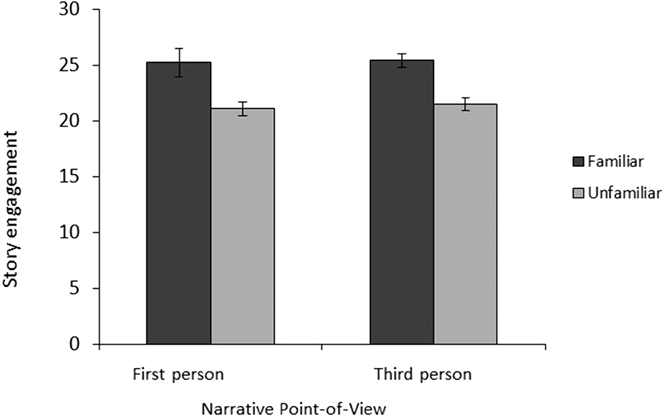
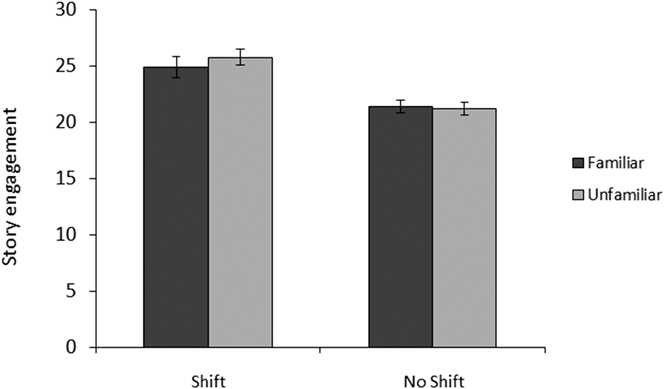
The repeated measures ANOVA revealed a significant main effect of familiarity of experience (F(1,32) = 48.03, MSe = 22.34, p < .001, ηp2 = .60), with participants reporting greater overall reading engagement for passages in the familiar condition (M = 25.34, SE = 0.81), compared with the unfamiliar condition (M = 21.3, SE = 0.57). A significant interaction between familiarity of experience and protagonist shift was identified (F(1,32) = 4.755, MSe = 4.432 p = .037, ηp2 = .129). Post-hoc (repeated measures) t-tests showed that participants reported significantly higher reading engagement after reading no-shift sentences compared with shift sentences in the familiar condition (t(32) = 2.215, p = .034). Engagement ratings for shift passages and no-shift passages did not differ significantly in the unfamiliar condition (t(32) = 0.77, p = .45). Thus, as displayed in Figure 2, there was a significant effect of emotional shift on engagement ratings for familiar passages but not for unfamiliar passages.
Mean overall engagement ratings for the narrative point-of-view and familiarity of experience conditions. Error bars indicate ± standard error of the mean.
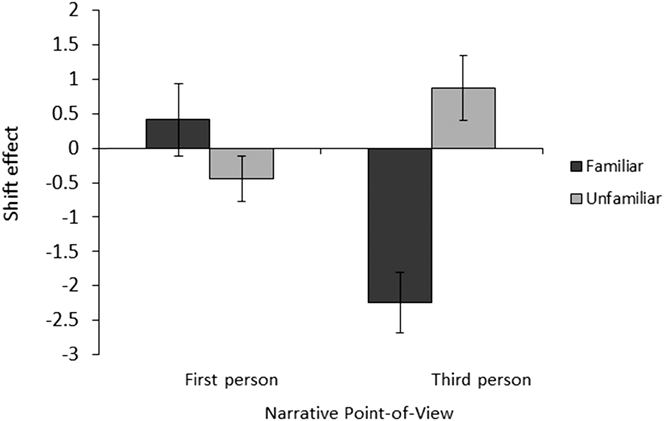
Moreover, a significant interaction between narrative point-of-view, familiarity of experience, and protagonist shift was also identified (F(1,32) = 30.01, MSe = 2.181, p < .001, ηp2 = .484). To examine the nature of this relationship, post-hoc (repeated measures) t-tests were used to compare overall engagement scores for the shift and no-shift passages in each of the four experimental conditions. Participants reported significantly greater reading engagement when reading no-shift compared with shift passages in the third-person familiar condition (t(32) = 5.16, p < .001). Engagement ratings for the shift and no-shift passages did not, however, differ significantly in the first-person familiar, first-person unfamiliar, or third-person unfamiliar conditions (highest t = 1.85, for the comparison between shift and no-shift passages in the third-person unfamiliar condition). Thus, as illustrated in Figure 3, a shift effect (calculated by subtracting mean engagement ratings for the no-shift passages from the mean engagement ratings for the shift passages) was only observed for third-person familiar narratives. No other main effects or interactions approached significance for the overall engagement ratings (highest F = 0.86, for the interaction between narrative point-of-view and familiarity of experience).
Mean ratings of overall story engagement for the familiarity of experience and protagonist shift conditions. Error bars indicate ± standard error of the mean.
3.2.2. Protagonist empathy
A 2 (narrative point-of-view) × 2 (familiarity of experience) × 2 (protagonist shift) repeated measures ANOVA was performed on scores from the item “How well could you enter into the protagonist’s emotion?”, reflecting empathy with the protagonist. The mean ratings of protagonist empathy for each condition are displayed in Table 3.
Mean ratings of protagonist empathy for each of the narrative point-of-view, familiarity of experience, and protagonist shift conditions. Standard deviations are presented in parentheses
The analysis showed a significant main effect of familiarity of experience (F(1,32) = 43.53, MSe = 0.28 p < .001, ηp2 = .58). Specifically, participants reported greater empathy with protagonist emotions after reading familiar passages (M = 5.05, SE = 0.15) compared with unfamiliar passages (M = 4.62, SE = 0.16). A significant interaction between narrative point-of-view and protagonist shift was also observed (F(1,32) = 4.19, MSe = 0.16, p = .049, ηp2 = .12). Participants reported greater empathy with the protagonist after reading no-shift passages (M = 4.86, SD = 0.94) than after reading shift passages (M = 4.77, SD = 1.0) in the first-person condition, but reported greater empathy for shift passages (M = 4.92, SD = 0.90) compared with no-shift passages (M = 4.80, SD = 0.87) in the third-person condition. A post hoc repeated measures t-test, however, did not reveal a significant effect of protagonist shift for either the first-person passages (t(32) = 1.84, p = .075) or third-person passages (t(32) = 1.54, p = .13).
Additionally, an interaction between narrative point-of-view, familiarity of experience, and protagonist shift was significant (F(1,32) = 5.62, MSe = 0.14, p = .024, ηp2 = .150). To investigate this, repeated measures t-tests were used to compare protagonist empathy ratings for shift and no-shift passages in each condition. Participants reported significantly greater empathy, on average, with the protagonist after reading no-shift passages compared with shift passages in the first-person unfamiliar condition (t(32) = 2.77, p = .009). Protagonist empathy ratings did not differ significantly between the shift and no-shift passages, in the first-person familiar, third-person familiar, or third-person unfamiliar conditions (highest t = 1.72, for the comparison between shift and no-shift passages in the third-person unfamiliar condition). This indicates that significant shift effect (calculated by subtracting the mean protagonist empathy ratings for the no-shift passages from the mean protagonist empathy ratings for the shift passages) was observed for first person, but only in the unfamiliar condition, illustrated in Figure 4.
Mean effect of a protagonist shift on overall engagement for the familiar and unfamiliar conditions, as a function of narrative point-of-view. Error bars indicate ± standard error of the mean.
No other significant main effects or interactions for protagonist empathy ratings were identified (highest F = 0.39, for the interaction between familiarity of experience and protagonist shift).
3.3.3. Story interest
A 2 (narrative point-of-view) × 2 (familiarity of experience) × 2 (protagonist shift) repeated measures ANOVA was calculated using participant ratings in response to the question “How interested were you in the theme of the story?” The mean story interest ratings for each condition are presented in Table 4.
The mean story interest ratings for each of the narrative point-of-view, familiarity of experience, and protagonist shift conditions. Standard deviations are presented in parentheses
The analysis revealed a significant main effect of familiarity of experience (F(1,32) = 5.197, MSe = 6.13, p = .029, ηp2 = .140), with participants reporting greater story interest for passages in the familiar condition (M = 4.84, SE = 0.31) compared with the unfamiliar condition (M = 4.15, SE = 0.13). All remaining main effects and interactions were non-significant (highest F = 1.43, for the main effect of protagonist shift).
3.3.4. Story readability
A 2 (narrative point-of-view) × 2 (familiarity of experience) × 2 (protagonist shift) repeated measures ANOVA was also used to assess participant ratings of story readability for item 5 – “How readable did you find this story?” The mean story readability ratings for each condition are reported in Table 5.
The mean story readability ratings for each of the narrative point-of-view, familiarity of experience, and protagonist shift conditions. Standard deviations are presented in parentheses

A main effect of familiarity of experience was identified (F(1,32) = 18.36, MSe = 0.10, p < .001, ηp2 = .36), wherein participants rated passages in the familiar condition (M = 5.22, SE = 0.15) as more readable than passages in the unfamiliar condition (M = 5.05, SE = 0.16). No other significant main effects or interactions were observed (highest F = 4.13, for the main effect of protagonist shift).
4. Discussion
The present study investigated the effect of narrative point-of-view and familiarity of experience on reading engagement and comprehension by comparing participants’ monitoring of protagonist emotions when reading ‘familiar’ and ‘unfamiliar’ stories written in the first or third person. To examine this, participants read a series of passages in each condition that did or did not feature a change in protagonist emotions at the end of the text, and rated their level of engagement for each story. The key findings, as follows, are discussed in further detail below:
(i) Familiar story scenarios produced higher ratings of engagement, story interest, and story readability than unfamiliar story scenarios.
(ii) Changes in character emotions increased reading times and reduced engagement ratings for stories narrated in the third person, but not first person.
(iii) Changes in character emotions reduced engagement to a greater extent when the story scenario was familiar than when it was unfamiliar.
(iv) Changes in character emotions reduced empathy ratings only when the story scenarios were unfamiliar and narrated in the first person.
4.1. narrative point-of-view
The first objective of this study was to examine the influence of narrative point-of-view on situation model construction, using implicit and explicit measures of story engagement. It was expected that readers would be more attentive to character emotions when reading first-person stories, and that a protagonist’s emotional shift would therefore result in a greater increase in target sentence reading times and a greater decrease in participant ratings of overall story engagement in the first-person condition, compared with the third-person condition. In contrast to this hypothesis, the presence of a protagonist emotional shift had a significant effect on reading times for passages written in the third person, but not in the first person. Consistent with this, a protagonist emotional shift had a significantly greater effect on participants’ overall reading engagement when participants read about familiar events compared with unfamiliar events, but only in the third-person condition. These results show that readers were more attentive to changes in protagonist emotions when stories were written in the third person. Extensive research has demonstrated that readers characteristically include protagonist emotions in their mental representation of the story situation (de Vega et al., Reference de Vega, Leon and Diaz1996; Gernsbacher et al., Reference Gernsbacher, Hallada and Robertson1998). Highly engaged readers have also been found to be more likely to detect protagonist emotional shifts during online comprehension (Komeda & Kusumi, Reference Komeda and Kusumi2006). Thus, these findings suggest that readers constructed a more elaborate and dynamic situation model that included changing character emotions when reading third-person stories than first-person stories.
Notably, the analyses did not reveal a significant effect of a protagonist emotional shift on similarity of thought and behaviour, or similarity of past experience ratings in either the first- or third-person conditions. Given the strong main effect of familiarity of experience on reader ratings for these items, it appears likely these questions assessed the extent to which readers’ prior experience of the world was similar to the protagonist’s and not readers’ level of affective engagement with the text (as purported by Komeda & Kusumi, Reference Komeda and Kusumi2006). Since an ‘emotional shift effect’ was observed for each of the remaining scale items, this also accounts for the absence of a ‘shift effect’ on total overall engagement scores for the narrative point-of-view conditions.
Conversely, a protagonist’s emotional shift had a significant effect on ratings of protagonist empathy when readers read ‘familiar’ stories compared with ‘unfamiliar’ stories in the first-person condition. The same effect, however, was not evident for the third-person familiar and unfamiliar passages. Thus, while readers were able to construct more effective situation models and better detect changes in protagonist emotions when reading third-person stories, first-person narration promoted entrance into protagonist emotions in instances where readers did not have relevant prior experience of story events. Consistent with our expectations, these findings suggests readers did, in fact, embody different perspectives during situation model construction as a function of narrative point-of-view.
More specifically, it appears that, on the one hand, readers were more attentive to aspects of the story world that lay outside the protagonist’s immediate focus when narrative events were described and simulated from a third-person perspective. On the other hand, readers were more likely to embody the protagonist’s perspective, and were therefore better able to enter into protagonists’ emotional states, when story events were unfamiliar, when first-person narrative point-of-view was used. As such, these findings may be accounted for in terms of a distinction between an actor’s and an observer’s perspective of the narrative space. Previously, Abelson (Reference Abelson1975) found that participants who were told to imagine narrative events as though they were watching the story ‘from above’ exhibited greater recall of the ‘far-off visual details’ of the story setting, while conversely, information pertaining to the movements and embodied experiences of the protagonist was more salient when individuals were instructed to comprehend the story as though they were the protagonist. Thus, third-person narrative point-of-view may have facilitated the construction of a more elaborate and detailed situation model by promoting a broader perspective of the story world (Brunyé et al., Reference Brunyé, Ditman, Mahoney and Taylor2011). Moreover, emotional shifts frequently arise from a turn of narrative events not anticipated by the protagonist. Readers may be more likely to attend to these unanticipated events, and therefore to make predictive inferences about changes in protagonist emotions in the first instance when they adopt an observer’s perspective of the story world compared with an actor’s perspective. Nevertheless, it is important to note that these results are somewhat inconsistent with the ‘enactment effect’ reported by Ditman et al. (Reference Ditman, Brunyé, Mahoney and Taylor2010), wherein simulating narrative events from the protagonist’s perspective was found to enhance situation model construction. In the present study, however, conducting a simulation of story events from a first-person actor’s perspective was not found to have an overall effect on situation model construction. Instead, it appears that simulating the narrative world from alternative perspectives made different aspects of the story situation more prominent within readers’ situation models.
Perhaps most importantly, this study provides some support for the view that first-person narrative point-of-view promotes the embodiment or internalization of character emotions in some instances. Recently, Brunyé et al. (Reference Brunyé, Ditman, Mahoney and Taylor2011) reported a similar finding, where readers internalized the emotions described in a story to a greater extent when they simulated narrative events from the perspective of the protagonist. In the present study, however, embodying an actor’s perspective during comprehension did not have an overall effect on readers’ empathy with protagonist emotions. More specifically, while it appears that first-person narrative point-of-view led readers to adopt an actor’s perspective while reading, this only had an effect on protagonist empathy ratings when participants read stories about unfamiliar events. This may be attributable to the strong main effect of familiarity of experience on protagonist empathy ratings, discussed in greater detail below. That is, readers may readily simulate protagonist emotions from an embodied perspective when they read about familiar story events, regardless of whether they adopt an actor’s or an observer’s perspective of the narrative space (Komeda et al., Reference Komeda, Kawasaki, Tsunemi and Kusumi2009). The results of the present study do, however, indicate that embodying the perspective of the protagonist during online comprehension may enhance readers’ empathy in instances when readers are less able to rely on their own prior experiences to comprehend protagonist emotions. Moreover, these findings suggest that familiarity of experience may compensate for differences in readers’ ability to empathize with protagonist emotions that may otherwise emerge from the characteristics of the narrative text itself.
The finding that third-person narrative point-of-view had an overall effect on situation model construction, but that first-person promoted emotional empathy (evidenced by a significant shift effect) when participants read unfamiliar passages, also suggests that greater empathy with protagonist emotions may not be an invariable outcome of the formation of more dynamic situation models that include character emotions. This finding is unanticipated in the light of extensive social cognition research demonstrating that the mechanisms involved in monitoring others’ emotion and in experiencing those same emotions for oneself are intimately related (see, e.g., Niedenthal, Barsalou, Winkielman, Krauth-Gruber, & Ric, Reference Niedenthal, Barsalou, Winkielman, Krauth-Gruber and Ric2005); however, it is not without precedent. Van Boven and Loewenstein (Reference Van Boven and Loewenstein2003) have shown that individuals simulate others’ emotions not only by considering the emotions they would experience in response to the same events, but also by accounting for differences between the other and the self. Komeda et al. (Reference Komeda, Kawasaki, Tsunemi and Kusumi2009) also reported a difference between the emotions readers experienced while reading, and their evaluations of the emotions experienced by protagonists who were similar, or less similar, to themselves on the personality dimension of extraversion. Future research may seek to further examine the nature of this distinction between emotional empathy and situation construction in relation to narrative comprehension.
4.2. familiarity of experience
The second objective of this study was to examine the effect of readers’ prior experience with the events depicted in a story on situation model construction. It was anticipated that readers would experience greater story engagement and would be more attentive to changes in character emotions when reading about story events that were familiar to them, based on self-reported personal experience, than unfamiliar events.
The hypothesis that target sentence reading times and engagement scores would be more affected by a protagonist emotional shift when participants read familiar compared with unfamiliar stories was partially supported. While there was no significant effect of a protagonist emotional shift on target sentence reading times for either the familiar or unfamiliar passages, the presence of a change in character emotions had a significant effect on overall engagement scores for familiar passages. This result suggests that readers were more attentive to changes in character emotions when reading stories about familiar themes and events.
In further support of this finding, readers reported significantly higher levels of story engagement after reading familiar passages than unfamiliar passages; familiarity of experience resulted in higher ratings of empathy with protagonist emotions, story interest, and readability; and participants also perceived the thoughts and behaviour, and the experience of the protagonist as it was described in the text, to be more similar to their own experience of the world when they read passages in the familiar condition.
However, the presence of an emotional shift did not impact on perceived similarity of thought or past experience after reading familiar or unfamiliar passages. That is, participants consistently judged the thoughts, emotions, and actions of the protagonist in response to story events as being similar or dissimilar to their own experience of the world, regardless of whether the story featured a change in character emotions. It is likely that this result reflects the nature of the questions that readers were asked for these items. Indeed, if a ‘shift effect’ was observed for these items in the familiar condition, it would be difficult to ascertain whether the result was indicative of greater attentiveness to character emotions, or because the protagonist emotional shift emerged from an unanticipated turn of story events that significantly diverged from the reader’s own experience. Less consistent with the emergent pattern of results, however, is the absence of an effect of a protagonist emotional shift on readers’ ratings of story interest and readability. Put another way, readers’ interest in the theme of the story and their judgements of story comprehensibility for passages which described familiar events were not affected by changes in character emotions throughout the text. Nonetheless, the overall ratings of story interest and readability clearly demonstrate that readers evaluated familiar story scenarios more highly than unfamiliar scenarios. In addition, participants’ ratings of overall engagement and protagonist empathy provide strong support for the finding that readers were better able to enter into, and monitor, character emotions when reading stories in the familiar condition. This study therefore indicates that readers were able to construct richer and more dynamic situation models that incorporated changing character emotions when reading about themes and events that were familiar to them.
Despite the consistent effect of familiarity of experience on subjective reading engagement scores, there was no effect of familiarity of experience for the reading time measures. It may be that the reading time measure was not sufficiently sensitive to capture the same effects of familiarity of experience observed for the explicit measures. Interestingly, participants reported significantly greater overall reading enjoyment after reading passages containing a shift, compared with no-shift passages, in the familiar condition. This suggests that the ‘emotional shift’ passages used in this study may have promoted story engagement by presenting familiar story themes in a more novel way, typically through the introduction of an interesting turn of events that evoked a different emotional response from the protagonist. Indeed, writing an engaging narrative no doubt requires something of a balance between, on the one hand, depicting events in a manner that readers can readily comprehend and mentally simulate using their own knowledge of real-world physical and social interactions and, on the other hand, maintaining reader interest by depicting familiar themes in a non-typical fashion. As noted earlier, the narratives in this experiment were carefully constructed to include cues for internal perspective taking (Sanford & Emmott, Reference Sanford and Emmott2012), and these cues were consistent across both familiar and unfamiliar story scenarios. The present results thus reflect effects of familiarity, while other narrative features that might influence perspective were controlled. However, further research is necessary to investigate the complex interactions that may occur between these various perspective cues. For example, the use of pronouns reflecting first, second, or third person may act as primary cues from which secondary cues are then interpreted (e.g., the use of a first-person pronoun may set up the expectation of an internal perspective, which can then be confirmed or disconfirmed through secondary cues); further, if there is a mismatch between the perspectives cued then this may produce incoherence in the narrative.
Additionally, if story engagement was primarily determined by the extent to which story themes and events were familiar to readers based on prior experience, it would be difficult to explain the immense popularity of certain genres, such as science fiction and fantasy stories. These highly fictional events, despite not being familiar to the reader, can still produce high levels of engagement. This seeming contradiction provides an example of the complex nature of narrative comprehension and embodiment. For example, a story set in a fictional world (e.g., a planet inhabited by unusual beings) will often describe the situation in sufficient depth (e.g., often careful attention is paid to vividly depicting sensory and perceptual information) to enable the reader to generate a simulation of this world. For a more realistic setting, there is a reduced onus on the narrator to paint such a rich picture of the scenario for the reader, who is assumed to be able to draw on their own past experiences and world knowledge. Additionally, novel scenarios may be more likely to engage creative thought processes in the reader rather than relying on existing (and thus perhaps less engaging) situational representations. In contrast, some research suggests that literary genres lead to the development of higher levels of theory of mind and empathy (e.g., Kidd & Castano, Reference Kidd and Castano2013). Rather than providing rich sensory and perceptual cues, literary genres often use metaphors and other literary devices to prompt engagement, and can challenge existing belief structures (which, in turn, may lead to heightened empathy). Relatedly, Gabriel and Young (Reference Gabriel and Young2011) found that readers who read a popular narrative about either vampires or wizards psychologically assimilated to the collective described in the story and ascribed to themselves more story-consistent character traits (e.g., superhuman abilities) after reading the text. Accordingly, while familiarity of experience may aid story comprehension and engagement, part of the benefit of reading narratives is immersion in the elements of the story which transcend our everyday experience.
5. Conclusion
The results of this study support previous research which highlights the role of readers’ prior experience in story comprehension and engagement. Readers must use their knowledge of real-world interactions to construct a multidimensional representation of the story situation (Zwaan, Reference Zwaan1999a) and mentally simulate story events using the same neural mechanisms that are believed to be involved in motor movement, sensation, and in the perception and experience of emotion (Glenberg, Reference Glenberg2011). Consequently, a higher level of familiarity based on personal experience with story events and themes may make these simulations seem more vivid and lifelike as readers incorporate these dynamic, ‘experiential traces’ (Zwaan, Reference Zwaan1999a) into their situation models. Moreover, this study adds to prior research showing that readers exhibit greater empathy with story characters when they can relate to the characters’ experience of the narrative world. Previously, Green (Reference Green2004) found that readers with relevant prior experience with the theme of the presented text reported greater immersion into the story world. The results of the present study, however, suggest that this effect may be more pronounced when readers have previously experienced story-relevant themes and events first-hand. Finally, this study also provides support for the view that empathy with the protagonist may affect online processing of narrative texts and that readers may be more motivated to read texts they believe to be of relevance to their own lives.
Appendix
Example stimuli
Example 1:
Ethan sat down at his desk at work and became lost in thought as he stared at his laptop screen. He had been feeling increasingly frustrated about his co-worker, Daniel’s, behaviour towards him. Moments earlier in their team meeting, Daniel had publicly challenged Ethan’s ideas, and for the third time this week. I wonder if he feels threatened by having me as a new member on the team, thought Ethan, although he could not imagine why Daniel would feel this way. Ethan’s reverie was interrupted by a knock on the door. Daniel was standing in the doorway.
Comprehension question:
In this story, Ethan looked at his laptop computer. (T)
Example 2:
Rebecca felt as though her stomach had dropped straight through the floor. She stared at the mobile phone bill that had just arrived in the mail. “I can’t afford this!” she whispered, as though speaking to the piece of paper would make it vanish. Paying this last bill would almost empty her bank account for the month. Christmas was just weeks away and Rebecca still had gift shopping to do. “I better pay this right away,” she said to herself. She fumbled through the side pocket of her purse, searching for the credit card she rarely used.
Comprehension question:
Rebecca received her credit card statement. (F)
Example 3:
I was horrified as I surveyed the complete mess in my backyard. My party had not turned out at all as I had planned. I had not anticipated the arrival of dozens of apparently intoxicated party crashers, all of whom had snuck through the back gate while my attention had been elsewhere. To make matters worse, the noise made by the party crashers was increasing by the minute. “If they don’t turn the volume down, the neighbours will call the police,” I worried. I timidly approached the group of uninvited guests to ask them to leave.
Comprehension question:
In this story, the protagonist was worried about the noise caused by the party crashers. (T)
Example 4:
I was very anxious. I was taking my practical driving test to gain my motor vehicle license and felt sure that I would fail. I took care to abide by all the road rules as the assessor, Martin, directed me to perform various driving tasks. But my nervousness meant I reacted to events on the road much slower than usual. Martin’s face was stern, and remained so as we returned to the car park outside the licensing centre. The test was over, and my heart began to race as I waited for Martin to break the bad news.
Comprehension question:
The protagonist sat a test to gain their motorcycle license. (F)