INTRODUCTION
Many species of hydroids form arborescent colonies that are a suitable substrate for sessile (Hughes, Reference Hughes1975, Reference Hughes1978a,Reference Hughesb) and vagile epibiontic organisms such as copepods, amphipods and polychaetes (Lagardère & Tardy, Reference Lagardère and Tardy1980; Bavestrello et al., Reference Bavestrello, Cerrano, Cattaneo Vietti, Sarà and Boillon1996).
Although it has recently been pointed out that a large number of protists live as epibionts on hydroid colonies, there is little information available about these relationships. Sessile diatoms settle on the branches of colonies producing dense assemblages or exploiting more specific microenvironments such as the inner side of hydrothecae or the narrow grooves between the annuli of branches (Di Camillo et al., Reference Di Camillo, Puce, Romagnoli, Tazioli, Totti and Bavestrello2005; Romagnoli et al., Reference Sarà2007). Sessile ciliates such as Ephelota have commonly been recorded on several hydroid species (Di Camillo et al., Reference Di Camillo, Puce, Romagnoli, Tazioli, Totti and Bavestrello2005), while Vorticella is a typical epibiont of some species of Aglaophenia where it settles on the edge of the theca (unpublished).
Moreover hydroids are generally considered a suitable substrate for benthic foraminifers: Dobson & Haynes (Reference Dobson and Haynes1973) recorded about 70 species settled on the hydroids dominating the benthic communities of the deep shelf of the Irish and the Malin Seas. The deep sea species Rupertina stabilis, Planulina ariminensis and Cibicioides wuellerstorfi settle on hydroid hydrocauli to improve the possibility of catching food particles (Lutze & Altenbach, Reference Lutze and Altenbach1988; Lutze & Thiel, Reference Lutze and Thiel1989). Nevertheless no specific studies have so far been dedicated to the relationships between these two groups.
The aim of this work is to report the presence of four different species of foraminifers which are epibiont on athecate hydroids belonging to the genus Eudendrium. The abundance and the distribution of the protozoans were determined for each hydroid and considered in relation to the shape and size of Eudendrium branches.
MATERIALS AND METHODS
Seventy-five colonies of Eudendrium—30 colonies of E. armatum Tichomiroff, 1887, 18 of E. glomeratum Picard, 1952, 17 of E. moulouyensis Marques, Peña Cantero & Vervoort, 2000 and 10 of E. racemosum (Cavolini, 1785)—were collected by SCUBA diving on the rocky cliff of the Costa Paradiso (west coast of Sardinia) at depths ranging between 5 and 35 m in October 2006. After sampling, each specimen was preserved in 4% neutralized formaldehyde.
Hydroids and epibiontic foraminifers were first classified; the surface included in the colony borderline was measured using the ImageJ software and the density of foraminifers (number of foraminifers per cm2) was determined. The diameter of the branches where foraminifers settled was measured and the cell number on each branch was counted. For the scanning electron microscopy observations some portions of the hydroids hosting foraminifers were first washed with distilled water and dehydrated in graded ethanol series samples, then dried in a critical point drier, coated with gold-palladium in a Balzer Union evaporator and examined with a Philips XL20 scanning electron microscope.
RESULTS
1. Hydroids
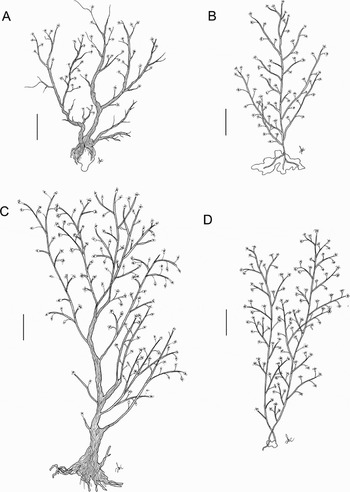
The four Eudendrium species differ both in the size and shape of the colonies and in their ecological requirements (Figure 1A–D).
Schemes of Eudendrium colonies. (A) E. armatum; (B) E. moulouyensis; (C) E. glomeratum; and (D) E. racemosum. Scale bars: A–D 1 cm.

Eudendrium armatum forms highly polysiphonic bi-dimensional colonies, 2.5–9.5 cm high (4.58 ± 1.98 cm on average) (Figure 1A). Samples were collected at depths ranging between 20 and 35 m inside caves or crevices in the cliff. Almost all colonies were hanging from the roof ceiling of the cave.
Eudendrium glomeratum forms large, polysiphonic colonies, 3–11 cm high (8.49 ± 2.43 cm on average) (Figure 1C). The basal, fascicled portions can be very thick. This species was mainly recorded on the cliff not directly exposed to solar light at 10 to 25 m.
Eudendrium moulouyensis has small colonies, 3–6.2 cm (4.19 ± 1.23 cm on average). The hydrocaulus and the branches are monosiphonic and thin out towards the distal extremities (Figure 1B). The species was collected at 5 to 25 m in areas exposed to light.
Eudendrium racemosum has colonies with monosiphonic hydrocauli increasing in diameter towards the base and 3.2–10.3 cm high (6.61 ± 2.24 cm on average) (Figure 1D). This hydroid species was found at depths between 5 and 10 m in well-lighted places and was often also colonized by algae and diatoms.
2. Foraminifers
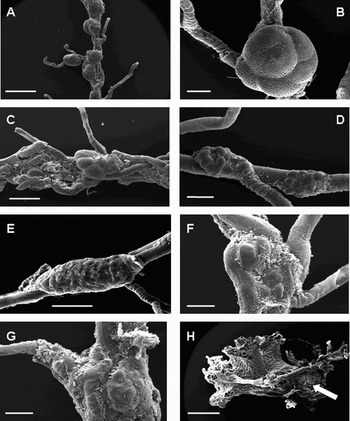
Four species of foraminifers—Rosalina globularis d'Orbigny, 1826, Lobatula lobatula (Walker & Jacob, 1798), Acervulina inhaerens Schultze, 1854 and Miniacina miniacea (Pallas, 1766)—were recorded on the Eudendrium colonies (Figures 2 & 3). Rosalina globularis presents a trochospiral test with a spiral side coarsely perforated and a smooth wall (Figure 2A–B), attached to the hydroid branches and stems on its ventral flat side by organic glue. Lobaluta lobatula (Figure 2C) and A. inhaerens (Figure 2D–G) have plastic tests, composed of irregular shaped chambers, which adapt their shape to the polysiphonic branches where they settle. In particular A. inhaerens is able to completely envelop the branches (Figure 2E). Miniacina miniacea forms irregular branching colonies, the tests are large and light red and attach to the base of the hydrocauli of the hydroids (Figure 2H).
Foraminifers epibiont of Eudendrium. (A–B) Rosalina globularis; (A) several cells on the apical portion of Eudendrium; (B) picture showing the typical shape of the test; (C) Lobatula lobatula. Cell on a slightly polysiphonic branch; (D–G) Acervulina inhaerens; (D) two specimens on monosiphonic branches; (E) A. inhaerens encrusting entirely a branch; (F) cell on the vertical grooves between two adjacent tubes of a polysiphonic branch; (G) A. inhaerens in a branch bifurcation (G): (H) Miniacina miniacea. The test was detached from the base of Eudendrium. The arrow shows the large attachment surface. Scale bars: A & H 1 mm; B, D, F & G 200 mm; E & C 500 mm.

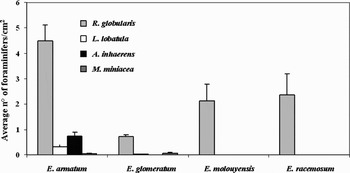
Average number (±SD) of foraminifers for each hydroid species.

The comparison of the foraminifer densities (number of foraminifers per square centimetre) between the different Eudendrium species (Figure 3) shows the highest values for Eudendrium armatum. Foraminifers are less abundant on Eudendrium moulouyensis and Eudendrium racemosum and scarce on Eudendrium glomeratum. In particular, R. globularis was the only species recorded on all the four Eudendrium. Lobulata lobatula was found on E. armatum and more rarely on E. glomeratum, while A. inhaerens was observed exclusively on E. armatum. Miniacina miniacea was more abundant on E. glomeratum, but was recorded also on E. armatum.
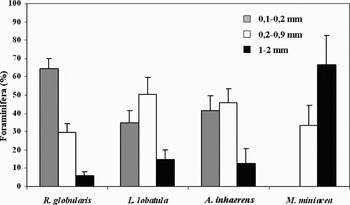
Regarding the spatial distribution of the four protozoan species on the colonies of E. armatum (Figure 4), R. globularis, L. lobatula and A. inhaerens were distributed along the entire colony although R. globularis was more frequent on the apical portions of the hydroid where the branches are younger and thinner (range 0.1–0.2 mm) (Figure 2A–B), while L. lobatula and A. inhaerens were mainly present on the central part of the colony where the branches are slightly polysiphonic (range 0.2–0.9 mm). In particular, L. lobatula was found only at the level of branch bifurcation (Figure 2C), while A. inhaerens colonized not only the monosiphonic branches (Figure 2D–E), but sometimes also the vertical grooves between two adjacent tubes of a polysiphonic branch (Figure 2F) and the branch bifurcations (Figure 2G). Finally, M. miniacea was observed only on thicker branches (0.2–0.9 mm) and on the highly polysiphonic basal region (1–2 mm) (Figure 2H).
Comparison of the distribution of the four foraminifer species according to the size of the branches of Eudendrium armatum.

On E. glomeratum the distribution pattern of R. globularis was similar to that observed on E. armatum although there were more foraminifers on the monosiphonic branches (0.1–0.2 mm), while M. miniacea was observed only on branches ranging between 1 and 2 mm. L. lobatula was very rare on E. glomeratum and was attached on thicker branches (1–2 mm).
Eudendrium racemosum and E. moulouyensis hosted exclusively R. globularis. They do not have polysiphonic branches except for the proximal portion of the stem and all the epibionts are found on the monosiphonic ramifications (0.1–0.2 mm).
DISCUSSION
The foraminifers observed on Eudendrium are not restricted to hydroids but are species commonly recorded as epibionts of algae and sea grasses. Epibiontic life on hydroids is a useful strategy for sessile foraminifers. In this way, the protozoans are able to rise from the bottom and can use the branched pattern of the host to support their pseudopodial network. This behaviour has already been documented for Rupertina stabilis living on hydroid colonies on the Norwegian continental margin (Lutze & Altenbach, Reference Lutze and Altenbach1988). Also Kitazato (Reference Kitazato1988) observed that Lobatula lobatula and Rosalina globularis living on algae collect diatoms using their pseudopodia. Moreover foraminifers living on Eudendrium may also exploit the food remnants egested by the polyps.
Hydroids probably do not benefit from their relationship with foraminifers although we have observed fascicled Eudendrium species incorporating their tests, together with other debris, thus possibly reinforcing the polysiphonic stem and branches.
Our data show a differential preference of foraminifers for the Eudendrium species. Particularly Eudendrium armatum hosts the highest number of individuals and species: this statement is in agreement with unpublished data concerning foraminifers which are epibiontic on Eudendrium in the Ligurian Sea.
This preference is probably related to the habitat where each hydroid species lives. Eudendrium armatum is generally observed inside dark habitats, such as holes or crevices, and this could promote the settlement of sciaphilous epibionts but this idea disagrees with the evidence that the two photophilous species Eudendrium moulouyensis and Eudendrium racemosum present a higher number of individuals than the deeper Eudendrium glomeratum.
Dobson & Haynes (Reference Dobson and Haynes1973) demonstrated that in environments characterized by turbulent conditions, foraminifers were confined to sheltered habitats provided by stable cobbles and algae. This preference of epibiontic foraminifers for habitats characterized by low water movement could be the reason for their preference for E. armatum typically living in sheltered habitats.
Epibiontic foraminifers not only show clear preferences for their host, but each species occupies a particular microhabitat on the same host. This fact was already known for algae and sea grasses where the epibiontic foraminifers were mainly studied. Kitazato (Reference Kitazato1983, Reference Kitazato1988, Reference Kitazato1994) described the epiphytic assemblage of the coralline algae Corallina pilurifera showing that on an algal thallus several microhabitats are present and the different groups of epibiontic foraminifers have a different degree of preferences for each microhabitat. Creeping forms settled on the distal portions of the thallus, free forms were observed on its proximal parts and sessile forms, such as R. globularis, were homogeneously distributed along the thallus. On the sea grass Posidonia oceanica, foraminifers living on rhizomes were planospiral (e.g. the spiral lies in a single plane), while those on leaves were trochospiral (e.g. the spiral does not lie in a plane) (Ribes et al., Reference Ribes, Salvado and Gracia1998).
Hydroids, such as algae and marine plants, are heterogeneous habitats comprising several microhabitats, in which different species of foraminifers may live. In particular, Eudendrium colonies present three main anatomical regions: a thick basal trunk, often encrusted by debris; a central portion represented by the stem and the main ramifications; and an apical region, composed of thin branches bearing polyps.
The distribution of the foraminifers on Eudendrium colonies appears to be affected by the relationship between the shape and size of their tests and the shape and size of the hydroid branches. Miniacina miniacea was observed only on E. armatum and E. glomeratum at the base of the stems or on larger branches. This species forms large branched colonies and needs big surfaces in order to attach itself and grow. Rosalina globularis colonizes both polysiphonic and monosiphonic portions of the hydroids but is more abundant on the unfascicled branches. This species has a trochospiral test attached to the hydroid by its flattened ventral side; the morphology of the test does not change in relation to the branch size or shape. On the contrary, Lobatula lobatula shows moderate adaptability. The test shape can vary according to the branch onto which the protozoan is attached, allowing it to settle even at the level of the ramification points. Acervulina inhaerens can attach itself and grow on any kind of branch due to its high plasticity. Its shell can adapt to the morphology of all branches, allowing the foraminifers to live inside grooves between the adjacent tubes of a polysiphonic branch.
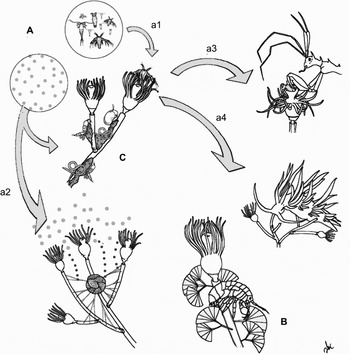
Recently (Romagnoli et al., Reference Sarà2007; Di Camillo et al., 2005) the high biodiversity of protists was underlined, mainly diatoms and protozoans, as epibionts on hydroids. Colonies of large hydroids can be considered as an assemblage of organisms, which are related not only by physical factors, but also by biotic and co-evolutionary interactions (Sarà, Reference Sarà1984). Hence, the large colonies of Eudendrium are a very complex living habitat hosting a large number of species involved in three different main trophic chains (Figure 5). One is related to a filter-feeding strategy (Figure 5A) mainly involving the Eudendrium polyps themselves (Figure 5A1) and the foraminifers (Figure 5A2) that, at different size levels, feed on material suspended in the water. The food collected by the polyps may be exploited by cleptocommensalist caprellids (Figure 5A3) and the polyps are predated by eolid nudibranchs (Figure 5A4). The second chain is linked to the diatom assemblages living on Eudendrium branches, exploited by a large number of grazers, mainly amphipods (Figure 5B). A third chain is made up of detritivorous organisms (copepods, nematodes and ostracods) that exploit the sediment settled on the colonies (Figure 5C) due to the widespread mucus production of the polyps (Bavestrello et al., Reference Bavestrello, Cerrano, Cattaneo Vietti, Sarà and Boillon1996).
Trophic chains involving Eudendrium and its epibionts. (A) First chain: A1, polyps catching plankton; A2, foraminifers feeding on suspended material; A3, cleptocommensalist caprellids exploiting the food collected by polyps; A4, polyps are predated by eolid nudibranches; (B) Second chain: amphipods grazing on the diatom assemblages living on Eudendrium branches; and (C) Third chain: detritivorous copepods that exploit the sediment settled on the hydroid colonies.