Over the past decade, biologic treatment of severe and active rheumatoid arthritis (RA) has become standard. Established tumor necrosis factor (TNF) inhibitors (etanercept, adalimumab, infliximab) are the first option and present a similar effectiveness. Several international clinical guidelines have been issued defining treatment approaches and the use of biologic therapies, including discussions of costs and cost-effectiveness (Reference Smolen, Landewe and Breedveld24). Current evidence suggests that remission has become a realistic goal when treatment is started early in the course of the disease (Reference Breedveld, Weisman and Kavanaugh3;Reference Emery, Breedveld and Heijde6) and guidelines have been issued for individualized treatment to target (i.e., remission) (Reference Smolen, Aletaha and Bijlsma23) as well as treatment of early RA (Reference Combe, Landewe and Lukas5).
In a large part due to their cost, biologics are only to be used after failure of one or more disease modifying anti-arthritic drugs (DMARDS) including methotrexate (MTX), generally more than two. In clinical practice, this leads to most patients not receiving biologics within the first 6–12 months after disease onset where the chances for remission are highest. In Europe, an estimated 12 percent of patients were on biologic therapy in 2008; the proportion for Sweden was estimated at 17 percent (Reference Kobelt and Kasteng15). Despite of this relatively small proportion, biologics for RA are among the most expensive treatments on the national drug budget Sweden (http://www.lif.se). Starting treatment earlier will increase the number of patients on treatment and it is important to investigate the added patient benefit and cost-effectiveness.
Two clinical trials comparing biologic treatment to MTX in early RA found that more patients achieved remission with etanercept (ETA) or adalimumab (ADA) and fewer discontinued treatment than with MTX (Reference Breedveld, Weisman and Kavanaugh3;Reference Emery, Breedveld and Heijde6). Introducing biologics in early RA is, however, likely to increase the impact on budgets. As a consequence, several strategies are currently being explored in clinical practice. Notable, it has been shown that it is possible to temporarily withdraw biologic treatment (Reference Nishimoto21;Reference van der Kooij, Goekoop-Ruiterman and de Vries-Bouwstra25) or reduce their dose (Reference Botsios, Furlan and Ostuni2;Reference Brocq, Millasseau and Albert4) in patients who have achieved remission. Similar strategies are examined in ongoing clinical trials, for example, with ETA (http://clinicaltrials.gov – trial NLT00575409).
Against this background, it is interesting to explore the cost-effectiveness of a potential future strategy involving biologic treatment to target in early RA with dose-reduction when remission is achieved.
METHODS
The Model
We adapted an economic model built to assess the cost-effectiveness of ETA/MTX treatment in severe RA (Reference Kobelt, Lindgren, Singh and Klareskog17). The model is based on the combined effect of function and disease activity to estimate costs and utility of different treatment options and radiographic progression is incorporated as an effect on function. The model was adapted to early RA and transformed to accommodate dose reductions and treatment switches.
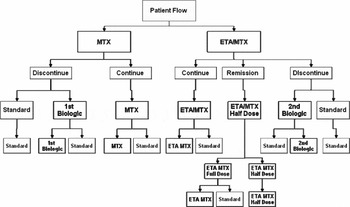
The basic model remains a Markov model with five main states based on functional capacity (measured with a patient outcome instrument in arthritis, the Health Assessment Questionnaire [HAQ], scored between 0 and 2.99 = worst): (state 1) 0 < 0.6; (state 2) 0.6 < 1.1; (state 3) 1.1 < 1.6; (state 4) 1.6 < 2.1; (state 5) 2.1 to 3. Each state is further divided into high and low disease activity (using the disease activity score, DAS28, scored between 1 and 10 = worst, where low disease activity is defined as DAS28 ≤ 3.2). In all resulting states, patients can be on biologic treatment (first, second, half-dose), on MTX or on standard DMARD treatment. Changes in disease status (HAQ level, high/low disease activity) or in treatment are modeled as transitions between the states in 6 month intervals (cycles), implemented at the start of the next cycle. Costs and utilities are assigned conditional upon HAQ, disease activity and treatment. Figure 1 illustrates the model schematically.
Simplified patient flow in the model. Patients with the characteristics of the total population enrolled in COMET (Reference Emery, Breedveld and Heijde6) start either with methotrexate (MTX) or etanercept (ETA)/MTX. Patients who discontinue in either group can switch to a (another) biologic (base case rate 50 percent) or receive standard therapy. Patients in remission with ETA/MTX switch to half the dose of ETA. Discontinuation on MTX and ETA-MTX and the rate of remission beyond 2 years are carried forward from the second year in COMET. Patients switching to their first (MTX) or another (ETA/MTX) biologic follow effectiveness and discontinuation rates as observed in the South Swedish biologics registry (SSATG) registry (Reference Kobelt, Lindgren and Geborek16). Upon discontinuation, patients move to standard therapy.

The Underlying Data
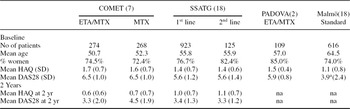
As is commonly the case in economic evaluation, no data set provided all necessary data, and we incorporated data from different sources. Table 1 presents the key baseline characteristics of the data used. All data sets were available at patient level
Characteristics of Data Sets Used

aGlobal VAS for health status (range 1–10, from best to worst).
COMET, clinical trial comparing etanercept/methotrexate to methotrexate alone in early rheumatoid arthritis (Reference Emery, Breedveld and Heijde6); SSATG, South Swedish Biologics Registry (Reference Geborek and Saxne9); PADOVA, Cohort study evaluating the efficacy of dose-reductions of etanercept (Reference Botsios, Furlan and Ostuni2); Malmö, observational study on costs and utilities of patients with rheumatoid arthritis (Reference Jacobsson, Lindroth and Marsal10); ETA, etanercept; MTX, methotrexate; Standard, treatment with standard nonbiologic disease-modifying arthritis drugs; HAQ, Health Assessment Questionnaire (range 0–2.99, from best to worst); DAS28, Disease Activity Score (range 1–10, from best to worst); na, not applicable.
First Line Biologic and MTX Treatment in Early RA. Patients enter the model either on ETA/MTX or MTX and treatment effectiveness was taken from a clinical trial (COMET) (Reference Emery, Breedveld and Heijde6). In this 2-year trial, patients with early active disease were randomized to either ETA/MTX or MTX for the first year. For the second year, patients on ETA/MTX were re-randomized to ETA/MTX or ETA, and patients on MTX to ETA/MTX or MTX. For this economic analysis, only patients consistently in the ETA/MTX or MTX arms were used. For the first year, effectiveness in terms of changes in HAQ and DAS28 was thus calculated from 274 and 268 patients on ETA/MTX and MTX, respectively; for the second year 136 and 133 patients continuing in the same arms were used. At baseline, 6.4 percent of patients were in state 1, 12.6 percent in state 2, 21.5 percent in state 3, 30 percent in state 4 and 29.4 percent in state 5. All patients had high disease activity.
HAQ and DAS28 transition probabilities were calculated for each 6-month period in the trial for patients remaining on treatment. Patients achieving remission or discontinuing treatment were considered separately for each period. In the absence of actual data for these patients beyond 2 years, transitions of the last 6-month period of the trial were extrapolated for patients remaining on their original treatment at the end of the trial.
Treatment After Discontinuation. Patients discontinuing ETA/MTX in COMET were allowed to switch to another biologic or to receive a mix of standard DMARDs as observed in Swedish clinical practice (Reference Jacobsson, Lindroth and Marsal10). Effectiveness of the second biologic was taken from the South Swedish biologics registry (SSATG) (Reference Geborek and Saxne9), excluding however ETA. Patients withdrawing from MTX were allowed to receive a first biologic, using data of the first biologic treatment from SSATG (all biologics), or standard DMARD treatment.
The SSATG data set used has been described earlier (Reference Kobelt, Lindgren and Geborek16) and comprised 923 patients starting biologic treatment for the first time, and 125 patients switching to a second TNF inhibitor that is not ETA. HAQ and DAS28 measurements were available frequently during the first year, but more irregular and less frequent in the second and subsequent years. We, therefore, calculated transition matrices for the five states for the first two 6-month periods only, while subsequent HAQ changes were estimated as an annual progression rate in the full sample. This can be justified as the treatment effect is essentially seen during the first 6 months, with HAQ and DAS28 relatively stable thereafter while on treatment (Reference Karlsson, Kristensen and Kapetanovic12). The average annual progression after the first year was estimated at 0.0102 and 0.0155 HAQ points for the first and second biologic, respectively.
Treatment with Reduced Dose of ETA. No formal studies regarding maintenance of remission on reduced dose of any of the biologics is available, but two follow-up studies in clinical practice using ETA give some insight. A French study found that a minority of patients with long-standing and very severe disease could remain on half dose beyond 12 months (Reference Brocq, Millasseau and Albert4). Contrary to this, an Italian study (University of Padova) in patients with less established disease found that a majority maintained remission, defined as DAS28 < 2.6 at 6 and 12 months (Reference Botsios, Furlan and Ostuni2) after randomization to half dose of ETA. During 2 years of follow-up 13 percent of patients required full dose again, the majority of them (71 percent) in the first year. This indicates that there is a window of opportunity to induce remission in early disease.
Model Parameters
Function (HAQ). Changes in HAQ calculated from COMET and SSATG are implemented at the beginning of the next cycle as transition between the HAQ states. Patients on standard therapy were assumed to progress at the average annual rate estimated earlier, 0.031 HAQ points (Reference Scott, Pugner and Kaarela22). No data are available on HAQ changes for patients in remission. However, it has recently been shown that synovitis may persist even in these patients, and that HAQ may thus not be entirely stable (Reference Lagana, Picchianti Diamanti and Ferlito18). We, therefore, assumed that these patients would progress at half the rate of patients on the first biologic in SSATG, 0.005 HAQ points/year. This underlying progression, although very small, can lead to a change in the HAQ state while on treatment.
The results of COMET showed a difference in radiographic progression between ETA/MTX and MTX of 4.3 points in the modified Sharp score at the end of 2 years (Reference Emery, Breedveld and Heijde6). This was modeled as a small increase in HAQ progression for patients on MTX, thus affecting the transition probabilities in this group. In the earlier version of the model a difference of 2.8 Sharp points was estimated to affect the underlying annual disease progression by 0.005 HAQ in patients with a disease duration of ≥5 years and a HAQ > 1.1 (Reference Kobelt, Lindgren, Singh and Klareskog17;Reference Scott, Pugner and Kaarela22).
Disease Activity (DAS28). Probabilities of having high or low disease activity were estimated directly from COMET and SSATG and extrapolated beyond the study period in the same way as HAQ (Supplementary Table 1, which can be viewed online at www.journals.cambridge.org/thc2011012).
Discontinuation and Switching. In COMET, 24.5 percent of patients in the ETA/MTX group and 37 percent in the MTX group withdrew during the 2-year trial; first year discontinuation was 17.9 percent and 24.6 percent, respectively. Discontinuation at 2 years for the first biologic in SSATG was 36.5 percent and for the second 48 percent; first year discontinuation was 29.4 percent and 39.6 percent, respectively. (Supplementary Table 2, which can be viewed online at www.journals.cambridge.org/thc2011012). Switching to a biologic is only allowed once, at withdrawal from the clinical trial, as no data are available to estimate changes with further switches in this type of patients. At the second discontinuation, patients will move to the standard mix of DMARD treatment. In the base case, and in the absence of any clinical practice data, we conservatively assumed that 50 percent of patients discontinuing in both arms of COMET would switch. At discontinuation from biologic treatment patients are assumed to return to their baseline HAQ, adjusted for underlying progression during the years of treatment. Discontinuation rates from second year in COMET were carried forward beyond the trial and switching is thus possible during the entire duration of the simulation.
Remission, Dose Reduction, and Return to Full Dose. Dose reduction was applied only to the ETA/MTX arm and allowed for patients with a DAS28 < 2.6 at two consecutive 6-month measurement points in COMET. Dose reduction of ETA is thus only possible from 12 months onward. According to this criterion, 29 percent (79/274) of patients achieved remission in the first year and a further 12.5 percent during the second year.
Failure to maintain remission in the Padova cohort (Reference Botsios, Furlan and Ostuni2) had been defined as reaching DAS28 ≤ 3.2 again, and patients returned to full dose immediately. The proportions failing at each 6 month period was applied to the model. A total of 109 patients had been eligible for half dose, and of these, 6.5 percent required full dose again within 6 months, 2.8 percent between 6 and 12 months, and 2 percent during the subsequent 6 month periods (Supplementary Table 2). At restart of full dose, patients remain in their HAQ state and are assumed to have high disease activity. They get the treatment effect on disease activity (remission) again at the next cycle, with the assumption that having achieved remission once on full dose, they would achieve it again.
Mortality. Normal mortality was adjusted for patients with a HAQ of 1.1 or higher, with a relative risk of 2.0 and 1.3 for patients with high and low disease activity, respectively. This takes into account that mortality is not increased in the first years of the disease (Reference Gabriel, Crowson and Kremers8;Reference Lindqvist and Eberhardt20), but would capture any potential improvement of mortality due to patients not reaching severe states or reaching them later.
Costs. Resource usage was estimated from a population-based survey in the Malmö area in Southern Sweden, combined with early retirement data for a more urban population (Stockholm area), as in the original model (Reference Kobelt, Lindgren, Singh and Klareskog17). The survey covers an estimated 90 percent of all patients in the area and includes all types of consumption (health care costs, community services, patient costs and productivity losses). Mean costs by HAQ level were calculated using bootstrapping and ranged from €4,500 to €19,500 adjusted to 2008 using the Swedish consumer price index. (Supplementary Table 3, which can be viewed online at www.journals.cambridge.org/thc2011012) Bootstrapping allows overcoming issues with small samples at certain HAQ values and produces a distribution that subsequently can be used in probabilistic sensitivity analysis. All costs except short-term sick leave were significantly correlated with HAQ only, when controlling for age, gender, and disease duration. Short-term sick leave was correlated with age and disease activity (high or low).
Utilities. Utilities (EQ-5D) (7) were taken from the above survey in Malmö. The survey covers the full range of relevant values (HAQ, age) which is not always the case in trials or biologics registries. We assigned scores to the different HAQ/DAS states using bootstrapping, controlling for age and gender. Mean utilities ranged from 0.768 to 0.239.
Utility scores were also available in COMET, albeit not for the full range of HAQ and age as the trial enrolled patients with early disease and lasted only 2 years. However, we found that patients in the ETA/MTX group had consistently higher utilities, by an average of 0.036, when controlling for HAQ. The same finding was made in the original model based on another clinical trial (TEMPO) (Reference Kobelt, Lindgren, Singh and Klareskog17). We implemented this difference in the model to patients on all biologic treatments, but conservatively only when they had low disease activity.
Analytical Framework. The model is analyzed as a microsimulation, using 300,000 simulations to obtain entirely stable results (see Supplementary Figure 1, which can be viewed online at www.journals.cambridge.org/thc2011012). Uncertainty in the model is explored with probabilistic analysis.
The base case is presented for 10 years. This appears short in view of the disease course, but was chosen in view of the data availability. Longer time frames improve the cost-effectiveness in chronic progressive diseases, but require more assumptions and thus increase the uncertainty of the results. The analysis is presented for the societal perspective including all costs (direct medical and nonmedical, informal care, production losses). A part from the fact that this is required for Sweden, it is also the appropriate approach in a disease where at least half of the costs are outside the health care system (Reference Jonsson11). Costs and effects are discounted with 3 percent.
Sensitivity analyses are performed for the time horizon, the perspective, the discontinuation rate, the proportion of patients switching or returning to full dose and the utility adjustment in the biologics group.
RESULTS
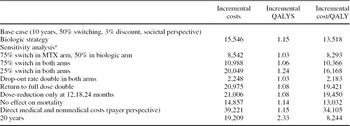
Simulation results are presented in Table 2, and the patient flow in the model is illustrated in Supplementary Table 4, which can be viewed online at www.journals.cambridge.org/thc2011012.
Results (€2008)

aAll analyses used a 10-year time frame and a societal perspective, except when otherwise indicated. QALYs, quality-adjusted life-year; MTX, methotrexate.
In the base case the cost per quality-adjusted life-year (QALY) gained when starting with ETA/MTX compared with MTX alone is estimated at €13,500 (societal perspective). Total discounted costs are 170,800 and 155,300, respectively, and patients have a total of discounted QALYs of 4.15 and 5.30.
In all sensitivity analyses explored, costs for the ETA/MTX strategy are slightly higher, but associated with a QALY gain of 1 to 2.3. Results were most sensitive to the drop-out rate, the duration of treatment with reduced ETA-dose and as expected the time horizon and the perspective of the analysis. The utility adjustment did not change the results significantly. When 75 percent instead of 50 percent of drop-outs are switching to a biologic, the cost per QALY gained with ETA/MTX decreases to €10,400 as costs in the MTX strategy increase proportionally more due to the higher underlying drop-out rate. Similarly, if the drop-out rate increases in both groups, the cost per QALY for ETA/MTX decreases, again due to a larger cost increase in the MTX strategy: With a double drop-out rate, the ICER decreases to €2,200. If failure to maintain remission is double, or if dose reduction is only possible during the clinical trial period, the ICER for ETA/MTX increases to €19,400. Including only medical costs (payer perspective), the ICER increases to €34,000. A longer time perspective (20 years) reduces the ICER to €8,200.
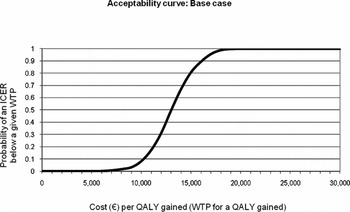
In the probabilistic analysis, using the base case scenario and the full range of data for all variables, 100 percent of simulations (1,000) result in a cost-effectiveness ratio below €20,000 (Figure 2).
Probabilistic analysis: proportion of estimates of increment cost-effectiveness ratios (ICERs) falling below given willingness to pay (WTP) for a quality-adjusted life-year (QALY). Acceptability curves indicate the probability that cost-effectiveness estimates fall below a given threshold (willingness to pay for a QALY) when the full range of patient level data is included in the probabilistic analysis. The acceptability curve presented uses the base case and results from 1,000 simulations. The mean deterministic incremental cost-effectiveness ratio (ICER) of our base case analysis is €13,500/QALY gained, and 100 percent of the simulations in the probabilistic analysis lie below a threshold of € 20,000.

DISCUSSION
We present a cost-effectiveness analysis of a hypothetical treatment scenario of early RA with biologics that includes a dose reduction for patients who achieve clinical remission. The analysis is perfumed for ETA as both a 2-year clinical trial for early treatment (COMET) and a cohort study investigating dose reduction (PADOVA) were available. Several issues in our analysis require discussion.
In COMET biologic treatment was used very early, including in treatment-naive patients. This does not currently correspond to clinical practice in Sweden. The study should, therefore, be seen as investigating a possible option. As a consequence, we had to make several assumptions and we have tried to be as conservative with regards to ETA as possible.
A key assumption not supported by any data concerns the number of patients who upon discontinuing their first treatment (either ETA/MTX or MTX) would switch to a different or their first biologic. In the base case we have conservatively assumed 50 percent. A higher proportion favors the biologics strategy, due to the higher drop-out rate on MTX and thus a larger cost-increase. Switching to a biologic in the MTX strategy may however be more likely as it would follow current clinical practice. Again, such an assumption favors the biologic strategy (see Table 2) and we have, therefore, decided to use conservatively 50 percent in both arms as our base case. After switching, detailed effectiveness data are available from the SSATG registry making it possible to adjust for potential differences in the sample (HAQ, DAS, disease duration).
We assumed that most patients withdrew from the trial due to lack of effect or to adverse events. Patients who remained in the trial despite high disease activity and a high HAQ, and thus an insufficient response, were not included in the group of failures (switches), as the number was small and did not allow stable estimates. Allowing them to switch would have favored the ETA/MTX strategy.
Few studies on effectiveness of ETA at a lower dose are available. The cohort study in Padova has systematically introduced dose modification for patients that achieve full remission and represents currently the most extensive data set. Although patients had slightly longer disease duration than patients in COMET, we believe that the results can be extrapolated to our scenario. The longer the disease duration, the more difficult it is to achieve and maintain remission, and one could argue that the rate of return to full dose could be even lower in the very early patients in COMET. As results are sensitive to the rate of return to full dose, this would favor the ETA strategy.
We incorporated data from different sources for this analysis. This is almost always required for economic evaluation. The purpose of such analyses is often to explore potential consequences of changes in the way patients are treated or in the effect of a treatment, rather than simply analyze known facts from a clinical trial or clinical practice. In RA, the effects are most visible in the long-term and all data sets are too limited in time. Clinical trials follow a strict protocol and the data thus do not provide information, for example, on what happens to drop-outs, or what would have happened in the case of remission. Nevertheless, due to this type of limitation in the data as well as the need for several assumptions, we limited the time frame to 10 years. It should however be noted that longer time frames will make the biologic strategy more cost-effective.
We have defined remission as a DAS28 < 2.6 at two consecutive 6-month measurements, which means that patients are in remission for up to 12 months before dose reduction is considered. This is similar to the criteria used in the Italian study. Using less or more stringent criteria for dose reduction will change the number of patients eligible for dose adjustments and thus change the cost-effectiveness. The optimal time when dose reduction is considered from the point of view of cost-effectiveness should be an objective of further research.
The analysis adapts and expands an Markov approach to modeling treatment. Considering the availability of patient level data, different types of models could have been considered. However, models represent the underlying data and assumptions and different techniques will result in similar results is all else is equal. As the existing model takes into account function, disease activity as well as erosions when estimating costs and utilities, we believed best to expand on this approach.
Several cost-effectiveness analyses for biologics in Sweden have been published. Results are not directly comparable as studies have used different data, products, and time frames, and all concerned patients with moderate to severe disease. ICERs ranged from €20,000 to €50,000 (adjusted to 2008) (Reference Bansback, Brennan and Ghatnekar1;Reference Kobelt, Eberhardt and Geborek13;Reference Kobelt, Jönsson, Young and Eberhardt14;Reference Kobelt, Lindgren, Singh and Klareskog17;Reference Lekander, Borgstrom and Svarvar19). In comparison, our ratios indicate that earlier and targeted treatment including dose reductions is a cost-effective strategy. Also, a modeling study based on the SSATG registry indicated that earlier treatment was less costly and provided more benefits than a late treatment start (Reference Kobelt, Lindgren and Geborek16).
Our results are presented for Sweden and as such are not directly transferrable to other jurisdictions, particularly not those using a payer rather than a societal perspective. However, what is in our opinion valid everywhere is that a strategy of dose reduction in the case of remission will reduce ICERs substantially. Remission is, however, more difficult to achieve in late disease and we believe that our model of a strategy of early treatment followed by dose-reduction if warranted provides insights into the cost-effectiveness of early treatment.
SUPPLEMENTARY MATERIAL
Supplementary Table 1
Supplementary Table 2
Supplementary Table 3
Supplementary Table 4
Supplementary Figure 1
CONTACT INFORMATION
Gisela Kobelt, PhD, MBA (kobelt.gisele@wanadoo.fr), Visiting Professor, Department of Orthopaedics, Lund University, Box 117, 22 100 Lund, Sweden; President, European Health Economics, 15 rue Victor Schoelcher, 68200 Mulhouse, France
Ingrid Lekander, MSc (Ingrid.lekander@ki.se), Department of Learning, Informatics, Management, and Ethics (LIME), Karolinska Institute SE-171 77 Stockholm; Senior Project Leader, i3 innovus, Klarabergsviadukten 90, hus D, 111 64 Stockholm, Sweden
Andrea Lang, MS (langdrea@gmail.com), Research Analyst, i3 innovus, Klarabergsviadukten 90 D, 111 64 Stockholm, Sweden
Bernd Raffeiner, MD (berndraffeiner@yahoo.com), Ph.D. Fellow, Costantino Botsios, MD, PhD (constantin.botsios@unipd.it), Assistant Professor, Department of Clinical and Experimental Medicine—Rheumatology Unit, University of Padova, via Giustiniani 2, Padova, Italy, 35128
Pierre Geborek, MD, PhD (Pierre.geborek@med.lu.se), Associate Professor, Department for Clinical Science (IKLV), Section of Rheumatology, Lund University; Senior Physician, Department of Rheumatology, Skåne University Hospital Malmö (SUS), 226 85 Lund, Lund, Sweden
CONFLICT OF INTEREST
Gisela Kobelt informs her institution has received consulting fees, support for travel to meetings and payment for this study from Wyeth/Pfizer; outside this study her institution has received consulting fees and payment for lectures or presentations from Wyeth/Pfizer, Abbott, Roche, and Bristol Myers Squibb. Ingrid Lekander and Andrea Lang inform that their institution has received financing from Wyeth/Pfizer to build the model. The other authors report they have no potential conflicts of interest.