Introduction
Pasture management strategies for areas under intermittent stocking have significantly evolved in recent decades, particularly for tropical forage grasses (Macedo et al., Reference Macedo, Cunha, Cândido, Domingues, da Silva, Lara and do Rêgo2021). Effective grazing management in full-sun systems necessitates animals entering the pasture at 95 % light interception (LI) (Parsons and Penning, Reference Parsons and Penning1988). This target grazing goal arises from a deeper understanding of the ecophysiological processes of forage plants and the impact of management on pasture productivity and quality (da Silva et al., Reference da Silva, Bueno, Carnevalli, Uebele, Bueno, Hodgson, Matthew, Arnold and de Morais2009). These studies laid the groundwork for establishing appropriate grazing management practices to optimise pasture production, quality, and longevity.
However, the 95 % LI benchmark directly correlates with the ideal grazing height for each species of forage plant grown in full sun, ensuring the forages have adequate nutritive value and quantity (Antunes et al., Reference Antunes, Montgner, Euclides, Taira, Echeverria, Nantes and Orrico Junior2021). In silvopastoral systems (SPS), where forage plants are cultivated under shade, morphophysiological changes occur due to these conditions. This suggests that adjustments to the 95 % LI index may be necessary, given the relationship between height and forage quality.
The significance of SPS is underscored by their integration of forage species and trees within the same area, creating synergistic benefits for the sustainability and efficiency of livestock production (Broom, Reference Broom2021; Gomes et al., Reference Gomes, Cavalli, Pedreira, Pedreira, Holschuch and Pereira2022). Forage plants exposed to lower light intensities tend to elongate stems and leaves as a strategy to maximise exposure to incident light, which results in taller plants (da Cruz et al., Reference da Cruz, Borges, Santos, Magalhães, Azevedo, da Fonseca and da Silva2021). Along with the greater elongation of leaves and stems, an increase in specific leaf area is observed, due to the greater expansion of leaf area relative to its weight leaf (Lopes et al., Reference Lopes, Paciullo, Araújo, Gomide, Morenz and Villela2017).
Shade-grown forage grasses, even when maintained at the same canopy height as those grown under full sunlight, may present differences in LI (Baldissera et al., Reference Baldissera, Pontes, Giostri, Barro, Lustosa, Moraes and de Faccio Carvalho2016). Consequently, managing grazing based on the 95 % LI criterion may not be the most appropriate approach for shaded forage plants (Machado et al., Reference Machado, da Fonseca, Lima, Martuscello, Paciullo and Chizzotti2020). Due to the phenotypic plasticity of plants in shaded conditions, further research is essential to optimise their use in these sustainable systems, ensuring that forage plants can provide both quality and quantity (de Oliveira et al., Reference de Oliveira, Menezes, Gonçalves, de Araújo, Ramirez, Júnior, Jayme and Lana2022). The aim is to enhance pasture utilisation while prioritising environmental protection (Santos et al., Reference Santos, Ferreira, da Cruz, Ribeiro, Alencar, Cabral, Francino and Aspiazú2018; Gomes et al., Reference Gomes, Pedreira, Bosi, Cavalli, Holschuch, Mourão, Pereira and Pedreira2019).
Our hypothesis is that, compared with full-sun conditions, Marandu palisade grass (MPG) [Urochloa brizantha (Hochst. ex A. Rich.) R. Webster cv Marandu] exhibits distinct morphophysiological responses to different shading levels in SPS. Furthermore, we anticipate that adjusting pre-defoliation heights to specific light environments will maintain forage productivity and nutritive value, thereby supporting effective grazing management and enhancing the sustainability of these production systems.
Given this context, research identifying the optimal grazing times for animals in shaded systems is necessary. This will maximise animal performance and pasture sustainability within these agricultural ecosystems, contributing to reducing greenhouse gas emissions. Thus, this study is proposed to compare the pre-defoliation heights of MPG under full sun conditions and within a silvopastoral system featuring varying levels of shading over two years of pasture management.
Materials and methods
Study area
The study was conducted in an experimental area with SPS implanted in the Cerrado biome. The plants were established 8 years ago in Bambuí, Minas Gerais, Brazil, with geographic coordinates 20°02′ S, 46°00′ W, at 705 m above sea level. The SPS was established in a contour line in 2012 using clonal eucalyptus trees (clone I144, hybrid between Eucalyptus urophylla × E. grandis). The trees were arranged in double rows, 3 metres between each tree and 12 metres between each row (Figure 1).
Schematic representation of light availability in the silvopastoral system (SPS) with sampling/plot locations (interrow (SPS 55–60 %); 0 to 2 m (SPS 50–55 %); 2 to 4 m (SPS 45–50 %); and 4 to 6 m (SPS 40–45 %) to the north and south) and in monoculture pasture (FS = full sun). Source: Personal archive.

The plants of MPG were established in 2013, one year after planting the eucalyptus. Between the implantation and the beginning of the present study, the forage was grazed by dairy cattle, with neither sward height regulation nor fertilisation, thus receiving no specific management. Meteorological data were collected from a station 1400 metres away from the experimental area. The annual rainfall was 1599 and 1265 mm, the maximum temperature was 35.61 and 36.13 °C, and the minimum temperature was 7.31 and 4.86 °C for Year 1 and Year 2, respectively.
Photosynthetically active radiation (PAR) was measured twice weekly throughout the experimental period. In the first year of the study, the PAR values in full sun were 1348 µmol m²/s during the summer (rainy season) and 1297 µmol m²/s during the winter (dry season). In the second year, these values were 1387 µmol m²/s for summer and 1159 µmol m²/s for winter. The mean PAR values recorded in the silvopastoral system in the first year were 786 µmol m²/s in summer and 661 µmol m²/s in winter. In the second year, the mean values were 791 µmol m²/s in summer and 660 µmol m²/s in winter. At the beginning of the experimental period, eucalyptus plants averaged were measured, showing an average height of 25 m and a diameter at breast height of 27.5 cm.
The total duration of the experiment was 730 days, spanning from November 14, 2019, to November 14, 2021. The experiment started with a uniform mowing at 20 cm height using a brush cutter (Stihl, São Leopoldo, Brazil), leaving a uniform stubble 20 cm above the soil. Following the mowing, the forage plants were fertilised with 100 kg N/ha per year over two years, divided into two applications: one in November and the other in February. The source of nitrogen used was ammonium sulphate [20 % N and 22 % sulphur (S)]. It is important to note that during the experimental period, grazing was simulated by mowing at 20 cm and removing the cut herbage.
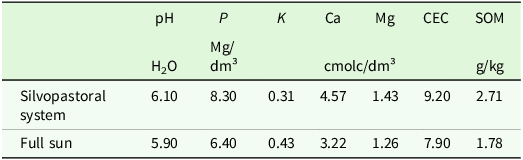
The soil of the experimental area is classified as dystroferric red latosol (Oxisols), which originated from limestone associated with the Bambuí Group geology (EMBRAPA, 2006). The 0–20 cm soil layer presented a granulometric composition of 625 g/kg clay, 322 g/kg silt, and 53 g/kg sand. The chemical characteristics of the soil sampled at the beginning of the experimental period from the 0–20 cm layer for both silvopastoral system (8 years established) and full sun monoculture are described in Table 1.
Soil chemical characteristics of the silvopastoral system and full sun, sampled at the beginning of the experiment, in the 0–20 cm layer

pH (Soil pH was measured in H2O and in 1 mol/L KCl, using a soil-to-solution suspension ratio of 1:2.5), P = phosphorus and K = potassium (Phosphorus and potassium were extracted using a double-acid solution of 0.05 mol/L HCl + 0.0125 mol/L H2SO4 (Mehlich 1), with available P determined by spectrophotometry and K by flame photometry), Ca = calcium and Mg = magnesium (Calcium and magnesium were extracted with 1 mol/L KCl and quantified by atomic absorption spectrophotometry (Analyst 700, Perkin Elmer, USA)), CEC = cation exchange capacity (was calculated as the sum of Ca, Mg, K, and H+Al contents), SOM = soil organic matter (was determined according to Raij et al. (Reference Raij, Quaggio, Cantarella, Ferreira, Lopes and Bataglia1987)).
Experimental design and treatments
The experimental design with treatments arranged in split plots (Figure 1). Different shading levels were allocated to the plots based on their distance from the tree component, which constituted the environments with different light availability ranges between the rows of the silvopastoral system (SPS). The treatments consisted of SPS with 55–60 %, 50–55 %, 45–50 %, and 40–45 % shading, corresponding to the mean shading levels measured over the entire experimental period, along with one treatment of MPG grown in full sun (monoculture). Within the subplots, the management techniques for the MPG pasture were distributed randomly, with four pre-defoliation heights: 30, 40, 50, and 60 cm.
The plots of the treatments under shading and monoculture had dimensions of 2 m wide by 18 m long, totalling 36 m². Each plot was subdivided into subplots of 2 m in width by 3 m in length, with a total area of 6 m², and separated by 1.5 m corridors. In the SPS, the central 2 m between tree row spacings was considered, and each experimental unit consisted of three consecutive double-row eucalyptus strips along with the understory of MPG.
Each experimental unit in the silvopastoral system (SPS) consisted of three double-row strips of eucalyptus, with the MPG understory planted in between them.
Evaluations
The number of defoliation cycles was evaluated over the experimental period and corresponded to the number of times the pastures reached the predetermined height for each treatment, at this point, evaluations and subsequent forage cutting were conducted.
During the evaluation period, two points in each experimental unit were randomly sampled using a square polyethylene frame with an area of 1 m² in all shading treatments whenever the forage plants reached the pre-defoliation height. We measured the height of the forage plants, the leaf area index (LAI), the LI, and the indices of chlorophyll and tillering according to the procedures outlined below. Two additional polyethylene frames with an area of 1 m² were sampled in each experimental unit to evaluate the leaf/stem ratio and total forage productivity.
The height of the pastures was monitored twice a week using a ruler graduated in centimetres, based on the average height of the canopy around the ruler as the criterion. Data on the total number of tillers were collected by harvesting and counting the number of tillers in the samples corresponding to 1 m².
The red to far-red ratio (R/FR) data was obtained through the readings performed by the FieldScout apparatus, Spectrum Technologies, Inc 3412 (Aurora, IL, USA). Three readings were taken for each subplot at three different times: 9:00, 12:00, and 15:00 h (early morning, midday sun, and late afternoon). These measurements were conducted before cutting each respective treatment, following the recommended guidelines for using the device under uniform light conditions.
The intensity of photosynthetically active radiation (PAR, µmol m²/s) in the study environments was measured using the AccuPar LP-80 Ceptometer (Decagon Devices, Pullman, WA). This equipment monitored LI by forage plants grown in the understory of eucalyptus trees and in full sun. Five measurements were taken at each point, both above and below the forage canopy of each subplot. Readings were recorded during the experimental period under diffuse radiation conditions at 9:00, 12:00, and 15:00 h (early morning, midday sun, and late afternoon), following recommended protocols for using the device on days with uniform light conditions.
The LAI was estimated simultaneously with the monitoring of LI by the average of the evaluated forage canopy since the ceptometer calculates the LAI based on the PAR measured above and below the canopy, simultaneously with other variables related to the sun’s position.
At the same time, the chlorophyll indices were measured using a clorofiLOG chlorophyllometer (model CFA 1030, Falker Automação Agrícola, Brasil). The equipment was positioned in the middle third of the first completely expanded leaf blade from the top of three tillers from each plant. Measurements were taken from three plants within each experimental unit under shaded conditions. These data allowed us to calculate the ratios of chlorophyll A to chlorophyll B (A/B) as well as the total chlorophyll content.
Following these measurements, the MPG plants were cut, leaving a 20 cm stubble above the soil. Additionally, a sample was collected from the field to determine the morphological composition of the plants. This sample was separated into stem and leaf fractions (leaf blade and leaf sheath) and placed into kraft paper bags. The bags were weighed before being placed in a forced air oven set at 55 °C for 72 h or until they reached a constant weight. After this process, the samples were weighed again to calculate the leaf-to-stem ratio (L/S) and dry matter yield (DMY).
The data were analysed using analysis of variance at a significance level of 5 %. This analysis evaluated the effects of grazing management height and shading, as well as the interaction between these two factors. In cases where a significant interaction or significance in any of the individual factors was observed, the Tukey Test was applied for mean comparisons, also at a significance level of 5 %. A regression model was utilised for the pre-defoliation height analysis, again at a significance level of 5 %. All statistical analyses were conducted using the Statistical Analysis System (SAS) software, version 9 (SAS 2012).
Results
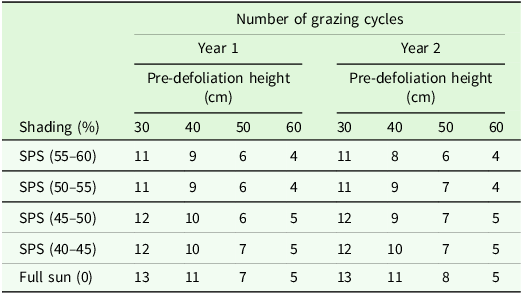
Throughout the years of evaluation, the number of cycles showed little variation in both the SPS and full sun. The MPG plants in monoculture exhibited more cycles, particularly at heights of 30 and 40 cm. In contrast, grazing at a height of 60 cm resulted in fewer cycles (Table 2).
Number of grazing cycles of Marandu grass under different shading conditions: silvopastoral system (SPS) and monoculture (full sun), based on the animals’ entry height

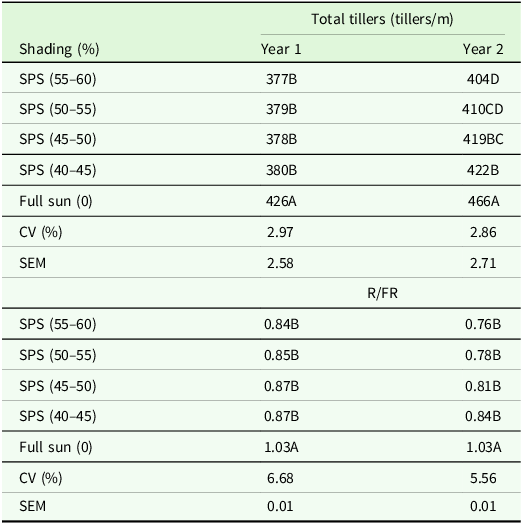
No interactions were found between pre-defoliation height and shading levels for total tillers and R/FR. However, significant differences (P < 0.05) in shading were noted for both evaluated variables (Table 3). Under shaded conditions, Marandu palisade plants exhibited a lower total tillering than those grown in full sun monoculture (P < 0.05) (Table 3). Over two years of evaluation, the full sun system exhibited a 12.5 % increase in total tillering, with a higher mean tiller density (tillers per m⁻²) compared to the more SPS.
Total number of tillers of Marandu grass and the red to far-red ratio under different shading conditions: silvopastoral system (SPS) and monoculture (full sun)

*Values followed by the same letter are not statistically different according to Tukey’s test at the 5% probability level (P < 0.05). R/FR = red to far-red ratio; CV = coefficient of variation; SEM = standard error of the mean.
The shading provided by the trees also reduced the R/FR ratio compared to the full sun system (Table 3). Specifically, the R/FR ratio decreased by 16.7 % in the first year and 22.5 % in the second year in comparison to the most SPS.
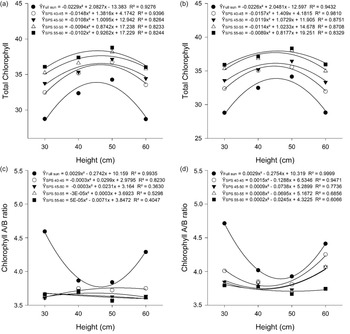
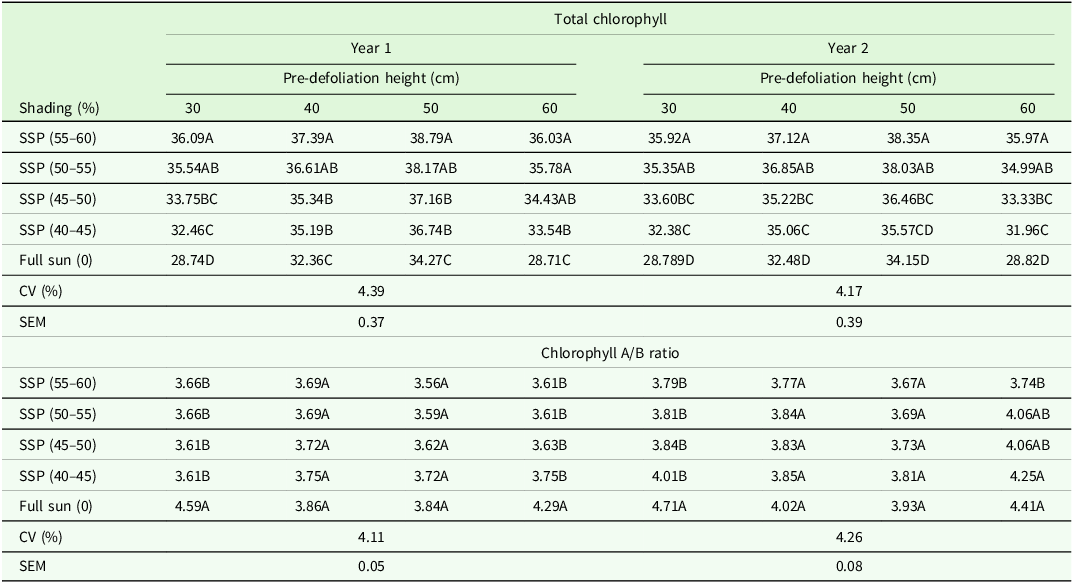
Additionally, the indices of total chlorophyll increased with greater shading levels (Figure 2a and b) over the two years. At all pre-defoliation heights, the highest total chlorophyll concentrations were found in systems with the most intense shading, specifically those with 50–55 and 55–60 % shade.
Total Chlorophyll Index for the first year (a) and second year (b), along with the chlorophyll A/B ratio for the first year (c) and second year (d) of the evaluation of Marandu grass under different shading levels and full sun conditions, as a function of pre-defoliation height.

We observed that MPG plants with pre-defoliation heights of 40 and 50 cm exhibited the highest total chlorophyll indices (Figure 2a and b). In terms of the chlorophyll A/B ratio, the full-sun plants responded more to the variation in height pre-defoliation than those grown in SPS (Figure 2c and d).
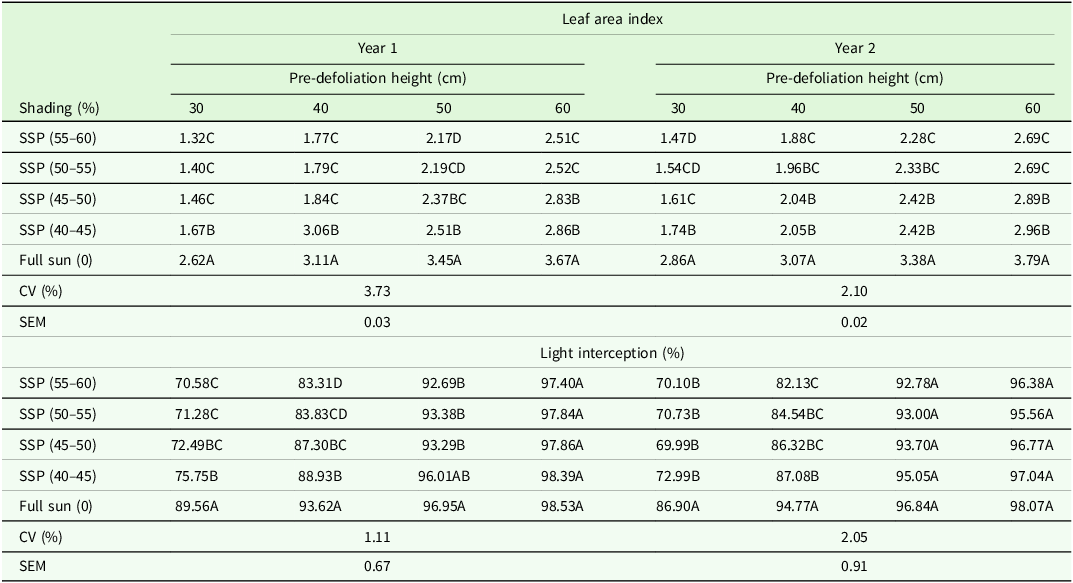
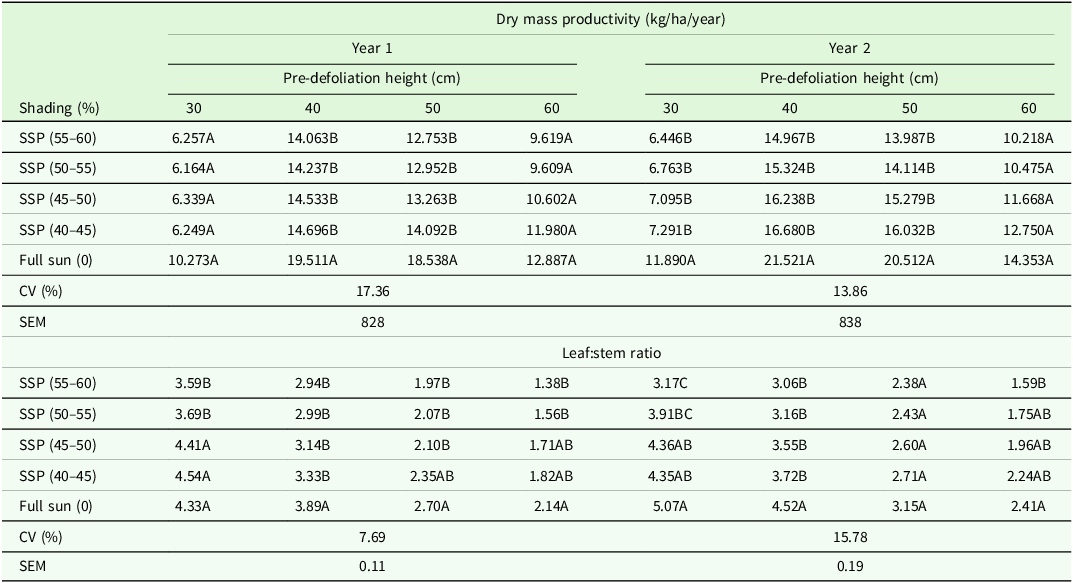
The LI, LAI, and DMY of MPG decreased as shading from the SPS increased (P < 0.05) (Tables 5 and 6).
Total chlorophyll and chlorophyll A/B ratio of Marandu grass under different shading conditions: silvopastoral systems (SSP) and monoculture (full sun) as a function of pre-defoliation heights

*Values followed by the same letter are not statistically different according to Tukey’s test at the 5 % probability level (P < 0.05). CV = coefficient of variation; SEM = standard error of the mean.
Leaf area index and light interception (%) of Marandu grass under different shading conditions: silvopastoral system (SSP) and monoculture (full sun) as a function of pre-defoliation heights

*Values followed by the same letter are not statistically different according to Tukey’s test at the 5 % probability level (P < 0.05). CV = coefficient of variation; SEM = standard error of the mean.
Dry mass productivity (kg/ha/year) and leaf:stem ratio of Marandu grass under different shading conditions: silvopastoral systems (SSP) and monoculture (full sun) as a function of pre-defoliation heights

*Values followed by the same letter are not statistically different according to Tukey’s test at the 5 % probability level (P < 0.05). CV = coefficient of variation; SEM = standard error of the mean.
As pre-defoliation heights increased, we observed a corresponding increase in LI values over the two years evaluated (Figure 3a and b). Importantly, only plants managed at 50 and 60 cm pre-defoliation heights reached the critical threshold of 95 % LI, highlighting these heights as the most effective for maximising canopy light capture. Similarly, the LAI also increased with higher pre-defoliation heights (Figure 3c and d).
Light interception (%) in the first (a) and second (b) years, and leaf area index in the first (c) and second (d) years of Marandu grass evaluation under different shading levels and full sun, as a function of pre-defoliation height.

The management of MPG at pre-defoliation heights of 40 and 50 cm resulted in the highest average DMY over two years of cultivation (P < 0.05) (Table 6). At these pre-defoliation heights, the mean DMY of MPG in SPS was 26.2 and 28.4 % lower than in full sun during the first year and 26.5 and 27.5 % lower in the second year. Over the two years of cultivation, the mean reduction in DMY of MPG compared to monoculture was 40.5 and 20.6 %, respectively, at pre-defoliation heights of 30 and 60 cm.
The DMY results for MPG were adjusted to quadratic regression models (Figure 4a and b). The optimal DMY for the two evaluation years was between 40 and 50 cm of the pre-defoliation heights. When comparing the management heights of MPG, we found that pre-defoliation heights of 40 and 50 cm resulted in 44.6 and 31.9 % higher DMY, respectively, compared to plants managed at 30 and 60 cm under full sun conditions. In SPS, the pre-defoliation heights of 40 and 50 cm showed DMY that was 54.8 and 25.4 % greater than those at 30 and 60 cm, respectively. Additionally, when comparing the full sun and shaded systems, DMY reductions were 39, 26, 28, and 19 % for 30, 40, 50, and 60 cm heights, respectively.
Dry mass productivity (kg/ha/year) in the first (a) and second (b) years of evaluation and leaf:stem ratio in the first (c) and second (d) years of evaluation of the Marandu grass under different shading conditions, as a function of pre-defoliation height.

In the full sun system, the highest DMY values for MPG were observed at a pre-defoliation height of 45.9 cm, yielding 20 003 kg ha/year of DMY in the first year and 45.8 cm, which produced 22 011 kg ha/year in the second year (Figure 4a). Conversely, in the SPS with a lower shading level (40–45 %), MPG exhibited greater heights before defoliation, measuring 48.1 cm in the first year and 47.4 cm in the second year. These increased heights correlated with higher DMY, reaching 15 202 kg ha/year in the first year and 17 399 kg ha/year in the second year. During this period, the SPS at 40–45 % shading recorded Light Interception (LI) values of 95.1 and 93.6 % for Year 1 and Year 2, which simply reflect the observed LI conditions during each evaluation year. As noted in this research, forage plants exposed to shading generally experience a reduction in LAI, elongated stems, and longer final leaf length (Olive et al., Reference Oliveira, Braz, Silva, Veloso, Rufino, Martuscello, Mourthé and Barros2021). Consequently, to achieve 95 % LI, an increase in plant height is necessary.
The leaf:stem ratio (L/S) of MPG showed a reduction (P < 0.05) when exposed to various shading conditions (Table 6). In the first year, the L/S ratios decreased by 20.3 and 19.7 % in SPS compared to full sunlight at heights of 40 and 50 cm, respectively. In the second year, the reductions were 25.3 and 19.6 % for the same heights.
The L/S ratios of MPG were modelled using linear regression (Figure 4c and d). An increase in pre-defoliation heights led to a decrease in the L/S ratio across all evaluated shading conditions. Specifically, the reduction in the L/S ratio of MPG from 40 to 50 cm in shaded systems was 31.5 % in the first year and 25 % in the second year.
Discussion
The different numbers of growth cycles observed in MPG (Table 2) can be attributed to decreased PAR and a reduction in the red to far-red ratio (Table 3). These factors lead to alterations in morphological traits, such as increased stem elongation (Nascimento et al., Reference Nascimento, Pedreira, Sollenberger, Pereira, Magalhães and Chizzotti2021), resulting in more cuttings.
The observed reduction in tillering (Table 3) can be attributed increased shading from the tree component. Several studies have also shown a decrease in the number of tillers in grasses of the genus Urochloa in shaded environments (Faria et al., Reference Faria, Morenz, Paciullo, Lopes and Gomide2018; Gomes et al., Reference Gomes, Pedreira, Santos, Bosi and Pedreira2020b; de Oliveira et al., Reference de Oliveira, Menezes, Gonçalves, de Araújo, Ramirez, Júnior, Jayme and Lana2022). In a related study, Nascimento et al. (Reference Nascimento, Pedreira, Sollenberger, Pereira, Magalhães and Chizzotti2021) reported a more significant 19 % reduction in tiller density than that observed in the present study, in an SPS with 20 % shading. Additionally, Oliveira et al. (Reference Oliveira, Braz, Silva, Veloso, Rufino, Martuscello, Mourthé and Barros2021) noted that while tillering is reduced in SPS, these systems can still provide high-quality forage, making them a good option for animal feeding.
The lower tillering of plants under shading may have resulted from the reduced R/FR ratio in integrated systems compared to full sun (Table 3). This reduction occurs because leaves intercept light, while chlorophyll selectively absorbs wavelengths within the red region of the spectrum (Lime et al., Reference Lima, Lelis, Martins, Paciullo, Nunes-Nesi, Araújo, Morenz, Silva, Gomide, Rodrigues and Chizzotti2021). Several studies have also shown that decreasing PAR and the R/FR ratio leads to lower tillering of forage plants in shaded conditions above 50 % (Paciulloet al., Reference Paciullo, Carvalho, Aroeira, Morenz, Lopes and Rossiello2007; Paciullo et al., Reference Paciullo, Gomide, Castro, Maurício, Fernandes and Morenz2017).
Changes in the quantity and quality of light (Table 3) affect the physiological characteristics of MPG under shading. Dias-Filho (Reference Dias-Filho2002) suggests that although MPG can maintain photosynthesis under reduced light levels, such conditions are not optimal for maximising productivity or maintaining appropriate morphology. Specifically, this shading leads to increased total chlorophyll indices and alters the ratio of chlorophyll A to chlorophyll B, with the reduction in the chlorophyll A/B ratio being primarily associated with an increase in chlorophyll B (Table 4). The shift in light wavelengths during these shading conditions stimulates chlorophyll B, crucial in capturing and transferring light to the chlorophylls responsible for conducting photochemical reactions in photosynthesis (Sousa et al., Reference Sousa, Moreira, Lemos Filho, Paciullo, Vendramini, Luna and Mauricio2023).
In the present study, the highest total chlorophyll values were observed at pre-defoliation heights of 40 to 50 cm, which may correspond to the peak of the plant’s photosynthetic activity (Figure 2a and b). Plants maintain high concentrations of chlorophyll to optimise light energy interception, especially when exposed to lower levels of incident light radiation (Lambers et al., Reference Lambers, Chapin and TL2008). An increase in total chlorophyll indices was also noted by Lima et al. (Reference Lima, Lelis, Martins, Paciullo, Nunes-Nesi, Araújo, Morenz, Silva, Gomide, Rodrigues and Chizzotti2021) in their study on Urochloa decumbens within a silvopastoral system under intense shading conditions (69 %) in Coronel Pacheco, Minas Gerais. The authors suggested that this increase in chlorophyll indices is linked to enhanced photosynthetic efficiency in response to light restriction.
Plants grown under shaded conditions exhibit morphophysiological changes that help them adapt to environments with lower PAR. This increased chlorophyll concentration (Table 4) can lead to higher crude protein content in the forage produced in these systems due to the direct involvement of nitrogen in the chlorophyll molecule (Faria et al., Reference Faria, Morenz, Paciullo, Lopes and Gomide2018).
According to de Oliveira et al. (Reference de Oliveira, Menezes, Gonçalves, de Araújo, Ramirez, Júnior, Jayme and Lana2022), reducing the spacing between tree rows in SPS to less than 28 m is associated with a significant decrease in LAI. In the current study, we observed that shaded systems had lower indices than those cultivated in full sun (Figure 3c and d).
The reduction in PAR decreases the production of photoassimilates, which are essential for the formation of new plant tissues, thereby resulting in a lower LAI. In a study conducted by Nascimento et al. (Reference Nascimento, Pedreira, Sollenberger, Pereira, Magalhães and Chizzotti2021) in Mato Grosso, Brazil, MPG was evaluated under SPS with 20 % shading and in full sun conditions while maintaining a pre-defoliation height of 30 cm. The researchers found no significant differences in LAIs between the two systems, recording averages of 1.43 for the SPS and 1.45 for full sun.
In contrast, Gomes et al. (Reference Gomes, Pedreira, Santos, Bosi and Pedreira2020b) reported no differences in productivity under shading. However, the present study imposed greater levels of shading, which may have influenced the reduction of the LAI in plants grown under these conditions, consequently leading to a decrease in dry mass productivity (Table 5) due to lower biomass allocation in the leaves (Vasconcelos et al., Reference Vasconcelos, Cândido, Pompeu, Cavalcante and Lopes2020).
In shaded environments, forage plants managed at 95 % LI exhibit greater heights due to stem elongation and reduced density of tillers (Baldissera et al., Reference Baldissera, Pontes, Giostri, Barro, Lustosa, Moraes and de Faccio Carvalho2016). Supporting this observation, when MPG reached approximately 95 % LI in full sun (around 40 cm in pre-defoliation height), the shaded systems demonstrated lower values of LI, as indicated in Table 5 and Figure 4a and b.
The height of MPG plants under shading increased by 25 % to achieve values close to 95 % LI. The ideal LI of 95 % was reached at approximately 40 cm in full sun and 50 cm in a shaded system (Table 5 and Figure 3a and b). Similar findings were reported by Baldissera et al. (Reference Baldissera, Pontes, Giostri, Barro, Lustosa, Moraes and de Faccio Carvalho2016) in their study on the effects of shading on the growth of MPG in a silvopastoral system, which involved 40 to 60 % shade and full sun conditions in Paraná, Brazil. The researchers noted that a 32 % increase in plant height was necessary to achieve a light intensity of 95 %, attributed to changes in the structural parameters of the grasses influenced by variations in luminosity in the understory.
In both years, the highest DMY was observed at pre-defoliation heights of 40 and 50 cm (Table 6 and Figure 4a and b). Although shading levels within the silvopastoral system did not differ significantly, all shaded treatments showed lower DMY compared with the full-sun condition. This reduction may have resulted from the high level of shading caused by the trees in the system, which ranged from 40 to 60 % shade. The findings support the conclusions of Vieira Júnior et al. (Reference Vieira Junior, Evers, Vianna, Pedreira, Pezzopane and Marin2022), who noted that it is essential to thin out the tree component in densely arranged SPS (with distances of less than 30 m) after a few years of cultivation to increase the incidence of PAR within the system.
The decrease in the number of tillers in shaded plants (see Table 3) may have contributed to the lower DMY observed. Faria et al. (Reference Faria, Morenz, Paciullo, Lopes and Gomide2018) studied the effects of shading at 0, 36, and 54 % on the forages U. decumbens cv. Basilisk and Urochloa ruziziensis cv. Kennedy in Juiz de Fora, Brazil. They reported that no decrease in forage productivity was observed despite the reduction in tillers. However, it is worth noting that the authors conducted experiments with artificial shading, which does not impact the R/FR ratio.
Similar reductions in DMY were also observed in MPG by Gomes et al. (Reference Gomes, Pedreira, Santos, Bosi, Lulu and Pedreira2020a). The authors reported average reductions of 25 % in the DMY of MPG when grown under shading at 24 and 40 % compared to cultivation in full sun. Despite the decreased DMY of MPG (Table 6), SPS can enhance the thermal comfort of animals (Paciullo et al., Reference Paciullo, Pires, Aroeira, Morenz, Maurício, Gomide and Silveira2014) and increase the levels of carbon and nitrogen in the soil, promoting better land use (Almeida et al., Reference Almeida, Frazão, Lessa, Fernandes, Veloso, Lana, de Souza, Pegoraro and Ferreira2021; Schinato et al., Reference Schinato, Munka, Olmos and Bussoni2023). This approach not only improves the quality and productivity of agricultural and forestry products but also helps conserve environmental resources (Hanisch et al., Reference Hanisch, Negrelle, Monteiro, Lacerda and Pinotti2022).
The DMY of MPG indicates a potential adaptive response to the management strategies employed, as higher values were observed in the second year under both full sun and shaded conditions (Table 6 and Figure 4a and b). Improvements in the L/S ratio were observed in the second year of the research (Figure 4c and d). Similar findings were reported by da Silva et al. (Reference da Silva, Domiciano, Gomes, Sollenberger, Pedreira, Pereira and Pedreira2020), who assessed the behaviour of MPG in silvopastoral, crop-livestock, and monoculture systems in the state of Mato Grosso, Brazil. The authors found comparable results, with a DMY of 13 200 kg ha/year for MPG in the silvopastoral system with 18.7 % shading.
MPG forage plants grown in SPS and managed at 60 cm in pre-defoliation exhibit a lower percentage of reduction in DMY compared to those managed at heights of 40 and 50 cm (Table 6). These findings indicate that MPG plants, even when managed at a greater height, adapt to light restrictions by reducing leaf production while increasing leaf area through the elongation of leaf blades (da Cruz et al., Reference da Cruz, Borges, Santos, Magalhães, Azevedo, da Fonseca and da Silva2021).
Reductions in the L/S ratio were also observed by Oliveira et al. (Reference Oliveira, Braz, Silva, Veloso, Rufino, Martuscello, Mourthé and Barros2021) when comparing the response of MPG to full sun and SPS with 50 % shading in Montes Claros, Brazil. The authors found no significant differences between the shading conditions but noted a nearly 60 % reduction in the L/S ratio with increased pre-defoliation height. They indicated that stem elongation rates are influenced by higher forage maturity, which may negatively impact the quality of pasture available to animals. Additionally, Gomes et al. (Reference Gomes, Cavalli, Pedreira, Pedreira, Holschuch and Pereira2022) suggested that lower light intensities tend to promote stem and leaf elongation as a strategy to maximise exposure to incident light, which is associated with increased fibre concentrations in the forage.
Silvopastoral systems should be planned to ensure their longevity. In this context, MPG demonstrates phenotypic plasticity in response to light restrictions when intercropped with Eucalyptus spp., as observed in the current study. SPS must provide an adequate supply of PAR to support the adaptation mechanisms of forage plants to shading, optimising both production and forage quality while promoting animal welfare. This approach will secure perennial productive pastures with superior animal performance or equivalent to pastures cultivated in full sun conditions.
Conclusion
The management height of MPG plants grown under shading in a silvopastoral system differs from the recommendations in the literature for plants cultivated in full sun, specifically regarding LI of 95 %. In a silvopastoral system with eucalyptus, MPG should be managed with a pre-defoliation height between 40 and 50 cm. High dry mass productivity was observed at 40–45 % shading levels, with an approximate height of 48 cm, at which point LI approaches 95 %. For medium and large producers, using MPG in a silvopastoral system with shading levels of 40–45 % and a pre-defoliation height of 50 cm is recommended. The high dry mass production in this shaded system, along with reduced management requirements, makes it better suited for these farmers.
Author contributions
Arnon Henrique Campos Anésio, Márcia Vitória Santos, Rafael Bastos Teixeira, Leonardo David Tuffi Santos, Domingos Sávio Campos Paciullo, Leidivan Almeida Frazão, Josiane Aparecida de Souza Barboza and Elenir Marques da Assunção contributed equally to data collection and analysis, as well as to the writing, editing, and revision of the manuscript. All authors read and approved the final version of the manuscript.
Funding statement
This study was funded in part by the Coordenação de Aperfeiçoamento de Pessoal de Nível Superior – Brasil (CAPES) – Finance Code 001, the Conselho Nacional de Desenvolvimento Científico e Tecnológico (CNPq), the Fundação de Amparo à Pesquisa do Estado de Minas Gerais (FAPEMIG), Bayer S. A. and the Instituto Federal de Minas Gerais – Campus Bambuí.
Competing interests
The authors declare there are no conflicts of interest.
Ethical standards
Not applicable.