INTRODUCTION
The family Carangidae is represented in Argentine waters by 17 species but only three are commonly found: Trachurus lathami, Parona signata and Seriola lalandei (Cousseau et al., Reference Cousseau, Gosztonyi, Elías, Ré, Sánchez and Bezzi2004). The other species are occasional visitors and within the genus Caranx (Linnaeus, 1766) only two were ever reported for Argentine waters: C. hippos and C. crysos (Menezes & Figueiredo, Reference Menezes and Figueiredo1980).
The blue runner Caranx crysos (Mitchill, 1815) has amphi-Atlantic distribution. In the eastern Atlantic, this species has been recorded from British islands (rare) to Angola, including the Mediterranean Sea (Fisher et al., 1981, 1987; Swaby et al., Reference Swaby, Potts and Lees1996; Bañón-Díaz & Casas Sánchez, Reference Bañón-Díaz and Casas Sánchez1997; Psomadakis et al., Reference Psomadakis, Bentivegna, Giustino, Travaglini and Vacchi2011). In the western Atlantic it is distributed from Nova Scotia (Canada) to Brazil (Smith-Vaniz, Reference Smith-Vaniz and Smith-Vaniz2002). The first and only report of the blue runner in Argentine waters was made by Cervigon & Bastida (1974). A second report of this species is here presented.
MATERIALS AND METHODS
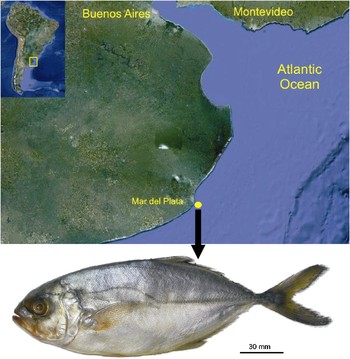
On 18 March 2008, a specimen of blue runner Caranx crysos, was caught with a line gear by local fishermen offshore Mar del Plata (38°0′22.98″S 57°32′7.51″W) at 8 m depth (Figure 1). The individual was identified according to Smith-Vaniz (Reference Smith-Vaniz and Smith-Vaniz2002) and measured with an ichthyometer and digital caliper to the nearest millimetre. The specimen was subsequently fixed in formalin, stored in 75% ethanol and catalogued in the Universidad Nacional de Mar del Plata fish collection as UNMDP T-061. Basic counts and measurements were taken following Cervigón (Reference Cervigón1980).
Map of Mar del Plata coast (Argentina), where the specimen of Caranx crysos was caught, 220.1 mm total length.

RESULTS
Morphological characteristics of the specimen of Caranx crysos were: body oval, high in profile, laterally compressed; small and blunt head, with equally small terminal mouth; strong incisor-like teeth; dorsal and anal fins somehow overlapped by a sheath of scales; forked tail. Colour is fresh light-olive to dark bluish-green dorsally and silvery-grey to golden ventrally.
The following measurements are in millimetres and in parentheses the percentage of standard length: total length: 220 (123); fork length: 192 (108); standard length: 178; head length 51 (28); preorbital length: 12 (7); postorbital length: 27 (15); horizontal eye diameter: 9 (5); interorbital length: 18 (10); predorsal length: 57 (32); first dorsal base length: 31 (17); second dorsal base length: 68 (38); anal base length: 59 (33); mouth length: 13 (7); pectoral length: 49 (27); ventral length: 23 (13); body depth: 64 (36); and body width: 29 (16). Meristic data were as follows: dorsal-fin rays: VIII–I, 23; anal-fin rays: II–I, 20; pectoral-fin rays: 21; pelvic-fin rays: I, 5; lateral-line scutes: 47; gill rakers on first gill arch: 10 upper, 26 lower.
DISCUSSION
The capture of Caranx crysos is the second documented occurrence in coastal waters of Buenos Aires Province (Argentina). The blue runner was only once recorded in Argentine waters ~ 40 years ago (Cervigon & Bastida, 1974). The authors described two specimens of 200 mm total length, captured in early autumn on the coast of Mar del Plata in 1966, but this first reported occurrence has been overlooked by global references such as FishBase (2010) (www.fishbase.org), FAO Species Catalogue (Smith-Vaniz, Reference Smith-Vaniz and Smith-Vaniz2002) and other recent publications (Dulčić et al., Reference Dulčić, Pallaoro and Dragičević2009). Menezes & Figueiredo (Reference Menezes and Figueiredo1980) mentioned the presence of C. crysos in Argentina but without a specific reference; once again, the first and only record of this species in Argentina (Cervigon & Bastida op. cit.) is not mentioned.
Species of the genus Caranx (Linnaeus, 1766) are wide-ranging subtropical Atlantic fish (Smith-Vaniz, Reference Smith-Vaniz and Smith-Vaniz2002). The are gregarious species and juveniles are often associated with floating objects which may facilitate, under favourable conditions (warm waters), the dispersal of isolated individuals from the main distribution area (Andaloro et al., Reference Andaloro, Campo, Castriota and Sinopoli2007; Brown et al., Reference Brown, Benfield, Keenan and Powers2010). Even though there are no reports indicating this kind of dispersion for tropical species arriving at this region, this hypothesis cannot be discarded.
The oceanic waters off the coast of Mar del Plata are relatively cold waters of subantarctic origin and are called Middle Shelf Waters (MSW) (Guerrero & Piola, Reference Guerrero, Piola and Boschi1997). Due to its low depth, the temperature of coastal waters are strongly influenced by the atmospheric thermic cycle and in a lower way by temperature of the MSW, reaching its maximum temperature at the end of summer and beginning of autumn, a period of time when several fish species with tropical or subtropical affinities are occasionally reported along the coast of Mar del Plata as specimens of Dactylopterydae, Carangidae, Haemulidae, Polyinemidae, Balistidae, Tetraodontidae, Sphyraenidae, Mobulidae, Kyphosidae, Fistularidae, Ostraciidae, Serranidae and Mugiliidae (Díaz de Astarloa et al., Reference Díaz de Astarloa, Figueroa, Cousseau and Barragán2000; Gonzalez Castro et al., Reference Gonzalez Castro, Díaz de Astarloa and Cousseau2006 and references therein).
The presence of C. crysos in temperate waters of Argentina is a possible consequence of the hypothesis proposed by Balech (Reference Balech1986) that involved the incursion of warm neritic waters (warm drift) to the Argentine continental shelf after originating in the subantarctic waters of the Malvinas Current. Such waters, after reaching lower latitudes and thus warming up, return poleward, west of the cold current, mixed with neritic Brazilian waters. This is, so far, the only checked explanation for the presence of subtropical species in Argentine waters (Balech & Erlich, Reference Balech and Erlich2008), an hypothesis already supported by other authors (Díaz de Astarloa & Figueroa, Reference Díaz de Astarloa and Figueroa1995; Díaz de Astarloa et al., Reference Díaz de Astarloa, Figueroa, Cousseau and Barragán2000; Gonzalez Castro et al., Reference Gonzalez Castro, Díaz de Astarloa and Cousseau2006; Ruocco et al., Reference Ruocco, Barbini, Mabragaña, Figueroa and Diaz de Astarloa2006) who reported tropical and subtropical affinity fish in Argentine waters.
ACKNOWLEDGEMENTS
We are much indebted to Dr Pablo Sisterna for providing the material. Two anonymous referees provided helpful insights to improve early drafts of this manuscript.