Many American citizens abstain from the political process. Since reliable data has become available, at least one in three eligible citizens has failed to vote in any given presidential election (McDonald and Popkin, Reference McDonald and Popkin2001). Moreover, since voters are unrepresentative of the wider population (Verba, Schlozman and Brady Reference Verba, Schlozman and Brady1995), low turnout has significant partisan and policy consequences (Fowler Reference Fowler2013; Hansford and Gomez Reference Hansford and Gomez2010). Dominant theories of voter participation predict that the increased pivotality associated with close elections will increase participation (Riker and Ordeshook Reference Riker and Ordeshook1968), and previous scholars have offered pivotality as a cure for unequal participation (Blais, Young and Lapp Reference Blais, Young and Lapp2000). In this article, we subject these claims to a rigorous test by conducting a field experiment in the aftermath of a tied election. We test the effect of priming and informing voters about an upcoming close election and find no consistent evidence that considerations of pivotality spur higher turnout or greater equality in participation. To the extent that we find any positive effect, it appears to be limited to a small subgroup of highly active voters.
The closeness of elections may theoretically lead to increased turnout through two different mechanisms: (1) individual voter psychology or (2) the heightened activity of campaigns and media associated with close elections. We focus on the former. The effects of media and campaigns on voter turnout are thoroughly studied, but for a variety of reasons that we will explore in this article, we still do not understand the effect of pivotality on voter psychology. Do close elections increase individuals’ incentives to participate? Isolating the direct effect of pivotality on voter psychology is paramount for modeling the calculus of voting and determining how public policies can increase voter turnout. If turnout is strongly influenced by media and campaign functions, these activities can, of course, be increased in the absence of close elections. However, if close elections increase turnout by convincing the voter that her vote is more valuable, then pivotality plays an important role in the calculus of voting, and structural reforms that encourage closer elections may be a fruitful policy solution to low participation.
THE DOMINANT VIEW ON PIVOTALITY AND TURNOUT
In their classic theory, Riker and Ordeshook (Reference Riker and Ordeshook1968) attempt to solve the paradox of voter turnout by asserting that citizens receive utility from the act of voting itself. In their well-known model, an individual's decision to vote is influenced by four factors: her probability of casting a decisive vote (P), the value that she would derive from her preferred candidate winning over that candidate's closest competitor (B), her utility derived from the act of voting itself (D) and the cost of voting (C). Therefore, a citizen will vote if and only if
 $$PB\,{\rm{ + }}\,D\, \gt \,C{\rm{.}}$$
This model provides the basis for much of the current understanding of the decision to vote. However, P is infinitesimal for any large election (e.g., Gelman, King and Boscardin Reference Gelman, King and Boscardin1998), so changes to P should have little effect on turnout. As Schwartz (Reference Schwartz1987) aptly points out, “Saying that closeness increases the probability of being pivotal … is like saying that tall men are more likely than short men to bump their heads on the moon.” Gerber, Green and Larimer (Reference Gerber, Green and Larimer2008), echoing Schwartz, note that “Because the probability of casting a decisive vote in an election is typically infinitesimal, the calculus of voting boils down to the relative weight of C and D.”
Nevertheless, the widespread belief among political scientists is that pivotality (P) causally influences voter turnout. For example, Key (Reference Key1949) attributed low turnout in the South during the early 20th century to the lack of electoral competition, and Downs (Reference Downs1957) famously stated that citizens have no rational reason to turn out in a one-sided election. Numerous scholars have argued that electoral competition is the cure for low turnout (e.g., Kelley, Ayres and Bowen Reference Kelley, Ayres and Bowen1967; Wattenberg Reference Wattenberg2002) and the explanation for trends in turnout over time (e.g., Burnham Reference Burnham1965; Franklin Reference Franklin2004). In one recent example, Arceneaux and Nickerson (Reference Arceneaux and Nickerson2009) write, “When the race is close and many people care about the outcome, more people decide to vote relative to races in which general interest is low.”
To demonstrate the dominance of this assumption, we reviewed all articles published on voter turnout since 1980 that appear in five leading political science journals. Of the 70 articles published since 1980 in these five journals that addressed the causes of voter turnout, 41 made a clear appeal to the importance of pivotality or electoral competition. Details of this search are included in the online appendix. Despite notable counterexamples such as Schwartz (Reference Schwartz1987) and Gerber, Green and Larimer (Reference Gerber, Green and Larimer2008), most published political science research continues to put pivotality at the center of models of turnout.
EMPIRICAL EVIDENCE ON PIVOTALITY AND TURNOUT
Previous evidence on pivotality and turnout has typically come in one of four forms, each of which suffers from methodological problems. (1) Correlations across elections between turnout and electoral competition (e.g., Barzel and Silberberg Reference Barzel and Silberberg1973; Cox and Munger Reference Cox and Munger1989) may overstate the effect of pivotality on the calculus of voting, because close elections differ from uncompetitive races on many dimensions such as campaign activity and media attention (confounding variables), and turnout may even influence competition (reverse causation). (2) Correlations across survey respondents between turnout and perceptions of pivotality (e.g., Aldrich Reference Aldrich1976; Riker and Ordeshook Reference Riker and Ordeshook1968) suffer from the same types of problems. Those who perceive an election to be close may differ from others in many unobservable ways, and the decision to turn out may influence perceptions of pivotality through cognitive dissonance. Our own analysis of survey data, available in the online appendix, suggests that correlations between perceived closeness and turnout arise more from omitted variables and cognitive dissonance than from an effect of pivotality. (3) Lab experiments have explored the links between pivotality and participation (e.g., Duffy and Tavits Reference Duffy and Tavits2008; Levine and Palfrey Reference Levine and Palfrey2007), but the settings are often artificial and apolitical, which limits the implications of these studies for real-world elections. (4) Finally, several field experiments have primed considerations of pivotality (Bennion Reference Bennion2005; Dale and Strauss Reference Dale and Strauss2009; Gerber and Green Reference Gerber and Green2000), but these experiments were either conducted in uncompetitive races (where the treatment had limited credibility) or failed to compare the treatment with an appropriate comparison group, limiting our ability to estimate the independent effect of pivotality. A more detailed literature review is available in the online appendix.
The ideal opportunity to test for the effect of pivotality on voter psychology arises when an election is known to be close beforehand.Footnote 1 In this circumstance, a field experiment could credibly inform citizens of the close election and test for the effects of this information. To our knowledge, the best opportunity in this regard is a special election held after an exact tie. In this article, we exploit precisely this rare opportunity.
FIELD EXPERIMENT DURING A TIED ELECTION
The 2010 November election for Massachusetts State House in the 6th Worcester District ended in a dead heat. After a series of recounts and a court case, Geraldo Alicea, the Democratic candidate, and Peter Durant, the Republican candidate, had each received exactly 6,587 votes. A special election was scheduled for 10 May 2011, and the race was likely to be close again. The same candidates who had just produced the tie would square off again with the same voters.Footnote 2 If pivotality could ever directly mobilize citizens in a large election, it would do so in this rare circumstance. We took advantage of this situation to test for the role of pivotality by manipulating voters’ knowledge of closeness.
By experimentally manipulating the awareness of pivotality in an actual election, we avoid many of the pitfalls that have plagued previous studies. Moreover, because pivotality is credibly approaching its theoretical maximum value (which is achieved only in an exact tie), we are allowing for the greatest chance of observing an effect. Moreover, the B term, the extent to which voters care about the outcome, is not trivial in this setting: the Massachusetts state legislature is highly professionalized (Squire Reference Squire2007), and legislators exert great influence on state agencies (Woods and Baranowski Reference Woods and Baranowski2006). Over $13 million was spent on elections to the State House in 2010,Footnote 3 and state parties, independent groups and the media took a strong interest in this particular election.
To measure the overall effect of closeness on voter turnout, including individual psychology and other effects, we would have to manipulate the actual closeness of elections, which is practically impossible and inappropriate for answering our question of interest. Instead of estimating the total effect of competition on turnout, we attempt to isolate the direct effect of pivotality on the individual calculus of voting. This special election provides an ideal opportunity because the upcoming election was expected to be very close, many citizens were unaware of this fact, and we were able to credibly inform citizens about the expected closeness of the race. Our design allows us to separate the direct effect of pivotality on voter psychology from the extraneous effects of campaigns, media and other confounding variables that are associated with close elections.
Many citizens in the district were relatively uninformed about the upcoming special election. Conducting a brief phone survey of registered voters in the three days leading up to the election, we found that only 64 percent knew that a special election was coming up on 10 May, only 52 percent could name both candidates, and only 41 percent knew that the previous election had ended in a tie. These figures likely overestimate the true level of knowledge, because the surveys only involved registered voters who answered the phone and agreed to answer questions about an upcoming election. Walking around the district on election day, we saw little campaign material aside from the polling places and the two candidates’ headquarters. Subsequent interviews with the candidates and campaign staffs revealed that the campaigns had focused their efforts on likely voters, targeting based on previous voter turnout, party registration, ethnicity and expressed support. One of the campaigns admitted to performing no voter contact in several of the five towns in the district. Furthermore, neither candidate directly mentioned the tied election in their campaign materials (author interviews, July and August 2011).
In the days prior to the election, we placed phone calls to registered voters to remind them about the special election and inform a random subset about the exact tie in the previous election. As it turned out, the special election was also an extremely tight race. Durant defeated Alicea by only 56 votes, so our treatment was credible in informing citizens that the race would be close. At first glance, it appears that citizens in the district failed to respond to the unique circumstances of the extremely tight election. Only 20 percent of the district's residents turned out in the special election, compared to 33 percent for the November election. Moreover, 16 percent of the special election voters supported an independent candidate who had little chance of winning. These observations show little support for the claim that voters are directly motivated by pivotality, but our experimental design allows us to explicitly estimate the effect of perceived pivotality on the individual calculus of voting.
Experimental Design
Some individuals in the district received a simple reminder that a special election was coming up, while others received the same reminder plus information about the tie and the unusually high chance that their vote could be pivotal. If the pivotal treatment mobilized more voters than the reminder treatment, then we would conclude that knowledge of electoral closeness mobilized voters. We applied the treatment through phone calls during the three days leading up to the election. By implementing the study through phone calls, we were able to first gauge each respondent's level of knowledge and then provide an experimental treatment. Phone experiments have been shown to substantially mobilize voters if conducted properly (Nickerson Reference Nickerson2006, Reference Nickerson2007), and our calls included the elements that have been demonstrated to increase turnout. We recruited and trained student volunteers to make the calls. We provided a script but instructed the callers to convey the appropriate information in a casual, conversational style without reading directly from the page.
Details on data processing and the sample selection are included in the online appendix. For 8,865 phone numbers of registered voters, we randomly assigned them into one of four conditions. Phone numbers were stratified according to their pre-treatment characteristics, and randomization was conducted within each stratum. More details on the randomization procedure, including balance and placebo tests that confirm the effectiveness of our randomization, are available in the online appendix.
One-third of the population, 2,955 phone numbers, was randomly assigned to the reminder condition. In this condition, a caller would introduce herself and identify the recipient of the call. If a registered voter did not answer the phone, then the caller would try to ask for one of the registrants associated with that phone number. In a casual manner, the caller would ask whether the recipient knew about the special election coming up. If the recipient claimed to know, then the caller would ask for the day that the election would take place. These two questions allowed us to identify the voters’ prior knowledge about the election, which was used in our subsequent analyses. Then the caller would simply remind the recipient that the election would be on 10 May to fill a seat in the State House. If the recipient asked for additional information, callers were permitted to provide the names and parties of the candidates. However, for any additional questions, the recipients were referred to the website of the Massachusetts Secretary of the Commonwealth. The complete script given to callers is available in the online appendix.
Another 2,955 phone numbers were randomly assigned to the pivotal condition. This treatment was identical to the reminder condition with one exception. At the end of the call, the caller would also inform the recipient of the reason for the special election by saying: “The reason that there is a special election is that the last election ended in an exact tie. Had one more or one less person voted in the last election, your candidate would have won. The special election on Tuesday is likely to be close again, so there is a high chance that your vote could make a difference.” Many subjects responded strongly to this information when speaking with the caller. Those who were unaware of the tie were surprised and intrigued, and others conveyed personal anecdotes about having voted despite hardship or about friends who failed to vote and could have made the difference.
A separate 296 phone numbers, one-thirtieth of the population, were randomly assigned to a survey condition. This condition allowed us to better gauge the extent of political knowledge among our population. As in the reminder and pivotal conditions, we asked recipients whether they knew about the upcoming election and whether they knew the date. Then we asked whether they could name the candidates or whether they knew the reason for the special election. As mentioned previously, only 41 percent of respondents knew that the previous election ended in a tie, suggesting that the majority of our sample was unaware of the unusually high chance that their vote could make a difference. The remaining 2,659 phone numbers received no call.Footnote 4
Our experiment allows us to assess the causal effect of being informed about electoral competition on turnout in the special election. The difference in turnout between the pivotal group and the reminder group represents the causal effect of interest, because the conditions were randomly assigned and the only difference between the two conditions is the information we provided about electoral closeness. One might worry that our treatment also contained some element of social pressure, which is known to influence turnout independent of pivotality (e.g., Gerber, Green and Larimer Reference Gerber, Green and Larimer2008). We acknowledge this possibility, since a phone call informing a citizen that her vote could make a difference could be construed as social pressure. However, we designed the study so that the reminder and pivotal phone calls were as similar as possible with the exception of information about pivotality. Because the callers were instructed to simply provide this information and do nothing more, the social pressure contained in these calls should be similar for both conditions. Therefore, we argue that the only meaningful difference between the two conditions was information about the closeness of the election, allowing us to estimate the effect of this information.
Estimation Strategy
Randomization and stratification, in addition to the advantage of avoiding imbalance between treatment groups, allows more precise estimates, because we can estimate the effect of the pivotal treatment versus the reminder treatment with strata fixed effects. Looking at all individuals i, in all strata j, we employ ordinary least squares (OLS) to estimate the following equation:
 $${{Y}_{ij}}\, = \,\beta *Pivota{{l}_{ij}}\, + \,{{\gamma }_j}\, + \,{{{\epsilon}}_{ij}}.$$
Yij is a dummy variable indicating whether the individual turned out to vote in the 10 May special election. Pivotalij is a dummy variable, taking a value of 1 if that individual is in the pivotal condition and a value of 0 if the individual is in the reminder condition. Individuals in the survey or no contact conditions are omitted from the subsequent analysis. γj represents a stratum-specific fixed effect. Some strata are likely to turn out at high rates, while others are not. This procedure removes that source of variation and estimates the effect of the pivotal treatment within strata.
RESULTS
Due to time and labor limitations, we were only able to call 5,157 of the 5,910 phone numbers (87 percent) that were assigned to an experimental condition. Because the order of call attempts was randomly assigned, similar numbers of attempts were made to phone numbers in the reminder and pivotal conditions. Of those attempts, 1,021 (20 percent) resulted in complete treatments. This figure is comparable to response rates in previous phone experiments (e.g., Nickerson Reference Nickerson2006). Importantly, the response rates were similar for the reminder and pivotal conditions, 20.3 and 19.3 percent, respectively.
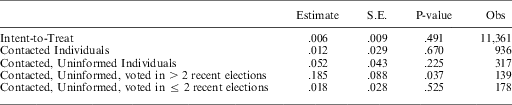
In Table 1, we estimate the effect of the pivotal treatment for five different subsets of experimental subjects. The online appendix provides the mean turnout rate for each relevant subset of experimental subjects, showing that simple differences-in-means yield the same results as our strata fixed-effects regressions. Row 1 shows our intent-to-treat estimate, the average effect of being assigned to the pivotal treatment compared to the reminder treatment. The estimate of .006 indicates that after removing strata fixed effects, subjects in the pivotal treatment group were 0.6 percentage points more likely to vote in the special election compared to those assigned to the reminder group. This effect is substantively tiny and statistically insignificant, suggesting that our pivotal treatment was not an effective method for increasing aggregate turnout. Moreover, our failure to reject the null is not a product of noise; we can statistically reject any effect larger than 2.4 percentage points.
Experimental Effect of Pivotal Treatment
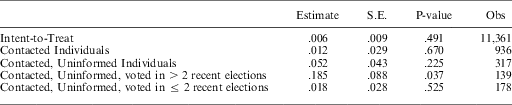
Note: the table presents the estimated effect of the pivotal treatment relative to the reminder treatment for five different subsets of experimental subjects. The estimates are OLS coefficients resulting from a regression of turnout on the pivotal treatment and strata fixed effects. Standard errors are clustered by phone number for the intent-to-treat estimate where multiple individuals can be associated with each household. For all other estimates, standard errors are heteroskedasticity robust.
We go on to analyze smaller subsets of the data according to our theoretical predictions about who should be most affected by the treatment. Keep in mind that the precision of our estimates declines as the subsample becomes smaller. In Row 2, we isolate those subjects who answered the phone and received a treatment. According to this estimate, the pivotal treatment increased turnout among this subgroup by 1.2 percentage points, but this estimate is not statistically significant. In Row 3, we focus on individuals who were directly contacted and who were uninformed about the upcoming election. There are only 317 such individuals, so this estimate is necessarily imprecise. Here, the estimated effect of the pivotal treatment is larger, 5.2 percentage points, but still statistically insignificant.
Compared to other results from get-out-the-vote experiments, our 5.2 percentage point estimate for uninformed, contacted individuals may, at first, appear large. However, the overall intent-to-treat effect is 0.6 percentage points, and we only obtain this 5.2 percentage point figure after narrowing our sample down to the group of subjects for which we would expect to see the largest possible effect. If other get-out-the-vote experiments narrowed their samples in this way, they would find much larger treatment effects. Most importantly, if pivotality exhibits a strong effect on voter psychology, as previous literature suggests, these treatment effects should be massive for this subsample—much larger than 5 percentage points.
We cannot know whether some of these positive coefficients have arisen by chance alone or through some real effect of our pivotal treatment. Our observed effects are not larger than we would expect by chance, and they are smaller than we would expect if pivotality weighs heavily on the calculus of voting. Even in this case of an extremely close election, voters did not turn out at high rates, and informing them about closeness had no statistically significant mobilizing effect. However, our estimate of the average effect on uninformed voters is not zero, so we can look more closely at the effect on subsets of voters to see if closeness has a mobilizing effect on habitual non-voters. This allows us to examine whether increased pivotality can decrease the gap between regular and non-regular voters. In Rows 4 and 5 of Table 1, we estimate the effect of the pivotal treatment separately for those who voted in three or more of the 9 most recent elections and for those who voted in two or less.Footnote 5 We choose this arbitrary cutoff because it splits our sample roughly in half. We find a large, statistically significant effect for regular voters (18.5 percentage points) but no effect for infrequent voters. A single interactive model yields the same result. The size of the effect for regular voters is large but not unprecedented (e.g. Michelson, Garcia Bedolla and Green Reference Michelson, Garcia Bedolla and Green2008), especially for a small subgroup. More important than the exact size of the point estimate (which is, of course, subject to statistical uncertainty) is that the effect for regular voters is statistically and substantively larger than the effect for non-regular voters. Figure 1 further demonstrates the variation of the pivotal treatment effect across prior levels of voter turnout. The figure presents separate kernel regressions of turnout in the special election across the probability of turnout in the nine previous elections for uninformed individuals in the pivotal and reminder groups. There is no effect of the pivotal treatment for infrequent voters, but there is a sizable effect for frequent voters.
Effect of pivotal treatment for uninformed subjects across previous turnout Note: Solid lines represent kernel regressions of turnout in the special election across each respondent's probability of turnout in the previous nine elections. The sample includes only contacted subjects who were initially uninformed about the upcoming special election. Dotted lines represent standard errors.

On the whole, we find little evidence that considerations of pivotality influence the individual calculus of voting. To the extent that we find a positive effect, it appears to be concentrated among a small sample of frequent voters. Therefore, if anything, increased pivotality has little impact on overall participation rates but may widen the turnout gap between the politically active and the politically under-represented.
DISCUSSION AND CONCLUSION
In this article, we assess the effect of pivotality on the calculus of voting by exploiting a rare opportunity to credibly test for the effect of pivotality in the aftermath of a tied election for a major political office. This test requires such a rare event that it may not be replicable.Footnote 6 We find little evidence that the closeness of elections and considerations of pivotality motivate voters to turn out.
Of course, we also leave many unanswered questions. As discussed previously, we do not attempt to measure the total effect of electoral competition, which would include the campaigning, media coverage and other factors that come with close elections. We also cannot speak to the potential long-term benefits of close elections, although the fact that Ohio's turnout in presidential elections is not dramatically greater than that of Wyoming or Massachusetts suggests that these effects are unlikely to be huge. Also, we cannot say whether our results would hold in a more salient election. Citizens are less interested in state legislative races than in federal and statewide races, but the chances of such a close race are significantly lower for larger electoral settings. Finally, we cannot say whether the results would have changed in a state with a more balanced state legislature. Some sophisticated voters may have known that this individual seat in the Massachusetts State House was unlikely to be pivotal in many roll-call votes. However, there are many reasons that voters may care about the party and identity of their state legislator even if she is not pivotal on roll-call votes. Moreover, the infinitesimal chance of casting a pivotal vote in a race that is also pivotal in the legislature makes the relevance of pivotality all the more elusive.
Our findings are consistent with literature that questions the usefulness of the classic models of voting. Some individuals like voting and others do not, but turnout decisions are rarely influenced by an individual's perception that her vote could influence political outcomes. While our findings challenge the usefulness of the canonical model, they do not reject it or distinguish between other competing models. Perhaps some of the non-canonical models in which pivotality does not play a role (e.g., Ferejohn and Fiorina Reference Ferejohn and Fiorina1974; Schwartz Reference Schwartz1987) will prove useful in understanding turnout. Further progress in understanding the calculus of voting will likely arise from careful testing of these alternative models and from identifying forces that factor into the direct costs and benefits of voting.
Voting is possibly the single most important act of democracy, and competitive elections are fundamental to a functioning democracy (Dahl Reference Dahl1970). Even though citizens often fail to vote or pay close attention to politics, one might expect that they will mobilize more when pivotality is high and therefore their vote could make a difference. However, our results suggest that most voters fail to consider the chances that their vote will be pivotal and therefore fail to participate even in the extreme scenario of high pivotality. The available evidence suggests that considerations of pivotality do not significantly factor into the calculus of voting.