1. Introduction and setting
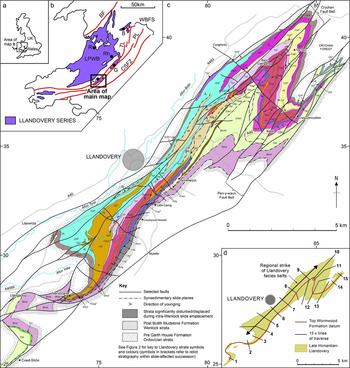
The outcrop of lower Silurian rocks east of the town of Llandovery in south central Wales constitutes the type area, or ‘global standard’, for the Llandovery Series (Cocks, Reference Cocks, Holland and Bassett1989) (Figs 1, 2). Detailed new geological mapping, allied to biostratigraphical, sedimentological and sequence analysis, underpins a new stratigraphical synthesis and thoroughly revised sedimentary architecture for this type succession (Fig. 3).
(a–c) Llandovery Series rocks in Wales and a simplified geology map of the Type Llandovery area (significantly modified after BGS, 2005a , b , 2009); UK National Grid co-ordinates refer to 100 km square SN. Abbreviations: B – Banwy River; BF – Bala Fault; CSFZ – Church Stretton Fault Zone; G – Garth; Ll– Llandovery; LPWB – Lower Palaeozoic Welsh Basin; PL – Pontesford Lineament; R – Rheidol Gorge; Rh – Rhayader; TL – Tywi Lineament; WBFS – Welsh Borderland Fault System; see Figure 2 for key to main map symbols. (d) Location of traverse lines used in the construction of Figure 3. Geological data BGS ©NERC 2012. Contains Ordnance Survey data ©Crown Copyright & database rights 2012. Licence No. 100021290.

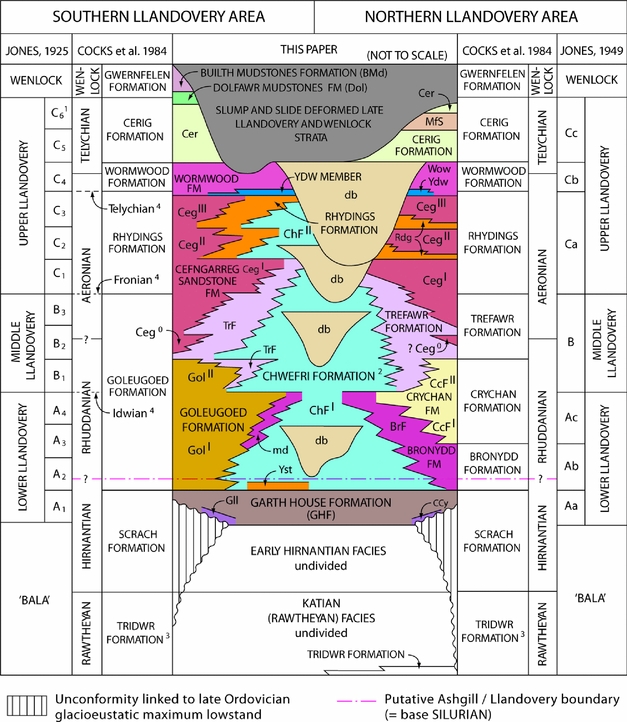
Old and new stratigraphical nomenclature for the Type Llandovery area (modified after Schofield et al. Reference Schofield, Davies, Waters, Williams and Wilson2009b ). Abbreviations and notes: CCy – Cwm Clyd Sandstone Formation; db – slump/slide-disturbed strata; Gll – Glasallt-fawr Sandstone Formation; md – sandy mudstone in Goleugoed Formation; Yst – Ystradwalter Member; 1 – now recognized as the Mwmffri Sandstone Member (MfS); 2 – broadly equivalent to the Coldbrook Formation of Cocks et al. (Reference Cocks, Woodcock, Rickards, Temple and Lane1984); 3 – now recognized as an older Katian (Rawtheyan) unit (see Schofield et al. Reference Schofield, Davies, Waters, Wilby, Williams and Wilson2004); 4 – abandoned former stage bases of Cocks, Toghill & Zeigler (Reference Cocks1970) (N.B. base Rhuddanian Stage was not formally identified in the Llandovery area and the precise position of base Aeronian is uncertain in the southern Llandovery area).

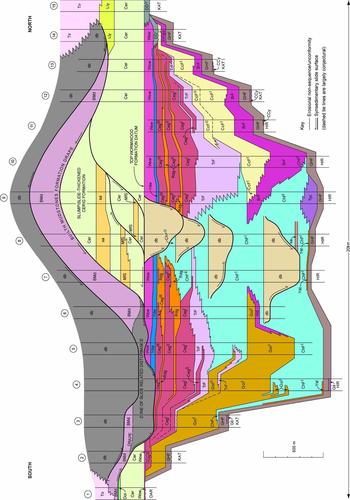
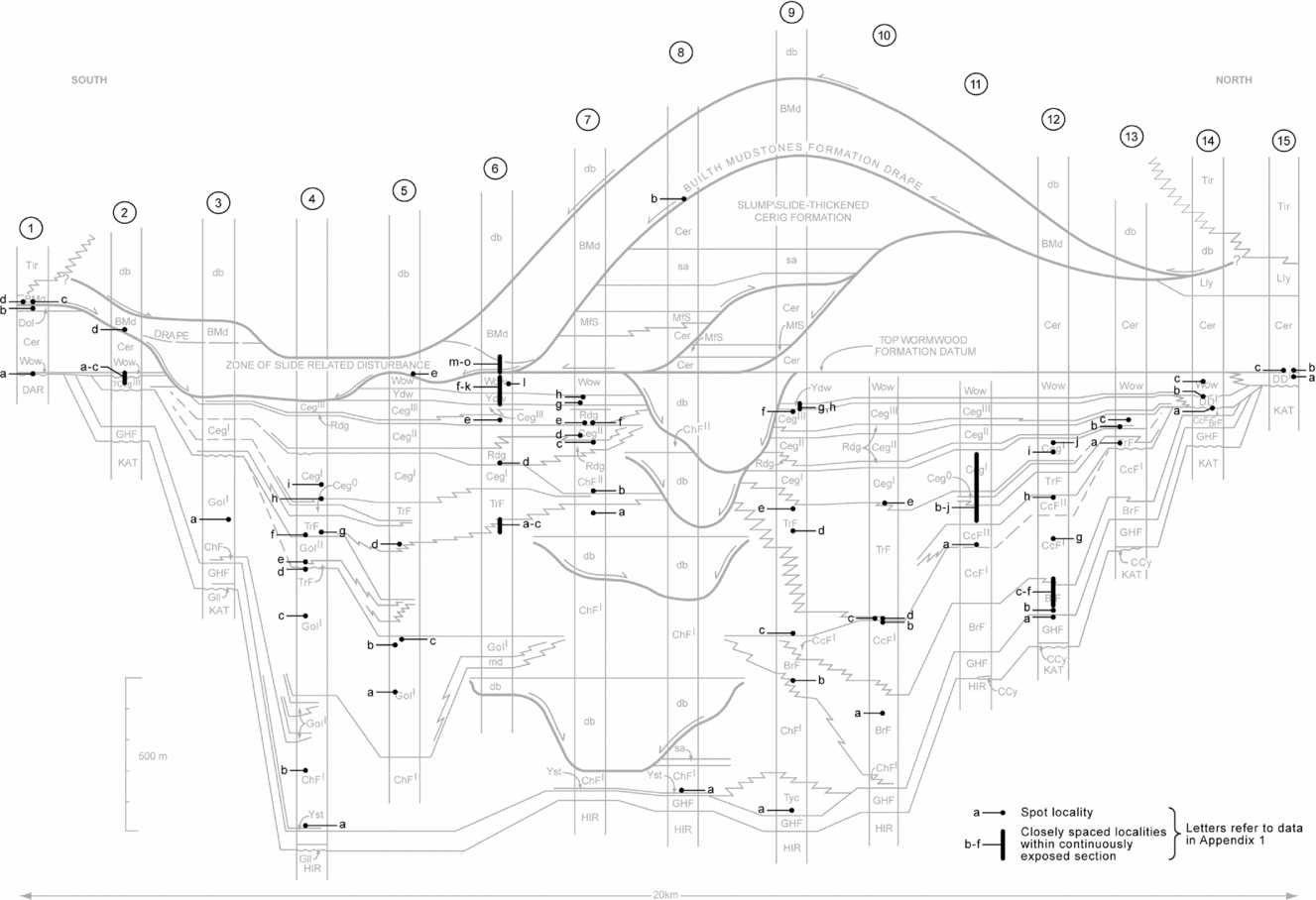
New architectural model for the Type Llandovery succession; see Figure 2 for key and Figure 1d for location of lines of traverse. The abbreviations DAR, HIR and KAT at the bases of the columns refer, respectively, to the Darriwilian (Llanvirn), Katian (Rawtheyan) and Hirnantian ages of the underlying Ordovician strata. Other abbreviations: DD – Derwyddon Formation; Lly – Llangammarch Formation; sa–sandstone-rich units in ChF and Cer; Tir – Tirabad Formation; Tyc – Tycwtta Mudstones Formation.

Deposited in mid southern palaeo-latitudes on the micro-plate of Eastern Avalonia, the Llandovery area succession comprises a spectrum of variably bioturbated sandstones and mudstones. Facies and fauna are consistent with accumulation on a periodically emergent shelf or ramp that bordered a region of enhanced subsidence and deep-water sedimentation to the northwest: the Lower Palaeozoic Welsh Basin (Davies et al. Reference Davies, Fletcher, Waters, Wilson, Woodhall and Zalasiewicz1997). The late Hirnantian to Llandovery succession in Wales, as elsewhere, records deposition following a major episode of South Polar ice sheet expansion on the super-continent of Gondwana (e.g. Page et al. Reference Page, Zalasiewicz, Williams, Popov, Williams, Haywood, Gregory and Schmidt2007). The major SW–NE-trending, basin-bounding faults that traverse the Llandovery area are components of the long-lived Welsh Borderland Fault System and its integral Tywi and Pontesford lineaments (Fig. 1) (Woodcock & Gibbons, Reference Woodcock and Gibbons1988). Movements on these structures influenced Silurian sedimentation in the region and caused locally significant synsedimentary deformation. Strata in the Llandovery area also display the pervasive effects of transpressive mid Devonian orogenesis, including a regional cleavage (Woodcock, Soper & Strachan, Reference Woodcock, Soper and Strachan2007).
2. Previous research
Authoritative accounts of the history of research in the Llandovery area are given by Cocks et al. (Reference Cocks, Woodcock, Rickards, Temple and Lane1984) and Bassett (Reference Bassett, Bassett, Lane and Edwards1991). The seminal studies of Jones (Reference Jones1921, Reference Jones1925, Reference Jones1949) and Williams (Reference Williams1951, Reference Williams1953) established the succession as the UK standard for lower Silurian rocks. The co-occurrence of graptolite and benthic fossil assemblages allowed the lithostratigraphical subdivisions (A, B and C) of Jones (Reference Jones1925) (Fig. 2) also to be defined in biostratigraphical terms, and this underpinned adoption of the Lower (A), Middle (B) and Upper (C) Llandovery stages as the standard chronostratigraphical nomenclature for the UK. Following Williams's (Reference Williams1951) and Zeigler's (Reference Ziegler1965, Reference Ziegler1966; Zeigler, Cocks & Bambach, Reference Ziegler, Cocks and McKerrow1968) work on brachiopod assemblages and lineages, Jones's (Reference Jones1925) finer scale subdivisions also became widely used as de facto chronozones (e.g. Zeigler, Cocks & McKerrow, Reference Ziegler, Cocks and Bambach1968; Cocks et al. Reference Cocks, Holland, Rickards and Strachan1971).
The need for international correlation and Global Boundary Stratotype Sections and Points (GSSPs) (see review by Holland, Reference Holland, Holland and Bassett1989) initiated a phase of further detailed study and led ultimately to the landmark publication of Cocks et al. (Reference Cocks, Woodcock, Rickards, Temple and Lane1984) that successfully established the Llandovery succession as the international series standard (Fig. 2). The constituent Rhuddanian, Aeronian and Telychian stages all take their names from sections near Llandovery and, though the adoption of Dob's Linn in Scotland as the basal Silurian stratotype made this the de facto base of the Rhuddanian Stage, both the other stages have their GSSPs in the type area (see Section 5). Cocks and his co-workers remapped the area, revised the graptolite and brachiopod biostratigraphy and, for the first time, undertook a detailed study of acritarch assemblages (Hill & Dorning, Reference Hill, Dorning, Cocks, Woodcock, Rickards, Temple and Lane1984). This work established a new lithostratigraphical and architectural model that emphasized the intact nature of the succession and continues to underpin the current international usage of the term Llandovery and its constituent stages (e.g. Cocks, Reference Cocks, Holland and Bassett1989; Holland & Bassett, Reference Holland and Bassett2002; Cocks, Fortey & Rushton, Reference Cocks, Forty and Rushton2010). However, it should be noted that Temple (Reference Temple1988), although a co-author, dissented from the conclusions of Cocks et al. (Reference Cocks, Woodcock, Rickards, Temple and Lane1984, p. 164), questioning the criteria used and the requirement to erect and define the current Aeronian and Telychian stages and their GSSPs.
Over the last 25 years, the British Geological Survey (BGS) and its collaborators have undertaken detailed mapping and interpretation of the deep-water Llandovery facies of the Lower Palaeozoic Welsh Basin in central Wales. This has contributed to a detailed understanding of basinal depositional events and processes (e.g. Woodcock et al. Reference Woodcock, Butler, Davies, Waters, Hesselbo and Parkinson1996; Davies et al. Reference Davies, Fletcher, Waters, Wilson, Woodhall and Zalasiewicz1997; Schofield et al. Reference Schofield, Davies, Waters, Williams and Wilson2009a ). In the last decade this work has been extended into the shelf successions of the Garth and Llandovery areas (Fig. 1), where the establishment of an event stratigraphy common to both the basin and shelf successions has been a central aim. New surveying has enabled significant revision to the stratigraphy and structure of Cocks et al. (Reference Cocks, Woodcock, Rickards, Temple and Lane1984), as summarized in texts (Schofield et al. Reference Schofield, Davies, Waters, Wilby, Williams and Wilson2004, Reference Schofield, Davies, Jones, Leslie, Waters, Williams, Wilson, Venus and Hillier2009b ; Barclay et al. Reference Barclay, Davies, Humpage, Waters, Wilby, Williams and Wilson2005) that accompany the recently published maps (BGS, 2005a , b , 2008). However, presented here are important additional modifications that stem from more recent findings.
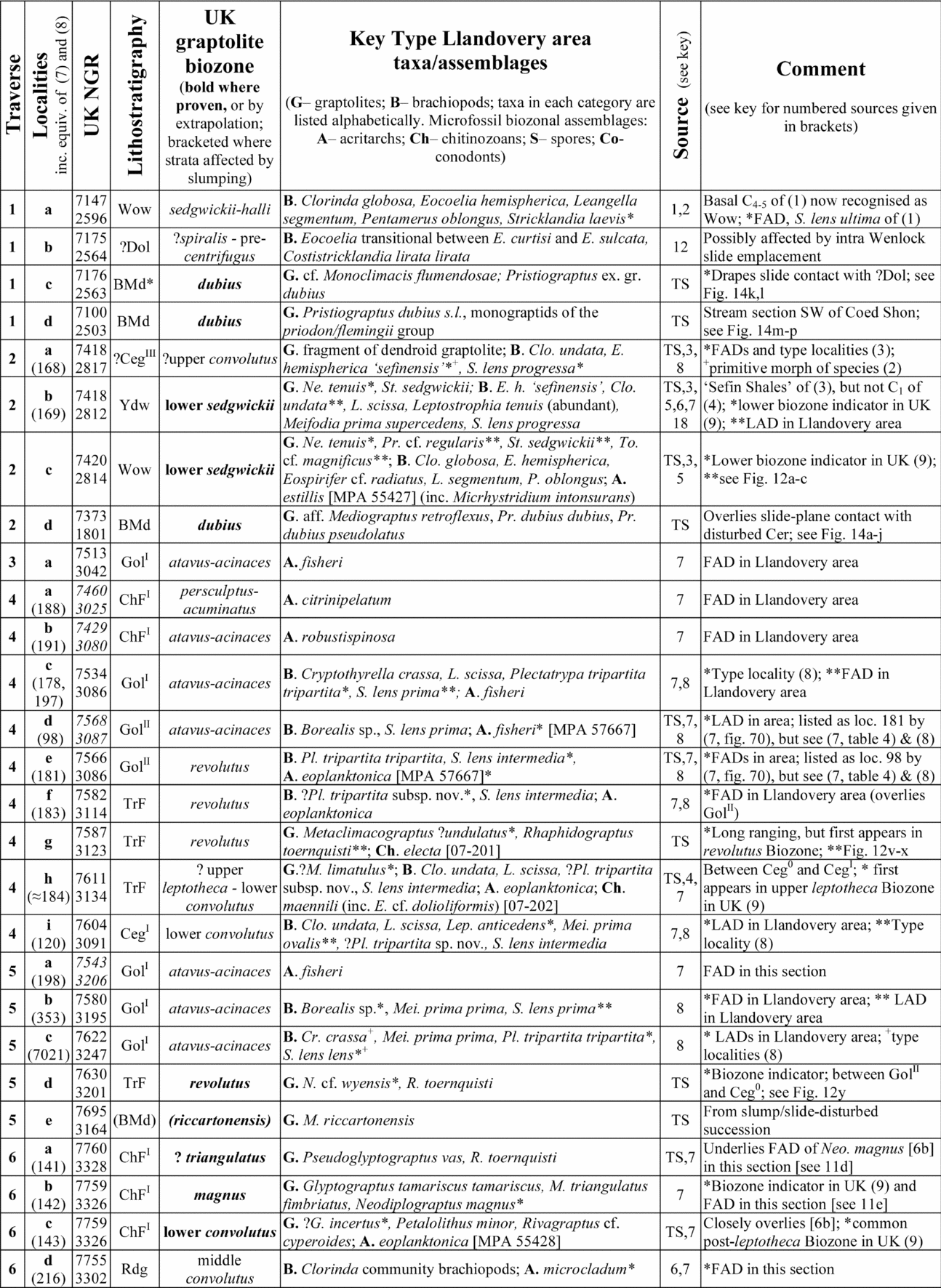
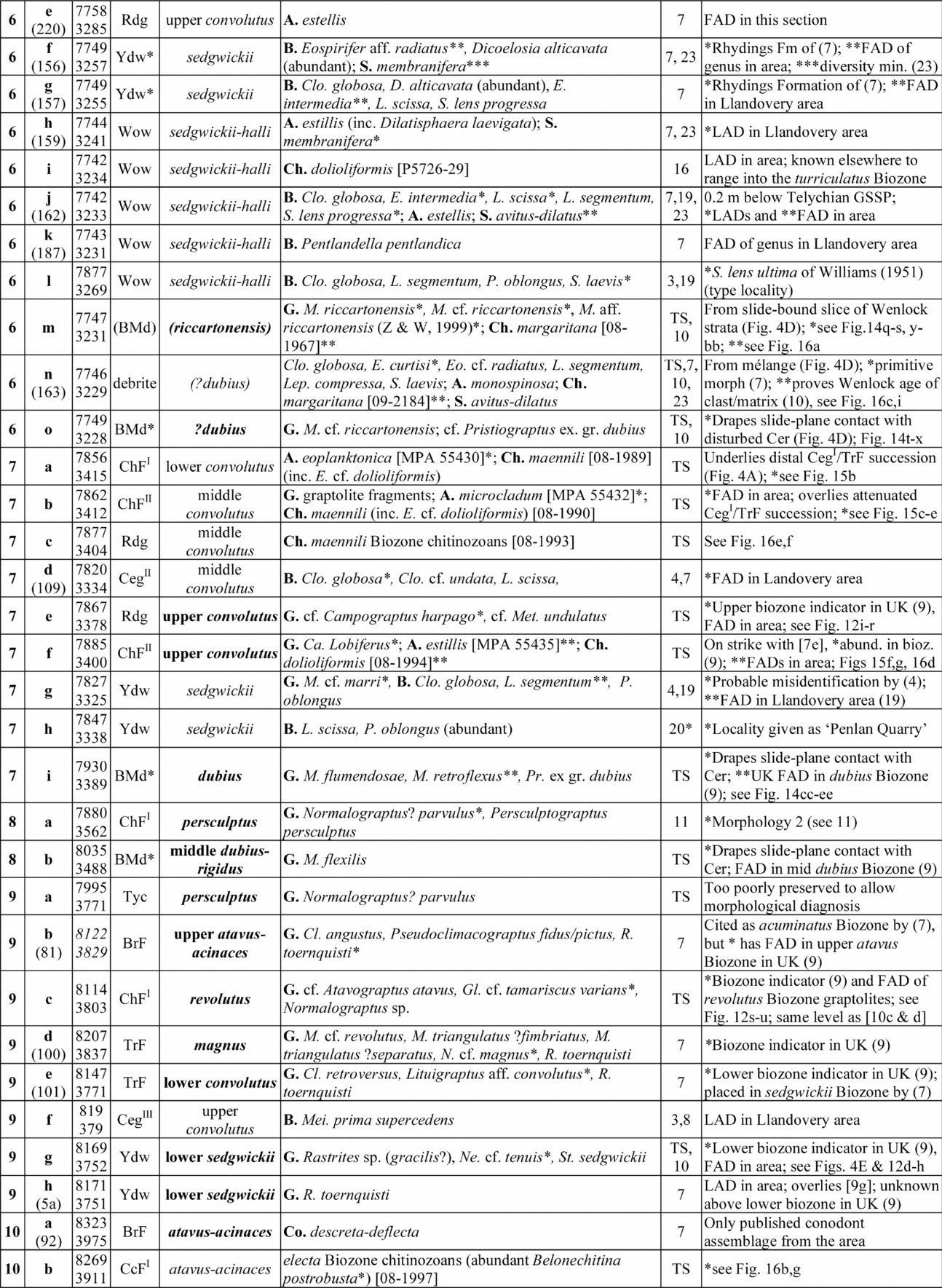
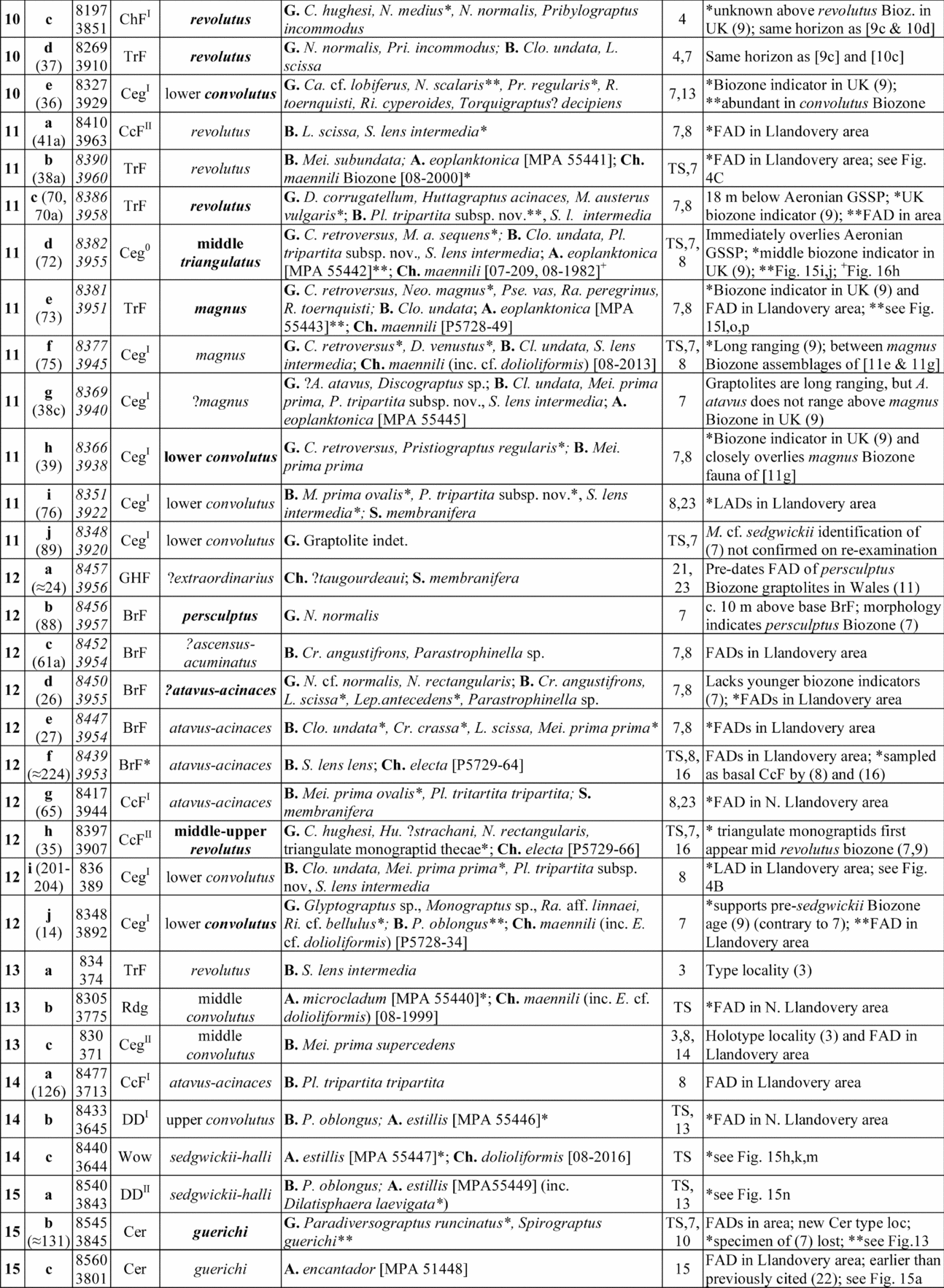
Many of the most important sections in the Llandovery area have been documented by Cocks (Reference Cocks, Bassett and Bassett1971), Siveter, Owens & Thomas (Reference Siveter, Owens and Thomas1989) and, as part of the UK's Geological Conservation Review, by Aldridge (Reference Aldridge, Aldridge, Siveter, Siveter, Lane, Palmer and Woodcock2000). Upgraded descriptions of some of the key localities investigated as part of the current study are provided in field guides by Davies et al. (Reference Davies, Waters, Zalasiewicz, Molyneux, Vandenbroucke and Williams2010, Reference Davies, Molyneux, Vandenbroucke, Verniers, Waters, Williams, Zalasiewicz and Ray2011). Details of some of the key new and previously cited fossil assemblages from the Llandovery area are given in Appendix 1, but form only a fraction of the extensive published and unpublished database. Fossil localities are cited in the text in the form [1a], [1b], etc., where the number refers to a traverse line (column) on Figure 11, and the letter to the locality on that line.
3. New architectural model
The new architectural model is based on 15 lines of traverse (Fig. 3) projected on to a common datum – the top of the Aeronian Wormwood Formation – and is constructed in a way that allows comparison with the architectures previously erected by Jones (Reference Jones1949, fig. 3) and Cocks et al. (Reference Cocks, Woodcock, Rickards, Temple and Lane1984, fig. 118). It provides the framework for a radical re-assessment of the Llandovery succession, whilst demonstrating the continuing international relevance of the area's mixed planktonic and benthic fossil assemblages.
3.a. Lithostratigraphy
The Llandovery succession comprises up to 2.2 km of shelf/ramp strata, deposited predominantly below the reach of frequent wave reworking. It can be divided into two distinct parts: a lithologically complex Rhuddanian to Aeronian lower part that includes bioturbated sandstones, muddy sandstones, sandy mudstones and silty mudstones; and an upper part comprising up to 740 m of mudstone-dominated Telychian strata.
Cross-cutting relationships persuaded Jones (Reference Jones1925, Reference Jones1949) that a number of erosional diastems were present within the succession. This underpinned his erection of a three-fold stratigraphical scheme (units A, B and C) and recognition of up to 13 subdivisions (A1–4; B1–3; C1–6) (Fig. 2). Cocks et al. (Reference Cocks, Woodcock, Rickards, Temple and Lane1984) presented much broader groupings of strata and did not differentiate many of the smaller scale units recognized by Jones (Fig. 2). They argued, in support of their successful bid for it to be recognized as the international series stratotype, that throughout much of its outcrop the succession was both stratigraphically intact and largely unaffected by faulting. However, the current work broadly vindicates Jones’ (Reference Jones1925) level of subdivision and, whilst there are important differences in detail, has confirmed that erosional non-sequences are a feature of the succession in some areas. Significantly, the recognition and mapping of a finer scale stratigraphy has also revealed greater structural complexity than envisaged by both Jones (Reference Jones1925, Reference Jones1949) and Cocks et al. (Reference Cocks, Woodcock, Rickards, Temple and Lane1984; also Woodcock, Reference Woodcock1987) (Fig. 1).
A feature of the work of Jones (Reference Jones1925, Reference Jones1949) and Cocks et al. (Reference Cocks, Woodcock, Rickards, Temple and Lane1984) was the erection of different stratigraphical schemes for the southern and northern parts of the area (Fig. 2). This reflects the presence of a distinctive, intervening, central facies belt. Jones thought the absence of key units in this region was the result of unconformity, but Cocks et al. (Reference Cocks, Woodcock, Rickards, Temple and Lane1984) correctly recognized the importance of lateral facies changes between more proximal, sand-prone units present in the north and south, and a more distal, mud-prone tract in the centre. An aim of the current work has been to rationalize the nomenclature used throughout the Llandovery area. In doing this, every attempt has been made to use the existing, widely cited, Cocks et al. (Reference Cocks, Woodcock, Rickards, Temple and Lane1984) nomenclature; only where necessary have new names been introduced.
3.a.1. Rhuddanian and Aeronian strata
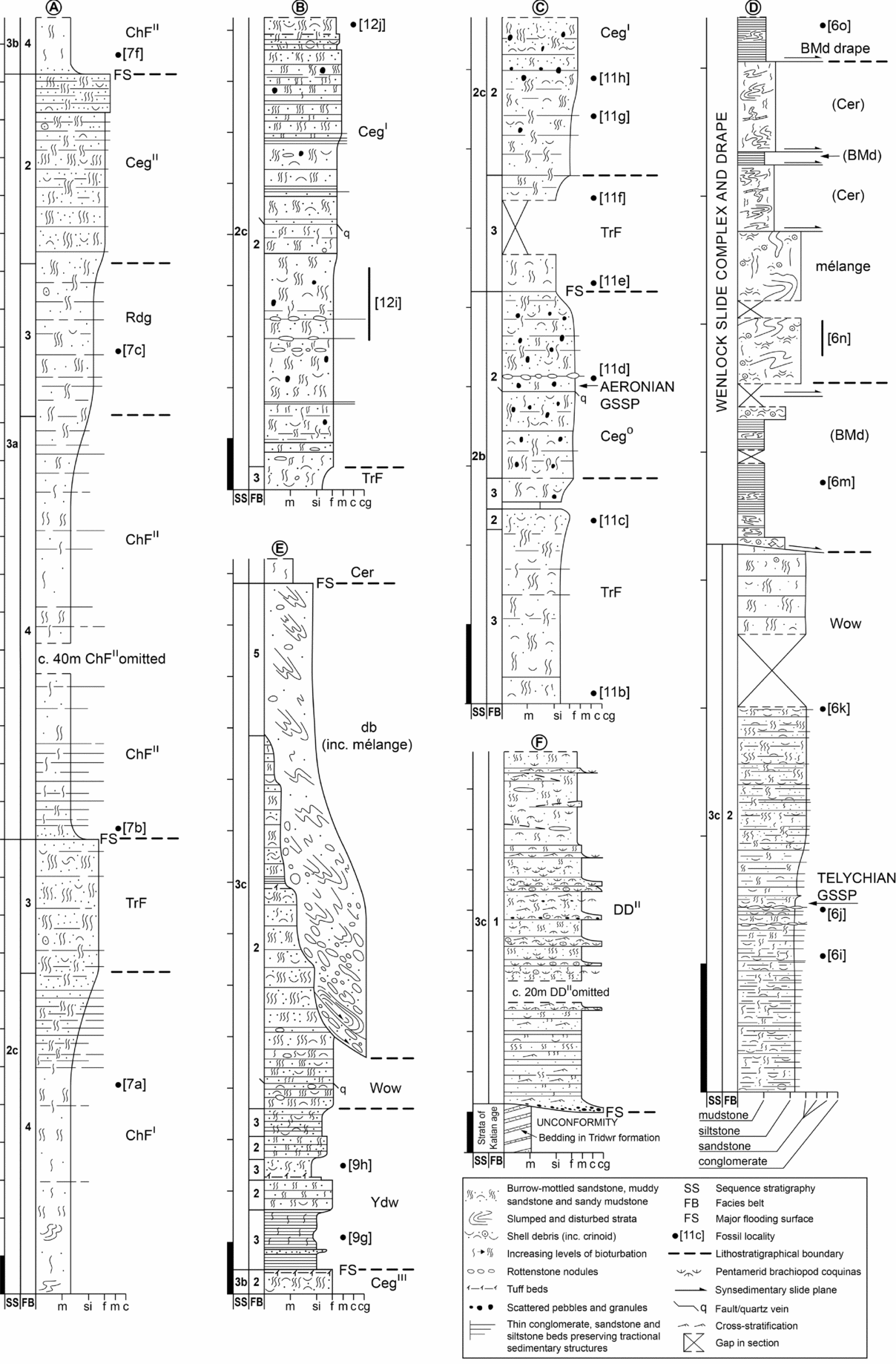
The complex lateral and vertical facies changes that characterize the Rhuddanian to Aeronian stratigraphy are shown in Figures 1–3 and in sedimentary logs (Fig. 4). Burrow-mottled Chwefri Formation mudstones pass northwards into sandy mudstones of the Bronydd and younger Trefawr formations. Both these divisions in turn pass into muddy, locally pebbly, strongly burrow-mottled Crychan Formation sandstones in which separate units (CcF I and CcF II) have been distinguished locally. In the south, the Chwefri Formation passes into the Goleugoed Formation that has been redefined, permitting recognition of the Trefawr Formation. The name Goleugoed Formation is now restricted to a facies that comprises muddy sandstones with distinctive, partially bioturbated, sandstone beds. The bulk of its outcrop comprises a thick older portion (Gol I), but a laterally restricted younger unit (Gol II) has been mapped in the Ydw valley area. Upper parts of the Trefawr Formation pass into a widespread lower unit of the muddy and mottled Cefngarreg Sandstone Formation (Ceg I) (Figs 4B, 5a); together these units divide the Chwefri Formation into a lower (ChF I) and an upper (ChF II) part (Fig. 4A). An earlier leaf of Cefngarreg Sandstone (Ceg 0) mapped in the south Llandovery area is correlated with the sandstone unit in the north that hosts the Aeronian GSSP in the Trefawr track section (Davies et al. Reference Davies, Molyneux, Vandenbroucke, Verniers, Waters, Williams, Zalasiewicz and Ray2011) (Fig. 4C). A key change to the Cocks et al. (Reference Cocks, Woodcock, Rickards, Temple and Lane1984) lithostratigraphy is the recognition of separate sandstone and mudstone facies within their Rhydings Formation. The latter name is retained for sandy mudstone facies whereas sandstone-dominated parts are now recognized as younger units of Cefngarreg Sandstone Formation (Ceg II and Ceg III) (Fig. 2). In the north, a younger sandstone-dominated unit, now recognized as the upper Aeronian to lowest Telychian Wormwood Formation, was initially included in the Cefngarreg Sandstone (BGS, 2005b ; Barclay et al. Reference Barclay, Davies, Humpage, Waters, Wilby, Williams and Wilson2005). In a significant modification to its usage, the locally fossiliferous Wormwood Formation has been extended downwards to include the newly erected, mudstone-dominated Ydw Member at its base (Fig. 4E). Note of this change is important since the equivalent strata were included by Cocks et al. (Reference Cocks, Woodcock, Rickards, Temple and Lane1984) in their Rhydings Formation and by Jones (Reference Jones1925) in his C3 division, and are now shown to host key fossil assemblages (see Section 4.a). In the northeast, the Wormwood Formation and upper levels of the underlying Cefngarreg Sandstone Formation pass into separate units of pentamerid-rich Derwyddon Formation sandstone (DD I, DD II) (Fig. 4F).
Sedimentary logs of selected sections in the Type Llandovery area: A – Troedrhiwfelen stream (Traverse 7); B – Cwm-coed-oeron track (Traverse 12); C – Trefawr track (Traverse 11); D – Cefn Cerig (Cerrig) quarry and cuttings (Traverse 6) (includes former type section of Cerig Formation); E – Glyn-moch track (Traverse 9); and F – Fire Tower Hill tracks (Traverse 15). Logs B–E adapted from Davies et al. (Reference Davies, Waters, Zalasiewicz, Molyneux, Vandenbroucke and Williams2010, Reference Davies, Molyneux, Vandenbroucke, Verniers, Waters, Williams, Zalasiewicz and Ray2011); SS numbers refer to Figure 8; FB numbers refer to Figures 6–8. For details of fossil localities [in square brackets] and map grid references refer to Figure 11 and Appendix 1. See Figures 1–3 for key to lithostratigraphical symbols. Vertical scale bars for A–E = 10 m, for F = 1 m.

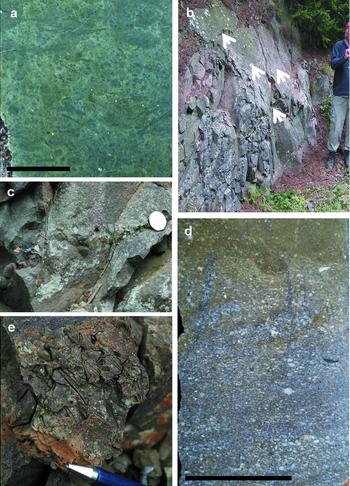
Type Llandovery area lithologies: (a) Intensely bioturbated and burrow-mottled muddy sandstone, Cefngarreg Sandstone Formation (Ceg I), Cwm-coed-oeron [SN 8363 3896] (scale is 5 cm); (b) field appearance of (a); arrows point to impersistent, partially bioturbated conglomerate lags and sandstone beds; (c) close-up of burrowed conglomerate lag in (b) (coin diameter is 27 mm); (d) cross-stratified granule conglomerate, bioturbated in upper part, Derwyddon Formation (DD I), Craig Derwyddon [SN 8429 3647] (scale is 5 cm); (e) coquina of Pentamerus oblongus brachiopod valves in Derwyddon Formation (DD II) sandstone, Fire Tower Hill [SN 8538 3844] (pen diameter is 7 mm).

3.a.2. Telychian strata
Blanketing the varied lower to mid Llandovery strata are the green, burrow-mottled mudstones that comprise the Telychian Cerig Formation. However, this study has shown that the disrupting effects of slumping and Wenlock slide emplacement are widespread in this portion of the stratigraphy such that the Cerig Formation type section (Fig. 4D) has had to be relocated. Davies et al. (Reference Davies, Waters, Zalasiewicz, Molyneux, Vandenbroucke and Williams2010) have proposed track sections in Crychan Forest that expose the conformable and dated base of the formation [SN 8546 3846] as the new type locality [15c] for this distinctive and widely mapped late Llandovery division.
3.a.3. Pre- and post-Llandovery strata
Changes by Davies et al. (Reference Davies, Waters, Williams, Wilson, Schofield and Zalasiewicz2009) to the interpretation of Hirnantian facies present below the Type Llandovery succession include abandonment of the term and concept of Cocks et al.'s (Reference Cocks, Woodcock, Rickards, Temple and Lane1984) ‘Scrach Formation’. In the revised model, the transgressive Garth House Formation oversteps earlier regressive Hirnantian facies preserved to the west of the Crychan Fault Belt, and rests unconformably on Katian (Rawtheyan) strata to the east. Further south, upper parts of the Llandovery succession overstep onto rocks of Darriwilian (Llanvirn) age. Subdivision and nomenclature for the local Wenlock succession follows that erected for the Builth Wells area (Zalasiewicz & Williams, Reference Zalasiewicz and Williams1999; Schofield et al. Reference Schofield, Davies, Waters, Wilby, Williams and Wilson2004), the Builth Mudstones Formation being the equivalent of Cocks et al.'s (Reference Cocks, Woodcock, Rickards, Temple and Lane1984) Gwernfelen Formation. However, the impacts of regional-scale slump and slide emplacement (e.g. Fig. 4D) dominate much of the Wenlock stratigraphy in the Llandovery area (Figs 3, 8).
3.b. Facies models and benthic communities
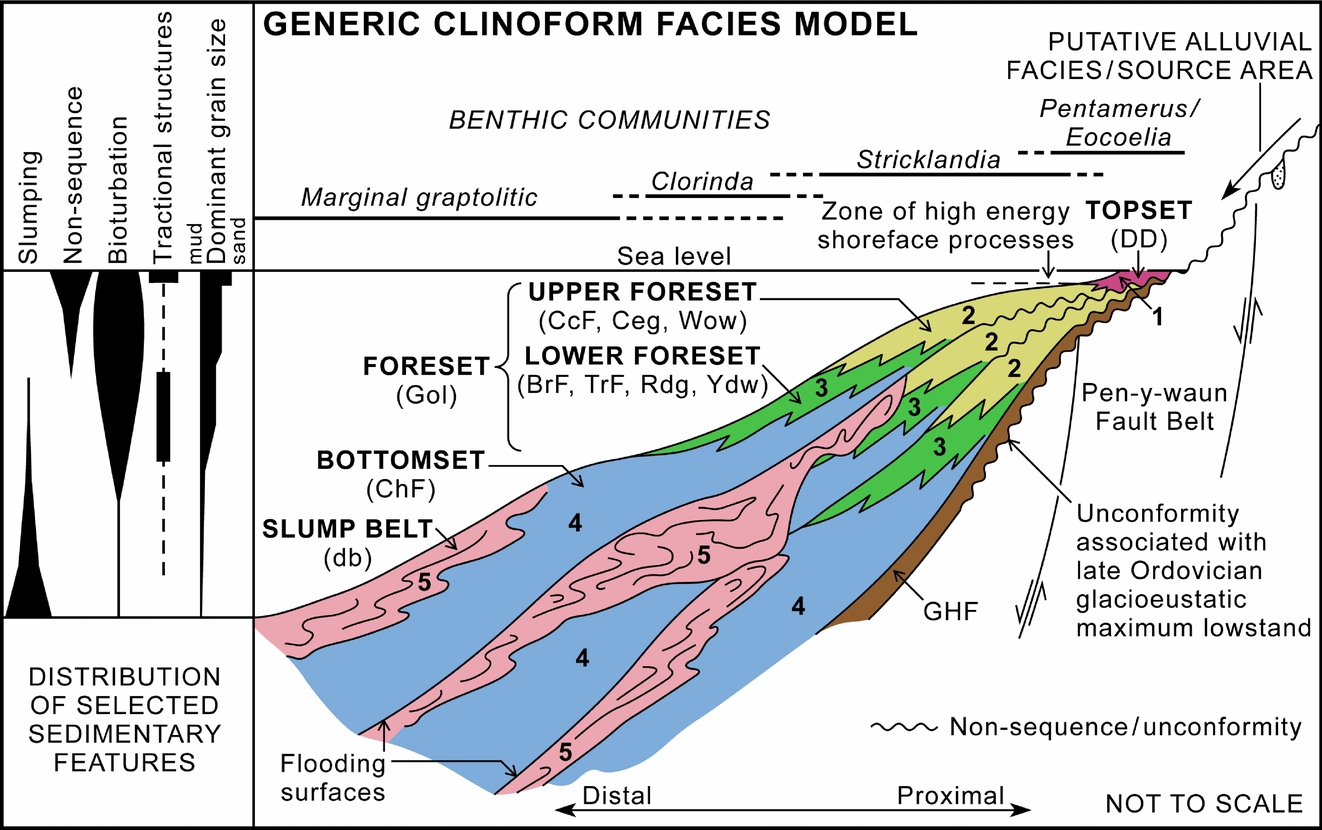
Pre-Cerig Formation facies of the Type Llandovery succession have been interpreted in the context of a generic clinoform model that comprises five broad facies belts: (1) topset; (2) upper foreset; (3) lower foreset; (4) bottomset; and (5) slump belt. The palinspastic relationships and intergradational sedimentary characteristics of these five belts are summarized in Figures 6 and 7; Figures 4 and 8 also make clear their close correspondence to the area's lithostratigraphical divisions. Lithological differences between upper and lower foreset facies form the basis for the separate recognition of the Crychan and Bronydd formations in the northern Llandovery region. Complex intertonguing of comparable facies prevents straightforward subdivision of the correlative Goleugoed Formation in the south. The latter, accordingly, can be viewed as an undivided succession of Rhuddanian foreset facies (Figs 6, 8).
Generic clinoform facies belt model for the Type Llandovery succession showing prograde relationships and dominant lithologies: 1 – topset sandstones; 2 – upper foreset muddy sandstones; 3 – lower foreset sandy mudstones; 4 – bottomset silty mudstones; 5 – slump/slide-disturbed strata; excluding upper slope Tycwtta Mudstones Formation facies. See Figure 7 for lithological details and Figure 2 for key to lithostratigraphical symbols.

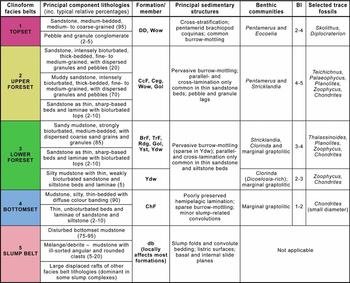
Summary lithological data for the Type Llandovery succession (excluding Garth House, Tycwtta Mudstones and Cerig formations). Facies belt numbers refer to Figures 6 and 8; BI – bioturbation index of Taylor & Goldring (Reference Taylor and Goldring1993).

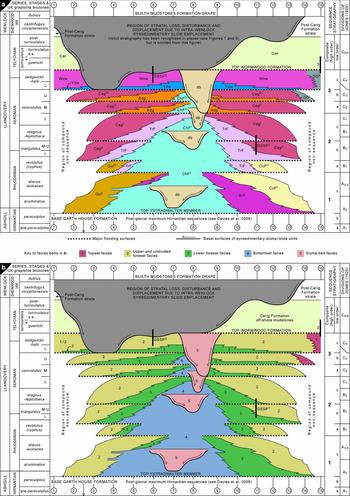
Generalized chronostratigraphical model and graptolite biostratigraphy for the pre-Cerig Formation Type Llandovery succession showing new prograde-based sequence stratigraphy and its relationship to: (a) local lithostratigraphy; and (b) clinoform facies belts. See Figures 2, 3 and 6 for key; GSSP1 – current Aeronian Stage Stratotype Section; GSSP2 – current Telychian Stage Stratotype Section; 3 – new Cerig Formation type section; acuminatus Biozone – ascensus–accuminatus Biozone of Zalasiewicz et al. (Reference Zalasiewicz, Taylor, Rushton, Loydell, Rickards and Williams2009).

A detailed sedimentological analysis of the Type Llandovery succession is beyond the scope of this account. Broadly speaking, however, the various Llandovery divisions record a series of progradational events (progrades) in which mud-prone bottomset facies pass laterally and vertically upwards into more sand-prone foreset units (e.g. Fig. 4A). Systematic changes in the degree of bioturbation, quantified with reference to the bioturbation index (BI) of Taylor & Goldring (Reference Taylor and Goldring1993), parallel these textural variations (Figs 6, 7). In thinner-bedded and weakly disrupted bottomset facies (BI 1–2), separate beds and laminae of sandstone, siltstone and mudstone survive and Chondrites and Zoophycos are the dominant trace fossils. In the thicker-bedded foreset facies the effects of bioturbation dominate. Primary sand, silt and mud layers have been thoroughly mixed together (BI 4–5) to produce homogeneous, strongly burrow-mottled, sandy mudstones and muddy sandstones with a diverse suite of trace fossils (Figs 5a, 7). Conglomerate lags and relict thin sandstone beds that have escaped the full effects of bioturbation preserve the only evidence of tractional processes (Fig. 5, c). Despite variations in the levels of burrowing, the bulk of the succession records oxic deposition. Dysoxic conditions are evidenced in weakly bioturbated Chwefri Formation facies, but only in the Tycwtta Mudstones Formation, an upper slope deposit of late Hirnantian to Rhuddanian age, are anoxic facies, preserving undisrupted hemipelagic lamination, widespread (Davies et al. Reference Davies, Fletcher, Waters, Wilson, Woodhall and Zalasiewicz1997).
The distribution of bathymetrically influenced benthic communities (Cocks, Reference Cocks, Bassett and Bassett1971; Cocks et al. Reference Cocks, Woodcock, Rickards, Temple and Lane1984) also broadly reflects these facies subdivisions. The shallowest Eocoelia and Pentamerus communities are present in upper foreset facies represented by shoaling parts of the Goleugoed, Crychan and Wormwood formations, and dominate the most proximal topset successions in the south and in the type Derwyddon Formation area (Fig. 5d, e). Temple's (Reference Temple1987) work has shown that Borealis replaces Pentamerus in Rhuddanian ‘Pentamerus community’ assemblages (cf. Cocks, Reference Cocks, Bassett and Bassett1971) [e.g. 5b]. Stricklandia community assemblages are also widespread in upper foreset facies whereas more offshore Clorinda community assemblages characterize lower foreset units. Assemblages rich in Dicoelosia, present in the Ydw Member [e.g. 6f, 6g] are interpreted as some of the deepest in the Llandovery area (Cocks et al. Reference Cocks, Woodcock, Rickards, Temple and Lane1984; cf. Jin & Copper, Reference Jin and Copper1999). The biota present in the Chwefri Formation, including its suite of soft-bodied burrowers (Davies et al. Reference Davies, Waters, Williams, Wilson, Schofield and Zalasiewicz2009), testifies to bottomset deposition beyond the colonizing reach of bottom-dwelling shelly benthos, along the margin of the planktonic graptolitic realm that characterized the deep-water Welsh Basin to the northwest.
Lower (Rhuddanian–Aeronian) parts of the succession have previously been viewed as pro-delta deposits (M. A. Woollands, unpub. Ph.D. thesis, Univ. College, London, 1970; Cocks et al. Reference Cocks, Woodcock, Rickards, Temple and Lane1984). However, the dominant, bioturbated, foreset facies compare with those formed in the modern ‘transition zone’ located between parts of the coastal shoreface dominated by tractional processes and the distal shelf (Reineck & Singh, Reference Reineck and Singh1975; Van Wagoner et al. Reference Van Wagoner, Mitchum, Campion and Rahmanian1990; Martin & Pollard, Reference Martin, Pollard, Hurst, Johnson, Burley, Canham and Mackertich1996; Bann & Fielding, Reference Bann, Fielding and McIlroy2004). Along low-energy coastlines, and where rates of sediment supply permit, the upper limit of this zone of intense burrowing can occur in depths as shallow as 2 m, whereas its lower reach can extend to depths of over 40 m. In this context, the prograde sequences that make up the Llandovery succession would record the repeated advance of transition zone facies across deeper, more distal and less bioturbated offshore deposits.
The scarcity of tractional sedimentary structures within the sand-prone facies suggests that the higher energy shoreface facies that should cap each progradational sequence are poorly represented. This may in part record the transgressive truncation of the upper parts of these sequences, a process described by Weise (Reference Weise1980), but an additional or alternative explanation is that the Llandovery systems were decapitated by active faulting along the eastern margin of the outcrop, a structural zone now represented by the Pen-y-waun Fault Belt (Figs 1, 6). The observed progradational sequences accumulated and were preserved to the west of this fracture zone, whereas the expected shallower facies may have accumulated on, but were regularly eroded from, the adjacent footwall high. Preserved remnants of these more proximal topset facies are represented by the Derwyddon Formation of the Pen-y-waun area and parts of the strongly overstepping and attenuated Wormwood Formation in the south (Fig. 8). In these areas, though bioturbation remained a periodically important process, sandstones with pentamerid brachiopod coquinas (Fig. 5e), and preserving cross-stratification and vertical escape traces, testify to the prevalence of tractional reworking in a shallow-water setting (Figs 4F, 5d, 6).
Building on this fault-controlled model, an alternative explanation for the observed facies patterns is to evoke the repeated progradation of sand-prone fan delta deposits across offshore bottomset muds. In this context, the homogenized foreset facies that dominate much of the Llandovery succession (Figs 6, 7) can be radically re-interpreted as the product of mass flow and resedimentation on a fan delta surface, with bioturbation a secondary or overprinting factor. The concept of in situ benthic communities would need urgently to be revisited were this depositional model to find favour. In common with the shoreface model, proximal topset facies recording alluvial deposition and the effects of shallow-water, wave and tidal reworking would have been anchored to the erosion-prone, footwall region; in which case the models of Westcott & Etheridge (Reference Wescott, Etherridge, Rachocki and Church1990) and Postma (Reference Postma, Colella and Prior1990) may prove relevant. It is anticipated that ongoing studies will resolve these contrasting facies models.
The intertonguing, sand-prone, foreset facies die out towards a central region to the east of Llandovery town where the thickest, uninterrupted Chwefri Formation succession is developed. This area of deeper, offshore deposition was also the site of sea bed instability, as recorded by the presence of extensive units of slumped and disturbed strata (Facies belt 5) (Figs 3, 8). Each of the major progradational events has an associated slump complex associated with it suggesting that elevated rates of sedimentation contributed to the growth of over-steepened and unstable gradients; contemporaneous movements on major faults perhaps provided a seismic trigger. The back scars of some slumps migrated into more proximal facies belts (Figs 4E, 10) and, accordingly, though many slump units comprise disturbed bottomset mudstone, others include large masses of displaced, upper foreset sandstone.
In the upper part of the succession, where it is unaffected by later, slide-related, deformation, the Telychian Cerig Formation records more widespread offshore mud deposition. Thin sandstone beds, including those that are abundant in the Mwmffri Sandstone Member, were emplaced by storm-generated gravity flows below storm wave base.
3.c. Sequence stratigraphy
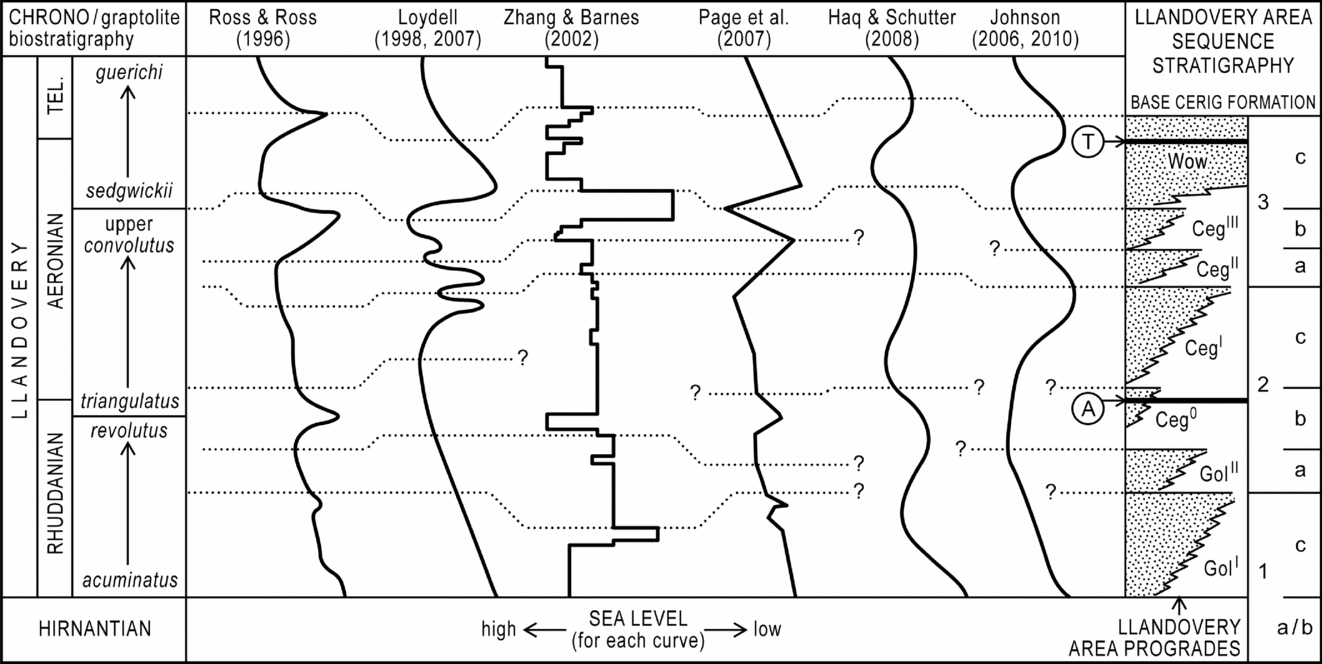
The new architecture clearly picks out a series of prograde sequences on a variety of scales; and yet smaller scale parasequences are recognized in measured sections (e.g. Davies et al. Reference Davies, Molyneux, Vandenbroucke, Verniers, Waters, Williams, Zalasiewicz and Ray2011). If recast as a chronostratigraphical section, using graptolite biozones as a proxy for time, the new architectural and facies models permit, for the first time, the erection of a detailed sequence stratigraphy for the Type Llandovery succession (Fig. 8). Each progradation is shown to overlie a sequence-defining flooding surface and the scales and geometries of the progrades favour grouping the seven main Rhuddanian to Aeronian sequences into three composite or higher order sequences (sensu Duval, Cramez & Vail, Reference Duval, Cramez and Vail1992). There are important variations in detail when compared with Jones (Reference Jones1925), but also clear echoes of his original A, B and C scheme in this new analysis. The progradational acmes of these composite sequences occurred during the acinaces, lower convolutus and upper sedgwickii–halli graptolite biozones. The initial post-glacial maximum rise in sea level appears to have peaked during the persculptus Biozone, but the Llandovery succession was fashioned by further flooding events that achieved their maxima during the revolutus, middle convolutus and lower sedgwickii biozones. Significant secondary events include those linked to the local first appearances of revolutus and upper convolutus graptolite biozone assemblages.
Evidence of fault movements and differential subsidence testifies to local tectonic activity, but, in marked contrast to the Telychian, the influence of tectonism on the Hirnantian to Aeronian rock record in central Wales appears, on the whole, to have been insufficient fully to mask that of eustasy (Woodcock et al. Reference Woodcock, Butler, Davies, Waters, Hesselbo and Parkinson1996; Davies et al. Reference Davies, Fletcher, Waters, Wilson, Woodhall and Zalasiewicz1997; Davies, Waters & Copus, Reference Davies, Waters and Copus1999; Schofield et al. Reference Schofield, Davies, Waters, Williams and Wilson2009a ). In the Llandovery area, two late Hirnantian age sequences record events in the immediate aftermath of the Late Ordovician glacial maximum lowstand, including the re-ventilation and faunal re-stocking of the Welsh Basin (Davies et al. Reference Davies, Waters, Williams, Wilson, Schofield and Zalasiewicz2009). However, work on Gondwanan sequences, particularly in South America, has confirmed that there were further periods of advance and retreat of the South Polar ice sheet throughout much of the early Silurian (e.g. Page et al. Reference Page, Zalasiewicz, Williams, Popov, Williams, Haywood, Gregory and Schmidt2007; Caputo, Reference Caputo, Landing and Johnson1998; Dias-Martinez & Grahn, Reference Dias-Martinez and Grahn2007) and it is the impacts of these events that are now widely accepted to account for perturbations in early Silurian sea level (e.g. Loydell, Reference Loydell1998). A comparison of Llandovery sea level curves (Fig. 9) is significantly hindered by calibration problems (e.g. Zhang & Barnes, Reference Zhang and Barnes2002; Johnson, Reference Johnson2010; Munnecke et al. Reference Munnecke, Calner, Harper and Servais2010) that, in the short term at least, the findings presented herein are likely further to compound (see Section 5). Differences in methodology and scale account for most difficulties, but differences in the timing of regional onset flooding verses global maximum flooding can also account for what appear to be major discrepancies between the regional and global datasets. Notwithstanding these problems, recent syntheses appear to acknowledge higher order eustatic regressions with acmes in the mid Aeronian (convolutus Biozone) and late Aeronian–early Telychian (Fig. 9). Evidence for an early to mid Rhuddanian regression is less clear, although several curves record a small-scale, pre-revolutus Biozone lowstand event. There is still less consensus about the timing and scale of secondary (lower order) regressions, though there is evidence of up to five such events between the latest Rhuddanian and end Aeronian. The precise correlations suggested in Figure 9 will doubtless be debated, but, within current dating constraints, glacioeustatic forcing culminating in emergence and erosion is seen to offer a ready explanation for many of the Llandovery area progrades. Conversely, the key flooding surfaces can be linked to intervening interglacial highstands (Fig. 9).
Rhuddanian to early Telychian sea level curves showing possible relationships to the newly erected Type Llandovery sequence stratigraphy (curve of Zhang and Barnes is simplified). Dotted lines – putative glacioeustatic flooding surfaces. N.B. aside from Page et al. (Reference Page, Zalasiewicz, Williams, Popov, Williams, Haywood, Gregory and Schmidt2007), curve alignments are as presented by Zhang & Barnes (Reference Zhang and Barnes2002) (earlier curves) and Johnson (Reference Johnson2010) (later curves), although alternative correlations for some key events are suggested. A – horizon of Aeronian GSSP; T – horizon of Telychian GSSP; acuminatus Biozone – ascensus–accuminatus Biozone of Zalasiewicz et al. (Reference Zalasiewicz, Taylor, Rushton, Loydell, Rickards and Williams2009).

The revolutus Biozone has been widely cited as marking a period of enhanced coarse clastic input to the Welsh Basin and its marginal shelf that was out of step with global eustasy (e.g. Davies & Waters, Reference Davies, Waters, Pickering, Hiscott, Kenyon, Ricci Lucci and Smith1995; Schofield et al. Reference Schofield, Davies, Waters, Williams and Wilson2009a ). But this study shows that, in keeping with eustatic events, the sand-rich Crychan–Goleugoed system contracted and was abandoned during this interval, inviting re-evaluation of its basinal correlatives. However, the overall distribution of sand-prone, Rhuddanian foreset facies testifies to separate periods of local progradation (Figs 3, 8b) that, in their timing and duration, were not fully consistent with the pattern of post-glacial deepening that most sea level curves depict (Fig. 9). It is to explain this and other discrepancies that the additional influence of local tectonism can be invoked (cf. Zhang, Barnes & Jowett, Reference Zhang, Barnes and Jowett2006). Though eustatic events can account for the timing of many Llandovery area sequences, local patterns of progradation are likely also to reflect the flux in sediment supply that stemmed from the emergence and deep erosion of up-faulted tracts to the east; and during some intervals this was perhaps the dominant factor.
The eustatic credentials of the marked guerichi Biozone flooding event recorded by the base of the Cerig Formation are also less certain. The Telychian was a period of enhanced regional subsidence and tectonic activity in Wales during which eustasy appears largely to have been overridden as the dominant control on sedimentation (Woodcock et al. Reference Woodcock, Butler, Davies, Waters, Hesselbo and Parkinson1996; Davies et al. Reference Davies, Fletcher, Waters, Wilson, Woodhall and Zalasiewicz1997). Newly discovered synsedimentary slides and associated disturbance also makes sequence analysis of the upper part of the succession problematic (Figs 3, 8). Despite this, a detailed, well-dated Rhuddanian to Aeronian sequence stratigraphy is now available for the Llandovery Series's type succession to aid with the calibration and diagnosis of global models.
3.d. Stratal loss in the Type Llandovery area
When traced into proximal northern and southern regions of the Type Llandovery area, each prograde has a correlative unconformity and, in the most proximal settings, these merge to produce surfaces of compound non-sequence (Fig. 8). Here, angular overstep relationships (Figs 1, 3) confirm that fault-influenced uplift, tilting and bevelling was an important factor, in a similar manner to that described by Gawthorpe et al. (Reference Gawthorpe, Hall, Sharp, Dreyer, Hunt and Gawthorpe2000) (Fig. 6). Overstepping relationships beneath the upper Hirnantian Garth House Formation record the impact of the Late Ordovician glacioeustatic lowstand and associated deep erosion (Davies et al. Reference Davies, Waters, Williams, Wilson, Schofield and Zalasiewicz2009). The extensive erosion surface that caps the main Goleugoed–Crychan progradation represents the A/B unconformity of Jones (Reference Jones1925). A major non-sequence is recognized at a level broadly equivalent to the base of Jones' C2 division that only locally equates to his B/C unconformity (Fig. 8). In marked contrast to Jones (Reference Jones1925, Reference Jones1949) and Cocks et al. (Reference Cocks, Woodcock, Rickards, Temple and Lane1984), the current study recognizes the transgressive base of the Wormwood Formation and the correlative parts of the Derwyddon Formation (Fig. 4F) as a key overstep surface, broadly equivalent to the sub-C4 unconformity recognized by Jones & Williams (Reference Jones and Williams1949).
The recognition of extensive slumped units and, particularly in the upper part of the succession and in the Wenlock, of regional-scale slide surfaces with associated zones of disturbance, shows that other processes have contributed to strata loss and displacement in the area (Figs 8, 10). Nevertheless, the central belt does appear to preserve an essentially intact Rhuddanian to Aeronian succession, and it is in this region that the strategy of dating the newly recognized flooding events (see Section 4) has had the greatest success.
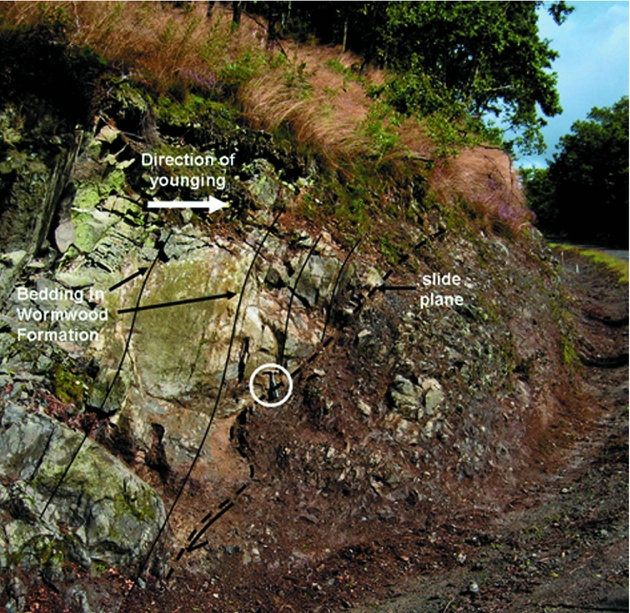
Mélange with blocks of sandstone (right) overlying basal slide plane of major synsedimentary slump truncating bedding in the Wormwood Formation (left), Glyn-moch track section [SN 8174 3751], Crychan Forest. Note strata are structurally inverted and young to the right; hammer for scale, circled, is 0.28 m long.

4. Biostratigraphy
Key to understanding the architecture of the adjacent, deep-water, Welsh Basin succession was the systematic use of graptolite biostratigraphy (e.g. Zalasiewicz, Reference Zalasiewicz1990; Loydell, Reference Loydell1991; Davies et al. Reference Davies, Fletcher, Waters, Wilson, Woodhall and Zalasiewicz1997). In an effort to replicate this success, and to establish a common biostratigraphical framework for regional correlation and event calibration, graptolites were also targeted for collection from the shelf facies of the Llandovery area. Systematic sampling for acritarchs and chitinozoans was also undertaken. Deficiencies in earlier sampling regimes were also addressed; for example, the focus for much of the graptolite work undertaken by Cocks et al. (Reference Cocks, Woodcock, Rickards, Temple and Lane1984) was in the north, whereas reported acritarch assemblages came from the south (Hill & Dorning, Reference Hill, Dorning, Cocks, Woodcock, Rickards, Temple and Lane1984).
A review of the extensive published faunal lists for the Type Llandovery area has also been undertaken, and these continue to provide data essential for local, regional and international correlation. In all, more than 400 micro- and macrofossil assemblages have been analysed during this study, including over 100 new assemblages. Those assemblages that are key to the erection of the new architectural model are plotted on Figure 11 and detailed in Appendix 1. This analysis has allowed the strengths and weaknesses of existing biozonal schemes to be evaluated and, by adopting a ‘first appearance datum’ (FAD) and ‘last appearance datum’ (LAD) approach, underpins a radically revised cross-correlation of the separate macro- and microfossil biozonal schemes for the Llandovery Series in its type area (see Section 6). A more detailed biostratigraphical database, including taxonomic analysis of the new macro- and microfossil discoveries, will be published elsewhere.
Selected fossil localities in the Type Llandovery area; see Appendix 1 for details.

4.a. Graptolites
Given the oxic and bioturbated nature of much of the succession, the deeper and more offshore facies, associated with the flooding events, were considered to provide the best taphonomic window for graptolite preservation, and proved productive (Fig. 11). It is important not to understate the difficulties of recovering graptolites from the Type Llandovery succession. They are extremely sparse, whilst their fragmentary nature commonly hinders identification. Nevertheless, targeted collecting has significantly increased the number of well-dated graptolite localities (Figs 11, 12, 13; Appendix 1). Ten additional Llandovery taxa have been recognized, bringing the total reported from the Llandovery area to 55. Additional persculptus Biozone and Wenlock taxa are also reported. The assemblages reported by Jones (Reference Jones1925) and Cocks et al. (Reference Cocks, Woodcock, Rickards, Temple and Lane1984) have been re-assessed and some of the most critical re-examined. All the newly reported graptolite assemblages are curated in the collections of the British Geological Survey, Keyworth, Nottingham, UK.
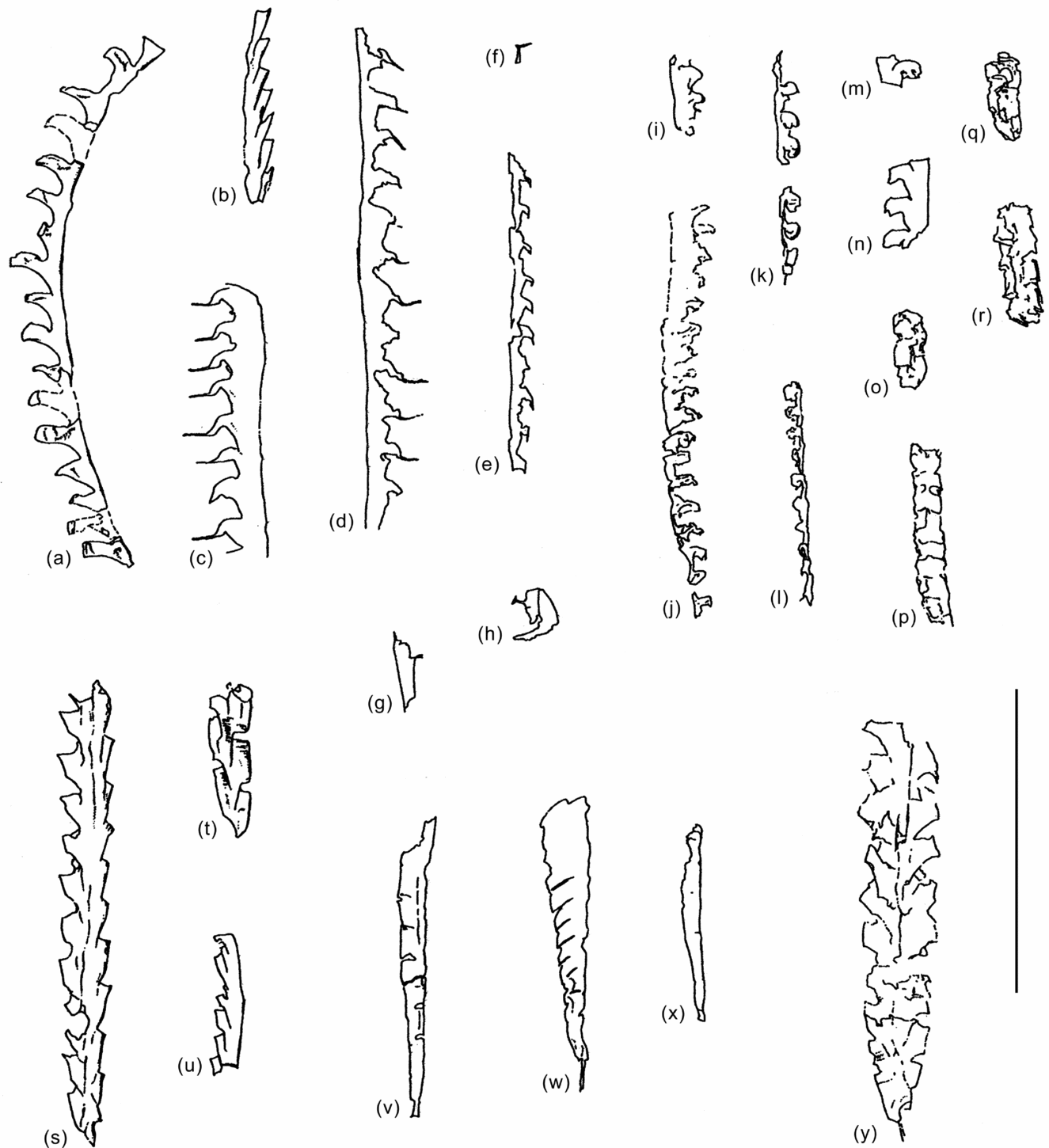
Examples of new Rhuddanian and Aeronian graptolite discoveries in the Type Llandovery area (locality numbers refer to Fig. 11 and Appendix 1). (a) Torquigraptus cf. magnificus, [2c], BGS JZB4187; (b) Pristiograptus cf. regularis, [2c], BGS JZB4185; (c) Stimulograptus sedgwickii, [2c], BGS JZB4185; (d, e) Stimulograptus sedgwickii, [9g] (d) JZB4171, (e) BGS JZB4172; (f) Rastrites sp. (gracilis?), sicula and th1, [9g], BGS JZB4172; (g, h) Neolagaragraptus cf. tenuis (h as predated fragment?), [9g], both BGS JZB4172; (i–n) cf. Campograptus harpago, [7e], (i) BGS JZB4082, (j) BGS JZB4073, (k) BGS JZB4084, (l) BGS JZB4070, (m) BGS JZB4099, (n) BGS JZB4097; (o–r) cf. Metaclimacograptus undulatus, [7e], (o) BGS JZB4097, (p) BGS JZB4085, (q) BGS JZB4082, (r) BGS JZB4086; (s) Glyptograptus cf. tamariscus varians, [9c], BGS JZB4114; (t) Normalograptus sp., [9c], BGS JZB4115; (u) Atavograptus cf. atavus, [9c], BGS JZB4114; (v–x) Rhaphidograptus toernquisti, [4g], (v) BGS JZB4167, (w) BGS JZB4156, (x) BGS JZB4165; (y) Normalograptus cf. wyensis, [5d], BGS JZB4104. Scale bar = 1 cm, except (o–t) and (y) = 5 mm.

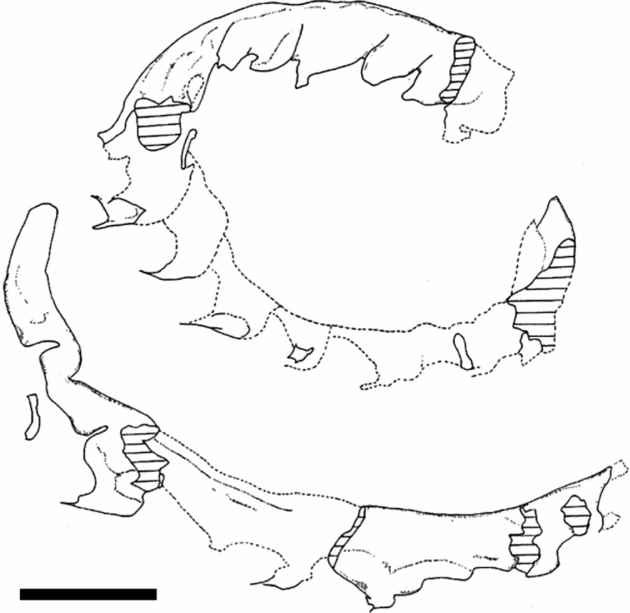
Spirograptus guerichi (BGS MWL6435), 3 m above base of the Cerig Formation at its revised type section [15b]. Scale bar = 1 mm.

The findings of this new work, when placed in the context of the new sequence stratigraphical framework, have allowed the FADs of many of the key Rhuddanian and Aeronian graptolite biozonal assemblages to be plotted throughout the area (Fig. 8), though no such resolution is possible for Telychian strata (see Section 5.d). In assessing the graptolite faunas, the revised UK range charts and biozonal nomenclature of Zalasiewicz et al. (Reference Zalasiewicz, Taylor, Rushton, Loydell, Rickards and Williams2009) have been used. A comparison of this UK scheme with those in use elsewhere is provided by Loydell (Reference Cullum and Loydell2011). Use of the revolutus Biozone in place of the cyphus Biozone marks a significant change from earlier published practice for the Llandovery of Wales. Former usage of the turriculatus Biozone in Wales, for example by Cocks et al. (Reference Cocks, Woodcock, Rickards, Temple and Lane1984) and Davies et al. (Reference Davies, Fletcher, Waters, Wilson, Woodhall and Zalasiewicz1997), has also changed. The guerichi Biozone now occupies the lower part of this interval. The term turriculatus Biozone s.l. (sensu lato) has been used in recent accounts to signify the original Welsh usage and for reference purposes (e.g. Schofield et al. Reference Schofield, Davies, Waters, Wilby, Williams and Wilson2004, Reference Schofield, Davies, Jones, Leslie, Waters, Williams, Wilson, Venus and Hillier2009 b). Graptolites distinctive of the lower [e.g. 9e] and upper parts [e.g. 7e] of the convolutus Biozone have been recovered from the Llandovery area. Assemblages indicative of the ‘middle’ part of the zone have been recognized in mid Wales (Davies et al. Reference Davies, Fletcher, Waters, Wilson, Woodhall and Zalasiewicz1997), but use of this term in the Llandovery area is largely informal.
Many of the newly plotted FADs are associated with flooding events, and it appears intuitively correct that each transgression has the potential to introduce newly evolved species. However, since it was these levels that were specifically targeted for collection, the discovery of biostratigraphically distinct assemblages from successive flooding levels may reflect this sampling bias; and it is a truism worth restating that local FADs of biozonal assemblages need not represent true biozonal bases in the strictest sense, or occur at precisely the same stratigraphical level everywhere.
Late Hirnantian persculptus Biozone graptolites are unknown below the base of the Chwefri Formation and its correlatives; it is at this level that the biozone's most primitive morphs first appear in Wales (Blackett et al. Reference Blackett, Page, Zalasiewicz, Williams, Rickards and Davies2009; Davies et al. Reference Davies, Waters, Williams, Wilson, Schofield and Zalasiewicz2009). A key discovery, contradicting Jones (Reference Jones1925) and Cocks et al. (Reference Cocks, Woodcock, Rickards, Temple and Lane1984), is that sedgwickii Biozone assemblages first appear in the Ydw Member of the Wormwood Formation (see Section 3.a and Fig. 17). The FAD of Neolagarograptus tenuis [9g] and, in its upper part, the LAD of Raphidograptus toernquisti [9h] suggest the member spans the lower part of the biozone, and this is supported by the presence in underlying strata of probable upper convolutus Biozone graptolites [e.g. 7e]. A specimen of Paradiversograptus runcinatus from the Cerig Formation (Cocks et al. Reference Cocks, Woodcock, Rickards, Temple and Lane1984, p. 148) has been lost, but the discovery of Spirograptus guerichi from close to the base of the formation (Fig. 13) confirms that this marks the local FAD of guerichi Biozone taxa. No younger Llandovery graptolites have been recovered in the type area, but in the nearby Garth area (Fig. 1) Schofield et al. (Reference Schofield, Davies, Waters, Wilby, Williams and Wilson2004) recorded griestoniensis, crenulata, spiralis and post-spiralis biozone assemblages below strata yielding basal Wenlock centrifugus and murchisoni biozone graptolites. New assemblages from Wenlock strata overlying the Type Llandovery succession (Fig. 14; Appendix 1) reveal the absence here of early Wenlock biozones (see Section 5.e).
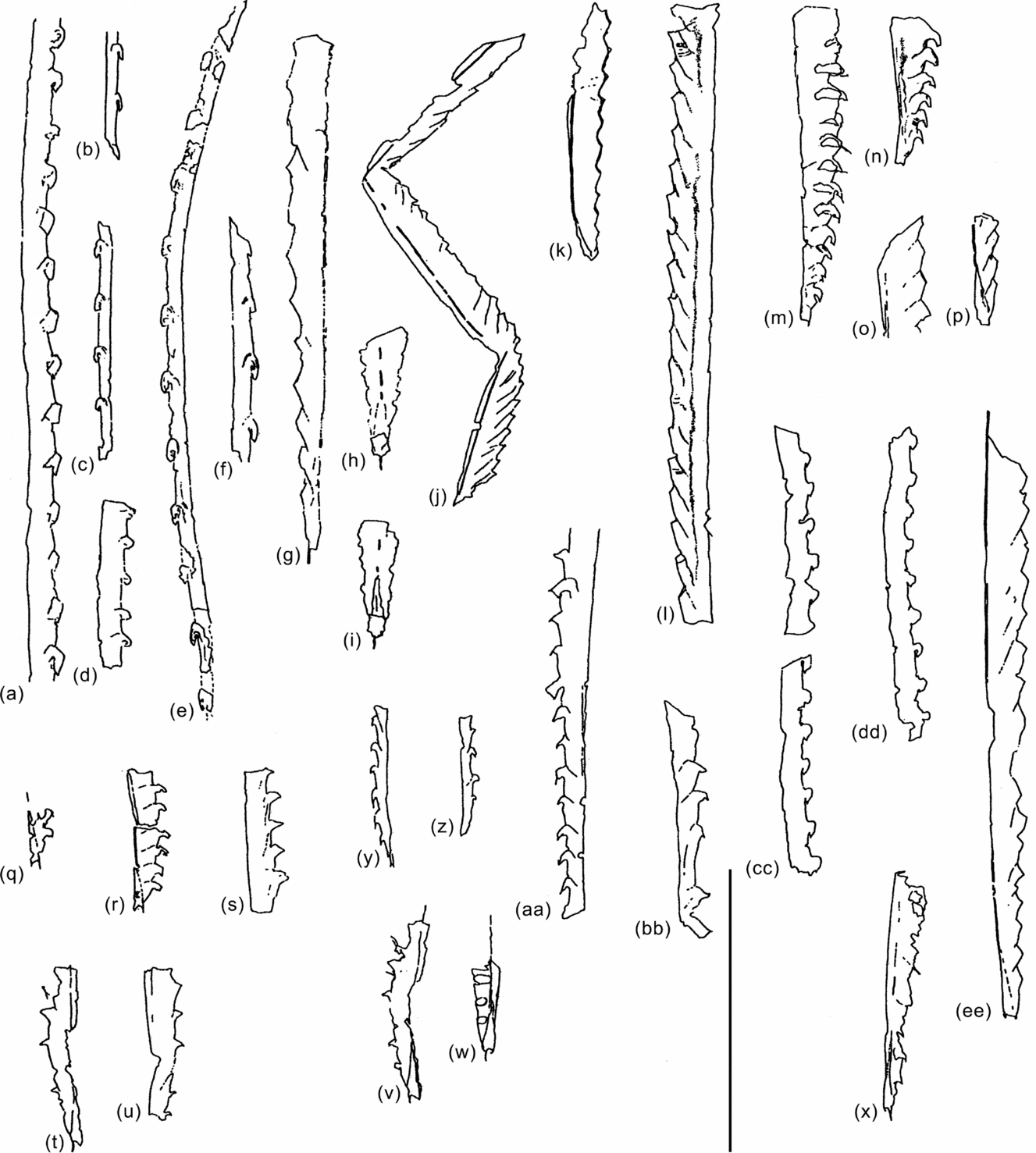
Examples of Wenlock graptolite discoveries in the Type Llandovery area (locality numbers refer to Fig. 11 and Appendix 1). (a–f) aff. Mediograptus retroflexus, [2d], (a) BGS JZB4209, (b) BGS JZB4206, (c, d) BGS JZB4205, (e) BGS JZB4199, (f) BGS JZB4200; (g–i) Pristiograptus ex. gr. dubius (h, i, dorsal aspect), [2d], (g) BGS JZB4231, (h) BGS JZB4213, (i) BGS JZB4212; (j) Pristiograptus dubius pseudolatus (predated?), [2d], BGS JZB4207; (k) Pristiograptus ex. gr. dubius, [1c], BGS JZB4037; (l) cf. Monoclimacis flumendosae [1c], BGS JZB4035; (m, n) Monograptus cf. priodon, [1d], (m) BGS JZB4008, (n) BGS JZB4002; (o, p) Pristiograptus ex. gr. dubius, [1d], (o) BGS JZB4011, (p) BGS JZB4009; (q–s) Monograptus riccartonensis, [6m], (q) BGS MWL6276, (r) BGS MWL6285, (s) BGS MWL6276; (t–v, x) Monograptus cf. riccartonensis, [6o], (t, v) BGS JZB4069, (u) BGS JZB4055, (x) BGS 4065; (w) cf. Pristiograptus ex. gr. dubius, [6o], BGS JZB4058; (y, z) Monograptus aff. riccartonensis of Zalasiewicz & Williams (Reference Zalasiewicz and Williams1999), [6m], (y) BGS JZB4052, (z) BGS JZB4053; (aa, bb) Monograptus cf. riccartonensis, [6m], (aa) BGS JZB4051, (bb) BGS JZB4050; (cc, dd) cf. Mediograptus retroflexus, [7i], (cc) BGS JZB4247, (dd) BGS JZB4246; (ee) Pristiograptus ex. gr. dubius, [7i], BGS JZB4247. Scale bar = 1 cm, except (j) = 2 cm.

4.b. Brachiopods
Key studies of late Hirnantian and Llandovery brachiopod assemblages and lineages, including those from the Llandovery area, are those by Jones (Reference Jones1928), Williams (Reference Williams1951), Zeigler (Reference Ziegler1966), Cocks (Reference Cocks1968, Reference Cocks1970, Reference Cocks1978), Cocks et al. (Reference Cocks, Woodcock, Rickards, Temple and Lane1984), Baarli (Reference Baarli1986) and Temple (Reference Temple1987). No systematic re-assessment of the taxonomic work of these authors has been attempted as part of the current study. However, the new mapping and architectural model allows the stratigraphical distributions of the key taxa to be re-evaluated (Section 6).
Facies locally preserved below the Garth House Formation, deposited during the Late Ordovician glacial maximum, contain the distinctive cold water ‘Hirnantia Fauna’ (Woodcock & Smallwood, Reference Woodcock and Smallwood1987). In Wales, as elsewhere, elements of this assemblage locally survive the post-glacial FAD of persculptus Biozone graptolites (Davies et al. Reference Davies, Waters, Williams, Wilson, Schofield and Zalasiewicz2009). In Llandovery strata, key transitions within the Stricklandia lens, Eocoelia and newly plotted Meifodia prima and Plectatrypa tripartita lineages can be related to key flooding surfaces and the FADs of graptolite assemblages. Species of Clorinda, Cryptothyrella, Leangella and Leptostrophia, and the generic transition from Borealis to Pentamerus are also important. Critically, it emerges that the ranges of key taxa within the important Eocoelia and Stricklandia lineages overlap within the Wormwood Formation. The evolutionary successions E. hemispherica → E. intermedia → E. curtisi and S. lens progressa → S. laevis may not be compromised, but the FADs of successor species appear not always to coincide with the LADs of their precursor forms. Moreover, all these transitions appear to pre-date the local FAD of guerichi Biozone graptolites (cf. Doyle, Hoey & Harper, Reference Doyle, Hoey and Harper1994; also Floyd & Williams, Reference Floyd and Williams2003). The genera Eospirifer and Pentlandella also have their local FADs in the Wormwood Formation, below and above the Telychian GSSP, respectively [6f, 6k].
Perhaps most significantly, it is now known that a key ‘Telychian’ assemblage of Cocks et al. (Reference Cocks, Woodcock, Rickards, Temple and Lane1984), including E. curtisi and S. laevis, came from a raft in a Wenlock synsedimentary mélange (see Section 5.d) [6n]. The relevance of specimens transitional between E. curtisi and the more advanced E. sulcata in the Sawdde Gorge, associated with the only record of Costistricklandia lirata from the Llandovery area (Hurst, Hancock & McKerrow, Reference Hurst, Hancock and McKerrow1978) [1b], must also be viewed with caution as the absence of early Wenlock strata [1c] suggests there is doubt whether the strata here have fully escaped the effects of Wenlock slide-related disturbance.
4.c. Acritarchs
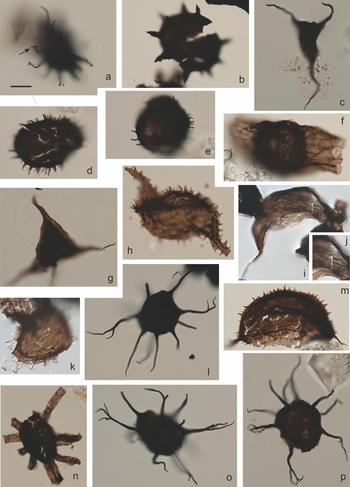
An acritarch biozonal scheme was established for the Type Llandovery area by Hill & Dorning (Reference Hill, Dorning, Cocks, Woodcock, Rickards, Temple and Lane1984) and modified slightly by Dorning & Bell (Reference Dorning, Bell and Hart1987). Further modifications were made by Davies et al. (Reference Davies, Fletcher, Waters, Wilson, Woodhall and Zalasiewicz1997) when applying the scheme to the Welsh Basin succession. The data of Hill & Dorning (Reference Hill, Dorning, Cocks, Woodcock, Rickards, Temple and Lane1984) have been recalibrated using the revised architecture and augment extensive new acritarch collections from the Llandovery area. Over 70 assemblages have been assessed and the 98 taxa now identified include over 30 newly recognized in the Llandovery area. A selection of the newly recovered specimens is shown in Figure 15. Slides and residues of all the newly reported acritarch assemblages are registered and curated in the MPA series of the British Geological Survey, and figured specimens are stored in the MPK collection of Type and Figured micropalaeontological specimens. Both collections are housed at the British Geological Survey, Keyworth, Nottingham, UK.
Examples of acritarchs from the Type Llandovery area. Information for each specimen includes: specimen number (prefixed MPK), sample number (prefixed MPA), slide number and England Finder co-ordinates (e.g. R31/3) (locality numbers [in square brackets] refer to Fig. 11 and Appendix 1). Specimens are stored in the MPK collection of Type and Figured micropalaeontological specimens of the British Geological Survey, Keyworth, Nottingham, UK. Scale bar in (a) = 10 μm for all except (j). (a) Gracilisphaeridium encantador Cramer ex Eisenack et al. Reference Eisenack, Cramer and Díez1973, MPK 14233, MPA 51448, slide 2, R31/3, looped process termination is arrowed, [15c]; (b) Tylotopalla robustispinosa (Downie) Eisenack et al. Reference Eisenack, Cramer and Díez1973, MPK 14234, MPA 55430, slide 1, K58/0, [7a]; (c) Domasia limaciformis (Stockmans & Willière) Cramer, Reference Cramer1970, MPK 14235, MPA 55432, slide 1, J62/0, [7b]; (d) Ammonidium cf. listerii Smelror, Reference Smelror1987, MPK 14236, MPA 55432, slide 1, U38/0, [7b]; (e) Ammonidium cf. listerii, MPK 14237, MPA 55432, slide 1, S49/0, [7b]; (f) Carminella maplewoodensis Cramer, Reference Cramer1968, MPK 14238, MPA 55435, slide 1, H41/4, [7f]; (g) Beromia rexroadii Wood, Reference Wood1996, MPK 14239, MPA 55435, slide 1, R53/0, [7f]; (h) Dactylofusa estillis Cramer & Díez de Cramer, Reference Cramer and Díez de Cramer1972, MPK 14240, MPA 55447, slide 2, G49/3, [14c]; (i, j) Eupoikilofusa rochesterensis Cramer ex Eisenack et al. Reference Eisenack, Cramer and Díez1976, MPK 14241, MPA 55442, slide 1, F65/0, (j) detail of ornament, [11d]; (k) Tunisphaeridium parvum Deunff & Evitt, Reference Deunff and Evitt1968, MPK 14242, MPA 55447, slide 2, G60/2, [14c]; (l) Multiplicisphaeridium cf. fisherii (Cramer) Lister, Reference Lister1970, MPK 14243, MPA 55443, slide 1, G63/0, [11e]; (m) Dactylofusa estillis, MPK 14244, MPA 55447, slide 2, P44/3, [14c]; (n) Dilatisphaera laevigata Lister, Reference Lister1970, MPK 14245, MPA 55449, slide1, J52/1, [15a]; (o) Multiplicisphaeridium cf. fisherii, MPK 14246, MPA 55443, slide 1, N51/4, [11e]; (p) Multiplicisphaeridium cf. fisherii, MPK 14247, MPA 55443, slide 1, F70/0 [11e].

Unlike the graptolite dataset, sampling for acritarchs was not restricted to flooding horizons, and the data obtained do not suffer from the same limitations. Even so, many of the key microfloral events coincide with regional and likely global flooding surfaces. The biozonation erected by Hill & Dorning remains relevant, but the positions of their biozonal boundaries (FADs) relative to the standard Llandovery graptolite biozonation are significantly revised (Fig. 19). Other microfloral incomings suggest their scheme is capable of refinement. The entry of species of Domasia, Visbysphaera and Salopidium above the earliest Cefngarreg Sandstone prograde (Ceg 0) could provide the basis for a local division of the eoplanktonica Biozone, and the upper part of the estillis Biozone is distinguished by the FADs of species of Cymatiosphaera, Dilatisphaera and Micrhystridium in the Wormwood and Derwyddon formations [e.g. 2c, 15a].
The recovery of the biozonal marker Gracilisphaeridium encantador from the basal Cerig Formation in the Derwyddon area [15c] shows that its FAD coincides with that of guerichi Biozone graptolites and is earlier than originally thought (Davies et al. Reference Davies, Fletcher, Waters, Wilson, Woodhall and Zalasiewicz1997). Of particular note, however, is that the two ‘Telychian’ localities (163, 223) of Hill & Dorning (Reference Hill, Dorning, Cocks, Woodcock, Rickards, Temple and Lane1984) are now shown either to be of Wenlock age and/or to have been affected by synsedimentary sliding. This means that the Deunffia monospinosa Biozone assemblage cannot be used to define the Telychian stratotype as proposed by Cocks et al. (1987). In both the Welsh Borderland and the Welsh Basin, such assemblages, including the index taxon, first appear in upper Telychian strata (Davies et al. Reference Davies, Fletcher, Waters, Wilson, Woodhall and Zalasiewicz1997).
4.d. Chitinozoans
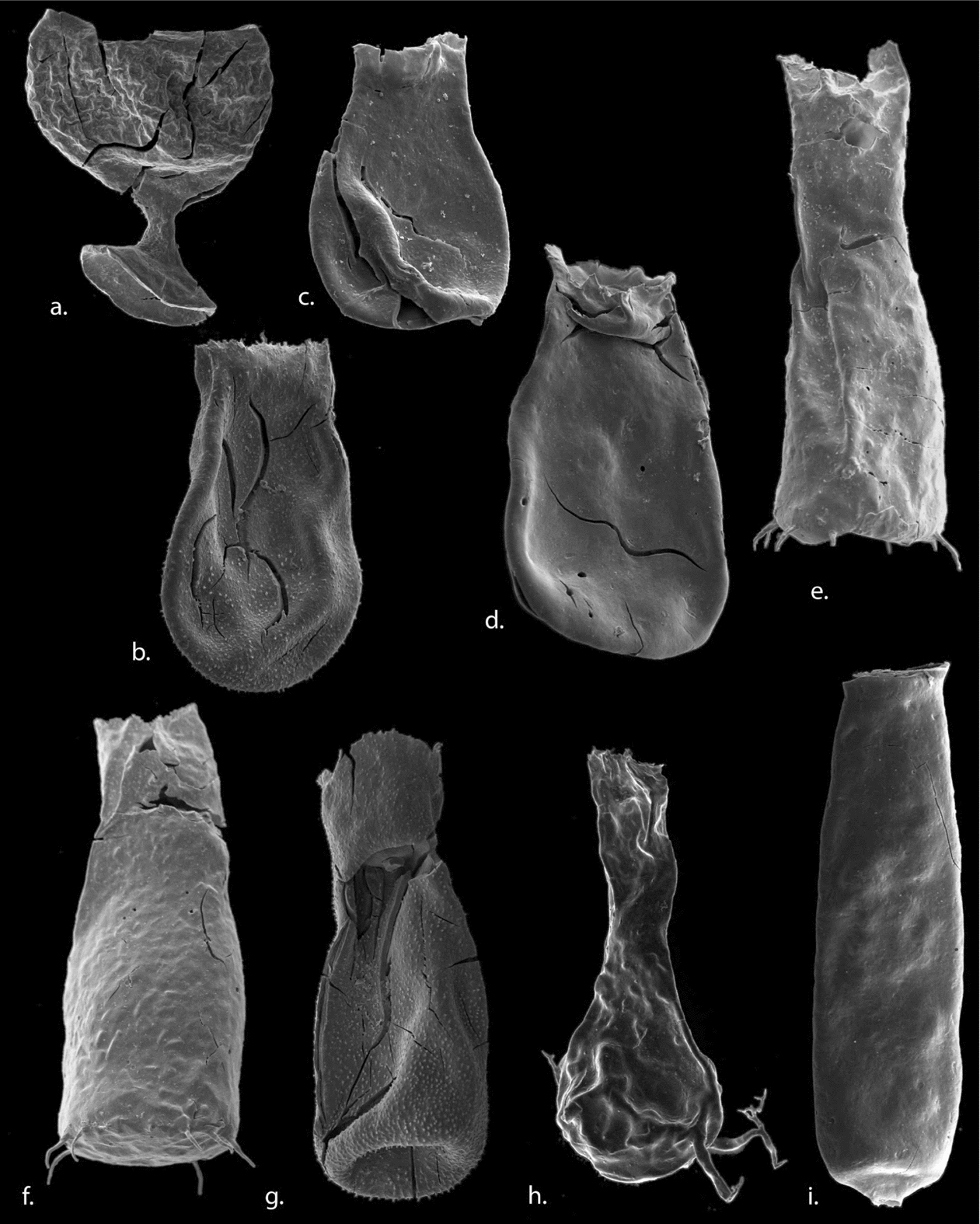
For Llandovery strata, the preliminary findings of De Permentier & Verniers (Reference De Permentier and Verniers2002) have been revisited and augment those of this study. The upgraded database of over 50 assemblages, comprising 47 identified taxa, underpins a detailed chitinozoan biozonation for the Llandovery area succession based on the global scheme for the Silurian erected by Verniers et al. (Reference Verniers, Nestor, Paris, Dufka, Sutherland and Van Grootel1995) and Verniers' (Reference Verniers1999) scheme for the Wenlock of the Builth Wells area. A selection of the newly recovered forms is shown in Figure 16. All newly reported chitinozoan specimens, and rock samples used for chitinozoan studies, are stored at the Research Unit Palaeontology, Ghent University, Krijgslaan 281 (Building S8), Belgium.
Examples of chitinozoans from the Type Llandovery area. Sample numbers refer to Ghent University databases (locality numbers [in square brackets] refer to Fig. 11 and Appendix 1). (a) Margachitina margaritana, length = 0.100 mm, 08–1967, [6m]; (b) Belonechitina ?aspera, length = 0.145 mm, 08–1997, [10b]; (c) Eisenackitina ithoniensis, length = 0.110 mm, 09–2184, [6n]; (d) Eisenackitina dolioliformis, length = 0.140 mm, 08–1984, [7f]; (e) Spinachitina maennili, length = 0.165 mm, 08–1993, [7c]; (f) Spinachitina maennili, length = 0.175 mm, 08–1993, [7c]; (g) Belonechitina postrobusta, length = 0.210 mm, 08–1997, [10b]; (h) Ancyrochitina sp., length = 0.130 mm, 08–1982, [11d; 1.1–1.2 m below Aeronian GSSP]; (i) Conochitina proboscifera, length = 0.420 mm, 09–2184, [6n].

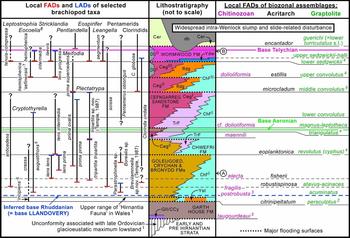
Assemblages of the electa, maennili and dolioliformis biozones are all recognized. The highest dolioliformis Biozone assemblage obtained to date underlies the FAD of guerichi Biozone graptolites, but this biozone is known elsewhere in Wales to extend into younger Telychian strata (e.g. Mullins & Loydell, Reference Mullins and Loydell2002). Late margaritana Biozone assemblages show strata previously regarded as Telychian to be of Wenlock age (Davies et al. Reference Davies, Molyneux, Vandenbroucke, Verniers, Waters, Williams, Zalasiewicz and Ray2011). The early Llandovery fragilis and postrobusta biozones, anticipated in strata below the FAD of electa Biozone assemblages [12f], have as yet not been proven. However, poorly preserved Hirnantian chitinozoans have been recovered from the base of the Garth House Formation (this study), and a similar assemblage from its top (T. J. Challands, unpub. Ph.D. thesis, Durham Univ., 2008) has been tentatively attributed to the taugourdeaui Biozone [12a]. These faunas are in the process of revision and, currently, firm observations for this biozone and its index fossil in the Welsh basin are restricted to the Bala area of mid Wales (Vandenbroucke, Reference Vandenbroucke2008; Vandenbroucke et al. Reference Vandenbroucke, Hennissen, Zalasiewicz and Verniers2008). As with the acritarchs, sampling for chitinozoans was not restricted to flooding levels. Nevertheless, the FADs of many key taxa closely overlie newly identified flooding surfaces, and a cross-correlation of the Type Llandovery acritarch and chitinozoan biozonation reveals significant coincidence (Fig. 19).
Precursor forms of some key biozonal species have also been identified and their FADs may be significant. Specimens recognized as Eisenackitina cf. dolioliformis, for example, first appear in strata of magnus–leptotheca graptolite Biozone age that overlie the earliest Cefngarreg Sandstone prograde (Ceg 0) [e.g. 4h, 11f] and permit the local subdivision of the maennili Biozone (Fig. 19).
4.e. Other fossils
Cocks et al. (Reference Cocks, Woodcock, Rickards, Temple and Lane1984) provided details of a conodont assemblage from the Bronydd Formation [10a] recognized as indicative of the Icriodella discreta–I. deflecta Assemblage Biozone (Fig. 19). Burgess (Reference Burgess1991) recorded spores of the membranifera–Pseudodyadospora sp. B Biosubzone in strata ranging from the Hirnantian Garth House Formation to the lower part of the Aeronian Wormwood Formation. Spores of the succeeding avitus–dilatus Biozone first appear in the upper part of the Wormwood Formation [6j], but below the Telychian GSSP (Fig. 19). The locations of key assemblages in these biozones are included in Appendix 1.
5. Chronostratigraphy
5.a. Concept and evolution
Since Murchison (Reference Murchison1867), there has been widespread acceptance that an upper division of the Type Llandovery succession oversteps a lower part (Jones, Reference Jones1921). Jones (Reference Jones1925) was the first to suggest that the lower unit itself comprised two separate units and to refer to the three ‘Divisions or Stages’ as (A) Lower, (B) Middle and (C) Upper Llandovery (Figs 2, 17). These earlier works were of their time in presenting a conflation of rock and time stratigraphical concepts. The drive to improve international correlation of Llandovery rocks persuaded Cocks, Toghill & Zeigler (Reference Cocks, Toghill and Ziegler1970) to give formal and biostratigraphical definition to four Llandovery divisions. The Lower Llandovery was defined as the Rhuddanian Stage, the Middle became the Idwian, and the Upper was divided into the Fronian and younger Telychian stages. The subsequent requirement for chronostratotypes to be located in sections that provide a record of uninterrupted deposition and to be based on internationally applicable criteria (see Holland, Reference Holland, Holland and Bassett1989) heralded the next phase of revision. Responding to the recommendations of the Silurian Subcommission and a perceived need to define just three divisions of ‘more nearly’ equal duration, Cocks et al. (Reference Cocks, Woodcock, Rickards, Temple and Lane1984) erected the current three stages and, in doing so, moved the Telychian GSSP from the base of the Wormwood Formation (their usage) to a point in its upper part.
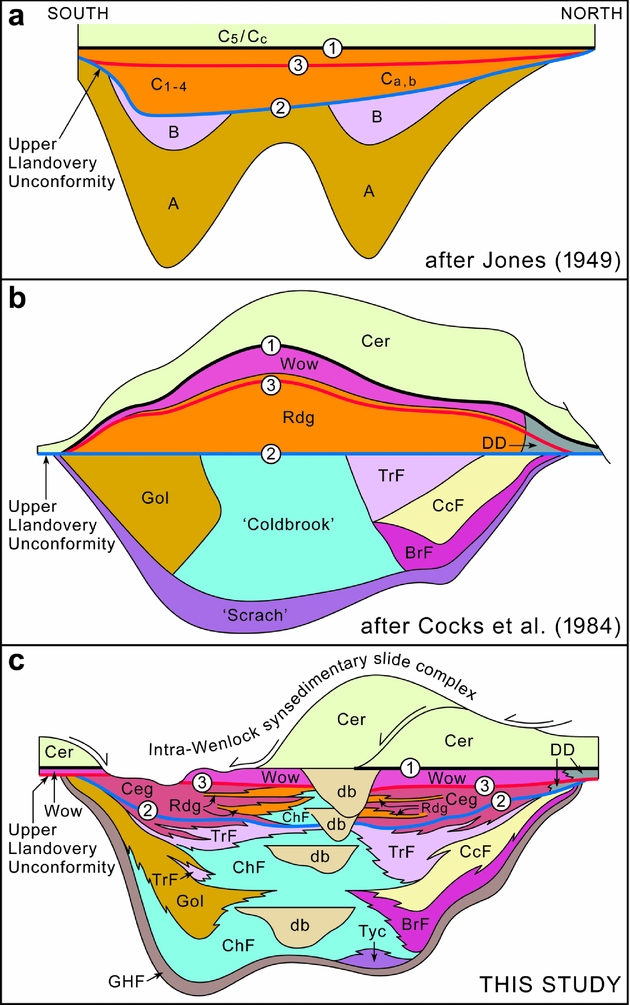
A comparison of former architectural models for the Type Llandovery succession with that presented by this study showing the relative positions of key datums and their relationship to the Upper Llandovery unconformity (and overstep) of early workers; (a) after Jones (Reference Jones1949); (b) after Cocks et al. (Reference Cocks, Woodcock, Rickards, Temple and Lane1984); and (c) this study (simplified from Fig. 3). 1 – top Wormwood Formation datum; 2 – FAD of sedgwickii Biozone graptolites as envisaged by Jones and Cocks et al.; 3 – FAD of sedgwickii Biozone graptolites as shown by this study. N.B. the position of datum 3 in (a) and (b) is indicative only as it lies in the upper part of Jones's C3 division and Cocks et al.'s Rhydings Formation (see text).

Since its first recognition in the Llandovery area, the position and use of the sedgwickii graptolite Biozone has been of particular interest (Fig. 17). Jones (Reference Jones1925, Reference Jones1949) considered the base of his C division (C1 subdivision) to mark the unconformable base of Murchison's Upper Llandovery (Figs 2, 17). Graptolites recovered from the southern Llandovery area suggested to him that the base of this unit was of sedgwickii Biozone age (Jones, Reference Jones1925, p. 383) (Fig. 17, datum 2). Cocks, Toghill & Zeigler (Reference Cocks, Toghill and Ziegler1970) and Cocks et al. (Reference Cocks, Woodcock, Rickards, Temple and Lane1984) failed to challenge this interpretation; it informed the definition of the former Fronian Stage, and continues to inform the published ranges of many key Llandovery Series taxa (e.g. Bassett, Reference Bassett, Holland and Bassett1989; Bassett & Rong, Reference Bassett, Rong, Holland and Bassett2002). The current study shows that the FAD of sedgwickii Biozone graptolite assemblages is much higher in the succession, within the Ydw Member (Fig. 17, datum 3). Paradoxically, however, it is the strongly overstepping base of this latter unit, and its correlatives in the north and south of the type area, that represents the Upper Llandovery unconformity of earlier workers (Fig. 17). The former widespread use of the term C1, notably in the Welsh Borderland (e.g. Zeigler, Cocks & McKerrow, Reference Ziegler, Cocks and McKerrow1968), but also internationally (e.g. Johnson, Rong & Yang, Reference Johnson, Rong and Yang1985), is no longer sustainable in terms of implying a like for like correlation with the Type Llandovery succession. However, where applied solely as a label for the sedgwickii Biozone, the correlation implied by its previous use may remain valid.
The case for retaining an ‘Upper Llandovery Stage’ (sensu Murchison, Reference Murchison1867; Jones, Reference Jones1921, Reference Jones1925), defined by the entry of sedgwickii Biozone graptolites and correlative faunas, has been made by Temple (in Cocks et al. Reference Cocks, Woodcock, Rickards, Temple and Lane1984, p. 164). The improved understanding presented here shows that several key brachiopod taxa (E. hemispherica, S. lens intermedia, S. lens progressa) and acritarch assemblages (microcladum, estillis), previously viewed as correlative proxies for the sedgwickii Biozone in the Llandovery area, are present in strata now known to pre-date both the FAD of sedgwickii Biozone graptolites and the ‘Upper Llandovery’ unconformity of earlier workers. However, the faunal flux recognized within the Wormwood Formation, including first appearances of acritarch species, spore assemblages, alongside brachiopod genera (Eospirifer, Pentlandella) and species of Stricklandia, Eocoelia, Leptostrophia and Leangella, suggests that a mixed assemblage can be defined that allows widespread correlation of the sedgwickii Biozone flooding event, underpinning its credentials as a possible alternative stage boundary.
5.b. Base Silurian System, Llandovery Series and Rhuddanian Stage
In 1985, the Silurian Subcommission formally moved the base of the Silurian System from the base of the persculptus graptolite Biozone to the base of the succeeding Parakidograptus acuminatus Biozone, which, following the work of Melchin, Cooper & Sadler (Reference Melchin, Cooper, Sadler, Gradstein, Ogg and Smith2004), is now referred to as the ascensus–acuminatus Biozone (Zalasiewicz et al. Reference Zalasiewicz, Taylor, Rushton, Loydell, Rickards and Williams2009). In the Llandovery area, this had the effect of removing from the Llandovery units previously included in it by Jones (Reference Jones1925, Reference Jones1949) and Williams (Reference Williams1951). The implications of this change of definition are discussed by Davies et al. (Reference Davies, Waters, Williams, Wilson, Schofield and Zalasiewicz2009) in their re-assessment of these strata. Graptolites of the persculptus and atavus–acinaces biozones have been recorded in the Llandovery area (Appendix 1) and exposures exist which must contain the base of the intervening ascensus–acuminatus Biozone (and hence of the series and system), but its precise location is currently unknown. The system boundary, and by default the Llandovery Series and Rhuddanian Stage boundaries, are defined at Dob's Linn in Scotland (Williams & Ingham, Reference Williams, Ingham, Holland and Bassett1989) and the need for an equivalent section in the Llandovery area, though desirable, is not essential. It should be noted, however, that the system boundary in the Llandovery area does not coincide with a significant sequence stratigraphical event. The linked glacioeustatic and climatic changes that initiated the global cycle of Silurian sedimentation are recorded by changes in sedimentary regime that occurred prior to the FAD of late Hirnantian persculptus Biozone graptolites in Wales (Fig. 7; Davies et al. Reference Davies, Waters, Williams, Wilson, Schofield and Zalasiewicz2009).
5.c. Aeronian stratotype
The biostratigraphical criterion used to define the base of the Aeronian Stage is the same as for the former Idwian Stage (Cocks, Toghill & Zeigler, Reference Cocks1970; Cocks et al. Reference Cocks, Woodcock, Rickards, Temple and Lane1984), i.e. the base of the gregarius graptolite Biozone (= base triangulatus Biozone). Cocks, Toghill & Zeigler (Reference Cocks1970) defined the base of the Idwian in the south of the type area at the unconformable A/B contact of Jones (Reference Jones1925). However, to meet the requirements for modern GSSPs, Cocks et al. (Reference Cocks, Woodcock, Rickards, Temple and Lane1984) located the base of the new Aeronian GSSP in the north, within fossiliferous sandstones that they included in the Trefawr Formation, but which Davies et al. (Reference Davies, Molyneux, Vandenbroucke, Verniers, Waters, Williams, Zalasiewicz and Ray2011) recognized as an early unit of the Cefngarreg Sandstone Formation (Ceg 0) (Figs 4C, 8, 18a). Temple (Reference Temple1988) has commented on the concepts and the inadequacy of the fossil data used to define the base of the triangulatus Biozone at the stratotype. Its location, at the base of Cocks et al.'s (Reference Cocks, Woodcock, Rickards, Temple and Lane1984) locality 72 in the Trefawr track section [11d], rests on the recovery of a single specimen of Monograptus austerus sequens from this horizon. The highest definitive revolutus graptolite Biozone assemblage, with M. austerus vulgaris, occurred over 18 m stratigraphically lower in the section [11c] (Fig. 4C). The conceptual issues raised by Temple are addressed by Holland & Bassett (Reference Holland and Bassett1988), and no additional macrofaunal data have been obtained as part of the current study. However, Zalasiewicz et al. (Reference Zalasiewicz, Taylor, Rushton, Loydell, Rickards and Williams2009) now restrict the range of M. austerus sequens to the middle part of the triangulatus Biozone, indicating that the Aeronian GSSP lies within, rather than at the base, of that biozone. An assessment of the other faunas from the section (micro and macro) fails to show a significant turnover across the stratotype boundary.
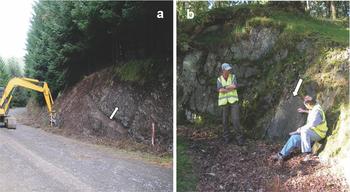
GSSPs in the Llandovery area: (a) Current Aeronian GSSP (arrowed; perpendicular to bedding) [SN 8382 3955], Cefngarreg Sandstone Formation (Ceg 0) (formerly Trefawr Formation; see text), Trefawr track section, Crychan Forest; (b) current Telychian GSSP (arrowed; parallel to bedding) [SN 7742 3233], Wormwood Formation, Cefn Cerig quarry (strata young towards left).

The current work allows the relative positions of the former Idwian and current Aeronian stage boundaries to be compared accurately (Fig. 2) and shows that the former lies at a lower level in the stratigraphy marked by the FAD of revolutus Biozone graptolites in the Llandovery area.
5.d. Telychian stratotype
The original Telychian stratotype of Cocks, Toghill & Zeigler (Reference Cocks, Toghill and Ziegler1970) was located in roadside exposures north of Cefn Cerig (Cerrig) farm at the base of Jones's (Reference Jones1925) C4 division [c. 6g]. In an effort to realign the stage definition with what were perceived as more internationally applicable biostratigraphical criteria, Cocks et al. (Reference Cocks, Woodcock, Rickards, Temple and Lane1984) relocated the basal Telychian GSSP to Cefn Cerig quarry in the upper part of the Wormwood Formation where it underlay their roadside type section for the succeeding Cerig Formation (Figs 4D, 8, 18b). Temple (Reference Temple1988) again identified conceptual problems with the stratotype definition: it is located above the LADs of two key brachiopod taxa [6j], but, as this study confirms, no FADs can be shown to coincide with the GSSP. That the current GSSP broadly equates with the base of the turriculatus s.l. Biozone was also questioned (see Johnson, Kaljo & Rong, Reference Johnson, Kaljo, Rong, Bassett, Lane and Edwards1991; Melchin, Cooper & Sadler, Reference Melchin, Cooper, Sadler, Gradstein, Ogg and Smith2004) and this study confirms that the Llandovery area FAD of guerichi (lower turriculatus s.l.) Biozone graptolites is at a higher level.
However, previous studies failed to recognize that this type section for the Cerig Formation displays the effects of dislocation associated with the emplacement of a major (tens of kilometres in width) intra-Wenlock synsedimentary slide complex (Figs 3, 8) (Davies et al. Reference Davies, Waters, Zalasiewicz, Molyneux, Vandenbroucke and Williams2010, Reference Davies, Molyneux, Vandenbroucke, Verniers, Waters, Williams, Zalasiewicz and Ray2011). The basal slide surface lies about 25 m stratigraphically above the GSSP, but overlying it is a dated slice of mid Wenlock strata [6m] (Fig. 4D). This intervenes between the stage boundary and the locality from which Cocks et al. (Reference Cocks, Woodcock, Rickards, Temple and Lane1984) obtained their lowest ‘Telychian’ fauna [6n]. Reported as being from the Cerig Formation, this assemblage is now known to come from a raft within a sedimentary mélange and to be associated with material that contains Wenlock chitinozoans. The provenance of the key brachiopods (S. laevis and a primitive E. curtisi) present at this locality cannot now be proven, but the sandstone raft they came from is indistinguishable lithologically from underlying Wormwood Formation facies in which S. laevis is known to be present [e.g. 6l]. These discoveries re-ignite the debate about the choice of the current Telychian GSSP and the criteria used in its selection (Temple, Reference Temple1988) and make the case for an alternative that can be defined using more robust biostratigraphical data and in the choice of which chemostratigraphical techniques may also have a role to play (e.g. Cramer et al. Reference Cramer, Loydell, Samtleben, Munnecke, Kaljo, Männik, Martma, Jeppsson, Kleffner, Barrick, Johnson, Emsbo, Joachimski, Bickert and Saltzman2010). The revised interpretation of the section also indicates that only thin, slide-bound and disturbed slices of true Cerig Formation are present in what is a clearly inappropriate type section (see Section 3.a).
5.e. Base Wenlock Series in the Type Llandovery area
Jones (Reference Jones1925, Reference Jones1949) and Williams (Reference Williams1953) recognized the base of the Wenlock Series in the Llandovery area as one of their unconformities. Jones (Reference Jones1925) commented on the absence of early Wenlock graptolites from the lower levels of his Wenlock Series succession, but noted the presence of the mid Wenlock taxon ‘Monograptus dubius’. In contrast, Cocks et al. (Reference Cocks, Woodcock, Rickards, Temple and Lane1984) cited ‘Monoclimacis vomerina basilica’ from a locality close to the base of their Gwernfelen Formation as an indicator of the basal Wenlock centrifugus Biozone. Exhaustive collecting has failed to confirm the presence of early Wenlock taxa and favours a radically new interpretation of the basal Builth Mudstones Formation contact and adjacent stratigraphy. New dates and detailed section logging demonstrate the presence of a major synsedimentary slide complex that severely disrupted and locally removed much of the Telychian and early–mid Wenlock parts of the succession (Davies et al. Reference Davies, Waters, Zalasiewicz, Molyneux, Vandenbroucke and Williams2010, Reference Davies, Molyneux, Vandenbroucke, Verniers, Waters, Williams, Zalasiewicz and Ray2011). Graptolites of the riccartonensis Biozone have been obtained from rafts of Builth Mudstone Formation within this slide-disturbed succession [5e, 6m]. The undisturbed Wenlock laminites that drape the upper surface of this slide-affected zone consistently yield dubius Biozone graptolites (sensu Zalasiewicz & Williams Reference Zalasiewicz and Williams1999; Fig. 14), such as to the southwest of Coed Shon [1d] and several localities to the north [e.g. 6o] (Fig. 4D). The products of a subsequent, late Wenlock phase of slumping and sliding succeed and locally truncate this drape succession (Fig. 3). Details of the nature and significance of these discoveries will be presented elsewhere.
6. Stratigraphical synthesis
A number of key stratigraphical conclusions emerge from this new architectural analysis of the Type Llandovery succession (Fig. 19):
Stratigraphical synthesis of the Type Llandovery succession focusing on the late Hirnantian to Aeronian; see Figure 2 for key lithostratigraphical symbols and Appendix 1 for biostratigraphical data and sources. Relative position of Derwyddon Formation (DD) in central column is shown schematically; FADs and LADs of key brachiopod taxa based largely on Williams (Reference Williams1951), Cocks et al. (Reference Cocks, Woodcock, Rickards, Temple and Lane1984) and Temple (Reference Temple1987); dashed tie lines denote uncertainty. N.B. FADs of biozonal assemblages shown as coincident with a flooding surface should be taken to imply that diagnostic taxa have been recovered from strata closely overlying this level and that taxa confined to the preceding biozone have not been found above it; in the generalized context of this figure the coincidence of such tie lines should be viewed as approximate. A – Icriodella discreta–I. deflecta Assemblage Biozone conodonts; B – FAD avitus–dilatus Biozone spores. Notes: 1 – see Davies et al. (Reference Davies, Waters, Williams, Wilson, Schofield and Zalasiewicz2009); 2 – level equivalent to FAD of persculptus Biozone graptolites in Wales; 3 – see Section 4.e; 4 – position significantly revised relative to Cocks et al. (Reference Cocks, Woodcock, Rickards, Temple and Lane1984); 5 – referred to the genus Hyattidina? by Temple (Reference Temple1987); 6 – Cr. incipiens is recognized as an early form of Cr. crassa in the Haverfordwest area (Temple, Reference Temple1987); 7 – ‘more primitive’ morph (Zeigler, Reference Ziegler1966); 8 – E. curtisi is present in slide-affected strata and a form transitional with E. sulcata is reported from the top of the Cerig Formation in the south Llandovery area (see Section 4.b); 9 – used informally in the Llandovery area; acuminatus Biozone – ascensus–accuminatus Biozone of Zalasiewicz et al. (Reference Zalasiewicz, Taylor, Rushton, Loydell, Rickards and Williams2009).

(1) Key sedimentary and faunal changes that signalled the end of the Late Ordovician glacial maximum and the onset of the Llandovery sedimentary regime in its type area were initiated prior to the FAD of persculptus Biozone graptolites in Wales.
(2) Upper Hirnantian to Aeronian strata comprise a series of prograde sequences separated by flooding surfaces and correlative unconformities. Each prograde was likely a far field response to South Polar glacial advance and global lowering of sea level.
(3) Late Hirnantian, Rhuddanian and Aeronian sequences can be grouped into three composite (or higher order) sequences which reached their progradational acme during the acinaces, lower convolutus and upper sedgwickii–halli graptolite biozones. Significant lower order progradations also occurred during the revolutus, triangulatus and both the middle and upper convolutus biozones. Two late Hirnantian sequences record the impact of the initial global rises in sea level that followed the Late Ordovician glacial maximum.
(4) Following a post-glacial maximum persculptus Biozone highstand, the succession of Llandovery flooding surfaces record glacioeustatic transgressions that peaked during the revolutus, middle convolutus and lower sedgwickii biozones; significant secondary events are linked to FADs of revolutus and upper convolutus graptolite biozonal assemblages.
(5) Significant deepening at the base of the Cerig Formation coincides with the FAD of guerichi Biozone graptolites, but in this case the impact of any eustatic sea level rise was possibly enhanced or overridden by the growing influence in Wales of Telychian tectonism.
(6) The main Crychan–Goleugoed progradation, widely cited as providing evidence of increased sediment input to the Welsh Basin during the revolutus Biozone highstand, reached its acme during the acinaces Biozone; the Crychan–Goleugoed system underwent a marked and consistent contraction during the subsequent revolutus Biozone deepening.
(7) Transitions within the Stricklandia lens and newly plotted Meifodia prima and Plectatrypa tripartita brachiopod lineages can be calibrated with the FADs of graptolite assemblages and used for local correlation, as can the FADs of species of Clorinda, Cryptothyrella, Leangella and Leptostrophia, and the generic transition from Borealis to Pentamerus.
(8) Cross-correlation of macro- and microfossil biozonal schemes reveals that important faunal turnovers can be linked to major flooding events, notably during the persculptus–acuminatus biozones, coinciding with the FAD of revolutus Biozone graptolites, and in the middle and upper convolutus Biozone. Significant faunal changes also occurred during the sedgwickii Biozone interval, and new microflora entered alongside guerichi Biozone graptolites. However, neither of the two stage GSSPs defined in the Type Llandovery area appear to coincide with faunal events currently viewed as key for international correlation.
(9) The FAD of lower sedgwickii Biozone assemblages is revised upwards to the base of a revised Wormwood Formation (Ydw Member); much of the strata equivalent to units C1–3 of Jones (Reference Jones1925) are now recognized as convolutus Biozone in age.
(10) Though confirmed as a sedgwickii Biozone event, it is the marked overstep observed at the base of the Wormwood Formation and correlative parts of the Derwyddon Formation (DD II) that represents the ‘Upper Llandovery’ unconformity of earlier workers (Fig. 17).
(11) Key elements of the Eocoelia and Stricklandia brachiopod lineages are all present in the Wormwood Formation. E. hemispherica and S. lens progressa are also present in strata below the Wormwood Formation and pre-date the Ydw Member FAD of sedgwickii Biozone graptolites; E. intermedia and the genus Eospirifer both have FADs within the Ydw Member and S. laevis and the genus Pentlandella also enter in the formation. The FADs of all these taxa pre-date the Cerig Formation FAD of guerichi Biozone graptolites.
(12) No post-guerichi Biozone Llandovery graptolites have been recovered from the type area. Younger Llandovery and basal Wenlock assemblages are present in the nearby Garth area. The earliest Wenlock graptolites in the Llandovery area, of riccartonensis Biozone age, were obtained from slide-disturbed strata. The overlying drape succession yields dubius Biozone graptolites.
(13) New and re-evaluated acritarch data show that the fisherii Biozone is pre-revolutus Biozone in age; the eoplanktonica Biozone is in part Rhuddanian; and that the microcladum Biozone entirely and the estillis Biozone partly pre-date the FAD of sedgwickii Biozone graptolites. Acritarch FADs above the earliest Cefngarreg Sandstone prograde (Ceg 0) and overlying the base of the Wormwood Formation may provide the basis for the division of the eoplanktonica and estillis biozones, respectively. Gracilisphaeridium encantador Biozone acritarchs, recorded for the first time in the Llandovery area, enter with guerichi Biozone graptolites at the base of the Cerig Formation.
(14) Hirnantian chitinozoans suggestive of the taugourdeaui Biozone are present in the Garth House Formation. The early Llandovery fragilis and postrobusta biozones have not been proven, but assemblages of the succeeding electa, maennilli and dolioliformis biozones are recognized and the local FADs of precursor species, notably E. cf. dolioliformis, allow further refinement. Critically, Wenlock margaritana Biozone assemblages have been obtained from strata previously believed to be Telychian in age.
(15) Recognition of a series of major mid Wenlock, slide-related deformation features and of significant stratal loss affecting the post-Wormwood Formation succession precludes accurate interpretation of this portion of the Type Llandovery stratigraphy and undermines the relevance of the macro- and microfaunal criteria cited by Cocks et al. (Reference Cocks, Woodcock, Rickards, Temple and Lane1984) as critical in the definition and selection of the Telychian Stage GSSP.
7. Conclusions
These findings have potentially far reaching bio- and chronostratigraphical implications. On the one hand they demonstrate significant shortcomings with both the Aeronian and Telychian GSSPs and the criteria cited at the time of their selection as critical for international correlation. The uncritical use of key biostratigraphical markers within the Stricklandia and Eocoelia brachiopod lineages is also questioned. The ranges of published acritarch biozone assemblages are thoroughly revised and erection of the monospinosa acritarch Biozone within the Cerig Formation by Hill & Dorning (Reference Hill, Dorning, Cocks, Woodcock, Rickards, Temple and Lane1984) is shown to be untenable. Stratal loss is also shown to be far more widespread than previously envisaged in both the proximal (non-sequences) and distal (slumping) portions of the sedimentary system. Moreover, widespread disturbance of upper parts of the Llandovery succession took place during emplacement of a regional-scale intra-Wenlock slide complex.
On the other hand, the new data and synthesis reinforce the Llandovery area as one of the best studied early Silurian successions in the world. The establishment of a eustatically driven Rhuddanian–Aeronian sequence stratigraphy, calibrated against a much more robust graptolite dataset, provides the basis for a global scheme defined at both composite (higher) and lower order sequence levels. In addition to the qualified use of Stricklandia and Eocoelia as tools for correlation, lineages of the brachiopods Meifodia, Plectatrypa and other genera are shown to have local potential. The faunal changes that occurred in the wake of the Late Ordovician glacial maximum, and the marked micro- and macrofaunal renewals associated with the FADs of the revolutus, middle and upper convolutus, lower sedgwickii and guerichi graptolite biozone assemblages all offer potential for international testing to support any future revision of the stage boundaries and their defining criteria; and a newly applied chitinozoan biozonation is now available to aid this process (Fig. 19).
It is not for this paper unilaterally to abandon the current stage GSSPs in the Llandovery area or to propose alternative sites and defining criteria. However, candidate sections exist locally that would continue broadly to reflect the concepts approved of in the selection of the current sites, as well as the historical importance and improved understanding of the succession, to which this study contributes. Repositioning of the Aeronian GSSP to a level nearer the FAD of triangulatus Biozone graptolites in the Trefawr track may be practicable. The base of the Telychian Stage should continue to reflect the faunal flux associated with the Wormwood Formation. The FADs of lower sedgwickii Biozone graptolites and of genera/species of brachiopods and acritarchs in the Ydw Member, or one of the other key faunal and/or floral events within the Wormwood Formation (Fig. 19), are obvious levels to consider. The level close to the base of the Cerig Formation in the Derwyddon area at which guerichi Biozone graptolites and encantador Biozone acritarchs first appear also has merit.
Moreover, the deficiencies of the Llandovery type area are compensated for when it is viewed in a regional context (Fig. 1). The adjacent, richly graptolitic Welsh Basin succession allows the recognition of all the standard Llandovery graptolite biozones and, notably in the Wye valley near Rhayader, includes the type localities for many (e.g. Lapworth, Reference Lapworth1900; Wood, Reference Wood1906; Loydell, Reference Loydell1991, Reference Loydell1992; Zalasiewicz, Reference Zalasiewicz1994, Reference Zalasiewicz1996; Zalasiewicz & Tunnicliff, Reference Zalasiewicz and Tunnicliff1994; Davies et al. Reference Davies, Fletcher, Waters, Wilson, Woodhall and Zalasiewicz1997; Zalasiewicz et al. Reference Zalasiewicz, Taylor, Rushton, Loydell, Rickards and Williams2009). Jones (Reference Jones1909) worked on the famous Rheidol Gorge succession prior to his study of the Llandovery area and subsequent examination has updated his sequence of Rhuddanian and Aeronian graptolite biozones (Sudbury, Reference Sudbury1958; Cave & Hains, Reference Cave and Hains1986). There, the triangulatus Biozone has been recognized in a fully exposed, continuously graptolitic section (Cullum & Loydell, Reference Cullum and Loydell2011). Recent work on the basin centre succession has allowed subdivision of the turriculatus s.l., crispus and griestoniensis biozones (e.g. Zalasiewicz, Reference Zalasiewicz1990; Loydell, Reference Loydell1992); and a detailed latest Llandovery and earliest Wenlock graptolite biozonation has been established in the Afon (River) Banwy in the east of the basin (Loydell & Cave, Reference Loydell and Cave1996). It seems entirely appropriate for the Type Llandovery concept to be broadened to encompass these adjacent stratigraphies and, potentially, for its stage stratotypes to be redefined and relocated in these strata.
Acknowledgements
Discussions with Rob Hillier (National Museum of Wales) with regard to facies models and the valued input of David Schofield and David Wilson, both of BGS, during the field investigations and drafting of this paper are gratefully acknowledged. Several of the classic sections, now Geological Conservation Review (GCR) sites, in the Type Llandovery area were specially cleared in 2009 by the Countryside Council for Wales (CCW). Sid Howells and Gareth Owen of CCW and the staff of the Forestry Commission Llandovery Office are thanked for their hard work in the clearing operations. Local landowners are warmly thanked for allowing repeated access to sections on their land and Mr Marcus Lampard of Mandinam, Llangadog for extending a key section on his property. This paper has benefited from reviews by Howard Armstrong, Mike Melchin, Phil Stone and Nigel Woodcock. The superb drafting skills of Antony Smith and Ian Gully of Aberystwyth University are also gratefully acknowledged. This research was supported by the BGS University Funding Initiative (BUFI) Contract No. P093; T. Vandenbroucke also thanks FWO-Flanders and the CNRS (France) for funding support. J. R. Davies and S. G. Molyneux publish with permission of the Executive Director of BGS. This work is a contribution to IGCP 591.
Appendix 1. Key fossil localities and assemblages in the Type Llandovery area
A1–A3 provide details of the key fossil assemblages that underpin the revised sedimentary and biostratigraphical architecture erected for the Type Llandovery succession, and their significance. Traverse line and locality numbers [including those cited in the main text in square brackets] refer to Figures 1 and 11. Localities on each traverse are arranged and numbered in stratigraphical order, oldest to youngest. Localities between traverses have been projected onto the nearest column. All UK National Grid References (NGRs) lie within 100 km square SN; some NGRs provided by Cocks et al. (Reference Cocks, Woodcock, Rickards, Temple and Lane1984), Temple (Reference Temple1987) and other authors have been amended where there are clear inaccuracies (e.g. plots off exposure) and these are shown in italics. Six figure NGRs are used for localities cited in older sources where the exact position is uncertain. See Figures 2 and 3 for key to lithostratigraphical symbols. Fossil genera have been updated wherever possible and only where species names have also changed is there additional comment; graptolite nomenclature follows Zalasiewicz et al. (Reference Zalasiewicz, Taylor, Rushton, Loydell, Rickards and Williams2009); brachiopod nomenclature largely follows Temple (Reference Temple1987). MPA numbers given for acritarch samples refer to the BGS micropalaeontology database; reference numbers for chitinozoan samples refer to University of Ghent databases. Symbols (*,**,+) refer to information in comments column. See main text for discussion of the various macro- and microfossil biozonal schemes applied. Notes: The membranifera–Pseudodyadospora sp. B spore Sub-biozone (usage of Burgess, Reference Burgess1991) is abbreviated to membranifera; Temple (Reference Temple1987) refers Cryptothyrella angustifrons to the genus Hyattidina?; Plectatrypa tripartita subsp. nov is of Temple (Reference Temple1987); the long ranging graptolite Raphidograptus toernquisti has been omitted from the list of taxa for localities 4h, 6c, 11d and 11g for brevity.
Details for key Llandovery area fossil localities [1a] to [6d].

Details for key Llandovery area fossil localities [6e] to [10b].

Details for key Llandovery area fossil localities [10c] to [15c].

Key to sources cited in Figures A1–A3: TS – this study; 1 – Williams (Reference Williams1953); 2 – Zeigler (1966); 3 – Williams (Reference Williams1951); 4 – Jones (Reference Jones1925); 5 – Jones & Williams (Reference Jones and Williams1949); 6 – Cocks (Reference Cocks, Bassett and Bassett1971); 7 – Cocks et al. (Reference Cocks, Woodcock, Rickards, Temple and Lane1984, including appendix by Hill & Dorning, Reference Hill, Dorning, Cocks, Woodcock, Rickards, Temple and Lane1984); 8 – Temple (Reference Temple1987); 9 – Zalasiewicz et al. (Reference Zalasiewicz, Taylor, Rushton, Loydell, Rickards and Williams2009); 10 – Davies et al. (Reference Davies, Waters, Zalasiewicz, Molyneux, Vandenbroucke and Williams2010); 11 – Davies et al. (Reference Davies, Waters, Williams, Wilson, Schofield and Zalasiewicz2009); 12 – Hurst, Hancock & McKerrow (1978); 13 – Jones (Reference Jones1949); 14 – Cocks (Reference Cocks1978); 15 – Molyneux (Reference Molyneux2003); 16 – De Permentier & Verniers (Reference De Permentier and Verniers2002); 17 – Zalasiewicz & Williams (Reference Zalasiewicz and Williams1999); 18 – Jones (Reference Jones1928); 19 – Cocks (Reference Cocks1970); 20 – BGS collections; 21 – T. J. Challands, unpub. Ph.D. thesis, Univ. Durham, 2008; 22 – Davies et al. (Reference Davies, Fletcher, Waters, Wilson, Woodhall and Zalasiewicz1997); 23 – Burgess (Reference Burgess1991).