Background
Globally, urinary tract infections (UTIs) cause substantial morbidity. In 2019, they accounted for nearly 405 million cases, and over 235,000 deaths, based on inpatient, outpatient (claims data), and vital registry data.Reference Yang, Chen, Zheng, Qu, Wang and Yi1 Diagnosis of uncomplicated cystitis or pyelonephritis generally relies upon assessing patients for evidence-based symptoms of UTI.Reference Gupta, Hooton and Naber2,Reference Garcia and Spitzer3 However, providers often conflate a positive urine culture with a UTI diagnosis.Reference Flokas, Andreatos, Alevizakos, Kalbasi, Onur and Mylonakis4,Reference Valentine-King, Van and Hines-Munson5 The Infectious Diseases Society of America (IDSA) guidelines do not support treatment of asymptomatic bacteriuria (ASB) outside of pregnancy and patients undergoing urologic surgery, as treatment does not improve outcomes and increases the risk of Clostridioides difficile infection, antibiotic resistance, and even symptomatic UTI.Reference Nicolle, Gupta and Bradley6
Despite multiple evidence-based guidelines that recommend against culturing the urine to screen and treat ASB,Reference Nicolle, Gupta and Bradley6–Reference Owens, Davidson and Krist8 inappropriate treatment of ASB is common.Reference Flokas, Andreatos, Alevizakos, Kalbasi, Onur and Mylonakis4 A meta-analysis of 30 studies reported a large proportion of patients with ASB received unnecessary antibiotics (pooled prevalence: 45% (95% CI: 39–50%).Reference Flokas, Andreatos, Alevizakos, Kalbasi, Onur and Mylonakis4 This overtreatment may fuel antibiotic resistance and lead to adverse patient outcomes, longer inpatient stays, and increased financial burden.Reference Garcia and Spitzer3,Reference Valentine-King, Van and Hines-Munson5 Certain findings in positive urine cultures have also been associated with inappropriate antibiotic prescribing, including isolation of an antibiotic-resistant organism, or a gram-negative organism, especially at a high concentration (≥105 CFU/mL).Reference Flokas, Andreatos, Alevizakos, Kalbasi, Onur and Mylonakis4,Reference Drekonja, Grigoryan and Lichtenberger9,Reference Petty, Vaughn and Flanders10 Thus, targeted interventions to reduce inappropriate urine culturing can remove potential triggers of inappropriate antibiotic prescribing for ASB.
Studies have examined the appropriateness of urine culture ordering in inpatient, emergency department (ED), and long-term care settings, and found a sizable proportion of urine cultures were ordered inappropriately and often among patients with nonspecific symptoms.Reference Hartley, Valley and Kuhn11–Reference Sloane, Kistler, Reed, Weber, Ward and Zimmerman16 For example, Hartley and colleagues found ∼46% of non-catheterized adults hospitalized in Michigan between 2008 and 2009 had an inappropriately ordered culture and the most common indications were a change in urine character, altered mental status, and leukocytosis.Reference Hartley, Valley and Kuhn11 Another group that evaluated catheterized and non-catheterized inpatients in New York City, NY, and Toronto, Canada, found 68% of 112 audited cultures lacked a qualifying clinical indication.Reference Leis, Gold, Daneman, Shojania and McGeer13 The most common indications were confusion (23%), unexplained leukocytosis (21%), history of UTI (11%), abnormal urine characteristics (9%), urinary retention (8%), and weakness or dizziness (7%).Reference Leis, Gold, Daneman, Shojania and McGeer13 A study that evaluated the appropriateness of 496 urine cultures collected from a largely male (97%), Veteran inpatient population in found 344 (69%) were inappropriately ordered, and 218 (63%) cultures stemmed from patients with non-specific clinical manifestations.Reference Drekonja, Gnadt, Kuskowski and Johnson14 A study conducted in the ED found nearly 80% of patients on admission had a urinalysis performed without clinical indication (UTI symptoms or acute kidney injury), and 118 (∼60%) of those patients had a urine culture ordered.Reference Yin, Kiss and Leis15 Lastly, a study conducted across 31 nursing homes in North Carolina found that 74% of 254 urine cultures were from residents that lacked any specific UTI signs or symptoms.Reference Sloane, Kistler, Reed, Weber, Ward and Zimmerman16
However, the appropriateness of urine culture ordering in primary care, where UTIs are commonly encountered, has not been well-described. Outpatient primary care represents a significant proportion of potential ASB or UTI cases, as more U.S. patients are estimated to be treated for a UTI in an office setting (3.6 million) compared to an ED (2.4 million) or inpatient setting (508,000).Reference Santo17–Reference McDermott19 Further, little is known about factors that may spur providers to improperly order a urine culture in primary care. Uncovering clinical diagnoses or patient factors associated with inappropriate cultures can provide insight to build stewardship interventions or to better understand workflows that may unknowingly promote inappropriate culturing. Therefore, we identified the prevalence of and risk factors associated with inappropriate urine culture ordering in a primary care setting.
Methods
Study design and population
We conducted a cross-sectional analysis among adults with urine cultures ordered at two primary care, safety-net clinics located in Houston, TX, between November 2018 and March 2020.Reference Hansen, Valentine-King and Zoorob20,Reference Valentine-King, Hansen and Zoorob21 Both clinics provide continuity of care services and offer access to care at little or no cost. Although both clinics are affiliated with an academic medical center, one clinic serves as a teaching clinic (Clinic A), with resident and attending physicians, while the other (Clinic B) is a non-teaching clinic with practicing attendings only. We excluded patients who had a urinary catheter and pregnant females, as U.S. guidelines recommend screening for and treating ASB among this latter population.Reference Nicolle, Gupta and Bradley6
We extracted the following data from the electronic medical record on a standardized form: patient demographics, visit-specific International Classification of Diseases 10th edition diagnoses, documented symptoms from the physician notes, medical history, and urine culture results from the day of the visit. The research coordinator extracting data received training on the definitions within the form and consulted two medical doctors if questions arose.Reference Hansen, Valentine-King and Zoorob20
Outcome measures
Our primary outcome measure, urine culture inappropriateness, was defined as a urine culture ordered for a patient that lacked documentation of any of the following: dysuria, frequency, urgency, hematuria, fever, costovertebral angle tenderness, chills, flank, suprapubic or pelvic pain,Reference Kolman22 or a coded diagnosis of cystitis or pyelonephritis. When patients had a diagnosis of nephrolithiasis, we conservatively considered these patients as having an appropriate indication, as the American Urological Association guidelines endorse ordering a urine culture if patients with nephrolithiasis have a urinalysis suggestive of UTI or history of recurrent UTI.Reference Pearle, Goldfarb and Assimos23
We examined all other diagnostic codes listed for patients and classified them into the following categories: back pain (excluding upper, thoracic, and midline back pain, chronic pain or sciatica), abnormal urinalysis (proteinuria, glycosuria, other abnormal findings (ICD10-R80-R82.x)) or urine characteristics (abnormal urine color, odor, cloudy or foamy urine, bacteriuria, pyuria), cardiovascular codes (hypertension, hyperlipidemia, chest pain, rhythm abnormality), endocrine-related codes (excluding diabetes), diabetes mellitus, lower abdominal pain, genitourinary tract cancer, incontinence, routine health codes (e.g., preventative care, annual physical), respiratory codes, renal impairment, recurrent UTI, sexually transmitted infection (STI), voiding issues, and gynecological/family planning-related visit.
Statistical analysis
We used descriptive statistics to characterize demographics, health characteristics, and visit-related diagnostic code categories and used generalized estimating equations (GEE) logistic regression to evaluate univariate relationships and create a multivariate model between these exposures and inappropriately ordered urine cultures. Variables with a P-value <0.2 from the univariate analysis entered the initial regression model. We carried out a backward, stepwise regression until only variables with a P-value <0.1 remained in the model.
We screened for confounding by evaluating if there was a significant (P-value <0.05) relationship between inherently immutable variables (e.g., age, race, sex) associated with the outcome and with other predictors found significant in the univariate analysis. We further tested for confounding by evaluating if there was a ≥ 10% change in the adjusted odds ratio (aOR) of the variable under study when the potential confounder was added to a GEE model.Reference Szklo and Nieto24 Multicollinearity was examined between categorical predictors by evaluating Cramer’s V. If Cramer’s V was indicative of a strong association (> 0.3), we further evaluated variable inclusion. As clinic type (teaching vs non-teaching) appeared to influence the relationship between certain diagnostic code groupings and the outcome, we assessed interaction on multiplicative and additive scales.Reference Knol, VanderWeele, Groenwold, Klungel, Rovers and Grobbee25,Reference Knol and VanderWeele26 Multiplicative interaction terms were extracted from GEE models and additive interaction was assessed by using the relative excess risk due to interaction (RERI) formula.Reference Knol, VanderWeele, Groenwold, Klungel, Rovers and Grobbee25–Reference TJ and Knol27 All statistical analyses were performed in RStudio; for regression modelling, we used the “geeglm” function with a logit link in the “geepack” package with an exchangeable correlational structure.Reference Højsgaard, Halekoh and Yan28
Results
Study population demographics and health characteristics
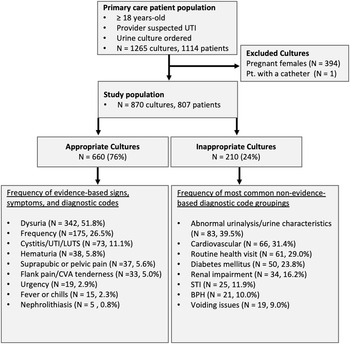
From 1265 cultures that originated from 1114 patients, 870 cultures from 807 patients met inclusion criteria (Figure 1). Two hundred and ten (24%, 95% CI: 21.4–27.1%) of 870 patient visits had an inappropriately ordered urine culture. Figure 1 displays the most common evidence-based symptoms among patients with appropriately ordered cultures; dysuria (N = 342, 51.8%) and frequency (N = 175, 26.5%) were the most common symptoms. The most frequent non-evidence-based code groupings among those with inappropriately ordered cultures included having an abnormal urinalysis or urine characteristic (N = 83, 39.5%), a cardiovascular-related visit (N = 66, 31.4%), or a routine health visit (N = 61, 29.0%).
Flow chart of patients with visits meeting inclusion criteria, prevalence of culture appropriateness and most common diagnostic code groupings and symptoms among each sub-group. UTI – Urinary tract infection, Pt – patient, LUTS – lower urinary tract symptoms, CVA – costovertebral angle tenderness, STI – sexually transmitted infection, BPH – benign prostatic hypertrophy.

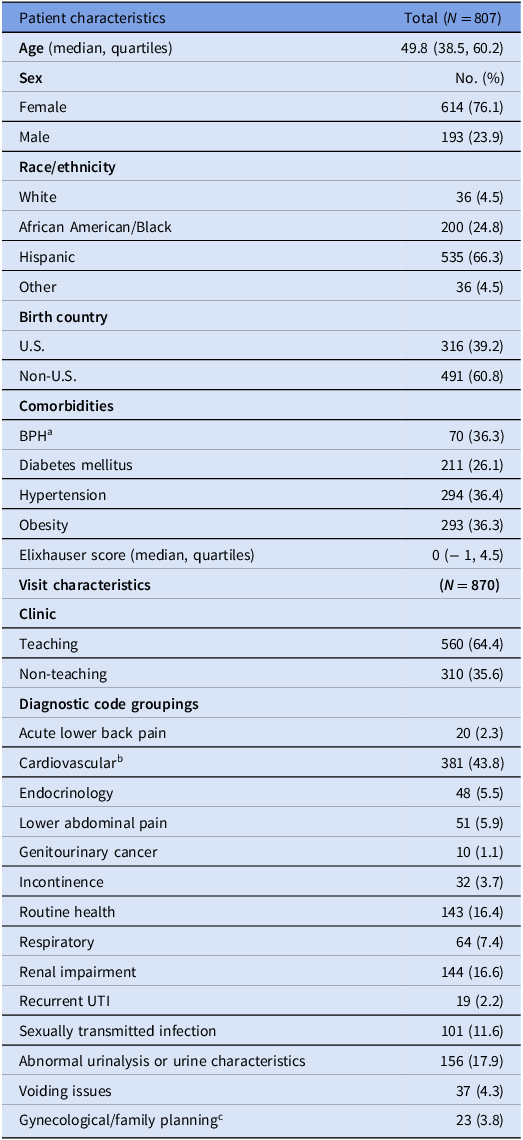
Among the 807 patients with 870 cultures evaluated, the median patient age was ~50 years and the majority were females (76.1%) of Hispanic (66.3%) or African American/Black (24.8%) race or ethnicity and were born outside of the U.S. (60.8%) (Table 1). The sample population had a similar average age (49.2 vs 50.7 years) when compared to a weighted analysis of patient demographics from both clinics between 2018–2020, but a higher representation of females (76.1% vs 63.0%) and Hispanic patients (66.3% vs 56.2%) (data not shown). The most common comorbidities included hypertension (36.4%), obesity (36.3%), and benign prostatic hypertrophy among men (36.3%). Approximately two-thirds of patients were seen at the teaching clinic (64.4%).
Patient characteristics and frequency of diagnostic code groupings by visit
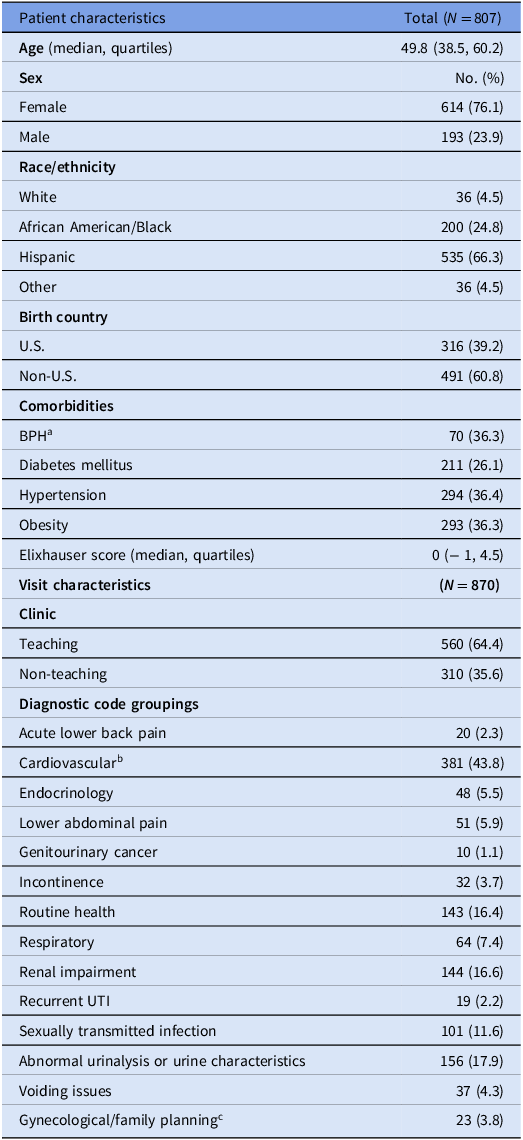
a Denominator used for calculating BPH prevalence is limited to men.
b Cardiovascular visit-groupings includes patients with hypertension as a comorbidity.
c Denominator used for calculating gynecological/family planning code prevalence is limited to women.
Prevalence and predictors of urine culture appropriateness
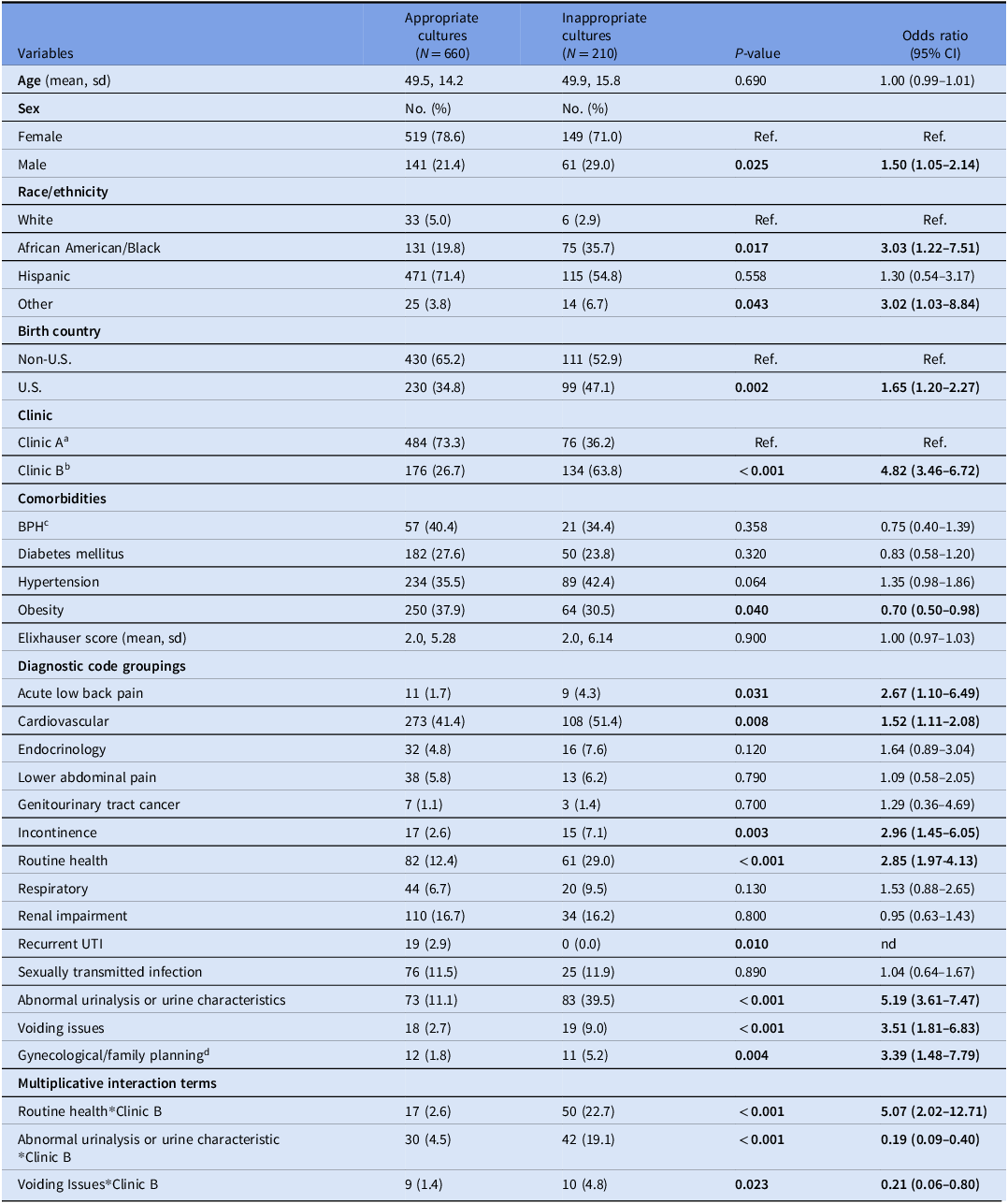
In the univariate analysis, patients that were male (OR: 1.50), of African American/Black race (OR: 3.03), born in the U.S. (OR: 1.65), or seen at the non-teaching clinic (OR: 4.82), were significantly more likely to have an inappropriately ordered urine culture, while obese patients were significantly less likely to have an inappropriately ordered culture (OR: 0.70) (Table 2). Patient visits with diagnostic code groupings pertaining to lower back pain (OR: 2.67), a cardiovascular diagnosis (OR: 1.52), urinary incontinence (OR: 2.96), a routine health visit (OR: 2.85), an abnormal urinalysis finding or urine characteristic (OR: 5.19), voiding issue (OR: 3.51), or a gynecological/well-woman visit (OR: 3.39) were associated with having a urine culture lacking an evidence-based indication (Table 2).
Descriptive statistics and univariate analysis of patient demographics, comorbidities, diagnostic code groupings and interaction terms
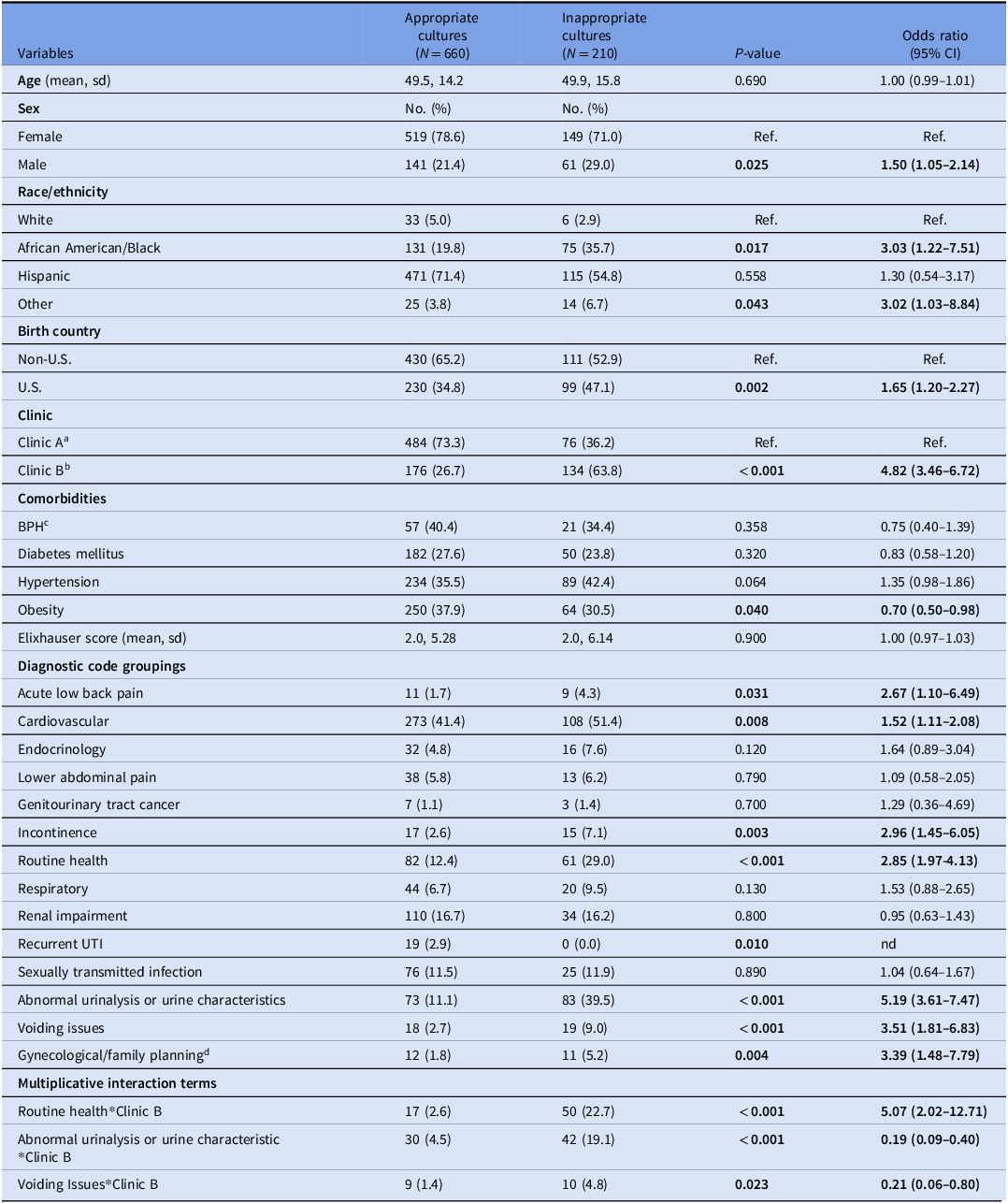
CI, confidence interval, SD, standard deviation, Ref, reference group, BPH, benign prostatic hypertrophy, UTI, urinary tract infection, ND, no data (unable to calculate odds ratio as ‘0’ present in one group)
a Clinic A is the teaching clinic.
b Clinic B is the non-teaching clinic.
c Denominator used for calculating prevalence among outcome limited to men; reference group is men without BPH.
d Denominator used for calculating prevalence among outcome limited to women; reference group is women without a gynecological or family planning visit.
Bold indicates significant P-value (α <0.05) obtained in univariate analysis.
Interactions between risk factors and clinic type
We found evidence of non-homogenous effects and multiplicative and additive interactions between having a routine health visit, abnormal urinalysis/urine characteristic, and a voiding issue with clinic type (Supplemental Tables 1 and 2, Table 2). For example, in Supplemental Table 1, when stratifying by clinic, we only found associations between routine health and the outcome in the non-teaching clinic and between voiding issues in the teaching clinic, respectively. Although having an abnormal urinalysis/urine characteristic was significantly associated with the outcome in both clinics, there was a much stronger effect in the teaching clinic (OR: 11.98) versus the non-teaching clinic (OR: 2.22). Furthermore, evidence of multiplicative (OR > 1) and super additive (RERI > 0) interactions were found between routine health visits (OR: 5.07, 95% CI: 2.02–12.71, RERI = 15.36) and the non-teaching clinic (Table 2, Supplemental Table 2). In contrast, there was evidence of negative interactions on the multiplicative (OR < 1) and additive scales (RERI < 0) for patients with an abnormal urinalysis/urine characteristic (OR: 0.19, 95% CI: 0.09–0.40, RERI = − 1.35) and voiding issues (OR: 0.21, 95% CI: 0.06–0.80, RERI = − 3.49) in the non-teaching clinic (Table 2) (Supplemental Table 2).
Collinearity
Cramer’s V was >0.3 for the following variable combinations: sex and gynecological/family planning codes (Cramer’s V = 1), race and country of birth (Cramer’s V = 0.77), and race and clinic (Cramer’s V = 0.45). As sex did not confound any independent variables, we excluded sex from the model, as perfect collinearity prevented the model from converging. Due to the strong association between race and country of birth, only race was used in the multivariate model, as it can be more easily ascertained across other studies.
Multivariate predictors of inappropriate urine culture ordering
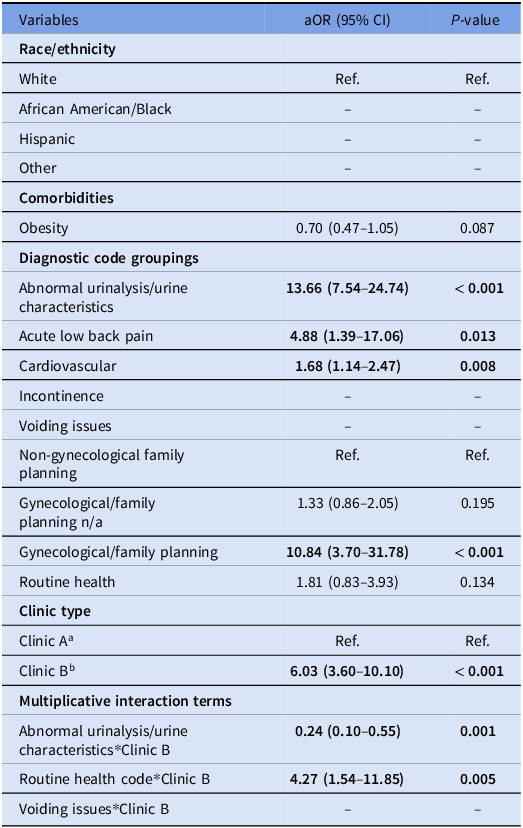
We found the following diagnostic code groupings were associated with inappropriate urine culture ordering: acute lower back pain (aOR: 4.88, 95% CI: 1.39–17.06), a cardiovascular-related visit (aOR: 1.68, 95% CI: 1.14–2.47), seeking care at the non-teaching clinic (aOR: 6.03, 95% CI: 3.60–10.10), having a gynecological/family planning visit (aOR: 10.84, 95% CI: 3.70–31.78), having a routine health encounter (aOR: 1.81, 95% CI: 0.83–3.93) within the non-teaching clinic (interaction aOR: 4.27, 95% CI: 1.54–11.85), and having an abnormal urinalysis or urine characteristic (aOR: 13.66, 95% CI: 7.54–24.74), which had a mitigated effect in the non-teaching clinic (interaction aOR: 0.24, 95% CI: 0.10–0.55) (Table 3).
Factors associated with inappropriate urine culture ordering: multivariate model
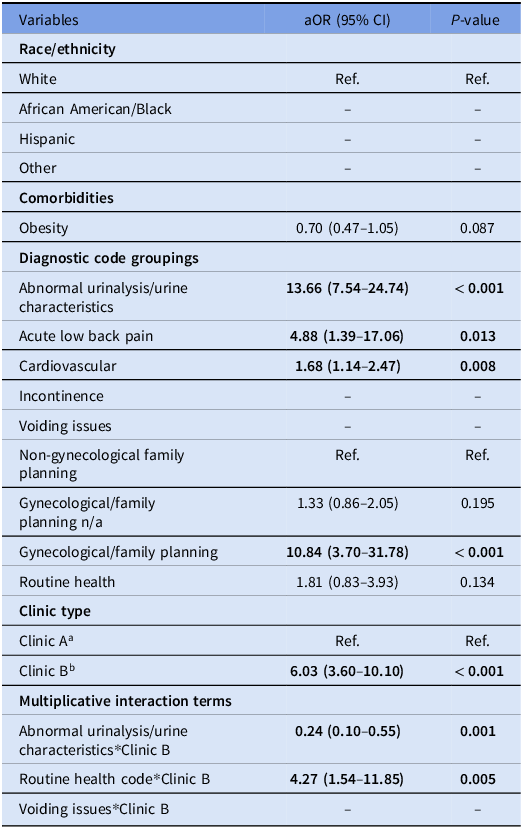
aOR – adjusted odds ratio, n/a – not applicable.
a Clinic A is the teaching clinic.
b Clinic B is the non-teaching clinic.
Dashes indicate variable initially entered model but dropped due to P-value >0.1.
Bolded aORs and P-values indicate predictor significant (P-value <0.05) in adjusted model.
Discussion
Little data exist exploring the appropriateness of urine culturing in ambulatory settings, where UTIs are most commonly evaluated and treated.Reference Fleming-Dutra, Hersh and Shapiro29 Additionally, as patient populations differ by demographics, acuity, and presenting illnesses across settings, there is a critical need to evaluate risk factors of inappropriate culturing within each clinical context. Among this safety-net, primary care population, we found 24% of urine cultures were ordered inappropriately. We also identified patients seen in the non-teaching clinic, patients with a routine health visit within the non-teaching clinic, those with an abnormal urinalysis finding or urine characteristic, acute lower back pain, a cardiovascular visit, or gynecological visit were significantly more likely to experience inappropriate urine culturing.
Few studies have evaluated urine culture appropriateness, and those that have were focused mostly on inpatient settings. These studies found higher levels of inappropriate culturing.Reference Hartley, Valley and Kuhn11,Reference Leis, Gold, Daneman, Shojania and McGeer13,Reference Drekonja, Gnadt, Kuskowski and Johnson14 Previous studies have found extremes of age and higher levels of comorbidities were independently associated with urine culture ordering, and our patient population had a lower median age (49.8) than these inpatient populations and a low Elixhauser score (median: 0).Reference Yin, Kiss and Leis15,Reference Horstman, Spiegelman, Naik and Trautner30 Previous inpatient studies also shared some similarities in misleading factors to our study (abnormal urinalysis/urine characteristics), but also factors that were more characteristic of older and higher acuity patients receiving inpatient care (e.g., confusion, falls, leukocytosis).Reference Hartley, Valley and Kuhn11,Reference Leis, Gold, Daneman, Shojania and McGeer13,Reference Drekonja, Gnadt, Kuskowski and Johnson14
We identified some expected but also unexpected risk factors for inappropriate culturing in primary care. As mentioned above, having an abnormal urinalysis finding or urine characteristic (e.g., odor, color) had a strong association (aOR: 13.66) with having an inappropriately ordered urine culture. Other studies have found abnormal urinalysis findings as risk factors of inappropriate antibiotic treatment among inpatients with ASB.Reference Petty, Vaughn and Flanders10,Reference Petty, Vaughn and Flanders31 We also identified acute lower back pain was associated with inappropriate urine culture ordering, which could reflect an overly conservative approach to encompass all potential patients where pyelonephritis could be suspected.
Interestingly, patients seen in the non-teaching clinic (aOR: 6.03), those with routine care visits (aOR: 1.81) in the non-teaching clinic (interaction aOR: 4.27), and cardiovascular-related visits (aOR: 1.68) were associated with inappropriate culturing. In the teaching clinic, trainees rotate through inpatient settings, which have diagnostic stewardship programs focused on reducing unnecessary urine testing; thus, exposure to this teaching could have mitigated inappropriate culturing in the teaching clinic. Second, attending physicians in the teaching clinic may be more apprised of the latest society guidelines. A possible reason routine health visits were associated with the outcome is due to their significant, positive relationship with having an abnormal urinalysis (p-value = 0.007). This relationship could be a signal that providers conducting routine care visits may have relied on urinalyses to monitor for other health conditions, such as screening for proteinuria. A recent review supports ordering a urinalysis when evaluating a patient for acute or chronic kidney disease and managing patients with diabetes, hypertension, or cardiovascular disease.Reference Haq and Patel32 As this patient population has considerable levels of diabetes (27.6%) and hypertension (35.5%), this may reflect why routine visits had a relationship with having an abnormal urinalysis. Of note, the urine cultures in our study did not stem from urinalyses with reflex to culture selected, and we do not know the sequence in which tests were ordered.
We also found that participants having a gynecological or family planning visit had increased odds of having an inappropriately ordered urine culture. When further examining this subgroup whose visits resulted in an inappropriate culture (n = 11), five women were also undergoing assessment for a possible STI. Clinicians may have difficulty distinguishing STIs from UTIs, due to some overlap and/or concomitant symptoms (dysuria, urethritis, suprapubic pain, fever).Reference Tuddenham, Hamill and Ghanem33 However, upon closer inspection, these five patients primarily had vaginal symptoms. One study found the triage protocol at an academic medical center included ordering a urinalysis for every woman presenting with genitourinary symptoms. Consequently, UTIs were overdiagnosed in 52% of cases, and 14 STIs were misdiagnosed as a UTI.Reference Tomas, Getman, Donskey and Hecker34 Thus, although we do not have knowledge of whether urinalyses were ordered for these women, it is a possibility that having a urinalysis positive for leukocyte esterase or pyuria, which occurs with both STI and UTI,Reference Tomas, Getman, Donskey and Hecker34 may have played a role in ordering a urine culture.
Our study has a number of limitations. First, we extracted data from two primary care, safety-net clinics composed mainly of racial and ethnic minorities not born in the U.S. with lower socioeconomic status. As this population may have limited health care encounters due to economic and transportation barriers, this could influence the breadth of care delivered at each visit, possibly resulting in additional screenings at a single encounter. As our population was comprised mainly of racial and ethnic minorities, we likely were underpowered to detect racial or ethnic differences in urine culture ordering compared to non-minorities. Our study relied on physician-documented diagnostic codes, which can be limited by low sensitivity or inconsistencies across providers; however, a recent study found using both ICD-10 diagnostic and symptom codes for identifying UTIs in primary care had a strong positive predictive value (96.3%).Reference Germanos, Light and Zoorob35 We also did not have access to additional tests (e.g., urinalyses) performed during the visit unless their results were noted as a visit diagnosis, nor did we know the order of testing, which could have better informed our conclusions. We had a few variables that had high collinearity, which caused some variables to be excluded (sex and country of birth), while some variables had interactions with clinic type, making it more difficult to determine if a variable was clinic/provider driven or more generalizable. As we are drawing conclusions from two clinics, it is possible a few high-volume providers who routinely obtain urine cultures could influence associations; however, the non-teaching clinic had a larger proportion of high-volume providers compared to the teaching clinic, which could potentially dilute the effect of one or two high-volume providers. Future multi-clinic studies with provider-level data on urine culture ordering are needed. Lastly, we used conservative criteria to determine the appropriateness of urine cultures, but did not assess the sensitivity or specificity of our approach.
In conclusion, almost a quarter of urine cultures were lacking an appropriate indication in our primary care clinics. We identified more traditional factors (e.g., abnormal urinalysis/urine characteristics) but also factors more specific to primary care, such as routine health visits. These novel factors deserve further exploration in other primary care environments. Further, as having an abnormal urinalysis served as a strong predictor, understanding how urinalyses are utilized across primary care settings will help improve our understanding and ability to devise diagnostic stewardship interventions.
Supplementary material
To view supplementary material for this article, please visit https://doi.org/10.1017/ice.2025.10235.
Acknowledgements
This project was supported by the National Institute of Allergy and Infectious Diseases of the National Institutes of Health under Award Number UM1AI104681 (PI: Grigoryan). MVK and MH were supported by the Health Resources and Services Administration, an agency of the U.S. Department of Health and Human Services (grant number T32 HP10031). BWT’s work was supported in part by the United States Department of Veterans’ Affairs, Health Services Research and Development Service (grant number CIN 13-413) at the Center for Innovations in Quality, Effectiveness, and Safety. The contents are those of the author(s) and do not necessarily represent the official views of, nor an endorsement by the NIH, HRSA, HHS, the Veterans Health Administration, or the U.S. Government. All authors report no conflicts of interest relevant to this article nor any competing interests.