The ingestion of colostrum by newborn ruminant is the only source of immunoglobulins (Ig) during the first month of life (Castro et al., Reference Castro, Capote, Bruckmaier and Arguello2011). Colostrum is not only a source of Ig (Hernandez-Castellano et al., Reference Hernandez-Castellano, Almeida, Ventosa, Coelho, Castro and Arguello2014), it is also a rich source of multiple biomolecules, some of which confer the colostrum with antimicrobial activity (AnAc) (Bhanu et al., Reference Bhanu, Amano, Nishimura and Aparna2015). On dairy farms, colostrum is usually milked and fed to neonates through bottles or buckets, so as to avoid the development of the mother-neonate bond, to prevent udder lesions, and to allow the colostrum to be treated in order to reduce presence of pathogens. Less common management practices are skimming or curding of the colostrum in order to enrich the Ig concentration (Castro et al., Reference Castro, Capote, Morales, Quesada, Briggs and Argullo2007). The objective of the present study was to investigate the effect of species (goat and sheep), treatment (pasteurization at 56, 63 and 72 °C, skimming and curding) and refrigeration time on colostrum antimicrobial activity (AnAc).
Materials and methods
The first milking postpartum colostrum from 12 dairy Majorera nanny goats and 12 dairy Canarian ewes was collected in a milking parlour. Each colostrum sample was divided into aliquots (50 ml) and stored at −80 °C until subsequent analyses were performed. Escherichia coli were obtained from rectal faeces samples collected from Majorera goat kids. Three gram (g) of faeces were suspended in 5 ml of a saline solution. Then 400 µl of the solution were plated onto Petri dishes with blood agar medium (Oxoid, Hampshire, United Kingdom). Petri dishes were incubated at 37 °C for 24 h. After that, different colonies, which had grown up in this blood agar media, were plated into McConkey agar (37 °C, 24 h, Oxoid, Hampshire, United Kingdom). When these colonies had established, a Gram stain was performed to identify coliforms bacteria. Gram negative bacilli, which correspond with Enterobacteriaceae, were identified at 1000× magnification in an optic microscope. Escherichia coli was confirmed using an Analytical Profile Index (Biomerieux, USA).
In the first experiment, colostrum samples were thawed and heated at 37 °C in a water bath for 30 min. After that, each sample was divided into 6 tubes containing 5 ml each. Of these six samples, five were subsequently suspended in different treatments while one sample served as control (no treatment). Treatments applied to samples were: pasteurization at 56 °C for 1 h, 63 °C for 30 min and 72 °C for 15 s according to Trujillo et al. (Reference Trujillo, Castro, Quevedo, Arguello, Capote and Guamis2007), skimming colostrum and curding (to obtain whey) colostrum according to Castro et al. (Reference Castro, Capote, Morales, Quesada, Briggs and Argullo2007). Escherichia coli suspension (McFarland No. 1 standard, approximately 3 × 10⁸ CFU/ml) was used. Two hundred μl of the E. coli suspension were plating into violet red bile agar medium Petri dishes (Oxoid, Hampshire, United Kingdom). Petri dishes were allowed to dry for 2 h. After that, 4 dried discs were located in each Petri dish: negative control (sterile saline serum 0.9%), positive control (Enrofloxacin, 250 µg) and two colostrum samples (each sample was tested in duplicate in different dishes). Petri dishes were subsequently incubated at 37 °C for 24 h. Halos formed were measured using a digital scanner and the AnAc percentage of different samples was estimated. Positive control was defined as 100% of AnAc and negative control was defined as 0% of AnAc. Sample values were calculated as follow:
 $$\eqalign{{\rm AnAc}\,\% = & \; \lpar {{\rm Sample}\,{\rm Diameter}-{\rm Negative}\,{\rm Control}\,{\rm Diameter}} \rpar \cr & \times 100/{\rm Positive}\,{\rm Control}\,{\rm Diameter}} $$
In the second experiment, twelve samples of goat colostrum (from the same animals involved in experiment 1) were used. Colostrum samples were thawed and heated at 37 °C in a water bath for 30 min. After that, each sample was divided into 4 tubes containing 30 ml each. Of these four tubes, three were subsequently distributed in different treatments while one tube was treated as control (no treatment). Treatments applied to samples were: pasteurization at 56 °C for 1 h, 63 °C for 30 min according to Trujillo et al. (Reference Trujillo, Castro, Quevedo, Arguello, Capote and Guamis2007) or skimmed. After treatments, each tube was aliquot into 6 tubes of 5 ml. All tubes were refrigerated at 4 °C, and the AnAc was assessed using the above equation on day 0, 2, 4, 6, 8 and 10 of refrigeration.
SAS 9.4 (SAS Institute Inc., Cary, NC, USA) program package was used for statistical analysis. Antimicrobial activity variable was transformed using a square root transformation due to absence of normal distribution. A factorial ANOVA was performed to evaluate the effect of species and treatments in experiment 1. For experiment 2, SAS PROC MIXED procedure for repeated measures was used to evaluate the fixed effect of colostrum treatments, refrigeration time and the interaction between both effects (treatment × refrigeration time) on colostrum antimicrobial activity. Significant differences between means were identified using the Tukey–Kramer test. Data are presented untransformed in the tables.
Results and discussion
Species (goat vs. sheep) had no effect on colostrum AnAc (P = 0.331). Antimicrobial activity is the sum of the effects of different bioactive substances that have been reported with immune or antimicrobial activity such as antimicrobial peptides, oligosaccharides, glycoproteins, lactoferrin, lactoperoxidase, lactadherin and Ig (Cacho and Lawrence, Reference Cacho and Lawrence2017). Lactoferrin and Ig are amongst the most active biomolecules in the colostrum, but no differences between goats and sheep colostrum have been reported (Abd El-Gawad et al., Reference Abd El-Gawad, El-Sayed, Mahfouz and El-Salam1996; Hernandez-Castellano et al., Reference Hernandez-Castellano, Almeida, Renaut, Arguello and Castro2016). Lactoperoxidase expression has been reported to be higher in cow than in goat or sheep colostrum (Hernandez-Castellano et al., Reference Hernandez-Castellano, Almeida, Renaut, Arguello and Castro2016). To date, no major differences have been reported between goat and sheep colostrum for the concentration of biomolecules with immune function, which is in agreement with our results (Table 1).
Effect of pasteurization, skimming and curding on antimicrobial activity (%) of goat and sheep colostrum

S, species; T, treatment; sd, standard deviation.
abMeans within a row with different superscript differ (P < 0.05).
Different pasteurization protocols tested in the present study did not affect the colostrum AnAc in either experiment (Tables 1 and 2). Colostrum pasteurization protocols applied in the present study are usually used for milk quality purposes (except 72 °C). Protocols using 56 and 63 °C have been described to avoid denaturation of Ig in colostrum (Trujillo et al., Reference Trujillo, Castro, Quevedo, Arguello, Capote and Guamis2007). Furthermore, Daniels et al. (Reference Daniels, Schmidt, King, Israel-Ballard, Mansen and Coutsoudis2017) have reported 70% stability for lactoferrin in human milk using traditional sterilization methods. The low pasteurization method temperatures/times combination used in the present study could be the reason for not detecting statistical differences for AnAc between methods. Colostrum skimming or curding have been proposed by Castro et al. (Reference Castro, Capote, Morales, Quesada, Briggs and Argullo2007) in order to increase the IgG concentration in colostrum. Our findings showed that skimmed colostrum AnAc was similar to pasteurization methods in both goat and sheep colostrum, however, the curding treatment showed lower colostrum AnAc. The curding method uses rennet in order to obtain the colostrum whey, Ig remains in the whey and the activity of this Ig was not affected according to Castro et al. (Reference Castro, Capote, Morales, Quesada, Briggs and Argullo2007). Milk lactoferrin concentration is affected by curding. Ripolles et al. (Reference Ripolles, Harouna, Parron, Calvo, Perez, Carraminana and Sanchez2015) reported a reduction in antibacterial activity of bovine milk lactoferrin and its hydrolysates when different types of rennet were used, but lactoferrin is very resistant to heat treatments (Franco et al., Reference Franco, Perez, Conesa, Calvo and Sanchez2018). Lactoperoxidase is not affected by curding according to Nandini and Rastogi (Reference Nandini and Rastogi2011). It was concluded from the results of these studies that lactoferrin is a suitable marker for investigating the reduction of colostrum AnAc after curding.
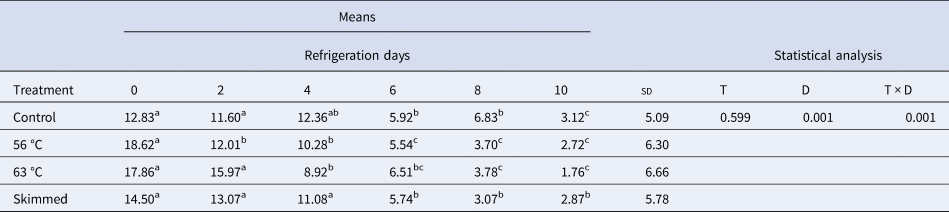
Effect of refrigeration time in colostrum antimicrobial activity according to colostrum treatment

T, treatment; D, day; sd, standard deviation.
abcMeans within a row with different superscript differ (P < 0.05).
Colostrum AnAc evolution during the refrigeration (4 °C) time among different treatments (control, 56 °C, 63 °C and skimmed) is represented in Table 2. While treatment did not affect colostrum AnAc, refrigeration time reduced AnAc through the studied period (P < 0.001). The largest decrease for colostrum AnAc was observed after 4 d of refrigerated storage, and after ten days the degree of reduction was 75, 85, 90 and 80% in control, 56 °C, 63 °C and skimmed colostrum treatments, respectively. On dairy farms, in order to facilitate the management during the birth seasons, it is necessary to refrigerate the colostrum. The effects of refrigeration on IgG concentration have been studied in goat colostrum (Arguello et al., Reference Arguello, Castro, Capote, Gines, Acosta and Lopez2003). In that study the reduction in IgG concentration in the colostrum during the refrigeration was 11% over 14 d, suggesting that Ig are not associated with the decline in AnAc during refrigeration. Lactoferrin stability has been reported during refrigeration in human milk during the first 4 d, but no references were found for longer times (Giribaldi et al., Reference Giribaldi, Ortoffi, Giuffrida, Gastaldi, Peila, Coscia, Raia, Arslanoglu, Moro, Cavallarin and Bertino2013; Rollo et al., Reference Rollo, Radmacher, Turcu, Myers and Adamkin2014). Lactoperoxidase has been reported to be active in raw milk for 7 d, and due to low concentration of sodium thiocyanate and hydrogen peroxide in milk the activity will be greater at the beginning of the refrigeration period (Gaya et al., Reference Gaya, Medina and Nuñez1991).
In conclusion, colostrum antimicrobial activity was similar in goat and sheep. Regarding treatments, curding the colostrum reduced the colostrum AnAc of the whey. Additionally, refrigeration at 4 °C for up to 4 d of previously frozen-thawed colostrum is not recommended.