


Introduction
Cognitive models of post-traumatic psychological adjustment have implicated both self-concept and self-appraisals in post-traumatic stress disorder (PTSD) (Brewin et al., Reference Brewin, Dalgleish and Joseph1996; Ehlers and Clark, Reference Ehlers and Clark2000). Those with disrupted post-traumatic psychological adjustment are thought to have structural changes in the self-concept and difficulties incorporating the trauma experience into the self-concept (Brewin, Reference Brewin2011). Additionally, those with disrupted adjustment have been found to have negative self-appraisals following trauma (e.g. ‘I am weak’, ‘I will never be the same again’). Such appraisals can maintain PTSD as they create a sense of current internal threat to self, which results in an individual engaging in cognitive and behavioural strategies to reduce the perceived threat. While such strategies may reduce distress in the short term, in the longer term they function to maintain PTSD symptoms as they prevent cognitive change (Ehlers and Clark, Reference Ehlers and Clark2000). Of importance, negative trauma-related changes in self-concept and self-appraisals predict a greater risk of PTSD developing even after initial symptoms are controlled for and a poorer response to treatment (Brewin, Reference Brewin2011). While research highlights that negative trauma-related changes in self-concept and self-appraisals play a major role in PTSD, the relationship between these two aspects of the self (i.e. the evaluative aspects [self-appraisals) and descriptive content about the self [self-concept]; Leary and Tangney, Reference Leary and Tangney2005) have not been thoroughly explored.
Self-concept is of great significance to one’s personhood and acts as the reference point from which all else draws meaning (Combs and Snygg, Reference Combs and Snygg1959; Krech and Crutchfield, Reference Krech and Crutchfield1948). It is an active, continuous and changing array of accessible self-knowledge and a framework for the perception and organization of one’s life experiences (Markus and Wurf, Reference Markus, Wurf, Rosenzweig and Porter1987). Self-concept, in Higgins’ (Reference Higgins1987) influential self-discrepancy theory, is divided into three domains, the ‘Actual’ (representation of the attributes that one believes they actually possess and is one’s basic self-concept), the ‘Ideal’ (representation of the attributes that someone would like to possess) and the ‘Ought’ (representation of the attributes that someone believes they should or ought to possess such as duty, obligations and responsibilities) (Higgins, Reference Higgins1996). When these domains are discrepant from one another, negative affect and anxiety can occur (e.g. Strauman, Reference Strauman1990; Strauman and Higgins, Reference Strauman and Higgins1987). The ought self-discrepancy refers to the extent to which an individual perceives their current self to differ from the self they believe they should attain to (as determined by significant others and society). The ideal self-discrepancy refers to the extent to which an individual perceives their current actual self to differ from the self one would ideally like to be.
In the context of trauma, self-concept and self evaluations are of significant importance to psychological well-being, as the trauma acts as a catalyst for re-defining or re-evaluating one’s self, as one is prompted to make sense of the experience. While extensive research has documented the important role negative trauma-related self-appraisals play in PTSD (e.g. Bryant and Guthrie, Reference Bryant and Guthrie2005; Ehlers and Steil, Reference Ehlers and Steil1995; Foa and Riggs, Reference Foa, Riggs, Oldham, Riba and Tasman1993), some research has also considered the influence of trauma on the self-concept. Finding meaning in an otherwise incomprehensible situation potentially leads to schema change, which consequently results in one’s possible selves being subject to change and potentially results in a new or discrepant self-concept (Brennan, Reference Brennan2001; Brewin, Reference Brewin2011; Janoff-Bulman, Reference Janoff-Bulman1992). Trauma can have a negative impact on one’s perceived self-concept; the perceived self-concept can become centred on the trauma experience. This in turn is associated with disrupted post-traumatic psychological adjustment (e.g. Berntsen and Rubin, Reference Berntsen and Rubin2006, Reference Berntsen and Rubin2007; McNally et al., Reference McNally, Lasko, Macklin and Pitman1995; Sutherland and Bryant, Reference Sutherland and Bryant2005). Sutherland and Bryant (Reference Sutherland and Bryant2008) found that those with PTSD reported that their perceived self-concept was more discrepant to their ideal and ought self-when compared with non-PTSD participants. Such disruptions in self-concept are likely to be associated with negative self-appraisals and evaluations after trauma (e.g. ‘I am weak and cannot cope’) (Sutherland and Bryant, Reference Sutherland and Bryant2008). However, such a proposal is yet to be investigated.
The self-concept is influenced by a range of contextual factors (Leary and Tangney, Reference Leary and Tangney2005); one such influential factor is culture (Abernathy, Reference Abernathy, Walz, Bleuer and Yep2008; Stone, Reference Stone2006). People in different cultures have strikingly different understandings of the self (Markus and Kitayama, Reference Markus and Kitayama1991, Reference Markus and Kitayama1994, Reference Markus and Kitayama2010). For instance, individualistic cultures (typically Western) tend to perceive the self to be unique, independent, autonomous and separate from others. In contrast, Asian cultures tend to perceive the self to be interdependent with others and emphasize relatedness of group norms and group harmony (see Markus and Kitayama, Reference Markus and Kitayama1991, Reference Markus and Kitayama2010). Research suggests that a consistent self-concept is less valued in Eastern cultures. Those from Eastern cultures with an interdependent self-focus have a more flexible, inconsistent and discrepant self-concept than their Western counterparts and are more tolerant of apparent contradictions in self-concept (Choi and Choi, Reference Choi and Choi2002; Church et al., Reference Church, Anderson-Harumi, del Prado, Curtis, Tanaka-Matsumi and Valdez-Medina2008; Cukur, Reference Cukur2002; English and Chen, Reference English and Chen2011; Heine, Reference Heine2001; Heine and Lehman, Reference Heine and Lehman1997; Heine et al., Reference Heine, Lehman, Markus and Kitayama1999; Markus and Kitayama, Reference Markus and Kitayama1994; Suh, Reference Suh, Diener and Suh2000, Reference Suh2002). English and Chen (Reference English and Chen2011) purport that self-discrepancies are not as problematic for Asian cultures with regard to self-concept and well-being. Despite these cultural differences in self-discrepancy, Gage et al. (Reference Gage, Coker and Jobson2015) recently found that for both British and Asian participants, endorsing negative self-characteristics were significantly associated with poorer psychological adjustment. Therefore, pan-culturally holding negative self-views may be associated with worse mental health outcomes. Such research raises questions regarding whether trauma survivors from Asian cultural backgrounds show similar levels of self-discrepancy as trauma survivors from Western cultures. Furthermore, given the greater acceptance of contradictions in the self-concept, is self-discrepancy as problematic for the post-traumatic psychological adjustment of Asian trauma survivors? Alternatively, given the recent research of Gage and colleagues (Gage et al., Reference Gage, Coker and Jobson2015), is negative self-concept and self-evaluation associated with poorer psychological adjustment pan-culturally?
The current research
The current research was part of a project investigating the influence of culture on two psychological processes involved in the development and maintenance of PTSD: appraisals and self-concept. Engelbrecht and Jobson (Reference Engelbrecht and Jobson2014) reported on data focusing on the influence of culture on the first component, trauma appraisals, and its implications for post-trauma psychological adjustment in a sample of British and Asian trauma survivors. The aims of the current research were to focus on the second component and investigate the relationships between post-trauma disruptions in self-concept (i.e. trauma-defined self-concept and self-discrepancies) and negative trauma-related appraisals in relation to post-traumatic psychological distress. Additionally, we aimed to examine whether these relationships differed depending on one’s cultural background. We investigated these aims in two studies. The first study explored these aims in a sample of British and Asian university students who had experienced a trauma or significantly distressing life experience. The second study investigated the aims in a group of British and Asian trauma survivors with and without PTSD. There is some overlap with Engelbrecht and Jobson (Reference Engelbrecht and Jobson2014) as the same samples were utilised. There are therefore data and textual overlaps on demographic characteristics and measures of post-trauma adjustment both within text and in subsequent tables. However, the measures and data and analysis pertaining to post-trauma self-concept, negative trauma-related appraisals and their relationships are novel to this research and not presented elsewhere.
Three hypotheses were investigated in both studies. First, we hypothesized that given research has found that Asian participants tolerate greater contradictions and inconsistencies in their self-concept, Asian participants would have significantly greater self-discrepancies than their British counterparts. Second, despite this cultural difference in self-discrepancies, given Gage et al. (Reference Gage, Coker and Jobson2015) found that pan-culturally holding negative self-views is associated with worse mental health outcomes, we predicted that pan-culturally greater disruptions in self-concept would be associated with poorer post-traumatic psychological adjustment. Third, given disruptions in self-concept are likely to be associated with negative self-appraisals and evaluations after trauma (e.g. ‘I am weak and cannot cope’) (Sutherland and Bryant, Reference Sutherland and Bryant2008), we predicted that discrepancies in self-concept would be associated with negative self-appraisals in both cultural groups.
Investigating these research aims is important as it has the potential to inform clinical and stress management, given the important role self-concept and trauma-related appraisals play in the development, maintenance and treatment of PTSD. Furthermore, although an impressive body of literature now exists in terms of understanding and treating PTSD, there remains a significant gap in this literature. Specifically, the majority of the literature pertains to trauma survivors from Western cultures, despite the increasing recognition that PTSD is observed in many different societies and cultures (Foa et al., Reference Foa, Keane, Friedman and Cohen2009). Therefore, there is a need for research to consider the influence of culture on post-trauma self-concept and appraisals in order to improve cultural understandings of the aetiology, maintenance and treatment of PTSD (Foa et al., Reference Foa, Keane, Friedman and Cohen2009).
Study 1: Method
Participants
As previously noted, demographic data were collected as part of another study, investigating the role of culture on cognitive appraisals of trauma and its implications for PTSD; see Engelbrecht and Jobson (Reference Engelbrecht and Jobson2014) for full details. Participants were 75 Asian International and British students (15 males, 60 females, ages ranging from 18 to 46 years, mean = 23, SD = 5.19). Participants were recruited from the Psychology Research Participation Panel at the University – a database of some 300 university and community volunteers who have agreed to help with psychological research. An email detailing information about the study was sent to those on the panel. Those interested in taking part in the study contacted the researcher. The inclusion criteria for the study included having experienced a traumatic, distressing or extremely stressful life event, being over 18 years of age and being able to complete the study in English. Adopting the approach used in previous cross-cultural research (e.g. Jobson and Dalgleish, Reference Jobson and Dalgleish2014; Wang and Ross, Reference Wang and Ross2005), the sample consisted of Caucasian British (n = 34; 28 female) and a mixed group of Asian International (n= 41; 32 female) students. The Asian group consisted of Chinese (n = 27), South Asian (n = 9), and South-East Asian (n = 5) participants. It is important to note that a similar pattern of results emerged, to that reported below, when just the Chinese participants were used in the analyses. All participants identified as having experienced a traumatic life event or an extremely stressful life event (types of events included assault, accidents, deaths) and self-identified as either British or Asian. Participants received £5 for participation.
Procedures and measures
The procedure and measures on post-traumatic psychological adjustment followed Engelbrecht and Jobson (Reference Engelbrecht and Jobson2014). Participants met with the researcher. Following written informed consent, participants completed the questionnaires in English in the following order:
Post-Traumatic Cognitions Inventory (PTCI; Reference Foa, Ehlers, Clark, Tolin and OrsilloFoa et al., 1999)
The PTCI is a 33-item inventory assessing appraisals related to trauma using 7-point scales. The PTCI has three subscales: negative appraisals about self (e.g. ‘I am a weak person’), world (e.g. ‘The world is a dangerous place’) and perceived self-blame (e.g. ‘The event happened to me because of the sort of person I am’). The PTCI has been found to have good internal consistency, convergent validity and discriminative validity (Foa et al., Reference Foa, Ehlers, Clark, Tolin and Orsillo1999). It has been used cross-culturally, including with Asian samples (Dragan et al., Reference Dragan, Gulcz and Wojtowicz2005; Su and Chen, Reference Su and Chen2008). In the current study the PTCI demonstrated good internal consistency (Cronbach’s α > .81).
Selves Questionnaire (SQ; Higgins, Reference Higgins1987)
The SQ was used to elicit self-discrepancies and measure trauma-defined self-concept. In terms of self-discrepancies, participants were instructed to make a list of one-word attributes that ‘describe the type of person you think you ideally would like to be’; that ‘describe the type of person you think you actually are’; and that ‘describe the type of person you think you ought to be’. The SQ has been used in several other studies (e.g. McDaniel and Grice, Reference McDaniel and Grice2005), including studies assessing post-trauma self-concept (Sutherland and Bryant, Reference Sutherland and Bryant2008). Self-discrepancy scores were coded according to the instructions of Sutherland and Bryant (Reference Sutherland and Bryant2008); attributes were coded as a synonym, antonym or non-relational according to Roget’s Thesaurus. To derive an ideal self-discrepancy score, the total number of matches was subtracted from the total number of mismatches between the list of actual and ideal self-attributes. Comparatively, for ought self-discrepancy score, the total number of matches were subtracted from the total number of mismatches between the list of actual and ought self-attributes (Higgins et al., Reference Higgins, Klein and Strauman1985).
Coding of trauma-defined self-concept was approached as follows. A trauma-defined ratio was developed based on a coding scheme used extensively in previous trauma and cross-culture research (e.g. Jobson et al., Reference Jobson, Moradi, Rahimi-Movaghar, Conway and Dalgleish2014; Jobson and O’Kearney, Reference Jobson and O’Kearney2006, Reference Jobson and O’Kearney2008, Reference Jobson and O’Kearney2009; Sutherland and Bryant, Reference Sutherland and Bryant2005). Each actual self-description was coded as trauma-defined or not. To be coded as trauma-defined, the response had to be directly and clearly related to trauma or survival; for example, ‘victim’, ‘survivor’, ‘scared’, ‘damaged’). The total number of trauma-defined responses was tallied for each participant, and these totals were divided by the total number of actual self-descriptions provided.
Inter-rater reliability was determined by one rater (blind to group status of participants) coding all responses on the SQ and an independent bilingual Asian British rater (blind to hypotheses and group status) coding 20% of responses. There were no evident differences in language fluency between the two raters; both raters were completing their PhD dissertations in English at their respective British universities. The kappa coefficients of inter-rater reliability were 1.00 for ideal self-discrepancy, .92 for ought self-discrepancy, and .82 for trauma-defined self-concept.
Impact of Events Scale-Revised (IES-R; Weiss and Marmar, Reference Weiss, Marmar, Wilson and Keane1997)
Distress following trauma was assessed using the IES-R. The IES-R is a 22-item self-report measure designed to assess current subjective distress for any specific life event (in this study participants selected the event they identified as their most distressing, traumatic life experience). The IES-R consists of avoidance, intrusions and hyper-arousal scales. Respondents are asked to rate each item on a scale from 0 (not at all) to 4 (extremely) according to the past 7 days. Participants receive a score for each scale and a total score. The IES-R has been found to have good internal consistency (alphas ranging from .81 to .91), test–re-test reliability (r = .89 to .94), criterion validity, content validity and construct validity (Weiss and Marmar, Reference Weiss, Marmar, Wilson and Keane1997) and has been used in previous cross-cultural research (e.g. Wu and Chan, Reference Wu and Chan2004). In the current study the IES-R had good internal consistency (Cronbach’s α = .87).
Hopkins Symptom Checklist-25 (HSCL-25; Derogatis et al., Reference Derogatis, Lipman, Rickels and Cori1974)
Given that there is a high comorbidity between depression and PTSD (Brewin and Holmes, Reference Brewin and Holmes2003), depression was measured using the HSCL-25 Part 2 (Derogatis et al., Reference Derogatis, Lipman, Rickels and Cori1974), which has 15 items that measure depression symptoms. Participants are required to indicate how much each symptom bothered or distressed them in the past week, including today, from 1 (not at all) to 9 (extremely). The depression score is the average of the 15 depression items. The HSCL-25 depression score has been consistently shown in several populations to be correlated with clinical assessment interviews of depression and the depression subscale has been shown to possess high internal consistency, high test–re-test reliability and adequate inter-rater reliability (Derogatis et al., Reference Derogatis, Lipman, Rickels and Cori1974) It is regularly used in cross-culture research (e.g. Mouanoutoua and Brown, Reference Mouanoutoua and Brown1995). In the current study the depression subscale demonstrated good internal consistency (Cronbach’s α = .89).
Demographics
Participants were also asked to provide their age, ethnicity, time in the UK, how hard they found the study on a 10-point scale from 1 (not at all) to 10 (extremely) and their English language skills on a 10-point scale from 1 (not very good) to 10 (extremely good). All Asian participants had university level English (i.e. participants had scored at least Level 6 on the International English Language Testing System).
Data analysis plan
For descriptive statistics, we used measures of central tendency (mean and frequency) and dispersion (standard deviation). The Shapiro–Wilks test was used to test the normality of cognitive appraisals and any transformations necessary. Hypothesis 1 (cultural differences in self-discrepancy) was tested using t-tests comparing British and Asian participants. Hypotheses 2 (pan-cultural disruptions in self-concept are associated with poorer post-traumatic adjustment) and 3 (pan-cultural discrepancies in self-concept are associated with negative self-appraisals) were explored using correlation analyses. Several violations of normality were present in the data. To address the issue of non-normal data, transformations were conducted. However, this did not alter the skew of distributions nor the relationships with other variables in a meaningful way. As the bootstrapping method is considered a robust non-parametric method for dealing with problems of non-normal data, the bootstrapping method (with 5000 resamples with replacement) was used as the technique for conducting the correlation analyses (Field, Reference Field2009; Preacher and Hayes, Reference Preacher and Hayes2008). Correlation analyses were conducted for each cultural group separately. Fisher’s Z-score comparisons were used to compare the correlation coefficients of the two cultural groups. When interpreting effect sizes, Cohen’s (Reference Cohen1992) guidelines were employed, whereby r of at least .10= small, .30 = moderate, and .50 = large. All analyses were performed using IBM SPSS version 24, and statistical significance for all tests was considered at an α level of 0.05.
Results
Participant characteristics
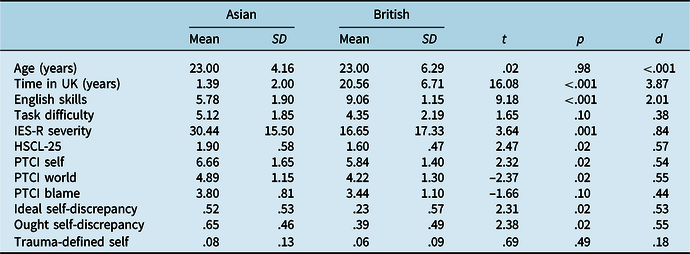
Table 1 presents demographic characteristics for both groups, and trauma-related distress and depression scores drawn from previously collected data (see Engelbrecht and Jobson, Reference Engelbrecht and Jobson2014), in addition to data on negative self-appraisals and measures of post-trauma self-concept. Unsurprisingly, the British group had lived in the UK for a significantly longer time and rated their English language skills as more proficient than the Asian group. The Asian group was found to score higher on trauma-related distress symptoms, depression symptoms and on the PTCI self and world subscales than the British group.
Group differences in demographic details, self-concept scores and cognitive measures scores

PTCI, Post-Traumatic Cognitions Inventory; IES-R, Impact of Event Scale-Revised; HSCL-25, Hopkins Symptom Checklist-25.
Hypothesis 1: Cultural differences in self-discrepancies
As hypothesized, the Asian group had significantly greater ideal and ought self-discrepancies than the British group. The results were evident when trauma-related distress symptoms and depression symptoms were included as covariates (see Table 1).
Hypothesis 2: Relationships with post-traumatic adjustment
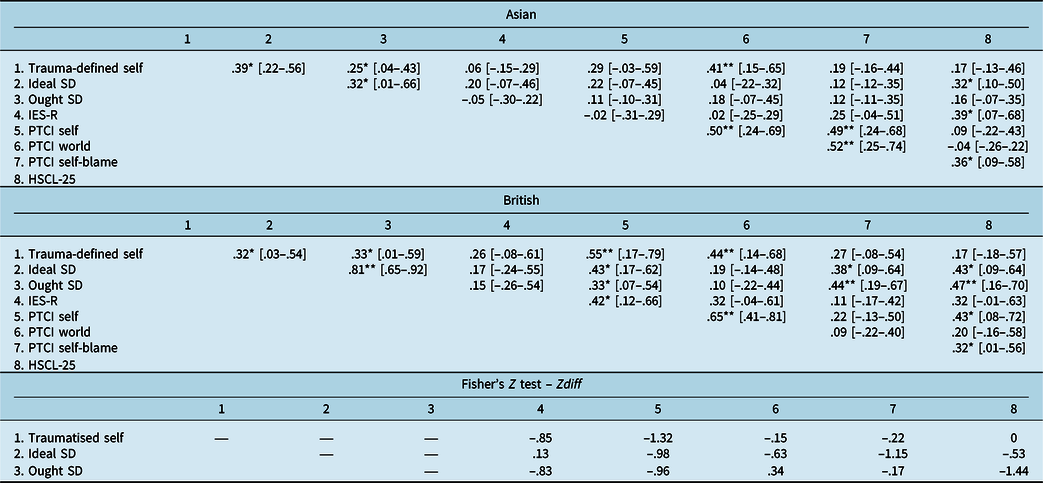
As displayed in Table 2, contrary to our predictions, for both British and Asian groups, disruptions in self-concept (i.e. self-discrepancies and trauma-themed self-concept) did not correlate significantly with PTSD symptoms, with negligible to small effects observed. For the Asian group, ideal self-discrepancy correlated significantly with depression, with moderate effects observed. For the British group there were significant moderate associations between depression and ideal and ought self-discrepancy. None of the Fisher’s Z-scores comparisons was significant, which indicates there were no significant cultural differences in relation to self-concept and measures of depression and PTSD.
Correlation coefficients [95% CI] for self-concept and cognitive variables for Asian and British cultural groups and Fisher’s Z comparisons

SD, self-discrepancy; PTCI, Post-Traumatic Cognitions Inventory; IES-R, Impact of Event Scale-Revised; HSCL-25, Hopkins Symptom Checklist-25. *p < .05, **p < .01.
Hypothesis 3: Relationship between distortions in self-concept and self-appraisals
As predicted, for the British group disruptions in self-concept (i.e. self-discrepancies and trauma-themed self-concept) correlated significantly with negative self appraisals, with moderate to large effects observed. However, in the Asian group, disruptions in self-concept did not correlate significantly with negative self-appraisals, with negligible to small effects observed. However, it is worth noting that the relationship between trauma-defined self-concept and negative self-appraisals was approaching significance (r = .29, p =.06) (see Table 2). Additionally, we found that pan-culturally, trauma-defined self-concept correlated significantly with negative world appraisals, with moderate effects observed. In the British group, ideal and ought self-discrepancies correlated significantly with self-blame appraisals, with moderate effects observed. None of the Fisher’s Z-scores comparisons was significant, again indicating there were no significant differences between cultural groups on measures of self-concept and self-appraisals. Additionally, as an exploratory analysis, we found that depression was significantly correlated with self-blame appraisals for both groups, in addition to negative self appraisals for the British group (see Table 2).
Discussion
Study 1 investigated the relationships between post-trauma disruptions in self-concept and negative trauma-related self-appraisals in relation to post-traumatic psychological distress. It also examined whether these relationships differed depending on one’s cultural background. First, as predicted, Asian participants had significantly greater discrepancies in their self-concept than British participants.
Second, there was little support for Hypothesis 2. Contrary to our hypothesis, for both cultural groups, disruptions in self-concept (i.e. self-discrepancies and trauma-themed self-concept) did not correlate significantly with PTSD symptoms, with negligible to small effects observed. This finding may be the result of Study 1 investigating this phenomenon in a non-clinical sample. For the Asian group, ideal self-discrepancy correlated significantly with depression, with moderate effect sizes observed. For the British group there were significant moderate associations between depression and ideal and ought self-discrepancy. This supports previous research that has found that when self domains (i.e. actual, ought and ideal) are discrepant from one another, negative affect can occur (e.g. Strauman, Reference Strauman1990; Strauman and Higgins, Reference Strauman and Higgins1987).
In support of Hypothesis 3, disruptions in self-concept correlated significantly with negative self-appraisals. However, these associations were only observed in the British group. Disruptions in self-concept did not correlate significantly with negative self-appraisals in the Asian group, although the relationship between trauma-defined self-concept and negative self-appraisals was approaching significance. Additionally, we found that pan-culturally, trauma-defined self-concept correlated significantly with negative world appraisals and in the British group ideal and ought self-discrepancies correlated significantly with self-blame appraisals.
The generalisability of these findings is limited by the fact that participants were university students, self-selected to take part in the study and not all participants were trauma survivors. Furthermore, recruiting volunteers from university settings via email solicitation may have resulted in biased samples, thus restricting generalisability of findings. Second, the international sample of Asian university students is likely to differ from a cross-section of the population living in their native country and this needs to be borne in mind when interpreting findings. However, as increasing numbers of immigrants from Asia are re-settling in Western cultures, cultural psychologists are increasingly shifting their focus from international comparisons to an examination of immigrants (Ross and Wang, Reference Ross and Wang2010). Furthermore, Study 1 would be strengthened by focusing on those with and without a diagnosis of PTSD, as opposed to those with trauma-related distress. Moreover, the Asian international student sample was considered as a single, collectivistic population, with the Caucasian British group on the extreme individualism side. Although there is support for this approach from previous literature (e.g. Hofstede and Hofstede, Reference Hofstede and Hofstede2004; Jobson and O’Kearney, Reference Jobson and O’Kearney2008; Wang and Ross, Reference Wang and Ross2005), the inclusion of a measure of interdependent/independent orientation would have provided better support for our conclusions. In this regard, it is also important to note that we did also conduct all the analyses using just the Caucasian British and Chinese participants only. The same pattern of results was found. Furthermore, while Asian participants had university-level English, language proficiency is a factor that needs consideration due to the dependency on language fluency in the study measures. Last, the two groups differed significantly on the IES-R, which made comparing groups potentially problematic. Differences were controlled statistically and a similar pattern of results emerged. Different statistical analyses (e.g. regression) were also considered; however, this did not aid in the interpretation of findings. Therefore in order to address this limitation trauma-related stress was more closely assessed in Study 2. Specifically, Study 2 did not use the IES-R but rather compared cultural groups with and without PTSD as assessed using the Structured Clinical Interview for DSM-IV-TR Axis I Disorders (SCID-I; First et al., Reference First, Spitzer, Gibbon and Williams2002).
Study 2
Study 1 justified further investigation of the relationships between post-trauma disruptions in self-concept (i.e. trauma-defined self-concept and self-discrepancies) and negative trauma-related appraisals in a clinical sample. The objective of Study 2 was to replicate and address two of the significant limitations associated with Study 1. First, Study 1 used the IES-R, which is a measure of subjective distress rather than a measure of PTSD. Additionally, in Study 1 the Asian group scored significantly higher on trauma-related distress than the Caucasian British group, which made cultural group comparisons and interpretation of findings problematic. Therefore, Study 2 investigated the same hypotheses as that outlined in Study 1 using a group of Asian and British trauma survivors with and without a diagnosis of PTSD. Second, previous cross-cultural studies comparing Asian immigrants with Westerners have tended to include a measure of interdependent/independent self-orientation (e.g. Jobson and O’Kearney, Reference Jobson and O’Kearney2008; Wang and Ross, Reference Wang and Ross2005). Therefore, Study 2 included a measure of self-orientation, similar to that used in previous cross-cultural research (e.g. Jobson et al., Reference Jobson, Moradi, Rahimi-Movaghar, Conway and Dalgleish2014; Jobson and O’Kearney, Reference Jobson and O’Kearney2008; Wang, Reference Wang2001), to assess variation in the salience and organisation of self-related material across cultural groups (Wang, Reference Wang2001). Our hypotheses remained the same as that investigated in Study 1.
Method: Study 2
Participants
As previously noted, demographic data for the two groups were drawn from previously collected data (see Engelbrecht and Jobson, Reference Engelbrecht and Jobson2014, for full details). All participants (Asian n = 47; Caucasian British n = 48) were recruited using from the general community in the UK by posters in public places, Adult Migrant English Programs, advertisements in local and ethnic newspapers, contacts with ethnic organisations and communities and organisations that provide treatment for trauma survivors. Notices called for those who had experienced a traumatic event and identified the study as researching trauma, appraisals and culture.
Procedure and measures
The procedure and measures on post-traumatic psychological adjustment followed Engelbrecht and Jobson (Reference Engelbrecht and Jobson2014) exactly. PTSD diagnosis was identified using the Overview and PTSD module from the SCID-I for DSM-IV-TR Axis I Disorders (First et al., Reference First, Spitzer, Gibbon and Williams2002). The SCID-I is a semi-structured interview and is routinely used as a diagnostic instrument. Interviews were audio-recorded to account for inter-rater agreement and reliability of the coding of the data. Inter-rater reliability was found to be good (kappa coefficient of .88) and discrepancies were resolved between raters.
Participants completed the questionnaire in English in the same order as related in Study 1, with the exception of the IES-R, which was replaced with the PTSD Checklist (PCL; Weathers et al., Reference Weathers, Litz, Herman, Huska and Keane1993). The PCL is a 17-item self-report measure of the DSM-IV symptoms of PTSD (American Psychiatric Association, 2000) and is used to screen individuals for PTSD, diagnosing PTSD and monitoring symptom change during and after treatment. Of the three versions of the PCL, the PCL-C (civilian) was used and asked about symptoms in relation to the traumatic experience the participants referred to in Task 1 of the SCID-1 (First et al., Reference First, Spitzer, Gibbon and Williams2002). The PCL is scored as a total symptom severity score (range = 17–85) and has good internal consistency (α = 0.96), and good convergent validity and diagnostic utility (sensitivity of 0.56, a specificity of 0.92, and a diagnostic efficiency of 0.84) (Keen et al., Reference Keen, Kutter, Niles and Krinsley2008). The PCL has been found to have adequate psychometric properties when used with Asian trauma survivors (e.g. Wu et al., Reference Wu, Chan and Yiu2008).
Additionally, the ‘I am’ (Kuhn and McPartland, Reference Kuhn and McPartland1954) was used to ensure the cultural groups did differ significantly in terms of independent/interdependent self-orientation. The ‘I am’ has been frequently used to examine and control for cultural differences in individuals’ sense of self (e.g. Jobson and O’Kearney, Reference Jobson and O’Kearney2008; Wang, Reference Wang2001; Watkins and Gerong, Reference Watkins and Gerong1999). The ‘I am’ asks respondents to provide statements in response to the question ‘Who am I?’. As in previous research, participants were asked to provide 10 statements (Bochner, Reference Bochner1994). The 10 responses were coded into comparable categories of the independent-interdependent dichotomy. Self-cognitions were coded as independent (private) if the responses referred to personal qualities, attitudes, beliefs or behaviours that were not related to other people (e.g. ‘I am intelligent’). Self-cognitions were coded as interdependent if they were collective self-cognitions (responses concerning particular groups or categories; e.g. ‘I am a woman’) or cognitions pertaining to interdependence, friendship and relationships, or to the sensitivity of others (e.g. ‘I am in love’). For each participant, an interdependent ratio was calculated by dividing total number of interdependent self-statements by the total number of self-statements provided. The ‘I am’ has been found to have good inter-rater reliability, criterion validity, test-re–test reliability (Kuhn and McPartland, Reference Kuhn and McPartland1954; Spitzer et al., Reference Spitzer, Couch and Stratton1973), content validity (Kuhn and McPartland, Reference Kuhn and McPartland1954) and concurrent validity (Spitzer et al., Reference Spitzer, Couch and Stratton1973). Therefore, the ‘I am’ is ‘regarded as a reliable measure for indexing the cultural construal of self in the dimension of independence-interdependence’ (Wang, Reference Wang2001; p. 222). In the current study, inter-rater reliability was excellent (κ = 1.00).
Data analysis plan
For descriptive statistics, we used measures of central tendency (mean and frequency) and dispersion (standard deviation). The Shapiro–Wilks test was used to test the normality of cognitive appraisals and any transformations necessary. The self-discrepancy component of Study 2 was explored using a 2 (culture; Asian vs British) × 2 (PTSD status; PTSD vs non-PTSD) × 2 (self-discrepancy; ideal vs ought) mixed analysis of variance (ANOVA). We examined whether the culture main effect (Hypothesis 1: cultural differences in self-discrepancy) and PTSD main effect (Hypothesis 2: pan-culturally those with PTSD will have greater disruptions in self-concept than controls) were significant. The PTSD × culture interaction was examined to explore whether culture and PTSD interact in their influences on self-discrepancy (Hypothesis 2). To examine the trauma-defined self-concept component of Study 2, a 2 (culture; Asian vs British) × 2 (PTSD status; PTSD vs non-PTSD) ANOVA was used. We examined whether the PTSD main effect was significant (Hypothesis 2: pan-culturally those with PTSD will have greater disruptions in self-concept than controls). For Hypothesis 3 (pan-culturally discrepancies in self-concept are associated with negative self-appraisals) the bootstrapping method (with 5000 resamples with replacement) was selected as the technique for conducting the correlation analyses for each cultural group separately (Field, Reference Field2009; Preacher and Hayes, Reference Preacher and Hayes2008). All analyses were performed using IBM SPSS version 24, and statistical significance for all tests was considered at an α level of 0.05.
Results
Participant characteristics
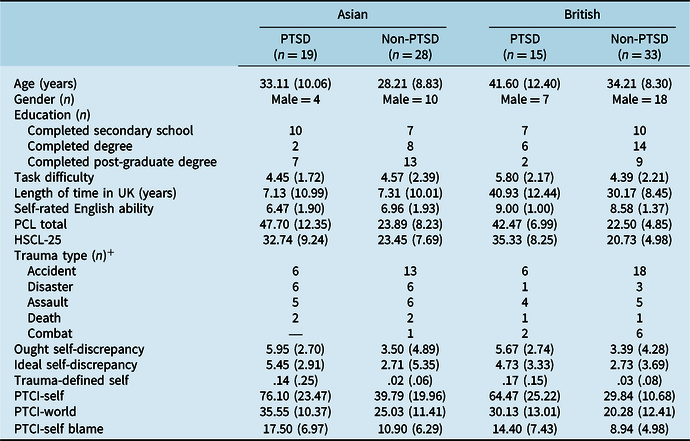
Participant demographic characteristics and post-trauma adjustment scores presented in Table 3 were drawn from previously collected data (see Engelbrecht and Jobson, Reference Engelbrecht and Jobson2014). Table 3 also presents novel data on measures of post-trauma self-concept and negative self-appraisals. As expected the Asian group (mean = .37, SD = .30) had a significantly greater interdependent ratio on the ‘I am’ than the British group (mean = .27, SD = .28), t (94) = 1.74, p < .05 (two-tailed). Those with PTSD scored significantly higher on the PCL than those without PTSD, F (1,91) = 154.17, p < .001, ηp2 = .63. The cultural main effect and interaction were not significant. Those with PTSD also had significantly higher symptoms of depression than those without PTSD, F (1,91) = 59.52, p < .001, ηp2 = .40. The culture main effect and interaction were not significant. There was a group difference in trauma type χ2 (4, N = 95) =10.36, p = .04. There were non-PTSD group differences in trauma type.
Mean demographic details, self-discrepancy scores, trauma-defined actual self scores and PTCI scores

+ Disaster, natural disaster; Assault includes sexual and non-sexual assault; Death, witness sudden death; PCL, Post-Traumatic Stress Disorder Checklist; HSCL-25, Hopkins Symptom Checklist-25; PTCI, Post-Traumatic Cognitions Inventory.
Hypothesis 1: Cultural differences in self-discrepancies
A 2 (culture; Asian vs British) × 2 (PTSD status; PTSD vs non-PTSD) × 2 (self-discrepancy; ideal vs ought) mixed ANOVA indicated that contrary to our hypothesis, the culture main effect was non-significant, F (1,92) = .11, n.s., ηp2 = .001.
Hypothesis 2: Post-traumatic adjustment
As predicted, for self-discrepancy, the PTSD main effect was significant, F (1,92) = 8.58, p < .01, ηp2 = .09; those with PTSD had greater self-discrepancies than those without PTSD. All the interactions were non-significant, F < 1. Thus, there was no evidence to suggest that culture influenced the PTSD main effect. The self-discrepancy main effect was also significant, F (1,92) = 5.68, p = .02, ηp2 = .06.
A 2 (culture; Asian vs British) × 2 (PTSD status; PTSD vs non-PTSD) ANOVA found that, as predicted, the PTSD group reported greater trauma-defined self-concept compared with the non-PTSD group, F (1,92) = 17.33, p < .001, η2 = .16. The interaction was non-significant, F (1,92) = .21, n.s., ηp2 < .01, suggesting that culture did not influence this PTSD effect. The culture main effect was also non-significant, F (1,92) = .12, n.s., ηp2 = .001.
Additionally, as an exploratory analysis, we found that for both cultural groups trauma-themed self-concept significantly correlated with depression, British, r (46) = .58, p < .001, 95% CI [.31–.85]; Asian, r (43) = .43, p < .01, 95%CI [.19–.66]. For both cultural groups, ought self-discrepancy did not correlate significantly with depression, British, r (46) = –.23, n.s., 95% CI [–.46–.01]; Asian, r (43) = –.25, n.s., 95% CI [–.51–.02]. While for the Asian group, ideal self-discrepancy did not correlate with depression, r (43) = –.04, n.s., 95% CI [–.34–.22], for the British group, ideal self-discrepancy did correlate significantly with depression, r (46) = –.26, p < .05, 95% CI [–.48–.02].
Hypothesis 3: Relationship between distortions in self-concept and appraisals
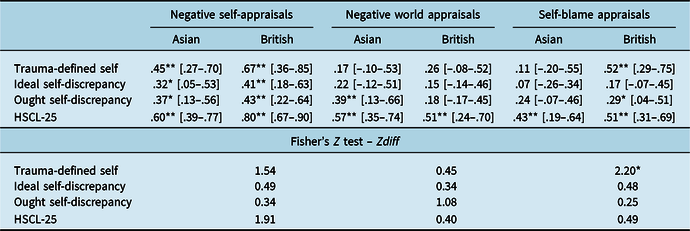
As shown in Table 4, in support of Hypothesis 3, pan-culturally trauma-defined self-concept correlated significantly with negative self-appraisals, with medium to large effect sizes observed. Additionally, for the Asian group, ought self-discrepancies correlated significantly with negative world appraisals, with a medium effect observed. For the British group, ought self-discrepancies and trauma-defined self-concept both correlated significantly with self-blame appraisals. Fisher’s Z-scores comparisons found that the British and Asian correlation coefficient for the association between trauma-defined self-concept and self-blame appraisals significantly differed (Table 4). Additionally, depression was found in both cultural groups to correlate significantly with negative self appraisals, negative world appraisals and self-blame (see Table 4).
Correlation coefficients [95% CI] between trauma-defined self-concept, self-discrepancies and negative self-appraisals for the British and Asian groups and Fisher’s Z comparisons

HSCL-25, Hopkins Symptom Checklist-25. *p ≤ .05, **p < .01.
Discussion
Study 2 investigated the three hypotheses in a sample of Asian and British trauma survivors with and without PTSD. In terms of Hypothesis 1, there was no significant cultural group main effect for self-discrepancy. This contradicts the findings of Study 1. We cannot be certain as to why these cultural differences were not evident in Study 2, but it may be possible that the length of time that the Asian participants had spent in the UK had impacted on these cultural influences. There was support for Hypothesis 2. Those with PTSD had significantly greater disruptions in self-concept (i.e. self-discrepancy and trauma-defined self-concept) than those without PTSD, regardless of participant’s cultural background. Therefore, unlike Study 1, in a clinical sample we found that distortions in self-concept differentiated between those with and without PTSD, regardless of cultural background. Hypothesis 3 was also supported. Pan-culturally disruptions in self-concept were significantly correlated with negative self-appraisals. Additionally, for the Asian group, ought self-discrepancies correlated significantly with negative world appraisals and for the British group ought self-discrepancies and trauma-defined self-concept correlated significantly with self-blame appraisals. The British and Asian correlation coefficients differed significantly for the association between trauma-defined self-concept and self-blame appraisals. Furthermore, regardless of cultural group, all PTCI subscales correlated with depressive symptoms, as were disruptions to self-concept.
There were several limitations associated with Study 2. First, in Study 2 there were no significant cultural differences in our findings. We cannot be certain of the robustness of these findings given the possibility that several factors (e.g. such as time in the UK, acculturation, language) may have influenced the findings. Therefore, we suggest that the findings of Study 2, whilst increasing our understanding of self-concept, self-discrepancy and self-appraisals in PTSD, does not adequately address our second aim which was to investigate the influence of culture on these relationships. Thus, future research is needed to systematically explore these issues. Second, the sample size of British and Asian trauma survivors was small, potentially influencing the statistical power to detect group differences. Third, the Asian group was considered as a single, collectivistic population, with the Caucasian British group on the extreme individualism side. As outlined in Study 1, this approach has been adopted in previous literature (e.g. Jobson and O’Kearney, Reference Jobson and O’Kearney2008; Wang and Ross, Reference Wang and Ross2005) and Study 2 found that the Asian group scored significantly higher on interdependence than the Caucasian British group, providing evidence for the expected cultural differences in self-construal in the dimension of independence/interdependence. However, future studies would benefit from employing a cross-country design. Additionally, the Asian and British participants differed on various demographic factors which may have influenced finings. However, when these differences were included as covariates, a similar pattern of results remained.
General discussion
The current research investigated distortions in self-concept (i.e. trauma-defined and self-discrepancies) and trauma-related negative self-appraisals in PTSD. We also aimed to examine whether these relationships differed depending on one’s cultural background. In terms of Hypothesis 1, there was support for our predictions in Study 1. Asian participants reported significantly greater self-discrepancies than British participants. These findings are consistent with previous cross-cultural research, which indicates that a consistent self-concept may be less valued in Eastern cultures and that those from Eastern cultures report greater self-discrepancy than their Western counterparts (Choi and Choi, Reference Choi and Choi2002; Cukur, Reference Cukur2002; Heine, Reference Heine2001; Heine and Lehman, Reference Heine and Lehman1997; Heine et al., Reference Heine, Lehman, Markus and Kitayama1999; Markus and Kitayama, Reference Markus and Kitayama1994; Suh, Reference Suh, Diener and Suh2000, Reference Suh2002). However, in Study 2, there was no support for this first hypothesis. We cannot be certain as to why these cultural differences were not evident in Study 2. It seems possible that Asian participants’ length of time in the UK (which was substantially greater than Asian participants used in Study 1) and associated factors (e.g. acculturation, language) may have had an influence on our findings. Therefore, the cultural inferences that can be drawn from the findings of Study 2 are potentially limited. Additionally, whilst we found pan-cultural similarities in self-aspects that differentiated between those with and without PTSD, future research needs to further systematically investigate whether culture does indeed influence these relationships.
In support of Hypothesis 2, in Study 2 pan-culturally trauma-defined self-concept and discrepancies in self-concept differentiated between those with and without PTSD. This supports the notion that endorsing negative aspects of the self-concept is associated with poorer psychological adjustment, regardless of cultural background (Gage et al., Reference Gage, Coker and Jobson2015). Furthermore, post-traumatic disruption in one’s self-concept was found to be associated with depression regardless of cultural group or clinical status. These findings indicate depression to be a common post-traumatic reaction following a trauma or highly stressful life event and is not necessarily unique to PTSD (Wells et al., Reference Wells, Morlan, Torres, Kloezeman, Mackintosh and Aarons2017). Researchers and clinicians would benefit from considering how these factors may contribute to depressive sequalae, for instance targeting a trauma-defined or distorted self-image could reduce negative self-evaluations and foster positive adaptation. However, the relationship between commonly co-occurring disorders such as PTSD and depression is not well understood (Stander et al., Reference Stander, Thomsen and Highfill-McRoy2014) and would benefit from further investigation.
There was also support for Hypothesis 3. In Study 1 (British group only) and Study 2 (both cultural groups) trauma-defined self-concept and self-discrepancies correlated significantly with negative self appraisals. Additionally, for the Asian group, trauma-defined self-concept (Study 1) and ought self-discrepancies (Study 2) correlated significantly with negative world appraisals. For the British group trauma-defined self-concept correlated significantly with negative world appraisals (Study 1) and trauma-defined self-concept (Study 2), and self-discrepancies correlated significantly with self-blame appraisals (Studies 1 and 2). Therefore, our findings suggest that disruptions in the self-concept are associated with negative self-evaluations (e.g. Liss et al., Reference Liss, Schiffrin and Rizzo2013). That is, if there is post-traumatic disruption in the self-concept is likely to be associated with negative appraisals of the self (e.g. ‘I am weak’, ‘I can’t cope’), appraisals that are proposed to play a role in the maintenance of PTSD (Ehlers and Clark, Reference Ehlers and Clark2000).
The findings support cognitive models of PTSD which claim that both self-appraisals and self-concept are associated with PTSD (Brewin, Reference Brewin2011; Brewin et al., Reference Brewin, Dalgleish and Joseph1996; Ehlers and Clark, Reference Ehlers and Clark2000). Following trauma, disruptions may occur in the self-concept and these disruptions appear to be regardless of the cultural background of the trauma survivor. Specifically, the trauma experience can become central to one’s self-concept and trauma survivors can perceive their self-concept as not being in line with the way they feel their self-concept should and would ideally like to be. These distortions in self-concept, in turn, may result in negative self-appraisals which over time has been found to be involved in the maintenance of PTSD (Dunmore et al., Reference Dunmore, Clark and Ehlers1997; Ehlers and Clark, Reference Ehlers and Clark2000). Thus, the results highlight the role of the self (i.e. trauma-identified self, self-discrepancies, negative self-appraisals) in PTSD and the importance of considering self-concept and self-appraisals in therapeutic interventions. For instance, self-schema work could address trauma-caused ‘vulnerable identities’ (Brewin and Holmes, Reference Brewin and Holmes2003), integrating current views of the self (e.g. ‘I am a victim’) into existing self-knowledge and the life story, and make sense of the trauma with respect to existing aspects of their self-concept and goals (Hembree and Foa, Reference Hembree, Foa, Reinecke and Clark2004) and targeting the relationship between appraisals and self-concept.
The limitations of the research are acknowledged. First, sample sizes were modest, which potentially limits statistical power and generalisability. Second, the studies were cross-sectional, which precludes causal explanations. Third, participants were asked to complete all tasks in English. This may have impacted on appraisals and identity for participants in the Asian group. Therefore, future studies may benefit from participants completing measures in their native language. Fourth, there were sampling concerns associated with both studies. Specifically, in Study 1 participants were self-selected university students who volunteered to take part in the research. Therefore, this is may not be a representative sample of either British or Asian populations, nor representative of trauma patients from either cultural group. Additionally, the Asian participants consisted of participants from several different countries with potential differences in their cultures and possible differences in their cognitive appraisals of trauma and self-concepts. Also, the majority of participants were female, which limits the generalisability of the findings. In Study 2, participants were also self-selected. These sampling concerns need to be considered when interpreting the findings. Fifth, although increasing numbers of immigrants from Asia are re-settling in Western cultures and cultural psychologists are consequently increasingly their focus from international comparisons to an examination of Asian immigrants in Western cultures (Ross and Wang, Reference Ross and Wang2010), employing a cross-country design in future studies may allow for greater exploration of cultural influences on the variables and would reduce the influence of the new culture on self-concept. Moreover, one needs to be mindful of the potential contributions of ‘culture shock’ to the findings, especially in Study 1 where the international Asian student sample had on average only been in the UK for a little over a year, which may have also contributed to higher levels of depression and distress being evident in this group. Additionally, it is worth considering the impact of acculturation on findings, especially in Study 2 where Asian participants had been in the UK varying amounts of time. Therefore, the research would have potentially benefited from measures of acculturation, culture shock and general cultural orientation. Such factors indicate that the cultural inferences that can be drawn from the current research may be limited and while overall it seems that pan-culturally there were similar influences in terms of the self and PTSD, future research needs to systematically investigate whether cultural mechanisms influence these relationships. Additionally, it is important to consider that measuring psychological variables in our Asian groups may have been influenced by the type of instruments used. Although the measures used have been validated in Asian populations, it is possible that there are cultural differences in understanding of self-concept, such as the meaning of ‘weak’. Finally, future research would benefit from examining trauma survivors from similar trauma types, as different trauma types (e.g. interpersonal) may influence the self-concept differently. Despite these limitations, the findings suggest distortions in self-concept are associated with PTSD, regardless of their cultural background. Such findings warrant further investigation into how self-concept can influence PTSD recovery.



Comments
No Comments have been published for this article.