




No CrossRef data available.
Article contents
- Extract
- The Relationship between Efficacy and Civic and Political Participation
- Opportunities for Efficacy Are Often Desirable
- The Limits of Political Efficacy as a Curricular Goal
- De-Politicizing Political Engagement: A Widespread Trend?
- The Challenge for Civic Educators
- Rethinking Political Efficacy as a Curricular Goal
- Biographies
- References
The Limits of Political Efficacy: Educating Citizens fora Democratic Society
Published online by Cambridge University Press: 25 April 2006
Article contents
- Extract
- The Relationship between Efficacy and Civic and Political Participation
- Opportunities for Efficacy Are Often Desirable
- The Limits of Political Efficacy as a Curricular Goal
- De-Politicizing Political Engagement: A Widespread Trend?
- The Challenge for Civic Educators
- Rethinking Political Efficacy as a Curricular Goal
- Biographies
- References
Extract
Justin is not alone. In a recent study of high school seniors fromCalifornia, for example, only 28% agreed that “I think people ingovernment care about what people like me and my family need” (Kahne and Middaugh 2005). Related findingsare common. A survey by the National Association of Secretaries ofState, for example, revealed that two-thirds of all young peopleagreed that “our generation has an important voice, but no one seemsto hear it.” Moreover, those youth who were least trusting were alsothe least likely to vote, to believe that government can affecttheir lives, or to pay attention to politics (National Association of Secretaries of State 1999).These findings, combined with numerous other indicators that showlow and in many cases declining civic and political participation,indicate that forms of engagement required for a participatorydemocracy to thrive are in need of attention (Macedo et al.2005).The initial research forthis essay was generously supported by a grant from the SurdnaFoundation. Subsequent research and writing was generouslysupported by the Social Sciences and Humanities Research Councilof Canada. We also wish to thank Melinda Fine, Barbara Leckie,Tobi Walker, and James Youniss for helpful feedback on earlierdrafts. The authors are solely responsible for any and allconclusions.
Information
- Type
- FEATURES
- Information
- Copyright
- © 2006 The American Political Science Association

Justin is not alone. In a recent study of high school seniors from California, for example, only 28% agreed that “I think people in government care about what people like me and my family need” (Kahne and Middaugh 2005). Related findings are common. A survey by the National Association of Secretaries of State, for example, revealed that two-thirds of all young people agreed that “our generation has an important voice, but no one seems to hear it.” Moreover, those youth who were least trusting were also the least likely to vote, to believe that government can affect their lives, or to pay attention to politics (National Association of Secretaries of State 1999). These findings, combined with numerous other indicators that show low and in many cases declining civic and political participation, indicate that forms of engagement required for a participatory democracy to thrive are in need of attention (Macedo et al. 2005).
In response to such concerns, educators and policy makers have stepped up efforts to promote young people's participation in political and civic affairs. A common strategy for doing so has been through service learning curriculum and community service activities that provide youth with readily-accessible opportunities to make a difference in their communities: elementary school students have cleaned up local parks; middle and high school students have brought food baskets to homeless shelters and volunteered in local hospitals, old-age homes, and recycling centers; college students have wet their civic feet by organizing and participating in a host of community projects to assist those in need. Indeed, unlike many measures of formal political engagement, rates of volunteerism among young people have risen dramatically over the past decade (Putnam 2000). Those hoping to foster civic and political engagement have often been supportive of these developments, believing that they will help young people recognize the value of giving back, will teach important skills, and will build their commitment to further engagement. One principal way this will happen, the argument goes, is by developing students' sense of efficacy. Eyler and Giles (1999), for example, argue that a sense of efficacy is a key building block for civic commitment. Indeed, many educators believe that if we shore up young people's sense of efficacy (their confidence that they can make a difference), then their levels of civic and political engagement will rise.
In this article, we discuss some surprising findings from our study of 10 nationally recognized programs that engaged youth in community-based experiences and aimed to develop democratic values. Many, but not all, of these initiatives employed service learning activities. We should note at the outset that our study was not intended to measure the relationship between efficacy and civic and political engagement. However, data from the two-and-a-half year study led us to question the common assertion that efficacious community experiences will necessarily prepare youth for participation in the democratic life of the community. The observations we detail below do not constitute a definitive proposition about the relationship between efficacy and rates of civic and political engagement. Rather, we offer a cautionary tale of some potential shortcomings of programs that emphasize efficacy and, likewise, highlight some possible value to experiences where students encounter roadblocks rather than success. We conclude by describing some ways educators might respond to some of the limits of efficacy when preparing citizens for life in a democratic society.
The Relationship between Efficacy and Civic and Political Participation
Researchers have identified a strong connection between an individual's sense that they can make a difference—their sense of efficacy—and their level of civic participation.1
We adopt a relatively traditional conception of efficacy in political and civic endeavors: the belief that what you or those in the community do can bring positive change (see Bandura 1977).
[T]he belief in one's competence is a key political attitude. The self-confident citizen appears to be the democratic citizen. Not only does he think he can participate, he thinks others ought to participate as well. Furthermore, he does not merely think he can take part in politics; he is likely to be more active.” (257)
Similarly, Conway found that those with high levels of political efficacy are 20–30% more likely to vote than those with low levels of efficacy, and similar relationships have been found to other forms of civic participation (in Berman 1997, 44; also see, Niemi and Associates 1974; and National Association of Secretaries of State 1999).
The strong relationship that social scientists have identified between young people's sense that they are competent civic actors and their desire to participate seems to provide a clear rationale for promoting positive educational experiences that can be shown to boost participants' sense of efficacy. Evidence from our study, in fact, supports these conclusions. But we will also show that these relationships are not as straightforward as they may seem. We will make two points in this regard:
- Exposure to certain kinds of constraints, although frustrating, can also help students learn about the ways power structures, interest group influences, and technical challenges can limit the ability of concerned citizens to bring about change.
- Shining the spotlight exclusively on efforts to promote efficacy may lead educators to emphasize non-controversial charitable activities. When charity and voluntary direct-service activities become the primary way in which educators teach about citizenship in a democracy, such curricula can reinforce the assumption that if individual citizens would just help out where help is needed, that these acts of kindness and charity (multiplied across a citizenry) will transform society and offer redress for complex social problems.
Indeed, emphasizing efficacy may promote a false victory by obscuring the need to understand how various governmental policies and market structures can both create and respond to different social problems. This focus may also distract attention from examination of various controversial social topics even though learning to thoughtfully and respectfully engage controversial issues is a fundamentally important component of schooling in a democracy (Noddings 1999; Oakes et al. 2000; Hess 2002). We will explore these limits of efficacy in some detail below. First, however, we turn to the supportive role an emphasis on efficacy can play in developing students' civic capacities and dispositions.
Opportunities for Efficacy Are Often Desirable
Our two-and-a-half year study of 10 programs that aimed to instill democratic values in youth and young adults included dozens of observations, 116 interviews, and just under 600 pre/post surveys that focus on changes in attitudes related to civic participation. We visited each program for a few days at least once each year to interview students and teachers and to observe the program in action. To illustrate our observations about efficacy we focus on two of these programs. Both programs were created through partnerships between the respective schools and outside curriculum developers. We were not involved in the design of the programs. We focus on these two programs because (a) they both worked with high school seniors in social studies classes and (b) the teachers who designed and implemented these programs employed strategies that had differing impact on students' sense of efficacy.2
For additional details on our methods please see Westheimer and Kahne 2004). For information on other programs in this study, please contact the authors.
Madison County Youth in Public Service
The story of Madison County Youth in Public Service demonstrates the ways an emerging sense of civic and political efficacy can contribute to students' civic and political commitments. As part of a Jefferson High School government course, students in this program worked in small groups with various government agencies on community-based projects. These internships required that small groups of students work on public service projects in their county's administrative offices. One group, for example, studied the feasibility of curbside recycling. They conducted phone interviews of 150 residents, undertook a cost analysis, and examined maps of the city's population density to determine which parts of the city should be served in this way. These students examined charts of projected housing growth to estimate growth in trash and its cost and environmental implications. Another group identified jobs that prisoners incarcerated for less than 90 days could perform and analyzed the cost and impact of similar programs in other localities. Other students helped to develop a five-year plan for the fire and rescue department.
In all of these projects, students were responsible for interacting with government agencies, writing reports, and presenting findings. The students' considerable successes were aided by a great deal of administrative footwork beforehand. For each of the projects, the school district's instructional supervisor coordinated contacts at the appropriate government agencies, worked with those agencies to structure appropriate and engaging projects, and found liaisons who were excited about working with students. In short, Madison County Youth in Public Service was structured for success—designed so that students succeeded in what they set out to do.
And succeed they did. The group of students organizing the recycling drive wrote an editorial based on their analysis that was published in their local newspaper. Making the case for improved funding for the fire and rescue department, one group of students calculated the number of minutes it would take for fire trucks to reach the widely disparate elementary schools in their rural district. Their calculations were publicized and the community responded with interest. Another group made a presentation about their efforts on behalf of the community to the county's Board of Supervisors.
Consistently, when discussing their experiences in this program, students expressed satisfaction with all they had accomplished and with the recognition they received for these accomplishments. As one student explained, “I thought it was just going to be another project. You know, we do some research, it gets written down and we leave and it gets put on the shelf somewhere. But, this [curbside recycling] is … really going to happen.” A different student told us, “I didn't realize this was going to be as big as what it is. I mean, we've been in the newspaper … four times.” And another student reported, “I didn't expect it to have such an impact. I thought it would be one of those classes where we all talk about it and … they'd nod and smile, [but] we really had an effect on what is happening.”
The Madison County program provided numerous opportunities for students to learn skills and to be exposed to information that, in addition to their accomplishments, enhanced their sense of political efficacy. For example, when high school students needed to make their presentation to their county's Board of Supervisors, each group worked with their teacher and with their field site supervisor to plan their presentation. They got tips on how to make their brief presentations interesting, on how to generate visual aids with computer software, and on how to insure that their primary message was communicated.
Perhaps most important from the standpoint of civic involvement, students linked their sense of efficacy (stemming from their emerging sense of capacity and from the impact of their work) to their desire for continued civic participation. For example, Eddie noted, “I didn't realize we had as much influence as we did. One person can really make a change in the community.” When we asked him whether this changed the way he thought about being a citizen, he replied that, after the experience with local government agencies, he thought that,
[All citizens] have a responsibility to voice their opinion by either writing letters or talk[ing] to people who control the county government, or state and federal government. Just let them know what you think about something that they're trying out. Maybe give new opinions or new ideas that you think would help.
Other students expressed similar satisfaction from what they accomplished as well as commitments to remain engaged in civic affairs in the future.
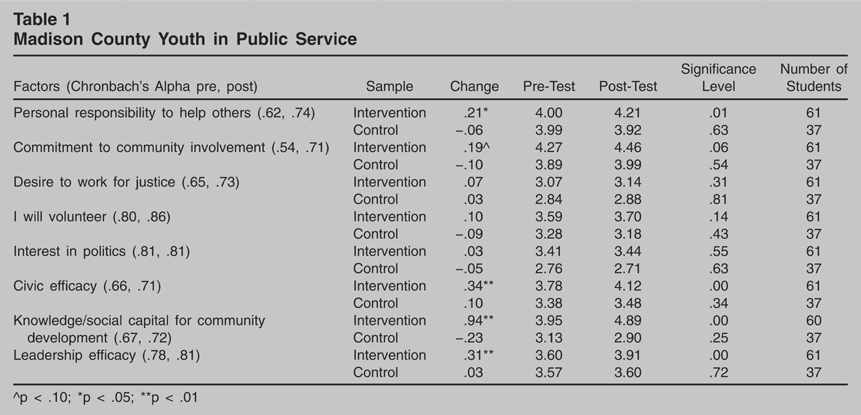
Our quantitative data was consistent with what we heard during interviews and saw during site visits. As detailed in Table 1, there were statistically significant changes in pre/post-Likert scale scores on several of our measures. In fact, we found a significant increase in all three measures related to efficacy: civic efficacy, leadership efficacy, and students' sense that they had the knowledge and social capital needed to effectively promote community development.3
Our measure of civic efficacy included items which asked if students felt that they, “can make a difference in my community.” The measure of leadership efficacy assessed students' sense of their effectiveness as leaders—assessing their level of agreement with statements such as “Once I know what needs to be done, I am good at planning how to do it.” Our measure of social capital for community development assessed students' sense of their own knowledge and ability to promote community development. It asked, for example, if students feel they “know how to contact and work effectively with organizations in their community such as schools, businesses, and social service organizations.” For a complete list of items for these scales or for other measures used in the study, please contact the authors.
Our use of a control group adds to our confidence in these results. The control group had similar academic skills and was taught by the same two teachers. This control group did not show statistically significant changes on any of the items we measured.
Madison County Youth in Public Service

Youth Action
Youth Action provides an interesting contrast to the Youth in Public Service program. The program, part of a district-wide collaborative effort, was created by the teachers at Woodrow Wilson High School.5
We are using the pseudonym “Youth Action” to denote a program that takes place in a school we have written about elsewhere (Westheimer and Kahne 2004). In this article we focus on the first year the program was implemented. After this first year, the curriculum was entirely restructured, bearing little resemblance to the curriculum analyzed herein. In writing that concerns subsequent years, therefore, we gave the program a different pseudonym so that the two instantiations would not be confused.
Students' experiences working on these community-based activities were uneven. Some students were engaged in in-depth projects that were powerful; others were engaged in projects that were badly thwarted. Their problems stemmed from two related dynamics. First, none of the government, school, and community agencies was prepared beforehand to expect contact from the students. Consequently, when students sought to investigate issues they frequently were turned away, ignored, or, in the students' words, “not taken seriously.” In addition—and more important for our purposes here—the projects students pursued challenged the status quo. While students in Madison County worked with city officials on projects, those in Youth Action criticized and sought to change various governmental and educational policies and programs from outside the system. Not surprisingly, Youth Action students encountered resistance.
Both qualitative and quantitative data regarding the students' frustrating experiences indicate that these experiences decreased their commitment to future civic involvement. In interviews, students reported high levels of frustration and a growing sense of hopelessness. They expressed a diminished sense of efficacy related to community improvement and questioned whether it is their responsibility to try. One student recalled her frustration this way:
We were trying to get anyone to listen to us but never got all the way through because we kept running into all this red tape that said “no you can't do that” [or] “Oh, you want to do that, well you'll have to go to that office over there.” [We] kind of got the impression that nobody really wanted to do anything about it.
This sense of frustration was widespread. In response to other interview and in-class reflection questions such as “What did you learn from these activities?” other students answered “If you go out into the community and try to do good, someone will pull you down,” “Basically, they were wasting our time and theirs too,” and “it's hard to get anyone to listen to you.”
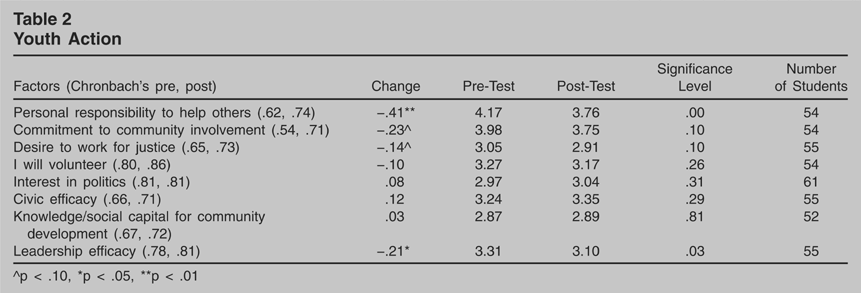
In most cases, the survey results, as shown in Table 2, were consistent with the interview data, reflecting the frustration students experienced in connection with their community-based activities. Numerous measures of students' orientation toward civic participation and community engagement declined. For example, students reported a sizable (−.50) and statistically significant decline when asked to indicate their level of agreement with the statement, “I want to become an effective leader in my community.” Students' sense of leadership efficacy also declined significantly. In addition, students' sense of personal responsibility to help others declined markedly and there were marginally significant declines in their commitment to community involvement and in their desire to work for justice.6
Our sense, as is discussed later in the paper, is that this decline in the desire to work for justice was due to a diminished desire to be engaged and not to a diminished sense of the importance of such work.
Youth Action

Thus, while efficacious experiences promoted civic commitment among Madison County students, frustrating experiences resulted in diminished self-confidence and diminished commitment to future civic involvement in Youth Action students.
The Limits of Political Efficacy as a Curricular Goal
Given that Madison County's approach promoted civic commitments and Youth Action's program did not, a logical plan of action would be to promote the Madison County approach over that employed by Youth Action. In other words, educators interested in promoting young people's political engagement might focus their efforts exclusively on civic education experiences that provide students with the sense that they can make a difference. We would argue, however, that the choice between these two programs or approaches is not straightforward. While giving students a chance to make a difference clearly may have benefits, this approach may also have costs. Our perspective on the issues can be clarified by considering the difference between internal and external efficacy as educational aims.
The Difference between Internal and External Political Efficacy
Those who study attitudes toward political engagement draw a significant distinction between internal and external political efficacy (Balch 1974). Internal political efficacy refers to a person's sense of his or her own ability to participate effectively in the political process. People with high degrees of internal political efficacy believe they are capable when it comes to civic affairs. Measures of external political efficacy, on the other hand, reflect perceptions of governmental and institutional responsiveness to citizens' needs and demands.
Although findings are not uniform, internal political efficacy has generally been found to have a positive relationship to political activity and the closer the alignment of a specified measure of efficacy to the form of activity, the stronger the relationship (Wollman and Stouder 1991). Measures of external efficacy, on the other hand, have not exhibited a consistent relationship to activity. Indeed, Shingles (1981) and others have found high internal political efficacy and low external political efficacy prompted political activity among African Americans (see also Ennis and Schrener 1987; Harris 1999). Feeling both personal competence and that government is not responsive to the needs of African-American citizens prompted many African Americans to participate in political affairs (often through activities such as litigation and protest) to bring about more just laws and increased government awareness and action.
Implications for Civic Education
In many cases, it seems reasonable to structure curriculum to promote students' sense of internal efficacy—their sense of personal competence. This goal might be pursued by developing that competence (and recognition of that competence) through a variety of both experiential and traditional educational activities.
Structuring curriculum so as to promote students' sense of external efficacy, however, may be problematic. African Americans and Latinos, for example, have tended to have a lower sense of external political efficacy than do their White counterparts (see Niemi and Junn 1998; Abramson 1983). Such results likely reflect the fact that government and community institutions are less responsive to African Americans and Latinos than to European Americans. The appropriate response, therefore, is to increase government responsiveness—not to try and convince a disempowered group that mainstream institutions want to respond to their concerns. To do otherwise is to alter indicators of a healthy democracy without challenging the underlying ills.7
Highlighting a similar set of issues, Thomas (1970) identified a conservative bias in measures of personal efficacy. He found that those holding a conservative political ideology were more likely to express personal efficacy than those holding liberal beliefs. Since these judgments may reflect reasonable interpretations of lived experience, he argued that it therefore makes no more sense to try and convince liberals that they should have more efficacy than it does to convince conservatives that they should have less.
What makes attention to broad notions of efficacy as a goal particularly complex, therefore, is that curricular strategies that deal sensibly with external efficacy may not promote internal efficacy (Youth Action students may have learned valuable lessons about external efficacy, but their sense of internal efficacy suffered). Conversely, curriculum that attends primarily to internal efficacy may not help students consider issues related to external efficacy (Madison County students may have gained a greater sense of internal efficacy, but they did not consider many issues related to external efficacy). We elaborate on these dynamics below.
Revisiting the Evidence8 Since, as we noted earlier, our study was not designed
to examine the differential significance of internal and
external efficacy, our survey measures of civic and
leadership efficacy blended attention to internal and
external efficacy—though our measure of leadership efficacy
focused primarily on internal efficacy. Our interviews,
however, contained much rich detail about students' changing
perceptions of both internal and external efficacy. Given
this limitation, we view our findings as suggestive, but far
from definitive. Clearly, more in depth and focused
attention to these issues would be valuable.
Since, as we noted earlier, our study was not designed to examine the differential significance of internal and external efficacy, our survey measures of civic and leadership efficacy blended attention to internal and external efficacy—though our measure of leadership efficacy focused primarily on internal efficacy. Our interviews, however, contained much rich detail about students' changing perceptions of both internal and external efficacy. Given this limitation, we view our findings as suggestive, but far from definitive. Clearly, more in depth and focused attention to these issues would be valuable.
The Youth Action projects engaged high stakes problems that students found difficult to solve. While many school-based programs might have students clean up a nearby park or collect clothing or food for a local charity, the Youth Action students were engaged in ambitious projects that sought to expose structural injustices, sometimes forgoing more typical and bounded projects that do less to challenge existing power structures. Whether to support a publicly funded health care center for women or how to investigate bias in standardized tests, for example, are controversial and unresolved social policy questions. In addition, students were trying to mobilize for change on their own—rather than by working with an organization (governmental or otherwise) that was a legitimate player in the given context. Not surprisingly, when their efforts failed to illicit a meaningful response—let alone a change in policy—students' desire to participate in political and civic endeavors declined, as did their sense of leadership efficacy (a measure which emphasizes internal efficacy).
At the same time, however, that these experiences may have diminished students' sense of internal efficacy and thus undermined their commitment to civic action, they also appear to have sparked valuable insights related to questions of external efficacy. Kira reported, for example:
I think it's really hard to get things done that count for anything. I mean we can pick up litter all day long and get something done [that is temporary], but to try and get them to build a women's health center in our community, that's a tough task and no one wants to do it.
In interviews and in class, students expressed an often-realistic assessment of how difficult it is to accomplish meaningful and, at times, controversial tasks. And, interviews and observations reveal that students were deeply engaged in these activities and that most took them very seriously. For example, Tony observed that
“We really had no clue that so many people would be against a [publicly funded] health center, but when we started to see where people stood on this, it seemed like, well those who wouldn't get nothing from it, they were the ones who didn't want it.”
When asked what it would take to get a women's health center built, Kira responded, “You'd have to change a lot of people's minds about stuff and organize…. You'd have to fight for it.”
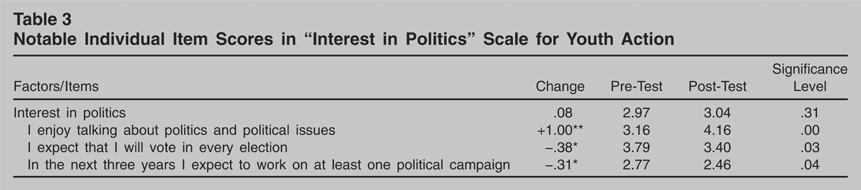
In addition, analysis of the survey data reveals important distinctions as well. For example, the scale measuring interest in politics showed no change. However, if we consider three of its items (see Table 3) we find movement in opposing directions. Two items related to political action (“interest in voting” and “interest in working on a campaign”) showed statistically significant declines of 0.38 and 0.31, respectively. At the same time, students reported a dramatic (+1.00) and statistically significant (p < .01) increase in “talking about politics and political issues.” In fact, this was the largest pre/post change of any item across all the programs we studied. Thus, the curriculum appears to have diminished students' sense of internal efficacy and, as a result, to have diminished their interest in related political activity, but not their overall interest in politics. Indeed, their interest in politically charged concerns and debates increased substantially.
Notable Individual Item Scores in “Interest in Politics” Scale for Youth Action

The Madison County Youth in Public Service curriculum offers lessons in this regard as well. While both qualitative and quantitative data indicate that these students showed impressive gains in their sense of civic and leadership efficacy, their interest in political discussion remained constant (see Table 1). We did not find evidence in student interviews, our observations, or our analysis of survey data that student projects examined ideological and political issues related to interest groups and the political process, the causes of poverty, different groups' access to health care, or the fairness of different systems of taxation (even though two projects focused on issues related to health care and taxation). Students focused on particular programs and policies and aimed for technocratic/value neutral analysis.
De-Politicizing Political Engagement: A Widespread Trend?
What is particularly troubling about this dynamic is that educators often are making this choice—emphasizing curricular strategies that develop internal efficacy but that obscure many issues related to external efficacy. For example, a great deal of curriculum fails to ask about the ways governments and other institutions respond to various individuals and social problems. What role is played by power, by interest groups, and by politics in structuring responses of key institutions to those who seek reform? What obstacles—political, social, and economic—hinder the collective pursuit of systemic change? (see Robinson 2000; Barber 1992). Data that the Department of Housing and Urban Development (HUD) collected on 599 college service-learning programs, for example, revealed that 50% were direct service (tutoring, serving food, clothes collections, blood drives), 42% provided technical assistance such as leadership classes and computer training, 7% emphasized physical revitalization such as tree planting and housing renovation, and only 1% were for political advocacy such as drafting legislation or building tenant councils (in Robinson 2000, 145). In addition, surveys of young people indicate movement in exactly this direction. For example, a study commissioned by the National Association of Secretaries of State (1999) found that less than 32% of eligible voters between the ages of 18 and 24 voted in the 1996 presidential election (in 1972, the comparable number was 50%), but that a whopping 94% of those aged 15–24 believed that “the most important thing I can do as a citizen is to help others.” In a very real sense, youth seem to be “learning” that citizenship does not require government, politics, or social action.
Indeed, in a separate analysis related to these issues, we found that the vision of citizenship embedded in particular curriculum mattered. Whether or not a curriculum emphasized structural issues or questions of social justice significantly influenced the kinds of civic and political insights and commitments that students developed (Westheimer and Kahne 2004). Walker, drawing on her teaching experiences with service learning at Rutgers University's Eagleton Institute of Politics, labels this phenomenon a “service/politics split” (2000). She describes the disposition of the students she has worked with this way:
[M]ost of them were filled with disgust, disillusionment, and even dread toward politics. They wanted to “make a difference” and they believed that the best way to do that was by helping another person one-on-one…. [C]hallenging decision-making structures … rarely entered their thinking.
Walker goes on to note that students involved in non-controversial activities that allow young people to “‘get things done’ and immediately see results” tend to think of civic engagement as “results driven activity” that do not challenge institutions in power. They are eager to feed the hungry but not to think about the causes of poverty or injustice; they tutor inner-city children, but do not ask why the schools have little in the way of resources. She concludes that her students learned a great deal about how to serve but little about affecting political change (2000).
Thus, while many programs that provide opportunities to work in the community may foster internal efficacy and may well be an effective way to increase students' enthusiasm for civic engagement, crucial questions of external efficacy and the skills needed to be efficacious in politically charged contexts get scant attention. Moreover, these programs may diminish or obscure both the importance of politics and the need to think about the impact and design of social institutions and structures.9
We also suspect that an emphasis on experiencing efficacy can sometimes lead to a focus on doing rather than thinking. Specifically, since careful analysis takes time away from action and since such analysis often highlights potential shortcomings of efforts that, on the surface, appear desirable, a commitment to efficacy may lead some educators to downplay analysis. This outcome is not inevitable, however. The programs we studied all emphasized academic and analytical work related to students' experiences.
The pursuit of a more just and equitable society requires more than individual efforts to make a difference. Students need to consider issues of external efficacy—to whom and in what contexts do government and other institutions respond. Attention to politics and to the ways institutions respond to or create social problems is also essential.
The Challenge for Civic Educators
Faced with this tension, what might educators do? In particular, how might good programs promote commitments to both politics and participation? Given the importance of experiences that promote internal forms of efficacy, how might these be promoted without obscuring structural issues and attention to social justice? We briefly note several prominent strategies here (also see Kahne and Westheimer 2003).
The kind of successful strategy employed in Madison County—placing students in efficacious organizations and having them join others in meaningful work—can be structured to emphasize root causes of problems while minimizing the potential sense of frustration and alienation that can occur when students work on their own on often intractable social problems. A clear and powerful example of this approach is provided in Youniss, McClellan, and Yates (1997) study of mostly African-American students enrolled in a Washington, D.C., catholic school. These students worked in soup kitchens and thus became part of efficacious institutions. This, combined with classroom analyses of poverty and homelessness did not necessarily provide them with a sense of complete success—but rather a vision of an ideal for which they and others could collectively strive. Frustration did not take hold of these students despite the fact that homelessness was not eliminated. Students became engaged in thinking about these issues and began to see themselves as capable of responding to a meaningful social problem.
Other strategies help carry students' sense of hope and vision as well. The Highlander Folk School in New Market, Tennessee, for example, seeks to engage students in a supportive community that can motivate and affirm the importance of challenging political structures and working for systemic change even when—or especially because—participants encounter strong resistance from governmental and non-governmental institutions. Numerous studies suggest that social bonds, a sense of affiliation, and support from a community with shared commitments can nurture and sustain civic involvement despite intimidating challenges and frustrating experiences (McAdam 1988; Youniss, McLellan, and Yates 1997).
Another program we studied at Berea College in Kentucky called the Overground Railroad had participants meet with individuals who were active in the civil rights movement. These individuals, who in some cases are still active in social change efforts today—individuals who stayed true to their convictions despite the challenges of their work—seemed to inspire students and buttress their sense of hope and civic commitments. They offered a compelling vision of a meaningful life and of the potential efficacy of collective social action.
Another program brought high school students in a Spanish language class together with Spanish-speaking adults to help the adults prepare for their upcoming citizenship exam—a highly satisfying and efficacy-building volunteering experience. Simultaneously, the students toured the community and studied the social, political, and economic conditions of the local town, and of other Hispanic communities in the United States and in Latin America. Through this work, students gained an increased awareness of underlying political concerns. Students, spoke (in Spanish), for example, about the high incidence of lead paint in houses in this community, about cycles of poverty, and about inadequate public services.
Rethinking Political Efficacy as a Curricular Goal
Young people today have too few opportunities to recognize their potential contributions to civic and political life. The Madison County Youth in Public Service program highlights the substantial impact that experiences of success can provide. But this is not the complete story.
The impact of the frustration Youth Action students experienced is also worthy of careful attention. While the experiences of students in Youth Action demonstrate that exposure to some authentic community dynamics can diminish students' sense of internal efficacy and in the process limit their commitment to future civic or political involvement, other indicators demonstrate the value of engaging students in analysis of significant and difficult-to-solve social problems. Part of the frustration Youth Action students experienced resulted from real world barriers to change. Students appeared to report low external efficacy because, in fact, external factors were barriers to change. We are reluctant to reject the value of these authentic experiences even though the recognition of their limited external efficacy may have also diminished students' internal efficacy as well as their motivation for active involvement in civic action. Emphasizing only efficacious acts because they permit students to experience success in helping others without confronting constraints on their external efficacy can advance a limited understanding of civic and political engagement. Such practices obscure the need for politics and for confronting root/institutional causes of social problems. This is made more worrisome by the fact that numerous societal norms and incentives will lead teachers and students to focus on civic activities that avoid major social problems and analysis of root causes of injustice and inequality. Such service activities are less controversial, easier to fund, and enjoy widespread public support. They also provide opportunities for promoting internal efficacy. While increasingly common, we are concerned that such activities will not provide sufficient preparation for the often contentious and difficult challenge of working to understand and change the social, economic, and political dynamics that surround complex issues such as poverty, caring for the environment, or racism. If teachers and students decide that such problems are hopeless or, alternatively, that it is easier to pursue a vision of citizenship that avoids conflict, the full promise of democracy will not be realized.
At the same time, authenticity alone—to the extent that it conveys a sense of hopelessness—is not desirable. The Youth Action curriculum aimed to promote commitments to active civic engagement. The democratic promise of such curriculum is not fulfilled if students “learn” that civic and political engagement is pointless. Rather, educating citizens for a democratic society requires that students gain a sense that they can make a difference and also identify, analyze, and challenge social and institutional practices as they work to create a more just society.
Biographies
Joseph Kahne is the Kathryn P. Hannam Professor of American Studies and professor of education at Mills College, Oakland, CA. A former New York City public school teacher, he studies urban school reform and the democratic purposes of schooling, directs the doctoral program in educational leadership, and is director of Research at the Institute for Civic Leadership at Mills (www.mills.edu/ICL). He is the author of Reframing Educational Policy: Democracy, Community, and the Individual, published by Teachers College Press. Joe Kahne can be reached at jkahne@mills.edu.
Joel Westheimer is University Research Chair and professor in the social foundations of education at University of Ottawa where he co-directs Democratic Dialogue, a research collaboration for inquiry into democracy, education, and society (www.democraticdialogue.com). A former New York City public schools teacher, he writes on democracy, social justice, service learning, and community. He is author of Among Schoolteachers: Community, Autonomy, and Ideology in Teachers' Work (Teachers College Press). Westheimer is currently working on a book on patriotism and the threat to American Education. He can be reached at joelw@uottawa.ca.
References
Abramson, P.
1983. Political Attitudes in
America: Formation and Change. San Francisco:
W. H. Freeman.Google Scholar
Almond, G. A., and
S.
Verba. 1963. The
Civic Culture: Political Attitudes and Democracy in Five
Nations. Princeton, NJ: Princeton
University Press.Google Scholar
Balch, G.
1974. “Multiple
Indicators in Survey Research: The Concept ‘Sense of Political
Efficacy.’” Political Methodology
1: 1–43.Google Scholar
Barber, B.
1992. An Aristocracy of Everyone:
The Politics of Education and the Future of America.
New York: Ballantine Books.Google Scholar
Berman, S.
1997. Children's Social
Consciousness and the Development of Social
Responsibility. New York: State University of
New York Press.Google Scholar
Ennis, J. G., and
R.
Schrener. 1987. “Mobilizing Weak Support for Social Movements:
The Role of Grievance, Efficacy, and Cost.” Social
Forces
66: 390–409.Google Scholar
Eyler, J., D. E.
Giles
Jr.
1999. Where's the Learning in
Service-Learning?
San Francisco: Jossey-Bass.Google Scholar
Harris, F. C.
1999. “ Will the Circle be
Unbroken? The Erosion and Transformation of African-American
Civic Life.” In Civil Society, Democracy, and Civic
Renewal, ed. R.
Fullinwider. New York: Roman and
Littlefield, 317–338.Google Scholar
Hess, D.
2002. Teaching to Public
Controversy in a Democracy. In Education in
Democracy for Social Studies Teachers: Principles and Practices
for the Improvement of Teacher Education, ed.
J.
Patrick. Bloomington,
ERIC/ChESS.Google Scholar
Kahne, J., and
J.
Westheimer. 2003.
“Teaching Democracy: What Schools Need to
Do.” Phi Delta Kappan
85 (1): 34–40,
57–66.Google Scholar
Kahne, J., and
E.
Middaugh. 2005.
“Preparing Citizens for Democracy: Strategies and
Indicators.” Presented at the Education and the
Civic Purposes of Schools conference, San Jose, Costa
Rica.Google Scholar
Macedo, et al. 2005. Democracy at Risk: How Political Choices
Undermine Citizen Participation, and What We Can Do About
It. Washington, D.C.: Brookings
Institution.Google Scholar
National Association of Secretaries of State.
1999. New Millennium
Project-Phase I: A Nationwide Study of 15–24 Year Old
Youth. Alexandria, VA: The Tarrance
Group.Google Scholar
Niemi, R. G., and
J.
Junn. 1998.
Civic Education: What Makes Students Learn. New
Haven: Yale University Press.Google Scholar
Niemi, R. G., and
Associates. 1974. The
Politics of Future Citizens. San Francisco:
Jossey-Bass.Google Scholar
Oakes, J., et al.
2000. Becoming Good American
Schools: The Struggle for Civic Virtue in Education
Reform. New York: Jossey-Bass.Google Scholar
Putnam, R.
2000. Bowling Alone: The Collapse
and Revival of American Community. New York:
Simon & Shuster.Google Scholar
Robinson, T.
2000. “Dare the
School Build a New Social Order?” Michigan Journal of
Community Service Learning
7: 142–157.Google Scholar
Sax, L. J., A.
Astin, W. S.
Korn, and K.
Mahoney. 1999.
The American Freshman: National Norms for Fall 1999.
Los Angeles: Higher Education Research
Institute, UCLA.Google Scholar
Shingles, R. D.
1981. “Black
Consciousness and Political Participation: The Missing
Link.” American Political Science Review
75: 76–91.Google Scholar
Strauss, A.
1990. Basics of Qualitative
Research: Grounded Theory, Procedures and Techniques.
Newbury Park, CA: Sage.Google Scholar
Thomas, L. E.
1970. “The
Internal-External Scale, Ideological Bias and Political
Participation.” Journal of Personality
38: 273–286.Google Scholar
Walker, T.
2000. “The
Service/Politics Split: Rethinking Service to Teach Political
Engagement.” PS: Political Science and Politics
33 (3): 647–649.Google Scholar
Westheimer, J., and
J.
Kahne. 2004. “What Kind of Citizen? The Politics of Educating
for Democracy.” American Educational Research
Journal
41 (2): 237–269.Google Scholar
Wollman, N., and
R.
Stouder. 1991. “Believed Efficacy and Political Activity: A
Test of the Specificity Hypothesis.” Journal of
Social Psychology
131 (4): 557–567.Google Scholar
Youniss, J., J.
A.
McClellan, and M.
Yates. 1997. “What We Know about Engendering Civic
Identity.” American Behavioral Scientist
40 (5): 620–631.Google Scholar
Youniss, J., and
M.
Yates. 1997.
Community Service and Social Responsibility in Youth.
Chicago: University of Chicago
Press.Google Scholar
Madison County Youth in Public Service
Youth Action
Notable Individual Item Scores in “Interest in Politics” Scale for Youth Action
 You have Access
- 147
- Cited by