





Introduction
Measles incidence in the United States has increased as vaccination rates have decreased. In 2024, the Centers for Disease Control and Prevention (CDC) reported 285 confirmed cases of which 198 (69%) occurred during 16 outbreaks. In contrast, in 2025, CDC reported 2,242 cases, 1,994 (89%) of which occurred during 49 outbreaks. 1 CDC reported that 6% of non-imported measles cases in the United States during 2001–2014 occurred in healthcare settings. Reference Fiebelkorn, Redd and Kuhar2 However, transmission in healthcare facilities has accounted for 14% to 93% of cases during outbreaks. Reference Maltezou and Wicker3–Reference Torner, Ferràs and Curto4
Measles outbreaks in healthcare settings have caused poor patient outcomes, including deaths. Reference Marshall, Hlatswayo and Schoub5 In addition, healthcare professionals (HCPs) are at two to eight Reference Atkinson, Markowitz, Adams and Seastrom6 times higher risk of acquiring measles than the general public. Reference Maltezou and Wicker3,Reference Dayan, Ortega-Sánchez, LeBaron and Quinlisk7,Reference Shefer, Atkinson and Friedman8 Staff who are either not immune to measles or whose status is unknown must be excluded from work during the incubation period, which adversely affects staffing. Moreover, the resultant infection prevention and public health investigations and interventions can be very expensive. Reference Torner, Ferràs and Curto4,Reference Shefer, Atkinson and Friedman8,Reference Helmecke, Elmendorf, Kent, Pauze and Pauze9,Reference Pike, Leidner and Gastañaduy10 Pike et al found that the median cost was $152,308 per outbreak, $32,805 per case, and $223 per contact. Reference Pike, Leidner and Gastañaduy10 Workdays lost to employee furloughs are often the major cost. Reference Chen, Anderson and Kutty11,Reference Rivera, Mason, Ross and Wright12
Factors associated with measles exposures in health care have included: Reference Maltezou and Wicker3,Reference Helmecke, Elmendorf, Kent, Pauze and Pauze9,Reference Chen, Anderson and Kutty11,Reference Limavady, Tu and Bedford13 (1) the virus has a high basic reproduction number (R0) and is highly transmissible by droplet nuclei that remain suspended in the air for hours; Reference Guerra, Bolotin and Lim14 (2) persons with measles can spread the virus four days before the rash appears, often leading to misdiagnosis and multiple healthcare visits before patients are diagnosed and put in airborne isolation; Reference Maltezou and Wicker3,Reference Moss15 (3) many HCP have never seen patients with measles and thus may not include measles in their differential diagnosis for a patient with fever and diffuse rash; Reference Maltezou and Wicker3 (4) patients may present with atypical symptoms and signs; Reference Cornelissen, Grammens and Leenen16 and (5) patients and visitors congregate in lobbies and in waiting rooms, which may increase the number of people exposed. Reference Maltezou and Wicker3
Potential infection prevention gaps that can impede infection prevention investigations and interventions include (1) inability to identify when patients are in specific areas of the facility, Reference Helmecke, Elmendorf, Kent, Pauze and Pauze9 (2) inadequate definitions of measles immunity, Reference Helmecke, Elmendorf, Kent, Pauze and Pauze9 (3) differing immunization policies for employed and non-employed healthcare personnel, (4) lack of or inadequate documentation of measles immune status for employed and non-employed healthcare personnel, Reference Chen, Anderson and Kutty11 (5) lack of an easy way to access this information 24/7, (6) inability to easily track where infected visitors were and identify visitors who may have been exposed, and (7) lack of information about the number of air exchanges per hour in different areas of their facilities. Reference Helmecke, Elmendorf, Kent, Pauze and Pauze9 Given these gaps, the increasing measles incidence and the consequences of measles exposures in healthcare facilities, we developed this survey to assess how well US hospitals are prepared to identify and isolate patients with measles and to identify common infection prevention and employee health gaps that could facilitate measles transmission.
Methods
The Infectious Diseases Society of America’s Emerging Infections Network (EIN) is a provider-based emerging infections sentinel network funded by the CDC. Reference Pillai, Beekmann, Santibanez and Polgreen17 Two current EIN member physicians (HB and LH) developed a 9-question survey in collaboration with the EIN program staff (PP and SEB) (Supplementary Data: http://www.int-med.uiowa.edu/Research/EIN/MeaslesIPquery_final.pdf). The EIN e-mailed an electronic link to 787 EIN physician members with infection prevention/hospital epidemiology responsibilities or interests on July 10, 2025 and sent reminders to non-responding physicians on August 7 and September 3. The survey was closed on September 10.
Respondents could opt out of the survey by responding that measles infection prevention was not within their scope of practice. Since respondents were not required to answer every question, denominators vary by survey question. EIN program staff linked saved practice data for each member physician with survey responses. We maintained the participants’ confidentiality. The University of Iowa’s Institutional Review Board has deemed EIN surveys to be non-human subjects research, thus, exempting surveys from IRB review. We used SAS v9.4 to analyze survey data.
Results
Respondents’ practice characteristics
Of 787 eligible EIN members (those who had responded to a prior survey), 225 responded (29%); 72 opted out of the survey as measles infection prevention was not within their scope of practice leaving 153 respondents who answered survey questions. Most respondents (105/153; 69%) practiced adult infectious diseases, 45 (29%) practiced pediatric infectious diseases, and 3 (2%) practiced both. The Pacific (17%), Mid Atlantic (14%), and South Atlantic (19%) US Census Divisions accounted for the practice locations of 50% of the respondents. Moreover, most respondents were experienced infectious disease physicians (72% had practiced >15 years since their fellowships) and most practiced in a university (39%) or non-university teaching hospital (31%).
Measles immunization of healthcare personnel
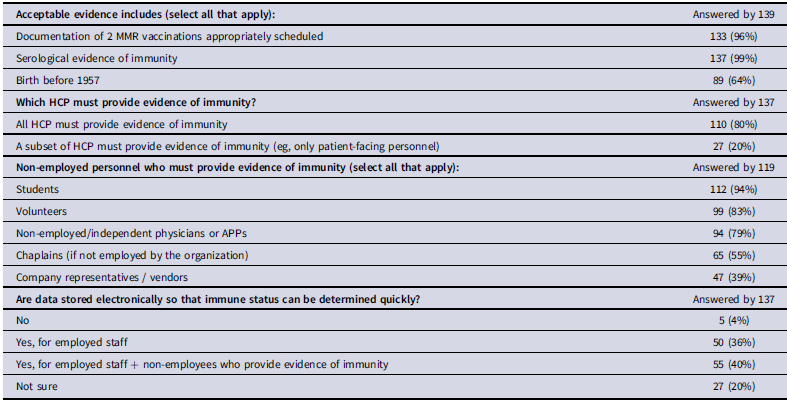
Of the 153 respondents, 139 (91%) reported that their institution requires evidence of immunity to measles for at least some persons (Table 1) of whom 137 (99%) selected serological evidence, 133 (96%) selected documentation of two appropriately scheduled MMR vaccinations, and 89 (64%) selected birth before 1957. Together these three responses (86/139, 62%) were the most common immunity criteria combination selected. Most respondents (110/137, 80%) indicated that all HCP must provide evidence of immunity. Students were the most common non-employed personnel required to provide evidence of immunity, followed by volunteers, non-employed/independent physicians or advanced practice providers, and chaplains not employed by the organization; only 39% reported that company representatives/vendors must provide evidence of immunity. Of note, 35/119 (29%) chose all five categories of non-employed personnel. Finally, when asked if measles immunity data are stored electronically such that the immune status of exposed personnel can be determined quickly, 36% chose “yes” for employed staff, 40% chose “yes” for employed staff plus non-employees who provide evidence of immunity, 20% chose “not sure,” and 4% chose “no.”
Measles immunization of healthcare personnel (HCP).
139 (91%) reported that their institution requires evidence of immunity to measles.

Table 1. Long description
The table presents survey responses about measles immunity requirements for healthcare personnel and non-employed personnel. It has 10 rows and 2 columns. The first column lists the questions or categories, and the second column lists the number of respondents and the percentage. Row 1: Acceptable evidence includes (select all that apply): Answered by 139. Row 2: Documentation of 2 MMR vaccinations appropriately scheduled: 133 (96 percent). Row 3: Serological evidence of immunity: 137 (99 percent). Row 4: Birth before 1957: 89 (64 percent). Row 5: Which HCP must provide evidence of immunity?: Answered by 137. Row 6: All HCP must provide evidence of immunity: 110 (80 percent). Row 7: A subset of HCP must provide evidence of immunity (eg, only patient-facing personnel): 27 (20 percent). Row 8: Non-employed personnel who must provide evidence of immunity (select all that apply): Answered by 119. Row 9: Students: 112 (94 percent). Row 10: Volunteers: 99 (83 percent). Row 11: Non-employed/independent physicians or APPs: 94 (79 percent). Row 12: Chaplains (if not employed by the organization): 65 (55 percent). Row 13: Company representatives / vendors: 47 (39 percent). Row 14: Are data stored electronically so that immune status can be determined quickly?: Answered by 137. Row 15: No: 5 (4 percent). Row 16: Yes, for employed staff: 50 (36 percent). Row 17: Yes, for employed staff + non-employees who provide evidence of immunity: 55 (40 percent). Row 18: Not sure: 27 (20 percent).
Note. APPs, advanced practice provider.
Thirteen respondents wrote comments in response to this question, 6 of whom stated that their ability to access data on measles immunity varied by whether the person was employed by the hospital or by another entity (eg, a clinic). One respondent indicated that the facility did not have electronic proof for their physicians and advanced practice providers; the respondent did not specify whether the facility employed these providers. Four respondents noted that they had some restrictions on their ability to access this information (ie, outside business hours; for “privacy reasons;” due to state law; for employees who were hired before records were digitized). Two respondents addressed gaps in our understanding of immunity in response to the question “What infection prevention issues still need to be addressed?” One respondent noted that “We need more precision on who is immune.” The other noted that we need to better understand how the time from the last vaccination affects immune status and whether the risk of transmission varies with the number of vaccinations.
Identification of exposed patients
The survey asked whether respondents could quickly (within hours) obtain information to help determine who might have been exposed. Of the 153 respondents, 134 (88%) could get check-in times, 116 (76%) could get the time patients were put in exam/patient rooms, 124 (81%) could get check-out times, and 108 (71%) could get the time spent in a specific area. One hundred (65%) respondents could access the data for all four time elements. Seven respondents provided additional comments, three of whom indicated they could access this information for some locations but not for others. One noted that the facility rapidly identified “at-risk patients” for two measles exposures. In contrast, another respondent noted that the information could be obtained but it was “hard to get the right staff to do it in the moment.” Two respondents addressed gaps in our ability to identify exposed persons when responding to the question “What infection prevention issues still need to be addressed?”. One respondent stated that we need “digital tools” to “help rapidly identify exposed personnel, patients, and, visitors” since this information is often collected manually. The other respondent noted that staff in outpatient offices and urgent care centers needed to “know how to identify and quarantine exposed patients, and know testing protocols.”
“Shared air space” exposures
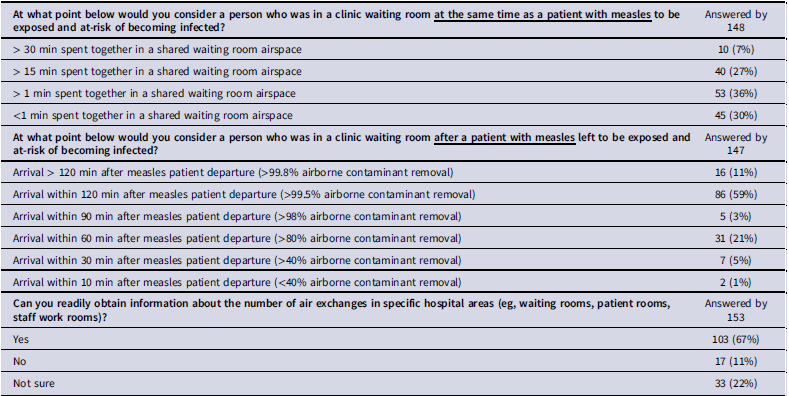
The survey asked three questions about “shared air space” and potential exposures. The survey provided four answer options (Table 2) to the question “At what point would you consider a person who was in a clinic waiting room at the same time as a patient with measles to be exposed and at-risk of becoming infected?” Respondents most frequently chose “More than 1 min spent together in a shared waiting room airspace” (53/148; 36%). The survey provided six answer options (Table 2) for the question “At what point would you consider a person who was in a clinic waiting room after a patient with measles left to be exposed and at-risk of becoming infected?” Respondents most frequently chose “Arrival within 120 min after measles patient departure” (86/147; 59%). Sixty-seven percent (103/153) of respondents indicated that they could readily obtain information about the number of air exchanges in specific areas (eg, waiting rooms, patient rooms, staff workrooms). We identified 43 different response combinations for these three questions together. The most commonly chosen combination was “More than 1 min spent in a shared waiting room airspace,” + “Arrival within 120 min after a measles patient departure” + “Yes” to availability of air exchanges (25/153; 16%). The second most common response differed only in that the time spent in a shared waiting room was <1 min (19/153; 12%).
“Shared air space” exposures

Table 2. Long description
The table presents survey responses about exposure risks in clinic waiting rooms. It has three sections with a total of 12 rows and 2 columns. The first section addresses the time spent in a shared waiting room airspace with a measles patient, with four response options. The second section addresses the time of arrival in the waiting room after a measles patient has left, with six response options. The third section asks if information about the number of air exchanges in specific areas can be readily obtained, with three response options. Row 1: More than 30 min spent together in a shared waiting room airspace, 10 (7 percent). Row 2: More than 15 min spent together in a shared waiting room airspace, 40 (27 percent). Row 3: More than 1 min spent together in a shared waiting room airspace, 53 (36 percent). Row 4: Less than 1 min spent together in a shared waiting room airspace, 45 (30 percent). Row 5: Arrival more than 120 min after measles patient departure, 16 (11 percent). Row 6: Arrival within 120 min after measles patient departure, 86 (59 percent). Row 7: Arrival within 90 min after measles patient departure, 5 (3 percent). Row 8: Arrival within 60 min after measles patient departure, 31 (21 percent). Row 9: Arrival within 30 min after measles patient departure, 7 (5 percent). Row 10: Arrival within 10 min after measles patient departure, 2 (1 percent). Row 11: Yes, 103 (67 percent). Row 12: No, 17 (11 percent). Row 13: Not sure, 33 (22 percent).
Seven of 13 respondents who provided comments indicated that this information was available for some areas and not for others (eg, lobbies or leased offices). In response to the question “What infection prevention issues still need to be addressed?” four respondents stated that we need to better define exposure and to better understand exposure time including the risk associated with the time in shared space and the time since the case departed.
Management of measles exposures
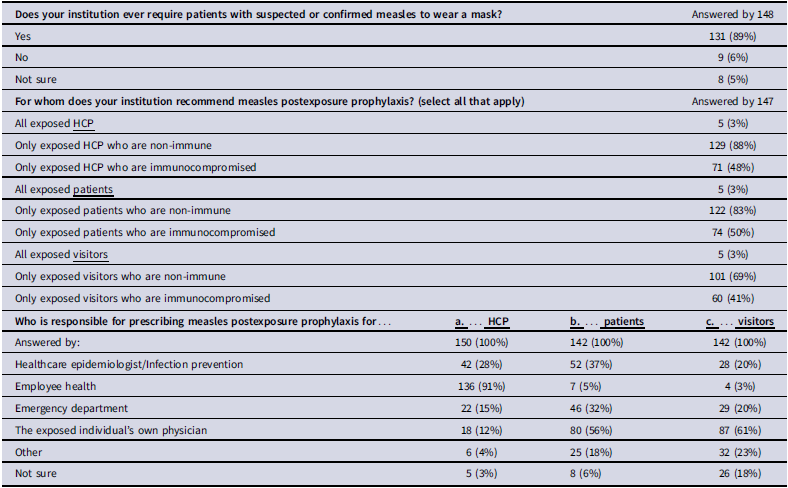
The survey asked three questions about prevention or management of measles exposures (Table 3). Of the 148 respondents, 131 (89%) reported that their institution requires patients with suspected or confirmed measles to wear a mask. This question generated multiple explanatory comments. Respondents noted that patients were required to wear masks when: outside of an isolation/AII room (n = 14), while being transported (n = 12), in common areas (n = 5), on entry to the facility/everywhere (n = 5), and in clinical/patient care areas (n = 4).
Management of measles exposures

Table 3. Long description
The table presents survey responses on measles exposure management protocols, focusing on mask requirements and postexposure prophylaxis. It has three main sections with multiple rows and columns. The first section addresses whether institutions require patients with suspected or confirmed measles to wear a mask, with 131 respondents (89 percent) answering yes, 9 (6 percent) answering no, and 8 (5 percent) not sure. The second section asks for whom institutions recommend measles postexposure prophylaxis, with options for healthcare workers (HCP), patients, and visitors, and their immune status. The third section identifies who is responsible for prescribing postexposure prophylaxis for HCP, patients, and visitors, listing roles such as healthcare epidemiologist/infection prevention, employee health, emergency department, the exposed individualʼs own physician, other, and not sure. Each row provides specific responses and percentages for these categories.
Note. HCP, healthcare professional.
Survey respondents were asked to identify exposed individuals—HCP, patients, and visitors—for whom their institution recommended measles postexposure prophylaxis (PEP; Table 3). Non-immune and immunocompromised HCPs, patients, and visitors was the most commonly selected combination response (47/147, 32%). Most (91%) respondents reported that employee health staff were responsible for prescribing measles PEP (Table 3) for HCP and that primary care providers were responsible for prescribing PEP for patients’ (56%) and visitors’ (61%).
Open-text field comments regarding measles infection prevention issues that should be addressed
Forty-six respondents provided free text responses about infection prevention issues regarding measles that still need to be addressed. In addition to the comments noted above, respondents identified issues related to public health and to diagnostic testing as common gaps. Of the public health-related comments, four addressed communication and coordination between public health departments and healthcare facilities, three addressed adverse effects of changes in federal policies and priorities, one addressed streamlining testing, and one addressed coordination with other state health departments. Six respondents identified needed improvements in diagnostic testing, four of which addressed the need for faster turn-around-times. One respondent indicated that commercial laboratories should standardize the specimens needed for diagnostic testing and one noted that clarification on when to submit urine for measles polymerase chain reaction (PCR) would be helpful. Other gaps included education, particularly about measles recognition (three respondents), infection prevention plans for women in labor and for postpartum and neonatal care (two respondents), and staffing levels (one respondent) and the number of airborne isolation rooms during outbreaks (one respondent).
Discussion
The United States had interrupted continuous endemic measles spread by 2000. Subsequently, vaccine hesitancy has increased and vaccination rates have decreased to the point that vaccination rates in many states are now less than 95%, the level needed for herd immunity Reference Williams, Kates and Josh18 and multiple states have experienced measles outbreaks. 1 Given these trends, EIN surveyed its members to assess healthcare facilities’ readiness to prevent measles spread among their staff, patients, and visitors. The survey identified multiple gaps that increase the risk of measles spread within healthcare facilities, hamper exposure investigations and interventions to prevent spread, and also increase the difficulty and expense of these efforts.
Essentially all respondents indicated that their facilities considered documentation of two appropriately scheduled MMR or positive measles serologies as evidence of measles immunity and most indicated that their facilities considered birth before 1957 as evidence of immunity. CDC accepts the latter as acceptable evidence of immunity for HCP “in routine circumstances” and also states that “healthcare facilities should consider vaccinating” these [HCP] if they “lack laboratory evidence of immunity.” 19 In addition, 20% of respondents indicated that their facilities required only a subset of HCP and non-employed personnel to provide this evidence. Given measles’ transmissibility, a single infected person can transmit measles virus to multiple people who can, in turn, infect more non-immune people. In addition, less than half of the respondents indicated that their facility stored measles immunity data electronically. Thus, many facilities are vulnerable to measles transmission and many will have difficulty identifying HCP’s immune status. This difficulty will hinder their investigations and likely will increase the cost since they will either need to give PEP to most or all exposed HCP or they will need to do serosurveys to identify those who are non-immune and need PEP.
CDC does not specify the exposure duration that increases a non-immune person’s risk of measles. Rather, CDC’s guidelines state that people who were in a shared air space with a person who has measles and were not wearing respiratory protection are potentially exposed, 20 which suggests that even short exposures could increase the risk. However, 26% of our respondents indicated that persons needed to share an airspace for >15 min with a person who has measles to be considered exposed, and 7% of respondents required >30 min. These responses suggest that a substantial proportion of exposed persons could be missed in healthcare facilities that apply those criteria. On the other hand, 11% considered that a person who enters the airspace >120 min after the person with measles leaves would be exposed; this approach could potentially unnecessarily increase workload and the cost of exposure workups and postexposure interventions.
The number of air exchanges affects the rate at which measles virus will be removed from the airspace and, thus, can affect the number of people exposed. 21 However, only 67% of respondents indicated that they could get information on the number of air exchanges in specific hospital areas. Twelve respondents added caveats regarding their ability to get this information. Most caveats described areas for which the information was not available or addressed limits on the accessibility or reliability of the data. This gap could cause infection prevention teams to miss both persons who likely were exposed and opportunities to decrease the risk of future exposures by increasing the number of air exchanges in high-risk areas like waiting rooms in emergency departments and clinics. This gap could also cause investigators to include people who likely are not at risk because the area in which they worked or were waiting had adequate air exchanges, but the infection prevention team did not have access to this information.
Six percent of respondents indicated that their hospital does not require patients who have measles to wear a mask. This practice may not be problematic if the patients do not leave a negative pressure room. However, these patients could spread the virus if they leave their rooms for tests or treatments, and they do not wear a “face mask” as recommended by CDC. 22
CDC recommends that HCP who do not have “presumptive evidence of immunity to measles” and who are exposed to measles should receive PEP. 23 Despite this recommendation, some respondents indicated that their institutions did not recommend PEP for non-immune HCP (12%), non-immune patients (17%), or non-immune visitors (31%). A higher percentage of respondents indicated that their institutions did not recommend PEP for immunocompromised HCP (52%), immunocompromised patients (50%), or immunocompromised visitors (59%). Visitors are difficult to identify without contacting all of the patients who could have been exposed and public health departments might take the lead on contacting those that can be identified, which may in part explain why fewer facilities recommend PEP for visitors. Nevertheless, these gaps could increase the risk that some HCP, patients, and visitors might acquire measles and could serve as sources for continuing measles spread.
A major limitation for this study was the fact that most respondents practiced in university or non-university teaching hospitals, which are more likely to have infectious disease consultants and to have more infection prevention and employee health resources than smaller less academic healthcare facilities. Thus, the survey results may not be generalizable to other healthcare facilities. However, we suspect that gaps may be more common in those settings given their more limited resources. Fewer respondents practiced in the New England, West North Central, East South Central, and Mountain Census Divisions; therefore, our findings may not be generalizable to these Divisions. Finally, some institutions could be represented by more than one respondent.
In conclusion, our findings highlight a lack of readiness across US healthcare facilities to prevent, identify, and mitigate measles outbreaks. Although most of the respondents’ hospitals have immunization requirements, we identified substantial issues including the lack of accessible electronic measles immunity records, misunderstandings about the criteria for immunity, and criteria for exposure, and lack of information about air exchanges by location. These gaps not only increase the likelihood of measles transmission but also increase the administrative and financial cost of exposure investigations. To prevent these consequences, healthcare facilities could use the survey questions (Supplementary Data: http://www.int-med.uiowa.edu/Research/EIN/MeaslesIPquery_final.pdf) to assess and improve their own measles preparedness and response.
Acknowledgments
None.
Financial support
This work was supported by two cooperative agreements from the Centers for Disease Control and Prevention: grant numbers NU50CK 000574 and U01 CK000613-01.
Competing interests
LH has received povidone iodine from 3 M and PDI for unrelated clinical trials. HB does not have conflicts of interest. KB does not have conflicts of interest. SEB received in-kind registration and lodging as staff for IDWeek 2024 from IDSA. PP has received unrelated grants or contracts from the National Institutes of Health and Pfizer, Inc. He received unrelated consulting fees from Eli Lily. His travel to meetings was reimbursed by the Bronchiectasis and NTM Association and the NTM Research Consortium.

 Open access

