Maize (Zea mays ssp. mays), or corn, developed as a domesticated crop in central Mexico more than 9,000 years ago and was adopted by Archaic foragers of the North American Southwest by around 2550–2050 cal BC (Hanselka Reference Hanselka and Vierra2018:281). From there, maize dispersed north and east over many regions of North America, with regional histories varying temporally, due to the genetic changes in maize as it adapted to selective environmental conditions, to human manipulation, and to the varying social and economic systems into which it was incorporated. By the time of European contact, maize was a significant crop in many Indigenous cultures. Documenting the arrival of this domesticate and charting its growing economic importance within specific geographical regions have remained of interest to North American archaeologists (e.g., Benz and Staller Reference Benz, Staller, Staller, Tykot and Benz2006; Johannessen and Hastorf Reference Johannessen and Hastorf1994; Smith and Cowan Reference Smith, Cowan and Minnis2003; Staller et al. Reference Staller, Tykot and Bruce F2006). For many Native tribes of the North American Plains, maize came to figure prominently in origin beliefs, ceremonies, rituals, and diet (Gilmore Reference Gilmore1977; Will and Hyde Reference Will and Hyde1964; Wilson Reference Wilson1987).
For decades, the earliest references for central Plains maize were isolated kernels and cob fragments from Middle Woodland Kansas City Hopewell (KCH) sites, dated by association to about AD 250. However, direct accelerator mass spectrometer (AMS) ages and δ13C values demonstrated that the remains were either not maize, as reflected by the δ13C isotopic value, or that they were associated with a later occupation than the context suggested (Adair Reference Adair and Minnis2003; Adair and Drass Reference Adair, Drass and Smith2011). Reported Middle Woodland maize from interior Midwest sites has also been AMS dated to the tenth and eleventeenth centuries AD (Simon Reference Simon, Raviele and Lovis2014, Reference Simon2017, Reference Simon2021), suggesting that maize did not arrive in these regions during the Middle Woodland.
Despite these refinements in our understanding of maize, the recovery of microbotanical remains of maize (phytoliths and starch granules) with directly associated AMS ages has provided a new approach to charting its presence and timing in archaeological contexts (Hart et al. Reference Hart, Lovis and Katzenberg2021; Lusteck Reference Lusteck, Staller, Tykot and Benz2006; Lusteck and Thompson Reference Lusteck, Thompson, Barnard and Eerkens2007; VanDerwarker et al. Reference VanDerwarker, Bardolph, Hoppa, Thakar, Martin, Jaqua, Biwer and Gill2016). Maize microremains from 16 sites located in the northeastern United States and Great Lakes region and 31 associated AMS dates on charred residue establish the presence for maize in the first several cal centuries BC (Hart et al. Reference Hart, Lovis and Katzenberg2021:Supplemental Table 1), centuries earlier than directly dated maize macroremains from the same region and centuries earlier than the macroremains from the Plains and interior Midwest.
As maize diffused from the Southwest to locations north and east, it likely crossed the southern and central Plains (Fritz Reference Fritz and Ubelaker2006:440). To account for the maize histories in the Northeast, sufficient time would be needed for maize to adapt to temperate latitudes as it was adopted by different groups. However, the oldest directly dated maize macroremain from the central Plains is AD cal 874 (δ13C of −9.48 and 2σ range of cal AD 777–977) and AD cal 810 (δ13C of −9.4 and 2σ range of cal AD 688–935) from the Avoca site (Adair Reference Adair and Minnis2003, Reference Adair2012), centuries later than the microbotanical evidence for early maize in the Northeast.
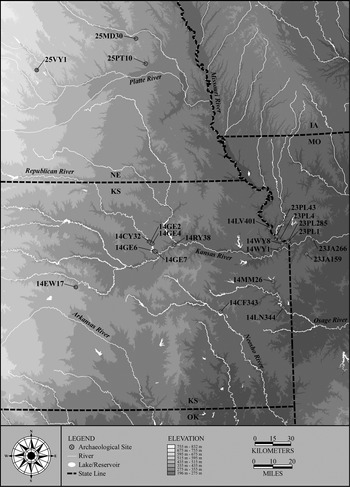
Using a combination of direct AMS radiocarbon dates and analyses of plant microremains, we address two issues: can early maize be identified from the central Plains, and if so, can such evidence help elucidate a potential route for the transmission from the Southwest? Thirty-five samples, including 24 ceramics (exhibiting both visible residue and absorbed residue), two ground stone, two soil samples, and seven dental calculus from 16 sites located in the eastern central Plains (Figure 1) were submitted for analysis. AMS dates were obtained from visible ceramic residue and from human remains.
Study area with location of sites discussed in text.

The Eastern Central Plains Region and Sites
The geographic region studied in this article includes the eastern portions of Kansas and Nebraska and the northwest section of Missouri (Figure 1). The Middle Woodland component (ca. 200 BC–AD 400) of this region is characterized by the Kansas City Hopewell (KCH; centered on the confluence of the Missouri and Kansas Rivers), Cuesta (southeast Kansas), Schultz (north-central Kansas), and Valley (eastern Nebraska).
These complexes differ in material culture, especially ceramics, levels of trade and interaction, mobility patterns, burial customs, and subsistence. For example, a foraging economy best describes Schultz, Valley, and Cuesta, with flotation providing evidence of plant cultivation for the KCH. Ceramic decorative styles suggest long-distance interactions with the Eastern Early Woodland complexes (Valley), the southeastern US Hopewell groups (Cuesta and KCH), and the Lower Illinois Valley (KCH). However, each complex likely emerged from earlier local adaptations (Johnson Reference Johnson1992; Keehner and Adair Reference Keehner and Adair2019; Martin Reference Martin2007; Schmits and Bailey Reference Schmits, Bailey and Schmits1989).
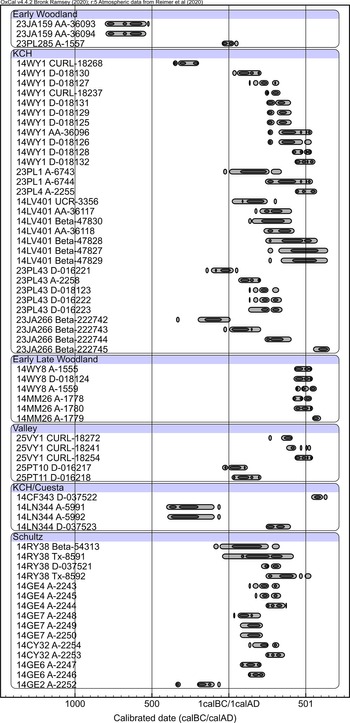
Refining the temporal range of these complexes included direct dating annual plant remains, visible ceramic residues, and human skeletal remains (Supplemental Table 1 and Supplemental Text 1). This establishes a temporal contemporaneity (Figure 2) and provides a chronological framework for the current analysis.
Calibrated AMS radiocarbon ages from sites discussed in text. Calibration was done with OxCal v4.4.2 Brock Ramsey (Reference Brock Ramsey2020); r:5 IntCal20 atmospheric curve (Reimer et al. Reference Reimer, Austin, Bard, Bayliss, Blackwell, Bronk Ramsey and Butzin2020).

Methodology
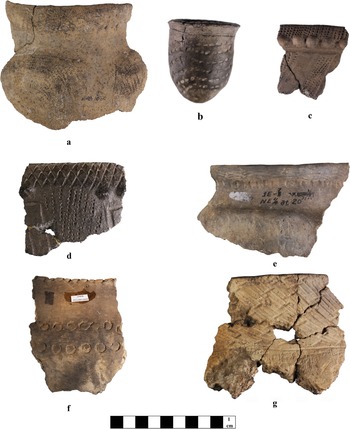
Curated collections were targeted for this study after a pilot project confirmed the preservation of starch and phytoliths in Plains Middle Woodland artifacts (Adair et al. Reference Adair, Duncan, Lusteck, Malainey and Perry2012). Artifacts and samples selected for this current study are listed in Table 1, and a representative sample of the selected pottery sherds is shown in Figure 3. Visible residue, identified by its distinctive polymeric char network (Crowther Reference Crowther2012:229), was also used for AMS dating. Dental calculus was collected from both Schultz and KCH burials for a total of seven samples from five sites. The residues were removed by researchers at the University of Kansas following established protocols (Lovis Reference Lovis1990; Supplemental Text 2).
Representative ceramic rim sherds from the study area: (a) Aker site, maize starch, 150 cal BC–cal AD 59; (b) James Younkin, maize starch; (c) 14LN344, maize starch, cal AD 243–401; (d) 14EW17, maize starch; (e) Trowbridge maize starch, cal AD 238–333; (f) Miller, cal AD 424–544; (g) 23PL285, cf maize starch, 44 cal BC–cal AD 61 (photos by Mason Niquette).

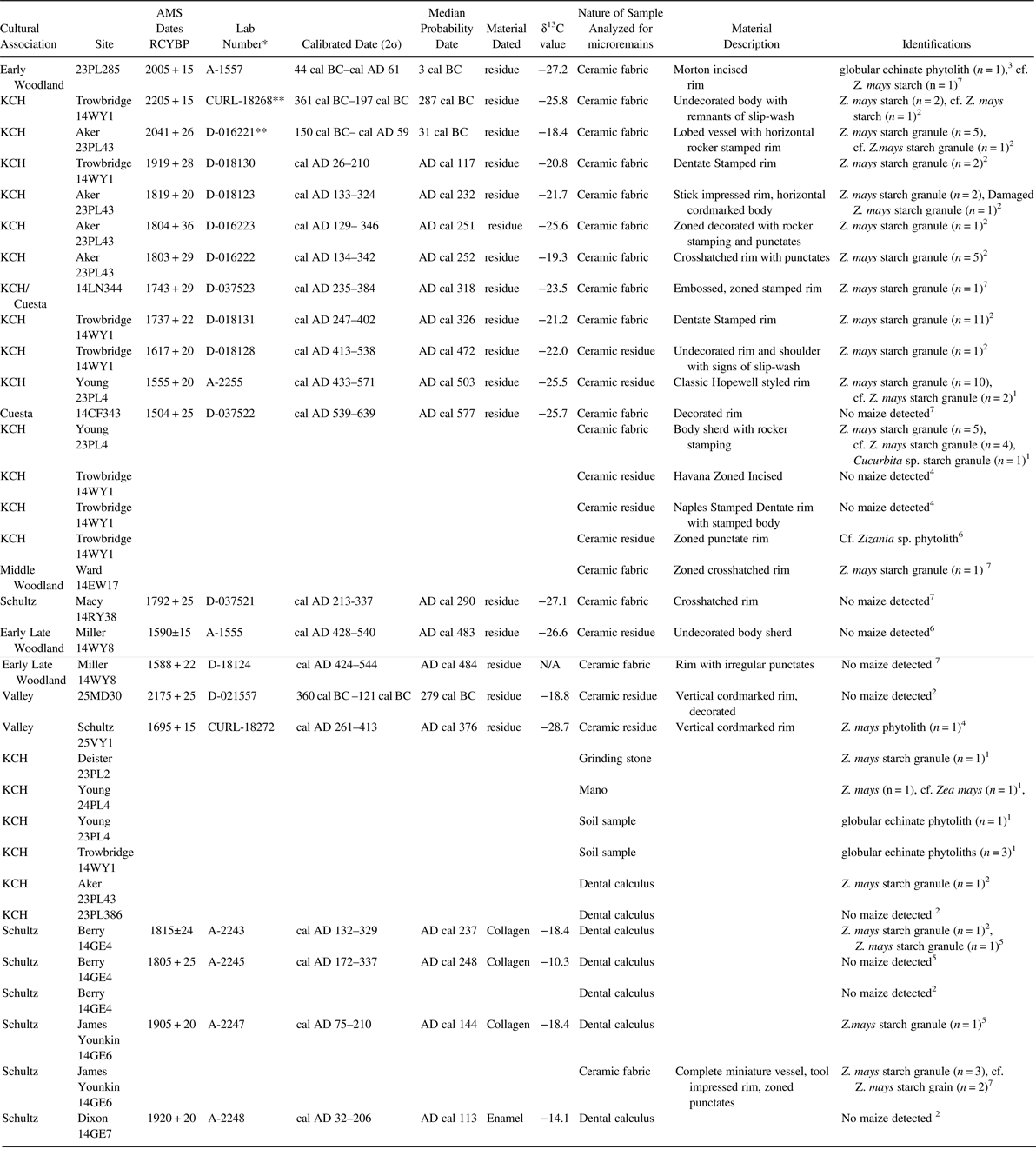
Identified Microbotanical Remains, with Artifact Description and Associated AMS Ages.

Notes: Identification made by 1Duncan and Pearsall Reference Duncan and Pearsall2012, 2Duncan and Young Reference Duncan and Young2018, 3Bozarth Reference Bozarth2011, 4Bozarth Reference Bozarth2014a, 5Bozarth Reference Bozarth2014b, 6Lusteck Reference Lusteck2012, 7Young and Duncan Reference Young and Duncan2020.
* Lab Designations: A = Illinois State Geological Survey; D = Direct AMS; CURL = University of Colorado, Boulder.
** δ13C values from Direct AMS and University of Colorado, Boulder labs are measured on the reduced graphite by the AMS and may not be an accurate reflection of environmental conditions or trophic and nutritional interpretations. The δ13C values may differ by about 1‰–3‰ when compared to the original material.
Two curated soil samples from the lower levels of pit features at Trowbridge and Young were also selected. In both cases, the pits contained diagnostic KCH ceramics and lithics. Context was also a consideration when selecting the grinding stone and mano from the KCH Young and Deister sites, respectively.
Samples were sent to one of the four labs (three analysists) over the course of the past 10 years. At all labs, the methodologies used for residue analysis were similar though not identical. After extraction, each analyst mounted the microremains on standard microscope slides, examined the slides under polarized light at high power, and used extensive comparative collections for the identification. The complete processing techniques, a discussion of lab contamination protocols, and comparative collections for accurate identifications for each lab are provided in greater detail in Supplemental Text 3.
Microscopic starch granules and phytoliths are produced in various plant parts; can be morphologically distinct at the family, genus, or species level (Pearsall Reference Pearsall2015; Pearsall and Piperno Reference Pearsall, Piperno, Pearsall and Piperno1993; Perry et al. Reference Perry, Dickau, Zarrillo, Holst, Pearsall, Piperno and Berman2007; Piperno et al. Reference Piperno, Andres and Stothert2000); and can resist degradation for thousands of years (Barton Reference Barton, Haslam, Robertson, Crowther, Nugent and Kirkwood2009; Piperno et al. Reference Piperno, Weiss, Holst and Nadel2004). For dental calculus, plant microremains are preserved during the mineralization process when dental plaque is converted to calculus and protected from breakdown by salivary amylase (Hillson Reference Hillson1996). The microscopic particles can become absorbed in the ceramic fabricFootnote 1 and can adhere within flake scars on chipped stone tools, within pockets on ground-stone implements, and within dental calculus (Henry and Piperno Reference Henry and Piperno2008; Skibo Reference Skibo1992). Starch found on an artifact represents either direct contact residue from use or from sediment transferred within the first several months of deposition (Haslam Reference Haslam2004).
Microbotanical Analysis Results
Table 1 provides a summary of the microremains identified from the project artifacts. Maize was identified in 60% of the samples, showing that this plant was cultivated or acquired and consumed by Middle Woodland groups in the central Plains. AMS dates provide direct chronological evidence for the use of maize from the cal third century BC through the fifth century AD. The presence of other plant microremains, including squash (Cucurbita sp.), wild rice (cf. Zizania spp.), and palm (Arecaceae sp.), support the existing macroremain assemblages or identify previously unknown plants.
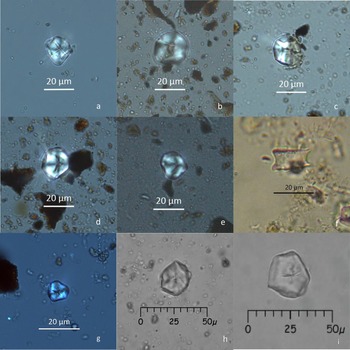
Starch granules (Figure 4a, b) recovered from ceramic fabric provide the earliest dates of 287 cal BC (range of 361–197 2σ cal BC) from Trowbridge and 31 cal BC (range of 150 2σ cal BC–cal AD 59) from Aker (Figure 3a). Starch granules recovered from the Morton Incised rim (Figure 3g) compare favorably to maize, with the residue dating to 3 cal BC (range of 344 2σ cal BC–cal AD 61). Eleven additional ceramic fabric samples and two visible residue samples produced evidence for maize. Direct dates on these samples range from AD cal 117 (2σ calibrated range AD 26–210) to AD cal 503 (2σ calibrated range of AD 433–571; Table 1, Figure 4c–g) and were recovered from KCH, Schultz (Duncan and Pearsall Reference Duncan and Pearsall2012; Duncan and Young Reference Duncan and Young2018; Young and Duncan Reference Young and Duncan2020), and Valley ceramics (Bozarth Reference Bozarth2014a).
Microbotanical remains of maize from ceramics from Early Woodland, KCH, and Middle Woodland: (a) Trowbridge maize starch granule, 361 cal BC–197 cal BC; (b) Aker maize starch granule, 150 cal BC–cal AD 59; (c) Trowbridge maize starch granule, cal AD 26– 210; (d) Aker maize starch granule, cal AD 129– 346; (e) Trowbridge maize starch granule, cal AD 247–402; (f) Schultz maize cob phytolith, cal AD 261–413; (g) James Younkin maize starch granule from pottery; (h) Young maize starch granule, cal AD 433–571; (i) Young maize starch granule from a mano. (Color online)

Undated maize starch granules were recovered from ceramic fabric from Young and from ground stone implements from Young and Deister (Figure 5a; Duncan and Pearsall Reference Duncan and Pearsall2012). No maize was detected in two Early Late Woodland (ca. AD 400–700) samples from the Miller site ceramics (Figure 3f).
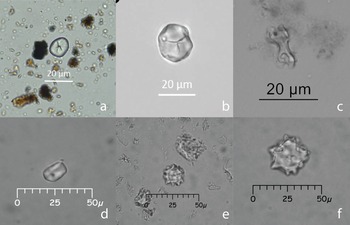
Microbotanical remains from KCH and Schultz: (a) Aker maize starch granule from dental calculus; (b) Berry maize starch granule from dental calculus, cal AD 132–329; (c) cf. Zizania spp. phytolith from Trowbridge; (d) Cucurbitaceae starch granule from Young; (e) globular echinate phytolith, Arecaceae sp. from Young; (f) globular echinate phytolith, Arecaceae sp. from Trowbridge. (Color online)

Three dental calculus samples—from the undated KCH Aker burial (Figure 5a) and two Schultz burial mounds—yielded maize starch grains. Maize starch granules (Figure 5b) were identified from the Berry mound (Bozarth Reference Bozarth2014b; Duncan and Young Reference Duncan and Young2018) and were associated with an AMS age of AD cal 237 (calibrated 2σ range of AD 132–329). Maize starch from James Younkin (Bozarth Reference Bozarth2014b) is associated with an earlier date of AD cal 144 (calibrated 2σ range of AD 75–210). A miniature zoned tool-impressed and punctated vessel (Figure 3b; Young and Duncan Reference Young and Duncan2020) found in direct association with the James Younkin burials (Schultz and Spaulding Reference Schultz and Spaulding1948) also contained maize starch. This provides a positive link between the use of the vessel for holding maize and the consumption of maize from the dental calculus.
Given the evidence for maize in the Schultz burials, Hopewellian sherds from associated habitation sites (Ward and Macy) were added to this study. An AMS date of AD cal 290 (calibrated 2σ range of AD 213–337) was obtained from ceramic residue from the Macy site, but maize was not identified from this artifact (Young and Duncan Reference Young and Duncan2020). The zoned crosshatched rim sherd from the undated Ward site (14EW17; Figure 3d) yielded maize starch (Young and Duncan Reference Young and Duncan2020).
Additional starch granules representing food items are from wild rice (cf. Zizania spp.) and squash (Cucurbita sp.; Figure 5c, d). Seeds of C. pepo were recovered from the Trowbridge site (Johnson Reference Johnson1975). The identification of a possible rice phytolith from ceramic residue (Figure 5c; Lusteck Reference Lusteck2012) is the first association of this plant with KCH. Wild rice (Z. aquatica) exploitation is recorded from many parts of the Northeast (Arzigian Reference Arzigian2000; Boyd and Surette Reference Boyd and Surette2010; Crawford and Smith Reference Crawford, Smith and Minnis2003; Lints Reference Lints2012). Although the natural distribution of Z. aquatica does not extend to the eastern Plains, the modern distribution of Z. palustris includes backwater marshes and wetlands of the Missouri River and its tributaries (Great Plains Flora Association Reference Barkley, Brooks and Schofield1986), as well as wetlands and lakes in the Nebraska Sandhills (Weaver Reference Weaver1965:43). Gilmore (Reference Gilmore1909:13) records that wild rice was a common food item for the Omaha-Ponca after they relocated to eastern Nebraska.
The identification of globular echinate phytoliths (also known as spinulose sphere phytoliths) from both soil samples is intriguing. These phytoliths (Figure 5e, f) are produced in members of the nonregional and non-native Arecaceae family (palms) (Duncan and Pearsall Reference Duncan and Pearsall2012) and are found in the leaves, stems, and petioles of palm species (Piperno Reference Piperno1988). The geographical distribution of the palmetto or bluestem palm (Sabal minor) includes southern Missouri (Small Reference Small1931). The California palm, Washingtonia filifera, extends east to central and southern Texas (Miller Reference Miller1990).
Ethnobotanical accounts (Moerman Reference Moerman1998) identify the use of both the California palm and the palmetto palm as medicine, for basketry and cordage, for unspecified recreational uses, as a stimulant, and as food among many tribes. Archaeologically, palm phytoliths were identified from precontact ceramics recovered from St. Catherine's Island, Georgia, suggesting the consumption of palm (Lusteck and Thompson Reference Lusteck and Thompson2006). Although the presence of globular echinate phytoliths from the study area could be similarly interpreted, they are more likely to have come from fibers used in cordage or basketry. KCH trade with the Southeast is evident in ceramic styles and marine shells (Keehner and Adair Reference Keehner and Adair2019; Kozuch Reference Kozuch2014), whereas maize originated from the Southwest.
Discussion
The results of this study add to the growing body of data for the presence of early maize use in precontact economies. The recovery of maize microremains from both burial and habitation contexts, which were directly dated from 287 cal BC to cal 503 AD, allows us to discuss when and where maize arrived in the eastern Plains and how it might have been processed and consumed by both foraging and farming groups in a manner that resulted in no or limited macroremains.
Pathways of Maize Dispersal and Adoption
Research in the greater Southwest documents evidence for maize use potentially as early as the fifth to fourth millennium cal BP (Hanselka Reference Hanselka and Vierra2018), when it was adopted by Archaic foragers (Minnis Reference Minnis, Cowan and Watson1992; Wills Reference Wills, Price and Gebauer1995). The pathway(s) and timing of a transmission out of the Southwest are difficult to identify, partly because of the paucity of directly dated archaeobotanical data from adjacent regions. For example, undated maize from Late Archaic occupations (ca. 1000–250 BC) in the Apishapa region of southeast Colorado suggests a diffusion of the crop out of the northern Southwest (Zier Reference Zier2018).
Once it became part of the local foraging economy, maize provided a means of securing additional resources as an extension of an existing wild plant gathering and tending practice. Vierra and Ford (Reference Vierra, Ford, Staller, Tykot and Benz2006) suggest that northern Rio Grande populations integrated maize into mobile farming economies by 1000 BC. Similarly, Roth and Freeman (Reference Roth and Freeman2008) present an ecological framework in which maize was adopted as an extension of a foraging strategy, possibly influencing mobility patterns.
The westernmost evidence for maize in the central Plains comes from the Schultz burials and isolated Hopewellian-styled ceramics. An extensive trade network is reflected in the Schultz funerary objects, including East Coast/Gulf of Mexico and Pacific Coast marine shell, copper, nonlocal lithics, and muscovite (Carlson Reference Carlson1997; Cumming Reference Cumming1958; Hoard and Chaney Reference Hoard and Chaney2010; Kozuch Reference Kozuch2014; Ray Reference Ray2014). Maize as a trade item could have been adopted and used in a manner similar to that described earlier for the foraging economy.
The temporal relationship between Schultz and KCH and the presence of Hopewellian-designed ceramics in Schultz phase sites suggest that the two groups interacted, providing a mechanism for the movement of maize. Interaction among the KCH and eastern and southeastern Hopewell groups is also evident from trade items and ceramic styles (Keehner and Adair Reference Keehner and Adair2019). If maize were a part of the Hopewell Interaction Sphere and traded widely over the eastern portion of the United States, isolated kernels or maize flour could have been a trade item. However, we cannot yet establish adoption trajectories or forms of interaction between the eastern Plains and the Northeast where early maize is identified that would account for the dispersal of this crop outside of the eastern central Plains. This is largely due to a lack of maize microremains from sites in the intervening regions. Therefore, evidence for early maize must be presented and interpreted on a regional basis, because groups may have expressed different strategies to possess maize at different times.
Potential Maize Use and Processing
Did the Plains people adopt or trade for maize as a supplement to wild resources, allowing them to increase their food options, especially in times of low prime resources, as suggested for the Mogollon Highland region of Arizona (Wills Reference Wills1989)? Sharing of food resources is a common practice among hunter-gatherers, providing a greater assurance and equitable distribution of food, especially in times of food shortage (Keeley Reference Keeley, Douglas Price and Gebauer1995; Kelly Reference Kelly1995); this practice also reinforces alliances and social ties. The presence of linear hypoplastic enamel defects on teeth samples from Dan Younkin and Berry burials (Dougherty Reference Dougherty2012) may indicate seasonal nutritional stress. But sharing maize to augment available foods does not necessarily mean that maize was grown by Schultz communities.
Sustained maize cultivation requires either a secure method of seed storage or the frequent introduction of new maize germplasm (Simon Reference Simon, Raviele and Lovis2014). With no evidence of plant cultivation for the Schultz phase or earlier Late Archaic occupations in the region, it is more likely that maize kernels or ground maize were traded into the region, rather than grown locally. Stable isotope values from the Schultz burials (Table 1) identify the presence of a C4 resource. A cautious interpretation that this reflects maize consumption is discussed in Supplemental Text 4.
Unfortunately, samples from Valley and Cuesta occupations provide little information on the use of maize. The single maize phytolith identified from Valley ceramic residue (Figure 4f) dates to AD cal 484 (cal 2σ AD 424–537), a time equivalent to the early Late Woodland period. A single maize starch granule was recovered from the 14LN344 ceramic (Figure 3c), but no maize was detected in the second Cuesta sample from 14CF343. Given the relatively small number of samples analyzed for each complex, it is difficult to determine whether low maize recovery is a sampling bias or only reflects a later or limited adoption of maize.
Kansas City Hopewell subsistence economies represent a combination of hunting, gathering, and farming. Plant remains reflect gathering and cultivation of native plants and introduced squash (Adair and Drass Reference Adair, Drass and Smith2011; Johnson Reference Johnson1975; Powell Reference Powell2009; Schroeder Reference Schroeder and Booth2012). A more sedentary settlement system than evidenced in Cuesta, Valley, or Schultz complexes can be inferred from the presence of deep and extensive middens, numerous pit features, and evidence for structures. With evidence for farming, maize could have been adopted as another cultigen, with consumption evident in the dental calculus from the Aker burial.
Maize starch on the grinding stone and hammerstone/mano (Figure 4i) suggests the grinding of maize kernels. Maize starch granules in the ceramic residue and from the ceramic fabric suggest the preparation or consumption of foods consisting of maize flour, an interpretation supported by experimental work on maize residue formation in cooking (Raviele Reference Raviele2010, Reference Raviele2011). If dried or dried/ground maize kernels were cooked, it would be unlikely to find phytoliths of maize cobs in the residue, whereas starch would likely be abundant. Although both starches and phytoliths can occur when green kernels are cut from the cob before cooking, green maize use is better revealed by diagnostic cob phytoliths (Raviele Reference Raviele2011). The frequency with which maize starch, rather than phytoliths, was present in the samples suggests the use of maize flour.
If maize were incorporated as another food crop in the existing suite of cultigens for the KCH, we would expect to recover macroremains, even with preservation and recovery issues. The larger Hopewell economy was anchored in the cultivation of native crop plants, with no evidence that maize contributed to the diet in any amount (Emerson et al. Reference Emerson, Hedman, Simon, Fort and Witt2020; Fritz Reference Fritz2019; Simon Reference Simon2021). Further, there is little evidence for maize use in the eastern central Plains during the Early Late Woodland and Late Late Woodland of about AD 400–900 (Adair and Drass Reference Adair, Drass and Smith2011; Bozarth Reference Bozarth and Logan1989; Powell Reference Powell and Logan2019), despite the continued presence of Eastern Agricultural Complex crops.
Ritual Usage
Given the microbotanical data for pounded maize, cooked maize, and consumed maize, we should consider another explanation for its early acceptance: one that focuses on maize as a nonsubsistence item.Footnote 2 Were there nonculinary virtues of maize that were useful in social or political arenas that could also explain the presence of maize microremains?
Maize use in a sacred or ritual context, perhaps related to feasting, has been proposed for the Middle Woodland period (Boyd and Surette Reference Boyd and Surette2010; Mickleburgh and Pagán-Jiménez Reference Mickleburgh and Pagán-Jiménez2012; Newsom and Deagan Reference Newsom, Deagan, Johannessen and Hastorf1994; Scarry Reference Scarry and Scarry1993); this suggests that maize could have been associated with gift giving and the maintenance of social alliances over large territories. For the Lower Illinois Valley, Fie (Reference Fie, Charles and Buikstra2006:445) suggests that the most congruent model is based on socially motivated exchange for subsistence-maintenance materials. Mueller (Reference Mueller2013) proposes that when different Hopewell communities got together, they exchanged foods and seeds, as well as knowledge. Maize may have therefore been an exotic and traded to be used by select individuals for specific purposes or ceremonies.
We recognize the strong interrelationship among maize, alcohol, and spiritual and social life (Hastorf Reference Hastorf2016; Kennedy Reference Kennedy1978; Mandelbaum Reference Mandelbaum1965; Marshall Reference Marshall1979) in parts of North America and note that beer made from starchy grains was one of the most widely consumed alcoholic beverages in the ancient world (Guerra-Doce Reference Guerra-Doce2015; Logan et al. Reference Logan, Hastorf and Pearsall2012; Munro Reference Munro1963; Wang et al. Reference Wang, Liu, Ball, Yu, Li and Xing2016, Reference Wang, Lui, Georgescu, Le, Ota, Tang and Vanderbilt2017). Hayden and colleagues (Reference Hayden, Canuel and Shanse2013:103) note that brewing is also extremely common among horticulturalists and is almost universal among those who grew grains. For example, Liu and coauthors (Reference Liu, Wang, Rosenberg, Zhao, Lengyel and Nadel2018) identify the fermentation of grains by the Natufians about 13,000 years ago, several millennia prior to the domestication of cereals in the Near East. In Mesoamerica, alcohol distillation of mescal was practiced for at least 25 centuries before the arrival of the Spanish (Goguitchaichvili et al. Reference Goguitchaichvili, Solano, Carlos Lazcano Arce, Carmen Serra Puche, Morales, Solar and Urrutia-Fucugauchi2018). Smalley and Blake (Reference Smalley and Blake2003) propose that the rapid spread of maize in Mesoamerica can be modeled after the extensive ethnographic record of maize stalk beer production (tesgüino) in the region.
In North America, there is the suggestion of the production of maygrass beer to produce a successful vision quest during the Early Woodland period (Schoenwetter Reference Schoenwetter and Drooker2001) and accounts of wine production in southern California (Fages Reference Fages and Priestley1937:22), the long tradition of maize beer making among the Mescalero Apache of the Trans-Pecos region of Texas (Castetter and Opler Reference Castetter and Opler1936), and the use of selected colored maize grains for the production of a fermented alcoholic drink in the Sierra Madre Occidental region (Hernandez Xolocotzi Reference Hernandez Xolocotzi1985). Modern-day spiritual and ritual functions of the Mandan involve maize as a component of these activities (Bowers Reference Bowers1991:183–205), whereas the ethnographic record documents maize use in rituals and ceremonies associated with planting, harvesting, origins, and well-being among Plains tribes (Will and Hyde Reference Will and Hyde1964).
However, despite these documented uses of grains in a nonsubsistence context, there are no archaeological data to support that maize-related rituals originated in North American prehistory with the initial adoption of maize. Additionally, maize use in a ritual or ceremonial context does not address how it was processed to leave microremains only or why it would have been adopted for such a use. Future research is needed to address these issues. Therefore, the suggestion that the early microbotanical remains of maize on the eastern Plains are a product of fermentation is speculative. Eerkens and Barnard (Reference Eerkens, Barnard, Barnard and Eerkens2007) report that it is difficult to identify fermentation from organic residues adhering to a ceramic vessel.
However, our understanding of the microbotanical residues and biomarkers produced and preserved during the malting, mashing, and fermentation stages of brewing ancient beer is still emerging (Hayden et al. Reference Hayden, Canuel and Shanse2013; Wang et al. Reference Wang, Lui, Georgescu, Le, Ota, Tang and Vanderbilt2017). Due to variations in temperature and moisture levels, starches are modified differently with various cooking treatments, which can explain the differential survival of starches (Crowther Reference Crowther2012). Experiments demonstrate that preservation of starchy granules happens during the cooking of low-moisture foods when desiccation and carbonization occur before the grains undergo gelatinization (Crowther Reference Crowther2012:230). Zarrillo and colleagues (Reference Zarrillo, Pearsall, Scott Raymond, Tisdale and Ouon2008:5009) suggest that the indurate aleurone of the hard endosperm flint maize may protect the endosperm starch from gelatinization. Gelatinization was not observed on microremains in this project.
The presence of maize microremains on grinding tools, within the encrusted residue on the inside of ceramic vessels, and directly in the ceramic fabric from the project area artifacts could be related to the cooking methods used for the malting and mashing processes, rather than to the previous suggestion of maize flour production. For example, malting is the process by which the insoluble sugars in maize are converted to soluble sugars during the steeping of the grain in water in large vessels for several days; this conversion is triggered by enzymes from the germinated grains (previously ground or smashed after being allowed to germinate). Mashing the malted maize in heated water in another vessel for a period of time then converts all of the starches to sugars. Fermentation of the liquid obtained from the mashing produces alcohol (Dineley Reference Dineley2004).
The making of maize beer could therefore leave residues on ground stone and an isotope signature in the ceramic fabric of the vessel used during the cooking process.
Consumption of the fermented drink could leave starch grains in dental calculus. Whether the fermented drink was used during mortuary rites or as a gift to solidify alliances is unknown. In such a context, maize-based alcohol would have a heightened relationship to a ritual event, even perhaps being a crucial component (Dietler Reference Dietler2006). Processed for its sugar rather than for its grain would also explain the near lack of maize macroremains and the growing evidence for maize microremains.
Detailing the transmission of maize from the greater Southwest to the Plains will require additional data. Uses of early maize may also require us to question existing models that see maize as exclusively a food item and adopted by ceramic groups already versed in horticulture. Numerous articles debate the initial role of maize in subsistence economies of the greater Southwest (Adams and Fish Reference Adams, Fish and Smith2011:152), with many uses predating the manufacture of ceramics (Fish Reference Fish and Minnis2004:145). A growing literature also indicates that farming is not the only pathway to alcohol production (Hayden et al. Reference Hayden, Canuel and Shanse2013). New theoretical and methodological approaches are needed as future research addresses the possible uses of early maize and refines the temporal gap between the presence of maize in the micro versus macro form. Understanding preservation biases as related to Middle Woodland processing and cooking methods is a critical component (Barton Reference Barton, Haslam, Robertson, Crowther, Nugent and Kirkwood2009; Crowther Reference Crowther2012; Dotzel Reference Dotzel2021; Haslam Reference Haslam2004; Raviele Reference Raviele2011).
Conclusions
This study demonstrates that maize use by prehistoric human communities of the central Plains has a more complex history than previously envisioned. Starch and phytolith evidence for maize and associated AMS ages document that this crop arrived in the eastern central Plains as early as 361–197 cal BC, more than 900 years earlier than the oldest directly dated macroremain. These data contribute to our understanding of the diverse regional and chronological variations evident in the history of maize in North America. The early Plains dates are consistent with those reported for early low-level maize use in the Northeast, but no direct relationship among peoples in these diverse areas can be made.
Early maize from the eastern Plains is identified from phytoliths and starch granules preserved in 60% of the samples analyzed and reflect possession, processing, and consumption. This early low-level use of maize, however, does not represent maize agriculture as we define it for post–AD 900 Plains groups. The association of the microremains with ceramics and burials is instead suggestive of a ritual context that may have strengthened social ties and political boundaries but was not exclusive to the Hopewell. The suggestion that maize was first adopted as a nonfood item to produce a sugary or fermented drink is not new but needs greater attention for the Middle Woodland period.
The use of maize and the suggested ritual use do not appear to extend into the Early Late Woodland period, a time that witnessed the decline in long-distance interaction and changes in the sociopolitical structure from the Middle Woodland period. The Plains data are suggestive of a pathway for the dispersal of this crop from the American Southwest, although geographical and temporal gaps, along with ecological factors and cultural processes, need to be addressed to refine this in greater detail. It is critically important to determine whether maize kernels or maize flour was the trade item or whether the plant was genetically adapted to temperate environments and grown by Plains Middle Woodland groups.
The starch and phytolith presence of other foods, including squash and wild rice, documents the importance of plants not well represented, if at all, in the archaeobotanical assemblage. Such is the case for the globular echinate phytoliths from the palm family.
Microbotanical remains may be the key to understanding how, when, and in what directions maize diffused throughout North America, the relationship among foraging and sedentary populations, and the suggested uses of maize. The presence of maize microremains in central Plains economies underscores the value of various artifacts in addressing this research, despite their still-limited interpreted potentials. It allows us to ask questions about the manner in which maize was processed and to speculate on its relationship to rituals. As microbotanical analyses increase in archaeobotanical research, and guided by social paleoethnobotany theory (Sayre and Bruno Reference Sayre and Bruno2017), we may gain a more complete understanding of prehistoric maize use. Existing museum collections, even those artifacts washed and curated for decades, provide a valuable source of materials readily available for further exploration.
Acknowledgments
We extend our appreciation for colleagues John Hart, Jack Hofman, Emily Johnson, and Mary Simon, as well as the three anonymous reviewers, who commented on earlier versions of this article and strengthened it. We thank Trisha Nelson at History Nebraska for access to the Valley phase ceramics and associated records and to Rob Bozell, also with History Nebraska, for arranging the loan of the ceramics from site 25MD30. Collections and records related to the KCH sites are curated at the University of Kansas. Alan Potter drafted Figure 1, Steven Keehner prepared Figure 2, and Mason Niquette assisted with Figure 3. Ellie Holder prepared the Spanish translation of the abstract. Rob Bozell (History Nebraska), Laura Kozuch (independent researcher), and Jack Ray (Missouri State University) assisted with the identification of faunal remains, marine shell artifacts, and lithic sources recovered from Schultz burials. Sean Dougherty (Milwaukee Area Technical College) conducted an analysis of human remains from Schultz burials, providing new information on the health of the individuals interred. We are grateful for their permission to use unpublished reports. Research funds for the AMS dating were provided by the National Science Foundation (BCS 9974895); the Department of Anthropology, University of Kansas, Carlyle S. Smith Fund; and the University of Kansas Endowment Association. Analyses of the microremains were also funded by the Carlyle S. Smith Fund, History Nebraska, and University of Kansas endowment funds from KU alum Kenneth Wilcox.
Supplemental Material
For supplemental material accompanying this article, visit https://doi.org/10.1017/aaq.2021.152.
Supplemental Table 1. Recent AMS radiocarbon ages from Early Woodland to Early Late Woodland occupations in the eastern Central Plains.
Supplemental Text 1. AMS dating of ceramic residue.
Supplemental Text 2. Methodology of ceramic residue and dental calculus removal.
Supplemental Text 3. Lab procedures, contamination protocols, and comparative collections.
Supplemental Text 4. Stable isotopic values for bone and enamel from Middle Woodland Individuals.
Supplemental Text 5. References for Supplemental Table 1.
Data Availability Statement
The images of maize and other plant microremains are curated on the Archaeology Division server at the University of Kansas and in possession of the affiliated analysts. These images can be examined upon request.