




No CrossRef data available.
Article contents
Factors associated with difficulties encountered by nurses in the care of terminally ill cancer patients in hospitals in Japan
Published online by Cambridge University Press: 24 August 2005
Abstract
Objective: To identify the factors associated with difficulties encountered by nurses working in general wards in hospitals in Japan.
Methods: Questionnaires including items regarding difficulties in providing care to terminally ill cancer patients, the existence of a mentor regarding end-of-life issues, awareness of end-of-life issues, and demographic factors were administered to 375 staff nurses working in general in-patient wards. Multivariate regression analyses were employed to investigate correlations between factors.
Results: Multivariate regression analysis revealed that the existence of a mentor for end-of-life issues was associated with fewer difficulties in all areas other than “Knowledge and skill of nurses.” Clinical experience was inversely related to difficulties in “Communication with patients and families” and “Personal issues.” Greater awareness of end-of-life issues was related to higher difficulties in most areas.
Significance of results: The existence of a mentor was correlated with fewer difficulties in most areas. Support by a palliative care team might be effective in reducing difficulties experienced by nurses and in improving care for terminally ill cancer patients. Basic communication training undertaken sooner after registration might be also useful.
Information
- Type
- Research Article
- Information
- Copyright
- © 2005 Cambridge University Press
INTRODUCTION
In the last decade, the number of palliative care units (PCUs) in Japan has increased rapidly. These units, however, provide care for only 2.5% of all patients who die from cancer (Ministry of Health and Labor, Grant for Scientific Research: Study Group for Promoting Hospice and Palliative Care Services, 2001). As home palliative care services have not yet been established in this country, hospitals remain the main setting for end-of-life care (Institute for Health Economics and Policy, 2000). Therefore, as in other countries, quality of end-of-life care in hospital is a very important issue (Kite, 1999; Teno et al., 2004).
Nurses play a very important role in end-of-life care, as the focus of care shifts from treatment to support of the patient's daily needs. However, nurses working in hospitals face various problems in relation to providing end-of-life care (Copp & Dunn, 1993; Sasahara et al., 2003).
In this study, we aimed to explore factors associated with these difficulties. Identifying such factors enables us to develop adequate and concrete support for nurses working in this field.
Although few studies have investigated difficulties encountered by nurses in the care of terminally ill cancer patients, “stress” or “burnout,” which are assumed to be similar in concept to “difficulty,” have been widely studied (Alexander & Ritchie, 1990; Ramirez et al., 1995; Payne, 2001). In the present study, we defined difficulty encountered by nurses as “sense of difficulty/trouble in the process of providing high quality care to terminally ill cancer patients and their families.” We postulated that stress would result from accumulating difficulties and that burnout would ensue as a response to increasing stress or to a prolonged period under stress.
In a review addressing stress experienced by health care professionals involved in end-of-life care, Vachon (2004) identified numerous variables as being related to stress, including age, gender, personality, coping style, social support, working system, and teamwork. In this article, we focus on those variables that were straightforward to ascertain and those in which it is possible to intervene.
METHODS
Study Sample
For convenience, three metropolitan teaching hospitals with more than 300 beds were selected. None were equipped with an in-patient hospice/PCU. Subjects were staff nurses working in general wards. Those working in pediatric, obstetric, or psychiatric wards, intensive care units, or operating rooms were excluded.
Procedure
This was a cross-sectional study, using a self-administered questionnaire. The head nurse in each ward distributed envelopes containing the questionnaire and a cover letter to the subjects. Completed questionnaires were sealed in the envelope provided and returned to a box placed in each ward within 2 weeks of being distributed. Data were collected from December to November 2002.
Questionnaire
We previously developed a questionnaire to measure difficulties encountered by nurses in the care of terminally ill cancer patients (Sasahara et al., 2003). This questionnaire is composed of the following eight scales, comprising a total of 78 items: “Communication with patients and families” (17 items), “Knowledge and skill of nurses” (10 items), “Treatment and IC (Informed Consent)” (8 items), “Personal issues” (6 items), “Collaboration as a team including the patient and family” (14 items), “Environment and system” (8 items), “Collaboration among nurses” (5 items), and “Near-death issues” (10 items). Scores for each item range from 1 (not at all) to 4 (very much), with higher scores representing greater difficulty.
We evaluated the following factors potentially related to difficulty experienced by nurses: (1) number of terminally ill cancer patients previously cared for, (2) the existence of a mentor regarding end-of-life issues, (3) previous experience of hospitalization for cancer, (4) personal experience of loss caused by cancer, (5) palliative care education, (6) awareness of end-of-life issues (interest, reading articles and books, reviewing conversations with dying patients, desire for education), (7) knowledge of palliative care, and (8) nursing autonomy and advocacy.
To assess awareness of end-of-life issues (Factor 6), we developed a scale for use in the present study with the assessment items discussed and devised by several nurses who had worked in palliative care settings. The scale comprised five items with scores ranging from 1 to 5 (one item was dichotomous and therefore scored either 1 or 2). Total score ranged from 5 to 22, with higher scores indicating higher awareness of end-of-life issues. To evaluate knowledge of palliative care (Factor 7), we developed a scale based on Ross's questionnaire (Ross et al., 1996). This scale comprised 22 items phrased as dichotomous questions, with correct answers being given one point. Higher scores indicated greater knowledge. To assess nursing autonomy and advocacy (Factor 8), we used one of the subscales from the Japanese version of Pankratz's Nursing Questionnaire (Pankratz & Pankratz, 1974; Kaharu, 1990). This scale consists of 26 items and uses a 5-point Likert-type scale. Higher scores indicate greater autonomy.
In terms of demographic factors, gender, age, education, type of qualification, and years of clinical experience were recorded.
Statistical Analysis
After confirming that distribution was not influenced by institution, data from the three hospitals were combined and analyzed. First of all, univariate analyses were conducted using the unpaired t-test, ANOVA, and Pearson product-moment correlation coefficients where appropriate.
Thereafter, association of each hypothesized factor with each area of difficulty was explored using multivariate linear regression. Standardized partial regression coefficients were calculated with models including all explanatory variables listed in Table 1, other than age, which was closely linked to duration of clinical experience (r = 0.86) and therefore excluded. Dummy variables were created for education, years of clinical experience, number of terminally ill cancer patients previously cared for, personal experience of loss due to cancer, and palliative care education. Awareness of end-of-life issues, knowledge of palliative care, and nursing autonomy were treated as continuous variables. Statistical analysis was performed using SAS version 8.2. Significance level was set at <0.05 (two-tailed).
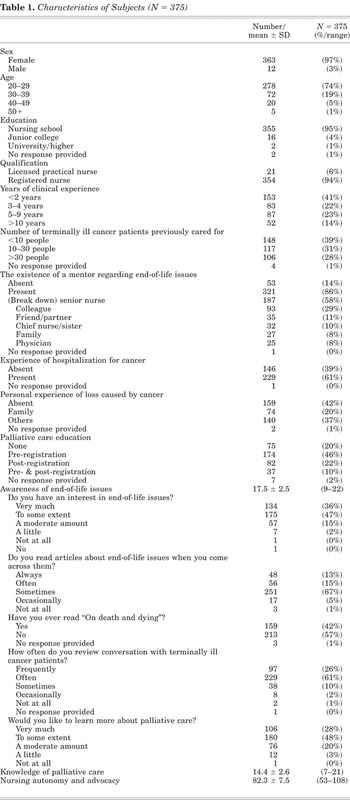
Characteristics of Subjects (N = 375)

RESULTS
Study Sample
Of the 534 survey questionnaires delivered, 450 were returned, yielding a response rate of 84%. Of these, responses with over 10% incomplete data overall and those filled out by respondents who had never cared for terminally ill cancer patients were excluded. A total of 375 responses (70%) were further analyzed.
Characteristics of the subjects are summarized in Table 1. Nearly 97% were women. Age ranged from 20 to 56 years (mean = 27.5, SD = 6.4) and 74% of respondents were under 30 years old. Duration of clinical experience ranged from 0.5 to 30 years (mean = 5.5, SD = 5.5) and 153 (40%) of subjects had under 2 years experience. Most subjects were registered nurses (94%). Three hundred and twenty-one respondents (86%) reported having mentors for end-of-life issues, with senior nurses or colleagues mostly fulfilling this role (58% and 29%, respectively).
Mean score for awareness of end-of-life issues was 17.5 (SD = 2.5, range 9–22); Cronbach's α was 0.74.
Factors Related to Difficulties According to Univariate Analysis
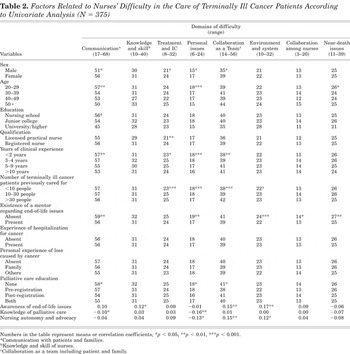
Results of univariate analyses are shown in Table 2. Overall, women experienced greater difficulties than men. Lower levels of difficulty in “Communication with the patient and family” were correlated with higher levels of education. Registered nurses reported slightly higher levels of difficulty in most areas; however, this trend reached statistical significance only for “Treatment and IC.” Subjects with greater clinical experience reported significantly lower levels of difficulty in “Communication with the patient and family” and “Personal issues,” but experienced more difficulties in “Collaboration as a team including patient and family” and “Treatment and IC.”
Factors Related to Nurses' Difficulty in the Care of Terminally Ill Cancer Patients According to Univariate Analysis (N = 375)

In five areas, the existence of a mentor for end-of-life issues was correlated with lower levels of difficulty.
Differences in palliative care education reflected differences in levels of difficulty in “Communication with patient and family,” “Personal issues,” and “Collaboration as a team including patient and family.”
Nurses with higher awareness of end-of-life issues scored significantly higher in “Knowledge and skill of nurses,” “Collaboration as a team including the patient and family,” and “Environment and system”; however, correlation coefficients were low for each of these categories. Nurses with greater knowledge of palliative care reported fewer difficulties with “Communication with patient and family” and “Personal issues.” Those reporting higher autonomy experienced more difficulties in “Collaboration as a team including patient and family” and “Environment and system,” but fewer difficulties in “Personal issues.” However, on the whole, correlation coefficients were low for these categories.
Factors Related to Difficulties According to Multivariate Analysis
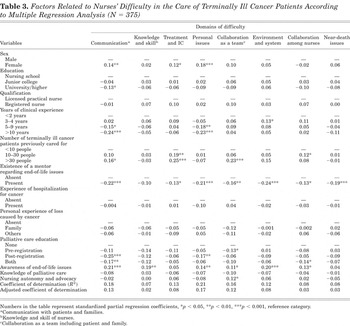
Results of multivariate regression analyses are presented in Table 3. Greater clinical experience was correlated with fewer difficulties in “Communication with patients and families” and “Personal issues.” However, the greater their experience with terminally ill cancer patients, the higher the level of difficulty reported by nurses in “Treatment and IC.” For all areas except “Knowledge and skill of nurses,” the existence of a mentor for end-of-life issues was associated with significantly lower levels of difficulty. For all areas other than “Treatment and IC” and “Near-death issues,” those who reported higher awareness of end-of-life issues experienced significantly higher levels of difficulty.
Factors Related to Nurses’ Difficulty in the Care of Terminally Ill Cancer Patients According to Multiple Regression Analysis (N = 375)

DISCUSSION
One of the most important findings of this study was that the existence of a mentor for end-of-life issues was commonly associated with seven areas of difficulty. One strategy to provide every nurse with someone whom they can approach for advice would be the establishment of a palliative care team. In many Western countries, peripatetic palliative care teams have been formed (Pan et al., 2001; Hospice Information, 2002). The team provides a variety of support for health care professionals as well as patients (Hockley, 1992; Weissman, 1997) and has been reported to have had a positive impact (Carter et al., 2002; Higginson et al., 2002). We believe that the results of the present study further emphasize the need for a palliative care team. In Japan, services provided by palliative care teams in general wards have been included within the national medical insurance scheme since April 2002. In the future, a longitudinal study will be needed to investigate how difficulties encountered by nurses change after the introduction of a palliative care team.
The correlation between greater clinical experience and fewer difficulties in “Communication with patients and families” and “Personal issues” was confirmed. This finding is consistent with results of a study indicating that younger caregivers experienced more difficulty in relationships with terminally ill cancer patients (Porta et al., 1997). It would be natural to assume that the greater the clinical experience held by nurses, the more terminally ill patients they would have cared for. However, after adjusting for this variable, clinical experience remained statistically significant, indicating that the benefits of clinical experience might be related to personal or professional maturity. Good communication between patients and health care professionals is enormously important in terms of understanding patients' preferences and supporting their decision making (Covinsky et al., 2000). As a clinical implication, we would suggest that basic communication training undertaken sooner after registration might be effective in reducing difficulties experienced by younger or less-experienced nurses. Furthermore, senior nursing staff should keep in mind the fact that younger and less-experienced nurses tend to have difficulties in those areas and be prepared to provide appropriate support when needed.
Although nurses with some palliative care education were likely to experience fewer difficulties on the whole, no consistent or significant finding was obtained regarding this factor. One possible reason was the phrasing of questions related to this item. We asked if respondents had either pre- or post-registration palliative care education and did not consider factors such as the length and contents of such education. Hence more detailed information regarding palliative care education should be gathered when assessing the association between this factor and nursing difficulties.
For six of the areas of difficulty, some association with awareness of end-of-life issues was determined. This finding may be interpreted as follows: Nurses with higher awareness in this area encounter greater difficulty as a result of a discrepancy between ideal care and actual care provided (Vachon, 1995). Based on this interpretation, higher difficulties appear to be favorable. However, we are not completely convinced that difficulty should be regarded as a good experience, because increasing levels of difficulty are believed to result in stress or burnout (Vachon, 1995, 1999). Accordingly, further studies are needed to investigate how difficulties change after interventions to raise awareness of end-of-life issues.
This study has several limitations. First, subjects were only recruited from relatively large, metropolitan hospitals. Moreover, mean age of subjects was younger than the national average for nurses in general hospitals (Japanese Nursing Association, 1999). Hence this sample is not sufficiently representative for our results to be generalized. Secondly, coefficients of determination were so small that the results could not be fully confirmed. A possible explanation is that we limited variables to those that were straightforward to ascertain and those in which it is possible to intervene, instead of including other potential factors such as coping style or quality of actual care. Nevertheless, the present study revealed factors associated with difficulties encountered by nurses in the care of terminally ill cancer patients. These findings will help to organize training or systems to support nurses, interventions that we believe can improve the care for terminally ill cancer patients.
ACKNOWLEDGMENTS
We would like to express our gratitude to the hospitals and nurses for their cooperation in this study. We would also like to thank the Kinugasa hospital for collaboration in the pilot study.
References
REFERENCES
Alexander, D. &
Ritchie, E.
(1990).
‘Stressors' and difficulties in dealing with the terminal
patient.
Journal of Palliative Care,
6,
28–33.Google Scholar
Carter, H.,
Mckinlay, E.,
Scott, I.,
et al.
(2002).
Impact of a hospital palliative care service: Perspective of the
hospital staff.
Journal of Palliative Care,
18,
160–167.Google Scholar
Copp, G. &
Dunn, V.
(1993).
Frequent and difficult problems perceived by nurses caring for the
dying in community, hospice and acute care settings.
Palliative Medicine,
7,
19–25.Google Scholar
Covinsky, K.E.,
Fuller, J.D.,
Yaffe, K.,
et al.
(2000).
Communication and decision-making in seriously ill patients:
Findings of the SUPPORT project. The Study to Understand Prognoses and
Preferences for Outcomes and Risks of Treatments.
Journal of the American Geriatric Society,
48,
S187–S193.Google Scholar
Higginson, I.J.,
Finlay, I.,
Goodwin, D.M.,
et al.
(2002).
Do hospital-based palliative teams improve care for patients or
families at the end of life?
Journal of Pain & Symptom Management,
23,
96–106.Google Scholar
Hockley, J.
(1992).
Role of the hospital support team.
British Journal of Hospital Medicine,
48,
250–253.Google Scholar
Hospice Information.
(2002).
Hospice and Palliative Care Facts and Figures.
London:
Author.
Institute for Health Economics and Policy.
(2000).
A Study of End-of-Life Care Programs and Policies.
Tokyo:
Author (in Japanese).
Japanese Nursing Association.
(1999).
1997 Report on status of nursing personnel.
Japanese Nursing Association Research Report no. 54.
Tokyo:
Japanese Nursing Association Publishing Company
(in Japanese).
Kaharu, C.
(1990).
Evaluation of Nursing Educational Program—The Case Report in
Japan.
The Japanese Journal of Nursing Research,
23,
77–88
(in Japanese).Google Scholar
Kite, S.
(1999).
Palliative care in hospital. In
Providing a Palliative Care Service,
Bonsanquet, N. &
Salisbury, C. (eds.), pp.
183–191.
New York:
Oxford University Press.
Ministry of Health and Labor, Grant for Scientific Research:
Study Group for Promoting Hospice and Palliative Care Service.
(2001).
Present Status and Future of Hospice/Palliative Care Units in
Japan.
Osaka:
Author
(in Japanese).
Pan, C.X.,
Morrison, R.S., &
Meier, D.E.
(2001).
How prevalent are hospital-based palliative care programs? Status
report and future directions.
Journal of Palliative Medicine,
4,
315–324.Google Scholar
Pankratz, L. &
Pankratz, D.
(1974).
Nursing autonomy and patients' rights: Development of a nursing
attitude scale.
Journal of Health and Social Behavior,
15,
211–216.Google Scholar
Payne, N.
(2001).
Occupational stressors and coping as determinants of burnout in
female hospice nurses.
Journal of Advanced Nursing,
33,
396–405.Google Scholar
Porta, M.,
Busquet, X., &
Jariod, M.
(1997).
Attitudes and views of physicians and nurses towards cancer patients
dying at home.
Palliative Medicine,
11,
116–126.Google Scholar
Ramirez, A.J.,
Graham, J.,
Richards, M.A.,
et al.
(1995).
Burnout and psychiatric disorder among cancer clinicians.
British Journal of Cancer,
71,
1263–1269.Google Scholar
Ross, M.,
McDonald, B., &
McGuinness, J.
(1996).
The palliative care quiz for nursing (PCQN): The development of an
instrument to measure nurses' knowledge of palliative care.
Journal of Advanced Nursing,
23,
126–137.Google Scholar
Sasahara, T.,
Miyashita, M.,
Kawa, M.,
et al.
(2003).
Difficulties encountered by nurses in the care of terminally ill
cancer patients in general hospitals in Japan.
Palliative Medicine,
17,
520–526.Google Scholar
Teno, J.M.,
Clarridge, B.R.,
Casey, V.,
et al.
(2004).
Family perspectives on end-of-life care at the last place of
care.
Journal of the American Medical Association,
291,
88–93.Google Scholar
Vachon, M.L.S.
(1995).
Staff stress in hospice/palliative care: A review.
Palliative Medicine,
9,
91–122.Google Scholar
Vachon, M.L.S.
(1999).
Reflections on the history of occupational stress in
hospice/palliative care.
Hospice Journal,
14,
229–246.Google Scholar
Vachon, M.L.S.
(2004).
The stress of professional caregivers. In
Oxford Textbook of Palliative Medicine,
Doyle, D.,
Hanks, J.,
Cherny, N. &
Calman, K. (eds.), pp.
992–1004.
New York:
Oxford University Press.
Weissman, D.E.
(1997).
Consultation in palliative medicine.
Archives of Internal Medicine,
157,
733–737.Google Scholar
Characteristics of Subjects (N = 375)
Factors Related to Nurses' Difficulty in the Care of Terminally Ill Cancer Patients According to Univariate Analysis (N = 375)
Factors Related to Nurses’ Difficulty in the Care of Terminally Ill Cancer Patients According to Multiple Regression Analysis (N = 375)
 You have
Access
- 18
- Cited by