


1. Introduction
The International Criminal Court (ICC) was created on the principle of complementarity, sharing jurisdiction with national courts that bear primary responsibility for addressing international crimes under the Rome Statute.Footnote 1 As a legal concept, complementarity manifests in the admissibility criteria outlined in Article 17, with Articles 18–20 of the Statute providing the framework for when either states or the ICC should step in to address international crimes. Complementarity also has a political aspect. It is a tool to ensure respect for states’ sovereign interests over such crimes, and the practical means enshrined in the framework of the Rome Statute (Statute) by which states can defend these interests regardless of whether they are parties to the Statute. Stahn observes that ‘complementarity is in many situations a cornerstone for a constructive relationship with non-states parties and a possible solution for accountability challenges. This requires not only legal interaction, but political dialogue’.Footnote 2 Additionally, there is what has been described as the systemic aspect of complementarity,Footnote 3 given the wording of the Preamble and Article 1 of the Statute, read in conjunction with Articles 17 to 20. This aspect of complementarity commands division of labour, co-ordination, and co-operation between the ICC and states.Footnote 4 Contrary to the intention of the drafters of the Statute, the Court’s ‘ICC-centric’ approachFootnote 5 to complementarity, often seen in how admissibility determinations are made, has not always balanced these three dimensions of this foundational principle. This has far-reaching implications for victims.Footnote 6
The ICC adopts a two-step inquiry into assessing admissibility.Footnote 7 This means that with the exception of ‘gravity’,Footnote 8 the Court will only examine unwillingness or inability to investigate and prosecute where there is an existing case, or where one formerly existed.Footnote 9 Consequently, a finding that no case exists or existed, means that there was ‘inaction’ on the part of the concerned state.Footnote 10 This is due to a strict textual interpretation and application of Article 17 to situations and cases before the Court. Also, if the state is investigating or prosecuting a case which is not the same as the one pursued by the ICC, this will be interpreted as an instance of inaction.Footnote 11 This became known as the same person and substantially same conduct test. Some scholars have considered as well as questioned the basis for such an interpretation in relation to inaction.Footnote 12 This approach to complementarity does not align with the object and purpose of the Rome Statute system of complementarity to fight impunity and do justice for victims, who in some instances may be better served by national proceedings.Footnote 13 This paper examines these issues and proposes an approach to interpreting and implementing complementarity in a manner that maximizes its potential.
This paper is broadly divided into two categories of discussions and proposals: law and policy and organizational restructuring. The former is contained in Section 2 which locates justice for victims and victim-oriented complementarity within the Rome Statute framework. Sections 3 and 4 contain the organizational restructuring discussions and proposals. Section 3 looks at rationales for a new complementarity division independent of the Office of the Prosecutor (OTP) and of the Assembly of States Parties to the Rome Statute (ASP). Section 4 continues in this direction by examining scholarly suggestions for a new complementarity body before setting out the paper’s proposed design. In Section 5, the paper uses select ICC situations to contextualize the functions of the proposed division in promoting the goals of the Rome Statute system of justice. Thus, it pulls the law and policy and organizational restructuring proposals together. The paper concludes by acknowledging that political will to advance these proposals may currently appear non-existent in the face of marked retrogression to anti-rule of law attitudes. Nonetheless, the creation and existence of the ICC suggest that when sustained efforts align with right timing, remarkable changes are achievable.
2. Victims in the ICC framework
2.1 A victim-oriented court
The three dimensions of complementarity mentioned in the introduction are expressly provided for in the Rome Statute framework. The Preamble, a key component of the Statute,Footnote 14 makes reference to the suffering of victims and the need to combat impunity for such crimes. Other parts of the Statute and other core legal texts of the Court contain several provisions covering the procedural and substantive rights of victims.Footnote 15 For example, those who suffered harm as a result of crimes listed in the Statute can be recognized as victims in accordance with Rule 85 of the ICC Rules of Procedure and Evidence (RPE). Article 68(1) of the Statute covers their right to protection. Article 68(3) provides for their meaningful participation in proceedings where their personal interests are affected, at stages determined to be appropriate by the Court and in a manner which is not prejudicial to or inconsistent with the rights of the accused and a fair and impartial trial. Moreover, if victims’ harms were due to crimes committed by a perpetrator convicted by the Court, they are entitled to reparations as set out in Article 75.
The drafters of the Statute placed great emphasis on the need for the interpretation of the core legal texts of the Court and all applicable law to be consistent with internationally recognized human rights,Footnote 16 as outlined under Article 21(3). Pellet considers this provision an ‘international super-legality’,Footnote 17 as it applies to all actions taken by the Court throughout all stages of proceedings, and applies to all parties and participants, including victims.Footnote 18 Thus, the Preamble to the Statute, its preparatory works,Footnote 19 and its victims’ provisions, evince the intention of the drafters to deliver some form of justice to victims,Footnote 20 albeit one attached to individual criminal responsibility. This victim regime provides a good foundation for victim-oriented justice which can aid the fight against impunity and enhance the position of victims without compromising the rights of the accused. Victim-oriented justice may manifest in substantive outcomes that can benefit victims,Footnote 21 such as uncovering the truth of their harms, the conviction of alleged perpetrators, and victims’ reparations.Footnote 22 Therefore, the paper’s arguments are based on the understanding that victims are integral to the fight against impunity.Footnote 23
2.2 Defining and locating victim-oriented complementarity within the Rome Statute framework
Justice at the ICC cannot be victim-oriented if its principle of complementarity is not victim-oriented. For example, if the ICC decides to defer to a state, how would representations made by victims be considered in determining the terms of the deferral? If the Court decides to admit the situation or case, how will it carry victims along in its proceedings? Ultimately, who between the ICC, states, regional, and sub-regional institutions would be better positioned to deliver victim-oriented justice in any given situation? These issues should be considered in the implementation of the principle of complementarity, since victims are integral to this system and the achievement of the ICC’s goals.
Victim-oriented complementarity was advanced by Moffett, who argues that state parties and the Assembly of State Parties should play a greater role in implementing justice for victims domestically.Footnote 24 This paper defines victim-oriented positive complementarity as a series of co-ordinated, robust, and inclusive measures, geared towards supporting states to investigate and prosecute international crimes and to deliver victim-oriented justice. Such measures could be pioneered by complementarity stakeholders – the ICC, states, and co-operation partners, and should be done in consultation with victims. Victim-oriented classical complementarity refers to the ICC’s holistic consideration of a state’s willingness and ability to investigate and prosecute international crimes, within a reasonable margin of appreciation reflective of the peculiarities of the situation or case, while making room for victims to meaningfully contribute to the process and outcome. It may require adjustment to how the Court currently deals with the role of timing in admissibility determinations, qualifying deference to states, and adoption of a complementarity understanding with monitoring clauses. Ultimately, it requires reading victims’ interests into complementarity provisions. ‘Victim-oriented’ was chosen as opposed to victim-centred, because the ICC is an international ‘criminal court’, which should prosecute perpetrators while carrying victims along and balancing all interests before the Court.
Article 68(3), which is central to victims’ participation in ICC proceedings, does not expressly exclude complementarity proceedings, as well as those that occur during investigations from stages of proceedings accessible to victims.Footnote 25 After much litigation on this issue,Footnote 26 the Appeals Chamber in the Democratic Republic of the Congo (DRC) Situation ruled that they may participate in judicial proceedings during the investigation stage ‘provided their personal interests are affected by the issues arising for resolution’.Footnote 27 Moreover, Regulation 81(4) of the Regulations of the Court (RoC) reflects the Court’s appreciation that the interests of victims may be affected at any stage of proceeding and should be protected. Such interests may relate to being kept informed about the progress of situations and cases.Footnote 28 It may also relate to being consulted on wide-ranging issues.Footnote 29 For instance, regarding a decision not to investigate or prosecute,Footnote 30 confirmation hearings in absentia,Footnote 31 amendments of charges,Footnote 32 joint or separate trials for accused persons in the same situation,Footnote 33 and issues around the admission of guilt.Footnote 34 This reinforces the notion that victims are integral to the Rome Statute system of justice. Yet in practice, much of these proceedings would not take place without some form of initiation by the Prosecutor, and victims’ ability to participate is not always guaranteed. Hence, the period before the commencement of an investigation is crucial, as much can be done to implement and ensure subsequent implementation of complementarity in a manner in line with the drafters’ intention and beneficial to victims.
2.3 Flexibility with the time requirement
It is important to clarify the connection between different provisions of the complementarity regime to highlight the relevance of the timing requirement for admissibility determinations. Articles 15 and 53 of the Statute outline instances where the OTP can initiate an investigation following a preliminary examination.Footnote 35 For an investigation to be initiated, the case must appear to fall within the ICC’s jurisdiction and be potentially admissible in accordance with Article 17.Footnote 36 Article 18 is necessary for avoiding overlapping investigations by giving primacy to the national proceedings, ensuring expeditious determinations if questions of admissibility arose,Footnote 37 and for preventing a waste of resources. Pursuant to Article 19, the Court may, on its own motion, determine the admissibility of a case in accordance with Article 17.Footnote 38 Where a state or an accused decides to challenge the Court’s jurisdiction or admissibility of a case, they can do so under Article 19, which may be more contentious compared to proceedings under Article 18. For all these pathways to an admissibility determination, the Rome Statute sets the timeframes for raising issues of admissibility to manage the Court’s resources and prevent unnecessary delays.Footnote 39 The general preference is to raise such issues early in the relevant proceeding.Footnote 40
Victims can participate in proceedings on challenges to the jurisdiction of the Court or the admissibility of a case under Article 19,Footnote 41 but their participation in deference proceedings under Article 18 is neither expressly provided nor precluded. Articles 18 and 19 proceedings share a commonality – they deal with issues of investigations and prosecutions, and victims can already participate in these proceedings.Footnote 42 Moreover, according to Rule 55 RPE, it is for the Pre-Trial Chamber to decide on the procedure to be followed for Article 18 deference proceedings. The practice has been to involve victims, albeit with limited participatory rights, as was evident in Afghanistan,Footnote 43 Venezuela,Footnote 44 the Philippines,Footnote 45 and State of Palestine situations.Footnote 46
It is against this backdrop that the paper argues for flexibility with timing requirements in relation to issues of admissibility. The paper proposes that in the process of conducting preliminary examinations, when a state requests a deferral or when they lodge an admissibility challenge, the Court should consider the specifics of each situation or case to identify at a minimum, some elements of willingness to investigate and prosecute. When this is present, the Court should engage in continuous constructive dialogue with the state as a means of encouraging them to deliver victim-oriented justice.Footnote 47 In this process, states’ capacity needs which may result in fatal admissibility challenges should be identified. They could then be offered the opportunity to develop capacity to fulfil their Rome Statute obligations and in a way that can benefit victims.Footnote 48 Only after some level of willingness and commitment have been identified can the Court award the state reasonable time to fulfil its obligations. There should be a possibility of extension in instances where the concerned state can show progress made towards agreed conditions.Footnote 49 This is in line with the current admissibility criteria, which requires a determination of inter alia ‘genuineness’ in a state’s action,Footnote 50 even in the absence of a deferral request.
2.4 Victim-oriented qualified deference within the Rome Statute framework
Victim-oriented qualified deference is an adaptation of Stahn’s conception of qualified deferenceFootnote 51 – a creative approach and a step in the right direction to manage some of the problems caused by the rigid nature of the ICC’s admissibility determinations.Footnote 52 However, it does not eliminate the problem caused by the same person and substantially same conduct requirement which forces states to mirror ICC investigations to secure a deferral.Footnote 53 His recommendation of time management is geared towards helping states meet this requirement by adjusting their investigations or prosecutions after lodging an admissibility challenge.Footnote 54 Hence, a state which successfully proves that they are investigating the same person for substantially same conduct may not necessarily be inclined to expand their approach to addressing other core international crimes affecting more victims.Footnote 55 Conditions for deferral need not include victims’ provisions, and victims’ representatives may not be privy to a state’s progress after the ICC defers to the state.
Victim-oriented qualified deference refers to the ICC’s deferral of the exercise of jurisdiction upon proof of states’ willingness and ability to address international crimes in a way that accommodates victims and their interests, with or without support for capacity building.Footnote 56 It advances victim-oriented positive complementarity – helping states to build their capacity for victim-oriented justice, and victim-oriented classical complementarity – determining admissibility in a victim-oriented manner.
A purposive interpretation of victims’ and complementarity provisions of the Rome Statute will show that victim-oriented qualified deference can be advanced under the Statute framework.Footnote 57 Stahn notes that since the Court is the ultimate arbiter over complementarity based on Article 17 criteria, the Chambers must have the power to rule on the steps leading to that result, including tying admissibility to conditions.Footnote 58 His argument can be extended to similar decisions, which could be made by the Prosecutor in the early stages during preliminary examinations and before pre-trial. Articles 17–19 and 53 of the Statute show that the Prosecutor can exercise discretion with regards to opening an investigation where situations have been referred to the Court by the UN Security Council (UNSC), or states. Beside proprio motu investigations, and state party referrals in relation to the crime of aggression under Articles 15 and 15 bis of the Statute, the Prosecutor has the powers to make admissibility assessments in all other instances without the need to involve the Chambers or to seek a UNSC determination.Footnote 59 Where the Prosecutor’s decision not to investigate or prosecute is not based solely on the interests of justice, there would be no need for the Chamber to rule on an issue of admissibility unless triggered by the Prosecutor, initiated by the Chamber or a review request to the Chamber by the referring state or the UNSC.Footnote 60 Therefore, there is scope to pursue victim-oriented complementarity in all eligible situations and cases, regardless of a formal deferral request, because the aim is to maximize the complementarity process.
2.4.1 Minimum conditions for accommodating victims’ interests in domestic jurisdictions
2.4.1.1 Victims’ status
The first minimum condition which states must commit to in order to seek the postponement of a final admissibility determination is commitment to recognition of victims which neither politicizes victimhood nor places victims in any hierarchical order.Footnote 61 Thus, to benefit from victim-oriented qualified deference, a state must prove that it has victims’ provisions through its own legislation. Otherwise, the state should commit to adopting such provisions which accord victim status to natural or legal persons, without any form of discrimination, and which must be based on direct or indirect harm suffered as a result of international crimes.
2.4.1.2 Victims’ participation
The second condition for securing victim-oriented qualified deference is a state’s commitment to providing victims’ participation within the state’s means and unique context. Mass victimization is an inherent feature of international crimes. It must be factored into considerations of the practicalities of victims’ participation in measures for addressing such crimes, while still pursuing their meaningful participation. The key to potentially realizing meaningful victims’ participation is, as Frank and Ferstman suggest, ‘a broad engagement with victims and civil society when considering ways to prosecute international crimes domestically and how to enhance the role of victims in such proceedings’.Footnote 62 This approach can help to address challenges associated with mass victim participation, such as the risk that some victims’ voices may be overshadowed by collectivization of their views and concerns.
2.4.1.3 Victims’ protection
Commitment to victims’ protection is the third condition for pursuing victim-oriented qualified deference and is pivotal to their participation and general inclusion in mechanisms for addressing international crimes. Without the assurance of safety, victims’ ability to participate and avail of their rights will be severely compromised, since in such circumstances, many victims may forfeit seeing justice done.Footnote 63 This was evident in the Kenya cases before the ICC which were marred by intimidation of victims.Footnote 64 Protection measures for different categories of victims should be prioritized as early as possible. This is a key requirement for victim-oriented qualified deference because victims are often witnesses for parties to the proceedings. In the DRC, some authorities implemented creative protection measures such as veiling victims, altering their voices, or having them give testimonies behind a curtain.Footnote 65
2.4.1.4 Victims’ reparations
The final condition for securing deference for pursuing victim-oriented justice is that states should show a willingness to provide reparations directly, or indirectly, including through other donors and co-operation partners. Reparation schemes by states need not be tied to a convicted person but can be created to support victims of a situation. This neither absolves the convicted person of criminal responsibility nor transfers responsibility to the state. Rather, like the ICC and the work of the Trust Fund for Victims, such a move could be a way to close the reparations gap where the convicted person is indigent and to protect victims’ rights.Footnote 66
A state does not have to show the availability of all victim-oriented measures at the same time when deference is considered. However, it must commit to developing them with or without support for capacity building by a timeline agreed with the ICC, and protection measures must be prioritized.
2.4.2 Complementarity understanding
To improve the chances of states’ compliance with agreed conditions, the paper proposes the use of a complementarity understanding – a type of Memorandum of Understanding (MoU) between the ICC, concerned states, and co-operation partners. It should be negotiated in a way that ensures that victims’ views are presented and adequately considered.Footnote 67 Such agreements represent a concrete demonstration of states parties’ commitment to the Court and its mandate.Footnote 68 The OTP has used MoUs in this context, including those signed with the VenezuelanFootnote 69 and GuineanFootnote 70 authorities regarding these respective situations. These differ to an extent in content, target, and method of implementation, from what the paper proposes. Depending on the stage of proceedings, the proposed complementarity understanding should capture some or all of the following: (i) the objectives of the complementarity process;Footnote 71 (ii) what the ICC expects from the concerned state, including the minimum victim-oriented conditions discussed above, and what the state expects from the Court or other co-operation partners;Footnote 72 (iii) what victims should expect from the agreement;Footnote 73 (iv) how the rights of the suspect or accused will be protected;Footnote 74 (v) stakeholders’ roles in the process in accordance with Article 93; (vi) agreed timelines to fulfil or show progress in fulfilling the minimum conditions; (vii) methods of monitoring and reporting progress; (viii) potential disputes, and measures for resolving them, and (ix) clauses on admitting or re-admitting the case to the ICC.Footnote 75 It is expected that built-in safeguards of monitoring and potential judicial intervention can encourage states’ compliance.Footnote 76
3. The ICC needs a new complementarity division
3.1 The status quo
As is evident from the foregoing and recalling the legal and technical, political and the systemic dimensions of complementarity discussed in the introduction, implementing complementarity is a multifaceted process with the OTP at the centre. The Chambers may be required to play an oversight role in accordance with the Statute.Footnote 77 Each stakeholder – the ICC, states, the suspects or the accused, and victims,Footnote 78 has unique interests in complementarity proceedings and decisions. The current structure of the OTP is shown in Figure 1, which also reflects the entire ICC structure. It is helpful for visualizing the institutional mechanisms that influence how complementarity is implemented.
Organizational structure of the ICCFootnote 79
Source: ICC, Proposed Programme Budget for 2026 of the International Criminal Court, ICC-ASP/24/10 (2025), Annex I, at P. 204, available at asp.icc-cpi.int/sites/default/files/asp_docs/ICC-ASP-24-10-ENG.pdf.

Figure 1: Long description
Organizational structure diagram of the ICC showing hierarchical relationships among the Organs of the Court, and the various offices and divisions within each organ. The organs of the Court are the Presidency, Chambers, Office of the Prosecutor and the Registry. There are functionally independent offices within the Registry, including the Office of Public Counsel for Victims.
The OTP’s Preliminary Examination Unit (PEU) takes the lead on complementarity by examining all communications on alleged international crimes to determine whether a situation meets jurisdictional and admissibility criteria to initiate an investigation.Footnote 80 The PEU also supports litigation arising out of this stage.Footnote 81 All OTP teams are guided by the interests of the OTP which may not always encompass all victims’ interests and may not always reflect the intention of the drafters of the Statute.Footnote 82 This is exemplified by Afghanistan’s deferral request,Footnote 83 as victims were dissatisfied with the Prosecutor’s attempt to deprioritize some aspects of the situation.Footnote 84 Another example comes from Israel’s litigation on preliminary rulings on admissibility and challenge to the ICC’s jurisdiction in the context of the State of Palestine situation.Footnote 85 This generated several submissions from the parties and victims and dissenting and concurring opinions from judges.Footnote 86 Moreover, the accused may support proceedings at the ICC for various reasons, including guarantees of an independent, impartial, and expeditious trial, as demonstrated in the Beina case in the context of the Central African Republic’s (CAR) admissibility challenge.Footnote 87 Therefore, the following sections discuss the organizational restructuring proposals which can address these issues.
3.2 Some efforts and proposals to improve complementarity from within and outside the Court
There have been efforts at the ICC to increase efficiency in how complementarity is implemented, to address challenges of lack of co-operation and growing attacks against the ICC’s work and staff, and to improve inclusivity and support for national authorities.Footnote 88 For example, the OTP used advance integrated teams under former Prosecutor BensoudaFootnote 89 and are now using unified teams following reorganization by the current Prosecutor.Footnote 90 Regardless of their names, it appears that their composition and functions are similar. They are mainly comprised of staff members with complementary skill sets – lawyers, investigators, analysts, international co-operation advisers, and country experts involved across the investigative and trial stages of work in relation to a situation.Footnote 91 In 2024, the Prosecutor published the OTP’s first ever Policy on Complementarity and Cooperation. As part of the strategy for implementing this policy, he created some new platforms. One is the Complementarity and Civil Society team within the OTP’s External Affairs Unit. Its aim is ‘ ‘to ensure a centralized focal point to support coordination of work and coherence of action with respect to regular engagement with civil society organizations’.Footnote 92 The other is the Complementarity and Cooperation Forum, which is meant to include victims’ representatives.Footnote 93 However, the nature of the Forum’s activities, issues for prioritization, and engagement on complementarity issues with stakeholders are set and controlled by the Prosecutor.Footnote 94
There have also been discussions and efforts within and outside the ASP on how to maximize complementarity and deepen stakeholders’ engagement and support, including through the ASP’s Complementarity Platform for Technical Assistance.Footnote 95 While these efforts have somewhat improved how complementarity is implemented, they remain insufficient for fighting impunity and doing justice for victims.
Some scholars have proposed the creation of an ASP body which can oversee complementarity from the early stages and serve as a bridge between the Court and states parties.Footnote 96 Kersten suggested that the OTP or the Registry should create an arm’s length independent body called a ‘Referral Review Panel’ and that this could be done without any amendment to the Rome Statute or approval of the ASP.Footnote 97 Instead of being staffed with ICC lawyers, the panel should have regional experts, some diplomats, people with knowledge of the politics of international law and who can work voluntarily and critically assess referrals from all trigger mechanisms.Footnote 98 The panel will then create a non-binding report which will form the basis upon which the OTP could proceed to an investigation.Footnote 99 Almost 12 years after this proposal, Prosecutor Khan convened an expert panel to support the evidence review and legal analysis in relation to his application for arrest warrant in the State of Palestine Situation.Footnote 100 The Panel did not advise on issues related to the admissibility of a case.Footnote 101 While not quite the referral review panel that Kersten proposed, this move by the Prosecutor reflects the political and legal complexities of complementarity.
Additionally, Articles 42(1) and 13–15 of the Statute designate the OTP as the body responsible for receiving referrals and any substantiated information on crimes within the Court’s jurisdiction. Articles 42 and 44(1) suggest that such a panel which Kersten proposes may be created by the Registry or OTP if they and their staff form part of these organs. Per Article 44, the Registrar is free to organize the Registry as they see fit for carrying out their functions. So far to this author’s knowledge, such bodies, established by the Registry and those required for judicial aspects of the Court’s work, have either been expressly provided for in the Rome Statute or in the Regulations of the Court.Footnote 102 There is also the issue that the use of gratis personnel or volunteers is restricted in the Statute, their effectiveness may be limited if they do not form part of the Court for administrative and regulatory purposes,Footnote 103 and may not be sustainable in the long run. Nonetheless, this paper supports Kersten’s view that such a panel should be more inclusive and not controlled by the OTP.
Newton proposes an amendment to Article 112(4) of the Statute by adding a paragraph requiring the ASP to create a standing complementarity coordination committee to oversee some aspects of admissibility reviewFootnote 104 and with a view to facilitating effective domestic investigations.Footnote 105 Stahn argues for an ASP Task Force on Complementarity composed of selected representatives of states parties.Footnote 106 They can then work to address some of the more systemic dimensions of complementarity relating to questions of the division of labour, co-ordination, and co-operation between the Court and states, dialogue and process.Footnote 107 Moffett argues that an ASP subsidiary body could take on the initial examination of complementarity.Footnote 108
Issues highlighted by all four scholars are pertinent. However, a complementarity body controlled by the ASP would lack the neutrality and independence crucial for the implementation of complementarity in the manner this paper proposes. Their involvement with admissibility review may not be possible within the Rome Statute framework, as admissibility determinations are matters for ICC organs.Footnote 109 Also, none of these scholars covered the inclusion of victims in such a body. Besides briefly outlining their ideas of the potential composition of such a body, none proposed a clear structure to enable such an entity to execute the functions envisaged. This paper’s proposals cover these and are based on the existing framework of the Statute as further elaborated below.
4. Designing the proposed independent complementarity division
4.1 Neutrality and independence
A discussion of what the neutrality and independence of the proposed division entail is warranted for four main reasons. First, the explanations for the many reshuffling exercises within the OTP reveal their struggles with dealing with the political and some co-operation aspects of complementarity, while also focusing on their core investigative and prosecutorial mandate.Footnote 110 Second, the current global political climate characterized by increased states’ non-compliance with international law and a shift towards influence of regional and subregional alliances. Third, the fact that the ICC is still an international organization, and like all such entities, it cannot completely insulate itself from the politics of international law. Fourth, to maintain any prospects of universality, or at the very least limit withdrawals from the Court. Complementarity which is the corner stone of the Statute for fighting impunity and delivering justice for victims, captures these issues and can be the solution when implemented through the right mechanism.
Here, neutrality refers to the ability of the proposed division to promote the goals of the ICC, and preserve the system of complementarity, without advocating and protecting specific interests of any party or participant to the detriment of the overall object and purpose of the Statute. This understanding of neutrality explains the paper’s choice of ‘victim-oriented’ used to describe complementarity as opposed to ‘victim-centred’.
Neutrality is closely linked to the requirement of independence, key features of institutional structures of international organizations tasked with addressing various states’ violations of human rights, or other treaty provisions.Footnote 111 While not a criminal court, the Inter-American Court of Human Rights and the Inter-American Commission on Human Rights (Inter-American Commission) are principal autonomous organs of the Organization of American States for the protection of human rights.Footnote 112 The Inter-American Commission is responsible for inter alia receiving, analysing, and investigating human rights violations and is not a party to proceedings before the Inter-American Court.Footnote 113 After examining admissibility and other substantive aspects of a petition, communication, or case, the Inter-American Commission can assist the parties to reach a friendly settlement or submit it to the Inter-American Court.Footnote 114
The independence and autonomy of the Inter-American Commission have contributed to its success in fulfilling its mandate in the face of severe difficulties.Footnote 115 Like the OAS, the ASP should consider a neutral, independent and inclusive ICC complementarity body, which is not a party to the proceedings. This can improve states’ co-operation with the ICC and other stakeholders for addressing international crimes in a sustainable and inclusive manner, domestically, regionally, subregionally, and in the Hague.
4.2 Creating the proposed complementarity division
The proposed division should be created by the ASP in accordance with Article 112(4) of the Statute. It provides that ‘the Assembly may establish such subsidiary bodies as may be necessary, including an independent oversight mechanism for inspection, evaluation and investigation of the Court, in order to enhance its efficiency and economy’.Footnote 116 The fact that an independent oversight mechanism can and has been created under this article,Footnote 117 suggests that the ASP can create other independent units if they are necessary and can contribute to the enhancement and efficiency of the ICC. Nothing in the Statute indicates that such bodies must be controlled by the ASP. Yet, they may be accountable to them, to the extent that their work is scrutinized through periodic reports similar to those issued by some ICC organs to the ASP. Given the reasons for neutrality discussed above, the proposed division should not be controlled by the ASP, which falls outside the chain of organs and units of the ICC responsible for the administration of justice.Footnote 118
While creating the proposed division may not require an amendment to the Statute, to execute the functions proposed in this paper, an amendment may be inevitable. This is because Articles 13, 14, and 42(1) suggest that no other organ or unit within the ICC is mandated to receive such referrals.Footnote 119 One way to avoid an amendment to the Statute would be to create a system where the OTP transmits such referrals to the proposed division for preliminary examination. Yet this might be discretionary and may be vulnerable to inconsistencies in dealing with situations. It may also result in prolonging or bureaucratizing the process instead of minimizing such.
It should be noted that the amendments anticipated here for the proposed division’s functions should not affect Articles 5–8 bis on crimes within the Statute. Which means that they would fall within Article 121(4) and may be relatively easier to adopt. Article 121(6) provides for the chance of withdrawal from the Statute, should seven-eighths of states parties accept the amendments. A positive view of the issue of potential withdrawal is that should this be obtainable, it means that such an amendment is favoured by a majority. Also, the time between achieving such rate of acceptance and the time during which a state considers a withdrawal, offer the opportunity for the latter state to reconsider their position.Footnote 120 However, it is difficult to envisage that a state party may choose to withdraw from the world’s only international criminal court dealing with horrendous crimes, due to amendments meant to realign it with the original intention of the drafters of the Statute.Footnote 121
4.3 Composition of the proposed independent complementarity division
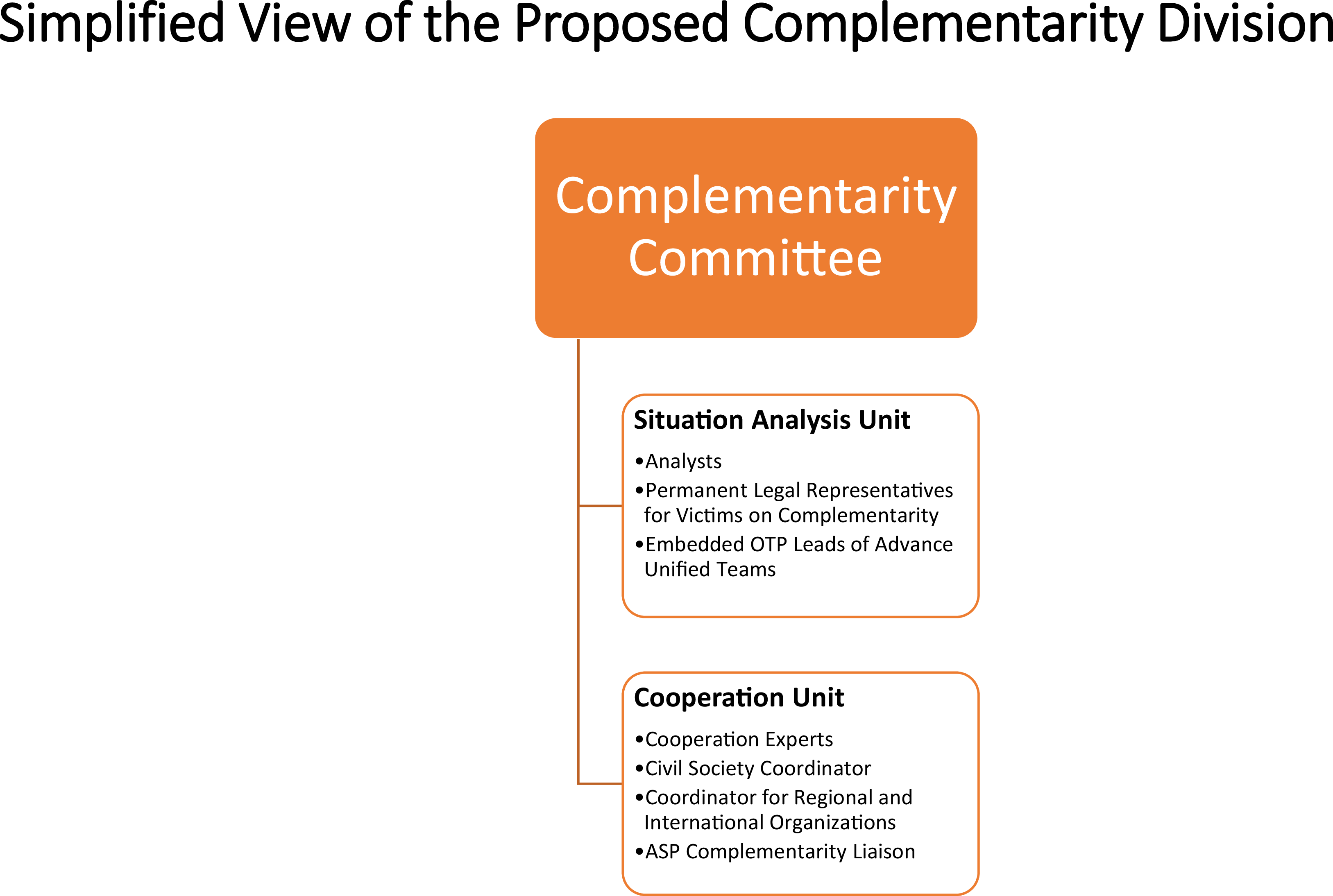
The design model proposed here is premised on the ability of the proposed division to fit into the Court’s current structure and avoid any negative impact on the Court’s independence.Footnote 122 This paper argues that the proposed complementarity division be made up of three main units: a Situation Analysis Unit, Co-operation Unit, and a Complementarity Committee. Figure 2 provides an overview of the makeup of these units, which are further discussed in relation to their proposed functions. Figures 3 and 4 show their proposed location within the Registry due to the Registry’s neutrality and role as the administrative arm of the Court, which provides services to all other organs so that the Court can function adequately.Footnote 123
Simplified view of the proposed complementarity division

Figure 2: Long description
Organizational chart illustrating proposed Complementarity Division structure with Complementarity Committee at top. Two subordinate units: Situation Analysis Unit and Cooperation Unit, are detailed. Situation Analysis Unit has the following positions: Analysts, Permanent Legal Representatives for Victims on Complementarity, and Embedded OTP Leads of Advance Unified Teams. Cooperation Unit has the following positions: Cooperation Experts, Civil Society Coordinator, Coordinator for Regional and International Organizations, and an ASP Complementarity Liaison. The Chart is highlighted in orange and white boxes.
The current structure of the ICC’s Registry
Source: ICC, Proposed Programme Budget for 2026 of the International Criminal Court, ICC-ASP/24/10 (2025), Annex I, at p. 204, available at asp.icc-cpi.int/sites/default/files/asp_docs/ICC-ASP-24-10-ENG.pdf.Footnote 124

Figure 3: Long description
ICC’s Registry Organizational chart. It illustrates the Structure of the Registry with its Division of Management Services, Division of Judicial Services, Division of External Operations, each with various sections. Victim-focused teams are located within the Division of Judicial services.
The proposed complementarity division within the registry

Figure 4: Long description
It illustrates the Structure of the Registry with its Division of Management Services, Division of Judicial Services, Division of External Operations, each with various sections. Victim-focused teams are located within the Division of Judicial services. The proposed complementarity division is to be attached to the Registry but not subordinate to it. It is functionally independent of the Registry.
4.3.1 The Complementarity Committee
This Committee should act as the proposed division’s management arm and should oversee the work done by the entire division. This Committee should be made up of experts elected in their individual capacity by the ASP, but who will represent all states parties and will reflect the five geographical regions of ICC States Parties.Footnote 125
4.3.2 Co-operation Unit
Securing judicial and non-judicial co-operation can be challenging and the quality of co-operation will impact preliminary examinations, investigations, prosecutions, and reparations. As mentioned above, the OTP has struggled with this while managing its core mandate of investigations and prosecutions. The issue persists, although the OTP, the Registry and Presidency have made several efforts to improve their respective and court-wide co-operation strategies and structures, including through the creation of co-operation focused units.Footnote 126 Poor rate of adoption of co-operation implementing legislation by states parties contributes to the difficulties with co-operation.Footnote 127 Nonetheless, political support and general co-operation might be improved if a neutral body involved in complementarity matters takes the lead. Thus, the proposed division should have a Co-operation Unit to take on the political and general aspects of co-operation from the very early stages of situations,Footnote 128 while working with the Registry which is also neutral and already supports all organs of the Court with judicial co-operation.Footnote 129
The proposed Co-operation Unit should be made up of co-operation experts in inter alia regional and subregional politics, a co-operation co-ordinator for civil society organizations (CSOs), and one for international, regional, and subregional governmental organizations.Footnote 130 It is worth noting that in 2024, the Prosecutor established the OTP-CSO Structured Dialogue initiative, which aims at facilitating quarterly sessions where the OTP and CSOs can enhance dialogue and co-operation.Footnote 131 As stated, neutrality could serve the Court’s needs in this regard, especially in the evolving international political landscape and the need for the OTP to focus on its core mandate.
The co-operation unit should also have an ASP Liaison because of the ASP’s important role of facilitation of knowledge exchange among states parties to address international crimes.Footnote 132 The limit to what can be communicated to the liaison and the extent of their involvement in the work of the proposed division will be determined by confidentiality and neutrality.Footnote 133
4.3.3 Situation Analysis Unit
The proposed Situation Analysis Unit should take over the conduct of preliminary examinations. This section should be staffed on a permanent basis by analysts and a Permanent Legal Representative for Victims on Complementarity issues. There should be a way to link the proposed division to the OTP due to the Prosecutor’s responsibilities regarding investigations and prosecutions.Footnote 134 The OTP uses its unified teams for its core tasks, to build situation-specific knowledge and a continuity of resources and expertise.Footnote 135 The heads of the unified teams can be embedded within the proposed Situation Analysis Unit.
4.3.3.1 Permanent Legal Representative for Victims on Complementarity
Complementarity’s centrality to the Rome Statute system of justice requires giving victims a seat at the table.Footnote 136 There are four important victims’ units at the ICC: the Victims Participation and Reparations Section (VPRS);Footnote 137 the Office of Public Counsel for Victims (OPCV);Footnote 138 Victims and Witnesses Section (VWS) of the Registry;Footnote 139 and the Trust Fund for Victims.Footnote 140 The VPRS processes victims’ applications for participation and reparations, while the VWS provides support and protection to witnesses and to victims who appear before the Court.Footnote 141 The OPCV assists victims as required in their legal representation in court, and the Trust Fund for Victims can provide different kinds of support to them and they implement court ordered reparations.Footnote 142 The merging of these existing units into one victims’ unit would not be sufficient to effectively protect victims’ interests throughout all stages of proceedings and may result in conflicts of interests given their respective mandates.Footnote 143 Victims need to be represented within the ICC’s complementarity mechanism so that meaningful inputs of victims’ units are more streamlined and better co-ordinated. Also, each of these units’ own networks can improve co-operation on victims’ issues some of which can be severe during prolonged preliminary examinations.
The proposed Permanent Legal Representative for Victims on Complementarity issues placed in this section could have a support staff attached to the OPCV whose mandate commences very early in ICC proceedings including those designed to address complementarity issues.Footnote 144 The Pre-Trial Chamber can instruct the OPCV to represent the interests of unrepresented victims, for instance, in deferral proceedings.Footnote 145 Alternatively, the OPCV can seek leave of the Court to do so.Footnote 146 Having a dedicated victims’ representative in the proposed division is achievable within the current legal framework of the Court as demonstrated in Section 2. Additionally, Rule 86 of the ICC RPE enshrines a general principle that all organs of the Court in performing their functions, shall take into account victims’ needs.Footnote 147 Since complementarity is crucial for the implementation of the Court’s mandate, it is logical to have such a position as a mechanism to enforce Rule 86.
5. Functions of the independent complementarity division
This section turns to contextualizing the functions of the proposed division using select ICC situations and cases. The proposed division should focus on promoting the goals of the Rome Statute system of complementarity throughout all stages of proceedings, while being mindful of the three dimensions of complementarity discussed in Section 1. They should be involved with analyses of communications and dialoguing with states, conducting preliminary examination, facilitating co-operation for victim-oriented complementarity, conclusion of a complementarity understanding, and contributing to non-party driven monitoring and compliance.Footnote 148 Since complementarity issues may arise at different stages in ICC proceedings, it is useful to look at the functions of the proposed division in phases. For this purpose, the paper borrows the European Union law terms ‘pre-contentious phase’ and ‘contentious phase’.Footnote 149
5.1 Functions of the proposed complementarity division in the pre-contentious and contentious phases
The pre-contentious phase is the period from when communications about alleged Rome Statute crimes have been made to the ICC up to the end of a preliminary examination phase without any admissibility challenge. Within this phase there is scope to read victims’ interests into complementarity provisions as explained in Section 2. The purpose of the pre-contentious phase is to avoid or at least minimize tensions between the ICC and states and to resolve issues between the OTP, the defence, and victims while upholding the Rome Statute’s aims. It could also be used to foster as far as practicable, local, regional, and subregional responses to situations by ascertaining states’ needs and applying flexible timing and victim-oriented qualified deference. At any time in the pre-contentious phase, the OTP, the defence, states, and victims retain their respective rights to challenge any part of the process by relying on relevant Rome Statute and RPE provisions available to them.
The contentious phase will usually commence once an admissibility challenge has been officially launched by a state or the accused, where there are compliance issues, or where the defence, victims and the OTP disagree on certain issues and may resort to judicial intervention for resolving them. In such cases, the proposed division can in the spirit of balancing interests and pursuing the Statute’s object and purpose, and through dialogue and communication, remind states of the minimum conditions they agreed to.
The paper uses the situations below from all ICC trigger mechanisms to explain how neutrality and independence could position the proposed division to function and arrive at more acceptable outcomes. For Cote d’Ivoire, there have been accusations that efforts to deliver justice in The Hague and in Cote d’Ivoire have been inefficient, biased, and does not sufficiently cover all sides to the conflict, or representative of crimes and victims’ harms.Footnote 150 The CAR II situation is useful for showing how victim-oriented complementarity through the proposed division could be consistently pursued in accordance with the goals of the Statute, regardless of states’ shifting political interests. Libya was chosen because it was not a party to the ICC at the time the UNSC referred the situation to the Court.Footnote 151 Also, Libya’s somewhat cooperative posture with the Court despite the African Union’s own stance on the ICC at the relevant time, and Libya’s subsequent acceptance of the ICC’s jurisdiction in 2025,Footnote 152 provide useful insights for such situations.
5.1.1 Cote d’Ivoire Situation
The Cote d’Ivoire Situation was opened proprio motu by the Prosecutor with three individuals charged. Cote d’Ivoire challenged admissibility of Simone Gbagbo’s case, invoking the principle of complementarity.Footnote 153 The Court rejected this for failure on Cote d’Ivoire’s part to prove that it was taking concrete, tangible, and progressive steps with regards to the OTP’s charges against her.Footnote 154 The other two defendants’ acquittal was confirmed by the Appeals Chamber, and charges against Simone Gbagbo were also vacated.Footnote 155 As of the OTP’s 2025 Annual Report, investigations in the situation are pending and regular contacts have been maintained with key stakeholders.Footnote 156
Opinions differ as to how the situation was and could have been handled before the collapse of these cases and limited accountability domestically, including with respect to the ICC’s restrictive interpretation of admissibility criteria.Footnote 157 The Cote d’Ivoire situation could have been suitable for applying tools of victim-oriented qualified deference through the proposed division, especially before reaching the point of judicial intervention. For example, Cote d’Ivoire adopted Rome Statute implementing legislation in 2015 to fully implement the substantial provisions of the Statute, including all but one general principle.Footnote 158 They established domestic mechanisms to address crimes within the context of the situation,Footnote 159 and Cote d’Ivoire’s civil society actively pushed for accountability.Footnote 160 Therefore, constructive dialogue, facilitation of co-operation, qualifying deference, and monitoring of compliance coupled with Cote d’Ivoire’s active civil society, could have improved the chances of delivering justice to more victims from all sides of the conflict. This could be in The Hague, in Cote d’Ivoire, in the region or subregion, for example through the Economic Community of West African States Court of Justice.Footnote 161
5.1.2 CAR II
CAR’s hybrid Special Criminal Court (SCC) which could try international crimes became functional seven years after the CAR II referral to the ICC.Footnote 162 The Yekatom case is useful here as qualified deference was raised by the defence when seeking a ruling of inadmissibility.Footnote 163 The Trial Chamber in issuing its decision followed the two-step approach to admissibility determination without any discussion of the merits or demerits of qualified deference.Footnote 164 The Appeals Chamber in the same case did not examine the concept.Footnote 165 The Yekatom defence had argued that CAR was able as of 2020 to try Mr. Yekatom because of the SCC.Footnote 166 The defence relied on Stahn’s version of qualified deference and asked the ICC to give CAR a chance to try Mr. Yekatom.Footnote 167 The Court deemed arguments advanced by the defence as incompatible with its approach to complementarity. This is because admissibility determinations are made based on the facts as they exist at the time of assessment, and not about adopting flexibility in admissibility rulings to mitigate the strict time requirements or address inability issues.Footnote 168
The Court noted that there was inaction on CAR’s part since no case against Mr. Yekatom was in existence in CAR at the relevant time.Footnote 169 There was also the issue that Article 37 of CAR’s Organic Law 15/003 gives the ICC primacy over cases where CAR and the ICC share concurrent jurisdiction.Footnote 170 Moreover, CAR authorities did not appear to be interested in the admissibility challenge.Footnote 171 This same law came under scrutiny in the Beina case, but this time, CAR wanted to exercise its jurisdiction. Thus, it challenged the admissibility of the Beina case before the ICC.Footnote 172 Victims in this case preferred justice to be done by CAR’s SCC and the Pre-Trial Chamber ruled in CAR’s favour.Footnote 173
This paper argues that with regards to the issue of time limitation and since CAR was co-operating in both cases, the proposed complementarity division could have recommended a phased approach to implementing complementarity. For the Yekatom case, the non-contentious phase could have been activated before the admissibility challenge by the defence. This could have been pursued since there was an effort by other international actors to restore security and build CAR’s capacity to deliver justice for victims.Footnote 174 The proposed division could have recommended qualified deference with victim-oriented conditions and clauses for the protection of the rights of the accused, with timeline to implement them. Alternatively, they could have considered burden-sharing and a postponement of a final decision on admissibility, even if CAR at the outset showed no interests in challenging admissibility. This would then provide the ICC with grounds to defer the Yekatom and other relevant cases to CAR where necessary, thereby freeing up the Court’s resources for situations which at the time were hibernated for lack of resources.Footnote 175 This method would not amount to a waste of resources because relevant ICC work products could, and have indeed been shared with CAR,Footnote 176 thereby contributing to its capacity which is a more sustainable approach. CAR’s domestic proceedings afforded victims the chance to participate, and some have recently been awarded reparations in record time compared to the ICC.Footnote 177
5.1.3 Libya
The UNSC referred the Libya Situation to the ICC.Footnote 178 At the early stages of this situation, the OTP noted that Libya was co-operating.Footnote 179 Libya received capacity building support,Footnote 180 and eventually challenged the admissibility of the Gaddafi and Al-Senussi cases.Footnote 181 The ICC rejected the admissibility challenge in relation to Gaddafi who at the time was not in Libya’s custody,Footnote 182 and instructed Libya to surrender him. Co-operation with the Court in this regard remained problematic,Footnote 183 and Gaddafi has now been reported dead.Footnote 184 The Court eventually declared Mr. Al-Senussi’s case inadmissible.Footnote 185 It found that the same case against him was before the ICC and that Libya was not unwilling or unable genuinely to carry out proceedings against Al-Senussi.Footnote 186 Notwithstanding the political dynamics of Libya and the region, and the security situation in the country, the ICC unconditionally deferred the case to Libya.Footnote 187 Subsequently, the situation in the country deteriorated, and Libya’s political divide did not improve.Footnote 188 These events suggested that the ICC would have probably found the case admissible in such an instance.Footnote 189 However, former Prosecutor Bensouda did not file a review in accordance with Article 19(10) of the Statute,Footnote 190 but reiterated the Chamber’s inadmissibility decision.Footnote 191 Had the ICC qualified its deference to Libya, it could have offered a legal basis to recall the Al-Senussi case where monitoring reveals that the expected results were not forthcoming even after reasonable adjustments which takes into account the changing situation.Footnote 192
Instead of prolonging the admissibility proceedings based on a very strict reading of Article 17, the ICC should have used the opportunity to make an impact in Libya,Footnote 193 since it displayed signs of willingness, had provisions for victims’ participation and showed a disposition towards carrying them along.Footnote 194 This willingness could have been cultivated using co-operation partners who can ensure that Libya carried victims along, and this process could be monitored. There is still room for a victim-oriented approach to complementarity in this situation, especially since Libya has now accepted the ICC’s jurisdiction.
5.2 Political will and budgetary considerations
One of the pertinent questions that may be asked in relation to creating a new complementarity division is whether there is an appetite to do so in the current global political climate. The discussions in Section 3 regarding the Court, the ASP, and stakeholders’ efforts to address issues with how complementarity is implemented, suggest that there is a fledgling political will to be galvanized for concrete progress.Footnote 195 However, it may be time to move away from an untenable patchy approach to addressing these issues, and step towards practical and sustainable solutions.
It is important to note here that budgetary considerations can impact the adoption of proposals for legal and structural changes in any context including at the ICC. The paper’s proposals may not require significant budgetary increase. They could be actionable by employing inter alia a purposive interpretation of existing provisions of the Rome Statute, other core ICC texts,Footnote 196 and by using different staffing models to minimize cost.Footnote 197 The proposed structure means that some existing ICC positions may be absorbed into some of the proposed units.Footnote 198 Additionally, there are cost neutral positions – those that already exist at the ICC and which can contribute to the work of the proposed complementarity division. Implementing complementarity in the manner proposed here and through such a body stands a better chance of increasing states’ exercise of their primary responsibility to address international crimes. More regional and subregional organizations may also get involved. Thus, in the long run, the benefits accrued may outweigh any short-term budgetary increase,Footnote 199 and this would require a comprehensive assessment beyond this paper.
6. Concluding remarks
This paper examined how the ICC’s goal of fighting impunity can be consistently pursued by upholding the system of complementarity as originally intended by the drafters of the Statute, while balancing all interests before the ICC. Victim-oriented complementarity stands a better chance of encouraging justice that is more meaningful and sustainable. A state which shows signs of willingness to address international crimes in a victim-oriented manner, should be given a chance to do so, even if it means allowing some flexibility with the time requirement of admissibility determinations. This can be accompanied by support for capacity building through complementarity stakeholders. State parties and non-parties can secure deference by the ICC, but they should at a minimum prove that they have met the requirement for victims’ protection and participation, and symbolic reparations, or a more substantive one. These are possible if the Court adopts a purposive approach to interpreting victims and complementarity provisions within the Rome Statute framework.
The paper argued that it is time for the various efforts to improve efficiency in complementarity to evolve into a bolder step forward. The ASP should consider creating a less contentious and an inclusive platform for states and other stakeholders to engage with the Court before contentious proceedings and subsequently. The composition of the proposed complementarity division should allow the ICC to focus on investigating and prosecuting the most responsible perpetrators. It also offers enhanced transparency of the process – a way to improve prosecutorial accountability,Footnote 200 and better access for victims to be heard and kept informed. These proposals require political will, which is currently hard to imagine, given the increasing attacks against the ICC, more outbreaks of wars and other international incidents, and increased tendency of states to draw closer to regional organizations. Yet inspiration should be drawn from the perseverance and sustained efforts which saw the remarkable adoption of the Rome Statute in 1998 and the subsequent creation of the ICC, after over six decades of efforts to create such a court.Footnote 201



 Open access

