


INTRODUCTION
Is national policy more responsive to the preferences of white Americans than to those of people of color? This is a fundamental question—not just for understanding American politics but also for assessing the quality of American democracy. No one can doubt that racial minorities have experienced profound political disadvantages in the past. The question is whether racial disparities continue to plague federal lawmaking, despite formal political equality, growth in the number of voters of color, and major increases in the number of racial and ethnic minorities holding office.
A large body of sophisticated research investigates racial biases in American politics. Yet little of this work examines unequal policy responsiveness in national policymaking. Instead, most focus on other venues and outcomes, such as subnational governments (e.g., Hajnal and Trounstine Reference Hajnal, Trounstine, Jack and M. Smith2013; Schaffner, Rhodes, and La Raja Reference Schaffner, Rhodes and La Raja2020) or the provision of constituency services (Butler and Broockman Reference Butler and Broockman2011). The few studies that have examined national policy responsiveness look at only a small subset of issues, rely on aggregated measures of voter ideology instead of voters’ specific policy preferences, or examine just roll call votes rather than ultimate policy outcomes (Rivera Burgos Reference Rivera BurgosN.d.; Griffin and Newman Reference Griffin and Newman2007; Griffin et al. Reference Griffin, Hajnal, Newman and Searle2019). Amid growing attention to unequal responsiveness based on class (e.g., Bartels Reference Bartels2008; Gilens Reference Gilens2012; Gilens and Page Reference Gilens and Page2014; Lax, Phillips, and Zelizer Reference Lax, Phillips and Zelizer2019), the absence of broader investigations of racial disparities in national policymaking stands out.
This paper offers such an analysis by drawing on a uniquely rich dataset that incorporates nearly 20 years of specific policy questions in the Cooperative Election Study (CES). Every year, the CES asks respondents if they support or oppose a number of bills under consideration in Congress (Ansolabehere and Kuriwaki Reference Ansolabehere and Kuriwaki2025). We add data on the disposition of these legislative items, as well as additional evidence that helps us understand legislators’ behavior. This new dataset allows us to move beyond aggregated measures of ideology and examine citizens’ yes-no support for specific policy items. All told, we compare 520,000 respondents’ preferences with policy outcomes—as well as with the roll call votes that produce them—across 134 diverse policy items. By doing so, we produce, for the first time, robust estimates of the correspondence between national policy outcomes and Black, Latino, Asian American, and white policy preferences.
We use this new dataset to tackle two broad questions. First, is national policy more responsive to the preferences of white citizens than to the preferences of Black, Latino, or Asian American citizens? Second, under what conditions are racialized disparities in policy representation exacerbated, diminished, or even reversed? The responsiveness of policymakers to citizen preferences is just one measure of the quality of representation. Still, we should be concerned about a democracy’s functioning if there is little or no alignment between what citizens say they want and what the government does, or if such alignment is much greater for some citizens than for others.
Not only has previous research on racial political inequality lacked the data necessary to tackle these questions. It has also generally failed to explore whether the disparities it finds might emerge in part through other channels—for example, due to unequal responsiveness to poorer citizens. Nor has it examined how these disparities vary across time, policy domain, or partisan context. We argue that the biggest likely source of variation is partisan control of the federal government. Parties play a special role in the representation of politically disadvantaged groups. As Dawson (Reference Dawson1994, 97) puts it, “Despite the relatively weak nature of American political parties, the party system is the best pressure point from which to influence public policy for groups whose resources consist mainly of concentrated numbers of people.” At the same time, the parties represent very different demographic coalitions. Thus, we expect that the pattern of policy winners and losers will shift with party control, narrowing or widening racial disparities.
We examine the patterns and correlates of racial disparities using two distinct measures of policy representation: “policy responsiveness,” or the correspondence between citizens’ support for a policy action and whether it occurs, and “dyadic representation,” or whether members of congress (MCs) vote in line with their constituents’ preferences. Our central measure is policy responsiveness. Pooling all 17 years and all 134 policy items in our dataset, we find that aggregate racial gaps in responsiveness are surprisingly small. white, Black, Latino, and Asian American respondents all get their preferred policy slightly less than half the time. Moreover, these patterns are relatively consistent across policy areas and do not differ markedly between policy items with higher levels of racial opinion polarization and those with lower levels.
When we divide our results by party control, however, we find that who wins and loses depends critically on which party governs. People of color are significantly disadvantaged compared to white Americans when Republicans control national political institutions. This is particularly true of the Senate—the institution that most often determines whether a CES item is successful. white Americans, by contrast, win equally often regardless of who governs. The differences are large: Black citizens lose on policy 7–9 percentage points more often than white citizens when Republicans control government, while Latinos and Asian Americans lose 4–7 points more often.
What might account for these sizable disparities? With our measure of policy responsiveness, we can explore the mediating role of income, education, age, gender, ideology, and party id. We find that party-based racial disparities in responsiveness persist even when we control for respondents’ income, education, age, gender, and ideology. However, when we control for respondents’ party id, many, but not all, of these party-based racial disparities disappear.
This last finding suggests that racial disparities emerge, in part, out of the different demographic profiles of the two parties’ voting coalitions. Voters of color tend to side with the Democratic Party, and the Democratic Party appears to be more responsive to them. Given how racialized party cleavages are in the United States, we caution against treating party id as a non-racial mechanism for party-based disparities. Our preferred interpretation is instead that party id is situated along the causal pathway between race and representation. Moreover, the direction of this causal pathway is unclear. It might be that the Democratic Party is more responsive to voters of color because they identify as Democrats. Or it might be that voters of color side with the Democratic Party because the party better represents them—in which case, our party id results are further evidence of party-based disparities. With our data, we cannot distinguish between these possibilities.
We can, though, gain greater insight into the role of race by turning to our second measure of policy representation: dyadic representation. In the latter half of the paper, we examine the correspondence between the roll call votes of MCs and their constituents’ support for those same items. The advantage of this multi-level approach is that it allows us to leverage variation across states and districts to identify more precisely where differences in responsiveness might emerge.
The results from our analysis of dyadic representation closely match our responsiveness findings: how each racial group is represented depends crucially on legislators’ partisanship. Democratic MCs represent the preferences of Black constituents and, to a lesser degree, Latino and Asian constituents better than the preferences of white constituents. By contrast, Republican MCs represent the preferences of white constituents better. These findings hold when we control for constituents’ party id and other racial correlates, suggesting they are driven by race, not the ideology, partisanship, or socioeconomic characteristics of an MC’s constituency. Indeed, looking at states with split party delegations, we show that even within these states, Republican senators represent constituents of color less well than do their Democratic counterparts. Given that these senators face the same electorate, the persistence of party-based racial disparities is notable.
A key advantage of moving to the district/state level is that we can investigate whether racial and ethnic minorities receive greater representation where they constitute a larger share of an MC’s constituency, as democratic theory would predict. Focusing on Black and Latino voters, however, we find a starkly non-linear relationship. Black Americans and Latinos receive better representation only when they approach or exceed a majority of a district’s population. This threshold is met only in the House and not the Senate. Instead, we find that Senators represent Black Americans worse and Latinos no better when Black Americans and Latinos constitute a larger share of their constituents. This unexpected inverse relationship between group size and representation for Black Americans is all the more striking because, as noted, the Senate is most often decisive for national policy outcomes.
We conclude our analysis, therefore, by investigating three potential mechanisms for these unexpected Senate results. The first is electoral competition. We find no difference between competitive and non-competitive states in the relationship between group size and representation. The second potential mechanism is a “Southern effect,” since racial minorities disproportionately live in Southern states, with their distinctive racial histories and attitudes. Here, we do find substantial differences: the size threshold that Black Americans must reach to receive better representation is higher in Southern states. Latinos receive worse representation as their share of the population increases in Southern states, but Latino group size has no association with the Latino-white dyadic representation gap in non-Southern states.
The final mechanism we investigate is racial resentment toward Black Americans. The literature on racial threat suggests that larger Black populations generate greater white resentment. Perhaps heightened resentment results in poorer representation of Black constituents, whether because voters’ preferences or party allegiances are more polarized or because legislators share these biases. Whatever the mechanism, we find that Black constituents do receive worse representation in states where white residents harbor more racial resentment. This is true even outside the South and when we control for state ideology. Moreover, when we account for state-level racial resentment, the negative relationship between Black population share and representation reverses. This suggests that racial threat dynamics help explain our group-size results.
Thus, we find that the most important institution in the lawmaking process fosters a very different representational dynamic for racial and ethnic minorities than for white Americans, and we uncover suggestive evidence that white racial attitudes contribute to this dynamic. More broadly, we find that party-based racial disparities in policy responsiveness and dyadic representation have large implications for who wins—and who loses—in American national policymaking.
ARE THERE RACIAL DISPARITIES IN RESPONSIVENESS AND REPRESENTATION?
“A key characteristic of democracy,” according to Dahl’s (Reference Dahl1971, 1) famous formulation, “is the continuing responsiveness of government to the preferences of its citizens, considered as political equals.” In this paper, we examine whether federal lawmakers are responsive to citizens’ expressed preferences (as measured by surveys) on bills and nominations before Congress. Our interest is in whether responsiveness so defined differs across racial and ethnic groups, which we take as suggestive of whether the members of these groups are in fact “considered as political equals.”
Responsiveness is not the only key characteristic of democracy; indeed, it can threaten democracy when citizens’ preferences conflict with basic rights (fortunately, this is not true of the specific policy items we examine). Nor is representation synonymous with responsiveness. For scholars focused on racial and ethnic minority representation, “descriptive representation”—whether representatives are from the same minority group as constituents—is also viewed as central.
We focus on the congruence between citizens’ preferences and policy outcomes because there is a large literature using this metric and because responsiveness can be thought of as a minimal standard uniting most theories of representation. As Caughey and Warshaw (Reference Caughey and Warshaw2018, 249) argue, “If policy change has no empirical relationship with mass preferences, then it is unlikely that citizens exercise the kind of control over government that lies at the core of democracy theory.”Footnote 1
This is particularly true given that our focus is on salient bills in Congress. These are items already high on the agenda that elites generally believe could be enacted. If we do not see congruence between citizens’ preferences and outcomes on these high-profile items, then we are unlikely to see it on less salient items. Nor would we expect other venues, such as the courts and executive agencies, to be reliably more responsive than the nation’s elected representatives. Still, we hope our assessment will be followed by additional research into other forms of representation, other venues, and other types of policies, as well as into the role of other political actors, such as interest groups, that may mediate responsiveness to citizen preferences.
Our analysis of responsiveness focuses on a specific question: are national policymakers more responsive to white Americans than to people of color? The preferences of citizens may be “the great engine of democracy” (Page, Shapiro, and Dempsey Reference Page, Shapiro and Dempsey1987, 1), but not all engines have the same power. For much of American history, slavery, segregation, and discriminatory policies deprived equal influence to racial and ethnic minorities, particularly Black Americans. The civil rights breakthroughs of the 1960s dramatically increased Black power and descriptive representation, and, in the decades that followed, other minority groups—notably, Latinos and Asian Americans—saw similar advances (Hajnal, Hutchings, and Lee Reference Hajnal, Hutchings and Lee2024). Yet voters of color continue to lag behind white Americans with regard to wealth, income, education, and other potential sources of influence (Hajnal, Hutchings, and Lee Reference Hajnal, Hutchings and Lee2024). They also tend to be disadvantaged by the American electoral structure, which tilts representation toward less densely populated areas and provides states with substantial control over voting rules and districting. Do these inequalities produce racial disparities in responsiveness?
Prior research suggests they do. Audit studies find that elected officials better represent white Americans than people of color when performing constituency services (Butler and Broockman Reference Butler and Broockman2011; white, Nathan, and Faller Reference White, Nathan and Faller2015; Gell-Redman et al. Reference Gell-Redman, Lajevardi, Crabtree and Fariss2018; Lajevardi and Oskooii Reference Gell-Redman, Lajevardi, Crabtree and Fariss2018). Moreover, there is evidence that policy outcomes in local politics are tilted toward white residents (e.g., Hajnal and Trounstine Reference Hajnal, Trounstine, Jack and M. Smith2013; Schaffner, Rhodes, and La Raja Reference Schaffner, Rhodes and La Raja2020). Finally, studies continue to find high levels of racial division in voting, campaigns, and policy debates, as well as prejudicial white attitudes toward voters and candidates of color (e.g., Abrajano and Hajnal Reference Abrajano and Hajnal2015; Tesler Reference Tesler2012; Kuziemko and Washington Reference Kuziemko and Washington2018; Hajnal and Rivera Reference Hajnal and Rivera2014). For all these reasons, we might expect citizens of color to be less well-represented than white citizens.
Despite these suggestive findings, however, no study has convincingly measured racial disparities in national policy responsiveness. Instead, studies of federal policymaking have overwhelmingly focused on class disparities (Bartels Reference Bartels2008; Gilens Reference Gilens2012; Gilens and Page Reference Gilens and Page2014; Lax, Phillips, and Zelizer Reference Lax, Phillips and Zelizer2019). This influential work generally indicates that the preferences of upper-income Americans dominate national policymaking (Bartels Reference Bartels2008; Gilens Reference Gilens2012; Gilens and Page Reference Gilens and Page2014; but see Enns Reference Enns2015)—a bias mediated by partisanship, with Republicans more responsive to upper-income Americans than Democrats are (Grossman, Mahmood, and Isaac Reference Grossmann, Mahmood and Isaac2021; Lax, Phillips, and Zelizer Reference Lax, Phillips and Zelizer2019; Rhodes and Schaffner Reference Rhodes and Schaffner2017). The problem is that these analyses have ignored what may be the most fundamental and contested source of representational disparities: race.
Thankfully, a small number of analyses have begun to fill the gap. We build on these valuable studies of race and responsiveness while seeking to address two limitations they share. First, unlike scholarship on class disparities, these studies do not examine whether the specific policies that voters support are enacted into law across a broad range of issues. They examine roll call votes rather than ultimate policy outcomes, look at only a few issues, or assess broad ideological congruence between voters and legislators (Rivera Burgos Reference Rivera BurgosN.d.; Griffin and Newman Reference Griffin and Newman2007; Griffin et al. Reference Griffin, Hajnal, Newman and Searle2019). Griffin and Newman (Reference Griffin and Newman2007), for example, compare constituents’ self-reported ideologies to the DW-nominate scores of their representatives and find greater congruence for white voters. Yet measures of ideological alignment may not capture responsiveness to citizens’ specific preferences (Ahler and Broockman Reference Ahler and Broockman2018), nor can we assume the link between self-reported ideology and preferences is the same for all racial groups (Jefferson Reference Jefferson2024).
Second, this work has focused on documenting racial disparities, rather than seeking to understand the individual-level and contextual factors that might widen or narrow them. In part, this reflects the data used in prior studies, which lack adequate scope for over-time or multivariate analysis. Our dataset, by contrast, spans many years and issues and is built up from large individual-level survey data, allowing us to employ respondent-level controls and to examine variation across time, policy domain, and partisan context (as well as across states and districts when we look at legislators’ roll call votes). Thus, a core goal of our analysis is to better understand the individual and contextual factors that might account for racial disparities. With our dataset, we can examine whether racial disparities are associated with other widely studied sources of political disadvantage, such as lower levels of income or education. We can also examine whether and how these disparities vary across time, issue, and political context—for example, across policy domains or across issues with smaller or larger racial divisions.
As noted, the contextual factor we most closely examine is partisan control of the federal government. Party control has long been central to the representation of groups whose power stems from their capacity to exert mass pressure rather than their disproportionate resources. Indeed, the growing allegiance of African Americans to the Democratic coalition was a fundamental precondition for the civil rights breakthroughs of the 1960s (Schickler Reference Schickler2016). As American society has diversified, the voter bases of the Democratic and Republican parties have grown increasingly racially and ethnically distinct, with the Democratic Party receiving much stronger support, on average, from voters of color (Hajnal, Hutchings, and Lee Reference Hajnal, Hutchings and Lee2024; Kuriwaki et al. Reference Hajnal, Hutchings and Lee2024). Democratic officeholders are also more likely to identify as racial and ethnic minorities themselves, and minority legislators appear more responsive than their white counterparts to voters of color (Dade Reference Dade2011; Dawson Reference Dawson1994; Griffin and Newman Reference Griffin and Newman2007; Griffin et al. Reference Griffin, Hajnal, Newman and Searle2019; Hajnal and Horowitz Reference Hajnal and Horowitz2014). All this might lead us to expect that national policy outcomes are more responsive to voters of color when Democrats are in charge. On the other hand, it may be that neither party has an incentive to appeal to groups like African Americans that are clearly aligned with one party (Frymer Reference Frymer1999). Thus, how partisan control affects racial disparities remains an open question, too—and one we seek to answer.
In short, existing perspectives leave us with contrary hypotheses and conditional expectations. At the same time, empirical tests of these relationships have proved elusive because of empirical and conceptual problems that our data and analyses are designed to address.
DATA AND METHODS
Our approach aims to overcome the two major limitations just discussed. First, the dataset that we develop allows us to reliably capture the preferences of citizens of color as well as white citizens on specific policy questions, allowing us to move beyond aggregate measures of broad ideological orientations. Second, our dataset allows us to compare these preferences with national policy outcomes across a wide range of issues over nearly two decades. This not only bolsters confidence in our findings but also provides us with a sufficiently long period to capture the effect of shifting contextual factors, such as changes in partisan control.
Our primary data source is the Cooperative Election Study, a publicly available survey conducted annually since 2006 (Ansolabehere et al. Reference Ansolabehere, Schaffner, Rivers, Sam, David, Warshaw and Kuriwaki2006–2022). A vital source for research at the intersection of political behavior and political institutions, the CES is the largest, politics-focused survey in the United States, with a sample of roughly 8,000–60,000 respondents every year (see Table SI-A1 in the Supplementary Appendix).Footnote 2
Critically, our dataset features sample sizes large enough to examine citizen preferences within states and congressional districts, which we can then compare with the roll call votes of the individual MCs representing those jurisdictions. Scholarship to date has generally focused on just one of the two different conceptions of representation that we introduced earlier: “policy responsiveness” and “dyadic representation.” Although we are primarily interested in policy responsiveness—the congruence between citizens’ opinions and final policy enactments—our dataset also allows us to examine dyadic representation, the congruence between constituents’ opinions and the votes of their elected officials. This allows us to zoom in on the “electoral connection” (Mayhew Reference Mayhew2004) that underlies national policy outcomes. It also provides us with the necessary variation to examine factors—such as the size of racial groups within states and districts—that do not vary nationally.
To measure respondent policy preferences, we draw on an annual set of four to ten CES questions related to specific roll call votes in Congress that have taken place or are anticipated to take place soon (Supplementary SI-B provides a complete list of questions and preference distributions). The questions cover prominent bills and nominations from 2003 until 2022, such as raising the minimum wage, confirming Supreme Court Justices, passing the Affordable Care Act, restricting abortion, placing sanctions on North Korea, withdrawing from Iraq, and responding to the COVID-19 pandemic. In short, these are high-profile issues where accountability and responsiveness should be most salient.
In total, the CES covers 134 policies and six nominations, though some are asked about more than once. We dropped the nomination questions because they do not capture specific policy preferences (our results are robust to their inclusion) and hand-matched each of the remaining 134 items to the relevant legislation. This required significant judgment as bills are often introduced and reintroduced repeatedly, meaning the same provision might be voted on during consecutive Congresses, requiring us to decide which is the right match for a given year of the CES.
Of the 134 items, we were able to match 111 to specific legislation with a roll call vote taken on the floor of at least one chamber of Congress. The remaining 23 items could not be matched to a specific roll call vote because the associated legislation was blocked in committee, blocked by party leaders, credibly threatened with a filibuster, or never formally introduced and therefore never received a vote on the floor of either chamber.Footnote 3 Our data on roll call votes come from VoteView.com (Lewis et al. Reference Lewis, Poole, Rosenthal, Boche, Rudkin and Sonnet2024). Where possible, we use votes on final passage of bills in both chambers. In the Senate, however, when only a cloture vote is taken (because it fails to pass the supermajority threshold), we consider the cloture vote to be equivalent to a vote on the bill itself. In all cases, we match the questions from the CES to the bill voted on temporally closest to when the CES asked about an issue. In general, bills are asked about within a year of a vote, though this is not always the case, and there might be as much as a 3-year gap between a vote being taken and the issue being asked about on the CES.Footnote 4
Across the 134 measures included in the CES, the policy positions of people of color differ substantially from those of white Americans. Indeed, racial differences generally surpass divides by education, income, and gender. The average absolute Black-white, Asian American-white, and Latino-white divide across all 134 measures is 15.4 percentage points, 11.1 percentage points, and 7.9 percentage points, respectively. By comparison, the average opinion difference between high school graduates and college graduates is 6.4 points, while the gap between those making over $150,000 and those making less than $30,00 is 4.9 points. The gap closest to those across racial groups is that between men and women, which is 8.6 points—similar to the Latino-white divide but smaller than the Black-white and Asian American-white divides.
Figure 1 shows opinion differences across racial-partisan groups on specific legislation within three broad issue areas: economic policy, cultural policy, and defense policy.Footnote 5 These three areas aggregate nine policy domains cataloged by the Comparative Agendas Project (CAP) (Jones, Larsen-Price, and Wilkerson Reference Jones, Larsen-Price and Wilkerson2009). The figure shows that while public preferences on these salient bills are highly correlated with partisanship, there are within-party opinion differences on many questions. On highly partisan issues, such as the minimum wage and stem-cell research, partisan identities are highly predictive of preferences, with only minor within-party differences across racial groups. However, on less party-polarized issues—for example, the extension of the North American Free Trade Agreement (NAFTA) or providing a pathway to citizenship for undocumented immigrants—there are substantial within-party differences that appear to be associated with race.
Partisan and Racial Opinion Gaps Across a Subset of Legislation

Figure 1. Long description
A multi-panel figure with three horizontal dot plots. The x-axis for all plots is Share in Support, ranging from 0.2 to 1.0. Data points are color-coded by Party I D (Blue for Democrat, Light Brown for Republican) and shaped by Race (Circle for Asian, Square for Latino, Triangle for Black, and Plus sign for White).
Top Panel: Economic.
* Minimum Wage: Republicans cluster around 0.5 to 0.6; Democrats cluster near 0.9 to 1.0.
* Extend NAFTA: Democrats cluster around 0.4 to 0.65; Republicans are more spread from 0.55 to 0.72.
* Bank Bailout (T A R P): Republicans cluster low at 0.2 to 0.48; Democrats cluster at 0.35 to 0.5.
Middle Panel: Cultural.
* Stem Cell Research: Republicans cluster around 0.35 to 0.5; Democrats cluster high at 0.85 to 0.95.
* Pathway to Citizenship for Undocumented Immigrants: Republicans cluster around 0.35 to 0.45; Democrats cluster around 0.5 to 0.85.
* Ban Gay Marriage: Democrats cluster low at 0.1 to 0.48; Republicans cluster high at 0.58 to 0.75.
Bottom Panel: Defense.
* Withdraw Troops from Iraq: Republicans cluster low at 0.2 to 0.4; Democrats cluster high at 0.88 to 0.95.
* Renew Phone Surveillance (Patriot Act): Democrats cluster around 0.38 to 0.52; Republicans cluster around 0.5 to 0.72.
* Iran Sanctions Act: Both parties show high support, with Democrats between 0.7 and 0.8 and Republicans between 0.75 and 0.92.
The use of the CES questions to study policy congruences has been challenged in an important study by Hill and Huber (Reference Hill and A. Huber2019), who argue that they may not capture what respondents would prefer if they had more information on the bill in question—especially the party split on the bill. We address this issue in greater detail and provide additional tests using Hill and Huber’s own data in Supplementary SI-C. To summarize what we show there, we find that greater information of the sort Hill and Huber provide in their experiments increases preference gaps between white, Black, and Latino voters and thus would, if anything, strengthen our main findings regarding racial disparities in responsiveness and dyadic representation. In any case, we believe that studies that center the effects of party control may well be more convincing if the policy questions do not include party cues. While such cues could allow voters to more accurately judge whether they support a policy, they could also encourage voters to embrace a policy on the basis of motivated reasoning. To convincingly show that party control matters, we think it ideal not to “stack the deck” in favor of finding that partisans get more of what they want when their preferred party is in power.
We remove observations where respondents answered “Don’t Know,” skipped the question, or were not asked. After these changes, our dataset contains about 3.7 million positions across nearly two decades of varying party control of Congress and the presidency, drawn from a nationally representative sample of more than 520,000 Americans. Along with detailed roll-call data, we also have demographic information for every respondent, including partisanship, gender, race, ethnicity, education, income, and religion (see Table SI-A2 in the Supplementary Appendix). Replication data are available at Markarian et al. (Reference Markarian, Hacker, Lockhart and Hajnal2025).
A Note on Agenda Setting
The CES items are not meant to be representative of all bills in Congress, much less all policy preferences that citizens might have. Rather, they are meant to sample high-profile bills of substantive importance. While we would like to have a broader set of questions, these are important items on which to measure responsiveness. If we see little responsiveness on highly salient items, it is unlikely we would find it on lower-profile ones. Thus, we see our measures as upper-bound estimates and caution against inferring from them that disparities do not exist on less salient issues.
Figure 2 provides an overview of the policy issues captured by the CES questions, disaggregating our three broad policy domains into the nine individual CAP issue areas mentioned earlier, along with a tenth CAP category: government operations. We compare the mix of issues covered by the CES with the mix covered by all bills, all public laws, and the Congressional Quarterly Almanac, from which the CES list is in part drawn (Congressional Quarterly N.d.; Ansolabahere and Kuriwaki Reference Ansolabehere and Kuriwaki2025). In the Supplementary SI-E, we also compare the CES questions with Mayhew’s “important enactments” (Mayhew Reference Mayhew2022) and Curry and Lee’s “congressional majority party agenda” bills (Curry and Lee Reference Curry and Lee2022). The coefficients in Figure 2 measure the overlap between each of these alternative lists and the bill-related questions on the CES. The results suggest that the CES covers a wide spectrum of domestic and foreign policy issues and relatively closely matches broader measures of the congressional agenda.
Differences in the Proportion of Bills Coded as Belonging to Each Category Across the CES Questions and Three Comparison Groups

Figure 2. Long description
A three-panel dot plot. Each panel shares a Y axis labeled Issue Area with ten categories and an X axis labeled Difference (proportion) ranging from negative 0.10 to 0.15 with a vertical zero-line.
Panel 1: C E S vs All Bills.
* Public Investments and Assets: negative 0.07
* Government Operations: negative 0.06
* Foreign Trade: negative 0.01
* Energy and the Environment: negative 0.01
* Defense and International Affairs: negative 0.01
* Health, Education, and Social Welfare: 0.03
* Immigration: 0.04
* Law, Crime, and Family Issues: 0.06
* Economics, Commerce, and Labor: 0.09
* Civil Rights and Liberties: 0.14
Panel 2: C E S vs C Q Major Issues.
* Public Investments and Assets: negative 0.05
* Foreign Trade: negative 0.04
* Energy and the Environment: negative 0.03
* Defense and International Affairs: negative 0.08
* Health, Education, and Social Welfare: negative 0.05
* Immigration: 0.01
* Law, Crime, and Family Issues: 0.08
* Economics, Commerce, and Labor: 0.02
* Civil Rights and Liberties: 0.11
Panel 3: C E S vs Public Laws.
* Public Investments and Assets: negative 0.10
* Government Operations: negative 0.06
* Foreign Trade: negative 0.01
* Energy and the Environment: negative 0.01
* Defense and International Affairs: negative 0.01
* Health, Education, and Social Welfare: 0.03
* Immigration: 0.04
* Law, Crime, and Family Issues: 0.06
* Economics, Commerce, and Labor: 0.09
* Civil Rights and Liberties: 0.14
A related concern about agenda setting is that our measures are distorted by the power of congressional majorities to advance or suppress certain issues. As elaborated in Supplementary SI-F, however, we do not see party agenda control as problematic for our analyses. We, of course, observe a different mix of issues depending on which party is in power. In particular, items high on the agenda appear to be selected to be popular among the majority party’s voters, particularly when a co-partisan holds the white House. However, we have a wide range of configurations of party control in our dataset. More important, the choices that parties make to advance or suppress policy items are crucial to responsiveness. If we are interested in how party control affects the representation of racial and ethnic minorities, then our measures of responsiveness need to be sensitive to party efforts to bring up (or block consideration of) items supported by different segments of the electorate.
FINDINGS: ARE THERE RACIAL DISPARITIES?
We begin by studying policy responsiveness, our main outcome of interest. We define responsiveness as the passage of a legislative item a respondent supports or the defeat of an item a respondent opposes. Thus, responsiveness can result from congressional action or inaction. The outcomes of the bills we look at are relatively evenly divided—though even for these high-profile items, defeat is more common than passage: 43.5% of the policies asked about become law.
Aggregate Results
In our first model, we run OLS regressions at the respondent level across all policy items, with the dependent variable being whether a respondent “wins”—that is, whether they see a policy they support enacted or one they oppose defeated. We use respondent-level binary variables based on respondents’ racial and ethnic self-classification; the reference category for these binary variables is white Americans. The model includes policy question fixed effects to account for year-to-year differences in the CES, electoral cycles, and baseline differences in items’ popularity. Results are presented in Figure 3, and full model results are available in Supplementary SI-G, based on this model:
Estimate Effect of Race on Policy Responsiveness
Note: White Respondents are the reference category (white average = 0.495). Individuals with other racial self-categorizations are excluded from the figure. All models include policy question fixed effects and standard errors clustered at that level.

Figure 3. Long description
A coefficient plot with a horizontal x-axis labeled Coefficient Estimate ranging from minus 0.10 to 0.10 in increments of 0.05. A vertical dashed line at 0.00 is labeled White Respondent. The y-axis lists three categories from top to bottom.
* Black Respondent: The point estimate is slightly below 0.00, with a horizontal error bar extending from approximately minus 0.04 to 0.035.
* Latino Respondent: The point estimate is approximately minus 0.02, with a horizontal error bar extending from approximately minus 0.045 to 0.01.
* Asian Respondent: The point estimate is approximately minus 0.02, with a horizontal error bar extending from approximately minus 0.045 to 0.01.
All three error bars cross the zero line, indicating that the differences from the White respondent reference category are not statistically significant at the displayed level.
OutcomeMatch_i,v = Race_i + QuestionFE + epsilon_i,vFootnote 6
where OutcomeMatch_i,v is the outcome for respondent i on vote v and Race is respondent i’s race.
Perhaps surprisingly, when we average across all policies and all years in our dataset, we find that racial and ethnic minorities win on policy at similar rates to white Americans. Over the nearly 20-year period for which we have votes on CES items, white Americans win on policy on average 49.6% of the time. Our models estimate that Black Americans, Latinos, and Asian Americans win at similar rates, and the small differences are not statistically significant. At least judging by this overarching measure, racial differences in national policy responsiveness seem limited.
Variation in Responsiveness Over Time
We caution against putting too much emphasis on this overall finding. While our analysis is more comprehensive than existing studies, it still covers less than two decades of lawmaking. Outcomes over this period could differ from outcomes in previous periods. More importantly, as we have argued, average win rates may hide variation in the size and direction of racial disparities over time and in particular across changes in partisan control of government.
In Figure 4, we begin to investigate this variation. It shows the percentage point gap in win rates between white Americans and our three main racial and ethnic groups for each year in the CES.Footnote 7 As the figure makes clear, there is substantial over-time variation in racial disparities. At times, racial and ethnic minorities win more regularly than white Americans. At other times, they lose more regularly. The figure strongly suggests that averaging over time provides an incomplete picture. It also offers some early insight into the effects of party control—a topic we turn to shortly.
Racial Gaps in Win Rates Relative to White Americans by Year and Party Control

Figure 4. Long description
The image consists of three vertically stacked scatter plots. The Y-axis represents the Representational Gap Relative to White Americans, ranging from negative 0.2 to 0.2. The X-axis represents the Year, ranging from 2006 to 2022. A horizontal red dotted line at 0.0 indicates parity with White Americans.
Legend Information:
Congressional Control is indicated by shape: circles for Democrat, triangles for Divided, and squares for Republican. Presidential Control is indicated by color: blue for Democrat and light brown for Republican.
Panel 1: Asian Americans
Data points fluctuate near the 0.0 parity line. Notable peaks occur around 2010 (blue circle) and 2017 (light brown square). A significant dip is seen in 2019 (light brown triangle).
Panel 2: Black Americans
Shows higher positive gaps between 2009 and 2014, peaking above 0.1. Gaps drop significantly below 0.0 in 2006 and 2019, with a notable negative square in 2016.
Panel 3: Latinos
Trends are similar to Black Americans but with slightly lower peaks. Most data points between 2011 and 2015 cluster near the parity line. Significant negative outliers appear in 2006 and 2019.
Across all panels, the 2019 data point (Divided Congress, Republican President) shows a sharp downward spike, while the 2009-2010 period (Democratic Congress and President) shows a positive trend.
Variation Across Issue Areas and Issue Polarization
Racial disparities vary a great deal over time. What accounts for that variation? One possibility is the mix of bills considered each year. If racial and ethnic minorities win more in certain policy areas than in others—for example, due to advocacy efforts or issue salience—shifts in the policy agenda from year to year could widen or narrow disparities. With the limited number of policies in our dataset, it is difficult to parse them too finely. Nevertheless, to look at variation across issue areas, we break our aggregate results down into our three previously mentioned categories—economic, cultural, and defense policy—as well as the CAP category of “government operations.”Footnote 8
Across these four broad areas, there is relatively little variation in outcomes. As Figure 5a illustrates, in all four, none of the racial gaps in representation is significant. At least in the aggregate, racial and ethnic minorities win about as often as white Americans in each domain.Footnote 9
Estimate Effect of Race on Policy Responsiveness by Issue Area and Polarization

Figure 5. Long description
A two-panel dot plot with a shared x-axis labeled Coefficient Estimate ranging from -0.2 to 0.2. A vertical dashed line at 0.0 indicates the baseline.
Panel 5.1 Issue Area: Displays estimates for Black, Latino, and Asian respondents across four categories.
* For Black Respondents, Government Operations (circle) shows a negative estimate with a wide confidence interval, while Economic Policy (triangle), Defense Policy (square), and Cultural Policy (plus) cluster near zero.
* For Latino Respondents, Government Operations is slightly negative, while other categories are near zero.
* For Asian Respondents, Government Operations is slightly positive, while Economic Policy is slightly negative.
Panel 5.2 Racially Polarized Issues: Displays estimates for the same respondent groups based on racial gaps.
* For Black Respondents, the Larger White-Black Gap (triangle) is near zero, while the Larger White-Latino Gap (circle) is negative.
* For Latino Respondents, all three gap categories (White-Latino, White-Black, and White-Asian) cluster closely together just below zero.
* For Asian Respondents, the Larger White-Latino Gap (circle) is the most negative estimate.
Legend 1 (Issue Area symbols):
* Diamond: Government Operations
* Triangle: Economic Policy
* Square: Defense Policy
* Plus: Cultural Policy
Legend 2 (Polarization symbols):
* Diamond: Larger White-Latino Gap
* Triangle: Larger White-Black Gap
* Square: Larger White-Asian Gap
Another possibility is that win rates for people of color depend less on the policy area and more on the extent to which white Americans and people of color disagree on the direction of policy. As racial minority opinions diverge from those of the majority, their odds of achieving policy success should decline. Figure 5b reveals that this mechanism may offer a partial but incomplete explanation. When white Americans and Black Americans or white Americans and Asian Americans disagree more than average, no significant racial disparities emerge. Regardless of the degree of racial opinion polarization, no substantial racial gaps in representation emerge when we pool all years of data together. However, when white Americans and Latinos disagree more than average, white Americans see better representation by about 4.4 percentage points (p < 0.05).
How Party Control Shapes Racial Disparities
We now turn to the factor that we think should produce substantial disparities: party control. Given clear racial patterns in partisan identification, we expect that racial biases in policy responsiveness will be mediated by partisan control of the presidency and Congress, with the Republican Party more responsive to the preferences of white Americans than to the preferences of people of color, and the Democratic Party potentially the opposite.
Indeed, that is exactly what Figure 4 suggests. A closer look at that figure, which we presented earlier, reveals that racial gaps in representation almost always reverse sign when partisan control of the presidency changes. Relative to white Americans, racial and ethnic minorities tend to win more when Democrats occupy the white House, and they tend to lose more when Republicans do. Partisan control of governing institutions appears to be a fundamental shaper of responsiveness.
To more carefully test for party effects, we add to our initial analysis a variable capturing party control of each legislative veto point (the House of Representatives, the Senate, and the Presidency). In three separate models, we regress whether a respondent wins on the respondents’ racial and ethnic binary classifications interacted with partisan control of the relevant institution. The first model interacts race and ethnicity with partisan control of the presidency, the second interacts race and ethnicity with partisan control of the House of Representatives, and the third interacts race and ethnicity with partisan control of the Senate as follows:
OutcomeMatch_i,v = Race_i*VetoControl_v + QuestionFE + epsilon_i,v
where OutcomeMatch_i,v is the outcome for respondent i on vote v, Race is respondent i’s race, and VetoControl is a bivariate indicator of Republican party control of the veto point of interest.
Two of our three models—those focused on the Presidency and the Senate—provide robust evidence that party control matters. Figure 6a shows substantial differences in policy responsiveness based on the President’s party.Footnote 10 When Democrats control the presidency, Black Americans win 3.9 percentage points more often than white Americans do—a gap that is substantively meaningful and nearly statistically significant (p = 0.08). The gap between Latinos and white Americans and between Asian Americans and white Americans is near 0 and not statistically significant. Overall, when Democrats govern, Black, Latino, and Asian American voters all see favorable policy outcomes, with over half of each group winning on policy.Footnote 11
Estimate Effect of Race on Policy Responsiveness by Partisan Control of Veto Point

Figure 6. Long description
Three vertical panels are arranged side-by-side, labeled 6.1 President, 6.2 House, and 6.3 Senate. The X-axis for all panels represents Coefficient Estimate, ranging from minus 0.2 to 0.1, with a dashed vertical line at 0.0 indicating the null effect. The Y-axis lists six interaction categories from top to bottom: Black Respondent asterisk Democratic Control, Latino Respondent asterisk Democratic Control, Asian Respondent asterisk Democratic Control, Black Respondent asterisk Republican Control, Latino Respondent asterisk Republican Control, and Asian Respondent asterisk Republican Control.
In the 6.1 President panel, Democratic control shows slightly positive coefficients for Black and Latino respondents, while Republican control shows significantly negative coefficients, particularly for Black respondents at approximately minus 0.13.
In the 6.2 House panel, all estimates for both Democratic and Republican control cluster closely around the 0.0 line with overlapping confidence intervals, indicating minimal variance in responsiveness.
In the 6.3 Senate panel, Democratic control shows slightly positive coefficients for all three groups. Conversely, Republican control shows negative coefficients for all groups, with the strongest negative effect for Black respondents at approximately minus 0.14.
When Republicans govern, however, the patterns are radically different. During Republican presidencies, there is a large racial gap in representation favoring white Americans: they win about 8.3 percentage points more often than Black Americans, and about 7.1 to 6.1 points more often than Latinos and Asian Americans, with the difference being statistically significant for Latinos. While voters of color see favorable outcomes during Democratic presidencies, they lose a majority of the time during Republican ones. Importantly, white Americans are not absolutely worse off during Democratic presidencies—they actually enjoy win rates about four percentage points higher than during Republican presidencies (51.2% versus 47.8%). However, they do not experience relative representational advantages during Democratic presidencies—and, indeed, are slightly disadvantaged compared to Black Americans.
For Black voters, presidential control is particularly consequential. When the president is a Democrat, Black Americans win 55% of the time, but under Republican presidents, policy is congruent with Black preferences only about 38.3% of the time. When Democrats hold the presidency, Latinos’ average win rate is 51% versus 40.5% under a Republican president. Asian Americans experience comparable partisan patterns, winning more with Democrats in power and losing more with Republicans in power.
Comparing Democratic and Republican presidencies, it is apparent that the representational advantages that Black Americans and Latinos experience under Democratic presidents are relatively small and often statistically insignificant, while the representational disadvantages they experience under Republican presidents are much larger and more significant. This helps explain why we end up with relatively small racial disparities in representation when we aggregate results across our entire dataset. Over this full period, the presidency was held by Democrats about three-fifths of the time. The evenness of aggregate outcomes in our dataset turns out to depend critically on the disproportionate prevalence of Democratic control.
Figures 6b and 6c turn from the presidency to show how partisan control of the House and Senate affects outcomes.Footnote 12 The figures confirm that partisan-specific racial disparities result from party control of Congress, too. They also suggest that these disparities are driven primarily by the Senate—party control of the House appears to have limited effects.Footnote 13 This is partly because the Senate is decisive when it comes to policy far more often than the House.
Figure 6c shows that when the Senate is controlled by Democrats, Black Americans win on policy about 5.5 percentage points more often than do white Americans, but when Republicans control the Senate, Black Americans lose about 8.3 percentage points more often than white Americans. Both differences are statistically significant. Black Americans win on policy 56.5% of the time with a Democratic Senate but only 40% with a Republican Senate. Latinos and Asian Americans win on policy about 1.9 percentage points more often than white Americans when Democrats control the Senate—advantages that are not statistically significant. Meanwhile, Latinos lose 7 percentage points and Asian Americans 6 percentage points more often than white Americans when Republicans control the Senate, statistically significant differences.
The effects of party control of the Senate parallel the effects of party control of the Presidency. This may be partially because partisan control of the Presidency and Senate temporally overlapped for 16 of the 19 vote-years in our dataset, capturing a compounding effect of multiple veto points. When all three veto-point interactions are included in one model, Senate party control stands out as the primary moderator shaping racial disparities in responsiveness (see Supplementary SI-I).
Turning to the substance of these differences, representational gaps are largest under Republican leadership on issues related to government operations, on cultural policies, and on policies where there is more racial polarization (see Supplementary SI-J and Supplementary SI-K). These disparities appear to result roughly equally from action and inaction—that is, the passage of policies that voters of color oppose and the failure of policies that voters of color support—though disparities for Black Americans appear distinctively driven by a low success rate for policies they support under Republican control (see Supplementary SI-L).
These results indicate that whether racial minorities succeed or struggle in achieving their policy preferences heavily depends on which party holds power. Under Democratic control, Black, Latino, and Asian American voters have greater chances of winning, while Republican control results in significant losses for these groups. For white Americans, party control also affects win rates but to a lesser degree and with an interesting pattern: white Americans tend to win slightly more on policy overall under Democrats, despite supporting Republican candidates more frequently, but their win rates are greater relative to voters of color under Republicans.
EXPLAINING PARTISAN RACIAL BIASES
These patterns suggest that party control moderates the link between race and responsiveness. Still, it remains unclear why different racial groups experience varied levels of responsiveness under the two parties. In this section, therefore, we explore a set of controls that have been shown to affect representation: age, gender, income, education, ideology, and party id.
Class-based disparities in responsiveness are well-documented (Bartels Reference Bartels2008; Gilens Reference Gilens2012; Gilens and Page Reference Gilens and Page2014; Jacobs and Page Reference Jacobs and Page2005), with some research suggesting Republicans are more likely to represent affluent interests (Bartels Reference Bartels2008; Grossman, Margalit, and Mitts Reference Grossman, Margalit and Mitts2022; Lax, Phillips, and Zelizer Reference Lax, Phillips and Zelizer2019). Given that Black and Latino Americans are generally less affluent than white Americans, income and education may partially explain the racial patterns we observe.Footnote 14
Ideology could also be a factor. People of color may be losing more regularly under Republicans because they tend to have more liberal policy preferences than the nation as a whole. Finally, the patterns we see could also be shaped by party id. Blacks, Latinos, and Asian Americans disproportionately identify with the Democratic Party. white Americans, by contrast, tend to favor the Republican Party. The disparate patterns in representation under Democrats and Republicans could therefore reflect, in part, the disparate racial coalitions undergirding each party.
Controlling for Correlates of Race
In Figure 7, we examine these correlates of race. The figure presents four models.Footnote 15 The first shows the point estimates for racial groups without controls to establish a comparative baseline. The second investigates whether the class or demographic correlates of race are contributing to the party-based racial disparities we previously observed. Here we incorporate controls for income, education, age, and gender. The third model incorporates each respondent’s ideology on a 5-point left–right scale. The last controls for each respondent’s party id on the standard 7-point scale. We run each of these four specifications on four different data subsets, based on partisan control of the two consequential veto points: the presidency and the Senate.
Racial Disparities Controlling for Respondent Characteristics

Figure 7. Long description
A multi-panel figure with four horizontal coefficient plots labeled 7.1 through 7.4. The x-axis represents Coefficient Estimate ranging from -0.1 to 0.1, with a vertical dashed line at 0.0. The y-axis for each panel lists Black, Latino, and Asian. A legend at the bottom identifies four models: No Covariates (black circle), Demo. Covariates (dark gray triangle), Ideology Covariate (medium gray square), and P I D Covariate (light gray plus sign).
* Panel 7.1 Republican President: All racial groups show negative coefficients. Black respondents have the most negative estimates, followed by Latino and Asian groups. Adding covariates generally shifts estimates closer to zero.
* Panel 7.2 Democratic President: Most estimates are positive or near zero. Black respondents show the highest positive coefficients, while Latino and Asian estimates cluster near the zero line.
* Panel 7.3 Republican Senate: Similar to the Republican President panel, all groups show negative coefficients. The magnitude of the negative effect is largest for Black respondents and smallest for Asian respondents.
* Panel 7.4 Democratic Senate: Similar to the Democratic President panel, estimates are generally positive. Black respondents show the strongest positive coefficient, while Latino and Asian groups are slightly positive or neutral.
In all panels, the P I D Covariate model (light gray plus) consistently shows the smallest magnitude of disparity, pulling the estimates closest to the zero baseline.
We start with the first model controlling for income, education, age, and gender. As Figure 7 reveals, adding controls for class and other demographic characteristics does not alter the statistical significance or substantiveness of our findings. Far from it: income, education, age, and gender account for only a small part of the variation we find. This suggests that party-based racial disparities are not due to the socioeconomic correlates of race, like income and education.
In the next model, we test whether people of color are losing more regularly under Republicans (and winning more regularly under Democrats) because they tend to have more liberal policy preferences. We find limited support for this explanation, too. While the point estimates for the racial variables moderately shrink in most models, Black, Latino, and Asian American voters all still lose disproportionately when Republicans control the presidency or the Senate. One caveat is that ideological labels may not represent consistent measures of the same latent concept for different racial and ethnic groups (Jefferson Reference Jefferson2024). Nonetheless, ideology does not seem to be a very promising explanation for the party-based racial disparities we find.
In the fourth model, we add a control for each respondent’s party id to see if the party allegiances of individual Americans account for the racial disparities that we see under different partisan regimes. Adding this control substantially reduces the estimated effects of race on representation. This is particularly true for Black Americans under Democrats. Any representational advantage that Black Americans have is no longer significant when we add a control for party identification. This suggests that the small representational advantage that Black Americans have under Democrats is tied to their partisan identities. However, the figure also shows that the representational disadvantage that Black Americans, Latinos, and Asian Americans experience under Republicans when Republicans control the Presidency and Senate does not fade away when party identification is added to the model. All of these groups still receive significantly less representation than white Americans when Republicans are in control even after controlling for respondent partisanship.
Given the strong allegiance of minority voters to the Democratic Party, it should not be surprising that controlling for party has a large impact on our estimates. For Black Americans in particular, our race and party variables are close to equivalent. When race and party are so tightly connected, it is very difficult to ascertain whether minority voters lose out more under Republicans because of their race or because they are aligned with the Democratic Party.
We consider this question more closely in the next section, where we turn from policy responsiveness to dyadic representation. Before we do so, however, we should note that there is suggestive evidence in our win-rate data that, even for Black voters, race does have an independent impact. So far, we have been comparing all voters in each of our three minority groups to all white voters. Because race and party are so tightly linked, however, the most instructive comparisons may well be between voters of color and white voters within the same party. The logic is straightforward. If voters of color are losing out when Republicans control government simply because they are Democrats, then we should not see markedly lower win rates for voters of color who are Republican (compared with white Republicans). If, however, we see persistent differences in win rates based on party control, even when we focus only on Republican voters, there is reason to think that race matters over and above the effects of party id.
We, in fact, find such differences. Under Republican control, white voters win more often on policy than voters of color, even when we limit our analysis to Republican respondents. For example, when Republicans have a Senate majority, the federal government enacts policies that are more in line with the preferences of white Republicans (54.2% of the time) than the preferences of Black Republicans (48.5%). Similar patterns hold for Asian American and Latino Republicans, though the gaps are smaller.Footnote 16 (They also hold if party control is defined as control of the presidency.) We also find the same increased responsiveness to Black voters under Democratic control that shows up in our earlier models. When Democrats have a Senate majority, the federal government responds more often to Black Republicans (50.4%) than to white Republicans (45.2%).Footnote 17 In these within-party comparisons, it appears that race still matters.
To sum up, none of the controls change our main results except for respondents’ party id. Adding income, education, age, gender, and even ideology to our models makes little difference. When we control for respondents’ party id, however, party-based racial disparities fade for Black Americans and are substantially reduced for Latinos and Asian Americans, though we still see within-party differences in win rates across racial groups. Alone among the class, demographic, and attitudinal correlates of race we examine, racial disparities appear to be associated with voters’ partisanship.
Race, Partisanship, and Representation
The findings of our multivariate models suggest that party-based racial disparities emerge, in part, out of the differing electoral coalitions of the parties. Voters of color—and especially Black voters—are more likely to identify with the Democratic Party, and they experience greater responsiveness when the Democratic Party is in charge. white voters are more likely to identify with the Republican Party, and they experience greater responsiveness when the Republican Party is in charge. Again, we caution against treating this as a non-racial mechanism for party-based disparities. Party id is a post-treatment variable (Sen and Wasow Reference Sen and Wasow2016). Race is “assigned” prior to the development of partisan attachments, and no one can doubt that racial identities factor into voters’ choice of parties. Thus, a portion of the effect of party id is really an indirect effect of race. Put another way, party id is situated along the causal pathway connecting race and representation.
Furthermore, the direction of this pathway is unclear. It is natural to assume that parties cater to their differing electoral coalitions when they are in charge (even if median voter models would suggest they should focus on swing voters). Dominant conceptions of party id portray it as an enduring allegiance reproduced through political socialization (Campbell et al. Reference Campbell, Philip, Warren and Donald1960; white and Laird Reference White and Laird2020). If party id is relatively fixed, then the causal arrow is rightly seen as running from greater identification with a party to greater responsiveness from that party when it controls power. However, partisan allegiances do change, and it is possible that voters of color identify with the Democratic Party because they observe the party better representing their preferences, while the opposite is true for white voters. In this “running tally” (Fiorina Reference Fiorina1976) model, the causal arrow would run the other way—from party-based racial disparities in responsiveness to voters’ partisan allegiances. We cannot, with our data, distinguish between these alternatives, both of which surely contain truth. But it is important to recognize that racial differences in party id may result from racial disparities in responsiveness, not just the other way around.
Our findings so far provide new answers to key questions: there are substantial party-based racial disparities, they are not exclusive to racially polarized issues or specific policy domains, and they are largely unchanged when we control for respondents’ class, demographics, and ideology but do appear to be associated with party id. Still, there are many questions about the factors widening or narrowing party-based racial disparities that we cannot answer with our evidence on national policy outcomes. The basic problem is that most of the key potential variables, from the size of racial groups to the attitudes of white voters, simply do not vary much at the national level.
For this reason, we shift our focus in the next section to dyadic representation, the alignment between individual constituents’ preferences and their MCs’ roll call votes. A distinctive benefit of our multi-level dataset is that we can examine the roll call votes that produce national policy outcomes and compare them with constituents’ preferences at the district and state levels. Because this expands our vantage point to hundreds of varied electoral jurisdictions, we can explore a range of potentially relevant factors that do not vary at the national level, such as the population size of racial groups, the competitiveness of elections, and the level of white racial resentment. Thus, shifting from policy responsiveness to dyadic representation helps us better understand the sources of party-based disparities in responsiveness.
To be clear, dyadic representation is not the same as policy responsiveness. Groups might experience excellent dyadic representation because they are geographically concentrated. But if their views are out of line with the national electorate, overall responsiveness to their preferences may be limited. Still, dyadic representation is a basic building block of responsiveness and is important in its own right. As we shall see, moreover, it exhibits strikingly similar patterns. The racial disparities between Republican and Democratic party control that we find at the national level re-emerge when we compare Republican and Democratic MCs at the state and district levels.
LEVERAGING CROSS-SECTIONAL VARIATION IN DYADIC REPRESENTATION TO EXPLORE PLACE-BASED SOURCES OF VARIATION
To measure dyadic representation, we compare the votes of specific MCs to the preferences of their constituents. In these analyses, then, partisanship refers to the party of the MC, not partisan control of Congress. Because each CES respondent’s state and district are included in the data, we can match all respondents outside of the District of Columbia to their Representatives in the House and their two Senators. Our data thereby allow us to assess whether CES respondents expressed support for a given legislative item and whether their MCs voted in line with their preferences.Footnote 18
Here again, the focus is on racial disparities. Regardless of the ultimate policy outcome, does the probability that a member of Congress votes in alignment with a constituent differ across racial and ethnic groups, and does this probability differ between Democratic and Republican MCs? We assess these questions for the same set of issues on which we measure policy responsiveness (except those items that never came up for a vote).Footnote 19
Race and Partisan-Based Disparities in Dyadic Representation
On aggregate, we find limited racial biases in dyadic representation, which we present in Supplementary SI-N. Racial and ethnic minorities appear to actually receive marginally better dyadic representation than white Americans in the House over this period, but experience no relative (dis)advantage in the Senate. While only able to speculate here, we suspect this pattern is related to the creation of majority-minority districts by the 1965 Voting Rights Act, which altered representational patterns in the House with the explicit goal of improving the dyadic representation of Black Americans.
However, as noted, the partisan patterns we find in our dyadic analysis closely match our earlier results on policy responsiveness.Footnote 20 As Figure 8 shows, we once again find stark party-based racial disparities. Republican MCs’ votes are significantly more likely to match the preferences of white Americans than those of people of color, while the opposite is true for Democratic MCs’ votes. These disparities exist both for House members and for Senators.
Dyadic Representation by Party with Robust Controls

Figure 8. Long description
A multi-panel figure with four vertically stacked coefficient plots. Each plot shares a common X-axis labeled Coefficient Estimate ranging from -0.2 to 0.1 and a Y-axis listing Black, Latino, and Asian groups. A vertical dashed line at 0.0 indicates the baseline. Data is shown for two models: No Covariates (black circles) and All Covariates (light gray triangles), both with horizontal error bars representing confidence intervals.
Panel 8.1 Democratic House Representative: All groups show positive coefficients. Black representatives have the highest estimate near 0.08 without covariates, which drops to near 0.01 with covariates. Latino and Asian estimates are between 0.02 and 0.05.
Panel 8.2 Republican House Representative: All groups show negative coefficients. Black representatives have the most negative estimate near -0.11 without covariates, moving toward 0.0 with covariates. Latino and Asian estimates are between -0.08 and -0.01.
Panel 8.3 Democratic Senator: All groups show positive coefficients. Black senators have the highest estimate near 0.13 without covariates, dropping to 0.02 with covariates. Latino and Asian estimates range from 0.02 to 0.08.
Panel 8.4 Republican Senator: All groups show negative coefficients. Black senators have the most negative estimate near -0.15 without covariates, moving to -0.04 with covariates. Latino and Asian estimates range from -0.08 to -0.02.
Importantly, racial biases in the Senate do not fade away when we control for respondents’ income, education, age, gender, ideology, party id, and state-level demographics using census data drawn from IPUMS NHGIS (Manson et al. Reference Manson, Schroeder, Van Riper, Kugler and Ruggles2024). Unlike in our responsiveness findings, racial gaps in dyadic representation persist for all racial and ethnic groups in the Senate even after we control for party id alongside all of these additional respondent-level and state/district-level covariates. In the House, however, these covariates largely account for party-based racial gaps. The two exceptions are Black Americans and Asian Americans represented by Republican MCs, where the coefficients remain statistically significant.
One potential concern is that these results may be driven by Republican MCs responding to electorates that are more conservative and Democratic MCs responding to electorates that are more liberal in ways that our controls fail to capture. To address this concern, we take advantage of the fact that some states are simultaneously represented by senators from different parties. In this case, the median voter in the state is held constant, with the only difference being the party of the senators. To conduct this analysis, we interact respondents’ race with the party of the senators and include question fixed effects and state-year fixed effects.Footnote 21 The model thus compares senators from different parties within a single state and year on identical policy items.
Our findings are presented in Figure 9. The results are consistent with our main findings and persist even when we control for respondents’ party id. What these results suggest is that Republican Senators represent white constituents better than they do constituents of color, and these disparities cannot be explained by differences in respondents’ party id or by differences across states, including differences in the preferences of the median voter. The opposite is true of Democratic Senators: in split delegations, they better represent constituents of color, and these differences cannot be explained by respondents’ party id or cross-state differences.Footnote 22
Dyadic Representation by Senators in Split Party Delegations

Figure 9. Long description
A coefficient plot with a horizontal X-axis labeled Coefficient Estimate ranging from negative 0.4 to 0.2. A vertical dashed line marks the zero point. The Y-axis lists eight interaction terms. Two data series are shown: black circles for P I D Covariate and gray triangles for No P I D Covariate, both with horizontal error bars representing confidence intervals.
* Black Respondent asterisk Democratic Senator: Gray triangle is at 0.13; black circle is at 0.01.
* Latino Respondent asterisk Democratic Senator: Gray triangle is at 0.07; black circle is at 0.01.
* Asian Respondent asterisk Democratic Senator: Gray triangle is at 0.07; black circle is at 0.02.
* Republican Senator: Gray triangle is at negative 0.01; no black circle shown.
* Black Respondent asterisk Republican Senator: Gray triangle is at negative 0.28; black circle is at negative 0.04.
* Latino Respondent asterisk Republican Senator: Gray triangle is at negative 0.14; black circle is at negative 0.04.
* Asian Respondent asterisk Republican Senator: Gray triangle is at negative 0.13; black circle is at negative 0.08.
* Respondent's Party I D: Black circle is at negative 0.08.
* Respondent's Party I D asterisk Republican Senator: Black circle is at 0.13.
Where Are Racial Gaps Largest? Exploring the Role of Group Size
A key advantage of moving to the district and state level is that we can investigate whether racial and ethnic minorities receive greater representation where they constitute a larger share of an MC’s constituency. Larger groups tend to have more electorally relevant resources, which should increase responsiveness to the group. However, larger groups that do not constitute a majority may also be perceived as threatening to members of the majority—a threat that could, in turn, spark backlash (Bobo Reference Bobo, Phyllis and A. Taylor1988; Enos Reference Enos2016; Giles and Hertz Reference Giles and Hertz1994; Key Reference Key1949). Group threat dynamics could ultimately lead to wider racial disparities where minority groups are larger. This is the inverse of the expectations of democratic theory, in which group influence grows as group size increases.
We measure and assess how the dyadic representation of each racial and ethnic minority group differs as its share of the district or state population varies. Specifically, we interact respondents’ race with a measure of their racial group’s share of the House district or state population. We focus on the two largest racial and ethnic minority groups: Black Americans and Latinos. (Asian Americans are too geographically concentrated to obtain adequate group-size variation in enough states and districts.)
Our regressions include covariates for respondents’ income, education, age, gender, ideology, and party id, as well as state or district logged voting age population, population share under 35, population share over 65, population share with a college degree, population share with a high school degree, population share from each racial group, and median income. Thus, the interactive effects of race and group size are net of the effects of respondents’ class, demographics, ideology, and party id, as well as state- or district-level demographic factors.Footnote 23 We model this as:
VoteMatch_i,v = Race_i * RaceShare_i_v + Covariates_i + VoteFE + YearFE + epsilon_i,v
where VoteMatch_i,v is the outcome for respondent i on vote v, Race is respondent i’s race interacted with the share of their district or state who are co-ethnics, and Covariates represents all the controls for respondent i, including state- or district-level controls.Footnote 24
We first investigate the effects of group size on dyadic representation in the House and Senate, pooling MCs from both parties. As can be seen in Figure 10, group size affects the representation of racial and ethnic minorities in very different ways in the two chambers. In the House, dyadic representation improves for racial and ethnic minorities as their share of the district population increases.Footnote 25 This is particularly true for Black Americans who are less well represented by their member of Congress than are white Americans when they make up less than 18% of the district population, but are better represented when they make up more than 23% (p < 0.05). However, further analysis suggests that these effects are non-linear and appear to be shaped by a near-majority threshold.Footnote 26
Marginal Effect of Being Black or Latino versus White on Dyadic Representation, by Group Share of District or State Population

Figure 10. Long description
The figure consists of four panels arranged in a two-by-two grid. The common y-axis is labeled Marginal Effects, and the common x-axis is labeled Percent of the District forward slash State Population Black forward slash Latino. Each panel contains a horizontal zero line, a solid black regression line, and a gray shaded area bounded by blue dashed lines representing confidence intervals.
* Top-left panel 10.1 Black Respondent vertical bar House: The x-axis ranges from 0% to 60%. The trend shows a linear increase, starting below zero at 0% population and crossing the zero line at approximately 20%, reaching a positive marginal effect of 0.1 at 60%.
* Top-right panel 10.2 Latino Respondent vertical bar House: The x-axis ranges from 0% to 75%. The trend shows a very slight linear increase, starting just below zero and crossing the zero line around 40%, ending slightly above zero at 75%.
* Bottom-left panel 10.3 Black Respondent vertical bar Senate: The x-axis ranges from 0% to 30%. The trend shows a sharp linear decrease, starting at a positive marginal effect of nearly 0.1 at 0% population, crossing the zero line at 15%, and dropping to nearly negative 0.2 at 30%.
* Bottom-right panel 10.4 Latino Respondent vertical bar Senate: The x-axis ranges from 0% to 50%. The trend is nearly flat, remaining very close to the zero line across the entire population range with widening confidence intervals at the higher percentages.
That larger numbers generally translate into greater representation in the House fits well with the predictions of democratic theory. Though we cannot be certain given our data, we suspect this reassuring result partly reflects the fact that racial and ethnic minorities make up large shares of some House districts. Due to racial segregation, gerrymandering, and the imperatives of the Voting Rights Act, minority groups can make up more than 40–50% of a district’s population.
The pattern looks very different in the Senate. Here, larger numbers do not translate into more representation. Quite the opposite: Black Americans are less well represented by their Senators (compared to white Americans) when they make up a larger proportion of the state’s population (p < 0.05). On average, Black Americans in states where the Black share of the population is 5% receive dyadic representation on par with white Americans in that state. By contrast, in states where the Black share of the population surpasses 14%, Black Americans receive worse dyadic representation than the mean white respondent. These group-size patterns are not observed for Latinos in the Senate, though group size is not positively associated with Latino representation in the Senate like it is in the House. Additional analysis presented in Supplementary SI-Q suggests that these findings are partially driven by states with larger shares of Black residents electing Republican MCs more often but may also be partially driven by the behavior of Republican MCs who represent Black constituents worse relative to their white constituents when they represent more Black constituents.
The patterns in the Senate are puzzling. The fact that Black Americans fare worse when they make up a larger share of the population runs counter to basic democratic expectations. And it raises a critical question: why are Black voters less well represented in states where their numbers are larger? In the next section, we investigate this important question.
The Role of Electoral Competition, Region, and Racial Resentment
We explore three potential explanations for the unexpected Senate group-size effects. The first is electoral competition. Do the effects disappear in more competitive states, where politicians of both parties have reason to seek the support of large minority electorates? The answer is no: the moderating effect of Black group size on Black representation in the Senate operates similarly in electorally competitive and non-competitive states (see Supplementary SI-R). The negative moderating effect of group size is slightly stronger and more pronounced in competitive states for Black Americans, but consistently negative.
A second possibility is that our results are driven by states in the South, with their large minority populations and distinctive racial histories and attitudes (Acharya, Blackwell, and Sen Reference Acharya, Blackwell and Sen2016). When we subset our analysis by region—comparing the South to the rest of the nation—we indeed find substantial differences. Black Americans, who are more likely to live in Southern states, receive worse representation in Southern states than in non-Southern states, irrespective of their population size. Outside the South, in fact, Black Americans receive better representation as their share of the population increases (see Supplementary SI-S).Footnote 27
The distinctiveness of the South pushes the question back: why would we see different effects in the South than elsewhere? One potential explanation—the last we tested—is white racial attitudes. The history of slavery and segregation in the South has bequeathed to the region both large Black populations and relatively conservative white racial attitudes. Moreover, while Black Americans represent a substantial minority share of the electorate in Southern states, they still fall well short of majority status (as they do in all states). These are the circumstances in which white backlash against sizable Black electorates is most likely to emerge.
To link negative racial sentiments to our group size findings, we first need to establish that such sentiments are more prevalent in states with larger Black populations. There is a large established literature using measures of “racial resentment” toward Black Americans (e.g., Kim Reference Kim2023; Kinder and Sears Reference Kinder and Sears1981; Kinder and Sanders Reference Kinder and Sanders1997; Lajevardi Reference Lajevardi2020; Ramirez and Peterson David Reference Ramirez and Peterson2020). The CES regularly asks two standard questions drawn from this literature (see Supplementary SI-T). We aggregate these scores across all years for all white respondents to create a mean resentment score for states. As displayed in Supplementary SI-U, white racial resentment toward Black Americans is indeed higher in states with higher Black population shares, with these states concentrated in the South.Footnote 28
With this association established, we turn to a more direct test: we interact the Black respondent coefficient with state-level white racial resentment scores and present these descriptive findings in Figure 11. For comprehensiveness, we present results for House members (using district-level white racial resentment, accounting for redistricting changes) as well as Senators. Models include the full set of respondent and district-level controls. We also run the Senate models controlling for region (South versus non-South) and for median state ideology and get similar results (see Supplementary SI-V).Footnote 29 These robustness tests, presented in the supplemental material, suggest that white racial attitudes, and not unobserved factors associated with region or overall political conservatism, are driving our results.
Marginal Effects of Being Black versus White on Dyadic Representation in the House and Senate, Varying by District and State Racial Resentment

Figure 11. Long description
The figure consists of six panels arranged in a 3 by 2 grid. The Y-axis for all panels is Marginal Effects, ranging from -0.4 to 0.2. The X-axis is Average District or State White Racial Resentment on a scale of 1 to 5. Each panel includes a histogram at the top showing the distribution of resentment and a regression line with a shaded confidence interval bounded by blue dashed lines.
* Panel 11.1 All Representatives. Shows a slight linear decrease in marginal effects as resentment increases from 2.5 to 4.5.
* Panel 11.2 All Senators. Shows a sharp linear decrease in marginal effects as resentment increases from 2.9 to 3.3.
* Panel 11.3 Democratic Representatives. Shows a slight linear increase in marginal effects as resentment increases.
* Panel 11.4 Democratic Senators. Shows a nearly flat, slightly positive trend line with wide confidence intervals.
* Panel 11.5 Republican Representatives. Shows a steady linear decrease in marginal effects as resentment increases.
* Panel 11.6 Republican Senators. Shows a slight linear decrease with wide confidence intervals that cross the zero line.
In all panels, a horizontal dotted line at 0.0 serves as a baseline for the marginal effects.
The results in Figure 11 indicate that white constituents’ racial resentment is strongly related to Black-white disparities in dyadic representation, particularly among Republican MCs. We start with all MCs. Figure 11a shows that, in the House, white racial resentment does not predict worse representation overall for Black Americans (compared with white Americans). Figure 11b shows, however, that in the Senate, African Americans’ representational disadvantage increases as the level of white racial resentment in the state increases. In states with racial resentment scores one standard deviation above the mean, Senators respond to Black constituents’ preferences about 12.3 percentage points less often than to white constituents’ preferences.
In Figures 11c–f, we break these results down by party. Here, it becomes clear that the effects of racial resentment are driven largely by Republicans. In both the House and the Senate, Republican MCs respond to higher levels of racial resentment among their white constituents by increasingly favoring white policy preferences over Black policy preferences. The effects are substantial and statistically significant. In the Senate, Republican MCs in states with the lowest levels of white racial resentment marginally favor Black policy preferences over white policy preferences. But in states with the highest levels of racial resentment, Republican Senators side with white Americans’ policy preferences about 20 percentage points more often than they side with Black Americans’.
By contrast, for Democrats, the relationship is relatively flat and statistically insignificant. Interestingly, in the House, there is a positive relationship between racial resentment and Black representation in some cases. In districts represented by Democrats, Black representation is higher in districts with higher levels of white racial resentment. This is likely because racial and ethnic minorities make up a majority of constituents in these districts and can thus largely determine the outcomes of elections themselves. This tipping-point dynamic also helps explain why the effects of racial resentment are greater in the Senate—again, the body that most shapes final policy outcomes. As already noted, states are jurisdictions in which Black Americans are likely to be large minorities, but not pluralities or majorities, of the electorate.
A potential threat to the foregoing conclusions is that Republican members of Congress in Southern states are more conservative than other Republican members of Congress for reasons unrelated to local racial demographics. If greater conservatism among Republicans in these states is not driven by racial threat, then our observed relationship is confounded. We have evidence that the relationship we find is not merely driven by such a confounding correlation. Notably, white racial resentment is negatively associated with the Black-white dyadic representation gap even when we focus only on Southern members of Congress. Nonetheless, with our observational data, we are unable to definitively say whether it is citizens’ racial resentment that drives our findings.
Racial resentment could worsen representational disparities in the Senate through several pathways. States with greater white racial resentment may have higher levels of racial polarization on policy issues (Abrajano and Hajnal Reference Abrajano and Hajnal2015; Filindra and Kaplan Reference Filindra and Kaplan2016; Tesler Reference Tesler2012; Kinder and Sanders Reference Kinder and Sanders1997).Footnote 30 White resentment could also directly shape legislators’ policy choices, with legislators promoting policies opposed by Black Americans more often when they represent more resentful white constituents (Garcia and Stout Reference Garcia and Stout2020; Morris Reference Morris2023). Finally, states with greater white racial resentment may simply be more likely to elect Republicans (Broockman and Soltas Reference Broockman and Soltas2020; Lajevardi and Abrajano Reference Lajevardi and Abrajano2019; Valentino and Sears Reference Valentino and Sears2005). Our results show, though, that racial resentment leads to poorer Black representation even when looking only at Republican MCs, indicating that its representational effects extend beyond its influence on party choice.
In sum, when Black Americans are not the majority within electoral jurisdictions, the quality of representation they receive is strongly and negatively correlated with the racial resentment of white Americans within those jurisdictions, which in turn varies with the size of the local Black population. In additional tests, we find evidence that the paradoxical effects of constituency size that we presented in the last section are accounted for when we control for white racial resentment. The negative relationship between the Black share of an MC’s constituency and Black representation disappears and even reverses signs when we interact our Black respondent variable with the state’s white racial resentment score (see Supplementary SI-V). Thus, the negative relationship between minority group size and dyadic representation appears to reflect white racial sentiments associated with larger minority populations, as highlighted by work on racial threat.
CONCLUSION
Is policy in the United States more responsive to the preferences of white Americans than to the preferences of people of color? Comparing national policy outcomes with the specific policy preferences of over 500,000 Americans on 134 salient policy items, we seek to answer this fundamental question. To do so, we assemble a new dataset, grounded in the CES (Ansolabehere et al. Reference Ansolabehere, Schaffner, Rivers, Sam, David, Warshaw and Kuriwaki2006-2022), that allows us to analyze the congruence between respondents’ preferences and policy outcomes for multiple racial groups across diverse issues over nearly 20 years. In contrast with prior work on racial disparities, this new approach allows us to examine how responsiveness varies across issues and over time, while also controlling for individual-level characteristics that might affect representation, such as income, ideology, and party id. We pay special attention to the impact of party control—long seen as central to the representation of disadvantaged groups—over a period in which the two parties have featured highly racially distinct voter coalitions.
When we pool our nearly 20 years of data, we find relatively small racial disparities in overall policy responsiveness. Yet racial disparities vary a great deal over time. We find little evidence that this variation is systematically linked to the issue areas under consideration or the degree of racial opinion polarization on policies. However, stark disparities emerge when we subdivide our data by party control of the presidency or the Senate. When Republicans hold the Oval Office or control the Senate, people of color win on salient policy debates significantly and substantially less often than white Americans. Black Americans experience the greatest party-based disparities, losing on policy between 7 and 9 percentage points more often than white citizens when Republicans reign. Latinos and Asian Americans lose 4–6 percentage points more often. By contrast, when Democrats hold the reins of power, people of color generally win as often as white Americans on policy—or, in the case of Black Americans, slightly more often. Which racial groups win on policy, and which groups lose, is very much a function of who controls the levers of power.
These are not small differences, and they occur on highly salient issues where we might expect party-based representational disparities to be modest. As such, they raise serious concerns about political inequality. Since ours is the first analysis to find such broad-scale party-based disparities, we devote most of our effort to understanding where they emerge and what might moderate them. We find little evidence that they reflect the demographic and class correlates of race: our results change little when we control for the disadvantaged status of racial and ethnic minorities (income, education) or their demographics (age, gender). Nor does ideology appear to be a critical factor: our results persist even when we control for respondents’ liberalism or conservatism.
The one variable that does produce strong effects is party id. Respondents’ partisanship explains some but not all of the party-based racial disparities that we find. When we control for respondents’ party id, these disparities become smaller. Party id is a post-treatment control (Sen and Wasow Reference Sen and Wasow2016), since race is causally prior to it, so it would be a mistake to treat it as a “true” cause of racial disparities. No one can ignore the race-related reasons why racial and ethnic minorities—and especially Black Americans—identify so closely with the Democratic Party. Beyond this, however, we are limited in what we can say about party id or other relevant factors when we limit our focus to overall policy responsiveness. At the national level, most of the key potential variables, from the size of racial groups to the attitudes of white voters, simply do not vary much over time.
Thus, we turn to an alternative measure of representation—dyadic representation—to examine the factors that increase or decrease the representation of racial and ethnic minorities at the state and district levels. Though policy responsiveness and dyadic representation are distinct, we find the same stark party-based disparities: the roll call votes of Republican MCs are more congruent with the preferences of their white constituents than with the preferences of their constituents of color. This remains true when we control for class, demographics, ideology, and even party id. Indeed, it is true even when we look at Senators of different parties representing the very same state, even though they are responding to the same class, demographic, and ideological mix of voters.
More striking still, for Black voters, we find that the relationship between their share of the district or state population and the quality of representation they receive is positive only in the House. In the Senate—the lawmaking institution that is most often decisive for outcomes—Black voters are less well represented relative to white voters when they constitute a larger share of the population. For Latinos, group size is unassociated with representation disparities in the Senate. This finding runs counter to basic democratic theory, and it raises the question of why Black Americans might receive less representation where they are a more numerous while other minority groups see no benefit to larger constituency sizes.
Among the explanations we consider, the role of white racial resentment stands out. Our results illuminate a stark relationship between state levels of white racial resentment and the representation of Black Americans. Where the Black population is small, racial resentment is limited, and Senators are particularly responsive to Black voters. But that advantage declines as the share of Black Americans increases—to the point where Senators respond to Black constituents’ preferences much less than to white constituents’. These patterns could reflect the behavior of white voters or the effect of racial resentment on Senators themselves. (And, while we take several steps in Supplementary SI-V to rule out potential confounders like region and voters’ overall conservatism, other unobserved covariates—particularly differences in the conservatism of Republican members of Congress unrelated to state-level racial resentment or minority group size—could contribute to our findings.) Because the patterns we observe play out across Republican Senators, they cannot solely be explained by the greater likelihood of electing Republicans in states with high levels of racial resentment. Whatever the mechanism, white racial sentiments appear to be strongly associated with the dyadic representation of Black Americans.
Much more work needs to be done to document and explain racial disparities in policy responsiveness and dyadic representation. While the CES series has proved invaluable for studies of representation, additional datasets and more experimental studies on the effects of information and party cues on citizens’ expressed preferences would be extremely valuable. Future studies should look beyond the salient issues in the CES to see whether racial disparities are greater on less visible issues, as the literature on the “scope of conflict” (Schattschneider Reference Schattschneider1960) would suggest. They should also delve more deeply into the role played by such institutional factors as gerrymandering, the filibuster, and Senate malapportionment.
The exclusive focus on public opinion in most existing research is also a limitation that should be addressed. With innovative research designs and new data, scholars could consider how other political actors—particularly interest groups and social movements—affect the likelihood that the voices of different racial and ethnic minorities are heard. No doubt a major reason why Democratic and Republican officeholders respond differently to voters of color is that the two parties’ broader coalitions of “intense policy demanders” (Bawn et al. Reference Bawn, Cohen, Karol, Masket, Noel and Zaller2012) are fundamentally different.
We would also encourage deeper exploration of the effects of white racial attitudes on political decision-making. When and how does racial resentment factor into the decision-making of public officials? And how might the potential negative effects of biased racial attitudes on the representation of racial and ethnic minorities be reduced, whether through institutional reforms, new efforts to mobilize and persuade voters, or efforts to better inform policymakers?
Our findings raise many concerns. Yet they also carry a hopeful message. While race and ethnicity affect the likelihood that citizens’ voices will be heard, shifts in governing power can close representational gaps as well as open them. If we can build on what we learn from these moments of more equal responsiveness, we may be able to foster a stronger multi-racial democracy.
SUPPLEMENTARY MATERIAL
To view supplementary material for this article, please visit http://doi.org/10.1017/S0003055425101287.
DATA AVAILABILITY STATEMENT
Research documentation and data that support the findings of this study are openly available at the American Political Science Review Dataverse: https://doi.org/10.7910/DVN/ZJ1I0V.
ACKNOWLEDGMENTS
The authors would like to thank the anonymous reviewers and editors at the American Political Science Review, Kevin Morris, Shiro Kuriwaki, Stephen Ansolabehere, Paul Pierson, participants in the Racial Retrenchment, Rights, and Policy Responsiveness panel at the 2024 Southern Political Science Association conference, particularly Kelsey Shoub and Andra Gillespie, participants in the 2024 Politics of Race, Immigration and Ethnicity Consortium (PRIEC) Conference at the Michigan State University, especially Diana Da In Lee, participants in a May 2024 seminar at University College London, especially Lucy Barnes and Moritz Marbach, who organized the workshop, and participants in the Accountability, Representation, and Responsiveness in the Congress panel at the 2024 American Political Science Association conference, especially Tyler Clarker, Deaniel Ebanks, and David Ebner, for their helpful feedback and comments.
FUNDING STATEMENT
This research uses CES data, which is funded by the National Science Foundation, grants #2148907, #1948863, #1756447, #1559125, #1430505, #1225750, #0924191, #1430473, and #1154420.
CONFLICT OF INTEREST
The authors declare no ethical issues or conflicts of interest in this research.
ETHICAL STANDARDS
The author affirms that this research did not involve human participants.
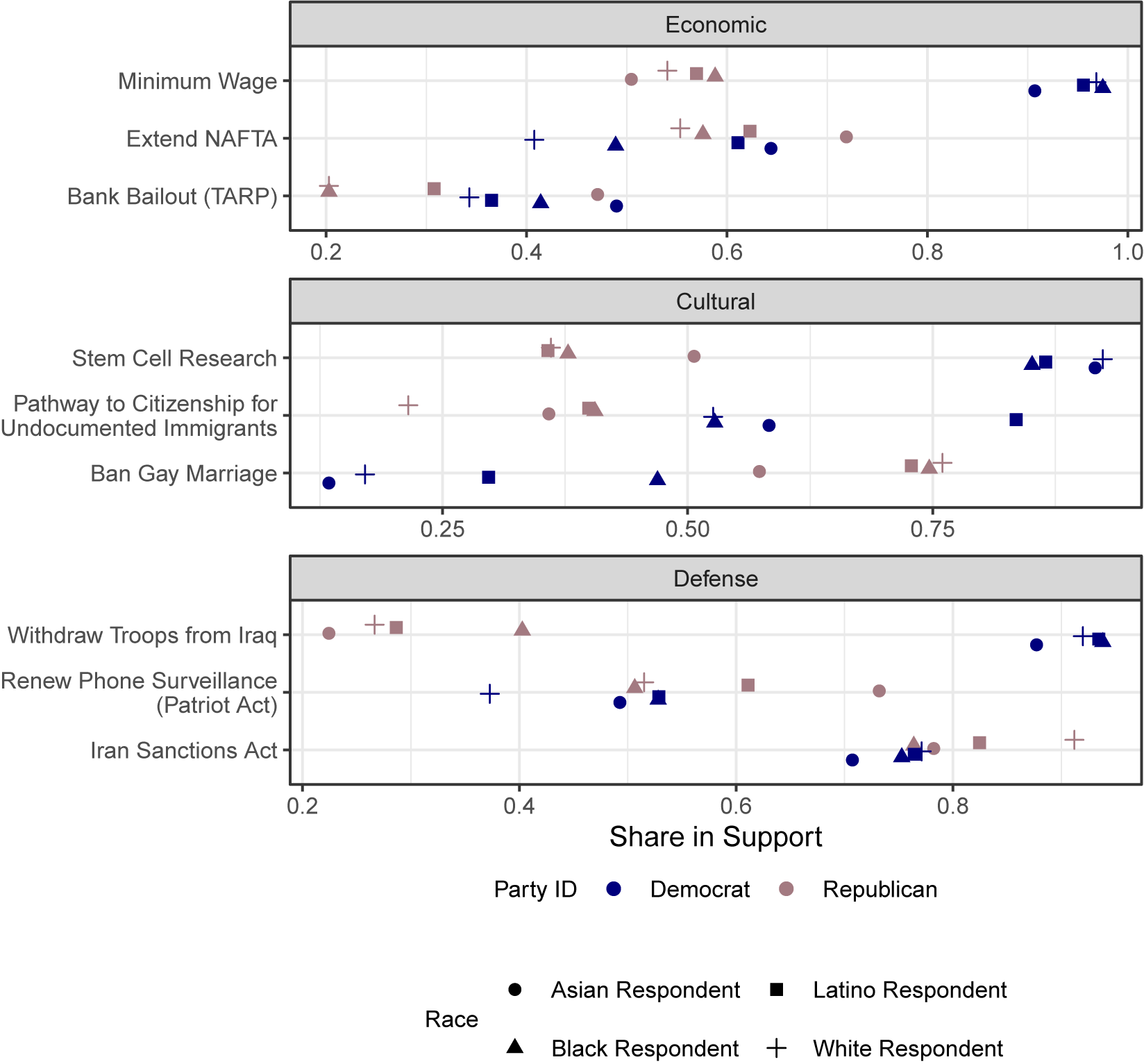
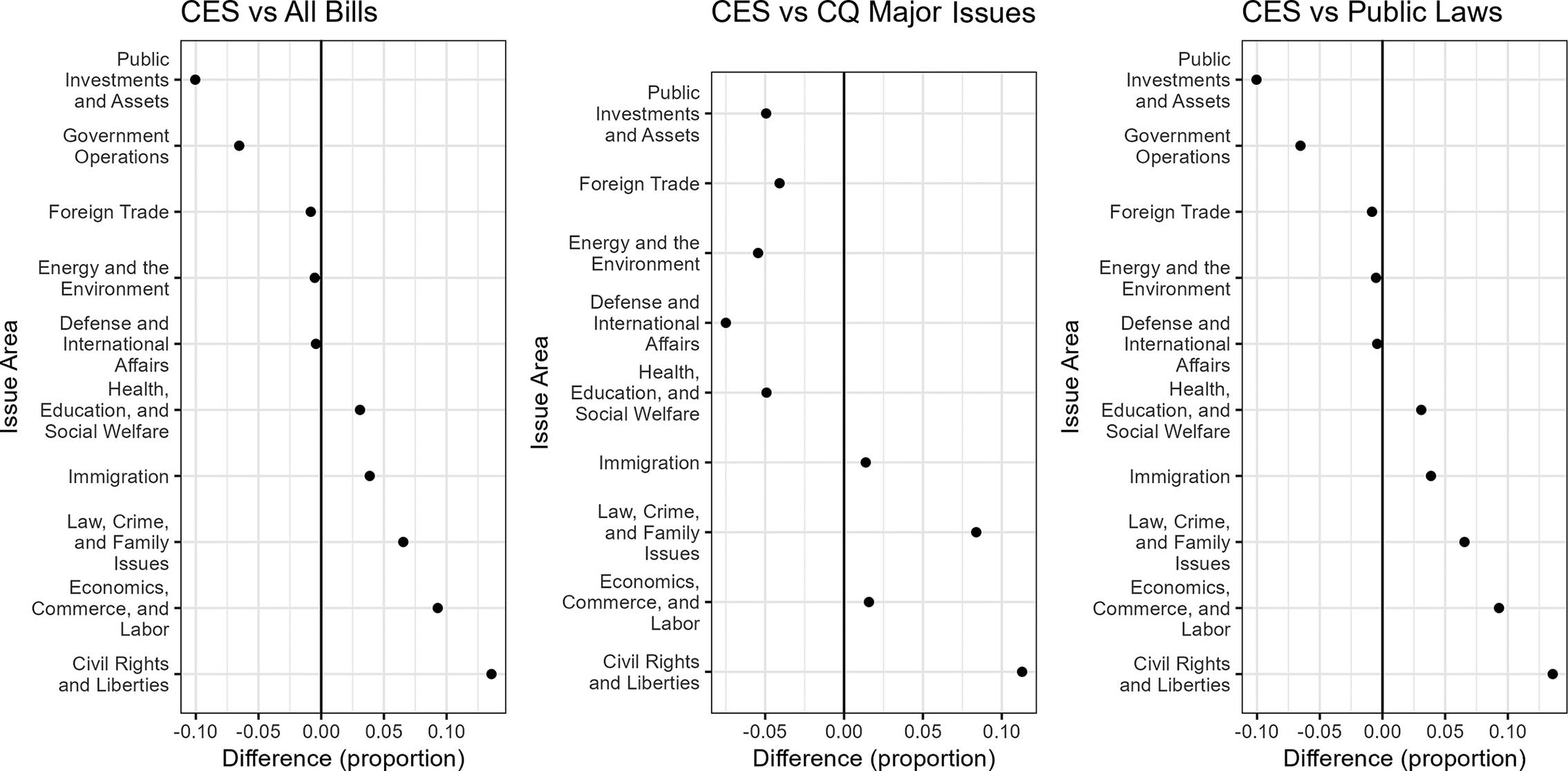
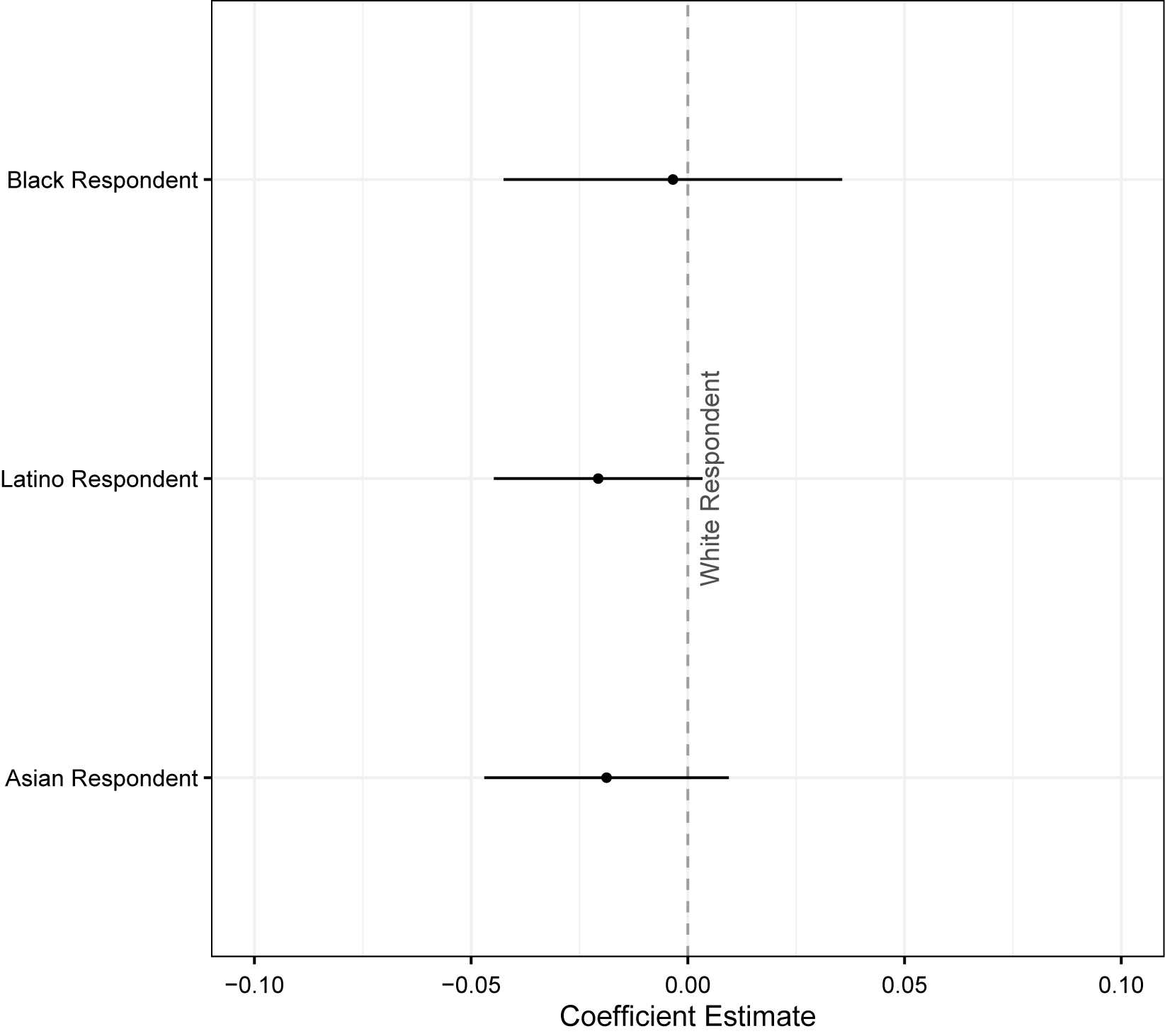
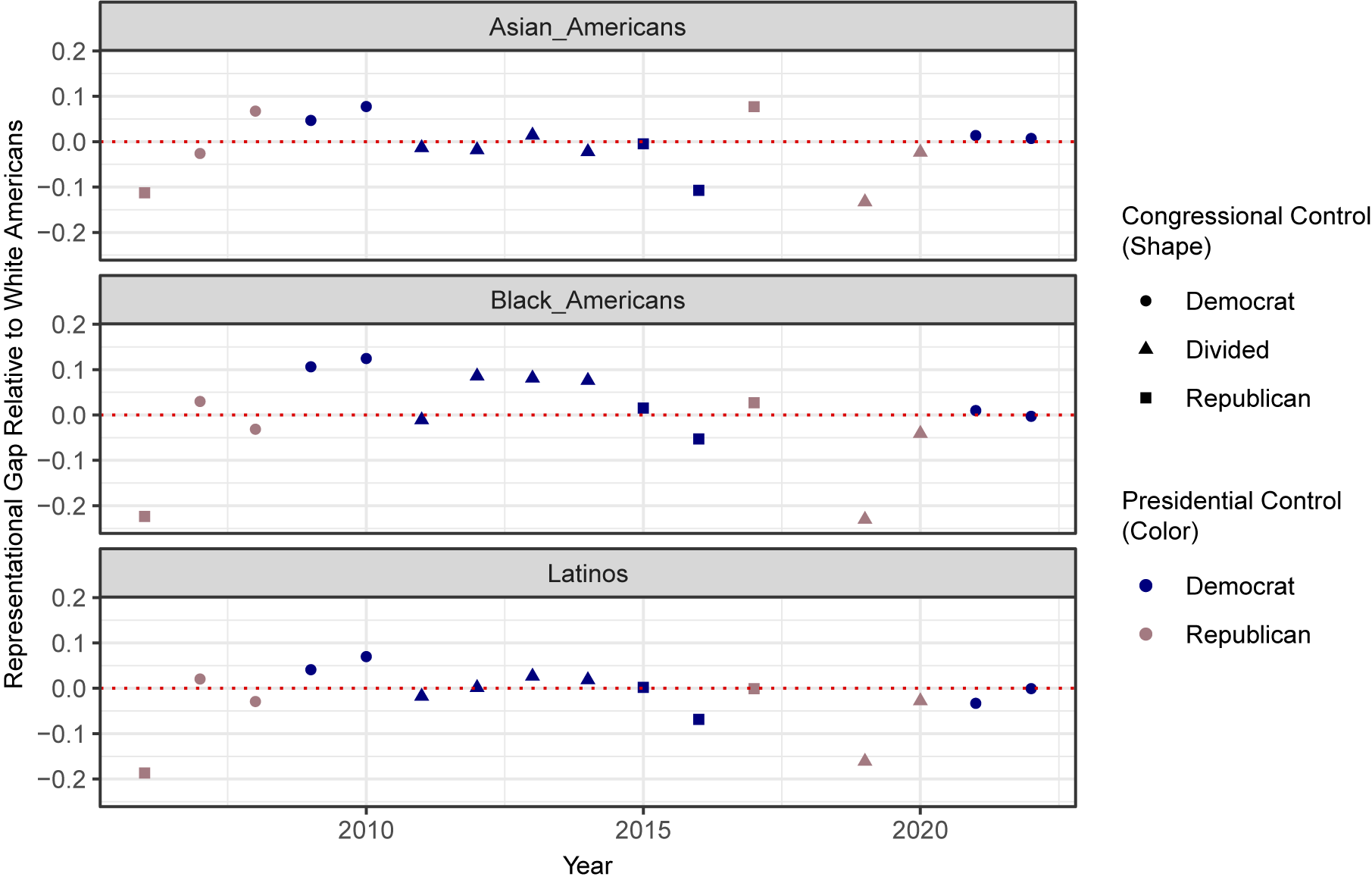
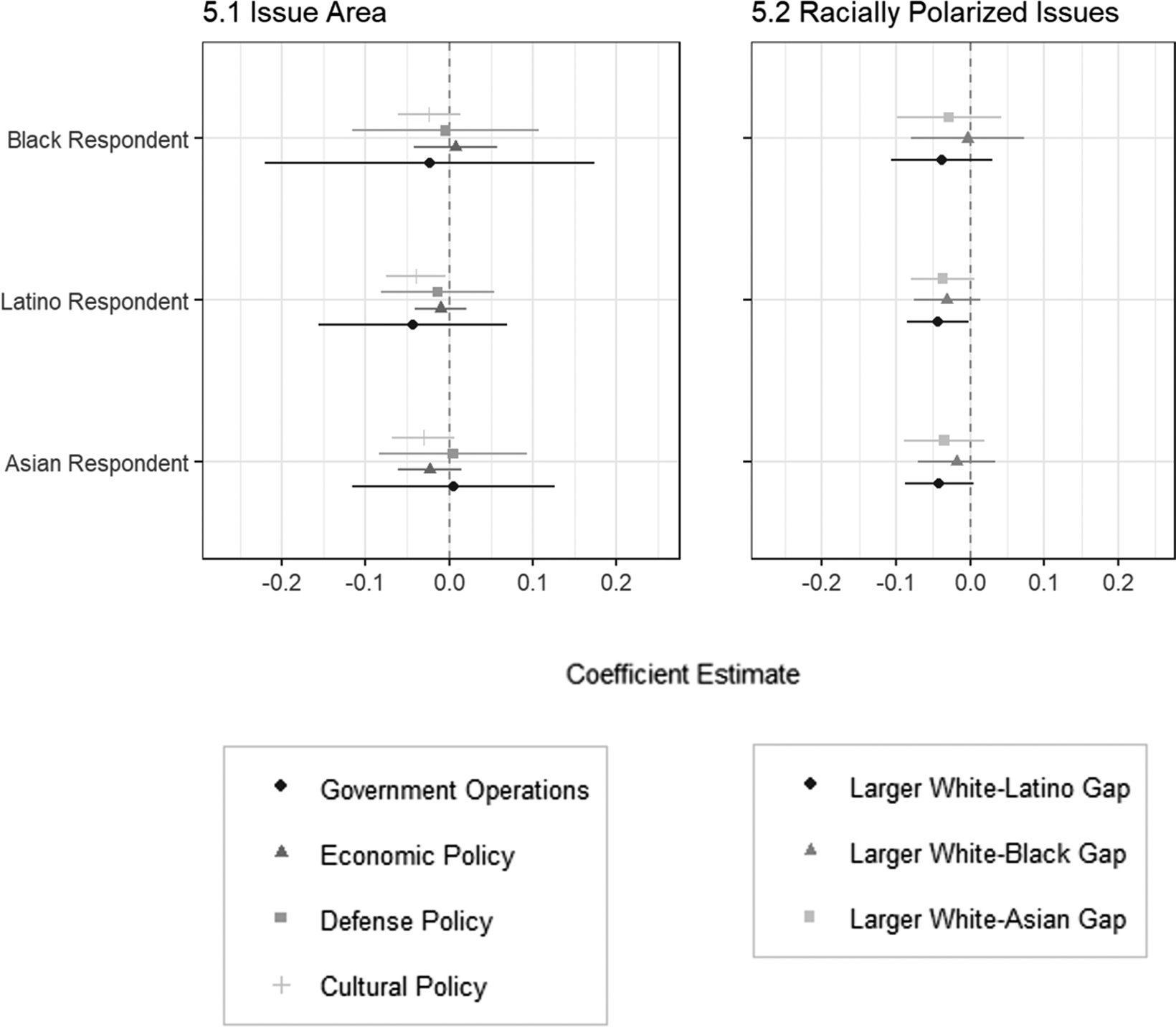
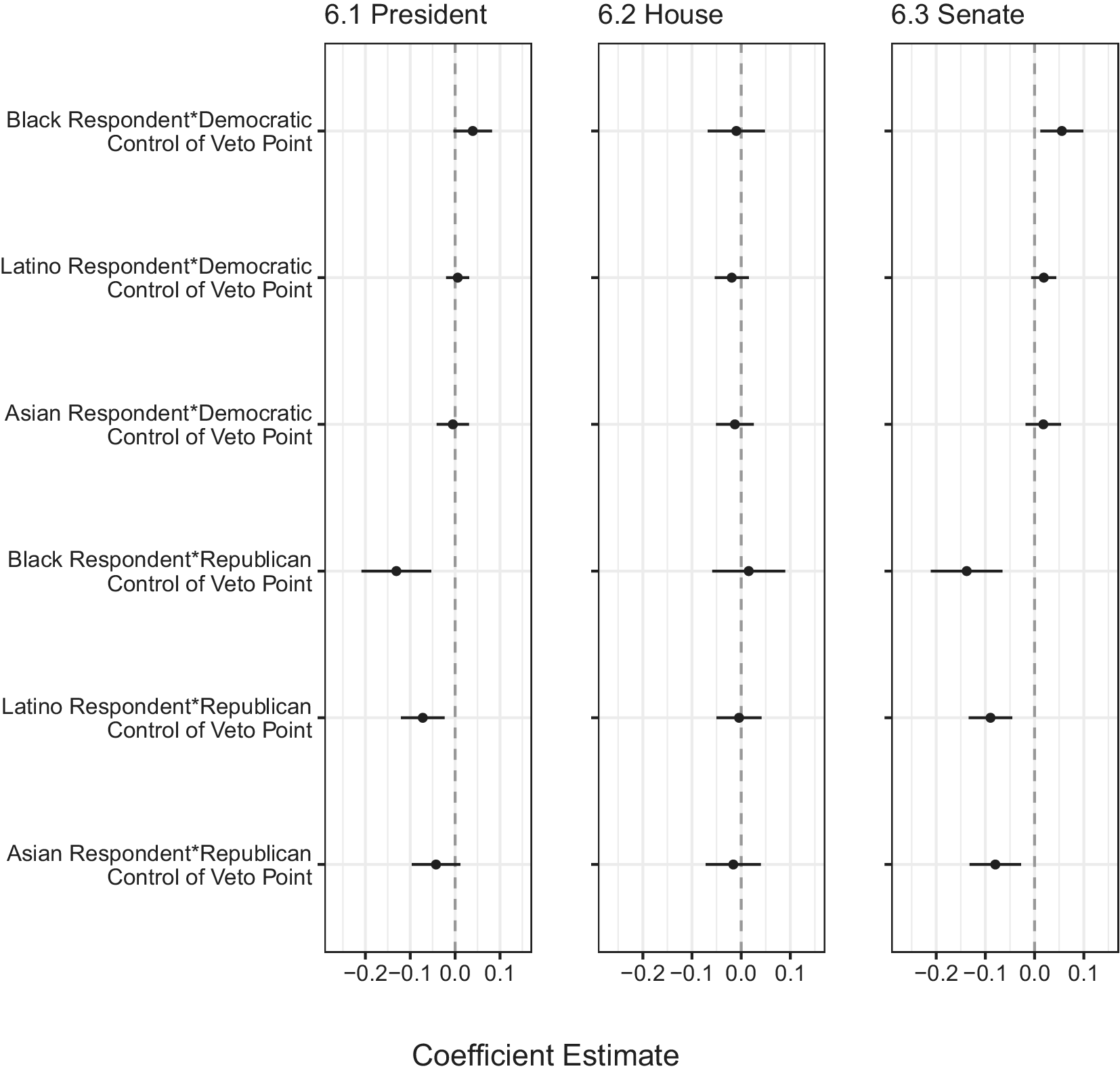
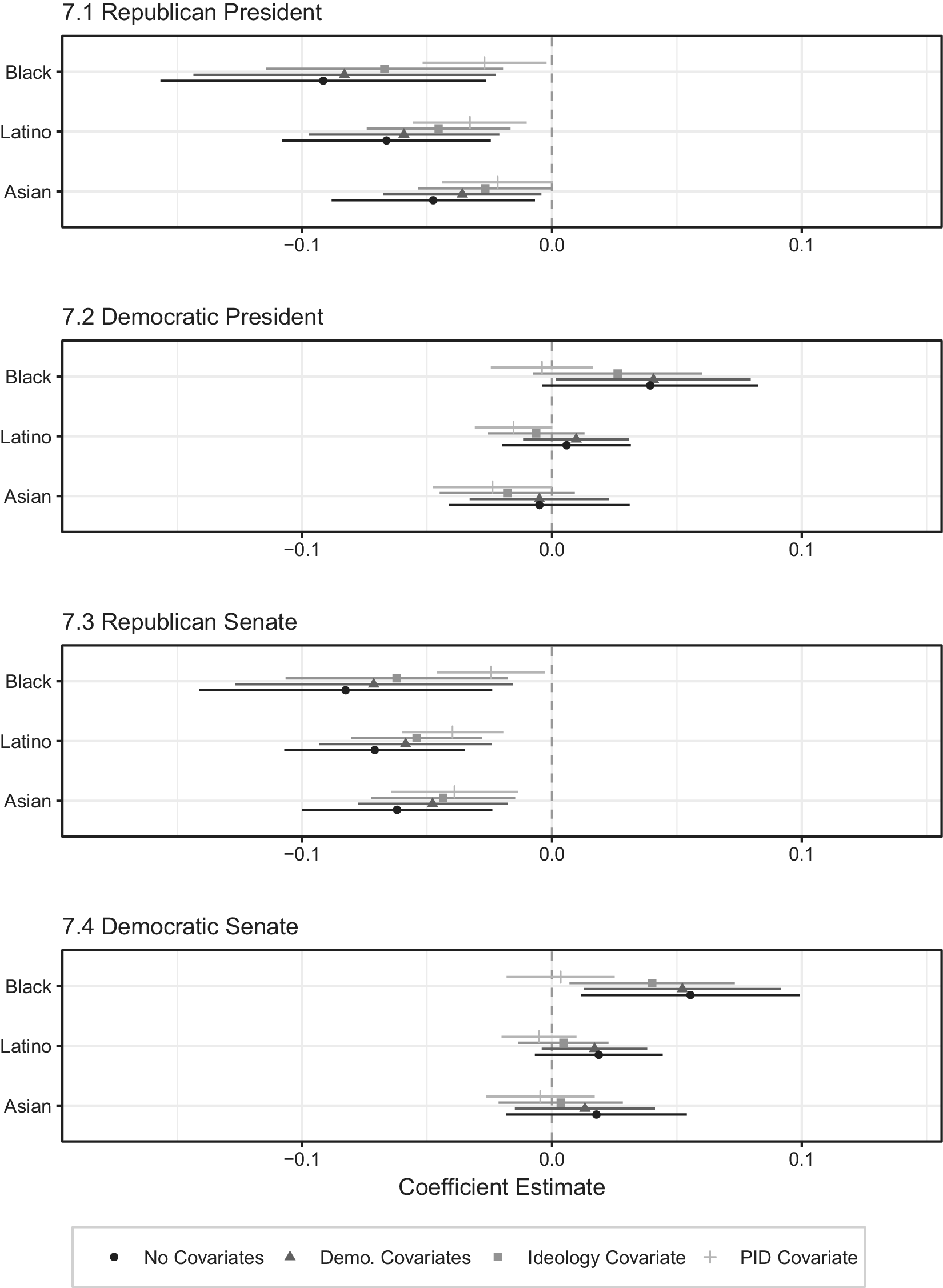
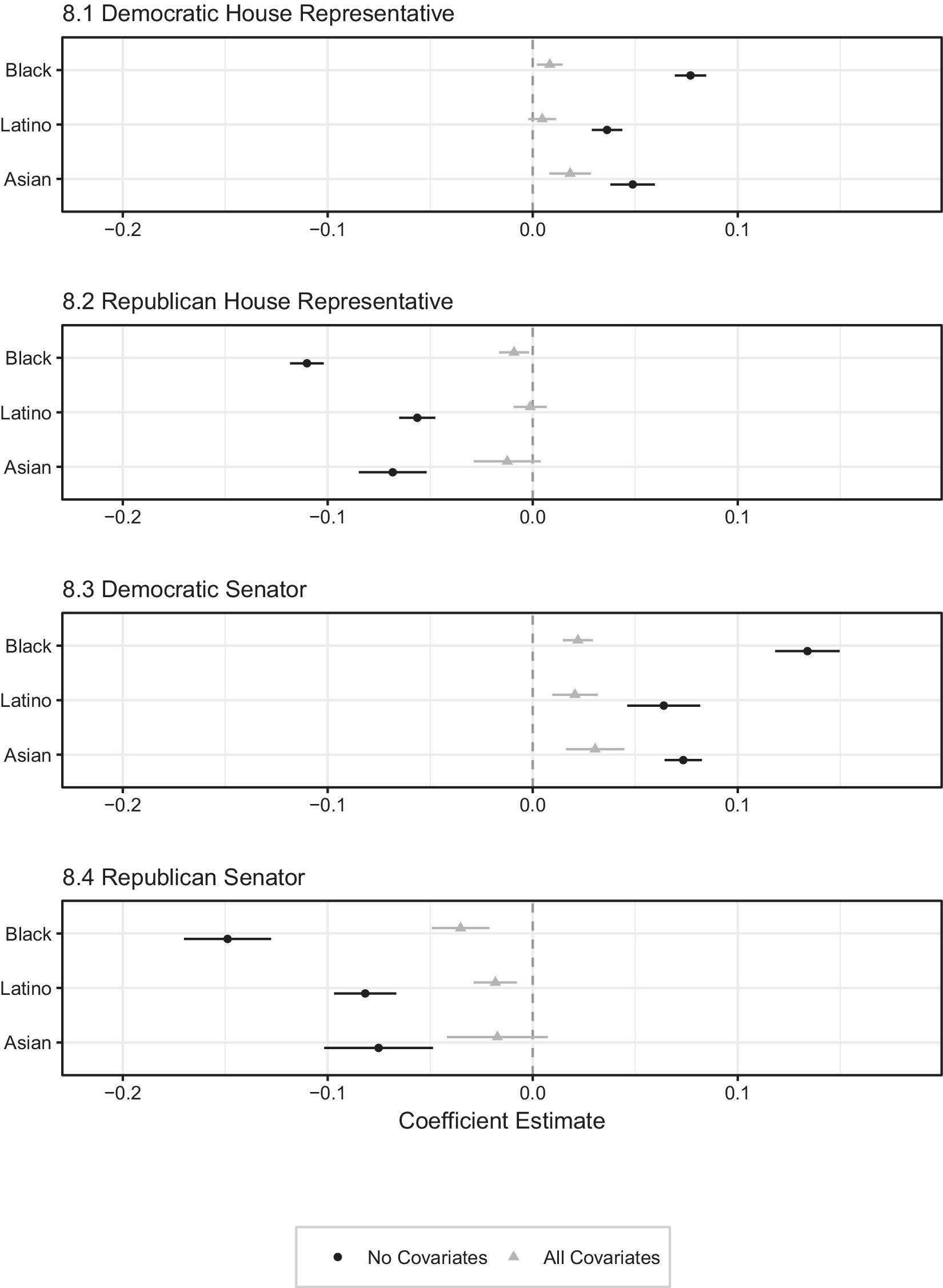
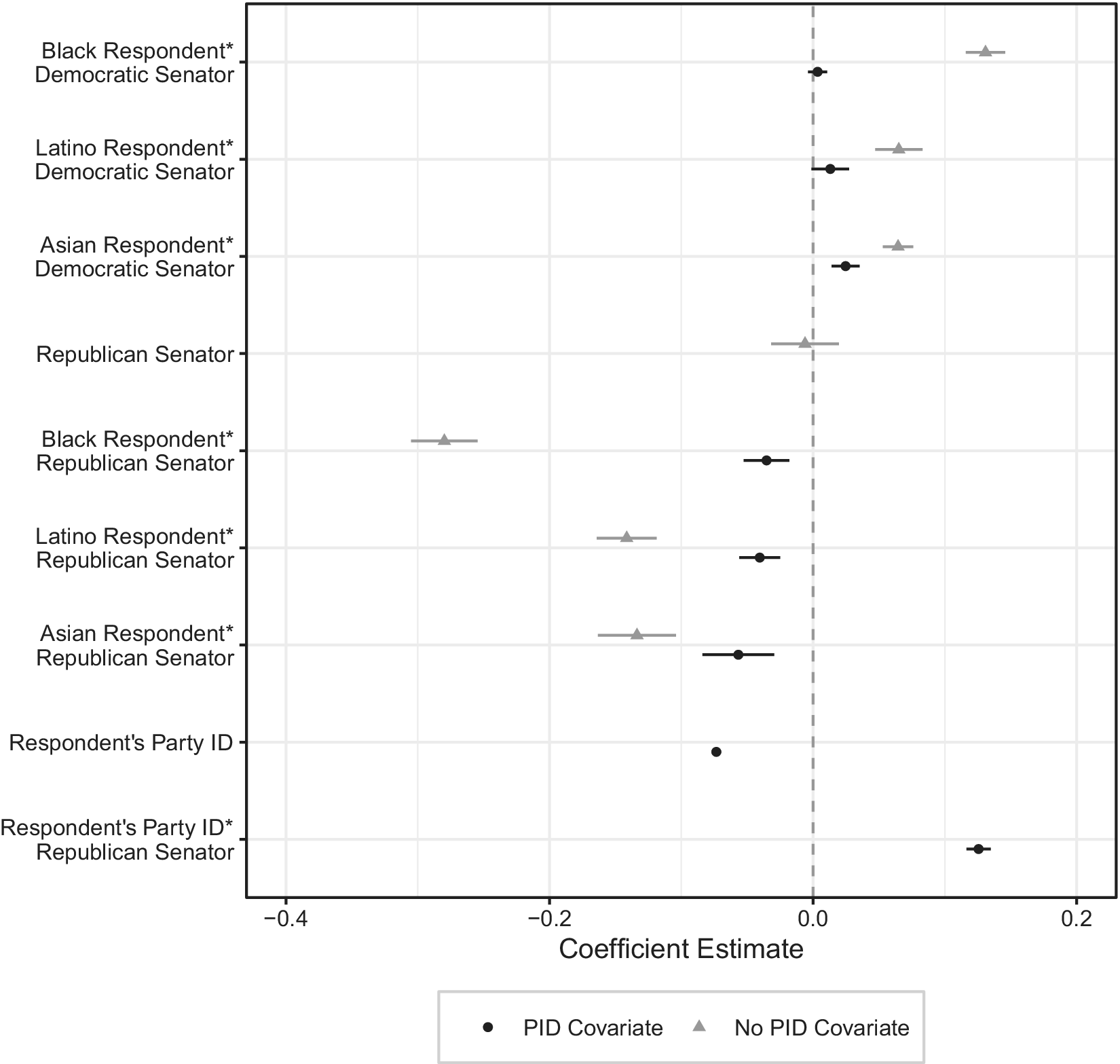
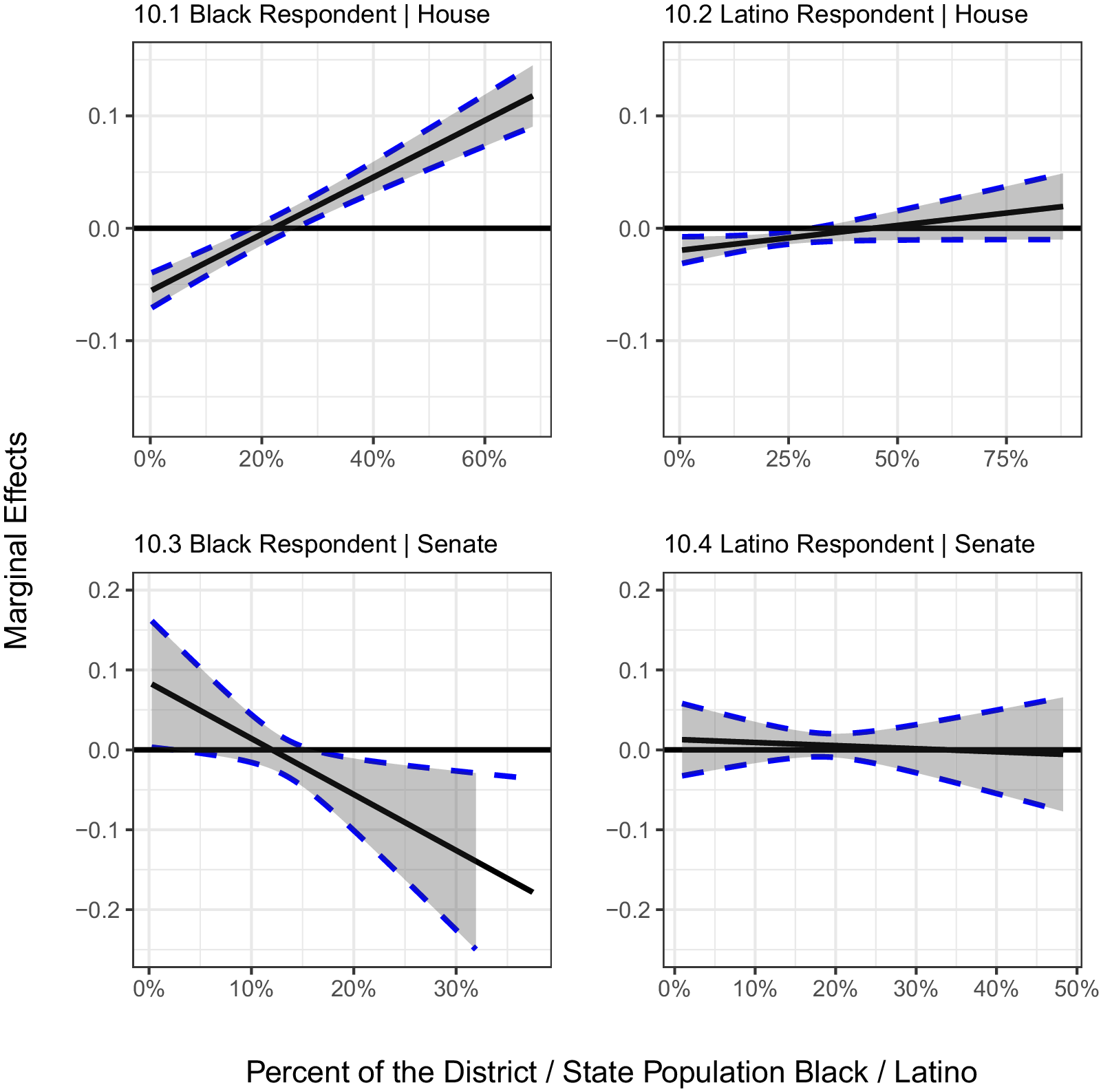
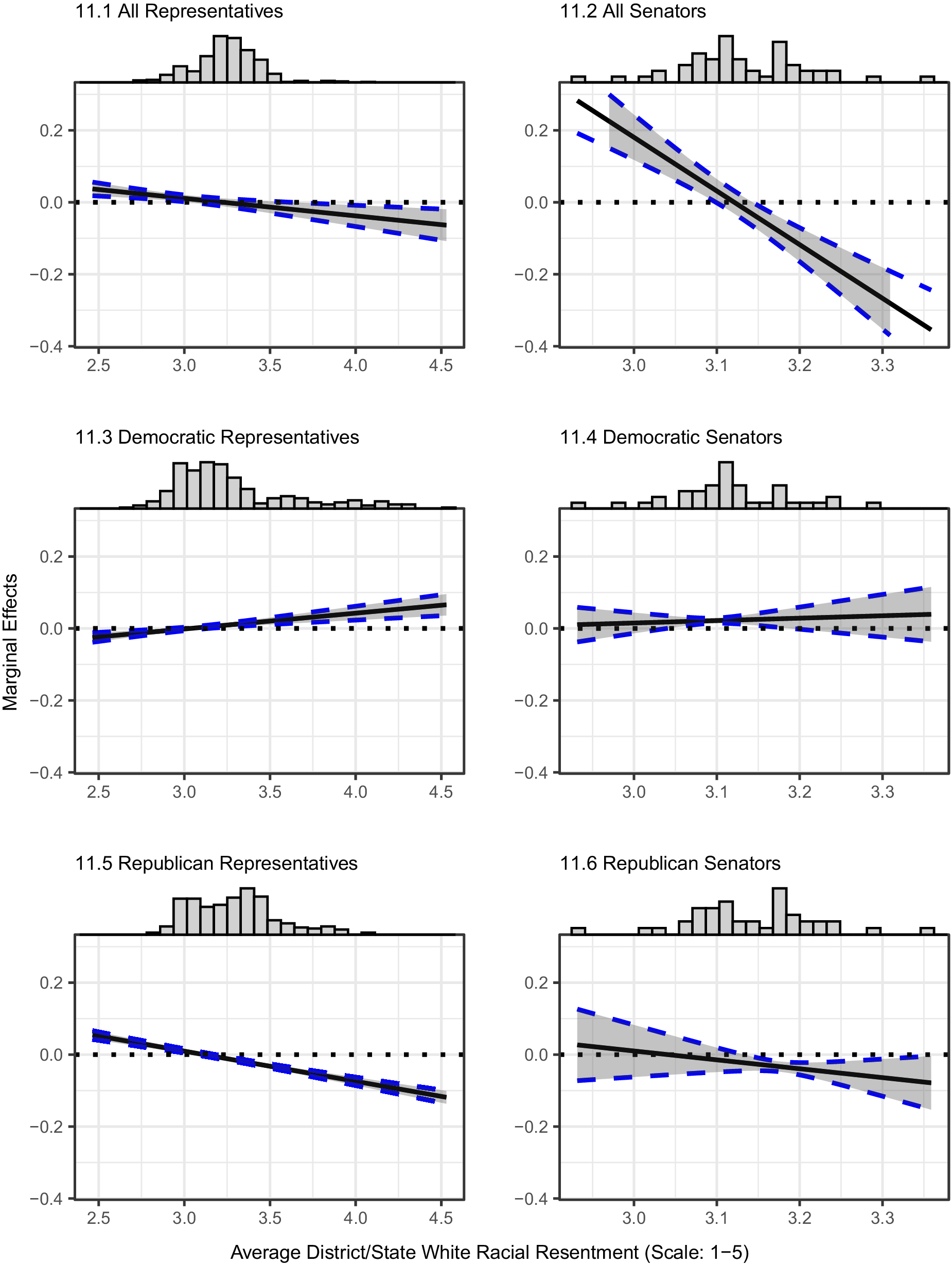


 Open access


Comments
No Comments have been published for this article.