Introduction
Helicoverpa armigera (Hübner) (Lepidoptera: Noctuidae) is a cosmopolitan pest occurring in all of the Old World, approximately between the northern and southern fortieth parallels (Hardwick, Reference Hardwick1965). This insect is a major pest of a wide range of plants, including field and horticultural crops in many parts of the world (Fitt, Reference Fitt1989; Zalucki et al., Reference Zalucki, Daglish, Firempong and Twine1986, Reference Zalucki, Murray, Gregg, Fitt, Twine and Jones1994). The pest status of this species is derived, in part, from its four life history characteristics: polyphagy, high mobility, high fecundity, and a facultative diapause that enables the species to survive seasonally changing, unstable habitats (Fitt, Reference Fitt1989). In northern Greece, H. armigera completes three or four generations per year and causes annual damage, especially to cotton crops (Mironidis, Reference Mironidis2009; Mironidis et al., Reference Mironidis, Stamopoulos and Savopoulou-Soultani2010).
Diapause is a genetically determined stage of suppressed development, and its expression may be controlled by environmental factors such as photoperiod and temperature (Danilevsky, Reference Danilevsky1961; Beck, Reference Beck1980; Tauber et al., Reference Tauber, Tauber and Masaki1986; Danks, Reference Danks1987). Insect diapause is a dynamic physiological process consisting of several successive, distinct phases, including induction, preparation, initiation, maintenance, termination and sometimes post-diapause quiescence, with each phase being modified by diverse environmental factors, as recently reviewed by Koštál (Reference Koštál2006). Photoperiod is one of the major abiotic factors that determines and/or modifies the several developmental phases of insects’ diapause (Danilevsky, Reference Danilevsky1961; Beck, Reference Beck1980; Saunders, Reference Saunders1982; Tauber et al., Reference Tauber, Tauber and Masaki1986; Danks, Reference Danks1987), particularly in species in temperate regions. However, photoperiodic responses may be modified significantly by other environmental factors, such as moisture, temperature and thermoperiod (Danilevsky, Reference Danilevsky1961; Beck, Reference Beck1983a, Reference Beck1985; Tauber et al., Reference Tauber, Tauber and Masaki1986; Danks, Reference Danks1987). This modification is typically provoked through three mechanisms: first, by setting the upper and lower thermal limits between which insects respond to photoperiod stimuli; second, by altering critical photoperiods; and, third, by altering or cancelling the diapause-inducing effect of photoperiod or by affecting the depth or duration of diapause (Leather et al., Reference Leather, Walters and Bale1993).
Temperate populations of H. armigera exhibit diapause under both field and laboratory conditions (Qureshi et al., Reference Qureshi, Murai, Yoshida, Shiraga and Tsumuki1999, Reference Qureshi, Murai, Yoshida, Shiraga and Tsumuki2000; Zhou et al., Reference Zhou, Applebaum and Coll2000; Shimizu & Fujisaki Reference Shimizu and Fujisaki2002, Reference Shimizu and Fujisaki2006; Ge et al., Reference Ge, Chen, Paralulee and Yardim2005; Shimizu et al., Reference Shimizu, Shimizu and Fujisaki2006; Liu et al., Reference Liu, Gong, Heckel, Wei, Sun and Li2009, Reference Liu, Gong, Li and Wei2010; Mironidis et al., Reference Mironidis, Stamopoulos and Savopoulou-Soultani2010). Under outdoor conditions, the incidence of diapause of H. armigera rapidly increased over a short period of time in September (Zhou et al., Reference Zhou, Applebaum and Coll2000; Shimizu et al., Reference Shimizu, Shimizu and Fujisaki2006) and/or October (Mironidis et al., Reference Mironidis, Stamopoulos and Savopoulou-Soultani2010). This increase could be a result of the combined effect of the decreases in photoperiod and ambient temperature (Shimizu & Fujisaki, Reference Shimizu and Fujisaki2006; Mironidis et al., Reference Mironidis, Stamopoulos and Savopoulou-Soultani2010) during the late-instar larval and/or prepupal stages (Kurban et al., Reference Kurban, Yoshida, Izumi, Sonoda and Tsumuki2005, Reference Kurban, Yoshida, Izumi, Sonoda and Tsumuki2007). A photoperiod ranging from 11.5 to 12.5 h combined with low or decreasing temperatures of 19–23°C are optimal for diapause induction in the major pest species of the genus Heliothis (Pearson, Reference Pearson1958; Hardwick, Reference Hardwick1965; Wellso & Adkisson, Reference Wellso and Adkisson1966; Roach & Adkisson, Reference Roach and Adkisson1970; Roome, Reference Roome1979; Cullen & Browning, Reference Cullen and Browning1978; Hackett & Gatehouse, Reference Hackett and Gatehouse1982; Henneberry et al., Reference Henneberry, Butler and Coudriet1993; Qureshi et al., Reference Qureshi, Murai, Yoshida, Shiraga and Tsumuki1999, Reference Qureshi, Murai, Yoshida, Shiraga and Tsumuki2000; Shimizu & Fujisaki, Reference Shimizu and Fujisaki2002, Reference Shimizu and Fujisaki2006; Shimizu et al., Reference Shimizu, Shimizu and Fujisaki2006). Likewise, pupae of H. armigera enter diapause in September and October in response to the declining temperatures and photoperiod in northern Greece (Mironidis et al., Reference Mironidis, Stamopoulos and Savopoulou-Soultani2010).
Most experimental studies of photoperiodism are conducted under constant temperature conditions, and the results obtained from such studies usually provide the basis for an analysis of phenology and seasonal development in the field. The results obtained from constant-temperature experiments are often not applicable directly to the field (Lamb, Reference Lamb1961) because the diurnal variation in temperature, i.e. the thermal optimum, in fluctuating temperatures, may differ from the constant temperature optimum (Cloudsley-Thompson, Reference Cloudsley-Thompson1953). In nature, fluctuating temperature conditions may expose insects to heat stress (Mironidis & Savopoulus-Soultani, Reference Mironidis and Savopoulou-Soultani2010). Relatively little work has been published investigating the effect of gradually changing temperatures in the real diurnal cyclic variation of field conditions on the induction of insect diapause (Chippendale et al., Reference Chippendale, Reddy and Catt1976; Bradshaw, Reference Bradshaw1980; Volkovich & Blumental, Reference Volkovich and Blumental1997; Musolin et al., Reference Musolin, Numata and Saulich2001). However, the effect of thermoperiod, which subjects insects to two different phases of temperature (thermophase-cryophase), has been well documented by several authors (Beck, Reference Beck1983b, Reference Beck1985, Reference Beck1988; Brown & Phillips, Reference Brown and Phillips1991; Eizaguirre et al., Reference Eizaguirre, Lopez, Asin and Albajes1994; Vaz Nuñes, Reference Vaz Nuñes1998; Fantinou & Kagkou, Reference Fantinou and Kagkou2000; Fantinou et al., Reference Fantinou, Perdikis and Chatzoglou2003; Wang et al., Reference Wang, Xue, Ge, Zhou and You2004, 2007; Fantinou & Chourdas, Reference Fantinou and Chourdas2006; Mironidis & Savopoulou-Soultani, Reference Mironidis and Savopoulou-Soultani2008). Therefore, it seems important to study the combined effects of light and temperature rhythms on the diapause biology of H. armigera. Furthermore, because this insect terminates diapause in response to temperature (Wilson et al., Reference Wilson, Lewis and Cunningham1979; Hackett & Gatehouse, Reference Hackett and Gatehouse1982; Mironidis et al., Reference Mironidis, Stamopoulos and Savopoulou-Soultani2010), the diapause intensity estimated under constant laboratory conditions (Shimizu & Fujisaki, Reference Shimizu and Fujisaki2002) may not be applicable under natural conditions, where the combined effects of fluctuating temperature and photoperiod in diapause regulation may be different (Mironidis et al., Reference Mironidis, Stamopoulos and Savopoulou-Soultani2010).
The present paper describes laboratory experiments designed to study the effects of constant and changing temperature conditions on the photoperiodic induction of diapause in H. armigera. In addition, the effects of temperature and photoperiod on the termination of diapause were examined.
Materials and methods
Insects
A laboratory colony of H. armigera was established in September 2007 from more than 400 larvae collected from cotton fields in northern Greece (41°N, 023°E). The insects were reared on an artificial diet (Smith, Reference Smith1966) and held at 25°C, 60–70% RH, under a photoperiod 16:8 h (L:D). The maintenance and handling of the colony has been previously described (Mironidis & Savopoulou-Soultani, Reference Mironidis and Savopoulou-Soultani2008). The offspring of the F5 generation were used for experiments to reduce the possible influence of the host plant sources. The experiments were conducted in controlled-environment chambers (Precision Scientific, General Electric, Louisville, KY, USA and GRW 1000SB CMP). The light intensity in the chambers was measured as 22.5 μEin m−2 s−1 (400–700 nm) by a quantum sensor Li 188 B (LICOR Inc.). The relative humidity was approximately 60–65%. The reported temperatures were accurate to within ±0.5°C.
Diapause induction in different temperature regimes
Newly hatched larvae (<24 h old) of H. armigera were used in all experiments of diapause induction. Three types of temperature regimes were used: constant, fluctuating and alternating.
Constant temperatures
To obtain the diapause response curves and to determine the critical photoperiod for diapause induction at different constant temperatures, the larvae were reared at 15, 20, 25 and 30°C under different photoperiodic regimes throughout their larval stage.
Fluctuating temperatures
The effect of progressive change (stepwise change every hour) in temperature with a mean value of 25°C or 20°C under different photoperiodic conditions (0:24, 4:20, 8:16, 10:14, 12:12, 13:11, 14:10, 16:8, 24:0 h (L:D); photophase started at 8 am every day) on diapause induction was examined. Figure 1a depicts the curves of hourly temperatures through the 24-h cycle of fluctuating regimes with mean temperatures of 25°C and 20°C. The transition from one temperature to another was essentially completed within approximately 1 min after switching.
Alternating temperatures
The effect of alternating temperatures of different amplitudes on diapause induction was determined by selecting four temperature cycles with thermophase:cryophase (T:C) temperatures, 18–34.8°C, 20–32°C, 22–29.2°C and 20–30°C, under constant photoperiodic conditions (10:14 h (L:D); photophase started at 8 am and finished at 6 pm every day). Each alternating temperature regime had a mean temperature of 25°C. The daily scheme of thermophase and cryophase of the alternating temperature regimes in combination with scotophase and photophase is depicted in fig. 1b. The transition from one temperature to another was essentially completed within approximately ten minutes after switching.
(a) The hourly temperatures through the 24-h cycle of fluctuating regimes for the mean temperatures of 25°C and 20°C (—, 25°C; - - -, 20°C). (b) Daily scheme of thermophase and cryophase of the alternating temperature regimes in combination with scotophase and photophase. Black bars, scotophase; open bars, photophase (▪, dark; □, light).

Newly hatched larvae (1st instar) were individually transferred from the colony to 50-ml plastic cups and were provisioned with an artificial diet. After ecdysis to the 4th instar, they were transferred to Petri dishes. Upon pupation, they were sexed based on the shape and size of the terminal segment (Reed, Reference Reed1965). The pupal diapause status was determined using two criteria. The first was the retention of pigmented eye spots in the postgenal region (Shumakov & Yakhimovich, Reference Shumakov and Yakhimovich1955). Immediately following larval-pupal ecdysis, the eyespots are distinct, occurring in a straight line across the postgenal area. These disappear during the first five days after pupation at 25°C and during the first eight days at 20°C in non-diapausing pupae (Mironidis, Reference Mironidis2009). The second criterion was the condition of the fat body in the pupal abdomen (Pearson, Reference Pearson1958). The fat body of newly formed pupae is composed of firm, rounded lobes and remains unchanged throughout diapause. Its histolysis coincides with movement of the eye spots and is, therefore, a valid supplementary criterion. Because the eye spots in some pupae can be very faint and are not discernible, it is useful to verify the condition of the fat body to determine if the pupae have entered diapause. Using the above criteria, 15 days after pupation, the pupae were checked under a stereoscope (M26, 40×; Leica, Wetzlar, Germany) for eyespot retention and for the condition of their liposome to separate diapausing from non-diapausing pupae.
Diapause development
To investigate the effect of chilling on diapause development, 20-day-old diapausing pupae of H. armigera were placed at 4°C for different lengths of time (ranging from 14 to 98 days) in continuous darkness. Diapausing pupae were obtained by rearing newly hatched larvae at 20°C and a short photoperiod of 8:16 h (L:D). After chilling, the pupae were exposed to 25°C or 20°C. One group of pupae was placed at a long-day photoperiod of 16:8 h (L:D), while the second group was placed at a short-day photoperiod of 8:16 h (L:D). They were then examined daily for adult emergence. Some diapausing pupae were kept at 25°C or 20°C without chilling as controls. Adult emergence was used as the criterion for the completion of diapause development (Hackett & Gatehouse, Reference Hackett and Gatehouse1982; Kay, Reference Kay1982; Qureshi et al., Reference Qureshi, Murai, Yoshida, Shiraga and Tsumuki2000; Mironidis, Reference Mironidis2009; Mironidis et al., Reference Mironidis, Stamopoulos and Savopoulou-Soultani2010).
Statistical analysis
The effect of the duration of exposure to chilling at 4°C on diapause termination of H. armigera pupae was determined by a one-way ANOVA. A logarithmic transformation log10(x+1) of the data was used to avoid heterogeneity of variance: untransformed means are presented in the figures. The percentages were compared using the chi-squared test (Sokal & Rohlf, Reference Sokal and Rohlf1995). The t-test was used to compare the values of the means from two samples. The calculations were performed using the statistical package SPSS NLN, 14 (SPSS Inc., 2006).
Results
Diapause induction
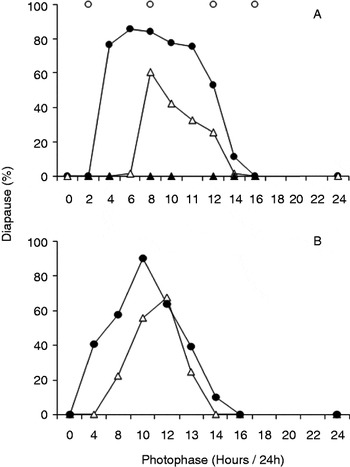
The diapause response curves of H. armigera, reared from the 1st instar to the pupal stage under different photoperiodic regimes at four constant temperatures (15, 20, 25 and 30°C) and at two fluctuating temperatures with means of 20°C and 25°C, are presented in fig. 2. The incidence of diapause was under photoperiodic control at 25°C and 20°C both at constant and fluctuating temperatures, indicating that this insect displays a type-III-photoperiodic response curve of a short-long-day insect, analogous to the photoperiodic response curve suggested by Beck (Reference Beck1980).
The H. armigera diapause response curves to various photoperiodic regimes (a) at four constant temperatures (15, 20, 25 and 30°C) (○, 15°C; ●, 20°C; ∆, 25°C; ▲, 30°C) and (b) at two fluctuating temperatures with means of 20°C and 25°C (●, 20°C; ∆, 25°C).

At a constant temperature of 25°C, the shorter critical daylength was between 6 and 8 h, and the longer critical daylength was approximately 10 h, while photoperiods with a daylength longer than 14 h or shorter than 6 h resulted in non-diapause (fig. 2a). The fluctuating temperature with a mean of 25°C shifted the diapause response curve to the right in relation to the curve of the corresponding constant temperature; the shorter critical daylength was approximately 10 h, and the longer critical daylength was approximately 13 h, while the highest percentage of diapause (67.2%) was observed at a 12-h photoperiod, higher than that of the corresponding constant temperature (25.7%) (fig. 2b). All insects reared at 15°C entered diapause, whereas no diapause was induced at 30°C at any of the photoperiodic regimes examined (fig. 2a).
At a constant temperature of 20°C, no diapause occurred at photophases longer than 14 h or shorter than 4 h. The shorter critical daylength at a constant 20°C was between 2 and 4 h, and the longer critical daylength was 12 h, whereas the highest incidence of diapause (85.7%) was observed at a photoperiod of 6 h. At fluctuating temperatures with a mean of 20°C, the highest incidence of diapause (90.3%) was observed at a 10-h photoperiod, which was higher than that of the corresponding constant temperature (77.4%). Moreover, the two critical daylengths at fluctuating temperatures with a mean of 20°C were between 4 and 8 h and between 12 and 13 h, respectively.
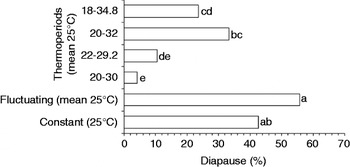
The amplitude of the thermoperiod in the alternating temperature regimes with a mean of 25°C (fig. 1b) at a 10-h photoperiod had a significant effect on the diapause incidence of H. armigera (χ2=24.9; df=3; P<0.001). High incidences of diapause occurred when the larvae were subjected to thermoperiods in which the lower temperature coincided with the scotophase. Under the thermoperiods tested, the incidence of diapause decreased from 33.3% at a thermoperiod of 20–32°C to 23.5% at a thermoperiod of 18–34.8°C and to 10.5% at a thermoperiod of 22–29.2°C (fig. 3). However, when part of the thermophase coincided with the scotophase and part of the cryophase coincided with the photophase (20–30°C) (fig. 1b), the incidence of diapause was much lower (4.2%) (fig. 3). The percentage of diapausing individuals in the alternating temperature regimes was significantly lower than that observed at the corresponding fluctuating (55.7%) or constant (42.6%) temperatures at the same photoperiod (10:14 (L:D) h) (χ2=61.4; df=5; P<0.001).
The diapause incidence (percentage) in H. armigera larvae reared under different thermoperiods with a mean temperature of 25°C and at the corresponding alternating and constant temperatures under photoperiod 10:14 h (L:D). The percentages followed by the same letter are not significantly different (P<0.05, chi-squared test).

Diapause development
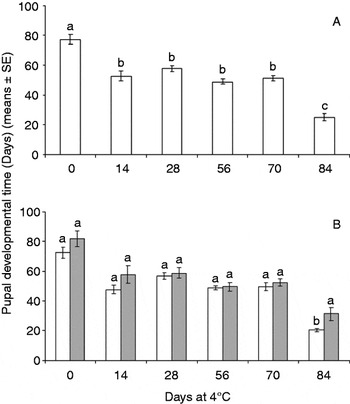
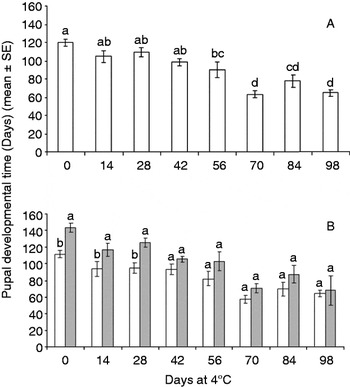
Although chilling at 4°C was not necessary for the completion of diapause development, it significantly decreased the time before adult emergence compared with unchilled controls at 25°C (F=56.6; df=5, 158; P<0.001) (fig. 4a) and at 20°C (F=19.1; df=7, 171; P<0.001) (fig. 5a). Pupae chilled for 14 days significantly reduced the time to adult emergence at 25°C compared with unchilled controls, but further reduction was not observed in this period until the chilling length reached 84 days (fig. 4a). When diapausing pupae were transferred at 20°C after their exposure at 4°C, chilling for 14, 28 and 42 days did not significantly differentiate the duration of the pupal stage, whereas pupae chilled for 70 and 98 days significantly decreased the time to adult emergence compared to the control (fig. 5a). In all treatments tested, the duration of the pupal stage of diapause individuals, irrespective of their exposure to chilling temperature, was shorter at a 16-h photoperiod than at an 8-h photoperiod, but the differences between the photoperiodic regimes were significant (P<0.05, t-test) only in a few cases (figs 4 and 5b).
The mean numbers of days required for adult emergence at 25°C in H. armigera pupae pre-chilled at 4°C for various lengths of time. (a) Total average irrespective of the photoperiodic condition at 25°C and (b) at a 16-h or 8-h photoperiod and 25°C. Different letters above the bars show significant differences in pupal developmental time: a, between the various times of exposure at 4°C (P<0.05, Tukey HSD test); and b, between the two photoperiodic conditions tested after the same period of exposure (P<0.05, t-test) (□, L:D: 16:8 h;  , L:D: 8:16 h).

The mean numbers of days required for adult emergence at 20°C in H. armigera pupae pre-chilled at 4°C for various lengths of time. (a) Total average irrespectively of the photoperiodic condition at 20°C and (b) at a 16-h or 8-h photoperiod and 20°C. Different letters above the bars show significant differences in pupal developmental time: a, between the various times of exposure at 4°C (P<0.05, Tukey HSD test); and b, between the two photoperiodic conditions tested after the same period of exposure (P<0.05, t-test) (□, L:D: 16:8 h; , L:D: 8:16 h).

Discussion
In H. armigera, H. zea and probably other species, the incidence of diapause increases with increasing latitude (Fitt, Reference Fitt1989). In the tropics, populations of H. armigera breed continuously (Coaker, Reference Coaker1959) although a small proportion (2–4%) of pupae may enter diapause (Reed, Reference Reed1965; Hackett & Gatehouse, Reference Hackett and Gatehouse1982), whereas in subtropical-temperate regions, most individuals enter diapause before winter (Roome, Reference Roome1979; Wilson et al., Reference Wilson, Lewis and Cunningham1979; Kay, Reference Kay1982; Qureshi et al., Reference Qureshi, Murai, Yoshida, Shiraga and Tsumuki1999, Reference Qureshi, Murai, Yoshida, Shiraga and Tsumuki2000; Zhou et al., Reference Zhou, Applebaum and Coll2000; Mironidis et al., Reference Mironidis, Stamopoulos and Savopoulou-Soultani2010).
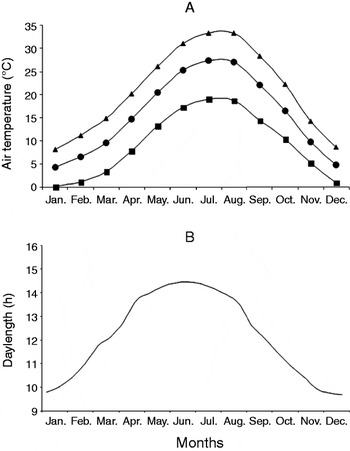
A population of H. armigera derived from northern Greece displayed a ‘short-long day’ diapause response curve (type III: Beck, Reference Beck1980) in the laboratory. A type-III photoperiodic response shows two well-defined critical daylengths. Low temperatures tend to broaden the range of diapause induction (Beck, Reference Beck1980). However, it has been reported that a ‘long-day’ (type I: Beck, Reference Beck1980) photoperiodic response was observed at a constant 20°C for Japanese populations of H. armigera (Qureshi et al., Reference Qureshi, Murai, Yoshida, Shiraga and Tsumuki1999, Reference Qureshi, Murai, Yoshida, Shiraga and Tsumuki2000; Shimizu & Fujisaki, Reference Shimizu and Fujisaki2002; Shimizu et al., Reference Shimizu, Shimizu and Fujisaki2006). The difference in the results between the Greek (type III) and Japanese (type I) populations could be attributed to the fact that the Japanese researchers did not study photoperiods with photophases <8 or >18 h. Moreover, our data are consistent with the findings of Roome (Reference Roome1979), who reported that a high incidence of diapause occurred in an H. armigera population of Botswana (South Africa) at a 6-h photoperiod and 18°C. The shorter critical daylength at constant temperatures 25°C and 20°C (6–8 and 2–4 h, respectively) is usually not encountered by insects in their natural habitats during the growing season in Greece (fig. 6). The short-day portion of the type III diapause induction curve is of no apparent ecological significance, but it may provide information on the nature of the response mechanisms (Beck, Reference Beck1980).
(a) The mean monthly air temperature over 20 years (1989–2009) (–▲–, maximum temp.; –●–, mean temp.; –▪–, minimum temp.) and (b) photoperiod throughout the year in northern Greece. The daylength was calculated as sunrise to sunset with a 0.5 h addition as twilight (Hellenic National Meteorological Service) (—, Daylength).

The photoperiodic response of diapause incidence is affected by temperature in all tested species of the genus Heliothis (Fitt, Reference Fitt1989). In the current study, we have shown that H. armigera larvae from northern Greece entered pupal diapause when the rearing temperature was low (15°C), whereas they failed to enter pupal diapause when the rearing temperature was high (>25°C), irrespective of the duration of daylength (fig. 2a). This result is consistent with the findings of other authors who studied the diapause response in other populations of H. armigera (Wilson et al., Reference Wilson, Lewis and Cunningham1979; Qureshi et al., Reference Qureshi, Murai, Yoshida, Shiraga and Tsumuki1999; Jallow & Matsumura, Reference Jallow and Matsumura2001; Kurban et al., Reference Kurban, Yoshida, Izumi, Sonoda and Tsumuki2007). Qureshi et al. (Reference Qureshi, Murai, Yoshida, Shiraga and Tsumuki1999) reported that a H. armigera population from Okayama (western Japan) rarely entered diapause, even at a considerably short photoperiod of 8:16 h (L:D) at 25°C. Qureshi et al. (Reference Qureshi, Murai, Yoshida, Shiraga and Tsumuki1999) also reported that all individuals entered diapause at 15°C, even under a long photoperiod of 16:8 h (L:D). Similarly, in H. zea (Pullen et al., Reference Pullen, Meola and Lopez1992), H. punctigera (Cullen & Browning, Reference Cullen and Browning1978; Browning, Reference Browning1979) and H. virescens (Henneberry et al., Reference Henneberry, Butler and Coudriet1993), it was found that higher percentages of pupal diapause were induced, irrespective of the photoperiodic conditions, when the larvae were reared at low temperatures. According to Kurban et al. (Reference Kurban, Yoshida, Izumi, Sonoda and Tsumuki2007), temperature is an important diapause cue in H. armigera because it can modify the photoperiodic effect after the photoperiodic stimulus has been received by the sensitive stage (primary 5th larval instar: Kurban et al., Reference Kurban, Yoshida, Izumi, Sonoda and Tsumuki2005).
The exposure of H. armigera larvae to fluctuating temperatures with a mean of 25°C or 20°C resulted in the same type of diapause response curve (type III: Beck Reference Beck1980) as observed at constant temperatures. Furthermore, a higher incidence of diapause was observed at fluctuating conditions than at the corresponding constant temperatures (fig. 2). Similar results have also been documented by other researchers (Chippendale et al., Reference Chippendale, Reddy and Catt1976; Bradshaw, Reference Bradshaw1980). This high incidence of diapause under changing conditions within the temperate zone may be a part of the climatic adaptation achieved by H. armigera in Greece. This is contrary to its subtropical populations, for which it has been demonstrated that they are not so sensitive to changes in photoperiod and temperature (Hackett & Gatehouse, Reference Hackett and Gatehouse1982; Shimizu & Fujisaki, Reference Shimizu and Fujisaki2006). An adaptive significance of this feature is quite clear. It ensures high percentages of survival for H. armigera temperate-zone populations during the cold season because, as we have shown in a previous study, the non-diapausing individuals are maladapted for winter survival in northern Greece (Mironidis et al., Reference Mironidis, Stamopoulos and Savopoulou-Soultani2010). In the temperate zone, autumn is characterised by unpredictably decreasing temperatures and predictably shortening daylengths (fig. 6). Under these conditions, individuals of the northern Greece population enter diapause between mid-September and early November, when the prevailing photoperiod ranges from 10 to 12 h and the mean air temperature declines from about 24°C to 15°C (fig. 6), while individuals not destined for diapause are subjected to high larval mortality (Mironidis et al., Reference Mironidis, Stamopoulos and Savopoulou-Soultani2010). In the present study, we have shown that under gradually changing temperature conditions, H. armigera exhibited a higher incidence of diapause when the photoperiod was 10 h and 12 h with fluctuating temperatures with a mean of 25°C (55.7 and 67.2%, respectively) and 20°C (90.3 and 63.8%, respectively). In contrast, it has been reported that fluctuating temperatures provoked the diapause-preventing effect in some insect species compared to constant ones (Volkovich & Blumental, Reference Volkovich and Blumental1997; Musolin et al., Reference Musolin, Numata and Saulich2001). It is worth mentioning that few studies exist that examine the effect of fluctuating temperatures (hourly changing-temperature conditions) on insect diapause, and none of them refers to H. armigera.
Thermoperiod is considered to be an important factor in diapause determination in a number of insects (Beck, Reference Beck1983b; Tauber et al., Reference Tauber, Tauber and Masaki1986; Brown & Phillips, Reference Brown and Phillips1991; Vaz Nuñes, Reference Vaz Nuñes1998; Fantinou & Kagkou, Reference Fantinou and Kagkou2000). On the contrary, some researchers suggested that diapause could be induced when the thermophase is in coincidence with either the scotophase or the photophase of the photoperiod (Eizaguirre et al., Reference Eizaguirre, Lopez, Asin and Albajes1994; Wang et al., Reference Wang, Xue, Ge, Zhou and You2004, Reference Wang, Xue, Zhou and Lei2007), underlining the importance of thermoperiod per se in diapause induction and not the scotophase temperature. Our data indicated that diapause was induced at all alternating temperatures tested, but the incidence of diapause was considerably low compared with corresponding fluctuating and constant temperatures under the same photoperiod (fig. 3). The ratio between diapausing and non-diapausing individuals was determined by the temperature amplitude and by the interaction of cryophase or thermophase with the photoperiod of the thermoperiod. Specifically, the higher percentages of diapause incidence were observed when thermophase was in coincidence with the photophase of the thermoperiod, whereas when part of the scotophase was accompanied by a relatively high temperature (treatment 20–30°C), it resulted in a reduced percentage of diapause (fig. 3), probably because of the strong modifying effect of the unnaturally high night temperature (Fantinou & Kagkou, Reference Fantinou and Kagkou2000).
One dispute regarding the relationship between diapause completion and low temperature concerns whether chilling is actually required for diapause development and whether it accelerates diapause development. In some insects, a period of chilling is not necessary for the termination of diapause, and most diapausing individuals may be activated spontaneously after an increase in temperature or photoperiod or both (Tauber et al., Reference Tauber, Tauber and Masaki1986; Danks, Reference Danks1987). For example, the exposure of Adoxophyes orana (Fischer von Röslerstamm) (Lepidoptera: Tortricidae) (Milonas & Savopoulou-Soultani, Reference Milonas and Savopoulou-Soultani2004) and Sesamia nonagrioides (Levebvre) (Lepidoptera: Noctuidae) (Fantinou et al., Reference Fantinou, Tsitsipis and Karandinos1998) to chilling conditions was not necessary for the termination of diapause. However, in many insect species, the exposure to lower temperatures is required for diapause development. Diapausing larvae of Colpoclypeus florus (Walker) (Hymenoptera: Eulophidae) cannot resume development unless they experience a minimum period at chilling temperatures; otherwise, the individuals will die (Milonas & Savopoulou-Soultani, Reference Milonas and Savopoulou-Soultani2000). However, the length of exposure to chilling temperatures for diapause development to be completed depends on the insect species (Danilevski, Reference Danilevsky1961; Tauber et al., Reference Tauber, Tauber and Masaki1986). Even though an exposure to chilling conditions was not a prerequisite for the completion of diapause development in H. armigera, it significantly decreased the time to adult emergence after chilling (figs 4 and 5). This acceleration of diapause development appears to be accompanied by a gradual decrease in trehalose content and an increase in glucose content in H. armigera (Izumi et al., Reference Izumi, Anniwaer, Yoshida, Sonoda, Fujisaki and Tsumuki2005). Moreover, our data showed that diapausing pupae without exposure to chilling completed their pupal stage in about 80 days and 120 days at 25°C and 20°C, respectively, while even a minimum length of exposure (14 days at 4°C) accelerated the time of adult emergence compared with the results of unchilled controls (figs 4 and 5). These findings are similar to those of Izumi et al. (Reference Izumi, Anniwaer, Yoshida, Sonoda, Fujisaki and Tsumuki2005), who reported that diapausing pupae of H. armigera maintained at 20°C (without exposure to chilling) did not break diapause 90 days after pupation, and the trehalose and glucose contents were almost the same as those at day 0. The decrease in trehalose content and the increase in glucose content may be linked to the termination of diapause in H. armigera (Kurban et al., Reference Kurban, Yoshida, Izumi, Sonoda and Tsumuki2008).
The time of diapause termination depends on its intensity, which is predetermined for each species as well as for each strain of a species (Tauber et al., Reference Tauber, Tauber and Masaki1986). The cold exposure of diapausing individuals combined with subsequent temperature increase favours enhanced and synchronous reactivation (Milonas & Savopoulou-Soultani, Reference Milonas and Savopoulou-Soultani2000). For the Greek population of H. armigera, the diapause termination and the eclosion of adults in the spring are determined by the local soil temperature conditions, with the adult emergence being concentrated in a period of 4–6 weeks between late April and early June (Mironidis et al., Reference Mironidis, Stamopoulos and Savopoulou-Soultani2010). Consequently, temperature has a primary role in diapause termination of H. armigera under outdoor conditions (Mironidis et al., Reference Mironidis, Stamopoulos and Savopoulou-Soultani2010). In the laboratory, long photoperiods tend to accelerate diapause development (figs 4 and 5b).
Diapause induction and termination is a complex phenomenon influenced by a multiplicity of stimuli, such as photoperiod and temperature (Tauber et al., Reference Tauber, Tauber and Masaki1986; Danks, Reference Danks1987). Our data showed that there was a significant interaction between temperature and photoperiod in terms of their effects on the induction and termination of diapause in H. armigera under laboratory conditions. However, the type of temperature regime (constant, fluctuating or alternating) may enhance or diminish the effects of photoperiod on the diapause induction of H. armigera. As diapause is the most important mechanism for winter survival of H. armigera in northern Greece (Mironidis et al., Reference Mironidis, Stamopoulos and Savopoulou-Soultani2010), knowing the factors controlling the induction and termination of diapause is essential for both understanding the temporal patterns of diapause incidence and forecasting of post-diapause populations in field; hence, it can significantly help the construction or improvement of phenology models.