INTRODUCTION
The term “mild cognitive impairment” (MCI) is used to describe the transitional state between healthy aging and Alzheimer’s disease (AD) (Petersen, Reference Petersen2004; Winblad, Palmer, Kivipelto, Jelic, & Fratiglioni, Reference Winblad, Palmer, Kivipelto, Jelic and Fratiglioni2004). There are different subtypes of MCI, but the most commonly studied and linked to progression to AD is amnestic MCI (aMCI; Petersen & Morris, Reference Petersen and Morris2005), which is typically characterized by a deficit in consolidating information (Crowell, Luis, Vanderploeg, Schinka, & Mullan, Reference Crowell, Luis, Vanderploeg, Schinka and Mullan2002; Sarazin et al., Reference Sarazin, Berr, De Rotrou, Fabrigoule, Pasquier and Legrain2007). This is consistent with early involvement of the hippocampus and related structures in aMCI (Jack et al., Reference Jack, Petersen, Xu, O’Brien, Smith and Ivnik1999). However, recent research examining executive aspects of learning, such as semantic clustering, often considered to be subsumed by the prefrontal cortex, suggests that the ability to encode new information may also contribute to the consolidation deficit in aMCI (Albert, Moss, Tanzi, & Jones, Reference Albert, Moss, Tanzi and Jones2001; Greenaway et al., Reference Greenaway, Lacritz, Binegar, Weiner, Lipton and Cullum2006). Nevertheless, the underlying cause of the encoding impairment currently remains unclear. Two proposed moderators include executive dysfunction and/or degradation of semantic memory; however, these hypotheses have yet to be directly tested. In this respect, the working memory model, originally proposed by Baddeley and Hitch (Reference Baddeley, Hitch and Bower1974) and recently updated by Baddeley (Reference Baddeley2000), provides a useful framework for investigating the complex relationship in aMCI between new learning, executive attentional capacity, and retrieval of semantic information.
An effective organizational learning strategy for list-learning tasks is semantic clustering, which is the process of actively reorganizing items on a word list according to a shared semantic feature and then recalling the items in successive order (Delis, Moss, Tanzi, & Jones, 2000). Semantic clustering is effective because large amounts of information are “chunked” into smaller units, permitting more efficient storage and retrieval (Baddeley, Reference Baddeley2001). Conversely, serial clustering, or the recall of words based on the original order of presentation, is a passive learning strategy that is typically associated with poor memory performance (Delis et al., Reference Delis, Massman, Butters, Salmon, Cermak and Kramer1991, Reference Delis, Kramer, Kaplan and Ober2000). Perri et al. (Reference Perri, Carlesimo, Serra and Caltagirone2005) investigated semantic encoding during word-list learning and found that the aMCI group demonstrated diminished semantic clustering relative to a control group. Nevertheless, a further study by Ribeiro, Guerreiro, and De Mendonça, (Reference Ribeiro, Guerreiro and De Mendonça2007) found that provision of semantic cues during retrieval improved subsequent recall in aMCI participants and raised clustering indices in the aMCI group to above chance expected levels. In a similar study, Bröder, Herwig, Teipel, and Fast, (Reference Bröder, Herwig, Teipel and Fast2008) simply emphasized the benefits of semantic clustering to participants prior to administering the task and demonstrated significant improvement in clustering across learning trials in the aMCI group. These findings suggest that people with aMCI may be sensitive to semantic associations in learning tasks, but experience difficulties in executing the strategy successfully.
Working memory (WM) has often been linked to the use of strategic encoding processes during learning (Park et al., Reference Park, Smith, Lautenschlager, Earles, Frieske and Zwahr1996). Baddeley and colleagues (Reference Baddeley, Hitch and Bower1974, Reference Baddeley2001, Reference Baddeley2003) offer a theoretical construct of working memory in which an executive attention control system is responsible for both overseeing the processing of two temporary storage systems, the phonological loop and the visuospatial sketchpad, and also interacting with the episodic buffer. Accumulating evidence supports the presence of executive attention dysfunction in aMCI in the areas of attention set-shifting (Albert et al., Reference Albert, Moss, Tanzi and Jones2001; Crowell et al., Reference Crowell, Luis, Vanderploeg, Schinka and Mullan2002; Daly et al., Reference Daly, Zaitchik, Copeland, Schmahmann, Gunther and Albert2000; Rozzini et al., Reference Rozzini, Vicini Chilovi, Conti, Bertoletti, Delrio and Trabucchi2007) and divided attention (Belleville, Chertkow, & Gauthier, Reference Belleville, Chertkow and Gauthier2007; Dannhauser et al., Reference Dannhauser, Walker, Stevens, Lee, Seal and Shergill2005). Tests of focused attention have received less attention with equivocal results (Wylie, Ridderinkhof, Eckerle, & Manning, Reference Wylie, Ridderinkhof, Eckerle and Manning2007; Zhang, Han, Verhaeghen, & Nilsson, Reference Zhang, Han, Verhaeghen and Nilsson2007). These executive attention deficits in aMCI are further supported by neuroimaging studies suggesting prefrontal cortex dysfunction in aMCI (Dannhauser et al., Reference Dannhauser, Shergill, Stevens, Lee, Seal and Walker2008), an area important for executive attention function. Although a number of research studies have already illustrated the detrimental effect of executive dysfunction on learning in healthy older adults (Duff, Schoenberg, Scott, & Adams, Reference Duff, Schoenberg, Scott and Adams2005; Tremont et al., Reference Tremont, Halpert, Javorsky and Stern2000) and in aMCI (Brooks, Weaver, & Scialfa, Reference Brooks, Weaver and Scialfa2006), it is yet to be determined whether deficits in attention allocation can account for the diminished use of encoding strategies in aMCI.
Furthermore, the specific contribution of the functions of the episodic buffer to new learning have not yet been investigated in aMCI. The recent addition of the episodic buffer provides a potential explanation for the conscious strategic binding function occurring during learning and provides an interface between WM and long-term memory (Baddeley, Reference Baddeley2000). The episodic buffer is argued to provide capacity within the WM model for storage of multimodal representations, integrating information from the temporary storage systems and from long-term memory. This process is especially important during new learning, which relies heavily upon preexisting knowledge held in long-term memory. For instance, learning a new recipe requires and, in fact, presupposes access and retrieval of preexisting knowledge of basic cooking terminology and skills. Furthermore, for effective learning to occur, preexisting information must be manipulated to allow for new information to be integrated within preexisting knowledge structures. The greater the connections between new and old information with long-term memory through the creation of multiple memory traces, the more likely that new information will be recalled at a later date (Nadel & Moscovitch, Reference Nadel and Moscovitch1997). It can be argued that a disruption in the cognitive processes of episodic buffer function or attentional allocation may detrimentally impact upon effective new learning in patients with aMCI. Finally, information processing speed has also been proposed to mediate age-related changes in both episodic memory (Salthouse, Reference Salthouse1996), and working memory (Salthouse & Babcock, Reference Salthouse and Babcock1991). With evidence of reduced processing speed in aMCI (Dixon et al., Reference Dixon, Garrett, Lentz, MacDonald, Strauss and Hultsch2007), the contribution of processing speed to the encoding impairment in aMCI requires investigation.
The objective of this study was to extend previous research investigating strategic approaches to learning in aMCI by evaluating the relationship between use of learning strategies and neuropsychological indices of WM. Based on prior studies, it was generally expected that the aMCI group, as compared to a control group, would demonstrate poorer performance on measures of verbal encoding and deficient use of organizational strategies (semantic clustering) during word-list learning. However, critically, it was also expected that failure to use semantic clustering strategies during learning would reflect impairments of WM (executive attention and/or the episodic buffer). The contribution of information processing speed to semantic clustering ability was also explored.
METHOD
Participants
Thirty-three participants diagnosed with aMCI (8 males, 25 females) and 33 healthy older adults (HOA) (9 males, 24 females) participated in the study. Participants with aMCI were recruited from four memory clinics in Melbourne, Australia. Diagnosis of aMCI was reached through multidisciplinary diagnostic consensus and assessment (i.e., neurological, psychiatric, radiological, and neuropsychological assessment) using Petersen’s aMCI criteria (Grundman et al., Reference Grundman, Petersen, Ferris, Thomas, Aisen and Bennett2004; Petersen, Reference Petersen2004). No distinction was made between single domain and multidomain aMCI. To avoid circularity, the neuropsychological measures used by the memory services for determining clinical diagnosis of aMCI were not used as outcome measures.
The diagnostic criteria for aMCI were: (a) subjective memory complaint; (b) objective impairment of 1.5 SD or more, below normative data on at least one of four neuropsychological tests of memory on delayed recall [i.e., Rey Auditory Verbal Learning Test (RAVLT), Rey-Osterrieth Complex Figure (ROCF), and Logical Memory (LM) and Visual Reproduction (VR) subtests from the Wechsler Memory Scale-III, (Wechsler, Reference Wechsler1997b); (c) preserved general cognitive function based on a Mini-Mental State Examination (MMSE; Folstein, Folstein, & McHugh, Reference Folstein, Folstein and McHugh1975) score ≥ 24, and structured clinical interview; (d) no impairment in activities of daily living as assessed by clinical interview; and (e) an absence of dementia (NINCDS-ADRDA; McKhann et al., Reference McKhann, Drachman, Folstein, Katzman, Price and Stadlan1984). On the diagnostic screening measures of episodic memory, all aMCI participants failed at least one of the possible four measures of delayed recall (i.e., performance > –1.5 SD below normative level), with 90% of participants failing the RAVLT, 77% failing LM, 55% failing the RCFT, and 33% failing VR. The requirement of impaired performance on one memory test was considered appropriate given that the aMCI participants were recruited from memory clinics and that aMCI diagnoses were based on multidisciplinary clinical judgment and consensus (Ahmed, Mitchell, Arnold, Nestor, & Hodges, Reference Ahmed, Mitchell, Arnold, Nestor and Hodges2008; Machulda et al., Reference Machulda, Senjem, Weigand, Smith, Ivnik and Boeve2009; Petersen & Morris, Reference Petersen and Morris2005; Winblad et al., Reference Winblad, Palmer, Kivipelto, Jelic and Fratiglioni2004).
Control participants were recruited through community groups. Inclusion criteria for the HOA group included: (a) aged between 60–90 years; (b) absence of a subjective memory complaint; (c) performance within the normal range on delayed recall of LM; and (d) an MMSE score ≥ 26. All participants were community dwelling with good conversational English skills. Exclusion criteria for both groups were: (a) significant visual and/or auditory impairment; (b) significant medical, neurological, or psychiatric illness; and (c) history of alcohol or substance abuse.
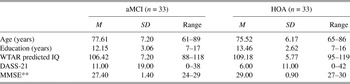
Eligibility criteria were assessed using (a) the Wechsler Test of Adult Reading (WTAR; Wechsler, Reference Wechsler2001) for an estimate of premorbid intelligence; (b) the Depression Anxiety Stress Scale (DASS-21; Lovibond & Lovibond, Reference Lovibond and Lovibond1995) for an indication of general emotional health; and (c) the MMSE (Folstein et al., Reference Folstein, Folstein and McHugh1975) as a brief screen of cognitive function. Demographic and screening variables are presented in Table 1. One-way analysis of variance (ANOVA) indicated no significant differences between groups in age (p = .21), years of education (p = .07), predicted IQ (p = .09), and emotional health (p = .34). A chi-square test for independence (with Yates Continuity Correction) found no significant differences in gender distribution between groups, Φ = –.03, χ2 (1, n = 66) = 0.00, p = 1.00. A one-way ANOVA revealed that the aMCI group performed significantly poorer than the HOA group on the MMSE (p < .01).
Means and standard deviations of demographic and screening variables for aMCI and HOA groups

Note
aMCI = amnestic mild cognitive impairment, HOA = healthy older adults, WTAR = Wechsler Test of Adult Reading, DASS-21 = Depression Anxiety Stress Scale, MMSE = Mimi-Mental State Examination. **p < .01.
Measures
Episodic memory
Acquisition and retrieval of new information was assessed via the Hopkins Verbal Learning Test – Revised, Form 3 (HVLT-R; Brandt & Benedict, Reference Brandt and Benedict2001). The HVLT-R contains a list of twelve common nouns representing three groups of four semantically related words (nonconsecutive). Acquisition of information was assessed by the total number of words recalled over three consecutive learning trials (Trials 1–3). This was followed by a 20-minute delayed free recall trial and a recognition trial which contains all 12 words of the original list with 12 additional nontarget words. Retrieval of information was measured by the percentage of information retained at delayed free recall (i.e., delayed recall divided by the highest of learning trials 2 or 3), and via the recognition discrimination index (correctly recognized words minus incorrectly endorsed distractor words). Semantic clustering represents use of the active strategy of reorganizing words according to shared semantic features. While serial clustering indicates words recalled in the same order in which they were presented. Semantic and serial clustering indices were computed by subtracting the chance-expected clustering score from the observed clustering score (see Stricker, Brown,Wixted, Baldo, & Delis, Reference Stricker, Brown, Wixted, Baldo and Delis2002). The chance-expected clustering score is computed to correct for the total number of words recalled. A semantic cluster was defined as the occurrence of two words recalled successively from the same semantic category, while a serial cluster was defined as an occasion in which two words were recalled in the same consecutive order in which they were recalled on the original list. Higher scores indicate greater use of semantic or serial clustering.
Semantic memory
The Boston Naming Test-2 (BNT-2; Kaplan, Goodglass, & Weintraub, Reference Kaplan, Goodglass and Weintraub2001) 15 item short form 4 (Mack SF4; Mack, Freed, Williams, & Henderson, Reference Mack, Freed, Williams and Henderson1992) is a task of confrontation naming and provided a simple measure of semantic memory. The dependent variables included the number of correct items produced spontaneously, and the number of responses produced following phonemic and semantic cues.
Executive attention of working memory
Ability to focus attention and inhibit a dominant response was assessed using the Color-Word Interference Test (Delis, Kaplan, & Kramer, Reference Delis, Kaplan and Kramer2001). Three conditions were administered: naming colors, reading words, and naming the color of words in incongruent ink (inhibition task). Each condition was timed in seconds and response times were converted into age-scaled scores. The dependent measure consisted of the standardized contrast score of the ability for inhibition while controlling for the time taken to name colors. The Trail Making Test Parts A and B (Reitan & Wolfson, Reference Reitan and Wolfson1985) provided a measure of the ability to shift attentional sets. Dependent measures were number of seconds to complete each subtest, and, to control for processing speed, the time difference score between Part B and Part A. The ability to divide attention was measured using the Telephone Search While Counting subtest from the Test of Everyday Attention (Robertson, Ward, Ridgeway, & Nimmo-Smith, Reference Robertson, Ward, Ridgeway and Nimmo-Smith1994). The dual task decrement was calculated by subtracting the time taken to complete the single task from the time taken to complete the dual task (weighted for accuracy).
Episodic buffer functioning of working memory
Verbal fluency was used to measure episodic buffer functioning, as the task requires strategic access to long-term memory, temporary storage of information, and integration of multimodal information (Baddeley, Reference Baddeley2001). For phonemic fluency, participants were required to generate words beginning with the letters F, A, and S over three separate 60-second trials (Controlled Oral Word Association Test; Benton & Hamsher, Reference Benton and Hamsher1976). Semantic verbal fluency was assessed using the number of correctly generated words within a further three separate 60-second trials from the semantic categories of “animals,” “clothing,” and “items from the supermarket.”. The total number of words within each fluency category was summed to provide the phonemic and semantic verbal fluency dependent variables.
Speed of information processing
The raw score from the Symbol Search subtest of the WAIS-III (Wechsler, Reference Wechsler1997a) and the time in seconds to complete Part A of the Trail Making Test (TMT-A; Reitan & Wolfson, Reference Reitan and Wolfson1985) provided measures of processing speed.
Procedure
Ethics approval was obtained from the Ethics Committee at La Trobe University and participating hospitals. Written informed consent was obtained from participants prior to participation. Tests were administered according to standardized procedures and in a standardized sequence within a single session of approximately 90 minutes.
Statistical Analyses
Prior to data analysis, the frequency distribution for each variable was assessed for violations of normality using standardized indices (z) of skewness and kurtosis with a conservative criterion of α = .001 (see Tabachnick & Fidell, Reference Tabachnick and Fidell2001). Variables with z values beyond ± 3.30 were transformed using a natural log transformation to meet assumptions of normality required for parametric analyses. The HVLT-R Discrimination Index was negatively skewed, and thus subsequently reflected prior to transformation. To assist interpretation of clinically based neuropsychological tasks, the median and interquartile ranges of the original variables are reported for the raw (untransformed) scores of variables in tables of descriptive statistics.
Group differences were investigated using multivariate analyses of variance (MANOVA), and when significant effects were found, univariate analyses (ANOVA) were evaluated using a significance level of α = .01, rather than .05. This is a nominal error rate, selected as a balance between the need to control for the inflation of Type 1 error rate and the need to avoid excessive loss of power arising from a Bonferroni-adjustment. Mixed-model ANOVAs assessed group differences in rate of learning and use of semantic and serial clustering across HVLT-R learning trials. Assumption of homogeneity of covariance (Mauchly’s Test of Sphericity) was violated to a moderate extent in the mixed ANOVA on semantic clustering over HVLT-R trials. Therefore, Greenhouse-Geisser adjusted values were reported and significant univariate differences were explored using post-hoc pairwise comparisons. When assumption of Sphericity was met, significant group differences were explored using post-hoc Tukey Honestly Significant Differences (HSD).
Effect size is reported, in either R 2 or η2 where, according to Cohen’s (Reference Cohen1988) criteria, .01 is a small effect, .09 a moderate effect, and .25 a large effect. As correlational analyses were exploratory, the results have been reported according to the magnitude of the effect. Note that the equivalent effect sizes, in terms of the Pearson product-moment correlation, would be .10, .30, and .50, respectively.
RESULTS
Episodic Memory and Learning in a Word-list Learning Task
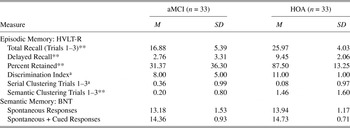
MANOVA of HVLT-R variables revealed a significant group effect, F(3, 62) = 31.79, p < .01, η2 = .61. Univariate analyses revealed that the aMCI group demonstrated significant impairment relative to the HOA group in acquisition of new information (Total Recall), F(1, 64) = 60.17, p < .01, η2 = .48, retrieval (Delayed Recall), F(1, 64) = 97.40, p < .01, η2 = .60, and recognition memory (Discrimination Index), F(1, 64) = 42.60, p < .01, η2 = .40, with large effect sizes (see Table 2).
Performance on episodic and semantic memory measures for aMCI and HOA groups

Note
Covariance analysis, controlling for Speed of Processing (Symbol Search), did not substantively alter the results. aMCI = amnestic mild cognitive impairment, HOA = healthy older adults, HVLT-R = Hopkins Verbal Learning Test–Revised, BNT = Boston Naming Test.
aMedian and interquartile range values of original (untransformed variables) are presented in this table. Analyses were performed on the Reflected and Log Transformed means for Discrimination Index (aMCI: M = 1.49, SD = 0.71; HOA: M = 0.48, SD = 0.53), and on the Log Transformed means for Serial Clustering Trials 1–3 (aMCI: M = 0.28, SD = 0.44; HOA: M = 0.03, SD = 0.71). **p < .01.
Learning strategies: Serial and semantic clustering
Serial and semantic clustering scores were averaged across Trials 1 to 3 to provide an indication of mean semantic and serial clustering indices during learning. MANOVA of clustering indices indicated a significant group effect, F(2, 63) = 8.36, p < .01, η2 = .21. There was no significant difference between groups in the mean serial clustering index, F(1, 64) = 2.97, p = .09, η2 = .04. The semantic clustering index, however, was significantly lower in the aMCI group relative to the HOA group, F(1, 64) = 16.31, p < .01, η2 = .20.
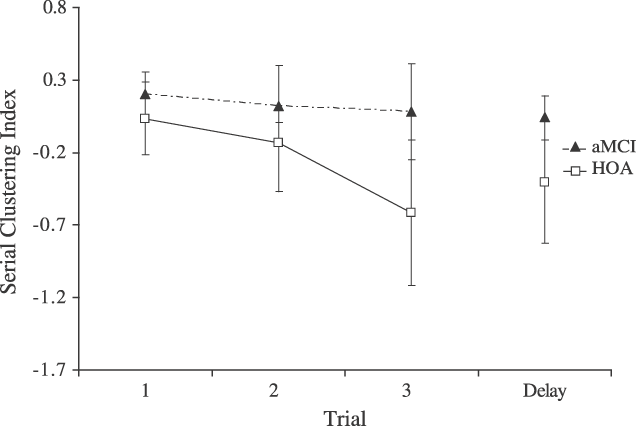
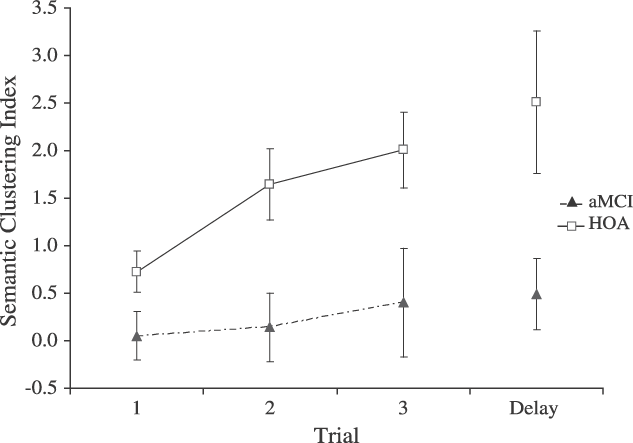
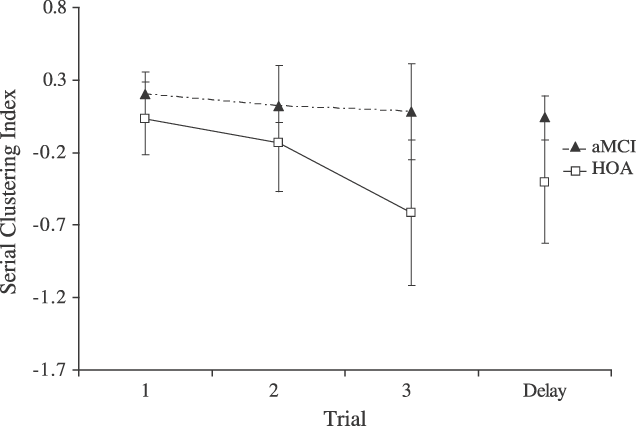
To determine the pattern of change in serial and semantic clustering across trials, the mean clustering index for each trial was plotted for each group; the means and 95% confidence intervals are presented in Figure 1 and Figure 2, respectively.
Means and 95% confidence intervals of log transformed serial clustering indices across HVLT-R trials for aMCI and HOA groups.
Means and 95% confidence intervals of semantic clustering indices across HVLT-R trials for aMCI and HOA groups.
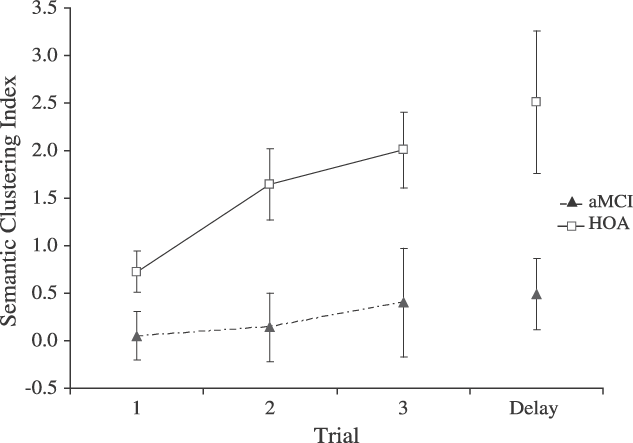
Figure 1 suggests a reduction in serial clustering across trials in the HOA group, with the greatest decrease occurring between Trials 2 and 3. In contrast, the aMCI group maintained consistent use of serial clustering across trials. There is, however, considerable variability of scores about the means for both groups. A 2 × 4 ANOVA indicated no significant interaction between group and trial for serial clustering indices, F(3, 62) = 1.25, p = .30, η2 = .06. The main effect for group, however, was significant, F(1, 64) = 6.77, p < .01, η2 = .10, with a moderate effect size, indicating that the aMCI group used serial clustering more than the HOA group across trials. The effect of time collapsed across groups was not statistically significant, F(1, 62) = 3.63, p = .02, η2 = .15.
Inspection of Figure 2 shows that the aMCI group exhibited little change in semantic clustering across trials, whereas the HOA group increased their use of semantic clustering, with the greatest increase occurring from Trials 1 to 2. A 2 × 4 ANOVA revealed a significant interaction between semantic clustering and group, F(3, 62) = 4.32, p < .01, η2 = .17. Pairwise comparisons showed that the aMCI group used semantic clustering strategies significantly less than the HOA group on Trials 2, 3, and the Delayed Recall Trial. The effect of trial within groups was significant for the HOA group, F(3, 62) = 13.86, p < .01, η2 = .40, but not for the aMCI group, F(3, 62) = 0.86, p = .47, η2 = .04, indicating that the aMCI group was unable to benefit from repetition to increase semantic clustering. Significant post-hoc pairwise comparisons were evident for the HOA group in semantic clustering between Trials 1 and 2, but not between Trials 2 and 3, or Trial 3 and the Delay Trial.
Relationship between word-list learning and learning strategies
In both groups, greater use of semantic clustering strategies was associated with better acquisition with a moderate effect size (Total Recall: aMCI, r = .49, and HOA, r = .50), and retrieval (Delayed Recall: aMCI, r = .47, and HOA, r = .39). In addition, greater use of semantic clustering strategies was also associated with better retrieval with a moderate effect size (Discrimination Index, r = –.39) for the aMCI group, but not for the HOA group, possibly as a result of their near ceiling performance on this measure. Greater use of semantic clustering was associated with less use of serial clustering for both the aMCI group with a moderate effect size, r = –.36, and for the HOA group, r = –.67, with a large effect size. As expected, Serial Clustering was weakly related to Total Recall and Delayed Recall for both aMCI and HOA groups.
Semantic Memory
A small but not statistically significant group effect was found on MANOVA for the two BNT variables (i.e., Spontaneous Responses, Total Responses), F(2, 63) = 2.67, p = .08, η2 = .08.
Working Memory and Processing Speed Performances
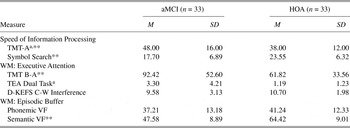
The means and standard deviations for measures of WM and processing speed are displayed in Table 3.
Performance on the neuropsychological measures for aMCI and HOA groups

Note
Covariance analysis, controlling for Speed of Processing (Symbol Search) did not substantively alter the results. aMCI = amnestic mild cognitive impairment, HOA = healthy older adults, TMT-A = Trail Making Test, Part A, TEA = Test of Everyday Attention, WM = working memory, D-KEFS C-W = Delis-Kaplan Executive Function System Color-Word, VF = verbal fluency.
aMedian and interquartile range values of original (untransformed variables) are presented in this table. Analyses were performed on the Log Transformed means for TMT-A (aMCI: M = 3.93, SD = 0.32; HOA: M = 3.68, SD = 0.25), and for the TEA Dual Task (aMCI: M = 1.46, SD = 0.77; HOA: M = 0.68, SD = 0.69) **p < .01.
Executive attention of working memory
MANOVA revealed a significant group difference for executive attention variables, F(3, 63) = 7.91, p < .01, η2 = .28. Significant univariate effects were evident for Dual Tasking, F(1, 64) = 18.67, p < .01, η2 = .23, and TMT B-A, F(1, 64) = 7.94, p < .01, η2 = .11, with the aMCI group performing significantly poorer than the HOA group. No significant group difference was found for Inhibition, F(1, 64) = 3.02, p = .09, η2 = .05.
Episodic buffer functions of working memory
MANOVA revealed a significant group difference for Verbal Fluency measures, F(2, 63) = 30.53, p <. 01, η2 = .49. Significant univariate effects were evident for Semantic Fluency, F(1, 64) = 58.12, p < .01, η2 = .48, with the aMCI performing significantly poorer than the HOA group. No significant difference between groups was found for Phonemic Fluency, F(1, 64) = 1.65, p = .20, η2 = .02.
Processing speed
MANOVA revealed a significant group effect for processing speed variables, F(2, 63) = 7.99, p < .01, η2 = .20. The aMCI group performed significantly slower than the HOA group on both TMT-A, F(1, 64) = 12.15, p < .01, η2 = .16, and Symbol Search, F(1, 64) = 12.91, p < .01, η2 = .17, with moderate effect sizes. It should be noted that covariance analysis adjusting for differences in processing speed did not substantively change any of the findings of significant group differences on neuropsychological tests of WM.
Relationship between Semantic Clustering and Working Memory
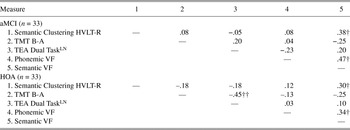
Correlations between measures of semantic clustering and WM are presented in Table 4. Semantic clustering was moderately associated with Semantic Verbal Fluency in the aMCI group, r = .37, p = .03, and the HOA group, r = .30, p = .09, with greater use of semantic clustering strategies being associated with better semantic fluency performance. By contrast, Phonemic Fluency was only weakly related with Semantic Clustering for the aMCI, r = .08, p = .67, and the HOA groups, r = .12, p = .50. Relationships between Semantic Clustering and measures of attentional capacity, namely, shifting attention (TMT B-A) and dividing attention (Test of Everyday Attention, TEA, Dual Task) were only weakly related in both groups.
Correlations between semantic clustering and working memory in aMCI and HOA groups

Note
aMCI = amnestic mild cognitive impairment, HOA = healthy older adults, HVLT-R = Hopkins Verbal Learning Test–Revised, TMT = Trail Making Test, TEA = Test of Everyday Attention, VF = verbal fluency.
LN Mean and standard deviation values of the Log Transformed variables.
R.LN Mean and standard deviation values of the Reflected and Log Transformed variables.
†moderate effect size; ††large effect size.
DISCUSSION
The objective of the present study was to investigate in aMCI the relationship between acquisition, strategies of learning, and components of WM (namely, executive attention and episodic buffer functions). In addition, the contribution of the general resource of processing speed was also considered. Consistent with previous research (Estévez-González, Kulisevsky, Boltes, Otermín, & García-Sánchez, Reference Estévez-González, Kulisevsky, Boltes, Otermín and García-Sánchez2003; Karrasch, Sinervä, Grönholm, Rinne, & Laine, Reference Karrasch, Sinervä, Grönholm, Rinne and Laine2005), the aMCI group demonstrated significant impairment in the acquisition of new information characterized by reduced encoding (total learning on the HVLT-R). Impairments in retrieval were also evident in the aMCI group on measures of HVLT-R delayed recall and recognition. Impaired encoding was investigated further by examining the use of organizational strategies during learning. As hypothesized, the aMCI group demonstrated significantly diminished use of active encoding strategies (semantic clustering) during learning, relative to the HOA group. Inspection of the means revealed that the aMCI group used semantic clustering above that considered by chance alone, suggesting that the group was aware of the semantic nature of the task and attempted to cluster accordingly, albeit not very effectively.
Examination of the pattern of clustering over trials reveals striking group differences. The HOA group showed a slight, but not statistically significant, decrease across trials in the relatively passive learning strategy of serial clustering, and a corresponding progressive increase in more active and effective semantic clustering techniques. In contrast, the aMCI group demonstrated no decrease in serial clustering across trials and did not increase use of semantic clustering, which remained at a significantly lower level as compared with the HOA group. The lack of spontaneous improvement by the aMCI group in semantic clustering over repeated presentations is consistent with Perri et al. (Reference Perri, Carlesimo, Serra and Caltagirone2005) and indicates that participants with aMCI need additional support during learning to benefit from the semantic structure of a complex learning task (Bröder et al., Reference Bröder, Herwig, Teipel and Fast2008, Ribeiro et al., Reference Ribeiro, Guerreiro and De Mendonça2007). In the present study, despite diminished semantic clustering in the aMCI group, the findings also indicate that when both groups used semantic clustering strategies, it was associated with better acquisition and retrieval of new information (HVLT-R indices). This is important as it reinforces the value of cognitive training in memory strategies for people with aMCI (Hampstead, Sathian, Bacon Moore, Nalisnick, & Stringer, Reference Hampstead, Sathian, Bacon Moore, Nalisnick and Stringer2008; Kinsella et al., Reference Kinsella, Mullaly, Rand, Ong, Burton and Price2009).
Reductions in processing speed have been proposed to account for age-related changes in episodic memory performance (Salthouse, Reference Salthouse1996), and indeed, research using healthy older adults has found that slowed processing speed significantly predicted diminished use of effortful encoding strategies during learning (Earles & Kersten, Reference Earles and Kersten1999; Hertzog et al., Reference Hertzog, Dixon, Hultsch and MacDonald2003). In the present study, however, the significant difference between aMCI and HOA groups in semantic clustering use remained, even after controlling for processing speed. Thus, although reductions in processing speed are evident in patients with aMCI, slowed processing speed does not solely account for limited use of strategic learning strategies in aMCI.
As expected, the aMCI group also performed more poorly on tests of WM than the HOA group; specifically, in the areas of shifting attention, dividing attention, and episodic buffer functioning (semantic verbal fluency) (see also, Albert et al., Reference Albert, Moss, Tanzi and Jones2001; Belleville et al., Reference Belleville, Chertkow and Gauthier2007; Crowell et al., Reference Crowell, Luis, Vanderploeg, Schinka and Mullan2002; Daly et al., Reference Daly, Zaitchik, Copeland, Schmahmann, Gunther and Albert2000; Hodges, Erzinçlioğlu, & Patterson, Reference Hodges, Erzinçlioğlu and Patterson2006; Rozzini et al., Reference Rozzini, Vicini Chilovi, Conti, Bertoletti, Delrio and Trabucchi2007). In addition, processing speed was slower in the aMCI group, however, it must be noted that differences in processing speed did not substantively alter the significance of the group difference on measures of WM. Thus, difficulties in aMCI in shifting and dividing attention and semantic fluency were not simply an artifact of slowed processing speed. Consistent with previous research, no significant group differences were identified in the ability to focus attention (Belleville et al., Reference Belleville, Chertkow and Gauthier2007; Zhang et al., Reference Zhang, Han, Verhaeghen and Nilsson2007).
Verbal fluency was selected as a measure of buffer function, as it afforded a comparison between the retrieval and manipulation of phonemic information, as distinct from that of semantic information. While both fluency tasks impose comparable demands on episodic buffer functioning, semantic fluency places additional demands on the retrieval of semantic associations from long-term memory (Rohrer, Salmon, Wixted, & Paulsen, Reference Rohrer, Salmon, Wixted and Paulsen1999; Murphy, Rich, & Troyer, Reference Murphy, Rich and Troyer2006). Thus, this finding does not support episodic buffer dysfunction per se, rather it suggests that episodic buffer dysfunction occurs during the strategic activation, manipulation, and retrieval of semantic associations from long-term memory. This may indicate an early manifestation of fragility in the semantic memory system, which is expected to evolve as AD-related pathology in the trans-entorhinal region impacting the hippocampus extends to broader regions of the temporal neocortex (Hodges et al., Reference Hodges, Erzinçlioğlu and Patterson2006; Hodges & Patterson, Reference Hodges and Patterson1995; Moscovitch et al., Reference Moscovitch, Rosenbaum, Gilboa, Addis, Westmacott and Grady2005).
The current study extended previous research by investigating the relationship between semantic clustering and WM. Contrary to our hypothesis, even though the aMCI group performed more poorly on measures of executive attention than the HOA group, these measures did not predict semantic clustering performance in the aMCI group. Rather, semantic clustering was significantly and solely related to the ability to strategically retrieve and manipulate semantic information from long-term memory (i.e., semantic verbal fluency). Therefore, when coupled with the lack of significant group difference in the Boston Naming Test, which provided an index of automatic access to well-learned semantic associations in long-term memory, impaired use of semantic clustering strategies during learning in aMCI appears to be selectively related to the interaction between the active and strategic function of the episodic buffer and the retrieval of semantic associations. The critical importance of close interaction between frontal circuits and medial temporal structures for binding and forming associative links between single units of information during both learning and later retrieval of information has been emphasized by several research groups (see the critical reviews of Jonides et al., Reference Jonides, Lewis, Nee, Lustig, Berman and Moore2008; Moscovitch et al., Reference Moscovitch, Rosenbaum, Gilboa, Addis, Westmacott and Grady2005; and Naveh-Benjamin, Reference Naveh-Benjamin2000), and our results are consistent with these brain–behavior models and the early pathological changes noted in the trans-entorhinal region and temporal structures in aMCI (Braak & Braak, Reference Braak and Braak1991; Jack et al., Reference Jack, Petersen, Xu, O’Brien, Smith and Ivnik1999). Moreover, verbal fluency tasks are among the most commonly used neuropsychological tests (Rabin, Barr, & Burton, Reference Rabin, Barr and Burton2005), thus, these results are directly applicable to the clinical arena.
Our results should be considered within the context of an unequal gender distribution and the small sample size. This may limit the generalizability of these results to other samples, and replication is required. In addition, although all participants in our aMCI sample demonstrated memory impairment, we did not differentiate between single- and multidomain aMCI. Recent research suggests that multidomain aMCI patients progress more rapidly to early stage AD (Ahmed et al., Reference Ahmed, Mitchell, Arnold, Nestor and Hodges2008). Although prediction of conversion to AD was not the focus of our study, it would be useful in further research to incorporate both a comprehensive baseline of neuropsychological tests that would allow subclassification of aMCI, and also a sample of participants diagnosed with AD, in order to evaluate the staging of the learning deficit in the degenerative process. It is expected that as the disease progresses in the transition from aMCI to AD, a more pervasive impairment of episodic buffer function emerges (Germano, Kinsella, Storey, Ong, & Ames, Reference Germano, Kinsella, Storey, Ong and Ames2008). In addition, longitudinal follow-up of patients with aMCI is important to determine whether diminished semantic clustering represents a sensitive diagnostic tool for identifying aMCI and predicting conversion to AD.
The current findings indicate that people with aMCI demonstrate significant difficulties in spontaneously applying semantic organizational strategies during learning. Identification of difficulties in aMCI in retrieving and using semantic associations to support new learning is important in progressing an understanding of the necessary interaction of WM and long-term memory in effective new learning. Furthermore, these findings contribute to an evolving understanding of the difficulties in older adults at risk of developing dementia.
ACKNOWLEDGMENTS
We gratefully acknowledge the assistance of the CDAMS staff from Caulfield Hospital, Bundoora Extended Care Centre, Austin Health, and Sunshine Hospital. A special thank you also to the participants who volunteered their time to take part in this research. This research was completed by the first author in partial fulfillment of the requirements for the degree of Doctor of Clinical Neuropsychology. A brief version of this paper was presented at the 14th Annual Conference of the Australian Psychological Society College of Clinical Neuropsychologists in Adelaide, Australia on November 14, 2008. The authors have reported no conflicts of interest.