Postpartum/Postnatal Depression (PND) is currently considered a significant health issue, because of its considerable negative effects on both mothers and infants. An examination of the prevalence rates for this illness in various environments, including in Arab states, clearly suggests that PND can have alarming repercussions if not identified and treated early (Sit & Wisner, 2009). This study finds that the prevalence rate of PND appears to be higher than anticipated by previous studies in this field. In developed countries, the prevalence rate apparently fluctuates between 10% and 15%. However, in developing countries, reported rates fluctuate between 16% and 36% (Al Dallal & Grant, Reference Al Dallal and Grant2012; Green, Broome, & Mirabella, Reference Green, Broome and Mirabella2006; Husain, Reference Husain, Husain, Chaudhry, Atif and Rahman2006; Patel, Rodrigues, & DeSouza, Reference Patel, Rodrigues and DeSouza2002). In Asian countries, the prevalence of postpartum depression has been reported to be between 0.5% and 60% (Halbreich & Karkun, Reference Halbreich and Karkun2006) and from 3.5% to 63.3% (Klainin & Arthur, Reference Klainin and Arthur2009).
These findings indicate that the mean prevalence of PND being 10–15% is not representative of the actual magnitude of the problem.
PND does not only affect the mother’s health, it also has a negative effect on the child’s emotional, cognitive, social and even physical development (Morais et al., Reference Morais, Lucci and Otta2013; Murray & Cooper, Reference Murray and Cooper1997; Patel, DeSouza, & Rodrigues, Reference Patel, DeSouza and Rodrigues2003; Oates et al. Reference Oates, Cox, Neema, Asten, Glangeaud-Freudenthal and Figueiredo2004). In most cases, the symptoms of depression appear six weeks after parturition and include lethargy, low mood, difficulty sleeping and concentrating, reduced appetite and lack of sexual desire, in addition to bouts of weeping for no apparent reason, anxiety, irritability, agitation, social withdrawal and feelings of guilt about not being able to raise a newborn baby (Patel et al., Reference Patel, Rodrigues and DeSouza2002; Stewart, Robertson, Dennis, & Grace, Reference Stewart, Robertson, Dennis and Grace2004; Wisner, Parry, & Piontek, Reference Wisner, Parry and Piontek2002). If these symptoms persist without intervention, they can lead to postpartum psychotic depression disorder/postpartum psychosis (Seyfried & Marcus, Reference Seyfried and Marcus2003).
The listed symptoms alter the mother’s emotions, affecting the way in which she interacts with the newborn baby and pursues her own self-interest in terms of health and nutrition, as well as her interest in her appearance and relationships with others. Usually, it is necessary to intervene with psychological treatment, counselling or medication, depending on the severity of the symptoms from which the mother is suffering. A review of several recent, as well as older studies, revealed the main direct causes of the illness remain unclear, although some clinical studies do highlight a number of pertinent factors, such as low secretion of the following hormones immediately after birth: Oestrogen, progesterone, endorphins, cortisol, prolactin and corticotrophin (Soares & Zitek, Reference Soares and Zitek2008), concern about body image (Silveira, Ertel, Dole, & Chasan-Taber, Reference Silveira, Ertel, Dole and Chasan-Taber2015), and anxiety about caring for the new child (Falah-Hassani, Shiri, & Dennis, Reference Falah-Hassani, Shiri and Dennis2016). For first-time mothers in particular, this fear is referred to as new parenting/motherhood anxiety. Mothers may also suffer from lack of physical comfort, such as insufficient sleep, if they have no one to help them in the home (Seyfried & Marcus, Reference Seyfried and Marcus2003). More risk factors have been reported. For instance, obstetrical history, biological factors, lifestyle (Ghaedrahmati, Kazemi, Kheirabadi, Ebrahimi, & Bahrami, Reference Ghaedrahmati, Kazemi, Kheirabadi, Ebrahimi and Bahrami2017), stressful life events, prior history of clinical depression and emotional support.
It is generally believed that the average prevalence rate for this illness worldwide is around 13% (Alasoom & Koura, Reference Alasoom and Koura2014; Veisani, Delpisheh, Sayehmiri, & Rezaeian, Reference Veisani, Delpisheh, Sayehmiri and Rezaeian2013). This rate is without doubt alarming, indicating an urgent need for more in-depth research into the causes and factors that lead to this illness, as it has negative effects on mothers, infants, and wider society (Shrestha et al., Reference Shrestha, Hazrah and Sagar2015). A study by Lanes, Kuk, and Tamim (Reference Lanes, Kuk and Tamim2011) found that between 8.46% and 8.69% of Canadian mothers suffer symptoms of PND. At the same time, the prevalence rate in Ireland reached 13.2% (Leahy-Warren, McCarthy, & Corcoran, Reference Leahy-Warren, McCarthy and Corcoran2011), and 30.6% in Nigeria (Ukaegbe et al., Reference Ukaegbe, Iteke, Bakare and Agbata2012). In the United States, the prevalence rate is 13.8% (Pooler et al., Reference Pooler, Perry and Ghandour2013), and in India it is 23% (Patel et al., Reference Patel, DeSouza and Rodrigues2003).
In Saudi Arabia the prevalence rate of PND is believed to be 14% in the central region of Saudi Arabia (Al-Modayfer, Alatiq, Khair, & Abdelkawi, Reference Al-Modayfer, Alatiq, Khair and Abdelkawi2015), and 17.8% in the eastern region (Alasoom & Koura, Reference Alasoom and Koura2014). Elsewhere in the region the rate is 22% in the United Arab Emirates (Green et al., Reference Green, Broome and Mirabella2006), 19% in Morocco (Agoub, Moussaoui, & Battas, Reference Agoub, Moussaoui and Battas2005), and between 10% and 20% in Jordan (Yehia, Callister, & Hamdan-Mansour, 2103; Mohamed, Mahmoud, Said, Abdelhafez, & Maklof, Reference Mohamed, Mahmoud, Said, Abdelhafez and Maklof2011), 12% in Oman (Al Hinai & Al Hinai, Reference Al Hinai and Al Hinai2014), 37.1% in Bahrain (Al Dallal & Grant, Reference Al Dallal and Grant2012), 21% in Lebanon (Chaaya et al., Reference Chaaya, Campbell, Kak, Shaar, Harb and Kaddour2002), and 19.2% in Tunisia (Masmoudi, et al., Reference Masmoudi, Tabelsi, Charfeddine, Ben Ayed, Guermazzi and Jaoua2008). It was suggested to be 27% in Sudan (Sati, Reference Sati2011), although the latest study of the Sudanese situation shows the incidence has dropped to 9.2% of the population (Khalifa et al., Reference Khalifa, Glavin, Bjertness and Lien2015), there is no clarification of why this considerable decline might have occurred. When averaged, the mean of these rates for the Arab world is about 20.51%, which is remarkably high; although caution should be applied, as the data shows considerable fluctuation, and may sometimes be inaccurate.
The fluctuations in the rate of prevalence of this illness highlight both a potential for increase in the number of cases, and that there are a variety of associated factors. Both surveys and experimental studies are needed to determine precise prevalence rates and the factors that could be responsible for the increase in PND. Studies to date show that the rates of occurrence, especially those in the Arab world, merit additional examination. Disparities that might be due to varying diagnostic criteria and associated risk factors, which vary from one case to another, should be taken into account, as well as the disparity of the environments in which these studies were carried out and the extent to which they are influenced by religiosity, religious beliefs, and cultural influences (Ramasubramaniam, Madhavanprabhakaran, Renganathan, & Raman, Reference Ramasubramaniam, Madhavanprabhakaran, Renganathan and Raman2014). The extent of mothers’ level of awareness of the illness also requires consideration. For example, some mothers who suffer from PND in certain environments complain that they have been afflicted with the evil eye (Ghubash & Eapen, Reference Ghubash and Eapen2009). In addition, the mother’s age and socioeconomic status, her level of education should also be considered. It is also essential to allow for the role of family support, the mother’s emotional state and patient history, as well as the role of social norms and values that govern societies (Al Dallal & Grant, Reference Al Dallal and Grant2012; Nasreen et al., Reference Nasreen, Ab Rahman, Rus, Kartiwi, Sutan and Edhborg2018). All of these factors can have a direct or indirect role in facilitating the onset of this illness.
In view of the disparity in the rates of PND worldwide and in the Arab world in particular, along with the lack of accurate statistics about its prevalence, especially in the western region of Saudi Arabia (as reported by the Ministry of Health and university research centers), this study aimed to determine an up to date prevalence rate for PND in the western region of Saudi Arabia. The data obtained is compared with rates indicated in studies carried out in other Arab countries. Some associated risk factors that might be causative or facilitative of this illness are examined in the current study. Therefore, the study aims: (a) To evaluate the prevalence of postnatal depressive symptoms in the Western region of Saudi Arabia; (b) to investigate the association between PND and the following factors: Mother’s age; her level of education; job; previous history of depression; health problems affecting the newborn baby; the desire to conceive; pregnancy complications; the method of delivery; the newborn baby’s gender and parental satisfaction with this; breastfeeding; and satisfaction with the support and help of the people at home, including the mother’s husband.
Method
The current study is a Cross-sectional quantitative design, which was carried out in the Western region of Saudi Arabia, mainly in the city of Jeddah.
Participants
To select a sample for the study, random contact was made with several women who had visited six hospitals and four health centers in Jeddah in order to vaccinate their children during the eighth or tenth week following birth
A total of 439 questionnaires were distributed randomly in these locations, of which 228 were completed by mothers who willingly agreed to participate. After the exclusion of incomplete forms and the withdrawal of five participants, the number of completed forms available for statistical analysis was 217. The age of the participants ranged from 24 to 45, with a mean age of 33.2 years (SD = 4.5). The questionnaires included a letter of consent to be signed before participating in the study and demographic information for women completing the Arabic version of the Edinburgh Postnatal Depression Scale. These questionnaires were completed between May and July 2016.
Instruments
The tools of the present study comprises of two parts. In part one, questions regarding some relevant information that should be provided by the respondent. These questions include mother’s age, the gender of the child, previous history of PND, mother’s employment, desire to conceive, delivery method, satisfaction with baby gender, and satisfaction with family and husband support. Whereas part tow pertained to EPSD ten statements discussed in the relevant section. Following Al-Modayfer’s et al. Study (2015), two items for rating satisfaction were included in the study.
Questionnaire: This was designed by the researcher and included much of the information necessary for the study, such as the mother’s age, the gender of the child and the mother’s prior history of PND. This questionnaire was presented to four referees and their views were considered with regard to possible deletions, additions and modifications, until it reached the final version distributed to the study participants.
Edinburgh Postnatal Depression Scale (EPDS): The original version of this scale, as prepared by Cox, Holden, and Sagovsky (Reference Cox, Holden and Sagovsky1987) comprises ten statements that measure PND symptoms. The items on the scale were answered according to how the mother had felt over the past seven days. The scores ranged from 0 to 3 for each item in order to measure the severity of these symptoms, with a possible total score of 30. For this study, the researcher translated the tool and used it after a reverse translation was performed to ensure the accuracy of the translation. It was also shown to two specialists in the field of translation. The researcher calculated the reliability of the tool using the Cronbach’s Alpha (.86) and split-half (.85) on an exploratory sample of 121 participants (female teachers) from different primary girl schools in Jeddah. The age ranged from 30 to 41, with a mean age of 35.04 years (SD =2.60).
A review of previous studies using this EPDS found the majority recommended using a cut-off point of > 13 (Cox et al., Reference Cox, Holden and Sagovsky1987; Sit & Wisner, 2009), where a score of 13 or more indicates depressive symptoms. This tool has psychometric properties that were suitable for the current study. Generally speaking, this scale is considered one of the best diagnostic scales used for PND.
Procedures
The process of collecting data was carried out by the author and a team of undergraduate female students from King Abdulaziz University. Most of the data were collected in person from the same locations except a few of them were posted later on to the author. The respondents were enthused to be part of the study and they willingly gave their responses.
Data analysis
All collected data have been carefully reviewed and entered in SPSS (V.17). For summarizing the outcome variables, descriptive statistics were used. In addition to, Pearson correlations, and Chi square were calculated for addressing the current study objectives.
Results
The current study found the prevalence of PND among Saudi mothers (mean age = 33.2, SD = 4.52) in the western region of Saudi Arabia had reached 17.1%, 64% of whom work outside the home. Likewise, the current study found that 13.4% of the participants were educated to high school level, whilst 79.3% had a bachelor’s degree and 7.4% had some form of postgraduate education. Furthermore, 56.7% of the newborn babies were female, while 43.3% were male; the satisfaction rate regarding the gender of the baby was 93.5%. Meanwhile, the satisfaction rate regarding each of the following was as follows: Pregnancy (71.4%), support of the family (75.1%) and support and help of the husband (71%). Additionally, the current study found that 31.1% of the babies had health problems, 77.4% of the mothers breastfed their children and 37.3% of the mothers had experienced complications during pregnancy. The rate of natural birth was 69.1%, while 30.9% were caesarean sections. Meanwhile, 31.8% of the mothers had a patient history of PND.
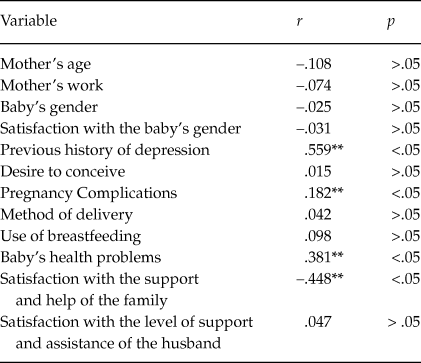
On the other hand, the Pearson correlation coefficient indicated a statistically significant positive relationship between PND and each of the following: Previous history of PND (r = .559; p < .05), health problems affecting the newborn baby (r = .381; p < .05), and the mother experiencing some complications during pregnancy (r = .182; p < .05). Likewise, the current study found a statistically significant negative relationship between PND and the support and help of the mother’s family (r = –.448; p < .05). A chi-squared test was also carried out to ascertain this relationship; the results clearly show there is a significant relationship between these four variables and PND using EPDS in the following manner: Previous history of PND (χ2 = 67.74, df = 1, p < .05), health problems affecting the newborn baby (χ2 = 31.42, df = 1, p < .05), the mother experiencing some complications during pregnancy (χ2 = 7.19, df = 1, p < .05), and the support and help of people at home (χ2 = 43.47, df = 1, p < .05).
Relationship between the Edinburgh Postnatal Scale (EPDS) and the Tested Factors

Correlation Coefficient between PND and Demographic Variables

Discussion
The current study aimed to determine the prevalence rate of PND in the western region of Saudi Arabia and to examine some of the associated risk factors. Preliminary data was obtained from the mothers participating in the study via a questionnaire that used the EPDS. The data obtained reveal a list of important factors to be taken into consideration, as they gave preliminary indications of the possibility of being afflicted with this illness. A review of recent studies conducted in the same context suggests that a number of factors are associated with the illness in different settings (Ramasubramaniam et al., Reference Ramasubramaniam, Madhavanprabhakaran, Renganathan and Raman2014), and the nature of how some of these factors are related to PND has been examined in the current study. Therefore, the current study found the prevalence rate for PND in the western region of Saudi Arabia had reached 17.1%, which is almost identical to the rate in Qatar, as found by Bener, Burgut, Ghuloum, and Sheikh (Reference Bener, Burgut, Ghuloum and Sheikh2012). That is slightly higher than the prevalence rates in the central region (Riyadh) of Saudi Arabia (14%) (Al-Modayfer et al. Reference Al-Modayfer, Alatiq, Khair and Abdelkawi2015), as well in the United Arab Emirates (15.8%) (Ghubash & Abou-Salehet, Reference Ghubash and Abou-Saleh1997), and Oman (Al Hinai et al., Reference Al Hinai and Al Hinai2014). At the same time, the prevalence rate recorded in the current study is lower than the most recently recorded prevalence rate in the United Arab Emirates (22%) (Green et al., Reference Green, Broome and Mirabella2006), as well as the rates in Morocco (18.7%), Lebanon (21%), Sudan (27%) (Sati, Reference Sati2011) and in Bahrain (37%) (Al Dallal & Grant, Reference Al Dallal and Grant2012).
Naturally, their newborn’s health is an important concern for the parents. A newborn’s health problems will have a negative effect on parents, especially in the case of chronic disorders (Al-Modayfer et al., Reference Al-Modayfer, Alatiq, Khair and Abdelkawi2015; Obeidat, Bond, & Callister, Reference Obeidat, Bond and Callister2009; Shrestha et al., Reference Shrestha, Hazrah and Sagar2015). During consultations with her doctor, the mother always has the opportunity to ask questions about the fetus’s condition and growth, and to listen and follow all instructions relating to a healthy pregnancy and the well-being of the fetus, such as the importance of proper nutrition and taking the necessary dietary supplements administered under medical supervision. Therefore, any congenital health problems are considered a causative factor with regard to any subsequent mood disorders that might emerge later, including depression, taking into account the fact that the complications suffered by the mother during pregnancy may be the cause of the newborn’s subsequent health problems. There was thus a positive correlation between these complications and PND.
A previous history of PND is considered a strong indicator of the likelihood that the mother would suffer from PND again, as noted in several studies, such as Agoub et al. (Reference Agoub, Moussaoui and Battas2005), Sati (Reference Sati2011), Bener et al. (Reference Bener, Burgut, Ghuloum and Sheikh2012) and Joury et al. (Reference Joury, AlAtmi, AlBabtain, Alsharif, AlBabtain, Mogbil and AlRuwaili2014). In terms of the attention, care and support provided by people at home, it should be noted that in Saudi society, the mother usually either moves to her parents’ home, or has someone from her family come and take care of her and her baby during parturition. This is because taking care of a new baby is a responsibility that can involve apprehension and concern for his or her health and welfare. Furthermore, taking care of the baby consumes much of the mother’s time, including intruding into her normal sleeping hours. The absence or lack of help, and care and attention from the family can thus cause frustration for the mother and force her to rely on her own efforts, which is not the same as the support and help that a family can provide, especially for first-time mothers. Likewise, taking care of a newborn baby without any support can distract the mother from taking care of her own health, such as eating properly and doing exercise to stay in shape. Most women suffer from these problems in the postnatal period (Heron, O’Connor, Evans, Golding, & Glover, Reference Heron, O’Connor, Evans, Golding and Glover2004). As a result of this absence or lack of support, the mother may be vulnerable to subsequent mood disorders, including depression. This conclusion concurs with those of the following studies: Al Hinai et al. (Reference Al Hinai and Al Hinai2014), Ramasubramaniam (Reference Ramasubramaniam, Madhavanprabhakaran, Renganathan and Raman2014), Al Dallal & Grant (Reference Al Dallal and Grant2012). Therefore, specialists in the field of clinical psychology emphasize that attention should be paid to the mood of both the mother and the father. This is because having parents in normal psychological health will have a positive effect on the rest of the family, including the newborn baby.
Although some studies have reported a relationship between PND and the baby’s gender (e.g. Deng, Xiong, Jiang, Luo, & Chen, Reference Deng, Xiong, Jiang, Luo and Chen2014; Gul, et al., Reference Gul, Bajwa, Niaz, Haroon, Liaqat, Ahmad and Chaudhry2013.; Jain, Tyagi, Kaur, Puliyel, & Sreenivas, Reference Jain, Tyagi, Kaur, Puliyel and Sreenivas2014), the current study has not found that relationship (r = –.025 ns) which is in line with Alharbi and Abdulghani’s study (Reference Alharbi and Abdulghani2014) and Al-Modayfer’s et al. (Reference Al-Modayfer, Alatiq, Khair and Abdelkawi2015) in the central region of Saudi Arabia and other previous studies (e.g. Cankorur, Abas, Berksun, & Stewart, Reference Cankorur, Abas, Berksun and Stewart2015; Dhillon & Macarthur, Reference Dhillon and Macarthur2010; Sylvén et al., Reference Sylvén, Papadopoulos, Olovsson, Ekselius, Poromaa and Skalkidou2011; Goker et al., Reference Goker, Yanikkerem, Demet, Dikayak, Yildirim and Koyuncu2012; Zangeneh, Alizadeh, Kaamrvamanesh, Rezaie, & Pormehr, Reference Zangeneh, Alizadeh, Kaamrvamanesh, Rezaie and Pormehr2009). This could be explained by cultural factors, which differ from one culture to another as the importance of the newborn’s gender may change according to cultures (Goker et al., Reference Goker, Yanikkerem, Demet, Dikayak, Yildirim and Koyuncu2012). Additionally, no relationship was found between postnatal depression and any of the following: The method of delivery (r = –.042 ns), the mother’s age (r = –.108 ns), her employment status (r = –.074 ns), satisfaction with the support and help of the husband (r = .047 ns), the desire to conceive (r = .015 ns) and breastfeeding (r = .098 ns).
In regards to the mother’s employment status, most working mothers hold educational jobs. The government offers them a 60-day, full salary maternity leave. In addition, mothers are eligible to apply for a longer leave (36 months) with 25% of their monthly salary (Article 22 Leaves Regulations for Saudis, 2005). This could very well explain why the mother’s employment status does not affect the incidence of depression during this period of time. This is despite the fact that some previous studies have indicated a relationship between the level of education and PND, for example Sati (Reference Sati2011), Currò et al. (Reference Currò, Rosa, Maulucci, Maulucci, Silvestri, Zambrano and Regine2009) and Yehia (Reference Yehia, Callister and Hamdan-Mansour2013), who found that the mother’s age and desire to conceive, as well as the method of delivery, are considered predictive factors for PND. However, the current study did not find any such association, which is in line with the results obtained by Alharbi and Abdulghani, (Reference Alharbi and Abdulghani2014) in the central region of Saudi Arabia. Therefore, it is recommended that further research and study into these factors should be carried out, in addition to examination of the other associated risk factors that could cause of PND in Saudi women in the future. More surveys could be carried out to determine a more accurate prevalence rate for PND in Saudi Arabia and its implications.
Based on our findings, it can be said that postpartum depressive symptoms are prevalent in Saudi Arabia. The consequences would negatively affect family members including newborns. Affected mothers will face difficulties in developing mother-infant relationship due to poor maternal role (Panzarine, Slater, & Sharps, Reference Panzarine, Slater and Sharps1995). Therefore, it is recommended that health care providers should be aware of this phenomenon and mothers should be screened for depressive symptoms in order to allow for sufficient interventions if needed.
The present study is a cross-sectional design in a specific region in Saudi Arabia so, the findings cannot be generalized. Secondly, the data were collected from a cosmopolitan city. Hence, the effects may differ from urban to rural areas. Therefore, it is recommended to investigate the impact of cultural factor along with other new factors on PND vulnerability in a comparison study across the country to obtain more rich information about the phenomenon. Aspects of educational and socioeconomic status are not incorporated in the present study which somewhat mars the external generalizability of the study.
It can be concluded that the prevalence rate of PND symptoms in western region in Saudi Arabia was 17.1. Factors including a previous history of depression, problems with a child’s health, issues with home support and complications during pregnancy could lead to PND. Heath providers should pay more attention to affected mothers for an appropriate quick intervention. Further experimental studies are required, however, to replicate these findings and identify other possible risk factors.