




No CrossRef data available.
Article contents
Show your teeth or not: The role of the mouth and eyes in smiles and its cross-cultural variations
Published online by Cambridge University Press: 20 December 2010
Abstract
Previous studies with Westerners have found that both the mouth and eyes are crucial in identifying and interpreting smiles. We proposed that Easterners (e.g., Chinese and Japanese) evaluate the role of the mouth and eyes in smiles differently from Westerners. Individuals in collectivistic Eastern society heavily rely on information from the eyes to identify and interpret the meaning of smiles.
Information
- Type
- Open Peer Commentary
- Information
- Copyright
- Copyright © Cambridge University Press 2010
References
Adolphs, R., Gosselin, F., Buchanan, T. W., Tranel, D., Schyns, P. & Damasio, A. R. (2005) A mechanism for impaired fear recognition after amygdala damage. Nature
433(7021):68–72.CrossRefGoogle ScholarPubMed
Adolphs, R. & Tranel, D., eds. (2000) The amygdala. A functional analysis. Oxford University Press.Google Scholar
Adolphs, R., Tranel, D., Damasio, H. & Damasio, A. R. (1994) Impaired recognition of emotion in facial expressions following bilateral damage to the human amygdala. Nature
372(6507):669–72.CrossRefGoogle Scholar
Bernstein, M. J., Young, S. G., Brown, C. M., Sacco, D. F. & Claypool, H. M. (2008) Adaptive responses to social exclusion: Social rejection improves detection of real and fake smiles. Psychological Science
19(10):981–83.CrossRefGoogle ScholarPubMed
Blairy, S., Herrera, P. & Hess, U. (1999) Mimicry and the judgment of emotional facial expressions. Journal of Nonverbal Behavior
23(1):5–41.CrossRefGoogle Scholar
Iacoboni, M., Molnar-Szakacs, I., Gallese, V., Buccino, G., Mazziotta, J. C. & Rizzolatti, G. (2005) Grasping the intentions of others with one's own mirror neuron system. PLoS Biology
3(3):529–35.CrossRefGoogle ScholarPubMed
Iacoboni, M., Woods, R. P., Brass, M., Bekkering, H., Mazziotta, J. C. & Rizzolatti, G. (1999) Cortical mechanisms of human imitation. Science
286(5449):2526–28.CrossRefGoogle ScholarPubMed
Jack, R. E., Blais, C., Scheepers, C., Schyns, P. G. & Caldara, R. (2009) Cultural confusions show that facial expressions are not universal. Current Biology
19(18):1543–48.CrossRefGoogle Scholar
Keysers, C. & Gazzola, V. (2007) Integrating simulation and theory of mind: From self to social cognition. Trends in Cognitive Sciences
11(5):194–96.CrossRefGoogle ScholarPubMed
Liu, C., Ge, Y., Mai, X. & Luo, Y. (under review) Eyes are windows to the Chinese soul: Evidence from the detection of real and fake smiles.Google Scholar
Maringer, M., Krumhuber, E., Fischer, A. H. & Niedenthal, P. M. (in press) Beyond smile dynamics: Mimicry and beliefs in judgments of smiles. Emotion.Google Scholar
Marshall, J. (2003) The canonical Smiley (and 1-line symbol) list. Available at: http://www.astro.umd.edu/~marshall/smileys.html.Google Scholar
Pollack, A. (1996) Happy in the East (^_^) or smiling in the West:-). The New York Times, August 12, 1996, p. D5.Google Scholar
Smith, M. L., Cottrell, G. W., Gosselin, F. & Schyns, P. G. (2005) Transmitting and decoding facial expressions. Psychological Science
16(3):184–89.CrossRefGoogle ScholarPubMed
xinhuanet. (2008) The mystery of the small points in those ancient ladies' face at the Beijing Olympics opening ceremony. Available at: http://cul.shangdu.com/recommend/20080811-10249/index.shtml.Google Scholar
Yuki, M., Maddux, W. W. & Masuda, T. (2007) Are the windows to the soul the same in the East and West? Cultural differences in using the eyes and mouth as cues to recognize emotions in Japan and the United States. Journal of Experimental Social Psychology
43(2):303–11.CrossRefGoogle Scholar
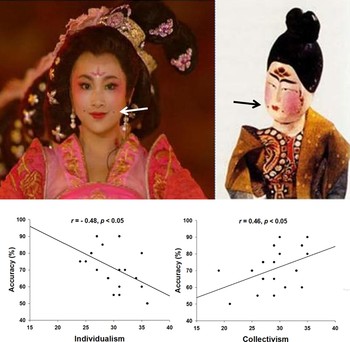
Figure 1. Top: Ancient Chinese women used fake dimples to embellish their closed-mouth smiles (Xinhuanet 2008). Bottom: Chinese participants who focused on the eyes in a real versus fake smiles identification task showed a negative correlation between accuracy and individualism scores, but a positive correlation for collectivism scores.
A major potential limitation of the SIMS model is, as authors Niedenthal et al. have explicitly stated, “The SIMS model has been largely developed using data collected in Western countries. Nevertheless, it is essential to note that cultural differences may modulate our account” (sect. 6, para. 3, emphasis ours). Here we echo this proposal and discuss how people in Eastern cultures differently evaluate the role of the mouth and eyes in smiles, and how such variations might modulate the SIMS model.
In the target article, the authors concentrate on the eyes and eye contact; however, in Western cultures, the mouth is as crucial as the eyes in identifying and interpreting facial expressions, especially happiness. The most unequivocal evidence comes from patient S.M., who has severely impaired detection of anger and fear after losing the bilateral amygdala, but still maintains an entirely normal identification of happiness (Adolphs & Tranel Reference Adolphs and Tranel2000; Adolphs et al. Reference Adolphs, Tranel, Damasio and Damasio1994). This dissociation is due to his inability to use information from the eyes but an intact ability to use information from the mouth (Adolphs et al. Reference Adolphs, Gosselin, Buchanan, Tranel, Schyns and Damasio2005). It therefore provides direct evidence that the mouth alone could supply sufficient information for the recognition of happiness and smiles, which has also been confirmed by the computational analysis of FACS-coded faces (Smith et al. Reference Smith, Cottrell, Gosselin and Schyns2005). The second vein of evidence derives from facial mimicry and the mirror neuron system. Facial mimicry is critical in constructing embodied simulations for smiles, and thus plays an important role in the SIMS model, yet the majority of studies on facial mimicry manipulate only the mouth and related zygomatic muscles (Blairy et al. Reference Blairy, Herrera and Hess1999; Maringer et al., in press). In addition, mimicry and embodied simulation have been closely linked to the mirror neuron systems (Keysers & Gazzola Reference Keysers and Gazzola2007), whereas studies of the mirror neuron system are essentially focused on actions from the mouth and hands, such as drinking, eating, and grabbing (Iacoboni et al. Reference Iacoboni, Woods, Brass, Bekkering, Mazziotta and Rizzolatti1999; Reference Iacoboni, Molnar-Szakacs, Gallese, Buccino, Mazziotta and Rizzolatti2005). Thus, it is not surprising that in the SIMS model, the mouth is the apt alternative of the eyes for observers in the social inhibition condition (see Figures 5 and 6 of the target article).
However, so far most data have been collected from Western cultures. There is evidence that Easterners evaluate the role of the mouth and eyes differently from Westerners. For example, “do NOT show ones' teeth when smiling” was a strict rule of discipline for ancient Chinese women, who even used adornments (e.g., fake dimples) to make up for the scarcity of emotional information conveyed by the mouth during their closed-mouth smiles (see our Fig. 1, Top). Another example is the smile emoticons used by Easterners and Westerners. While Westerner use emoticons exaggerating the mouth with a crimped line and simplifying the eyes as two dots, e.g., :-) or :), Japanese use emoticons with simplified mouth but crimped eyes, e.g., (^.^) or (^_^) (Jack et al. Reference Jack, Blais, Scheepers, Schyns and Caldara2009; Pollack Reference Pollack1996; Yuki et al. Reference Yuki, Maddux and Masuda2007). Chinese, especially females, go even further by evoking the ancient tradition of attaching fake dimples, for example, (*^_^*) (Marshall Reference Marshall2003).
Top: Ancient Chinese women used fake dimples to embellish their closed-mouth smiles (Xinhuanet 2008). Bottom: Chinese participants who focused on the eyes in a real versus fake smiles identification task showed a negative correlation between accuracy and individualism scores, but a positive correlation for collectivism scores.
Such a cross-cultural difference has been replicated in experimental research. In two studies using emotional expressions in emoticons or computer-edited photographs of real faces, Yuki et al (Reference Yuki, Maddux and Masuda2007) compared the difference between Japanese and Americans in weighing facial cues when interpreting emotional expressions. Results showed that Americans weighed expression cues displayed in the mouth more when judging emotions, whereas Japanese tended to weigh expression cues in the eyes heavily. In a recent eye-tracking study investigating the decoding of facial expression signals in a facial expression categorization task, Jack et al (Reference Jack, Blais, Scheepers, Schyns and Caldara2009) found that Easterners and Westerners adopt different decoding strategies when reading others' facial expressions. Westerners distributed their fixations evenly across the face, whereas Easterners systematically biased their fixations toward the eyes and ignored the mouth. In our study (Liu et al., under review), we found that when asking Chinese speakers to judge the Duchenne and non-Duchenne smiles as either real or fake (Bernstein et al. Reference Bernstein, Young, Brown, Sacco and Claypool2008), those who voluntarily stated the eyes to be the most useful source of information are more accurate (mean=71.11±12.31%) than those who preferred the mouth (mean=62.89±11.34%), p<.05. More interestingly, the accuracy of participants preferring the eyes is negatively correlated with individualism scores, but positively correlated with collectivism scores (Fig. 1, Bottom), indicating that individuals in a collectivist society heavily rely on information from the eyes to identify and interpret others' facial expressions and social intentions.
How could these Eastern culture data modulate the SIMS model? We propose two possible modifications. First, how do Easterners, as highly dependent on the information from the eyes, cope with the social inhibition situation when eye contact is not available? One interpretation for these cross-cultural differences is that Easterners are good at regulating facial expressions because of the restriction of expressing individual emotion in public, especially for those expressions originating from the mouth, because it is much easier to control than the eyes. Consequently, Easterners usually do not trust what they read from others' mouths (Yuki et al. Reference Yuki, Maddux and Masuda2007). If this were true, we might expect to find that Easterners could search for supplemental information from other relatively uncontrollable sources (e.g., body language) when the eyes are unavailable, rather than still relying on those controllable sources (e.g., mouth) as Westerners do, according to the SIMS model. Second, how could the systematic underrating of the mouth in reading and decoding others' facial expressions influence Easterners' facial mimicry ability and mirror neuron system? Would an Eastern “patient S.M.” lose the ability to recognize happiness because of an inability to decode the eyes? Future cross-cultural neuroimaging studies of the differences in positive emotions thus are very promising.
ACKNOWLEDGMENTS
This work was supported by the NSF China (30930031); the Ministry of Education, China (PCSIRT, IRT0710); National Key Technologies R&D Program (2009BAI77B01); and by the Global Research Initiative Program, NIH, USA (1R01TW007897) to Yue-Jia Luo.