Between 1971 and 1975, congressional leaders quietly transformed the character and politics of public assistance in the United States. Three legislative initiatives were passed in quick succession and with little debate—the Talmadge Work Incentive amendments (WIN II), Supplemental Security Income (SSI), and the Earned Income Tax Credit (EITC). Although they drew little attention at the time, their combined impact was significant in two respects. First, by redefining the terms and target populations of income assistance, they established the elements of a workfarist approach to federal antipoverty policy, one that turned the ends and means of federal assistance away from traditional needs-based New Deal welfarism and toward the principle of rewarding, encouraging, and enforcing work. In addition, the initiatives helped to create the political capacity for subsequent retrenchment of traditional welfare programs, notably Aid to Families with Dependent Children (AFDC).
This argument poses a challenge to the standard historical account of the political development of federal antipoverty policy. New Deal and Great Society Democrats, according to the conventional story, promoted and increased social welfare provision at the federal level from the 1930s through the 1960s. After the 1980 election, the tide turned. Conservative Republicans—led first by Ronald Reagan and later by Newt Gingrich—pursued an agenda of retrenchment and rollback, through budget cuts, eligibility restrictions, escalating work requirements, and finally (in the case of AFDC) dismantlement. Although they did not achieve all they hoped for, they ushered in a new conservative era in welfare politics. Embedded in this story is an unambiguous account of the sequence, architects, and outcomes of these events: liberal Democrats led expansions of the welfare state until 1980, with their most ambitious visions thwarted by the conservative coalition in Congress; Republicans, with the backing of key Democrats in Congress and the White House, brought contraction and retrenchment in the years following. I argue that neither the cast of leading characters nor the timing of events in this account is quite accurate. The institutional origins of the twin transformations in public assistance—the rise of modern workfarism and the decline of New Deal welfarism—lie not in the Republican-led retrenchment campaigns of the 1980s and 1990s, but in initiatives launched by southern congressional Democrats beginning in the late 1960s and culminating in the programs of the 1970s.
Scholars have not addressed adequately the substance or significance of the policy changes of the 1970s, nor their impact on subsequent policymaking. Most classic accounts of welfare policy development quickly shift focus from the (largely expansionary) 1960s to the (largely contractionary) 1980s.Footnote 1 The 1970s were, in the words of one historian, the years of “stalemate,” sandwiched between the liberal and conservative welfare state projects.Footnote 2 This period saw budgetary increases for public assistance programs, two failed attempts at reform under Presidents Nixon and Carter, and little else of note.Footnote 3 Where the three 1970s initiatives are discussed, they are treated as distinct and unrelated developments. The Talmadge amendments (WIN II) are often overlooked or raised only in passing, as a tightening of the original 1967 WIN work requirements for AFDC recipients. The development of SSI is often tacked onto the social welfare expansions of the Great Society period, mentioned as a consolation prize after the collapse of Nixon's proposed Family Assistance Plan (FAP), or treated as a mere administrative change: none of these characterizations provides an accurate depiction of its origins or significance. Despite increasing recognition of EITC's importance as a social welfare measure, the politics of its passage are rarely incorporated into the larger story of welfare politics, and the program is often overlooked entirely in developmental analyses of the welfare state.Footnote 4
Far from years of stalemate, I argue that the early 1970s saw a distinct phase of welfare-state development, one that disrupts the neat demarcations between expansion and contraction, and between the respective roles of liberal welfare-state “builders” and conservative “retrenchers.” It was led by southern Democrats, not by New Deal or Great Society liberals. Although it marked a conservative turn, it was not an episode of retrenchment; rather, it was a period of welfare-state building, and brought an expansion of programs for the elderly, disabled, and working poor. Far from a series of minor and unrelated initiatives, moreover, the creation of the three programs examined here redefined the purposes of federal public assistance, turning it from the existing New Deal welfarist model toward a modern workfarist model. In an example of “policy feedback,” they also laid the groundwork for later assaults on the welfarist underpinnings of core New Deal public assistance programs such as AFDC.Footnote 5
New Deal welfarism was always limited and never fully coherent, of course. Federal public assistance in the United States was constrained from the start by the terms of the New Deal political settlement, and by the patchwork character of the new federal social protections of the 1935 Social Security Act. The New Deal welfare state provided a favored tier of “social insurance” programs for current and retired workers, and a second tier of less generous, means-tested “public assistance” programs for discrete categories of poor Americans. Institutionally, the public assistance programs were weakened by the decision to divide control between state and federal authorities; politically, they suffered because they lacked the appeal and constituencies of universal social insurance programs such as social security.
Yet within these constrained origins, public assistance under the New Deal reflected a particular needs-based entitlement ideal. The welfarist aim of New Deal public assistance was, in short, to reduce poverty through extending a federal guarantee of assistance to eligible needy populations, as a matter of right and on the basis of need—not of labor market attachment. Unlike social insurance, public assistance programs were designed precisely for needy populations deemed “unemployable.”Footnote 6 Categorical assistance was provided to eligible single-parent families and the elderly and blind (later expanded to include the disabled more generally). This was a thin concept of entitlement—always qualified, limited to certain groups, never adequate to meet existing needs—but it was a welfarist entitlement nonetheless, one that advocates hoped to expand into a broader need-based social safety net.Footnote 7
With the initiatives of the 1970s, federal public assistance came to assume new workfarist purposes and forms. Public assistance policies in these years were fundamentally recast—to require work from those on AFDC, to reward work among low-wage workers, and to exempt from work only those too old or incapacitated to earn wages. The aim was increasingly to preserve and promote incentives to work and to reduce reliance on government assistance for most poor Americans. Although its policies have taken a variety of forms, the core of workfarism is an explicit repudiation of New Deal welfarism, particularly for poor families.
I make the argument in three points, through a close examination of the passage and significance of the key legislative initiatives (WIN II, SSI, and EITC) of the 1970s. First, I argue that each initiative reflected a political response by southern Democratic leaders in Congress to President Nixon's proposed Family Assistance Plan, a plan that promised to expand dramatically the welfarist model of public assistance by creating a basic income guarantee for all poor families with uniform national standards for eligibility and benefits. FAP triggered a conservative counter-reaction, particularly among southern Democratic congressional leaders; these three programs were its leading edge. I demonstrate that the programs were created when southern Democrats moved strategically to “hive off” favored elements of the Nixon FAP proposal, modify them as necessary, and secure passage through independent legislative vehicles. This had the immediate political effect of undercutting moderate and conservative support for FAP, carefully cultivated by the administration on the basis of precisely these provisions.
Although southern Democratic leaders had many reasons to oppose the Republican administration's plan, their statements and legislative maneuvers indicate that a core concern was the challenge FAP posed to existing social, political and economic arrangements in the South. Southerners understood that FAP threatened to destabilize local low-wage labor markets—and their embedded racial and gender hierarchies—by directing federal cash assistance to current and potential workers. Each of their three favored legislative alternatives, in contrast, promised to leave labor market relations largely intact, and to ensure that the able-bodied poor were compelled to enter the workforce. WIN II established the principle that most AFDC parents could not rely on public assistance as an alternative to work unless they met certain narrow criteria. SSI restricted its guarantee of aid only to those physically unable to work. EITC, meanwhile, promised to subsidize and prop up—rather than disrupt—local low-wage labor markets. In this sense, the initiatives were profoundly conservative, even though they marked expansions; and they served core economic and political interests of the southern elite.
Second, I argue that taken together, these initiatives had the effect of redefining the purposes of federally-supported public assistance. The struggle over income assistance has long been a debate over whether and how to assist three categories of poor Americans: (a) those who are poor because they cannot work; (b) those who are poor because they will not work; and (c) those who are poor even though they are working. Footnote 8 The New Deal sought to direct assistance to the first category and to limit it to the second; no cash assistance was provided to those in the third.Footnote 9 The FAP proposal reflected an ambitious policy attempt to erase these distinctions by installing an income floor under all poor families. The southern conservative counter-reaction aggressively asserted its own distinctions, rejecting FAP's radically inclusive approach to public assistance, and recasting the parameters of assistance to the first two categories more narrowly than even the New Deal had, while extending new aid to the third category.
In securing passage of these three initiatives, southern conservatives helped to shift the aims of federal assistance. The new public assistance model was one that offered aid to a much more limited needy population judged to be physically unable to work, through SSI; imposed work requirements on those judged able but unwilling to work, through WIN II; and offered a new entitlement to those who were poor even though they were working, through EITC. This established the foundation of the workfarist approach: by the mid-1970s, programs for the poor had been significantly expanded, but in ways that accorded new priority to the criteria and imperative of work.
Third, I argue that these initiatives helped launch the conservative political project of retrenchment in the 1980s and 1990s, although their legislative authors may not have recognized this at the time. In distinct but related ways, the three programs made it possible for a later generation of conservatives to win the support of moderates and thereby build legislative coalitions adequate to pass retrenchment measures, particularly those aimed at AFDC: these were feedback effects of the policy changes of the 1970s. Three conditions were necessary for moderates to abandon their traditional welfarist commitments to AFDC and decades-old alliance with liberal Democrats. First, they had to reject the New Deal premise that AFDC recipients and/or their caseworkers should have the discretion to decide whether and which recipients should be expected to earn wages. They needed to embrace, instead, the twin workfarist assumptions that virtually all adult recipients could and should be expected to work, and that state and local officials were obligated to ensure that they did so. It was a small step from there to the premise that the measure of success for AFDC was whether it moved families from welfare to work, not simply whether it reduced families' poverty. The passage of the WIN amendments formalized this claim. Second, moderates needed assurance that those physically unable to support themselves, such as the elderly and disabled poor, would be provided for; SSI offered this assurance. And third, moderates needed an alternative to AFDC for those able-bodied adults now expected to move from welfare to work, in the form of a reduced, work-based safety net for poor families; EITC was just such a program. Each of these initiatives thus helped create the political capacity for the dismantlement of AFDC and its need-based entitlement, culminating in 1996 with the repeal of one of the original titles of the Social Security Act (ADC/AFDC), and its replacement with a capped block grant to the states, Temporary Assistance for Needy Families (TANF).
This argument engages recent scholarship on workfare and on welfare state retrenchment. Several scholars have addressed the contrast between welfarist and workfarist forms of social provision, often in cross-national studies, and have observed the rise of the latter in liberal welfare states.Footnote 10 Much of this literature posits an affinity between workfare and the new political economy of contemporary capitalism, particularly the demand for “flexible” labor. Few of these works, however, have focused attention on the political development of workfare in U.S. public assistance—how, when, and why this turn took place. This argument suggests, moreover, that the origins of workfare in the United States might have as much to do with the local and highly stratified southern labor markets of the past, as with the “flattened and flexible” global labor markets of the twenty-first century.
A second body of literature, meanwhile, addresses the distinctive politics of welfare retrenchment in recent decades, with a focus on the period from the 1980s to the present. Several recent works have leveled compelling new challenges at old assumptions about welfare state retrenchment.Footnote 11 Scholars have pointed to patterns of expansion in certain programs or policy areas even in periods of fiscal constraint, and to trends toward a reconfigured, market-oriented “enabling” paradigm for social provision.Footnote 12 This analysis seeks out earlier sources and architects of the conservative turn in U.S. welfare policy to better understand these trends. In particular, I suggest that the concept of capacity, usually reserved for discussions of welfare-state expansion and policy implementation, is equally relevant to making sense of the political project of retrenchment: conservatives in the 1980s and 1990s relied on certain claims and programs developed in the 1970s to build the political compromises and coalitions for retrenchment of welfarist programs. Shifting the interpretive lens in this way clarifies funding patterns and redefines the roles of and relationships between major antipoverty programs. EITC, for example, is conventionally seen as an exception or counterpoint to the broader trend of retrenchment exemplified by the dismantlement of AFDC: it expanded even as other programs faced serious cutbacks.Footnote 13 In fact, the creation and expansion of EITC enabled conservatives to win moderate support for cutbacks in AFDC; EITC, in short, was used politically to facilitate AFDC's decline. Implicit here is the notion that, in the sphere of U.S. public assistance, retrenchment and reconfiguration can be two sides of the same coin: one model of income assistance was dismantled as another was constructed, offering one explanation for why some programs grew and others declined in a period of conservative ascendancy.
I. WORK, WELFARE, AND THE SOUTH
In the late 1960s, pressures for reform in public assistance were mounting, and attention was focused on AFDC. Program costs had doubled since the start of the decade, caseloads were growing at record rates each year, and state and local officials demanded fiscal relief. There was a renewed focus on the question of “welfare dependency” in the wake of the 1965 Moynihan report on the black family, and the growing number of never-married and non-white welfare recipients fueled public hostility. The increased participation of women within the workforce, meanwhile, and the small, voluntary work program initially incorporated into the Kennedy administration's 1962 Public Welfare initiatives and modestly expanded by Johnson officials created new expectations for work-based reform.
If the sources of the turn to workfare were many, southern Democratic leaders in Congress played a particular and pivotal role in consolidating the shift and ushering in a new era in public assistance. Although not conceived or executed as a coordinated conservative assault on the old New Deal system, the piecemeal reforms introduced by such southern legislators as Senate Finance Committee chair Russell Long (D–LA), House Ways and Means Committee chair Wilbur Mills (D–AR), and Senator Herman Talmadge (D–GA) transformed and expanded the existing structure of public assistance.
Why would conservative southern lawmakers, who were generally opposed to both a large federal role in public assistance and the creation of new programs for the poor, spearhead an expansion of the federal welfare state? Southern leaders' motives and interests in public assistance policy were neither uniform nor unchanging.Footnote 14 Broadly, however, the role of southern Democrats in building a new workfare regime is best understood in the context of relief's role in the region's social and economic order, and of southern leaders' reaction to Richard Nixon's Family Assistance Plan (FAP).
Since the New Deal, congressional and state leaders from the South had guarded their authority over the size and operation of public assistance programs. They did so as a means to defend state fiscal autonomy, to shield the region's social and political arrangements from federal intervention, and to enable economic elites in parts of the South to ensure that the supply of low-cost labor was not undermined by the provision of relief.Footnote 15 In the struggles over the Social Security Act, the Roosevelt administration envisioned limited, largely state-run public assistance programs, but sought to impose minimal federal standards for eligibility and benefit levels and oversight of program administration. Southern congressional leaders objected to these as incursions on local authority, and the provisions were stripped from the legislation. The administration's attempt to establish a “reasonable subsistence” standard for benefits under Title I (Old Age Assistance) and Title IV (Aid to Dependent Children), collapsed, for example, when it met the opposition of southern congressional leaders who “feared that northern standards might be forced on the South in providing for Negro and white tenant families,” according to one of the creators of Title IV.Footnote 16
These legislative compromises constrained the ability of early federal administrators to meet their stated welfarist aims for programs such as ADC, which included extending assistance to all eligible families, providing aid at adequate levels, and administering the program more equitably and uniformly.Footnote 17 Above all, they left state welfare officials with wide discretion to determine eligibility requirements and benefit levels, ensuring that federal welfare policies would not force significant changes in state priorities for taxing and social spending, nor alter the basic structure of local labor markets.Footnote 18
During the programs' early years, this institutional advantage was used by some states (particularly in the Northeast and West) to create more expansive programs for the elderly poor, but by many others to create programs for poor families that were far more limited, discretionary and discriminatory than New Deal federal welfare administrators had envisioned.Footnote 19 Welfare officials in the South could—and did—control the flow of labor by imposing work requirements or withholding benefits at harvest and other times, and maintain the economic status of blacks by denying them aid or providing benefits that were lower than those of white families.Footnote 20 Southerners' assurance of such control, in fact, led them to push FDR for a larger federal financial contribution to public assistance at the outset.Footnote 21 Throughout the postwar years, southern politicians remained eager to gain more federal funds—as long as they determined who received assistance and under what limitations. Thus Senator Russell Long (D–LA), for example, supported numerous increases in federal aid levels while opposing the federal welfarist vision underlying programs such as AFDC from his position on the Senate Finance Committee.
By the late 1960s, however, southerners were beginning to lose many of their traditional assistance-related means of control over their low-wage labor forces and over the size and costs of state welfare rolls. The Civil Rights Act had banned discrimination in the distribution of federal funds, limiting local and state discretion, and Supreme Court rulings had explicitly struck down several favored tactics for controlling welfare eligibility and benefits to potential workers. Welfare rolls rose dramatically as eligibility restrictions were lifted.Footnote 22 The federal government, meanwhile, was challenging more forcefully states' restrictive practices, even threatening to suspend aid payments to states that did not comply with antidiscrimination laws.Footnote 23 Frustrated conservative leaders like Long repeatedly condemned court decisions that limited the capacity of their states to restrict welfare eligibility and spending.Footnote 24 The new cohort of leaders elected in the wake of the civil rights battles and hailed as representatives of the “New South,” meanwhile, largely tracked the positions of such political elders as Long, Talmadge, and Mills on issues of federal public assistance.Footnote 25 Even as the region's social order was transformed by black migration, economic expansion, and the extension of voting rights, in short, welfare in the South remained controversial, and tied to struggles over the region's low-wage labor force and persistent racial hierarchies.
When Richard Nixon unveiled a major new federal social welfare initiative in a nationally-televised address in August 1969, therefore, southerners were watching closely. Nixon's Family Assistance Plan proposed to step boldly outside the limits of New Deal public assistance by providing a new welfarist guarantee of income to all poor families—with one parent or two, working or nonworking. A family of four with no other income would receive an annual minimum federal grant of $1,600, which could be supplemented by the states. Those who worked but were still poor could earn up to $60 a month without seeing a reduction in their benefits; after that, their benefits would be reduced by 50 percent for each dollar of earned income. Able-bodied family heads, with some exceptions, would be required to accept a “training or suitable job opportunity,” or lose their portion of the family's grant. For the needy “aged, blind, and disabled,” meanwhile, FAP would create a new program with standardized eligibility and benefit levels.Footnote 26
As the Nixon administration awaited Congress' reaction, “the major question,” observed Daniel Patrick Moynihan, “was how the South would respond.” One of the architects of FAP, Moynihan was banking on southern support. The South had changed, he reasoned, and political leaders might see FAP as an opportunity to bring billions in federal resources to address southern poverty, and to bridge divides of race and region through an agenda of “economic liberalism.”Footnote 27 Indeed, Moynihan had made the case within the Nixon administration that FAP could defuse racial tensions over public assistance: AFDC was losing public support in part because it was increasingly identified with African-American recipients, he argued; FAP would change the equation by bringing millions of the mostly-white working poor into the nation's aid system.Footnote 28 Robert Finch, Secretary of Health, Education, and Welfare (HEW), advanced the same argument in the administration's initial bid for FAP support from Congress.Footnote 29
But the administration's hopes for southern support were never realized.Footnote 30 Although FAP was supported by some members of the southern congressional delegation, including House Ways and Means chair Wilbur Mills, the overwhelming majority were opposed to the plan. In every major debate and every vote on FAP over a three-year period, southern opposition ran broad and deep. There were many objections to the plan; the record of floor statements, congressional testimony, and legislative skirmishes with the administration provides insight into leading southern Democrats' major concerns.
Two aspects of FAP drew repeated fire. The first was the principle of a federally-guaranteed income. The promise of federal aid to poor families provided on the basis of their income levels would mean an enormous infusion of federal cash assistance to the poor through the social welfare system. Southerners recognized that this threatened to further weaken state leaders' control over welfare rolls and the welfare poor by setting a national minimum assistance level and more uniform eligibility criteria for public assistance. The second was the principle that most family members would receive some aid whether or not the family head was working. Southern leaders warned repeatedly that this would lead workers in low-paid sectors to work less or not at all. FAP's core innovation of extending aid to the working poor would thus undermine the very foundations of local labor markets, especially in poor areas.Footnote 31 “Bluntly put,” wrote analyst Kevin Phillips in a July 1970 column, “the program would strike at the rural social-economic and political power base of Dixie's conservative Democrats.”Footnote 32
If the stakes seemed high, it is because the numbers were striking. One-half of all poor families in the nation still lived in the South. Wages and working conditions for those at the bottom of the labor market were the worst in the nation, particularly for blacks. Two-thirds of the country's poor black families were in the South, and, according to the Department of Labor, black workers there were forced to accept poorly paid, part-time jobs at twice the rate as elsewhere in the United States.Footnote 33
In this economic context, even the low benefit levels promised under FAP would have a sweeping impact. Of the nearly four million households that would receive FAP payments, over two million were in the South; under FAP the percentage of families with incomes under $2,000 in the South would, for the first time, approach that of other parts of the country.Footnote 34 A review of estimates from the Nixon administration and members of Congress suggests overall that FAP would make over one-third of Mississippi's population eligible for public assistance, along with one-quarter of Kentuckians and Louisianans, and roughly one-fifth of the populations of Alabama, Arkansas, Georgia, Tennessee, North Carolina, and South Carolina. Conservative southerners were already frustrated by the fact that over five percent of southerners were receiving welfare at the time. Under FAP, railed Senator Harry Byrd, Jr. (D–VA), the welfare rolls would triple in thirteen states.Footnote 35
Southern observers immediately recognized the impact these levels of assistance would have not only on poverty levels, but also on labor and race relations. A majority of FAP benefits would continue to go to white families, according to administration estimates.Footnote 36 But distributing cash aid to six to seven million additional southerners, primarily in working poor families, would alter the economic choices available to all poor workers, changing both the character of the low-wage labor market and the region's racial politics.Footnote 37
By providing a new base of economic security for blacks, FAP would upset the balance of political power in the South. A southern official of the Citizens' Councils spelled out the impact, stating that FAP “would enormously increase the voting power of the poor people, and in the South an awful lot of poor people are Negroes.”Footnote 38 Among other things, FAP's income guarantee would limit the effectiveness of economic reprisals—such as reductions in pay or loss of employment—that many employers used to intimidate blacks from voting. This meant, as Steve Van Evera noted in New South in fall 1971, that FAP could give black political power “the greatest boost … in the rural South since the Voting Rights Act of 1965.”Footnote 39 A 1970 Wall Street Journal survey of southern opinion on FAP captured many of these concerns. The vast majority, the paper reported, “agree with Senator Herman Talmadge, the Georgia Democrat, that the bill ‘would undermine the best qualities of this nation’.” Citing the percentage of southern citizens who would be FAP-eligible, the story concluded, “Southerners believe that this could bring significant changes in the Southern way of life.”Footnote 40
On Capitol Hill, the debate among southern leaders turned repeatedly to concerns about FAP's effects on the labor market. Members of Congress argued that increased access to public assistance would be a disincentive to work. Representative Phil Landrum (D-GA) told a reporter, “There's not going to be anybody left to roll these wheelbarrows … . They're all going to be on welfare.”Footnote 41 Senator Long and others also worried about the larger labor market implications of FAP's guaranteed income, including potential upward wage pressures. In arguing for his own alternative to FAP, Long reassured fellow conservatives that, unlike FAP, his plan would not disrupt the existing and extensive low-wage labor market, carefully listing forty-one distinct jobs in which a person might earn less than the minimum wage, including in public sector positions, “small retail stores,” “small service establishments,” “agricultural pursuits,” and “domestic service.”Footnote 42
Southern leaders condemned FAP's modest work requirements, which seemed to them little more than a cruel joke. They saw quickly what Patrick Moynihan was unable to convey to those northern liberals who opposed FAP's work mandate as too tough: under the FAP requirement, guaranteed assistance would continue to flow to other family members—even if the head of the family refused to take an available job.Footnote 43 The only “penalty” for refusing work, therefore, was the loss of the breadwinner's share of the family grant. After decades of local work rules, southerners were accustomed to more stringent controls on welfare recipients' labor.
In the eyes of some in the Nixon administration, southern leaders' persistent attempts to tighten FAP's work requirements were fueled primarily by their interest in maintaining cheap labor supplies. One exasperated HEW official questioned whether Russell Long's devotion to the idea of imposing strict work obligations on welfare recipients had less to do with the alleged erosion of the work ethic among poor mothers and more to do with the availability of domestic labor. Regardless of costs or of family circumstances, he emphasized,
[Long] will reply, “That's okay, you can't put a value on those children seeing a mother get up at 5:30 to go to work.” Doing what? Picking armadillos off the highway? … I think that … what Long and others are really concerned about [is] that if this bill goes through they won't be able to get a maid down in Louisiana.Footnote 44
Concerns over workforce implications were the subject of extensive and repeated discussions in House and Senate hearings and floor debates, and led to legislative struggles over specific provisions within FAP regarding the control of labor. Southern Democrats joined Republicans, for example, in removing a critical caveat in FAP's work requirement stating that recipients were required only to accept “suitable” employment. Representative Joel Broyhill (R–VA) drew the line in the sand, telling reporters:
I will insist that no one receive any assistance through the welfare program who is physically able to do work but refuses to do so. I don't want any provision limiting the requirement to “suitable” employment. Any type of work should be considered suitable or reasonable to a person seeking public assistance.Footnote 45
The southern contingent lost a battle, however, when the Nixon administration reworked the original FAP bill (which died in the Senate later that year), and reintroduced it as H.R.1 in 1971. The original bill stipulated that FAP recipients could be assigned to any job paying the “prevailing wage,” and permitted states to administer the program. This would have provided some latitude for southern administrators seeking to preserve the hierarchies in the region's labor market, where the “prevailing wage” for domestic work in Mississippi, for example, was $4 a day.Footnote 46
In response to pressure from labor and northern liberals, however, the FAP bill was revised to mandate federal rather than state administration and to assert that family breadwinners had the right to reject any job paying less than $1.20 an hour (the federal minimum was $1.60 at the time). These income levels were indeed likely to force up wages significantly throughout the South, which had the lowest average hourly earnings ($1.08) in the nation. Under the revised rules, FAP would provide a federal family income, even if a poor father or mother did not accept placement in many of the jobs then available in the region—unless local employers agreed to drastically boost wages for a wide range of jobs in agriculture, domestic work and services that did not fall under the umbrella of the federal minimum wage, to reach $1.20, the FAP minimum.Footnote 47
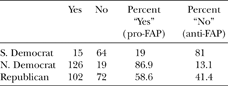
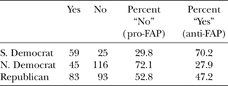
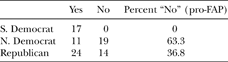
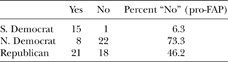
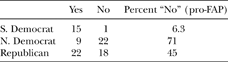
Despite numerous attempts by the Nixon administration to address southerners' concerns, opposition remained strong. On the two direct votes on FAP in the House, southern Democrats voted against the plan by margins of 81 and 70 percent. Northern Democrats were 86 and 72 percent in favor; Republicans were nearly evenly split. (See Tables 1 and 2.) In the Senate, the pattern was similar, though there were no direct up-or-down votes on the measure. In the FAP-related votes, over 90 percent of southern Democrats cast votes that opposed the measure.Footnote 48 (See Tables 3, 4, 5.)
H.R. 16311–Family Assistance Act: Final passage. (Passed 243–155, 16 Apr. 1970)
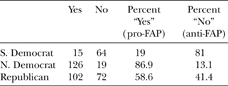
Source: Congressional Quarterly Almanac 25 (1970): 16H.
H.R. 1—Welfare-Social Security: Ullman Motion to Delete Family Assistance Plan Provisions (Rejected 187–234, 22 Jun. 1971)
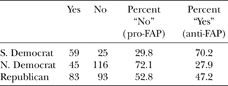
Source: Congressional Quarterly Almanac 26 (1971): 35-H.
Long Motion to Table Ribicoff Liberal Version of FAP (Passed 52–34, 3 Oct. 1972)
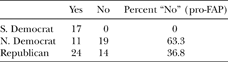
Source: Congressional Quarterly Almanac 27 (1972): 72–73S.
Long Motion to Table Ribicoff Amendment to Remove Committee-passed Family Assistance Provisions from FAP Social Security Bill (Passed 44–41, 4 Oct. 1972)
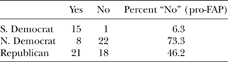
Source: Congressional Quarterly Almanac 27 (1972): 72–73S.
Roth Motion to Pilot-test Competing Welfare Reform Proposals (Passed 46–41, 4 Oct. 1972)
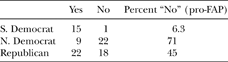
Source: Congressional Quarterly Almanac 27 (1972): 72–73S.
Nor was the president able to secure the votes of more than a small percentage of southern members of his own party. Cast largely out of party loyalty, these Republican votes were costly to party stalwarts such as Representative George H. W. Bush (R–TX), who lost his bid for a Senate seat in the November 1970 election. Shortly before the election, his Democratic opponent, Lloyd Bentsen, launched a statewide campaign attacking Bush's support for FAP. True to the southern Democratic position, Bentsen's ads criticized Bush's pro-FAP vote and the promise of “14 million more on welfare,” and urged voters that a vote for Bentsen was a “vote against big welfare” and higher taxes.Footnote 49 Internal documents from the Nixon White House include a letter from President Nixon to Bush in late October:
I understand that you have been attacked by your opponent for your support of the Family Assistance Plan on the grounds that it is a ‘guaranteed annual income.’ This is a very serious misinterpretation of the goals of our plan.Footnote 50
But, of course, it was not a serious misinterpretation of FAP, and southern leaders knew this. Many southerners, in short, “feared that FAP's guaranteed income would shrink the supply of cheap labor, bankrupt marginal industry, boost the cost of locally produced goods and services, increase taxes, and put more blacks into political office,” concluded journalists Vincent and Vee Burke in their 1974 study of FAP.Footnote 51
Little wonder, with these perceived stakes for his region, that Long waged a pitched battle against FAP from his pivotal position as chair of the Senate Finance Committee. Although FAP drew criticism from both the left (for not going far enough) and the right (for going too far), the vote tallies show that over 75 percent of liberals ultimately supported some version of FAP in the House and Senate; the measure was defeated in the end by the lack of moderate and conservative support in the Senate. From the spring of 1970 through the fall of 1972, Long's blocking tactics, backed by a nearly solid southern Democratic caucus and conservative Republicans, kept the Senate from voting on FAP when passage looked assured, and steadily eroded its support.Footnote 52 This strategy ultimately proved fatal to Nixon's plan.
The struggle over FAP, moreover, led key southern Democrats to seek public assistance strategies that would better serve the interests of their states and preserve the structure of local labor markets. As it became clear that FAP was not simply going to go away after its first setbacks in the Senate, opponents realized that they needed to counter with their own alternative proposals. The twin commitments to defeating FAP and defending southern political and economic arrangements thus created a powerful incentive for conservative—even if expansionary—reform for Long and other southern leaders in the early 1970s.
II. BUILDING WORKFARE THROUGH PIECEMEAL POLICYMAKING
Beginning in 1971, with the nation riveted on the legislative battle over the Nixon proposal, conservative southern leaders in Congress began quietly passing legislation that would help bring in a new era in public assistance. In each case, they selected—and modified—favored elements of the FAP proposal and pursued them through different legislative vehicles.
The three initiatives shared several features. First, each reflected distinct elements of the conservative vision and regional interests of key southern leaders. Second, each had the effect of redefining the terms of public assistance for one of the three categories of poor Americans described earlier. The Talmadge amendments targeted current welfare recipients, many of whom, in the view of conservative workfarists, were poor because they would not work; SSI restructured assistance for elderly and disabled individuals, whom conservatives believed were poor because they could not work; and EITC extended aid to families who, conservatives recognized, were poor even though they were working. In altering the terms of assistance, each of the initiatives advanced the premises of workfarist public assistance—namely, set tight limits on welfare entitlements; require work from all who are physically able; and reward work among those already in the low-wage labor force. Finally, each of the initiatives introduced policy changes that facilitated compromises and/or coalitions in the 1980s and 1990s that helped erode and ultimately dismantle the main welfarist entitlement for poor families.
WIN II (The Talmadge Amendments):
The first move was made by Senator Herman Talmadge (D–GA). He took aim at the welfare poor—and, in particular, at AFDC recipients. Under the New Deal's welfarist model of public assistance, federal policy considered these recipients poor because caregiving obligations made them unable to work. Indeed, the original intent of the Aid to Dependent Children program, according to its architects, was to “release from the wage-earning role” eligible single mothers of young children, so that they could “rear them into citizens capable of contributing to society.”Footnote 53 Beginning in earnest with the push by southern Democrat Wilbur Mills to add a new federal work mandate (WIN I) to AFDC in 1967, workfarist reformers asserted, instead, that these recipients were too often simply unwilling to work, and therefore should be subject to work requirements.Footnote 54
Talmadge was one of FAP's harshest congressional critics. In addition to sharing fellow southerners' concerns about the sheer numbers that would be brought into the federal cash assistance system under the plan, he believed that FAP did far too little to require work by the able-bodied. In hearings before the Senate Finance Committee in the spring of 1970, Talmadge grilled HEW Secretary Robert Finch and Undersecretary John Veneman.Footnote 55 He expressed alarm about the impact on his state of Georgia, concluding that “in many areas we might have over half the people in individual counties on welfare.”Footnote 56 When Talmadge's questioning led Veneman to acknowledge the low cash penalty a FAP family would pay if a father refused work, the exchange confirmed many conservatives' worst fears about FAP. For Talmadge and other southern Democrats, it underscored the need to tighten existing work requirements for welfare recipients—and to defeat the FAP income guarantee.Footnote 57 WIN I, Talmadge argued, had proved to be a “dismal failure,” and FAP failed to address its shortcomings.Footnote 58
After the first version of FAP collapsed in 1970, Talmadge led conservatives in pulling the work requirement out of the FAP proposal and passing a version of it in separate social security-related legislation. The aim, in his view, must be a workfarist one—namely, to “make productive citizens out of nonproductive citizens.”Footnote 59 Dubbed “WIN II” because they revised the initial WIN rules, the Talmadge amendments passed in December 1971.Footnote 60
As political maneuver, the Talmadge amendments had an immediate effect on the balance of forces in the FAP struggle, one not lost on Talmadge and his allies. Passing the work requirement independent of the other elements of the FAP package significantly reduced FAP's appeal to conservatives when the administration came back with a revised version of the bill. The work requirement, as Representative John Byrnes (R–WI) explained, was “what some consider the sweetener.”Footnote 61 With WIN II, conservatives got the “sweetener” without having to swallow the rest of the package. In signing the bill on 28 December 1971, Nixon acknowledged the political implications of WIN II, urging Congress to complete the task of reform by passing the entire FAP proposal.Footnote 62 Scheduled to take effect on 1 July 1972, WIN II was on the books even as the Senate continued its final deliberations on FAP.
As policy initiative, WIN II had a deeper and enduring impact on the politics of welfare, marking an important turning point in the transition from New Deal-style welfare to workfare. The new law changed the underlying premise regarding eligibility for federal work requirements. Work obligations of various forms had been imposed on welfare recipients at the state level since the enactment of the Progressive Era mothers' pension programs that were the precursors to AFDC. But the official position of welfarist federal administrators from the New Deal through the Great Society had been that work should be voluntary for poor single mothers. This position was reflected not only in the guidelines to the states issued by the federal Bureau of Public Assistance, but also in the 1962 Public Welfare Amendments, which supported those mothers who chose to earn wages but imposed few requirements.Footnote 63
Southern leaders in Congress formally revoked this New Deal premise with the two successive WIN amendments. Spearheaded to passage in 1967 by Wilbur Mills, WIN I imposed the first federal mandate that states require work of AFDC recipients. Under WIN I, however, states were expected only to refer “appropriate persons” for work or training, and state officials were largely able to decide which recipients met these criteria. The 1967 law had no real enforcement provision that would be triggered if states failed to follow this limited mandate.Footnote 64
WIN II now reversed this standard and established a tougher basis for work requirements. The new law required all adult recipients, except for those explicitly exempted, to register for work, under penalty of loss of benefits. The aim was to impose a nationwide work registration requirement for AFDC recipients. By removing the reference to “appropriate persons” and the discretion of state and local caseworkers in determining who met this qualification, the law significantly widened the categories of recipients considered eligible for work—and included mothers of school-age children. A failure to comply with the work requirement could be sanctioned with the loss of the adult recipient's portion of the family benefit.Footnote 65
The amendments also increased the federal contribution for the public-service jobs component of the program for recipients not placed in private-sector employment; those placed in public service jobs would receive only their welfare checks as compensation. This concept of work in exchange for a welfare check would become for some a hallmark of modern “workfare.” Finally, the new law had greater enforcement power: states would lose a portion of their federal funds if they failed to refer at least 15 percent of their adult recipients to the program by mid-1974.Footnote 66
Exemptions, loopholes, lack of funding, and employment barriers would ultimately limit the amendments' reach and impact on work levels among AFDC recipients. Nonetheless, WIN II was tougher than existing law, and its passage signaled in part the rising frustration in Congress over the failures of WIN I to move recipients into the workforce.Footnote 67
More importantly, WIN II helped facilitate the shift toward workfare by establishing a new evaluative measure for AFDC's success—moving recipients from welfare to work. Once virtually all adult recipients were judged work-appropriate, and once states were expected to establish programs that moved recipients from welfare to work, policymakers began to focus increasingly on whether and how well AFDC was meeting this aim.
WIN II signaled two additional trends in the turn toward workfare, both of which prefigured the conservative position in the policy debates of the 1980s and 1990s. Programmatically, WIN II took a step toward equating the goal of self-support with being increasingly “tough” on work requirements. Among other things, this meant elevating “work-first” approaches over those designed to strengthen the long-term employability and earning power of jobless recipients. WIN I had been designed in part to encourage AFDC recipients to pursue formal education and training in order to improve their prospects for later employment. In some cases, it included support for recipients to attend college. WIN II changed the emphasis from boosting the medium and long-term employability and skills of public assistance recipients, to immediate referral to available jobs (“work-first” plans). The shift was in part a response to studies indicating that immediate placement and on-the-job training were more effective at reducing AFDC caseloads. Under WIN II, broader education and training alternatives were discouraged, and states were to spend at least one-third of WIN funds on on-the-job training and public service employment. This approach was pursued in particular through the provision of tax credits to employers for hiring WIN participants, and reimbursements for on-the-job training.Footnote 68
The passage of the Talmadge amendments also marked a trend toward escalating work requirements even in the face of policy failure. This would emerge as a defining pattern in the politics of welfare and work in the 1980s and 1990s: faced with evidence that previous attempts (such as WIN I) were failing to move recipients into the workforce, policymakers responded not by re-assessing the strategy, but by escalating it, imposing more and tougher requirements.Footnote 69
As evidence mounted of WIN I's failures, members of Congress from both parties were largely silent on the obstacles to success posed by both the weaknesses in the low-wage labor market and the characteristics of the recipient pool, electing instead simply to tighten the requirements. Studies of WIN I showed, for example, that only a fraction of recipients were judged appropriate for work by local authorities. Of the 5.3 million AFDC recipients in 1967, only 2.8 million were eligible for WIN, and only 700,000 were deemed “appropriate for referral.” The remainder were ill, needed at home, without child care, or considered otherwise inappropriate for training. Lawmakers' response in WIN II, however, was to simply eliminate the discretionary power of state welfare agencies and caseworkers to determine which recipients were appropriate for referral. Similarly, lawmakers were confronted with discouraging evidence on training and placement rates. Some 400,000 people were actually enrolled in WIN by mid-1972, when WIN II took effect; only about 25 percent of these finished training. In the end, only 52,000, less than 2 percent of the total pool, actually held jobs.Footnote 70 Faced with this evidence, lawmakers responded by shifting the emphasis to immediate job placement, simply sidestepping training and education.
With the WIN amendments, the measure of AFDC's success began to shift decisively from the welfarist aim of reducing poverty to the workfarist aim of moving recipients from the welfare rolls into the workforce, and policymakers began to chart AFDC's less-than-impressive record in this regard. Beginning in the 1960s, policymakers had increasingly sought reform strategies that would restrain the growth in AFDC rolls; WIN I and WIN II inscribed into federal policy welfare-to-work strategies as the means to achieve this aim.Footnote 71 By the 1980s, this logic allowed conservative advocates of welfare retrenchment to adopt a position of attacking AFDC as a “failed” program—not only because poverty rates remained high despite AFDC's rising costs and rolls, but also because the program failed to move recipients into work. These twin failures would serve as the basis for building a broader coalition of opponents of AFDC and advocates for more and tougher work requirements.Footnote 72 Just as WIN II's architects had done in reaction to WIN I's dismal record, lawmakers in the 1980s and 1990s argued that when existing work requirements failed to achieve results, the answer was not to re-evaluate the feasibility and wisdom of a welfare-to-work strategy, but to escalate it.
By the mid-1990s, the workfarist logic of success, failure, and escalation first formalized through WIN governed the debate. Rhetoric on both sides of the aisle underscored the consensus that AFDC needed radical reform and many emphasized its failure to move recipients from welfare to work. It was, in President Clinton's words, simply “broken.”Footnote 73 Clinton had long embraced the notion that work was the pre-eminent measure of AFDC's success (“welfare reform is first and foremost about work”)—and had even sought to turn this workfarist criteria against the Republicans, condemning their proposals as “weak on work.”Footnote 74 The language of “failure” and the consensus on work, meanwhile, pushed many moderate policymakers in 1996 to a policy compromise with conservatives with which they were uneasy. Many Democrats, observed Congressional Quarterly at the time, “did not want to be seen as supporting the current system”—even though “they had concerns about the bill's potential impact on the poor.”Footnote 75
The Supplemental Security Income Program (SSI)
The next major initiative to be separated from the administration's FAP proposal and passed independently was an expanded program of assistance for the poor elderly, disabled, and blind. Approved in October 1972, the new Supplemental Security Income (SSI) program would appear, at first glance, to have little to do with a workfarist turn in public assistance or with the retrenchment of AFDC decades later. SSI was, however, essential for what (or more accurately, whom) it excluded. SSI's achievement, from a workfarist standpoint, was in breaking apart the “trio” of New Deal public assistance programs, and defining more narrowly which poor Americans should receive income assistance without work obligations. In short, SSI wrote into law the conservative answer to the question of which Americans are poor because they cannot work, and erased the New Deal's definition.
Under New Deal welfarism, three categories of needy had received public assistance because they were deemed “unemployable”—the elderly, the blind (and later the disabled), and poor mothers with dependent children. The three programs were inscribed in the Social Security Act as Titles I (Old Age Assistance), X (Aid to the Blind), and IV (Aid to Dependent Children, later AFDC), and together, they constituted the original public assistance programs of the New Deal welfare state. A new title providing public assistance for the disabled poor was added fifteen years later. The institutional relationship between the programs was particularly important for AFDC as controversy began to mount in the late 1950s and 1960s. The administrative tie to programs for the elderly and disabled poor (often called the “adult categories”) provided a measure of political protection for AFDC by linking the fate of its recipients to the fates of aged and disabled recipients, as federal administrators or Congress developed reforms, rules, and expansions to apply to all of the assistance programs in the decades after the New Deal.Footnote 76
The passage of SSI created a new program for whom policymakers considered physically unable to work due to old age or disability. Poor families receiving AFDC were left out. This reflected a major policy and institutional transformation in public assistance, one which has received relatively little scholarly attention.Footnote 77 SSI marked a significant expansion of the welfare state—the new program served greater numbers of needy individuals, was administered by the Social Security Administration, and provided a federal floor of assistance with benefits indexed to maintain their value in the face of inflation. However, it also marked an exclusion of the largest and most controversial group of unemployables: dependent children and their caregivers.Footnote 78 Politically, this set SSI on the path of institutional growth in subsequent years—and AFDC on the road to contraction.
Once again, conservative southern Democrats in Congress (Mills and Long in this case) provided the primary impetus and strategy for “hiving off” of FAP the provisions that became SSI and passing separate legislation. As with WIN II, it was the FAP proposal, and the political struggles that enveloped it, that prompted them to act.Footnote 79
Congressional support for the Nixon administration's provisions for the elderly and disabled poor emerged early, in both House and Senate responses to FAP in 1969 and 1970. This was consistent with the longstanding and broad support—even among many conservatives—for aiding those physically unable to work, especially the elderly. Leaders of poor southern states were particularly eager for increased federal assistance for these needy populations. As Mills observed in the 1970 FAP debates, “I think we would all agree … that the adult public assistance recipients, the old, the halt, the blind, are most deserving of any additional help that we can give them.”Footnote 80 Indeed, Long and Mills had played central roles for decades in pushing for increased federal funding, under state control, for OAA and the other adult programs, beyond what either Republican or Democratic administrations had requested.Footnote 81 It was their support for this assistance that led conservative leaders such as Long to worry that the continued link to AFDC risked implicating these “deserving” groups in the “welfare mess.”Footnote 82
It was therefore no surprise that southern conservatives backed the initial FAP provisions for the elderly and disabled. When the administration introduced a revised FAP bill in 1971, however, it proposed a change in the provisions for the elderly and disabled that drew conservative ire: the new program, the administration proposed, would be directly administered by the federal government.Footnote 83 Federalizing control of public assistance was a contentious issue for conservatives, especially southerners. Two factors consolidated conservative acceptance of this proposition. One was the active leadership of two powerful southern leaders (Mills and Long), and the other was the changing political interests of lawmakers throughout the South regarding the elderly poor.
The active support of Ways and Means Chair Mills, working closely with ranking Republican member Byrnes, was critical to SSI. From the outset, Mills' position in the FAP debate was different than that of many of his southern colleagues. He saw federal administration as a means toward the larger ends of cost-control and workfare, a better means than state administration.Footnote 84 His institutional position led him to support FAP as well, despite his skepticism about key provisions.Footnote 85
In principle, Mills was an advocate of states' rights, limited federal government, the free market, and the work ethic. Like other southerners, he was concerned about FAP's proposal to provide an income guarantee for the working poor, which he worried “would create tremendous disincentives to work in some states, like mine for example, where the wages are low.”Footnote 86 Despite his states' rights views and concerns about certain elements of the Nixon plan, however, Mills supported FAP and its proposed federalization of public assistance. He felt that public assistance programs, and particularly AFDC, had been “sadly and badly administered” by the states.Footnote 87 As both a fiscal conservative and chair of the revenue committee, it frustrated Mills enormously that although the federal government picked up the bill for over half of public assistance costs, it was constrained in its ability to control federal welfare spending because of the existing cost-sharing system. The structure of divided authority also made it possible for states to disregard federal rules—including the 1967 WIN work requirements he had championed. Many states had resisted the federal WIN program, preferring their own strategies for managing the balance between work and welfare. Mills sought to persuade skeptical conservatives that WIN's failures would be addressed by reducing state discretion. He saw the federalization of welfare promised under FAP as a way to rein in costs, to shrink the bureaucracy, to enforce tighter standards against welfare fraud, and to increase work and training requirements.Footnote 88 Byrnes echoed Mills' concern:
Hell, we can't trust the states. We can't depend upon them to carry out the philosophy of our program—to enforce the work and training requirements. Look at what has happened to the WIN program, how few states have participated in the program since 1967 and attempted to implement the general philosophy of the program.Footnote 89
In a Rules Committee hearing on FAP, Byrnes elaborated:
It seems to me that this new system has much better administrative potential than the present system, at least, as far as gaining the basic objective that we want, and that is getting people into the economic system and going to work.Footnote 90
It was a combination of Mills' own workfare commitments, his institutional position on the Ways and Means Committee, and his frustration with state administration that led him to support FAP's federalization of welfare programs. Although he was concerned primarily with state administration of AFDC, he extended the logic to the “adult categories.” For these categories, Mills supported not only federal administration of matching grant programs, but also an increase in the income floor.Footnote 91 This became the basis for the provisions in FAP that would become SSI.
It would not be easy, however, to convince other southern leaders to support the federalization of public assistance programs through the proposed SSI program. For decades, the southern position on public assistance had been to accept federal dollars but maintain state control over administration. In deliberations on the second version of the House bill in the southern- and western-dominated Senate Finance Committee in fall 1972, members balked. One Senate staffer explained:
The Committee looked at the new program for the aged and disabled adults early in the proceedings and they voted to change [the bill] so the adult programs would remain under state administration. This motion was advocated by the “states' rights types” on the Committee. It took a big lobbying job by HEW to get the federal program approved by the House back into the Committee's bill.Footnote 92
In fact, it took more than “a big lobbying job” to win the support of southern conservatives. It took a shift in the political and economic interests of southern lawmakers, and the strategic leadership of one key leader in the Senate, Russell Long.
By the early 1970s, Long understood that demographic shifts had changed the logic of public assistance in the South. Waves of migration beginning in the 1940s had brought primarily young African-American workers and their families to the North. This was spurred in part, Long noted, by “mechanization of the farm,” which had “cut back drastically on the availability of jobs.”Footnote 93 Large numbers of elderly blacks remained behind by the 1970s, most of whom were no longer able to work for wages. Rural southern counties confronted the twin burdens of a diminishing tax base and a growing public assistance burden, as Jill Quadagno has shown. One Mississippi county, for example, saw its elderly population expand from five to eleven percent between 1940 and 1970.Footnote 94 In Long's state of Louisiana, state officials were eager for help.Footnote 95 Roughly one-third of the elderly population received old-age assistance, and, by the early 1970s, Louisiana's OAA program was the third largest in the nation. Indeed, of the thirteen largest OAA programs, eight were in the South.Footnote 96
By the time SSI was being considered in Congress, therefore, southern leaders faced a new logic. Many sought increased federal payments to ease the burden their states faced in providing public aid to the elderly and disabled poor; and concerns over local control of assistance for these groups had diminished. These changing conditions helped southerners in Congress to accept the principle of federal control of SSI.
But if regional demographic changes led some policymakers to see the proposed SSI reform as less of a threat, it took Senator Long to see it as an opportunity to advance the interests of conservative southerners in defeating FAP and promoting workfare. For two years, Long employed his power as Finance Committee chair to block FAP. He tried in vain during this period to convince the administration to separate the proposed increase for the adult programs from the family assistance component of FAP, recognizing that the former provided political cover for the latter.Footnote 97 As the administration attempted to win over conservatives and moderates during this protracted struggle, Long developed a parallel strategy to that of delay: he would defeat FAP by proposing a sizable expansion of funding for the two categories of poor he believed should receive public assistance—those unable to work and the working poor.Footnote 98 The first would eventually become SSI; the second would become EITC.
By 1972, with FAP languishing but not yet defeated, Long made a critical move. In September, his committee reversed its previous position and declared its support for the House proposal to federalize public assistance for the adult categories, which paved the way for SSI's approval. Long had a strategic plan behind this shift: he would block FAP by backing increased assistance for the elderly and disabled poor. As he later explained to his biographer, he believed that supporting federalization of the adult programs would eliminate any chance that the family support provisions of FAP would ever be enacted:
To keep them from coming back with something that was going to make the whole nation into a welfare state, I felt that the way to spike their guns on that would be to take all the money they estimated spending on this family program and apply that to the aged.Footnote 99
With the removal of the obstacle posed by Long and his committee, SSI was included in the omnibus social security legislation passed later that year. SSI's creation was thus due in no small measure to the divergent workfarist concerns of two conservative southern leaders—to Mills' frustration with AFDC and the failures to impose work requirements on its recipients, and to Long's attempts to scuttle FAP.
Meanwhile, the Nixon administration's strategy on the adult assistance programs also helped secure SSI's passage—in part by distancing it from existing welfare programs, notably AFDC. Support for the program within the Nixon administration came from Veneman and Finch at HEW, and from Social Security Administration commissioner Robert Ball. The case they made for SSI as they promoted the program on Capitol Hill was critical in shaping the nascent workfare regime in public assistance.Footnote 100
Administration officials sought not only to combine the adult assistance programs for the blind, disabled, and elderly into a single federal program, but also to shift the public perception of this assistance from a welfare to a social insurance program. The new program was to be federally funded; it was to be indexed for inflation, and would provide more stable and generous benefits than the existing adult assistance programs. Above all, it was to be administered by the respected Social Security Administration. Although the program was initially titled “Assistance to the Aged, Blind, and Disabled,” Veneman pressed to rename it “Supplemental Security Income,” eliminating the word “assistance” and making the program sound more like social security. According to one Finance Committee staffer, the committee concurred because members “didn't want SSI called welfare.”Footnote 101
Packaging SSI as an extension of social security rather than an expansion of welfare eased passage on Capitol Hill: Mills, for example, touted SSI by saying that passage “assured that virtually no aged person will have to live below the poverty level.”Footnote 102 In the end, the combined efforts of Mills, Long, and administration supporters paid off. At the close of the legislative battles over FAP in late 1972, House and Senate members sat down in the conference session to see what they could agree to pass as amendments to the Social Security Act. Senate conferees refused to accept the FAP provisions passed by the House almost sixteen months earlier. House conferees refused to accept the Senate proposal to pilot-test FAP, as well as a liberal and conservative alternative. The controversial family assistance provisions were therefore eliminated. But in a bill sent to President Nixon a day before the end of the legislative session, members approved increases for social security, Medicare, and Medicaid, and they passed SSI.Footnote 103
In the short run, SSI was billed as the one program salvaged from FAP, the program backed by both sides in the debate.Footnote 104 SSI's eligibility criteria—including reduced means test burdens and an increased income threshold—promised to extend coverage to 2.8 million new people, an increase of nearly 50 percent. The $140 monthly benefit floor for elderly individuals exceeded benefits paid in more than half the states under the old public assistance programs, and Congress indexed SSI benefits to keep pace with inflation, as it had done for the social security program in separate legislation earlier in the year.Footnote 105 In the years following SSI's enactment, the program grew more rapidly than its creators had expected. The program also saw a significant shift in its recipient population. Elderly recipients, the favored population of SSI's congressional authors, were the largest category at the outset, but their numbers steadily declined as social security benefits reduced the number of elderly poor. Meanwhile the number of disabled recipients rose sharply, including a growing number of children with disabilities.Footnote 106
SSI thus reflected a major welfare state expansion. Yet in the long run, the decision to create this program absent other elements of the FAP proposal also had a conservative impact on the politics and debate over public assistance, particularly for poor families. It fundamentally redefined the category of nonworking poor Americans deemed worthy of federal cash assistance. This group was now narrowly construed to include only those adults who were physically unable to work for wages (the elderly, blind, and disabled), and disabled children. Drawing this line to exclude able-bodied adults further paved the way for the workfarist turn in public assistance. As poor single mothers were recast as potential workers, they and their children, a total of 11 million AFDC recipients who had been part of the public assistance categories since the New Deal, were “written out” of the new social contract that was SSI. Only a fraction of AFDC recipients—those individual children or parents with SSI-eligible disabilities—could qualify to receive aid under SSI.Footnote 107
Politically, the move to delink AFDC from the other two programs and to isolate it also helped facilitate AFDC's retrenchment in later years, in two respects. First, SSI was explicitly designed and promoted in ways that eroded political support for AFDC. Like social security before it, SSI was billed by its advocates as superior to the AFDC “dole,” in this case as a “supplement” to existing social insurance.Footnote 108 This image further tarnished AFDC as a mere “welfare” program. The distinction was more than rhetorical: AFDC's demeaning approaches to means-testing, work requirements, and paltry benefits now marked it as a less-favored entitlement than SSI.
Equally important, SSI was indexed for inflation, and AFDC was not. AFDC benefits were eroded by inflation beginning in the 1970s and continued to lose ground as policy cuts escalated and inflation persisted in the 1980s. The benefits ultimately lost nearly half their value, in real terms, over twenty years.Footnote 109 This meant that AFDC was not only failing to meet its new workfarist goal of moving recipients from welfare to work, but was also proving markedly less effective at meeting its old welfarist aim of lifting families out of poverty. SSI benefits, in contrast, more than maintained their value in real terms (and increased more than threefold in absolute terms) over the same period.Footnote 110 This contrast further enabled conservatives to persuade moderates that AFDC was uniquely ineffective and ill-managed, bolstering the coalition of opposition to it.
In addition, the existence of SSI for the aged and disabled poor gave moderates the political cover they needed to support conservative cuts and reforms in AFDC while still claiming that the “truly needy” populations would be protected through SSI. The program made it easier for leaders such as Ronald Reagan and Newt Gingrich to mobilize moderate support for AFDC's decline, and both used the opportunity to do so. To be sure, SSI was not immune from efforts by conservatives in Congress and the White House to curb program growth. In the 1980s and 1990s, both the Reagan administration and congressional conservatives sought and achieved program reductions, though their boldest attempts to reduce SSI spending were rebuffed.Footnote 111 In each case, however, conservatives also used the program to justify graver attacks on AFDC.
Indeed, in its early assaults on the welfare state, the Reagan administration was quick to leverage the division between SSI and AFDC by portraying recipients in the former as the “truly needy” and distinguishing them from those in the latter program. The administration was then able to underscore its commitment in principle to SSI (even as it tightened SSI eligibility standards and increased administrative reviews) while promoting deep budget cuts for AFDC families and others. In February 1981, for example, President Reagan defended proposed cuts that would eventually exceed $25 billion in programs for the poor before a joint session of Congress.Footnote 112 The existence of SSI allowed Reagan to claim that he was ensuring aid for the neediest populations even as he imposed sharp reductions in AFDC and elsewhere. Reagan singled out SSI, assuring Congress and the public that he would not pursue cuts in “supplemental income for the blind, the aged, and the disabled”:
I know that exaggerated and inaccurate stories about these cuts have disturbed many people, particularly those dependent on grant and benefit programs for their basic needs …. Those who, through no fault of their own, must depend on the rest of us—the poverty stricken, the disabled, the elderly, all those with true need—can rest assured that the social safety net of programs they depend on are exempt from any cuts.Footnote 113
In the 1996 debate over eliminating AFDC, SSI was again on the table for cuts, and Congress took steps to limit the expansion of child recipients and bar immigrants from receiving SSI. Even as they imposed limits on the program, however, conservatives continued to use the distinction between AFDC and SSI to defend eliminating the entitlement to assistance for one population of the original New Deal trio (poor families) by assuring their commitment to the other two (poor elderly and disabled citizens) through SSI. Conservative leaders such as House Budget Committee chair John Kasich (R–OH) argued for the 1996 bill by drawing the now-familiar line between SSI and AFDC recipients, and insisting that the former would be protected: “The American people feel fundamentally that if somebody's disabled, we're going to help them. But if somebody's able-bodied and can work, then they need to go to work.”Footnote 114
The Earned Income Tax Credit (EITC)
The third move by conservatives in Congress was led by Russell Long. It addressed the final category of poor Americans—those who were poor even though they were working. This group had been explicitly left out of New Deal cash assistance programs; they were not, by definition, “unemployable.” Their incorporation both expanded federal assistance to the poor and helped solidify the workfare paradigm.
As with WIN II and SSI, the Earned Income Tax Credit of 1975 had its origins in FAP. Long's twin innovations were to restrict FAP's income guarantee for poor families to those who were working, and to administer it through the tax code, rather than through the traditional cash payments FAP proposed. EITC and the working families it served would become a centerpiece of the new workfarist approach to public assistance in the 1980s and 1990s. The program also provided moderates and conservatives with the “alternative solution” they needed to justify cutting AFDC and imposing work requirements on its recipients. In size, scope, and political support, EITC would eclipse AFDC by the time that program was repealed and replaced by TANF in 1996. Less than a decade later, EITC payments were twice the level of TANF payments.Footnote 115
EITC's political origins and impact are not well understood. The program is distinct from other programs for the poor both because it is a tax measure rather than a social welfare provision and because it serves working families rather than traditional relief recipients. This has led many social policy scholars to overlook EITC in accounts of welfare state development.Footnote 116 Scholars such as Christopher Howard and Donald Ventry have carefully charted the program's political history, tracing its roots to the FAP struggles over welfare.Footnote 117 But even these accounts do not address two important features of EITC's development—its origins as one of a series of measures introduced by conservative southerners, and its impact as part of a fundamental shift from welfarism to workfarism in public assistance.
EITC, I argue, was conceived by Senator Long as a political solution to what he saw as a problem of welfarism run amok in the AFDC program. Tracing the political development of EITC through four phases from conception to passage clarifies the motives, interests, and strategies of EITC's chief architect. It demonstrates, in particular, how Long was prodded by Nixon's initiative to respond with and refine his own plan, and how he developed a proposal that would meet his simultaneous aims of blocking FAP, addressing the “welfare mess,” and protecting southern interests.
The first phase of EITC's evolution reflected Long's reaction to and critique of FAP as a welfarist proposal. The senator's convictions were that work should be required of able-bodied welfare recipients, and that aid should not be disbursed to them as an entitlement on the basis of need. He made his views clear in the first hearings held by the Senate Finance Committee on the FAP bill that passed the House in early 1970. In his opening remarks, Long first took aim at FAP for proposing to add the working poor to the bloated welfare rolls: “This bill represents the most extensive, expensive, and expansive welfare legislation ever handled by the Committee on Finance.”Footnote 118 He then laid out his own workfarist criteria for addressing the welfare poor: reform entailed reducing “dependency” by moving recipients from the welfare rolls into the workforce, and the measure of FAP was whether it would finally achieve this goal.
The Committee on Finance has attempted on past occasions to deal with the problem of increasing dependency on welfare …. We wrote into law the work incentive [WIN] program which provides broad authority for the training and placement of welfare recipients. It was the congressional goal to reduce welfare by training recipients to perform gainful employment and to help find them suitable jobs, thereby adding a dignity to their existence, which welfare cannot provide.Footnote 119
FAP, in Long's view, promised only to worsen existing problems; its weak work incentives would not “do more than repeat the failures of the existing law.”Footnote 120 The committee grilled Nixon administration officials on FAP's ability to meet these reform aims. By the second day of hearings, Long was exasperated: “Why don't we junk the whole thing and start all over again?”Footnote 121 He suspended the hearings the next day, demanding that the administration revise the bill, particularly in ways that addressed the relationship between FAP and other means-tested programs such as food stamps and low-income housing assistance, and that would change the “monetary incentives for able individuals to reduce or quit gainful employment in order to qualify for larger welfare benefits.”Footnote 122 When the administration sent down a revised bill in June, Long dismissed it as “a worse bill—and a more costly one.”Footnote 123
If Long was not impressed with the evolving FAP proposal, however, he was concerned about its political momentum—and, in response, he began to craft his own welfare reform alternative. This marked the second phase of EITC's development. Long recognized that FAP had successfully directed a spotlight at the problems of the working poor. Although he objected to the administration's proposal, he understood that this group was drawing broad sympathy, which created both a political imperative and an opportunity. In his own proposal for the working poor, Long specified that workers should receive assistance when no work was available, and small wage supplements if their hourly wages were too low.Footnote 124
Behind this proposal was a shrewd political insight. Long saw that ensuring adequate rewards to work was essential to successful welfare reform, as he and other workfarists defined it. And he knew that some pro-work initiatives, including FAP's income floor, posed serious threats to the southern social and economic order. Something less threatening was needed. In committee hearings on 22 July 1970, Long began to articulate the heart of what would become EITC: “The bill could include ‘wage supplements’ to public or private employers which would help increase salaries of low-income employees who would otherwise qualify for welfare assistance.” The idea was a straightforward one: require poor adults to enter the workforce, and pay employers to pay them more: “Pay private employers to put people to work. That can muster a majority in this Committee right now.”Footnote 125
Long's early proposals, offered in reaction to FAP's welfarist proposals, reflected core workfarist principles: require work of all who were physically capable of it; reward work for those in the low-wage labor force; and preserve market incentives in the process, by bolstering the existing wage system rather than undermining it.
At the same time, Long's emerging workfare initiative served to protect southern economic elite interests precisely where FAP would undermine them. This was evident in several respects. Unlike FAP, Long's proposal provided no income guarantee to all poor families, no opportunity for able-bodied workers to opt out of wage labor and instead collect federal benefits. Unlike FAP, it imposed a tough, non-negotiable work requirement on all adult welfare recipients except for those with very young children. Unlike FAP, finally, it protected market relations while aiding the working poor. Rather than allowing the government to provide a non-wage income source to workers, it strengthened the wage relationship with a “supplement,” avoiding the threat FAP posed to business owners, particularly to marginal employers in the low-wage sector. There would be no increase in labor costs to employers; instead, these costs would be subsidized by government. Nor would there be ripple effects as wage pressures pushed pay levels up through the market as a whole. Long's approach, in short, would have a deeply stabilizing effect on the region's low-wage labor market.
FAP advocates in the Nixon administration recognized the many longstanding sources of Long's obstructionism. Long had waged a protracted and public battle against the concept that welfare was a “right,” and had escalated his public opposition to pro-welfare initiatives in response to rising pressure from welfare recipients and advocates from the National Welfare Rights Organization.Footnote 126 The senator was also more than once accused of opposing FAP to preserve elite control of the southern economy and its low-wage labor force.Footnote 127 Nixon staffers, moreover, understood the distinction between FAP's welfarist approach and Long's competing workfarist approach. In a memorandum to the president dated 2 September 1970, HEW Undersecretary John Veneman noted that “Long is still pursuing an independent course, and is having Committee staff draft a wage subsidy bill as an alternative to Family Assistance.” Veneman explained Long's preference for using the market (through subsidies) rather than government assistance to address the problems of the working poor:
The Chairman has an idea of his own which he seems very much wedded to. He accepts the concept that the working poor need help, but instead of giving them income supplementation from the government he wants to give them higher wages than they are worth by subsidizing the employer.Footnote 128
As Long worked behind the scenes to develop his workfarist alternative, he used his position as Senate Finance Committee chair repeatedly to postpone votes on the administration's FAP proposal in 1970—a time when Nixon officials believed they had the votes to pass their plan. By the end of 1970, the first FAP measure died in Congress.Footnote 129
The third phase in EITC's development began early in the next congressional session, when Nixon vowed to reintroduce FAP and to make it “White House priority number one until it is enacted”—a challenge to which Long readily rose.Footnote 130 While his primary tactics remained obstructionist and dilatory parliamentary maneuvers against the administration's plan, Long also took steps to develop a full-fledged workfare alternative to FAP, one that could draw broad support among conservatives and moderates.
In the process, Long made two critical moves. The first was to tie together proposals for cutting cash assistance to many AFDC recipients with proposals for extending aid to the working poor. In extending a hand to one group of poor Americans while withdrawing it from another, Long's approach made his “welfare reform” appear both tough (on the welfare poor) and generous (to the working poor). His second move was to design and package the bonus for the working poor as a social security tax offset. By billing this move as “tax relief,” Long increased its appeal, particularly among conservatives.
The basic outlines of Long's workfare plan contained several components. Families headed by an employable father or a mother with no children under age six would no longer be eligible for any cash assistance, including AFDC. This would move 40 percent of recipients (1.2 million families) off of the AFDC rolls and into the workforce; they would instead be eligible for federally-guaranteed jobs paying 60 percent of minimum wage, or for federal wage supplements if they found low-paying jobs in the private sector. Long's rationale was that this would give the parents (mostly single mothers) “an opportunity to become independent through employment, including a guaranteed job and substantial economic incentives to move into regular jobs.”Footnote 131
Current low-wage workers, under Long's plan, would also receive a “work bonus.” This is typically seen as the earliest form of the EITC. Family heads with income under $4,000 would receive a cash refund equal to 10 percent of their wages subject to social security taxes. Long argued that this bonus would offset social security taxes, act as an earnings subsidy, and prevent the taxing of poor individuals onto the welfare rolls. It was, he emphasized, distinct from a guaranteed income or a general negative income tax, because it conditioned payments on work.Footnote 132
Conservative support for this idea would not be easy to marshal or sustain. Some conservatives opposed expanding assistance to the poor in any form. Other conservatives, such as Nixon aide Martin Anderson (a vocal internal critic of FAP), particularly resisted the idea of aiding workers.Footnote 133 Yet Long correctly reasoned that a proposal for tax relief for the working poor would resonate with most conservatives far more than one seeking (as FAP did) to give them a “handout,” particularly given recent increases in payroll taxes.
Long's proposed tax measure, however, was explicitly designed to serve his workfarist objectives for reforming welfare; tax equity effects were secondary. A pure argument for tax equity for the working poor, after all, would demand tax credits for all of those whose wages and tax burden left them below the poverty line. The aim would be to prevent the taxing of people into poverty. Long's concern was narrower: he wanted to stop taxing people onto the welfare rolls. As a result, he sought to provide the tax credit only to those who might otherwise seek welfare; his proposed offset was limited to certain working poor families.
By 1972, Long's plan proposed expansionary new measures, but rested on solidly conservative principles: cutting the welfare rolls, requiring work, and providing tax relief. The senator was skilled at making the case for his reform on any of these grounds, and proved adept at using any of a range of rationales to support the proposal. He maintained that the plan was developed as a way of “relieving low-income working persons from the social security tax,” but also argued for the need for wage supports given conditions in the labor market. As Long explained on the Senate floor:
One can look at this as he wants to. He can look at it as a work subsidy for those making low wages. He can look at it as a tax refund. We decided to call it a work bonus, because, whatever one calls it, it results from tax money collected as a result of the man's working.Footnote 134
Above all, Long saw his workfare plan as a repudiation of a failed welfarism. This point was highlighted in the Senate Finance Committee report on H.R. 1, which asserted “that paying an employable person a benefit based on need, the essence of the welfare approach, has not worked.”Footnote 135 His own plan, Long countered, offered a clear, simple solution: “If someone doesn't work, he doesn't get the payments, and that's how it should be.”Footnote 136
The social security bill that had been approved by the House in early 1971, with FAP as its centerpiece, finally came up for debate in the full Senate in September 1972. Despite broad support for other measures in the bill, “a floor fight over the ‘workfare’ provisions appeared inevitable,” Congressional Quarterly concluded. “The outcome of that struggle would determine the fate of H.R. 1, once labeled ‘number-one priority’ by President Nixon.”Footnote 137 As the debate unfolded, it became clear that Long's strategy of packaging the wage subsidy as tax relief had indeed won over some conservatives and moderates. Those concerned with the prospect of “adding” the working poor to the welfare rolls and triggering a massive expansion in public assistance through a FAP-style reform now had another way to interpret Long's plan. This exchange between Lawton Chiles, a moderate Democrat from Florida, and Long illustrates the point:
Chiles: This proposal would not be like the present family assistance program, would it, where we would take somebody not now on welfare, who is employed, but give him a monthly check and put him on the welfare rolls? This would be a way of supplementing his earnings and getting around that; would it not?
Long: That is the way we view it.Footnote 138
In the end, the Senate voted to pilot-test three competing welfare reform plans.Footnote 139 All three proposals were then eliminated during the conference session—and Long had achieved his goal. After delaying action on the bill for almost thirty months after FAP first passed the House, he had helped guide FAP to its collapse. Long would later tell reporters that defeating FAP was the crowning accomplishment of his thirty-eight-year legislative career.Footnote 140
The fourth and final phase of EITC's development came in FAP's aftermath. Long honed his proposal, persisted in his search for legislative opportunities, and finally secured its passage as part of a tax bill in 1975. Capitalizing on its multiple appeals, he ultimately sold his workfarist reform plan as tax relief and economic stimulus following the 1974 recession.Footnote 141
Although FAP had launched his pursuit of a work bonus proposal, the plan's collapse did not end Long's mission. Beyond its instrumental value in helping to defeat FAP, Long wanted to see his proposal enacted; he recognized its benefits, for his region and others, and believed that it would both address the welfare problem and help the working poor. Long tried unsuccessfully to win passage of his plan in both 1973 and 1974. The proposal failed to muster adequate support, in part due to lingering congressional concerns that Long's tax credit still smacked of FAP-style income guarantees.Footnote 142
Long's proposal would not win passage until 1975, when it was incorporated into a major tax reduction package developed in response to the previous year's recession. Christopher Howard has detailed the factors leading to EITC's eventual passage, including the changed legislative context and economic recession.Footnote 143 Most important for these purposes was the battle waged and won by Long over the design of the final initiative. In a showdown with Representative Al Ullman (D–OR), Long ensured that EITC was designed as a workfarist rather than a welfarist measure.
When the House took up the Ford administration's 1975 tax bill, Ullman, who had succeeded Wilbur Mills as chair of the House Ways and Means Committee, included an “earned income credit.” Clearly modeled on Long's previous work bonus proposals, it was presented by the committee as a means to “offset the impact of the Social Security taxes on low-income persons.”Footnote 144 Ullman, however, had structured the provision to address the broad problem of taxing low-wage workers into poverty, as Howard demonstrates. It would therefore be available to all earners within the income limits, regardless of whether they were married or had dependent children. Designed this way, it would have covered an estimated 28 million people.Footnote 145 Ullman reduced the benefit to 5 percent of income—half of Long's proposed benefit—in order to contain costs. With a larger eligible population, the program was estimated to cost $3 billion in its first year, an ambitious new welfarist entitlement for the working poor.
Conversely, Long intended that EITC serve as part of his workfarist vision of welfare reform. The tax credit, he argued, should be aimed at the current or potential welfare population, not poor workers as a whole. According to Long, the goal was simultaneously to prevent current workers from seeing their wages reduced by taxes to the point where they were eligible for public assistance, and to entice current welfare recipients into the workforce with subsidized wages.
The defining struggle over the shape of EITC took place when Ullman's proposal reached the Senate. Long's Senate Finance Committee fundamentally altered the measure by shifting the target to the welfare population rather than the broader working poor population. The phase-out level was raised to $8,000 and the benefit rate was re-established at 10 percent of income, but the credit was restricted to those low-income workers with dependent children—precisely the population likely to end up on AFDC rolls. The effect was to dramatically reduce the number of possible beneficiaries, to cut the overall costs to $1.5 billion (even though benefits were higher), and to make it a measure that was designed to serve what the committee called its “most significant objective, to assist in encouraging people to obtain employment, reducing the unemployment rate and reducing the welfare rolls.”Footnote 146 Long's influence was also evident in other measures introduced to strengthen the drive for work-oriented welfare reform. For example, the committee included a tax credit for employers of up to 20 percent of wages paid to hire AFDC recipients—“a credit available to businesses as well as to individuals hiring welfare recipients for personal services.”Footnote 147 In the end, the House-Senate conference committee, dominated by Long, abandoned Ullman's vision of a broad-based EITC for all of the working poor and passed the Senate version of the bill.
As a result of Long's victory, EITC was enacted as a workfarist response to the AFDC program. The benefit was designed to exclude not only non-earners, but also the working poor without children. Long's measure was focused on the problem of moving and keeping people off of welfare and in the low-wage labor market, rather than on the broader problem of improving the conditions of those who are poor even though they work.
Although EITC's benefits were quite modest in the first decade of the program, it broke new ground by providing aid in support of wages for working poor parents. EITC thus established another core element of the new work-oriented approach to public assistance. And, as with the other two 1970s initiatives, the program's rise helped fuel the decline of AFDC.
The link between the politics of AFDC and EITC was forged as EITC was repeatedly promoted as an alternative to AFDC. Following Long's lead, conservatives advanced EITC alongside an agenda to reduce or eliminate AFDC, through work requirements and/or cutbacks. As Long sought to make EITC permanent in the late 1970s, he also pushed his own workfare reforms for AFDC recipients and argued against plans (such as the one unveiled by President Jimmy Carter in 1977) that proposed to expand cash assistance to the poor, including those without children. As he observed in 1978, “It's my judgment that you don't need any more people on welfare.”Footnote 148
More importantly, EITC provided a logic for moderates to justify retrenchment in AFDC. In 1978, for example, Ullman proposed a welfare reform plan that combined reduced AFDC benefits with expanded EITC benefits. As one congressional staffer argued, “They're getting the same amount of money but from an employer through the earned income tax credit instead of from the government. It reduces the stigma and saves going to the welfare office.”Footnote 149
During the 1980s and 1990s, a growing number of lawmakers turned to EITC not just as a complement to AFDC but as a partial alternative to it, in the debates surrounding the Family Support Act (1988) and the Clinton welfare reform (1996). Representative Tom Downey (D–NY), for example, was a central architect of the work-oriented Family Support Act. Even as he led Democrats down the workfare path, Downey was convinced that what was needed for this approach to succeed were jobs that lifted welfare recipients out of poverty. His House Ways and Means subcommittee also held extensive hearings on addressing the needs of the working poor. EITC emerged, in his view, as an important part of the solution to both problems, and his growing estimation of EITC appeared to track his mounting disenchantment with AFDC.Footnote 150 By 1991, frustrated over the inadequate implementation of the Family Support Act, Downey said, “I, like many others, have concluded that the AFDC program violates some of the values that Americans hold dear, particularly the value that Americans place on the relationship between income and work.” He then highlighted the committee's role in “promot[ing] legislation designed to increase the return to work for low-income families by expanding the earned income tax credit, a policy that will provide work incentives for AFDC recipients.”Footnote 151
In the same period, the centrist Progressive Policy Institute released a brief on family policy that made a strong case for expanding EITC. Written by two policy analysts who would later serve in key domestic policy roles in the Clinton White House, the paper defended the substantial costs of the proposed increase ($4 billion) with a veiled reference to AFDC: “Given the disappointing record of other, more bureaucratic anti-poverty efforts, this would be a small sum for what it can deliver.”Footnote 152 Later, in the years before AFDC received its final blow, the Clinton administration defended its own significant funding increases for EITC by arguing in part that EITC was needed to maintain incentives for poor Americans to choose work over welfare.Footnote 153
Republicans, meanwhile, repeatedly used EITC to advance their own welfare retrenchment agenda in the 1990s. When Democrats countered that Republican workfare proposals were unreasonable because of the lack of decent-paying jobs available to welfare recipients, programs such as EITC enabled Republicans to avoid discussions of the hardships posed by welfare cuts or the inadequacies of the labor market, and “to focus everyone's attention on the total income package of a mom working at low wages,” according to former Republican House Ways and Means staffer Ron Haskins. “A main point of debate for Republicans,” in short, was the role of government assistance for the working poor, and “the main anchor of the work support system” was EITC.Footnote 154
III. CONCLUSION
Eight years after Richard Nixon addressed the nation with his proposal to “end the welfare mess,” President Jimmy Carter made good on his own campaign pledge to offer a plan for a “complete overhaul of our welfare system.”Footnote 155 Carter's plan, called the Program for Better Jobs and Income (PBJI), also sought to make far-reaching and expansive changes in public assistance. It, too, died in Congress. One surviving element of the Carter plan, however, signaled the trajectory of federal income assistance policies. In part to attract conservative support from Long and others, Carter proposed an expansion of EITC.Footnote 156 As the welfarist elements of PBJI collapsed, lawmakers used the Revenue Act of 1978 to expand and make permanent EITC. The trend was clear: workfarist policies were gaining ground against welfarist proposals.
The 1970s thus began and ended with bold presidential initiatives to remake American public assistance and to extend government income support to working poor families. And indeed, the public assistance institutions created in the New Deal were remade in fundamental ways. The transformation, however, was not carried out by Presidents Nixon or Carter, nor by liberal welfarists in Congress, who had defined much of the welfare state's expansion since 1935. It was led instead by conservative southern Democrats in Congress who opposed the presidential initiatives. And it was achieved, piece by piece, in a way that reflected and reinforced their commitments to promoting work, limiting welfare entitlements, and protecting southern interests in maintaining control over local labor markets. Taken together, the policy changes they pushed through and the new institutions they created set the foundation for a new workfarist approach to public assistance in the United States.
By 1996, finally, the relationship between the events of the 1970s and the retrenchment of AFDC was clear. Although Republican conservatives launched and led the familiar retrenchment projects of the 1980s and 1990s, they could not succeed without capturing a number of moderate votes. As former Republican staff director Ron Haskins explained, “We needed a proposal that would attract moderate Democrats, and then we would be not only in the game but possibly in control.”Footnote 157
The legislative initiatives of the 1970s facilitated these reformers' efforts to persuade moderates to dismantle the welfarist model of assistance for poor families in favor of a workfarist alternative. They did so by offering a clear rationale (through WIN) for judging AFDC's welfare entitlement a failure and demanding ever-tougher work requirements in response, by enabling policymakers (through SSI) to support aid to those most Americans judged to be the neediest and most helpless even while withdrawing aid from poor families, and by offering an alternative program (EITC) for those AFDC recipients willing and able to toe the workfarist line. Although AFDC's opponents repeatedly decried the costs of the program, this was not, in the end, a battle over money: successive expansions in SSI and EITC easily eclipsed any welfare cost savings. It was instead a slow-moving struggle over the character and purposes of the public assistance programs of the U.S. welfare state.