INTRODUCTION
In recent years there have been significant changes to the environment in which radiation therapists (RTs) practice. The implementation of new equipment and technology has significantly improved treatment outcomes for patients and shaped the role of the RT.Reference O'Connell1 In Australia, as is the case with other countries up until the 1970s, practice was rarely based on sound scientific evidence.Reference Bentzen2 Rather, practice (technical and patient care) was ‘passed down’ through the years by a process of informal reflections and observations on the part of Radiation Oncologists (ROs) and Physicists. The primary role of the RT was to carry out the instructions of the RO, thus working as a ‘Technician’. Evidence of this perception of the role of the RT was highlighted as recently as the late nineties in an editorial publication describing the role of the RT as ‘turning on the machine’ with the ROs having the body of knowledge allowing them to make the decisions.Reference Trotti3 Therefore, one of the major developments in the past decade for RTs has been the transition from a profession whose practice was based on carrying out the requests of the RO, to a profession whose work (similarly to that of the RO or Physicist) is increasingly based on sound scientific evidence, generated as a result of rigorous research activities.Reference Bentzen4 These developments are reflected at many levels in clinical centres and educational institutions. The evolution of the radiation therapy service and the radiation therapy education sector themselves has influenced some of the developments in the profession which in turn have impacted on the research agenda. The Australian Institute of Radiography (AIR) competency based standards are an exemplar of how the AIR has considered the changing needs of the profession in relation to research and education.5
RADIATION THERAPY SERVICES IN AUSTRALIA
There are currently 48 clinical centres delivering radiation therapy services in Australia. These include both public and private sector services with some being large multi-site organisations and others being single linear accelerator centres. The majority of centres are located in state capital cities or other metropolitan areas. Over the past 10 years, however, there has been a shift in service provision towards developing radiation therapy services in rural and remote areas of Australia. This strategy was initiated as a result of the Baume report which was instigated to thoroughly review radiation therapy services on a national scale in 2002.Reference Baume6 The implementation of rural services has made a significant impact on the workload of the metropolitan centres and most importantly has provided improved access to radiotherapy services for patients living in these areas. The three rural centres in Victoria, for example, are each situated approximately 150 km from the Melbourne city centre and they are all ‘satellites’ of larger metropolitan cancer centres. When commenting on the status of research in radiation therapy it is important to be mindful of the issues associated with this altered framework for service provision. Consideration also needs to be given to the changes in the delivery of radiotherapy education which occurred as a result of the Baume report.Reference Baume6
RADIATION THERAPY EDUCATION IN AUSTRALIA
There are six universities in Australia which deliver entry level programs. Five of these are Bachelor programs and there is currently one graduate entry Masters program (GEM). One of the universities which currently delivers a Bachelor program is also about to implement a GEM. There are now approximately 180 new students enrolled nationally each year into entry level programs. This number is a significant increase when compared to the number of radiation therapy students who were trained nationally prior to the publication of the Baume report.Reference Baume6 A 50% increase in the number of undergraduate training positions was necessary in order to meet the projected workforce numbers which were anticipated to rise from 859 total establishment in 2000 to 1,531 in 2010.Reference Barton, Peters and Kenny7,8 Anecdotal evidence suggests that this increase in students over a relatively short period of time has occurred without adequate expansion of the service to accommodate new graduates entering the profession. It is highly likely that there will be a surplus of graduates entering the profession during the coming years who may find it a challenge to gain employment.
Given the recent changes in service delivery, education and the dynamic nature of practice including the increased emphasis on evidence based practice and research, it was decided to evaluate the current status of radiotherapy research in Australia. This article attempts to identify issues related to the implementation of research in the clinical and education sectors. It will provide a summary of local and national research priorities and the current infrastructure for supporting research (and opportunities for practitioners) within clinical centres. A synopsis of the challenges associated with engendering a research culture will be discussed with a conclusion indicating the direction for the further development of research in radiation therapy. For the purpose of this article, the term research excludes activities related to clinical audit and governance.
METHODOLOGY
In order to present a holistic overview and a national picture of the current status of research in RT, it was decided that all clinical centres and educational institutions involved in teaching and delivery of RT should have the opportunity to share their experiences and provide input on their perspective on issues related to RT research.
ETHICAL ISSUES
Investigation into the current status of research in Australian clinical centres was conducted under the auspice of a national audit. As the information sought was not sensitive and did not compromise the organisations or individuals responding, it was not necessary to seek ethics approval. All respondents were not identifiable and all information was kept secure and not released for any other purpose. In order to preserve anonymity, all clinical centres were numbered and de-identified as they responded and from there onwards were referred to by their corresponding number rather than institution name.
DISTRIBUTION OF THE SURVEY
The names and contact details of the Managers of all clinical centres were acquired in December 2007 from a list which was readily available in the radiation therapy public domain. They were then sent an e-mail inviting them to contribute information for use in the article. A covering letter was attached to the e-mail explaining the nature and purpose of the article. Consent was implied when responses were returned. The e-mail was sent to all 48 clinical centres in Australia with a request for the Manager, Clinical Educator or Researcher to respond. The e-mail was specifically directed to these professional groups in each of the clinical centres because anecdotal evidence suggested that they were most likely to have access to the information required.
COLLECTION OF INFORMATION FROM CLINICAL CENTRES
A survey consisting of a series of prompts aimed at guiding responses was constructed and delivered online. The initial prompts asked for demographic information about the clinical centres (staffing numbers, whether they were a public or private centre, patient numbers etc.). Other information such as the number of research positions within centres and the number of staff undertaking higher research degrees (HRDs) was also provided by centres. A series of open ended prompts were also used to acquire information relating to the status of each clinical centre with respect to research (the role of employed research RTs, the centre's involvement in national, local and RT led research, research priorities and perceived barriers/challenges to research). A reminder e-mail was sent to departments several days before the closing deadline to provide a final opportunity for those who had not yet responded to do so. After this final reminder was sent, there was no further follow up on centres that did not respond.
COLLECTION OF INFORMATION FROM UNIVERSITIES
In order to enable staff from the academic institutions to have input to the article, it was decided that a group of lecturers already involved in an established National Clinical Education Working Party would be invited to contribute. This took the form of a consultative process whereby all members were sent an e-mail asking them to provide feedback and input their views and comments on an overview written about the role of educational institutions. This e-mail was sent to representatives of all six universities that deliver radiation therapy programs. There was no follow up for those who chose not to respond.
ANALYSIS OF INFORMATION
The quantitative information was transferred into an Excel spreadsheet and frequency analysis carried out. Any significant comments from the responses of the qualitative prompts were recorded and themed.
RESULTS
Demographic information
A total of 36 (75%) e-mail responses were received as a result of the initial communication to the 48 clinical centres as well as two of the six universities approached. There were 13 responses from private practices and 23 responses from public centres. The department sizes varied between single unit rural centres to multi-site metropolitan centres. Establishment numbers ranged from 9.4 to 139 full time equivalent (FTE) RT positions. These centres treated between 35 and 470 patients per day.
Research positions
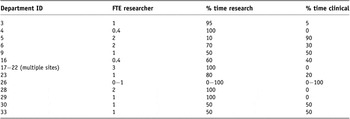
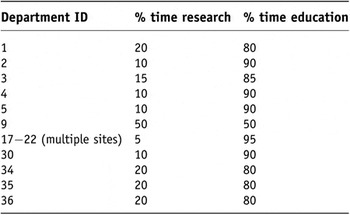
There were 13 clinical centres with research positions, six of which (46%) employed a FTE member of staff in research. In four centres this position was solely dedicated to research. The responses indicated that there were often fractional arrangements combining research roles with either a clinical role or an educational role or in some cases both. The proportion of time spent in these roles varied greatly. The combinations of research/clinical time and research/education time in the responding centres can be seen in Tables 1 and 2. A total of five centres indicated a combined research/education role but did not specify the allocation of time afforded to these.
Number of research positions per clinical centre and proportion of time afforded to research/clinical practice (total N = 13)

Proportion of time spent in combined researcher/educator role (total N = 11)

Research roles
The respondents indicated four main role and responsibility themes for the research RT. The first theme was facilitating research, which included tasks such as assisting with the generation of ideas for new research projects, planning methodological approaches and advising on the ethics and research process. Conducting research included planning projects and collecting/analysing data. Research collaboration was the third theme which included establishing and maintaining relationships with other departments, organisations and bodies to generate research. Quality assurance (QA) roles (the final theme) included engaging in activities related to audit and clinical governance.
Research priorities
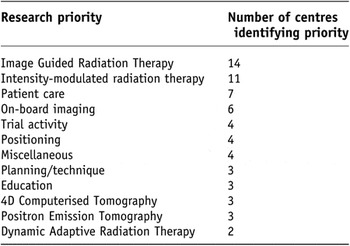
A range of research priorities were identified by clinical centres, with the two most common being technically oriented. Image guided research (primarily into prostate fiducial markers) was the most prevalent theme to emerge with 14 centres indicating this as a priority (Table 3). Intensity-modulated radiation therapy (IMRT) was cited as the second most common area for research. Patient care (e.g., quality of life, skin care and toxicity) was third in priority. A number of other priorities included offline image matching, brachytherapy, dosimetric inter-comparison, stereotaxis and total lymphatic irradiation for graft versus host syndrome. The respondents suggested a number of indicators which were used to prioritise research themes in their clinical centres. These included the potential benefits to the clinical centre, potential benefits to patients, research group/committee evaluation and consensus, RO preference, clinical centre needs analysis, manager/departmental head preference and equipment/resource need.
Research priorities (total N = 36)

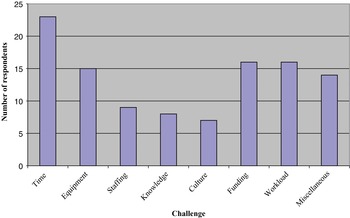
Most clinical centres suggested that there were challenges associated with achieving research priorities (Figure 1). Time and workload (including patient waiting list pressures) were the most commonly occurring challenges. Access and availability of equipment (linear accelerators, planning computers and dosimetry equipment) were also seen as constraints. Funding issues were highlighted (particularly by private centres) together with issues associated with organisational culture and lack of incentives. Academic issues such as knowledge about the research process, access to current literature and limited opportunity for affiliation with universities were also considered to be challenges to developing research in the clinical environment.
Challenges associated with achieving research priorities (total N = 36).

Research activity
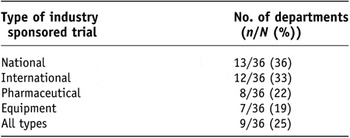
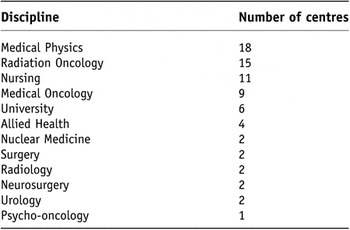
The responses demonstrated that RTs were involved in a range of research studies, many of which were sponsored externally or affiliated with industry. There were 24 clinical centres involved in national, international, pharmaceutical and equipment industry sponsored clinical trials (Table 4). The most prevalent trial activity was involvement in national trials, with 36% of centres indicating participation. A total of 25% of clinical centres were involved in all of the above types of trial activity. It was also evident that RTs initiate their own research, with 28 respondents indicating this type of activity within their centres. Participation in single and multi-centre research studies was indicated by 9 and 14 centres, respectively, with five centres being involved in both. At a local level, within organisations there was evidence of multi-disciplinary collaborative research activity (Table 5). The most common research collaboration was with Medical Physics departments and ROs, followed by Nursing and Medical Oncology. Few centres were involved in research with the Allied Health professions and the other Medical Radiation Science disciplines and the nature of these projects was not divulged.
Industry sponsored research activity (total N = 36)

Engagement in multi-disciplinary research (total N = 36)

Sources of funding
A limited number of sources were cited as avenues through which research funding had been acquired, with six centres indicating one or a combination of the following agencies as supporting their research:
The Cancer Institute of New South Wales
Australian Institute of Radiography
National Health and Medical Research Council
State cancer councils
Other medical research institutes
Hospital funding
Victorian Cancer Agency
Postgraduate research-based qualifications and publications
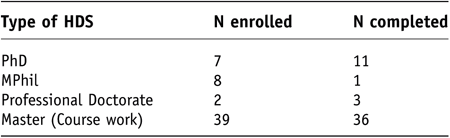
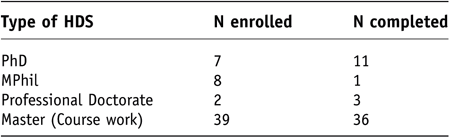
The responses to RT engagement in Masters by coursework and HRDs indicated that small, but increasing numbers of RTs had either successfully completed or were undertaking higher degrees (Table 6). Completion of a Masters by coursework was the most popular option, with 39 RTs enrolled and 36 having completed this qualification. The research-based PhD, MPhil and Professional Doctorate (HRD) routes were less popular with seven, eight and two RTs, respectively, enrolled in these and 11, one and three, respectively, having completed these. There were a total of 32 RTs who had either completed or were undertaking HRDs. Twenty-one of the 32 RTs who had completed or were undertaking an HRD worked in centres where there was no dedicated research position. The other 11 worked in the centres with dedicated research RT positions. Over the past five years a total of 36 departments produced 52 publications in peer-reviewed journals.
Number of radiation therapists who are enrolled in or have completed higher degree studies (HDS) (total N = 36)
DISCUSSION
The information elicited from the responding clinical centres indicated that research is on the agenda and encouraged throughout Australia. The size of the clinical centre and their public/private status were related to the scope and amount of research activity undertaken. The greatest activity and breadth of research occurred in the larger multi-site public centres, although there were smaller private centres where research was fostered and which had a number of employees either undertaking or having completed HRDs. It was evident that the larger centres had a greater number of staff employed in dedicated research roles and as such have the infrastructure to engage in more collaborative multidisciplinary research (MDR). Private centres may not be as active in MDR because they are not always located within large hospitals and may therefore encounter challenges due to logistical issues and limited networking opportunities. It was encouraging to see that half of the centres which responded had some sort of formal RT research position. However, only six of these were full time positions (FTE) and only four centres had 100% of the role dedicated to research.
The challenges associated with the generation of funding to sustain dedicated full time positions may explain these small numbers. This is evidenced by the small number of external bodies identified as supporting RT research financially. Combining the role with either a clinical or educational position was a popular strategy, with more centres combining educational roles (n = 11) compared to clinical roles (n = 9). In both these cases, challenges are likely to arise where one person acts in two different roles. None of the centres indicated the permanence of the roles (whether the appointments were permanent, fixed term, temporary or secondments). It may have been useful to establish this given that funding for research does not necessarily continue long term.
As there are only limited numbers of research positions in centres, the provision of secondment and rotational opportunities may be useful approaches for Managers to take when employing RTs into research positions. This type of arrangement may be considered attractive from both organisational and practitioner perspectives. It may be likely that exposing a number of practitioners to the world of research over a set period of time (e.g., annually) would enhance research appreciation and the research skill base in the centre, although there is no evidence to support this. This arrangement also allows RTs to have a ‘taste’ of working in the field of research without feeling that they are committed to it for the rest of their careers. This model would, however, limit the depth of expertise in the field and therefore a balance of developing expertise and breadth of skills across staff would need to be achieved.
A series of themes emerged when the responses for roles and responsibilities were analysed. Research facilitation and conduct of research were two of the four themes. It might be anticipated that because these roles are key to the position of research RT that the practitioner should be trained (preferably formally with an HRD) in research methodology. Unfortunately, the specific details regarding the qualifications of the research RTs were not featured in the information provided by the respondents. The results indicate that even though there are members of staff who have either completed or who are undertaking HRDs in a clinical centre this does not necessarily mean that there are dedicated research positions in these centres.
The tasks associated with research positions included reviewing literature, identification of project topics, formulation of research proposals, ethics submissions, grant and funding applications. For the majority of clinical centres, it was understood that this role would also contribute to fostering a culture of and raising the profile of research amongst all RTs. Other key roles included research collaboration/liaison with external organisations and the establishment of links to engage in multi-disciplinary projects and joint research. Research RTs also engaged in QA activities such as verification of patient and equipment data for national research studies. Quality audit and clinical governance tasks were also incorporated into the role in many centres; this may be the reason for anecdotal evidence which suggests that there is confusion amongst some RTs as to what constitutes research and how this differs from audit/clinical governance.
The involvement of RTs in clinical trials was highlighted by 25% of respondents, with a lower rate of participation in the private sector. This may be related to funding and resource issues, although no specific reasons were elicited from the information received from centres. Most clinical trials rely on steady recruitment of patients which is easier in large centres. As such, pharmaceutical companies tend to approach these larger clinical organisations rather than the smaller clinical centres. The role of the RT in trials ranged from patient recruitment, data collection and QA. It is encouraging that RT input into clinical trial design for the Trans-Tasman Radiation Oncology Group (TROG—which coordinates specialist radiation oncology research in New Zealand and Australia) is now acknowledged and valued. Over the past two years, a series of recommendations have emerged from this group whereby RTs are now routinely included on trial management committees. In the state of New South Wales, TROG have recently employed an RT specifically to investigate and identify the challenges associated with clinical trial participation in Sydney. The RT is responsible for implementing strategies in conjunction with the clinical centres to overcome these challenges. Although the RT in this role is not primarily focused towards on increasing RT involvement in trials, anecdotal evidence suggests that RTs would like more involvement.
It is evident that a research culture exists and is increasing within the radiation therapy community in Australia. Engagement in collaborative research was reported often. This was both interdisciplinary between organisations and multidisciplinary, primarily with ROs and Medical Physicists. The information provided by the respondents of this investigation demonstrated that a small number of studies were undertaken in collaboration with allied health and nursing, although the nature of these studies was not reported.
Current research priorities indicate that technological advances are driving much of the research in radiation therapy. The prevalence of technical research into image-guided radiotherapy and IMRT may be anecdotally related to the recent introduction of kV imaging and cone beam computed tomography into Australian centres. The results indicate that patient care studies have taken lower priority. This may be reflective of the role of the nurse in managing patient care in many Australian radiation therapy centres and also because industry funding is provided for equipment and technical research. It is important that patient care remains a high priority for RT research as opportunities may present for collaborative research with oncology nurses. There have been a series of international publications in the oncology nursing field identifying key research priorities related to psychosocial issues and radiation therapy.Reference Murphy and Cowan9,Reference Mcilfatrick and Keeney10 It would therefore seem ideal in these areas to undertake MDR. There are only a small number of clinical centres who deliver brachytherapy and stereotactic services which explains the lower priority given to these areas of practice. The notion that research is heavily directed by technological advances is further strengthened if one analyses the methods of prioritising research topics. These relate primarily to the potential benefits of the outcome to the department and patients, but are also driven by acquisition of new equipment. The results of the current investigation highlight that availability of resources and opportunity for innovation are factors which increase the priority of an area for research. There are no studies in the radiation therapy literature which report on the most appropriate methods for identifying research priorities. Studies from the international nursing literature suggest that methods such as Survey and Delphi technique are useful in identifying priorities.Reference Murphy and Cowan9,Reference Mcilfatrick and Keeney10
The availability of adequate resources (time in particular) is considered one of the key challenges associated with incorporating research into practice. This is highlighted in the nursing research literature as a key constraint to research activity.Reference Walsh11 In the case of centres which have patient waiting lists, it may be difficult to justify time being taken for research rather than for treating patients. Thus, heavy patient workloads may mean that equipment is only available for research purposes outside the clinical working day and staff may not be prepared to engage in working outside their usual hours.
The ability to resource funding for research has been highlighted as a potential issue and a reason for limitations in research activity. Although there are a number of organisations and funding bodies which support research, only six respondents indicated they had acquired funding from one or more of these bodies. This may be due to a general lack of knowledge of the existence of such organisations or anxiety about the process of application for funding or previous unsuccessful attempts. It is therefore important that experienced staff (possibly from related but other disciplines) act as mentors for the process of funding submission preparation. There was the perception that funding bodies only supported public centre research and as such research had a low priority in private centres.
All practitioners working in radiation therapy are now expected to have an understanding of the research process and the importance of evidence-based practice. As such, research knowledge and skills are now key graduate attributes and are therefore incorporated into the curricula of all Australian University courses. In addition, the inception of the ‘research age’ in radiation therapy has necessitated that practitioners themselves embrace new concepts and develop new skills in understanding the notion of and benefits of research. Increasingly, these skills are being developed to an advanced level with practitioners studying for course-work Masters and HRDs such as Master of Philosophy (MPhil), Doctor of Philosophy (PhD) and Professional Doctorates (PD).
There are a small number of clinical RTs who have completed HRDs and the numbers enrolling on these pathways are steadily increasing. The main pathway for RT postgraduate study is definitely that of the coursework masters degree. It is beyond the scope of this article to analyse the reasons for this choice of pathway but anecdotal evidence suggests that the composition of a coursework masters is appealing where practitioners are able to study single structured ‘byte sized’ units as opposed to what might be perceived to be a more lengthy route with less structure in the HRD. The low numbers who have either completed or are undertaking HRDs may explain the relatively low rate of publications in peer-reviewed journals. Another issue may be that there are relatively few peer-reviewed journals devoted specifically to the field of radiation therapy.
All of the institutions which deliver entry level programs now offer HRD programs. Given the current surplus of practitioners entering the profession, the opportunity may present for a greater number of RTs (with the required pre-requisites) to continue onto HRDs rather than working clinically. A number of institutions have implemented Honours or Masters pathways for graduates as a link between the entry level qualification and the HRD. The most common approach for such entry into research is a supervised research project undertaken over 1–2 years (this may vary depending on the individual institution). This research year (or two) does not usually contain a coursework module, but some institutions include a small coursework component which covers statistical analysis and critical review of journal articles. The aim of this research year is to provide the students with an opportunity to carry out a small research project from beginning to completion and develop skills in writing, analysis and communication of scientific issues, as well as preparing applications for ethics committees, patient information sheets and other research related documents. Successful completion of such a year provides the academic supervisors with feedback on the applicants’ potential to carry out and commit to MPhil and PhD degrees. The applicants, on the other hand, find out if the research year reaches their expectations and if they wish to pursue these activities further.
It is apparent that a priority for the Universities is to ensure that teaching staff delivering the RT programs have undertaken or are undertaking HRDs. At present those academics with MPhil/PhD qualifications are few and far between. There has, however, been a recent increase in the number of academics enrolled in HRDs. This has certainly been a culture shift for some lecturers whose priorities were once with teaching alone and who themselves have not undertaken research during their professional education and career. It is now expected that research should inform teaching and that all staff are engaged in research activity, in some universities with at least a 30% fraction of their time dedicated to research activities. This proves an ongoing challenge in most institutions from a resource and time perspective.
Other issues related to the Australian research agenda
The professional body (AIR) is currently in the process of strategic planning and one of the areas that will be strengthened in this process is the support of research in the profession. The support offered at the present time includes incentives at both state and national levels to encourage research by students and practitioners. There are annual prizes for student research article presentations and annual research scholarships for practitioners
CONCLUSION
Overall, RTs have embraced the concept of research, with a number of clinical centres recognising this and utilising a variety of employment strategies to create research RT positions. There are, however, many challenges associated with undertaking research some of which are perceived to affect productivity during routine work. It must be remembered that this report is a snapshot of the status of Australian radiation therapy research at one point in time. As such, not all clinical centres provided information and therefore some aspects of the results may change in the future. With continued support from radiation therapy Managers, ROs, Physicists, the professional body and increased collaboration with other disciplines and universities the future for RT research in Australia looks promising.
Acknowledgements
We acknowledge all RTs who provided information for the purpose of the article. We also thank the following colleagues for their contribution: Eileen Giles, Katheryn Churcher and Mel Grand.