


Introduction
Primary-care/low-intensity mental health services are currently undergoing significant change and are generating creative and stimulating ideas on how these services can best meet the significant and diverse needs in our communities (e.g. Bennett-Levy et al. Reference Bennett-Levy, Richards and Farrand2010). With generous funding, the English Improving Access to Psychological Therapies (IAPT), as well as significantly improving standards of care for those with common mental health problems, has great potential to reach much higher numbers, much earlier in their ‘journey’. Low-intensity services sit at the heart of this (IAPT, 2012). These new services are now building strong foundations and will, hopefully, develop the range of services offered as clinicians gain more experience and confidence. However, early indications suggest that very large numbers of individuals do not attend or complete treatment and that, for completers, recovery rates are only between 40% and 55% (Richards & Borglin, Reference Richards and Borglin G2011). The title of the 2012 document ‘IAPT three year report: the first million patients’ while initially seeming impressive does hide the realities of inefficient models. We need to ensure that efficiency is given equal priority to effectiveness in order to achieve the best value for the money spent (White, Reference White2008).
STEPS is the NHS primary-care mental health team in south-east Glasgow. South-east Glasgow is a deprived community and generally performs badly compared to the rest of the country in terms of a range of indices of deprivation: greater numbers being income- and employment-deprived, more claiming benefits, lower life expectancy, higher infant mortality and low birthweight. The Pakistani community (the largest in Scotland) comprises 11% of south-east Glasgow, more than five times the Scottish average [Glasgow Centre for Population Health (GCPH), 2008].
While mental health services within the Scottish NHS system differ from that of the English system, Glasgow had, possibly, the first dedicated primary-care mental health teams in Britain, offering an essentially low-intensity service (individual therapy is expected to offer up to 6–8 sessions) and involving, typically, higher banded workers – clinical psychologists, CBT therapists and person-centred counsellors. Since 2005, the STEPS service has offered a six-level, low-intensity service for those with common mental health problems. The levels are: individual therapy, groups/classes, single contacts, non-face-to-face interventions, working with others, and population level. The service can best be described as offering matched care – attempting to get the individual to the right level of service first time. The main interventions offered by STEPS include ‘Mood Matters’, a six-session interactive CBT/positive psychology group approach for up to 20 individuals; ‘Connect’, a CBT social anxiety class; ‘Stress Control’, a transdiagnostic didactic CBT approach that, typically attracts over 40 people to the afternoon class and over 100 people to the evening class (White, Reference White, Bennett-Levy, Christensen and Farrand2010a) and a range of self-help options, including the ‘Steps out of Stress’ booklet (and audio booklet) series and a website (www.glasgowsteps.com; White, Reference White2009). Information about the service can be found in White et al. (Reference White, Joice, Petrie, Johnston, Gilroy, Hutton and Hynes2008) and White (Reference White, Bennett-Levy, Christensen and Farrand2010b).
A previous paper reported unacceptably high attrition rates with individual CBT and person-centred counselling (Grant et al. Reference Grant, McMeekin, Jamieson, Fairful, Miller and White2012). Case-notes of all those referred in a 4-month period were assessed for those who failed to opt-in; those who opted-in but failed to attend the first appointment and those who attended the first appointment but subsequently dropped out. Thirty-two percent failed to opt-in; 26% who opted-in failed to attend their first appointment; 34% who attended their first appointment failed to complete the therapy. Thus, completion rates for those who opted-in for therapy was 37%; 21% if we include those who did not opt-in. Those from the most deprived areas were less likely to opt-in. Although CBT therapists had no waiting lists, due to the amount of administration involved, individuals waited, on average, 28 days from the GP issuing the referral to the first appointment. CBT therapists, at this assessment appointment, triaged the majority of individuals, usually to other STEPS services such as Stress Control (White, Reference White, Bennett-Levy, Christensen and Farrand2010a). This caused another delay in getting the person to the right part of the service quickly. A related problem may have been that, when a GP refers a patient for individual assessment, those individuals assume they will be offered individual therapy and, due to this expectation, may be less willing to consider another approach even if the clinician feels that approach is appropriate. The need to seek a GP referral may also medicalize the problem and disempower the potential service-user by promoting a ‘doctor knows best’ philosophy. In addition, there were ethical concerns about the use of the opt-in approach with the possibility of individuals failing to opt-in for the wrong reasons, e.g. due to low self-esteem, or feeling that their problems did not merit an appointment. The authors concluded that the service needed a root-and-branch change in how services are offered, particularly for individual therapy, at the low-intensity primary-care level.
We felt that individuals should be placed at the centre of the decision-making process – not dependent on having a GP agree to refer them but actively empowered in deciding what part(s) of the service would best meet their needs. The old system allowed self-referral to all services except for individual therapy; this required GP referral. We decided to change this. Thus, in September 2008, the whole service became self-referral with individuals able to navigate around the service, allowing them to see, for example, a therapist face-to-face at the advice clinic (Grant et al. Reference Grant, McMeekin and White2010; White, Reference White, Bennett-Levy, Christensen and Farrand2010c); go straight to an intervention without the need for an assessment, e.g. a group or class or use a non-contact service such as STEPS (www.glasgowsteps.com; White, Reference White2009), or to seek rapid contact with a qualified therapist over the phone. This latter approach – ‘Callback’ – would allow the individual to speak to a qualified therapist, be assessed and offered advice and/or be quickly triaged to an appropriate intervention, offered either by STEPS or another service provider. Offering genuine choice allows us to move further from a ‘one size fits all’ approach to reinforce our ‘horses for courses’ model (White, Reference White, Bennett-Levy, Christensen and Farrand2010d).
There are some clear advantages to offering phone assessment – individuals do not have to take time off work to attend a clinic, pay transport costs or have to arrange childcare. As the service ‘calls back’, there are no cost implications. It may be that stigma is reduced if the person is able to make a call from their own home rather than present themselves at a clinic. With the widespread use of mobiles, service users can ensure that callbacks go only to them and not to a land-line used by others. This also offers greater flexibility in terms of where and when they make the call and receive the callback. As part of the ‘horses for courses’ philosophy, services users who did not feel comfortable with Callback had the option of the face-to-face advice clinic.
Lovell and colleagues have shown that service users find phone contact acceptable (Lovell et al. Reference Lovell, Cox, Haddock, Jones, Raines, Garvey, Roberts and Hadley2006; Ludman et al. Reference Ludman, Gregory, Tutty and Von Korff2007). There is growing evidence for phone assessment and therapy (Mohr et al. Reference Mohr, Likosky, Bertagnolli, Goodkin, Van Der and Dwyer2000; Richards et al. Reference Richards, Lovell, Gilbody, Gask, Torgerson, Barkham, Bland, Bower, Lankshear, Simpson, Fletcher, Escott, Hennessey and Richardson2007). Bee et al. (Reference Bee, Lovell and Lidbetter2010) found that service-user satisfaction with phone-based CBT was mixed but that users found few difficulties in adapting to the approach. It has been extensively utilized in low-intensity IAPT services, being used more frequently than face-to-face contacts in the large sample described by Richards & Borglin (Reference Richards and Borglin G2011).
Advantages for clinicians relate to flexibility. They can make the callback whenever they have an opening in their day. If the person is unavailable, the clinician immediately moves to another callback or another piece of work. This compares to the often significant amount of time that is wasted when individuals fail to attend their first assessment appointment in a clinic. Clinicians, able to respond more quickly to need, may feel more empowered.
This paper looks at the first 2500 users of the Callback service. The main questions were:
• Can clinicians assess on the phone?
• Will ‘hard to reach’ service-user groups use the service, e.g. those who are depressed, those from ethnic minority communities, those aged >65 years and, of greatest relevance to our service, those from the most deprived areas.
• Can we respond quickly to calls and can service users access services quickly following the callback?
Method
Procedure
Beginning in September 2008, all STEPS services became self-referral. The 112 GPs and other referrers in south-east Glasgow were informed of the change in the 3 months prior to this. Due to good working relationships with GPs, they were supportive of this change. While GPs would no longer be able to refer to the service, their role became that of signposters. GPs were able to continue referring members of the black and ethnic minority (BME) or asylum-seeking communities who would require interpreting services and, hence, be unable to phone us. GPs were instructed that, if they felt any individual would lack the confidence to call us, the practice could inform us and we would either phone the individual or arrange an appointment at the advice clinic. This has occurred on four occasions.
Workshops were held for therapists and role-plays of callbacks were carried out before the service started.
The service brochure
In order to ensure a wide range of access points to the service (Lovell & Richards, Reference Lovell and Richards2000), a 31-page service booklet was produced and distributed to both ‘traditional’ sites, such as GP practices, community mental health teams (CMHTs), social work teams, voluntary organizations, victim support, accident and emergency, and also to less obvious places such as libraries, bowling clubs, community halls, housing associations, gardening clubs, mother and toddler groups, supermarket foyers, pubs, chemists and churches/mosques. The booklet cover is deliberately anonymous and the term ‘mental’ is not used anywhere in the booklet. The booklet should be easily understood by anyone with a reading age of a 9-year-old (Flesch, Reference Flesch1948).
The booklet divides into four sections: information about stress; STEPS classes; therapist contact services; other STEPS services and other services. The booklet can be viewed at www.glasgowsteps.com/about/services.php. ‘Callback’ is part of the therapist-contact section alongside the advice clinic which offers a face-to-face 30-minute appointment. The phone number is prominently displayed beneath a half-page description of the service.
Using the service
An answer machine is available for 24 hours per day. A short message informs callers that they will be called back by a qualified therapist, usually within three working days. They are told it is not a crisis line and, if they urgently require help, are given the number for NHS-24 (Scotland). Users are asked to leave their name, phone number, date of birth and GP's name. The service is provided by two clinical psychologists (J.W. and M.R.), two CBT therapists (S.J. and C.R.) and one person-centred counsellor (V.M.). Trainees and assistant psychologists have, under supervision, also taken part in this service.
Administrative workers in STEPS remove messages from the machine twice a day, record the relevant information on the front cover of the Callback record, dating the time the call was made. Names and dates of birth allow the administrative workers to check the NHS system for an existing mental health record and, in particular, an ‘alert’, e.g. if there is a record of violence towards therapists, before allocating the callback to the appropriate clinician. Clinicians are allocated certain GP practices to allow them to develop closer working relationships with GPs, thus callbacks are distributed in this way in preference to a rota system. Due to close working relationships within the team, it was expected that clinicians would assist colleagues who receive too many callbacks in a short period.
If no one answers the callback, a message, if possible, is left informing the person that STEPS has called and will call again. If three calls are unanswered, the person is asked to call again and leave information on when would be a good time to call them. GPs are supplied with this information and also when we are unable to leave a message. Callbacks are available between 8 a.m. and 6 p.m.
Assessment
Calls begin with therapists introducing themselves and describing their professional background, explaining how the Callback system works, recording the address and postcode (to establish deprivation status) and asking if this is a suitable time to talk. If not, a time to call back is arranged. Consent to inform the GP of the call is requested. A 6-page assessment record is used containing the following subject areas: presenting problem, medication, previous mental health problems and treatment, suicidal ideation/self-harm, drug and alcohol use, aggression/forensic issues, work/activity levels, physical health, relationship/dependants, expectations of the service and a clinician summary. An ‘outcome’ page records what services have been agreed upon. This record will shortly be available in the STEPS database, allowing clinicians the option of creating an immediate electronic record. Services will be arranged at the end of the call, e.g. the therapist will verbally give the individual an appointment time, following this up with written confirmation. Initially, it was intended to ask the person to respond to CORE-10 questions (Connell & Barkham, Reference Connell and Barkham2007) at the start of the call. However, this idea was abandoned immediately as, although psychometric data would have been valuable, this was outweighed by concerns that it would get in the way of quickly building a relationship with the individual. Completed records are given to administration workers with requests in the ‘Admin task’ box, e.g. ‘add to next Mood Matters group’.
A pro-forma letter sent to the GP and attached to each assessment record, allows the clinician to include a handwritten summary of the main problem area(s) and to tick the appropriate service box, i.e. individual therapy, Stress Control, etc. Clinicians may instead dictate longer assessment letters, e.g. when arranging individual therapy. A NHS mental health record, as opposed to a STEPS-only record, is only opened if the individual enters individual therapy. This would be discussed with individuals during the callback to ensure that they are able to give informed consent before this is arranged. All other services – classes, workshops, etc. – do not generate such a record. The clinician who makes the callback provides the therapy. The only exception to this would be where a CBT therapist arranged person-centred counselling within the team and vice versa (2% of all calls) or where cases would be given to trainees (less than 1%).
Results
Referrals
Between September 2008 and December 2012, 2500 callbacks were made. This represented 18% of all service-user contacts. Twenty percent of service users booked appointments at the other main ‘therapist-contact’ service – the advice clinic. The most popular service remains the Stress Control class which attracted 35% of all service-users in the same period.
Call data
Average time to call back was 8.4 hours after the initial call was received (range 0–76 hours). Average call time was 28 minutes (range 11–125). Sixty-four percent of callers were female. Mean age was 38 (range 17–92) years. In total, 10.9% of calls came from members of BME communities. Ninety-two percent of callbacks were ‘successful’, i.e. the person was called back and a phone assessment took place. Of these, 58% required one call, 32% two calls, 7% three calls and 3% four or more calls. Fifty-four percent of callers left mobile numbers, 35% landline numbers and 11% left both. Eighteen users requested two callbacks and two users, three.
‘Failures’
From the limited data we had on the 8% we were unable to contact, 54% were female, mean age was 35 years, and 11% were from BME communities. On average, 3.6 calls were made to each individual, the first, on average, 9.8 hours after the initial call. We were able to leave messages for 90% of unanswered calls.
Presenting problems
We did not attempt to formally diagnose problems using DSM/ICD as this would be impractical using this model. Thus caution should be applied in interpreting the global labels we used. The principal categories identified were depression (18%), mixed anxiety/depression (28%), anxiety (19%), relationships (11%), adjustment (5%), personality (4%), drug/substance abuse (3%), childhood sexual abuse (3%), post-traumatic stress disorder (3%) and ‘other’ (6%) including psychosis and obsessive compulsive disorder.
Medication
Fifty-four percent of callers were currently using a psychotropic medication. Of these, 88% were using an antidepressant, 5% a benzodiazepine, 3% a beta-blocker. The remaining 4% were taking either antipsychotics, methadone or hypnotic medication.
Previous treatment
Fifty-three percent of callers had received previous mental health treatment, mainly as outpatients at the secondary-care level. Of these, 6% had received help at a community addiction service, 6% had seen a community psychiatric nurse, 28% a counsellor, 20% a psychiatrist and 26% had been treated by a clinical psychologist. Five percent had received in-patient help, 4% had received help from the STEPS service and 5% from other sources. Taken together with medication data and clinicians’ judgement, these findings suggest Callback is dealing with a clinical population.
Employment
Forty percent of those using Callback were unemployed/on benefits; 37% were currently employed; 8% employed but signed off sick; 6% were students and 9% retired. The number of callers who were unemployed was double that of the general south-east Glasgow figure (GCPH, 2008).
Scottish Index of Multiple Deprivation (SIMD) data
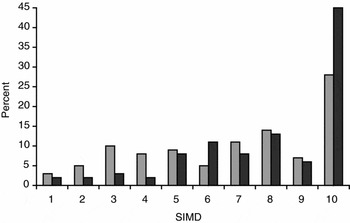
SIMD designates each postcode with a value between 1 and 10, where 1 represents the most affluent and 10 the most deprived households (Scottish Executive, 2006). Figure 1 shows the number of calls received from each SIMD category.
Callbacks by Scottish Index of Multiple Deprivation (SIMD). 1 = least deprived; 10 = most deprived ( ), compared to SIMD of south-east Glasgow (
 ).

As can be seen, compared to the SIMD profile of south-east Glasgow (GCPH, 2008), Callback attracted significantly greater numbers from the most derived postcodes.
Outcome data
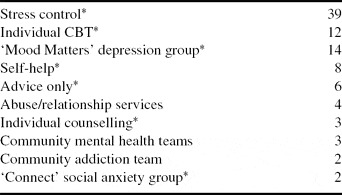
Table 1 displays the top ten outcomes for the 92% of individuals who were successfully called back. Twenty-eight options were suggested including referring to social care providers, women's aid, Rape Crisis Centre, weight management, debt advice, and multi-cultural services. Eighty-six percent of callers were offered a service provided by the STEPS team. Two percent of users were offered more than one intervention, e.g. Stress Control and counselling. On average, those offered a service (therapy, class/group/workshop) within STEPS started the intervention 9.4 days following the callback. Due to the open-access model of interventions such as Stress Control, we do not record attendance/completion rates on a routine basis.
Top ten services offered during the callback (%)

*Denotes service provided by STEPS.
Satisfaction, ease data
Clinicians rated each call using a 1–10 scale for ‘clinician satisfaction with the call’, ‘perceived caller satisfaction’ and ‘how difficult the call had been’. Scores of 10 for the first two measures represented ‘very satisfied’ and, for the third, ‘very difficult’. Mean scores were, respectively, 8.3, 8.3 and 2. A forthcoming paper will look, in detail, at the perceptions of users of the service (A. Fairful & J. White, unpublished data).
Referrals to individual therapy
Individuals who asked specifically for individual therapy (and who the therapist felt would benefit from it) and/or those who the therapist felt would not benefit from any other STEPS approach even if they requested it, were likely to be offered a one-to-one intervention. Clinicians agreed that in most cases individual therapy was not withheld from individuals who were requesting this approach. A forthcoming paper will look at this issue in more detail. Two hundred and seventy-six (12%) individuals were offered individual CBT and 69 (3%) person-centred counselling. Forty-six of the CBT cases were allocated to trainees. These individuals would have been unlikely to have been offered individual therapy otherwise. In addition, clinicians offered further face-to-face assessment to 28 individuals as they felt seeing the person would aid assessment, e.g. by observing non-verbal behaviour. Clinicians anticipated offering individual therapy to most of these individuals. Twenty-six attended the appointments. Of these, 14 were then offered individual therapy. Thus, in total 15.6% of all callers were offered individual therapy. In terms of deprivation, there was no difference between those offered individual therapy compared to other services.
CORE data
CORE-10 data, completed at the first appointment of individual therapy, were available for 86% of those offered individual therapy. Average scores were 25.1. This places them in the ‘moderate-severe’ range (Connell & Barkham, Reference Connell and Barkham2007). These scores are similar to individuals who use other parts of the service (unpublished STEPS audit data) and provide further evidence that our primary-care team, in line with many other low-intensity services, do not see the ‘mild to moderate’ cases.
Individual therapy – efficiency
Individuals offered individual therapy were seen, on average, 9.1 days following callback. Of the 359 individuals offered an appointment; 334 (93%) attended. Three hundred and one of these 334 have now been discharged. If a patient failed to attend an appointment agreed upon by both therapist and patient at the previous appointment and then subsequently failed to contact the service, that patient was designated a non-completer even if it was anticipated by the therapist that it would be the final appointment following a course of therapy. Following this strict criterion, 247/301 (82%) completed therapy/counselling (mean 5.6 sessions, range 2–12).
Discussion
‘Callback’ appears to be an efficient alternative to GP referral. Individuals were called back within 9 hours of making the initial call. This compares favourably with the old system with an average 28-day delay between the GP issuing the referral and the person being seen for the first appointment (Grant et al. Reference Grant, McMeekin, Jamieson, Fairful, Miller and White2012). Users then entered a STEPS service, including individual therapy, within, on average, 10 days following the callback. Clinicians found it to be a satisfying experience, allowing them to provide rapid intervention to people with clinical-level problems. Clinicians found few problems in assessing over the phone and calls could be fitted in between other tasks allowing better use of scarce therapist time. Although we did role-plays before the service began, therapists agreed that assessing on the phone was not difficult and did not require significant training. Quality control measures such as meetings to discuss individual cases were helpful. Clinicians are encouraged to bring non-clear-cut calls back to team meetings to see if their colleagues would make the same decisions. Typically there was a high degree of concurrence among clinicians. As we did not look in any detail at diagnostic interviewing, caution should be used in interpreting our wide categories of, e.g. ‘anxiety’.
The system was flexible, allowing clinicians to continue to assess face-to-face whenever required yet this happened in only a minority of cases. The service was rarely used as a ‘crisis line’ and in virtually all cases the therapists felt they could offer at least some help. As 86% of individuals were offered a service within STEPS, there is no evidence that the approach simply burdens other services by signposting individuals away from our service.
In terms of the questions posed, the results seem positive. Clinicians believed they were able to call back quickly, believed they were able to assess on the phone and believed they were able to get people into a wide range of services quickly after the call back. As would be expected, mixed anxiety/depression was the most common problem identified – the most common problem found in primary-care mental health followed by anxiety and depression (Das-Munshi et al. Reference Das-Munshi, Goldberg and Bebbington2008). Thus people who were depressed were able to make the first move and make the call to us. A total of 10.9% of calls came from members of the BME community, a community that comprises 11.6% of the south-east Glasgow population. These numbers are positive as many of the more traditional community members would be unlikely/unable to use Callback due to language and cultural factors. Relevant alternatives, including written GP referral to STEPS requesting individual assessment with an interpreter, exist for this population but are seldom used, probably due to existing culturally relevant services for this population. We noticed a significant increase in referrals following mental health awareness training we provided to imams from local mosques. Imams, who reported being previously unsure about recommending our services, became more positive following these meetings and, for example, allowed us to display service brochures, booklets and relaxation CDs translated into Urdu in the mosques.
Only 7% of those who used the service were aged >65 years. As the over-65s constitute 13% of the south-east population, this is a disappointing finding but reflects problems found across the primary-care mental health teams in the city in attracting this hard-to-reach population (Broomfield & Birch, Reference Broomfield and Birch2009). We had hoped that this group would have found phone contact, if anything, easier than having to attend a clinic. Reasons for poor take-up of services are likely to be multi-dimensional and require further work.
Callback attracted an over-representation from the most deprived areas. Having the service meet the cost of the callback may encourage people from the poorest sectors to make the initial brief call. Although encouraging, we should have received significantly more referrals from the more deprived areas given the strong link between deprivation and prevalence of common mental health problems (Meltzer et al. Reference Meltzer, Singleton and Lee2002). The same problem existed in the old GP-referral system. It is possible, however, that Callback is one way to reduce the powerful stigma issues that may result in those in deprived areas, particularly men, being less likely to seek out help (Hayward & Bright, Reference Hayward and Bright1997). However the factors associated with this ‘hard to reach’ population are likely to be complex and require us to continually develop our service to better meet the biopsychosocial needs of this large population (White, Reference White, Bennett-Levy, Christensen and Farrand2010d).
The completion rates of 82% in individual therapy data show significant improvement over those obtained in the old GP-referral system where, after opt-in, only 37% completed therapy (21% of those before opt-in). Clinicians believed that the new system allowed us to better judge who requires individual therapy and who is motivated to participate in it. Having the two options of CBT and person-centred approaches allowed greater flexibility and, in routine meetings to discuss the system, there was a good consensus between clinicians about who could benefit from the two approaches. CBT and PCT therapists collaborated well as all therapists did in assisting colleagues overburdened with calls. Clinicians reported high correlation between what they suggested and what they perceived the person wanted. A future paper will look at callers’ perception of the service (A. Fairful & J. White, unpublished data).
With only 15.6% of callers being triaged to individual therapy, the service has significantly reduced the amount of time clinicians are spending in clinics. In the old system, they were often working in an unproductive manner due to ‘no-shows’. The relatively small number of people choosing to go to one-to-one – the least efficient service offered by STEPS – further reinforces clinicians’ views that the majority of those who used Callback did not have a preference for individual therapy and that clinicians were not denying them their preferred option. This perception is reinforced by looking at the wider service – 64% of those who came into the service after reading the service booklet did not use either Callback or the Advice Clinic even although these options allow rapid access to a therapist. Instead, they opted for directly entering a service without assessment, most typically a class or group.
There were examples of early intervention and picking up problems that, otherwise, may not have emerged. Twelve people, assessed as possibly having a psychotic disorder – problems which had not been detected despite frequent visits to their GPs – were quickly referred to secondary care as were six callers who were perceived to have strong suicidal ideation. Clinical psychology services in secondary care, who audited these referrals in the first year of service, concluded that the referrals were, in every case, appropriate, providing further evidence of our ability to quickly but accurately assess problems in this way. An instance of child abuse, identified from a call from a woman complaining of domestic abuse directly towards her, resulted in the relevant services being contacted (with the woman's agreement) and legal action being taken against the perpetrator. A woman who reported a history of serious episodic depression, phoned to request help as she felt she was ‘on the slippery slope’. She was quickly provided with two sessions of CBT to reinforce previous therapy and, it appeared, was able to prevent a further episode. A delay of 28 days, under the old system, may not have allowed early enough intervention.
Clinicians reported how many individuals used the service in a flexible way. One young man was happy to take his callback while he waited for his bus in a city-centre bus station; people were called back at lunch-time during work, mothers were called while their young children slept and one man, soon to be moving to Ireland, was put in touch with a specialist service in Donegal that would meet his needs. The approach may help disabled/chronically ill individuals to use the service more easily. Following a callback to a woman house-bound due to physical ill-health, we were able to arrange phone counselling for her. Different parts of the service interacted positively with Callback – one woman picked up a copy of the ‘Everything you always wanted to know about stress (but were afraid to ask)’ DVD (available to view at www.glasgowsteps.com, or available from the first author) and a service brochure at a STEPS stall in the foyer of a large supermarket. She watched the DVD the same day, identified with it (realizing for the first time that she had a mental health problem), consulted the service brochure and used the Callback service the following day. She was quickly triaged to the Stress Control class.
While Lovell reported that, in her phone therapy trial, over 60% of users preferred to receive a call between 6 p.m. and 8 p.m. (Lovell, Reference Lovell, Bennett-Levy, Christensen and Farrand2010), we did not find this was a significant issue. This may simply be due to Callback being a one-off call instead of a series of calls.
What we do not know is whether moving the full service to self-referral has disadvantaged some people who may have attended if referred by the GP but who were unable to make the first step themselves via self-referral. Informal discussions with GPs do not suggest this is the case. On balance, we feel the service is now very easily accessed and, by placing the individual at the very centre of decision making, offers advantages over the old system.
Higher technical options are also readily available such as the use of Skype which would allow non-verbal cues to be taken into account. However, a major advantage of this approach is its simplicity and flexibility. The results suggest it works well enough in primary care. With therapists’ positive experiences of using the phone, we have begun offering phone therapy – ‘Callback Plus’ – as well as assessment for those who would prefer this to face-to-face clinic appointments and, by so doing, further increasing choice for users.
Callback is part of an interactive system. It will work best when there are easily accessed options. A low-intensity service offering only individual therapy would struggle to keep the service fluid. Similarly if a service demanded that every potential service user had to be assessed before being offered a service, therapists may find themselves operating essentially as call-centre workers, fielding calls for most of the day. Having a range of classes and groups allows people to access services quickly whether directly or through a Callback triage. Having options within the service also adds variety to clinicians’ jobs. With, on average, 2–3 callbacks each week, each therapist was easily able to accommodate these calls and, with the clinical time saved, able to devote more time to further develop other areas of the service.
Callback has contributed to the whole multi-purpose/multi-level service by augmenting genuine choice to service users by empowering them to navigate around the service according to their perceived requirements and not simply what the therapist feels is right for them. Callback allows those who wish assessment and therapist advice to easily access it. These results also provide an alternative to the ‘stepped-care’ model, e.g. Bower & Gilbody (Reference Bower and Gilbody2005), which argues for individuals being initially offered the least intensive approach and only being ‘stepped-up’ to more intensive approaches if the earlier intervention has not worked. This assumes that individual therapy is always ‘the best’ and that it is rationed for efficiency rather than effectiveness reasons. Our ‘horses for courses’ model implies a more flexible view – individual therapy is best for some and not for others. Those who want to explore this option are enabled to do so immediately and do not have to ‘jump through hoops’ in order to be considered for it. As far as possible, individuals, not the service, should decide which intervention is best suited to their needs. Callback has helped contribute to a service model that aims to achieve this objective.
Declaration of Interest
None.
Learning objectives
(1) Development of low-intensity services for common mental health problems.
(2) Use of more efficient interventions.
(3) Offering genuine choice to service users.



Comments
No Comments have been published for this article.