When decision-making is studied in sport, different variables (e.g. opponents, location of team members, fatigue, emotions) interact in order to arrive at a specific decision in a particular game situation (Williams & Ericsson, Reference Williams and Ericsson2005). From the cognitive psychology viewpoint, studying response selection focuses mainly on the reasoning processes and thoughts associated with decision-making that an athlete develops in competition (for a review, García-González, Araújo, Carvalho, & Del Villar, Reference García-González, Araújo, Carvalho and Del Villar2011). In this regard, the level of sport expertise depends on mental representations and on the cognitive processes that occur between the interpretation of this stimulus and the response selection (Hodges, Starkes, & MacMahon, Reference Hodges, Starkes, MacMahon, Ericsson, Charness, Feltovich and Hoffman2006). In this sense, the study of decision-making in open sports becomes especially relevant, due to the fact that this type of sport features a high degree of variability (Moran, Reference Moran2012). Consequently, athletes, who have to select a response, face an unpredictable environment in which they have to interact with players from their own team, as well as with players from the opposite team, who are taking their own decisions at the same time (Johnson, Reference Johnson2006; Nielsen & McPherson, Reference Nielsen and McPherson2001). In sports such as volleyball, and more specifically in the attack action, athletes must quickly understand which stimuli have a clear influence on decision-making (e.g. characteristics of setting, blocking positions and location of defenders) in order to select the most appropriate response in agreement with existing circumstances of the game (Johnson, Reference Johnson2006; Macquet, Reference Macquet2009; Tenenbaum, Reference Tenenbaum and Spielber2004).
Given the relevance of decision-making in sport, it is suggested that there is a need to develop training programs aimed at improving decision-making, designing representative tasks that include essential aspects of the game context (Marasso, Laborde, Bardaglio, & Raab, Reference Marasso, Laborde, Bardaglio and Raab2014). In sports like volleyball, decision-making follows an active process involving the examination and selection of relevant information from the game context, in order to control actions that will permit reaching an objective (Broadbent, Causer, Williams, & Ford, Reference Broadbent, Causer, Williams and Ford2014).
Vickers (Reference Vickers2007) developed a Decision Training Model that was characterized by focusing athletes’ training on the establishment of clearly tactical oriented tasks, in order to consider the players´ behavioral interaction with the different elements of the environment during the sporting action. This model proposes the use of tools for decision-making training, such as video-feedback and questioning. By using video-feedback, athletes can observe their decision-making in a training and competition situation, they can identify the opposite team’s strengths and weaknesses, as well as improve in recognizing contextual factors (Groom, Cushion, & Nelson, Reference Groom, Cushion and Nelson2011; Nelson, Potrac, & Groom, Reference Nelson, Potrac and Groom2014). In open sports like volleyball, the game actions (e.g. attack, defense, displacements, etc.) occur too quickly and there is a lot of information available. In this sense, there is little evidence to support the idea that by simply watching the video, this is going to be effective (Boyer, Milteberger, Batsche, & Fogel, Reference Boyer, Milteberger, Batsche and Fogel2009). Consequently, one of the essential conditions for video-feedback to become effective is that it should be used with the aid of an expert or mentor, who will try to direct the athlete’s attention towards specific and relevant information from the sports scene (Vickers, Reference Vickers2007).
In contrast, questioning is a tool that has not been commonly used in the field of sport training (Chambers & Vickers, Reference Chambers and Vickers2006; García-González, Moreno, Moreno, Gil-Arias, & Del Villar, Reference García-González, Moreno, Moreno, Gil-Arias and Del Villar2013). The main purpose of this tool is to ask athletes a series of questions that have a high tactical component, which will enable them to explore new forms of interaction with the environment and thus be able to effectively and accurately execute a technical-tactical skill (Díaz-del-Cueto, Hernández-Álvarez, & Castejón, Reference Díaz-del-Cueto, Hernández-Álvarez and Castejón2012). Hence, questioning helps guide players, by way of open-ended questions, towards self-reflection, self-regulation and problem-solving. In this case, questioning applied in sport training, may be a useful tool, not only to improve technical skills but also to improve the decision and tactical variables in open sports (Chambers & Vickers, Reference Chambers and Vickers2006; Vickers, Reference Vickers2007).
In this sense, recent studies have demonstrated that the use of video-feedback and questioning 24–48 hours after competition and in laboratory conditions is a highly recommended strategy in order to optimize decision-making, both in athletes in formative categories (García-González et al., Reference García-González, Moreno, Moreno, Gil-Arias and Del Villar2013; García-González, Moreno, Gil-Arias, Moreno, & Del Villar, Reference García-González, Moreno, Gil-Arias, Moreno and Del Villar2014; Moreno, Del Villar, García-González, Gil-Arias, & Moreno, Reference Moreno, Del Villar, García-González, Gil-Arias and Moreno2011) and in elite athletes (Moreno, Moreno, Ureña, Iglesias, & Del Villar, Reference Moreno, Moreno, Ureña, Iglesias and Del Villar2008). In this study, we wish to advance knowledge in the application of this type of intervention because the research that has analyzed decision-making in real game time and during training is limited (Farrow & Raab, Reference Farrow, Raab, Farrow, Baker and MacMahon2008). Therefore, the intervention applied in this investigation, which was conducted by applying video-feedback and questioning, took place in a real game context, with the aim of favoring the immediacy of the change in decision-making. This immediacy between thinking and action is the main contribution of the study. As a consequence of the above, the main objective was to analyze the effect of applying a decision training program, based on video-feedback and questioning, on decision-making in a volleyball attack action, in real game time. Derived from this general objective, a hypothesis was put forward whereby the players participating in the decision training program would significantly improve in terms of the percentage of successful decisions taken, with respect to the players from the control group.
Method
Participants
The study sample was comprised of eight female volleyball players aged between 14 and 16 years old (M = 14.75; SD = .70), who were included in the Under-16 category. All players had an intermediate level of expertise because they competed at regional level and they had an average of 4 years’ experience playing volleyball (SD = 1.06). The participants in the study belonged to the same training group, which enabled us to control the “effect of training” variable, as all the athletes had the same coach and they trained 4 hours a week.
Participants were divided into two groups of four individuals: experimental group (age, M = 15.00 SD = .81; volleyball playing years, M = 3.75 SD = 1.00) and control group (age, M = 14.50 SD = .57; volleyball playing years, M = 4.25 SD = .50). The players were subdivided into experimental group and control group in agreement with the results obtained in decision-making during the first study phase (Pre-test). To this end, the test for homogeneity of variances was applied by means of Levene’s test, which showed that before applying the decision training program, both groups were homogeneous in the decision-making variable (Levene’s statistic = 2.210; p = .188). Likewise, when forming the groups, the athletes’ specific area of intervention in the real game and the players’ participation in competition were both taken into consideration. Thus, both groups included midfielders, receivers and opposers, as well as players who were usually members of the first-team or substitutes.
The research has been developed under the recommendations of the Declaration of Helsinki. The participants and their parents were informed of the study. As the participants’ were under age, the parents signed an informed consent. The research project was fully approved by the Ethics Research Committee of the University of Extremadura (Spain).
Variables
The independent variable of the study was the decision training program, applied in real game time and based on the use of video-feedback and questioning. The intervention program was applied in a personalized manner for each one of the players of the experimental group in agreement with their specific position (i.e., midfielders, receivers and opposers). The basis of this program was the analysis by the players of their own decisions, by means of video-feedback and questioning. In this analysis, they tried to identify the reasons why they took the decision at that moment in the game, based on video-feedback and open-ended questions (questioning). They also analyzed the consequences of their decisions and possible alternatives to them. The program was applied by the senior investigator, who had to guide the analysis process based on viewing the game actions and asking open-ended questions. In this case, the senior investigator did not directly intervene in the analysis conducted by the player, but rather waited for the athlete’s response to the question asked.
The intervention program was applied in a training context and more specifically in a 6x6 game situation. Participants in the study all belonged to a team that had two weekly training sessions. During each training session, work was carried out with the four experimental group players, individually analyzing two different attack actions with each one of them. Thus, each athlete analyzed a total of 44 attack actions throughout the 11 weeks when the intervention program was applied. The intervention program was applied to each one of the experimental group players immediately after having carried out an attack action in a real 6x6 game situation. This meant that the athlete had to leave the 6x6 game situation to be submitted to the decision training program. A substitute took her place in order to guarantee game continuity. Two successful decisions (e.g. attack aimed at a free zone of the opposite court) and two unsuccessful decisions (e.g. attack aimed at the opposing team’s best defender) were shown to the athletes during each training session. The aim was for the players to learn the key factors of a successful decision and be able to compare it with an unsuccessful decision. In this case, the player identifies the relevant conditions for decision-making (game situation, companions, opponents and the actual attacking player). These context conditions were analyzed as constraints to decision-making. Players spent approximately 4 minutes analyzing the decisions they had made in the attack action, which was analyzed according to the guidelines of previous studies (García-González et al., Reference García-González, Moreno, Moreno, Gil-Arias and Del Villar2013; García-González et al., Reference García-González, Moreno, Gil-Arias, Moreno and Del Villar2014; Moreno et al., Reference Moreno, Del Villar, García-González, Gil-Arias and Moreno2011; Moreno et al., Reference Moreno, Moreno, Ureña, Iglesias and Del Villar2008).
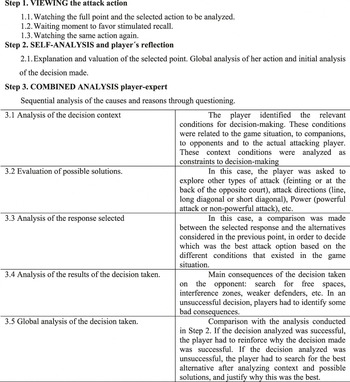
Each attack action was analyzed in agreement with the following steps:
-
▪ Step 1: Viewing the video footage. After carrying out the attack action, the player left the court and viewed her action twice in a row in order to recall the situation that had occurred previously.
-
▪ Step 2: Self-analysis and reflection by the player. In this second step, the athlete was asked to analyze her own attack action, conducting a self-assessment and giving a numerical score (1–10), which she justified verbally.
-
▪ Step 3: Joint analysis between player and expert. An interactive process was carried out with the supervisor, whereby the player had to identify the causes and reasons for the decision taken, trying to find, in the case of an unsuccessful decision, other more adequate alternatives to the attack situation experienced previously. To better understand the application process of the decision training program, each one of the steps is shown in detail in figure 1.
Sequence for the analysis of every game action.
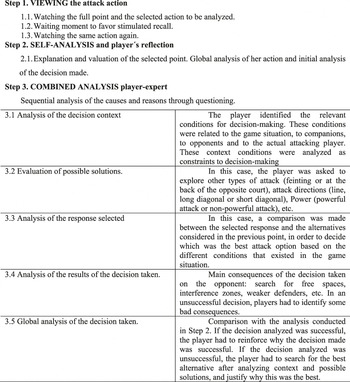
The dependent variable was decision-making, defined as the process whereby athletes select one type of attack from a series of alternatives to execute it at a specific moment and in a real game situation (Bar-Eli, Plessner, & Raab, Reference Bar-Eli, Plessner and Raab2011; Tenembaum, Reference Tenenbaum and Spielber2004).
Instruments
The decision-making assessment was based on indirect and external systematic observation, a methodology that had been used in previous studies to measure athletes’ decision-making in real game situations (Nielsen & McPherson, Reference Nielsen and McPherson2001). Each one of the matches was filmed with a camera, which was situated at a slightly elevated perspective (approximately 3 m) near the end line of the volleyball court, so that the entire width of the playing field could be viewed, thus improving the perception of depth.
The observation of the decision-making in the volleyball attack action was carried out via the “Game Performance Assessment Instrument” (GPAI), developed by Oslin, Mitchell, and Griffin (Reference Oslin, Mitchell and Griffin1998) and extensively used in scientific research (Arias & Castejón, Reference Arias and Castejón2012). This instrument was designed with research and educational purposes, with the intention of being able to observe and code sporting actions that show the individual’s ability to solve tactical problems. The authors proposed an open and flexible instrument, comprised of 7 categories: base, adjust, decision-making, skill execution, support, cover and guard/mark. In this study, we focus on the decision-making category of the original instrument (Oslin et al., Reference Oslin, Mitchell and Griffin1998). A total of 1068 attack actions were analyzed, 525 of which corresponded to the control group and 548 to the experimental group. The attack actions were coded into successful decisions, assigning a value of 1, when at least one of the three criteria established were respected, and unsuccessful decisions, assigning a value of 0, when none of the criteria established were satisfied (see Figure 2). For example, a successful decision would be if the player made an attack on a very cohesive block to get blocking-out. However, an unsuccessful decision would be if a player made an attack on an area covered by defenders. With respect to the criteria proposed to assess the decision-making, it must be mentioned that, due to the actual characteristics of the instruments, all the criteria were equally important and therefore, there was no type of hierarchy. To calculate the percentage of successful decisions, the total number of these decisions was divided by the sum of the number of successful and unsuccessful decisions and multiplied by 100 (Mitchell, Oslin, & Griffin, Reference Mitchell, Oslin and Griffin2006). This percentage of successful decisions was calculated individually for each participant in each one of the matches of the different phases that were established in the research: Pre-test (4 matches), Intervention (11 matches) and Retention (4 matches). In this way, an average percentage of successful decisions was obtained for both groups (experimental and control) taking into account the mean obtained in each one of the research’ phases. The criteria that were considered to assess if the decision taken was successful or unsuccessful are specified in the figure 2.
GPAI of Oslin et al. (Reference Oslin, Mitchell and Griffin1998) adapted for the volleyball attack by Moreno et al. (Reference Moreno, Del Villar, García-González, Gil-Arias and Moreno2011).

The observation of the decision-making was based on a real competition situation, which represents the influence of environment on decision-making performance (Raab & Köppen, Reference Raab, Köppen, Araujo, Ripoll and Raab2009). The observation was carried out by one single outside observer, who holds a sports science degree and used to be a volleyball coach (Level II in the Spanish Volleyball Federation) with at least five years’ experience at this level. The observer had to undergo a training process, establishing a total of eight 30-minute sessions in order to obtain reliability in the decision-making analysis. A sample of five of the 19 matches was observed, more than 10% the total sample (Tabachnick & Fidfell, Reference Tabachnick and Fidell2007). Intra-observer reliability was calculated based on Cohen’s Kappa statistic, as concordance due exclusively to chance is excluded in the calculation. The intra-observer Cohen’s Kappa values reached, in the observation of the decision-making variable, were higher than .81 in the five training sessions. To guarantee the time reliability of the measurement, the same sample of matches was analyzed with a time difference of ten days, obtaining intra-observer reliability results of .85. These results reflected very good concordance, thus obtaining the necessary reliability for the subsequent coding of the dependent variable (Altman, Reference Altman1991).
Procedures
A quasi-experimental design was proposed with two groups (experimental group and control group) establishing the following study phases: Phase A (Pre-test), and Phase B (Intervention) and Phase C (Retention). The structure of each and every one of the sessions established in the different research phases included a first technical-tactical training part and a second part where a 6x6 game situation was proposed.
Phase A (Pre-test): in this first phase, which took place before applying the decision training program, the decision-making of all the players was assessed during four competition matches. This initial measurement of decision-making enabled the athletes to be distributed into the groups established for the research.
Phase B (Intervention): this was comprised of 11 competition matches. The application of the decision training program, based on the use of video-feedback and questioning, took place in this second phase, in a 6x6 game situation during training. The training session of the team with the study players was organized into two parts: during the first training hour, the coach proposed technical-tactical tasks, whilst during the second training hour, a game situation of 6 against 6 was proposed, which is when the intervention program was applied. During the development of the research, the 8 players pertaining to the study trained for the same time and competed in the same number of matches, the only difference being that the athletes from the experimental group were submitted to the intervention program in the second part of the training session. Parallel to the application of the decision training program, the decision-making of players from both the experimental group and the control group was assessed during the competition matches that took place at the weekends.
Phase C (Retention): This last research phase corresponds to the four matches played during the season following the application of the intervention program. Approximately three months had elapsed from the end of the intervention phase to the start of the retention phase. In this phase, as in the previous ones, the competition matches were recorded to assess decision-making in the attack action. The purpose of this was to assess the stability of the measure after the intervention carried out.
Statistical analysis
The IBM SPSS program, version 19.0 was used to analyze the data. The results were obtained by means of the parametric statistic as the values reached in the Shapiro-Wilks test, for a sample of less than 30 individuals, indicated data normality. A one-factor ANOVA was performed for each one of the study phases to verify the intergroup difference, and a repeated measures ANOVA was performed for each one of the groups to analysis the intra-group differences. The three study phases were compared by pairwise comparisons of this test. The effect size was calculated using the partial eta-squared statistic (η p 2), as this allowed us to know the extent of the differences found, on minimizing the influence of the sample size. Statistical power (SP = 1-β) was calculated to test for the probability of a type II error. The level of statistical significance was established for p ≤ .05, with a confidence interval for differences of 95%.
Results
Intergroup analysis
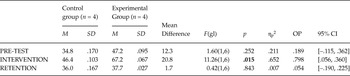
The results showed that after applying the decision training program, the experimental group showed a significantly higher average percentage of successful decisions than the control group. In contrast, no significant differences were found in the pre-test and retention measures (see table 1).
Means, standard deviations, way ANOVA for the variable decision-making in attack action

Note: The average value is expressed in percentages.
Intra-group analysis
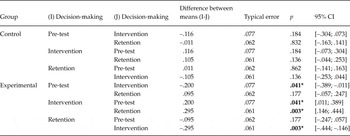
In the intra-group analysis, the multivariate contrasts showed that there were no significant differences in the control group between the three measurements carried out in the research (Λ Wilks = .647; F(2, 5) = 1.363; p = .337; η p 2 = .353; SP = .182). In contrast, significant differences were found in the experimental group in the different measurements carried out in the study (Λ Wilks = .201; F(2, 5) = 9.937; p = .018; η p 2 = .799; SP = .884). Significantly higher values were obtained in the pairwise comparison in the intervention phase than in the pre-test, and significantly higher values were also obtained in the intervention phase than in the retention test (see table 2).
Pairwise Comparison of Decision-Making Skills for Intragroup Analysis

* p < .05.
Discussion
The objective of the study was to analyze the effect of applying a decision training program, based on video-feedback and questioning, on decision-making in volleyball attack action, in real game time. Derived from this general objective, a hypothesis was put forward whereby the players participating in the decision training program would significantly improve in terms of the percentage of successful decisions taken, with respect to the control group players. The study results determined that the participants in the experimental group showed a significantly higher number of successful decisions after applying the intervention program than the control group players. This goes to show that the decision training program had a significant influence on the players’ decision capacity (Groom et al., Reference Groom, Cushion and Nelson2011; Hodges, Chua, & Franks, Reference Hodges, Chua and Franks2003; Vickers, Reference Vickers2007).
The effectiveness of the decision training program, based on video-feedback and questioning, has been proven by García-González et al. (Reference García-González, Moreno, Gil-Arias, Moreno and Del Villar2014) in tennis. In that study, the training program was applied to Under-14 category tennis players, who showed a significant improvement both in the quality of the decisions taken and in performance. Likewise, studies have been conducted in volleyball that have shown the effectiveness of video-feedback and questioning as tools that help optimize the decision-making of Under-16 players in the attack action (Moreno et al., Reference Moreno, Del Villar, García-González, Gil-Arias and Moreno2011) and of setters from the Spanish national team in the setting action (Moreno et al., Reference Moreno, Moreno, Ureña, Iglesias and Del Villar2008).
The results obtained may be due to the characteristics of the intervention program, whose aim was, on the one hand, to evaluate tactical aspects of the game situations analyzed, and, on the other hand, to analyze the most effective response (Vickers, Reference Vickers2007). Therefore, those athletes who were submitted to the intervention program in order to optimize decision-making, reached a higher level of cognitive expertise. This allowed the experimental group players to use specific strategies to take successful decisions and make strategically better choices in the attack action. The purpose of all of this is to hinder defense in the opposite team (Marcelino, Sampaio, & Mesquita, Reference Marcelino, Sampaio and Mesquita2012). Thus, the application of the decision training program caused the athletes to focus more on the existing conditions in the game context, such as characteristics of the setting, blocking cohesion of the opposite team, layout and location of defense in second line, or the marker, as well as to carry out a more sophisticated interpretation of the tendencies, strengths and weaknesses of the opposite team (Nielsen & McPherson, Reference Nielsen and McPherson2001).
On the other hand, it must be mentioned that after applying the intervention program, the percentage of successful decisions made by the control group players increased by 11.6%, although it must be underscored that this increase in percentage of successful decisions was not statistically significant. Therefore, just practicing the sport gives rise to improvements in cognitive expertise. But, based on the research results, it must be pointed out that the improvements in decision-making will be greater when tools such as video-feedback and questioning are used, in order to further optimize the athlete’s performance (Vickers, Reference Vickers2007; Williams, Ford, Eccles, & Ward, Reference Williams, Ford, Eccles and Ward2011).
With reference to the retention phase, noteworthy is the fact that significant differences have been found in the experimental group between the intervention and the retention phases in favor of the intervention phase. These results tell us that the levels reached after applying the intervention program were not maintained in time. One of the aspects to be considered in order to justify these results is the time during which the decision training program was applied, which was determined by the length of the sporting season, namely, a total of 16 weeks. This leads us to suggest that, in order to maintain the decision-making quality levels, the length of the intervention program must be increased. It would also probably be necessary to cover more than one sporting season and increase the number of actions that the decision training program is applied to (Moreno et al., Reference Moreno, Del Villar, García-González, Gil-Arias and Moreno2011). In similar studies, the improvements reached after applying the intervention program were maintained in the retention phase when this was implemented during the last four matches of the season when the decision training program was applied (García-González et al., Reference García-González, Moreno, Gil-Arias, Moreno and Del Villar2014; Moreno et al., Reference Moreno, Del Villar, García-González, Gil-Arias and Moreno2011). In contrast, in this research, our intention was to verify the retention level reached by the players after a change in game category. The results obtained prove the need for a new decision training program to be applied in each sporting season as part of the athletes’ general training. However, more research studies must be conducted in this line to determine the existing retention level when the athlete changes game category from one season to another (Lola, Tzetzis, & Zetou, Reference Lola, Tzetzis and Zetou2012; Williams et al., Reference Williams, Ford, Eccles and Ward2011).
During the application of the decision training program, coaches are recommended to apply the intervention individually in agreement with the athletes’ tactical needs. This will also develop their capacity to ask questions with a high tactical content that adapt to the player’s specific position, in order to favor cognitive involvement and reflection. On the other hand, this type of decision training must be implemented progressively, meaning that, at the beginning, the coach will identify the reasons why the players took a decision, and later on, it will be the athletes who have to find alternatives to the decision taken.
In short, the effectiveness of this type of intervention program is due mainly to the fact that athletes keep ahead of events, they direct their attention towards more relevant stimuli, they recover the best response from their long-term memory, and, in short, they choose the most effective response in agreement with the objectives of the game (Vickers, Reference Vickers2007).
As a final conclusion, we can indicate that the decision training program presented in the research has allowed for a more contextualized treatment of the decision-making cognitive variable. This is because the application of the tactical-decision training program and the assessment of the decision-making were carried out in a real game situation, unlike previous studies, when the intervention and assessment were carried out outside a real competition context or in a laboratory situation (Put et al., Reference Put, Wagemans, Spitz, Armenteros Gallardo, Williams and Helsen2014). Thus, this represents a significant advance in knowledge about the application of intervention programs to improve cognitive expertise in formative category athletes, given that the players analyzed their attack action in real game time, thus allowing them to immediately implement the reflections that arose during analysis in the game situation. This, in turn, achieves a direct relationship between thinking and action (Moran, Reference Moran2012).
Therefore, the suggestion is for formative category coaches to include the use of a decision-making training tool, such as video-feedback and questioning in their weekly training plan as this will significantly improve decision-making in real competition situations. All of this represents an increase in time spent on tasks considered to be essential to achieve cognitive expertise (Berry & Abernethy, Reference Berry and Abernethy2009).
One of the limitations of the study was the small number of participants, which limits the capacity to extrapolate the results. The research was conducted with all the attack players of the team, so an increase in sample would require a design with more participating teams, which may present other type of problems of experimental control in the intervention. On the other hand, it is worthwhile pointing out that another of the study limitations lies in the second application phase of the decision training program. During this phase, athletes must rationalize and think about the different aspects that determined their decisions, together with the expert. Sometimes, this rationalization or analysis process may not correspond entirely with what the player thought during the attack action. Despite these limitations, this research offers a new perspective to understand and optimize the decision-making process in volleyball players during a real game situation.