INTRODUCTION
Patients have formed an integral component of successful clinical training since the early days of medicine. With the advent of academic curricula underpinning clinical practice this involvement still largely remained firmly in the clinical departments. More recently many health professions have responded to a call for greater patient involvement across all aspects of pre-clinical training. Much of the current literature providing evaluation of these initiatives relates to medicine, nursing, mental health and social work, although most health professions demonstrate some evidence of academic engagement with patients beyond the requirements of clinical work-integrated placement training.
There is a wealth of evidence relating to use of standardised patients and cases in the clinical environmentReference van Zanten, Boulet and McKinley 1 , Reference Howley and Martindale 2 where students are presented with well-rehearsed situations. Although this evidence confirms the value of these expert patients there are fewer published studies relating to use of these ‘expert’ patients in the academic environment. Within these studies the cited benefits of involving patients in the medical education classroom are considerable and include value to both students and patients. Students commonly perceive patient-led sessions as enjoyable and informative,Reference Terry 3 , Reference Solomon 4 leading to increased empathy,Reference Gidman 5 diminished fear of patient contactReference Henriksen and Ringsted 6 and reduced use of jargon.Reference Thomson and Hilton 7 There is also evidence to suggest that in the academic environment students can escape the confines of the professional–patient relationship and ask questions that might be inappropriate in the clinical setting.Reference Henriksen and Ringsted 6 Thomson found that patient involvement enabled physiotherapy students to challenge assumptionsReference Thomson and Hilton 7 and misconceptions. A common finding is that students report increased patient engagement in subsequent clinical placements.Reference Stickley, Stacey, Pollock, Smith, Betinis and Fairbank 8 From an educational perspective the involvement of patients is frequently reported as helping to bridge the theory-practice gap in nursing,Reference Carpenter 9 , Reference Turnbull and Weeley 10 radiographyReference Bleiker, Knapp and Frampton 11 and mental health education.Reference Perry, Watkins, Gilbert and Rawlinson 12
The success of a patient involvement initiative is strongly dependent on recruitment and briefing of appropriate patients. Most patients will have little previous teaching or public speaking skills; although those that do should provide a valuable learning experience.Reference Hattie and Timperley 13 It is important to be wary of the stage the patient is at along their journey. Patients with recent clinical experience commonly express vivid recollections and strong feelings but may lack experience of engaging with students while more practiced patients run the potential risk of presenting a more ‘routine’ experience and losing authenticity. It is important to encourage honesty and openness during teaching sessions to ensure students are provided with an authentic learning experience. A recent review highlighted the importance of student debriefing sessions as a vehicle for reflection and future planning.Reference Terry 3 Further studiesReference Solomon 4 , Reference Thomson and Hilton 7 highlighted the value of a dedicated training programme for patients involved in education.
Most patients will not have a clear understanding of pedagogical principles but an outline of how their session contributes to student learning will certainly clarify the purpose of their input and help maintain focus.Reference Solomon 4 A planning session with both academic and patient is also an ideal opportunity to explore possible discussion points, design the optimal format and establish boundaries for the presentation.Reference Stickley, Stacey, Pollock, Smith, Betinis and Fairbank 8 It is important that the preparation dialogue is two-way and that the patient has an opportunity to present ideas for facilitation.Reference Solomon 4 They will certainly have a unique perspective on their experiences and clinical practice from which the students will gain invaluable understanding.
Naturally all patients will have their own individual story to tell, and will be an expert on their own experiences, but some patients are more knowledgeable about radiotherapy than others. At Queensland University of Technology, there is growing use of expert radiotherapy patients who are also working in the field as health professionals or academics. From an academic perspective this potentially reduces the training requirements in relation to pedagogy and student engagement. These individuals are also able to supplement their patient perspective with that of a health professional with perception relating to both ‘sides’ of the experience. Anecdotal evidence and feedback suggested that these experts emphasised very different aspects of their experience and a qualitative study was designed to provide narrative relating to the impact of contextual differences in experiences on the expert patient ‘teaching’ session. The rationale for this was to help inform recruitment of the most appropriate expert patients in order to best support radiotherapy student learning. This paper is based on interviews with two expert patients from very different backgrounds; a ‘lay’ person with no previous knowledge of radiotherapy and a clinical radiation therapist working as a clinical educator. The aim of the paper is to contrast the perspectives of the ‘educator’ patient with the ‘lay’ patient in relation to their teaching sessions.
METHODS
Participants
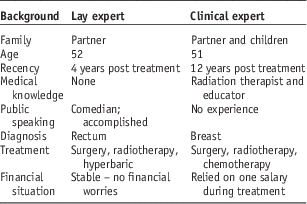
The selected ‘clinical’ expert had been teaching the session for 4 years while the ‘lay’ expert had been participating for 3 years. As a comedian, the lay expert has well-developed communication skills and is willing to share some communication tips with the students, which is useful in first year. Comparative demographic details of the participants can be seen in Table 1. The expert patients were invited via e-mail to provide feedback in the form of an interview. The data collection for this study was granted ethical approval by the University Human Ethics Research Committee as part of a wider Course Development research project. Participants were assured that their contributions would be anonymised and that participation was voluntary.
Participant characteristics and experience

Data collection
Interviews were semi-structured with a common set of open-ended questions for each participant stimulating further discussion and encouraging development of a narrative. Both were given the opportunity to read the questions immediately before the interview. The interviews were scheduled at a time and venue to suit both participants. The lay expert was interviewed directly before the 2015 teaching session on campus; the interview was ~50 minutes. The clinical expert was interviewed off campus, outside of teaching time to suit the interviewee’s work commitments; the interview was ~25 minutes. The interviews were recorded digitally and transcribed before data analysis. Transcription was performed by a member of the research team and an independent transcription service.
Data analysis
A phenomenological approach was adopted for this project with no preconception of potential themes and issues arising. The transcriptions were coded and all comments were assigned individual subthemes. This analysis was performed by two researchers who were blinded to each other’s work. These were then cross-checked with any arising disagreements being resolved by a third independent observer. Subthemes were then grouped to form more general themes.
RESULTS
Data analysis identified subthemes relating to both the treatment experience and teaching experience of the expert patients.
Treatment experience
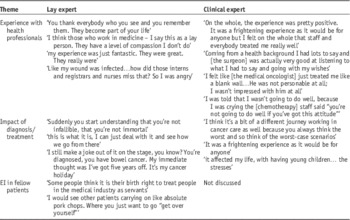
There were several interesting areas of similarity and key differences in the treatment experiences of the two participants. In particular they provided comments relating to their experience of other health professionals and fellow patients. Table 2 summarises the comments which relate to expert patient experience of health professionals and fellow patients as well as the impact of the diagnosis and treatment.
Themes relating to treatment experiences

EI=Emotional Intelligence.
Teaching experience
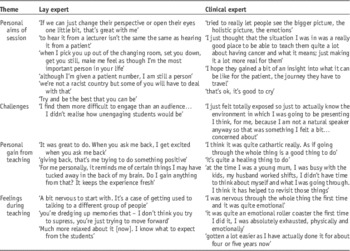
The two participants had very different prior experience of public speaking as well as different levels of knowledge and understanding of radiotherapy. The ‘lay’ expert freely acknowledged a complete lack of understanding relating to their condition while the ‘clinical’ expert clearly had highly detailed knowledge of their disease and management options. Table 3 summarises the comments relating to these themes. Additional themes arose from their motivation, challenges, feelings and gains relating to the teaching sessions.
Themes related to teaching experience

DISCUSSION
Negative experiences of treatment
The results indicate that both expert patients experienced similarities as well as differences during their involvement in the sessions. Both had negative experiences, albeit at different points in the pathway; the lay expert after surgery and the clinical expert before and at the start of chemotherapy. The clinical expert felt that they were bombarded with statistics and sent away to decide on whether to proceed with chemotherapy. This clearly led to a perception that the medical oncologist was not interested in them as a person and certainly not interested in the fact that they had any previous oncology knowledge. On the first day of chemotherapy, the clinical expert was quite emotional but was informed by the nurse ‘to pull yourself together, there are people worse off than you’. This perhaps demonstrates a lack of empathy or compassion in this staff member and does highlight the need for positive relationships between health professionals and patients. The incidents highlighted could be related to a lack of emotional intelligence, in certain staff members which has been linked to compassionate health care.Reference Cherry, Fletcher, O’Sullivan and Dornan 14 Although there is a lack of studies relating to oncology professionals, it is clear that the expert patients had perceived significant difficulties in communication with some staff. There is some evidence to suggest that oncologists have difficulty discussing some topics with patients, especially if there is an emotional burden associated with it.Reference Mack and Smith 15 Halkett et al.Reference Halkett, Merchant and Jiwa 16 also found that radiation therapists (RTs) lack confidence when communicating with patients in relation to psychosocial issues. This incidental finding suggests that there is a need for highly empathic and resilient radiation therapy and oncology staff, with effective communication skills. This in turn indicates a clear mandate for emotional intelligence development within pre-registration training programmes.Reference van Zanten, Boulet and McKinley 1 Communication skills training is also essential and there is some evidence to suggest that interacting with patients does improve students’ communication skills.Reference van Weel-Baumgarten, Bolhuis, Rosenbaum and Silverman 17
Positive experiences of treatment
Both also reported positive experiences during radiation therapy treatment. This is not surprising for the clinical expert, who received treatment in the department in which they were employed. The lay expert was very satisfied with the staff and although he admitted to having no knowledge whatsoever of the treatment, reported a very positive experience. This is consistent with the findings of Halkett and KristjansonReference Halkett and Kristjanson 18 who assert that patients value staff who can provide a sense of comfort during the treatment process. These findings also correlate with the ‘patient as a person’ approach to patient centred care required in current healthcareReference Schofield, Green and Creed 19 where patients do not necessarily wish to talk about their disease but rather seem to prefer discussing normal life as a way of coping.Reference Kvåle 20 Interestingly it has been demonstrated that providing appropriate patient care to patients contributes to job satisfaction but that dealing with suffering and distress may lead to burnout,Reference Diggens and Chesson 21 especially if the healthcare professional feels out of their depth. This indicates the value of communication skills training.Reference Halkett and Kristjanson 18 , Reference Schofield, Green and Creed 19
Reflection on teaching experience
The clinical expert had no previous experience of public speaking before the first teaching session and was very nervous before the first session. The lay expert was employed in the comedy industry so was accustomed to public speaking. Despite this confidence, some of his comments suggested nervousness before the first session; a factor highlighted in a recent review.Reference Hill, Thompson, Willis and Hodgson 22 This does highlight the vulnerability of the teaching situation and the need for facilitators to manage this.Reference Costello and Horne 23 Unsurprisingly given the theme of the session, both had a strong focus on the impact of health professionals on patients. Both speakers were keen to emphasise the importance of good communication between health professionals and patients. The lay expert stated that it was very annoying to be asked, ‘how are you?’ as a cancer patient. They also both shared a strong conviction that patients should be treated individually. Interestingly the lay expert had an additional perspective on the patient–professional relationship and strongly criticised the attitude of fellow patients, stating that some patients lacked emotional intelligence. Very few studies have investigated emotional intelligence in patients but higher emotional intelligence has been associated with lower levels of anxiety in some patients undergoing treatment.Reference Smith, Turner, Pati, Petrides, Sevdalis and Green 24 It was interesting that this was not mentioned by the clinical expert but this perhaps stems from a professional reluctance to recognise or respond to the issue.
Other factors
Both experts enjoyed the experience and despite nervousness with the first session were highly enthusiastic about the prospect of subsequent events. This is likely related to the positive response received from students during the sessions. It has been noted that expert patients reported negative experiences when students in the sessions were perceived to lack ‘compassion, empathy and gratitudeReference Lauckner, Doucet and Wells 25 but this was not the case in these sessions.
Spencer and McKimmReference Spencer and McKimm 26 identified several key research topics including identifying factors motivating patients to participate and any influences on their experiences. This study does go some way to answering these questions as both patients in this study identified making a difference to students and patient care as a motivating factor. This finding is consistent with that of a 2012 studyReference Lauckner, Doucet and Wells 25 which identified this as a documented benefit of participating in student education. Other benefits include catharsis, also highlighted by the participants in this study. Potential vulnerabilities identified in the Lauckner study included the difficulty of sharing personal and difficult experiences,Reference Lauckner, Doucet and Wells 25 also highlighted by the participants.
Both participants felt it was important for students to understand that behind every patient is a person, not just a body part. Although both did find some difficulty in revisiting emotions and feelings, the experience was strongly felt to be cathartic for each participant.
It would be useful to conduct more long-term study into expert patients to quantify this catharsis and determine the specific impact of educational involvement on their own emotional well-being. GechtReference Gecht 27 has attempted to measure the effects on patients but the measures were based on quality of life and health status as opposed to a well-being measure.
Both had very different financial circumstances, with the lay expert citing financial stability, while the clinical expert had to rely on one salary as a result of sick leave during the entire treatment pathway. This may have been an additional compounding factor. SharpReference Sharp, Carsini and Timmons 28 measured the effect this can have on a patients’ psychological well-being and noted it as a causative factor for both anxiety and depression in some patients. It is important to highlight this issue as both staff and students may underestimate the impact this can have on a patient during treatment.
Recommendations
The findings from these interviews support those found in the evidence base for other professions. Both experts highlighted the importance of choosing the patient wisely. Both patients interviewed for this article were in excess of 2 years post treatment at the time of their first session. Although it can still be emotional for a patient to talk about their experiences, some distance from the experience is advisable to ensure the patient is not too vulnerable. Both lay and clinical experts were able to bring negative and positive aspects of their treatment experience to the students. Both experts shared a common motivation for engendering a patient-focussed approach in the students which outweighed their natural nervousness relating to the teaching experience.
Both expert patients indicated the value of a meeting between the academic coordinator and the patient before the session as seen in Table 3. This meeting should outline expectations including the purpose of the session, what the students should get out of it, what sort of questions can be expected, as well as to ascertain how the patient may feel about this during the session. Feedback from this study also supports this importance of familiarising the patient with the location of the session, especially if it is a first time speaker. This may help to alleviate some anxiety associated with the public speaking and academic environment aspects of the experience. Some room designs may be more appropriate for these activities than others; a raked lecture theatre can clearly be a daunting place for an untrained speaker.
It is important that an academic staff member facilitates the session, to ensure both the patient and students feel at ease. If the patient is nervous, it is good practice to ask the students to write their questions on paper and post them anonymously in a box during a break; this can also assist students who may be too shy to ask questions. This will give the patient the opportunity to look at the questions and give them time to formulate an answer, rather than putting them on the spot.
A debriefing session with the patient after the session is useful as it offers the opportunity to discuss the experience. It is equally useful to debrief with students after the session to assess the emotional impact of the session as well as encourage ongoing reflection to maximise learning.
CONCLUSIONS
The interviews with both expert patients in this study highlight that patients are keen to participate in teaching sessions with healthcare (RT) students. Although the experience was initially nerve wracking and emotional, the patients in this study not only enjoyed this experience but found participation to be cathartic. Participants identified clear value of the teaching for themselves and the students and were enthusiastic about participation.
The study aimed to identify the impact of contextual differences in experiences on the expert patient ‘teaching’ session and the findings indicated that the experts had different experiences but similar expectations of health professionals’ empathy and care. In particular they both had different perspectives of their fellow patients and their role in the healthcare partnership. These findings indicate the value of ensuring students have access to a range of perspectives. Previous public speaking or clinical experience seemed to have limited impact on patient experience and suggested the vulnerability of the situation. As both had negative experiences at different points in their pathways, both were keen to emphasise the importance of caring for the patient as a person rather than a disease or body part.
A formal evaluation of patient engagement sessions from the students’ perspective would provide valuable insight into students’ feelings and expectations of this process and the specific pedagogical of patient involvement in health professional training. Work relating to this is ongoing.
Acknowledgement
The authors would like to acknowledge the assistance of Mark Warren with proof reading the manuscript and the patients for participating in these sessions.
Financial support
This research received no specific grant from any funding agency, commercial or not-for-profit sectors.