When implementing policies, executives in federal agencies balance their own priorities for policy with the need to please elected officials. One circumstance in which agencies’ attempts to balance external pressures with agency preferences are likely to be challenging involves the geographic distribution of policy benefits. Externally, reelection-driven members of Congress attempt to influence agency behaviour by “earmarking” or advocating for distributive benefits for their districts (Mayhew Reference Mayhew1974; Fiorina Reference Fiorina1989). Internally, as Arnold (Reference Arnold1979) argued, agencies make allocation decisions strategically to gain favour and build reputations within Congress. In so doing, agencies win increased budget resources and enhance the volume of discretion they enjoy over policy.
Scholars have examined how members of Congress secure distributive policy benefits through earmarks (e.g. Mayhew Reference Mayhew1974; Arnold Reference Arnold1990; Balla et al. Reference Balla, Lawrence, Maltzman and Sigelman2002; Evans Reference Evans2004). However, for the time, Congress has eliminated earmarks for political and deficit-related reasons. Critically, this reform did not eliminate members’ electoral needs for distributive benefits. Unsurprisingly, earmarks have been replaced by other methods through which members pursue distribution to their districts, including the insertion of requests for projects in report language and “letter-marking”. Letter-marking occurs when members of Congress write to the head of an administrative agency asking (or demanding) that the agency retain, or allocate, distributive benefits in their districts.
As Congress continues to operate under a moratorium on earmarks, congressional scholars do not yet know whether, and under what circumstances, members of Congress are successful in securing benefits for their districts through letter-marking. Does the shift from using earmarks to letter-marking as a tool for the allocation of distributive benefits give members of Congress less leverage while giving more discretion to agencies? Recent studies of distributive politics have focussed on the political conditions that lead to distributive allocations from bureaucratic agencies to congressional districts, including the ideological congruence of legislative and executive branch actors (Bertelli and Grose Reference Bertelli and Grose2011. Berry et al. Reference Berry, Burden and Howell2010; Gordon Reference Gordon2011; Ting 2012). Noticeably absent, however, is consideration of the priorities of agencies in determining the allocation of distributive benefits.
To examine whether agency preferences can shape the allocation of distributive benefits, we investigate the US Federal Aviation Administration’s (FAA) decision to withdraw funding of 173 air traffic control towers in the Federal Contract Tower Program (FCTP) as a result of sequestration contained in the Budget Control Act of 2011. Following its announcement of the closing of the towers, the FAA entertained appeals, allowing communities to argue why it was in the national interest for their towers to remain operational. Helpfully to congressional scholars, members of Congress engaged in letter-marking by writing over 100 letters to the agency and the Department of Transportation (DOT) demanding that towers in their states and districts (and the associated local jobs) be retained. The appeal process resulted in 24 towers receiving waivers to continue operation. Using a novel data set of the over 100 congressional letters written in support of air traffic control towers, we examine the influence of agency, and member, priorities in the agency’s decision to grant waivers.
In the face of intense political pressure from members of Congress, the FAA based its decisions on its own policy preferences through the use of technical expertise. Accordingly, these findings suggest that Congress’s use of indirect tools such as letter-marking gives members less leverage to secure distributive benefits while giving agencies more discretion over allocation decisions. We view this study as a compelling addition to the literatures on bureaucratic policymaking and distributive politics for several reasons. We employ several unique and highly reliable sources of data including letters written to the Secretary of Transportation and FAA benefit-cost (B-C) ratios for each tower to assess the effect of technical expertise and letter-marking on distributive benefit allocations. These measures constitute especially valid indicators of agency and member preferences, respectively, allowing us to examine how bureaucratic policymakers balance agency and congressional priorities. Finally, an additional contribution of our study is that we assess the effectiveness of letter-marking, a new vehicle used by members of Congress to advocate for distributive benefits in their districts.
Although we rely upon a single case study, our results suggest that letter-marking affords members of Congress limited influence over agencies as a general matter. As our case involves a decision of an agency issuing waivers to retain rather than allocate new distributive projects, members of Congress would have a significant electoral incentive to exert significant pressure on an agency to retain the project in their district (Arnold Reference Arnold1990). The high degree of congressional interest in the FAA’s decision is evident in the over 100 letters that were written to the agency. If we do not observe congressional influence in this case, it may be unlikely that letter-marking exerts influence under other circumstances in which members of Congress expended less effort in trying to retain, or advocate for, distributive benefits.
Agency and congressional preferences in distributive policymaking
Much of the scholarly literature on distributive policy has been legislative centric in that it focusses on the conditions under which distributive policies are allocated (e.g. Buchanan and Tullock Reference Buchanan and Tullock1962; Rundquist and Ferejohn Reference Sciara1975), the role of committees in producing distributive policies that help to build majority coalitions (Evans Reference Evans2004), how “pork” engenders support for general interest legislation (Arnold Reference Arnold1990; Evans Reference Evans2004) and how members distribute benefits to their districts (e.g. Mayhew Reference Mayhew1974; Fiorina Reference Fiorina1989; Balla et al. Reference Balla, Lawrence, Maltzman and Sigelman2002; Lee Reference Lee2003; Sciara Reference Stein and Bickers2012). In addition, scholars have wrestled with how agencies employ discretion over the distribution of resources to engender support for agencies from lawmakers. Arnold (Reference Arnold1979) argued that bureaucrats engage in allocational strategies, distributing funds to court representatives who are relatively neutral or mildly opposed to the agency. Likewise, Stein and Bickers (Reference Ting1995, 7) emphasise that agencies “have both the opportunity and motivation to be responsive to requests for help from legislators and their constituents”, observing this responsiveness in empirical analyses of federal spending. Subsequent research has stressed that ideological congruence between lawmakers and agencies helps lawmakers obtain benefits under the purview of agencies (Bertelli and Grose Reference Bertelli and Grose2011) and that executives direct civil servants to use technical expertise to optimise distributive benefit allocations (Maor Reference Maor2007; Berry et al. Reference Berry, Burden and Howell2010; Lazarus Reference Lazarus2010; Gordon Reference Gordon2011; Ting 2012).
Yet, research on bureaucratic policymaking stresses that agencies and bureaucrats can pursue their own priorities when administering programmes under their purview. As Wilson (Reference Wilson1989, 244–248) puts it, agencies “define their tasks”. Agencies can do so in part because elected officials are uncertain about how “policy outputs”, that is, the decisions of agencies, affect the attainment of “policy outcomes” desired by lawmakers. Such agencies are “procedural organisations” (Wilson Reference Wilson1989, 163–164), as is the case for many regulatory agencies like the FAA. The opaqueness of the effect of regulatory policies on outcomes makes it difficult for elected officials to assess whether agencies are using discretion in a manner consistent with elected officials’ priorities. A substantial volume of research on bureaucratic policymaking stresses that bureaucrats possess the latitude to pursue their own priorities from a general focus on principal agent dilemmas that face supervisors (Brehm and Gates Reference Brehm and Gates1997), especially when agency personnel interact with the public (Lipsky Reference Lipsky1980) to the use of budgets to foster agency priorities (Krause Reference Krause1996), to the role of managers in affecting policy (Lipsky Reference Lipsky1980; O’Toole and Meier Reference Nixon1999; Meier and O’Toole Reference Meier and O’Toole2001, Reference Meier and O’Toole2006).
If members of Congress have intense preferences for distributive policies, and agencies possess the ability to pursue their own goals when administering programmes, what happens when agencies administer programmes that involve the allocation of distributive benefits to members’ constituencies? Do agencies retain the ability to pursue their own goals? Or does Congress smother agency discretion, compelling agencies to make decisions that correspond to the distributive priorities of members, committees or party leaders?
Very little research exists on this matter, although Carpenter’s (Reference Carpenter2001) research on the basis for bureaucratic autonomy is instructive. In assessing how middle-level managers at the Department of Agriculture and the US Postal Service were able to pursue programmatic goals during the late 19th and early 20th centuries, Carpenter noted that members of Congress had strong preferences that these agencies focus on the distribution of benefits. In the case of agriculture, members wanted the agency to distribute seeds to farmers, among other things. In case of the post office, members benefitted from the location of post offices in their districts, whereas managers at these agencies had their own views on the missions, and policies, that the agencies should pursue. By improving the capacity of their agencies to solve problems and by cultivating relationships with diverse sets of stakeholders and developing political support for their ideas, middle-level managers were able to alter the focus on these agencies’ missions, deprioritising distributional goals championed by Congress and prioritising goals the bureaucrats viewed were in the public interest (Carpenter Reference Carpenter2001).
Although Carpenter’s (Reference Carpenter2001) analysis suggests that agencies can pursue their own programmatic goals in the presence of strong congressional demands for distribution, Carpenter is careful to note that not all agencies will achieve such autonomy. Importantly, most research on distributive politics does provide guidance on what happens when agency priorities for programmes collide with congressional priorities for distribution. As we discuss, this omission is important given that the elimination of earmarks should lead, and has led, members of Congress to pursue other strategies, such as letter-marking, to attempt to influence how agencies make policies with distributional consequences. To what degree are members successful? To what degree can agencies pursue their own policy priorities?
The evolution of letter-marking
The earmark bans enacted by the House in 2010 and the Senate in 2011 have given rise to the practice of letter-marking by members of Congress seeking to secure distributive benefits for their districts. Letter-marking is a common practice among members of Congress that spans several agencies for a wide range of projects including harbour dredging from the Army Corps of Engineers, new hospitals from the Department of Veterans Affairs, health research facilities operated by the Department of Defense and requests for runway improvements from the FAA (Nixon Reference Nixon2010, Reference Nixon2012). The process for directing funds to a member’s district begins with a call for programmatic requests or language requests from constituents by members of Congress.Footnote 1 Programmatic requests allow members of Congress to propose total funding amounts for programmes but do not allow for the identification of specific projects to be funded. Language requests do not direct funding to a particular entity but encourage, urge, or direct some type of action by an agency. Constituents (and presumably organised interests) identify projects and areas of need within the member’s district that they want funded by the federal government. The member of Congress then writes to appropriations cardinals to have their programmatic or language requests inserted into the bill or report language.
Once the programmatic request is enacted as part of the appropriations bill, members of Congress write letters to the head of an administrative agency asking (or demanding) that the agency retain, or allocate, distributive benefits in their districts. In an examination of the allocation of discretionary projects by the Army Corps of Engineers, Nixon (Reference Nixon2012) found that the deficit-constrained Congress not only exceeded the President’s request for funding for the Army Corps of Engineers, but also that members inserted a provision that directed the agency to consider the number of jobs created by a project as a criterion for the allocation of those projects. Members of Congress then wrote letters to the Army Corps of Engineers with estimates of how many jobs the projects in the districts they supported would create. Although letter-marking has evolved over time, congressional scholars still do not know the extent to which it affects agency decisionmaking. This article will explore to what degree agency allocation decisions reflect congressional and/or agency priorities when it comes to the FCTP.
Explaining the allocation of distributive policy benefits: the FCTP
The literature on legislative-executive relations has not grappled with the emphasis on the ability of agencies’ to pursue their own priorities in the policy-making process when it comes to policies that distribute benefits. We do so by examining the FAA’s decisions to reopen air traffic control towers in response to congressional requests to do so. The FAA is the primary government agency responsible for regulating aviation in the United States. In addition to serving as a regulatory agency, the FAA is also the operational provider of air traffic control services and is responsible for secure and efficient air traffic management services and aeronautical information to customers operating in the national airspace system. In addition to the 264 air traffic control towers operated by the FAA and its unionised controllers, the agency oversees and funds 252 towers operated by private contractors through the FCTP. Under the FCTP, the FAA can contract with private entities to provide air traffic control services at airports that did not formerly have a tower or wanted to convert a former federal tower to a contract tower.Footnote 2 These airports tend to be in smaller communities and have little commercial service and less complex airspace than larger airports. However, the presence of a tower in these smaller communities typically stimulates the local economy through the jobs created by the tower, reduced insurance costs for operators and increased activity at the airfield [United States Contract Tower Association (USCTA) 2011].
Importantly, since the origin of the programme, the FAA has conducted benefit-cost analyses (BCA) on each of the towers in the FCTP to determine if the continued operation of the tower was cost beneficial and to maximise its limited operational resources. The FAA’s BCA compares the operating and capital costs of the contract tower to the benefit of the tower to the national airspace system through the quantification of avoided accidents, collisions and aircraft damage due to the presence of an air traffic tower at the airport (Mills Reference Mills2013). The FAA’s BCA is largely based on a 1990 study and guidance document that compared accidents, mid-air collisions and aircraft damage caused by ground collisions at small airports with and without towers and those without towers (Mills Reference Mills2013). The study found that having a tower at an airport prevented 1.80 mid-air collisions per one million operations, 1.26 accidents per one million operations and 2.78 ground collisions per one million operations. To calculate the safety benefits of a tower, the FAA takes the multipliers above and multiplies the number of operations in millions at the airport by the average number of passengers on the aircraft operated at the airport and by the most recent value of life in dollars issued by the DOT (Mills Reference Mills2013).
The FAA’s BCA also includes a benefit value from time savings associated with the more efficient sequencing of aircraft. Over the history of the programme, specific members of Congress have attempted to insert provisions into authorisation or appropriations legislation to direct the agency to include benefits associated with local job creation or economic activity generated by the insertion of a tower. However, the Office of Management and Budget (OMB) has successfully resisted such efforts by arguing that local jobs created from federal investment in infrastructure projects or operational programmes such as air traffic control are not considered as benefits but rather as economic transfers, because the jobs created under one project or programme investment in a location would still be created if the project or programme were put in another community. Despite congressional attempts to modify the application of the FAA’s BCA,Footnote 3 no changes to the FAA’s BCA process have been implemented. In summary, the level of traffic at an airport primarily drives the overall B-C ratio: as more traffic occurs at an airport, the benefit of the tower becomes greater as there is more potential for an accident and increased time savings. Therefore, if the level of air traffic at an airport declined drastically owing to events such as an economic recession, it is likely that the B-C ratio at an airport would fall below 1.0 and result in the FAA withdrawing its funding from the tower.
A key provision of the Budget Control Act of 2011 stated that, if the Joint Select Committee on Deficit Reduction could not develop a budget resolution by the end of 2012, it would trigger $1.2 trillion in automatic budget cuts through a process known as budget sequestration. Although members of Congress reached an agreement to extend the deadline for sequestration to March 1, 2013 with the passage of the American Taxpayer Relief Act of 2012, they were not able to develop a budget resolution before the new deadline. Following the enactment of sequestration, on March 1, 2013, the FAA announced that it would cease funding to 173 towers in the FCTP in order to allow the agency to achieve a portion of its $633 million in cost reductions required by the OMB (United States Congressional Research Service 2013). The FAA chose the 173 (of the 250 total towers) slated for closure by relying on a set of operational thresholds developed by the OMB: towers with fewer than 150,000 total operations or fewer than 10,000 commercial operations would be closed.Footnote 4 Importantly, the OMB’s selection of operational thresholds meant that towers with B-C ratios over 1.0 would be slated for closure. The OMB noted that the guiding principles used to develop the criteria were to “maintain high safety standards and to minimize the impact to the greatest number of passengers” (FCTP Closure Notification Letter 2013).
As part of the process of notifying airports that their contract tower funding would be withdrawn, the FAA allowed airports to appeal the decision by providing evidence that the closure of the tower at their airport would have negative effects on the national interest.
Interestingly, the FAA noted that providing evidence of a substantial national interest “will not necessarily result in any particular tower remaining open” (FCTP Closure Notification Letter 2013). In addition, the USCTA encouraged its members to not only file formal national interest exemption appeals with the FAA, but also to contact their representatives or senators to put pressure on the FAA to spare their towers from the proposed cuts (USCTA 2013). During the one-week appeal process, the FAA and the DOT received over 100 letters from members of Congress demanding that the agency grant an exemption to keep the tower in their state or district open. Members from both parties wrote letters, called FAA officials, published op-eds in local papers, and held press conferences in an attempt to put pressure on the agency to grant an exemption for their tower.
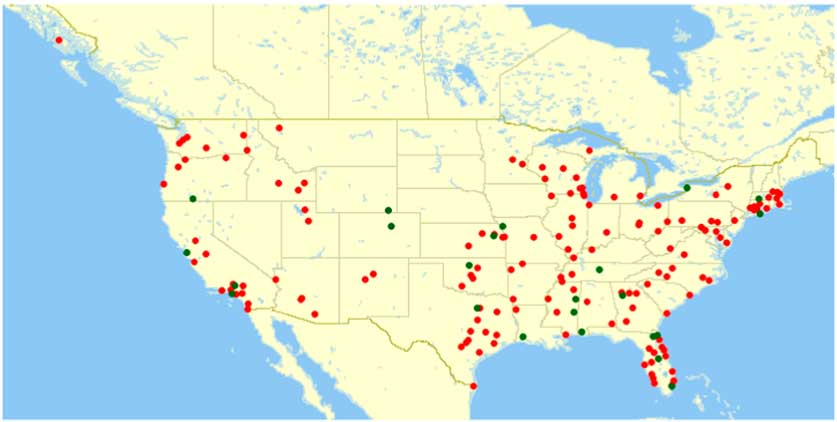
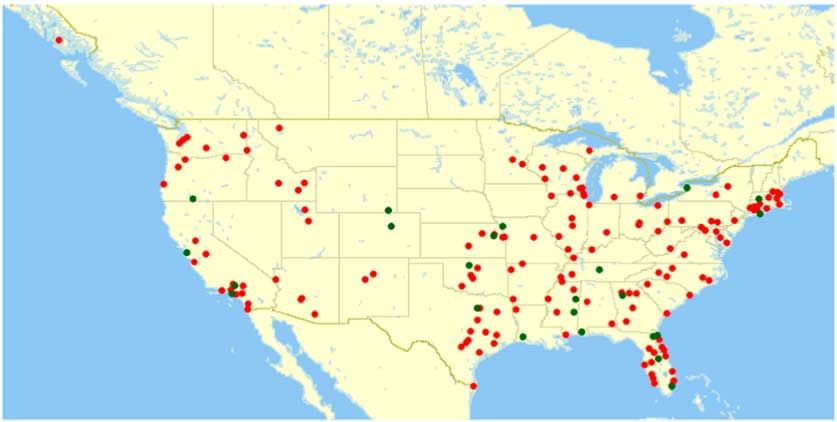
On March 22, 2013, the FAA granted 24 exemptions to contract towers determined critical to the national interest. Figure 1 illustrates the wide-ranging geographic distribution of the contract towers to be closed (in red) and the 24 national interest exemptions (in green). The FAA offered little justification or insight into the decision criteria used to arrive at their list of exempted airports, which led some observers to argue that the FAA and the DOT had used the appeal process to save the towers of political allies who were supportive of the administration (Bogardus and Laing Reference Bogardus and Laing2013). To invoke Wilson’s terminology, did the FAA avail itself of the opportunity to “define its tasks” to retain efficient towers and eliminate inefficient ones or did the agency cow to members making requests/demands through letter-marking?
Location of Federal Contract Tower Program towers.
Explaining FAA decisions to grant national interest exemptions
Given the FAA’s preference for a system of private towers that are economically efficient, and given the discussion above regarding the capacity of agencies to pursue their own priorities, we expect the FAA to rely on the most scientific, technically sophisticated and easily justifiable tool at its disposal when deciding which towers are granted national interest exemptions: the B-C ratio. In particular, consistent with Maor (Reference Maor2007) who argues that, when agencies possess professional tools rooted in science, they will use those tools to deflect political pressure during the allocation process while pursuing their own goals of efficiency and effectiveness, we expect the FAA to facilitate its own priorities by granting exemptions to towers with higher B-C ratios. Therefore:
H1: The probability of receiving a national interest exemption from the FAA increases as the tower’s B-C ratio increases.
In addition to this emphasis on bureaucratic preferences, scholarship on distributive politics stresses that administrative agencies will use the allocation of distributive benefits to build coalitions of members of Congress to strengthen support for the agency’s mission or to ensure increased appropriations (Arnold Reference Arnold1979). Cultivating such political support among elected officials may be especially wise, given that agencies are uncertain about the political environment (Krause Reference Krause2002, Reference Krause2003) and may seek to build support to avoid retribution from elected officials in the future (Carpenter and Lewis Reference Carpenter and Lewis2004). In this case, granting exemptions to members of Congress who request that the agency keep a tower from closing would be the FAA’s means of accomplishing this goal. Accordingly:
H2a: The probability of a tower receiving a national interest exemption increases as the number of letters from a member of Congress requesting an exemption for the tower increases.
Finally, we note that, although agencies may wish to cultivate congressional support, they may desire to do so on their own terms. In this case, given the FAA’s emphasis on scientific and technical expertise, if the agency wishes to grant exemptions in response to congressional requests, it should be more likely to do so when members make requests for towers whose B-C ratios are relatively high, that is, members may be unlikely to save inefficient towers, though they may be able to save efficient ones. This line of reasoning leads us to expect the following conditional hypothesis:
H2b: The probability of an exemption increases when members of Congress request exemptions for towers with higher, but not lower, B-C ratios.
Data and methods
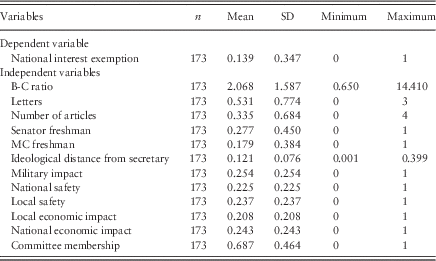
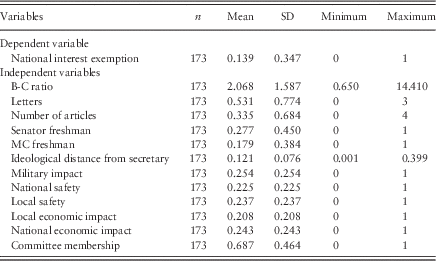
To assess these hypotheses, we employed an original data set of operational and political information from the 173 contract towers originally identified for closure by the OMB and FAA. Importantly, in this study, the unit of analysis is the distributive benefit (the tower), not the member of Congress. This focus allowed us to examine both the behaviour of members of Congress and the FAA in the allocation of distributive benefits. The dependent variable in our study was a dichotomous variable that indicates whether a tower received a national interest exemption from the FAA following the appeal process. The issuance of a national interest exemption was akin to the allocation of a distributive benefit in that it retained towers in districts that would have been lost owing to sequestration cuts by the OMB and FAA. In order to assess the effect of technical expertise and political pressure on the allocation decisions of agencies, we operationalised a number of variables using our unique data set (Table 1).
Summary statistics for variables of interest
B-C=benefit-cost; MC=member of Congress.
FAA B-C ratio
In order to measure agency policy preferences and the use of technical expertise by the FAA, we used the agency’s latest published B-C ratio for each tower in the FCTP. As previously stated, the FAA’s BCA compares the annual operating and capital costs of the contract tower to the benefit of the tower for the national airspace system through the rigorous quantification of avoided accidents, collisions, fatalities and aircraft damage because of the presence of an air traffic tower at the airport.Footnote 5 The overall B-C ratio for an airport is primarily driven by the level of traffic at an airport – as more traffic occurs at an airport, the benefit of the tower’s presence becomes greater as there is more potential for an accident. If a tower achieves a B-C ratio above 1.0, it is deemed to be a cost-beneficial project for federal investment. The higher the B-C ratio, the more operational importance the tower has on the FAA’s overall air traffic control programme. In our sample, the B-C ratios range from 0.65 to 14.41 with a mean of 2.068 and SD of 1.587, indicating a wide range of values for each tower. This wide range of B-C ratios is due largely to the crude criteria used by the OMB to determine the initial list for closure. For example, if an airport had 9,000 annual commercial operations (under the OMB threshold of 10,000 commercial operations) with a large aircraft such as a Boeing 767 or 777 and fewer than 150,000 total annual operations, it would be closed under the OMB criteria, but would have a very high B-C ratio owing to the large avoided fatality benefit associated with the large aircraft flying into the airport.Footnote 6
Congressional letter-marking
In order to construct our variables to measure congressional letter-marking, we obtained (through a Freedom of Information Act disclosure) 101 letters sent from members of Congress to the FAA and DOT during the national interest exemption appeal process. The letters contained a wide range of signatory arrangements – some letters were from individual senators and representatives relating to specific towers in their districts or states, whereas other letters were from entire state delegations touting the importance of all contract towers in their states. We read each letter to determine if a member of Congress made a request for a specific tower to receive a national interest exemption. Of the total 101 letters submitted, 98 letters asked that a specific contract tower be given a national interest exemption (with the other three letters expressing for the FCTP as a whole). In these 98 letters, there were 85 unique towers identified by members of Congress. We operationalised the variable by assigning a count for the number of letters written in support of a national interest exemption for each tower.
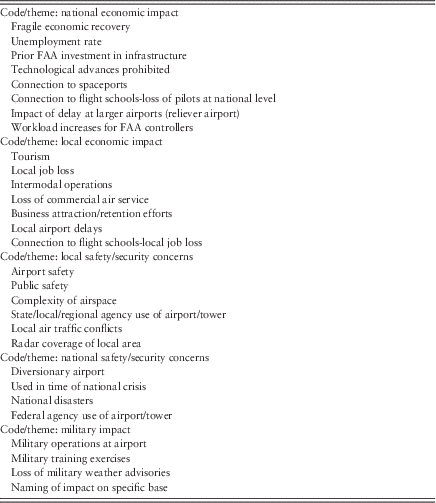
We coded each of the 98 letters to determine whether particular arguments made by members of Congress were more effective than others during the national interest exemption appeal process. Letters were coded according to five categories such as national safety impact, national economic impact, local safety impact, local economic impact and military impact (Table 2). After we personally coded the letters, we asked a graduate student to code the same letters using the same coding scheme, resulting in a Cohen’s κ score of 84%.Footnote 7 For each tower, each category was assigned a value of 0 or 1 depending upon whether each theme was identified in the letter, meaning one tower whose member of Congress wrote a letter on their behalf could have up to five possible themes.Footnote 8
Coding scheme for FCTP congressional sequestration letters
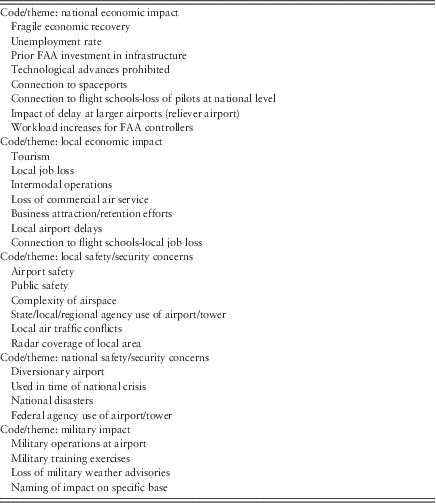
FCTP=Federal Contract Tower Program; FAA=Federal Aviation Administration.
Controls
In addition to the covariates of interest, we also included a series of control variables to account for other institutional factors that may have affected the impact of the letter on receiving a national interest exemption from the FAA. As previous literature suggests ideological congruence between members of Congress and the geographical allocation of distributive policy benefits by agencies (Bertelli and Grose Reference Bertelli and Grose2011), we included a measure of ideological distance between members of Congress and the cabinet secretary, in this case Ray LaHood, who served as the Secretary of Transportation from 23 January 2009 until 2 July 2013. We constructed the measure of Secretary – Congressman ideological distance as the absolute value of the difference between the Common Space DW-NOMINATE Scores for each senator and representative and that of the secretary. With Common Space DW-NOMINATE Scores, the House and Senate are scaled as if they are one legislature. A single ideal point was estimated for each member of Congress based on his or her entire record of service. Each legislator had the same ideal point throughout her entire record of service. Put differently, Common Space Scores placed members of the House and Senate in the same space allowing members to “be compared across chambers and across Congresses” (Poole Reference Roberts2005). We used the Common Space Scores estimated for the 113th Congress as of August 2013. These scores estimate members’ ideal points based on their legislative activity up through this date. As the unit of analysis was the tower, and each tower had two associated senators and one representative, we took the average ideological position of both senators and the representative to calculate the distance from their average position with that of the secretary. This method is consistent with the work of Nixon (2004) who used Common Space Scores to show that ideological congruence between Congress and the president was a significant factor in executive appointments.Footnote 9
Previous literature also suggests that senior members are more likely to receive federal benefits (see Roberts Reference Rundquist and Ferejohn1990; Lee Reference Lee2003, among others). To this end, we included a dummy variable coded as “1” if the member of Congress representing the airport was a freshman, and “0” if they were not. Previous work also suggests that agencies may choose to allocate benefits to members of Congress who serve on key committees in order to gain favour in policymaking (Arnold Reference Arnold1979; Evans Reference Evans2004). In this case, legislators serving on the FAA Authorizing and Appropriations Committees should be more likely to receive an exemption than their colleagues serving on different committees. We included a dichotomous variable coded as “1” if any member of Congress (two senators or representative) representing the airport served on the House Transportation and Infrastructure Aviation subcommittee, the Transportation, Housing and Urban Development subcommittee of the House Appropriations committee, the Senate Commerce Aviation subcommittee, or the Transportation, Housing and Urban Development subcommittee of the Senate Appropriations committee.
Another possible influence on the agency’s allocation decision is media coverage of the potential creation (or in our case, removal) of new projects in the community (Gordon Reference Gordon2011). To construct the control variable for media coverage variable, we used a collection of media stories contained on the USCTA website. Each time a story was published, the USCTA placed it in its website, usually the same day. We limited our sampling of media stories to the day following the announcement of the 173 tower closures by the OMB until the day before the FAA’s announcement of the national interest exemptions. During this time period, there were 116 news articles posted on the USCTA website. We read each article and determined if the article mentioned a specific tower. There were 106 unique articles that mentioned the closure of a specific tower. We then constructed a variable that was a count of the number of articles written about each tower.Footnote 10
In order to understand what factors contributed to the allocation of distributive policies, we estimated a series of models with the granting of a national interest exemption for local towers by the FAA as the dependent variable. Given the nature of this variable, we employed a logit specification. We use a logistic specification rather than a selection model due to the nature of the relationship between the dependent variable and the independent variable of interest -- the presence of a congressional letter. Specifically, because it was possible for a tower to receive a national interest exemption without their member of Congress writing a letter, it was inappropriate to use a selection model. The dependent variable in our models was the aforementioned binary measure coded as “1” if the tower received the national interest exemption, and “0” if they did not. As previously stated, the unit of analysis was the tower.
Results
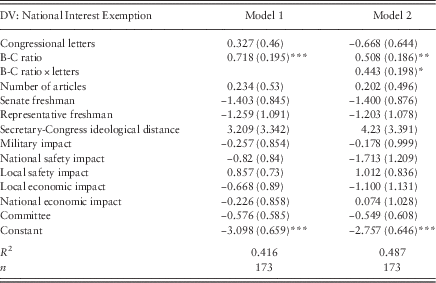
Table 3 presents the results of two models estimating the probability that an airport slated for closure received a national interest exemption. The first column presents the estimates of Model 1, which models the receipt of a national interest exemption as a function of both legislative-centred variables including legislator attention in the form of letter-marking and ideological congruence between legislators and the cabinet secretary, as well as a measure of agency policy preference and technical expertise through each tower’s B-C ratio. The second column presents the estimates of Model 2, which models the receipt of a national interest exemption as a function of these measures along with an interaction term that examines if the effect of congressional letters is conditioned by the tower’s B-C ratio.
Logit estimation of national interest exemptions
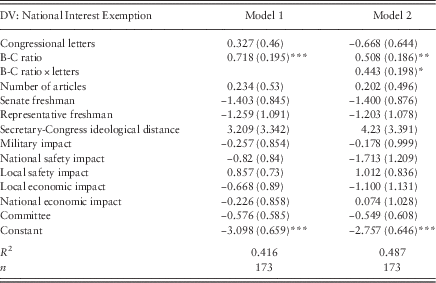
Note: The dependent variable is a binary measure of national interest exemption, where a “1” indicates the tower received an exemption. Robust standard errors in parentheses. The R 2 is McKelvey and Zavoina’s (1975) R 2.
B-C=benefit-cost.
*p<0.05; **p<0.01; ***p<0.001.
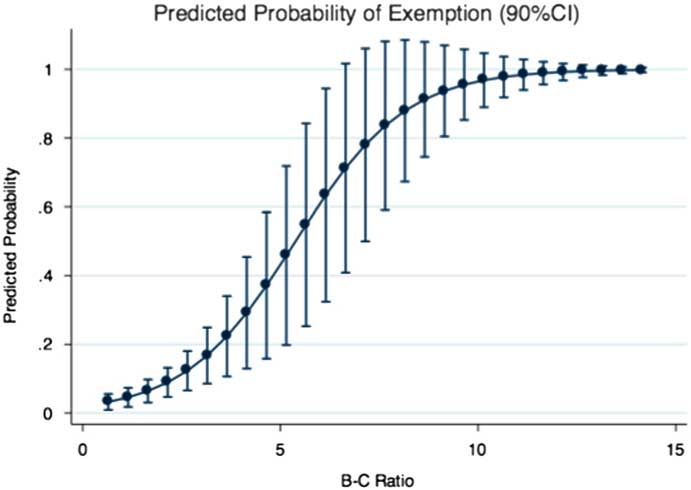
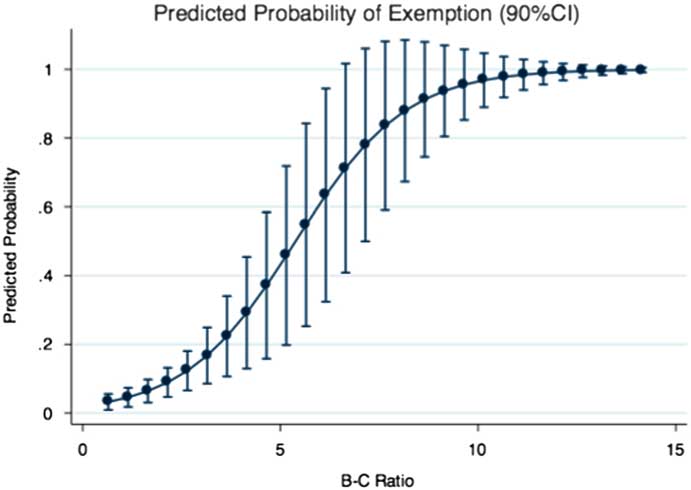
The results of Model 1 illustrate that a tower’s B-C ratio has a significant and positive effect on the probability that a tower receives a national interest exemption from the FAA, providing support for H1. Figure 2 presents the predicted probability of receiving an exemption based on this B-C ratio. As this figure illustrates, low values of B-C ratio are associated with a very low probability of receiving an exemption. As the B-C ratio increases, the predicted probability of receiving an exemption increases, with a B-C ratio of 8.15 or greater being associated with over a 90% probability of receiving an exemption. This suggests that the agency attempted to pursue their policy preference of maximising its scarce resources for air traffic control by relying on the B-C ratio to guide its national interest exemption decision-making process. Our analysis also finds no significant effect of ideological congruence on the allocation of national interest exemptions by the FAA.Footnote 11 , Footnote 12
Effect of benefit-cost (B-C) ratio on probability of national interest exemptions. CI=confidence interval.
Another key finding from Model 1 is that the presence of one or more letters from members of Congress requesting a national interest exemption was not a significant factor in the FAA’s decision-making process, which is inconsistent with our theoretical expectation in H2a. In addition, the letter content variables included in the model were not a significant factor in the FAA’s allocation of national interest exemptions.Footnote 13 This indicates that the indirect nature of letter-marking, when compared with earmarking, puts less pressure on the FAA to consider requests from members of Congress during the allocation process. Moreover, this finding suggests that letter-marking gives members of Congress much less leverage over agency allocation decisions than more direct tools such as earmarks.
In terms of our control variables, we found that there was no relationship between media coverage of a pending tower closure and the FAA’s allocation of national interest exemptions. We also included control variables for a number of institutional conditions in Model 1, specifically ideological congruence, membership on relevant authorisation and appropriations subcommittees, and tenure in office. Ideological congruence does not have a significant effect on whether the FAA issues a national interest exemption for a tower. Membership on authorisation or appropriations subcommittees does not have a significant effect on whether or not a tower receives a national interest exemption from the FAA. Tenure in office, measured as whether the senator or representative representing the region with the tower was a freshman in office during the 113th session of Congress, is also insignificant at conventional levels.
In order to assess the degree to which the effect of congressional letter-marking is conditioned by the B-C ratio, we estimated Model 2 with an interaction between B-C and the number of congressional letters received for each tower. We find a significant and positive effect of the interaction of B-C ratios and congressional letters on the allocation of national interest exemption, which suggests that the letters requesting national interest exemptions were only effective if the tower had a high B-C ratio. This confirms our theoretical expectation (H2b) that agencies simultaneously pursue their own policy preferences while managing future uncertainty by building coalitions of support by granting requests contained in letters from members of Congress.
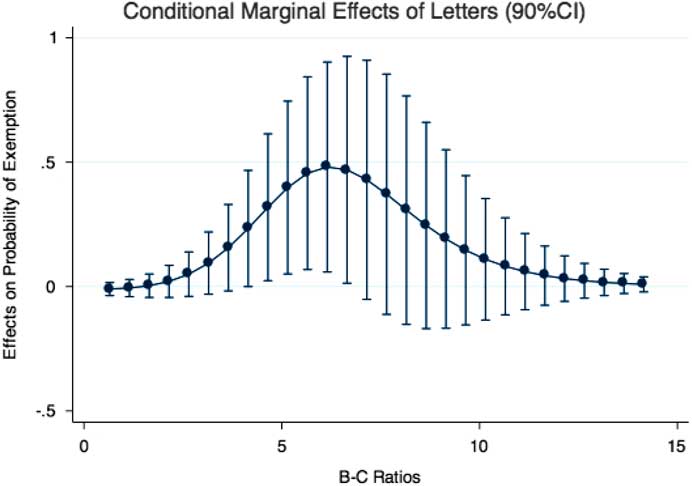
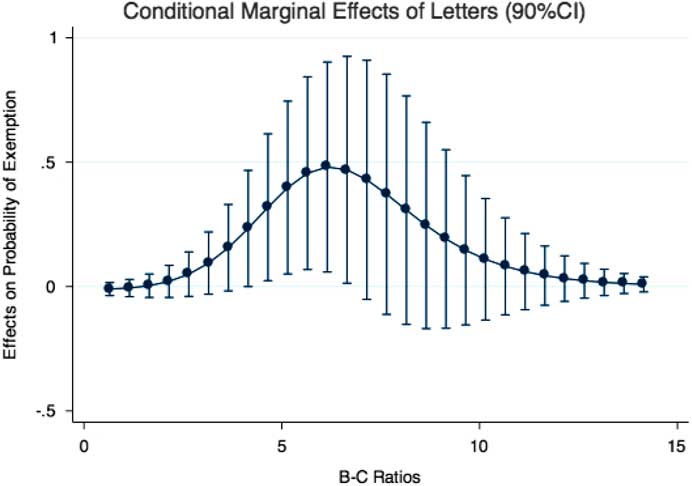
Looking specifically at the coefficients presented in Model 2, we see a positive and significant interaction between the B-C ratio and letter, indicating the effect of letter-marking is conditioned by the B-C ratio. Figure 3 displays the marginal effect of letter writing across a range of values of the B-C ratio with the associated 90% confidence intervals. Holding all other covariates at their means, this graph shows that the marginal effect of letter writing is not significant across the entire range of B-C ratios. Instead, the marginal effect of letters is significant between of 4.15 and 6.15. At these values, letter-marking increases the predicted chances of receiving an exemption by 22 and 45%, respectively. For the rest of the values, the effect of letter-marking is not significantly different from 0. Letters serve to increase the probability of an exemption for a small range of B-C values; however, in the majority of cases, where the B-C is high or low, letters have no independent effect. In reality, this constitutes a very small number of towers – seven of the 173 towers slated for closure (or 4%) had a B-C ratio between 4.15 and 6.15.
Marginal effects of additional congressional letters on national interest exemptions. B-C=benefit-cost; CI=confidence interval.
The results here provide a more nuanced examination of Arnold’s (Reference Arnold1979) argument that agencies are responsive to members of Congress to build support for their mission. Our findings suggest that the shift from earmarking to letter-marking gave the FAA more freedom to pursue its own policy preferences of efficiency and effectiveness through its BCA process, while at the same time allowing the agency to cultivate political support by granting national interest exemptions to towers with a high B-C ratio whose members of Congress wrote a letter to the agency. Although the lack of significant political covariants is surprising, it reinforces the fact that agencies retain significant discretion in the allocation of benefits relative to the members who write letters.
Discussion
The results of our analysis suggest that, when making decisions regarding the allocation of distributive benefits, agencies attempt to balance their own policy preferences with attempts to build a broad political base of support for their mission. In allocating national interest exemptions to save specific contract towers from closure, the FAA relied predominantly on its own policy preference for efficiency by using its BCA process to identify towers to remain in operation. Our findings confirm and expand upon the results of Krause (Reference Krause1996, Reference Krause2002, Reference Krause2003) and O’Toole and Meier (Reference Nixon1999) by providing a detailed account of the mechanism and rationale for an agency’s ability to pursue their own policy preferences. Our findings also reinforce the argument advanced by Carpenter (Reference Carpenter2001) who found that middle managers responsible for the allocation of distributive benefits are often able to deprioritise the goals of members of Congress while furthering the policy preferences of the agency. Given the highly politicised environment around the issuance of the national interest exemptions, the FAA’s BCA process allowed the agency to professionalise the allocation decision while also pursuing its own policy preference – the maximisation of funding for the most cost-beneficial towers.
Another key finding from our analysis is that, while the congressional letter-marking in and of itself had little effect on the agency’s allocation decision, the FAA did grant exemptions when it received a letter from members of Congress -- but only when the issuing of distributive benefits would further the agency’s own policy preference of increased efficiency. This result suggests that indirect tools used by members of Congress to request distributive benefits through letter-marking give members less leverage over agency allocation decisions (Sciara Reference Stein and Bickers2012). However, consistent with the work of Arnold (Reference Arnold1979) and Krause (Reference Krause2002, Reference Krause2003), our findings indicate that agencies act strategically to cultivate political support for their mission to manage future uncertainty by allocating distributive benefits in such a way as to satisfy requests made by members of Congress in letters to the them. Further, our analysis also suggests that agencies decide which requests to honour, not through a political calculation, but rather by using technical expertise and public management practices to allocate distributive benefits.
Our findings also provide a nuanced empirical test for Ting’s (2012) theoretical model of politicised and professionalised allocation decisions by showing that the shift from earmarking to letter-marking reduces direct political influence over allocations. Interestingly, politicisation (in our case letter-marking) had little direct effect on the FAA’s decision-making process. However, as the agency professionalised its decision-making process to pursue its preference of maximising the efficiency of the FCTP, the agency issued exemptions to marginal towers if they had received a letter from a member of Congress requesting an exemption. This result suggests that the political effect described by Ting (2012) is conditioned by agency policy preferences (in this case, the results of the BCA). As such, members of Congress may be motivated to try to micromanage agency processes that rely on technical expertise, such as BCA processes, to ensure the continued flow of distributive benefits to their districts in an era of letter-marking (Citation #4).
Finally, contrary to the work of Bertelli and Grose (Reference Bertelli and Grose2011), we find no relationship between the allocation of national interest exemptions by the FAA and ideological congruence between members of Congress and the Secretary of the DOT. We believe there are several reasons for this finding. First, our case may not be the most appropriate to test the effect of ideological congruence, given the uniqueness of the ideological affiliations of Secretary of Transportation Ray LaHood who was a Republican in Congress and who now serves in a democratic administration. Second, the lack of significance of ideological congruence may be a result of the agency trying to maximise its resources, given significant budgetary challenges imposed by sequestration. Finally, owing to the fairly tight allocational decision timeframe facing the FAA, it may be the case that the agency did not have the time to think strategically about the political implications of its decision and instead relied on the BCA as a more familiar and expedient decision-making process. More research that takes into account agency preferences is needed to further develop theory on the effect of ideological congruence on distributive benefit allocations.
Conclusion
When making decisions about the allocation of distributive benefits, agencies must find a balance between external pressures and internal preferences. Previous literature on distributive benefit allocation has omitted agency preferences in the analysis of the factors that drive the allocation decision-making process. Using the case of the FCTP and the issuance of national interest exemptions by the FAA, our novel design assessed the effect of agency policy preferences and congressional letter-marking on allocations of distributive benefits. Our analysis suggests that, in highly politicised environments, agencies will rely on their own policy preferences to guide distributive benefit allocations while also honouring congressional requests when it meets their policy objectives to cultivate political support for the agency’s mission. In issuing national interest exemptions to keep certain towers open, the FAA relied predominantly on its technical BCA process to guide its decision-making process, consistent with its own priorities. Although members of Congress penned over 100 letters demanding that towers in their district be saved, letter-marking only affected the FAA’s allocation decision when its BCA process identified the tower as a high-value project.
The findings from this study have implications for understanding bureaucratic and congressional politics, especially in an era of tight budgets. Specifically, these findings suggest that, as agency budget allocations from members of Congress tighten, agencies will look to maximise their scarce resources by using technical expertise and decision-making criteria to assess the relative value of distributive projects overseen or funded by the agency. This finding is consistent with Wilson’s (Reference Wilson1989) classic observation that agencies can achieve discretion by “defining tasks”, especially in procedural organisations such as the FAA and other regulatory agencies. This finding is also consistent with a myriad of research, discussed above, on the capacity of agencies to foster their own priorities. Critically, we find that this capacity extends to the distribution of benefits about which members of Congress care.
Accordingly, our findings also have implications for understanding distributive politics in Congress. The increasingly prevalent practice of letter-marking had little effect on the allocation of distributive benefits by the FAA, which may suggest that the recently enacted moratorium on earmarks due to concerns about budget austerity gives members of Congress less leverage in funnelling projects to their districts. Moreover, this lack of leverage may encourage members of Congress to micromanage agency decision-making processes through authorisation and appropriations language (Nixon Reference Nixon2012; MacDonald Reference MacDonald2010; Mills Reference Mills2013). In addition, it might also be the case that agencies attempt to preemptively placate requests by members of Congress for projects in their districts by relying on decision criteria that spread benefits to a geographically diverse set of constituents to build broad support for the agency. Finally, our findings suggest that members of Congress may engage in a more rigorous evaluation of a local project before deciding to publically support or advocate for the project. This result suggests that members of Congress will increasingly have to weigh national budget priorities against their distributive needs to support local “pork barrel projects” in their districts.
Acknowledgements
We are grateful for all comments provided by participants at these conferences. In addition, we are grateful for valuable input from Dan Carpenter, Don Moynihan and Mike Ting.