Introduction
Around the world, one and a half billion people face threats of violence. Peace brings hope for an end to violence and coercive governance. However, a defining feature of postconflict environments is the large number of citizens who vote for political parties with deep roots in the violent organizations of the past. Indeed, despite their use of violence, civil war successor parties emerge from nearly every war termination and remain central figures in the politics of countries transitioning from conflict to peace, on average capturing a majority of the electorate’s votes. They win elections in all regions of the world and across a variety of political contexts: in the aftermath of wars both long and short, in countries rich and poor, in ethnic and nonethnic societies, and in the presence and absence of peacekeepers. At times, voters cast their ballots in favor of parties with atrocious pasts from the incumbent side and from the side of the rebels; from the right and left of the political spectrum. This behavior raises theoretically provocative questions: Why, after episodes of mass violence, do citizens elect belligerent actors, including those who used violence against the civilian population? How do violent actors win votes?
Although many factors influence postwar voting, psychology and recent findings in political science would lead us to expect that past victimization should have lasting political legacies, and that at the polls, the electorate should punish belligerents for this victimization.Footnote 1 At the same time, civil war actors vary in their use of atrocities,Footnote 2 so we should expect that the parties garnering postwar electoral support were restrained rather than indiscriminate in their wartime use of violence. I test these hypotheses using cross-national, subnational, and individual-level data. Surprisingly, I find that indiscriminately violent actors performed, on average, just as well in postwar elections as those who were restrained in their use of violence against civilians. Terrorized regions voted for belligerents’ successor parties in equal measure to regions unscathed by the belligerents’ wartime campaigns. And victims as well as nonvictims voted for the belligerents who carried out violence against the population. Wartime violence does not chiefly guide postwar electoral outcomes in the founding elections, nor does coercion. I find that despite irregularities in the first set of postwar elections, these votes are often cast voluntarily, freely, and fairly.
I argue that it is not the least bloodstained or most fraudulent rebel and incumbent parties that emerge victorious in these elections. Instead, belligerent parties’ electoral success depends on the military balance of power at war’s end. Military strength translates into votes through two mechanisms that I call “security voting” and “mitigating the violent past.” The consolidation of security proves highly salient for voters after war, and they electorally reward the militarily stronger belligerent for bringing gains in security. This follows a variant of the canonical retrospective voting logic. However, rather than economics dominating voters’ strategic calculations, security plays an important role: “Good times [that is, security and peace get] parties [into] office; bad times cast them out.”Footnote 3 Belligerents’ relative military strength at war’s end further signals prospective credibility and competence on security issues, enabling them to own the security valence issue.Footnote 4 These safety concerns cross classes, regions, ethnicities, and sectors. Winning the security vote therefore enables successor parties to reach beyond their hardcore supporters and appeal to significant swing and contested voters.
Critically, the security gains attributed to the stronger belligerent offsets the belligerent’s use of atrocities, allowing it largely to evade culpability for violence. In deciding whether to give their vote to political actors who, at times, committed atrocious crimes against humanity, citizens act like any judge or jury and consider mitigating circumstances. Provision of security, peace, and order ranks high among these circumstances. The attribution of responsibility for wartime violence and credit for peace does not happen in a vacuum, however; it takes place in a propaganda crossfire between the former warring parties over the narrative of the war. I propose that armed with a story that resonates and a superior propaganda machine, the stronger belligerent tends to control the writing of this history. The insight that perceived, spun violence—as opposed to objective, factual violence—matters for the attribution of blame enables us to understand voting for violent actors as consistent with individual and collective rationality.
To demonstrate the relationship between relative military strength at war’s end and postwar electoral outcomes, I use new cross-national data that I collected on all belligerents who transitioned from civil war in 1970 to 2010. I evaluate the theory’s mechanisms of security voting and mitigating the violent past with rich interview, archival, and survey data from El Salvador. I tease out whether belligerents’ electoral success follows alternative pathways. In particular, I demonstrate empirically, with quantitative and qualitative evidence, that it is not belligerents’ incumbency status, wartime popular support, provision of public goods, organizational cohesion, financing, or use of intimidation that drives postwar votes or the strong link between wartime fighting capacity and postwar electoral success.
Postwar Politics, Legacies of Violence, and Counterintuitive Voting
In addressing the question of why people elect candidates who used violence against the civilian population, this article contributes to several literatures. First, it adds to the literature on postwar politics. We know surprisingly little about the strategic landscape of parties and voters in the aftermath of civil war. Exciting literatures exist on armed electoral politicsFootnote 5 and the transition to democracy after wars,Footnote 6 and there is a vast body of scholarship on mainstream, nonviolent political behavior, but almost nothing bridges the gap between these subjects.Footnote 7 This article picks up where the postwar democratization literature lets off, and offers an argument to understand and predict who is likely to dominate the postwar electoral arena, how parties campaign and voters cast their ballots in this arena, and when political power is likely to remain in the hands of formerly coercive actors.Footnote 8 First postwar elections prove foundational, setting nations on path-dependent courses. Most civil war successor parties remain key players on the political stage decades after terminating their wars. This article considers not only the postwar parties that represent the ideological and organizational characteristicsFootnote 9 of the rebel side, as is the trend in the literature,Footnote 10 but also those born from the government side of the conflict. The sole theory we have on the latter comes from scholarship on authoritarian successor parties,Footnote 11 of which only a minority emerge from civil war.Footnote 12 Equipped with knowledge of postwar elections, future analyses can explore how having these types of formerly coercive politicians in office can affect the quality of democracy and governance.
By theorizing about politics after war, this article extends a new body of literature on political legacies of violence that examines whether victimization increases political participation.Footnote 13 I explore how victimized populations participate, whom they reject or endorse, and when violence influences political behavior. Rather than look at intergenerational effects, as recent scholarship does,Footnote 14 I look at the founding postwar elections.
The article also adds to our understanding of why people vote in counterintuitive ways, seemingly against their self-interest. Existing studies focus predominantly on why people behave electorally against their material self-interest.Footnote 15 For example, lower-class voters in the United States support Republican candidates who advocate policies that benefit the rich.Footnote 16 In India, poor Dalits vote for the Bharatiya Janata Party, whose elite agenda blocks redistributive programmatic policies.Footnote 17 John Huber and Piero Stanig find that large proportions of voters around the world support the “wrong” party from an income perspective.Footnote 18 Others vote against their ostensible self-interest defined more broadly. Immigrants voted for Donald Trump despite his anti-immigrant agenda.Footnote 19 Brazilian candidate Jair Bolsonaro won votes even among groups he had insulted.Footnote 20 This article extends the research agenda on seemingly irrational voting by shedding light on why, once populations victimized by civil war belligerents manage to gain peace, they vote for these very same actors to govern their countries. It adds to the growing literature on why voters elect candidates with known ties to criminals in India,Footnote 21 militias in Colombia and Brazil,Footnote 22 warlords in Central Asia and Africa,Footnote 23 and corruption in Latin America.Footnote 24 And it helps to explain when and why electorates might prefer security to justice.Footnote 25 In the conclusion, I turn to additional implications of the findings for existing and future research.
Explaining the Success of Civil War Successor Parties
After suffering wartime violence and winning peace, why do millions of people around the world elect to live under the rule of political actors with violent pasts?
Wartime Victimization
Insights from psychology and political science would lead us to expect that a population plagued by massacres, kidnapping, rape, and extortion should vote against rather than for the actors who carried out the atrocities. Tortured by direct and indirect violence, citizens should feel anger and indignation. These emotions should, in turn, fuel a desire for punitive action against the perpetrators, and should increase prejudice, blame, and exclusionist attitudes.Footnote 26
The relationship between violence and wartime civilian response has been well studied. For example, Stathis KalyvasFootnote 27 and Luke Condra and Jacob ShapiroFootnote 28 demonstrate theoretically and empirically that indiscriminate violence backfires, with citizens turning against the violent group. Similarly, Daphna Canetti and colleaguesFootnote 29 and Claude Berrebi and Esteban KlorFootnote 30 show how terrorist violence has created a civilian backlash against perpetrators of violence in Israel. Extending this analysis to the postconflict environment, Laia Balcells illustrates how wartime victimization in Spain triggered revenge, leading to long-lasting electoral nonsupport for political parties associated with the perpetrators and support for parties with rival identities.Footnote 31 In their recent work on Ukraine, Noam Lupu and Leonid PeisakhinFootnote 32 and Arturas Rozenas, Sebastian Schutte, and Yuri ZhukovFootnote 33 affirm these legacies, revealing that the descendants of those who suffered intensely from indiscriminate Soviet violence hold more hostile attitudes toward Russia.
Of course, not all civil war belligerents perpetrate the same high levels of atrocity. It follows that the most intuitive explanation for the puzzle of post civil–war party success would offer that those victorious electorally must have been (more) restrained in their use of indiscriminate violence and that the votes they won must have come from those who were not victims of that violence. The vengeful voting logic yields the following hypotheses:
Hypotheses on National-Level Dynamics
—H1.1. The electoral success of belligerent successor parties should be greater following conflicts in which the belligerents carried out only restrained violence.
—H1.2. The electoral success of belligerent successor parties should be greater following conflicts in which the opposition carried out indiscriminate atrocities.
—H1.3. The electoral success of belligerent successor parties should be greater following conflicts in which the opposition carried out a greater share of atrocities than the belligerents.
Hypotheses on Subnational-Level Dynamics
—H1.4. The electoral success of belligerent successor parties should be greater in regions where the belligerent carried out only restrained violence.
—H1.5. The electoral success of belligerent successor parties should be greater in regions where the opposition carried out indiscriminate atrocities.
—H1.6. The electoral success of belligerent successor parties should be greater in regions where the opposition carried out a greater share of atrocities than the belligerents.
Hypotheses on Individual-Level Dynamics
—H1.7. Victims should vote against their perpetrators’ successor parties.
—H1.8. Victims should vote for political actors with identities that rival those of their perpetrators.
Surely populations, and victims in particular, may feel extreme indignation, anger, and even hatred about the violence perpetrated. But sometimes they do not.Footnote 34 This article challenges the automatic translation of victimization into vengeful voting, denying not the critical impact of violence on politics, but the fact that the violence is objectively understood, processed, and perceived, especially in the immediate aftermath of war. It argues instead that military war outcomes produce asymmetry in the attribution of blame for the violence—whom the victimized populations will punish, and why—and that therefore, perceptions of culpability do not track with the intensity of the crimes committed.Footnote 35
Coercion
The literature on the political legacies of violence seeks to explain voluntary political reactions. But a second framework holds that voters might support politicians with unsavory pasts not out of affinity, but out of coercion—with guns to their heads—rendering their electoral behavior unsurprising.Footnote 36 Although there is limited scholarship on the dynamics of coerced voting in postwar contexts, during war,Footnote 37 and in nonconflict environments,Footnote 38 scholars demonstrate that electoral intimidation has a powerful ability to sway voters.Footnote 39 Daron Acemoglu, James Robinson, and Rafael Santos, for example, reveal how parties exploited paramilitaries to win elections in Colombia.Footnote 40 Paul Collier and Pedro VicenteFootnote 41 formally model how violence marred a Nigerian election, and Robinson and Ragnar TorvikFootnote 42 determine that parties in Zimbabwe used repression to exclude swing voters.Footnote 43 The implication of this literature would be that coercion drives the puzzling votes for civil war successor parties, suggesting the following observable implications:
Hypothesis on National-Level Dynamics
—H2.1. The vote share of civil war successor parties should correlate with their use of electoral intimidation, violence, and fraud.
Hypothesis on Subnational-Level Dynamics
—H2.2. Belligerent successor parties should perform better electorally in regions with high levels of electoral intimidation, violence, and fraud.
Hypothesis on Individual-Level Dynamics
—H2.3. Individuals subject to voter intimidation, violence, and fraud should be more likely to vote for civil war successor parties.
Electoral coercion can no doubt account for some of the empirical regularity of votes for victimizers.Footnote 44 War does not become peace overnight,Footnote 45 and postwar democracies often remain partial and poorly institutionalized. But parties with violent pasts win elections even where violence has ended and political contests are deemed free and fair. They win not only the votes of the vulnerable but also those of the least vulnerable, who are casting their ballots freely. They win over time, even as the memory of coercion fades, and they receive voters’ ballots and their attitudinal support. This article does not deny the existence of coerced votes in postwar elections, but seeks to explain the puzzling, abundant, voluntary votes for actors with violent legacies.
Argument: Voting for Victors
Normal Politics in Abnormal Times
I start with the premise that to understand political life after violence, we must understand belligerent successors as parties who seek to prove their competence to the electorate, own salient issues, create party brands, and sway voters through propaganda. We must also understand victims and nonvictims as voters who rationally engage in retrospective and prospective assessmentsFootnote 46 and respond to programmatic and nonprogrammatic appeals. And we must see the two—belligerent parties and war-affected voters—as engaged in strategic interaction to cull votes and seek representation.Footnote 47 However, I depart from the mainstream politics approach by arguing that the issues dominating this transitional period differ from those salient during normal times.Footnote 48 In particular, security—concern for personal safety, political stability, law and order, and the absence of violence—is critical. As former Burundian President Domitien Ndayizeye summarized, “The people [are] desperate for peace.”Footnote 49 In emotional terms, if “fear prepares the individual to satisfy safety concerns” and “heightens the desire for security,”Footnote 50 the provision of such security reduces fear, and citizens seek to insulate themselves from its potential return. To explain postwar election results therefore requires an understanding of which party can own the salient security valence issue.
Credit for Security Improvements
I argue that voters credit and electorally reward the militarily stronger actor at the end of the war for bringing order and stability. If the war ends in a decisive military outcome, conflict termination is attributed to the stronger—in this case victorious—belligerent: it defeated its adversary and thereby brought an end to the conflict and violence. If the war ends in stalemate, but with one actor relatively stronger, that actor will be credited with peace: it was in a better position to continue fighting, but did not, opting instead to end its violence.
Security Voting: Owning the Security Issue
Security constitutes a valence issue—as coined by Donald Stokes,Footnote 51 a consensual issue for which parties are judged not on “the ultimate objective of policy” but “on proving competence around the issue.”Footnote 52 Attributed with gains in security, militarily stronger belligerents signal a positive reputation for expertiseFootnote 53 and credibility on peace and order issues, rendering their violent past a “competency advantage.”Footnote 54 They are deemed able to provide security in a way that the weaker belligerents and parties without roots in the civil war cannot.Footnote 55 Thus the stronger belligerent successor party owns the security valence issue during the highly uncertain time of political transition.
Importantly, safety issues often crosscut social cleavages like class, region, and ethnicity, and appeal to the undecided and weakly aligned voters in postwar environments who worry about the implementation of peace. Owning this issue therefore enables the stronger belligerent to cull votes not only from core constituencies, but also from independent or contested voters. This is significant because belligerents’ social bases tend to be more extreme than the “prototypical” voter is,Footnote 56 so achieving electoral success depends on their ability to reach beyond their wartime hardcore constituencies, and to build a multisector coalition.Footnote 57
Where belligerents used violence only in a restrained fashion, security voting operates as the sole mechanism by which military strength translates into electoral success. But in cases where the stronger belligerents committed indiscriminate violence against civilians, their violent past not only wins them security votes, but also punishes them with vengeful votes. Understanding why the former trumps the latter, causing the militarily strong belligerents to win elections, requires an interpretation of how citizens attribute responsibility for wartime violence.Footnote 58
Mitigating the Violent Past
I argue that the stronger belligerent’s provision of peace alters the cognitive process by which individuals attribute blame. I treat post-war voters as “intuitive prosecutors”Footnote 59 who engage in a “sense-making process” to interpret the violent past and “how their offenders should be viewed and treated.”Footnote 60 Voters consider not only the crimes committed, but also the mitigating circumstances surrounding those crimes. Provision of security ranks top among the extenuating factors. Violence elicits “the cognition that [the belligerent] has committed a bad action against one’s self or group”Footnote 61 and produces anger and a desire for revenge. However, security—relief from the negative emotion of fear—moderates that cognition, as the belligerent has also committed a good action by reducing fear. This may render the cognition neutral, short-circuiting the revenge mechanism. Thus the stronger belligerent—attributed with bringing security—can largely evade culpability. As a result, victimized populations and even victims themselves vote for the perpetrators of violence against them. Meanwhile, the weaker belligerent lacks recognition for security gains, so the atrocities its forces committed remain unmitigated. In voters’ eyes, this belligerent’s violence brought no peace, but only death and destruction. The weaker belligerent therefore is blamed for the war in general.
Spin and Propaganda
These biased and asymmetrical attributions do not happen in a vacuum. Rather, they take place in a propaganda crossfire between the former warring parties. I argue that the stronger belligerent’s version of history tends to win this battle, both because its version resonates with the citizenry, which credits it with security that mitigates blame for the atrocities (“stories that confirm what we already know are the ones most likely to take root”),Footnote 62 and because the stronger belligerent tends to possess a more powerful media machine to amplify its narrative.Footnote 63 Using rhetoric, framing, and marketing, the stronger belligerent captures and harnesses the power of propaganda to mediate the relationship between atrocity and political reaction, thus swaying citizens’ behavior in its favor.Footnote 64
This article’s logic helps to explain why, even though the army and paramilitaries carried out violence equal to that perpetrated by the FARCFootnote 65 rebels in Colombia,Footnote 66 the militarily defeated FARC bore the brunt of citizens’ anger, and why President Álvaro Uribe, credited with bringing security gains, avoided blame for atrocities committed during his administration’s successful military campaigns.Footnote 67 It also helps to explain why, despite carrying out genocide in Guatemala’s Western highlands, Efraín Rios Montt’s militarily victorious Guatemalan Republican Front was viewed as the “great pacifier” in these same areasFootnote 68 and why his “victims voted for his party in droves.”Footnote 69 The logic holds true even in ethnic contexts. At the end of the war in Burundi, many Tutsis crossed ethnic lines to vote for the Hutu party best able to offer security.Footnote 70 In Rwanda, the Tutsi-led Rwandan Patriotic Front was “credited by many Rwandans—Hutu and Tutsi alike—with having ended the 1994 genocide,” and was seen as best able to “guarantee” security.Footnote 71 The party thereby won by a landslide, with a vast majority of its votes coming from Hutus. In Iraq’s 2018 election, large numbers of Sunnis voted for Shiite cleric Muqtada al-Sadr’s political list Sa’iroun (Moving Forward) and the Da’wa Shia sectarian party, in part because of their effective fight against ISIS.Footnote 72
From my framework, I derive the following observable implications:
Hypothesis on National-Level Dynamics
—H3.1. The electoral success of belligerent successor parties in the founding national elections should correlate with their relative military strength at the end of the war.
Hypotheses on Party Dynamics
—H3.2. Successor parties should aim to claim credit for peace and to own the security valence issue.
—H3.3. Successor parties should seek to spin their own past violence and cast blame for the war on their adversaries.
Hypotheses on Individual-Level Dynamics
—H3.4. Individuals should credit the militarily stronger party at war’s end with peace.
—H3.5. Individuals should deem the militarily stronger party as most competent on the maintenance of security going forward.
—H3.6. Swing voters should vote for the militarily stronger party.
—H3.7. Individuals should attribute responsibility for past violence in a biased and asymmetrical fashion, blaming the militarily weaker party disproportionately for the war.
Research Design
The puzzle I seek to explain and the observable implications of the different explanations vary across violent actors, across regions within countries, and across voters. Moreover, they prove amenable to testing with different methodologies. I therefore adopt a multilevel, multi-method research design.
I constructed an original, cross-national data set of postwar politics from 1970 to 2010 to establish the universe of cases and broad correlates of postwar electoral success globally. To my knowledge, this is the first data set to study postwar electoral outcomes. It traces the successor parties of both the rebel side and the government side of the conflict, and identifies the vote share for parties without a violent past.
Victimization, coercion, and voting, however, are not evenly distributed across regions of countries. I therefore examine subnational data on postwar elections in El Salvador. I chose this case because (1) wartime violence was extremely asymmetric, offering a sharp test of the vengeful voting theory; (2) the Truth and Reconciliation Commission (TRC) reported in 1993, before the founding election, so voters could have known the “facts” of the violence before casting their votes; and (3) the conflict ended in military stalemate, but with one side relatively stronger, offering a harder case for my military strength argument, which should be most pronounced in cases of military victory/defeat.
Because the theory has implications for individuals’ voting behavior and political attitudes, I explore survey data from the Latin American Public Opinion Project (LAPOP), Instituto Universitario de Opinión Pública (IUDOP), and Consultoría Interdisciplinaria en Desarrollo (CID– Gallup) to understand issue salience, perceived issue ownership, and differential voting patterns among core versus swing voters and victims versus nonvictims.
My theoretical expectations tell the story of a process, so I need to understand if the party and voter protagonists spoke and acted as the theory would predict. Moreover, the mechanisms of security voting and mitigating the violent past are best tested with rich qualitative data. I therefore conducted fieldwork in El Salvador, interviewing key players on the government and rebel sides, including former presidents, presidential candidates, senators, mayors, military commanders, party campaign strategists, and peace negotiators, as well as victims and United Nations officers, academics, civil society leaders, and journalists. I also collected newspaper, radio, television, and campaign data from multiple archives, including those of the Salvadoran newspaper, El Diario de Hoy; the Salvadoran National Museum of Anthropology archive of La Prensa Gráfica; the archives of Sebastián Alejos, 1994 campaign manager for the Farabundo Martí Liberation Front (FMLN); the archives of the Nationalist Republican Alliance (ARENA)’s campaign strategist Manuel Melendez; the archives of the Centro de Información, Documentación y Apoyo a la Investigación (CIDAI); the Museo de la Palabra e Imagen archives of historical interviews with candidates and FMLN radio transcripts; and the Archivos Perdidos, which include 250 hours of broadcast material. These interview and archival records revealed the platforms on which the parties ran, how strong versus weak belligerents dealt with their pasts, how victims perceived the violence, who controlled the media and how it was harnessed, and whether the successor parties succeeded or failed at political framing.
I first describe the cross-national data and results, and then I turn to the subnational- and individual-level data and qualitative case evidence.
Cross-National Data Set
I constructed a new, cross-national data set of all belligerents who transitioned from civil war in the years 1970 to 2010. The database sets the belligerent in a specific conflict episode as the unit of observation, allowing for multiparty civil wars. It draws on the UCDP/PRIOFootnote 73 Armed Conflicts Dataset, which defines civil war as any armed and organized confrontation between government troops and rebel organizations that reaches an annual battle death threshold of twenty-five.Footnote 74 I restrict the data set to conflicts that exceeded one thousand battle-related deaths over their duration, according to the UCDP cumulative intensity variable. I use the UCDP Conflict Termination Dataset as a first check as to whether the conflicts have ended.Footnote 75 This data set defines termination as an active year “followed by a year in which there are fewer than 25 battle-related deaths.” Some conflicts, though deemed ended by these criteria, did not even briefly demilitarize; the groups were merely unable to cross the violence threshold for a period. I therefore use the UCDP Encyclopedia and extensive qualitative sources to verify that each belligerent had transitioned from violence. The coding decisions of each case may be found in the supplementary material.Footnote 76
Selection
Selection issues might bias the picture I paint of postwar politics. My universe of cases consists of all conflicts that ended and were followed by elections. I examine the full set of cases in this universe. Of course, the electoral success of groups who chose not to end their fighting and of former belligerents who did not run for office are unobservable. It may be that groups who believed they would perform dismally in founding elections chose not to disarm or not to participate in elections.
Several pieces of evidence moderate these selection concerns. Many groups in the sample that did run gained less than 1 percent of the vote. It is possible that these groups misestimated their electoral success, but it is hard to believe they could have done so by such large margins, which suggests that unpopular groups still do try their hand at the polls. Additionally, only eight groups in the sample boycotted the elections. I code these results as 0 and as a robustness check, drop them from the sample.Footnote 77 Elections took place in the vast majority of postconflict countriesFootnote 78 and only four groups were banned from running, indicating that electoral runs by successor parties were widespread; nearly every case of civil war that ended in the period 1970 to 2010 had belligerents participating in postwar elections. Dawn Brancati and Jack Snyder find only three cases in which postwar elections did not occur.Footnote 79 Moreover, the norm of democratic contestation has become so strong internationallyFootnote 80 that it leads belligerents to trade bullets for ballots, even when doing so may not be a rational strategy.Footnote 81
Nonetheless, because war termination and elections are nonrandomly assigned and sound instrumental variables are unlikely, I seek to properly specify control variables to account for the potential selection bias.Footnote 82 To accurately assess the explanatory leverage of military strength on elections, I pay great attention to factors that might affect both relative strength at war’s end and electoral performance in the founding elections. The literature on conflict and peace suggests five variables that might confound this relationship, bias the estimated coefficient, and influence the likelihood of conflict termination, specific terms of termination, and elections: external guarantees, power sharing, veto players, conflict type, and war duration.Footnote 83
I include a UN intervention variable, derived from Brancati and Snyder,Footnote 84 which captures whether the UN intervened through mediation, observation, peacekeeping, or enforcement. Such intervention should both provide external guarantees, enabling the actors to end their armed struggles,Footnote 85 and also render elections and successor parties more likely because belligerents’ participation in politics has become part of the UN’s peace-building recipe.Footnote 86 Power sharing should similarly facilitate conflict termination by enabling internal guarantees of the peace terms.Footnote 87 I use the Peace Agreement Dataset’s shagov variable,Footnote 88 indicating the presence of power-sharing provisions. This variable also helps control for the nature of the electoral system, and may influence whether independent truth and reconciliation efforts exist and whether both sides are able to define subjective violence independently. I include the number of veto players (belligerents who were clearly autonomous, cohesive, and viable), which David Cunningham has demonstrated renders bargaining more challenging and war longer.Footnote 89 The number of civil war players may also affect relative strength, the number of parties in the system, the civil war successors’ decision to run in the elections, and their vote shares. It may also influence the challenge of attributing blame. Finally, from the UCDP data set, I include a variable capturing war duration and another indicating the nature of the incompatibility, because longer-lasting conflicts and those fought over territory tend to be harder to resolve.Footnote 90
Outcome Variable
Electoral data are collected for the founding elections, that is, the first postconflict legislative and presidential elections after each episode of civil war.Footnote 91 I also collected data on the second postconflict legislative and presidential elections and regional elections. As the dependent variable, this research uses the valid vote share of a successor party. Information about the electoral vote share is collected from various print and electronic sources.Footnote 92
On average, rebel successor parties gained approximately 19 percent of the valid votes in the founding postconflict elections; incumbent successor parties won 36 percent of the votes; and belligerent parties outperformed opposition parties that had no blood on their hands.Footnote 93
Electoral success varied significantly.
Explanatory Variables
Military Strength
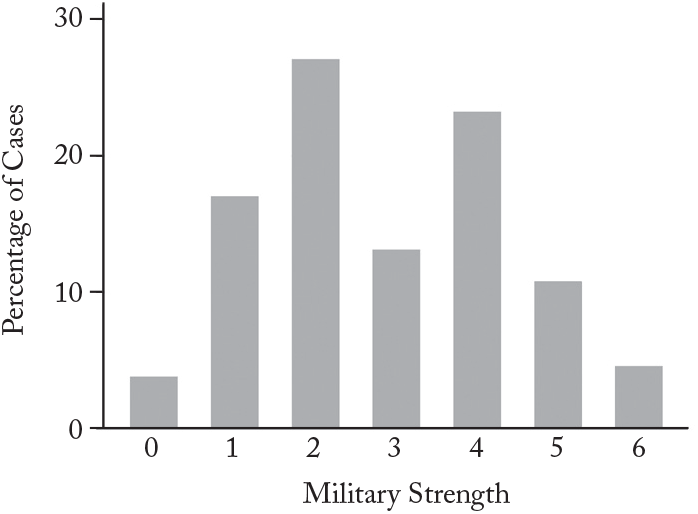
Testing the article’s key cross-national hypothesis (H3.1) requires that I capture military outcomes and the distribution of relative military strength at the end of the war. To do so, I first employ data from the UCDP termination data set on whether the conflict ended in victory and for which side. I construct an indicator, military strength, which assumes a value of 0 if the belligerent was defeated and 6 if the belligerent was victorious. For the cases in which the conflict did not end in decisive victory, I use the indicator rebstrength from the Non-State Actor (NSA) data set on the strength of the rebels relative to the government at war’s end.Footnote 94 I reverse the values for the incumbent observations. I code the military strength indicator as 1 if the belligerent was much weaker, 2 if weaker, 3 if at parity, 4 if stronger, and 5 if much stronger.Footnote 95 Figure 1 shows the distribution of relative military strength in the sample, ranging from outright defeat (0) to outright victory (6).
Relative Military Strength at War’s End

Vengeful Voting
To operationalize atrocities and evaluate H1.1 and H1.2, I construct two dummy variables—belligerent’s atrocities and adversary’s atrocities—which capture whether the belligerent or its opponent used the most severe forms of civilian abuse or restrained from this behavior by engaging in “deliberate efforts to avoid attacking civilian targets.” To construct these variables, I rely on the coding criteria and data of Jessica Stanton, who defines indiscriminate violence against civilians as “massacres; scorched earth campaigns; cleansing of a particular ethnic or religious group; or deliberate bombing and shelling of civilian targets.”Footnote 96 If a belligerent did not engage in any of these four forms of violence, it is coded as restrained. Forty-four percent of rebels and 36 percent of incumbent actors exhibited restraint in their use of atrocities. To evaluate H1.3, I construct a relative atrocities variable, which assumes a value of 1 if the belligerent was restrained in its use of violence while its adversary carried out indiscriminate violence, 2 if both actors exercised restraint, 3 if both sides carried out indiscriminate violence, and 4 if the adversary exercised restraint while the belligerent conducted campaigns of indiscriminate brutality. Table 1 shows the distribution across these values of relative atrocity.
Relative Atrocities

Coercion
To determine whether the puzzling regularity of votes for actors with violent pasts can be explained by coercion in an environment in which the elections were neither free nor fair (H2.1), I test several indicators. I use the Varieties of Democracy indicator, v2xel_frefair, a clean election index capturing the extent to which there was an absence of registration fraud, systematic irregularities, government intimidation of the opposition, vote buying, and election violence.Footnote 97 This index ranges from 0 to 1, with a mean of 0.4 in the sample. In the supplementary material, I separately look at whether government electoral coercion can account for incumbent successor party performance, and whether rebel electoral coercion can explain rebel party vote share.Footnote 98
Estimation
To test the cross-national hypotheses, H1.1–H1.3, H2.1, and H3.1, I consider a series of regression models.Footnote 99 My main specifications use ordinary least squares. A number of countries in the data set have experienced multiple civil wars. I account for the nonindependence of these observations within countries by presenting robust standard errors clustered on the country unit.Footnote 100
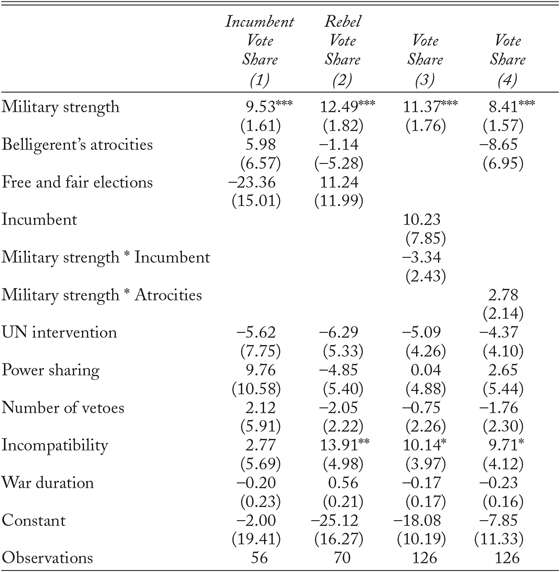
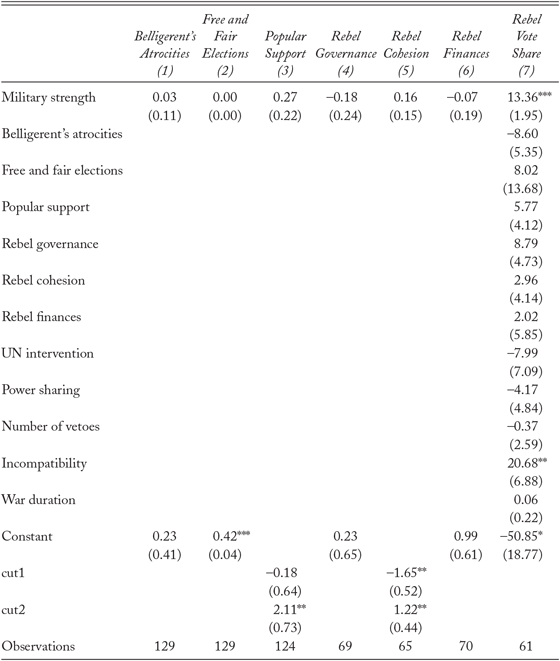
Model 1 in Table 2 tests H3.1, the influence of relative military strength; model 2 analyzes H1.1, the effect of the belligerent’s atrocities; model 3 tests H1.2, the impact of its adversary’s atrocities; model 4 tests H1.3, the effect of relative atrocities; and model 5 tests H2.1, the effect of free and fair elections. Model 6 evaluates the combined equation using the belligerent’s atrocities operationalization of victimization.Footnote 101
Correlates of Civil War Successor Party Success

Standard errors in parentheses; robust standard errors account for country clustering; *p < 0.05, **p < 0.01, ***p < 0.001
After presenting the main results, I engage in additional analyses to unpack the findings.
Results: Cross-National Data
The first central finding of the cross-national analysis is that the distribution of military power at war’s end proves a powerful predictor of the first postwar elections. Consistent with H3.1, the measure of the military balance of power is highly correlated with electoral outcomes across all specifications of the model. Cross-nationally, belligerents who are militarily strong, relatively, at war’s end perform significantly better in postwar voting than do militarily weak ones. Figure 2 illustrates this result.
Relative Military Strength at War’s End and Vote Shares in Founding Elections

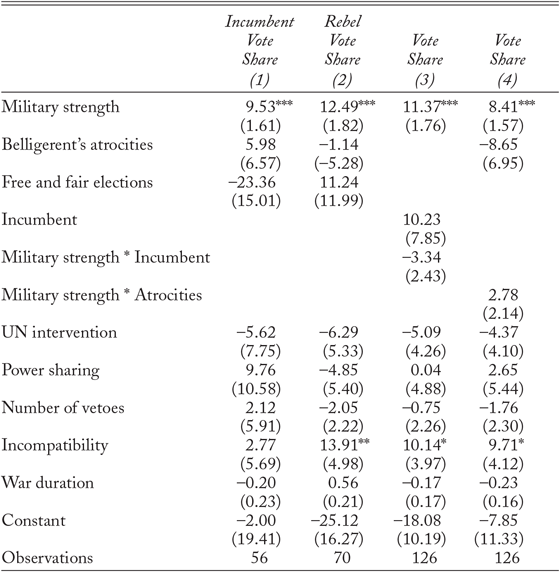
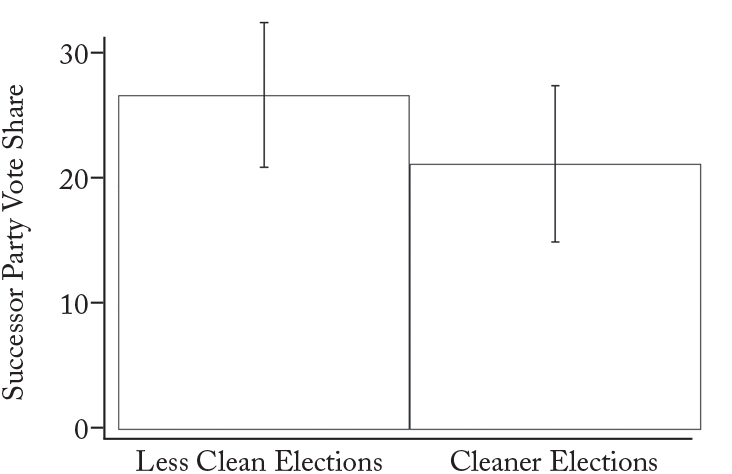
The cross-national analysis further reveals that rebel and incumbents’ wartime use of atrocities and electoral coercion cannot account for citizens’ decisions of whether to vote for these belligerents’ successor parties. Figure 3 illustrates the overall null result of wartime victimization on post civil–war party success. The right-hand panel displays the average vote share for parties derived from belligerents who committed indiscriminate mass atrocities, while the left-hand panel shows the vote share for parties with roots in organizations that exercised only restrained violence. We can see that despite the great variance in their wartime execution of brutality, these parties performed identically in postwar elections. Figure 4 demonstrates the statistically insignificant difference between the average vote share for successor parties competing in relatively more free and fair elections (above 0.5 on the clean elections index) and for those competing in relatively less free and fair elections (below 0.5 on the index).Footnote 100
Unpacking the Results
Incumbents Versus Rebels
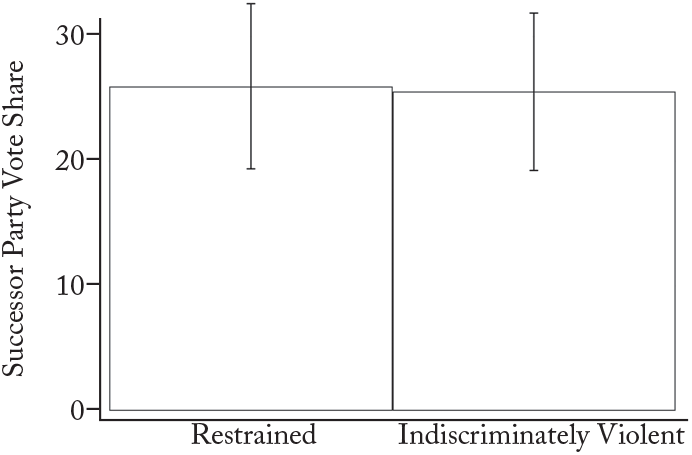
The analyses thus far combine observations on incumbents and rebels. On average, however, incumbents outperformed rebels electorally. It is worth breaking up the sample to see if the correlates of electoral success for parties derived from the government side diverge from those from the rebel side. Incumbents, for example, enjoy institutionalized advantages through their control of the state apparatus and their experience in government. In Table 3, model 1 examines the correlates of incumbent successor-party vote share and model 2 explores those of rebel successor-party success. Model 3 adds an interaction term for incumbency and military strength. Consistent with my argument, the findings suggest that the results mirror each other for the government and opposition sides.Footnote 103 Figure A.1 in the supplementary material illustrates this symmetry.Footnote 104
Wartime Victimization and Successor Party Vote Shares

Free and Fair Elections and Successor Party Vote Shares

Correlates of Civil War Successor Party Success: Unpacking the Results

Standard errors in parentheses; robust standard errors account for country clustering; *p < 0.05, **p < 0.01, ***p < 0.001
Interacting Atrocities and Military Strength
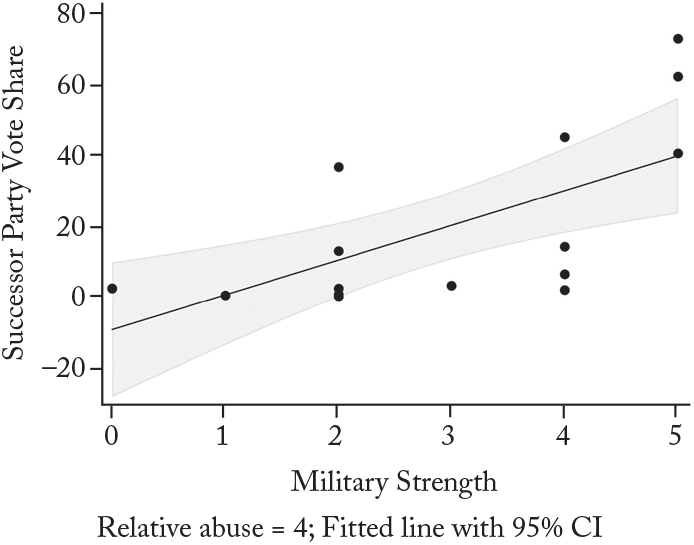
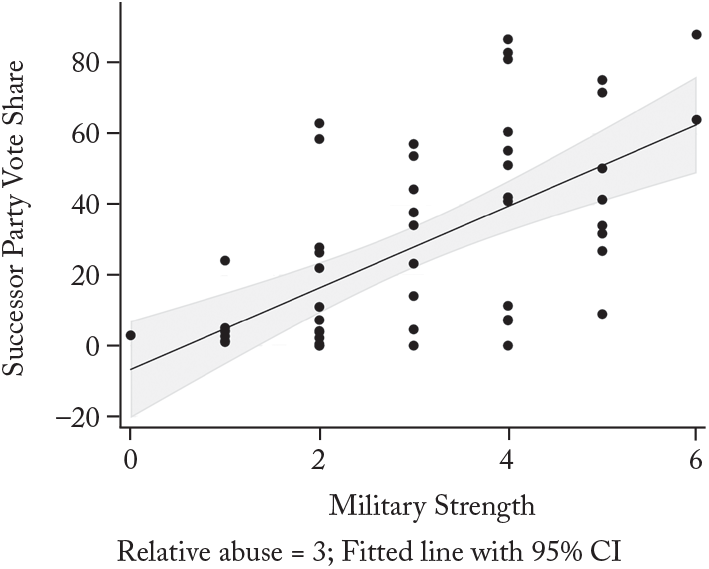
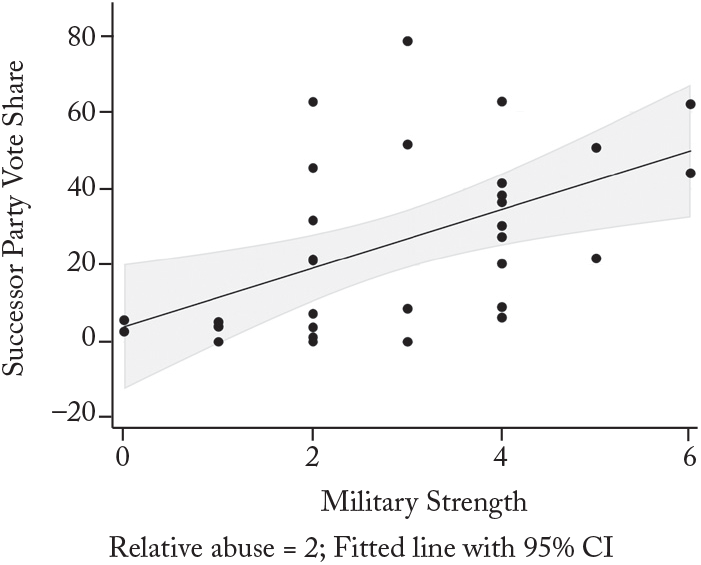
The theory posits that military strength should offset the belligerents’ use of atrocities. But the extent of the belligerents’ atrocities should not matter. Consistent with this, Table 3, model 4, reveals an insignificant interaction term between the use of atrocities and military strength. I also break down the analysis and explore whether, as anticipated, the relationship between military strength and vote share holds under the four conditions captured by the relative atrocities indicator. In contexts in which both actors were restrained in their use of violence, military strength should guide voting only through the security voting mechanism. In contexts in which one or both actors used indiscriminate violence, military strength should operate both through the security voting mechanism and through the one mitigating the violent past.
Asymmetric Violence by Adversary: Military Strength and Votes

Asymmetric Violence by Belligerent: Military Strength and Votes

Figures 5 and 6 show that the relationship between military strength and electoral success holds when there is asymmetry in the use of atrocities.Footnote 105 Figure 7 shows that the relationship holds when both parties engaged in indiscriminate violence. And Figure 8 shows that even in cases in which both parties exercised restraint, there is a relationship between military strength and electoral success.Footnote 106
Symmetric Atrocities: Military Strength and Votes

Symmetric Restraint: Military Strength and Votes

Alternative Mechanisms Linking Military Strength at War’s End and Postwar Electoral Success
I propose a logic in which militarily effective belligerents leverage their strength to gain credit for peace, win the security valence issue, and spin and disseminate a story of the violent past. However, military strength could also work through a variety of alternative mechanisms to affect postwar voting patterns. I engage these alternatives using the cross-national data, and then explore them with evidence from El Salvador below.
Relatively stronger belligerents could be better positioned to engage in electoral coercion or better able to restrain their use of atrocities. In this sense, coercion and atrocities would operate as intervening variables. If this were the case, we would still expect to observe a relationship between coercion and vote share and between atrocities and vote share, but Table 2 (models 2–6) does not provide it. Nonetheless, it is worth exploring whether military strength might be capturing these alternative variables. I explore these relationships in Table 4, models 1 and 2, and find no significant results, suggesting that actors who are relatively strong militarily are just as likely to be indiscriminately violent as relatively weak ones, and that winning the war does not render belligerents more likely to rig or coerce the elections.Footnote 107
It might also be that popular wartime support, rebel governance, and the extent to which belligerents claim to represent excluded subsets of the population can account for the robust relationship between military power and electoral success in the cross-national data.Footnote 108 To explore this possibility I use mobcap, the NSA data set indicator for rebel mobilization capacity, rated relative to the government.Footnote 109 According to Reed Wood, “This variable represents a crude accounting of the popularity of the organization among the population of the conflict state and reflects the size of the constituency from which the organization can potentially draw support and resources.”Footnote 110 I reverse the indicator for the incumbent observations. I also use Reyko Huang’s dummy variable for rebel public goods provision,Footnote 111 which assumes a value of 1 if the rebels provided education or created their own schools, if they offered health care, built hospitals, or founded clinics, or if they engaged in relief operations to address war-related humanitarian issues; and 0 otherwise. Model 3 regresses popular wartime support on military strength and model 4 analyzes the relationship between rebel governance and rebel military strength. The insignificant coefficients provide little support for this alternative mechanism.
Alternative Mechanisms Linking Military and Electoral Successa

Standard errors in parentheses; robust standard errors account for country clustering; *p < 0.05, **p < 0.01, ***p < 0.001
a Models 1, 4, and 6 use logit regression; models 3 and 5 use ordinal logit; models 2 and 7 use ordinary least squares.
Another alternative mechanism linking fighting capacity and electoral performance centers on organizational weapons: unity and financing.Footnote 112 Relatively strong belligerents may just be better at organizing, which is why they win elections. Stronger belligerents, for example, might exhibit higher levels of cohesion, built through a history of “sustained, violent, and ideologically driven conflict.”Footnote 113 From conflict, the movements would derive hardened identities, solidarity networks, and military-style internal discipline, which serve their successor parties well in postwar elections.Footnote 114 It is likely that stronger belligerents also enjoy more robust financing. Such wartime funding may be fungible and also used to bankroll postwar clientelism and campaigns, boosting electoral performance. For cohesion, I employ an indicator from the NSA data set, strengthcent, measuring the extent to which a central command exercises control over the constituent groups of an insurgent movement. For rebels’ access to resources I use Huang’s variable,Footnote 115 which assumes a value of 1 if the rebel group systematically depended on profits from the extraction, sale, or trade of natural resources, such as diamonds, minerals, timber, and metals; or from illicit activities, such as narcotics trading and other contraband.Footnote 116 In Table 4, models 5 and 6, I find that rebel cohesion and finances are unrelated to rebel military strength using conventional levels of significance.
Table 4, model 7, uses as the outcome the vote share for rebel successor parties and demonstrates that the relationship between military strength at war’s end and electoral performance in the founding post-war election is robust to controlling for these potentially confounding variables: electoral coercion, atrocities, popular support, rebel governance, cohesion, and financing.Footnote 117 The analysis casts doubt on the ability of these alternative mechanisms to account for variation in postwar electoral success. Each of the coefficients’ 95 percent confidence intervals includes the possibility of no effect.
These cross-national analyses have potential limitations: they may present ecological inference issues, the null effects could be explained by classical measurement error, and the correlational analyses do not lend themselves to mechanism testing. Additionally, evaluating my theory’s key mechanisms—security voting and mitigating the violent past—requires detailed analysis of political party and electoral behavior. The next section seeks to overcome these challenges, and to trace the process through which military strength translates into voting patterns. I do so by scouring archival records, studying party propaganda, tracking public opinion, and interviewing politicians and voters in El Salvador.
Violence and Voting in El Salvador
Civil war ravaged El Salvador from 1979 to 1992. The war’s origins lie in the escalating grievances of the preceding decades. Rural land-lessness grew from 12 percent in 1961 to 41 percent in 1975. Urban unemployment increased, shantytowns grew, living conditions deteriorated, and fraudulent elections in 1972 undermined the peaceful route to political change. The response was a mass mobilization to press the government for reform. Rather than enact reform, the state engaged in indiscriminate repression.Footnote 118 It did so through its security forces and through large-scale, organized death squads and militias.Footnote 119 This repression turned a divided, apolitical, peaceful social movement into a united, revolutionary, and violent one in the form of the leftist FMLN guerrillas.Footnote 120 It drove recruits into the arms of the rebels and afforded them popular support, camouflage from the government, and the resources to fund their high-risk insurgency.Footnote 121 Violence escalated.
The civil war finally ended in a negotiated settlement, the Chapultepec Accords, in 1992; founding elections were held two years later. In these elections, the ARENA party, derived from the counterinsurgent death squads and the National Conciliation Party (PCN) of the military dictatorship,Footnote 122 won 49.3 percent of the presidential vote in the first round, 68.3 percent in the second round, and thirty-nine of the eighty-four legislative seats. The FMLN, successor to the guerrilla armies, won 25.6 percent of the electorate’s votes in the first round, 31.7 percent in the second round, and twenty-one of the legislative seats. Using diverse data, I seek to understand why these parties with violent pasts performed well electorally, and why ARENA outperformed the FMLN.Footnote 123
Wartime Victimization and Postwar Voting
The Salvadoran civil war took the lives of at least 70,000 in a country of 4.6 million and left more than a million refugees.Footnote 124 The Truth and Reconciliation Commission revealed the highly asymmetrical nature of the atrocities. The FMLN “assassinated opposition mayors, forcibly recruited civilians to fight on its behalf, kidnapped wealthy businessmen for ransom, and engaged in widespread acts of economic terrorism.”Footnote 125 But the government’s atrocities far outnumbered those of the FMLN. The TRC estimated that the incumbent side was responsible for 95 percent of the political killings, the guerrillas only 5 percent.Footnote 126 In
1980 alone, some 12,000 people were killed, most “either captured and executed by the death squads or killed in wholesale massacres carried out by government forces in rural areas.”Footnote 127 These massacres began to assume huge proportions, with death tolls for each massacre climbing to one thousand individuals. State-sponsored forces left the bodies of their abducted, tortured, and murdered victims “in designated locations that became so commonplace that they inspired a neologism: ‘body dumps.’”Footnote 128 By the vengeful voting hypothesis, one would expect that the FMLN and ARENA, both with blood on their hands, would have been punished in the postwar elections, and that the FMLN party, derived from the relatively restrained rebels, should have easily beaten ARENA, which was originally tied to the indiscriminately repressive state.
Outside observers also held these expectations. They “were initially skeptical about ARENA’s prospects. In the US Embassy, for example, the consensus was reportedly that ‘[arena’s leader, Major Roberto D’Aubuisson, is] just a right-wing extremist. He can’t get any support.’”Footnote 129 Even the successor parties themselves were certain that revenge would drive voting. For example, “in many towns that served as military outposts on the edges of FMLN zones of control, town residents suffered from the guerrilla attacks; so, in the 1994 election, FMLN campaigners acknowledged that ‘naturally we have to pay a political cost for the war damage.’”Footnote 130 Instead, despite the “damage” caused by the FMLN, it gained a sizable share of the electorate’s votes, and despite the incumbent’s large-scale atrocities, ARENA won nearly half the votes.
Understanding the Null Results of Vengeful Voting
It could be that the electorate did not know of the successor parties’ ties to the violent organizations of the past. But this explanation rests on shaky ground. As mentioned above, the TRC revealed its findings before the election, and these were reported in the national media. According to ARENA peace negotiator David Escobar Galindo, “The truth commission was accepted and was seen as neutral by all because it was done by foreigners.”Footnote 131 The FMLN party ran known guerrilla military commanders as candidates, and was widely recognized as the direct inheritor of the rebel movement.Footnote 132 The ARENA party, “was the ‘aboveground alter ego’ of El Salvador’s notorious ‘death squad’ networks.”Footnote 133 ARENA founder and party leader D’Aubuisson was closely associated with the death squad violence; a former US ambassador described him as a “pathological killer.”Footnote 134 At the same time, we know from the work of Elisabeth WoodFootnote 135 that ARENA modernized as the conflict dramatically transformed the country’s reliance on agricultural exports. By the end of the war, ARENA represented modern, conservative business elites, though it maintained a hardline faction and continued to deploy images evoking its violent founder.Footnote 136 Despite these changes in ARENA, according to Galindo, “It’s not as if people didn’t know what had happened. Everyone knew.”Footnote 137
It could be that the national-level patterns mask subnational ones in which victimized regions voted against the perpetrators, while nonvictimized regions accounted for the puzzling vote share for the civil war belligerents. Michael Allison finds that conflict zones were more likely to vote for the FMLN than were nonconflict zones.Footnote 138 However, his study does not disaggregate the violence by perpetrator. Anecdotally, the civil war primarily ravaged communities in the north and east of the country. And yet ARENA swept these areas most victimized by the war.Footnote 139
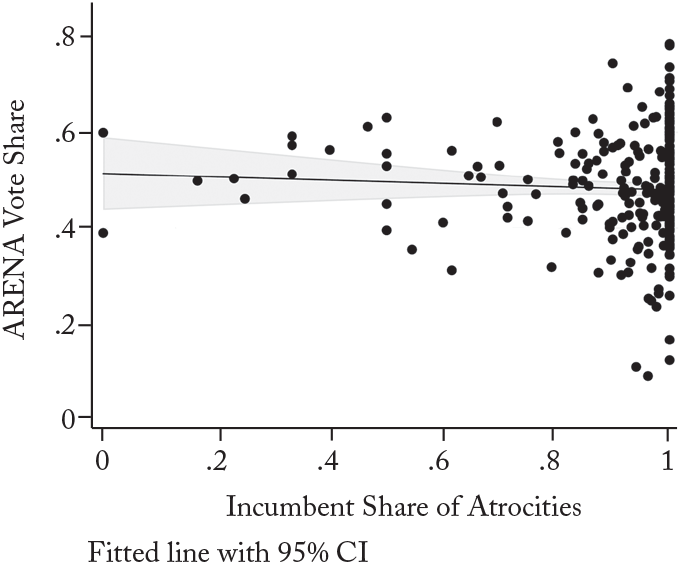
To better estimate these subnational patterns and test H1.4–H1.6, I analyze municipal-level election results and break down the atrocities by perpetrator—government or rebel—using data from the TRC.Footnote 140 I find that the relative atrocities (disappearances, homicides, kidnappings, torture, and rapes) committed by the government versus rebels had no relationship with postwar electoral success. ARENA’s vote share remained constant whether the government was responsible for 0 percent of the atrocities in the municipality or 100 percent. Figure 9 illustrates this result.Footnote 141
Relative Atrocities and Arena Votes at the Municipal Level

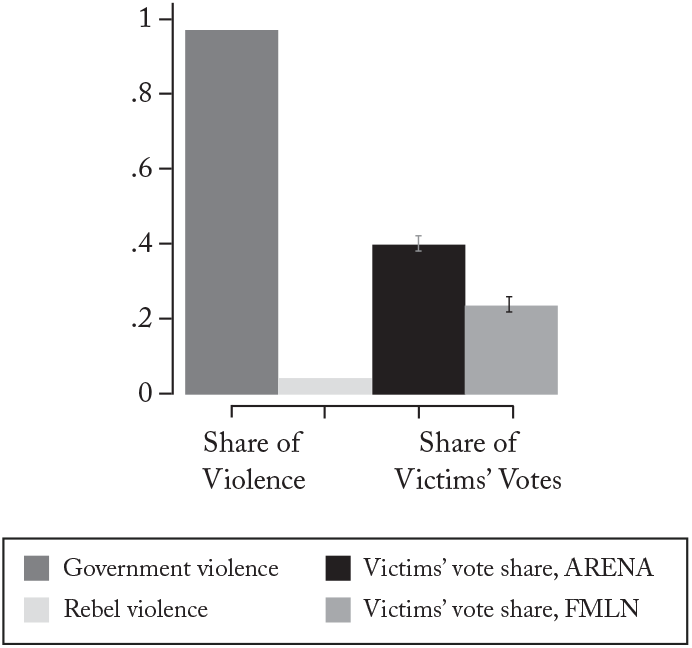
It could be that the puzzling national and subnational pattern of voting for victimizers reflects the ballots of nonvictims, and that victims voted as anticipated, that is, FMLN victims voted for ARENA and government victims voted for the FMLN.Footnote 142 This is especially important to assess given the massive displacement in El Salvador, which meant that the most victimized population might not have still lived where the violence occurred. To test H1.7–H1.8, I use the LAPOP survey from 1995, which asked respondents whether they had lost a family member or close relative as a result of the armed conflict. The question does not ask the political identity of the perpetrator. But given that the survey was administered on a representative sample of Salvadorans, and that the government committed 95 percent of atrocities and the FMLN 5 percent, we should anticipate that 5 percent of reported victims in the survey would support ARENA and 95 percent would support the FMLN. Instead, we find the following electoral dynamics: 40 percent of victims voted for ARENA, and 24 percent cast votes for the FMLN (Figure 10).Footnote 143
Perpetrators’ Atrocities and Victims’ Votes

Coercion
It could also be that the votes in these territories were forced rather than voluntary. But evidence suggests that the 1994 elections in El Salvador were “deemed to be free and fair.”Footnote 144 The international community spent more than $20 million and deployed three thousand observers in support of these elections. The International Foundation for Electoral Systems reports that the voting process was conducted in an “orderly, peaceful, and transparent fashion which permitted the popular will of the Salvadoran people to be expressed … without fear of violent incidents.”Footnote 145 Even the FMLN presidential candidate, Rubén Zamora, defended the elections, describing, “There were no irregularities.”Footnote 146 In-deed, the results were “accepted by contenders and observers alike.”Footnote 147
To further test for the fear of reprisals explanation subnationally (H2.2), I supplement the focus on valid vote shares with an analysis of nonvalid votes, and find no relationship between blank and null votes and ARENA’s electoral success (see figures A.6 and A.7 in the supplementary material).Footnote 148 I analyze 1995 LAPOP survey data and find that victims and nonvictims abstained in equal proportions (33.2 percent versus 33.5 percent, respectively). While the public opinion data may be subject to bias, they reveal that 91 percent of the electorate reported never having been influenced to vote for a specific party. Those who pointed to voter pressure were significantly more likely to vote for the FMLN than ARENA, casting doubt on H2.3. Only 1 percent of respondents said they had not voted in the 1994 election because of violence or lack of security.Footnote 149 Additionally, even as ARENA’s coercive threat eroded over time, its electoral success remained relatively constant. As I develop below, ARENA sought to sell itself as the party of peace and protection, rather than using the threat of reprisals, coercion, or remilitarization as a centerpiece of its campaign.
While anger and fear undoubtedly influenced the ballots of many Salvadorans, the national, subnational, and individual voting patterns in El Salvador do not directly follow the patterns of vengeful and coerced voting, which echoes my findings at the cross-national level.
Relative Military Strength at War’s End and Postwar Voting
As in the cross-national data, it seems that the military balance of power guided electoral results in El Salvador. The FMLN was locked in a stalemate with the Salvadoran military.Footnote 150 The Salvadoran state was unlikely to be able to “defeat the insurgents militarily,”Footnote 151 and military victory was “similarly out of the [FMLN’s] own reach.”Footnote 152 While stalemated, the government was stronger relative to the FMLN.Footnote 153 The vote share reflected this distribution of military power. I find that both ARENA and the FMLN sought to win credit for peace, craft and propagate the dominant version of El Salvador’s violent past, and own the salient security valence issue. In this political fight, the militarily stronger ARENA emerged victorious, enabling it to win the founding elections.
The Stronger Belligerent Successor Party’s Behavior
Placing Blame (H3.3)
According to Galindo, ARENA’s peace negotiator, “Victors get to write history; here we had neither victor nor vanquished, so both sides were involved in the narrative.”Footnote 154 Former FMLN commander and presidential candidate Facundo Guardado explained, “In 1994, the election was all about the rewriting of what each side had done during the war … it was a ‘war’ over the causes of the war … and who were the constructors of peace…. It was two big rewritings [of history].”Footnote 155
ARENA scripted a narrative in which “any blame for the war and its destruction was laid squarely on the FMLN.”Footnote 156 As ARENA party strategist Manuel Melendez explained, “ARENA used testimonies from people affected by the war, by FMLN attacks.”Footnote 157 ARENA’s 1994 campaign archives reveal, “We [ARENA] have to position … [the FMLN presidential candidate] as ‘a Judas’ who has betrayed his country.”Footnote 158 Before the elections ARENA frequently ran anonymous ads on Salvadoran television, such as this:
The camera focuses close-up on drawing paper and a small hand with a crayon sketching a female figure. A child’s voice-over says “this is mommy,” and goes on to draw a second male figure identified as “daddy.” The hand then sketches a third smaller figure identified as “me.” The drawing of “me” has only one leg, and the small voice says that this is the result of a [FMLN] terrorist mine. The child’s soft voice tells viewers that the [FMLN] terrorists are hoping people will forget, but the child doesn’t think mommy and daddy will forget.Footnote 159
ARENA painted the FMLN candidates as responsible for the horrific and “vivid memories of the war,” warning that a FMLN government would rule as it had during the war: violently.Footnote 160 Campaign ads showed photos of child soldiers to emphasize that the FMLN had recruited thousands of children during the war. A series of ARENA ads featured maps of El Salvador showing the number of FMLN violent incidents in each region.Footnote 161 The text read, “The terrorist [FMLN’s] destruction of 2,698 towers and electrical structures impoverished people, ruined small businesses, and caused unemployment. Is that acting for the good of the people?” Another ad read. “The destruction of 678 schools is the contribution of [FMLN] terrorism to the education of our children. Is this putting our children first?”Footnote 162 El Diario de Hoy published, “More than 70,000 dead—the vast majority of them civilians—was the balance of [the FMLN’s] onslaught against the defenseless population.”Footnote 163 In other words, ARENA used the victimization narrative, conjuring up images of the FMLN’s violent past. However, rather than doing so objectively, acknowledging the government’s own role in perpetrating 95 percent of the cited 70,000 deaths, ARENA spun a version of history in which the “terrorist” FMLN had unleashed all wartime violence.Footnote 164
Consistent with my theory’s predictions, ARENA explicitly sought to spread its story, aiming for its subjective version to be internalized by the population as objective fact. In 1993, for example, according to internal party records, ARENA strategized to create an “educational program that [would] show the last ten years of our history … that reminds the population daily, who the [FMLN] people are who are now asking for [their] vote … Saying to the undecided voter, ‘before giving your vote, think about the future without forgetting the past.’”Footnote 165 ARENA’s campaign sought to have this “educational program” on the ARENA version of history be “placed apart from [its] formal campaign,” disseminated, and “sponsored by some democratic institution”Footnote 166 so that it would be accepted by the population not as spun history but as fact.
Claiming Credit for Peace and Mitigating Its Own Violent Past (H3.2, H3.3)
While painting the FMLN as responsible for all wartime violence, ARENA tried to distance itself from the war, spinning its own past use of violence as justified by its ultimate achievement of peace and order: a net positive balance.Footnote 167 “During electoral campaigning, references to D’Aubuisson and his ‘invaluable services’ to the fatherland permeate[d] party propaganda.”Footnote 168 ARENA comprised not “death squad” members but “warriors of liberty,” to quote the title of a book by one ARENA founder.Footnote 169 Another ARENA founder justified the violent means by saying, “Nothing done to defend your country is against the law.”Footnote 170 ARENA members narrated, “Before ARENA’s political struggle, there was chaos, demagogy, deception, [and] disrespect for life and all values.” ARENA “[fought] to see our country in peace, progress, and freedom.”Footnote 171 Rather than referring to the conflict as a two-sided civil war, pro-ARENA newspaper articles called the violence “the war of communism against our country.”Footnote 172 As the relatively stronger actor militarily, ARENA sought credit for ending the conflict. One ARENA advertisement showed only ARENA signing the peace accords, with a graph in the background depicting the economic growth that accompanied the implementation of order.Footnote 173
Seeking to Own the Security Issue (H3.2)
ARENA also sought to leverage its military strength to signal competence and credibility on security issues and the implementation of peace.Footnote 174 Its ads all carried the ARENA messages: “Let’s build a future in peace, rejecting violence”Footnote 175 and “ARENA will guarantee the implementation of the peace accords, continue with peace, reconstruct the country.”Footnote 176 According to Salvadoran President Alfredo Cristiani (ARENA party), in the 1994 campaign, “there was a lot of ‘remember these [FMLN] guys … They know how to destroy things, not build things.’ … [This campaign strategy] worked [for ARENA] because it was accompanied by ‘We [ARENA] are going to solve your problems.’”Footnote 177 ARENA framed itself not as the party of wartime violence, stuck in the past, but as the party of peace, enabling it to modernize and move on to other issues concerning the electorate for which its past would prove an advantage. ARENA not only sought to advance its own reputation on security issues, but also to undermine the FMLN’s ability to own these issues. For example, ARENA ran a cartoon ad showing the FMLN candidate dressed as a bandit, with the caption, “We will [be able to] fight crime since we have the experience” … as criminals.Footnote 178
The Weaker Belligerent Successor Party’s Behavior (H3.2–H3.3)
Of course, the FMLN also sought to spin itself in a positive light.Footnote 179 As FMLN campaign strategist Sebastian Alejos describes it, the FMLN sought “to convey a new image, signaling a new beginning.” The FMLN “had to refresh its logo … with lowercase letters (FMLN) to make it more friendly … Most of the campaign material was done with cartoons, to show a friendlier image.”Footnote 180 FMLN also claimed credit for peace, arguing that it had “fought a war to win peace.” At the same time, according to Alejos, “It was important for us [the FMLN] to face the accusation … that we were children-eaters.” But “if we answered saying that they [ARENA] were death squads, etc., it did not suit us.”Footnote 181 Zamora confirmed this, acknowledging, “We could not point to ARENA’s crimes because [the narrative of the war] was their territory.”Footnote 182 Attacks against the ARENA party claiming “that they were associates of the death squads, etc…. did not work.”Footnote 183
Disseminating the Narrative
I argue that part of the reason ARENA’s story gained traction in El Salvador in a way that the FMLN’s did not is because it resonated with the public’s own attribution of credit and blame, and their assessment of competence. ARENA’s story also took hold because, as the militarily stronger actor, ARENA gained not only control of the content of history, but also access to propaganda and mobilization machines to amplify and spread that history.
ARENA controlled the state apparatus, including the media access afforded by such an apparatus.Footnote 184 It also had greater resources to devote to campaign financing. It was estimated that ARENA spent approximately US$12 million on the founding postwar campaign, compared to only $270,000 by the FMLN.Footnote 185 A study by Hemisphere Initiatives conducted midway through the founding postwar campaign found that ARENA’s advertising time on television and radio averaged five to fourteen times that of the FMLN.Footnote 186 This broadcasting advantage allowed ARENA to run a variety of ads and to run them often.Footnote 187 Moreover, the organization of former Nationalist Democratic Organization militias, which underpinned ARENA, had a massive membership and wide geographic reach to transmit ARENA’s narrative.Footnote 188
Internal FMLN party documents confirm FMLN’s relative poverty in dissemination platforms: “We have a great disadvantage … Our ideas are worth nothing if there are no ways to transmit them or if the inequality in communication is very large … We cannot stay with methods of traditional protestors and with pamphlets.”Footnote 189 As Zamora summarized:
They had more propaganda than we did … a powerful media apparatus … The political lesson is: never lie, but also never say truths that are going to play into the other’s hands. They committed most of the crimes, but it didn’t matter. Because … they controlled all of the media, they could control the story.Footnote 190
In the postwar “marketplace of ideas,”Footnote 191 the militarily stronger ARENA had the upper hand.Footnote 192
Voters’ Political Attitudes and Behavior (H3.4–H3.7)
I turn now to voters’ perceptions and voting behavior to see if voters felt and acted as my theory predicts. In particular, I look for evidence of whether they disproportionately blamed the militarily weaker party for the war and the violence, and credited the militarily stronger party with peace, deeming it the most competent on security going forward.
Consistent with these predictions, the polls reveal that at least 51 percent of the electorate viewed the FMLN with some degree of hostility,Footnote 193 blaming it, rather than ARENA, for the war and economic destruction (H3.7). The rebels were held accountable for national economic conditions. In the 1991 LAPOP survey, 50 percent of the population blamed the war for limiting economic growth and causing low levels of employment, and more than twice as many blamed the “guerrillas’ destruction” as blamed the government’s public policies for these economic woes, such as pervasive electricity outages.
Moreover, polls indicate that more Salvadorans gave credit to ARENA than to the FMLN, for the years of peace preceding the elections (H3.4).Footnote 194 Problems with the peace accords were blamed on the FMLN (47 percent, compared with 23 percent on ARENA).Footnote 195 ARENA was viewed by half the population as the party that “most favors the pursuit of peace.”Footnote 196 As President Cristiani explained, “When you look at it objectively, it had to be both sides that wanted peace … but politically speaking … the population felt that the government, this government [ARENA] really brought peace.”Footnote 197 FMLN’s Guardado confirmed this observation. In the public’s perception, he said, “It was ARENA that signed the peace.”Footnote 198
And the peace accords, in the citizens’ estimation, were bringing gains in security on which the ARENA “peace” party could capitalize.Footnote 199 According to Cristiani, “The national feeling in 1994 was that the war was over, all this violence and destruction and all that was over … and all of a sudden, now we have peace, there’s prosperity and everybody’s free to run around … We [ARENA] promised peace, prosperity, and liberty, and we came through.”Footnote 200
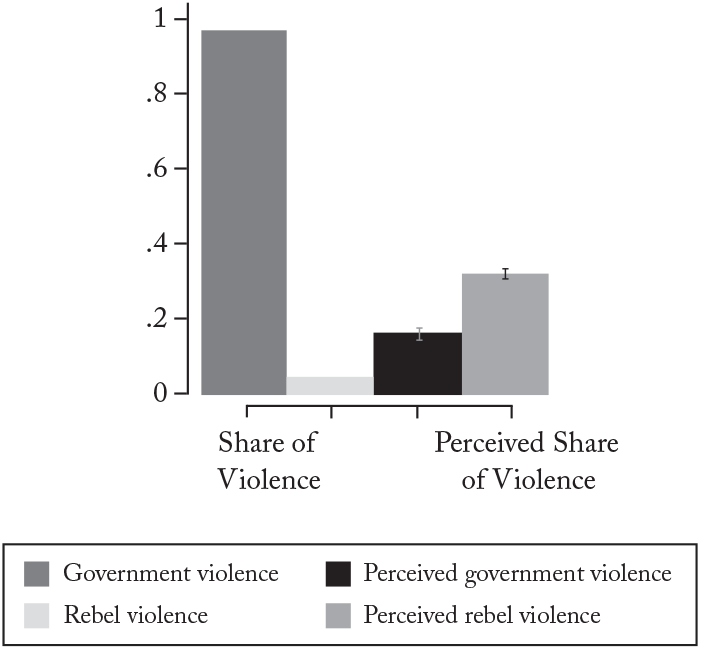
Perhaps most remarkably, ARENA’s provision of peace and its narrative managed to repaint the blame for the wartime atrocities (H3.7).Footnote 201 As Cristiani corroborated, “It really depends on why the violence is done, and how it is done; and violence by one side is not necessarily the same as violence by the other side.”Footnote 202 Whereas the TRC found the state-sponsored forces responsible for 95 percent of the violence and the rebels for 5 percent, the 1991 LAPOP survey showed that 32 percent of the population believed the FMLN had exhibited less respect for human rights and abused the Salvadoran population more than had the government. Only 17 percent believed that the government side had shown less respect for human rights and been more abusive (see Figure 11).Footnote 203 This divergence between the objective accounting and subjective understanding of the violence points to the powerful ability of the stronger belligerent to transform perceptions of wartime atrocities and bias the attribution of blame.
Objective Versus Subjective Violence

ARENA further translated its fighting strength into a party brand of security, succeeding in painting itself as the best provider of security, peace, and order going forward (H3.5). A majority of the population viewed ARENA as the party best able to fulfill the peace accords and fight crime.Footnote 204 Moreover, the electorate seemed to value these security credentials greatly in their selection of an executive. When asked in 1992 what characteristics the next Salvadoran president must have, respondents answered, “Watching over the population.” Surprisingly, they placed little weight on leaders being capable or democratic, helping the poor, or creating jobs.Footnote 205 According to Cristiani, “A sense of security … is one of the ingredients of feeling fine, not scared, ‘I have a bright future’ …. The idea of a better future really helped ARENA.”Footnote 206
Important to the power of ARENA’s narrative was that both the retrospective and prospective security stories were nonideological and non-sector-specific. Rather, they aimed to make programmatic linkages.Footnote 207 In this way, the narrative enabled ARENA to appeal beyond its core wartime constituencies and to shift swing voters concerned with a valence issue that tends to transcend class and ideology cleavages and to be highly salient following war: security and peace.Footnote 208
Cristiani concluded, “The swing vote is what made ARENA win.” In October 1992, 62 percent of the Salvadoran electorate was unaligned. In October 1993, 51 percent remained undecided, and neither the incumbent party nor the rebel one commanded a partisan majority.Footnote 209 Based on information on rebel and incumbent territorial control from Vincent McElhinny and Fermán Cienfuegos, at war’s end, 65 percent of Salvadoran municipalities constituted “contested” territory.Footnote 210 The story ARENA spun of the past—that providing peace offset the government’s past violence—resonated with this broader swing and unaligned electorate. Cristiani explained, “Because of the fact that we had brought about peace … the swing voters remained with ARENA” (H3.6).Footnote 211 ARENA won 49 percent of the vote in disputed municipalities, compared to FMLN’s 16 percent. It won the contested votersFootnote 212 and a multisector electoral coalition “across regions and classes.”Footnote 213 With this coalition, it won the postwar elections.
Alternative Mechanisms
It is worth exploring whether the distribution of military strength brought ARENA this electoral victory through alternative mechanisms of popular support or organizational assets.Footnote 214
Popular Support
Can we rule out that the founding postwar election was simply a byproduct of underlying popular sentiments that rendered ARENA relatively stronger than the FMLN at war’s end? There are several pieces of evidence that cast doubt on the ability of popular wartime support to explain ARENA’s showing in the founding election. According to my interviews with ARENA and FMLN leaders, the FMLN was seen as the party of “el pueblo” (the people) and ARENA as the party of the rich.Footnote 215 LAPOP survey evidence suggests that the population leaned more to the political left (60 percent) than the right (40 percent), and that ARENA won 40 percent of center-left to left voters. The popular support logic can help to explain why the belligerent parties won their core constituencies. But the founding elections were won by securing swing voters and contested territories. The wartime popular support logic offers little analytic leverage for these undecided voters at the end of the war. Finally, if the votes were at least partially voluntary, as I argue above, it becomes tautological to argue that popular support dictated votes. Instead, we have to explain why citizens supported ARENA. I argue that it is because they attributed ARENA with peace and security.
Organizational Assets
Evidence from El Salvador similarly reinforces the null results of the organizational assets mechanism at the cross-national level. ARENA was deemed “capable of managing internal tensions without significant schisms … [and] broadly united.”Footnote 216 Nonetheless, the party was built on the foundation of hundreds of militias, and it is unclear how centralized and unified these militias really were. Moreover, it had both moderate and hardline factions.Footnote 217 As quoted by George Vickers, Jack Spence, and Melrose Huff, “To talk about the cohesiveness of ARENA is an overstatement. There is very, very serious internal fighting within the ARENA party.”Footnote 218 Despite these divisions, ARENA remained a unitary party throughout the period under examination. It also had experience, having competed in the demonstration elections of the 1980s.
By contrast, the FMLN lacked electoral experience and comprised five different organizations that “maintained their own leadership and organizational structure throughout the war.”Footnote 219 “FMLN’s Achilles’ heel … has been lack of unity.”Footnote 220 The FMLN splintered in the aftermath of the peace accords and shed its more moderate elements.Footnote 221
Although cohesion can help explain ARENA’s stronger electoral showing, the lack of unity among FMLN’s factions should have doomed it electorally.Footnote 222 Cohesion cannot account for its positive electoral performance. Differential cohesion is insufficient to explain the election results. But as highlighted above, certain assets, particularly financing, proved important to the differential capacities of the two sides to spread their versions of the past.
Conclusion
This article offers a way to make sense of the seemingly counterintuitive voting patterns of populations victimized by war at the crossnational, subnational, and individual levels. It asserts that relative military strength at the end of the conflict allows belligerents to claim credit for bringing order, which enables them to mitigate and spin their past violence, and to credibly promise to implement security, a valence issue for voters.
The article has several implications for existing and future scholarship. First, it sheds light on elections of candidates with unsavory pasts. While some belligerents studied were restrained in their use of violence, others conducted campaigns of indiscriminate atrocities. Understanding the political success of these actors contributes to our grasp of democratic politics.
By emphasizing the security dimensions of these voting patterns, this article offers intuitions into a broad phenomenon: citizens often favor security at any cost, especially during waves of criminality or perceived spikes in other forms of insecurity. This helps us to understand why victims tend to support authoritarianism, reject democracy, and approve of repressive measures, displaying a willingness to tolerate coercive actors in office if the coercive credentials of these politicians afford them competence in establishing law and order.Footnote 223 Contemporary examples include voter support of the merciless “punisher” President Rodrigo Duterte in the Philippines—a bombastic firebrand deemed able to clean up a crime-riddled nation;Footnote 224 endorsement of the exmilitary dictator Muhammadu Buhari in Nigeria; citizen preferences for a return to military dictatorship in Egypt; and Brazilian votes for an iron-fisted candidate who “speaks with admiration and nostalgia for Brazil’s military dictatorship, during which 434 people were killed or disappeared and thousands were tortured.”Footnote 225 Future research should seek to reveal specifically what renders candidates credible on security issues for voters.
The security logic also helps us to understand why victims do not always seek transitional justice. At times, they wish to get on with their lives, “forgive and forget” the past, and focus on other concerns like power, security, and jobs.Footnote 226 How different mitigating factors serve to offset atrocities in the minds of victims and nonvictims is a topic worthy of future inquiry. For example, it merits exploring how the offsetting effect of security compares to that of in-group membership, as explored by Jason Lyall, Graeme Blair, and Kosuke Imai, and by myself in earlier work;Footnote 227 shared ideology, as established by Francisco Gutíerrez Sanín and Wood;Footnote 228 and provision of material benefits, as documented by Andrew Beath, Fotini Christia, and Ruben Enikolopov.Footnote 229
This article examines postwar election outcomes. A logical next step in the research agenda would be to ask whether parties with violent pasts really return to war if they lose the postwar elections.Footnote 230 If they win the elections, how do they govern? Once they join the realm of electoral politics, do belligerents change their ways and deepen democracy?Footnote 231 Or do they maintain a coercive character and perpetuate authoritarian legacies? Does it undermine democracy to have violent undemocratic actors win by democratic electoral means?
I argue that the relationship between atrocity and political reaction is mediated by the framing of the past violence and of the victimizers. In this sense, the findings confirm Margaret Somers’s observation that “which kinds of narratives will socially predominate … will depend in large part on the distribution of power.”Footnote 232 By underscoring the critical role played by subjective narratives, and by propaganda and media in spreading these narratives, this article speaks to contemporary debates about fake news, spinning of facts, and when political messaging works. Future researchers should pay specific attention to how national and subnational narratives interact, and why belligerents opt to spin their past through contrition, distancing, deflection, scapegoating, or obfuscation, and with what electoral implications.Footnote 233 This article highlights how the military balance of power at the end of a war may undermine the pluralism of the media, with important implications for multiparty democracy. Future research should seek to understand when and how new information treatments about the past could alter victims’ and nonvictims’ attribution of blame.
This article enhances our knowledge of the path from wartime to mainstream politics. Retrospective and prospective votes, the hallmarks of normal elections, take hold quite quickly after war. However, rather than economics dominating this voting, security plays an important role. Often seen as an aberration, such security voting is likely much more prevalent than is commonly believed. More than one and a half billion people face violence in conflict-affected areas. Many more face threats of insecurity, crime, and terrorism in nonconflict areas and during political transitions. Understanding the underpinnings of security voting may enhance the canonical voting models’ leverage in these settings. Last, the cross-national data suggest a great deal of path dependency between first and second postwar elections. The longer-term electoral politics of postconflict environments and specifically, the timing of the return of material voting should be a subject of future inquiry.Footnote 234 As peace solidifies and citizens start taking the provision of order for granted, the mitigating effect of peace on judgments of atrocities should diminish, and the possibilities for transitional justice should expand.Footnote 235 These eventualities could weaken the narrative spun by the more powerful actor, and possibly align subjective and objective violence over time. This would render my findings consistent with scholarship on the short half-life of counterinsurgency success on voting,Footnote 236 accounts of the long-term intergenerational effects of violence on political attitudes,Footnote 237 and evidence of the advantages of delaying founding postwar elections.Footnote 238
Supplementary Material
Supplementary material for this article can be found at https://doi.org/10.1017/S0043887119000091.
Data
Replication data for this article can be found at https://doi.org/10.7910/DVN/IGIJGG.
Acknowledgments
I thank Jonathan Panter and Oscar Pocasangre for exceptional research assistance. I also wish to thank Ashley Litwin, Minju Kwon, Camilo Nieto Matíz, and Lucia Tiscornia for their contributions. For facilitating my fieldwork in El Salvador, I extend my deep gratitude to Andrés Suster and Michael Allison. For excellent and constructive comments, I am grateful to the editors of World Politics and four anonymous reviewers, as well as Sheri Berman, Nancy Bermeo, Johanna Birnir, Allison Carnegie, Jon Elster, Page Fortna, Frances Hagopian, Merlin Heidemanns, Alisha Holland, John Ishiyama, Robert Jervis, Kimuli Kasara, Robert Keohane, Caroline Hartzell, John Huber, Scott Mainwaring, John Marshall, Gwyneth McClendon, Vicky Murillo, Melissa Lee, Roger Petersen, Jack Snyder, and Hillel Soifer. I also appreciate the input from participants at the Princeton University Comparative Politics Colloquium and International Relations Colloquium; Berkeley Comparative Politics Colloquium; University of Chicago Program on International Security Policy Seminar and Workshop on the State, Violence, and Social Control; MIT Security Studies Program Seminar; UNC Lethal Aid and Human Security Workshop; George Washington University Institute for Security and Conflict Studies Workshop; Columbia University Junior Faculty Workshop; Yale University Order, Conflict, and Violence Seminar; Harvard University David Rockefeller Center for Latin American Studies Seminar; Washington University in St. Louis Conference on Political Violence and Terrorism; Notre Dame Comparative Politics Working Group; cwIc; Princeton esoc Labs; Folke Bernadotte Academy Research Workshop; and annual meetings of the Latin American Studies Association, American Political Science Association, and International Studies Association. Unless otherwise noted, all translations are my own. The statements made and views expressed are solely my responsibility.
Funding
I acknowledge funding from the Carnegie Corporation of New York, United States Institute of Peace, and Kellogg Institute for International Studies, Institute for Scholarship in the Liberal Arts, and the Faculty Research Support Program at the University of Notre Dame.
Sarah Zukerman Daly is an assistant professor of political science at Columbia University. She studies international relations and comparative politics with a focus on conflict, peace, and Latin America. Her book, Organized Violence after Civil War: The Geography of Recruitment in Latin America (2016), examines the recurrence of violence and consolidation of peace. She can be reached at sd2623@columbia.edu.