1 Introduction
1.1 Master Teapot
In his last paper [Reference ThurstonTh], William Thurston defined the Master Teapot as the closure of the set of pairs
 $(z,s)$
, where
 $s\in (1,2]$
is the slope of a tent map
 $T_s$
with the turning point periodic, and
 $z\in \mathbb C$
is a Galois conjugate of s (in fact the name ‘Master Teapot’ does not appear in [Reference ThurstonTh] but, according to [Reference Bray, Davis, Lindsey and WuBDLW], was assigned to this object in Thurston’s 2012 course at Cornell University).
This notion became popular among specialists in low-dimensional dynamical systems, both for its mathematical content and for the interesting structure of its graphic presentation (see, for example, [Reference Bray, Davis, Lindsey and WuBDLW, Reference Lindsey, Tiozzo and WuLTW, Reference Lindsey and WuLW, Reference TiozzoT]). It is also related to the Littlewood polynomials (polynomials with coefficients
 $\pm 1$
). Note that while the original idea concerning Littlewood polynomials was to study their zeros on the complex unit circle, their real roots are also an object of interest (see, for example, [Reference Han and SchiedHS, Reference VaderV]).
Let us recall what a Galois conjugate is. If the real number s is transcendental, the Galois conjugates of s are not defined. If s is algebraic (that is, a zero of a polynomial with rational, equivalently integer, coefficients), we take the minimal polynomial of s, that is, the monic polynomial (the polynomial with leading coefficient
 $1$
) with rational coefficients and with smallest degree, such that s is a zero of this polynomial. Then all the complex zeros of this polynomial are Galois conjugates of s.
Since in the definition of the Master Teapot it is assumed that the turning point of
 $T_s$
is periodic, the map is Markov [Reference Alsedà, Llibre and MisiurewiczALM, p. 251]. The slope s is, by [Reference Alsedà, Llibre and MisiurewiczALM, Corollary 4.3.13], the exponential of the topological entropy. Hence, by [Reference Milnor and ThurstonMT, Theorem 6.3],
 $1/s$
is the smallest positive zero of the kneading determinant
 $D_s$
of
 $T_s$
. Moreover, if
 $z\in \mathbb C$
is a Galois conjugate of s, then also
 $1/z$
is a zero of the kneading determinant of
 $T_s$
; see formula (4). This means that one way to investigate the Master Teapot is to look at the zeros of the kneading determinants. We restrict our attention to real positive zeros of
 $D_s$
. In particular, since the radius of convergence of
 $D_s$
is 1, we look at the zeros in
 $(0,1)$
. On the other hand, we do not assume that the turning point of
 $T_s$
is periodic, so we look at all
 $s\in (1,2]$
.
Thus, we define the Real Teapot as the set
 $$ \begin{align} \{(s,x):D_s(x)=0,\; x\in(0,1),\; s\in(1,2]\} \end{align} $$
(note that we do not take the closure); see Figure 1. Consequently, we will concentrate on tent maps (and often only on topologically mixing ones, that is, those with slopes in
 $(\sqrt 2,2]$
). However, whenever the proofs do not really require the unimodal maps to be tent, we will consider general unimodal maps.
The Real Teapot. The horizontal axis is s, from
 $1$
to
 $2$
; the vertical axis is x, from
 $1/2$
to
 $1$
.

Our Real Teapot bears some resemblance to the set
 $\widehat \Sigma $
from [Reference TiozzoT]. However, we are considering the family of all (not only Markov) tent maps with positive topological entropy instead of quadratic maps, and we are looking only at the zeros in the real interval
 $(0,1)$
instead of from the unit disk. This makes our set considerably smaller, so we lose connectivity and perhaps local connectivity. Thus, considering the family of quadratic maps (or all unimodal maps) could allow us to obtain stronger results in those directions, but by (5) it would lead us further from the original ideas of Thurston, by introducing too many ‘non-Galois’ points corresponding to the factor
 $D_B(x^n)$
in (5).
1.2 Unimodal maps, kneading sequences and kneading determinants, tent maps
Throughout the paper we expect that the reader knows the basics of the kneading theory. All unimodal maps are assumed continuous and scaled to [
 $0,1]$
, strictly increasing on
 $[0, c] $
and strictly decreasing on
 $[c,1]$
for some
 $c\in (0,1)$
, with
 $$ \begin{align} 0=f^2(c)<c<f(c)=1. \end{align} $$
Since there are several versions of the kneading theory, let us specify which one we are using. To get the kneading sequence
 $K=K_f$
of a unimodal map
 $f\colon ~[0,1]\to [0,1]$
, we code the trajectory of
 $1^{-}$
using the symbols
 $R=(c,1]$
and
 $L = [0,c)$
(that is, we code the trajectory of
 $1$
but if the turning point c is periodic, we replace
 $1$
by a slightly smaller point and we take the limit as this point which is coded goes to
 $1$
from the left). Then we recode for a sequence of signs: start with
 $+$
, R changes the sign, L does not; then the kneading determinant is the power series
 $D=D_f$
with the corresponding coefficients
 $+1$
and
 $-1$
.
Thus, the kneading sequence K always starts with
 $RL$
and so the kneading determinant
 $$ \begin{align*} D(x) = \sum _{k=0}^{\infty} \varepsilon_k x^k \end{align*} $$
starts with
 $D(x)=1-x-x^2\cdots $
. Each
 $\varepsilon _k$
is equal to
 $+1$
or
 $-1$
, depending on whether
 $f^k$
is increasing or decreasing, respectively, at the point
 $1^{-}$
. If the block of first k symbols in K contains odd or even number of Rs, we have
 $\varepsilon _k = -1$
or
 $\varepsilon _k = +1$
, respectively.
In the important case when the turning point c is periodic with period n we can also write the kneading sequence in the form of a finite sequence
 $RLS_3\cdots S_{n-1}C$
, where
 $S_i\in \{L,R\}$
. In this case, that is when
 $f^n(c)=c$
, by [Reference Milnor and ThurstonMT, Lemma 4.5, p. 486], the nth term in the kneading determinant is always
 $+x^n$
and not
 $-x^n$
. The next term is
 $-x^{n+1}$
, since the turning point c is mapped to
 $1$
and points in any small neighborhood of
 $1$
are coded by R. Then the kneading determinant
 $1-x -x^2 \cdots +x^n-x^{n+1} \cdots $
is a rational function with the denominator
 $1-x^n$
.
In the set of all kneading sequences we have a natural order which takes into account the fact that the map is orientation preserving on the left lap and orientation reversing on the right one. Namely, if we have two distinct kneading sequences, we look for the first place where they differ. Then, if the number of symbols R in the common part is even, the ordering of the kneading sequences is the one induced by
 $L<C<R$
, and if this number is odd, it is the one induced by
 $R<C<L$
.
We will use the admissibility condition, which tells us which sequences can be kneading sequences (see [Reference Collet and EckmannCE, p. 71] where such sequences are called maximal). It tells us that
 $K=A_1A_2\cdots A_n A_{n+1} \cdots $
is a kneading sequence of a unimodal map if and only if K is greater than or equal to every shift of K, that is,
 $K\ge A_nA_{n+1}\cdots $
for every n. Those inequalities make sense since in the definition of the order we do not have to assume that the sequences involved are kneading sequences of unimodal maps.
In particular, it follows that if a kneading sequence starts with
 $RL^NR$
, then it does not have any block of symbols L longer than N. This implies that in its sequence of signs there are no blocks of the same symbol longer than
 $N+1$
.
According to [Reference HofbauerHo, p. 120] (or [Reference Collet, Crutchfield and EckmannCCE, Lemma 2]), for unimodal maps topological entropy is an increasing function of the kneading sequence. We denote this function by H. Later, in Theorem 2.4, we will state some conditions for the points at which it is strictly increasing.
A particular example of a unimodal map is the map
 $T_s$
,
 $s\in (1,2]$
, restricted to its core; as explained above, we consider it rescaled to
 $[0,1]$
. The map
 $T_s$
understood in this way has constant slope s (in absolute value), the turning point
 $c=1-1/s$
and
 $T_s(1)=0$
. Instead of
 $K_{T_s}$
and
 $D_{T_s}$
we use also the notation
 $K_s$
and
 $D_s$
, respectively. Recall that
 $T_s$
is mixing if and only if
 $T_s(0)<a$
where a is the fixed point in the decreasing lap, that is,
 $a=s/(1+s)$
. This is equivalent to the condition
 $s\in (\sqrt 2,2]$
.
1.3 Galois conjugates of the slope. Zeros of the kneading determinant
If
 $\alpha $
is an algebraic number, denote by
 $\operatorname {Gal} (\alpha )$
the set of Galois conjugates of
 $\alpha $
, that is, the set of zeros of the minimal polynomial of
 $\alpha $
. The minimal polynomial of
 $\alpha $
is irreducible, and conversely, if a monic polynomial with rational coefficients is irreducible and has
 $\alpha $
as a zero, then it is the minimal polynomial of
 $\alpha $
[Reference HungerfordH, Theorem 11.6].
Let
 $s\in (1,2]$
be the slope of a tent map
 $T_s$
. As explained above,
 $1/s$
is the smallest positive zero of the kneading determinant
 $D_s$
. Assume that s is such that the turning point of
 $T_s$
is periodic, which is an assumption in the definition of the Master Teapot. Then s is an eigenvalue of the transition matrix associated to the orbit of the turning point of
 $T_s$
[Reference Alsedà, Llibre and MisiurewiczALM, Theorem 4.4.5], so the slope s is an algebraic number.
Given a map
 $f\colon X\to X$
, suppose that each iterate
 $f^k$
has only finitely many fixed points and denote this number by
 $N(f^k)$
. Then the zeta function of f is defined to be the formal power series
 $$ \begin{align*} \zeta (z) = \exp\bigg ( \sum_{k=1}^{\infty} \frac{N(f^k) \cdot z^k}{k}\bigg ) \end{align*} $$
for each
 $z\in \mathbb C$
such that this series converges. Recall the following facts.
According to [Reference Milnor and ThurstonMT, Theorem 9.1], the reciprocal of the zeta function for the tent map
 $T_s$
whose turning point is periodic of period p, is
 $(1-z^p)D_s(z)$
. At the same time, by [Reference Bowen and LanfordBL, Theorem 1], for the subshift of finite type with the transition matrix M, the reciprocal of the zeta function is
 $\det (I-zM)$
. Thus,
 $(1-z^p)D_s(z)=\det (I-zM)$
. Therefore,
 $$ \begin{align} D_s(z)=\frac{\det(I-zM)}{1-z^p}=\frac{z^{p-1}\det (({1}/{z})I-M)}{1-z^p}, \end{align} $$
so the zeros of
 $D_s(z)$
are reciprocal to the eigenvalues of M.
In particular, formula (3) implies that
 $$ \begin{align} \bigg \{\frac{1}{z} \colon z\in \operatorname{Gal} (s)\bigg \} \subset \{ z\in \mathbb C \colon D_s(z)=0 \}. \end{align} $$
Due to Tiozzo [Reference TiozzoT] it is known that the opposite inclusion does not hold; see §7.5 for more details and a related question.
If f is a unimodal map, its kneading determinant D is a function defined in the open unit disk in the complex plane and, being analytic, has only isolated zeros. We will study it (and still denote it by D) in the real interval
 $[0,1)$
, so for any
 $\varepsilon \in (0,1)$
the interval
 $(0,1-\varepsilon ]$
contains only finitely many zeros of D. In particular, if the set of positive zeros of D is non-empty, then D has the first (smallest) zero that we will denote as
 $\operatorname {FZ}(D)$
.
-
(F1) By [Reference Milnor and ThurstonMT, Theorem 6.3], the kneading determinant D has a zero in the open interval
 $(0,1)$
if and only if the topological entropy
$h(f)>0$
. In such a case
$$ \begin{align*} h(f)=\log\frac{1}{\operatorname{FZ}(D)}\quad\text{and } D \text{ has no (complex) zeros in } |z|<\operatorname{FZ}(D). \end{align*} $$
Since
$h(f)\leq \log 2$
, we can see that if
$h(f)>0$
then
$\operatorname {FZ}(D) \geq 1/2$
. -
(F2) Clearly
$D(x)>0$
for
$0 \leq x < \operatorname {FZ}(D)$
and so, by [Reference PrestonPr, p. 197, (1.17)],
$$ \begin{align*} D'(x)<0 \quad \text{for } 0 \leq x < \operatorname{FZ}(D). \end{align*} $$
If D has no positive zero, that is, if
$h(f)=0$
, we have both
$D(x)>0$
and
${D'(x)<0}$
for all
$0 \leq x < 1$
.


In the present paper we want to obtain more results on the zeros of the kneading determinants of unimodal maps. To illustrate the complexity of the problem, look at the maps
 $T_s$
,
 $s\in (1,2]$
. They have positive entropy
 $\log s$
and, by (F1), the first zero of the kneading determinant for them is
 $1/s$
, a continuous function of the slope s. Unlike the first zero, the situation with the second and higher zeros is more complicated. Figure 2 shows all zeros except the first ones (the curve
 $1/s$
showing the first zeros would be below the visible part of the figure). Vertical red lines are every
 $0.0015$
, and horizontal ones every
 $0.01$
(so the highest horizontal line is at
 $x=1$
and the lowest one at
 $x=0.79$
). Every horizontal pixel represents
 $1000$
values of s. For computational reasons, what we see in the highest row of squares is not reliable; see also §5. The set of the points plotted in the figure is the essential part of the Real Teapot. The rest of it lies to the left or below the area shown in the figure.
All zeros except the first ones, for the slopes
 $s\in [\sqrt 2, 2]$
. It resembles Spanish moss (Tillandsia usneoides), so maybe this should be the name of our set, rather than Real Teapot?

When speaking of zeros of a kneading determinant, we will have only positive zeros, that is, zeros in
 $(0,1)$
, in mind. In particular, the first zero or the second zero will mean the smallest zero or the second smallest zero in
 $(0,1)$
, respectively.
1.4 Renormalization and star product
Many unimodal maps are renormalizable. This means that there is an invariant cycle of intervals with disjoint interiors, one of those interiors containing the turning point (if the period of that cycle is n, we speak of n-renormalizability). In that case the kneading sequence of the map is a star product
 $K=\underline {A}*B$
, where
 $\underline {A} C$
is a finite kneading sequence, and B is an arbitrary kneading sequence.
The map obtained by collapsing all intervals of the cycle, and their preimages, to points, has kneading sequence
 $\underline {A} C$
. The map of the first return to an interval of the cycle (we can choose any of them; it is called a restrictive interval), restricted to this interval, has kneading sequence B.
Remember that it may happen that this map is again renormalizable.
In fact, the star product can even be applied to sequences that do not satisfy the admissibility condition. We refer readers who want to find the formal definition of it to [Reference Collet and EckmannCE]. Here we will only need to know two specific cases, which will be used in the proof of Lemma 4.5, namely,
 $RL*RL^{\infty }=RLL(RLR)^{\infty }$
and
 $RL*L^{\infty }=(RLR)^{\infty }$
.
Two things important to us are that topologically mixing tent maps are not renormalizable, and that there is a nice formula for the kneading determinant of renormalizable maps. Namely, if the kneading determinants of maps with kneading sequences
 $K,\underline {A} C,B$
are
 $D_K,D_A,D_B$
respectively,
 $K=\underline {A}*B$
, and the length of
 $\underline {A} C$
is n, then, according to [Reference Milnor and ThurstonMT, equation (14.9)], we have
 $$ \begin{align} D_K(x)=(1-x^n)D_A(x)D_B(x^n). \end{align} $$
Observe that if
 $n\ge 3$
, then the zeros contributed by
 $D_B(x^n)$
are not smaller than
 $\sqrt [3]{1/2}$
(compare §1.5 below).
Related to this, if
 $K=\underline {A}*B$
, the length of
 $\underline {A} C$
is greater than 2 and the entropy of a map with the kneading sequence
 $\underline {A} C$
is positive then the topological entropies of maps with the kneading sequences K and
 $\underline {A} C$
are equal (this easily follows from (F1), (5), [Reference Bowen and FranksBowFr, Theorem 1(1)] and [Reference BlockBl, Theorem B]). However, if the length of
 $\underline {A} C$
is 2 (that is,
 $\underline {A}=R$
; this corresponds to a decreasing map, that is,
 $c=0$
), then the topological entropy of a map with the kneading sequence K is one half of the topological entropy of a map with the kneading sequence B, because in this case
 $D_R(x)=1/(1+x).$
So, formula (5) yields
 $$ \begin{align} D_K(x)=(1-x)D_B(x^2). \end{align} $$
Observe that this case corresponds to a
 $2$
-renormalization.
To illustrate this, consider the tent map
 $T_2$
. Its kneading sequence is
 $K_2= RL^{\infty }$
and the kneading determinant
 $D_2(x)=1-x-x^2-x^3-\cdots = (1-2x)/(1-x)$
. If we want to find the kneading determinant for
 $T_{\sqrt 2}$
, we can proceed directly by realizing that
 ${K_{\sqrt 2}= RLR^{\infty }}$
and so
 $D_{\sqrt 2}(x)=1-x-x^2+x^3-x^4+x^5-x^6+\cdots = (1-2x^2)/(1+x)$
, or we can use formula (6). Indeed,
 $T_{\sqrt 2}$
is 2-renormalizable;
 $[0,a]$
and
 $[a,1]$
, where
 $a=2-\sqrt 2$
is the fixed point of
 $T_{\sqrt 2}$
, form a 2-cycle of intervals. The first return map to
 $[a,1]$
, that is, the restriction of
 $(T_{\sqrt 2})^2$
to
 $[a,1]$
, is topologically conjugate to
 $T_2$
. We therefore have
 $K_{\sqrt 2} = R*K_2$
and by (6),
 $$ \begin{align*} D_{\sqrt 2}(x)= (1-x)D_2(x^2) = (1-x)\frac{1-2x^2}{1-x^2}=\frac{1-2x^2}{1+x}. \end{align*} $$
Similarly, one can get
 $D_{\sqrt [2^{k+1}]2}(x)$
from
 $D_{\sqrt [2^{k}]2}(x)$
.
1.5 Main results
We summarize our main results and describe the organization of the paper.
In §2 we describe a class of unimodal maps, so-called R-even ones, whose kneading determinant has just one zero in
 $(0,1)$
; see Theorem 2.8.
In contrast, in §3 we show that generically the mixing tent maps have kneading determinants with infinitely many zeros in
 $(0,1)$
; see Theorem 3.2.
In §4 we investigate how large the second zero in
 $(0,1)$
of the kneading determinant of a unimodal map is, provided it exists. In Theorem 4.12 we show that it is always greater than or equal to
 $\sqrt [3]{1/2} \approx 0.793\,701$
(if the kneading sequence begins with
 $RL^NR$
,
 $N\geq 2$
, then the best lower bound for the second zero is in fact
 $\sqrt [N+1]{1/2}$
; see Proposition 4.7). Moreover, in the same theorem we show that the first zero, if it exists, is always simple. In general this is not true for other zeros in
 $(0,1)$
; see Figures 9 and 10.
The values
 $s=\sqrt [2^k]2$
,
 $k\ge 0$
, belong to those for which the kneading determinant of the tent map
 $T_s$
has only one zero in
 $(0,1)$
, but both for
 $s\to 2^-$
and
 $s\to \sqrt [2^k]2$
,
 $k\geq 1$
the limits of the second zeros are equal to
 $1$
; see Theorem 4.14.
In §5 we consider the set-valued function sending the slope s to the set of all zeros in
 $(0,1)$
of the kneading determinant of the tent map
 $T_s$
. We look at a neighborhood of the golden mean
 $s_3$
; this slope corresponds to the situation when the turning point is periodic of period 3. Some computations and arguments indicate that the graph of that set valued function, considered as a subset of the product of the neighborhood of
 $s_3$
with
 $(0,1)$
, contains the union of countably many graphs of continuous functions with various connected domains. The pictures show a fractal structure.
In §6 we investigate what changes if we replace the Real Teapot by its closure.
Finally, in §7, we suggest some questions for possible further research.
2 When the kneading determinant has just one zero in
$(0,1)$

As we know, the kneading determinant of a unimodal map has a positive zero if and only if the map has positive topological entropy. When does it have only one positive zero?
We start with the following fact about power series.
Lemma 2.1. Let
 $\varphi (x)=\sum _{n=0}^{\infty }\varepsilon _nx^n$
, where
 $\varepsilon _n\in \{-1,+1\}$
,
 $\varepsilon _0=+1$
, and if
 $\varepsilon _n=+1$
then
 $\varepsilon _{n+1}=-1$
. Then
 $\varphi '(x)<0$
for all
 $x\in (0,1)$
.
Proof. Define sequences
 $(\varepsilon _n^{(k)})_{n=0}^{\infty }$
by induction on k. First set
 $\varepsilon _n^{(1)}=+1$
if n is even and
 $\varepsilon _n^{(1)}=-1$
if n is odd. Suppose that
 $(\varepsilon _n^{(k)})_{n=0}^{\infty }$
is defined, let m be the smallest integer for which
 $\varepsilon _m^{(k)}\ne \varepsilon _m$
, and suppose that
 $\varepsilon _m=-1$
. Then set
 $\varepsilon _n^{(k+1)}=\varepsilon _n^{(k)}$
if
 $n<m$
and
 $\varepsilon _n^{(k+1)}=-\varepsilon _n^{(k)}$
if
 $n\ge m$
. Observe that unless
 $(\varepsilon _n^{(k+1)})_{n=0}^{\infty }=(\varepsilon _n)_{n=0}^{\infty }$
, if
 $\ell $
is the smallest integer for which
 $\varepsilon _\ell ^{(k+1)}\ne \varepsilon _\ell $
, then
 $\varepsilon _\ell =-1$
, so we can continue induction.
Set
 $\varphi _k(x)=\sum _{n=0}^{\infty }\varepsilon _n^{(k)}x^n$
(if the induction stopped, then we just repeat the last
 $\varphi _k$
). The functions
 $\varphi _k$
(and
 $\varphi $
) are analytic in the unit disk and the sequence
 $(\varphi _k)$
converges to
 $\varphi $
uniformly on compact sets. Therefore the sequence
 $(\varphi _k')$
converges to
 $\varphi '$
uniformly on compact sets.
We have
 $\varphi _1(x)=1/({1+x})$
, so
 $\varphi _1^{\prime }(x)={-1}/{(1+x)^2}<0$
on
 $(0,1)$
. Moreover,
 $$ \begin{align*} \varphi_{k+1}(x)-\varphi_k(x)=-\frac{2x^m}{1+x}, \end{align*} $$
so
 $$ \begin{align*} \varphi_{k+1}^{\prime}(x)-\varphi_k^{\prime}(x)=-2\;\frac{mx^{m-1}+(m-1)x^m}{(1+x)^2}<0 \end{align*} $$
on
 $(0,1)$
. Therefore,
 $(\varphi _k^{\prime })$
is a decreasing sequence of negative functions on
 $(0,1)$
, so its limit
 $\varphi '$
is negative.
As we know from §1.2, the kneading sequence of a unimodal map always starts with
 $RL$
. We will call such a sequence R-even if, except for the leading R, all other Rs come in blocks of even lengths (that includes a possible infinite block). We will also call a unimodal interval map R-even if its kneading sequence is R-even. We are really interested only in unimodal maps with positive topological entropy (then the kneading determinant has at least one positive zero). In particular, in Corollary 2.6 we show that R-even unimodal maps do have positive topological entropy.
Recall that for a kneading sequence K we denote by
 $H(K)$
topological entropy of maps with the kneading sequence K, and that H is increasing.
We are going to prove Theorem 2.4 about kneading sequences in which H is strictly increasing. This theorem is known, but we could not find an explicit proof of it in the literature. Arguments in [Reference Bruin and van StrienBvS, Lemma 7.3] also imply strict monotonicity, but that result is in a far more general and technical setting, therefore we provide our own much simpler proof.
Let f be a unimodal map of positive topological entropy. By [Reference Milnor and ThurstonMT], it is semiconjugate to a tent map
 $T_f$
of the same entropy. The semiconjugacy
 $\varphi _f$
is increasing and maps the right endpoint to the right endpoint (so it maps the turning point of f to the turning point of
 $T_f$
). Thus, it maps the left (right) lap of f to the left (right) lap of
 $T_f$
. Denote the turning point of f by
 $c_f$
, and the turning point of
 $T_f$
by
 $c_{T_f}$
.
We consider first unimodal maps with topological entropy greater than
 $(1/2)\log 2$
.
Lemma 2.2. If the point
 $c_{T_f}$
is periodic for
 $T_f$
then either
 $c_f$
is periodic for f or the kneading sequence of f is a star product.
Proof. Assume that
 $T_f^n(c_{T_f})=c_{T_f}$
for some
 $n>0$
. If
 $\varphi _f^{-1}(c_{T_f})$
consists of one point, then
 $f^n(c_f)=c_f$
; otherwise it is an interval whose trajectory forms an invariant cycle of intervals, so the kneading sequence of f is a star product.
Lemma 2.3. If f and g have the same topological entropy greater than
 $(1/2)\log 2$
, and different kneading sequences, then for each of
 $f,g$
either the turning point is periodic, or the kneading sequence is a star product.
Proof. Since
 $h(f)=h(g)$
, we have
 $T_f=T_g$
. Thus, for one of the maps (say, f), the kneading sequence is different from the case for
 $T_f$
. Therefore,
 $\varphi _f(f^n(c_f))=c_{T_f}$
for some
 $n>0$
. This implies that
 $T_f^n(c_{T_f})=c_{T_f}$
. Now we apply Lemma 2.2 to each of
 $f,g$
.
Now we replace the assumption that the topological entropy is greater than
 $(1/2)\log 2$
by a weaker assumption that it is positive. We will write
 $R^{*m}*B$
for
 $R*R*\cdots *R*B$
, where R is repeated m times.
Theorem 2.4. Assume that K is the kneading sequence of a unimodal map with positive entropy, for which the turning point is not periodic, and K is not of the form
 $R^{*m}*B$
for
 $m\ge 0$
and a kneading sequence B which is a star product. Then H is strictly increasing at K.
Proof. Let K be the kneading sequence of f. Assume first that
 $h(f)>(1/2)\log 2$
. Then by Lemma 2.3, for any kneading sequence
 $K^{*}\neq K$
we have
 $H(K^{*})\neq H(K)$
.
Now, if
 $K=R^{*m}*B$
for a kneading sequence B which is not a star product, we reduce it to the former case by taking m 2-renormalizations. We do not have to consider the case when K and
 $K^{*}$
are 2-renormalizable different numbers of times, because then clearly
 $H(K^{*})\neq H(K)$
.
Finally, we use the fact that H is increasing.
Since we work with unimodal maps of positive topological entropy (increasing on the first lap and decreasing on the second lap, and restricted to the core, which is always assumed to be
 $[0,1]$
), the kneading sequence always starts with
 $RL$
. Therefore, there are kneading sequences of the following four types:
 $RLL\cdots $
,
 $RLR^{\infty }$
,
 $RLR^{2N}L\cdots $
and
 $RLR^{2N-1}L\cdots $
, for
 $N\ge 1$
. Moreover, we have
 $$ \begin{align*} RLR^{2N-1}L\cdots < RLR^{\infty} < RLR^{2N}L\cdots <RLL\cdots, \end{align*} $$
and so we immediately get the following corollary (recall that a is the fixed point in the decreasing lap).
Corollary 2.5. The function H is strictly increasing at
 $RLR^{\infty }$
. In particular, if
 $f\colon ~[0,1]\to [0,1]$
is a unimodal map with positive topological entropy, then the following assertions hold.
-
(a)
$K_f=RLR^{\infty }$
if and only if
$h(f)=(1/2)\log 2$
. -
(b)
$K_f=RLL\cdots $
or
$K_f=RLR^{2N}L\cdots $
,
$N\ge 1$
, if and only if the topological entropy
$h(f)$
belongs to the interval
$((1/2)\log 2,\log 2]$
. In this case
$f(0)<a$
. -
(c)
$K_f=RLR^{2N-1}L\cdots $
,
$N\ge 1$
, if and only if
$h(f)\in (0,(1/2)\log 2)$
. In this case
$f(0)>a$
.





Corollary 2.6. All R-even unimodal maps have topological entropy in the interval
 $[(1/2)\log 2,\log 2]$
.
Lemma 2.7. Let
 $\sum _{n=0}^{\infty }\varepsilon _nx^n$
be a kneading determinant and let K be the associated kneading sequence. Then,
 $\sum _{n=0}^{\infty }\varepsilon _nx^n$
satisfies the assumptions of Lemma 2.1 if and only if K is R-even.
Proof. To compute the kneading determinant from the kneading sequence, we start by setting
 $\varepsilon _0=+1$
, and then we replace R by
 $-1$
and L by
 $+1$
. Next, we take the products of initial parts to get our sequence
 $(\varepsilon _n)$
; recall that it starts with
 $+1,-1,-1$
.
If the kneading sequence is R-even, then Rs come in pairs. Therefore, if
 $\varepsilon _n=+1$
for some
 $n\geq 1$
, then
 $\varepsilon _{n+1}=-1$
.
If there is an additional R at the end of a block of Rs, we will get
 $\varepsilon _n=\varepsilon _{n+1}=+1$
. This completes the proof.
From Lemmas 2.1 and 2.7 and Corollary 2.6 we immediately get the following theorem.
Theorem 2.8. Assume that a unimodal map f is R-even. Then its kneading determinant has negative derivative and a unique zero in
 $(0,1)$
.
Theorem 2.8 shows that R-evenness is a sufficient condition for the kneading determinant to have a unique zero in
 $(0,1)$
. The condition is not necessary. Such an example exists even if the turning point is periodic.
Example 2.9. (One zero without the kneading sequence being R-even)
For
 $n\in \mathbb N$
, the tent map
 $T_{s_n}$
with the kneading sequence
 $RLLR^{2n-1}C$
has turning point periodic with period
 $2n+3$
. By (F1),
 $x_n=1/s_n\in (1/2,1)$
is the first zero in
 $(0,1)$
of the kneading determinant of
 $T_{s_n}$
. The kneading sequence
 $K_{s_n} = RLLR^{2n-1}C$
can also be written in the form
 $K_{s_n}= (RLLR^{2n-1}L)^{\infty }$
. The beginning block
 $RLLR^{2n-1}$
yields the beginning block of the kneading determinant,
 $$ \begin{align*} Q(x)&:= 1-x-x^2-(x^3-x^4)-(x^5-x^6)-\cdots-(x^{2n+1}-x^{2n+2}) \\ &=1-x-x^2-x^3\frac{1-x^{2n}}{1+x}=\frac{x^{2n+3}-2x^3-2x^2+1}{1+x}~. \end{align*} $$
Then the kneading determinant is
 $$ \begin{align*} D_{s_n}(x) = Q(x) +x^{2n+3} Q(x) + (x^{2n+3})^2 Q(x) + \cdots = \frac{x^{2n+3}-2x^3-2x^2+1}{(1+x)(1-x^{2n+3})}~. \end{align*} $$
To show that
 $D_{s_n}(x)$
has only the zero
 $x_n$
in
 $(0,1)$
, we look at the first three derivatives of the polynomial
 $P_n(x)=x^{2n+3}-2x^3-2x^2+1$
(we think of
 $P_n(x)$
and its derivatives as defined only on
 $[0,1]$
):
 $$ \begin{align*} (P_n)'(x) &= (2n+3)x^{2n+2}-6x^2-4x,\\ (P_n)"(x) &= (2n+3)(2n+2)x^{2n+1} - 12x -4,\\ (P_n)"'(x) &= (2n+3)(2n+2)(2n+1)x^{2n} - 12. \end{align*} $$
The third derivative is strictly increasing, with
 $(P_n)"'(0)<0$
and, since
 $n\geq 1$
,
 ${(P_n)"'(1)>0}$
. Hence, there is a point
 $t_n\in (0,1)$
such that
 $(P_n)"'(x)$
is negative for
 $x\in [0,t_n)$
and positive for
 $x\in (t_n, 1]$
. It follows that
 $(P_n)"(x)$
is strictly decreasing on
 $[0,t_n]$
and strictly increasing on
 $[t_n, 1]$
. Since
 $(P_n)"(0)<0$
and
 $(P_n)"(1)>0$
, there is a point
 $q_n \in (t_n, 1)$
such that
 $(P_n)"(x)$
is negative for
 $x\in [0,q_n)$
and positive for
 $x\in (q_n,1]$
. Thus
 $(P_n)'(x)$
is strictly decreasing on
 $[0,q_n)$
and strictly increasing on
 $(q_n,1]$
. Since
 $(P_n)'(1)=2n+3-10$
, we distinguish two cases.
Case 1:
 $n\in \{1,2,3\}$
. In this case
 $(P_n)'(0)=0$
and
 $(P_n)'(1)<0$
. Hence, using the properties of
 $(P_n)'(x)$
, we can see that
 $(P_n)'(x)$
is negative for
 $x\in (0,1]$
. Therefore
 $(P_n)(x)$
is strictly decreasing on
 $[0,1]$
and so
 $x_n$
is the only zero of
 $P_n$
in
 $(0,1)$
.
Case 2:
 $n\geq 4$
. In this case
 $(P_n)'(0)=0$
and
 $(P_n)'(1)>0$
. It follows that there is a point
 $r_n \in (q_n, 1)$
such that
 $(P_n)'(x)$
is negative for
 $x\in (0,r_n)$
and positive for
 $x\in (r_n,1]$
. Thus,
 $P_n(x)$
is strictly decreasing on
 $[0,r_n]$
and strictly increasing on
 $[r_n,1]$
Since
 $P_n(0)>0$
and
 $P_n(1)<0$
, we can see that
 $P_n(r_n)<0$
and
 $P_n(x)$
has exactly one zero, which lies in
 $(0,r_n)$
(it is of course
 $x_n$
).
We have shown that in both cases
 $P_n(x)$
has just one zero in
 $(0,1)$
, so
 $D_{s_n}(x)$
has just one zero in
 $(0,1)$
.
Denote by
 $\mathscr {R}$
the set of all parameters
 $s\in (\sqrt 2,2)$
such that the tent map
 $T_s$
is R-even and the turning point of
 $T_s$
is not periodic.
Theorem 2.10. The cardinality of
 $\mathscr {R}$
is that of the continuum.
Proof. Let
 $K=RLLR^{2k_1}LR^{2k_2}LR^{2k_3}\cdots $
. Then the shifts of K are
 $L\cdots $
,
 $RR\cdots $
, or
 $RLR\cdots $
. In all three cases, they are (strictly) smaller than K. It follows that K satisfies the admissibility condition for every choice of
 $k_i\ge 1$
. Moreover, one can easily check that such K is not a star product, so there exists a tent map
 $T_s$
with this kneading sequence. It also follows from the form of K that the turning point of
 $T_s$
is not periodic. Obviously
 $s\neq 2$
and so, by Corollary 2.5(b),
 $s\in (\sqrt 2,2)$
. Since the set of all such choices of K has the cardinality of the continuum, the proof is finished.
Remark 2.11. For a unimodal map f we denote the fixed point to the right of the turning point c by a. Let
 $a'$
denote the point other than a, whose image is a, provided it exists. Then one can show that a unimodal map f with
 $f(0)\le a$
is R-even if and only if the trajectory of c misses the interval
 $(a',c)$
.
Moreover, the class of R-even unimodal maps can be described as the class of those maps for which the kneading map Q (see [Reference HofbauerHo]) takes values only in
 $\{0,1\}$
.
3 Real zeros of kneading determinants of generic tent maps
We show that generically the mixing tent maps have kneading determinants with infinitely many zeros in
 $(0,1)$
.
Let
 $T_s$
be the tent map with slope s, where
 $\sqrt 2<s\le 2$
. For any
 $n\ge 3$
, set
 $v_n=(1/2)^{1/n}$
.
Lemma 3.1. If for
 $T_s$
the turning point is periodic of period n, and
 $V\subset (0,1)$
is a neighborhood of
 $v_n$
, then there is an open interval
 $J\subset (\sqrt 2,2)$
having s as an endpoint, and such that for every
 $t\in J$
the kneading determinant of
 $T_t$
has a zero in V.
Proof. Let s be such that for
 $T_s$
the turning point is periodic of period n. Suppose first that
 $v_n$
is a zero of
 $D_s$
of odd multiplicity. Then any function sufficiently close to
 $D_s$
has a zero close to
 $v_n$
. If
 $t<s$
is close enough to s, then the series for
 $D_t$
coincides with the series for
 $D_s$
up to some very large powers of x, so for
 $x\in (0,(v_n+1)/2)$
the function
 $D_t$
is close to
 $D_s.$
Consequently,
 $D_t$
has a zero in
 $V \cap (0,(v_n+1)/2)$
. This means that s is the right endpoint of some interval
 $J\subset (\sqrt 2,2)$
, such that for every
 $t\in J$
the kneading determinant of
 $T_t$
has a zero in V.
Suppose now that
 $v_n$
is not a zero of
 $D_s$
of odd multiplicity. If the kneading sequence of
 $T_s$
is
 $\underline {A} C$
, consider a unimodal map f with kneading sequence
 $\underline {A}*RL^{\infty }$
. According to (5), we have
 $$ \begin{align*} D_f(x)=(1-x^n)\;D_s(x)\;D_2(x^n)=D_s(x)\;(1-2x^n). \end{align*} $$
The function
 $1-2x^n$
has a simple zero at
 $v_n$
. By our assumption,
 $v_n$
is not a zero of
 $D_s$
of odd multiplicity, so it is a zero of
 $D_s(x)\cdot (1-2x^n)$
of odd multiplicity. If
 $t>s$
is close enough to s, then the series for
 $D_t$
coincides with the series for
 $D_f$
up to some very large powers of
 $x.$
So by the same arguments as before,
 $D_t$
has a zero in V. No tent map has a kneading sequence between
 $K_s$
and
 $K_f$
, so s is the left endpoint of some interval
 $J\subset (\sqrt 2,2)$
, such that for every
 $t\in J$
the kneading determinant of
 $T_t$
has a zero in V.
Now we can show that for a generic
 $s\in (\sqrt 2,2)$
, the kneading determinant of
 $T_s$
has infinitely many zeros in
 $(0,1)$
. In fact, we prove a slightly stronger theorem.
Theorem 3.2. Let
 $U\subset (0,1)$
be a neighborhood of the set
 $\{v_n:n\ge 3\}$
. Then the set of those
 $s\in (\sqrt 2,2)$
, for which
 $D_s$
has infinitely many zeros in U, is residual in
 $(\sqrt 2,2)$
.
Proof. For every
 $N>3$
, the set of those
 $s\in (\sqrt 2,2)$
for which the turning point of
 $T_s$
is periodic of period greater than N, is dense in
 $(\sqrt 2,2)$
. Therefore, by Lemma 3.1, the set of those
 $t\in (\sqrt 2,2)$
for which
 $D_t$
has a zero in
 $U\cap (v_N,1)$
contains an open dense subset
 $Z_N\subset (\sqrt 2,2)$
. The intersection
 $Z=\bigcap _{N=4}^{\infty } Z_N$
is residual, and if
 $s\in Z$
then
 $D_s$
has infinitely many zeros in U.
4 Lower bounds for the second zero of the kneading determinant
In this section we prove that the second positive zero of the kneading determinant of a unimodal map with positive entropy, if it exists, is greater than or equal to
 $\sqrt [3]{1/2} \approx 0.793\,701$
.
Consider the family
 $$ \begin{align*} \mathscr{D}:= \{g\colon g \text{ is a differentiable function } [0,1) \to \mathbb R \text{ and } g(0)=1\}. \end{align*} $$
Our unimodal maps are defined on
 $[0,1]$
, with the first lap increasing and the second one decreasing, with the turning point mapped to
 $1$
and
 $1$
mapped to
 $0$
. Notice that the restriction of the kneading determinant of any unimodal map to the interval
 $[0,1)$
belongs to
 $\mathscr {D}$
.
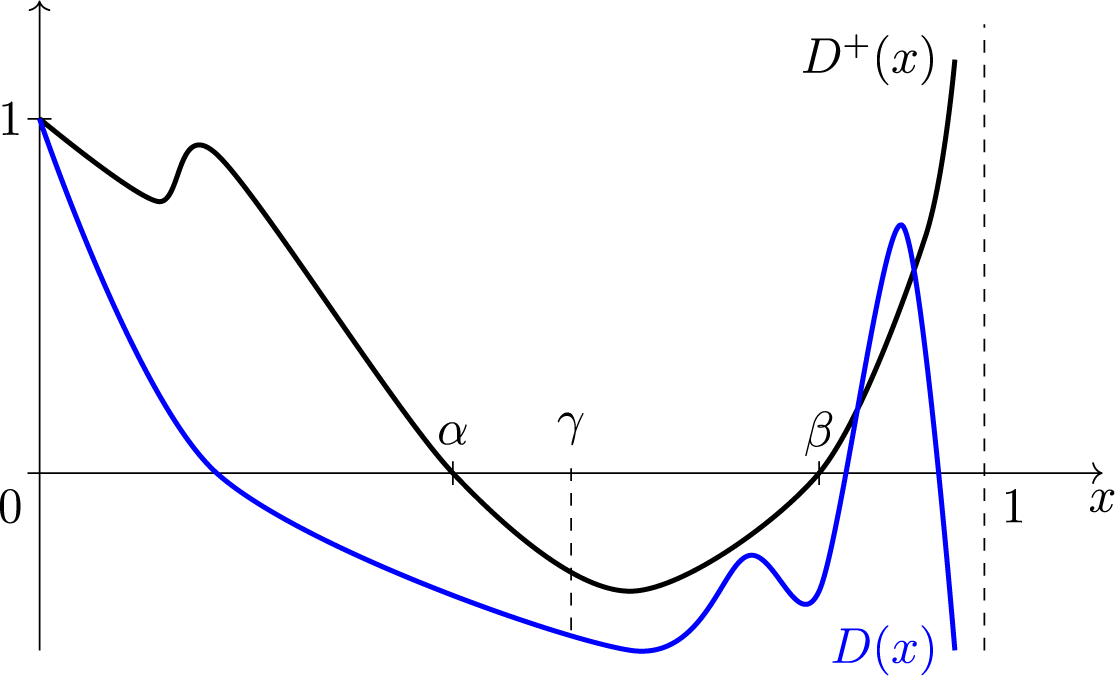
The next lemma and its proof are illustrated in Figure 3.
The functions D and
 $D^+$
from Lemma 4.1.

Lemma 4.1. Let
 $D, D^+ \in \mathscr {D}$
and let
 $\alpha ,\beta ,\gamma $
be such that
 $0<\alpha <\gamma <\beta <1$
. Assume that:
-
(i)
$D(x)\leq D^+(x)$
for
$x\in (0,\beta )$
, with
$D^+(x) < 0$
for
$x\in (\alpha ,\beta )$
; -
(ii)
$D'(x)<0$
for
$x\in (0,\gamma )$
.


Then D has a unique zero in
 $(0,\alpha ]$
(which, of course, is the first zero of D), and the function D has negative derivative at it. Moreover, the second positive zero of D, if it exists, is in
 $[\beta , 1)$
.
Proof. Since
 $D(0)=1$
and
 $D(\alpha ) \leq D^+(\alpha )\le 0$
, the function D has a zero in
 $(0,\alpha ]$
. This zero is unique and D has negative derivative at it, since
 $D'(x)<0$
for
 $x\in (0,\alpha ]$
. Suppose D has the second positive zero z. Then
 $z>\alpha $
, and since
 $D(x) \leq D^+(x) < 0$
for
 $x\in (\alpha ,\beta )$
, we get
 $z \geq \beta $
.
Typically, we will use the next lemma inductively to obtain a power series
 $D^+$
satisfying the assumptions of Lemma 4.1 from a power series D.
Lemma 4.2. Let
 $D(x)=1+\sum _{k=1}^{\infty }\varepsilon _kx^k$
and
 $\widehat {D}(x)=1+\sum _{k=1}^{\infty }\delta _kx^k$
, where
 $\varepsilon _k, \delta _k\in \{-1,1\}$
.
-
(a) If
$\delta _k\ge \varepsilon _k$
then
$D(x)\leq \widehat {D}(x)$
and
$D'(x) \leq \widehat {D}'(x)$
for every
$x\in (0,1)$
(moreover, these two inequalities are strict provided the inequality
$\delta _k\ge \varepsilon _k$
is strict for at least one k). -
(b) If there exists n such that
$\varepsilon _n=-1$
and
$\varepsilon _{n+1}=1$
,
$\delta _k=-\varepsilon _k$
for
$k=n,n+1$
, and
$\delta _k=\varepsilon _k$
otherwise, then
$D(x)<\widehat {D}(x)$
for every
$x\in (0,1)$
and
$D'(x)<\widehat {D}'(x)$
for every
$x\in (0,{n}/({n+1}))$
.


Proof. Part (a) is obvious. To prove (b), notice that
 $\widehat {D}(x)-D(x)=2x^n(1-x)$
, and this is positive for every
 $x\in (0,1)$
, while its derivative is
 $2(n+1)x^{n-1}({n}({n+1})-x)$
, so it is positive for all
 $x\in (0,{n}/({n+1}))$
.
If f is a unimodal map, denote by a the fixed point in the decreasing lap.
We are now in a position to prove that the second positive zero of the kneading determinant of a unimodal map f, if it exists, is greater than or equal to
 $\sqrt [3]{1/2}$
. This will follow from a series of propositions. In each of them we will consider only unimodal maps with kneading sequences of a particular form, as follows.
-
• The cases
$K=RLR^{\infty }$
and
$K=RLR^{2N}L\cdots $
with
$N\geq 1$
, will be dealt with in Proposition 4.3. -
• The case
$K=RL^{\infty }$
is covered by Proposition 4.4. -
• The case
$K=RL^NR\cdots $
, where
$N\ge 2$
, is covered by Proposition 4.7 (in this proposition we prove even a stronger result—we find the best lower bound for the second zero as a function of N). -
• The case
$K=RLR^{2N-1}L\cdots $
, with
$N\ge 1$
, is covered by Proposition 4.11.


Then the main result of this section is Theorem 4.12.
Note that here we are basically using the version of the kneading theory that does not use the symbol C (see §1.2).
Proposition 4.3. (
$K=RLR^{\infty }$
or
$K=RLR^{2N}L\cdots $
,
$N\geq 1$
)


Let f be a unimodal interval map, with the kneading sequence K equal to
 $RLR^{\infty }$
or beginning with
 $RLR^{2N}L\cdots ,$
with
 $N\geq 1$
. Then the kneading determinant D of f has exactly one zero
 $x_0$
in the interval
 $[0,\xi )$
, where
 $\xi $
is the second positive zero of the polynomial
 $2x^7-x^2-x+1$
(approximately
 $0.816\,041$
, which is greater than
 $\sqrt [3]{1/2}$
). Moreover,
 $D'(x_0)<0$
.
Proof. If the kneading sequence of f is
 $RLR^{\infty }$
, then
 $D(x)=({1-2x^2})/({1+x})$
, so it has a unique zero in
 $(0,1)$
, namely
 $\sqrt {1/2}$
(which lies in
 $[0,\xi )$
). Otherwise, since K begins with
 $RLR^{2N}L\cdots $
and every kneading sequence is maximal, it follows that K cannot have subsequences of two consecutive Ls. In particular, K begins with
 $RLR^{2N}LR.$
Therefore, the sequence of signs of the power series for the kneading determinant D of f (including a
 $+$
for the leading 1) begins with
 $+--(+-)^N-+$
and it has no blocks of the same sign of length greater than 2.
We will modify this sequence of signs by induction, using Lemma 4.2(b), to obtain a power series
 $D^+$
, corresponding to the sequence of signs
 $+--(+-)^N(-++)^{\infty },$
that verifies the assumptions of Lemma 4.1 for appropriate
 $\alpha ,\beta $
and
 $\gamma $
. This means that
 $$ \begin{align*} \begin{aligned} D^+(x)&=1-x-x^2+x^3(1-x+\cdots+x^{2N-2}-x^{2N-1})\\ & \quad +x^{2N+3}(-1+x+x^2-x^3+x^4+x^5-\cdots)\\ &=1-x-x^2+x^3\frac{1-x^{2N}}{1+x}+x^{2N+3}\frac{-1+x+x^2}{1-x^3}\\ &=\frac{1-2x^2}{1+x}-2x^{2N+3}\frac{1-x^2-x^3}{(1+x)(1-x^3)}. \end{aligned} \end{align*} $$
Clearly,
 $D, D^+ \in \mathscr D,$
and by Lemma 4.2,
 $$ \begin{align} D(x) \leq D^+(x) \text{ for } x\in(0,1)\quad \text{and}\quad D'(x)\leq(D^+)'(x) \text{ for } x\in(0,7/8) \end{align} $$
(the minimum power of x affected by the rule
 $(-+)\mapsto (+-)$
is
 $7$
or higher).
To simplify computations, we are going to use Lemma 4.1 not for D and
 $D^+$
, but for
 $$ \begin{align*} \overline{D} (x):= (1+x)D(x) \quad\text{and}\quad \overline{D^+}(x):= (1+x)D^+(x), \end{align*} $$
for
 $x\in [0,1).$
Since
 $D, D^+ \in \mathscr D,$
also
 $\overline {D}, \overline {D^+} \in \mathscr D.$
Moreover, from (7),
 $$ \begin{align} \overline{D}(x)\leq \overline{D^+}(x) \text{ for } x\in(0,1)\quad\text{and}\quad \overline{D}'(x) \leq (\overline{D^+})'(x) \text{ for } x\in(0,7/8) \end{align} $$
because, for
 $x\in (0,7/8)$
,
 $$ \begin{align*} (\overline{D})'(x) = D(x)+(1+x)D'(x) \leq D^+(x)+(1+x)(D^+)'(x)=(\overline{D^+})'(x). \end{align*} $$
Since
 $$ \begin{align*} \overline{D^+}(x)= (1+x)D^+(x)= 1-2x^2-2x^{2N+3}\frac{1-x^2-x^3}{1-x^3}, \end{align*} $$
by differentiating we get
 $$ \begin{align*} (\overline{D^+})'(x) = -4x-(4N+6)x^{2N+2}\frac{1-x^2-x^3}{1-x^3}+ 2x^{2N+3}\frac{2x+x^4}{(1-x^3)^2}. \end{align*} $$
Let
 $\gamma $
be the positive zero of the polynomial
 $1-x^2-x^3$
(approximately,
 $0.754\,878$
). This polynomial is decreasing for
 $x>0$
, so it stays positive for
 $x\in (0,\gamma )$
. Therefore, for
 $x\in (0,\gamma ),$
 $$ \begin{align*} (\overline{D^+})'(x) < -4x+2x^{2N+3}\frac{2x+x^4}{(1-x^3)^2} \le -4x+2x^5\frac{2x+x^4}{(1-x^3)^2} = \frac{P(x)}{2x(1-x^3)^2}, \end{align*} $$
with
 $P(x)=x^8-2x^6+2x^5+4x^3-2.$
We want to show that
 $P(x)<0$
for
 $x\in (0,\gamma ).$
We have
 $$ \begin{align*} P'(x)=8x^7+10x^4+12(x^2-x^5)>0 \end{align*} $$
for
 $x\in (0,1),$
so it remains to show that
 $P(\gamma )<0$
. However,
 $$ \begin{align*} P(x)=(x^3+x^2-1)(x^5-x^4-x^3+4x^2-5x+8)-(4x-3)(x+2), \end{align*} $$
and
 $4\gamma -3>0$
, so indeed,
 $P(\gamma )<0$
, and consequently,
 $(\overline {D^+})'(x)<0$
for
 $x\in (0,\gamma )$
.
Since
 $\gamma < 7/8$
, by (8) we have
 $$ \begin{align} \overline{D}(x)\leq \overline{D^+}(x) \text{ for } x\in(0,1)\quad\text{and}\quad \overline{D}'(x) \leq (\overline{D^+})'(x)<0 \text{ for } x\in(0,\gamma). \end{align} $$
Thus, in order to use Lemma 4.1 for
 $\overline {D}$
and
 $\overline {D^+}$
, we need to define
 $\alpha $
and
 $\beta $
such that
 $0<\alpha <\gamma <\beta <1$
and
 $\overline {D^+}(x) < 0$
for
 $x\in (\alpha ,\beta )$
. It is easy to check that
 $\overline {D^+}(\gamma )<0$
, so
 $\overline {D^+}$
has exactly one zero in
 $(0,\gamma )$
. Call this zero
 $\alpha $
. The limit of
 $\overline {D^+}(x)$
as x increases to 1 is
 $+\infty $
, so
 $\overline {D^+}$
has the second largest positive zero,
 $\beta \in (\gamma ,1)$
. With those definitions of
 $\alpha $
and
 $\beta $
, our assumptions are satisfied. Thus, the first positive zero
 $x_0$
of
 $\overline {D}$
(and therefore, of D) exists and is in
 $(0,\alpha ]$
, and the second positive zero of
 $\overline {D}$
(and therefore, of D), if it exists, is greater than or equal to
 $\beta $
. Moreover, by Lemma 4.1 applied to
 $\overline {D}$
and
 $\overline {D^+}$
,
 $(\overline {D})'(x_0)<0$
. Then also
 $D'(x_0)<0$
as required (this is obvious, since
 $\overline {D} (x_0)=0$
gives
 $D(x_0)=0$
and we have
 $(\overline {D})'(x)= D(x) + (1+x)D'(x)$
).
Here
 $\alpha $
and
 $\beta $
depend on N. However, if
 $x\in (\gamma ,1)$
, then
 $\overline {D^+}(x)$
decreases as N increases, so
 $\beta \ge \widehat {\beta }$
, where
 $\widehat {\beta }$
is the value of
 $\beta $
obtained for
 $N=1$
. For
 $N=1$
we have
 $$ \begin{align*}\begin{aligned} \overline{D^+}(x)=1-2x^2-2x^5\frac{1-x^2-x^3}{1-x^3} &=\frac{2x^8+2x^7-x^3-2x^2+1}{1-x^3}\\ &=(2x^7-x^2-x+1)\frac{1+x}{1-x^3}, \end{aligned}\end{align*} $$
so
 $\widehat {\beta } =\xi $
. This completes the proof.
Proposition 4.4. (
 $K=RL^{\infty }$
) Let f be a unimodal interval map with the kneading sequence
 $RL^{\infty }$
. Then the kneading determinant of f has exactly one zero in
 $[0, 1)$
, namely
 $1/2$
, and its derivative at this zero is negative.
Proof. The kneading determinant is
 $1-x-x^2 - x^3- \cdots = (1-2x)/(1-x)$
. The result follows.
The next case to consider is a kneading sequence of the form
 $K=RL^NR\cdots $
with a finite
 $N\geq 2$
. To make the proof of Proposition 4.7 more transparent, we first prove the following lemmas.
Lemma 4.5. Let
 $N\ge 2$
and let f be a unimodal map such that the kneading sequence of f begins with
 $RL^N(RL^{N-1}R)^nRL^N$
for some
 $n\geq 0$
. Then the second zero of the kneading determinant of f, if it exists, is strictly greater than
 $\sqrt [N+1]{1/2}$
.
Proof. Since the kneading sequence K begins with
 $RL^N(RL^{N-1}R)^nRL^N$
, it is straightforward to check that, regardless of whether
 $n=0$
or
 $n\geq 1$
,
 $$ \begin{align*} RL^{N-1}*L^{\infty}=(RL^{N-1}R)^{\infty} <K< RL^N(RL^{N-1}R)^{\infty}=RL^{N-1}*RL^{\infty}. \end{align*} $$
Thus, by [Reference Collet and EckmannCE, Theorem II.2.7(i)], there is a unique kneading sequence B such that
 $K=RL^{N-1}*B$
(due to the inequality
 $K<RL^{N-1}*RL^{\infty }$
we have
 $B\neq RL^{\infty }$
; we will use this later). Therefore, since
 $D_{RL^{N-1}}(x)=(1-x-x^2-\cdots -x^N)/(1-x^{N+1})$
, according to formula (5) we have
 $$ \begin{align} D_K(x)=(1-x^{N+1})D_{RL^{N-1}}(x)D_B(x^{N+1}) =(1-x-x^2-\cdots-x^N)D_B(x^{N+1}). \end{align} $$
The polynomial
 $P(x)=1-x-x^2-\cdots -x^N$
is decreasing for
 $x>0$
,
 $P(0)=1$
, and
 $P(1)<0$
, so it has a unique zero z in
 $(0,1)$
. If
 $x=\sqrt [N+1]{1/2}$
, then
 $$ \begin{align*} P(x)=1-x\frac{1-x^N}{1-x}=1-x\frac{1-1/{2x}}{1-x} =1-\frac{x-1/2}{1-x}=\frac{3/2-2x}{1-x}. \end{align*} $$
Since
 $N+1\ge 3$
, we have
 $\sqrt [N+1]{1/2}>3/4$
, so
 $P(x)<0$
. Thus,
 $z<\sqrt [N+1]{1/2}$
. On the other hand, by Theorem 2.4, the function H is strictly increasing at
 $RL^{\infty }$
and since
 $B\neq RL^{\infty }$
, the entropy of a unimodal map with kneading sequence B is strictly smaller than
 $\log 2$
. Hence, by virtue of (F1) in §1.3, the first zero of
 $D_B(x)$
, if it exists, is strictly greater than
 $1/2$
. Thus, the first zero of
 $D_B(x^{N+1})$
, if it exists, is strictly greater than
 $\sqrt [N+1]{1/2}$
(which in turn is strictly greater than z). Thus the second zero of
 $D_K$
, if it exists, is strictly greater than
 $\sqrt [N+1]{1/2}$
.
Lemma 4.6. Let
 $N\ge 2$
and let f be a unimodal map such that the kneading sequence of f begins with
 $RL^NR$
, but not with
 $RL^NRL^N$
. Then the derivative of the kneading determinant of f is negative in
 $(0,d)$
, where d is the unique zero in
 $(0,1)$
of the polynomial
 $$ \begin{align*} Q(x)=-12x^7+24x^6-12x^5-6x^4+8x^3-1 \end{align*} $$
(approximately
 $0.663\,744$
).
Proof. If
 $N=2$
, then the sequence of signs corresponding to the kneading determinant D of f begins with
 $+(-)^3(+)^k-$
, where
 $1\le k\le 2$
. By replacing minuses by pluses and
 $-+$
by
 $+-$
(as we did in the proof of Proposition 4.3), we can get the sequence of signs
 $+---++-(+)^{\infty }$
. The corresponding power series is
 $$ \begin{align*} \widehat{D}(x)=1-x-x^2-x^3+x^4+x^5-x^6+\sum_{i=7}^{\infty} x^i =\frac{1-2x+2x^4-2x^6+2x^7}{1-x}. \end{align*} $$
By Lemma 4.2 we get
 $D'(x)\le \widehat {D}'(x)$
for all
 $x\in (0,5/6)$
.
If
 $N>2$
, then the sequence of signs corresponding to the kneading determinant D of f begins with
 $+(-)^4$
, so again by replacing minuses by pluses and
 $-+$
by
 $+-$
we can get the same sequence
 $+---++-(+)^{\infty }$
. Therefore, again we get
 $D'(x)\le \widehat {D}'(x)$
, this time for all
 $x\in (0,4/5)$
.
We have
 $\widehat {D}'(x)=Q(x)/(1-x)^2$
, and Q has unique zero d in
 $(0,1)$
. Moreover,
 ${Q(x)<0}$
for all
 $x\in (0,d)$
. Since
 $d<4/5$
, we get
 $D'(x)<0$
for all
 $x\in (0,d)$
.
Proposition 4.7. (
$K=RL^NR\cdots , N\geq 2$
)

Let
 $N\ge 2$
and let f be a unimodal map such that the kneading sequence of f begins with
 $RL^NR$
. Then the second zero of the kneading determinant of f, if it exists, is greater than or equal to
 $\sqrt [N+1]{1/2}$
. The equality holds if and only if the kneading sequence is
 $RL^N(RL^{N-1}R)^{\infty }$
. Moreover, the derivative of the kneading determinant of f at the first zero is negative.
Proof. Denote by K the kneading sequence of f and by D its kneading determinant. As we noticed in the introduction, in the sequence of signs corresponding to K there cannot be more than
 $N+1$
of the same signs in a row.
First consider the important particular case when the kneading sequence is
 $$ \begin{align*} K^{*}= RL^N(RL^{N-1}R)^{\infty} =RL^{N-1}*RL^{\infty}. \end{align*} $$
Then, according to (10), the kneading determinant is
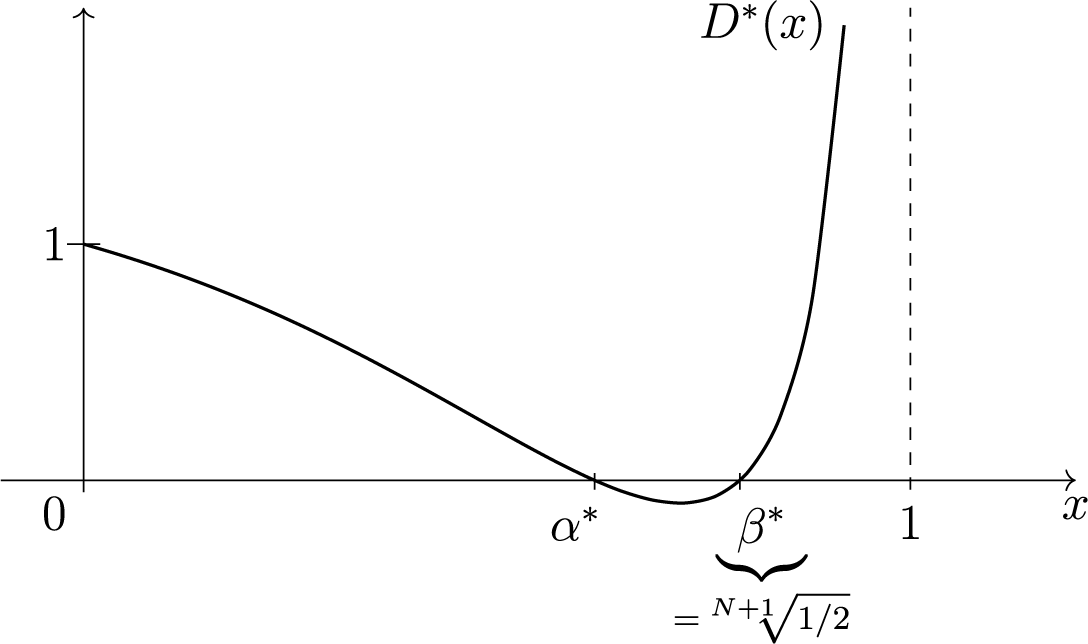
 $$ \begin{align} \begin{aligned} D^{*}(x) &= (1-x-x^2- \cdots -x^N)D_{RL^{\infty}}(x^{N+1}) \\ &=\frac{(1-x-x^2-\cdots-x^N)(1-2x^{N+1})}{1-x^{N+1}}. \end{aligned} \end{align} $$
Denote by
 $\alpha ^{*}$
the unique positive zero of the polynomial
 $1-x-x^2- \cdots -x^N$
and set
 $\beta ^{*} = \sqrt [N+1]{1/2}$
. If d is the number from Lemma 4.6, then
 $$ \begin{align} \alpha^{*}\le\frac{\sqrt 5-1}{2}<d< \sqrt[3]{1/2} \leq \beta^{*} \end{align} $$
because
 $(\sqrt 5-1)/2$
is the positive zero of the polynomial
 $1-x-x^2$
. Observe that
 $\alpha ^{*}$
is the first zero and
 $\beta ^{*}$
is the second zero of
 $D^{*}$
, and
 $D^{*}$
is negative between them (see Figure 4). By Lemma 4.6, the derivative of
 $D^{*}$
at the first zero is negative. This completes the proof in this particular case.
If
 $K^{*}=RL^N(RL^{N-1}R)^{\infty }$
then the second zero of the kneading determinant
 $D^{*}(x)$
is
 $\beta ^{*}=\sqrt [N+1]{1/2}$
, so this lower bound for the second zero is attainable.

Now, if
 $K=RL^NR \cdots $
is different from the considered particular case, then there is a finite
 $n\geq 0$
such that
 $$ \begin{align*} K=RL^N(RL^{N-1}R)^n A_1A_2\cdots A_{N+1}\cdots \end{align*} $$
where
 $A_1A_2 \cdots A_{N+1}\neq RL^{N-1}R$
. We are going to prove that in this case the second zero of the kneading determinant, if it exists, is strictly greater than
 $\beta ^{*}=\sqrt [N+1]{1/2}$
. By Lemma 4.5, this is true if
 $A_1A_2\cdots A_{N+1} = RL^{N}$
. From now on we will therefore additionally assume that
 $A_1A_2\cdots A_{N+1} \neq RL^{N}$
, so
 $A_1A_2\cdots A_N\neq RL^{N-1}$
.
The corresponding sequence of signs is
 $$ \begin{align} +(-)^{N+1}((+)^N-)^na_1a_2\cdots a_N\cdots, \end{align} $$
and the block
 $a_1a_2\cdots a_N$
is different from
 $(+)^N$
. It follows that this block begins with at most
 $N-1$
pluses (moreover, we know that
 $a_1=-$
is possible only if
 $n\geq 1$
, since for
 $n=0$
we would have
 $N+2$
minuses in a row). By using the rule
 $(-+)\mapsto (+-)$
and taking into account that there are no blocks of pluses longer than
 $N+1$
, by using an argument very similar to that in the proof of Proposition 4.3, we always can get the sequence
 $$ \begin{align} +(-)^{N+1}((+)^N - )^n ((+)^{N-1} -++ )^{\infty}. \end{align} $$
By Lemma 4.2, for the kneading determinant
 $D(x)$
corresponding to (13) and its majorant
 $D^+(x)$
corresponding to (14), we have
 $$ \begin{align} D(x)\leq D^+(x) \end{align} $$
for all
 $x\in [0,1)$
.
We have
 $$ \begin{align*} D^+(x) &= 1-x-\cdots -x^{N+1} + \frac{x^{N+2} (1+x+\cdots +x^{N-1}-x^N)(1-x^{(N+1)n})}{1-x^{N+1}} \\ &\quad+ \frac{x^{(N+1)n+N+2}(1+x+\cdots +x^{N-2}-x^{N-1}+x^N+x^{N+1})}{1-x^{N+2}}. \end{align*} $$
By grouping the terms not containing n and those containing n we get
 $$ \begin{align*} D^+(x) &= \frac{(1\kern1.4pt{-}\kern1.4pt x\kern1.4pt{-}\kern1.4pt\cdots\kern1.4pt{-}\kern1.4pt x^N)(1-2x^{N+1})}{1-x^{N+1}}\kern1.4pt{-}\kern1.4pt \frac{2x^{(N+1)n+2N+1}(1\kern1.4pt{-}\kern1.4pt x)(1\kern1.4pt{-}\kern1.4pt x^{N+1}\kern1.4pt{-}\kern1.4pt x^{N+2})}{(1-x^{N+1})(1-x^{N+2})}\\ &=D^{*}(x)- \frac{2x^{(N+1)n+2N+1}(1-x)(1-x^{N+1}-x^{N+2})}{(1-x^{N+1})(1-x^{N+2})}. \end{align*} $$
The polynomial
 $S(x)= 1-x^{N+1}-x^{N+2}$
is decreasing for
 $x>0$
, with
 $S(0)=1$
and
 $S(1)=-1$
, so it has a unique zero in
 $(0,1)$
. We have
 $$ \begin{align*} S(\beta^{*}) = S \Big(\sqrt[N+1]{1/2}\Big) = 1 - 1/2 - \Big(\sqrt[N+1]{1/2}\Big)^{N+2}>0. \end{align*} $$
Thus
 $S(x)$
and, consequently, also the second term, which is subtracted from
 $D^{*}(x)$
, are positive for all
 $x\in (0,\beta ^{*}]$
. From this and (15) it follows that
 $$ \begin{align} D(x) \leq D^+(x) < D^{*}(x) \end{align} $$
for all
 $x\in (0,\beta ^{*}]$
.
Moreover, by Lemma 4.6,
 $D(x)$
has negative derivative in
 $(0,d)$
where, by (12),
 ${\alpha ^{*} < d < \beta ^{*}}$
. Therefore, applying Lemma 4.1 to functions D and
 $D^{*}$
, we get that the first zero of D is in
 $(0,\alpha ^{*}]$
and the second zero, if it exists, is in
 $[\beta ^{*},1)$
. Hence, the derivative of D at the first zero is negative and the second zero, if it exists, is in fact strictly greater than
 $\beta ^{*}$
, because (16) gives
 $D(\beta ^{*}) < D^{*}(\beta ^{*})=0$
. This completes the proof.
Remark 4.8. Fix
 $N\geq 3$
. By Proposition 4.7 and the beginning of its proof,
 $\sqrt [N]{1/2}$
is the second zero of the kneading determinant corresponding to the kneading sequence
 ${K^{*} =RL^{N-2}*RL^{\infty }}$
. Since this
 $K^{*}$
is a star product, it is not a kneading sequence of any tent map (as mentioned in §1.4, mixing tent maps are not renormalizable). However,
 $RL^{N-2}C$
, which is the same as
 $(RL^{N-2}R)^{\infty }$
, is the kneading sequence of the tent map whose turning point is periodic with period N; denote its slope by
 $s_N$
. Since this kneading sequence is R-even, the corresponding kneading determinant
 $(1-x-x^2-\cdots -x^{N-1})/(1-x^{N})$
has only one zero in
 $(0,1)$
. By (F1),
 $s_N$
is the reciprocal of this zero. Hence,
 $s_N$
is the positive zero of the polynomial
 $x^{N-1}-x^{N-2}-\cdots -x-1$
(alternatively, the largest positive zero of the polynomial
 $(x^{N-1}-x^{N-2}-\cdots -x-1 ) (x-1)= x^{N}-2x^{N-1}\,{+}\,1$
). Here are some approximate values:
 $s_3 = (1+\sqrt 5)/2 \approx 1.618\,03$
,
 $s_4\approx 1.839\,29$
,
 ${s_5 \approx 1.927\,56}$
,
 $s_6\approx 1.965\,95$
.
Unlike the point
 $(s_N, 1/s_N)$
on the curve of first zeros, the point
 $(s_N, \sqrt [N]{1/2})$
(see Figure 5) does not belong to the Real Teapot (there is no second zero in this case). However, it belongs to its closure, since the limit of the second zero at the point
 $s_N$
from the right (in the family of tent maps) is
 $\sqrt [N]{1/2}$
(see §5).
All zeros except the first ones, for the slopes
 $s\in [\sqrt 2, 2]$
and with
 $s_3, s_4, s_5, s_6$
marked. We also marked slopes
 $\check {s}_9,\check {s}_7,\check {s}_5$
, which correspond to the orbit of the turning point being Štefan of period
 $9,7,5$
(see §7.1).

From Corollary 2.5 and Propositions 4.3, 4.4 and 4.7, we immediately obtain the following corollary.
Corollary 4.9. If a unimodal map has topological entropy from
 $[(1/2)\log 2,\log 2]$
, then the second zero of its kneading determinant, if it exists, is greater than or equal to
 $\sqrt [3]{1/2}$
. Moreover, the derivative of this kneading determinant at the first zero is negative.
It remains to consider the case of a unimodal map g such that
 $K_g=RLR^{2N-1}L\cdots $
with finite
 $N\ge 1$
.
Remember that by the zeros of a kneading determinant we mean, as always in this paper, the zeros in
 $(0,1)$
. Unimodal maps are assumed to be defined on the interval
 $[0,1]$
which is their core.
Part (a) of the next lemma is known but we do not have a reference.
Lemma 4.10. Let
 $g\colon [0,1] \to [0,1]$
be a unimodal map with topological entropy
 ${h(g)\in (0,(1/2)\log 2)}$
. Then there exist a subinterval J of
 $[0,1]$
with
 $g^2(J)\subset J$
, and a unimodal map
 $g^{*}\colon [0,1]\to [0,1]$
, conjugate to
 $g^2|J$
, such that:
-
(a)
$h(g^{*}) = 2h(g)$
; -
(b) the second zero
$z_2^{*}$
of
$D_{g^{*}}$
exists if and only if the second zero
$z_2$
of
$D_g$
exists, and in such a case
$z_2^{*}=z_2^2$
; -
(c) if
$z_1^{*},z_1$
are the first zeros of
$D_{g^{*}},D_g$
respectively, and
$(D_{g^{*}})'(z_1^{*})<0$
, then
$(D_g)'(z_1)<0$
.


Proof. By Corollary 2.5 we have
 $g(0)>a$
, where a is the fixed point of g in the decreasing lap. Then g is
 $2$
-renormalizable with restrictive intervals
 $J_0=[0,a]$
and
 $J_1=[a,1]$
. We have
 $g(J_0)=J_1$
,
 $g(J_1)=J_0$
and the maps
 $g_0=g^2\vert J_0$
and
 $g_1=g^2\vert J_1$
are topologically conjugate through the conjugacy
 $g\vert J_1\colon ~J_1\to J_0$
. It follows that
 $h(g_0)=h(g_1) =2h(g)$
.
The map
 $g_1$
, after restricting it to its core
 $J\subset J_1$
, is conjugate to a unimodal map
 $g^{*}\colon [0,1]\to [0,1]$
. Then
 $h(g^{*})=h(g_1)=2h(g)$
and we get (a).
By (6),
 $$ \begin{align} D_g(x)=(1-x)D_{g^{*}}(x^2), \end{align} $$
which tells us immediately that (b) is true.
By formula (17), we have
 $z_1^{*}=z_1^2$
, and
 $$ \begin{align*} (D_g)'(z_1)= -D_{g^{*}}(z_1^{*}) + 2z_1(1-z_1)(D_{g^{*}})'(z_1^{*}) =2z_1(1-z_1)(D_{g^{*}})'(z_1^{*})<0, \end{align*} $$
and (c) follows.
Proposition 4.11. (
$K=RLR^{2N-1}L\cdots $
,
$N\geq 1$
)


Let f be a unimodal map with positive topological entropy and kneading sequence
 $K_f=RLR^{2N-1}L\cdots $
,
 $N\ge 1$
. Then there is
 $k\geq 1$
such that
 $h(f)\in (({1}/{2^{k+1}})\log 2,({1}/{2^{k}})\log 2]$
. If the kneading determinant
 $D_f$
has at least two zeros in
 $(0,1)$
then its second zero is greater than or equal to
 $(\sqrt [3]{1/2})^{{1}/{2^k}}$
(and hence strictly greater than
 $\sqrt [3]{1/2}$
). The derivative of
 $D_f$
at the first positive zero is negative.
Proof. By Corollary 2.5,
 $h(f)\in (0,(1/2)\log 2)$
and
 $f(0)>a$
, where a is the fixed point of f in the decreasing lap. So there exists
 $k\geq 1$
such that
 $h(f)\in (({1}/{2^{k+1}})\log 2,({1}/{2^{k}})\log 2]$
(if
 $k=1$
then
 $h(f)\in (({1}/{2^{k+1}})\log 2,({1}/{2^{k}}) \log 2)$
). Now we use Lemma 4.10 inductively, and at the last step (when the entropy is greater than or equal to
 $(1/2)\log 2$
) Corollary 4.9.
Propositions 4.3, 4.4, 4.7 and 4.11 immediately give us the following easy to remember fact.
Theorem 4.12. Let f be a unimodal interval map with positive topological entropy. Then the derivative of the kneading determinant at the first positive zero is negative, so it is a simple zero. The second positive zero of the kneading determinant of f, if it exists, is greater than or equal to
 $\sqrt [3]{1/2}$
. It is equal to
 $\sqrt [3]{1/2}$
if and only if the kneading sequence of f is
 $RLL(RLR)^{\infty }$
.
Lemma 4.10 shows that the Real Teapot has the block structure as expressed in the following corollary.
Corollary 4.13. The Real Teapot (1) is a union
 $$ \begin{align*} B_0\cup B_1 \cup B_2 \cup \cdots, \end{align*} $$
where
 $B_k$
,
 $k=0,1,\ldots ,$
is the set of those points of the Real Teapot whose first coordinate is in
 $(\!\sqrt [2^{k+1}]2,\sqrt [2^k]2]$
. Moreover,
 $$ \begin{align*} \Phi (B_k)= B_{k+1} \quad \text{and} \quad \Phi^{-1} (B_{k+1}) = B_k, \quad k=0,1,\ldots, \end{align*} $$
where
 $\Phi (s,x) = (\sqrt s, \sqrt x)$
and its inverse
 $\Phi ^{-1}(s,x) = (s^2, x^2)$
.
Proof. The Real Teapot contains points
 $(2, 1/2)$
,
 $(\sqrt 2,1/\sqrt 2)$
,
 $(\sqrt [4] 2, 1/\sqrt [4] 2), \ldots $
and no other points whose first coordinate is of the form
 $\sqrt [2^k] 2$
,
 $k=0,1,\ldots .$
Indeed, for
 $s=2$
and
 $s=\sqrt 2$
a direct computation shows that the kneading determinant has only one zero and we know by (F1) that it is the reciprocal of the slope. For the rest of those points this follows from Lemma 4.10(b). The map
 $\Phi $
sends each of them to the next one. The rest follows from Lemma 4.10(b).
To finish this section, for
 $s\in (1,2]$
, let us define
 $\varphi (s)$
as the second zero of the kneading determinant of
 $T_s$
if it exists, and
 $1$
otherwise. For all
 $s=\sqrt [2^k]2$
,
 $k\ge 0$
, the kneading determinant has only one zero in
 $(0,1)$
, so
 $\varphi (\sqrt [2^k]2)=1$
. The next theorem shows that the function
 $\varphi $
is continuous at those points.
Theorem 4.14. We have
 $$ \begin{align} \lim_{s\to 2^{-}}\varphi(s)=\lim_{s\to\sqrt[2^k]2}\varphi(s)=1 \end{align} $$
for all
 $k\ge 1$
.
Proof. As s goes to 2 from the left, the kneading sequence of
 $T_s$
starts with
 $RL^NR$
, and N goes to infinity. By Proposition 4.7,
 $\varphi (s)\ge \sqrt [N+1]{1/2}$
, so
 $\varphi (s)$
goes to 1.
As s goes to
 $\sqrt 2$
, the kneading sequence of
 $T_s$
starts with
 $RLR^{2N}$
(regardless of whether the next symbol is R or L), and N goes to infinity. The corresponding sequence of signs starts with
 $+--(+-)^N$
, so the kneading sequence is
 $$ \begin{align*} D(x)=1-x-x^2+(x^3-x^4)+(x^5-x^6)+\cdots+(x^{2N+1}-x^{2N+2})+ \sum_{k=2N+3}^{\infty} \varepsilon_kx^k, \end{align*} $$
where
 $\varepsilon _k\in \{-1, +1\}$
. Set
 $$ \begin{align*} \begin{aligned} D^+(x)&=1-x-x^2+(x^3-x^4)+(x^5-x^6)+\cdots+(x^{2N+1}-x^{2N+2})+ \sum_{k=2N+3}^{\infty} x^k\\ &=1-x-x^2+\frac{x^3-x^{2N+3}}{1+x}+\frac{x^{2N+3}}{1-x}\\ &=\frac{1-2x^2}{1+x}+\frac{2x^{2N+4}}{1-x^2}. \end{aligned} \end{align*} $$
Then
 $D(x)\le D^+(x)$
and
 $D'(x)\le (D^+)'(x)$
for all
 $x\in (0,1)$
.
We have
 $$ \begin{align*} (D^+)'(x)=\frac{-2x^2-4x-1}{(1+x)^2}+x^{2N+3}\frac{4N+8-(4N+4)x^2} {(1-x^2)^2}\le-1+\frac{(4N+8)x^{2N}}{(1-x^2)^2} \end{align*} $$
for all
 $x\in (0,1)$
. The function
 $\psi _N(x)=-1+(4N+8)x^{2N}/(1-x^2)^2$
is increasing on
 $(0,1)$
. Fix
 $\varepsilon \in (0,1)$
. If N is sufficiently large, then
 $\psi _N(1-\varepsilon )<0$
, so
 $D'(x)\le (D^+)'(x)\le \psi _N(x)<0$
for all
 $x\in (0,1-\varepsilon )$
. Therefore D has at most one zero (namely, the first one) in
 $(0,1-\varepsilon )$
. Consequently, if s is sufficiently close to
 $\sqrt 2$
, then
 $\varphi (s)\ge 1-\varepsilon $
. This proves (18) for
 $k=1$
.

5 Close to period
$3$

Let us look at what happens close to the slope where the turning point is periodic of period 3 (this slope is the golden mean; we will denote it by
 $s_3$
). Let us start by looking at Figures 6, 7 and 8. On the horizontal axis there are slopes s of the tent maps, on the vertical axis are the zeros of the kneading determinant (
 $1$
is at the top). For x close to 1 the power series that defines the kneading determinant
 $D_s(x)$
converges very slowly, so numerical methods for finding the zeros fail. Therefore we see a gap close to
 $x=1$
, which is an artifact. In fact, some coarse estimates suggest that we cannot believe anything with
 $x>0.99$
(the highest red squares).
Slopes from
 $1.61$
to
 $1.67$
, all zeros except the first ones.

Slopes from
 $1.6175$
to
 $1.6235$
, all zeros except the first ones.

Slopes from
 $1.6178$
to
 $1.6184$
, second and third zeros.

In our pictures every horizontal pixel (there are
 $1800$
of them) corresponds to
 $1000$
values of s. The red grid makes it simpler to see approximate values of s and the zeros of
 $D_s$
.
In Figure 6 the slopes are from
 $1.61$
to
 $1.67$
. Vertical red lines are every
 $0.0015$
, and horizontal ones every
 $0.01$
(so the highest horizontal line is at
 $x=1$
and the lowest one at
 $x=0.79$
). The position of
 $s_3$
is easily visible not far from the left side of the picture. To the left of
 $s_3$
all zeros are close to 1, while to the right of it (and close to it) it looks like there are additional zeros quite far from 1. A natural conjecture is that those are second zeros.
Now let us stretch the horizontal axis. In Figure 7 the slopes are from
 $1.6175$
to
 $1.6235$
, so the vertical red lines are every
 $0.000\,15$
. We see better the phenomena that we noticed in Figure 6.
Let us continue and stretch the horizontal axis even more, and plot only second (black) and third (cyan) zeros. In Figure 8 the slopes are from
 $1.6178$
to
 $1.6184$
, so the vertical red lines are every
 $0.000\,015$
. And indeed, it looks like to the right of
 $s_3$
the zeros far from
 $x=1$
are second zeros.
However, we see clearly another phenomenon (which we could have noticed earlier). Namely, there is a change in the form of discontinuities in the zeros close to 1. In fact, we cannot tell whether they are discontinuities; what we see may just be very steep curves (however, let us refer to them as discontinuities). To the left of
 $s_3$
(where they are second zeros) they look like discontinuities from the left, while to the right of
 $s_3$
(where they are third zeros) they look like discontinuities from the right. Moreover, they correspond to the steep parts of graph for the second zeros, which are far from 1.
Let us try to explain the phenomenon that we observed. What happens immediately to the left and right of
 $s_3$
? At
 $s_3$
the kneading sequence is
 $RLC$
, so the kneading determinant is
 $(1-x-x^2)/(1-x^3)$
. It has only one zero in
 $(0,1)$
(in fact, we knew this without calculations, because the infinite version of the kneading sequence
 $RLC$
is
 $(RLR)^{\infty }$
, which is R-even). If s is slightly smaller, a big chunk of the power series stays the same, so for a small
 $\varepsilon>0$
the kneading determinant has only one zero in
 $(0,1-\varepsilon )$
. If s is slightly greater than
 $s_3$
, then the kneading determinant is close not to
 $D_{s_3}$
, but to the kneading determinant of the map with kneading sequence which is the star product of
 $RL$
and
 $RL^{\infty }$
(the kneading sequences in between, including the last one, are missing in our picture, because there are no such tent maps). The kneading determinant of this map is
 $(1-x-x^2)(1-2x^3)/(1-x^3)$
, so it has two zeros in
 $(0,1)$
. The second zero is
 $\sqrt [3]{1/2}$
. This means that for s slightly greater than
 $s_3$
there is a second zero close to
 $\sqrt [3]{1/2}$
and for a small
 $\varepsilon>0$
the kneading determinant has only two zeros in
 $(0,1-\varepsilon )$
.
This shows that on some interval
 $(s_3,\widehat {s})$
or
 $(s_3,\widehat {s}]$
the second zero exists, so it is a function of s. This function was already introduced in connection with Theorem 4.14 and denoted there by
 $\varphi $
. From what was said above we know that
 $$ \begin{align*} \lim_{s\to (s_3)^+} \varphi(s) = \sqrt[3]{1/2}. \end{align*} $$
The function
 $\varphi $
is continuous, at least at points from
 $(s_3, \widehat {s})$
. Indeed, the only values of s at which the kneading determinant as a function of s is discontinuous, are those at which the turning point is periodic (in the space of kneading determinants we take the topology of uniform convergence on compact subsets of
 $[0,1)$
). If for a given s the turning point is periodic of period n, then
 $$ \begin{align*} \lim_{t\to s^-}D_t(x)=D_s(x) \quad\text{and}\quad \lim_{t\to s^+}D_t(x)=(1-2x^n)D_s(x). \end{align*} $$
Since the zero of
 $1-2x^n$
is much greater than the second zero of
 $D_s$
, the second zero of both limits is the same.
Let us take the largest
 $\widehat {s}$
for which the above holds. It is interesting what happens at
 $\widehat {s}$
. There are three possibilities. The first one is that at
 $\widehat {s}$
the second and third zeros meet, creating a second zero of multiplicity 2 (or greater), and when s increases, this second zero disappears. Of course in this case some greater zero can become the second one. The second possibility is that in the situation described in the preceding paragraph the zero of
 $1-2x^n$
is smaller than the second zero of
 $D_s$
, and it becomes the second zero. The third possibility is that the limit of the second zero at
 $\widehat {s}$
is 1.
There is strong numerical evidence that in our case the first possibility occurs. In Figures 9 and 10 we see that between
 $1.619\,961\,091$
and
 $1.619\,961\,092$
the second and third zeros collide.
(a) The graph of the kneading determinant for the slope
 $1.619\,961\,091$
;
 $0.5\le x< 1$
. (b) The part around the turning point is zoomed in; we can see the second and the third zero.

(a) The graph of the kneading determinant for the slope
 $1.619\,961\,092$
;
 $0.5\le x< 1$
. (b) While the value at the turning point in Figure 9 was positive, now it is negative. Hence, for some slope between
 $1.619\,961\,091$
and
 $1.619\,961\,092$
, the value at the turning point is equal to zero (the zero is multiple).

If we start not from an s corresponding to a turning point of period 3, but from any other s for which the turning point is periodic, we have a similar situation (in particular,
 $\lim _{s\to (s_N)^+} \varphi (s) = \sqrt [N]{1/2}$
holds also for all
 $N\geq 4$
), but in general the zero we consider will not necessarily be the second one. Then other possibilities may be realized. Anyway we see that our Real Teapot contains the union of countably many graphs of continuous functions with various connected domains.
The pictures strongly suggest that those graphs have a nice fractal structure. Two interesting questions are what their Hausdorff dimension is and whether it is the same for every curve.
For the ‘discontinuities’ mentioned earlier we have an explanation only if s is close to
 $s_3$
from the left. Then we have the phenomenon described above, whenever the turning point is a periodic point. However, since the period is much greater than 3, everything happens close to
 $x=1$
, and moreover, to see the similar picture we would have to stretch the s-axis considerably. We do not have the explanation for the ‘inverted discontinuities’ to the right of
 $s_3$
. It may be connected with the fact that these are third zeros, or again, it may only look like this because we do not stretch the s-axis sufficiently.
6 Closure of the Real Teapot
In the definition of Thurston’s Master Teapot one takes the closure. If we consider the closure of the Real Teapot (in
 $(1,2]\times (0,1)$
), what would change in our results?
The only section where interesting questions arise is §2. We proved there that if a unimodal map is R-even, then its kneading determinant has a unique zero in
 $(0,1)$
. The latter property for the map
 $T_s$
is equivalent to
 $\{s\}\times (0,1)$
intersecting the Real Teapot only at one point
 $(s,1/s)$
. If we replace the Real Teapot by its closure, this property does not necessarily hold for R-even maps. For instance, for
 $s_3$
, considered in §5, the kneading sequence of
 $T_{s_3}$
is R-even, but the point
 $(s_3,\sqrt [3]{1/2})$
belongs to the closure of the Real Teapot.
However, this phenomenon is impossible if the orbit of the turning point of
 $T_s$
is not periodic.
Theorem 6.1. If the kneading determinant of the map
 $T_s$
has only one zero and the turning point of
 $T_s$
is not periodic, then
 $\{s\}\times (0,1)$
intersects the closure of the Real Teapot only at one point
 $(s,1/s)$
.
Proof. The function assigning to t the kneading determinant of
 $T_t$
is continuous at
 $t=s$
. Since we are dealing with analytic functions, the same is true if we replace the kneading determinant by its derivative. By Theorem 4.12, this derivative is negative at the first zero of
 $T_s$
. Our topology in the space of kneading determinants is that of uniform convergence on compact sets. All this shows that for any compact subset X of
 $(0,1)$
the set
 ${\{s\}\times X}$
intersects the closure of the Real Teapot at one point at most. Therefore,
 $\{s\}\times (0,1)$
intersects the closure of the Real Teapot only at one point.
Together with Theorem 2.10, we obtain the following corollary.
Corollary 6.2. The set of those slopes
 $s\in (\sqrt 2,2]$
for which
 $\{s\}\times (0,1)$
intersects the closure of the Real Teapot only at one point
 $(s,1/s)$
, has the cardinality of the continuum.
This corollary allows us to draw conclusions about the connectivity properties of the closure of the Real Teapot.
Theorem 6.3. The closure of the Real Teapot in
 $(1,2]\times (0,1)$
has infinitely many connected components.
Proof. By Proposition 4.11, if
 $s\in (2^{1/2^{k+1}},2^{1/2^k}]$
, then the second zero of
 $D_s$
, if it exists, is greater than
 $(\sqrt [3]{1/2})^{1/2^k}$
. Since
 $(\sqrt [3]{1/2})^{1/2^k}>(1/2)^{1/2^{k+1}}$
, this means that the hyperbola (strictly speaking, a part of the hyperbola) of the first zeros lies strictly below the rest of the closure of the Real Teapot. This hyperbola is one connected component. The vertical lines
 $\{s\}\times (0,1)$
, where
 $s\in \mathscr {R}$
, are disjoint from the rest of the closure of the Real Teapot, so they divide it into infinitely many sets. Each of those sets is either a connected component, or a union of connected components.
Of course, since the closure of the Real Teapot has infinitely many connected components, the same is true for the Real Teapot itself.
7 Questions
7.1 When a kneading determinant is between kneading determinants of two Štefan cycles
We have shown in §4 that the second positive zero of the kneading determinant of a unimodal map with positive entropy, if it exists, is greater than or equal to
 $\sqrt [3]{1/2} \approx 0.793\,701$
. In particular, it is true for any kneading determinant
 $D_K(x)$
where
 $$ \begin{align*} K_3=(RLR)^{\infty}<K, \end{align*} $$
and
 $K_3$
is the kneading sequence corresponding to the
 $3$
-cycle. Analogously, for
 ${k\ge 1}$
and Štefan’s cycle of period
 $2k+1$
, let us denote its kneading sequence
 $K_{2k+1}=(RLR^{2k-1})^{\infty }$
. By Theorem 2.8 its kneading determinant has a unique zero in
 $(0,1)$
. We are able to show that the second positive zero of the kneading determinant
 $D_K(x)$
with
 $K_5<K<K_3$
, if it exists, is greater than or equal to
 $\sqrt [5]{1/2} \approx 0.870\,550$
. Can be this observation generalized, that is, is it true that the second positive zero of the kneading determinant
 $D_K(x)$
with
 $K_{2k+3}<K<K_{2k+1}$
, if it exists, is greater than or equal to
 $\sqrt [2k+3]{1/2}$
(see Figure 5)?
7.2 When the turning point is periodic
For
 $n\geq 3$
, the number
 $U_n$
of all unimodal n-cycles (more precisely, unimodal patterns of period n, according to the terminology of [Reference Alsedà, Llibre and MisiurewiczALM]) is given by the formula
 $$ \begin{align*} U_n = \frac{1}{n} \sum_{\substack{d|n \\ d \text{ odd}}} \mu(d)2^{\frac{n}{d} -1}, \end{align*} $$
where
 $\mu $
is the Möbius function; see [Reference Weiss and RogersWR] or [Reference GannonG]. For each of them we may consider the corresponding connect-the-dots unimodal map and its kneading determinant which, since the turning point is periodic with period n, has the form
 $$ \begin{align*} \frac{1- x -x^2 + \varepsilon_3 x^3 + \cdots + \varepsilon_{n-1} x^{n-1}}{1-x^n} \end{align*} $$
(with a Littlewood polynomial in the numerator, that is, a polynomial whose all coefficients are in the set
 $\{-1,+1\}$
). We may ask how many zeros in
 $(0,1)$
the kneading determinant has. If, for given n, we check this for all
 $U_n$
kneading determinants, how often do we get one zero, two zeros, etc.?
By checking periods from
 $3$
to
 $23$
which are prime numbers, we find that two zeros appear for the first time for
 $n=11$
and three zeros for
 $n=23$
; see Table 1. For
 $n=23$
, in 86.5% of cases there is only one zero. What about for much higher periods? Further, what is the smallest period
 $n_k$
when k zeros appear? If
 $N_n$
is the maximal number of zeros appearing for the period n, is it true that
 $N_n/n \to 0$
when
 $n\to \infty $
?
Number of zeros for five prime periods.

7.3 Simple zeros
By Theorem 4.12, for the unimodal maps, the first zero in
 $(0,1)$
of the kneading determinant is always simple. In general this is not true for other zeros in
 $(0,1)$
; see Figure 10(B). We conjecture that for a generic slope s the kneading determinant of the tent map
 $T_s$
has only simple zeros.
7.4 Topology of the Real Teapot
We saw in §5 that the Real Teapot contains the union of countably many graphs of continuous functions with various connected domains. Is it equal to such union? Does it have isolated points? If yes, how many? Is it locally connected?
Another question is about the closure of the Real Teapot in
 $(1,2]\times (0,1)$
. We saw that it is not connected, but is it locally connected? And what happens if we take the closure in
 $[1,2]\times [0,1]$
instead? Is it connected? Is it locally connected?
7.5 Galois conjugates versus zeros of the kneading determinant
Suppose that the turning point for
 $T_s$
is periodic. Tiozzo [Reference TiozzoT, §7.3] gives an example where not all zeros of the kneading determinant of
 $T_s$
are Galois conjugates of
 $1/s$
, which shows that the opposite inclusion in (4) does not hold. (Here
 $\{1/z \colon z\in \operatorname {Gal} (s)\} = \operatorname {Gal} (1/s)$
, which is a consequence of the fact that if a polynomial is irreducible then the polynomial with the same coefficients but written in the reversed order is also irreducible.) However, Tiozzo’s example is the Štefan orbit (see [Reference Alsedà, Llibre and MisiurewiczALM]) of period 7. Then the kneading sequence of
 $T_s$
is
 $(RLR^5)^{\infty }$
, which is R-even, so those extra zeros do not belong to the real interval
 $(0,1)$
. Does there exist a similar example with the extra zeros in
 $(0,1)$
?
7.6 Master Teapot versus Real Teapot
In our coordinates, the Master Teapot
 $\operatorname {MT}$
introduced at the beginning of §1.1 can be written as the closure of the set
 $$ \begin{align*} \{(s,z) \colon 1/z \in \operatorname{Gal}(s), s\in(1,2], T_s \text{ has the turning point periodic}\}. \end{align*} $$
Our Real Teapot
 $\operatorname {RT}$
is given by (1). It is not closed, so we should consider its closure (in
 $(1,2] \times (0,1)$
); denote it here by
 $\operatorname {cRT}$
. Now consider the real slice
 $\operatorname {rMT}$
of
 $\operatorname {MT}$
, that is,
 $\operatorname {rMT} = \operatorname {MT} \cap ((1,2]\times (0,1))$
. Then the question is whether
 $\operatorname {cRT}=\operatorname {rMT}$
. This can be divided into two questions about one set contained in the other one.
Acknowledgements
We would like to thank the anonymous referee for many important suggestions that allowed us to improve the paper. They include, in particular, the short proof of Theorem 2.10, the second part of Remark 2.11, and §7.6. Lluís Alsedà has been supported by the Spanish Ministerio de Ciencia e Innovación grant number PID2020-118281GB-C31 and by the Spanish Ministerio de Economía y Competitividad grant number MDM-2014-0445 within the ‘María de Maeztu’ excellence program, and the Spanish State Research Agency, through the Severo Ochoa and María de Maeztu Program for Centers and Units of Excellence in R&D (CEX2020-001084-M). Jozef Bobok was supported by the European Regional Development Fund, project No. CZ 02.1.01/0.0/0.0/16_019/0000778. Michał Misiurewicz was supported by grant number 426602 from the Simons Foundation. Ľubomír Snoha was supported by VEGA grant 1/0634/24.