The mason carefully folded a hand-written page of Arabic script, doubling it over repeatedly until it formed a neat and tiny packet. He then burrowed the amulet deep inside the hollow of a sheep's horn, climbed onto an empty oil drum, and fitted the base of the horn into a small round notch in the wall above a doorway. The pointed tip was carefully oriented skyward. From his elevated spot on the drum, the mason ordered the apprentice to fetch his trowel and a dollop of mud plaster which he used to secure the horn firmly in place. The concealed paper was inscribed with secret verses and its position over the house entrance would protect the structure and its inhabitants from harm. When the mason finished, he gathered his small sack of tools and speedily ascended the staircase to the second storey with the apprentice in tow. The interior and exterior walls were being constructed in tandem and they presently reached a height of two metres on this upper floor level. The mason peered through a window opening into the courtyard below and bellowed for the labourers to bring timbers and mortar. The young man churning the pile of mortar with his bare legs stopped to shovel the oozing mud into woven baskets and another labourer fetched the slender palm timbers. The materials were passed from one labourer to the next, across the courtyard and along the staircase. The mason nimbly scaled one side of an unfinished doorway and straddled at the top of the wall. His apprentice followed suit, positioning himself on the opposite side of the opening. A nearby labourer chopped the timbers to equal lengths and handed them to the mason to bridge the top of the doorway. After placing the first two timbers, the mason judged that the lintel was sloping downward toward his apprentice. He halted the task, removed the timbers, and instructed the young man to raise the height of the wall on that side of the doorway with fragments of mud brick and mortar. The lintel needed to be perfectly horizontal in order to support the heavy loads of the wall and ceiling above. The apprentice followed instruction and the mason scrutinized his work and corrected him when necessary until the walls were even. Together, they repositioned the timber lintel and the apprentice periodically sought signs of approval and stole glances to observe and mimic his master's well-rehearsed procedures. (Field notes, Djenné, January 2002)
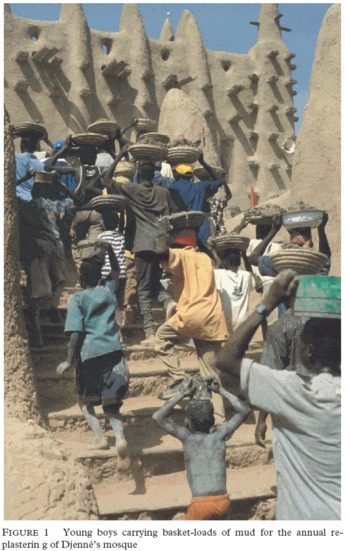
In 2001 and 2002 I conducted anthropological fieldwork in the historic town of Djenné, Mali, working as a labourer and apprentice in order to learn about the masons’ lives, skills and apprentice-style learning (see Marchand 2009). Situated close to the Bani River in the Inland Niger Delta region, Djenné is of ancient origin (McIntosh and McIntosh 1981) and was an important centre of trade and Islamic scholarship throughout the medieval period and into the early years of French colonial rule. Religious identity remains a salient marker for the town's cosmopolitan population, but its economic position was usurped during the twentieth century by Mopti and its decline has been exacerbated in recent decades by severe droughts and emigration. Djenné’s unique architectural heritage of massive, sculptural mud-brick structures nevertheless thrives, and the town was declared a World Heritage site by UNESCO in 1988 (see Figure 1).
The highly developed art of mud-brick masonry is perhaps best exemplified by the bold forms of Djenné’s mosque (reconstructed in 1906) and by the elegant pilastered façades and roofline decorations of the so-called ‘Moroccan’- and ‘Tukolor’-style houses built over the centuries by wealthy merchant-traders and marabouts. The masons themselves occupy the middling economic classes (LaViolette Reference LaViolette and Childs1994), but wide disparity exists between those with an abundant clientele and others who struggle to find work. Client relations are typically passed on from master to trainee, but not all of the apprentices that a mason teaches during his career will share in the inheritance. The official building season is brief, corresponding with the driest months between January and April. Essential repairs and maintenance may be commissioned outside this period, though many builders pursue agriculture or fishing during the rainy seasons, or seek employment as labourers in the capital, Bamako, or further abroad. The six-day working week is followed by a rest on Monday when some take up petty trading in the weekly market to supplement their incomes. A mason's daily wage, and that of a labourer, are set by their trade association, the barey ton, which also regulates disputes and organizes communal enterprises such as the festive annual re-plastering of the mosque.1
The opening excerpt from my field notes succinctly illustrates the sorts of daily practice that reproduce both Djenné’s urban character and its corporate community of masons. Building sites provide structured, hierarchical environments for learning and honing trade skills, and masonry know-how is regularly fused with protective magic (Marchand Reference Marchand, Jansen and Schmidt2007a). In this essay, I first outline the principal categories of knowledge associated with masonry, arguing that a mason's prowess is forged at the complex interface between technical know-how and socio-cultural forms of knowing and practice. The essay moves next to a discussion of changing practices and negotiated forms of innovation in this strongly ‘traditional’ context, focusing on recent changes introduced to tool technology, materials, and architectural design and planning. Notably, a mason's respected status and his creative rights as an artisan are counterbalanced by his professional duties and responsibilities to reproduce Djenné’s distinctive sense of place. The politics of innovation are explored in the concluding section, drawing briefly upon examples of celebrated master craftsmen.
A MASON'S KNOWLEDGE
In order to describe the complex constitution of a mason's expertise, and to consider its transmission and acquisition between mentors and trainees in Djenné, I have identified four main categories of knowledge that are regularly manifested in local building practices. These are technical skill, design ability, propositional knowledge and mastery of secrets. In a mason's work, such categories are not separated and isolated from one another, but may be enacted simultaneously. In effect, each informs and modifies the others, and together they produce the ‘mason’ as a coherent category of person that is recognized by his community of fellow practitioners and by the public of resident patrons.2
Technical skill
First, technical skill may be described as a practice-based form of knowledge, involving a coordinated integration of bodily techniques and procedures with tools and the material(s) being processed. In the case of Djenné’s masons, this includes, for example, wielding an adze with the correct rhythm and intensity to carve and modify mud brick geometries; laying course-work speedily and efficiently by hand; monitoring the verticality of walls with a plumb line; evenly spreading mud plaster and finely sculpting decoration with a trowel; and constructing ceilings with various arrangements of quartered palm-wood trunks. Learning technical skills relies heavily on non-verbal forms of embodied communication between actors, but it may also entail verbal questioning, directives, commentary and corrections. Typically, a mason's transmission of skills is achieved via his physical display of tasks, occasionally accentuating specific aspects of his presentation and drawing attention to certain procedures for the benefit of his pupil (Marchand Reference Marchand, Asquith and Vellinga2005; 2007b). The apprentice gradually attains the right ‘feel’ for his own skilled performance through a coordinated combination of engaged observation, imitation and repetitive practice (Ingold Reference Ingold2000: 353). Ultimately, the activity becomes incorporated into his repertoire of habituated embodied movements, and can be exercised in sequence with other actions, and in concord with other actors.
Embodied skills such as those listed above arguably describe the rudiments of the mason's professional practice, but, as I elaborate below, technical skills are insufficient criteria in their own right for qualifying the mason as a distinct social category. A degree of technical proficiency in building and handling tools may in fact be shared by other social actors in Djenné who are not publicly qualified as masons, including the experienced wage labourers who work on construction projects every dry season between agricultural cycles, and regular citizens who carry out repairs and small additions to their own homes. Notably, during the annual re-plastering of the town's enormous mosque, there is a large number of male participants – including young boys – who are perfectly adept at spreading the mud with broad, rapid sweeps of their palms in even horizontal bands. In short, even if the average mason is somehow quantifiably better at building than his fellow non-mason, the fashioning and articulation of a mason's specific expertise necessarily involves something beyond acquiring building techniques and possessing a kit of tools.
Design skill
This ‘something more’ can be elaborated by considering other practices involved in masonry. The second category I consider is the mason's ability to conceptualize spatial configurations and building forms prior to, and while immersed in, actual building practices. This knowledge might be glossed as design skill. In Djenné, architectural design and structural decisions are seldom if ever exercised with pencil on paper, but instead are alternately visualized in the so-called ‘mind's eye’ and kinaesthetically ‘felt’ with the acting body. Masons occasionally draw schematic plans or elevations in the dirt with a fingertip or sharp instrument in order to communicate their intentions with colleagues and trainees, but, for the most part, design ideas evolve and sharpen in the physical processes of making. Unless restoring (or reconstructing) officially designated houses in accordance with measured drawings prepared by architects or draughtsmen,Footnote 3 the masons of Djenné are effectively ‘master builders’, responsible for both the design and construction of edifices. Their operations do not involve mapping pre-conceived design ideas and templates onto the urban landscape in bricks and mortar. Rather, conceptual imagining and practical making unfold together and dialectically modify one another throughout the work.
For university students enrolled in architecture, design is a distinct subject taught in the studio and largely disconnected from any physical participation in building activity. By contrast, design in the craftsman's curriculum is part and parcel of his direct engagement with tools and materials on the building site. Like learning the techniques for laying bricks and constructing ceilings, the know-how for arranging living spaces and architectural elements in culturally acceptable ways is acquired through careful observation, mimicry and a degree of hands-on improvisation (Marchand Reference Marchand2001). Following the master's example, apprentices and junior masons develop a practical understanding of the limits and potentials of their various building materials and methods. This includes, for example, an experiential knowledge of the compressive strength of mud bricks in walls, staircases and sculptural decoration; the tensile capacity of palm-wood timbers used as ceiling beams, lintels and projecting toron scaffolds; the durability of plasters made from fermented laterite soil and various organic compounds; the compatibility (or incompatibility) of materials such as mud, cement and clay tiles, each with their own physical properties and rates of thermal expansion and contraction, and so on. This ‘tried-and-tested’ kind of understanding creates and entrenches convictions about what does and doesn't work, and in turn delineates a range of possibilities for experimentation and design innovation within what is popularly recognized as a Djenné style of architecture. I return to the question of innovation in the second half of this article.
House design is not solely dictated by the mason's vision or the structural limitations of the materials he uses. Supply is also a determining factor. For instance, as the precious sources of mature ronier palmsFootnote 4 are depleted in the surrounding countryside, available timber lengths are decreasing, thereby affecting interior room dimensions and the ceiling configurations that can be made. Bricks, mortar and plasters, too, are dependent not only upon the maker's skills, but also on the availability of soil with the right combination of clay, sand and organic matter. This rich mixture is normally deposited each year during the rainy season when the floodplains and system of rivulets that surround Djenné are inundated with silt-laden waters. The quantity and quality of alluvium deposits, however, is hampered by drought and may be further diminished by the recently constructed dam at Talo, located upstream from Djenné along the Bani River (see Gallier Reference Gallier2002; Marchand 2009).
Stylistic conventions were somewhat ossified during the twentieth century by colonial and post-colonial officials who appropriated the regional style in their respective constructions of, first, the French Sudan, and later, a Malian national identity grounded in ideals of a shared cultural and material heritage (Rowlands Reference Rowlands, Bedaux, Diaby and Maas2003). Djenné’s World Heritage status has also played a determining role in the reproduction of an architectural vocabulary that points to the past. Based on UNESCO doctrine, Malian law attempts to ‘protect’ the town by restricting development in the historic city, enforcing mud-brick construction and preserving the form and layout of existing buildings. This heritage discourse has been adopted by a handful of masons who have, in turn, strategically made themselves into experts on the question of ‘authentic’ building practices.
In the case of one such mason, his authoritative claims have been shaped and textured through his discussions with scholars and conservationists, and by the historic images of the town's architecture that circulate in books and postcards. The latter include late-nineteenth and early-twentieth century photographs that were collected and published by Europeans, and that serve as benchmarks for present-day restoration efforts. But they also include more recent photographs and architectural drawings published in the works of contemporary scholars. In an intriguing manner, published images are consumed by modern masons who in turn re-present the Djenné ‘style-Soudanais’ in transformed ways through their professional practice and in their conversations with clients and researchers – like me, the anthropologist-cum-apprentice. Imagined architectural prototypes are constantly modified in this discursive process but they nevertheless continue to buttress false ideals of continuity in practice and form.
Clients in Djenné, like clients anywhere, come to the negotiations with their own programmes, aesthetic aspirations and budgetary constraints which must be respected and accommodated by their mason. Popular tastes are increasing shaped by outside influences as more clients travel; own television sets, radios and mobile telephones; and electronically plug into the worldwide web of information. Fashions emanating from the nation's capital Bamako and beyond are often construed as being antagonistic to the conservation efforts of local and international campaigners, and debate around ‘tradition and modernity’ has intensified.
In recent decades, nation-wide trends in the building sector have popularized the use of steel-reinforced concrete, cement plasters, industrial paints, glazed and decorated ceramic tiles, and European-style embellishments such as concrete balustrades, electric ceiling fans and flamboyant light fixtures. In Djenné, such newly available choices sometimes interface with, rather than displace, the historic palette of materials and aesthetic expression, and result in a changing array of possibilities framed by the dominant discourse on tradition (Vogel, Marchand and Sidibe 2007). But there have also been cases of abrupt and extensive alterations that challenge the negotiated limits of acceptability among the community of masons and town residents. It is in mediating the shifting boundaries that define Djenné’s so-called ‘style-Sudanais’ discourse that the mason, as designer-builder, has an especially salient role to play as spokesperson and, more importantly, practitioner.
Propositional knowledge
A mason's spoken communications with his work crew, fellow craftsmen, suppliers, clients and other members of the public are expressions of his propositional knowledge. Concisely, propositional knowledge is the ability to formulate statements about the world, to logically evaluate truth and relevance of new information, to synthesize ideas, and to confirm, modify or discard existing beliefs and theories. This is exemplified in Kresse's study of Mombasa's orators at the baraza (in this issue). Propositional knowledge is defined more by its common medium of formulation and expression (spoken language and a direct relation between individual words and concepts) than by a specific area of expertise. Under this broad category I include the mason's various competencies in verbally promoting his expertise and services; negotiating contracts, conditions and rates with clients; directing his troupe of labourers; estimating quantities of material and ordering supplies; calculating and bargaining over costs; and scheduling deliveries, workdays and project programmes. Evidently, knowledge of such often-interconnected issues is not arrived at through conceptual thinking and verbal discourse alone, but rather is very much formed and refined through the mason's direct engagement and physical experience in the trade.
Apprentices and junior masons start to acquire the sorts of propositional knowledge necessary for managing projects by watching and listening to their master's transactions on site and in the marketplace. Unlike the ample opportunity that apprentices have for imitating and practising building technique, occasions to actively participate in business matters arise infrequently. Apprentices may be charged with organizing their subordinate labourers, and they are occasionally dispatched on errands to fetch building materials, schedule deliveries or deliver messages. Social etiquette, negotiating strategies and basic marketplace arithmetic are learned from an early age in the home, at school and in everyday interactions. Throughout his training period on site, a young mason's communications skills, economic understanding and abstract spatial thinking are honed in ways specific to his professional practice.
Before a mason entrusts his apprentice with overseeing projects, the young man must demonstrate an ability to issue directives, settle disputes and negotiate simple transactions. Evidently, the act of speaking communicates more than mere words. It is the illocution that bears a capacity for instilling confidence and staking authority (Austin Reference Austin1962). Communication is performative, and a mason's words should ideally be voiced with conviction and resolve, and his talk should be delivered with a confident posture and controlled gesture. Effectively, acquisition and manifestation of propositional knowledge cannot be detached from embodied ways of knowing and acting. An attentive tutee therefore endeavours to imitate his master's performance not only in terms of its spoken content, but in its bodily and psychological attitudes.
Knowledge of secrets
Indeed, there is a vital component of a Djenné mason's propositional knowledge that remains, in a certain sense, ‘unspoken’. I refer to this fourth category as his knowledge of secrets. More specifically, secrets include the knowledge of incantations, benedictions and the making of amulets or gris gris. All of these practices combine Qur'anic verse with words, objects and physical rituals that connect people to the forces that animate the world. Secret knowledge expressed in Qur'anic verse, or within an Islamic framework, is described as bey koray, or literally ‘white knowledge’; and that attributed to (non-Islamic) black African sources is called bey bibi, or ‘black knowledge’ (Marchand Reference Marchand, Jansen and Schmidt2007a, 2009; Mommersteeg 2003). These classifications bear striking similarity to the ‘white’ and ‘black’ categories of specialist knowledge (gandal) discussed in Dilley's study of Senegalese clerics and craftsmen (this issue). A mason's enunciation of secret verses is normally made at inaudible levels, but his words are accompanied by ritualized actions, postures and gestures that are purposely made available to public observation.
Bey koray and bey bibi are regularly fused in the blessing of grains, animal bones and other objects that are buried in house foundations or hidden in the hollow of animal horns to protect dwelling and dwellers. All Djenné’s masons claim to make benedictions each morning to guarantee the safety of their workforce; and special benedictions are made for an apprentice when he is declared a mason. When commencing a new project, incantations may be recited to rid the land of any malevolent djinn or spirits residing there; and incantations protect one against jealousies aroused in the fierce competition for work contracts. Spells pronounced by powerful adversaries can make walls crumble, or cause a mason to tumble or be injured. In defence, counter-spells are uttered and small gifts offered (le prix de thé or le prix de kola) to neutralize malicious intents. The knowledge of secrets is by no means incidental to masonry practices, but rather is fundamental to the making of buildings and the constitution of masons.
In the confluence of Mande and Songhay cultures that make up Djenné, there exists an unwavering belief in the power of words to alter fates and change the world. Djenné is renowned throughout West Africa for its marabouts and their manufacture of potent blessings and amulets (Mommersteeg Reference Mommersteeg, Bedaux and Waals1994). Though the masons’ verses likewise harness the powers of Islamic knowledge, their secrets are regarded as distinct from those of the marabouts. Masons are uninhibited about joining animist forces to their memorized Qur'anic suar (singular, sūra). Some press forefingers to temples to indicate that secret knowledge is safely stored in their memories, and others grip their bellies with two hands to mark the spot where power lies.
A mason's secrets are taught to his most trusted apprentices, or sometimes only to sons and nephews who are fully committed to the trade. In fact, however, the words and ritual actions that compose a secret may be known to any young trainee who works closely with a mason over a period of time, but he can only legitimately exercise this knowledge once, and if, he becomes fully qualified. Obtaining his official status as a mason is necessary in order for the public to draw a causal link between his performance of secret knowledge as an event and the reality to which it refers in the world (Boyer Reference Boyer1990: 97): namely the provision of a sound building and secure living environment. Secrets harbour potential dangers and the application of their powers demands maturity and experience. Secrets are therefore transmitted little by little from one generation to the next, and some are never revealed. Their productive purpose and limits are generally agreed by trade members, and abuses of secret knowledge, like serious incidence of technical ineptitude, are judged and regulated collectively by the barey ton association.
A synthesis of knowledge
The four categories – technical skill, design ability, propositional knowledge and secrets – constitute the mason as a social person and make up the core of his professional activities in Djenné. Though I have compartmentalized them to render a coherent account of each, it must be underlined that they are seamlessly integrated in daily practice. Building technique, design, correct speaking and ritual verse may be simultaneously displayed by the mason within the interactive context of the building site, and motivated apprentices are expected to mimic these activities and weave them into an intelligible and productive set of practices. Together, these ways of knowing produce and reproduce the materiality of Djenné’s buildings in combination with a real assurance of safety and well-being for the town's population.
Beyond issues of professional performance, identity and the physicality of the urban environment, the masons’ work also generates tangible networks of social and economic relations. These networks include relations of patronage between a patrilineal line and its dedicated family of builders which, in many cases, extend back several generations. They also include a cooperative division of labour between various crafts that includes the blacksmiths who forge the masons’ tools; their potter wives who fire rain spouts and wall tiles; carpenters who manufacture doors and latticed window shutters; and legions of entrepreneurs who make bricks and haul cartloads of laterite soil to the building sites. Supply networks spread beyond the geographical limits of Djenné and the Inland Niger Delta, and certain construction materials are increasingly imported from further afield (palm trunks from Burkina Faso; glazed ceramic tiles from Bamako; and other household accessories that come from Europe and the Middle East). Masonry practices also produce shifting hierarchies, changing collaborations and new rivalries within the trade community itself.
Rank and status among masons involves such attributes as seniority; descent from a well-established line of builders; affiliation to an esteemed master; numbers of apprentices under one's own tutelage; accumulated work experience outside Djenné; Islamic knowledge and pious demeanour; and, of course, one's competent performance within the four categories of knowledge I have described. There is no fixed configuration of these factors by which to measure success, and individuals strategically select which attributes to emphasize in making self-declarations of proficiency and expertise. The patriarchal structure within the trade, for instance, is manipulated by young masons who tactically claim status by capitalizing either on their descent, on the reputation of their former master, or on relations that they may have formed with government officials or conservation experts. Alternatively, the age-set hierarchy may be cautiously subverted by young masons who claim superior knowledge over senior colleagues about the properties and uses of such ‘modern’ materials as concrete or tiles, or about the emerging communication technologies newly available in Djenné. Despite the outward reverence for age and seniority, spaces exist within the power structure for creative manoeuvre. The attributes of rank and status do not stack up neatly, and instead can be carefully negotiated and re-combined in a myriad of innovative ways by individual masons jockeying for position.
To illustrate, I refer to the example of a relatively young mason who has crafted a unique position for himself within the discourse and representation of the town's architecture. Unlike the majority of his colleagues, this mason is numerate, fluent in spoken French and literate in Arabic script. His communication abilities have made him a popular informant for foreign researchers, and through these channels he has become conversant with Western discourses of tradition, heritage and ‘vernacular’ architecture. As a result, he was assigned a key role in the Mali-Dutch restoration of historic houses that commenced in 1995, and a few years later he took on a leading position in the town's waste-water management project. Involvement in these schemes has taught him to read basic architectural drawings and acquire valuable project management skills which he has put to use in overseeing the construction of houses for several European residents and the house of a government minister in the distant city of Kayes. To my knowledge, there is no precedent among the town's mud masons for this sort of transformation from ‘hands-on craftsman’ to ‘site foreman’, and, as a consequence, his status among the broader corporate community is difficult to categorize. He has skilfully manoeuvred his way through the ranks to achieve national and even international recognition, and he has travelled to Washington DC, Holland and South Korea to erect model constructions of Djenné-style buildings. Though his youth leaves his authority vulnerable to contestation from other masons, he has successfully taken control of his career trajectory while remaining rooted to his professional practice and trade community.
To innovate – the act of introducing change and novel combinations of existing elements – is elemental to constructing identities and practices, but, as I will argue, not all individuals have equal licence to engage in it. In the final section, I focus on the question of innovation among Djenné’s masons and the relations of power that both facilitate and constrain it.
NEGOTIATING LICENCE AND LIMITS FOR INNOVATION
Novel introductions to skilled practice and crafted products may be the outcome of focused creativity, but are more often the result of situational improvisation and adjustment when faced with changing circumstances (Hallam and Ingold 2007). A mason's daily improvisation with his tools, available materials and standard construction methods produces ongoing transformations. If they work, such changes are incrementally absorbed in his procedures and the things he makes without being singled out for special recognition. Occasionally, novel practices and built forms may also be the outcome of a ‘committee effect’, whereby oppositional stances taken by masons working on a shared project are reconciled within a single framework, yielding a sometimes unstable union of elements. More mundanely, changes in practice and product also result from sheer incompetence, laziness or a rebellious intent to subvert standards; or they may even be authored as ironic or humorous statements, not necessarily intended by their authors to be evaluated in a serious manner.
It follows that transformations to the repertoire of building practices and architectural forms are realized by a multitude of different processes. For a change to qualify as an innovation, however, I contend that a more complex play of social interaction is involved. Innovation demands formal recognition of that thing's novel quality and a response that evaluates the new practice or object in terms of its purpose, usefulness, efficiency, aesthetic value or congruency with what already exists. For this reason, changing practices and forms resulting from daily improvisation are not likely to be registered as innovations (if noticed at all); and those resulting from incompetence or rebellious subversion are typically classified as aberrations. For something different to qualify as an innovation, the response need not be commendatory but there must be a conscious recognition of some ‘intentionality’ toward making that new thing or doing something in a novel way.
Recognition, response and validation of a novel practice introduced by masons come from their fellow practitioners and patrons, and from foreign visitors and outside agents with a vested interest in the town's heritage. Consequently all these players are implicated in shaping the discourse on masonry and Djenné’s style-Soudanais architecture. Masons produce and assess their work in the light of those real and imagined exchanges with a public audience. This argues firmly against notions of creative genius operating in isolation, and posits instead that innovation and creativity are the result of intensive social interaction. An ‘author’, therefore, might be better defined as an individual who, through processes of social consensus, is recognized and validated by his community to possess the necessary knowledge (including skills) and qualifications to engage creatively in his craft and procure innovative results.
The social construction of the author (the individual who comes to be associated with a novel work), like innovation itself, involves recognition and an evaluative response. As I argue above that not everything different will be conceived and classified as an innovation, likewise not every individual who produces something different (be it an object, idea or practice) will be deemed an author. This politics of innovation and authorship will be further explored in the remaining discussion of changes in tools, materials and design, illuminated by brief examples of contemporary masons and their practices in Djenné.
Tools
In the late nineteenth and early twentieth centuries, during the early period of French colonial rule over this region of West Africa, the principal masonry tools used in Djenné were a long crowbar-type implement called a sasiré, the wooden-handled hoe and the adze for chopping palm wood. Though the masons’ inventory has remained sparse, a number of significant, mainly imported, additions were made over the course of the last century that have brought change to local building practices and architecture. These new tools are the wooden rectangular brick mould, the measuring tape, the plumb line, the spirit level and the trowel. Two distinct types of trowels are employed for different tasks. The so-called French trowel, which is considered too small and delicate for the heavy work of laying coursework, is best suited to sculpting decorative elements and the projecting roofline mitres (sarafar). A second kind of heavy-duty trowel is produced locally by the blacksmiths for spreading mortar and chopping bricks to size, and this was designated the kuuru-bibi trowel (literally, ‘black-skinned’ trowel).
The most critical transformation in form and practice arrived with the introduction of the brick mould in the 1930s. The production of small hand-shaped cylindrical bricks, known as djenné ferey (‘djenné brick’), was soon entirely replaced by the more rapid manufacture of larger, standard rectangular ones called tubaabu ferey (‘white man's brick’). Though some masons allege that the older-style mud bricks were more durable, others argue that if the walls of historic houses constructed of djenné ferey become structurally unstable, repairs are impossible and they must be demolished. In fact, the technique for making and working with djenné ferey has almost, if not entirely, disappeared. Because of their regularity in size and planar surfaces, tubaabu ferey can be laid quickly and efficiently, and more courses can be raised in a single day than with the djenné type. Not only has wall thickness been reduced, but walls are now straighter and architectural lines crisper than in the past. Near-perfect verticality has been further propitiated by standard systems of measurement, plumb-lines and levels. These changes in building form are bemoaned by conservationists who perceive the molten contours of surviving djenné-ferey buildings as a characteristic feature of the town's style-Soudanais.
Though power tools have not been introduced to the building site, other electrified forms of technology have been imported to Djenné. In the years since 2002, the handful of land-line telephones that once served the entire town have been superseded by a flood of mobile telephones and two internet cafés. This is not only altering communication habits and social etiquette (a worthy study in itself), but also means that Djenné, including its masons, is increasingly linked to events, products, ideas and opinions circulating both within and outside the town. It remains to be seen what impact this will have on local masonry practices, client demands and architectural expression.
Materials
In terms of new construction materials, one of the most ubiquitous throughout West Africa and the developing world is unquestionably concrete breeze block. Extensive use of these blocks or of any other form of concrete structure in Djenné has been curtailed by the town's official heritage status. All of Djenné, including the adjacent archaeological site of Djenné-Djeno, was declared a World Heritage Site by UNESCO in 1988, and rules were put in place that prohibit the use of concrete and make mud mandatory for all residential construction. Much to the chagrin of heritage representatives, cement is nevertheless used for rendering floors and wall surfaces, as well as for finishing decorative elements. Inhabitants claim that cement renderings make for tidier interior surfaces, and when applied to the exterior of a house, cement eliminates the need for annual re-plastering in mud – at least as long as the cement coating remains intact. Once the rendering cracks (an inevitable consequence due to the different expansion and contraction rates of the wall's mud core and the rigid cement coating) rainwater can infiltrate and cause serious structural damage to the building. In the short term, cement deprives masons of their annual job of renewing mud surfaces on their client's homes, but after a few years they are called upon to urgently fill cracks, repair sections where the rendering has fallen away, and possibly to restore entirely dilapidated structures.
Mud's susceptibility to erosion from water, wind and intense sunshine makes building surfaces the prime site for experimentation with new protective finishes. An array of mud plasters are concocted using various grades of laterite soil, and the addition of chopped straw, rice husks, pebbles, ash, powdered baobab fruit or karité butter improves durability and water resilience. Some masons also brew toxic termite poisonsFootnote 5 into brick mortars and plasters to deter the voracious pests from infesting wooden window casements and ceiling beams,Footnote 6 but this poses a hazard to those working the materials with bare arms and legs. Some plasters are prepared and used immediately, while others are fermented in pits or piles for several days or weeks. Fermentation with organic matter improves the mud's cohesive strength, and its colour may change in the process from shades of ochre and red to dark grey. One European client with a vested interest in Djenné’s heritage commissioned masons to render his home with plasters of different hues, thereby highlighting prominent features of the building to grand effect. He also left his interior ceiling surfaces without plaster, choosing instead to expose the beautiful triangulated geometries and textures of the costly palm trunks. This case of ‘invented tradition’ clearly illustrates how masons are not necessarily the key innovators of all building-style transformations. Rather, masons are situated agents within socially complex processes of creativity, and these processes are ultimately directed at realizing the social and political aspirations of patrons – especially those of the elite taste-makers.
Commercial house paints are applied to some interiors, either directly on a super-fine coating of mud plaster or on top of cement. More recently, several houses in town have circumscribed their front doors and window openings with cement painted over in bold, solid colours. Small, flat red-clay tiles have also mushroomed in popularity over the past decade, and these are fixed with concrete to cover floors and stair treads, and more frequently to cloak exterior walls. The locally fired tiles were originally produced in standard rectangular forms, but entrepreneurial artisans are now manufacturing a variety of moulded shapes including lozenges, diamonds, hexagons and hearts. The cost of clay tiles, and of the labour involved in setting them, is relatively high, so tiles have come to connote prestige. Like cement renderings, they keep rain erosion at bay, but only so long as cracks and fissures are absent. Once infiltrating waters wash away the contact between mud wall and tiles, they can fall off in plates, posing a potential hazard to passers-by. Glazed and patterned ceramic tiles have also found new markets among Djenné’s wealthy patrons. These slick, mass-produced tiles are being imported to be used for the same purposes as the local clay ones, though their use to date on exterior surfaces is extremely limited. The allure of resilient, easy-to-clean surfaces that are popularly associated with modern, urban and European lifestyles is reflected by a tiny but growing demand for porcelain squat-toilet plates and wash basins.
Design
It seems that arcaded verandas in residential construction (Maas and Mommersteeg 1992: 65) and arches, such as those supporting the roof of Djenné’s mosque (Bourgeois Reference Bourgeois1987: 62), were introduced from North Africa during the colonial era and integrated into what was coined by the French as the ‘style-Soudanais’ (Prussin Reference Prussin1986: 18). Verandas continue to be built to the present day with variations in the geometries of their arched openings and decorative details, and Djenné’s masons have erected several spectacular mud mosques in outlying villages that display imaginative interiors of slim round columns and series of superimposed arches. Houses continue to be laid out around interior courtyards where much of the cooking and domestic work is conducted, and these spaces are accessed from the street via a series of interconnected vestibules that are sometimes used for business activities or teaching Qur'anic students. Living spaces typically consist of paired rooms: a parlour (galia) and adjoining room for sleeping (tasika), though the function of either room is not strictly prescribed. House plans in the densely populated heart of the town respond to the often irregular geometries of plots, and many are double-storied and make use of their roof terraces for drying millet and chilli peppers, or for sleeping during the hot season. Houses erected in the newer quarters that finger out along the town's edge are laid out along neat orthogonal grids of wide streets. Most are single-storey dwellings planned around interior courtyards, and their boxy features lack the decorative embellishments identified with Djenné’s style-Soudanais.7
A new Moroccan-style house located in one of the old quarters ostentatiously displays its modern finery. Shiny tiles surround the front door and a white Italianate balustrade crowns its second-storey roofline like a Mediterranean villa. The property belongs to a wealthy marabout residing in Bamako, and his younger brother acts as the live-in guardian. In brief, the house is a traditional mud-brick construction ‘iced’ in a dazzling coat of imported materials. Copious quantities of cement cover the walls, floors and ceilings; tiles glisten; high-tech fixtures illuminate the interior; and a giant roof-mounted satellite dish tracks television signals from around the globe. The house was recently completed, but, when I visited in 2005, its mason was already busy at work patching surfaces and replacing heaving floor tiles. ‘We warned the marabout that this would happen!’ he exclaimed. ‘Mud and cement don't go together, but he insisted on these things.’ Though the mason was fully aware of the potential problems his client would face, he nevertheless beamed with pride. The house displays his ability to work with modern materials and, for better or worse, all of Djenné was discussing this bold intervention in the urban fabric. Indeed, the craftsmanship was finely executed despite the emerging topography of cracks and fissures. Public sentiment was divided, and some masons pointed to the project as an example of what should definitely not be built in Djenné. One observer mused philosophically about the authenticity of the house, asking rhetorically: ‘Even with its sarafar (mitres), can we still call this a Moroccan-style house?’ Other residents long to build such a house themselves one day.
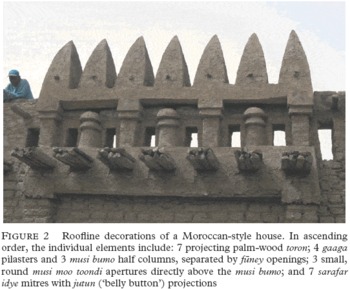
The traditional roofline decorations of both the Tukolor- and Moroccan-style houses are composed of set elements that normally vary in quantity and proportion only. In the case of the Moroccan-style façade, these elements include shallow ‘male’ pilasters (sarafar har) that frame and metaphorically ‘protect’ the two ends of the building, and they extend above the height of the low parapet wall to form tapering mitres capped with bulbous ‘hats’ (sarafar fula). Two ‘female’ pilasters (sarafar woy) frame the main doorway to the house and, like their male counterparts, they extend the full height of the two-storey façade. A palm-wood lintel spans the space between them, and on top of this lintel is a complex ensemble of decorative elements. In ascending vertical order, the first elements in the display are the horizontal row of evenly-spaced toron Footnote 8 (projecting rectangular bundles of palm-wood sticks). The toron are both decorative and functional, providing shade on the façade and a form of built-in scaffolding upon which the masons construct the remaining decoration and make future repairs. Above this is a series of squat pilasters (gaaga) framing centrally-positioned half-columns with rectangular apertures (fūney) on either side. The fūney, like those along the length of the parapet wall, pierce the thickness of the decorative screen. The short half-columns are capped by pill-like hats piled one on top of the other. This combination of elements is referred to as the musi bumo (‘cat's head’). The gaaga pilasters support a second palm-wood lintel positioned a small distance above the tops of the musi bumo, and supporting a series of tapering mitres that align vertically with the gaaga and musi bumo elements below. The ‘offspring’ on this final crest are called the sarafar idye, (idye meaning ‘son’) and each is embellished on its front face with a small, protruding jutun (belly button) (see Figure 2).
The total number of pilasters and ‘cat's heads’ may vary from one house to the next, yielding a minimum of five, and a maximum of ten or more sarafar idye mitres above. Some masons are adamant that the ‘traditionally correct’ quantity of sarafar idye is always an odd number, but historic examples of even numbers exist, and quantity is in fact dependent on the arrangement of all elements. Judged more vociferously are the proportions. Masons gauge rhythm and proportion by ‘eye’ rather than with prescribed numeric ratios, and some are self-critical about their work, harshly reviewing past projects and striving to execute more visually satisfying results. In addition to the list of potigé (façade) elements listed above, another was reportedly introduced more than a decade ago by the now-deceased master, Mama Kourani. His novel addition consists of a small round perforation made through the decorative screen in the space squeezed between the top of the ‘cat's head’ and the uppermost palm-wood lintel. This innovation was christened the musi moo toondi, or ‘cat's eye’, and is now a standard component in the potigé design of accomplished masons. Masons profess that to incorporate the musi moo toondi and maintain satisfying proportions between all other elements is the true measure of mastery in their craft.
CONCLUSION: THE POLITICS OF INNOVATION
Innovations such as the ‘cat's eye’ are typically attributed to master masons, and sometimes only posthumously. Mama Kourani, who died in 2004, is being hailed by some as the greatest of Djenné’s contemporary masons, and even the introduction of clay-tile cladding has been ascribed to him. Other dissenting voices maintain their allegiance to Beré Yonou, a master who trained many apprentices, and whose model piety has resulted in his becoming a muezzin for the mosque and leader of the local dawat'Islamiyyah religious circle. Attributing innovations to deceased or eminent members of the community such as Mama Kourani and Beré Yonou serves not only to legitimate the novelty through a process of association, but locates that novelty firmly within a genealogy of historic practices. In a sense, to attribute innovations to specific individuals with recognized authority is a political act. It is an act directed at ascertaining credibility and acceptance for both the practice (or architectural feature) and the practitioner. By pointing to already validated persons, younger or lesser-known practitioners are largely absolved from responsibilities of negotiating recognition and approval. They instead seek legitimization as mere reproducers, even though this may not be entirely the case.
Masons, young and old, display an intriguing propensity to profess their expertise while, at the same time, deflecting any praise and honour this solicits. Many masons I worked with flaunted their expertise in conversation with a public audience or with subordinates, and then abruptly retracted their boast by claiming to be only ‘un petit maçon’.Footnote 9 In one sense, these were cautious manoeuvres to stake authority and prompt public confirmation without being accused of overstepping boundaries and branded as pretentious. Since esteemed masters also partook in these discrepant performances of self-promotion and self-effacement, their claims might also be construed as attempts to reconcile the social contradiction that exists between the individual's ambition to be an autonomous creator and the recognition that his expertise and ability to innovate emanate from his membership within, and interaction with, the community. Even those at the top of the pecking order recognize a duty to acknowledge the historicity of their own practices, and their experience reveals that any successful innovation is embedded in complex social relations and political processes.
By at once introducing change and indexing the past, innovations are strategically promoted within a discourse of continuity. This applies equally to ‘revisions’ in building practices that claim to re-establish tradition and to changes that herald improvement or advancement over what came before. Framing change within a discourse of continuity allows difference to be formulated in familiar language, thereby rendering it more accessible to popular understanding and acceptance. For patrons, configuring novel architectural features as seemingly part of an established trajectory serves to hedge their personal risk of being perceived by neighbours as tasteless or having transgressed social norms. It also enables them to communicate their social position using new, or possibly trend-setting vocabulary that will have meaning for others precisely because it has been safely incorporated inside the margins of ‘Djenné architecture’.
For the community of masons, weaving change into a politics of tradition enables them better to secure their collective ownership and sense of control over the representation of trade practices. In reality, trade practices are ever-shifting, subject not only to consciously promoted innovations by practitioners, but also to interventions from the outside, including new tools, materials, spells and popular trends. In re-making the new into tradition, masons effectively re-make themselves. Invoking a connection between past and present practices of technical know-how, design, propositional knowledge and secrets is a social performance that makes-over the mason's identity as traditional. The traditional mason is perceived by his community to be a historically validated person, initiated in his craft, and in possession of a specialized expertise to reproduce household security, a socially and culturally navigable built environment, and an architecture that perpetuates Djenné’s distinctive pride of place.
ACKNOWLEDGEMENTS
The fieldwork component of this study carried out in 2001 and 2002 was supported by the British Academy and the School of Oriental and African Studies, and the writing of this article was completed with support from an Economic and Social Research Council (ESRC) Fellowship (RES-000-27-0159). I would like to thank Rogier Bedaux for his support in realizing this project, and the masons of Djenné for their tremendous hospitality and willingness to share their building-craft knowledge with me.
Young boys carrying basket-loads of mud for the annual re-plasterin g of Djenné's mosque

Roofline decorations of a Moroccan-style house. In ascending order, the individual elements include: 7 projecting palm-wood toron; 4 gaaga pilasters and 3 musi bumo half columns, separated by fūney openings; 3 small, round musi moo toondi apertures directly above the musi bumo; and 7 sarafar idye mitres with jutun (‘belly button’) projections