



Nomenclature
- C W, C B, Cp i
-
Representing the world coordinate system, body coordinate system, and motor coordinate
system respectively.
- R BW, R p i B
-
Representing the rotation matrix from the body coordinate system to the world coordinate
system and the rotation matrix from the motor coordinate system to the body coordinate
system, respectively.
- R X, R Z
-
Representing the rotation matrices around the X-axis and Y-axis respectively.
- p , ω B, r
-
Position, Angle and attitude.
- t P i
-
The pulling force generated by a single motor.
- I B, IP i
-
Body moment of inertia and motor moment of inertia.
- ω P i
-
Angle of the motor.
- τ P i
-
The torque generated by the motor.
- τ ext i
-
Torque generated by external disturbances.
- τ B
-
The torque acting on the body.
- α , ω
-
Tilt angle and speed of the motor.
- F(α), τ(α)
-
Representing the allocation matrix of vector quadrotor.
- e r , e ω
-
Angular velocity error and angle error respectively.
- e p, e v
-
Position error and velocity error respectively.
- k r , k ω , k p , k 1 , k 2, k 3
-
Representing gain coefficient.
1.0 Introduction
1.1 Background of vector quadrotor
Quadrotors have been extensively studied and widely adopted in academia, commerce, and industry due to their simple structure and agile flight capabilities. Conventional quadrotors typically employ a coplanar propeller configuration–also valued for its structural simplicity and flexible flight performance [Reference Song, Li, Yang and Rodriguez-Andina1, Reference Liu, Li, Yang and Zhou2]. This configuration primarily enables force generation along the vertical axis while simultaneously generating torques about all three axes. However, it results in an underactuated system, which inherently limits the independent control of position and attitude. This underactuation prevents the system from executing tasks that require decoupled attitude and position control. For example, a coplanar quadrotor cannot adjust its position independently while maintaining a specific attitude, or vice versa. To address these limitations, fully actuated and overactuated quadrotor designs have gained traction in recent years [Reference Hao, Xian and Xie3–Reference Nguyen, Park, Park and Lee5]. These designs incorporate additional actuation mechanisms, allowing each propeller to generate forces in different directions; full actuation or overactuation is then achieved by controlling these force vectors [Reference Hamandi, Usai, Sablé, Staub, Tognon and Franchi6]. Another approach involves tilted-axis rotors oriented in diverse directions, which can generate forces and torques across all three dimensions of space [Reference Rajappa, Ryll, Bülthoff and Franchi7–Reference Rashad, Engelen and Stramigioli10]. However, non-coaxial rotors (a common feature of such designs) inherently suffer from unavoidable thrust loss, leading to reduced flight efficiency. For instance, Tognon et al. [Reference Tognon and Franchi11] theoretically demonstrated that a minimum of seven rotors is required to achieve omnidirectional control–this increase in rotor count, in turn, elevates energy consumption. The vector quadrotor model investigated in this study is based on the design proposed by Rajappa et al. [Reference Rajappa, Ryll, Bülthoff and Franchi7]. Figure 1 presents the prototype of a quadrotor with tiltable propellers. Given the unique characteristics of this vector quadrotor, both its control strategies and control allocation logic must be redefined.
Picture of the holocopter prototype [Reference Rajappa, Ryll, Bülthoff and Franchi7]. The four propeller groups are slightly tilted.

1.2 Disturbance rejection controller
As the development of quadrotors progresses, the trajectory missions have become increasingly complex [Reference Jacquet, Corsini, Bicego and Franchi12, Reference Tal and Karaman13]. Model-free methods perform poorly when dealing with external unknown disturbances and model uncertainties [Reference Manzoor, Xia, Zhai and Ma14]. Model-based control methods require precise knowledge of the mathematical model of the controlled system. Obtaining accurate models is often costly and requires extensive domain expertise. While adaptive and model predictive control improve disturbance rejection, they incur significant performance penalties. Model predictive control combined with adaptive control is used for high-speed flight [Reference Manzoor, Xia, Zhai and Ma14]. A nonlinear adaptive model predictive control strategy, enhancing robustness, and stability is proposed in Ref. (Reference Tian, Liu, Lu, Zuo, Zong and Zhang15). Additionally, the authors in Ref. (Reference Doukhi and Lee16) apply the neural network adaptive control to a quadrotor. Notably, similar efforts have been made in fixed-wing UAVs: the authors [Reference Abdo, Erkin and Çelik17] developed a single-stage autonomous control system for fixed-wing formation flight, enabling the follower to track the leader under vortex effects via a novel geometric algorithm, validated by simulations. This highlights the broader relevance of robust control strategies across different UAV platforms. Theoretically, it is often impractical to predict disturbances in advance due to the chaotic nature of wind [Reference Nisar, Foehn, Falanga and Scaramuzza18].
Zhang et al. [Reference Zhang, Chen, Zhang, Sun and Sun19] applied active disturbance rejection control (ADRC) to unmanned aerial vehicles (UAVs) to mitigate model uncertainties, while Wang et al. [Reference Wang and Zhao20] implemented a linear extended state observer (LESO) for UAVs to estimate unknown disturbances. Extended state observers (ESOs)—–the general class of which LESO is a subset–operate based on error information: they treat all dynamics except the control input as ‘total disturbances’ and estimate these disturbances. However, increasing ESO gains to improve estimation accuracy can simultaneously amplify noise and induce peak pulses [Reference He and Wu21, Reference Xia, Yang, Li, Wang and Zhang22]. This limitation becomes more pronounced during high-velocity UAV flight, where unknown disturbances manifest as high-order nonlinear functions with large amplitudes and rapid rates of change–leading to constrained ESO estimation accuracy, as noted by Ahmad et al. [Reference Ahmad and Ali23]. To address the issue of insufficient observer accuracy, Qi et al. [Reference Qi, Li and Chen24, Reference Qi, Hu, Li and Li25] designed a compensation function observer (CFO). This CFO employs pure integral cascade and filtering techniques, which significantly enhance observer performance. Building on this, Qi et al. [Reference Qi, Deng, Li and Yu26] further proposed a model compensation control (MCC) strategy based on CFO. The MCC controller integrates three components: feed-forward control, feedback control and disturbance observation. By fully leveraging known model information and rapidly compensating for unknown disturbances, MCC achieves superior anti-disturbance performance [Reference Li, Qi, Guo, Chen and Zhao27]. Adequate compensation for unknown disturbances is critical, especially during high-speed UAV flight–where UAVs experience significant attitude variations and elevated velocities. UAVs are additionally subjected to a range of disturbances, including wind, aerodynamic drag, airflow interference and sensor noise. If these unknown disturbances are not compensated for in a timely manner, the controlled system may suffer substantial performance degradation or even become unstable.
The pursuit of large accelerations within short time frames induces significant attitude perturbations in high-agility quadrotors, thus requiring high-precision attitude stabilisation control systems. For manoeuverable desired commands, accurate extraction of their higher-order differentials is critical to the system’s transient response–this is because such differentials reflect both the response rapidity and dynamic trends of the system. Neglecting high-order information adversely affects controller performance. Two types of differentiators are commonly used to address this need: the tracking differentiator (TD) [Reference Ahmad and Ali23] and the high-order differentiator (HOD) [Reference Li, Qi, Guo, Chen and Zhao27]. Both compute the derivatives of desired signals while filtering out high-frequency noise. Compared to TD, HOD offers two key advantages: first, it is a linear differentiator, making it more practical for real-world applications; second, it can directly extract first-order, second-order and even higher-order derivatives, thereby eliminating the complexity associated with cascading multiple TDs. Notably, HOD and the previously introduced CFO have been integrated into the MCC strategy. This integrated approach yielded satisfactory results in test flights.
1.3 Control allocation algorithms
Vector quadrotors are characterised by having more control inputs than the DOF requiring control, and this overactuated configuration confers enhanced agility as well as the ability to maintain specialised attitudes during flight. However, overactuation also poses significant challenges to conventional control allocation methods. Several control allocation methods have been developed for vector quadrotors. The pseudoinverse (PINV) method is widely used due to its simplicity in computation [Reference Yih and Wu28], but it fails to meet precision requirements–especially in complex or dynamically constrained environments. Notably, PINV often leads to suboptimal control allocations, particularly when handling nonlinearities, actuator limitations or highly dynamic flight regimes. Another approach is the admissible wrench space optimal geometric control allocation method proposed by Yang et al. [Reference Yang, Yu, Li and Basin29], which fully leverages the system’s controllability and attitude accessibility. Additionally, a model predictive control (MPC)-based control allocation method has been proposed in [Reference Wang, You and Baghdadi30], though this method suffers from high computational complexity and slow response speeds. To address these limitations of existing methods, we propose using SQP to formulate the control allocation problem as a constrained optimisation task. By incorporating a well-designed cost function that accounts for actuator efficiency, flight trajectory tracking and energy consumption, this SQP-based method enables more precise and robust computation of the quadrotor’s propeller tilt angles and rotor speeds. Furthermore, constraints such as actuator bounds, system dynamics and physical limitations are integrated into the optimisation process, which ensures that the computed control inputs are not only feasible but also optimal in terms of both performance and efficiency.
In the broader context of UAV optimisation, advancements in path planning algorithms have also been notable. The authors [Reference Aslan and Erkin31] showed that the immune plasma algorithm (IPA) outperforms other meta-heuristics in unmanned combat aerial vehicle (UCAV) path planning across most scenarios. The authors [Reference Aslan and Erkin32] presented MULIPA, an enhanced multi-population immune plasma algorithm with optimised migration and treatment mechanisms, outperforming meta-heuristics in UCAV path planning for safety and fuel efficiency. The authors [Reference Aslan and Erkin33] proposed DUALIPA, a faster dual-population immune plasma algorithm variant with a greedy heuristic, outperforming 14 meta-heuristics in most UAV path planning tests. The authors [Reference Aslan and Erkin34] proposed a multi-threaded back-and-forth algorithm (tBaF) with gradually expanded thread upper bounds, outperforming the original BaF and 14 meta-heuristics in path planning with 4-8 times fewer function calls. These algorithmic advancements, alongside the proposed SQP-based control allocation method, collectively contribute to enhancing the performance, efficiency and adaptability of UAV systems in diverse operational scenarios.
1.4 Main contributions
This paper makes the following key contributions:
-
• We propose a control strategy for overactuated vector quadrotors, which integrates special orthogonal group SO(3)-based rotational modeling with model compensation control. This strategy effectively addresses nonlinear dynamics of the system and enhances both control robustness and attitude control performance.
-
• We formulate the control allocation problem as a constrained optimisation task using SQP, enabling high-precision computation of propeller tilt angles and rotor speeds. By balancing actuator efficiency, trajectory tracking accuracy and energy consumption while satisfying system constraints, this SQP-based method achieves superior performance under dynamic flight conditions.
2.0 Problem formulation
The vector quadrotor analysed in this study comprises five primary rigid bodies that undergo relative motion: the central body and four propeller assemblies. Each propeller assembly consists of two key components: a propeller arm (which houses the rotor that drives the tilting mechanism) and a propeller mounted on the rotor (responsible for generating rotational motion to produce thrust). This section focuses on deriving the equations of motion for this multibody system.
2.1 Preliminary definition
Let
 ${C}_{\textrm{W}}:\left\{{O}_{\textrm{W}};\ {X}_{\textrm{W}},{Y}_{\textrm{W}},{Z}_{\textrm{W}}\right\}$
denote the world inertial frame and
 ${C}_{\textrm{B}}:\left\{{O}_{\textrm{B}};\ {X}_{\textrm{B}},{Y}_{\textrm{B}},{Z}_{\textrm{B}}\right\}$
denote the moving frame attached to the quadrotor’s body at its centre of mass. We also define
 ${C}_{{\textrm{P}}_{i}}:\left\{{O}_{{\textrm{P}}_{i}};\ {X}_{{\textrm{P}}_{i}},{Y}_{{\textrm{P}}_{i}},{Z}_{{\textrm{P}}_{i}}\right\}$
,
 $i=1,\cdots ,4$
, as the frames associated with the
 $i$
th propeller group, with
 ${X}_{{\textrm{P}}_{i}}$
denote the tilting actuation axis and
 ${Z}_{{\textrm{P}}_{i}}$
the propeller actuated spinning axis.
We define
 ${\mathbf{R}}_{12}\in $
SO(3) as the rotation matrix representing the orientation of the frame
 $1$
with respect to the frame
 $2$
. Therefore, the matrix
 ${\mathbf{R}}_{\textrm{B}\textrm{W}}$
represents the orientation of the body frame w.r.t. the world frame, while the matrix
 ${\mathbf{R}}_{{\textrm{P}}_{i}\textrm{B}}$
represents the orientation of the propeller group
 $i$
th frame w.r.t. the body frame. By denoting
 ${\alpha }_{i}$
as the propeller tilt angle about the axis
 ${X}_{{\textrm{P}}_{i}}$
, it follows from Fig. 1 that
 \begin{align}{\mathbf{R}}_{{\textrm{P}}_{i}\textrm{B}}={\mathbf{R}}_{Z}\left((i-1)\frac{\pi }{2}\right){\mathbf{R}}_{X}\left({\alpha }_{i}\right).\end{align}
Among them,
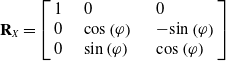 ${\mathbf{R}}_{X}=\left[\begin{array}{lll}1 {}&\quad 0 &\quad {} 0 \\ 0 {}&\quad \textrm{c}\textrm{o}\textrm{s}\left(\varphi \right) {}&\quad -\textrm{s}\textrm{i}\textrm{n}\left(\varphi \right)\\ 0 {}&\quad \textrm{s}\textrm{i}\textrm{n}\left(\varphi \right) {}&\quad \textrm{c}\textrm{o}\textrm{s}\left(\varphi \right)\end{array}\right]$
and
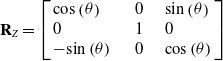 ${\mathbf{R}}_{Z}=\left[\begin{array}{lll}\textrm{c}\textrm{o}\textrm{s}\left(\theta \right)&\quad {} 0 {}&\quad \textrm{s}\textrm{i}\textrm{n}\left(\theta \right) \\ 0&\quad {} 1&\quad {} 0 \\ -\textrm{s}\textrm{i}\textrm{n}\left(\theta \right) {}&\quad 0&\quad {} \textrm{c}\textrm{o}\textrm{s}\left(\theta \right)\end{array}\right]$
. They represent the rotation matrices around the
 $X$
-axis and
 $Z$
-axis, respectively. Similarly, we let
 \begin{align}{\mathbf{o}}_{{\textrm{P}}_{i}\textrm{B}}={\mathbf{R}}_{Z}\left((i-1)\frac{\pi }{2}\right){\left[h \quad 0 \quad 0\right]}^{{\top }}\end{align}
be the origin of the frames associated with the propeller’s
 ${C}_{{\textrm{P}}_{i}}$
in the body frame, with
 $h$
representing the distance between
 ${\mathbf{O}}_{{\textrm{P}}_{i}}$
from
 ${\mathbf{O}}_{\textrm{B}}$
.
Let
 $\mathbf{p}={\mathbf{o}}_{\textrm{B}\textrm{W}}\in {\mathbb{R}}^{3\times 1}$
denote the position of the body in the world frame, and let
 ${\mathbf{R}}_{\textrm{B}\textrm{W}}$
denote its orientation. Moreover, the propeller tilt angles
 ${\alpha }_{i}$
(rotations about
 ${X}_{{\textrm{P}}_{i}}$
) specify the orientations of the propeller groups relative to the body frame. We omit the propeller spinning angles about
 ${Z}_{{\textrm{P}}_{i}}$
from the set of configuration variables, although the propeller spinning velocities
 ${\overline{\omega }}_{i}$
about
 ${Z}_{{\textrm{P}}_{i}}$
are incorporated into the system model. The detailed part will be introduced later.
2.2 Equations of dynamics
In the last subsection, some basic definitions are introduced. We focus on introducing dynamic equations in this subsection.
 \begin{align}\left\{\begin{array}{l}\ddot{\mathbf{p}}=-{\mathbf{e}}_{3}g+{m}^{-1}{\mathbf{R}}_{\mathrm{B}\mathrm{W}}\sum _{i=1}^{4} {\mathbf{R}}_{{\mathrm{P}}_{i}\mathrm{B}}{\mathbf{t}}_{{\mathrm{P}}_{i}}+{m}^{-1}{\mathbf{f}}_{1}\\ \\ {\dot{\mathit{\omega }}}_{\mathrm{B}}={\mathbf{I}}_{\mathrm{B}}^{-1}\sum _{i=1}^{4} \left({\mathbf{o}}_{{\mathrm{P}}_{i}\mathrm{B}}\times {\mathbf{R}}_{{\mathrm{P}}_{i}\mathrm{B}}{\mathbf{t}}_{{\mathrm{P}}_{i}}\right)+{\mathbf{I}}_{\textrm{B}}^{-1}{\mathbf{f}}_{2}\end{array}\right.\end{align}
Equation (3) represents the dynamic model of the vector quadrotor, where
 $\mathbf{p}={\left[x\textrm{}\textrm{}\textrm{}\textrm{}y\textrm{}\textrm{}\textrm{}\textrm{}z\right]}^{{\top }}$
and
 ${\mathit{\omega }}_{\textrm{B}}={\left[\varphi \textrm{}\textrm{}\textrm{}\textrm{}\theta \textrm{}\textrm{}\textrm{}\textrm{}\psi \right]}^{{\top }}$
denote the position and attitude in an inertial coordinate system. The total mass of the vector quadrotor, is
 $m$
, the gravitational acceleration is
 $g$
and the vector
 ${\mathbf{e}}_{3}=[0\textrm{}\textrm{}\textrm{}\textrm{}0\textrm{}\textrm{}\textrm{}\textrm{}1{]}^{{\top }}$
. The rotation matrix
 ${\mathbf{R}}_{\textrm{B}\textrm{W}}$
represents the body coordinate system to the world coordinate system. The rotation matrix
 ${\mathbf{R}}_{{\textrm{P}}_{i}\textrm{B}}$
represents the rotor coordinate system to the body coordinate system. The thrust
 ${\mathbf{t}}_{{\textrm{P}}_{i}}$
is generated by a single motor, and
 ${\mathbf{I}}_{\textrm{B}}$
is the moment of inertia.
2.2.1 Analysis of dynamic equations
By applying standard techniques, a comprehensive description of the quadrotor’s dynamic model can be derived by accounting for the forces and torques produced by the propeller’s motion, along with any cross-coupling effects resulting from gyroscopic and inertial interactions arising from the relative motion of the five bodies that compose the quadrotor. Regarding aerodynamics and torque, we only consider the factors that drive the quadrotor, and the sum of the known and unknown disturbances in the system represented by
 ${\mathbf{f}}_{1}$
and
 ${\mathbf{f}}_{2}$
. We now outline the key conceptual steps required to derive the quadrotor’s dynamic model. To this end, let
 ${\mathit{\omega }}_{\textrm{B}}\in {\mathbb{R}}^{3\times 1}$
denote the angular velocity of the quadrotor body
 $\textrm{B}$
expressed in its body frame
 $\beta $
, and consider the
 $i$
th propeller group
 ${\textrm{P}}_{i}$
. The angular velocity of the propeller, expressed in its frame, is defined as
 \begin{align}{\mathit{\omega }}_{{\textrm{P}}_{i}}={\mathbf{R}}_{{\textrm{P}}_{i}\textrm{B}}^{{\top }}{\mathit{\omega }}_{\textrm{B}}+{\left[{\dot{\alpha }}_{i} \quad 0 \quad {\overline{\omega }}_{i}\right]}^{{\top }}\end{align}
where
 ${\overline{\omega }}_{i}$
is the spinning velocity of the propeller about
 ${Z}_{{\textrm{P}}_{i}}$
. This produces an angular acceleration
 \begin{align}{\dot{\mathit{\omega }}}_{{\textrm{P}}_{i}}={\mathbf{R}}_{{\textrm{P}}_{i}\textrm{B}}^{{\textrm{}}^{{\top }}}{\dot{\mathit{\omega }}}_{\textrm{B}}+{\dot{\mathbf{R}}}_{{\textrm{P}}_{i}\textrm{B}}^{{\top }}{\mathit{\omega }}_{\textrm{B}}+{\left[{\ddot{\alpha }}_{i} \quad 0 \quad {\overline{\omega }}_{i}\right]}^{{\top }}.\end{align}
From the application of Euler’s equations of motion, it follows that
 \begin{align}{\mathit{\tau }}_{{\textrm{P}}_{i}}={\mathbf{I}}_{{\textrm{P}}_{i}}{\dot{\mathit{\omega }}}_{{\textrm{P}}_{i}}+{\mathit{\omega }}_{{\textrm{P}}_{i}}\times {\mathbf{I}}_{{\textrm{P}}_{i}}{\mathit{\omega }}_{{\textrm{P}}_{i}},\end{align}
where the torque
 ${\mathit{\tau }}_{{\textrm{P}}_{i}}$
represents the torque generated when a single rotor rotates, and matrix
 ${\mathbf{I}}_{{\textrm{P}}_{i}}\in {\mathbb{R}}^{3\times 3}$
is the constant symmetric and positive definite inertia matrix of the propeller group. We assume the presence of a counter-rotating torque about the
 ${Z}_{{\textrm{P}}_{i}}$
axis, caused by air drag and modelled as
 \begin{align}{\mathit{\tau }}_{\textrm{e}\textrm{x}{\textrm{t}}_{i}}={\left[0 \quad 0 \quad -{k}_{m}{\mathit{\omega }}_{{\textrm{P}}_{{i}_{Z}}}\left|{\mathit{\omega }}_{{\textrm{P}}_{{i}_{Z}}}\right|\right]}^{{\top }}\end{align}
where
 ${\mathit{\tau }}_{\textrm{e}\textrm{x}{\textrm{t}}_{i}}$
denotes any external torque applied to the propeller and
 ${k}_{m}$
is the drag coefficient. Considering the quadrotor body
 $\textrm{B}$
and its four propellers
 ${\textrm{P}}_{i}$
, we obtain
 \begin{align}{\mathit{\tau }}_{\textrm{B}}={\mathbf{I}}_{\textrm{B}}{\dot{\mathit{\omega }}}_{\textrm{B}}+{\mathit{\omega }}_{\textrm{B}}\times {\mathbf{I}}_{\textrm{B}}{\mathit{\omega }}_{\textrm{B}}+\sum _{i=1}^{4} {\mathbf{R}}_{{\textrm{P}}_{i}\textrm{B}}{\mathit{\tau }}_{{\textrm{P}}_{i}},\end{align}
where
 ${\mathbf{I}}_{\textrm{B}}\in {\mathbb{R}}^{3\times 3}$
is the constant, symmetric and positive definite inertia matrix of
 $\textrm{B}$
. The torques
 ${\mathit{\tau }}_{\textrm{B}}\in {\mathbb{R}}^{3\times 1}$
acting on
 $\textrm{B}$
are generated by the moments produced by the four propeller forces along the
 ${Z}_{{\textrm{P}}_{i}}$
axes,
 \begin{align}{\mathbf{t}}_{{\textrm{P}}_{i}}={\left[0 \quad 0 \quad {k}_{f}{\overline{\omega }}_{i}\left|{\overline{\omega }}_{i}\right|\right]}^{{\top }}\end{align}
acting at
 ${\mathbf{o}}_{{\textrm{P}}_{i}\textrm{B}}$
in
 ${C}_{\textrm{B}}$
(the propeller drag torques are already accounted for in the terms
 ${\mathit{\tau }}_{{\textrm{P}}_{i}}$
), and
 ${k}_{f}$
is the thrust coefficient. According to (9), we obtain
 \begin{align}{\mathit{\tau }}_{\textrm{B}}=\sum _{i=1}^{4} \left({\mathbf{o}}_{{\textrm{P}}_{i}\textrm{B}}\times {\mathbf{R}}_{{\textrm{P}}_{i}\textrm{B}}{\mathbf{t}}_{{\textrm{P}}_{i}}\right).\end{align}
Regarding the translational dynamics, we assume for simplicity that the barycentre of each propeller group
 ${\textrm{P}}_{i}$
coincides with
 ${\mathbf{O}}_{{\textrm{P}}_{i}}$
, allowing us to neglect the inertial effects on the propeller groups caused by the quadrotor body’s acceleration in space. Therefore, recalling that
 $\mathbf{p}$
represents the quadrotor body’s position in the world frame, we obtain
 \begin{align}m\ddot{\mathbf{p}}=-mg{\mathbf{e}}_{3}+{\mathbf{R}}_{\textrm{B}\textrm{W}}\sum _{i=1}^{4} {\mathbf{R}}_{{\textrm{P}}_{i}\textrm{B}}{\mathbf{t}}_{{\textrm{P}}_{i}}.\end{align}
In summary, Equations (4)-(11) characterise the rotational and translational dynamics of the quadrotor body and propeller groups. Note that the inputs of the model are the rotor torques that actuate the propeller tilting axes
 ${X}_{{\textrm{P}}_{i}}$
and spinning axes
 ${Z}_{{\textrm{P}}_{i}}$
. The propeller spinning velocities
 ${\overline{\omega }}_{i},$
which generate the forces and torques (6)-(8), which influence the translational and rotational motion of the quadrotor body
 $\textrm{B}$
as a function of its current configuration, particularly the tilting angles
 ${\alpha }_{i}$
which are actuated by
 ${\mathit{\tau }}_{{\alpha }_{i}}$
.
2.2.2 Summarising of dynamic equations
We now define servo angle
 $\mathit{\alpha }={\left[{\alpha }_{1},\cdots ,{\alpha }_{4}\right]}^{{\top }}\in {\mathbb{R}}^{4\times 1}$
and rotor speed
 $\mathit{\omega }={\left[{\overline{\omega }}_{1}\left|{\omega }_{1}\right|,\cdots ,{\overline{\omega }}_{4}\left|{\omega }_{4}\right|\right]}^{{\top }}\in {\mathbb{R}}^{4\times 1}$
. Note that the elements of the vector
 $\mathit{\omega }$
are the signed squares of the spinning velocities
 ${\overline{\omega }}_{i}$
, since the torques and forces in (8)–(11) are approximately linear functions of these quantities. Therefore, in the following analysis,
 ${\omega }_{i}={\overline{\omega }}_{i}\left|{\overline{\omega }}_{i}\right|$
will be considered as the spinning velocity of the
 $i$
th propeller, with the understanding that the actual speed can always be recovered as
 $\overline{\omega }=\textrm{s}\textrm{i}\textrm{g}\textrm{n}\left({\omega }_{i}\right)\sqrt{\left|{\omega }_{i}\right|}$
, where
 $\textrm{s}\textrm{i}\textrm{g}\textrm{n}\left({\omega }_{i}\right)$
is signum function. Under these assumptions and neglecting external disturbances, the vector quadrotor dynamic model simplifies to:
 \begin{align}2pt\left\{\begin{array}{ll}\ddot{\mathbf{p}} &= -{\mathbf{e}}_{3}g+{m}^{-1}\textrm{}{\mathbf{R}}_{\textrm{B}\textrm{W}}\mathbf{F}\left(\alpha \right)\mathit{\omega }\\[3pt] {\dot{\mathit{\omega }}}_{\textrm{B}} &={\mathbf{I}}_{\textrm{B}}^{-1}\mathit{\tau }\left(\alpha \right)\mathit{\omega }\\[3pt] {\dot{\mathbf{R}}}_{\textrm{B}\textrm{W}} &={\mathbf{R}}_{\textrm{B}\textrm{W}}\textrm{}[{\mathit{\omega }}_{\textrm{B}}{]}_{\wedge }\end{array}\right.,\end{align}
where
 $[\cdot {]}_{\wedge }$
denotes the standard mapping from a vector
 $\alpha \in {\mathbb{R}}^{4\times 1}$
to its corresponding skew-symmetric matrix
 $\left[\alpha \right]\in \textrm{S}\textrm{O}\left(3\right)$
, and
 \begin{align}\mathbf{F}\left(\alpha \right)=\left[\begin{array}{cccc} 0 {}&\quad -{k}_{f}{\textrm{s}}_{2} {}&\quad 0 {}&\quad {k}_{f}{\textrm{s}}_{4} \\ -{k}_{f}{\textrm{s}}_{1} {}&\quad 0 &\quad {} {k}_{f}{\textrm{s}}_{3} &\quad 0 \\ {k}_{f}{\textrm{c}}_{1} &\quad -{k}_{f}{\textrm{c}}_{2} &\quad {} {k}_{f}{\textrm{c}}_{3} &\quad {} -{k}_{f}{\textrm{c}}_{4}\\ \end{array}\right],\end{align}
 \begin{align}\begin{array}{l}\mathit{\tau }\left(\alpha \right)=\left[\begin{array}{cccc}0 &\quad {} h{k}_{f}{\textrm{c}}_{2}-{k}_{m}{\textrm{s}}_{2} &\quad {} 0 {}&\quad h{k}_{f}{\textrm{c}}_{4}+{k}_{m}{\textrm{s}}_{4}\\ -h{k}_{f}{\textrm{c}}_{1}+{k}_{m}{\textrm{s}}_{1} {} &\quad 0 {}&\quad h{k}_{f}{\textrm{c}}_{3}-{k}_{m}{\textrm{s}}_{3} &\quad {} 0\\ -h{k}_{f}{\textrm{s}}_{1}-{k}_{m}{\textrm{c}}_{1} {} &\quad h{k}_{f}{\textrm{s}}_{2}-{k}_{m}{\textrm{c}}_{2} {}&\quad -h{k}_{f}{\textrm{s}}_{3}-{k}_{m}{\textrm{c}}_{3} &\quad {} h{k}_{f}{\textrm{s}}_{4}-{k}_{m}{\textrm{c}}_{4}\\ {} {} {} \end{array}\right] \end{array}, \\[3pt] \nonumber \end{align}
matrices
 $\mathbf{F}\!\left(\alpha \right)\in {\mathbb{R}}^{3\times 4}$
,
 $\mathit{\tau }\left(\alpha \right)\in {\mathbb{R}}^{3\times 4}$
representing the allocation matrix of vector quadrotor, where
 ${\textrm{s}}_{i}=\textrm{s}\textrm{i}\textrm{n}\left({\alpha }_{i}\right)$
and
 ${\textrm{c}}_{i}=\textrm{c}\textrm{o}\textrm{s}\left({\alpha }_{i}\right)$
. It is noteworthy that the input
 $\mathit{\omega }$
appears linearly in Equation (12), as anticipated. The subsequent controller design is conducted based on the simplified model given by (12)–(14).
2.3 Problem formulation
This paper aims to design a controller for vector quadrotors that regulates position and attitude, enabling the quadrotor to track a desired trajectory while compensating for external disturbances and nonlinear system dynamics. Specifically, the control problem is defined as follows: using the available control inputs, track an arbitrary desired trajectory characterised by
 ${\mathbf{p}}_{\textrm{d}}\left(t\right)\in {\mathbb{R}}^{3\times 1}$
(desired position) and
 ${\mathbf{r}}_{\textrm{d}}\left(t\right)\in {\mathbb{R}}^{3\times 1}$
(desired attitude). Here,
 $\mathbf{p}\left(t\right)\in {\mathbb{R}}^{3\times 1}$
(actual position) and
 $\mathbf{r}\left(t\right)\in {\mathbb{R}}^{3\times 1}$
(actual attitude) denote the position and attitude of the vector quadrotor’s main body, which serve as the system’s output functions. It should be emphasised that this trajectory-tracking problem is inherently ill-posed for standard quadrotors with fixed propellers, due to their underactuated nature. In contrast, the overactuated design of the vector quadrotor–featuring eight independent control inputs–guarantees complete controllability of both the position and orientation of its main body. This controllability will be demonstrated in subsequent analyses.
The primary objective of the controller design is high-precision trajectory tracking, which enables the vector quadrotor’s position and attitude to converge rapidly and robustly to their commanded reference values. The controller should minimise rise time, overshoot and steady-state error while maintaining stability under model uncertainties, external disturbances and sensor noise. To achieve this goal, a tightly coordinated inner-loop attitude regulator and outer-loop position tracker are required. These components should be supplemented with adaptive or robust mechanisms that sustain performance throughout the vector quadrotor’s full flight envelope.
In summary, requirements for trajectory tracking are as follows
 \begin{align}\left\{\begin{array}{lll}\underset{t\to {\infty }}{\textrm{l}\textrm{i}\textrm{m}}{\mathbf{p}}_{\textrm{d}}\left(t\right)-\mathbf{p}\left(t\right)=0 {} {} \\[5pt] \underset{t\to {\infty }}{\textrm{l}\textrm{i}\textrm{m}}{\mathbf{r}}_{\textrm{d}}\left(t\right)-\mathbf{r}\left(t\right)=0 {} {} \\ {} {} \end{array}\right..\end{align}
Subsequently, corresponding controllers for attitude and position is designed, along with methods for calculating the spinning velocities
 ${\omega }_{i}$
and tilt angular
 ${\alpha }_{i}$
, in the next section.
3.0 Controller design
3.1 Model compensating control
In this subsection, we will introduce model compensation control, which includes high-order differentiator and a compensation function observer.
A second-order differentiable single-input single-output (SISO) controlled system is defined as
 \begin{align}\ddot{y}=bu+{f}_{k}+{f}_{u},\end{align}
where
 $y$
denotes the system output, and
 $b$
represents the control input coefficient.
 $u$
denotes the system input,
 ${f}_{k}$
represents the known model information, and
 ${f}_{u}$
accounts for the unknown disturbances in the model.
Assumption 1.
We define
 $f={f}_{k}+{f}_{u}$
,
 $f$
is a smooth nonlinear bounded time-varying function with an unknown expression, which includes both the deterministic model
 ${f}_{k}$
and the uncertainty model disturbances
 ${f}_{u}$
.
In highly manoeuverable flights, disturbances mainly originate from strong winds, gyroscopic torques, aerodynamic forces and complex mechanical structures, all of which are bounded and continuous. The block diagram illustrating the vector quadrotor’s control structure is shown in Fig. 2. HOD estimates the derivatives of the desired signal. CFO estimates the unknown disturbances, providing replacements for the unknown perturbations
 ${\widehat{\mathbf{f}}}_{1}$
,
 ${\widehat{\mathbf{f}}}_{2}$
in (3). CFO and HOD will be discussed in the following.
Block diagram of vector quadrotor control that SO(3)-based MCC with SQP.

For (16), the control rate is
 \begin{align}u=\frac{1}{b}(\!\!-{k}_{p}(y-{y}_{\textrm{d}})-{k}_{d}(\dot{y}-{\widehat{\dot{y}}}_{\textrm{d}})+{\widehat{\ddot{y}}}_{\textrm{d}}-{\widehat{f}}_{u}-{\widehat{f}}_{k}),\end{align}
where
 ${k}_{\textrm{p}}$
,
 ${k}_{\textrm{d}}$
represents the error gain factors,
 ${\widehat{\dot{y}}}_{\textrm{d}}$
,
 ${\widehat{\ddot{y}}}_{\textrm{d}}$
are estimated by HOD, and
 ${\widehat{f}}_{u}$
is observed by CFO.
MCC fully utilises the known model information
 ${\widehat{f}}_{k}$
and compensates for the unknown disturbance
 ${\widehat{f}}_{u}$
in real time, thereby enhancing its anti-disturbance performance. Additionally, the differential information in MCC provides a foundation for high-manoeuverability control in servo tracking. Therefore, MCC compensates for system nonlinearities, enabling the closed-loop system to achieve predefined dynamics similar to those of linear systems.
Certain issues arise when applying it to attitude control. Specifically, the formulation in (17) is only applicable within Euler’s framework. This approach decomposes attitude into pitch, roll and yaw, simplifying attitude control. However, it disrupts the continuity of the control process. In the
 $\textrm{S}\textrm{O}\left(3\right)$
space, the attitude control trajectories lose their smoothness. When the vector quadrotor undergoes large-angle flips, the decoupled control significantly restricts its manoeuverability. In extreme cases, the control system may encounter singularities. Control formulated in
 $\textrm{S}\textrm{O}\left(3\right)$
is free from this issue. It is grounded in mathematical theories, including attitude dynamics, directional representation and rotation vectors. It’s goal is
 ${\textrm{l}\textrm{i}\textrm{m}}_{t\to {\infty }}\mathbf{r}\left(t\right)={\mathbf{r}}_{\textrm{d}}$
. Essentially, it represents a continuous geometric control approach. It avoids the issue of universal joint locking present in Euler angles and the ambiguity inherent in quaternion representations. The control approach exhibits near-global stability. It maintains good performance even under drastic attitude changes. Following, we extends MCC framework to the
 $\textrm{S}\textrm{O}\left(3\right)$
space.
3.2 Attitude errors and controller
Assume that an arbitrary, smooth, desired attitude trajectory
 ${\mathbf{r}}_{\textrm{d}}\left(t\right)\in \textrm{S}\textrm{O}\left(3\right)$
is provided. The corresponding angular velocity of command can be derived using the attitude dynamic equation,
 ${\widehat{\mathit{\omega }}}_{\textrm{B}}={\mathbf{r}}_{\textrm{d}}^{{\top }}{\dot{\mathbf{r}}}_{\textrm{d}}$
. We define the error terms related to the attitude dynamics of the quadrotor. The attitude error and angular velocity error function investigated in (18) and some of its key properties are summarised as follows. For a given command
 ${\mathbf{r}}_{\textrm{d}},{\mathit{\omega }}_{\textrm{d}}$
, and the current attitude and angular velocity of the vector quadrotor, denoted by
 $\mathbf{r},{\mathit{\omega }}_{\textrm{B}}$
. We define the attitude error vector as
 ${\mathbf{e}}_{\mathbf{r}}\in {\mathbb{R}}^{3\times 1}$
, and we define the angular velocity error vector
 ${\mathbf{e}}_{\mathit{\omega }}\in {\mathbb{R}}^{3\times 1}$
as follows
 \begin{align}\left\{\begin{array}{l}{\mathbf{e}}_{\mathbf{r}}=\frac{1}{2}{\left({\mathbf{r}}_{\textrm{d}}^{{\top }}-{\mathbf{r}}^{{\top }}{\mathbf{r}}_{\textrm{d}}\right)}^{\vee }\\[3pt] {\mathbf{e}}_{\mathit{\omega }}={\mathit{\omega }}_{\textrm{B}}-{\mathbf{r}}^{{\top }}{\mathbf{r}}_{\textrm{d}}{\mathit{\omega }}_{\textrm{d}}\end{array}\right..\end{align}
The authors in Ref. (Reference Lee, Leok and McClamroch35) introduce a nonlinear controller for the attitude-controlled flight mode, defined by the moment vector expression
 \begin{align}\begin{array}{ll}{\mathit{\tau }}_{\textrm{d}}= {} -{k}_{\mathbf{r}}{\mathbf{e}}_{\mathbf{r}}-{k}_{\mathit{\omega }}{\mathbf{e}}_{\mathit{\omega }}+{\mathit{\omega }}_{\textrm{B}}\times {\mathbf{I}}_{\textrm{B}}{\mathit{\omega }}_{\textrm{B}}-{\mathbf{I}}_{\textrm{B}}\left({\widehat{\mathit{\omega }}}_{\textrm{B}}{\mathbf{r}}^{{\top }}{\mathbf{r}}_{\textrm{d}}{\mathit{\omega }}_{\textrm{d}}-{\mathbf{r}}^{{\top }}{\mathbf{r}}_{\textrm{d}}{\dot{\mathit{\omega }}}_{\textrm{d}}\right)\end{array},\end{align}
where
 ${k}_{\mathbf{r}}$
,
 ${k}_{\mathit{\omega }}\in {\mathbb{R}}^{3\times 1}$
represent the error gain factors,
 ${\mathit{\omega }}_{\textrm{d}}$
and
 ${\dot{\mathit{\omega }}}_{\textrm{d}}$
are computed using HOD. Afterwards, we introduced CFO to calculate external disturbances
 ${\widehat{\mathbf{f}}}_{1}$
and obtain a new control rate
 \begin{align}\begin{array}{ll}{\mathit{\tau }}_{\textrm{d}}= {} -{k}_{\mathbf{r}}{\mathbf{e}}_{\mathbf{r}}-{k}_{\mathit{\omega }}{\mathbf{e}}_{\mathit{\omega }}+{\mathit{\omega }}_{\textrm{B}}\times {\mathbf{I}}_{\textrm{B}}{\mathit{\omega }}_{\textrm{B}}-{\mathbf{I}}_{\textrm{B}}\left({\widehat{\mathit{\omega }}}_{\textrm{B}}{\mathbf{r}}^{{\top }}{\mathbf{r}}_{\textrm{d}}{\mathit{\omega }}_{\textrm{d}}-{\mathbf{r}}^{{\top }}{\mathbf{r}}_{\textrm{d}}{\dot{\mathit{\omega }}}_{\textrm{d}}-{\widehat{\mathbf{f}}}_{1}\right)\end{array}.\end{align}
3.3 Position errors and controller
We introduce a nonlinear controller for the position-controlled flight mode. This flight mode necessitates analysing the coupled translational and rotational equations of motion. Therefore, we utilise the notation and analysis from the previous subsection to characterise the properties of the closed-loop system in this mode.
We define the position error
 ${\mathbf{e}}_{\mathbf{p}}$
and velocity error
 ${\mathbf{e}}_{\dot{\mathbf{p}}}$
. An arbitrary smooth position tracking reference
 ${\mathbf{p}}_{\textrm{d}}\left(t\right)\in {\mathbb{R}}^{3\times 1}$
is selected. The position and velocity tracking errors are defined as follows
 \begin{align}\left\{\begin{array}{l}{\mathbf{e}}_{\mathbf{p}}=\mathbf{p}-{\mathbf{p}}_{\textrm{d}}\\[3pt] {\mathbf{e}}_{\mathbf{v}}=\mathbf{v}-{\dot{\mathbf{p}}}_{\textrm{d}}\end{array}\right..\end{align}
Next, we introduce the position controller, which is defined by control expressions for the thrust magnitude vector, as follows
 \begin{align}\mathbf{f}=\left({k}_{\mathbf{p}}{\mathbf{e}}_{\mathbf{p}}+{k}_{\dot{\mathbf{p}}}{\mathbf{e}}_{\dot{\mathbf{p}}}+mg{\mathbf{e}}_{3}-m{\ddot{\mathbf{p}}}_{\textrm{d}}-{\widehat{\mathbf{f}}}_{2}\right){\mathbf{R}}_{\textrm{B}\textrm{W}}{\mathbf{e}}_{3},\end{align}
where
 ${k}_{\mathbf{p}}$
,
 ${k}_{\dot{\mathbf{p}}}$
are the gain factors,
 ${\dot{\mathbf{p}}}_{\textrm{d}}$
,
 ${\ddot{\mathbf{p}}}_{\textrm{d}}$
are estimated by HOD and introduced CFO to calculate external disturbances
 ${\widehat{\mathbf{f}}}_{u2}$
.
3.4 Compensation function observer
The term
 ${f}_{u}$
in (16) is crucial for the vector quadrotor’s anti-disturbance capability. To estimate
 $n$
th order CFO is designed in Ref. (Reference Qi, Hu, Li and Li25). The state equation is
 \begin{align}\left\{\begin{array}{l}{\dot{z}}_{\textrm{c}1}={z}_{\textrm{c}2}\\[3pt] {\dot{z}}_{\textrm{c}2}={z}_{\textrm{c}3}\\[3pt] \textrm{}\textrm{}\textrm{}\textrm{} \vdots \\[3pt] {\dot{z}}_{\textrm{c}n}=\mathbf{l}{\mathbf{e}}_{\textrm{c}}+{z}_{\textrm{c}(n+1)}+bu\\[3pt] {\dot{z}}_{\textrm{c}(n+1)}=\lambda \mathbf{l}{\mathbf{e}}_{\textrm{c}}\\[3pt] \widehat{f}=\mathbf{l}{\mathbf{e}}_{\textrm{c}}+{z}_{\textrm{c}(n+1)}\end{array}\right.,\end{align}
where
 ${z}_{\textrm{c}1},\cdots ,{z}_{\textrm{c}n},{z}_{\textrm{c}(n+1)}$
represent the internal state variables of the observer,
 ${\mathbf{e}}_{\textrm{c}}={\left[{e}_{\textrm{c}1},\cdots ,{e}_{\textrm{c}n}\right]}^{{\top }}$
is the error vector, and
 ${e}_{\textrm{c}i}={x}_{i}-{z}_{\textrm{c}i},i=\textrm{1,2},\cdots ,n$
. The matrix
 $\mathbf{l}=[{l}_{\textrm{c}1},\cdots ,{l}_{\textrm{c}n}]$
contains adjustable coefficients,
 $\lambda $
is the filter factor,
 $\widehat{f}$
is the estimate of disturbance.
Remark 1. Estimated disturbance
 $\widehat{f}=\mathit{l}{\mathit{e}}_{c}+{z}_{c3}$
can be seen as
 ${f}_{k}+{f}_{u}$
in (16), where the observer in (23) closely resembles the structure of the original system in (16). An ideal observer should maintain a structure and form that are as consistent as possible with the original system.
Remark 2. To enhance observation accuracy, CFO effectively leverages sensor information, as captured by
 ${\mathit{e}}_{c}$
.
Remark 3. The term
 ${f}_{k}$
in (16) is deterministically known, rendering its estimation unnecessary. Incorporating it enhances control accuracy. Observation of this term is unnecessary, and it can be decoupled from CFO. Consequently,
 $bu$
in (23) should be replaced with
 $bu+{f}_{k}$
.
Lemma 1. [Reference Qi, Li and Chen24] The
 $n$
th order CFO corresponds to an
 $(n+1)$
th order system. It can achieve zero error estimation for constant, ramp and up to
 $n$
th order signals. The observed values of
 $(n+1)$
th order signals remain bounded.
3.5 High-order differentiator
Given the desired signals
 ${y}_{\textrm{d}}$
, the differential and high-order derivative information can be extracted. The designed
 $n$
th order HOD in Ref. (Reference Li, Qi, Guo, Chen and Zhao27) is
 \begin{align}\left\{\begin{array}{l}{\dot{z}}_{\textrm{h}1}={z}_{\textrm{h}2}+{l}_{\textrm{h}1}({y}_{\textrm{d}}-{z}_{\textrm{h}1})\\[3pt] {\dot{z}}_{\textrm{h}2}={z}_{\textrm{h}3}+{l}_{\textrm{h}2}({y}_{\textrm{d}}-{z}_{\textrm{h}1})\\[3pt] \textrm{}\textrm{}\textrm{}\textrm{} \vdots \\[3pt] {\dot{z}}_{\textrm{h}(n+1)}={z}_{\textrm{h}n}+{l}_{\textrm{h}n}({y}_{\textrm{d}}-{z}_{\textrm{h}1})\end{array}\right.\end{align}
where
 ${z}_{\textrm{h}1},{z}_{\textrm{h}2},\cdots ,{z}_{\textrm{h}1(n+1)}$
represent the internal states of the HOD,
 ${l}_{\textrm{h}1},{l}_{\textrm{h}2},\cdots ,{l}_{\textrm{h}n}$
the parameters to be adjusted. At time
 ${t}_{0}$
,
 ${y}_{\textrm{d}}({t}_{0}+{\Delta }t)$
is expressed using its Taylor series expansion
 \begin{align}\begin{array}{l}{y}_{\textrm{d}}({t}_{0}+{\Delta }t)={y}_{\textrm{d}}\left({t}_{0}\right)+{\dot{y}}_{\textrm{d}}\left({t}_{0}\right){\Delta }t+\cdots +\frac{{y}_{\textrm{d}}^{\left(n\right)}\left({t}_{0}\right){\Delta }{t}^{\left(n\right)}}{n!}+o\left({\Delta }{t}^{(n+1)}\right)\end{array}\end{align}
where
 $o\left({\Delta }{t}^{(n+1)}\right)$
is the infinitesimal term.
Assumption 2.
The expected signal
 ${y}_{d}({t}_{0}+\Delta t)$
is a time-varying function with
 $n$
th order derivatives at time
 ${t}_{0}$
, while the
 $(n+1)$
th order infinitesimal term
 $o\left(\Delta {t}^{(n+1)}\right)$
is neglected.
In practice, the signal sampling time in vector quadrotors is short. Thus, the higher-order terms
 $o\left({\Delta }{t}^{(n+1)}\right)$
can be neglected. Assumption 2 includes constant, first-order, and second-order signals, as well as their combinations, encompassing a broad range of cases.
Lemma 2. [Reference Qi, Deng, Li and Yu26] HOD designed in (24) ensures zero steady-state estimation error for the
 $n$
th order derivative of the expected signal.
3.6 Closed-loop system analysis
In practice,
 ${f}_{1}$
is replaced by
 ${\widehat{f}}_{1}$
, which is observed by first-order CFO and
 ${\widehat{f}}_{2}$
is observed by second-order CFO. Therefore, for attitude and position control, we have
 \begin{align}\left\{\begin{array}{ll}{\mathit{\tau }}_{\textrm{d}} {} &=-{k}_{\mathbf{r}}{\mathbf{e}}_{\mathbf{r}}-{k}_{\mathit{\omega }}{\mathbf{e}}_{\mathit{\omega }}+{\mathit{\omega }}_{\textrm{B}}\times {\mathbf{I}}_{\textrm{B}}{\mathit{\omega }}_{\textrm{B}}-{\mathbf{I}}_{\textrm{B}}\left({\widehat{\mathit{\omega }}}_{\textrm{B}}{\mathbf{r}}^{{\top }}{\mathbf{r}}_{\textrm{d}}{\mathit{\omega }}_{\textrm{d}}-{\mathbf{r}}^{{\top }}{\mathbf{r}}_{\textrm{d}}{\dot{\mathit{\omega }}}_{\textrm{d}}-{\widehat{\mathbf{f}}}_{1}\right)\\[6pt] \mathbf{f} {} &=\left({k}_{\mathbf{p}}{\mathbf{e}}_{\mathbf{p}}+{k}_{\dot{\mathbf{p}}}{\mathbf{e}}_{\dot{\mathbf{p}}}+mg{\mathbf{e}}_{3}-m{\ddot{\mathbf{p}}}_{\textrm{d}}-{\widehat{\mathbf{f}}}_{2}\right){\mathbf{R}}_{\textrm{B}\textrm{W}}{\mathbf{e}}_{3}\end{array}\right.\end{align}
Usually, when the requirements for control are not stringent,
 ${\widehat{f}}_{1}$
and
 ${\widehat{f}}_{2}$
can be ignored. But as UAV velocity increases, the effect of
 ${\widehat{f}}_{1}$
and
 ${\widehat{f}}_{2}$
on the UAV will become more severe. Estimation and compensation by observers are simple and effective.
Taylor expansion of f based on Assumption 1, we have
 \begin{align}\left\{\begin{array}{ll}f({t}_{0}+{\Delta }t) {} &=f\left({t}_{0}\right)+\dot{f}\left({t}_{0}\right){\Delta }t+\frac{1}{2!}\ddot{f}\left({t}_{0}\right)({\Delta }t{)}^{2}+o\left(({\Delta }t{)}^{3}\right)\\[6pt] {y}_{d}({t}_{0}+{\Delta }t) {} &={y}_{d}\left({t}_{0}\right)+{\dot{y}}_{d}\left({t}_{0}\right){\Delta }t+\frac{1}{2!}{\ddot{y}}_{d}\left({t}_{0}\right)({\Delta }t{)}^{2}+o\left(({\Delta }t{)}^{3}\right)\end{array}\right.\end{align}
Assumption 3.
Since
 $o(\Delta t{)}^{3}$
is small, which is ignored. The
 $f$
and
 ${y}_{d}$
are constant value signals, ramp signals, acceleration signals and linear combination of them.
Equation (16) is a second-order controlled system. Its main problems are to solve the effect of second-order disturbances. For ordinary UAV, (16) can be small enough to be ignored due to the short sampling time and boundary
 $f$
. On the other hand, when higher control precisions are required, higher-order CFO also can be chosen. Here, use of second-order CFO is based on practicality and simplicity of analysis. For
 ${y}_{d}({t}_{0}+{\Delta }t)$
, it is usually given by the remote. When the sampling period of the UAV is short, it is reasonable to ignore
 $o\left(({\Delta }t{)}^{3}\right)$
.
Based on Lemma 1 and Assumption 3, second-order CFO achieves unstable estimates for any
 $f$
. That is
 ${\textrm{l}\textrm{i}\textrm{m}}_{x\to 0}\widehat{f}=f$
. Based on Lemma 2 and Assumption 3, second-order HOD achieves no steady-state error estimates for any
 ${y}_{d}$
.
Proof. We aim to prove the stability of the following control law:
 \begin{align}\mathbf{f}=\left({k}_{\mathbf{p}}{\mathbf{e}}_{\mathbf{p}}+{k}_{\dot{\mathbf{p}}}{\mathbf{e}}_{\dot{\mathbf{p}}}+mg{\mathbf{e}}_{3}-m{\ddot{\mathbf{p}}}_{\textrm{d}}-{\widehat{\mathbf{f}}}_{2}\right){\mathbf{R}}_{\textrm{B}\textrm{W}}{\mathbf{e}}_{3}\end{align}
using Lyapunov stability theory, combined with the analysis of the system’s error dynamics. Here,
 ${\mathbf{e}}_{\mathbf{p}}=\mathbf{p}-{\mathbf{p}}_{\textrm{d}}$
denotes the position error,
 ${\mathbf{e}}_{\dot{\mathbf{p}}}=\dot{\mathbf{p}}-{\dot{\mathbf{p}}}_{\textrm{d}}$
denotes the velocity error,
 ${\widehat{\mathbf{f}}}_{2}$
is the estimated disturbance, and
 ${\mathbf{R}}_{\textrm{B}\textrm{W}}{\mathbf{e}}_{3}$
represents the thrust direction in the world frame.
Substituting the control law into the dynamic equation of the system (assuming the dynamic equation is
 $m\ddot{\mathbf{p}}={\mathbf{f}}_{2}+{\widehat{\mathbf{f}}}_{2}-mg{\mathbf{e}}_{3}$
, where
 $mg{\mathbf{e}}_{3}$
is the gravity term):
 \begin{align}m\ddot{\mathbf{p}}=\left({k}_{\mathbf{p}}{\mathbf{e}}_{\mathbf{p}}+{k}_{\dot{\mathbf{p}}}{\mathbf{e}}_{\dot{\mathbf{p}}}+mg{\mathbf{e}}_{3}-m{\ddot{\mathbf{p}}}_{\textrm{d}}-{\widehat{\mathbf{f}}}_{2}\right){\mathbf{R}}_{\textrm{B}\textrm{W}}{\mathbf{e}}_{3}+{\mathbf{f}}_{2}-mg{\mathbf{e}}_{3}\end{align}
Rearranging for the second derivative of the position error (
 ${\ddot{\mathbf{e}}}_{\textrm{p}}=\ddot{\mathbf{p}}-{\ddot{\mathbf{p}}}_{\textrm{d}}$
):
 \begin{align}m{\ddot{\mathbf{e}}}_{\textrm{p}}=m\left(\ddot{\mathbf{p}}-{\ddot{\mathbf{p}}}_{\textrm{d}}\right)=\left({k}_{\textrm{p}}{\mathbf{e}}_{\textrm{p}}+{k}_{\textrm{d}}{\dot{\mathbf{e}}}_{\textrm{p}}+mg{\mathbf{e}}_{3}-{\widehat{\mathbf{f}}}_{2}\right){\mathbf{R}}_{\textrm{B}\textrm{W}}{\mathbf{e}}_{3}+{\mathbf{f}}_{2}-mg{\mathbf{e}}_{3}\end{align}
For simplified analysis, assume
 ${\mathbf{R}}_{\textrm{B}\textrm{W}}{\mathbf{e}}_{3}={\mathbf{e}}_{3}$
(i.e. the thrust direction aligns with the world z-axis), then:
 \begin{align}m{\ddot{\mathbf{e}}}_{\textrm{p}}={k}_{\textrm{p}}{\mathbf{e}}_{\textrm{p}}+{k}_{\textrm{d}}{\dot{\mathbf{e}}}_{\textrm{p}}+mg{\mathbf{e}}_{3}-{\widehat{\mathbf{f}}}_{2}+{\mathbf{f}}_{2}-mg{\mathbf{e}}_{3}\end{align}
The gravity terms cancel, giving:
 \begin{align}m{\ddot{\mathbf{e}}}_{\textrm{p}}={k}_{\textrm{p}}{\mathbf{e}}_{\textrm{p}}+{k}_{\textrm{d}}{\dot{\mathbf{e}}}_{\textrm{p}}+\left({\mathbf{f}}_{2}-{\widehat{\mathbf{f}}}_{2}\right)\end{align}
If the disturbance estimation is accurate (
 ${\widehat{\mathbf{f}}}_{2}\to {\mathbf{f}}_{2}$
), then:
 \begin{align}m{\ddot{\mathbf{e}}}_{\textrm{p}}+{k}_{\textrm{d}}{\dot{\mathbf{e}}}_{\textrm{p}}+{k}_{\textrm{p}}{\mathbf{e}}_{\textrm{p}}=0\end{align}
We choose the Lyapunov function as:
 \begin{align}V=\frac{1}{2}m{\dot{\mathbf{e}}}_{\textrm{p}}^{{\top }}{\dot{\mathbf{e}}}_{\textrm{p}}+\frac{1}{2}{k}_{\textrm{p}}{\mathbf{e}}_{\textrm{p}}^{{\top }}{\mathbf{e}}_{\textrm{p}}\end{align}
The time derivative is:
 \begin{align}\dot{V}=m{\dot{\mathbf{e}}}_{\textrm{p}}^{{\top }}{\ddot{\mathbf{e}}}_{\textrm{p}}+{k}_{\textrm{p}}{\mathbf{e}}_{\textrm{p}}^{{\top }}{\dot{\mathbf{e}}}_{\textrm{p}}\end{align}
Substituting error dynamics:
 \begin{align}m{\ddot{\mathbf{e}}}_{\textrm{p}}=-{k}_{\textrm{d}}{\dot{\mathbf{e}}}_{\textrm{p}}-{k}_{\textrm{p}}{\mathbf{e}}_{\textrm{p}}\end{align}
gives:
 \begin{align}\dot{V}={\dot{\mathbf{e}}}_{\textrm{p}}^{{\top }}(\!\!-{k}_{\textrm{d}}{\dot{\mathbf{e}}}_{\textrm{p}}-{k}_{\textrm{p}}{\mathbf{e}}_{\textrm{p}})+{k}_{\textrm{p}}{\mathbf{e}}_{\textrm{p}}^{{\top }}{\dot{\mathbf{e}}}_{\textrm{p}}\end{align}
Simplifying:
 \begin{align}\dot{V}=-{k}_{\textrm{d}}{\dot{\mathbf{e}}}_{\textrm{p}}^{{\top }}{\dot{\mathbf{e}}}_{\textrm{p}}\end{align}
Since
 ${k}_{\textrm{d}} \gt 0$
, we have
 $\dot{V}\le 0$
. Therefore, the system is globally stable in the sense of Lyapunov, and the error dynamics are asymptotically stable.
Proof. The attitude dynamics are
 \begin{align}{\mathbf{I}}_{\textrm{B}}{\dot{\mathit{\omega }}}_{\textrm{B}}=-{\mathit{\omega }}_{\textrm{B}}\times \left({\mathbf{I}}_{\textrm{B}}{\mathit{\omega }}_{\textrm{B}}\right)+{\mathit{\tau }}_{\textrm{d}}+{\mathbf{f}}_{1}.\end{align}
Define the attitude and angular velocity errors by
 \begin{align}{\mathbf{e}}_{\mathbf{r}}=\frac{1}{2}{\left({\mathbf{R}}_{\textrm{d}}^{{\top }}\mathbf{R}-{\mathbf{R}}^{{\top }}{\mathbf{R}}_{\textrm{d}}\right)}^{\vee }, \end{align}
 \begin{align}{\mathbf{e}}_{\mathit{\omega }}={\mathit{\omega }}_{\textrm{B}}-{\mathbf{R}}^{{\top }}{\mathbf{R}}_{\textrm{d}}{\mathit{\omega }}_{\textrm{d}}. \\[6pt] \nonumber \end{align}
They satisfy
 \begin{align} {\dot{\mathbf{e}}}_{\mathbf{r}}=\mathbf{E}(\mathbf{R},{\mathbf{R}}_{\textrm{d}})\textrm{}{\mathbf{e}}_{\mathit{\omega }}, \\[-8pt] \nonumber \end{align}
 \begin{align} \parallel \mathbf{E}(\mathbf{R},{\mathbf{R}}_{\textrm{d}})\parallel \le 1. \\[9pt] \nonumber \end{align}
Consider the control law
 \begin{align}{\mathit{\tau }}_{\textrm{d}}=-{k}_{\mathbf{r}}\textrm{}{\mathbf{e}}_{\mathbf{r}}-{k}_{\mathit{\omega }}\textrm{}{\mathbf{e}}_{\mathit{\omega }}+{\mathit{\omega }}_{\textrm{B}}\times \left({\mathbf{I}}_{\textrm{B}}{\mathit{\omega }}_{\textrm{B}}\right)-{\mathbf{I}}_{\textrm{B}}\left({\widehat{\mathit{\omega }}}_{\textrm{B}}{\mathbf{R}}^{{\top }}{\mathbf{R}}_{\textrm{d}}{\mathit{\omega }}_{\textrm{d}}-{\mathbf{R}}^{{\top }}{\mathbf{R}}_{\textrm{d}}{\dot{\mathit{\omega }}}_{\textrm{d}}\right)-{\widehat{\mathbf{f}}}_{1},\end{align}
where
 ${k}_{\mathbf{r}},{k}_{\mathit{\omega }}\in {\mathbb{R}}^{3\times 3}$
are positive definite gains and
 ${\widehat{\mathbf{f}}}_{1}$
is the disturbance estimate.
Let the estimation error be
 \begin{align}{\stackrel{\sim }{\mathbf{f}}}_{1}={\mathbf{f}}_{1}-{\widehat{\mathbf{f}}}_{1}.\end{align}
Substituting the control into the dynamics yields the error system
 \begin{align}\left\{\begin{array}{l}{\dot{\mathbf{e}}}_{\mathbf{r}}=\mathbf{E}\textrm{}{\mathbf{e}}_{\mathit{\omega }},\\ {\dot{\mathbf{e}}}_{\mathit{\omega }}=-{\mathbf{I}}_{\textrm{B}}^{-1}{k}_{\mathbf{r}}\textrm{}{\mathbf{e}}_{\mathbf{r}}-{\mathbf{I}}_{\textrm{B}}^{-1}{k}_{\mathit{\omega }}\textrm{}{\mathbf{e}}_{\mathit{\omega }}+{\Delta }+{\mathbf{I}}_{\textrm{B}}^{-1}{\stackrel{\sim }{\mathbf{f}}}_{1},\end{array}\right.\end{align}
with
 \begin{align} {\Delta }\triangleq -{\widehat{\mathit{\omega }}}_{\textrm{B}}{\mathbf{R}}^{{\top }}{\mathbf{R}}_{\textrm{d}}{\mathit{\omega }}_{\textrm{d}} &+ {\mathbf{R}}^{{\top }}{\mathbf{R}}_{\textrm{d}}{\dot{\mathit{\omega }}}_{\textrm{d}}-{\dot{\mathit{\omega }}}_{\textrm{d}}, \\[-8pt] \nonumber \end{align}
 \begin{align} \parallel {\Delta }\parallel &\le \delta . \\[9pt] \nonumber\end{align}
Choose the Lyapunov function
 \begin{align} V={k}_{\mathbf{r}}\textrm{}{\Psi }(\mathbf{R},{\mathbf{R}}_{\textrm{d}})+\frac{1}{2}{\mathbf{e}}_{\mathit{\omega }}^{{\top }}{\mathbf{I}}_{\textrm{B}}{\mathbf{e}}_{\mathit{\omega }}+\frac{1}{2}{\stackrel{\sim }{\mathbf{f}}}_{1}^{{\top }}{{\Gamma }}^{-1}{\stackrel{\sim }{\mathbf{f}}}_{1}, \\[-10pt] \nonumber \end{align}
 \begin{align} {\Psi }=\frac{1}{2}\textrm{t}\textrm{r}({\mathbf{I}}_{3}-{\mathbf{R}}_{\textrm{d}}^{{\top }}\mathbf{R}), \\[9pt] \nonumber\end{align}
with
 ${\Gamma } \gt 0$
. Using
 $\dot{{\Psi }}={\mathbf{e}}_{\mathbf{r}}^{{\top }}{\mathbf{e}}_{\mathit{\omega }}$
gives
 \begin{align}\begin{array}{ll}\dot{V} {} &= {k}_{\mathbf{r}}\textrm{}{\mathbf{e}}_{\mathbf{r}}^{{\top }}{\mathbf{e}}_{\mathit{\omega }}+{\mathbf{e}}_{\mathit{\omega }}^{{\top }}{\mathbf{I}}_{\textrm{B}}{\dot{\mathbf{e}}}_{\mathit{\omega }}+{\stackrel{\sim }{\mathbf{f}}}_{1}^{{\top }}{{\Gamma }}^{-1}{\dot{\stackrel{\sim }{\mathbf{f}}}}_{1}\\[3pt] &={k}_{\mathbf{r}}\textrm{}{\mathbf{e}}_{\mathbf{r}}^{{\top }}{\mathbf{e}}_{\mathit{\omega }}+{\mathbf{e}}_{\mathit{\omega }}^{{\top }}\left(-{k}_{\mathbf{r}}{\mathbf{e}}_{\mathbf{r}}-{k}_{\mathit{\omega }}{\mathbf{e}}_{\mathit{\omega }}+{\mathbf{I}}_{\textrm{B}}{\Delta }+{\stackrel{\sim }{\mathbf{f}}}_{1}\right)+{\stackrel{\sim }{\mathbf{f}}}_{1}^{{\top }}{{\Gamma }}^{-1}({\dot{\mathbf{f}}}_{1}-{\dot{\widehat{\mathbf{f}}}}_{1}).\end{array}\end{align}
Adopt the adaptation law
 \begin{align}{\dot{\widehat{\mathbf{f}}}}_{1}={\Gamma }\textrm{}{\mathbf{e}}_{\mathit{\omega }}.\end{align}
Then
 \begin{align}\dot{V}=-{\mathbf{e}}_{\mathit{\omega }}^{{\top }}{k}_{\mathit{\omega }}{\mathbf{e}}_{\mathit{\omega }}+{\mathbf{e}}_{\mathit{\omega }}^{{\top }}{\mathbf{I}}_{\textrm{B}}{\Delta }+{\stackrel{\sim }{\mathbf{f}}}_{1}^{{\top }}{{\Gamma }}^{-1}{\dot{\mathbf{f}}}_{1}.\end{align}
By Cauchy–Schwarz and Young inequalities, for any
 $\eta \gt 0$
,
 \begin{align} {\mathbf{e}}_{\mathit{\omega }}^{{\top }}{\mathbf{I}}_{\textrm{B}}{\Delta }\le \frac{{\lambda }_{\textrm{m}\textrm{a}\textrm{x}}\left({\mathbf{I}}_{\textrm{B}}\right)}{2\eta }\parallel {\Delta }{\parallel }^{2}+\frac{\eta }{2}\parallel {\mathbf{e}}_{\mathit{\omega }}{\parallel }^{2}, \\[-8pt] \nonumber\end{align}
 \begin{align} {\stackrel{\sim }{\mathbf{f}}}_{1}^{{\top }}{{\Gamma }}^{-1}{\dot{\mathbf{f}}}_{1}\le \frac{1}{2}\parallel {\stackrel{\sim }{\mathbf{f}}}_{1}{\parallel }_{{{\Gamma }}^{-1}}^{2}+\frac{1}{2}\parallel {\dot{\mathbf{f}}}_{1}{\parallel }_{{{\Gamma }}^{-1}}^{2}. \\[9pt] \nonumber\end{align}
Hence
 \begin{align}\dot{V}\le -{\lambda }_{\textrm{m}\textrm{i}\textrm{n}}\left({k}_{\mathit{\omega }}\right)\parallel {\mathbf{e}}_{\mathit{\omega }}{\parallel }^{2}+\frac{\eta }{2}\parallel {\mathbf{e}}_{\mathit{\omega }}{\parallel }^{2}+\frac{{\lambda }_{\textrm{m}\textrm{a}\textrm{x}}\left({\mathbf{I}}_{\textrm{B}}\right)}{2\eta }{\delta }^{2}+\frac{1}{2}\parallel {\stackrel{\sim }{\mathbf{f}}}_{1}{\parallel }_{{{\Gamma }}^{-1}}^{2}+\frac{1}{2}\parallel {\dot{\mathbf{f}}}_{1}{\parallel }_{{{\Gamma }}^{-1}}^{2}.\end{align}
Choose
 \begin{align}\eta \lt 2{\lambda }_{\textrm{m}\textrm{i}\textrm{n}}\left({k}_{\mathit{\omega }}\right).\end{align}
Then
 \begin{align}\dot{V}\le -{c}_{\mathit{\omega }}\parallel {\mathbf{e}}_{\mathit{\omega }}{\parallel }^{2}+{c}_{{\Delta }}{\delta }^{2}+{c}_{f},\end{align}
for some constants
 ${c}_{\mathit{\omega }},{c}_{{\Delta }},{c}_{f} \gt 0$
. Together with
 \begin{align}{\dot{\mathbf{e}}}_{\mathbf{r}}=\mathbf{E}\textrm{}{\mathbf{e}}_{\mathit{\omega }},\end{align}
and
 $\parallel \mathbf{E}\parallel \le 1$
, it follows that
 $({\mathbf{e}}_{\mathbf{r}},{\mathbf{e}}_{\mathit{\omega }},{\stackrel{\sim }{\mathbf{f}}}_{1})$
is uniformly ultimately bounded.
If
 \begin{align}{\Delta }\equiv 0 \quad \textrm{a}\textrm{n}\textrm{d} \quad {\dot{\mathbf{f}}}_{1}\equiv 0,\end{align}
then
 \begin{align}\dot{V}\le -{c}_{\mathit{\omega }}\parallel {\mathbf{e}}_{\mathit{\omega }}{\parallel }^{2},\end{align}
which implies almost global asymptotic stability:
 \begin{align}\underset{t\to {\infty }}{\textrm{l}\textrm{i}\textrm{m}}{\mathbf{e}}_{\mathit{\omega }}=0, \quad \textrm{}\textrm{}\textrm{}\textrm{}\textrm{}\textrm{}\textrm{}\textrm{}\underset{t\to {\infty }}{\textrm{l}\textrm{i}\textrm{m}}{\mathbf{e}}_{\mathbf{r}}=0.\end{align}
3.7 Control allocation
This subsection presents an optimisation method for generating feasible tilt angles (
 ${\alpha }_{i}$
) and rotor speeds (
 ${\omega }_{i}$
) for the vector quadrotor system. As the vector quadrotor is an overactuated system, its control input allocation requires a systematic optimisation approach. The complete optimisation framework integrates cost functions and constraints, ultimately forming a quadratic programming problem with linear constraints (SQP with linear constraints), defined as follows:
 \begin{align}\begin{array}{ll}\underset{{\omega }_{i}}{\textrm{m}\textrm{i}\textrm{n}} \quad E={k}_{1}{\left|\left|{v}_{\textrm{B}}\right|\right|}^{2}+{k}_{2}{\left|\left|{\mathbf{e}}_{\mathbf{p}}\right|\right|}^{2}+{k}_{3}{\left|\left|{\mathbf{e}}_{\mathbf{r}}\right|\right|}^{2}\\[3pt] s.t. \quad mg \, {\le} \, {\left({\mathbf{R}}_{{\textrm{P}}_{i}\textrm{B}}{\mathbf{t}}_{{\textrm{p}}_{i}}\right)}_{3}\\[3pt] {} \left[\begin{array}{l}\ddot{\mathbf{p}}\\ {\dot{\mathit{\omega }}}_{\textrm{B}}\end{array}\right]={\mathbf{e}}_{6}g+\mathbf{J}\left(\alpha \right)\left[\begin{array}{l}\mathit{\omega }\\[3pt] {\mathit{\omega }}_{\alpha }\end{array}\right]\\[3pt] {} {\omega }_{\textrm{m}\textrm{i}\textrm{n}}\le {\omega }_{i}\le {\omega }_{\textrm{m}\textrm{a}\textrm{x}}\\[3pt] {} {\alpha }_{\textrm{m}\textrm{i}\textrm{n}}\le {\alpha }_{i}\le {\alpha }_{\textrm{m}\textrm{a}\textrm{x}}\\ {} \end{array}\end{align}
where
 ${v}_{\textrm{B}}=\sqrt{{v}_{x}^{2}+{v}_{y}^{2}+{v}_{z}^{2}}$
denotes the simplified kinetic energy of the vector quadrotor. Here,
 ${e}_{\mathbf{p}}$
and
 ${e}_{\mathbf{r}}$
represent the position error and attitude error, respectively, while
 ${k}_{1},{k}_{2},{k}_{3}$
are weight coefficients. The inequality constraint
 $mg{\le}{\left({\mathbf{R}}_{{\textrm{P}}_{i}\textrm{B}}{\mathbf{t}}_{{\textrm{p}}_{i}}\right)}_{3}$
is designed to ensure that the thrust generated by the rotor speed maintains the vector quadrotor in hovering equilibrium; the symbol
 ${\left({\mathbf{R}}_{{\textrm{P}}_{i}\textrm{B}}{\mathbf{t}}_{{\textrm{p}}_{i}}\right)}_{3}$
denotes the third element of the vector
 ${\mathbf{R}}_{{\textrm{P}}_{i}\textrm{B}}{\mathbf{t}}_{{\textrm{p}}_{i}}$
. The equality constraint is given by:
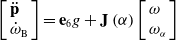 $\left[\begin{array}{l}\ddot{\mathbf{p}}\\ {\dot{\mathit{\omega }}}_{\textrm{B}}\end{array}\right]={\mathbf{e}}_{6}g+\mathbf{J}\left(\alpha \right)\left[\begin{array}{l}\mathit{\omega }\\ {\mathit{\omega }}_{\alpha }\end{array}\right]$
where
 ${\mathbf{e}}_{6}={[\begin{array}{l@{\quad}c@{\quad}c@{\quad}c@{\quad}c@{\quad}r}0&0&0&0&0&1\end{array}]}^{{\top }}$
, and the matrix
 $\mathbf{J}\left(\alpha \right)$
(referred to as the output Jacobian, with
 $\mathbf{J}\left(\alpha \right)\in {\mathbb{R}}^{6\times 8}$
) is defined as
 $\mathbf{J}\left(\alpha \right)={\mathbf{J}}_{\textrm{R}}{\mathbf{J}}_{\alpha }\left(\alpha \right)$
. Here,
 ${\mathbf{J}}_{\textrm{R}}\in {\mathbb{R}}^{6\times 6}$
(also an output Jacobian) and
 ${\mathbf{J}}_{\alpha }\left(\alpha \right)$
are expressed as:
 ${\mathbf{J}}_{\textrm{R}}=\left[\begin{array}{l@{\quad}r}{m}^{-1}{\mathbf{R}}_{\textrm{BW}} {}& {0}^{3\times 3}\\ {0}^{3\times 3} {}& {\mathbf{I}}_{\textrm{B}}^{-1}\end{array}\right],\textrm{}\textrm{}\textrm{}\textrm{}{\mathbf{J}}_{\alpha }\left(\alpha \right)=\left[\begin{array}{l@{\quad}r}\mathbf{F}(\alpha)&{0}^{3\times 4}\\ \mathit{\tau}(\alpha)&{0}^{3\times 4}\end{array}\right]$
Note that
 ${e}_{\mathbf{r}}$
and
 ${e}_{\mathbf{p}}$
are defined in (18) and (21), respectively. For the vector quadrotor’s end-effector:
 ${\mathbf{r}}_{\textrm{d}}\left(t\right)$
and
 $\mathbf{r}\left(t\right)$
represent the desired and actual attitudes, while
 ${\mathbf{p}}_{\textrm{d}}\left(t\right)$
and
 $\mathbf{p}\left(t\right)$
represent the desired and actual positions. Additional constraints are introduced to ensure accurate computation of the tilt angles
 ${\alpha }_{i}$
and rotor speeds
 ${\omega }_{i}$
–proper constraints are critical for this purpose. Specifically, the constraints
 ${\omega }_{\textrm{m}\textrm{i}\textrm{n}}\le {\omega }_{i}\le {\omega }_{\textrm{m}\textrm{a}\textrm{x}}$
and
 ${\alpha }_{\textrm{m}\textrm{i}\textrm{n}}\le {\alpha }_{i}\le {\alpha }_{\textrm{m}\textrm{a}\textrm{x}}$
define the permissible ranges for
 ${\omega }_{i}$
(rotor speed) and
 ${\alpha }_{i}$
(tilt angle), respectively. It is important to note that the trajectory generation algorithm can be computed either offline or online. Given that quadratic optimisation problems can be efficiently solved using state-of-the-art algorithms, this approach is particularly suitable for online computation—even on hardware with limited computational resources. Online iteration allows for dynamic adjustment of optimisation parameters during specific mission phases, which facilitates the implementation of different redundancy resolution strategies by tuning cost function weights based on the mission phase or external triggers. This capability is demonstrated in the experimental section through a vector quadrotor mission.
3.8 Theoretical analysis of allocation algorithm
The core foundation of global convergence lies in the intrinsic properties of the optimisation problem, which determine the existence, uniqueness and reachability of the optimal solution.
The objective function is defined as
 \begin{align}E={k}_{1}{||{v}_{\textrm{B}}||}^{2}+{k}_{2}{||{\mathbf{e}}_{\mathbf{p}}||}^{2}+{k}_{3}{||{\mathbf{e}}_{\mathbf{r}}||}^{2}\end{align}
where the weight coefficients
 ${k}_{1},{k}_{2},{k}_{3} \gt 0$
. By definition, squared norm terms are strictly convex functions, and the weighted sum of strictly convex functions remain strictly convex. This implies that the objective function has a unique minimum point in its domain.
The feasible region
 ${\Omega }$
is defined by linear constraints, including equality constraints describing system dynamics, and inequality constraints such as rotor speed limits, tilt angle bounds and thrust requirements. Linear constraints inherently form convex sets, and the intersection of convex sets is also a convex set. Thus,
 ${\Omega }$
is a convex set.
Due to physical limits on rotor speeds and tilt angles:
 \begin{align} {\omega }_{\textrm{m}\textrm{i}\textrm{n}}\le {\omega }_{i}\le {\omega }_{\textrm{m}\textrm{a}\textrm{x}},\textrm{}\textrm{}\textrm{}\textrm{}{\alpha }_{\textrm{m}\textrm{i}\textrm{n}}\le {\alpha }_{i}\le {\alpha }_{\textrm{m}\textrm{a}\textrm{x}}\end{align}
the feasible region
 ${\Omega }$
is bounded. Meanwhile, sets defined by linear constraints are necessarily closed. A ‘bounded and closed’ set in Euclidean space is a compact set.
For the problem of minimising a strictly convex function over a non-empty convex set, there exists at most one global optimal solution. Furthermore, according to the Weierstrass extreme value theorem, a continuous function (here, the strictly convex objective function
 $E$
) must attain its minimum on a compact set. Combining these two points, the optimisation problem admits a unique global optimal solution.
The proposed problem is essentially a convex SQP problem, which can be efficiently solved using state-of-the-art SQP solvers (e.g. interior-point methods or active-set methods). The global convergence of these solvers for convex SQP problems has been fully verified.
Interior-point methods transform constrained problems into a series of unconstrained subproblems using barrier functions. For convex SQP, each subproblem remains strictly convex, and the sequence of solutions generated by interior-point methods converges to the global optimal solution with a quadratic convergence rate, independent of the initial point selection.
Active-set methods iteratively identify ‘active constraints’ (i.e. constraints that hold with equality at the optimal solution) and reduce the original problem to a low-dimensional unconstrained SQP problem. For convex SQP with a compact feasible region, the number of active-set updates is finite, ensuring that the algorithm converges to solution in a finite number of steps.
When the algorithm is used for online optimisation (e.g. real-time adjustment of weight coefficients), global convergence remains valid:
-
• Weight adjustments only alter the ‘shape’ of the objective function without violating its strict convexity (the Hessian matrix of the new objective function remains positive definite);
-
• The feasible region
 ${\Omega }$
remains unchanged (still a compact set), so the new problem still admits a unique global optimal solution;
-
• Smooth adjustments of weights lead to continuous changes in the optimal solution, and the iterative sequence can stably track these changes, ensuring convergence in online scenarios.

The optimisation framework for the vector quadrotor system is a convex quadratic programming problem with a compact feasible region and a unique global optimal solution. When using standard SQP algorithms such as interior-point methods or active-set methods, the iterative sequence converges to this global optimal solution regardless of the initial point. Convergence is maintained even in scenarios with online parameter adjustments. Therefore, the algorithm theoretically possesses global convergence.
4.0 Simulations
The control structure is illustrated in Fig. 2. The vector quadrotor’s
 $m=1.072\textrm{}\textrm{}\textrm{k}\textrm{g}$
, the vector quadrotor’s inertia matrix
 ${\mathbf{I}}_{\textrm{B}}=\textrm{d}\textrm{i}\textrm{a}\textrm{g}[\begin{array}{l@{\quad}c@{\quad}r}0.039&0.055&0.059\end{array}]\ \textrm{k}\textrm{g}\cdot {\textrm{m}}^{2}$
and the body radius is
 $h=0.2$
m. the thrust coefficient is
 ${k}_{f}$
=
 $2.2\times 1{0}^{-6}\textrm{}\textrm{}\textrm{N}/(\textrm{r}\textrm{a}\textrm{d}/{\textrm{s}}^{2})$
. the torque coefficient is
 ${k}_{m}$
=
 $4.11\times 1{0}^{-8}\textrm{}\textrm{}\textrm{N}/(\textrm{r}\textrm{a}\textrm{d}/{\textrm{s}}^{2})$
. The setting of controller gain parameters is centred on system dynamic performance, requiring a balance between response speed and stability. Refer to research results of similar SO(3) control and model compensation control (MCC), selecting typical values matching the system order
 ${k}_{\mathbf{r}}=\textrm{d}\textrm{i}\textrm{a}\textrm{g}[\begin{array}{l@{\quad}c@{\quad}r}8&1.2&0\end{array}],{k}_{\mathit{\omega }}=\textrm{d}\textrm{i}\textrm{a}\textrm{g}[\begin{array}{l@{\quad}c@{\quad}r}3&1&0.5\end{array}],{k}_{\mathbf{p}}=\textrm{d}\textrm{i}\textrm{a}\textrm{g}[\begin{array}{l@{\quad}c@{\quad}r}410&290&270\end{array}],{k}_{\dot{\mathbf{p}}}=\textrm{d}\textrm{i}\textrm{a}\textrm{g}[\begin{array}{l@{\quad}c@{\quad}r}5&5&9\end{array}]$
. if the trajectory tracking error is too large, gradually increase the proportional terms to improve response sensitivity; if overshoot or oscillation occurs, increase the derivative terms to enhance damping effect. The final parameters must satisfy Lyapunov stability conditions (e.g.
 ${k}_{\mathbf{r}},{k}_{\mathit{\omega }}$
are positive definite matrices) to ensure asymptotic stability of the closed-loop system.
The weight coefficients
 ${k}_{1},{k}_{2},{k}_{3}$
. In the optimisation objective function are used to balance system motion energy, position tracking accuracy and attitude stability. Initially set as
 ${k}_{1}=1,{k}_{2}=2,{k}_{3}=2$
to achieve a preliminary balance of multiple objectives. In actual debugging, dynamic adjustments are made according to task priorities: if trajectory tracking accuracy is prioritised (e.g. high-precision hovering scenarios), increase
 ${k}_{2},{k}_{3}$
to 3-5 times the initial values; if energy consumption reduction is required (e.g. long-endurance missions), increase
 ${k}_{1}$
to 1.2-1.5 times the initial value. Weight adjustment needs to compare the mean square error (MSE) and energy consumption indicators under different combinations to select the parameter combination with optimal comprehensive performance.
4.1 Effect of control algorithm
To verify the feasibility of the control algorithm, MCC controller combine with SQP based on SO(3). In the subsection, we calculate the trajectory and attitude of tracking a stationary target using the Lyapunov vector field navigation method [Reference Muslimov and Munasypov36]. The simulation considers a vector quadrotor equipped with a fixed-angle camera to track a stationary target. We limit the maximum yaw rate of the vector quadrotor to
 ${\dot{\psi }}_{\textrm{m}\textrm{a}\textrm{x}}=0.1\textrm{}\textrm{}\textrm{r}\textrm{a}\textrm{d}/\textrm{s}$
and a nominal speed of
 ${v}_{0}=15\textrm{}\textrm{}\textrm{m}/\textrm{s}$
. The desired angle
 ${\theta }_{\textrm{d}}$
is determined by the distance between the vector quadrotor and the tracked target, given by
 ${\theta }_{\textrm{d}}=\textrm{a}\textrm{t}\textrm{a}\textrm{n}\left(\frac{z}{x}\right)$
assuming no background wind, where
 $z,x$
representing the altitude and horizontal displacement of the vector quadrotor, respectively. While tracking the target, the vector quadrotor obtains the target’s velocity and position using the onboard camera. To ensure effective camera operation and keep the target centred in its field of view, the distance between the camera and the target should be maintained within a specified range.
Considering that the vector quadrotor’s flight altitude is constant and simplify the problem, this paper requires the vector quadrotor to maintain an approximately constant standoff distance from the target on the horizontal plane while tracking the target. The vector quadrotor starts from the position
 $x=600\textrm{}\textrm{}\textrm{m},y=600\textrm{}\textrm{}\textrm{m},z=100\textrm{}\textrm{}\textrm{m}$
with an initial speed of
 ${v}_{x}=15\textrm{}\textrm{}\textrm{m}/\textrm{s},{v}_{y}=-15\textrm{}\textrm{}\textrm{m}/\textrm{s},{v}_{z}=0\textrm{}\textrm{}\textrm{m}/\textrm{s}$
and tracks a stationary target located at
 $x=100\textrm{}\textrm{}\textrm{m},y=100\textrm{}\textrm{}\textrm{m},z=0\textrm{}\textrm{}\textrm{m}$
. The standoff distance is set to
 $150\textrm{m}$
.
Figure 3 shows the trajectory of the vector quadrotor in the
 $\left(x,y\right)$
coordinate plane, which represents the variables in
 $x$
and
 $y$
, respectively. Vector quadrotor starting from
 $x=600\textrm{}\textrm{}\textrm{m},y=600\textrm{}\textrm{}\textrm{m}$
, vector quadrotor’s
 $x$
and
 $y$
values oscillate between
 $x=-106\textrm{}\textrm{}\textrm{m},y=306\textrm{}\textrm{}\textrm{m}$
after entering the standoff range. Adjusting the vector quadrotor’s required flight speed, a single vector quadrotor can successfully track a stationary ground target under heading control.
The changes in position and attitude of vector quadrotor when tracking stationary targets.

Figure 3(a) indicates that the vector quadrotor can correctly enter the standoff range and remain stable within this range. Figure 3(b) shows that the yaw angle
 $\psi $
of the vector quadrotor continuously increases while the roll angle
 $\varphi $
increases during the initial stage. Once the vector quadrotor enters the standoff range, it maintains stability. Clearly, vector quadrotor can accomplish the task of tracking stationary targets.
Figure 4(a) illustrates the temporal evolution of the four tilt angles
 ${\alpha }_{i}$
, while Figure 4(b) presents the corresponding rotor speeds
 ${\omega }_{i}$
, both obtained by numerically solving (63) using the proposed control allocation framework. As the system initiates motion, significant fluctuations can be observed in both
 ${\alpha }_{i}$
and
 ${\omega }_{i}$
, reflecting the system’s dynamic response to the initial conditions and external disturbances. As the vector quadrotor approaches and enters the standoff range, these fluctuations progressively diminish, indicating convergence and stabilisation of the control variables. This behaviour demonstrates the system’s ability to self-stabilise under the designed control strategy.
The tilt angle
 ${\alpha }_{i}$
of the servo and the rotor speed
 ${\omega }_{i}$
are calculated using quadratic programming algorithms.

The above results collectively confirm the feasibility and effectiveness of using a quadratic programming method to simultaneously determine the tilt angles and rotor speeds. Moreover, they validate the precision of the dynamic model in predicting the system’s physical outputs, thereby laying a solid foundation for real-time implementation.
4.2 Comparison of observer effects
In this subsection, we will compare the effectiveness of different observers. We consider four methods: MCC,
 $\textrm{S}\textrm{O}\left(3\right)$
-based MCC, ADRC and
 $\textrm{S}\textrm{O}\left(3\right)$
-based ADRC. The
 $\textrm{S}\textrm{O}\left(3\right)$
-based MCC, which is applied to vector quadrotor, is proposed in this paper. The key difference between the
 $\textrm{S}\textrm{O}\left(3\right)$
-based ADRC method and the
 $\textrm{S}\textrm{O}\left(3\right)$
-based MCC lies in the observer and differentiator. The former employs LESO and TD, while MCC utilises HOD and CFO. LESO and CFO in the controller share the same characteristic equation in both experiments and simulations. The parameter selection is determined based on the analysis of characteristic equations. The dynamic performance of CFO and HOD is determined by the poles of the characteristic equations. The principle of pole selection is to balance overshoot, delay time and settling time. In the simulations, we took these factors into account. The characteristic equation of the first-order HOD is given by
 ${s}^{2}+{l}_{\textrm{h}1}s+{l}_{\textrm{h}2}=0$
 $({l}_{\textrm{h}1}=15,{l}_{\textrm{h}2}=75)$
. This ensures that the poles of HOD are located at 5 and 15. Similarly, the characteristic equation of the second-order HOD is given by
 ${s}^{3}+{l}_{\textrm{h}1}{s}^{2}+{l}_{\textrm{h}2}s+{l}_{\textrm{h}3}=0$
 $({l}_{\textrm{h}1}=8.25,{l}_{\textrm{h}2}=22.695,{l}_{\textrm{h}3}=20.80)$
. In a similar way, the characteristic equations of the LESO and the first-order CFO are given by
 ${s}^{2}+\lambda s+{l}_{\textrm{c}1}=0$
 $({l}_{\textrm{c}1}=27,\lambda =12)$
. The characteristic equation of the second-order CFO is given by
 ${s}^{3}+{l}_{\textrm{c}1}{s}^{2}+(\lambda {l}_{\textrm{c}1}+{l}_{\textrm{c}2}s+\lambda {l}_{\textrm{c}2}=0)$
. For all second-order CFOs in simulations, we set
 ${l}_{\textrm{c}1}=63.48,{l}_{\textrm{c}2}=20.7,\lambda =3.07$
. Next, the controller parameters should be tuned based on the observer’s performance. The parameters
 ${k}_{\mathbf{p}},{k}_{\dot{\mathbf{p}}},{k}_{\mathbf{r}}$
and
 ${k}_{\mathit{\omega }}$
offer large adjustment margins, ensuring improved performance over a wide range of conditions.
The initial state at
 $t=0$
is given by
 $\mathbf{p}=\dot{\mathbf{p}}=\mathbf{r}={\mathit{\omega }}_{\textrm{B}}={0}^{3\times 1}$
. Given a disturbance
 ${f}_{\theta }={f}_{x}=0.5$
applied at
 $10\textrm{s}$
. Given persistent Gaussian noise in the interval
 $15\textrm{s}-25\textrm{s}$
, with a mean of
 $\mu =0$
and a variance of
 $\sigma =0.01$
. CFO and LESO independently estimate the unknown disturbance in the pitch channel. The comparative performance of the observers is illustrated in Fig. 5(a). For
 ${f}_{\theta }=0.5$
, the maximum estimation error of LESO is 0.134, while that of CFO is 0.0532. For Gaussian noise, the mean absolute error (MAE) of LESO is 0.0450, while that of CFO is 0.0294. CFO exhibits superior performance. Moreover, increasing the error gain of LESO can reduce both delay and steady-state error. However, this results in high-frequency oscillations. The convergence of LESO is inherently constrained by its structural design. Lemma 1 states that the second-order CFO can achieve zero error estimation for both slope and acceleration signals. However, LESO provides a bounded estimation of the slope signal but diverges when estimating higher-order signals (Qi et al., 2024). In practice, first-order or second-order CFOs are preferred due to their sufficiently high estimation accuracy. Higher-order CFOs require additional sensor information, which is often impractical for vector quadrotors.
Performance comparison of different controllers under disturbance without expectation signals.

The quality of observation directly impacts controller performance. The variation in pitch angle is illustrated in Fig. 5(b). For
 ${f}_{\theta }=0.5$
, the maximum pitch angles for ADRC,
 $\textrm{S}\textrm{O}\left(3\right)$
-based ADRC, MCC and
 $\textrm{S}\textrm{O}\left(3\right)$
-based MCC are 0.0661 rad, 0.0517 rad, 0.027 rad and 0.0106 rad, respectively. For Gaussian noise, the MAEs for ADRC,
 $\textrm{S}\textrm{O}\left(3\right)$
-based ADRC, MCC and
 $\textrm{S}\textrm{O}\left(3\right)$
-based MCC are 0.0262rad, 0.0241rad, 0.0055rad and 0.0026rad, respectively. Therefore,
 $\textrm{S}\textrm{O}\left(3\right)$
-based MCC exhibits superior anti-disturbance performance against high-frequency and step disturbances. The variation of
 $x$
is illustrated in Fig. 5(c). For
 $x$
, the MAEs for ADRC,
 $\textrm{S}\textrm{O}\left(3\right)$
-based ADRC, MCC, and
 $\textrm{S}\textrm{O}\left(3\right)$
-based MCC are 0.1167rad, 0.0784rad, 0.0559rad and 0.0334rad, respectively. On the other hand, for pitch angle and
 $x$
, Fig. 5(b) and (c) further demonstrate that
 $\textrm{S}\textrm{O}\left(3\right)$
-based MCC has a faster response time compared to other methods. Overall, the
 $\textrm{S}\textrm{O}\left(3\right)$
-based MCC method demonstrates superior anti-disturbance performance in both position and attitude control.
4.3 Comparison of tracking effects between four controllers
The vector quadrotor is subjected to a disturbance given by
 ${f}_{x}={f}_{\varphi }=0.6\textrm{s}\textrm{i}\textrm{n}(t+0.5)+\textrm{s}\textrm{i}\textrm{n}(0.8t+0.5)+\textrm{c}\textrm{o}\textrm{s}\left(1.2t\right)$
and the initial state at
 $t=0s$
is
 $\mathbf{p}=\mathbf{v}=\mathbf{r}={\mathit{\omega }}_{\textrm{B}}={0}^{3\times 1}$
. At the same time, the desired position for
 $x$
is specified, as shown in Fig. 6(b). Figure 6(a) illustrates the performance of LESO and CFO in estimating the disturbance. The MAE of LESO is 0.6834, while that of CFO is 0.0455. The estimation performance of CFO is approximately 13.48 times better than that of LESO. Figure 6(b) illustrates the performance of different controllers in tracking the same desired signal. Intuitively, control methods based on LESO exhibit higher delays and larger errors when tracking sine wave signals. MCC method tracks sine signals with low delay and minimal error but exhibits larger overshoots and a longer settling time when responding to step signals. For step signal tracking, the settling times of ADRC,
 $\textrm{S}\textrm{O}\left(3\right)$
-based LESO, MCC, and
 $\textrm{S}\textrm{O}\left(3\right)$
-based MCC are 3.46, 4.23, 2 and 0.32 seconds, respectively. Meanwhile, compared to MCC, the overshoot of
 $\textrm{S}\textrm{O}\left(3\right)$
-based MCC is reduced by approximately 35%.
Observation errors of CFO and LESO and trajectory tracking effects of four different controllers.

We evaluate the performance of MCC and
 $\textrm{S}\textrm{O}\left(3\right)$
-based MCC methods in tracking step signals with amplitudes of 2m, 3m, 4m and 5m, each lasting for 3 seconds. The tracking performance of
 $x$
is illustrated in Fig. 7(a) and (b). For the two methods, the settling time does not differ significantly. For a step signal of 2m/s, the overshoot of
 $\textrm{S}\textrm{O}\left(3\right)$
-based MCC was 6.9%, while that of MCC was 22%. The overshoot of MCC method is eight times greater than that of the
 $\textrm{S}\textrm{O}\left(3\right)$
-based MCC. For a step signal of 3m/s, the overshoot of
 $\textrm{S}\textrm{O}\left(3\right)$
-based MCC was 6.9%, while that of MCC was 21.2%. The overshoot of MCC method is 11.5 times greater than that of the
 $\textrm{S}\textrm{O}\left(3\right)$
-based MCC. For a step signal of 4m/s, the overshoot of
 $\textrm{S}\textrm{O}\left(3\right)$
-based MCC was 6.9%, while that of MCC was 21.8%. The overshoot of MCC method is 14.2 times greater than that of the
 $\textrm{S}\textrm{O}\left(3\right)$
-based MCC. For a step signal of 5m/s, the overshoot of
 $\textrm{S}\textrm{O}\left(3\right)$
-based MCC was 6.9%, while that of MCC was 21.9%. The overshoot of MCC method is five times greater than that of the
 $\textrm{S}\textrm{O}\left(3\right)$
-based MCC. Therefore, the tracking precision of the
 $\textrm{S}\textrm{O}\left(3\right)$
-based MCC method is significantly higher.
Position comparison of different controllers under disturbance with expectation signals.

4.4 Comparison of optimisation algorithm performance
The experimental environment is built on the Windows 11 operating system. In terms of hardware configuration, it is equipped with an Intel Core i5-13600KF processor and an NVIDIA GeForce RTX 3080 graphics card (12 GB memory), which can provide strong computing and graphics processing capabilities for the experiment. The development and operation of the experiment are mainly completed relying on the Simulink platform, which can effectively support experimental procedures such as model construction and simulation analysis.
4.4.1 Optimisation of objective functions by different algorithms
In the evaluation of algorithm performance, convergence time is one of the key indicators for measuring the efficiency and effectiveness of an algorithm. In particular, the convergence time to reach the final stable value directly reflects the time consumed by the algorithm to produce reliable and unchanging results. This study focuses on three algorithms, namely SQP, MPC and PINV, and conducts an in-depth comparison of their convergence times to reach the final stable value, aiming to comprehensively understand the performance characteristics and applicable scenarios of each algorithm.
In the Fig. 8, from these values, it can be intuitively observed that the SQP algorithm has the shortest convergence time to reach the final stable value, which is only 1.03. The convergence time of the MPC algorithm is 1.23, placing it in an intermediate position. The PINV algorithm has the longest convergence time, which is 1.70. To more clearly illustrate the differences in convergence speeds among the algorithms, we calculated the ratio of each algorithm’s convergence time to that of the fastest algorithm, SQP. The convergence time of MPC is approximately 1.194 times that of SQP, and that of PINV is approximately 1.650 times. This multiplicative relationship further emphasises the advantage of the SQP algorithm in terms of convergence speed. In the application of vector quadrotor, this advantage enables the reduction of decision-making waiting time, allowing the vector quadrotor to seize fleeting opportunities.
Optimisation of objective functions by different algorithms.

To conduct an in-depth comparison of the differences in objective function values between different algorithms and the benchmark algorithm SQP, we calculated the deviation degree of the MPC and PINV algorithms relative to the final objective function value of the SQP algorithm. Specifically, by obtaining the final objective function value of each algorithm, we computed the percentage of the absolute value of the difference between this value and the final objective function value of the SQP algorithm relative to the final value of the SQP algorithm, so as to measure the degree of deviation.
The calculation results show that the deviation degree of MPC relative to SQP is 0.12%, and that of PINV relative to SQP is 0.22%. From this data, it can be inferred that in terms of the final value of the objective function, the result of the MPC algorithm is closer to that of the SQP algorithm, and its deviation degree is significantly smaller than that of the PINV algorithm.
4.4.2 Comparison of utilisation rates of different algorithms
From the Fig. 9, the average CPU utilisation rates of SQP, MPC and PINV are 16.53%, 23.51% and 11.00%, respectively. Taking the average CPU utilisation rate of SQP (16.53%) as the benchmark, the average CPU utilisation rate of MPC (23.51%) is significantly higher than that of SQP, with an increase of approximately 42.2%. In contrast, the average CPU utilisation rate of PINV (11.00%) is lower than that of SQP, with a decrease of approximately 33.4%.
Comparison of utilisation rates of different algorithms.

In terms of memory usage, the average values of SQP, MPC and PINV are 9.02%, 20.15% and 13.75%, respectively. The average memory usage rate of MPC is approximately 2.23 times that of SQP. The average memory usage rate of PINV, which is 13.75%, is also higher than that of SQP, with an increase of approximately 52.4%.
In terms of energy consumption, the average values of SQP, MPC and PINV are 20.02W, 28.01W and 15.00W, respectively. The average energy consumption of MPC is approximately 1.4 times that of SQP. PINV has the lowest average energy consumption, which is 75% of that of SQP.
Overall, the MPC algorithm offers faster speed; it consumes significant resources, including higher CPU utilisation, memory usage and energy consumption. The PINV algorithm is relatively lightweight, with low and stable resource requirements and efficient energy utilisation, but it is inferior in terms of computational accuracy and speed. The SQP algorithm, on the other hand, has indicators that lie between the two, making it a more balanced choice. In practical applications, during the high-speed movement of tilt-rotor UAVs, the SQP algorithm can achieve a better balance between performance and resource consumption.
5.0 Conclusions
This work addresses the challenges of controlling overactuated vector quadrotors by proposing a novel framework that integrates SO(3) theory, model compensation control and sequential quadratic programming. Traditional methods, limited by Euler angle singularities and inadequate handling of nonlinear dynamics, is outperformed by our approach, which leverages the geometric precision of SO(3) to ensure singularity-free attitude representation and robust rotational modeling. By embedding SQP into the control allocation process, the system optimises tilt angles and rotor speeds under physical and dynamic constraints, enhancing trajectory tracking, actuator efficiency and energy utilisation.
The integration of MCC further strengthens the disturbance rejection and compensates for unmodeled dynamics, while the global stability properties of SO(3) guarantee reliable posture control in aggressive manoeuvers. Simulation results validate the framework’s effectiveness, demonstrating superior anti-disturbance performance and manoeuverability in high-speed, high-precision flight scenarios. This methodology advances control allocation for over actuated quadrotors, offering a unified solution that balances mathematical rigour, optimisation-driven control, and real-world robustness.
Acknowledgements
I would like to express my sincere gratitude to all individuals and institutions that have supported the completion of this paper. First and foremost, I am deeply indebted to my supervisor, Liang Zhang, for his/her invaluable guidance throughout the entire research process. From refining the research topic and optimizing the experimental design to revising the manuscript with rigorous academic standards, Liang Zhang has consistently provided insightful suggestions and patient support. His dedication to scientific inquiry and meticulous approach to research have not only ensured the smooth progress of this work but also set a profound example for my future academic endeavors. I would also like to thank Yan Gao from the for their generous help in the experimental phase. This research was financially supported by the National Natural Science Foundation of China (Grant No.62473282) and (Grant No.62503359). The funding support is greatly appreciated as them made this research possible. Finally, I want to thank my family and friends for their unwavering understanding, encouragement, and emotional support during the busy period of research and writing. Their trust and companionship have been my strongest motivation to overcome difficulties and stay focused on this work.



