A drop of favor received, repay in pour
(滴水之恩, 当涌泉相报)
- Chinese ethical code of Yi, by Su and Littlefield (Reference Su and Littlefield2001)
INTRODUCTION
The norm of reciprocity (or bao in Chinese) has been identified as a promising angle for investigating strong guanxi development among individuals who are not blood relatives in a Chinese cultural context (Chen & Chen, Reference Chen and Chen2004; Hwang, Reference Hwang1987; Luo, Reference Luo2005; Su & Littlefield, Reference Su and Littlefield2001; Yang, Reference Yang and Fairbank1957). However, bao, as an effective norm for regulating social exchanges in highly structured relationships of Chinese society, may be vulnerable to ‘Renqing Dilemma’, where individuals might not be motivated to provide favors because of the unpredictability of receiving a future return of the favor (Chan, Reference Chan2006; Hwang, Reference Hwang1987; Tsang, Reference Tsang1998).
Although under uncertain circumstances some renqing dilemma may be resolved by authority and power, which may reinforce the rule of favor exchange (renqing) and prompt reciprocation and trust development between non-kin partners (Hwang, Reference Hwang1987; Su & Littlefield, Reference Su and Littlefield2001), such external solution mechanisms may not be strong enough for enacting favor and favor reciprocation, particularly when providing favor inflicts significant hardship on the favor givers. In these adverse situations, established relationships may falter if only normal bao or renqing governs relationship development, because renqing stresses equality in exchange, whereas adversity calls for sacrifice and altruism on a favor provider. Such situations can make renqing seem ‘as thin as a piece of paper’, resulting in an unresolvable ‘Renqing dilemma’ (Hwang, Reference Hwang1987).
In Chinese society, a unique concept and norm, jiangyiqi, may be useful for resolving such a dilemma in social exchanges in China. Jiangyiqi norm is characterized by one's attitude of willing to sacrifice one's own interests and benefits to help others, especially friends. Individuals adhering to the jiangyiqi norm are believed to commit to strong reciprocation and to doing whatever he or she can to help friends. As commonly said of jiangyiqi, ‘Wei Peng You Liang Lei Cha Dao’ (为朋友两肋插刀; Shed one's blood for one's friends). Jiangyiqi individuals (individuals who are strongly committed to following jiangyiqi norm) often have strong beliefs in altruism and sacrifice, which are fundamental for building strong relationships under adverse conditions. Under adverse conditions, especially when life may be lost, equality in exchange that renqing relationship is built upon may not be possible to pursue. Therefore, partners looking for equal reciprocation may back out of the relationship. Nonetheless, jiangyiqi individuals following the jiangyiqi norm are willing to sacrifice, and hence may take the difficult conditions as an opportunity to demonstrate their commitment to the partnership. Jiangyiqi is common and observable in business practice. For example, Jack Ma, the founder of Alibaba, is regarded as a person of jiangyiqi (Cao, Xi, Zhang, & Han, Reference Cao, Xi, Zhang and Han2012). During an interview, he admitted that he truly believes in jiangyiqi in his life (Chen, Reference Chen2013). Many conference rooms in Alibaba's headquarters are named after places and characters appearing in very popular Chinese martial arts novels written by Jin Yong. Most of these novels stress jiangyiqi and xiayi (Chinese chivalrous heroism).
In this research, we aim to explore the essence of the jiangyiqi concept and its implications for management. Our work is an extension of the sparsely discussed notions of bao and Yi in previous management and organization literature. Specifically, we discuss how jiangyiqi is different from and related to bao and Yi. This extension helps enrich the understanding of norms of social exchanges in Chinese culture, as well as indigenous Chinese attitudes. More importantly, we highlight how jiangyiqi as a norm of social exchange contributes to resolving the renqing dilemma in maintaining social relationships when other solutions are likely to fail. Furthermore, we fill a research gap in the literature by connecting bao and Yi through jiangyiqi. Lastly, we demonstrate some important implications of jiangyiqi for organizational management, an endeavor that has never been made.
Next, we introduce the complicated concept of jiangyiqi and make a connection between jiangyiqi and Yi. Then, we explore the connotation of jiangyiqi as a social norm for facilitating strong interpersonal relationships among non-kin individuals in Chinese culture. Lastly, we discuss the implications of jiangyiqi as an individual characteristic for conducting business in Chinese culture.
THEORETICAL BACKGROUND AND DEVELOPMENT
Yi (Righteousness), Yiqi, and Jiangyiqi
Jiangyiqi is a derivative of yi, the moral value of righteousness in the Confucius value system (Chai, Reference Chai1959; Cheng, Reference Cheng1972). Confucius says, ‘A gentleman appreciates the code of Yi, while a small man upholds the rule of Li (self-interests)’ (‘Jun Zi Yu Yu Yi, Xiao Ren Yu Yu Li’; 君子喻于义, 小人喻于利) (Analects 4/16). When one faces the choice between life and ‘Yi’, one is advised to choose yi over one's own life (Lau, Reference Lau2003). As one of five traditional Confucian values (i.e., ren, yi, li, zhi, xin), yi refers to the pursuit of righteousness or appropriateness, particularly over an individual's self-interests (i.e., wealth, safety, wellbeing, etc.) (Yu, Reference Yu2006).
Jiangyiqi is also tied directly to a term coming out of yi – yiqi. The compound word of yiqi refers to the moral state (qi) of upholding the code of justice and righteousness (yi) in an individual's value system when dealing with social relationships. Collectively yiqi depicts an individual's attitudinal orientation toward upholding the code of justice and righteousness, as well as the cognitive orientation of ignoring risks to honor yi. According to Ci Yuan (辞源), the dictionary of Chinese etymology, yiqi refers to an attitude to sacrifice one's own interests, sometimes even life, to help others of relevance, friends in particular. The word jiang adds a notion of ‘adhering to’ or ‘embracing’ the attitude of yiqi to make it jiangyiqi. Jiangyiqi confers four related meanings in different communication contexts. First, it is used as a synonym to yiqi or as an attitude of embracing righteousness and justice. Second, it is often referred to yiqi conduct, a type of altruistic behavior. Third, it refers to an individually preferred social exchange norm. Individuals adopting this norm are expected to treat friends and others with yiqi or maintain an attitude of yiqi toward others. Lastly, jiangyiqi is used as an adjective to judge individuals regarding their propensity to practice the norm of yiqi in social exchanges, that is, if an individual can be said to be jiangyiqi or not. Individuals deemed to be jiangyiqi are believed to maintain a yiqi attitude in treating others in social relationships or are believed to be willing to sacrifice for friends and others. Therefore, jiangyiqi can be considered as an individual characteristic demonstrated in the individual's commonly held attitude toward others in social relationships. Jack Ma's being jiangyiqi is an example of such a use.
In the remainder of the paper, we first investigate jiangyiqi as an attitude that gives away a person's behavior. In social psychology, attitude has been researched extensively through a tripartite model, which suggests that attitudinal evaluation is reflected commonly in affective, cognitive, and behavioral responses of an individual toward a stimulus (Hovland & Rosenberg, Reference Hovland and Rosenberg1960; Zanna & Rempel, Reference Zanna, Rempel, Bar-Tal and Kruglanski1988). Following this model, we treat the behavioral denotation of jiangyiqi as a dimensional representation of jiangyiqi as an attitude. This leads us to discuss the topic of interest: the two connotations of jiangyiqi, one as a social norm and the other as an individual characteristic. Both have some important implications for managerial practice in a Chinese context.
Jiangyiqi Attitude Construct
Perceived righteousness as an internalized moral value and social obligation
Attitude can be viewed as long-term memory structures of individuals (Petty, Brinol, & DeMarree, Reference Petty, Briñol and DeMarree2007). These cognitive structures coevolve with an individual's perception of self and relationship with others construed by their cultures, especially the shared moral values in a culture (Markus & Kitayama, Reference Markus and Kitayama1991). In Chinese culture, the unique moral value bounded to jiangyiqi is obvious Yi. As stated above, Yi refers to the pursuit of righteousness or appropriateness by a nobleman who is expected to display righteous behavior to others, regardless of the loss and gains incurred for himself. Noblemen are viewed as ideal citizens in Confucianism. Individuals are encouraged to copy the conduct of noblemen. If not, one is perceived with disdain. Hence, Chinese societies admire Yi Shi (义士), or individuals devoted to honoring Yi.
Yi can be regarded as the ethical principle underpinning a jiangyiqi individual's cognitive structure. Jiangyiqi individuals must embrace yi in their value system in the treatment of others. When sacrificing their own interests, they believe that it is the right thing to do. Their perception comes from their moral beliefs, although from an outsider's perspective, this perception may be counterproductive. Due to its moral foundation of righteousness, yi induces a strong sense of social obligation in the cognitive aspect of jiangyiqi attitude.
Strong affect attached to altruism and sacrifice
Mencius, who extends the meaning of Yi substantially after Confucius, states that an individual who does not follow Yi in conducting himself should feel shameful (Lau, Reference Lau2003; Norden, 2002). He notes that a heart of shame is the germ of dutifulness (II.A.6). In the ‘shame culture’ of China (Chu, Reference Chu1972; Fung, Reference Fung2006), which stresses face, how others see one is as important as how one sees oneself (Hofstede, Reference Hofstede1991). In Chinese societies, jiangyiqi has been conducted to prevent shame or a damaged self-image but more so to pursue honor and a positive social image among others. Pursuing yi may be even as important as one's own life (Lau, Reference Lau2003).
The concerns for honor and shame inherently tie the jiangyiqi attitude to the emotional state of an individual. In social interactions, jiangyiqi is seen more frequently among close friends. This is likely due to the affect that exists in these intimate relationships that fuel the emotion of dignity and shame in an individual's moral judgement over righteousness. Because of friendship and affection in these relationships, seeing a close friend suffer is likely to elicit strong compassion, which subsequently causes an individual to make an emotional decision in evaluating righteousness and justice. As a result, a righteous decision is likely to be made, prompting individuals to go extra miles in reciprocating and seeking justice for a friend while ignoring personal loss or risks.
Despite this, Confucius says ‘As to how the superior man behaves with regard to others and in view of a situation, he has no particular preference, nor particular prohibition, but only Yi as its standard of evaluation’ (4:10) (君子之于天下也, 无适也, 无莫也, 义之与比). The saying asks for a jiangyiqi individual to maintain the affect attached to yi for others, not just friends, when conducting jiangyiqi. This affect aspect is in line with behavioral aspect of altruism in jiangyiqi. Altruistic behaviors may be viewed by non-jiangyiqi others as an emotional outcome, instead of a rational outcome.
Strong mutual bao (报) (reciprocity) and pre-bao in behavior
Jiangyiqi stresses sacrifice and voluntary favor giving. When this occurs mutually among two friends, it can be viewed as a type of bao behavior. On the other hand, unidirectional jiangyiqi makes jiangyiqi behavior different from a typical bao behavior. It may be viewed as a type of pre-bao behavior that elicits mutual jiangyiqi in close relationships, but it occurs not just among these relationships. Pre-bao behaviors occur when a jiangyiqi individual voluntarily provides favors to others, including the original favor giver, his/her family members or even close acquaintances (Yang, Reference Yang, Kao and Sinha1997). Confucians proclaim that one should ‘help others as one wants to help his own parents and brothers’ (Yu, Reference Yu2006). When uni-directional jiangyiqi behaviors are reciprocated by the favor receiver on a voluntary basis and with explicit sacrifice, mutual jiangyiqi will be observed between the two partners of the exchange. Because reciprocity demonstrates loyalty to the relationship, mutual jiangyiqi would be more adored than uni-directional jiangyiqi.
A popular historical story best illustrates the gist of jiangyiqi. A military general called Guan Yu (关羽), who is a critical figure in a classic history novel from the Ming dynasty, Romance of the Three Kingdoms, rejected generous gifts from his enemy, Cao Cao, and risked his life to save the family of Liu Bei, who is Guan Yu's sworn brother. Guan Yu's loyal attitude toward Liu Bei and his contempt for his enemy's offering is well regarded as jiangyiqi. Because of his being jiangyiqi to others, General Guan Yu is characterized as the embodiment of loyalty, righteousness, bravery, and benevolence (忠, 义, 勇, 仁) in Chinese culture. Guan Yu's strong relationship with Liu Bei provides imagery and symbolism for loyal friends to look after each other in times of hardship and uncertainty.
Similar to the story of Guan Yu and Liu Bei, when an individual holds jiangyiqi toward a close friend, the ultra-generous favor will be stored in the relationship and is expected to be paid back by the friend in the future. To a third person, jiangyiqi conduct that occurs among two close friends or fraternity displays selfishness (which may be called reciprocal selfishness given the established relationship). In other words, jiangyiqi is viewed to contain an implicit, long term motive of selfishness. This hidden selfishness intent may be most evident when mutual jiangyiqi conducts are observed among friends.
These mutual jiangyiqi conducts, however, rarely occur simultaneously among friends. There will always be an initiator that sacrifices first in the relationship. When a person sacrifices for a partner in a dyadic relationship, the implicit self-serving motive is often overshadowed by the explicit altruism of the sacrifice. Especially in situations of high adversity and urgency, such as risking one's life or health to help a friend, the consequence of sacrifice is often so costly that future repayment is impossible to count upon. In such situations, jiangyiqi conduct is more similar to a notion called reciprocal altruism (Trivers, Reference Trivers1971) in evolutionary biology and sociobiology.
Reciprocal altruism refers to the altruistic behaviors that an individual demonstrates toward non-kin others in expectation of being assisted by the recipients in the future (Trivers, Reference Trivers1971). Sociobiology research provides some explanations of how self-serving purpose evolves into reciprocal altruism in human adaptation. Moore (Reference Moore1984) suggests that reciprocal exchange of goods creates productive advantages for altruists in a non-altruist population. In the evolution process, selection for traits (such as reciprocal sharing) associated with the ability to optimally take advantage of reciprocal exchange is likely to have followed to allow the trait to be inherited in the next generations. The selection further critically increased these traits in the population and may have allowed true reciprocal altruism to be established. This perspective indicates that as human societies evolve, reciprocal sharing that comes out of selfish motives gradually promotes reciprocal altruism (Moore, Reference Moore1984).
In sum, jiangyiqi is derived from an individual's value of being altruistic in reciprocating friends, even to the extent that these behaviors may create extreme adversity to the individual him- or herself, so that a moral obligation of righteousness toward others, in particular friends, is fulfilled.
Jiangyiqi, Bao, and Renqing as Social Exchange Norms
Whereas at the individual level jiangyiqi can be viewed as an attitude that an individual holds toward relationships with others, at the dyadic and society level, jiangyiqi also serves as a preferred social norm of exchange that implies a rule for developing strong guanxi among non-kin relatives. Li (Reference Li2007: 66) observes that strong guanxi features ‘sentimental, personalized, dyadic, reciprocal, long-term, and indeterministic features’. Sentimental, personalized, and long-term features of guanxi are commonly presented in close family ties, whose blood connection gives kin clear advantages over non-kin in developing strong relationships. To compensate for the lack of blood connection, non-kin could take advantage of reciprocity and indeterministic features to stimulate sentimental and personalized features in relationships. Doing so would generally require two individuals to follow the rule of renqing in traditional Chinese societies. According to Hwang (Reference Hwang1987), renqing facilitates the development of mixed ties, or relationships among non-kin and is regulated by favor and face pressure. Renqing is suggested to be a derivative rule of reciprocity, or bao in the Chinese language (Hwang, Reference Hwang1987; Luo, Reference Luo2005Footnote [1]; Su & Littlefield, 2001; Luo, Reference Luo2005).
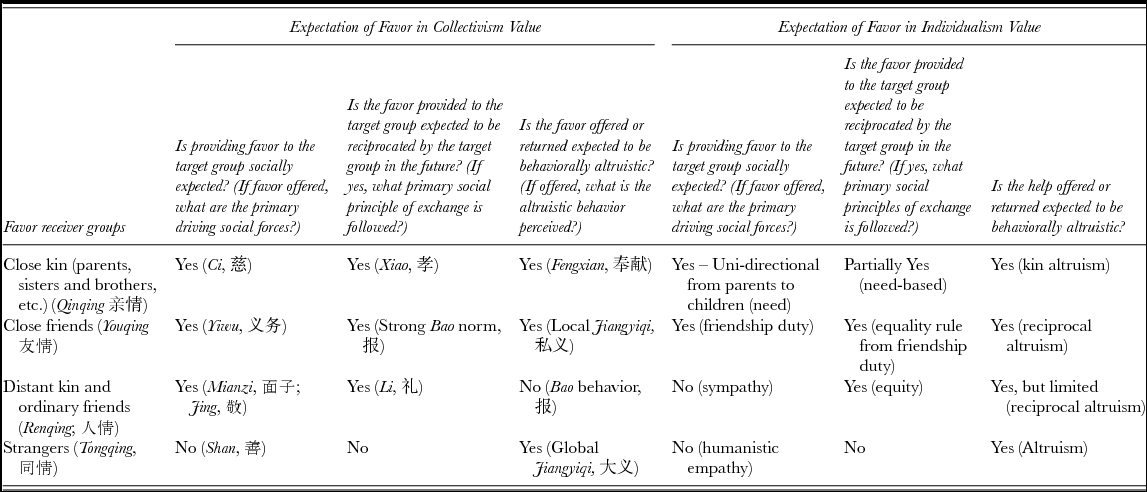
Bao depicts the rule of interaction-based trust development in the Chinese cultural context (Luo, Reference Luo2005). It has been argued that the Chinese indigenous norm of bao contains two features that make it different from the Western norm of reciprocity. One feature is that bao is a long-term oriented exchange that discourages instant bargaining of payback; the other is that a bao-induced relationship creates affection, or Qing (Hwang, Reference Hwang1987; Chen & Chen, Reference Chen and Chen2004; Luo, Reference Luo2005). There are various types of Qing (see first column in Table 2 for some examples). Renqing, for example, is a type of affection based upon favor exchange. On the other hand, if viewed as a norm of social exchange, renqing solicits the exchange of affection.
The norm of renqing, however, is a general norm of bao. It has limitations in developing strong relationships. One of the limitations is depicted in renqing dilemma by Hwang (Reference Hwang1987). Hwang (Reference Hwang1987) examines one contingency – the existence of social power – that facilitates reciprocation among favor givers and favor recipients and may resolve the renqing dilemma. Hwang's analysis assumes that institutional forces and social pressure may remove some uncertainties of being paid back for a person's favor provided to exchange partners. Although uncertainties surrounding renqing dilemmas may be trumped by clear social expectations and institutional pressure, we argue that institutional forces alone may not be sufficient enough to motivate individuals to provide assistance to others. In highly uncertain situations, institutional structures may change drastically. In addition, in some situations of high adversity, individuals may need to assume immediate hardship when providing help to others. As discussed earlier, the hardship may be impossible to compensate for in the future. When circumstantial adversity incurs significant costs on a favor giver, renqing may be proven fragile. As it is said, a husband and wife may go on their own ways to escape disasters (夫妻本是同林鸟, 大难临头各自飞). After all, an individual's obligation toward non-kin individuals is generally not as strong as the obligation toward his or her family (Fei, 1992/Reference Fei1947; Hwang, Reference Hwang1987). Hence, it is acceptable to a large extent that in adverse situations, a common favor giver decides not to offer help to non-kin in order to prevent significant loss or hardship to himself. As a result, adversity may curb reciprocity and create an unsolvable renqing dilemma.
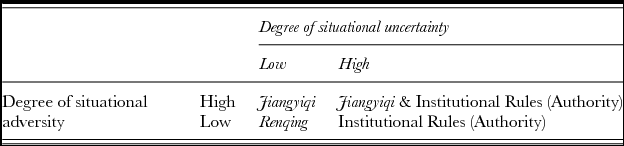
We posit that in situations of high adversity and high uncertainty, non-kin need to display altruism and resort to jiangyiqi as a norm of exchange to escape the renqing dilemma and develop strong non-kin relationships. Jiangyiqi can be viewed as a unique type of bao norm that, when practiced, stresses strong affection, voluntarism, and sacrifice. Under the situations of ambiguous institutional cues, an individual's willingness to provide altruistic favors to others will significantly increase the degree of perceived trustworthiness in the individual. Altruism is a foundation to friendship (Annis, Reference Annis1987). If a favor receiver in a relationship shows great appreciation for the altruistic favor, the relationship between the two may be elevated from renqing to strong mutual ganqing (Tsang, Reference Tsang1998). Ganqing is shared affection that may create strong affect-based trust. If a favor recipient reciprocates with sacrifice and voluntarily, the exchange rule between non-kin may transition to a need-based rule, like that of close family members. A Chinese proverb says, ‘Prosperity makes friends and adversity tries them’ (有福同享, 有难同当). Strong trust can be established through successfully dealing with adversity and uncertainties with trusting behaviors. The trigger of reciprocity in such situations includes not only an individual's internalization of social obligation but also the altruistic orientation of the individual. Table 1 compares various drivers of reciprocity under the two contingency conditions: adversity and uncertainty.
Appropriate rules of reciprocity under different degrees of uncertainty and adversity

The above discussion indicates that both jiangyiqi and renqing can be viewed as derivatives of the norm of reciprocity. However, they are different with respect to the trigger of reciprocity and the degree of expected reciprocity. Renqing occurs in an individual's normal social interactions with others, where connections are a necessary condition. Reciprocity based upon renqing is triggered by common social events, such as ceremonies and holidays. When practicing renqing, one is not expected to reciprocate with significant hardship caused to oneself unless social pressure exists. Thus, renqing represents common bao. In contrast, jiangyiqi is triggered by the likeability of others and perceived fairness. Jiangyiqi goes along with strong ganqing and contains a stronger affection for others. Tsang (Reference Tsang1998: 66) defines ganqing as ‘emotional commitment of the parties involved’. He states that two persons may have guanxi but not ganqing. Likewise, two individuals may be in reciprocity without liking each other (Mao, Peng, & Wong, Reference McKnight, Cummings and Chervany2012). When two individuals go through adversity together in life and support each other with sacrifice, strong ganqing is likely to arise between them because adversity and sacrifice stimulate a strong emotional response (Larsen et al., Reference Larsen, Hemenover, Norris and Cacioppo2003). That is why jiangyiqi behaviors occur mostly when situations are highly uncertain and adverse, where emotion drives sacrifice to save relationships.
Next, we compare indigenous Chinese codes of social exchange in particularistic relationships with their counterparts in Western culture, to show where jiangyiqi behavior stands in the Confucian value system and collectivist culture and how its content is different from very similar concepts in Western culture, such as reciprocal altruism.
Predominant Social Values and Codes of Conduct on Reciprocity in Chinese and Western Circles of Relationships
Based upon past studies on relationship circles in Chinese societies (i.e., Fei, 1992/Reference Fei1947; Hwang, Reference Hwang1987; Ip, Reference Ip2009; Luo, Reference Luo2005) and some frameworks of social relationships proposed in Western societies in sociology and biology (i.e., Ashton et al. Reference Ashton, Paunonen, Helmes and Jackson1998; English, Reference English and Jecker1992; Fehr & Fischbacher, Reference Fehr and Fischbacher2003; Gouldner, Reference Gouldner1960; Krebs & Davies, Reference Krebs and Davies1987; Mancini & Blieszner, Reference Mancini and Blieszner1989; Trivers, Reference Trivers1971), we developed Table 2 to identify the social expectations for favor giving and favor returning related to jiangyiqi behavior. Given the difference in the conception of the words in different languages, we use indigenous concepts in Chinese to actually describe Confucian values and the codes of conduct governing a specific relationship in Chinese culture, while using Western sociological and philosophical constructs to describe the codes of conduct that guide relationships in a Western culture.
A comparison of social obligation for reciprocation in Chinese and Western cultures

Regarding the social expectation of giving favors to others, a collectivist culture and an individualistic culture are most similar in the relationship categories of close friends and strangers, but quite different in treating common friends and family members. Both cultures regard helping close friends as a duty or obligation, or Yiwu (义务) in Chinese. The saying of a friend in need is a friend indeed (患难见真情) is widely acknowledged in both cultures. In addition, in both cultures it is not uncommon for an individual to help strangers under no social obligation. In Western culture, the altruistic help is driven by humanistic empathy (Eisenberg & Miller, Reference Eisenberg and Miller1987). In the collectivist culture of China, the help is done out of Shan (善), or benevolence and goodness, which Mencius claims to be an innate moral sense possessed by all human beings (Lo, Reference Lo, Zuñiga and Andrés Cuevas2011). The two cultures differ significantly in treating common non-kin people. Hwang (Reference Hwang1987) has detailed such differences.
In the close family circle, in Chinese culture, both parents and descendants have undeniable obligations to take care of each other. Parents are expected to follow Ci (慈), a type of Ren (仁) (benevolence and love), in treating their children, whereas children are expected to take care of their parents following Xiao (孝), or filial piety (Hsieh, Reference Hsieh and Moore1967; Hwang, 1999; Yang, Reference Yang, Kao and Sinha1997), the obedience to seniors and the obligation to care and respect for seniors in a family:
What are the things which humans consider righteous? Kindness on the part of the father, and filial duty on that of the son . . . (Li Chi, Chapter 9: Li Yun)
In comparison, in Western cultures, parents are also expected to take care of their children, but their parental duty ends once their children reach adulthood. In addition, grown-up children are not expected to take care of parents or seniors in their family. The care given by parents to children is out of the biological motive of survival and reproduction (Ashton et al., Reference Ashton, Paunonen, Helmes and Jackson1998), whereas the assistance provided by children to their family is out of affection and of a voluntary nature instead of social pressure (English, Reference English and Jecker1992).
After a favor is provided to someone, is the favor receiver expected to reciprocate? The two cultures differ mostly in the exchange relationship between common non-kin people and between close family members. In traditional Chinese culture, an adult child is obligated to take care of parents following filial duty, or Xiao, until his/her parents pass away (Fei, Reference Fei1947). In contrast, in Western culture, an adult child has no such obligation, though he/she can provide assistance to parents voluntarily or in the feedback of reciprocal altruism. Parents like to enjoy their freedom after the adult children leave their home and pursue their own interests. Parents and adult children treat each other like friends in Western cultures (Mancini & Blieszner, Reference Mancini and Blieszner1989). In regard to the obligation to reciprocate favors received from common friends, Hwang (Reference Hwang1987) argues that a normal Chinese person can expect to receive a favor back in the future from the favor receiver because of the social regulation of face (面子) in Chinese society. In comparison, in Western cultures, an individual has no particular obligation to help individuals in his/her general connection, except for some degree of sympathy.
In treating favors received from close friends, Chinese are expected to ‘return a pear for a plum’ (Chen & Chen, Reference Chen and Chen2004). The commitment to reciprocate close friends is strong and occasionally may surpass the commitment to even kin. As it is said, ‘One can count on friends while being away from home, just like counting on parents at home’ (在家靠父母, 出门靠朋友). In Western culture, one is expected to reciprocate friends, although one should not expect payback when the favor is done. If a person needs a friend to do him/her a favor but the friend refuses, then the focal person would feel justifiably hurt or betrayed. The context of the obligation of a friend is constitutive in the same way as that of the obligation of parenting (Annis, Reference Annis1987).
Although it seems that there is little difference in the obligations provided toward friends in the two cultures because both stress altruism, the altruism in the two cultural perceptions of obligation are different in two aspects: the source of altruism and the degree of altruism in the fulfillment of duties. Regarding sources of altruism, in Chinese culture, fulfilling duties to friends comes from a sense of bao obligation, similar to one's obligation to family members. Adhering to jiangyiqi helps introduce a common friend into a family network and develop the common friendship into pseudo-kinship. In contrast, in Western cultures, a person behaves altruistically to friends due mostly to liking. The favor giver is expected to be reciprocated from a friend solely based upon the assumed loyalty from the friend toward friendship (Annis, Reference Annis1987). The favor giver may provide the favor not because of perceived social pressure, but more from the intrinsic appreciation of friendship or individual sense of duty in friendship.
The second difference, which is more distinctive between the two cultures, lies in the degree of altruism in fulfilling one's duty to friends. The literature on friendship in Western cultures has not suggested that a favor provided to friends shall inflict significant risks or costs on favor givers in a friendship. Two people pledging to be friends are expected to show concern, comfort, sympathy, and support as well as being open, honest, and trustworthy to each other (Annis, Reference Annis1987), but they are not expected to undertake significant sacrifice for friends. In comparison, because of the sense of obligation and honor, practicing the jiangyiqi norm in Chinese culture imposes more of a kin altruism in nature among close friends, making the relationship more devoted and fraternal. In Chinese culture, family members are expected to get ready to sacrifice, or Feng Xian (奉献), for each other to uphold the reputation of a family (Lee, Reference Lee, De Vos and Slote1998). Hence, in Chinese culture, jiangyiqi norm are practiced largely as a motivation to develop pseudo-kinship through many symbolic actions that simulate kin-like ties (or perceptions) in seeking fraternity, not just friendship. Although not connected through blood, individuals develop fraternal relationships with others to symbolize a blood-like connection by doing family-like bonding rituals, such as drinking a mixture of their blood or making an oath to take care of each other's family (McIsaac, Reference McIsaac2000). In traditional Chinese societies, these rituals are performed to testify that sworn brothers will maintain a jiangyiqi attitude towards each other (Jacobs, Reference Jacobs1979). Although such rituals are rarely performed publicly today in Chinese society, alternative forms of fraternal relationship building, such as regularly exchanging luxury gifts, enacting certain dining etiquette, and even tattooing and using the ‘language’ of brotherhood are still popular (Wang, Reference Wang2010). This propensity of using jiangyiqi norm to proximate kin altruism best characterizes the unique Chinese altruism in jiangyiqi behavior. Because of this propensity, jiangyiqi norm has become a speaker for the ubiquitous presence of pseudo-kinship among non-kin people in the collectivist culture of China, where everybody is expected to be treated like a potential member of a big family. Other kin-like relationship languages used to address non-kin people, such as sworn mother (干妈) and sworn father (干爸), facilitate the development of a family-like atmosphere in society as a whole. They play a similar role to what common family titles (e.g. aunts and uncles) used by the youth do when greeting unrelated adults or seniors in social life.
Two Forms of Jiangyiqi as a Norm of Social Exchange: Local Jiangyiqi vs. Global Jiangyiqi
Su, Mitchell, and Sirgy (Reference Su, Mitchell and Sirgy2007: 303) note that ‘interpersonal association in China is prescribed by two sets of ethical codes of conduct: the code of brotherhood (Yi) and the code of reciprocity (Bao)’. Here, Su et al. (Reference Su, Mitchell and Sirgy2007) note only one type of jiangyiqi norm as the code of brotherhood, which we call local jiangyiqi. Local jiangyiqi can be practiced to pursue ‘Righteous fraternities’ (McIsaac, Reference McIsaac2000) among friends. These individuals tend to practice jiangyiqi only to their close friends, who are expected to reciprocate by practicing jiangyiqi back as ‘sworn brothers’. These local jiangyiqi individuals engage in moral concerns and altruistic behaviors only when an intimate relationship is sought or present.
Another type of jiangyiqi norm, which we call global jiangyiqi, expands this brotherhood notion to a much greater extent. As Confucius taught, ‘All people from our country are brothers’. Global jiangyiqi solicits righteousness and justice (Yi) not only among friends but also among common others (Cheng, Reference Cheng1972). It approximates the equality norm of social exchange, but carries a strong sense of altruism. This altruism demonstrated by a yi individual (Yi Shi, 义士) does not require the other party in the exchange to pay back the favor, at least altruistically. The person abiding by the norm of jiangyiqi is willing to help common others simply because it is the right thing to do. Global jiangyiqi contains a component of general altruistic orientation. General altruism is also believed to be tied with empathy (Krebs, Reference Krebs1975), or ‘Ren’ (仁). It may not be a type of behavior targeted at developing relationships mainly because the altruists are not necessarily close and identifiable to the recipients.
Individuals accepting global jiangyiqi norm will not give up moral standards simply to protect their friends’ interests. They set a moral boundary for helping their friends by considering other stakeholders’ interests. In other words, they seek righteousness not only for their friends but also for others. Therefore, the global jiangyiqi norm is a Xia Yi (侠义) and Dao Yi (道义) type of social norms. Such individuals would like to shoulder responsibilities as obligations, or Tie Jian Dan Dao Yi (铁肩担道义). In contrast, an individual following local jiangyiqi norm will be eager to demonstrate behaviors of brotherhood, showing brothers sharing through both fortune and misfortune, or You Fu Tong Xiang, You Nan Tong Dang (有福同享有难同当). There is a stronger affection tied to practicing local jiangyiqi than to practicing global jiangyiqi. Furthermore, it is normal that individuals practicing local jiangyiqi will try to defend their friends’ interests regardless of the potential harm caused to other stakeholders. Chinese history has demonstrated numerous cases that non-kin relationships were even upheld higher than kin relationships by individuals because of altruism.
Whereas both global jiangyiqi and local jiangyiqi norm elicit jiangyiqi behaviors, global jiangyiqi stresses righteousness and altruism more than reciprocity. However, individuals of global jiangyiqi may be highly honored and respected by the general public for their yiqi conduct. These honors and respect contribute to their reputation, which they may benefit from later in their social lives. In contrast, local jiangyiqi stresses reciprocity, but holds the righteousness and altruism rule mostly between friends. Individuals practicing local jiangyiqi would more strongly hope to be reciprocated by their friends later. Thus, two partners practicing local jiangyiqi may maximize their benefits collected from the relationship, sometimes at the expense of other stakeholders. Hence, local jiangyiqi demonstrates more reciprocal selfishness.
Jiangyiqi and Management of Guanxi and Trust in Chinese Organizations
As discussed above, jiangyiqi, be it used to refer to attitude, social exchange norm, or behavior, affects the development of an individual's social relationships in China. A highly jiangyiqi individual regards highly and adheres strongly to the norm of jiangyiqi in social relationships. In comparison, we define a non-jiangyiqi individual as one that is not committed to following the norm of jiangyiqi in relationships.
The jiangyiqi characteristic of an individual may inform the individual's capacity in pursuit of trust and guanxi in the Chinese cultural context. Jiangyiqi as an individual characteristic differs from trust in that jiangyiqi stresses attitudinal and behavioral patterns of an individual, whereas trust is more related to the psychological state that drives certain behaviors. Trust is a person's (a trustor) willingness to be vulnerable to a trustee (Mayer et al., Reference Mayer, Davis and Schoorman1995). It is a psychological state comprising the intention to accept vulnerability based upon positive expectations of the intentions or behaviors of another (Rousseau et al. Reference Rousseau, Sitkin, Burt and Camerer1998). In addition, the jiangyiqi characteristic discloses an individual's behavioral tendency of inflicting harm upon self to benefit others. This altruistic component is different than vulnerability in trust judgment, because being vulnerable could also happen under the circumstances of receiving help, such as the trust of a doctor by a patient.
A person may or may not trust others when he or she considers the context, such as the sensitivity and importance of issues involved and the types of relationships (Rousseau et al., Reference Rousseau, Sitkin, Burt and Camerer1998). McKnight and associates (Reference McKnight, Cummings and Chervany1998) have identified two context-based trust inducing beliefs of a trustor: a situational normality belief and structural assurance belief. A situational belief occurs when individuals judge the situations to be normal or customary. Such familiar situations then make a trustor feel comfortable in developing trust intent toward others. A structural assurance belief happens when individuals believe that contextual factors such as promises, contacts, regulations, and guarantees can give them the safeguard that the other parties are trustworthy (McKnight, Cummings, & Chervany, Reference McKnight, Cummings and Chervany1998). In contrast, jiangyiqi characteristic strongly reflects the moral value that an individual adopts in developing social relationships. The two aspects of jiangyiqi attitude, righteousness, and affection, expound the prosocial orientation of an individual. An individual's prosocial orientation is relatively enduring after an individual achieves adulthood (Eisenberg, Guthrie, Cumberland, Murphy, Shepard, Zhou, & Carlo, Reference Eisenberg, Guthrie, Cumberland, Murphy, Shepard, Zhou and Carlo2002), making jiangyiqi more of a stable individual characteristic than a situation-dependent behavioral outcome.
The above clarification of the concepts of trust and jiangyiqi builds a foundation for further exploring the possible relationship between the two. One's attitude toward other humans plays a central part in one's belief about the intent of others in social exchanges. Given a jiangyiqi individual's unique moral, behavioral, and cognitive nature, it is predictable that a jiangyiqi individual would be more likely to trust others than a non-jiangyiqi individual would. Jiangyiqi behavior is built upon a foundation of morality, upon which trust is built as well (Hosmer, Reference Hosmer1995). As Uslaner (Reference Uslaner2002) states, ‘trusting strangers means accepting them into our moral community. . . and we must have positive views of strangers’ (1–2). Accepting the moral code of righteousness, jiangyiqi individuals believe justice and righteousness are attainable among fellow friends. They also have a very strong belief, not just hope, that their actions will benefit the recipients of their actions so that the costs incurred through the altruistic actions will be paid back to them directly from friends, or indirectly from the community of interaction in the future. Without such belief, jiangyiqi type of bao or pre-bao behaviors will not happen. An individual would guard his or her own interests in frequent interactions with others if he or she has doubts about the existence of justice. Conversely, having faith in other human beings motivates an individual to take risks in trusting others in an initial contact (McKnight, Cummings, & Chervany, Reference McKnight, Cummings and Chervany1998). The likelihood of being reciprocated later further enhances this trust for a jiangyiqi individual.
Proposition 1a: In developing an initial relationship, the more jiangyiqi an individual is, the more likely the individual will trust others.
A jiangyiqi individual's thinking pattern and value system will make him or her more likely to bring initial trust into the development of a relationship. However, it is much easier to trust a friend than a stranger. As stated earlier, global and local jiangyiqi differ in that local jiangyiqi is more likely to occur between close friends, whereas global jiangyiqi may be practiced to general friends, even enemies. Corresponding with this difference, there are local jiangyiqi individuals and global jiangyiqi individuals. McKnight et al. (Reference McKnight, Cummings and Chervany1998) argue that in the initial relationship, to the extent that the situation is novel and ambiguous, faith in humanity will lead to trusting beliefs. Given global jiangyiqi individuals are less likely to consider particularistic ties, global jiangyiqi individuals may more strongly hold the belief that all human beings are generally seeking justice and enjoy living in a just world. Strelan (Reference Strelan2007) reports that individual belief in a just world is positively associated with forgiveness, suggesting that an individual believing in a just world would be less concerned with being betrayed by people. People with a strong belief in a just world are thought to be confident in being treated justly by others (Dalbert, Reference Dalbert, Leary and Hoyle2009).
Altruistic individuals have been found to be more forgiving and less retaliating (Ashton et al., Reference Ashton, Paunonen, Helmes and Jackson1998). Doing favors for others is viewed as not just a duty but more of an honor for extremely global jiangyiqi individuals, such as Guan Yu. As a result, such individuals’ feeling of vulnerability to future actions of their friends will be significantly subdued. Their tendency to have a strong commitment to relationships reflects their strong orientation to trust others. Compared with global jiangyiqi individuals, local jiangyiqi individuals will be less willing to be vulnerable to general others, especially to strangers, partly because their limitation of altruism to friends displays explicitly more reciprocal selfishness. We expect global jiangyiqi characteristic to affect the degree of initial trust on others more than local jiangyiqi characteristic.
Proposition 1b: In developing an initial relationship, global jiangyiqi individuals will trust others more than local jiangyiqi individuals will.
Because jiangyiqi individuals are reputed as being altruistic and practicing bao, a trustor will hold positive expectations for a jiangyiqi trustee's future action. This expectation may transform into benevolence belief, not a self-interested belief, in a trustee's motives, making jiangyiqi individuals more likely to be perceived as good candidates for friends. As a result, an individual who has a reputation of being jiangyiqi is more likely to be trusted initially by others than a non-jiangyiqi individual. A study in behavioral science by Barclay (Reference Barclay2004) shows clearly that in an experiment on competitive altruistic behaviors and trust, participants who distributed more money to public goods, a signal of altruistic behavior, were more trusted by other participants in the experiment.
Behaving unselfishly and trusting others may result in being taken advantage of by others and consequently, be viewed as yu (愚), or irrational and ignorant, in developing dyadic relationships. However, most people in Chinese culture would still prefer to have friends that are jiangyiqi. Most people would prefer to be perceived as being jiangyiqi as well; being tagged as NOT jiangyiqi would be a serious curse for a person in search of relationships. As a result, jiangyiqi characteristic can help an individual with the initial development of relationships, especially with non-kin, since it disseminates a very strong signal of loyalty, honesty, and sacrifice that appeals to others seeking relationships.
Proposition 2a: In developing an initial relationship, the more jiangyiqi an individual is, the more likely the individual will be trusted by others.
Visible reciprocal altruistic behaviors may enhance a jiangyiqi trustee's friend-making reputation because reciprocity will make a trustor feel less vulnerable to a jiangyiqi trustee than to a non-jiangyiqi trustee. If a trustee is seen as forgiving and less retaliating (Ashton et al., Reference Ashton, Paunonen, Helmes and Jackson1998), a trustor would believe strongly that a jiangyiqi trustee will stand by him or her when s/he is put in a disadvantageous situation. If a trustor makes a mistake during friendship, he or she can rely on a jiangyiqi trustee's forgiveness to prevent the damage to their relationship from the mistake. Such projectable assurance further convinces a trustor to confide in a jiangyiqi trustee. In a study conducted on undergraduates, Friedrichs (Reference Friedrichs1960) shows that attractiveness as a friend is most highly correlated with altruistic behaviors. The literature on altruism suggests that altruism and liking are a two-way street: one is more altruistic toward those one likes, and one tends to like those who are most altruistic (Krebs, Reference Krebs1970). This suggests that local jiangyiqi trustees have an advantage over global jiangyiqi trustees because they are more likely to stress affection and likability associated with close relationships. Some social groups, such as gangsters or rebels, tend to use jiangyiqi as a social and psychological tool to strengthen ties among members and the unity in their groupsFootnote [2] (Wang, Reference Wang2010).
Proposition 2b: In developing an initial relationship, local jiangyiqi characteristic will help an individual develop close relationships more easily than global jiangyiqi characteristic.
Taking the perception of jiangyiqi as a characteristic of individuals a step further and examining it in a reciprocal way in a dyadic trustor-trustee relationship, one would expect that a very strong relationship will be formed if both individuals in a friendship are jiangyiqi. Evident jiangyiqi behavior is more likely to be seen in repeated interactions between individuals, because repeated interactions allow partners to verify each other's reciprocation and altruism. When both individuals are jiangyiqi, it will be very easy for one partner to verify altruistic reciprocation from the other partner. Consequently, it will be easy for two jiangyiqi individuals to feel confident about their trust in each other. Their future jiangyiqi attitude toward each other will be reinforced by mutual benefits obtained through their jiangyiqi behaviors. Experiments on reciprocal altruism have shown that reciprocally altruistic partners adopting a quid pro quo strategy receive the most reciprocal benefits in classic prisoners’ dilemma experiments (Trivers, Reference Trivers, Kappeler and van Schaik2006).
Proposition 3a: Mutual trust between two individuals who are both jiangyiqi (i.e., mutual jiangyiqi) will be stronger than mutual trust between two individuals who are not both jiangyiqi.
There is a subtle difference in the trust base between two local jiangyiqi individuals and the trust base between two global jiangyiqi individuals. Local jiangyiqi individuals restrict their jiangyiqi behaviors to close friends, who they may view as ‘sworn brothers’. Such selective jiangyiqi behaviors will make local jiangyiqi individuals feel privileged in giving and receiving favors from each other. This feeling further enables them to develop a sense of being a part of a closely knitted circle, or a sworn family. Gradually between two local jiangyiqi individuals, social exchanges will involve favoritism toward each other, which in turn, will further enhance the relationship between two local jiangyiqi individuals.
In comparison, between two global jiangyiqi individuals, because their jiangyiqi behaviors toward others are nonselective, they will not develop the same sense of privilege and bond toward each other only. They provide favors for each other not just because it is right to do so for each other, but also because it is also acceptable to the general public. The exchanges among them are less likely to produce the sense of privilege and family-like bond toward their relationship.
Proposition 3b: Mutual trust between two local jiangyiqi individuals will be stronger than mutual trust between two global jiangyiqi individuals.
The above-discussed propositions build a foundation for us to understand the impact of jiangyiqi characteristic on an individual's guanxi network within an organization. Given its advantages in trust development, jiangyiqi characteristic may imply some advantageous features of an individual's informal network of guanxi (guanxi web关系网). Within an organization, two networks intertwine with each other to constitute a complicated guanxi web of organizational members. One is a formal network, in which individuals are connected through organizational structure, role definition, and operational procedures. The other one is an informal network, in which organizational members connect and interact privately in self-initiated social events. Informal networks usually lack those typical network control mechanisms of formal networks, such as a mission statement, rules, hierarchy, and expected behavior codes for network members. They rely more on relationships and socialization, such as mutual respect and trust, voluntary service to others, and self-discipline to keep them loosely coupled (Krackhardt & Hanson, Reference Krackhardt and Hanson1993; Pagel, Erdly, & Becker, Reference Pagel, Erdly and Becker1987).
The formal network and informal network exists in three forms: advice network, trust network, and communication network (Krackhardt & Hanson, Reference Krackhardt and Hanson1993). An informal network is unbinding, meaning that its maintenance requires more voluntary contributions from its members. Hence, it is more reflected in the trust network of an organization. Given a jiangyiqi individual's altruistic orientation and a tendency to sacrifice for others, we can expect that a jiangyiqi individual is likely to honor obligations and duty to others in social interactions, such as volunteering to organize birthday parties and contributing to donations. As a result, a jiangyiqi individual may be respected and trusted by more members than a not-so-jiangyiqi individual in an informal trust network.
Proposition 4a: Other things being equal, within a firm's informal network, jiangyiqi individuals will have more connections inside the organization than non-jiangyiqi individuals.
Granovetter notes that ‘the strength of a tie in a network is a (probably linear) combination of the amount of time, the emotional intensity, the intimacy (mutual confiding), and the reciprocal services which characterize the tie’ (Reference Granovetter1973: 1361). In a social network, two nodes (individuals) with weak ties are characterized by infrequent contact and a lack of mutual commitment to relationship. In comparison, strong ties are characterized by strong mutual commitment to the connection and frequent interactions between two nodes in the network. Because global jiangyiqi individuals tend to practice jiangyiqi to nonfriends, mutual commitment is unlikely to exist in a global jiangyiqi individual's relationships. In comparison, mutual commitment is likely to exist in a local jiangyiqi individual's relationships with others. As a result, the informal networks around local jiangyiqi individuals will be stronger than those around global jiangyiqi individuals. However, since maintaining strong ties requires substantial time and efforts and even emotional engagement, individuals tend to have limited strong ties due to resource constraints. We expect a global jiangyiqi individual to attract more individuals to join his or her network, whereas a local jiangyiqi individual will have limited, but strong, ties in his or her network.
Proposition 4b: Within a firm's informal network, a local jiangyiqi individual will have stronger connections with others than a global jiangyiqi individual, whereas a global jiangyiqi individual will have more connections than a local jiangyiqi individual.
Building upon a jiangyiqi individual's propensity to have a more expansive network inside the organization than a non-jiangyiqi individual, we can further expect that jiangyiqi managers may elicit strong loyalty from their subordinates and create strong organizational citizenship behaviors among their subordinates. During interactions with employees, managers are viewed as the representatives of their organizations. Employees’ commitment to an organization is based upon their perceived fulfillment of a psychological contract that they develop with their organization. A psychological contract is an unwritten expectation of mutual obligations between employees and employers (Argyris, Reference Argyris1960; Schein, Reference Schein1990). Psychological contracts are fulfilled by managers through reciprocating the contributions that employees make toward their organization (Rousseau, Reference Rousseau1989). A jiangyiqi manager is likely to take this fulfillment as a genuine obligation and compensate their associates justly, or somewhat altruistically, so that the psychological contract is enhanced but not breached in the perception of associates. Choi and Mai-Dalton (Reference Choi and Mai-Dalton1998) argue that in changing environments, self-sacrificial leadership will facilitate individual and organizational adaptation and that followers will attribute charisma and legitimacy to a self-sacrificial leader and intend to reciprocate. The CEO of Lenovo, Yuanqing Yang, for example, once distributed his 3.25 million yuan bonus among 10,000 employees. His behavior no doubt gave a boost to employee commitment to Lenovo.
With the enhanced psychological contract and organizational commitment from employees, we can expect that organizational citizenship behaviors will arise from the subordinates of jiangyiqi managers. Evidence has shown that psychological contracts affect the civic virtue behaviors of professionals (Robinson & Morrison, Reference Robinson and Morrison1995). If a psychological contract is breached, professionals are found to be less likely to engage in civic virtue behavior toward their organizations. Other studies have found that other types of organizational citizenship behavior (i.e., helping, advocacy and functional participation) are affected by psychological contract through the mediation of anticipated reciprocation (Coyle-Shapiro, Reference Coyle-Shapiro2002).
Proposition 5a: A jiangyiqi manager is more likely to help an organization elicit organizational citizenship behavior among subordinates than a non-jiangyiqi manager.
In addition, global jiangyiqi managers can be expected to treat their subordinates and associates indifferently in practicing the jiangyiqi norm due to their general application of righteousness. Those who interact with global jiangyiqi managers would feel the justness and fairness that global jiangyiqi managers demonstrate. Psychological contracts can be fulfilled in a rather transparent way by global jiangyiqi managers, so that a broader group of followers would be attracted to the manager. In comparison, because they are selective, local jiangyiqi managers are likely to develop particularistic relationships with followers and associates. Such particularistic relationships would elicit a strong type of organizational commitment among subordinates -affective commitment -because subordinates would be convinced that they are having a special, personal relationship with their managers. Affective commitment has been found to have the strongest and most favorable correlations with organizational citizenship behaviors among three common forms organizational commitments (i.e. Affective, continuance and normative commitment) (Meyer, Stanley, Herscovitch, & Topolnytsky, Reference Meyer, Stanley, Herscovitch and Topolnytsky2002).
Proposition 5b: A global jiangyiqi manager will elicit organizational citizenship behavior among a greater number of followers compared to a local jiangyiqi manager, whereas a local jiangyiqi manager will elicit a higher level of commitment to organization among individual followers.
Externally, practicing the jiangyiqi norm may influence an organization's guanxi network. An organization's guanxi network is dependent upon its members’ connections with external stakeholders, because essentially guanxi refers to ‘relationship between or among individuals creating obligation of continuous exchange of favors’ (Dunfee & Warren, Reference Dunfee and Warren2001: 192). Chen and Chen (Reference Chen and Chen2004) argue that reciprocity, or bao, produces jiaoqing, which pertains to the sense of obligation and indebtedness through established social interactions and economic exchanges between two exchange partners in a society. Mutual obligation among exchange partners underpins the existence of guanxi (Chen, Chen, & Huang, Reference Chen, Chen and Huang2013). Because of mutual obligation and jiaoqing, mutual jiangyiqi partners have advantages over exchange partners that are not mutual jiangyiqi. Mutual jiangyiqi partners tend to stress mutual obligation in their relationship through languages and behaviors that display jiaoqing (in toasting etiquette, for example). Jiangyiqi norm and jiaoqing often go side by side to make a saying of Jiang Yi Qi Zhong Jiao Qing (讲义气, 重交情). Hence, jiangyiqi norm is likely to produce guanxi through the stimulation of jiaoqing.
When developing its external guanxi network, an organization will benefit from assigning jiangyiqi individuals to perform boundary-spanning tasks. Boundary-spanning positions connect an organization with its external environment. Individuals who are well connected internally and externally are the most competent at performing in this role (Tushman & Scanlan, Reference Tushman and Scanlan1981). Although official relationships are important for individuals to represent their organization in exchanging resources with the external environment, as well as developing normal business relationships, personal ties are critical for enhancing such relationships with Chinese, especially when impartial judiciary is absent (Xin & Pearce, Reference Xin and Pearce1996). We expect that a more expansive guanxi network will be developed around jiangyiqi individuals because those individuals will be able to use jiangyiqi norm to produce jiaoqing and obligation with external stakeholders. As a result, jiangyiqi individuals will be perceived as more ideal guanxi partners than non-jiangyiqi individuals. In a relationship-based society, it is natural that such guanxi partners with external stakeholders will be passed on to organizations by jiangyiqi members serving in boundary-spanning positions.
Proposition 6a: Other things being equal, the more jiangyiqi individuals performing boundary-spanning roles for an organization, the more expansive external guanxi network of the organization will be.
In addition to the mechanism of obligation, practicing jiangyiqi norm may enhance guanxi quality through affection (Ganqing). Affection induces emotion in a guanxi relationship between two individuals and enhances guanxi through sharing and exchanging feelings, such as happiness and pain (Chen & Chen, Reference Chen and Chen2004; Lin, Reference Lin2011). Through the sharing of happiness and pain, partners go through Tong Gan Gong Ku (同甘共苦). A local jiangyiqi individual will pursue the sharing with others close to them like sworn brothers. This perception of brotherhood-like relationships tends to drive a local jiangyiqi individual to display favoritism, sometimes to the extent of even ignoring or hurting the interests of general others, in helping their ‘brothers’. Such favoritism will convince a favor receiver that the other local jiangyiqi individual is doing so not just out of general righteousness, but because he or she is treated in a special way in the eyes of a local jiangyiqi individual. If a favor receiver accepts the favor, he or she is likely to feel more affectionate toward their relationship with local jiangyiqi individuals because of this brotherhood like feeling. We expect local jiangyiqi individuals to have an advantage over global jiangyiqi individuals in leveraging affection (ganqing) to build close relationships, because they are more likely to cross the line in extending favors for others so that others will feel that they are treated specially.
However, some external stakeholders interacting with jiangyiqi individuals may feel uncomfortable with displayed favoritism in local jiangyiqi conducts. In their exchange relationships with local jiangyiqi individuals, these external stakeholders may not be sure about whether they have developed sufficient ganqing with local jiangyiqi individuals or not, so that they become the favored party in an exchange. This uncertainty may cause hesitation and reservation in guanxi development with local jiangyiqi individuals. Conversely, when dealing with a global jiangyiqi individual, these stakeholders would not have such concerns because of the absence of favoritism in global jiangyiqi individual's behaviors. We can expect that most external stakeholders will take fair exchange as the bottom line (thus preferring to build relationships with global jiangyiqi individuals), whereas only a few who are able to exchange feelings and favors appropriately can achieve strong guanxi with local jiangyiqi individuals and, subsequently, with organizations represented by these local jiangyiqi individuals.
Proposition 6b: Other things being equal, local jiangyiqi individuals performing boundary-spanning roles will help their organization develop stronger relationships in a guanxi network, whereas global jiangyiqi individuals will help their organizations develop a more expansive guanxi network.
Organizations may benefit from having jiangyiqi members, but under certain circumstances, organizations could also be negatively influenced by these members, especially when they occupy critical top management positions. The literature on guanxi has noted that the costs of maintaining guanxi and the obligation to guanxi hu (partners in a guanxi network) can be counterproductive (Li, Zhou, & Shao, 2009; Su & Littlefield, Reference Su and Littlefield2001). If guanxi is created and maintained by jiangyiqi individuals, they will need to make a tough decision when the interests of their friends and the interests of their organizations are in conflict. In a survey of European firms doing businesses in China, Tung and Worm (Reference Tung and Worm2001) report that 63% of respondents consider guanxi to be a personal asset, whereas only 20% believe that it belongs to an employer. It is not rare that some jiangyiqi individuals choose to side with the interests of their friends and end up hurting the interests of their organizations. Researchers on guanxi have long recognized these potential negative consequences of guanxi, such as benefiting a few at the expense of the many, violating important fiduciary duty, and corruptions in organizations (Dunfee & Warren, Reference Dunfee and Warren2001; Steidlmeier, Reference Steidlmeier1999). Unfortunately, many of these negative consequences may be done out of jiangyiqi. Jiangyiqi managers may be involved in the dark side of guanxi, which hurts organizations over-exploiting guanxi.
Thus, appointing jiangyiqi individuals to critical positions such as top management creates a dilemma for organizations. We posit that one trajectory of positive and negative impact of jiangyiqi behaviors lies in the type of jiangyiqi behaviors. Generally, we can expect that organizations will benefit from having more global jiangyiqi individuals, who view justice from the interests of multiple stakeholders, than having more local jiangyiqi individuals, who give considerate weight to the interests of private partners with particularistic ties and are more affect-driven in their jiangyiqi conduct. When faced with the ethical dilemma of defending a friend's interest vs. the interests of other stakeholders, a local jiangyiqi top management team (TMT) member will be more likely to fulfill a private obligation (vs. a public obligation) than a global jiangyiqi TMT member.
Proposition 7: When there is a conflict between private interests of friends and obligation to their organization, local jiangyiqi TMT members are more likely to show concerns for and defend more strongly the private interests of a friend than global jiangyiqi members.
DISCUSSION
Seeking and developing relationships is very important for doing business in China due to the lack of structural support such as legal and contract control (Xin & Pearce, Reference Xin and Pearce1996). Research on how to develop guanxi and trust-related social capital will remain relevant for a long period of time, despite a slowly improving legal environment. As an extension to previous research on guanxi and trust development, our paper calls attention to another emic construct, jiangyiqi, which holds the key in developing strong non-kin relationships. Our paper is the first to investigate this culturally unique antecedent of relationship development in the Chinese context. In addition to exploring the nature of jiangyiqi, we extend previous research on guanxi and trust development by elaborating the relationships between jiangyiqi, bao, trust development, and guanxi at both the dyadic and network levels. Our propositions, though exploratory in nature, enrich the theory on relationship development in China and hence complement organizational-level antecedents of relationship development, such as perceived procedure justice (Chen, Chen, & Xin, Reference Chen, Chen and Xin2004; Luo, Reference Luo2008) and perceived individual and organizational similarity (Chen, Friedman, Yu, & Sun, Reference Chen, Friedman, Yu and Sun2011; Farh, Tsui, Xin, & Chen, Reference Farh, Tsui, Xin and Cheng1998; Leung, Liang, Priem, & Shaffer, Reference Leung, Liang, Priem and Shaffer2013).
Despite the above-said contributions, we have left some important issues unaddressed in this paper. One such issue worthy of investigation about jiangyiqi is the management of jiangyiqi employees. Generally speaking, organizations will be enticed to recruit jiangyiqi individuals so that they can benefit from these individuals’ strong and broad external ties as well as possible strong commitment and loyalty from these individuals. However, these individuals may behave opportunistically to defend the interests of their friends and relationship while negatively affecting their organizations. Future scholars should explore the question: How should an organization resolve this paradox in monitoring jiangyiqi behaviors, in particular local jiangyiqi behaviors, so that they can maximize the loyalty of these individuals while limiting the potential harm of jiangyiqi behaviors?
Another issue that our research does not address is the conceptualization of jiangyiqi as an organizational construct. Although we conceptualize jiangyiqi as an individual characteristic, organizations can also be judged based on their orientation to behave in a jiangyiqi way. The value of high moral standard, the willingness to sacrifice to related parties, and commitment and loyalty to partners are by no means only individual behaviors. They can be collective behaviors demonstrated in organizational policies and organizational culture. Researchers interested in exploring jiangyiqi at the organizational level should pay attention to the construct's distinction and relatedness to similar concepts, such as corporate social responsibility (CSR). Jiangyiqi could be a Chinese form of corporate social responsibility at the organizational level.
In addition to the potential for further theoretical extensions, our paper offers abundant opportunities for empirical research. Given that jiangyiqi is a new construct, there is an urgent need for empirical studies that explore the measure of the construct. Researchers can develop questionnaires to verify the latent structure of the construct and the antecedents that we describe below in the paper. Empirical research can also be done to test the propositions developed in this paper. It is very important to validate the relationships before any suggestions can be provided for practitioners.
It is also worthwhile to gain a deeper understanding of why a person is jiangyiqi by investigating the antecedents of jiangyiqi comprehensively. Both individual-level and dyadic-level variables would be relevant in the development of jiangyiqi. At the individual level, one general personality characteristic, conscientiousness, and one social characteristic, face (Hwang, Reference Hwang1987), are worth of serious consideration. Conscientiousness refers to an individual's trait of being reliable and willing to achieve (Hough, Reference Hough1992; Mount & Barrick, Reference Mount and Barrick1995). Willingness to achieve makes a person work hard and face challenges, whereas being dependable allows an individual to fulfill responsibilities and duties (Roberts, Jackson, Fayard, Edmonds, & Meints, Reference Roberts, Jackson, Fayard, Edmonds, Meints, Leary and Hoyle2009). It can be expected that highly conscientious individuals tend to have high commitment to relationships. In addition to conscientiousness, face, especially the internalization of mianzi, is tied closely to socially enacted dignity and honor. We can expect that an individual highly sensible to his or her image in others’ minds would try hard to defend the image and to prevent humiliation, or losing face. Jiangyiqi behaviors may be driven by an individual's strong internalization of social expectation in a collectivist culture. Lastly, we call our readers to pay attention to the distinction between global jiangyiqi and local jiangyiqi practice. It is worthwhile to further investigate and verify the specific manifestations and ethical implications of these two types of jiangyiqi behaviors.
By raising attention to jiangyiqi, our paper provides some guidelines for business practitioners foreign to Chinese culture on how to develop strong relationships in China. First and most importantly, a foreign businessman should be aware of such a culturally embedded, social psychological orientation of jiangyiqi in their partners – some partners are more jiangyiqi, and others are less so. Developing strong relationships with partners that commit to jiangyiqi norm to different degrees requires different types of socialization processes. Jiangyiqi partners tend to pay more attention to verbal commitment and emotional engagement in the relationship and a long-term relationship. They are likely to trust partners initially. Starting business with a jiangyiqi partner is relatively easy. However, jiangyiqi partners would also expect their foreign partners to be jiangyiqi as well. They normally believe that relationship/friendship is more important than the outcomes of the deal as to temporary gains and losses. If their partners show signs of self-interests or lack of commitment to obligations, they will take it personally and feel betrayed by their partners. Conversely, a not very jiangyiqi partner will pay attention to procedure justice and fairness in developing relationship. They consider good business relationships as those that put business first and put private relationships second. For foreign partners, a transparent, transactional relationship is more effective to start business with these types of local partners. A foreign partner would need to have a long-term contract signed with such local partners to safeguard their interests.
Internally, foreign partners should pay attention to how to manage their local hires. Some local hires are more jiangyiqi than others. A foreign invested company would benefit from having jiangyiqi members, because these individuals will seek and promote fair deals and transactions for their employers. Their moral standards and business ethics will help guard a foreign company against local exploitation of their foreignness, such as the overcharge of materials, hidden costs in contracts, etc. Again, as previously mentioned, it is important for foreign managers to detect local jiangyiqi behaviors, through which employees may take advantage of their foreignness to help their particular friends, customers, or even competitors. These local jiangyiqi behaviors are most confusing to foreign managers, who cannot understand why someone would even put his own job at risk in order to help their friends. Our paper would be very useful for these foreign managers to understand this unique norm of social exchange.